Introduction
Psychopathy is characterized by distinctive emotional and interpersonal features (including lack of empathy/remorse, shallow emotions, conning/deceptiveness, grandiosity and glibness), often in the context of chronic antisocial behavior marked by deficient impulse control. There is currently considerable debate regarding the boundaries and nomological network surrounding the psychopathy construct, including the status of deficient anxiety or fear as core elements versus peripheral concomitants (Skeem et al. Reference Skeem, Ploaschek, Patrick and Lilienfeld2011; Lilienfeld et al. Reference Lilienfeld, Patrick, Benning, Berg, Sellbom and Edens2012; Miller & Lynam, Reference Miller and Lynam2012; Marcus et al. Reference Marcus, Fulton and Edens2013; Patrick et al. Reference Patrick, Venables and Drislane2013). The triarchic model of psychopathy proposed by Patrick et al. (Reference Patrick, Fowles and Krueger2009) represents an attempt to reconcile alternative approaches to conceptualizing the disorder, which have varied historically in the degree to which maladaptive criminogenic features (e.g. callousness, aggression, cruelty) have been emphasized relative to features entailing low anxiousness and social efficacy. The triarchic model proposes that alternative conceptions differ in the relative emphasis placed on three distinguishable phenotypic facets: disinhibition (deficient impulse control and dysregulated negative affect), meanness (deliberate cruelty and aggressive exploitation of others) and boldness (relative fearlessness, resilience to stress, and social dominance).
The central aim of the current study was to examine how the phenotypic facets of the triarchic model are represented in symptomatic components of the most commonly used clinical assessment instrument for psychopathy, the Psychopathy Checklist – Revised (PCL-R; Hare, Reference Hare2003). A secondary aim was to evaluate the hypothesis that high levels of boldness would distinguish psychopathy from the more prevalent diagnosis of antisocial personality disorder (ASPD), as a basis for clarifying conceptual boundaries between these two related diagnoses.
Triarchic model of psychopathy
Historically, conceptions of psychopathy have varied with regard to the relative emphasis placed on cruel, aggressive and criminally deviant behavior versus tendencies toward low trait fear/anxiousness and interpersonal dominance. The triarchic model (Patrick et al. Reference Patrick, Fowles and Krueger2009) was developed to reconcile alternative historic perspectives by characterizing psychopathy in terms of three distinct but intersecting dispositional constructs: disinhibition, meanness and boldness (see Skeem et al. Reference Skeem, Ploaschek, Patrick and Lilienfeld2011 for a review). Disinhibition refers to general proneness toward impulse control problems, including deficient behavioral monitoring and restraint, impatient urgency, a failure to plan for the future, low frustration tolerance, angry/reactive aggression, poor regulation of affect and susceptibility to substance use problems. Meanness encompasses tendencies toward callousness and lack of empathy for others, shallow emotional attachment, exploitativeness, instrumental or predatory forms of aggression, destructiveness and deliberate cruelty. Boldness entails social dominance and efficacy, self-assurance, resilience to stressful life events, enjoyment of activities involving uncertainty or risk, and the ability to remain calm and poised in the face of threat or pressure.
The three constructs of the triarchic model are hypothesized to be reflected to varying degrees in commonly used assessment instruments for psychopathy. The predominant clinical inventory for assessing psychopathy in forensic populations is the PCL-R (Hare, Reference Hare2003), which is rated on the basis of a clinical interview and review of institutional files. The PCL-R contains 20 items that demarcate broad affective-interpersonal and impulsive-antisocial factors, which are further divisible into distinct content facets (Hare, Reference Hare2003). From the standpoint of the triarchic model, the PCL-R provides substantial coverage of both disinhibition (through items of the impulsive behavioral style facet of factor 2) and meanness (through items loading on the affective facet of factor 1 and the antisocial facet of factor 2), with more modest coverage of boldness through items of the interpersonal facet of factor 1 in particular (Hall et al. Reference Hall, Benning and Patrick2004; Benning et al. Reference Benning, Patrick, Salekin and Leistico2005; Patrick et al. Reference Patrick, Fowles and Krueger2009).
Relevance of boldness to psychopathy versus ASPD
There has been recent vigorous debate regarding the nomological network surrounding psychopathy and, more particularly, the role of boldness in defining the construct. Some writers have argued that boldness (or fearless dominance as assessed by the Psychopathic Personality Inventory; PPI; Lilienfeld & Andrews, Reference Lilienfeld and Andrews1996; Lilienfeld & Widows, Reference Lilienfeld and Widows2005) is only modestly or tangentially related to psychopathy and, as such, lies outside its nomological network. For example, Miller & Lynam (Reference Miller and Lynam2012) argued on the basis of a meta-analytic review that PPI fearless dominance shows limited associations with criterion variables such as antisocial behavior, violence and substance use emphasized in historic and contemporary accounts of psychopathy, instead reflecting mainly positive adjustment tendencies in the form of extraversion and immunity to negative-affective states such as anxiety and sadness/depression. In a later meta-analytic review, Marcus et al. (Reference Marcus, Fulton and Edens2013) raised related questions about the centrality of boldness (as indexed by PPI fearless dominance) to psychopathy, noting in particular that: (1) boldness exhibits distinct (and often opposing) relationships with external criterion variables compared to facets of psychopathy reflecting impulsive and antisocial behaviors; and (2) scores on PPI fearless dominance correlate only modestly with overall scores on other existing psychopathy measures. Other authors (Skeem et al. Reference Skeem, Ploaschek, Patrick and Lilienfeld2011; Lilienfeld et al. Reference Lilienfeld, Patrick, Benning, Berg, Sellbom and Edens2012; Patrick et al. Reference Patrick, Venables and Drislane2013), citing additional lines of conceptual and empirical work, including evidence that psychopathy encompasses multiple facets as opposed to a single dispositional dimension, that it differs from other disinhibitory conditions in terms of salient affective detachment and interpersonal exploitativeness, and that its interpersonal features (which relate most closely to boldness) are what differentiates psychopathy most clearly from the more common diagnosis of ASPD, have argued that the construct of boldness as reflected in PPI fearless dominance is in fact integral to the psychopathy construct and belongs in its nomological network.
Concerning the distinction between psychopathy and ASPD, the adult criteria for the latter as defined in DSM-IV-TR (APA, 2000) includes a chronic pattern (beginning in adolescence and continuing into adulthood) of law-breaking or violation of the rights of others, along with impulsivity/failure to plan ahead, irresponsibility, recklessness, deceitfulness, irritability/aggressiveness and a lack of remorse for repeated wrongdoing. In terms of constructs specified by the triarchic model, these ASPD criteria can be viewed as indexing disinhibition to a prominent degree, and meanness (primarily through the lack of empathy criterion) to a secondary degree, with negligible representation of boldness. Although intended to capture the diagnostic construct of psychopathy described historically by Cleckley (Reference Cleckley1941), the ASPD conception has been criticized for providing inadequate coverage of the interpersonal and affective features considered most essential to psychopathy (Hare, Reference Hare1983; Lilienfeld, Reference Lilienfeld1994; Hare & Hart, Reference Hare, Hart and Livesley1995) in favor of more overt antisocial behaviors presumed to be more readily observable, and hence more reliably rated. Relevant to this, PCL-R scores (and scores on factor 2 in particular) are moderately to highly correlated with ASPD symptoms in offender samples (Hare, Reference Hare2003), but offenders diagnosed as psychopathic according to the recommended score cutoff for the PCL-R represent only a modest subset of those who meet diagnostic criteria for ASPD (Widiger, Reference Widiger and Patrick2006).
The current study
The current study used data from two samples of adult male offenders recruited from prison and court-mandated substance abuse treatment settings. The aims of the study were twofold and motivated by current debates regarding the boundaries and nomological networks surrounding diagnoses of psychopathy and DSM-IV ASPD. First, we sought to evaluate empirically how constructs of the triarchic model are represented in scores on the most commonly used clinical assessment of psychopathy (PCL-R), in comparison with their representation in the existing (DSM-IV) criteria for antisocial personality. Specifically, we examined the convergent and discriminant validity of PCL-R and ASPD symptom scores in relation to facets of the triarchic model as indexed by relevant self-report scales. Based on prior research, we predicted that: (1) PCL-R factor 2 scores (the impulsive behavioral style facet in particular) and symptoms of ASPD would exhibit associations with the disinhibition facet of the model; (2) both PCL-R factors would demonstrate associations with the meanness facet, as would ASPD; and (3) factor 1 of the PCL-R (its interpersonal facet in particular) would exhibit a selective relationship with boldness.
Second, we sought to evaluate the incremental validity of boldness (relative to disinhibition and meanness alone) in the prediction of PCL-R psychopathy facets and DSM-IV ASPD symptom scores. In light of the research reviewed here, we predicted that: (1) boldness would contribute incrementally (i.e. above and beyond disinhibition and meanness) to prediction of overall psychopathy as indexed by the PCL-R (i.e. total scores), and scores on its interpersonal component in particular; but (2) would not contribute incrementally to prediction of ASPD symptom scores.
Method
Participants and procedures
Study participants were adult male offenders from two settings: a medium security state prison in Minnesota (n = 157) and a residential substance use treatment facility in Florida (n = 169). Participants from the prison sample were the focus of a prior study (Venables & Patrick, Reference Venables and Patrick2012) that evaluated the validity of higher-order factors of the Externalizing Spectrum Inventory (ESI; Krueger et al. Reference Krueger, Markon, Patrick, Benning and Kramer2007). The second sample consisted of adjudicated offenders completing court-ordered residential substance abuse treatment. Participants at each site were recruited randomly from facility rosters subject to the following criteria: no current major mental disorder (i.e. schizophrenia, bipolar I) as determined from questions on a brief screening questionnaire and information contained in file records; competency in English; and no visual or hearing impairments. The age ranges for the prison and treatment samples respectively were 21–55 years (mean = 32.5, s.d. = 7.8) and 18–55 years (mean = 30.3, s.d. = 9.2). The racial compositions of the two samples were: (1) prison: 59.1% Caucasian, 14.3% African American, 7.1% Hispanic, 5.8% Native American, 5.2% mixed race and 8.4% other; (2) substance treatment: 66.4% Caucasian, 16% African American, 10.4% Hispanic, 0.8% Asian, 2.4% mixed race and 4% other.
All participants provided informed written consent prior to participation. The data collection procedures undertaken at each site were largely identical, including the administration of measures pertinent to the present study. Participants received a payment of US$30 (prison) or US$40 (treatment sample) for participation, deposited into their institutional account.
Measures
ESI (Krueger et al. Reference Krueger, Markon, Patrick, Benning and Kramer2007)
The current study used two overlapping short forms of the ESI comprising subsets of the full (415-item) inventory described by Krueger et al. (Reference Krueger, Markon, Patrick, Benning and Kramer2007). A 159-item version (cf. Venables & Patrick, Reference Venables and Patrick2012) was used with the prison sample, and a 100-item subset of this version was used with the substance treatment sample. Both versions provided for estimation of scores on the ESI general externalizing (disinhibition) factor and its callous-aggression and substance abuse subfactors. Within the large ESI development sample (n = 1787; Krueger et al. Reference Krueger, Markon, Patrick, Benning and Kramer2007), the correlation between total scores on the 159-item and 100-item versions of the ESI and scores on the full ESI was extremely high (r values = 0.99 and 0.98 respectively). Scores on the 159-item and 100-item version of the ESI are also very highly correlated (r > 0.99). Items were answered using a four-point scale, with response options of ‘true’, ‘somewhat true’, ‘somewhat false’ and ‘false’.
Venables & Patrick (Reference Venables and Patrick2012) presented evidence for convergent and discriminant validity of scores on the general externalizing, callous-aggression and substance abuse factors of the ESI. For purposes of the present study, disinhibition and meanness were operationalized respectively as scores on the ESI general externalizing and callous-aggression factors (cf. Patrick et al. Reference Patrick, Fowles and Krueger2009; Patrick, Reference Patrick2010), computed from scores on the abbreviated inventories as described by Venables & Patrick (Reference Venables and Patrick2012). Specifically, scores on the lower-order ESI facet scales, computed as mean endorsement of items comprising each subscale after reverse keying negatively worded items, were used to compute weighted aggregates of scales known to load most strongly and uniquely onto each higher-order factor (cf. Krueger et al. Reference Krueger, Markon, Patrick, Benning and Kramer2007)Footnote 1 Footnote †. Because only disinhibition and meanness scores were relevant to the current study aims, substance abuse scores were not included in analyses.
Boldness scale (Patrick, Reference Patrick2010)
The measure of boldness used in the current study was the 19-item boldness scale of the Triarchic Psychopathy Measure (TriPM; Patrick, Reference Patrick2010; Sellbom & Phillips, Reference Sellbom and Phillips2012), developed to index boldness in terms of tendencies toward social efficacy, emotional resiliency and venturesomeness. Items are completed using the same four-point response format as the ESI. Internal consistency (Cronbach's α) reliabilities for items of the TriPM boldness scale in the prisoner and substance treatment samples were 0.86 and 0.84 respectively, and mean inter-item correlations were 0.26 and 0.23. To confirm expected convergence between the TriPM boldness scale and the fearless dominance factor of the PPI (also theorized to index boldness; Patrick et al. Reference Patrick, Fowles and Krueger2009), items comprising the three subscales demarcating this factor of the PPI (i.e. social potency, stress immunity and fearlessness) were administered to participants in the prison sample (n = 154). The correlation between boldness scale scores and fearless dominance scores (computed as a unit-weighted average of relevant PPI scales) in this sample was very high, at r = 0.80 (cf. Sellbom & Phillips, Reference Sellbom and Phillips2012).
PCL-R (Hare, Reference Hare2003)
The PCL-R was developed to assess criminal psychopathy in forensic settings. Its 20 items are scored on the basis of data from a semi-structured interview in conjunction with information derived from collateral sources (i.e. institutional file records). The items of the PCL-R are viewed as having a hierarchical organization (Hare & Neumann, Reference Hare, Neumann and Patrick2006), in which items comprising its affective-interpersonal (factor 1) and antisocial deviance (factor 2) components can be further subdivided into facets reflecting social guile and manipulativeness (interpersonal facet), callous-unemotionality (affective facet), impulsive-irresponsible tendencies (impulsive behavioral style facet) and chronic antisocial behavior (antisocial facet). Scores for the four lower-order PCL-R facets were computed for each participant and used in primary analyses. Inter-rater reliability intraclass correlation coefficients (ICCs) for PCL-R total, factor and facet scores in the Minnesota portion of the current sample ranged from 0.76 to 0.89 (cf. Venables & Patrick, Reference Venables and Patrick2012). Inter-rater reliability estimates were not available in the Florida sample because taping of interview sessions was not permitted; however, the protocols for training, administration and scoring of this PCL-R in this sample matched those for the Minnesota sample, and thus reliabilities were probably similar.
Interview assessment of ASPD (SCID-II; First et al. Reference First, Gibbon, Spitzer, Williams and Benjamin1997)
The prison sample was administered a semi-structured diagnostic interview, the Structured Clinical Interview protocols for DSM-IV II disorders (SCID-II), to assess for DSM-IV-TR (APA, 2000) symptoms of childhood conduct disorder (CD) and adult antisocial behavior (AAB). Inter-rater reliability ICCs for CD and AAB scores were 0.93 and 0.73 respectively (cf. Venables & Patrick, Reference Venables and Patrick2012).
Self-report assessment of CD (SCID-II-PQ; First et al. Reference First, Gibbon, Spitzer, Williams and Benjamin1997)
The Florida sample completed the SCID-II Personality Questionnaire (SCID-II-PQ), which includes 119 items corresponding to the DSM criteria for Axis II personality disorders. The items of the SCID-II-PQ rephrase DSM criteria and participants indicate the presence or absence of each item. The SCID-II-PQ scale for ASPD only includes items related to CD before the age of 15.
Data analysis
First, we evaluated relationships between facets of the triarchic model (disinhibition, meanness and boldness) and scores on PCL-R psychopathy through use of zero-order correlations and full-entry regression analyses. Relationships between triarchic facets and symptoms of ASPD were also examined by the same methods. A second set of analyses was undertaken to evaluate the incremental validity of boldness in the prediction of PCL-R psychopathy scores and ASPD symptoms. Specifically, hierarchical regression analyses were computed in which externalizing-related facets of the triarchic model (i.e. disinhibition and meanness) were entered as predictors of psychopathy or ASPD symptom scores in step 1, and boldness scores were entered as an additional predictor in step 2 to provide for evaluation of the incremental contribution of boldness to prediction beyond indices of externalizing. All statistical effects were evaluated at a significance level of 0.01.
Results
Intercorrelations among triarchic facet scores
Disinhibition and meanness scores were highly correlated in each sample (r = 0.7 and 0.6). By contrast, disinhibition was largely unrelated to boldness (r = −0.01) in the prison sample and slightly negatively related to boldness in the treatment sample (r = −0.16), whereas meanness showed a modest positive association with boldness in each sample (r = 0.24 and 0.15) that increased after controlling for scores on disinhibition (semipartial r = 0.37 and 0.32 respectively).
Associations of triarchic facet scores with PCL-R psychopathy
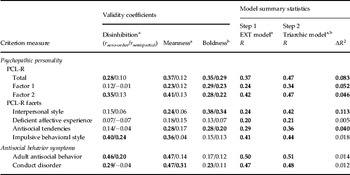
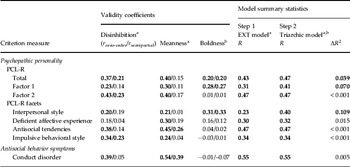
Table 1 presents validity coefficients for triarchic facet scores in the prediction of PCL-R psychopathy scores for the prison sample, and Table 2 presents the corresponding findings for the substance treatment sample. The validity coefficients represent simple (zero-order) associations of disinhibition, meanness and boldness scores with PCL-R scores, whereas the semipartial correlations (akin to standardized β coefficients) reflect the unique contributions of disinhibition, meanness and boldness to the prediction of PCL-R scores.
Relationships between triarchic psychopathy scores and PCL-R psychopathy facets and antisocial personality in a male prisoner sample (n = 157): correlation and regression coefficients

PCL-R, Psychopathy Checklist – Revised.
a The first step in the hierarchical regression analyses in which disinhibition and meanness were entered as predictors in an externalizing (EXT) model in the prediction of psychopathy facets and antisocial behavior.
b The second step in the hierarchical regression analyses in which boldness scores were entered as a third predictor in a triarchic model to examine the predictive validity of boldness above and beyond disinhibition and meanness in the prediction of psychopathy facets and antisocial behavior.
Bolded validity coefficients and model summary statistics are significant at the p < 0.01 level (r ⩾ 0.20).
Relationships between triarchic psychopathy scores and PCL-R psychopathy facets and antisocial personality in a male offender in-patient substance use treatment sample (n = 169): correlation and regression coefficients

PCL-R, Psychopathy Checklist – Revised.
a The first step in the hierarchical regression analyses in which disinhibition and meanness were entered as predictors in an externalizing (EXT) model in the prediction of psychopathy facets and antisocial behavior.
b The second step in the hierarchical regression analyses in which boldness scores were entered as a third predictor in a triarchic model to examine the predictive validity of boldness above and beyond disinhibition and meanness in the prediction of psychopathy facets and antisocial behavior.
Bolded validity coefficients and model summary statistics are significant at the p < 0.01 level (r ⩾0.20).
As predicted, disinhibition was positively correlated with PCL-R total and factor 2 scores, and was uniquely predictive of scores on the impulsive behavioral style facet of factor 2. Additionally, disinhibition showed a modest zero-order correlation with scores on PCL-R factor 1 in the treatment sample, attributable to its overlap with meanness. Consistent with the hypothesis that meanness serves as a primary point of intersection between externalizing psychopathology and the core affective-interpersonal features of psychopathy, meanness exhibited robust zero-order associations with PCL-R total, factor 1 and factor 2 scores (r's = 0.23–0.41). At the zero-order level, meanness scores also predicted scores on all four facets of the PCL-R (with the r value for the affective facet in the prison sample significant at 0.05). However, meanness showed a unique predictive contribution only for scores on the antisocial facet within the treatment sample, highlighting the importance of its overlap with disinhibition (i.e. general externalizing proneness) in the prediction of PCL-R psychopathy.
Furthermore, in line with the study hypotheses, boldness was positively related to PCL-R total, factor 1 and interpersonal facet scores in both samples, both at the zero-order level and after controlling for overlap with disinhibition and meanness. Additionally, in the prison but not the substance treatment sample, boldness contributed distinctively to prediction of scores on PCL-R factor 2 even after controlling for overlap with other triarchic facets, specifically as a function of its association with the antisocial component of factor 2. Also shown in Tables 1 and 2, under the subheading ‘Model summary statistics’, are the results from hierarchical regression analyses in which disinhibition and meanness scores were entered in the first step (i.e. the externalizing model) and boldness scores were entered in the second step (i.e. the full triarchic model). For each PCL-R score variable in each participant sample, the overall model R from each step is shown along with the ΔR 2 value reflecting the incremental contribution of boldness to prediction beyond disinhibition and meanness. As predicted, boldness contributed incrementally to the prediction of PCL-R total (8.3% and 3.9% increase in variance explained within the prison and treatment samples respectively) and factor 1 scores (5.2% and 7% increase in variance explained), largely through its association with the PCL-R interpersonal facet (11.3% and 10.9% increase in variance explained). Additionally, in the prison sample only, boldness contributed incrementally to the prediction of PCL-R factor 2, in this case as a function of its association with the antisocial facet (4% increase in variance explained).
Associations of triarchic facet scores with DSM-IV ASPD symptoms
Interview-based assessments of ASPD symptoms (both child and adult) were available for the prison sample (Table 1) whereas questionnaire-based assessments of conduct disorder symptoms only were available for the treatment sample (Table 2). In the prison sample, disinhibition and meanness each showed positive correlations with child and adult symptoms of ASPD but disinhibition was correlated more strongly with adult than child symptoms (Z = 2.5, p < 0.05). Furthermore, disinhibition accounted exclusively for adult symptoms of ASPD when entered concurrently with meanness, whereas meanness accounted exclusively for child symptoms of APSD when entered concurrently with disinhibition. Boldness was related to child but not adult symptoms of ASPD at the zero-order level, but this association was accounted for by overlap between boldness and meanness (i.e. the semipartial coefficient for boldness was not significant). In the substance treatment sample, both disinhibition and meanness showed significant zero-order r values with child symptoms of ASPD as assessed by questionnaire, but (mirroring findings for interview-assessed symptoms) meanness alone emerged as a unique predictor of the child symptom component of ASPD when evaluated concurrently with disinhibition.
Finally, in the hierarchical regression analyses testing for incremental predictive contributions of boldness, significant omnibus prediction was evident in each case for disinhibition and meanness at step 1 (R = 0.47 and 0.50 for child and adult ASPD symptoms respectively as assessed by interview, and R = 0.55 for child ASPD symptoms as assessed by questionnaire), but in no case did boldness add significantly to prediction (range of ΔR 2 = 0.005–0.014, p's > 0.09). The results were thus in accordance with our hypothesis that the diagnostic criteria for DSM-IV ASPD reflect externalizing facets of the triarchic model (i.e. disinhibition and meanness) but (in contrast with PCL-R psychopathy) are unrelated to boldness.
Discussion
Our aims in the present study were (1) to evaluate empirically how constructs of the triarchic model are represented within the most widely used clinical inventory for psychopathy (i.e. the PCL-R) in comparison with their representation in the current (DSM-IV) criteria for ASPD, and (2) to evaluate the incremental validity of boldness (over and above disinhibition and meanness) in the prediction of psychopathy and child and adult symptoms of ASPD. Offenders from two different facilities, a state prison and a residential substance treatment facility, were studied to ensure a diverse representation of individuals with varying levels of psychopathic and antisocial tendencies. Our findings are discussed with reference to commonalities versus distinctions between psychopathy and ASPD, and the role of boldness in the nomological network surrounding the psychopathy construct.
Relationships of triarchic model facets with psychopathy as compared to ASPD
Disinhibition, operationalized in the current study by combining scores on subscales of the ESI that serve as indicators of general externalizing proneness (Krueger et al. Reference Krueger, Markon, Patrick, Benning and Kramer2007; Venables & Patrick, Reference Venables and Patrick2012), was related most clearly to features of psychopathy reflecting an impulsive and unreliable lifestyle. This facet of the triarchic model is prominently represented in most conceptual and empirical models of psychopathy, presumably because it encompasses some of the most overt and socially disruptive features of the condition. Disinhibition was also related to adult symptoms of ASPD in the prison sample and (less distinctively) to child ASPD symptoms in both participant samples; the finding that disinhibition predicted adult ASPD symptoms more strongly than meanness, but not child symptoms, probably reflects the fact that the adult symptoms include lesser representation of aggressive-destructive tendencies and greater representation of impulsive-irresponsible tendencies. Meanness, operationalized in terms of scores on the callous-aggression factor of the ESI, was predictive of total, factor and facet-level scores on the PCL-R, and of child and (to a lesser extent) adult symptoms of ASPD. Taken together, these results indicate that disinhibitory tendencies entailing impulsivity, irresponsibility and rule-breaking represents one point of intersection between psychopathy and ASPD, with separable tendencies toward callousness and aggressive-exploitativeness representing another.
Boldness, operationalized through the 19-item TriPM boldness scale (Patrick, Reference Patrick2010), also showed a significant positive relationship with PCL-R psychopathy, primarily as a function of its association with the interpersonal facet of PCL-R factor 1. By contrast, in terms of relationships with ASPD, boldness was associated only modestly with interview-assessed symptoms of CD in the prison sample, and only as a function of its overlap with meanness. Moreover, hierarchical regression analyses demonstrated an incremental contribution of boldness, over and above disinhibition and meanness, to PCL-R psychopathy (through the interpersonal facet of factor 1 in particular) but not to ASPD. Thus, although boldness seems to be related to distinct interpersonal features of psychopathy, it is largely unrelated to symptoms of DSM-IV ASPD.
Controversies regarding the role of boldness and boundaries of the psychopathy construct
Our findings have important implications for current debates regarding the boundaries of psychopathy and whether boldness belongs in the nomological network of this classic diagnostic construct (Miller & Lynam, Reference Miller and Lynam2012; Marcus et al. Reference Marcus, Fulton and Edens2013). Our results address these questions in two ways: first, by providing evidence for the convergent and discriminant validity of the boldness construct in relation to the distinct components of the PCL-R; and second, by demonstrating that boldness serves to distinguish PCL-R psychopathy from ASPD.
As such, our findings coincide with the alternative viewpoint, expressed in response to the aforementioned reviews (e.g. Lilienfeld et al. Reference Lilienfeld, Patrick, Benning, Berg, Sellbom and Edens2012; Patrick et al. Reference Patrick, Venables and Drislane2013; see also Skeem et al. Reference Skeem, Ploaschek, Patrick and Lilienfeld2011), that boldness is in fact integral to classic accounts of psychopathy as a condition entailing severe behavioral pathology masked by an outward appearance of psychological health (Cleckley, Reference Cleckley1976; Lykken, Reference Lykken1995). Elements of this contrasting viewpoint include the notion that psychopathy is inherently a multifaceted construct, entailing the confluence of multiple trait dispositions rather than a unitary or unidimensional syndrome; and that the interpersonal features of psychopathy (i.e. boldness) are what differentiate psychopathy most clearly from the more common diagnosis of ASPD. Consistent with this perspective, the current results empirically demonstrate the incremental contribution of boldness (over and above externalizing proneness) to prediction of psychopathy, and highlight the role of boldness in differentiating psychopathy from ASPD. These findings provide support for a role of boldness in the nomological network of psychopathy as described in the triarchic model (Patrick et al. Reference Patrick, Fowles and Krueger2009).
Limitations and future directions
Some limitations of the current work are important to acknowledge. First, analyses focused on data from samples of male offenders. Although these samples served the aim of representing varying levels of psychopathic and antisocial tendencies, it will be important in future studies to include representation of other types of participants (e.g. female offenders, non-incarcerated men and women) to establish the generalizability of the current findings. In particular, the question of how boldness contributes to the expression of psychopathy in women as compared to men is an issue in need of further investigation (cf. Verona & Vitale, Reference Verona, Vitale and Patrick2006). A further limitation of the current work is that constructs of the triarchic model were operationalized in a separate domain of measurement (i.e. self-report questionnaire) than psychopathy and ASPD (i.e. clinical interview and file review). In view of conceptual and empirical work indicating lower expected relationships between constructs when measured across differing domains (Campbell & Fiske, Reference Campbell and Fiske1959; Blonigen et al. Reference Blonigen, Patrick, Douglas, Poythress, Skeem, Lilienfeld, Edens and Krueger2010), it will be valuable in future work to re-examine relationships of triarchic constructs when operationalized in the same domain as psychopathy and ASPD scores.
Notwithstanding these limitations, the current findings are of relevance to longstanding debates regarding the scope and boundaries of psychopathy and its relationship with ASPD. From the perspective of the triarchic model, ASPD as defined in the DSM emphasizes impulsive rule-breaking (disinhibitory-externalizing) conduct, and to a lesser extent callous-aggressiveness (meanness), while neglecting coverage of boldness. The alternative trait-dimensional system for personality disorders in DSM-5 (APA, 2013) includes enhanced representation of meanness in ASPD, through emphasis on traits from the domain of antagonism. However, the construct of boldness remains under-represented even in this alternative trait-based characterization of ASPD (cf. Strickland et al. Reference Strickland, Drislane, Lucy, Krueger and Patrick2013). Findings from the current study encourage further research directed at evaluating whether inclusion of features of boldness in the criteria for ASPD, or specification of a ‘psychopathic’ variant of ASPD entailing such features, would strengthen linkages with historic and contemporary research on the phenomenon of psychopathy and prove beneficial in clinical practice.
Acknowledgments
The research reported here was supported by grants MH089727, MH072850 and MH065137 from the National Institute of Mental Health. We are grateful to the residents and staff of the Minnesota Correctional Facility at Lino Lakes, MN, and the Drug Abuse Comprehensive Coordinating Office, Men's Department of Corrections Residential Treatment Center, in Tampa, FL. We also thank M. Kramer for his assistance with statistical analyses and B. Hicks for his scholarly input on a draft of this manuscript.
Declaration of Interest
None.