Introduction
Poultry require both essential and non-essential amino nitrogen to service obligatory metabolic processes and to fuel the yield of egg and or meat products. These requirements form the basis of the dietary crude protein requirements. Glycine is one of the amino acids (AA) classically categorised as dietary nonessential AAs (NEAAs). Nevertheless glycine is a multi-tasking molecule participating in vital physiological functions beyond protein synthesis (Meléndez-Hevia et al., Reference MELÉNDEZ-HEVIA, DE PAZ-LUGO, CORNISH-BOWDEN and CÁRDENAS2009). These roles include energy release, reproduction, feather cover, blood accretion, and immune health. Apart from these roles, glycine has nutritional and metabolic interactions with key essential AA (EAAs), such as methionine, threonine and arginine. Such interactions suggest the possibility to use glycine to manipulate dietary AA and N efficiency. These hypotheses were addressed in part 1 of this two-paper series based on published glycine responses especially in broilers.
The present paper further draws upon glycine efficacy data to debate its relevance to more efficient health and immunity system, gut functionalities, food-feed safety and welfare of poultry. Additionally, the patterns of glycine concentration in routine feedstuffs as well as the dietary glycine optimal recommendations have been reviewed. Questions on the dietary glycine optimum impact feed cost, the expansion of global feed resource base, possibilities for routine supplementation of crystalline glycine to poultry diets and eco-sustainability of the modern poultry industry are addressed.
Glycine, health and immunity, gut functionality and feed/food safety
There is evidence confirming that glycine has a role in health and immunity. For example glycine is abundantly incorporated into immunogenic proteins, produced in response to stress signals (Grimble, Reference GRIMBLE1990). As reviewed by Grimble (Reference GRIMBLE1990), glycine, serine and SAAs make up as much as 14–56% of AA residues in human inflammatory proteins secretions (Grimble, Reference GRIMBLE1990). Thus the plasma and hepatic concentrations of these immune-active AAs may be modified during an immune challenge, thereby inducing quantitative changes in their feeding requirements (Le Floc'h et al., Reference LE FLOC'H, MELCHIOR and OBLED2004).
Ross et al. (Reference ROSS, HOLTMAN and GILFILLAN1955a) reported depletion in plasma and hepatic free glycine, serine and SAAs during experimental salmonellosis. However, Ross et al. (Reference ROSS, HOLTMAN and GILFILLAN1955b) observed that arginine (but not glycine) treatment prolonged the survival time of chicks challenged with Salmonella pullorum. Grimble et al. (Reference GRIMBLE, JACKSON, PERSAUD, WRIDE, DELERS and ENGLER1992) reported glycine+cysteine supplementation modulated cytokines secretions in tumour necrosis factor endo-toxaemia rat model. Takahashi et al. (Reference TAKAHASHI, AOKI, TAKIMOTO and AKIBA2008) documented that glycine supplementation arrested systemic inflammation in broilers via a suppression of cytokine production. Since cytokines disturb AA utilisation (Le Floc'h et al., Reference LE FLOC'H, MELCHIOR and OBLED2004), glycine should be investigated as a supplement for re-prioritising AA utilisation back to production processes.
As a major nutrient used in intestinal mucinogenesis (see part 1), glycine further participates in gut absorptive and health functionalities. Moran (Reference MORAN2010) extensively discussed the structural roles of glycine plus serine, threonine, proline and cysteine in intestinal mucin fine structure and how they are involved in the ‘unstirred water layer’ (UWL). Glycine and proline give plasticity, serine and threonine offer rigidity, while cysteine helps in bridging the composite glycoproteins into a ‘net-like’ configuration over the enterocytes. These structures are organised to allow selective passage of digested nutrients, while simultaneously preserving the integrity of the underlying villi surface. This is consistent with observations that mucin turnover is aggravated in disease states, leaving the mucosa surface vulnerable to luminal pathogens (Ball et al., Reference BALL, LAW, BERTOLO and PENCHARZ1999).
As a constituent AA in the integuments (skin, feathers) and connective tissues (blood, bones, cartilages, collagen and intestinal tissues), glycine is implicated in intestinal and body defence against microbial invasion and internal organs injury. Poor skin strength is an economic issue due to downgrading of affected carcasses in broiler processing. Recently De Aguiar Picanço et al. (Reference DE AGUIAR PICANÇO, LOPES-PAULO, MARQUES, DIESTEL, CAETANO, DE SOUZA, MOSCOSO and PAZOS2011) observed, in an enteric damaged rat model, that intra-gastric infused glycine regenerated epithelial and mucosa surfaces even better than L-arginine. Glycine likely elicited this response by accelerating de novo intestinal collagen synthesis to execute the gut repair.
As a substrate in glutathione biosynthesis (illustrated in part 1), glycine works in anti-oxidative defence. Glutathione is a peptide functioning in metabolic detoxification – such as free radical neutralisation. It works via its sulphydryl group which possesses affinity for charged toxicants (Friedman, Reference FRIEDMAN1994). Increased methionine requirement typically observed during aflatoxicosis has been linked to an accentuated physiological need for glutathione in detoxification (Veltmann et al., Reference VELTMANN, WYATT, VOIGHT and SHAMSUDDIN1983; Akinde, Reference AKINDE2011). Sekhar et al. (Reference SEKHAR, PATEL, GUTHIKONDA, REID, BALASUBRAMANYAM, TAFFET and JAHOOR2011) found age-related limitations in glutathione synthesis in adult humans, and this may be corrected by a combination of cysteine+glycine. Research is needed to determine if glycine is rate limiting in glutathione synthesis in poultry and under what conditions. This has implications in systems stipulating low antibiotic, eco-sustainable poultry integration.
Interestingly high glycine intake triggers Clostridia perfringens overgrowth and necrotic enteritis (Drew et al., Reference DREW, SYED, GOLDADE, LAARVELD and VAN KESSEL2004), having negative implications for food-feed safety. This issue has been attributed to slow release of native glycine, making this AA available for enteric microbial metabolism. Since free AAs are absorbed rapidly, free glycine is able to address this problem (Dahiya et al., Reference DAHIYA, HOEHLER, VAN KESSEL and DREW2007).
Dietary glycine and serine recommendation and feedstuffs evaluation
The determination of dietary nutrient optimums and feedstuffs evaluation are key pillars in animal nutrition. Published glycine+serine optimum levels show very high variation, ranging between 0.97 to 2.32% of diet (for 0-56 day old broilers; NRC, 1994; Dean et al., Reference DEAN, BIDNER and SOUTHERN2006). Given the varied metabolic involvements of glycine, this is to be expected. In this context, because accreted pectoral muscle creatine (a major glycine metabolic end product) is curvilinearly related to age, glycine requirement increases in starting birds but decreases with age (Ngo and Coon, Reference NGO and COON1976; Ngo et al., Reference NGO, COON and BEECHER1977). Glycine status in early life also will modify the optimum in subsequent phases (Ngo and Coon, Reference NGO and COON1976). Other determinants are dietary levels of metabolically associated AAs e.g. arginine, SAAs and serine (Ohta and Ishibashi, Reference OHTA and ISHIBASHI1995). Serine will completely negate the requirement for glycine on an equimolar basis (Akrabawi and Kratzer, Reference AKRABAWI and KRATZER1968). However, it is unknown if the dietary proportion of serine to glycine skews this requirement. To improve methodological standardisation and data precision, it may be helpful to report glycine requirement not only on glycine+serine basis, but also as total dietary glycine activity (glycineTDA). The latter is derived by transforming dietary serine to glycine on equimolar basis. There is an indication that glycine+serine need is greater in high CP (Heger and Pack Reference HEGER and PACK1996), but Dean et al. (Reference DEAN, BIDNER and SOUTHERN2006) rejected this hypothesis, and affirmed that the optimum is higher under LCP alimentation. This discordance might arise because while both gut metabolism and uric acid synthesis are major drivers of the requirement under LCP alimentation, the latter is more important under high N loading. The nature of the supplemented basal diet (Ngo and Coon, Reference NGO and COON1976) and the criteria used in deducing the saturation point (Corzo, Reference CORZO2012) further contribute to the controversies surrounding glycine+serine optimums.
To draw a conclusion on optimum glycine level for weight gain, feed intake and FCR in broilers, a meta-analysis of published glycine+serine responses was undertaken. The data were taken from eight dose-response studies, representing a total of 54 dietary treatments and 5066 broilers between 0–21 d of age. Selected studies used modern broiler strains, covered similar age phase and all supplemented basal diets were clearly deficient in glycine+serine. As argued above, the optimum was calculated on both glycine+serine and glycineTDA(%) bases. GlycineTDA(%) is:
glycine_{TDA(%) }= glycine _{(%\ diet) }+ serine _{equimolar\ glycine(%) }
where glycine_{TDA(%) } is total dietary glycine activity, while serine _{equimolar\ glycine(%) } is serine transformed into equimolar amount of glycine. \num Serine_{equimolar\ glycine (% ) } = {{molar \ mass \ of \ glycine } \over{molar\ mass\ of\ serine} } \times {dietary\ Serine \ level (%)}, where the term \num{{molar\ mass\ of\ glycine } \over{molar\ mass\ of\ serine} } (i.e. 0.7143), is a biological constant representing intermediary conversion efficiency of serine to glycine.
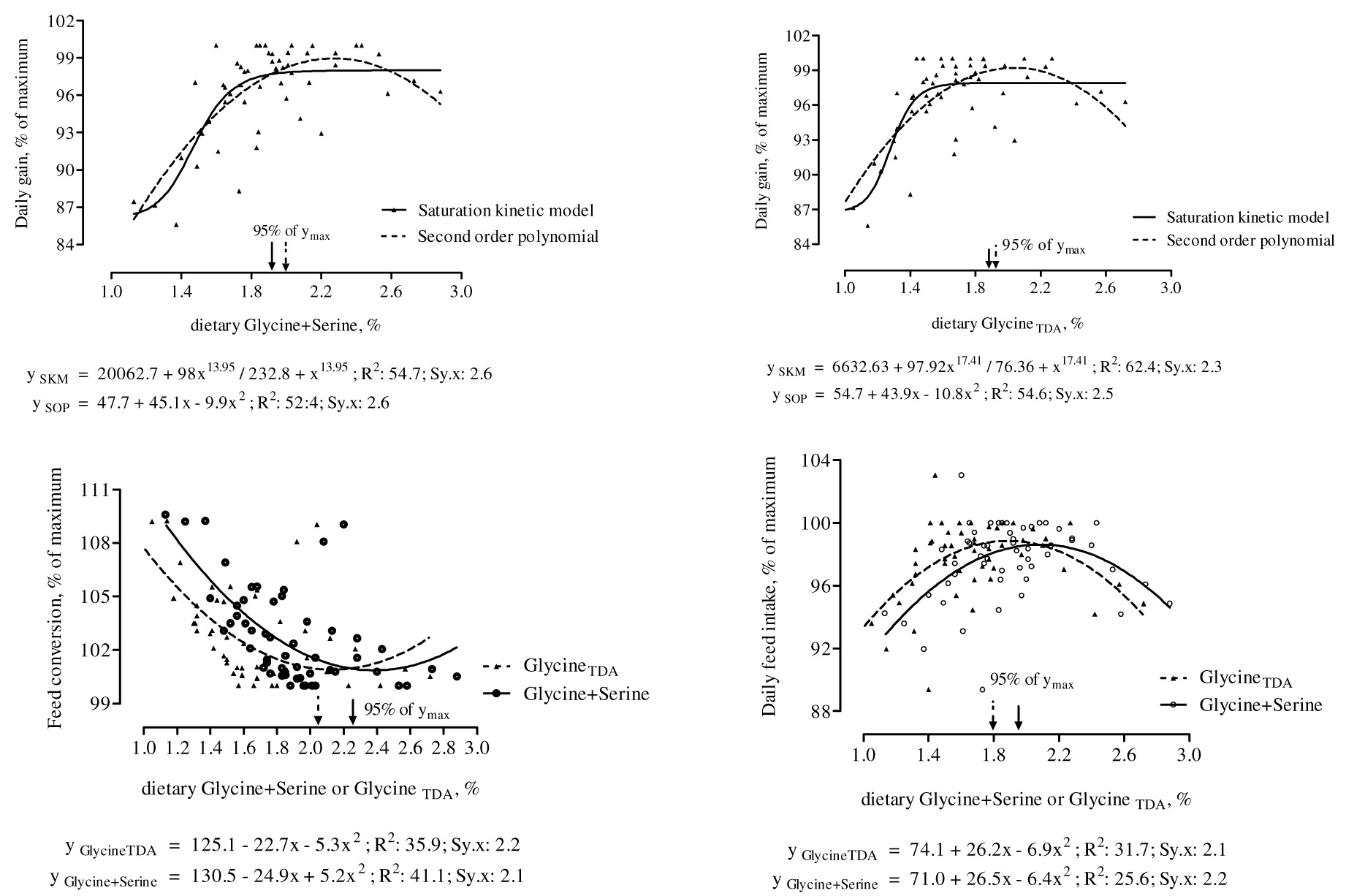
To adjust for methodological variations among data sets, performance responses were expressed as percentages of the maximum. Curvilinear responses (Figure 1) to increasing intake of glycine+serine or glycineTDA(%) with evidence of a plateau were described using both saturation kinetic model (SKM) and second order polynomial (SOP) for ADG, while both FCR and ADFI were suitably described by only SOP. Model SKM is represented by:
y= \num {a*R + y _{max}* x^k} \over\num {R + x ^k}
(Vedenov and Pesti, Reference VEDENOV and PESTI2008) and SOP by: y=a+bx+cx^2
where y=response variable, x=nutrient level and a, b, c, k, R and ymax are models parameters.
The use of both SKM and SOP for daily gain data was to study impacts of differing non-linear models on the optimum, as both fits were suitable. Models were fitted according to least square procedures executed by GraphPad Prism (version 5.0, Graph Pad Software, Inc. San Diego, CA). Calculated model equations and fitted curves are shown on Figure 1. Generally the R2 of the curves are low, suggesting the variations among the data sets were not completely captured by the chosen models. On the other hand the precision of the calculated curves were confirmed given that all Sy.x (defining the standard deviation of the residuals) were low. Taking the classical approach of basing the dietary AA level (x value of the curve) to achieve 95% of the maximal response (y value) as requirement, the SKM and SOP predicted 2.1 and 2.2% respectively, as requirement for glycine+serine to optimise daily gain. Corresponding analysis of the glycineTDA(%) curves returned predictions of 1.94% and 1.93% for the SKM and SOP model, respectively. That is, these two predictive models do not yield different estimates for the present data set. On the other hand, the quadratic 95% asymptote was achieved with dietary glycine+serine and glycineTDA(%) concentrations of 2.27% and 2.03%, respectively, for FCR. Dietary levels of 1.97% and 1.80% were predicted at 95% of plateau for glycine+serine and glycineTDA(%), respectively, to optimise ADFI. The values obtained in this evaluation closely agree with recent information. Thus a range of 1.91-2.27% of total glycine+serine is hereby recommended in young broilers diets, depending on performance criteria chosen. In contrast Akinde and Etop (Reference AKINDE and ETOP2014) titrated 1.60% as total glycine+serine optimum in laying hens fed a LCP basal diet.
Relationship between dietary Glycine+Serine or Glycine total dietary activity (TDA) and relative maximum performance (average daily gain, feed conversion ratio or average daily feed intake) in 0 - 21 d broilers. The regressions were calculated by pooling together 8 dose response data sets, adapted from Schutte et al. (Reference SCHUTTE, SMINK and PACK1997), Corzo et al. (Reference CORZO, KIDD, BURNHAM and KERR2004), Dean et al. (Reference DEAN, BIDNER and SOUTHERN2006) and Waguespack et al. (Reference WAGUESPACK, POWELL, BIDNER and SOUTHERN2009).

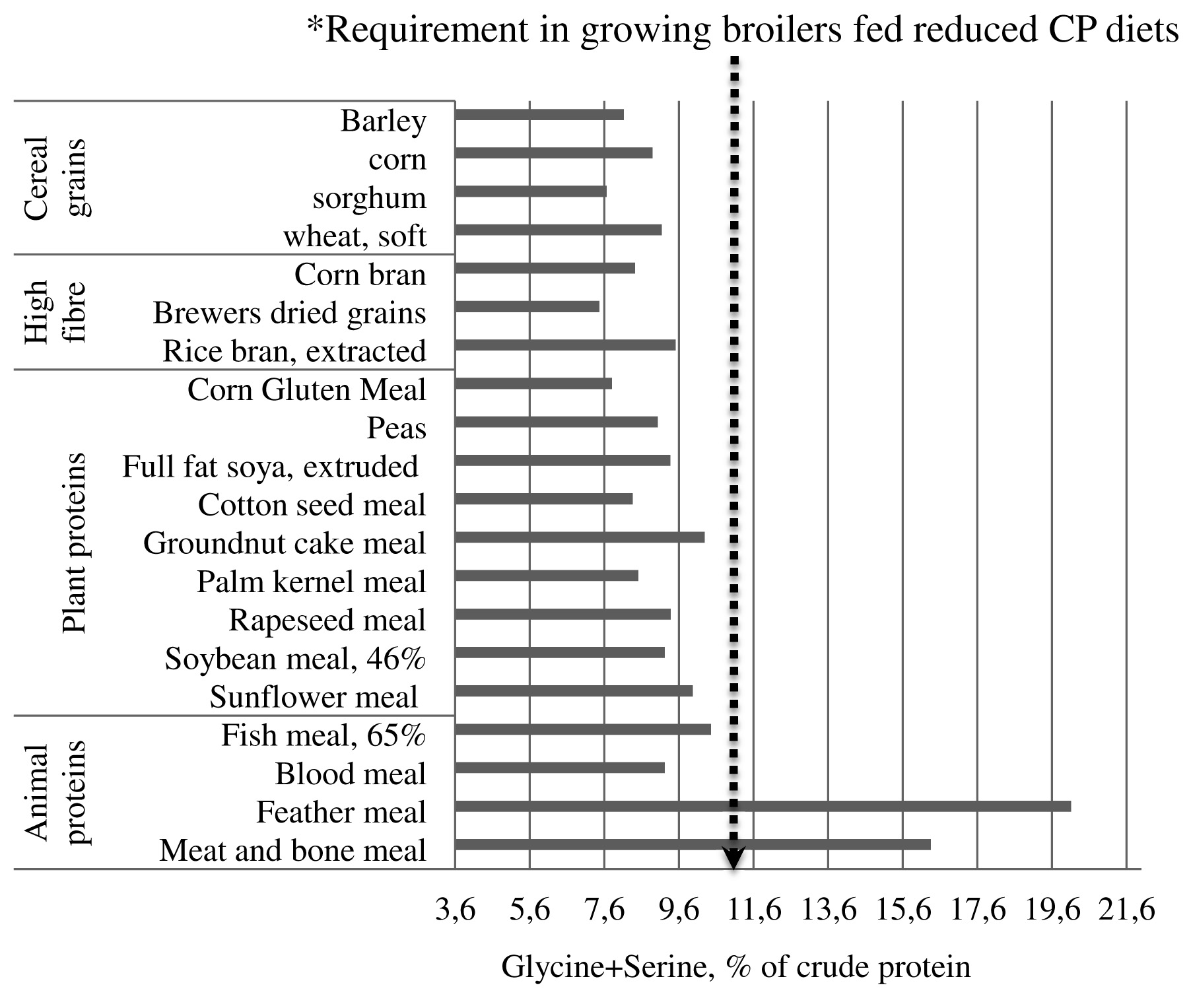
Figure 2 is an assessment of trends in glycine+serine density in common ingredients, in relation to ingredient CP level and to total physiological needs. It reveals an abundance of glycine+serine in animal proteins, followed by vegetable proteins, while cereal proteins are generally deficient. It is evident that the high physiological demand for glycine in LCP diets (previously discussed) makes such diets not easily formulated for young broilers without animal proteins. However recent feed safety concerns and sustainability issues with fish meal (dwindling ocean resources) question the use of animal proteins in poultry feeds. Alternatively, dietary fortification with feed grade crystalline glycine could help bridge this glycine+serine gap.
Free glycine is assigned standard nutritive values of 1570 ME (kcal/kg) and 116.62% CP and is regarded as 100% bioavailable to poultry (NRC, 1994; Leeson and Summers, Reference LEESON and SUMMERS2005). Its net metabolic utilisation for N is 31%, 92% and 137% higher than L-valine, L-lysine HCl and L-arginine HCl, respectively (Allen and Baker (1974), cited by Heger, Reference HEGER2003).
Glycine+Serine concentrations in relation to crude protein levels in selected feed ingredients and to total physiological requirement in young broilers fed reduced protein diets (calculated using feedstuffs composition data in Sauvant et al. (Reference SAUVANT, PEREZ and TRAN2004) and on total Gly+Ser requirement of 2.32% in low crude protein diet reported by Dean et al. (Reference DEAN, BIDNER and SOUTHERN2006)).
A modern, efficient, ecofriendly and cost effective AA nutrition model, involving glycine as one of the free supplemented AAs, requires a refined feed evaluation system based on the true/SID format. Standardised ileal digestibility is a quality criterion implementing the correction of digestibility with IEF, as earlier mentioned in paper 1 (Akinde, Reference AKINDE2007). This standardisation becomes necessary due to post ileal modification in AA excretion, causing imprecise quantification of digestible AAs in feedstuffs/formulated feeds. For example, glycine digestibility increased by 30-45 fold when apparent ileal digestibility in sorghum and wheat were corrected for IEF (Kadim et al., Reference KADIM, MOUGHAN and RAVINDRAN2002). Similar corrections in soyabean meal, fish meal, meat and bone meal, and blood meal further improved glycine digestibility by 4–10 folds (Kadim et al., Reference KADIM, MOUGHAN and RAVINDRAN2002). This higher imprecision of uncorrected digestibility in cereals relative to proteins is due to low AA concentrations in the former.
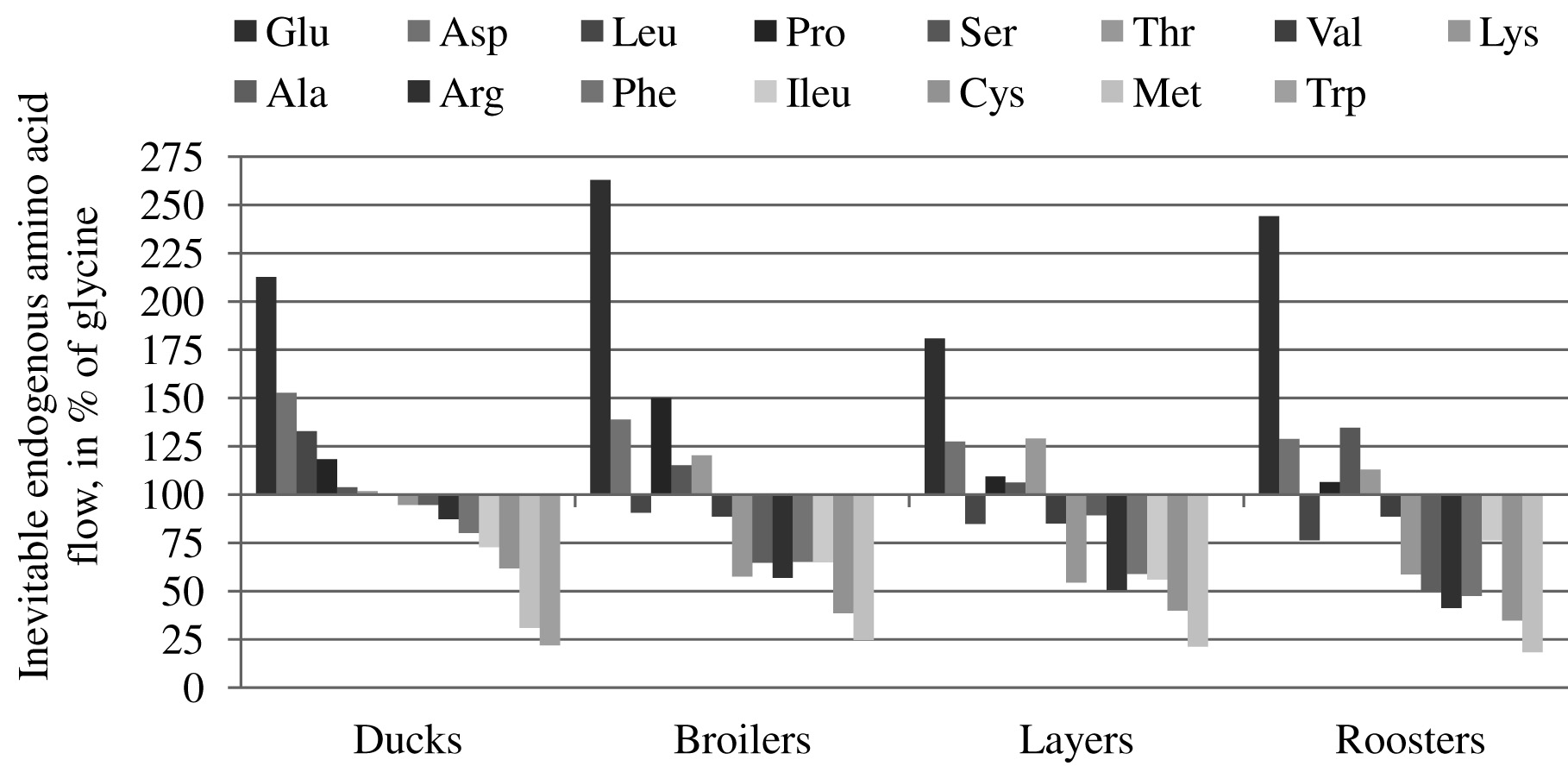
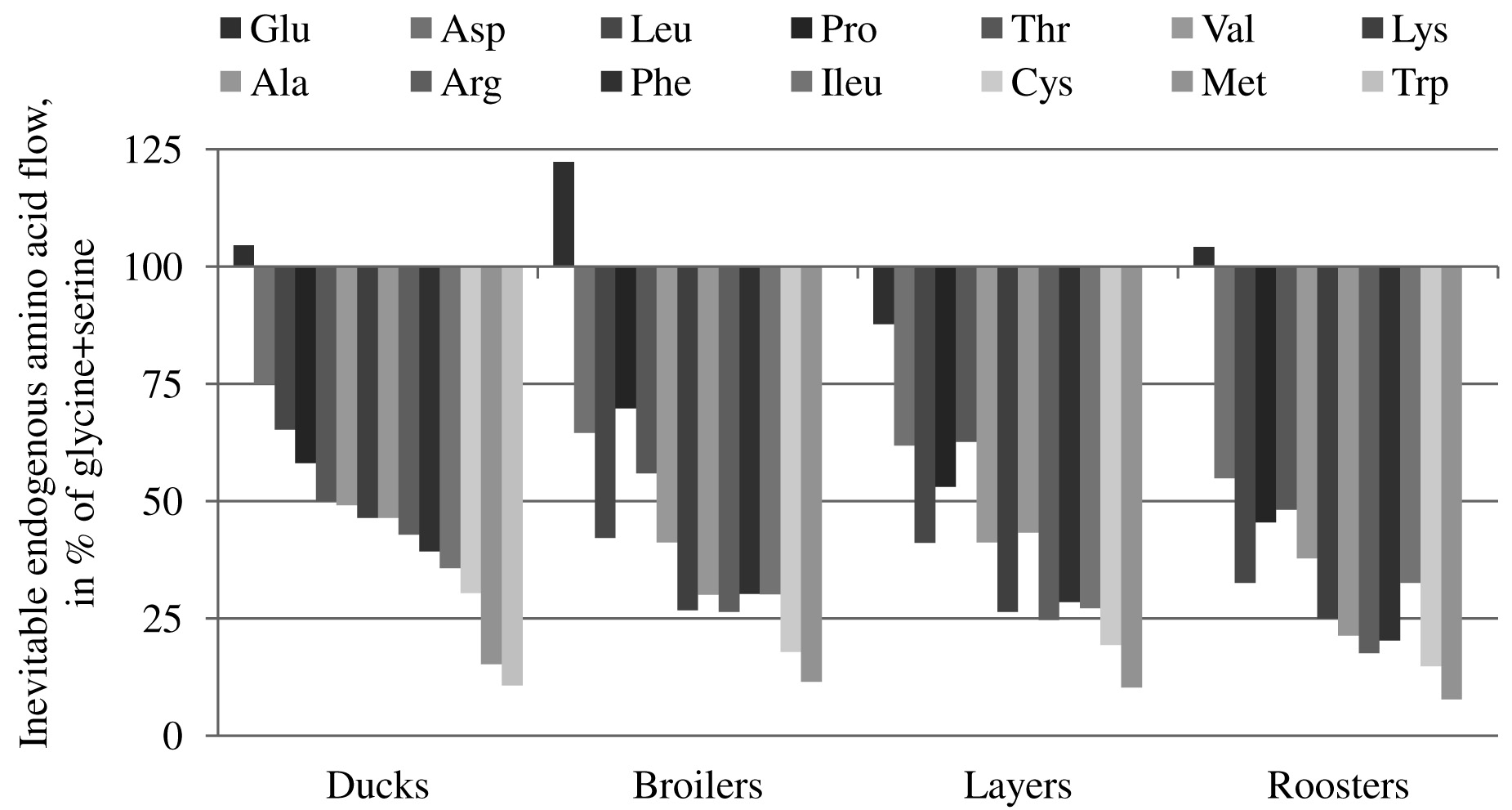
The first study quantifying IEF of AAs including glycine+serine has been conducted in heavy meat ducks, as part of a series of studies on maintenance protein metabolism (Figures 3 and 4, Akinde et al., Reference AKINDE, KLUTH and RODEHUTSCORD2011). On relative scale, basal glycine (Figure 3) or glycine+serine (Figure 4) flow estimate was quantitatively superior to most other AAs, in agreement with previous investigators (Ravindran and Hendriks, Reference RAVINDRAN and HENDRIKS2004). Only glutamic acid flow superseded glycine+serine in ducks (104.5%); and in broilers (123%) and roosters (104.1%), as observed by Ravindran and Hendriks (Reference RAVINDRAN and HENDRIKS2004) (Figure 4). This implies that the inevitable intestinal flows and digestibility of glycine and serine are modified by factors that provoke/alleviate intestinal AA excretion (phytate/phytase, soluble fibre/fibrolytic enzymes, stress etc.). Indeed when phytase is used to liberate proteins bound to phytates (the so called ‘extra phosphoric effects of phytase’; Selle et al., Reference SELLE, RAVINDRAN, COWIESON and BEDFORD2010a; Reference SELLE, COWIESON and COWIESON2010b), digestibility of glycine, serine and threonine often give the highest response among the AAs.
Comparative ileal inevitable endogenous flow of individual amino acids in poultry, based on the flow of glycine (Ravindran and Hendriks, Reference RAVINDRAN and HENDRIKS2004; Akinde et al., Reference AKINDE, KLUTH and RODEHUTSCORD2011).
Comparative ileal inevitable endogenous flow of individual amino acids in poultry, based on the flow of glycine+serine (Ravindran and Hendriks, Reference RAVINDRAN and HENDRIKS2004; Akinde et al., Reference AKINDE, KLUTH and RODEHUTSCORD2011).
Conclusions
It is concluded that glycine is vital to efficient health and gut functionality of broilers. This is in addition to the booster effects it has on the efficiency of utilization of dietary essential amino acids and protein outlined in part one of this review. Taken together these bioefficacies suggest that glycine improves efficiency, safety and sustainability of poultry and is feasible as a performance promoter especially under the liabilities imposed by practical rearing conditions. Additionally it seems that glycine may be deployed to surrogate antibiotics in growth promotion.
Therefore studies are recommended not only to evaluate the glycine supplying power of ingredients, but to precise the conditions under which glycine supplementation is effective as a growth promoter. The roles of glycine as a nutrient adjunct therapy in resolving stress and common diseases like heat stress, transport welfare, salmonella, coccidiosis and necrotic enteritis require investigators attention. Whether or not rearing stress alters glycine/serine bioavailability needs clarification. Benefits of glycine alone or in combination with other immunogenic AAs to body immune-competence and to the alleviation of pathogenic insults need conclusive investigations. Studies into the individual components of the total glycine requirement, including its net basal and production components are also needed.
Acknowledgement
The author is grateful for the doctoral fellowship award of the German Academic Exchange programme (DAAD) used in carrying out part of the research work cited in this paper. Also the assistance of colleagues at the Institute of Agricultural and Nutritional Sciences of Martin-Luther-University Halle-Wittenberg during those studies is gratefully acknowledged.