Almost half of the academic political scientists in the United States work in teaching institutions—that is, those without doctoral programs (Collins, Cooper, and Knotts Reference Collins, Cooper and Gibbs Knott2010, 510). Yet, we know little about the research careers of these faculty. They are excluded from some assessments of research output (e.g., Masuoka, Grofman, and Feld Reference Masuoka, Grofman and Feld2007, 533) and other work compares only their aggregate output to that of faculty in PhD institutions (Collins, Cooper, and Knotts Reference Collins, Cooper and Gibbs Knott2010; Hesli and Lee Reference Hesli and Lee2011, 395). Faculty in many teaching institutions have long been expected to produce a research record to earn tenure; Jenson (Reference Jensen, McWilliams and Seery2015, 108–10) concluded that these expectations have risen in recent years in many of them. Yet, service and teaching demands also have increased in many of these institutions. Moreover, because the literature on expectations for faculty performance in these institutions is largely anecdotal, it will be not clear how they shape careers until systematic research is available.
Almost half of the academic political scientists in the United States work in teaching institutions—that is, those without doctoral programs.
Considerable evidence, however, indicates that scholarly research careers take various paths (e.g., Jones, Reedy, and Weinberg Reference Jones, Reedy, Weinberg and Simonton2014). Some faculty are most productive when young, some are productive during their entire career, and others are most productive late in their career. Because of heavy teaching and service loads as well as limited research support, faculty in teaching institutions also may demonstrate distinctive career paths. However, we have no systematic knowledge of these paths.
This article presents an empirically validated typology for research career paths for a sample of teaching-institution political science faculty late in their career. These paths differ widely, especially in their vigor and character over time. Yet, many of these scholars have a research career essentially identical to those of some faculty in research institutions. Furthermore, some paths suggest that scholars direct their research to audiences that may not be responsive to it by subsequent publications and citations. Future research could explicate the personal and institutional correlates of different paths. How research careers differ across different types of teaching institutions would be of particular interest.
CRITERIA FOR DISTINGUISHING RESEARCH TYPES
Typologies should meet commonly observed criteria, especially that categorical types are distinguishable on meaningful distinctions for the character of research careers (Collier, LaPorte, and Seawright Reference Collier, LaPorte and Seawright2012, 223–26). Prior research on scholarly careers, along with direct observations of careers in our field, identified the following distinctions that especially shape career paths of original research for publication. Qualitative and quantitative information on these two dimensions identifies the different career paths:
-
1. The type and temporal character of the career, as indicated by whether individuals (1) were tenured in their first academic position, (2) had a brief or enduring career in that type of institution, or (3) transitioned to a career in a research institution.
-
2. The character of a scholar’s published work, both early and late in the career, is assessed by (1) the frequency of original research, (2) the “stature” of publication outlets in the discipline and their primary audiences, and (3) how the two preceding traits vary over time.
Distinct logical combinations on these dimensions define possible career paths, and this article identifies cases in my sample of scholars whose careers reflect these distinct combinations.
INFORMATION FOR THE TYPOLOGY
Two successive annual cohorts of individuals entering new tenure-track assistant professor positions in teaching institutions in 1988 and 1989 were chosen for this study (Hill Reference Hill2021b). A sample with individuals well advanced into their career also was necessary to assess full career paths. Forty-six individuals—admittedly a small sample—were identified from appointment announcements in the “People in Political Science” section in quarterly issues of PS: Political Science & Politics. Perhaps not all appointments were announced this way, but the diversity of the hiring institutions represented suggests that the listings are likely representative if not fully inclusive. Virtually every career path identified includes individuals who began their career in a bachelor’s- or master’s-degree–granting public university (the most numerous cases, as expected) as well as those from private liberal arts and religiously affiliated institutions. The generalizability of the career paths discovered, of course, can be confirmed only by future studies. However, this discussion and the online methods appendix provide empirical observations in support of this generalizability.
Many of these individuals are still employed in a political science department and have professional information pages on their department’s website. Some who left the academy also have personal online information pages. Many present full vita on these websites, but some of them provide only a brief description of their scholarship. For cases in which the information was modest or dated, additional information was collected from lists of completed dissertations in PS, publications in JSTOR and Researchgate.net, publications in the Web of Science Core Collection (explained in the online methods appendix), and general online searches for other publications. Thus, all of the data used for constructing the typologies are from public sources. When complete information was not available for some codings, I indicate the degree of certainty of particular estimates (King, Keohane, and Verba Reference King, Keohane and Verba1994, 32).
These observations suggest that categorization for this typology has a modest risk of error. Only the criteria for the outlets and audiences for a scholar’s publications and the publication trajectory over time require weighing of facts judgmentally, although not in all cases.
CODING PUBLICATION RECORDS
It is widely agreed that there is no optimal method to judge the quality or character of publication records. Yet, to rate the quality of publication portfolios and the audiences to which those portfolios are principally directed, I used the subjective evaluations of journal outlets by political scientists in Garand and Giles (Reference Garand and Giles2003) for peer-reviewed journal articles with original research. They calculated for 115 journals a measure of “journal impact” by multiplying a measure of how highly their respondents rated each journal as a desired publication outlet (“evaluation”) by their assessment of how commonly they read each journal for research in their own field (“familiarity”). The online methods appendix lists more of these journals, new ones that I added, and validation evidence for the journal and book-publisher rankings.
These data produce a measure for the impact of each journal and indicate the audiences that the journals attract. Garand and Giles (Reference Garand and Giles2003, 295) distinguished the top three journals, which I labeled “tier 1,” as the leading general journals in political science: American Political Science Review, American Journal of Political Science, and Journal of Politics. These are the only journals that earned very high evaluation and familiarity ratings. Furthermore, these journals seek to publish the most prominent work in all subfields to attract readers from all fields.
The next 19 journals I categorized as “tier 2.” These journals had high evaluation scores but—except for PS—much lower familiarity scores than the tier 1 outlets. Thus, they attract more specialized sets of readers. This tier includes five general political science journals (e.g., Political Research Quarterly); three general journals for other disciplines (e.g., American Sociological Review); and 11 others that are highly regarded subfield journals (e.g., Political Theory).
The distinction between tiers 1 and 2, however, is not applicable to some purposes. These are all prestigious publication outlets, and publishing in any one of them is a signal achievement. Some subfield journals even have higher impact scores than some general journals, although this may be due to subfield citation practices (Garand and Giles Reference Garand and Giles2007, 746–47). Furthermore, no scholar in my sample published only in tier 1 or only in tier 2 outlets. Therefore, my categories generally distinguish among those who publish regularly in both of these two tiers, occasionally in both, or rarely in either one.
“Tier 3” of the remaining journals includes 96 that are predominantly read by specialized groups of scholars—as indicated by their generally low familiarity scores. Many scholars in my sample publish almost exclusively in these journals. These three tiers also comport with Wuffle’s (Reference Wuffle1993, 90) observation that “minor papers belong in minor journals, and specialized papers in specialized ones….”
Many of the scholars in the sample also publish in journals not in the Garand and Giles (Reference Garand and Giles2003) survey or among those I included for having relatively recent publishing start dates. These journals, which I labeled “tier 4,” generally have low impact scores and highly specialized orientations that attract highly specialized audiences. Publications in all four journal tiers are assessed from the time of initial faculty appointments to the present.
To evaluate peer-reviewed books and book chapters of original research, I used rankings of 92 book publishers from a survey of American political scientists who were asked where they prefer to publish book manuscripts and which presses’ books they read for research in their field (Garand and Giles Reference Garand and Giles2011). There also were three tiers of publishers in this category.
The tier 1 presses include the university presses for Cambridge, Princeton, Oxford, and Chicago (whose scores for impact are notably above the next tier). A tier 2 of university presses—Harvard, Cornell, Michigan, Yale, and Kansas—follows, with notably higher scores than those below them. The tier 3 of 83 presses includes university and commercial presses that have notably lower preference scores for survey respondents’ own manuscripts and reading in their field. Thus, they attract smaller and more specialized audiences than the first two tiers of presses. As with the journal outlets, many scholars in the dataset have published with presses not in the Garand and Giles (Reference Garand and Giles2003) list, which I labeled tier 4 outlets.
ADDITIONAL DATA FOR CHARACTERIZING CAREER PATHS
Existing research on productivity in political science focuses on the number of publications and citations (e.g., Masuoka, Grofman, and Feld Reference Masuoka, Grofman and Feld2007). Thus, I demonstrate how these achievements vary by career path with data on publications, citations, and H indices from the Web of Science Social Sciences Citation Index, Social Sciences and Humanities Book Citation Index, and Social Sciences and Humanities Conference Proceedings Index (see the online methods appendix for a description).
Some research considers how the prestige of where scholars earned their PhD affects their productivity. Thus, I report the number of scholars in each category who earned their doctorates in “top 25” departments based on peer ratings in Jones, Lindzey, and Coggeshall (Reference Jones, Lindzey and Coggeshall1982).
It also has been widely demonstrated that women’s publications and citations are lower than those of men (e.g., Dion, Sumner, and Mitchell Reference Dion, Sumner and Mitchell2018). Thus, I indicate gender representation in each category in table 1 and assess its implications for women’s and men’s research productivity generally and in each category. I also adopted Kim and Grofman’s (Reference Kim and Grofman2019, 689) rarely followed recommendation to make gender comparisons with temporally matched cohorts.
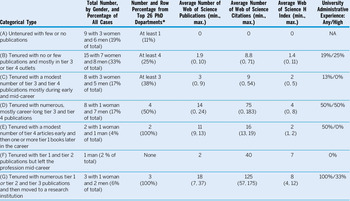
A Typology of Career Types or Paths for Scholars Whose First Positions Were in Teaching Institutions

Notes: N = 46: 16 women, 30 men. *Accounting for ties in the approximate top 25.
Wildavsky (Reference Wildavsky1993, 135–36) argued that administrative posts encourage weak scholars and limit the scholarship of those who assume such positions. I demonstrate how holding these positions varies across career types with two measures. One measure is for assuming “high” administration posts for departmental headships, any deanship, and university-wide positions including the presidency. The second measure (“all”) includes the preceding positions and adds directorships for educational and research programs (e.g., director of undergraduate studies) and journal editorships.
CAREER PATHS IN TEACHING INSTITUTIONS
Table 1 presents the career paths in teaching institutions. Reviewing the categories in order, 19% of the sample (i.e., category A) started a career in a teaching institution but did not sustain it. Most disappeared without a clue as to where they went professionally.
The modal category in table 1, as perhaps should be expected, is B, with 34% of cases earning tenure with few or no publications. However, categories C, D, and E include 39% of all cases that sustained some type of ongoing research program for a part or all of their career—and who remained in teaching institutions. The 17% of the total in category D have Web of Science success scores virtually identical to one category of research-institution faculty—with career-long publications in tier 3 and tier 4 outlets.
The 17% of the total in category D have Web of Science success scores virtually identical to one category of research-institution faculty.
The two scholars in category E of table 1 demonstrate a distinctive career-long commitment to research as well, where their best scholarship is “late work,” like some of the individuals profiled by Jones, Reedy, and Weinberg (Reference Jones, Reedy, Weinberg and Simonton2014).
Although small, the last two categories also merit comment. The one individual in category F spent 13 years at one institution, earned tenure with a good research record, and left for a private business career. Thus, leaving the academy after success in these institutions is rare.
Also rare are the three individuals in category G who “published their way” into research institutions—and whose records are as good as the top-ranked category for research-institution scholars. Yet, all three had PhDs from highly ranked doctoral programs, first taught in elite private teaching colleges, and began to publish in high-reputation outlets early in their career. Thus, this path also might be rare.
In summary, these categories of scholars distinguish notable research paths not revealed in prior research. As evidence for the generalizability of these career paths, paths A–D are replicated in comparable data for research institutions, although at times with different percentages of the sample. Furthermore, the highly productive scholars in category G match a category for scholars whose entire career was in research institutions (Hill Reference Hill2021a).
Consider the first of the additional variables in table 1 for the percentages of individuals in each category who earned their PhD at a highly ranked institution. These individuals are especially numerous in the categories with any notable publications (i.e., categories G, E, D, and C).
Second, consider that higher Web of Science publications, citations, and H indices are associated with more and more prestigious publications. Yet, the abundant publications in tier 3 and tier 4 outlets of scholars in category D do not lead to equally numerous citations. Are these individuals seeking publications for other reasons or might they be communicating with audiences that do not respond with citations in books or articles?
Third, individuals who stayed in teaching institutions and had relatively high publication success (i.e., categories D and E) were most likely to be named to administrative positions. One of the three individuals in category G was a department chair in a teaching institution before moving to a research institution. Evidently, publication success is an advantage for candidates seeking administrative posts in these institutions.
Fourth, the numbers of women and men in table 1 categories are few and limit generalizations about gender-specific patterns. However, effectively equal proportions of women and men earned tenure, although men are moderately more successful in research. That is, 40% of the men who earned tenure in these institutions are in categories C, D, and E with active research programs; only 31% of the women are in those categories.
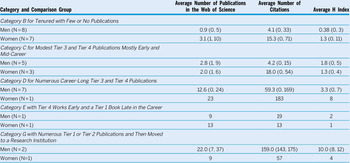
In contrast, table 2 presents Web of Science publication statistics for men and women in the categories with notable publications. The comparisons vary across categories but, in general, women appear to be as well published and cited as men. Women have more publications and citations than men in categories B and D but fewer in category G; the results are mixed in categories C and E. Although the numbers of cases are few, these results comport generally with those for faculty in research institutions.
Publication and Citation Comparisons for Female and Male Scholars in Teaching Institutions

Conclusions
If there is conventional wisdom about research careers in teaching institutions, it plausibly would anticipate careers like those in categories B and C in table 1, which include 24 individuals with modest research output mostly early in their career. Thus, 65% of the 37 individuals who earned tenure in these institutions fit that expectation, whereas 35% have more robust research programs. Furthermore, some of the latter individuals have research records that rival those of scholars in research institutions. Thus, the diversity of career paths in teaching institutions is intriguing fodder for future research.
There also must be distinctive ambitions associated with many of these paths regarding research goals and which audiences that scholars seek to address with their research. We know little about those matters, yet they seem essential for understanding scholarship in the political science community generally.
There also must be distinctive ambitions associated with many of these paths regarding research goals and which audiences that scholars seek to address with their research.
Finally, considerable research finds that women publish less and are less well cited than men. However, the results presented here—derived from a rarely used research design with temporally matched scholarly cohorts—suggest that gender differences in these respects are modest overall. Future research using this research design and larger samples should replicate these analyses to confirm their generalizability.
DATA AVAILABILITY STATEMENT
Replication materials are available on Harvard Dataverse at https://doi.org/10.7910/DVN/VCFQDZ.
SUPPLEMENTARY MATERIALS
To view supplementary material for this article, please visit http://dx.doi.org/10.1017/S1049096521000391.