A decade ago, the book Nicaragua y el FSLN (1979–2009). ¿ Qué queda de la revolución? was published (Martí i Puig and Close 2009). Its aim was to see the extent, throughout the history of Nicaragua—going beyond regime changes—to which violent, authoritarian, and patrimonial practices have persisted among those who have held power.
The issue of analyzing continuities over ruptures in Nicaraguan politics is relevant today. During its history, Nicaragua has experienced U.S. occupation, a liberal oligarchic regime, a repressive family dictatorship, and a socialist-inspired revolutionary regime; and since 2007 (with Daniel Ortega’s return to power), it would appear that the political regime has changed once again. In this article, we wish to explore whether Ortega has been constructing a hybrid regime since 2007 that has combined democratic institutions with authoritarian elections.Footnote 1 We also wish to assess whether, as of the April 2018 protests, it has mutated again into an “electoral authoritarian” regime resembling Somocismo.Footnote 2
What is happening today in Nicaragua has surprised many people whose only reference to Nicaraguan politics was the victory (in 1979) and the electoral defeat (in 1990) of the Sandinista revolution. Despite their differences, these two episodes were exceptional for many reasons, but above all because they broke with the revanchist, patrimonial, caudillo-inspired logic of Nicaraguan politics. The revolution was exceptional for its multiperson leadership (consisting of nine commanders), which condemned and rejected caudillismo and the cult of personality. The Sandinista National Liberation Front (FSLN) abandoned the Leninist dogma, putting pluralism into practice, even offering the government to the group that won in free, competitive elections, as was the case in 1990.
But these exceptional circumstances were soon to vanish. On the one hand, the FSLN failed in its attempts to democratize and quickly came under the tight control of Daniel Ortega. On the other hand, the liberal democracy inaugurated in 1990 mutated in 1997 with the rise to power of a corrupt president, who had no qualms about coming to an agreement with Ortega in 2000 to de-democratize the country (Martí i Puig Reference Martí i Puig2010). From then on, Nicaraguan politics were redirected through traditional patterns, and a political culture re-emerged based on the concentration of power in few hands, in the co-option (or expulsion) of the opposition, in the dismantling of institutional counterweights, and in impunity (Close et al. Reference Close, Puig and McConnell2011).
We wish to show that subsequently, with Daniel Ortega’s return to power in 2007, elements of continuity with Somocismo reappeared, concentrating a large number of public and private resources in Ortega’s hands, including full control of the state administration. The only thing that seemed to differentiate Ortega from Anastasio Somoza was that Ortega used force and repression only sporadically. We believe that difference ceased to exist on April 18, 2018, when protests against Ortega broke out, unleashing government repression that continues at this writing (February 2019).
In view of the above, the aim of this article is to show four things: how Nicaragua has been de-democratized since 2000; how electoral competition has increasingly declined since 2008, until elections have become authoritarian; the type of regime created in Nicaragua and its inability to handle protest; and the nature of the conflict generated since 2018. Our aim is to reflect on possible ways out of the crisis, including an early end to the president’s term, the opening of negotiations, or the authoritarian castling of the regime. This article is based on the literature that analyzes processes of de-democratization, the characteristics of hybrid regimes, and the fall of presidents in the region.
The term de-democratization is used to refer to the “erosion,” “backsliding,” and “regression” of democracy experienced by a regime, and to facilitate a direct comparison with democratization. De-democratization indicates that a democracy—or a regime undergoing a democratization process—was the starting point, and that the direction taken over time has been toward “less democracy.” With this concept, no assumption is made about causes, conditions, or culprits, or about speed, extent, or endpoint. All these factors are treated as empirical questions based on case studies (Bogaards Reference Bogaards2018, 1482).
Brief Electoral History:1990-2016
The 1990 elections, which resulted in the defeat of the FSLN, put an end to the revolutionary process and also to the Contra War.Footnote 3 These can be considered to have been the “founding elections” (McConnell Reference McConnell2011) of Nicaraguan democracy, since they were the first in the country’s history that attracted the participation of all the political parties and established electoral competition, with hundreds of international observers present.Footnote 4 The institution responsible for the organization of the elections was the Supreme Electoral Council (CSE), under the supervision of the United Nations Observer Mission for the Verification of the Electoral Process in Nicaragua (ONUVEN) and monitored by several organizations from the international community.
Contrary to most forecasts, the FSLN lost the elections. As a result, the presidency went to Violeta Barrios de Chamorro and 51 of the 90 seats in the National Assembly to non-Sandinista parties, while the FSLN obtained 39 seats.Footnote 5 These elections brought three immediate consequences: pluralism was strengthened; political activity was channeled within the framework of the 1987 Constitution, rejecting the use of arms; and the correlation of forces changed. Thus the Nicaraguan electoral process offered a clear example of an institutional settlement, on the basis of which the different stakeholders established not only agreements but also the “rules of the game” and sufficient guarantees to ensure participation in elections, accepting the uncertainty that these entail (Przeworski Reference Przeworski, O’Donnell, Schmitter and Whitehead1986).
The political events of the next five years were so intense that by the 1996 elections the FSLN had undergone a split, and the National Opposition Union (UNO) coalition had disappeared (Martí i Puig Reference Martí i Puig2013b). Against this backdrop, the constitution was amended in 1995 with the aim of reducing the power of the presidency and modifying the electoral system in the presidential elections in different aspects, such as moving from a simple majority election to one in which it was necessary to hold a second round if no candidate had managed to obtain 45 percent of the vote.Footnote 6 At the same time, reforms were made regarding the composition of the electoral administration, moving to a more partisan model (McConnell Reference McConnell2011).Footnote 7
With these new regulations, elections were held on October 20, 1996, again with international and national observers present. Participating in these elections were 23 candidates for the presidency and a wide range of parties for the National Assembly. Results showed a trend toward polarization between the FSLN and the PLC, a liberal, anti-Sandinista party led by the then-mayor of Managua, Arnoldo Alemán. The elections were peaceful and orderly, although there were some logistical problems with the vote count that undermined the quality, but not the credibility, of the process (McConnell Reference McConnell2009; Martí i Puig Reference Martí i Puig2013a). Alemán’s victory was clear, with 51 percent of the vote, compared to 37.7 percent obtained by Ortega.
Arnoldo Alemán’s administration (1997–2001) was controversial, and the event most open to question during his mandate was the signing, in January 2000, of an agreement forged between Alemán and Ortega. Known officially as the Governance Agreement (and popularly as the Pact), it made the judiciary and the election administration (CSE) more partisan, and the electoral system was changed again.Footnote 8
The 2001 presidential and legislative elections resulted in victory for the Liberals, with Enrique Bolaños standing for president (he obtained 56.3 percent of the vote and a majority in the National Assembly, with 53 seats). Although Bolaños was the candidate put forward by Alemán, the two Liberal leaders soon fought. This resulted in splitting the Liberal Party into two blocs and in the accusation and imprisonment of Alemán for corruption.
It was this division in the Liberals that subsequently facilitated Ortega’s rise to power in the following elections, in 2006. Accordingly, these could be described as critical elections, since they were marked by a change in the party system.Footnote 9 The system was transformed from a Sandinista–anti-Sandinista confrontation to a four- party contest, due to the splintered Sandinista and Liberal groups that opposed the Pact (Martí i Puig Reference Martí i Puig2008). Daniel Ortega emerged victorious in these elections with 38.07 percent of the vote, thanks to the new electoral system, which had lowered the threshold for victory in presidential elections. Winning over 5 percent more votes than the second candidate secured his victory.
Thus the FSLN won the presidency and a simple majority of seats in the National Assembly. This victory can be explained by three issues, two of them linked to the Pact: the 2000 Elections Act reduced the threshold required to win the presidential elections; new political forces emerged as a result of their rejection of the Pact; and the FSLN conducted a campaign based on a de-ideologized discourse calling for peace and reconciliation and a rapprochement with the most conservative sectors of society.
When the FSLN came to power, the Sandinistas found not only a partisan judicial and electoral administration in their favor but also a fragmented opposition. So they set about neutralizing the competitive nature of the electoral system and centralizing the administration (Prado Reference Prado2010).
The first event of this era was the 2008 municipal elections.Footnote 10 Among other actions, the CSE revoked the legal status of the Conservative Party and the Sandinista splinter group, the Sandinista Renovation Movement (MRS), before the elections were held (McConnell Reference McConnell2009). Moreover, after the elections, the multiple reports of fraud on polling day were ignored (Martí i Puig Reference Martí i Puig2013a).Footnote 11 In response to the lack of institutional transparency, the opposition organized mass protests in the streets, and several media and social sectors denounced the fraud.Footnote 12 Nevertheless, the CSE certified a clear victory for the FSLN (winning 105 municipalities) and did not accept any of the allegations. And yet the official results were never published. Meanwhile, opposition representatives reported a clear victory for the anti-Sandin- ista leaders in Managua and León.Footnote 13 As a result, it can be assumed that fraud was committed in the 2008 elections, even though government authorities hid behind ambiguous statements and deliberate inconsistencies (Schedler Reference Schedler2013).
The 2008 elections turned out to be a crucial event, given that no competitive elections have been held in the country since. However, the government no longer needed to implement fraudulent practices on polling day itself in the following elections (2010, 2011, 2014, and 2016). Instead, the state administration systematically orchestrated a plan in which—thanks to the collaboration of judicial authorities, the total control over the CSE, and the discretionary use of public resources—the opposition, which traditionally had had difficulties establishing consensus, was increasingly diminished, losing any real capacity to compete.Footnote 14
Subsequently, Nicaragua’s elections transformed from competitive in the 1990–2006 period to more typical of “hegemonic electoral autocracies” from 2011 on. The 2008 elections marked the transition by combining both electoral competition and fraud (Schedler Reference Schedler2004).Footnote 15 The 2011 elections, in which the president, the National Assembly, and the Central American Parliament were elected, were held without the existence of a clear electoral roll. The opposition parties had no representation at the polling stations, and the vast majority of attorneys were Sandinistas (Pérez-Baltodano Reference Pérez-Baltodano2012). Despite an explicit ban on “immediate re-election,” laid down in the Constitution, Daniel Ortega ran for president again, thanks to a legal gray area—a ruling for the writ of amparo (Treminio Sánchez Reference Treminio Sánchez2015).
According to official results, Ortega obtained 62.5 percent of the vote and the FSLN won 63 parliamentary representatives, compared to 31 percent of the vote for Fabio Gadea (a veteran, hardline anti-Sandinista) and 31 representatives for the PLI- UNE coalition. According to the OAS and EU electoral observation missions, the elections were plagued by irregularities. Nonetheless, the Nicaraguan people believed that the FSLN’s victory was credible (Pérez-Baltodano Reference Pérez-Baltodano2012), even though the elections had been riddled with flaws before the actual polling day.
The same happened, and with even greater intensity, in the 2016 elections. Therefore, it was taken for granted that the FSLN and its candidate, Ortega, this time with his wife, Rosario Murillo, running alongside him, would be given his third consecutive victory (Sonneland Reference Sonneland2016).
In these elections, the governing party had an advantage not only in winning votes but also in technical management. Referring to the organization of the elections, the Nicaraguan civil society organization Consorcio Panorama Electoral issued a statement charging that “the elections did not meet basic standards of electoral integrity, but rather represented a step backward compared to the last three elections, which had lacked credibility” (CENIDH 2016).
The FSLN used the public media to promote itself in the electoral campaign, and propaganda messages were also displayed on official state buildings, on such a large scale that any competition was quashed. Accordingly, parties expressed great difficulties in obtaining bank funds to finance their campaigns and vote protection, while local observers (no international observers were authorized) reported that the FSLN had made discretionary use of public buildings, such as schools, across the country for propaganda purposes, in clear violation of the law (CENIDH 2016).
Thus, the country was painted rosa chicha (bubble-gum pink) and filled with billboards portraying Daniel Ortega and Rosario Murillo. The government logo was in the top lefthand corner, along with the words Government of Reconciliation and National Unity, the People as President. In the top righthand corner was the slogan
Christian, Socialist, in Solidarity. The campaign slogan read “Daniel, always ahead, onward to more victories for Nicaragua.” Against this backdrop, and despite protests voiced by the opposition and demonstrations every Wednesday (Álvarez 2016)) demanding free and fair elections, all the polls indicated that Daniel Ortega would be the winner (Arévalo 2016).
Also controversial was electoral participation. The opposition pointed out that less than 35 percent of the census had voted, while the president of the CSE certified a participation of 68.2 percent.Footnote 16 Be that as it may, official data indicated that Daniel Ortega became president with 72.44 percent of the vote and that the FSLN obtained 71 of the 92 National Assembly seats, while representation of opposition groups was anecdotal.
The Menu of Manipulation and Loss of Confidence in the System
The real electoral situation in Nicaragua should be analyzed on the basis of the literature on authoritarian elections because Nicaragua is a country where credibility in the electoral process has collapsed as a result of a civic movement to change the government.Footnote 17 With this in mind, it is necessary to give an account of what Schedler (Reference Schedler2004) terms the “menu of manipulation,” which has been implemented in Nicaragua in each of its seven dimensions of choice presented in his book. These are the object of choice, the range of choice, the formation of preferences, the agents of choice, the expression of preferences, the aggregation of preferences, and the consequences of choice.
If we consider the object of choice, it should be noted that some candidates should not have participated in the elections. This is true for the vice president, Rosario Murillo. She, as Daniel Ortega’s wife, should have been excluded under Article 147 of the Constitution, which bans people related to the president by consanguinity or by affinity from running for office. However, this ban was overruled by legislators who considered the Ortega-Murillo tandem legally valid. They interpreted the affinity relationship as applying to the spouse’s blood relatives but not to the spouse herself, a distinction that the opposition called illogical.
As for the range of choice (that is, freedom of supply), since 2000, the CSE and the government have indeed reduced the opposition’s possibilities for action by restricting their access to the electoral arena. An example occurred in the 2001 municipal elections, when the shape of the municipal district of Managua was changed in order to exclude the most popular candidate, in an exemplary case of gerrymandering (McConnell Reference McConnell2009). Similarly, since 2006, the legal status of parties (such as the MRS) has been eliminated, or interventions have been made in intraparty lawsuits with a view to disorganizing and fragmenting dissent. This was the case on June 8, 2016, when the Supreme Court ousted opposition legislator (and 2006 presidential candidate) Eduardo Montealegre from his position as leader of the Liberal Party (PLI), giving the post to the unknown Pedro Reyes, who quickly withdrew from the electoral competition (Equipo Envío Reference Envío2016a).
Thus, it could be said that the regime was able to plan and provoke the failure of the opposition, either by changing the size or shape of electoral districts or by taking advantage of internal disputes among the opposition, while demands to create and consolidate one party were extremely challenging.
Regarding the formation of preferences (freedom of demand), we can point out inequality in access to the media and to funds to finance the election campaign. Although this is not a scenario of radical inequality, due to the existence of independent media, such as La Prensa, Canal 12, Radio Corporación, and the weekly Confidencial, it should be noted that the Ortega-Murillo family and their closest supporters own seven radio stations and three television channels (channels 4, 8, 13), as well as controlling channel 2 (Castro Reference Castro2014; Bravo Reference Bravo2015). On the other hand, regarding the restriction of political and civil liberties, we could say that a mixture of freedom and control existed, above all in relation to NGOs and organized civil society unrelated to the government (Close Reference Close2016).
As for agents of choice (inclusion), although no formal restrictions on suffrage exist, the CSE controls the identification process and has overseen the updating and purging of the electoral roll since May 2012. This is a practice that may lead to changes in the composition of the census.Footnote 18 It is more complex to pass judgment on the expression of preferences, since it is not easy to obtain evidence of the existence of coercion or corruption. Nevertheless, there are those who claim that a certain clientelist control does exist through networks that implement conditional transfer policies (the Citizen Power Councils [CPC] and the Family Councils), but it is impossible to pass judgment with the available data.
Another matter is the aggregation of preferences. Here, although institutional bias does not exist in the election of members of parliament, the practice of reducing the number of unfavorable votes has taken place in some elections, such as the 2008 municipal elections in Managua and León, and in 2011 in some of the country’s inland towns. In 2016, the opposition reported the invalidation of thousands of votes, contested by FSLN attorneys in polling stations where they had lost the ballot count, and in the CSE municipal offices.Footnote 19
Finally, we need to address decisiveness of choice; that is, when elections end without consequences, thus preventing the elected officials from exercising their powers. This case (choice without consequences) has occurred in Nicaragua, given that two purges of elected representatives have taken place. The first was in 2013, when the elected representatives of the Sandinistas, Xochilt Ocampo and Agustín Jarquín, were removed from office, the former for abstaining from voting on the Interoceanic Canal Law and the latter for announcing his break with the FSLN in 2015. The second purge took place on July 29, 2016, when the CSE stripped 28 opposition legislators (16 elected officials and 12 substitutes) of their seats for refusing to recognize Montealegre’s replacement as leader of the PLI in the episode described above in relation to range of choice.
However, even with this review of the “menu of manipulation,” it should be noted that the resourcefulness of the authoritarian imagination is based not on logic but on experience. If the aim of authoritarian governments is to choose a series of
tactics to help them remove the democratic core from electoral competitions (Greene et al. Reference Greene, Slater and Schedler2015), it would appear that in the case of Ortega’s agents, they have succeeded. In our opinion, since 2007, the Ortega Administration has managed to develop a series of practices that violate democratic norms so severely and systematically that we are obliged to call the elections held in Nicaragua authoritarian or hegemonic.
The existence of noncompetitive multiparty elections forces the opposition to change the rationale underlying its campaign. In many cases, it is not simply about seeking votes to defeat the government at the polls but about putting pressure on other national and international bodies to achieve institutional reforms in order for the votes to count. Thus, the opposition parties are immersed in a far more complicated strategic environment than in a democratic system, being forced to make “chess moves back and forth” (Schedler Reference Schedler2013) without knowing if they are triggering a move toward democracy or toward the ideological hardening of an authoritarian regime.
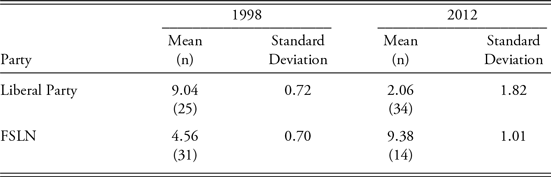
What is evident is that the last decade has seen not only a loss of competitiveness but also an accelerated loss of confidence in the political system in general, and in the electoral system in particular. This becomes clear when the results of surveys conducted among FSLN and Liberal parliamentarians in 1998, before Ortega’s rise to power, are compared to another survey in 2012, when the FSLN was already in power (see table 1).Footnote 20 Table 1 shows that the confidence of the Liberals in electoral processes had declined from 9.04 to 2.06 points (on a 0—10 scale), while it had increased among the Sandinistas.
Nicaragua: Measures of Trust in Electoral Processes Among the Parliamentary Elite

Source: Latin American Elite Project of the University of Salamanca
The de-democratization process has also been captured by indices measuring the state of democracy in various countries.Footnote 21 Even before the 2018 crisis, in the decade spanning 2007 to 2017, Nicaragua was already one of the world’s regimes where the quality of democracy had declined most (Mainwaring and Pérez-Liñán 2015; Lürmann et al. 2017).
What Type of Regime Has Daniel Ortega Created?
After describing the de-democratization process experienced in Nicaragua since 2000 and its culmination in the most recent elections in 2016, we need to take a closer look at the characteristics of the political regime that Daniel Ortega has been constructing over his decade in power.
Since Ortega became President of the Republic, the power in Nicaragua, of an extremely personalist nature, has been structured and exercised hierarchically, with no interest in accountability or explanations.Footnote 22 A clear example is that the family residence of Daniel Ortega and Rosario Murillo is not only the FSLN central headquarters but also the president’s official residence, where the President of the Republic lives with his wife and vice president.Footnote 23 In addition, their children occupy positions in the key circles of power.Footnote 24 Thus the concept of amoral familism emerges forcefully as a way of understanding the political dynamics established in the country.Footnote 25
In any case, it should be noted that this approach to concentrating power based on family ties is not exclusive to Nicaragua. Political dynamics with similar aspirations can be found all over the Americas (and in many parts of the world), as illustrated by the presidential ambitions of couples such as the Kirchners in Argentina, the Calderóns in Mexico, the Coloms in Guatemala, and the Fernándezes in the Dominican Republic; or of parents and children, such as the Fujimoris in Peru, the Trudeaus in Canada, or the Torrijoses in Panama. The problem in Nicaragua, apart from family greed, lies in the fact that Ortega has been able to deinstitutionalize the FSLN and the state and has therefore dismantled any control mechanisms, whether vertical or horizontal. And since these control mechanisms have been dismantled, the drift of the political system in Nicaragua toward a patrimonial regime has been accomplished in just over a decade.
The most paradoxical issue is that Ortega enjoyed relatively high levels of popular support until April 2018 and maintained a large network of interests that permeated society, from the highest economic spheres to the most disadvantaged social sectors. How was it possible to reach this point? His position of dominance resulted not only from the availability of large financial resources, thanks to Nicaragua’s membership in the Bolivarian Alliance for the Americas (ALBA), but also to Ortega’s ability to shape the state institutions for his own purposes.
Thanks to ALBA, the Ortega Administration was able to co-opt both the traditional and economic elites and the most impoverished sectors of the country. Cooptation of the elites was possible because Ortega had maintained the economic production and commercialization model promoted since 1990 and had boosted it with privileged access to the Venezuelan market.Footnote 26 In this context, the economic elites, linked to the Superior Council for Private Enterprise (COSEP), remained close to the regime until 2018. In the decade 2007–18, the large corporations in Nicaragua gained new markets while being able to guarantee labor discipline because the historically combative trade union organizations were under the control of the FSLN. From 2007 to 2017, the gross domestic product in Nicaragua increased by an average of 4 percent per year, and the annual 5 percent inflation rate was maintained, generating remarkable business stability.Footnote 27
On the other hand, support from the most impoverished sectors of the country was related to a wide array of targeted social policies. These policies were the result of three elements: the government’s political will to fight poverty, Nicaragua’s alignment with conditional transfer policies promoted by the majority of governments in the region, and the ability to allocate resources to these policies, thanks to income obtained by public and private companies through the ALBANISA corporation.Footnote 28 These targeted social policies were implemented across Nicaragua through state- owned and party platforms, first called Citizen Power Councils (CPC) and later known as Family Councils (GF), and were coordinated by Rosario Murillo.Footnote 29
Ortega also was able to exert his authority over the state institutions. Thus, Ortega personally took control of the FSLN and its related organizations, and with it the judiciary, the legislative authorities, the National Police, the armed forces, and the Supreme Electoral Council.
In addition, Ortega had created a “Sandinista bourgeoisie,” which originated in the 1990s with la piñata, enhanced by the ALBANISA-owned businesses and the proximity of the government.Footnote 30 Moreover, in 2014, Ortega reshaped the institutional framework through constitutional reforms (partially amending a large number of articles), reinforcing the figure of the president, and eliminating restrictions on indefinite re-election (Álvarez and Vintró 2014). Regulations concerning the armed forces were also changed, making them subject once again to the will of the President of the Republic (Cuadra Lira Reference Lira2016).
In light of this extended authority, the Ortega regime has become a kind of updated version of the traditional caudillo regime of the past, in which the caudillo controlled the administration of the state and its laws, led the armed forces, controlled the electoral machinery, took care of his electoral clientele, and managed and arbitrated business (Close Reference Close2016). In this sense, the prevailing regime in Nicaragua reembodies the patrimonial-caudillo tradition developed by the Somoza dynasty and departs from the revolutionary project preached by the FSLN over 20 years of guerrilla struggle, which it had sought to implement in the 1980s (Thaler Reference Thaler2017). For all these reasons, in the decade from 2007 to 2017, Ortega can be said to have created a type of regime similar to the patrimonial, sultanistic model of Somocismo in the sense that Chehaby and Linz (Reference Chehaby and Linz1998) have given it. The biggest difference from Somocismo (in the 2007–17 decade) was its ad hoc and limited recourse to force and repression. In the Ortega Administration, however, this changed with the protests of April 2018 (Pineda Reference Pineda2016).
The 2018 Crisis: Castling or Fall of the Presidency?
On April 18, 2018, protests broke out unexpectedly in Managua, driven by thousands of students demonstrating against a multitude of accumulated grievances. Initially, demands focused on rejecting changes in contributions to the Nicaraguan Social Security Institute (INSS) and on poor government management of a fire that had devastated part of the Indio-Maiz Biological Reserve. But the mobilization quickly turned into a protest against the presidential couple’s authoritarian, patrimonial, and plutocratic way of governing (Equipo Envío Reference Envío2018). The government responded by accusing demonstrators of being “petty, terrorists, mediocre [people], and criminals” (mezquinos, terroristas, mediocres, y delincuentes, in Murillo’s words), and used disproportionate repression (see especially the reports of OHCHR 2018; GIEI 2018).
The crisis, however, was deeply rooted, due to Ortega’s absolute control over the government apparatus. The construction of an “authoritarian electoral regime” (as understood by Shedler [2013]) meant that the political system was unable to channel dissent. By not permitting an organized opposition with a voice in the institutions, any protest arising during those years was ignored. And when the accumulated dissatisfaction erupted into mass street protests, the regime’s only response was brutal repression, which necessarily called into question the very nature and survival of the regime.
These protests have become the most important in Nicaragua in the twenty- first century. Yet they have not been enough to force the departure of Daniel Ortega. This is of interest in comparative politics, given that mass protests have triggered the fall of the president currently in office in several countries. For many years, the literature on the fall of presidents has analyzed the intervening factors for or against maintaining presidents in power. Thus, it should be noted that over the last quarter-century (1992–2016), 15 presidents have been removed from office before the end of their mandate in 9 countries in the region.Footnote 31 Before the 1990s, the way to remove presidents from office was by staging a coup d’état, breaking the constitutional order. However, for more than two decades, the “departure of the president” has been due to a variety of factors, generating “a new pattern of political instability in the region,” as Pérez-Liñán (Reference Pérez-Liñán2009) points out.
The causes motivating the “departure” of presidents have been diverse (Pérez- Liñán 2009, 2014; Pérez-Liñán and Polga-Hecimovich Reference Pérez-Liñán and Polga-Hecimovich2017; Edwards Reference Edwards2015; Martínez Reference Martínez2015; Serrafero Reference Serrafero2018). Sánchez Gayosso and Escamilla Cadena (2017) have analyzed the literature and distinguished the following causes: acts of corruption; media scandals; election campaigns financed from the proceeds of drug trafficking; mental disability; confrontation with the legislative power; social protest due to unjustified repression by the government; an economic crisis; bankruptcy of a legislative or government coalition; or a military intervention. Despite this long list, Pérez-Liñán (Reference Pérez-Liñán2009) believes that at least three conditions must be met to bring about the fall of a president: first, the president’s party not having a majority in the legislature (a condition Pérez-Liñán considers necessary but not sufficient in itself); second, a media scandal against the president promoted by the media; and third, widespread street protests calling for the president’s resignation. On this basis, the existence of an institutional conflict between the executive and legislative powers is crucial, because mobilizations are mere triggers that apply pressure in a context of confrontation between powers.Footnote 32
In the case of Nicaragua, the crucial elements that Pérez-Liñán refers to are clearly not present, because Ortega has absolute control over the legislative power, as a result of the process of de-democratization explained in this article. Some factors related to the fall of presidents can be found, such as an economic recession stemming from a decline in the support received from Venezuela and the sanctions imposed by the U.S. government, suspected unlawful enrichment in the management of ALBANISA, and the street protests.Footnote 33 But the regime’s control over the state institutions makes a rapid presidential downfall quite unforeseeable. Thus, the central element in this episode is the role of the army and whether a military intervention is possible, as happened in Honduras when Manuel Zelaya was removed from office (Llanos and Marsteintredet Reference Llanos and Marsteintredet2010). In Nicaragua, however, the president has gradually gained control over the army, which took a distant position when the protests reached their peak. Proof of this is the fact that the brutal repression against the people was carried out by the National Police and, in particular, by unidentified progovernment paramilitary groups (Equipo Envío Reference Envío2019b).
Another element that can explain the fall of a president is the president’s own attitude toward such a downfall. In this case the president, the FSLN, and its related organizations have upheld a discourse totally denying any crisis. Officially, the people who took to the streets have been accused of being vandals and coup plotters, and it has been announced that this crisis represents the beginning of the “third phase” of the Sandinista Popular Revolution for Nicaragua, based on the participation of the faithful and the purge of opportunists and traitors.Footnote 34 The official discourse has also indicated that the alliance with strategic partners (in reference to business owners and the Catholic Church) has come to an end, and grassroots involvement would be further strengthened. At the same time, a strong call has been made for the revival of the Sandinista Defense Committees (CDS), once the wave of repression used in so-called Operation Clean-up has concluded.
Analyzed tangentially in the literature—although, in our opinion, key in this case—is the capacity of the opposition. In the case of Nicaragua, the de-democratization process has also affected the opposition’s capacity to become an alternative to the government. Apart from protests against Ortega, the opposition has failed to present either a well-defined discourse or a project. Made up of a broad coalition (the majority formed by young people), though lacking cohesion, the opposition is sustained by its rejection of the regime and is characterized as being self-organized and lacking leadership. Those examples of its discourse and manifestos that have so far come to light reveal a great plurality of ideological and political sensibilities. Taking part in the mobilizations were Sandinistas belonging to the Movement for the Rescue of Sandinismo (M+RS) and the Sandinista Renewal Movement (MRS), as well as anti-Sandinistas, for whom only the Catholic Church is a moral and political reference. Thus, protest in the street is one thing and competition in the electoral arena quite another—whether in early elections (one of the opposition’s demands) or in institutionally planned ones.
But the regeneration of Nicaraguan politics is not only about organizing new elections and voting. A long-term commitment is needed for the party system to be revitalized and for the political parties to be able to compete in democratic elections. Not only has the democratic involution of the last decade disrupted the electoral administration, it has broken and undermined the entire party system. Precisely for this reason, any step toward democratization must involve negotiation outside the institutional framework provided by the regime, a practice that has also been a permanent part of the country’s history (Esgueva Gómez Reference Gómez1999).
Ultimately, the most substantive political changes have always been the result of negotiations held outside the institutional sphere (necessarily devoid of representatives of the government of the time) between opposing agents that recognize each other as spokespeople. The most recent examples of negotiations of this nature include the agreements reached at the end of the 1980s (within the framework of the Esquipulas Peace Agreement) between the Sandinista government and the Contra; the negotiations established in 1990 between the government of Violeta Barrios de Chamorro and the FSLN to draw up the Transition Protocol for the Transfer of Executive Power; and in 2000, the Governance Agreement (better known as the Pact) between Alemán and Ortega, as a result of which the democratic system began to deteriorate (Martí i Puig and Close 2009).
Many observers believed that negotiations of the same nature would be initiated on May 16, 2018, when the first session of the Table for National Dialogue was inaugurated. Members of the government, universities, unions, private employers, and civil society organizations came together for negotiations mediated by the Episcopal Conference of Nicaragua. But the talks failed because the government did not put an end to the repression, nor was it willing to work toward an agenda for democratization. Ortega, however, has blamed the Catholic Church for this failure (Equipo Envío Reference Envío2019a). This criticism of the church was not casual, since the church has become the only institution present throughout the country that is firmly structured and has voice and authority.
Nowadays, nobody knows what the outcome of the crisis will be, although up to now it has been marked by some continuities in the culture of power politics embraced by Nicaragua; namely, the concentration of resources in the hands of one leader, the use of force at times of crisis, and the inability of the institutions to resolve conflicts.