Introduction
Congenitally corrected transposition of the great arteries is a rare congenital anomaly which are responsible for 0.5% of all CHDs (1 out of 33,000 live births). Reference Arribard, Kara, Hascoët, Bessières, Bonnet and Houyel1 In this anomaly, both ventricles and their associated atrioventricular valves are reversed and there is atrioventricular and ventriculo-atrial discordance. Consequently, on the left side, the tricuspid valve connects the left atrium with the morphologically right ventricle, and aorta originate from morphologically right ventricle; on the right side, the mitral valve connects the right atrium with the morphologically left ventricle, then the morphologically left ventricle communicates with the pulmonary trunk. The systemic and pulmonary venous return flows towards the pulmonary trunk and the aorta, respectively. Reference Arribard, Kara, Hascoët, Bessières, Bonnet and Houyel1 In these patients, the morphological right ventricle (left-sided ventricle) acts as a systemic ventricle and morphological left ventricle is the subpulmonic ventricle that receives blood from the right atrium.
Corrected transposition of the great arteries can be associated with other congenital cardiac abnormalities. Ventricular septal defect, pulmonary stenosis, left atrioventricular valve regurgitation, and complete heart block account for 80% of all associated anomalies with corrected transposition of the great arteries. Association of corrected transposition of the great arteries and isolated atrial septal defect is a very rare condition. Reference Munaf, Farooqui, Kazmi and Ul-Haque2 In this condition, a left-to-right shunt through the inter-atrial septal defect is present, so it is expected that in the long run, it will increase the right heart volume overload and enlargement, and of course, in these special patients, subpulmonic ventricle (morphological left ventricle) enlarges and right-sided atrioventricular valve (mitral valve) regurgitation would be evident. In these cases, as the patient grows up, left to right shunt through atrial septal defect increases, and patient becomes symptomatic. As in all patients who have a significant left-to-right intracardiac shunt, it is recommended to repair the atrial septal defect in order to prevent further complications (such as an elevated pulmonary hypertension, Eisenmenger’s syndrome, right ventricular failure). Reference Moazenzadeh, Jafari, Farrokhnia and Aliramezany3
Besides the inherent risks of cardiac surgery, Reference Wilkinson, Smith, Lincoln and Anderson4 transcatheter closure is now the gold standard treatment of secundum-type atrial septal defects. Reference Alkashkari, Albugami and Hijazi5 Few studies Reference Olgun and Ceviz6,Reference Mitchell, Timperley, Blackman and Ormerod7 have shown the application of transcatheter closure of atrial septal defect in corrected transposition of the great arteries. In this paper, we describe three patients with corrected transposition of the great arteries who were admitted to our clinic and with regard to previous history and paraclinical evaluation they had isolated secundum-type atrial septal defect without any associated anomaly. With regard to significant intracardiac shunts and lack of indication for cardiac surgery, all of them underwent percutaneous closure of atrial septal defect.
Case 1
A 38-year-old woman with no history of any disease was referred to our clinic with a complaint of exertional dyspnoea (NYHA classes 2 to 3). According to physical examination, lung auscultation was normal, but heart auscultation revealed a 3/6 systolic murmur on the left sternal border. Other examinations were unremarkable. In ECG, the absence of q wave in lateral leads and left axis deviation was detected.
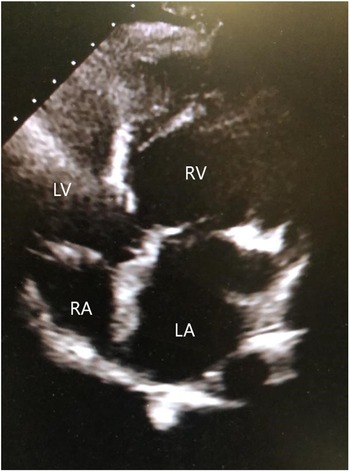
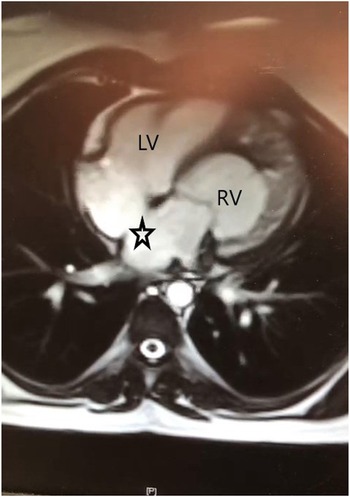
Due to heart auscultation, echocardiography was performed. In the subxiphoid view, we observed normal atrial and visceral situs; in the four-chamber view, we detected ventricular discordance. Morphological left ventricle was on the right side with moderate enlargement (LVEDD = 40 mm) and mild dysfunction; the morphological right ventricle was on the left side (double discordance) and had normal size with preserved function (Fig 1). The right atrioventricular valve (mitral valve) had moderate regurgitation. Secundum-type atrial septal defect (18 mm) was observed (also detected in contrast echocardiography), without ventricular septal defect or pulmonary stenosis. A significant intracardiac shunt (Qp/Qs = 1.8) was also detected. Great arteries were transposed and aorta was on the left side and anterior. The anatomy and function of the right and left ventricles were completely determined using cardiac MRI images. As shown in the echocardiography, the morphologic right ventricle (according to the specific anatomy and the condition of the atrioventricular valve) was located on the left side with normal size and preserved systolic function. A morphologic left ventricle was seen on the right side and was associated with some degree of enlargement (mild) and dysfunction (moderate) (Fig 2). Furthermore, an isolated secundum-type atrial septal defect was seen.
Ventricular discordance in four-chamber view.

Ventricular discordance associated with large secundum-type atrial septal defect (star) in cardiac MRI.

Because of having an isolated atrial septal defect with significant left to right shunt and the fact that she was symptomatic, trans-esophageal echocardiography was performed and showed suitable rim size. Accordingly, she was a candidate for atrial septal defect device closure. Cardiac catheterisation was done and atrial septal defect was occluded with Occlutech ASD device (size: 21 mm) successfully. During follow-up after 1–3 and 6 months, symptoms improved and sub-pulmonic ventricle dimension reduced to 37 mm in multiple measurements.
Case 2
A 32-year-old man, known case of corrected transposition of the great arteries with long-standing exertional dyspnoea (NYHA class 3) was admitted to our clinic with a complaint of recent aggravation of dyspnoea. Lung auscultation was normal on physical examination. In heart auscultation, a 3/6 systolic murmur could be heard on left sternal border. Other findings were unremarkable.
In trans-thoracic echocardiography, we observed a large secundum-type atrial septal defect (2.4 cm) with left to right shunt (Qp/Qs = 2.1), which was confirmed in colour flow study, but there was no ventricular septal defect or pulmonary stenosis. Mild enlargement (LVEDD = 42 mm) of right-sided left ventricle (sub-pulmonic ventricle) with mild to moderate dysfunction was noted. Left-sided right ventricle (morphologic right ventricle) had mild enlargement and mild dysfunction in echocardiography. The left atrioventricular valve had moderate regurgitation and right atrioventricular valve had mild to moderate regurgitation. This finding was confirmed by cardiac MRI results, and we did not detect any associated anomaly except corrected transposition of the great arteries with isolated atrial septal defect. The patient had been under treatment by Valsartan, Carvedilol, and Eplerenone for 12 months prior to his recent referral, but dyspnoea has aggravated since last month. After trans-esophageal echocardiography, with regard to suitable rim size, he was a candidate for atrial septal defect device closure.
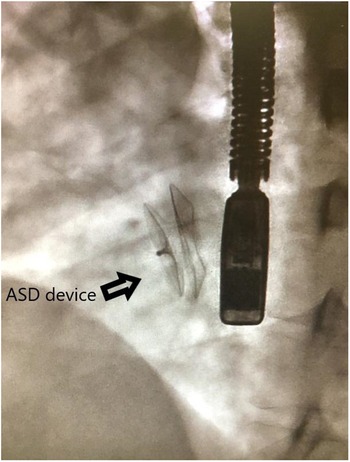
In ventricle injection during cardiac catheterization, we observed hyper-trabeculated right ventricle in the left side and catheter was entered into morphologic right ventricle from aorta. This ventricle had mild enlargement and dysfunction. Right-sided left ventricle was seen with mild enlargement and moderate dysfunction and increased pressure that indicated sub-pulmonic ventricle had been affected by volume overload of large atrial septal defect with a significant shunt. For this reason, atrial septal defect was successfully occluded via trans-catheter procedure with Occlutech ASD device (size: 27 mm) (Fig 3).
Atrial septal defect device was seen in proper position in angiographic view.

Case 3
A 28-year-old woman without any history of disease was referred to our clinic. Her principal complaint was dyspnoea (NYHA class 2) and palpitations. She had experienced one attack of paroxysmal supraventricular tachycardia. On physical examination, only abnormal finding was a 3/6 systolic murmur that could be heard on left sternal border. Echocardiography showed Q wave in right precordial lead and 24-hour Holter monitoring did not show an abnormal arrhythmia. We performed echocardiography, and atrial and visceral situs were normal in the subxiphoid view; the four-chamber view showed ventricular L-looping and left artery connected to the morphological left-sided right ventricle and tricuspid valve, right artery connected to MV and left ventricle. Aorta arose from the morphological right ventricle and pulmonary artery from the morphological left ventricle. The morphologically left ventricle was on the right side and was mildly enlarged (LVEDD = 43 mm) and had mild dysfunction; the morphologically right ventricle was on the left side and had mild to moderate systolic dysfunction. The right-sided atrioventricular valve (mitral) had mild to moderate and left-sided atrioventricular valve (tricuspid) had moderate regurgitation. A secundum-type atrial septal defect (2.1 cm) was detected and was confirmed with contrast echocardiography and Color Flow Doupler. No ventricular septal defect or pulmonary stenosis was detected. We also calculated a significant intracardiac shunt (Qp/Qs = 1.8) by echocardiography. Furthermore, in trans-esophageal echocardiography adequate rim size was observed. This finding was also seen in cardiac MRI. We prescribed Valsartan and Carvedilol to the patient. The patient reported significant improvement but because of a significant intracardiac shunt in follow-up trans-esophageal echocardiography and no indication for surgery, she was a candidate for percutaneous closure of atrial septal defect. After diagnostic catheterisation, we noticed that morphologic left ventricle was in the right side with mild enlargement and dysfunction. This ventricle was sub-pulmonic with increased pressure but sub-systemic ventricle was in the left side. Furthermore, course of right heart catheter showed atrial septal defect. In haemodynamic and oximetry study, significant step up was seen in right atrium favouring an atrial septal defect. Shunt study was done, and with regard to the significant left to right shunt, atrial septal defect was occluded with Occlutech ASD device (size: 26 mm) without any complication.
Procedural technique
All three patients underwent transesophageal echocardiography under sedation, and the size of atrial septal defects and their rims were measured. After ensuring the suitability of the atrial septal defects for percutaneous closure, we started our trans-esophageal echocardiography-guided procedure via femoral approach after anaesthesia. Systemic pressure was monitored during the procedure. Cardiac catheterisation and haemodynamic study (saturation study and pressure measurement of all chambers) were performed for all patients. Sizing balloon test was performed for all patients, and in patients 2 and 3, sizing balloon occlusion test was performed for the evaluation of pressure of right ventricualr end diastole after balloon test. The appropriate device size was selected according to sizing stop flow diameter and placed through the femoral vein sheath. After making sure of the proper device position and push and pull manaeuver, the device was released and sheath was removed. At the end of the procedure, complete trans-esophageal echocardiography was performed to check the proper position of the device and the amount of residual shunt, which showed no residual shunt and complication. Follow-up echocardiography was done immediately and 24 hours after closure for detection of possible complications and patients were discharged with 6 months daily dose of Aspirin 80 mg and Plavix 75 mg. Furthermore, follow-up echocardiography was done 1, 3, and 6 months later.
Ethical consideration
The method of performing the procedure and possible complications were explained to each patient. An informed consent was taken regarding the procedure and for reporting of cases separately for each of the three reported cases.
Results
From 2017 to 2020, we visited three patients with diagnosed corrected transposition of the great arteries and isolated secundum-type atrial septal defect. Our patients’ ages ranged from 28 to 38 years. One of them was male; he was also the only known case of corrected transposition of the great arteries, but the others had no history of any disease. All of them underwent transcatheter atrial septal defect device closure. Early echocardiography performed the day after the procedure showed that the device was in the proper position. None of the patients suffered from any kind of complication. All of them were discharged with good condition and were prescribed a daily dose of Aspirin 80 mg and Plavix 75 mg. For follow-up, we performed trans-thoracic echocardiography at first, third, and sixth month after the intervention. For all of them, atrial septal defect device was in proper position and had no pericardial effusion. The function of the right-sided left ventricle (sub-pulmonic ventricle) improved and the severity of the left-sided atrioventricular valve regurgitation (MR) was reduced. Clinical evaluation also revealed the improvement of the functional class. The information of all patients is summarised in Table 1.
Demographic and paraclinical data of the patients.

LV: left ventricle; PAP: pulmonary arterial pressure; AV: atrio-ventricular; mm: millimeters; mmHg: millimeter of mercury; cc/m2: Milliliter per Square Meter.
Discussion
Morphology and anatomy
Corrected transposition of the great arteries is the result of atrioventricular and ventriculoarterial discordance. Left atrium is connected to the morphologically right ventricle on the left side and right atrium connected to the morphologically left ventricle on the right side. Furthermore, morphologically left ventricle drainage to the pulmonary artery. A study conducted by Arribard et al. Reference Arribard, Kara, Hascoët, Bessières, Bonnet and Houyel1 mentioned the discordant nature of the atrioventricular connections and not the nature of the ventriculoarterial connections as the major element of this condition; they also suggest the term “double discordance” as a better term for describing this situation.
Most patients with corrected transposition of the great arteries have one or more associated malformations. Ventricular septal defect (occurs in 70% of the cases, and its usually peri-membranous), PS (present in almost 40% of the cases, and most of them are sub-valvular), abnormalities of the left-sided atrioventricular valve, and the conduction system disturbance are the most common associated anomalies. Some of the left-sided atrioventricular valve abnormalities happens up to 90% of the patients, and the apical displacement of the septal and mural leaflets is the most common form of these abnormalities; the extent of regurgitation across this valve is the most important factor related to clinical symptoms. The unusual position and route of the atrioventricular node and its bundle and susceptibility of the long penetrating bundle to fibrosis make the patients vulnerable to complete heart block (occurring at almost 2% per year). Another likely anomaly is secundum-type atrial septal defect that can be isolated, but it is rare. Reference Munaf, Farooqui, Kazmi and Ul-Haque2,Reference Warnes8,Reference Wallis, Debich-Spicer and Anderson9 Few studies have mentioned other rare associations like Criss cross heart Reference Quintana, González and Muñoz10 and aortic coarctation. Reference Brandão, Magalhães and Correia11
Clinical presentation
Clinical presentation can range from being asymptomatic to sudden cardiac arrest. Most clinical manifestations are related to associated anomalies. Pulmonary stenosis and ventricular septal defect can cause cyanosis. Furthermore, we can see manifestations of heart failure caused by a haemodynamically significant ventricular septal defect. Patients can also be diagnosed by presenting manifestations of complete heart block. Complaining from dyspnoea and palpitations is also common. Being asymptomatic is another possibility that mainly happens to patients with isolated corrected transposition of the great arteries, which is rare. Some of these patients are diagnosed by incidental chest radiography or ECG. Even in some cases, patients experience a full life without any problem and are diagnosed after the autopsy. Reference Wallis, Debich-Spicer and Anderson9,Reference Agarwal, Samad, Kalvin, Bush and Tajik12,Reference Amaral, Valente and Manso13
On physical examination, bradycardia caused by high-degree atrioventricular block and a single loud second heart sound which is palpable on the left sternal border are the most common findings. Associated ventricular septal defect, pulmonary stenosis, or atrioventricular valve regurgitation can cause murmur. Reference Wallis, Debich-Spicer and Anderson9
Diagnosis
One of the simple ways to diagnose this disease is a chest X-ray, that in some cases, leads to disease diagnosis for the first time. On a chest X-ray, the heart can be levocardia, mesocardia, or dextrocardia. With levocardia and mesocardia, there are hints to guide us towards corrected transposition of the great arteries: the aorta and the pulmonary trunk form the upper part of cardiac silhouette. These elements will appear abnormally straight because of the loss of normal relationships between the great arteries; the ascending aorta is not visible on the right side, and there is no sign of the convexities of aortic knob and the pulmonary artery on the left side; the left ventricular border tend to appear more vertical than usual, which is called humped appearance. Due to the association of dextrocardia and corrected transposition of the great arteries, getting suspicious of corrected transposition of the great arteries when dextrocardia happens is important. Reference Warnes8
Another diagnostic tool is echocardiography and findings of an echocardiography can be the first clues for diagnosis. The common finding is the presence of Q waves in the right precordial leads and the absence of Q waves in the left precordial leads; unfortunately, this is sometimes misinterpreted as inferior myocardial infarction. Varying degrees of atrioventricular block can also be present. Reference Warnes8,Reference Amaral, Valente and Manso13
Another inexpensive and available diagnostic tool is echocardiography, which can provide us with valuable findings such as confirming the diagnosis and determining the presence of any associated anomalies. The anatomical approach should be detailed and sequential, starting from the visceral atrial situs and continuing to the great arteries. Due to the structural complexities, assessing the right ventricle and tricuspid valve can be challenging, but it is an essential part of the diagnosis. Using reliable parameters can be valuable: tricuspid annular plane systolic excursion, fractional area changing, tricuspid ring tissue doppler S’ wave, myocardial performance Tei index, and global longitudinal strain by the speckle tracking method. Reference Wallis, Debich-Spicer and Anderson9,Reference Amaral, Valente and Manso13–Reference Rudski, Lai and Afilalo15 Considering that it is not possible to examine the right ventricle by echocardiography even in normal patients, it is recommended to use a cardiac MRI to accurately examine the size and function of the systemic right ventricle.
Another diagnostic tool is cardiac MRI which is not available everywhere, but its role has increased over the past few years. Defining ventricular function and volumes is the main function. Because of the complex shape of the right ventricle and the multiple coarse trabeculations in the context of right ventricle hypertrophy. It can be challenging and expertise in CHD imaging can be helpful. Hornung and Calder Reference Hornung and Calder14 declared cardiac MRI as their primary method for tracking RV size and function in patients without pacemakers; and echocardiography as their primary method for patients with pacemakers. Radionuclide angiography is another mentioned Reference Benson, Burns and Schwaiger16 modality for this application. Reference Warnes8,Reference Amaral, Valente and Manso13
Nowadays, with the advancement of non-invasive methods such as echocardiography and cardiac MRI, the indications for cardiac catheterisation have been limited, but the measurement of left and right heart pressures and pulmonary resistance, evaluation of the coronary arteries or the aortic arch, complex pulmonary atresia, and pulmonary venous abnormalities are still potential indications. It is also an essential part of any pre-operative assessment in older patients. Reference Warnes8,Reference Wallis, Debich-Spicer and Anderson9
Management
Medical management covers several issues including prevention from right-sided right ventricle failure; managing of failing systemic right ventricle; conduction abnormalities; and endocarditis. Conventional systemic left ventricle protection strategies are usually used in settings with symptomatic heart failure or severe systemic right ventricle dysfunction. Although the evidence is limited, diuretics, inhibitors of angiotensin-converting enzyme, angiotensin receptor blockers, and digoxin are prescribed routinely for this population. Beta-blockers are also used, but precaution should be taken regarding possible complete heart block in patients with known conduction system disturbance. Reference Wallis, Debich-Spicer and Anderson9,Reference Agarwal, Samad, Kalvin, Bush and Tajik12,Reference Connolly, Miranda, Egbe and Warnes17 The presence of an advanced second- or third-degree AV block, having symptoms or ventricular dysfunction are the indications of pacemaker implantation. Reference Amaral, Valente and Manso13 In a study conducted by Connelly et al. Reference Connelly, Liu, Williams, Webb, Robertson and McLaughlin18 on 52 patients with corrected transposition of the great arteries, six patients (∼11%) developed endocarditis; this implies the importance of antibiotic prophylaxis according to the American Heart Association guideline. Reference Baddour, Wilson and Bayer19
Surgical management: Diagnosis of corrected transposition of the great arteries does not always imply the need for surgery. Furthermore, there is not much consensus about the preferred surgical approach; the reasons for that can be summarised into three words: complexity, variability, and rarity; consequently, most of the repairs are individually tailored. In general, two main surgical approaches are used in these patients, including physiological and anatomical repair.
Physiological approach is the classic method of repairing. The main aim of this method is to fix associated anomalies, and the common trait among all these methods is leaving the morphologically right ventricle at systemic pressure. This approach is straightforward, but the fact that morphologically right ventricle will likely fail over time results in poor prognosis. Reference Wallis, Debich-Spicer and Anderson9,Reference Amaral, Valente and Manso13 Also, if complete heart block happens during the procedure, a pacemaker must be planted. Reference Wallis, Debich-Spicer and Anderson9
The most common physiologic surgery is tricuspid valve replacement. Valve repair is not encouraged and a mechanical or a bioprosthetic valve is the preferred option. It is usually performed either as an isolated procedure or at the time of intracardiac repair of other lesions. The causal relation between morphologically right ventricle dysfunction and TR is not clear yet. Having a better morphologically right ventricular function (ejection fraction >40%) leads to lower mortality during this surgery; hence, early operation can be beneficial. We generally expect satisfactory results, but systemic right ventricle ejection fraction <40%, atrial fibrillation, and non-systemic ventricular systolic pressure >50 mm/Hg at the time of operation are the risk factors for mortality or transplantation late after valve replacement. Reference Amaral, Valente and Manso13,Reference Koolbergen, Ahmed and Bouma20,Reference Mongeon, Connolly, Dearani, Li and Warnes21
Ventricular septal defect has a protective effect on TR. Haemodynamic impact and specific morphology of defect dictate the need for operation. This repair is usually done during the same operation for pulmonary stenosis; asymptomatic patients with the stable situation and not severe lesions are not good candidates for these combined procedures. The situation can become very challenging in very cyanotic patients. Heart block is an important complication of ventricular septal defect closure that should be considered after surgery and during follow-up. Reference Amaral, Valente and Manso13,Reference de Leval, Bastos and Stark22,Reference Bogers, Head, de Jong, Witsenburg and Kappetein23
When there is pulmonary stenosis, the severity of obstruction and the degree of cyanosis, hypoxaemia, and polycythaemia caused by the right-to-left shunt and the decreased flow of blood to the lungs will determine the indication for surgery. Reference Wallis, Debich-Spicer and Anderson9
Atrial septal defect is rare in congenitally corrected transposition of the great arteries, Reference Munaf, Farooqui, Kazmi and Ul-Haque2 and information around it is scarce. Repairment of a large atrial septal defect, isolated or simultaneously with another defect, may be necessary. Reference Amaral, Valente and Manso13
Anatomic approach: The anatomic approach is comprised of surgical methods that try to return the morphologically left ventricle to systemic circulation and achieve better long-term prognosis. Reference Hornung and Calder14 This is reached through the rerouting of the pulmonary venous return to the morphologically left ventricle and aorta, and the systemic venous return to the morphologically right ventricle and pulmonary arteries. Reference Wallis, Debich-Spicer and Anderson9
Double switch operation is the mixture of two previously used procedures: the Senning atrial baffle procedure which redirects blood flow at the atrial level and the arterial switch procedure where the great arteries are transected and reversed. Reference Amaral, Valente and Manso13 Almost four decades after the introduction Reference Nikaidoh24 of double switch operation, there is still not much consensus about it.
Relative contraindications of double switch operation are extensive and include straddling of the tricuspid valve, anomalous coronary arterial anatomy, hypoplasia of the morphologically left ventricle, and anomalies of the mitral valve. Reference Wallis, Debich-Spicer and Anderson9
This approach has been investigated in children. The studies Reference Marathe, Chávez and Schulz25,Reference Hiramatsu, Matsumura, Konuma, Yamazaki, Kurosawa and Imai26 have shown that it is practical and promising in children, and even mentioned younger age at the time of operation as a favourable factor for better prognosis. In contrast, long-term complications including neo-aortic valve deterioration and reinterventions, Senning pathway obstruction, right ventricle-pulmonary artery conduit obstructions, and left ventricle dysfunction are also reported. Reference Marathe, Chávez and Schulz25,Reference Murtuza, Barron and Stumper27
The situation in adults is different: the reports of this operation in adults are scarce, and the criteria for a safe patient selection are not defined yet; consequently, this procedure should be performed with caution. Amaral et al. Reference Amaral, Valente and Manso13 investigated 16 studies related to surgical experience in children and adults, published between 1995 and 2018 and concluded that, although the number of cases is small and cannot be used as strong evidence for decision-making, these cases can be instances of the feasibility of this method for adults; they also emphasised the importance of case-by-case decision making.
Complications of anatomical approach vary based on the method used. The atrial switch can cause sinus nodal dysfunction, supraventricular arrhythmias, and problems with the atrial baffle. The ventricular switch is related to aortic obstruction, aortic regurgitation, or conduit obstruction and regurgitation. Sometimes, arterial switch is performed as a part of the double switch which can result in coronary arterial obstruction or stenosis, aortic valvar regurgitation, and pulmonary arterial stenosis. When using a homograft conduit to restore circulation to the pulmonary arteries, deterioration of the homograft valve will require replacement. Complete heart block is another complication that arose during surgery in one-quarter of patients. Termignon et al. Reference Termignon, Leca and Vouhé28 suggest implanting a pacemaker to resolve this problem. Reference Wallis, Debich-Spicer and Anderson9
Catheter-based interventions
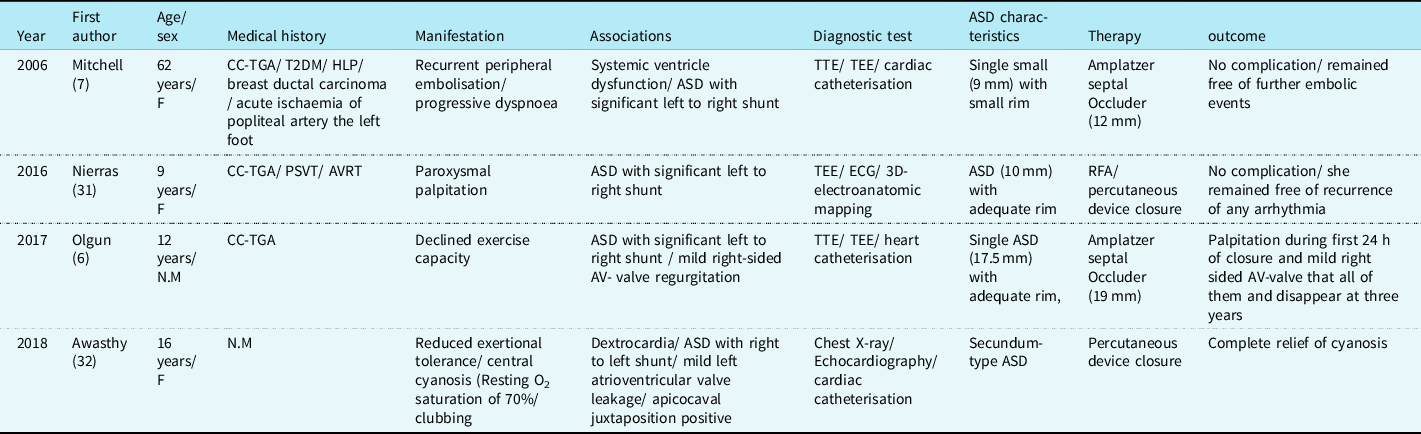
Catheter-based interventions are well-established methods for the treatment of cardiac pathologies including corrected transposition of the great arteries patients. Catheter ablation for the treatment of arrhythmias Reference Baral, Veldtman, Yue, Duke and Morgan29 and percutaneous TR repairment Reference Franzen, von Samson, Dodge-Khatami, Geffert and Baldus30 are the most common applications. It is also used for atrial septal defect closure. Isolated atrial septal defect is rare in corrected transposition of the great arteries, and the studies regarding the application of percutaneous transcatheter closure in atrial septal defect are infrequent. Herein, we reviewed the literature for the reports of this intervention (Table 2).
Previous studies on CC-TGA patients with percutaneous ASD closure.

CC-TGA, congenitally corrected transposition of the great arteries; ASD, atrial septal defect; F, female; M, male; T2DM, type 2 diabetes mellitus; HLP, hyperlipidaemia; PSVT, paroxysmal supraventricular tachycardia, AVRT, atrioventricular reentrant tachycardia; N.M, not mentioned; TTE, transthoracic echocardiography; TEE, transesophageal echocardiography; RFA, radiofrequency ablation.
We found five cases. All of these patients were young children except for a 62-year-old lady. Symptoms related to heart failure like dyspnoea and decreased exercise capacity were the most common. Having an intracardiac shunt was the most common characteristic related to corrected transposition of the great arteries. Echocardiography and heart catheterisation were the most diagnostic methods used. Four of these patients recovered from the procedure without any complication and remained free of their main complaint in the follow-up. Only a 12-year-old patient had palpitations during the first 24 hours of the procedure and abnormality in echocardiography and 24-hour Holter monitoring; these abnormalities resolved by 3 years.
Cardiac transplantation
For individuals with refractory heart failure, orthotopic transplantation seems to be the only option. Despite the higher early mortality in patients with CHD, including corrected transposition of the great arteries, long-term survival is higher in this group than that of non-CHD patients. Reference Doumouras, Alba, Foroutan, Burchill, Dipchand and Ross31 They also had better early and long-term outcomes among all recipients of donor hearts in the United States of America between 2000 and 2018 who were older than 17 years of age. Reference Riggs, Zafar, Radzi, Yu, Bryant and Morales32
Follow-up
Annual or biannual clinical evaluation is necessary for all corrected transposition of the great arteries patients regardless of the type of their previous surgical repair; patients with complicating factors such as severe systemic right ventricular dysfunction may benefit from more frequent visits. Doing these follow-ups in a centre run by a paediatric cardiologist or adult cardiologist with specific expertise in CHD is the ideal scenario. Patients should be advised to maintain a healthy lifestyle and avoid smoking. Although many cardiologists advise against doing strenuous or endurance exercise, doing regular moderate exercise is encouraged. Due to the increased risk of heart block, echocardiography should be performed at each visit; considering 24-hour Holter monitoring is also beneficial. Regular cardiopulmonary exercise testing can be profitable because it can assess functional capacity and possible arrhythmias. Echocardiography and cardiac MRI can evaluate the anatomy and haemodynamics of the heart and are two essential parts of the follow-up. Hornung and Calder Reference Hornung and Calder14 encourage performing cardiac MRI at least every 3 years. Reference Warnes8,Reference Wallis, Debich-Spicer and Anderson9,Reference Hornung and Calder14 In case of atrial septal defect device closure, 1, 3, and 6 months and then annual evaluation for the detection of likely complications such as cardiac erosion or endocarditis is recommended.
Conclusion
Although the cases of percutaneous transcatheter closure are few and cannot be generalised and recommended, we believe that the outcomes are promising and can demonstrate that this approach is practical. We also highlight the importance of individualised decision-making. Another essential factor is a rigorous follow-up after the procedure, and this should be done more frequently in patients with certain co-morbidities and complicating factors such as systemic right ventricular dysfunction. In the end, we recommend doing studies with more population, and we believe that by doing these studies, this procedure can be a well-established method for atrial septal defect closure in patients with corrected transposition of the great arteries.
Data availability statement
The data that support the findings of this study are available from the corresponding author upon reasonable request.
Acknowledgements
We thank the patients for their consent to participate in this project.
Authors contribution
ZK and AF manage the patients, MA and AS drafted the paper, MA and ZK finalised the paper. All authors read and approved final version of the paper.
Financial support
This research received no specific grant from any funding agency, commercial, or not-for-profit sectors.
Conflicts of interests
None.
Ethical statement
We took informed consent of the patients for entering the study. Additionally, we ensured that patient’s information would not be disclosed.