I. INTRODUCTION
Thermoelectric devices offer the potential for many energy efficiency improvements because they enable solid state energy transfer and conversion. Thermoelectric materials, usually semiconductors, can directly convert thermal to electrical energy and vice versa. There are two types of applications for thermoelectric devices. Thermoelectric refrigerators use electricity for solid-state cooling via the Peltier effect, and thermoelectric generators convert heat into electricity through the Seebeck effect. Although thermoelectric materials and devices have seen extensive development since the 1950s,Reference Goldsmid and Douglas1–Reference Dörling, Ryan, Craddock, Sorrentino, El Basaty, Gomez, Garriga, Pereiro, Anthony, Weisenberger, Goñi, Müller and Campoy-Quiles9 two factors still hinder their proliferation: low energy conversion efficiency,Reference Hermes and Barbosa10,Reference Karri, Thacher and Helenbrook11 and the complexity of traditional manufacturing techniques.Reference LeBlanc12
There has been significant effort to improve thermoelectric materials’ properties because of the materials’ low energy conversion efficiency. The thermoelectric material performance is usually evaluated through the thermoelectric figure of merit,Reference Ioffe, Stil’bans, Iordanishvili, Stavitskaya, Gelbtuch and Vineyard13 a dimensionless value ZT = (S 2σ/k)T, where S is the Seebeck coefficient, σ is the electrical conductivity, k is the thermal conductivity, and T is the temperature. A high ZT translates into better performance of the thermoelectric device. Substantial research has therefore been conducted on materials—from bulk to films, nanowires, and quantum dots—to increase the ZT values of materials.Reference Harman, Taylor, Spears and Walsh14–Reference Pennelli20 However, the latter challenge, namely the device fabrication technique, has not caught up with the development of materials and the requirement for construction of complex thermoelectric structures. Traditional thermoelectric device manufacturing has multiple steps—ingot pressing or sintering powders, dicing and polishing, metallization, leg dicing, and interconnect and braze/solder application—before module assembly can even begin. This process is time consuming, wastes material, and does not allow for complex geometry fabrication. These traditional material fabrication techniques are therefore a bottleneck in expanding the application of thermoelectric technology. In fact, materials improvements have largely been limited to laboratory-scale demonstrations, while device-level improvements continue to be limited by processing and device engineering difficulties.Reference LeBlanc12
Selective laser melting (SLM), also known as laser powder bed fusion, is an additive manufacturing process using a laser beam to selectively melt powder particles and build up parts layer-by-layer. Compared to traditional manufacturing methods, SLM is a material-efficient one-step process that enables the fabrication of complex three-dimensional structures. In addition, depending on the specific application, the SLM process could also reduce device manufacturing and assembly time. Since its invention in the late 1980s,Reference Deckard21 SLM has been applied to metals,Reference Gu, Meiners, Wissenbach and Poprawe22 polymers,Reference Schmid, Amado and Wegener23 and ceramic materials.Reference Zocca, Colombo, Gomes and Günster24 Application examples in the medical and industrial fields include medical scaffold, dental implant, micro-tooling, aircraft engine turbine blade, bespoke filter, light-weighted thin wall hydraulic structures, etc.Reference Yap, Chua, Dong, Liu, Zhang, Loh and Sing25 SLM has recently been demonstrated on thermoelectric materials, with preliminary reports describing the formation of single melt tracks in bismuth telluride (Bi2Te3) powder compacts.Reference El-Desouky, Read, Bardet, Andre, Leblanc and Bourell26–Reference El-Desouky, Carter, Mahmoudi, Elwany and LeBlanc28 Recently, slurry-basedReference Mao, Yan, Wu, Xie, Xiu, Yang, Zhang, Uher and Tang29–Reference Yan, Ke, Yang, Uher and Tang31 laser melting of multiple Bi2Te2.7Se0.3 layers and extrusion-basedReference Kim, Kwon, Eom, Lee, Park, Jo, Park, Kim, Im, Lee, Min, Kim, Chae, King and Son32 3D printing of Bi0.5Sb1.5Te3 were reported. The former used lubricants to form slurries and enables layer-by-layer spreading of the power material, and the latter adopted binder-mixed inks for particle deposition. The preparation of a high-quality slurry or ink with proper viscosity is an essential requirement for those processes; a post-process annealing, a pre-sintered bulk substrate, or a binder material was also required. Even though a sintering aid was used to fill void spaces, the final bulk of Bi0.5Sb1.5Te3 only showed a density of 3.91 g/cm3 (about 57% relative density).Reference Kim, Kwon, Eom, Lee, Park, Jo, Park, Kim, Im, Lee, Min, Kim, Chae, King and Son32 Bulk samples from the ink-based process also underwent about 20% shrinkage in both width and thickness after post-process annealing.Reference Kim, Kwon, Eom, Lee, Park, Jo, Park, Kim, Im, Lee, Min, Kim, Chae, King and Son32 The above challenges may be overcome using powder-based processes. Commercial SLM processes typically use loose powders, so adding a lubricant hinders the integration of thermoelectric material systems into a somewhat established manufacturing process. Selectively melting loose powder in a layer-by-layer approach would improve the viability of commercial SLM for thermoelectric materials and devices.
In this paper, we report the first demonstration of a successful SLM process on loose powders of thermoelectric material without any pre- or post-processing, pre-forming a substrate, or binder materials, so the process described herein may be directly applied in standard, commercial SLM equipment. Bi2Te3 powder was chosen not only because it is a standard thermoelectric materialReference Goldsmid and Douglas1 but Bi2Te3 alloys also continue to be among the best and most widely used thermoelectric materials for both thermoelectric refrigeration and power generation for moderate temperature heat sources.Reference Goldsmid33 Bi2Te3 is a narrow gap semiconductor,Reference Sehr and Testardi34 and it has also been of recent interest because it exhibits topological insulator behavior.Reference Zhang, Liu, Qi, Dai, Fang and Zhang35
II. EXPERIMENTS AND METHODS
The SLM process was conducted with a custom-built tool to enable flexibility in materials processed. (Commercial tools are typically specified for only a few materials such as stainless steel and titanium while our system allows for maximum flexibility for research purposes.) Bi2Te3 powders (99.98% trace metal basis, Alfa Aesar, Karlsruhe, Germany) were evenly spread and flattened inside a thin stainless steel ring (McMaster-Carr, Robbinsville, NJ, part number 97022A331) which serves as the powder bed container for one layer. For each layer, a laser scanned the surface in a pre-designed pattern. The laser processing was conducted in an enclosure purged with N2 gas. An oxygen sensor monitored the oxygen level throughout the experiment, with levels maintained at or below 4%. The laser is a 1070 nm diode-pumped Ytterbium fiber laser, operating in the continuous wave mode with output power up to 100 W (IPG Photonics, Oxford, MA, YLR-Series). The system is equipped with a mid-power scanner (IPG Photonics, P30 series) to control laser beam position. After one layer was processed, another ring was added on top, and a second powder layer was deposited inside the new ring. Then the laser repeated the scan pattern. The stacked rings eventually formed a sample holder for the desired number of additive layers. The total thickness for each layer was about 150 µm. After 8 layers, an ingot in the desired shape with a thickness over 1 mm was formed.
Control samples were made using a hot press. Two sets of the original Bi2Te3 powders (approximately 2 grams each) were hot pressed at 500 °C in a nitrogen environment at 150 MPa. The first powder sample was hot pressed for 10 min and resulted in a sample density of 6.1 g/cm3 (∼79% relative density), and the second, hot pressed for 3 h, resulted in a density of 7.1 g/cm3 (∼92% relative density).
Phase identification was conducted with X-ray diffraction, and sample imaging was performed with scanning electron microscopy. The SLM-processed samples were first gently crushed and ground into powder using a mortar and pestle. Then powder XRD was performed with a Rigaku Miniflex II Cu Kα X-ray diffractometer (Rigaku, The Woodlands, Texas). Other SLM-processed samples were cast in epoxy resin, ground, and polished to reveal the cross section along the build direction. The surface was polished down to a 40 nm finishing using an Allied High Tech Multiprep polishing system. The SEM micrographs for the cross section were then obtained with an FEI Talos Teneo LV FEG scanning electron microscope (FEI, Hillsboro, Oregon).
The density was measured using a Mettler Toledo XS204 density determination kit (Mettler Toledo, Columbus, OH), based on Archimedes’ principle. The sample was first weighed in air; then it was completely immersed in liquid and weighed again. The density was determined through the formula:  ${A \over {A - B}} \times \left( {{\irho _1} - {\irho _2}} \right) + {\irho _2}$, where A is the sample weight in air, B is the sample weight in liquid, ρ 1 is the density of liquid, and ρ 2 is the density of air (0.0012 g/cm3). Technical grade distilled water was used; it has a density of 0.99764 g/cm3 at the measured temperature of 22.7 °C.
The absolute Seebeck coefficient, S, and electrical resisitivity, ρ, were characterized in the in-plane direction. At room temperature, steady-state S and four-probe ρ were measured using a custom-designed probe, calibrated using standards and compared with a separate probe,Reference Martin, Erickson, Nolas, Alboni, Tritt and Yang36,Reference Martin and Nolas37 with an uncertainty of approximately 15% for both S and ρ. The high-temperature S and ρ were measured from 50 up to 500 °C in a He environment using a commercial Linseis LSR-3 Seebeck coefficient and electric conductivity measurement unit (Linseis Gmbh, Selb, Germany).
The specific heat c p and thermal diffusivity λ were measured in the cross plane direction from 30 to 500 °C in vacuum using a commercial Linseis Laser Flash Analyzer (LFA 1000) with a Diode-pump IR Laser and LN2-cooled IR detection system (Linseis Gmbh, Selb, Germany). The thermal conductivity k was determined using k = c pρ mλ, where ρ m is the mass density. The measured density value at room temperature was used for all temperatures to calculate thermal conductivity. The temperature-dependent thermal properties were measured in the direction perpendicular to that in which the Seebeck coefficient and electrical resistivity were measured due to restrictions in the measurement technique and sample geometry. Any anisotropy in thermal conductivity is not captured in the characterization results presented here. This is a common limitation encountered in thermoelectric property characterization, particularly for thin/thick film or small samples.
III. RESULTS AND DISCUSSION
The loose powders of Bi2Te3 were successfully processed in a layer-by-layer approach to produce a final disc-shaped part which was 8 mm in diameter and over 1 mm thick. The disk was formed with eight layers of powder with each layer about 150 µm thick. To form the disk, the optimal laser power, spot size, scan speed, and hatch distance were 25 W, ∼50 µm, 500 mm/s, and 37.5 µm, respectively. These parameters led to a laser energy density E of 1.3 J/mm2, according to  $E = {p \over {vh}}$, where p is the laser power, v is the scan speed, and h is the hatch distance.Reference Ho, Gilbson and Cheung38 The processing parameters were chosen such that the energy density was high enough to melt each layer thoroughly and low enough to avoid sample bending.
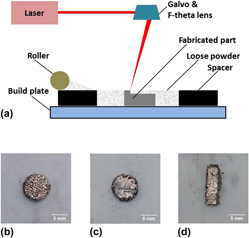
Improving density (or minimizing porosity) of the produced parts is a major challenge for SLM, regardless of whether it is applied to metals, ceramics, or semiconductors. Size distribution and particle morphology affect the ability of the powder to flow,Reference Wilkes, Hagedorn, Meiners and Wissenbach39–Reference Liu, Marziano, Bentham, Litster, White and Howes41 which influences packing of the powder bed and thus affects density (or porosity). For the case of Bi2Te3, the as-received powders had a large size distribution ranging from below 10 µm to larger than 150 µm, and the powder particles generally have irregular shapes (i.e., aspherical, high aspect ratio). Detailed powder characterization including size and morphology (e.g., aspect ratio and circularity) was reported previously.Reference Batista, El-Desouky, Crandall, Wang, Yang and LeBlanc42 The large size distribution and irregular particle shapes cause mechanical interlocking and lead to voids which cause low packing density of the powder bed before melting.Reference Batista, El-Desouky, Crandall, Wang, Yang and LeBlanc42 Consequently, the Bi2Te3 disks formed were not fully dense, as shown in Fig. 1(b). To increase density, we increased the laser power from 16 W to 25 W (changing the energy density from 0.85 J/mm2 to 1.3 J/mm2, respectively) with other parameters the same, resulting in an effective improvement of the density from 6.27 g/cm3 to 6.81 g/cm3, or 81%–88% relative density when compared to the standard Bi2Te3 density, 7.74 g/cm3.Reference Haynes43 A comparison of the samples made with low and high energy density is shown in Figs. 1(b) and 1(c). Figures 1(b)–1(d) show multiple geometries, disc and rectangular, made with the SLM process.
Optical images of parts built from commercially available Bi2Te3 powder using a layer-by-layer SLM approach. (a) Sketch of the SLM process on TE materials. (b and c) Parts in disk shape, with 8 mm in diameter. (d) Part in rectangular shape ∼3 mm × 11 mm. All parts are over 1 mm thick. The laser processing parameters were adjusted to increase the relative density. (b) 16 W of laser power resulted in a relative density ∼81%. (c) 25 W of laser power resulted in a relative density ∼88%.

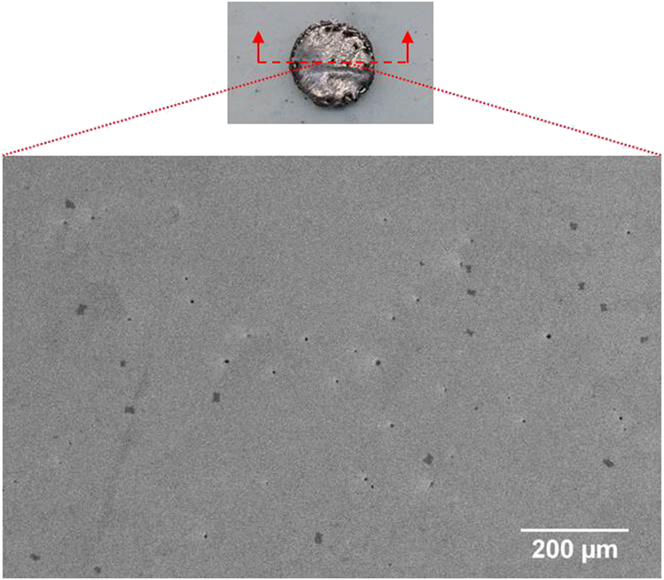
The high density sample [shown in Fig. 1(c)] was further analyzed to demonstrate the quality of melting in the SLM processing. Figure 2 shows a scanning electron micrograph of the sample’s cross section, in-plane along the build direction (perpendicular to the laser scan direction). No separation between adjacent layers was visible across the entire surface of the cross section. The surface features some spherical pores, the majority of which are approximately 5 µm or larger in diameter. Spherical pores are generated from gas trapped during rapid solidificationReference El-Desouky, Carter, Mahmoudi, Elwany and LeBlanc28,Reference Kempen, Thijs, Yasa, Badrossamay, Verheecke and Kruth44,Reference Monroy, Delgado and Ciurana45 or keyhole instability and collapse.Reference Katayama, Kawahito and Mizutani46,Reference Lee, Ko, Farson and Yoo47 This sample’s relative density, 88%, is comparable to the control samples manufactured using hot pressing on Bi2Te3 (92% relative density), suggesting that the fusion of powders was quite successful through the SLM process.
Scanning electron micrograph of a polished cross section of the SLM processed Bi2Te3 bulk sample. Each layer is about 150 μm thick; no separation between powder layers is observable.

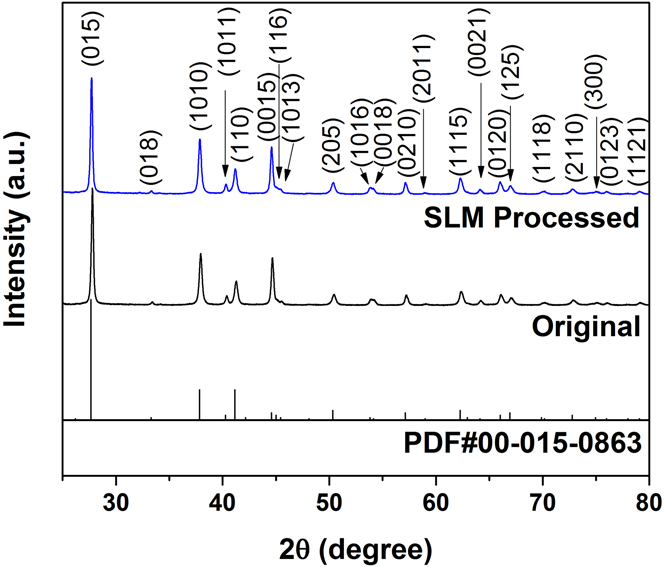
To explore any chemical or structural transition during the SLM processing, the processed samples were compared to unprocessed control samples using powder XRD. The results presented in Fig. 3 indicate that the two spectra are almost identical in the measured range, and no clear new phases were observed. Both spectra are well-matched with the database values for Bi2Te3 (PDF#00-015-0863), suggesting the SLM process preserved the structure for Bi2Te3. This result is consistent with the Bi–Te system’s phase diagram where the only possible phase crystallized from the liquid phase at 60 at.% of Te is Bi2Te3 at 585 °C.Reference Satterthwaite and Ure48 XRD peak intensity differences for Bi2Te3 from spark plasma sintering, rolling, and forging were previously reported and interpreted as crystallographic preferred orientation changes.Reference Zhao, Zhang, Li, Zhang and Liu49–Reference Euvananont, Jantaping and Thanachayanont51 However, our results do not indicate a change in preferred orientation. We did notice XRD intensity differences from coarse powders crushed from SLM processed samples, indicating a lack of random orientation. However, continuing to grind samples to fine powders led to intensities which were well-matched to the control samples, suggesting that the SLM process does not influence the intrinsic anisotropy for Bi2Te3.
XRD patterns of Bi2Te3 samples for original powders and those from SLM processed sample. Both spectra are well-matched with positions and intensities, and they match the database values for Bi2Te3 (PDF#00-015-0863).

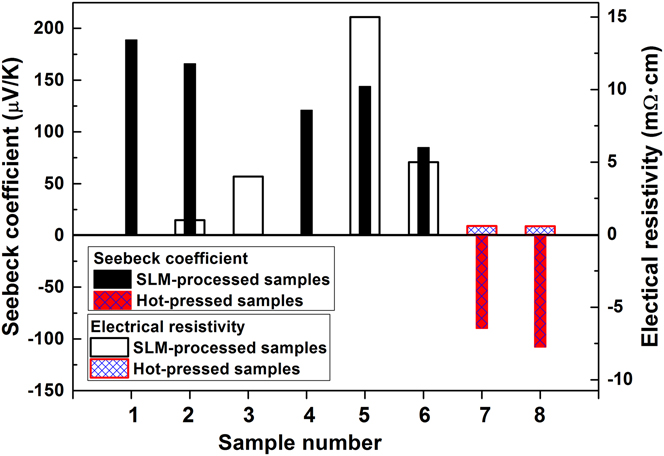
We also characterized the thermoelectric and electrical properties of the SLM-produced samples. The room temperature Seebeck coefficient, S, and four-probe electrical resistivity, ρ, were measured in the in-plane direction using a custom-designed vacuum probe. The range of S and ρ values are 85–189 µV/K from five samples and 1–15 mΩ cm from four samples at room temperature, respectively, with the majority falling between 144 and 189 µV/K and 1–5 mΩ cm. A summary of the Seebeck coefficient and electrical resistivity values is shown in Fig. 4. The measured values vary from sample to sample, and the variation is possibly related to varying powder bed layers and defect conditions (as discussed below) which are introduced from the melting and solidification process. The aspherical powder particle morphology leads to variation in the surface condition of each powder bed layer, so there may be a slight variation in the density and porosity of the produced samples. These geometric variations affect the calculations of intrinsic physical properties since only extrinsic properties are measured (e.g., electrical resistivity is extracted from a measurement of electrical resistance). Production and selection of only spherical powder particles could narrow the variation. Our results are consistent with reported experimental values, which range from 130 μV/K to 260 μV/K for Seebeck coefficient and 0.6 mΩ cm to 2.5 mΩ cm for electrical resistivity.Reference Goldsmid52 For example, our sample with room temperature S and ρ values of 166 μV/K and 1 mΩ cm, respectively, is in good agreement with the reported values of 160 μV/K and 0.7 mΩ cm on regular p-type Bi2Te3 materials.Reference Goldsmid33
A summary of the measured Seebeck coefficient and electrical resistivity at room temperature. Samples #1–#6 are the SLM-processed samples; samples #7 and #8 are fabricated through hot-pressed method on pristine powders. The processing parameters for all the samples can be found in Table S1 in the Supplementary Material.

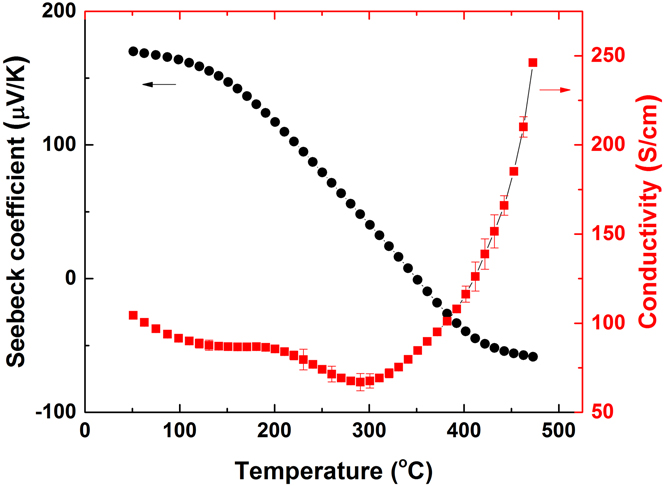
The thermal and electrical properties of the SLM-produced samples were further characterized at high temperatures. The temperature-dependent absolute Seebeck coefficient, electrical conductivity, specific heat, thermal diffusivity, thermal conductivity, and thermoelectric figure of merit ZT were characterized up to almost 500 °C in either vacuum or a helium environment using the Linseis system; the results are shown in Figs. 5 and 6. The sample measured at high temperature (yielding the data in Fig. 5) was not the same sample as that measured at room temperature, but all samples were processed in the same way. The absolute value of the Seebeck coefficient is representative of the material’s ability to convert thermal energy to electrical energy. As temperature increased, S first decreased from about 165 μV/K at 50 °C until it reached close to zero at about 350 °C. Then, the Seebeck coefficient’s absolute value increased with temperature, up to −50 μV/K at 473 °C. The electrical conductivity shows a similar behavior, initially decreasing and then increasing around 300 °C.
The absolute Seebeck coefficient and electrical conductivity from 50 to 473 °C for the SLM-processed Bi2Te3 sample. The conductivity data were averaged over a set of ten measured values, and the uncertainty bar shown is from the standard deviation. The uncertainty on the measured Seebeck coefficient is ±7%, according to the Linseis technical specifications.

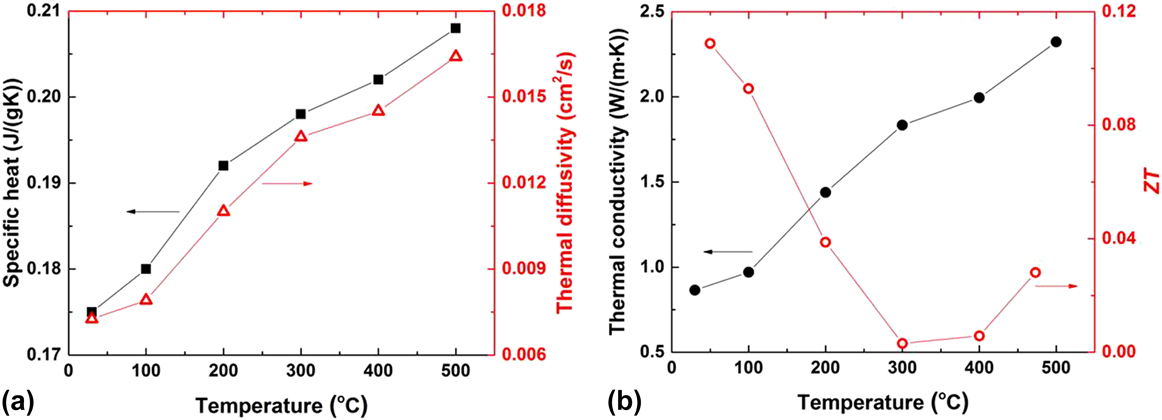
The thermoelectric properties for the SLM-processed Bi2Te3 sample from 30 up to 500 °C. (a) Both the specific heat (square) and thermal diffusivity (triangle) increase with increasing temperature in the measured temperature range. The uncertainties for specific heat and thermal diffusivity are ±5% and ±2.4%, respectively, according to the Linseis technical specifications. (b) As the temperature increases, the thermal conductivity (filled circle) increases, and the thermoelectric figure of merit, ZT (open circle), first decreases until 300 °C then increases.

Both the thermoelectric and electrical behaviors are in agreement with previous reports. Unlike thin films which can be p-type or n-type,Reference Zou, Rowe and Min53–Reference Kim, Choi, Bae, Kim and Oh55 both single crystals and polycrystalline bulk samples of Bi2Te3 are p-type at room temperatureReference Satterthwaite and Ure48,Reference Goldsmid52,Reference Vasenin56–Reference Nolas, Sharp and Goldsmid58 if the sample is grown slowly from a stoichiometric melt without intentional doping. There are consistent reports that Bi2Te3 bulk samples undergo a p-to-n conversion while heated at high temperatures if the annealing time is short (less than 4 h, e.g., Ref. Reference Schultz, McHugh and Tiller59). The magnitude of the negative S values increases as the temperature increases,Reference Vasenin56,Reference George, Sharples and Thompson60 which is consistent with our results (see Fig. 5). Even thin film samples which are n-type at room temperature show the same trend: an increasingly negative S and ρ that first increases and then decreases with increasing temperature.Reference Kim, Choi, Bae, Kim and Oh55
There are differing perspectives about the cause of the p-to-n transition. One theory explains the transition based on crystalline vacancy defects.Reference Schultz, McHugh and Tiller59 Point defects act as donors or acceptors depending on their energy level relative to the Fermi level. In this theory, tellurium vacancies are the electron donors and the predominant active point defects in the Bi2Te3 system. The original p-type material is driven to n-type because the higher temperature effectively generates additional Te vacancies for short-time heating. The conversion from p- to n-type reflects the relative concentrations and position of the Te and Bi vacancy energy levels. George et al. also suggested that an increase of vacancy concentration, due to both thermal excitations and sintering effects,Reference Bernard61 will result in a n-type material because the vacancies act as hole traps.Reference George, Sharples and Thompson60 The idea of vacancies in Bi2Te3 playing a significant role was supported by several studies.Reference Miller and Li62–Reference Drasar, Lostak and Uher67 However, Hashibon and ElsässerReference Hashibon and Elsässer68 suggested that antisite defects, TeBi and BiTe, instead of vacancies, play a dominant role in the electrical and thermoelectric properties of Bi2Te3. The antisite defect BiTe leads to p-type conduction as an acceptor, and TeBi leads to n-type conduction as a donor. The authors also rationalized the original formation of p-type Bi2Te3 by claiming that there are more Te sites than Bi sites in the lattice (3:2 ratio), so the excess of BiTe defects leads to p-type semiconducting behavior. Kim et al.Reference Kim, Choi, Bae, Kim and Oh55 explained their experiment results using this antisite defect model.
In summary, changes in electrical and thermoelectric properties can occur in binary compounds like Bi2Te3, depending on the thermal history of the material.Reference Schultz, McHugh and Tiller59 Although there are different explanations, a common theme is the electrical and thermal behavior of Bi2Te3 depends heavily on crystalline point defects, be they vacancy defects, antisite defects, or other types of point defects. To identify which effect dominates is beyond the scope of this work; however, we propose a general framework to explain our experimental results. The original sample is p-type with holes as the majority carriers. As temperature increases, increasing point defects act as donors until the material eventually becomes n-type. During this process, the material experiences a carrier density decrease from the annihilation of the promoted electrons and existing holes. The large decrease in the carrier concentration is accompanied by a slight increase in the carrier mobility, as supported by the findings of other studies.Reference Kim, Choi, Bae, Kim and Oh55,Reference Kim and Lee69 The end effect is an increase in ρ with the initial increase of temperature, as shown in Fig. 5. As the temperature further increases to above 300 °C, the mobility of carriers sharply increases, similar to the results of Kim et al.Reference Kim, Choi, Bae, Kim and Oh55 This improvement in the carrier mobility probably comes from grain growth of the material and a reduction in scattering centers during the high temperature treatment.Reference Kim and Lee69 Grain growth in Bi2Te3 was directly observed and supported by Schultz et al.Reference Schultz, McHugh and Tiller59 No grain growth was observed in the bulk Bi2Te3 specimens at 325 °C, but grain growth was observed at 400 and 500 °C. Higher carrier mobility leads to larger electrical conductivity, which is consistent with our observations.
To verify the conjecture that annealing leads to a transition from p- to n-type semiconductor, the pristine Bi2Te3 powders were hot-pressed to bulk format at 500 °C in a N2 environment and then measured at room temperature. Two hot press runs, one for 10 min and another for 3 h, generated bulk samples with densities of 6.1 g/cm3 and 7.1 g/cm3 (about 79% and 92% relative density), respectively. The thermoelectric and electrical properties of both samples agree. The higher density sample had an S of −108 μV/K and ρ of 0.58 mΩ cm while the other sample’s properties were −90 μV/K and 0.6 mΩ cm, respectively. Compared with the positive S values from the SLM-produced samples, these results confirm high temperature annealing changed Bi2Te3 from a p-type to n-type semiconductor.
Figure 6(a) shows the measured specific heat and thermal diffusivity in the cross-plane direction; both properties increase with temperature. The thermal conductivity was then calculated according to them. The thermal conductivity increased with increasing temperature over the entire measurement region as shown in Fig. 6(b). With measured properties, the thermoelectric figure of merit ZT was calculated, as shown in Fig. 6(b). The behavior of ZT with temperature is primarily dominated by the electrical conductivity and the Seebeck coefficient. ZT first decreased with increasing temperature until about 300 °C, slightly increased between 300 and 400 °C, then increased more sharply with increasing temperature. The highest ZT value was about 0.11 at 50 °C. The S and ZT values of the SLM-processed bulk Bi2Te3 are in the same range as other p-type or doped n-type bulk samples.Reference Wright70 These results indicate that the SLM method is capable of producing Bi2Te3 samples with thermoelectric properties comparable to samples produced by traditional methods.
IV. CONCLUSION
The results presented here demonstrate successful SLM of a thermoelectric material (Bi2Te3) from a loose powder. Even though the powder morphology made spreading of thin layers a challenge, loose powder was processed in a layer-by-layer approach to build a bulk solid without requiring any pre- or post-processing. Although low relative density is a challenge for the SLM technique, effective selection of processing parameters enabled a final part relative density of 88%; pores on the surface and within the body of the parts were still evident. The structure and physical properties of the final bulk parts were fully characterized. SEM micrographs did not show separation between adjacent layers, suggesting sufficient melting within and between layers. The X-ray diffraction measurements confirmed the structure and the crystallographic preferred orientation of Bi2Te3 were conserved during the laser processing. The temperature-dependent Seebeck coefficient, electrical conductivity, specific heat, thermal diffusivity, and thermoelectric figure of merit ZT of the laser melted Bi2Te3 sample consistently indicated an evolution of defects, carriers, and mobility with temperature, and these property changes as a function of temperature explain the observed p- to n-type transition at around 350 °C. The SLM-produced Bi2Te3 bulk sample had similar thermoelectric and electrical properties to those fabricated from traditional methods. Although SLM of thermoelectric materials is nascent, this work attests to its viability and signals its applicability to other thermoelectric materials.
Supplementary Material
To view supplementary material for this article, please visit https://doi.org/10.1557/jmr.2018.390.
ACKNOWLEDGMENTS
We would like to acknowledge support from Oak Ridge National Laboratory Manufacturing Demonstration Facility RAMP-UP (Subcontract 4000145175), Virginia Center for Innovative Technology (CRCF Award MF16-020-En), and GWU University Facilitating Fund. We are especially grateful to James Ridenour and Dr. Christopher L. Cahill for equipment use and assistance with the XRD work, and we wish to acknowledge Linseis Inc. for the assistance of characterization of thermal and electrical properties. G.S.N. acknowledges support from the National Science Foundation Grant No. DMR-1748188. D.H. acknowledges support from the II-VI Foundation Block-Gift Program. Electron microscopy was conducted in The George Washington University Nanofabrication and Imaging Center.