By 1937, the Fascist regime had been mobilising women politically for some time. Although the Fasci Femminili (FF – Fascist Women's Groups), which had emerged spontaneously in the early years of fascism, had initially managed to survive largely only on sufferance from the male party hierarchs, from the early 1930s, as part of the regime's new policy of ‘going to the people’, they began to be encouraged and expanded. This process accelerated further in the late 1930s due to their prominent role in the mobilisation of the civilian population against the League of Nations sanctions triggered by the Ethiopian War.Footnote 1
Female party membership had been boosted, in 1933, by the creation of a mass organisation for peasant women, the Sezione Massaie Rurali (Rural Housewives Section), and by late 1937 membership of the FF had risen to 743,786 and of the Massaie Rurali to 895,514.Footnote 2 But these substantial membership figures (which continued to rise in the following years) still excluded many sections of the adult female population. An additional organisation was needed if Party Secretary Achille Starace's somewhat surreal aim of putting the entire Italian nation into some sort of Fascist uniform was to be achieved. It was in the hope of achieving this kind of totalitarian organisation of women that, on the first day of ‘year XVI of the Fascist Era’ (28 October 1937), the Sezione Operaie e Lavoranti a Domicilio (SOLD - Section for Female Workers and Outworkers) was officially launched.Footnote 3
This large but little-known organisation has been almost entirely ignored by the still somewhat patchy historiography on the role of women in Fascist Italy.Footnote 4 It does, however, merit investigation, both in order to deepen historical understanding of women's experience of the Fascist regime and also because its attempt to reach out to sections of the female population hitherto largely excluded from the political sphere makes it an interesting milestone in the history of female politicisation in twentieth-century Italy.Footnote 5 Only a few years later, all of its members were to gain the right to vote and to stand for political office in the new-born Republic. Although many historians have tended (quite rightly, in many respects) to locate the roots of women's post-war political role in the wartime Resistance movement, we still need a fuller understanding of the wider context, a context which, of course, includes the political role of women during the twenty-year period of Fascist rule.
The organisation's history also sheds light on a hitherto unexplored corner of the Fascist attempt to forge a ‘totalitarian state’. Much recent historiography, particularly the currently fashionable cultural readings of the Fascist period, seems to take the regime's totalitarian claims for granted,Footnote 6 and the history of SOLD does indeed serve as a good illustration of the regime's great determination to pursue this aim. How effective it actually was in transforming the attitudes and political beliefs of those it recruited is, however, less clear.
SOLD: Aims and Members
According to Article 3 of its founding regulations the new organisation's purpose was:
a) to promote fascist and educational propaganda among women workers, favouring the improvement of their professional and domestic capacities;
b) to provide moral and social assistance for women workers, particularly regarding their feminine responsibilities;
c) to help women workers enrolled in the Section find employment, through the appropriate offices, to facilitate outworking on behalf of third parties and to encourage the application of all the welfare measures and social insurance that the regime provides for women workers.Footnote 7
According to these regulations, membership was open to: ‘women workers employed in factories or other manufacturing workplaces, outworkers, and women from working-class families, who are old enough to join the Fasci Femminili’.Footnote 8 This phrasing, somewhat misleadingly, gives the impression that SOLD was primarily for industrial workers, and this was further reinforced by Article 5, which stated that: ‘SOLD sections can be set up in Fasci Femminili located in those parts of provinces where there is a good deal of industrial or artisanal activity’. In practice, however, although industrial workers were indeed an important focus of the organisation's activities, it also recruited domestic servants. This involved some linguistic slippage as the fact that they were not explicitly mentioned means that they had been subsumed in the category of outworkers, a classification that ignored the fact that servants worked, not in their own homes, but in the homes of others. This fitted well with Fascist preconceptions of gender roles which saw any sort of work within the family (including outwork of all kinds) as the most suitable for women. Servants were, however, mentioned in a later, revised version of the regulations in which the phrase ‘welfare and job placement for servants’ was added to clause 3c.Footnote 9 The organisation also gradually tried to recruit other categories of workers, such as, from August 1938, nurses and nursing orderliesFootnote 10 and, from July 1940, travelling saleswomen.Footnote 11
The fact that working-class housewives without extra-domestic employment were included was significant as this reinforced the idea that the new section was not intended to be a trade union. In Fascist ideology, women were supposed to think of themselves as mothers, or future mothers, and so an organisation such as this, which grouped various kinds of women rather than various kinds of workers, was deemed more suitable. As will be demonstrated below, although the organisation did offer some professional training it also provided a great deal of domestic science. The inclusion of women without employment also helped underscore the ideologically important idea that the regime was not doing more for female workers than for housewives.
Nonetheless, despite the regime's consistent ideological opposition to women's employment and its promotion of a domestic role for them, there were substantial numbers of working women in inter-war Italy. Although legislation was introduced to restrict female access to the labour market, it was patchy, primarily targeted at the middle class, and mostly concerned with keeping women in specific, subordinate work roles rather than actually preventing them from working.Footnote 12 This was a realistic approach given that female wages were essential for many poorer families. According to official figures, there were 1,377,373 female industrial workers in 1936. Numbers rose further with Italy's entry into the Second World War, although war work was never made compulsory for women. Forced mobilisation of civilians was unnecessary both because of the abundant labour supply and because Italy's lack of coal and iron ore rendered gearing up to a full war economy impossible.Footnote 13
Some industrial workers worked in factories but many were outworkers. Admittedly some of the latter were from ‘pluriactivity’ rural households and, as such, eligible to join the existing section for peasant women but outworking was also common in urban areas. Exact numbers of outworkers are unknown (census statistics provide little help here) but all commentators agree that they were extremely numerous.
The number of servants was actually increasing.Footnote 14 According to census statistics, their numbers rose from 380,614 in 1921 to 469,510 in 1931, and to 554,076 by 1936. There were, moreover, undoubtedly many more part-time domestics who went uncounted by census enumerators. In this period, nearly all servants were female – 95% in 1936 – and this meant that 10.5% of all women and girls officially classified as ‘economically active’ did this kind of work.
In 1937, some female workers already belonged to Fascist trade unions. In 1925, the Fasci Femminili leadership had devised a plan to set up their own unions and they even entered into discussions with the head of the Fascist unions, Edmondo Rossoni, about this idea but the project, which involved a division of labour whereby the unions negotiated employment contracts and the FF tended to members’ welfare needs, came to nothing.Footnote 15 Women could, nonetheless, join mixed Fascist unions, and indeed some had to, given union control of labour exchanges. Although, to date, there is a dearth of research on the gender aspects of Fascist trade unions, the fact that only one had a female leader (Maria Vittoria Luzzi of the midwives’ union) seems telling. Many categories of women, moreover, continued to lie beyond the reach of Fascist political organisers. No Fascist organisation of any kind, for example, had ever explicitly tried to recruit servants.
In theory, even servants could have joined the FF since, according to its 1932 regulations, the only qualifications were to be female, Italian and ‘of exemplary moral conduct and firm Fascist faith’.Footnote 16 It is, however, unlikely that many did so, as the activities of the FF were mainly the dispensing of politicised welfare and – although systematic analysis of FF membership is impossible because virtually no membership files have survived – what evidence there is suggests that the majority of the members were upper or middle class. Servants undoubtedly saw the FF as an organisation for their lady employers, not one that they themselves might join.
The minimum age for FF or SOLD membership was twenty-one (although younger women could join if married). Younger women were instead recruited by the party's youth organisations, themselves undergoing a major reorganisation at the time with the creation of the umbrella organisation GIL (Gioventù Italiana del Littorio – Italian Youth of the Lictors) in October 1937. Even before this, in January 1937 the Giovani Fasciste (Young Female Fascists – for those aged 18–21), had foreshadowed SOLD by creating five specialised subsections, including one for ‘young female workers’, in an attempt to broaden its predominantly middle-class membership.Footnote 17 The following month, reduced membership rates were introduced for working-class or peasant members of the Giovani Italiane (Young Female Italians – for those aged 14–17) and Giovani Fasciste.Footnote 18
Although considered equivalent to full party membership, it was much cheaper to join SOLD than the FF. In 1937–8, for example, provincial federations charged between 6 and 12 lire per annum for FF membership (exactly the same as for men), whereas SOLD membership cost just 2.50 lire.Footnote 19 SOLD membership, moreover, entailed only the purchase of a neckerchief and a metal badge to be worn on everyday clothes, rather than an FF tailored uniform. As one reply to a ‘reader's letter’ in the SOLD newspaper noted: ‘A uniform would represent quite a financial burden for certain categories of modest workers and the party wanted and wants to avoid this’.Footnote 20 In 1941, for example, the SOLD badge cost just 1 lira, compared to 4 lire for a standard badge of the National Fascist Party (the Partito Nazionale Fascista, or PNF) and 3 for the neckerchief,Footnote 21 whereas an FF uniform could be as much as 400 lire.Footnote 22
The black triangular neckerchief was adorned with the fascio littorio and the word DUCE scattered over it in white lettering. According to Alba Pochino:
the finest things are represented in the neckerchief: - the black of the glorious Blackshirts, sanctified by the blood of our Martyrs, - the Fascio Littorio, symbol of the power of the imperial Rome of yesterday, of today, tomorrow, and always, - and the word DUCE, repeated many times, like the acclaim of the Leader, the Leader who has returned Italy to its imperial heights.Footnote 23
At rallies and other political events, the neckerchief was often worn with factory overalls. The badge featured a small fascio littorio with a tricolour background and the letters O. L. D. picked out in gold.Footnote 24 SOLD organisers, in contrast, wore the standard FF black tailored uniform with (from February 1938) insignia denoting their SOLD responsibilities – a black cloth badge with a large gold letter M in Mussolini's cursive script, with gold stars or stripes for provincial or local SOLD secretaries respectively. From September 1938, ‘Fascist home visitors’ who specialised in SOLD activities also got special badges. For rallies, each SOLD provincial section had a banner and local sections a pennant, both featuring a fascio littorio on a black background, with a tricolour border and gold lettering.
The founding regulations stated that: ‘The workers and outworkers who currently have FF membership can retain it or ask to be transferred to the Section for Workers and Outworkers. Equally, they can belong to both the FF and SOLD.’Footnote 25 At first this seems to have threatened levels of FF membership. A memo drafted in March 1938 by Clara Franceschini and Rachele Ferrari del Latte noted that, ‘this year many Fascist women – particularly in northern industrial areas – have not renewed their FF membership cards and have transferred to the Section for Workers and Outworkers, preferring that Section, partly because membership is cheaper’.Footnote 26 Their proposed remedy, that worker members of the FF be offered dual membership of both organisations at a reduced price of 7.50 lire, was initially rejected by the PNF Deputy Secretary Adelchi Serena but later partially adopted in the form of dual membership at 3 lire, but only for women who could not afford the full rate.Footnote 27
SOLD activities
SOLD offered its members a wide range of educational and recreational activities. Although their primary purpose was to sugar the pill of political propaganda, and despite the fact that they constantly tried to hammer home the message of women's maternal destiny, many of these activities potentially had a modernising effect, perhaps unintended, on the members. They provided opportunities for, among other things, professional training, travel, self-improvement and, sometimes, just sheer fun. They took women out of the home, helped widen their horizons and undoubtedly contributed to the organisation's appeal.
Training courses, which combined propaganda with practical instruction, were a major activity. In a report to a meeting of the FF Central Committee, for example, Clara Franceschini claimed that in 1940–1 SOLD had run 12,000 courses attended by 230,000 members.Footnote 28 Where relevant, members simply joined pre-existing courses run by the FF, Massaie Rurali or trade unions, but SOLD also had its own courses, run on party premises or, on occasion, in factories, usually in co-operation with a firm's fascist leisure club (dopolavoro).Footnote 29 This included professional training such as specialised courses for nannies and cooks or in industrial subjects, but many courses focused primarily on women's domestic and maternal skills, rather than on workplace skills. General domestic science was very common but there were also courses on subjects such as childcare, dressmaking, embroidery, darning and mending, or domestic crafts like hand-weaving. Some areas offered literacy courses for those who needed to catch up on basic education, German tuition (for those planning to work abroad) and ‘colonial skills’ (to prepare young women for a future as wives in the Italian empire). Many SOLD courses, however, were broader, just a series of lessons on things like domestic science, religion and childcare. The propagandistic aspects were pretty pervasive and all courses included at least some teaching of ‘Fascist culture’ (which usually meant topics like the history of Italy and of Fascism, the ‘achievements’ and ‘benevolence’ of the regime, the structure of the corporative state and so on). A major theme of all domestic science training was the autarkic ‘fight against waste’. In early 1940, for example, a film on this topic, made by the National Agency for Scientific Management (Ente Nazionale per l'Organizzazione Scientifica del Lavoro), was screened at meetings of domestic servants around Italy.
Teachers on courses included schoolteachers, FF activists and staff from the Fascist trade unions and the OND (the regime's mass leisure organisation). Assistance with training and other activities also came from industrial social workers employed by the unions.Footnote 30 Industrial social work was a profession promoted by the regime as suitable for women, providing ten-month training courses in a party-run residential college (the Scuola Superiore Fascista di Assistenza Sociale), founded in 1928, at San Gregorio al Celio in Rome.Footnote 31 Factory social workers employed by private firms were also asked to contribute but only with activities organised for their own workforces.Footnote 32
Some of the training was linked to the Littoriali Femminili del Lavoro. A male version of these national competitions had been going for some time but in 1939 a women's Littoriali, organised by female students from the Fascist university groups and assisted by the FF, was added. The competitors were industrial or agricultural workers, aged 18–28, members of SOLD, the Massaie Rurali or GIL. Competitors for the industrial sections were selected by local SOLD secretaries and then given training in technical and political subjects. The technical training was related to the competitor's area of work. The political training covered ‘women's tasks – the principles and history of Fascism – the organisation and functions of the party – the reasons for and the features of the racial policy – the trade union and corporative system, with particular reference to autarky – lastly, the spiritual and political development of the Empire.’Footnote 33 From 1940, two new competitions on ‘women's preparation for family life’ were added to the list of technical subjects (for which, from 1942, the first prize was a ‘dowry savings book’ from which money could only be withdrawn upon marriage). Local, then provincial, heats were staged, followed by national competitions, consisting in political and practical tests. Even the practical competitions could have a political theme. Shirt-makers, for example, were tested on how well they could make a black shirt for a Fascist uniform. Large numbers of women competed in these events. In 1941, there were 30,224 in the first round, 17,018 at the ‘prelittoriali’ and 1,243 at the finals.Footnote 34 During the war new sections were added, such as a competition for lathe workers, reflecting the changing employment situation.
SOLD also ran numerous competitions. The demographically-themed ‘Proles’ competition, funded by ONMI, the regime's maternal welfare organisation – and supposedly standing for ‘Per Romanamente Onorare Lavoro e Specie’ (To Romanly Honour Work and Species)Footnote 35 – was for ‘well-reared offspring’. The prizes of layettes, clothing, household utensils and diplomas, awarded to mothers of large families who were judged to have raised their children particularly well, were distributed ceremonially on 24 December, the annual Fascist ‘Mother and Child Day’.Footnote 36 Many Federations offered ‘Fedeltà’ (fidelity) prizes for servants or workers who had loyally worked for the same family or firm for many years. In Rome in 1940, the winners were Palmira Dandina (a domestic servant), and Assunta Succucci (a worker), each with fifty-five years with the same employer.Footnote 37 Other competition themes included ‘the clean and tidy home’, ‘the floral balcony, patio or windowbox’, singing, dressmaking, the best student on a training course, the decoration of a market stall (for travelling saleswomen), the ‘fight against waste’ or even strange, ‘autarkic’ skills such as weaving dog hair.Footnote 38 Typical prizes included household items, diplomas, money or outings.
SOLD also provided numerous recreational opportunities, such as sports, film screenings, drama groups, choirs and outings. Some outings were explicitly political, such as ‘pilgrimages’ to Mussolini's birthplace in Predappio or attending political rallies, but there were also trips to concerts and plays or jaunts to historic sites or beauty spots, albeit usually leavened with at least some propaganda. In 1941, for example, 150 workers from central Palermo went on a trip to Monreale:
After hearing Mass at the Sanctuary on the heights of Monreale, they joyfully and serenely ate a meal which had been prepared for them on the spot. Afterwards they visited the magnificent Cathedral and then ended their lovely day off with expressions of faith and devotion to the Duce and recognition for their female hierarchs who look after them with such loving care.Footnote 39
Similarly, film screenings could combine both aspects. In 1941, in Cremona, for example, a screening included a comedy (Felicità Colombo), a propagandistic documentary and a cartoon. There was also a live orchestra and speeches from local FF leaders.Footnote 40
From 1939, SOLD (in collaboration with the Fascist unions, GIL and the industrialists' corporative organisation) ran summer holidays (‘turni di riposo’) at seaside or mountain locations. In addition to walks and swims, these included: ‘autarkic works, lessons in domestic science or Fascist culture with appropriate commentaries on the War Bulletins, interesting sessions round the radio . . . the solemn flag-raising ceremony and the pious, thoughtful time of communal prayer’.Footnote 41 In 1941, 3,330 women from thirty-eight provinces participated in the ‘turni’.Footnote 42 Funding for this initiative came from the party, the unions and private donations. In Varese, for example, the premises and much of the funding were provided by Arcangelo Castelli di Gemonio, a local industrialist.Footnote 43 This recourse to private funding may be one reason why most of the holidays were in richer northern areas. In 1939, of twenty-eight provinces that organised ‘turni’, only three, Catania, Naples and Taranto, were southern.Footnote 44 In 1942, holidays were organised in three northern spa resorts. A few women from each federation were chosen for the free 12–15 day holidays (the participants paid only travel expenses, with special discounts) which included daily ‘thermal treatments’. They were selected according to ‘how long they had been SOLD members . . . their economic situation, as well as the military, fascist and demographic merits of members of their families’.Footnote 45
Some Federations provided additional services for members. In 1938, for example, there was a special doctor's surgery for SOLD members in ModenaFootnote 46 and, by 1942, Pisa had a ‘social advice office’.Footnote 47 Members were also offered handouts and cut-price goods. These included the opportunity to apply for a reduced price Necchi sewing machine, an extremely desirable item for a working-class family. Necchi, a firm with close political connections to the regime, offered the reduction for free to a few ‘deserving’ members. In return, Necchi benefited from tariff protection and, as the main Italian producer, did well out of the autarky campaign. For example, schools that bought Singer sewing machines were reprimanded.Footnote 48 Other handouts ranged from free concert tickets to hot soup for market stall holders or study grants for members’ children. In Catania, a lottery was even held in 1940 where the prizes were 2,000 lire dowries.Footnote 49 Some handouts were primarily incentives to attend meetings. In Palermo in 1942, for example, at a SOLD meeting in the state tobacco factory: ‘Following a talk about “Wartime food policy: rationing and consumption” there was a prize-draw of useful and attractive gifts for the home, which were much appreciated by the worker members’.Footnote 50 Some handouts were only available to certain categories of members, such as those with many children, or to reward those who had recruited more than five new members.Footnote 51
Many SOLD activities were provided in collaboration with other Fascist organisations. This was partly because it was founded at a time when numerous other organisations, with overlapping functions, already existed but also because the middle-class FF organisers lacked the technical know-how for most of the training. The Fascist unions, for example, contributed (as outlined above) to some of the training activities and they also edited the SOLD newsletter. This was a period when, after years of great weakness in the ‘corporative’ structures, the unions were beginning to recover at least a little influence in the regime, and were paying increased attention to welfare and training.Footnote 52 For practical reasons, many activities were organised jointly for SOLD and Massaie Rurali members. Co-operation with GIL was particularly close because many female factory workers and domestic servants were quite young. Consequently, the workers’ section of the Giovani Fasciste functioned, in part, as a junior SOLD section, and its members often participated in activities offered to the adult membership.Footnote 53 GIL, in turn, opened many of its ‘meeting places for young female workers’ to SOLD members.Footnote 54 By May 1941, GIL had 134 such meeting places.Footnote 55
Another SOLD activity was garment-making workshops. The FF had run initiatives like this for some time, effectively a continuation of a ‘welfare’ activity pioneered during the First World War when middle-class women had helped run workshops producing military uniforms.Footnote 56 As early as 1923, the Gruppo Femminile Fascista of Reggio Emilia, for example, had a ‘Training Workshop’ where ‘needy girls’ stitched garments under portraits of Mussolini.Footnote 57 Once SOLD was founded, the workshops were incorporated into its programme of activities. In some workshops, Giovani Fasciste or FF members sewed and knitted garments for charitable distribution but more often this was done, under FF supervision, by unemployed women in return for either wages or the profit from the sale of the goods. Both kinds of workshop had a training dimension. According to a party survey, in 1937, there were about 200 FF-run sewing workshops. Over half the provincial federations had at least one.Footnote 58 None were commercial operations, but run as a form of welfare. They mainly produced Fascist uniforms, sports outfits for party holiday camps or layettes for new mothers, all to be distributed free to poor families. Some made clothes for welfare institutions. In 1937, for example, when orders for other work were low, the Vicenza workshop made clothes for the provincial mental hospital.Footnote 59 During the Ethiopian War and the Second World War, SOLD workshops also made military uniforms.Footnote 60
SOLD also ran a campaign for the take-up of social insurance, focusing particularly on the extension of invalidity and old age insurance to outworkers. Managed by the Istituto Nazionale Fascista della Previdenza Sociale (INFPS – founded 1933), this was a voluntary, not compulsory, scheme. SOLD sections were supposed to collect applications to join the scheme and forward them to INFPS.Footnote 61 A further important campaign, related to ‘Technical Training Day’, staged annually from 1941, which aimed to promote national productivity, was to get women to take more technical training and also to encourage their children in this direction. The emphasis on practical and technical training for the working class and peasantry became, of course, a core Fascist education policy with the launching of the School Charter in 1939.
Many activities specifically targeted servants. These included ‘Sunday meeting places’ offering leisure activities, professional training and political lectures. The FF also ran campaigns to ensure servants had compulsory medical checks, a procedure that, despite a welfare gloss which claimed that it helped servants by identifying medical problems requiring treatment, was undoubtedly primarily to protect the employer's family from potential infection. A ‘Fascist home visitor’ (a middle-class, female volunteer) was meant to be on duty in the facilities where the check-ups took place. SOLD also ran information and assistance offices for migrant servants passing through railway stations. It also intervened in the recruitment process.Footnote 62 Each Labour Exchange for Commercial Workers (run by the Fascist unions) set up a special office for servants, where a Fascist home visitor would vet applicants for their suitability. The division of labour was that the unions dealt with ‘the technical aspects . . . leaving the spiritual and political aspects and welfare assistance to the Fasci Femminili (SOLD)’. Once a servant was offered a new job she would once again meet the home visitor to receive information on the local ‘opportunities’ the regime provided (mostly SOLD activities). The home visitor also passed her name to the party section nearest to her new place of employment to ensure she continued to receive ‘moral and political assistance’.Footnote 63 This rather strange system (given that many FF members were themselves employers of servants) obviously afforded excellent opportunities for political propaganda and recruitment.
SOLD members took part in the choreographic aspects of the regime, such as mass rallies and parades. These included a huge rally of 70,000 Fascist women, staged in Rome in 1939. The awarding of prizes from SOLD's many competitions, the annual distribution of membership cards, the blessing of section pennants, or even simply the opening of training courses, were all used as excuses for pomp, ceremony and propagandistic speeches.
The war, of course, had an effect on SOLD activities. New courses appeared, to prepare members for new, hitherto male, work roles or to train them to make military clothing. They were also encouraged to grow vegetables, raise poultry on urban balconies and report anyone flouting the price-control or rationing systems. Some SOLD members became involved in FF welfare activities such as knitting garments for front-line soldiers, visiting military hospitals, mending the uniforms of wounded soldiers or staging entertainments for them and corresponding with serving soldiers as ‘war godmothers’. SOLD members, however, were more frequently the beneficiaries than the dispensers of wartime welfare. Some sections ran canteens for female workers, an attractive initiative at a time of food shortages.Footnote 64
Lavoro e famiglia
SOLD had its own four-page monthly newspaper, Lavoro e famiglia (Work and Family), published from March 1938 to May 1943, which was produced by the Fascist industrial workers’ union for the Fasci Femminili and distributed free to SOLD members via local sections. Mingling practical advice with political propaganda, it included ‘news’ of various kinds (from accounts of political events to articles on the role of women in Italy's Axis allies Germany and Japan), copious domestic science advice including recipes and tips for ‘fighting waste’, information on ‘careers suitable for women’, regular news of SOLD activities around Italy, accident prevention information, articles on suitable sports for women, profiles of interesting or heroic women past and present, a legal column explaining the numerous clauses of the Civil Code and, in the last few issues, short stories. Although it did occasionally publish articles written by ‘readers’, most were penned by hierarchs from the Fascist Party or unions. There was also a back-page column where ‘Emma’ (Margherita Armani) replied to readers’ letters on political or practical questions such as how to access welfare assistance of various kinds, including social insurance.
Virtually everything, from advice on how to shop wisely at market to information on employment legislation, from cookery tips to discussions of how to bring up children, was drenched with large doses of political propaganda. The relentless diet of good news mainly focused on the themes of all the good things that the regime was doing for workers, the greatness, goodness and infallibility of the Duce and, more broadly, the triumphant progress Italy had made under Fascism, compared to the dark days of the past. Various other Fascist campaigns were prominent too, including ruralisation, race, demography and autarky. Rural readers, for example, who wrote to ‘Emma’ asking how to find an urban job were advised to stay where they were and perhaps try rural handicrafts if they needed work. Indeed, a general message of many articles was the idea that everyone should remain in their allotted place and not aspire to anything different. Workers should remain workers (preferring technical training to anything that might lead to ‘unsuitable’, bourgeois, forms of employment) and women should opt only for appropriate jobs and ultimately hope to be homemakers. Even the housework columns emphasised how workers had no need of luxury in a home since, instead, a good, thorough clean would suffice. The level of propaganda crescendoed after Italy entered the Second World War in June 1940, when the paper began to include a good deal of (mis)information on the triumphant progress of Italy's armed forces and the inevitability of victory as well as, of course, many articles on women's role in the war effort.
There were numerous articles about women's work, including regular features suggesting ‘suitable’ types of female employment (generally those with a caring or domestic aspect). However, although the particular emphasis did vary slightly according to who was writing the article (with a considerably more positive approach to female employment from some commentators – notably Maria Gasca Diez and Mariella Tabellini – than others) all ultimately had to toe the line of the regime's somewhat contradictory official policy on this issue whereby, although it was accepted that some women did have to work out of necessity, their true destiny and the only way they could be properly spiritually and morally fulfilled was as wives and mothers. Domestic science courses were just as much aimed at workers as at housewives. Indeed, workers were seen as particularly deficient in such skills, having started work at a young age. During the war, the movement of women into hitherto male occupations was encouraged, but its temporary nature was constantly stressed.
Organisers and organisation
SOLD's organisational structure is a good illustration of the fact that, despite numerous fascist pronouncements on gender roles which spoke of women as one single category, united by their common biological, maternal destiny, the regime in fact adopted a deeply class-based approach to the mobilisation of women, reaching out to women of different classes in quite different and distinct ways. SOLD was run, not by working-class women themselves, but by members of the mainly middle-class Fasci Femminili. It was they who organised training programmes, leisure activities and trips to political rallies, dispensed welfare and propaganda, supervised sewing workshops and sat on provincial and national SOLD committees. The role of the working-class members was far more passive: their role was primarily to receive things organised for them and to be duly grateful for the benevolence of the regime.
In 1937, each provincial FF federation was ordered to create a SOLD branch and the FF fiduciary (the highest-ranking female Fascist in each province) selected a provincial SOLD secretary, subject to the approval of the federale – the (male) provincial party chief – to whom the women's organisations were, at all times, subordinate. The position of SOLD secretary, like almost all provincial female hierarchical roles (including, until 1940, that of FF fiduciary), was an unpaid, volunteer, job. For a volunteer, it was potentially a considerable undertaking and it was doubtless for this reason that the FF fiduciaries were instructed to recruit the new SOLD secretaries from the ranks of their existing ‘collaborators’, in other words, experienced organisers. Specialised training, combining lectures on political, legal and practical themes with visits to firms and welfare organisations, was provided annually in Rome for them. In October 1939, for example, 306 women attended the course.Footnote 65 Similarly, many Federations ran their own training courses for local leaders.Footnote 66 From February 1941, provincial SOLD secretaries became members of the new FF Provincial Committees, established to co-ordinate FF activities in rapid expansion due to the war.Footnote 67
It is possible to glean some information on provincial leaders from documents conserved in the PNF central archives. In late 1940, as part of the inspection process, information on local hierarchs was collected from provincial federations. The information is partial as all the files relating to the thirty-five provinces from the letters A-F are missing. Some of the surviving files, moreover, lack this specific information. However, it has been possible to find information on SOLD secretaries from forty-four provinces (nearly half of all provinces).
In these provinces, sixteen of the SOLD secretaries (such as Maria De Pascalis from Lecce and Clelia Corsaletti from Parma) were teachers of various types, one was a doctor, three were clerical workers, one a landowner, one (Anna Maria Mattani from Pistoia) was simply described as wealthy (‘benestante’) and eighteen were listed either as housewives or with no profession noted. Four were social workers, of which three were specifically identified as industrial social workers. None whatsoever were factory workers, outworkers or servants. Twenty-five of them were unmarried, two were widows and seventeen were wives. Although their ages were not recorded, the date they joined the party was. They ranged from ‘fascists of the first hour’, like Maria Amici, a factory social worker from Macerata, and Ninetta Canali, a teacher from Pescara, both of whom had been party members since 1921, to Lucia Artale, an unmarried housewife who became Palermo SOLD secretary only four months after joining the party in June 1940. The majority, however, had been FF members since the late 1920s or early 1930s and were therefore likely to have been reasonably experienced organisers.Footnote 68
The creation of SOLD further swelled the proliferating pecking order of local female party hierarchs.Footnote 69 In addition to the SOLD secretaries in each Fascio or Gruppo Rionale (local party group), there were SOLD Fascist home visitors with welfare and propaganda responsibilities. During the war, a new bottom rank of nucleus leader (capo nucleo) was introduced, lowly footsoldiers who carried out some of the day-to-day work of the organisation, such as ensuring members received their copies of Lavoro e famiglia and helping with recruitment. Archival evidence from Leghorn in 1942 suggests that many nucleus leaders were actual SOLD members, in other words, working-class women, although some were FF members, but all ranks higher than this, even SOLD secretaries in small towns, were members of the FF not of SOLD itself.Footnote 70
Each province had a SOLD Provincial Advisory Committee. Chaired by the deputy federale, its remit was to bring together all the various organisations involved in SOLD, in order to draw up a programme of local activities. It was meant to meet at least every three months and its membership included the provincial FF fiduciary and SOLD secretary, leaders of the local Fascist unions and employers’ organisations, a ‘Fascist social worker’ and representatives of various local organisations (including ONMI).Footnote 71 There was also a National SOLD Committee, chaired by the PNF Secretary, with a similar mix of union and employers’ representatives, FF national hierarchs and representatives of various organisations such as ONMI and INFPS. The Lavoro e famiglia editor and the head of the ‘demography and race’ section of the Interior Ministry were also members.Footnote 72
SOLD was founded at a time when party headquarters was beginning, for the first time, to employ (paid) National Inspectresses (ispettrici nazionali) to run the women's organisations, evidence of their expanding membership and activities. The ispettrici (the highest rank women ever attained in the party) were mainly women who had proved their worth by long service at provincial level. The first ispettrice in charge of SOLD at the central office from December 1937 to September 1940 was the ‘fascist of the first hour’ Clara Franceschini. Although only thirty-six years old when appointed ispettrice, Franceschini was already a seasoned political organiser, having been FF provincial fiduciary in Pavia since 1925. She was probably entrusted with this new national role (which involved running both the Massaie Rurali and SOLD) because of her long experience organising seasonal rice-workers, which included editing the Fascist newspaper La Mondina (The Female Rice-Weeder).Footnote 73 In August 1940, when the thirty-eight-year-old graduate Licia Abruzzese joined the ranks of the ispettrici, she took over responsibility for SOLD (Franceschini was transferred to working mainly with ONMI).Footnote 74 The fact that Franceschini and Abruzzese were true devotees of the Fascist cause rather than opportunist jobseekers is clear from the fact that they both, unlike most of the other ispettrici, remained loyal to Mussolini after his fall in 1943. Abruzzese went on to found the Gruppi Fascisti Repubblicani Femminili (Fascist Republican Women's Groups), the continuation of the FF in the Italian Socialist Republic (Repubblica Sociale Italiana, or RSI).Footnote 75 In a further reshuffle in December 1941, responsibility for SOLD was transferred to yet another newly appointed ispettrice – the war widow and science teacher Lina Eramo Gozzi, whose membership of the PNF dated from 1927. Prior to her promotion to national rank Eramo Gozzi had been fiduciary in Mantua.Footnote 76
In March 1943, a new figure was added at provincial level, the ‘SOLD technical leader’, to advise members on legal and welfare matters. These women were to be recruited and paid by the corporative organisations for industrialists and for industrial workers and then, after special training, sent to work in the provincial FF offices.Footnote 77 The imminent fall of the regime, however, makes it doubtful that any actually started work.
Joining SOLD
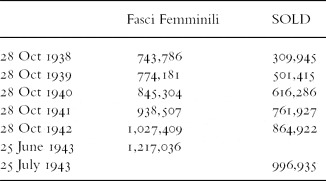
Although smaller than its sister section for peasant women, as the table below shows, SOLD membership rose rapidly to reach nearly a million by the fall of the regime. Numbers of those who participated in SOLD activities were, moreover, swelled by the specialised GIL sections. It is not possible to know exactly who these members were because membership records have not survived. Official figures do, nonetheless, offer some insight into the regional distribution of membership. By the end of the first year of the organisation, of the 309,945 members, almost a third were concentrated in the two northern industrial cities of Milan (55,000) and Turin (33,100). Perhaps unsurprisingly, like the Massaie Rurali,Footnote 78 SOLD membership was higher in the North than the South. Most of the provinces with very low memberships at this point were southern. Admittedly, 12,000 had joined in Naples and 8,000 in Bari but most other southern provinces had hundreds, rather than thousands, of members. Catanzaro, with only 350 members, was not untypical.Footnote 79 After this, regional disparities continued. In 1942, 80,000 women renewed their SOLD membership cards in Milan and 50,000 did so in Turin. Membership in Bari (18,000) and Naples (40,000) continued to be strong but otherwise membership lagged in the South. It is noteworthy, nonetheless, that every single province did have at least some members and, despite the uneven distribution, this was indubitably a truly national organisation, present throughout Italy, including in its reach provinces where women had previously had very little or no involvement in the world of politics.Footnote 80
National Membership: Fasci Femminili and SOLDFootnote 81

It would be wrong, moreover, dismissively to assume that southern sections existed only on paper. In Messina, for example, a report in November 1939 claimed that:
The workers and outworkers section has been commendably active, developing the organisation that, until a year ago, was embryonic, running about 150 technical and professional training courses. They have organised twenty-six exhibitions, forty-five outings, and developed a reasonable amount of hospital, medical and employment placement assistance for members.
The sceptics who like to hide behind the pretext that there are too many difficulties and bad habits, and who, therefore, thought to exclude Sicilian women from party activism, have been proved totally wrong.Footnote 82
Messina had 2,800 members in 1938 and 8,000 renewed their cards in 1942.
The sheer numbers of members is, of course, quite impressive. However, as this was an organisation founded in the later years of the regime, the meaning of membership is particularly hard to read. What is clear is that, although the idea that some joined out of enthusiasm for Fascism cannot be ruled out, opportunism and material factors played an important role. Some women, such as servants who had to pass through the vetting system described above, probably joined to obtain employment. This was true for other categories too, as SOLD organisers were instructed to collaborate with employment exchanges to ensure priority for ‘particularly needy’ SOLD members.Footnote 83 Others joined because the party card was becoming a prerequisite for access to welfare benefits and services which had previously been open to all. In practice, moreover, many SOLD activities, such as domestic science courses for working-class women or garment-making workshops, long predated its foundation, but now only party members could benefit. For example, as early as 1925 the FF were already organising holidays for female workers.Footnote 84 This suggests that SOLD was established primarily formally to recruit for the party the existing beneficiaries of party welfare initiatives.
The party predictably tried to portray SOLD's impressive membership level as spontaneous, evidence of enthusiasm for the organisation's aims, and it is indeed possible that, unused as they were to getting any sort of assistance from either the state or any political party, some women did welcome this unprecedented attention. In 1939, for example, the PNF Secretary boasted that a domestic servant had written to him that: ‘If you only knew how much your words help us. We feel proud that some good soul is caring for us and taking our situation to heart, a situation that up to now was simply terrible.’Footnote 85 There is no way of knowing if this letter was genuine, but some may well have rushed to join. SOLD recruitment techniques, however, suggest that this was frequently not the case. Although some organisers just used traditional methods such as touring factories giving speeches, heavier-handed methods were also employed. In Reggio Emilia, for example, where membership of all the Fascist women's organisations was particularly high, due in large part to the dynamic leadership of the Provincial Fiduciary Laura Marani Argnani,Footnote 86 domestic servants were recruited through their employers. Making use of her influential position as principal of the local teacher training college, she invited 1,400 heads of families who employed servants to her office to explain in person why their staff lacked SOLD membership cards. According to her account of this incident, this technique ‘gave good results’.Footnote 87 Similarly bullying methods were used to recruit factory workers. In Padua, recruitment was launched in March 1938 with a leaflet, sent to the owners of all local industrial firms, in which the recently-appointed SOLD Provincial Secretary Maria Cavazzana Mioni invited them
to carefully report the names and exact addresses of your female workers, as well as giving me a list of those who have refused to join.
Because the PNF, in order to develop all the declarations of the Labour Charter and particularly in this case Article XXIII, would like preference given to party members in recruitment for factory employment, I invite owners of factories and so on, to kindly persuade those who are reluctant to do so, to sign up so that they can benefit from the wise protection of the state.Footnote 88
Improving the lives of working-class women?
Clearly one aim of the organisation was to win hearts and minds by giving the impression that the regime was actively improving the lives of working-class women and it did offer them a range of training and recreational opportunities and other benefits that must have been quite attractive for many. Overall, however, the extent of the regime's commitment really to better the lives of this sector of the population is doubtful. SOLD generally only provided welfare, not rights, and the availability of such welfare provisions was uneven, dependent as it was on the unpaid, volunteer labour of its organisers.
Tellingly, despite some fine phrases in the Labour Charter of 1927 about how Fascism would protect outworkers,Footnote 89 servants and outworkers were, in fact, explicitly excluded from some of the social legislation passed during the ventennio. Although there were, admittedly, some improvements (such as the introduction of paid holidays for servants in the new Civil Code of 1942 and the gradual extension of forms of social insurance), neither of these categories (both seen, in some respects, as not ‘real workers’ given that they worked within women's ‘normal realm’ of the home) was covered by the protective legislation (Law 653) for women and children passed in 1934 (which, for example, forbade night work and stipulated the maximum weights women could be made to carry). Nor were either of them included in the provisions of Law 1347, passed the same year, which extended maternity leave to one month before and six weeks after giving birth. Although, from 1935, the Fascist unions did manage to introduce collective contracts to define wages and working conditions for some categories of outworkers, by the fall of Fascism many outworkers and all servants were still not covered by them. Of course, as many historians have argued, the terms of the contracts negotiated by the Fascist unions were often far from favourable to workers, but they did represent a bottom line below which employers could not, legally at least, depress pay and conditions. For extremely vulnerable categories such as these, any protection might have been better than nothing. In fact outworkers had to await legislation passed in 1958 and 1973, many years after the fall of Fascism, for the right to many social benefits long enjoyed by other categories of workers.
On only two occasions were such issues broached in Lavoro e famiglia. The first of these isolated outbursts of honesty in what was otherwise a tediously rhetorical publication came, in October 1940, in one of the occasional articles written by actual workers (which, apart from this, were usually even more propagandistic than the rest of the paper). Aurora Lenzi, a ‘Turinese worker’, wrote that it was unsurprising that increasingly few women wanted to become servants as they lacked many basic protections available to other workers. Although the author diplomatically emphasised the idea that Mussolini had done so much for other categories that it was now time that servants benefited too, this was, nonetheless, a startling departure from the usual tone of the newspaper.Footnote 90 Perhaps emboldened by this, a few months later an intelligent young woman employed by the Fascist unions, Mariella Tabellini (the 1941 ‘littrice di cultura’ – the regime's highest accolade for university students),Footnote 91 wrote an article, the tone of which contrasted starkly with most of the publication's usual fare. Tabellini, clearly used to the more open debate the regime permitted students, wrote that many outworkers lacked
limits on night work, holidays or weekly days off . . . Although their precise numbers are unknown, there are doubtless hundreds of thousands of people subjected to an economic regime which, in some cases, can only be termed inhuman, like earning less than three lire for sewing a safari jacket.
She was careful to emphasise how much Fascism had done to help women workers, ‘but, in reality, virtually none of the regime's insurance and welfare provisions for workers reach those outside factories.’Footnote 92 This article, however, proved the last of its kind and the paper thereafter quickly quashed debate with a vigorous return to the well-worn theme of the regime's benevolence.
Conclusion
Party Secretary Achille Starace believed that the ‘capillary system’ of the expanding party structure would yield (as he explained in a report to the Fascist Grand Council in 1935) ‘the possibility of controlling every single individual and every square inch of territory’.Footnote 93 As a kind of ‘mopping-up’ organisation designed to capture categories of women hitherto beyond the party's reach, SOLD exemplifies the regime's commitment to this approach. Closely modelled on its sister organisation for peasant women, it suggests that at least some party hierarchs believed that the strategy of entrusting the Fasci Femminili with the job of organising poor women en masse, pioneered by the Massaie Rurali, had been a successful one.
Like the section for peasant women, SOLD's primary purpose was to spread political propaganda about the regime's achievements and women's domestic and maternal mission. It delivered this propaganda by packaging it with an appealing mix of educational and recreational activities. It suffered, however, from the same problem as the Massaie Rurali in that it was a top-down organisation with little space for initiative on the part of the working-class women it recruited. It entailed only a rather passive form of party membership and this ultimately constituted a limitation on its ‘totalitarian’ potential. It is, moreover, very difficult, its undoubted modernising aspects notwithstanding, to see SOLD as in any sense empowering, except perhaps, and only in a limited manner, for the middle-class organisers.
SOLD did recruit an impressively large membership but this, in practice, tells us more about the effectiveness of its recruitment techniques than about the attitudes of those who signed up, since many had been either forced to join or else had chosen to do so for more pragmatic than political reasons. Moreover, although Fascist propaganda frequently invoked the huge membership figures of the mass organisations as a kind of proof of the people's devotion to the regime, the organisation's strategy was somewhat more realistic: membership was construed more as a route to Fascist faith than a demonstration of it. The idea was to first recruit women and then transform their views by subjecting them to propaganda.
Whether this actually worked is very difficult to judge, not least because, despite extensive research, I have been unable to find memoirs or archival documents that might shed meaningful light on this issue. The organisers, of course, tried to claim that it did. One pamphlet, for example, argued that SOLD had ‘drawn women workers to the regime, making them into enthusiastic and convinced Fascists, truly, fully conscious of the honour of belonging to the ranks of the party‘.Footnote 94 Such assertions must, of course, be taken with a large pinch of salt, for SOLD was trying to convert to the Fascist cause some quite challenging categories of women. Many of the urban workers (and indeed servants originating in certain specific parts of rural Italy such as the Po Valley) who joined were likely to have come from families with a left-wing tradition, and the regime's ability to win over their hearts and minds was far from a foregone conclusion. The relatively short-lived nature of the organisation, moreover, given its late founding date, doubtless further diluted its effectiveness.