On November 21, 1960—the day after Thanksgiving—many Americans tuned their televisions to CBS to watch Harvest of Shame. Trusted broadcast journalist Edward R. Murrow spent the next hour in a documentary exposé of farmworker conditions. The program opened with a farmworker crew shape-up in Florida, labor contractors hawking promises of good earnings. As a truck crammed full of twenty migrant workers drove off, Murrow quoted a farmer: “We used to own our slaves. Now we just rent them.” After detailing migrant workers’ hardships and highlighting the fact that those same workers harvested the food viewers ate the previous night for their feasts, Murrow closed the program with an appeal: “The migrants have no lobby,” he said. “They do not have the strength to influence legislation. Maybe we do.”Footnote 1
Although farmworkers lacked lobbying clout, they had an ally in James P. Mitchell, President Eisenhower’s labor secretary. Over the objections of the congressional farm bloc and Secretary of Agriculture Ezra Taft Benson, Mitchell worked to do what he could to improve the lives of the nation’s farmworkers, and Murrow featured him in Harvest of Shame. Secretary Mitchell spoke movingly about the migrant workers’ problems. Referring to farmworkers as “excluded Americans,” Mitchell called their plight “a shame in America.” Toward the end of the program, he blamed “the pressures of the farm group” for his “inability to make any impact at all, in terms of either regulations or law that would help the farmworkers.”
As Murrow concluded his final interview segment with Mitchell, the secretary voiced his aggravation with agricultural employers who opposed government action on behalf of farmworkers while simultaneously accepting crop subsidies. “We guarantee to the farmer no loss in certain crops,” he said. “There, the farmer likes to participate in government largesse, but Lord help the fellow like myself who dares suggest that perhaps the government should do something about the workers that work on the farms.” The secretary concluded, “As a citizen, in or out of this office, I propose to continue to raise my voice until the country recognizes that it has an obligation to do something for them.”Footnote 2 These were strong words coming from Eisenhower’s Labor Department chief, more striking because the administration supported foreign guestworker programs that allowed farmers to import workers from Mexico and the Caribbean at predetermined wages and, given their deportability, with little threat of strikes.
Despite growers’ control over guestworker programs, Secretary Mitchell’s administrative authority over guestworkers gave him an opening to try to improve conditions for American farmworkers in the absence of protective legislation. This was especially the case with the Bracero Program,Footnote 3 the guestworker program for Mexican agricultural workers that operated in various guises from 1942 to 1964. As unionists, civil rights activists, and religious and reform organizations increasingly attacked the program in the late 1950s, Mitchell responded by channeling his frustrations into efforts to enforce and strengthen Bracero Program regulations in a bid to improve job prospects for American farmworkers. Leveraging guestworker policies to improve American farmworkers’ conditions proved an imperfect strategy, but Mitchell’s innovative approach helped make the program increasingly untenable for growers, politicians, and farmworker advocates.
A Brief History of the Bracero Program and Illegal Immigration
Congress created the Bracero Program in 1942 as part of wartime mobilization. Growers claimed they needed Mexican guestworkers because farm labor shortages threatened the war effort. Born of wartime necessity, the program lasted through 1964. Over the course of its twenty-two-year duration, the federal government issued more than four million short-term work contracts to Mexican workers seeking employment in U.S. agriculture. While growers made their arguments about labor shortages and the unwillingness of Americans to do farm work, critics in the labor, civil rights, and religious-reform communities argued these were flimsy pretexts for a program giving growers what they wanted: easily disposable laborers who could be paid low wages and deported if they protested. Critics claimed growers used braceros to hold down wages for American farmworkers and prevent unionization after the rural strikes and protest movements of the 1930s.Footnote 4
Still, wartime mobilization allowed Mexico to demand guarantees that its citizen-workers would not be exploited, though those guarantees gave rise to policy mechanisms that were poorly enforced. Braceros would receive “prevailing wages” that American farmworkers accepted for the same work, and growers could not employ braceros in areas where they would have an “adverse effect” on local labor. As the program unfolded, however, growers wielded influence over local offices or state agencies responsible for overseeing it. Employers could not receive braceros until they advertised jobs through local U.S. Employment Service offices. If insufficient numbers of workers responded, officials certified a shortage, which was then approved by the Labor Department’s Bureau of Employment Security as the green light for growers to contract braceros. However, for most of the Bracero Program, this system operated in a decentralized manner.Footnote 5 Growers advertised wages that local laborers rejected, claiming a labor shortage that was quickly certified by friendly officials. This pattern of control through local administration of the program emerged quickly, and it characterized the program until the late 1950s.Footnote 6
When wartime controls ended in 1947, direct grower recruiting of braceros replaced government-to-government contracting, providing even less oversight. Attempts to negotiate a more lasting version faltered, bracero contracting declined, and growers turned to undocumented workers from Mexico.Footnote 7 When Border Patrol agents apprehended these undocumented immigrants, they simply converted them to bracero status as a way to threaten Mexico into negotiating and to meet growers’ labor needs in border states.Footnote 8 Domestic farmworkers were displaced; their wages stagnated in the face of grower control over both formal and undocumented guestworkers. Although unions, clergy, and liberal activists lobbied Congress for improvements, the farm bloc held fast.Footnote 9
By 1951, the U.S. and Mexico had reached agreement on a more lasting foundation for the Bracero Program made up of a standard work contract between grower associations and braceros, an international agreement, and Public Law 78, the American authorizing legislation. The new Bracero Program gave the Department of Labor a larger administrative role in determining prevailing wages, labor shortages, and adverse effect, but it continued to rely on local and state officials whom growers influenced. The network of federal and state Employment Service offices that provided job services to workers were all organized under the Department of Labor’s Bureau of Employment Security. Farm employers persisted in advertising wages local workers refused, manufacturing their own labor shortages. As a result, farmworker wages stagnated while undocumented immigration boomed, threatening to render the Bracero Program irrelevant by giving growers a labor force free of any protections.Footnote 10
The Eisenhower administration supported the Bracero Program both to manage immigration and to meet growers’ labor preferences. The administration was so committed to guestworkers that it abrogated the international agreement when Mexico bargained too hard. During 1953 negotiations over program renewal, Mexico’s new president, Adolfo Ruiz Cortines, stood firm on Mexican demands concerning Department of Labor prevailing wage procedures and recruitment center locations. Mexican intransigence led Louisiana senator and Public Law 78 coauthor Allen Ellender to declare, “I would be almost willing to abandon” the program and allow growers to contract braceros without Mexican approval.Footnote 11 As talks stretched into December, the administration threatened to go it alone by unilaterally recruiting braceros.Footnote 12
Unilateral recruitment began on January 22, 1954. Between January 23 and February 5, Mexican workers repeatedly rushed border checkpoints only to be repelled violently by Mexican police. If they made it across, INS detained them, required them to place a foot on Mexican soil, and then processed them as braceros.Footnote 13 The chaos was captured in a photograph showing Mexican and U.S. border officers playing tug-of-war with a bracero astride the border.Footnote 14 The U.S. Comptroller General ended the episode because funds appropriated for a bilateral program could not be used for unilateral labor recruitment, but the point had been made. Negotiations resumed, and the new international agreement (concluded March 10) extended the Bracero Program to the end of 1955 in a document full of Mexican concessions.Footnote 15 Having shown it could not control the emigration of citizen-workers except through guestworker programs, Mexico deferred to the United States in future negotiations.
Like Mexican officials, advocates for American farmworkers found it similarly difficult to influence guestworker policies. In Texas, Mexican American civil rights activists from the GI Forum joined forces with the Texas State Federation of Labor to publicize the problem of undocumented immigrants in the Lower Rio Grande Valley in a pamphlet titled “What Price Wetbacks?” Eduardo “Ed” Idar, president of the GI Forum, argued that undocumented immigrants pushed their “blood brothers, American citizens of Mexican descent” out of the region and into the migrant stream earlier every year. The report also urged stronger controls over the Bracero Program, but the report acknowledged that program improvements required a solution to the undocumented problem first.Footnote 16 “What Price Wetbacks?” indicated the twin problem facing farmworker advocates: the interconnectedness of guestworkers and undocumented labor. They argued awkwardly that the undocumented immigrant problem could be solved by expanding the Bracero Program, but that program protections for American farmworkers had to be better enforced.
Rising calls for better border enforcement from activists and growing attention on an open border during the Cold War led to the 1954–55 INS crackdown called Operation Wetback, which detained hundreds of thousands of aliens, encouraged the “self-deportation” of hundreds of thousands more (according to INS press releases), and shifted employment toward braceros. INS Commissioner Joseph Swing held cordial meetings with growers prior to the drive, arguing that if a grower failed to secure legal labor, “all he has to do is let either the Department of Labor or Immigration know and we will see that he gets it.”Footnote 17 Braceros were less likely to leave a grower, and they were immune from deportation raids.Footnote 18
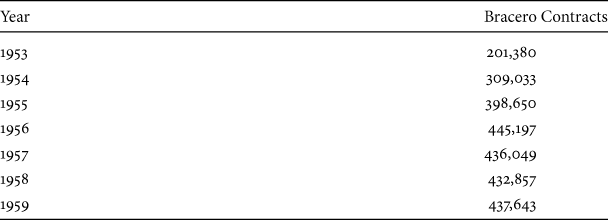
Swing focused on pragmatic diplomacy with growers during the enforcement campaign because immigration law specifically exempted employing illegal aliens from the criminal penalties for “harboring or concealing” undocumented workers. This exemption, known as the “Texas Proviso,” was added to immigration law in 1952 by Texas congressmen to protect their state’s growers from prosecution. As the roundup wound down, Border Patrol claimed that more than one million illegal immigrants were arrested, many of them converted into legal, temporary braceros.Footnote 19 These numbers should be taken cautiously, though, given the Border Patrol’s pressing need to prove that it controlled the border. With the border seemingly secured, bracero employment increased rapidly. Just before Operation Wetback, bracero contracts numbered 201,380, but that number reached a plateau of more than 430,000 annually between 1956 and 1959 (Table 1).Footnote 20 More significant, however, was the braceros’ growing share of agricultural employment. Between 1951 and 1957, braceros had gone from 15 percent of seasonal farmworkers to 34.2 percent.Footnote 21
Bracero Contracts by Year, 1954–1959

Source: Data adapted from Calavita, Inside the State, 218, appendix B.
Reformers Take Aim
The Bracero Program’s growing importance after Operation Wetback gave critics a larger target, and no one aimed at the Department of Labor for its failure to enforce program safeguards more than Ernesto Galarza. Galarza was a Mexican immigrant, scholar, and organizer with the National Agricultural Workers Union (NAWU). The NAWU was a small, chronically cash- and resource-starved union that attempted to organize California farmworkers in the face of the Bracero Program. As agricultural wages declined relative to industrial wages after World War II and farmworkers were displaced by braceros, Galarza railed against the Department of Labor for its lackluster enforcement.Footnote 22 Having failed to secure the removal of braceros from farms the union had struck throughout the late 1940s and early 1950s, Galarza gathered the NAWU’s scarce resources for a publicity campaign against the program. His work was part of a broader effort to document Bracero Program problems by Catholic and civil rights activists who joined the labor movement in denouncing the program.
The result was an exposé of the Bracero Program titled “Strangers in Our Fields.” In the second half of 1955, Galarza toured grower association housing camps to interview more than 345 braceros.Footnote 23 The following spring he released an eighty-page report.Footnote 24 Arguing that U.S. farmworkers’ conditions depended on growers’ and administrators’ adherence to bracero protections, the study asked whether the bracero “actually enjoys the legal, contractual and civil rights to which both governments have been committed.”Footnote 25
“Strangers in Our Fields” attacked the Labor Department’s maladministration of the program. One bracero summed up the general feeling: “The sheep over there in that field are better than we are,” he said. “Here in the camp it is one bite after another,” referring to paycheck deductions for housing and food.Footnote 26 Galarza noted the $1.75 maximum meal charge under the program had become the standard deduction for meals supplied by contractors who offered low-quality food. Food complaints were “an almost universal grievance.” Despite contract language guaranteeing braceros access to kitchens, in practice they were forbidden from cooking, the report argued. Only 10 of the 345 interviewees were currently preparing their own meals.Footnote 27
Like the meals, braceros expressed discontent with housing. One reported covering “holes in the windows and walls with paper.” When he asked for more blankets, the camp manager refused. Another bracero told Galarza that his crew was housed “in a barn which was used for the cows when we moved in.” The walls had four-inch gaps between planks; the smell was “repelling.”Footnote 28 Among the interviewees, only two had “seen or heard of a housing inspector in their camps.”Footnote 29 Galarza attributed lax inspections to the Labor Department’s delegation of the job to California’s Department of Employment, which in turn delegated to its understaffed Division of Housing.Footnote 30 Galarza performed his own inspections using official regulations. Larger grower association-operated camps fared better, but the more numerous smaller camps had serious problems.Footnote 31 Out of two hundred small camps, Galarza found forty-four with major violations, including a drainage ditch carrying “stable and kitchen waste meandering among the tents,” and eighty braceros sharing two open-air toilets.Footnote 32
Like other reformers and activists, Galarza blamed the Labor Department for bad conditions and low wages for American farmworkers. There could be no effective oversight when the Bureau of Employment Security employed fifteen compliance officers for all California and Arizona, making each officer responsible for over sixty-six hundred braceros in 1955. No braceros Galarza interviewed “knew the name or the address” of compliance personnel.Footnote 33 With resources spread so thinly, the department could only achieve “token enforcement” by relying on the good behavior of local offices and state agencies affiliated with it. As evidence of the abysmal record, Galarza cited two bracero bus crashes. Eleven braceros died, but neither Mexican consulates nor department compliance officers investigated within twenty-four hours.Footnote 34 When deaths did not warrant prompt investigation, braceros “will decide to be silent” about problems, Galarza wrote.Footnote 35
Appropriations decisions and budgetary constraints on the Labor Department made it difficult to enforce regulations, granting growers the freedom to ignore controls. This was especially pressing for Galarza and the NAWU on the question of prevailing wages. In California, the State Employment Service simply gathered information on “payments in the various crops” and forwarded the data to the Labor Department, which determined prevailing wages as “the most common wage found in the area.” This was a sharp departure from Public Law 78’s definition of prevailing wages as rates that would attract Americans to the job.
The decentralized administration of the program created a “maximum of flexibility and a minimum of attention to administrative controls.”Footnote 36 The result was unemployment and displacement for American workers, while braceros earned little. Because of low prevailing wages and short work days coupled with payroll deductions, Galarza even found braceros who owed employers money at the end of a pay period.Footnote 37 When the NAWU advocated on braceros’ behalf, Labor Department procedures required the union to provide information, which it then gave to the employer, “who usually sends the bracero right back to Mexico” before investigating.Footnote 38 With payroll deductions for inferior services, low wages, and no redress, Galarza concluded that braceros returned to Mexico possibly “a little richer,” most likely poorer, but in any event, “wiser.”Footnote 39
Department of Labor officials who oversaw the Bracero Program responded swiftly to “Strangers in Our Fields,” but the responses revealed that Galarza was right. In Region X of the Bureau of Employment Security (which included California), officials were so affronted that they refuted Galarza’s claims in their own memorandum. But the refutations validated the critiques. On housing, the memo plainly admitted, “We cannot pretend that our own Field Representatives inspect more than a small percentage of the thousands of housing units in California.” Overall, Region X administrators declared that Galarza asked the impossible: “To ‘police’ the program in a manner implied by the author would obviously involve hundreds of compliance officers,” an expansion that would have required larger congressional appropriations.Footnote 40
Although officials denounced it, the pamphlet’s circulation emboldened farmworker advocates in the religious and liberal communities to press the department to act. Catholic leaders concerned with farmworker reform increasingly made connections to the farm labor movement.Footnote 41 In 1955, the Bishops’ Committee for the Spanish Speaking had invited Galarza to speak at a conference, and Archbishop Robert Lucey of San Antonio thanked the “laymen who have the nerve” to oppose the program.Footnote 42 Catholic social welfare organizations, the Quakers, and the National Council of Churches all responded positively to the “Strangers” report, and several organizations in California began asking Galarza for regular updates so they could continue to press the Labor Department on compliance.Footnote 43 In November 1956, the National Sharecroppers Fund (longtime policy ally and frequent fund-raising arm of the NAWU) joined the fray, publicizing a letter it sent to Secretary of Labor James Mitchell demanding that he investigate the facts “fully and publicly.”Footnote 44
James P. Mitchell and the Bracero Program as a Tool for Farmworker Reform
Secretary Mitchell likely was relieved to see reformers demanding improvements; he began using these calls as justifications for increasing the department’s authority over the Bracero Program as part of his attempt to improve conditions for farmworkers. Mitchell became an unlikely ally, their champion in an administration that so supported guestworkers it had recruited them unilaterally in 1953. Mitchell came to Eisenhower’s Cabinet with a résumé blending public service with private enterprise. He had spent four years working with the New Deal’s Emergency Relief Administration, but during the 1940s and early 1950s he held labor-relations positions in both the private and public sectors. A “Democrat-for-Eisenhower” during the 1952 election, he joined the administration as assistant secretary of the Army in 1953.Footnote 45
When Mitchell replaced Martin Durkin as labor secretary late in 1953, he immediately began building a strong Labor Department that he would try to use on farmworkers’ behalf.Footnote 46 After reorganizing the department and reclaiming authority that postwar conservative congresses had transferred to other departments, he directed his attention to farmworkers because he felt they had been left behind by the New Deal.Footnote 47 Mitchell highlighted migrant workers’ appalling living and working conditions when he repeatedly pressed Congress to enact improvements. He pushed the creation of an Interagency Committee on Migrant Labor that would encourage states to coordinate reform legislation, but it never cleared farm bloc objections. Mitchell also supported legislation to extend Fair Labor Standards Act protections to farmworkers on four occasions during his tenure, an effort that was met not only with congressional disapproval, but that also created an open cabinet rift when Secretary of Agriculture Ezra Taft Benson publically denounced it.Footnote 48
The increasing criticisms and attention from reformers that “Strangers in Our Fields” represented and generated gave Secretary Mitchell an opportunity: if he could not win reform legislation, then perhaps he could wield Bracero Program protections as a tool to improve conditions for American workers.Footnote 49 Responding to reformers’ critiques, Mitchell issued new housing and meal regulations and followed them up with inspections. The housing regulations came after brief spot-checks late in 1956, which revealed housing “unfit for human habitation.”Footnote 50 Revised standards banned triple-deck bunks, required spring mattresses, and mandated separate cooking and eating facilities in new facilities and proper kitchen ventilation in existing ones. Braceros were entitled to one toilet per fifteen men, hot water, and laundry facilities that could accommodate weekly washing of clothes.Footnote 51 The department also ruled that food concessionaires in the camps had to improve offerings. In a regulation indicating just how bad the food was, meals made from “kidneys, tripe, tails, chicharrones, [and] hearts” could only be served once weekly.Footnote 52
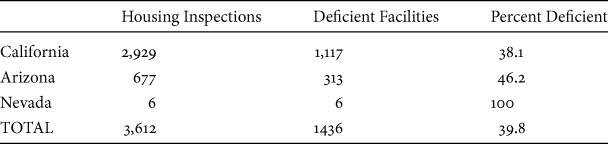
With new housing regulations established, Mitchell ordered a yearlong inspection tour in 1957, and the department stood by the new rules by closing down housing camps in violation.Footnote 53 By April, growers’ disregard for the rules was obvious. Inspectors found the Coachella Valley Farmers Association housing 2,193 braceros in a facility that accommodated 940.Footnote 54 Overall, the inspections in Region X revealed that 38 percent of California’s and 46 percent of Arizona’s housing facilities were deficient (Table 2). By August, the department had closed fifty-eight camps, representing a clear departure from past department practices of looking the other way on bracero housing.Footnote 55 Inspectors also examined payroll records as part of an overall compliance drive. Payroll inspections revealed violation rates of 17.5 percent in California and almost 40 percent in Arizona (Table 3). The 1957 enforcement campaign represented a substantial increase in department compliance activity. In 1956, Region X reported 404 housing and 328 payroll inspections; in 1957, those numbers rose to 3,612 and 893.Footnote 56 The inspections forced growers to improve their procedures to comport with program mandates. For example, by 1958, the payroll inspection violation rate for Region X had declined 25 percent from the previous year.Footnote 57
Bureau of Employment Security Housing Inspections, Region X, 1957

Source: U.S. Department of Labor, Bureau of Employment Security, Region X, Foreign Workers Program, Report of Field Representatives’ Activities, 1 January–31 December 1957, File Reports and Statistics, 1953–60 [1 of 2], Office of the Solicitor, Regional Attorney, Region 9, DOL, Records Relating to the Mexican Labor (“Bracero”) Program, 1950–64, Box 8, RG-174, NARA San Bruno.
Bureau of Employment Security Payroll Inspections, Region X, 1957

Source: Ibid.
Growers howled against Mitchell’s Labor Department, hoping to nip this bureaucratic activism in the bud. A growers’ association president in New Mexico called the new regulations unnecessary, since braceros in his state were so close to the border that they could simply “return home” on their own if conditions were not to their liking.Footnote 58 President Charles Shuman of the American Farm Bureau Federation was more direct, writing Secretary Mitchell to school him in American jurisprudence. “A man is innocent until proved guilty,” he wrote, but administrators violated that principle when they sanctioned growers for violations. “If the Department of Labor says a man is guilty—he’s guilty, and that’s the end of it,” Shuman concluded.Footnote 59
While growers protested, farmworker advocates continued highlighting the Bracero Program as a major impediment to American workers, which in turn inspired Secretary Mitchell to continue using the Bracero Program to improve conditions. In November 1957, Fay Bennett and the National Sharecroppers Fund held a conference for farmworker advocates titled Migratory Labor and Low Income Farmers. The conference was intended to build networks among reformers, and it anticipated the formation of a new, high-profile reform committee to coordinate action on farmworker policies. In addition to labor leaders George Meany and Walter Reuther, religious leaders concerned with farmworker conditions helped organize and underwrite the conference. Sponsors included representatives of major religious organizations, including the National Catholic Rural Life Conference’s vice president Rev. James L. Vizzard, S.J., the National Council of Churches, and Rabbi Israel Goldstein, co-founder of Brandeis University and a major figure in the American Jewish community. Rounding out the list of sponsors were prominent liberals Eleanor Roosevelt and Arthur Schlesinger, as well as civil rights figures such as A. Philip Randolph and George I. Sanchez.
As religious leaders, union delegates, and policy advocates all focused on the farmworkers’ plight, listened to experts on farmworker and agricultural conditions, and attended breakout sessions to brainstorm solutions and strategies, Bennett and her staff distributed five hundred copies of Galarza’s “Strangers in Our Fields” to attendees.Footnote 60 As 1958 began, these reformers took solace as the Labor Department continued its enforcement. Mitchell used the momentum created by “Strangers in Our Fields” and the 1957 migratory labor conference to tighten program administration and work to improve employment prospects and conditions for American workers.
Farmworker recruitment was one area of marked improvement. Unionists serving on the department’s Labor Advisory Committee on Farm Labor called on the Bureau of Employment Security to require employers “to recruit throughout the entire United States.”Footnote 61 In response, Secretary Mitchell instructed his subordinates not to approve bracero requests where “domestic workers can be obtained to meet farm labor needs.”Footnote 62 Assistant Secretary Newell Brown hammered the point before a meeting of the Imperial Valley Farmers Association, which had a long history of replacing domestic farmworkers with braceros and undocumented workers during labor conflicts.Footnote 63 Brown told the growers that unemployment and underemployment in rural areas was “increasingly troubling the public conscience.” Growers’ associations would have to increase wages; improve migrant housing; establish contracts with farmworkers covering transportation, hours, and wages; and conduct systematic recruitment in rural areas of chronic underemployment.Footnote 64
The department enforced its new policies on domestic recruitment, rebuffing complaints and stripping entire grower associations of their bracero privileges when individual members failed to comply. When New Mexico congressman Joseph Montoya complained to the Bureau of Employment Security about new farmworker recruitment requirements, the director fired back that there were “unemployed farm workers presently available in Oklahoma and the States in the Mississippi River Valley.” If Montoya’s constituents needed workers, the director told him they could recruit them using the Employment Service. Growers should offer farmworkers a wage “at or exceeding” the bracero rate, as well as family housing instead of accommodations meant for all-male braceros.Footnote 65 The Dona Ana County growers’ association hired more than one hundred American farmworkers as a result of the department’s new policies.Footnote 66 In California’s Coachella Valley, when a grower in Indio was found employing braceros to sort tomatoes despite instructions to cease and hire American workers, the Department of Labor revoked “all authorizations to the Coachella Valley Farmers Association to contract Mexican nationals” as part of a policy to “ensure first preference for farm jobs to American citizens.”Footnote 67
Having opened the employment door to American farmworkers, Mitchell’s Labor Department next tried to improve their wages by reforming the program’s wage determination procedures. The department issued a ruling effective September 1958 to reduce braceros’ adverse effect on domestic farmworker earnings. Prior to the ruling, the prevailing wage was the wage covering two-thirds or more of an area’s farmworkers. The new ruling reduced the threshold to 40 percent, which allowed the department to use Bracero Program prevailing wages to standardize higher wages paid to a smaller proportion of workers.Footnote 68
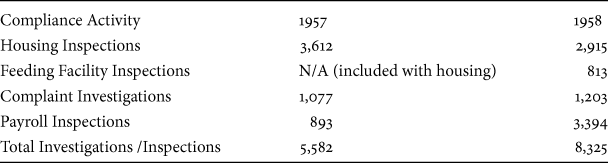
Officials also raised wages for braceros working at piece rates. The international agreement stipulated that braceros should earn at least 50¢ per hour, but where they worked at piece rates, braceros often fell below this minimum.Footnote 69 The department’s new “90–10 formula” required employers to raise rates where fewer than 90 percent of braceros averaged 50¢ per hour.Footnote 70 Inspections helped enforce the new rules. In Bureau of Employment Security Region X, officials continued housing inspections, launched a cafeteria compliance tour, increased complaint investigations, and expanded payroll checks. Overall, compliance activities had increased 49 percent over 1957 in the region (Table 4). And in Texas, cotton growers in the Lower Rio Grande Valley were found to be in such egregious violation of the new 90–10 rule that the Labor Department temporarily suspended bracero privileges for all Valley farmers.Footnote 71
Bureau of Employment Security Compliance Activities, Region X, 1957–1958

Source: U.S. Department of Labor, Bureau of Employment Security, Region X, Foreign Workers Program, Report of Field Representatives’ Activities, 1 January–31 December 1957; U.S. Department of Labor, Bureau of Employment Security, Region X, Foreign Workers Program, Report of Field Representatives’ Activities, 1 January–31 December 1958, File Reports and Statistics, 1953–60 [2 of 2], Office of the Solicitor, Regional Attorney, Region 9, DOL, Records Relating to the Mexican Labor (“Bracero”) Program, 1950–64, Box 8, RG-174, NARA San Bruno.
Growers denounced Secretary Mitchell as a dangerous man legislating by decree, but the secretary refused to bow. Senate Majority Leader Lyndon Johnson (a bracero employer himself) received angry correspondence from farmers and ranchers.Footnote 72 One called department administrators “little egg head caesars [sic]” who needed to have their “heads examined.”Footnote 73 Another scoffed at the idea that farmers should provide “hot and cold water [and] modern toilet facilities.”Footnote 74 Growers also renewed their decades-old claim that they needed braceros on favorable terms because Americans refused the work. One telegrammed Johnson after returning from the local employment office, where two “able-bodied men” were sitting, refusing farm work “due to laziness.”Footnote 75 Another lamented that growers had to recruit out of state “before he could be certified for braceros.”Footnote 76
Still, Mitchell held fast, even when the Senate Majority Leader subjected him to the Johnson Treatment. Johnson led the entire Texas congressional delegation to a meeting with the secretary to discuss the rules, but all he could get from Mitchell were reassurances that the department would not impose “unworkable procedures.”Footnote 77 Mitchell was unwilling to soften his new regulations because he refused to backslide on his commitments or wait any longer on the farmworker issue at a time when reformers and farmworker advocates were pressing him to act.
Secretary Mitchell and the Beginning of the End of the Bracero Program
By the fall of 1958, public attention and activists’ attacks on the Bracero Program and Mitchell’s reforms began to create a positive feedback loop. The secretary ramped up his efforts to use the Bracero Program to regulate labor relations in agriculture. By continuing his advocacy on behalf of farmworkers, Mitchell took part in a broader farmworker moment that was marked by increasing public concern for America’s poorest workers. Signs of the coming changes emerged first in California. The California Migrant Ministry, founded in 1957, began coordinating with the Community Service Organization’s Cesar Chavez and Dolores Huerta, both of whom were trained or heavily influenced by community organizer Saul Alinsky. As Chavez and Huerta began conceiving of farmworker organizing campaigns as an outgrowth of their civil rights activities, the AFL-CIO launched its own attempt at unionizing the state’s agricultural laborers—the Agricultural Workers Organizing Committee—in 1959.Footnote 78
Meanwhile, congressional farm bloc support waned for a guestworker program that was becoming a public relations liability, and the more liberal Congress produced by the 1958 midterms created openings to bring the farmworker controversy directly to Capitol Hill. In Eisenhower’s lame duck period, Mitchell’s Bracero Program reforms aimed to improve employment prospects for farmworkers, but they also foreshadowed the end of the Bracero Program itself.
The reform drive on the farmworker question gained steam in October with the formation of the National Advisory Committee on Farm Labor, an outgrowth of the organizational activity that followed the National Sharecroppers Fund 1957 migratory labor conference. Headed by prominent religious figures and big-name liberals like Eleanor Roosevelt, the Advisory Committee announced hearings in Washington, D.C., for February 1959, with the goal of evaluating how much American agriculture depended on “the inefficient use and low standard of living of farm labor” and to establish a program to give farmworkers full “participation in the American standard of living.”Footnote 79 The Advisory Committee heard testimony from government officials, relief organizations, growers associations, the NAWU, and farmworkers. Speakers highlighted poverty, poor working conditions, and the Bracero Program’s effects.
The committee found that braceros “are legally in a superior position to citizen workers,” and farmworker testimony verified workers’ displacement by braceros. Something of a star witness, Secretary Mitchell himself testified, calling migrant children’s lack of educational access “the ugliest kind of human waste.” Calling for sweeping reforms, he declared, “the migrant farm worker will never take his place as a fully useful citizen” until “federal legislation guarantees him a decent minimum wage.” Referring to the Bracero Program, he pledged a “direct attack on specific problems” in the program that affected farmworker conditions.Footnote 80 At the end of the hearings, the Advisory Committee recommended expanding bracero protections to all workers; extending the National Labor Relations Act, Fair Labor Standards Act, and Social Security Act to farmworkers; federal aid for states to improve migrant housing, health, and welfare services; education and child care for migrant children; and a congressional investigation of the Bracero Program.Footnote 81 Indicating the labor movement’s new willingness to tackle farmworker organizing, AFL-CIO Secretary-Treasurer William Schnitzler announced the labor federation’s Agricultural Workers Organizing Committee, an “organizational campaign among workers employed on the large corporate farms.”Footnote 82
The Advisory Committee helped give voice and unity to the many farmworker advocacy groups that had sprung up in the late 1950s. The committee released a fifty-nine-page report on farmworkers’ legal positions at state and federal levels, characterizing substandard labor conditions on the nation’s largest farms as “an unquestioned fact” and farmworkers’ exclusion from labor laws as “discrimination.”Footnote 83 By the summer of 1959, smaller like-minded groups had formed in Texas and California, echoing the Advisory Committee. In California, the Citizens Committee for Agricultural Labor lobbied the State Department of Employment on farmworker recruitment and bracero issues.Footnote 84 The new California civic organization joined religious and Mexican-American groups already active in the state’s fields. The American Friends Service Committee, Migrant Farm Ministry, National Catholic Rural Life Conference, and the Community Service Organization all offered to help officials with the labor supply problem to show that farmworkers wanted work. Swamped with offers to assist it, California’s Farm Placement Service created circulars to notify the groups of farmworker job opportunities.Footnote 85
Convinced he now had something of a mandate, Secretary Mitchell pushed again to increase Bracero Program enforcement and expand his department’s regulatory authority in a bid to improve farmworkers’ lives. Mitchell first appointed a group of consultants to study the program. Appealing to Catholic social justice concerns, Mitchell asked Msgr. George G. Higgins, director of the Social Action Division of the National Catholic Welfare Conference, to serve as one of the Bracero Program reviewers.Footnote 86 The consultants’ final report called for significant reform, but Higgins felt the recommendations were too weak. In June, he authored a preliminary report calling for increased Labor Department statutory authority over farmworker recruitment and bracero wages and conditions. Higgins also recommended a system of labor contractor registration, rural development programs, and farmworkers’ inclusion under labor law.Footnote 87
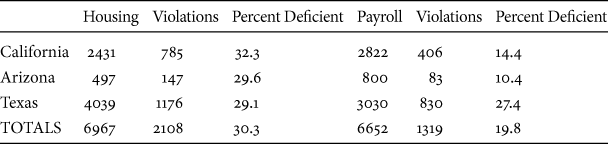
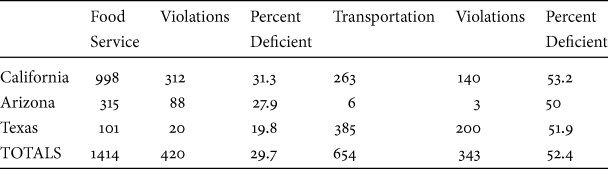
As the consultants debated the program, Mitchell continued his enforcement campaign. The Department of Labor ordered 144 growers association housing camps closed, and it threatened to close another 1,000 if they were not immediately improved.Footnote 88 In 1959, compliance personnel added safety inspections for vehicles used to transport braceros from camps to worksites, a move prompted by a deadly accident in Soledad, California, involving a flatbed truck that had been converted into a bracero bus. The bus caught fire, killing twelve and seriously injuring seventeen farmworkers.Footnote 89 The new transportation regulations caught growers off guard; inspectors discovered violations in more than half of their investigations, but by the middle of 1959, inspections were the least of growers’ problems with the department (Tables 5 and 6).Footnote 90
Bureau of Employment Security Housing and Payroll Inspections, Region X and Texas, 1959

Source: U.S. Department of Labor, Bureau of Employment Security, Region X, Foreign Workers Program, Report of Field Representatives’ Activities, 1 January–31 December 1959, file “Reports and Statistics, 1953–60 [2 of 2], Office of the Solicitor, Regional Attorney, Region 9, DOL, Records Relating to the Mexican Labor (“Bracero”) Program, 1950–64, Box 8, RG-174, NARA San Bruno; Texas Employment Commission, 1959 Annual Report, Texas AFL-CIO Records, Correspondence with Federal Agencies, 1957–69, AR 110, Series 24, Box 2, Folder 8: Texas Employment Commission, Misc. Rec.—1959–61, University of Texas–Arlington Special Collections.
Bureau of Employment Security Food Service and Transportation Inspections, Region X and Texas, 1959

Source: Ibid.
The consultants’ project and compliance activities continued the department’s activism, but in the spring of 1959 Mitchell went further. He used his authority under the 1933 Wagner-Peyser Act to propose sweeping new regulations to compel growers to recruit domestic farmworkers before they could get their labor shortages certified and begin contracting braceros. The regulations were Mitchell’s attempt to protect American farmworkers from “adverse effect” by braceros. Passed during the New Deal, the Wagner-Peyser Act created and governed the Employment Service network of offices that coordinated between federal and state governments under the umbrella of the Bureau of Employment Security. Rather than offering wages that would attract American farmworkers before requesting braceros, most growers advertised a wage farmworkers rejected, then claimed a labor shortage that was rapidly certified by friendly local and state officials.
Mitchell’s Wagner-Peyser regulations were designed to leverage Bracero Program regulations to increase the employment of American farmworkers. Mitchell specified certain prevailing wages and working conditions for job advertisements posted in Employment Service offices. Wages varied by crop and state, but the goal was to prevent de facto bracero authorizations by forcing growers to offer higher wages before the department would certify labor shortages.Footnote 91 The regulations required Employment Service officials to ensure that growers could provide “hygienic and adequate” housing for “available domestic agricultural workers,” and required growers to handle transportation arrangements. In addition to recruiting locally and statewide, growers would be required to use the Employment Service for interstate recruitment within a “reasonable” distance determined by the department.Footnote 92
In effect, Mitchell used the Wagner-Peyser Act to consolidate departmental authority over state officials affiliated with the Employment Service who frequently advised staff to serve growers’ wills. With this new rule, Mitchell hoped to end the days of quick bracero certifications at predetermined wages. The department used its powers to place domestic farmworkers into jobs formerly held by braceros and forced local and state officials as well as grower associations to comply. However, local and state officials in California continued to skirt the rules. In June, when farmworkers complained that Employment Service officials were splitting up work crews and making it harder for them to arrange transportation, the Labor Department reminded field staff that domestic workers should always be referred “to employment nearest their place of residence.”Footnote 93 A few days later, the Bureau of Employment Security circulated a staff memo summarizing requirements for bracero requests, indicating continued noncompliance at the local level.Footnote 94
Meanwhile, for growers and their congressional allies, Mitchell had gone much too far. Employers charged that the Wagner-Peyser regulations were illegal. The Texas legislature even passed a grower-sponsored resolution denouncing the department for “stripping the state agencies of their Constitutional and Statutory powers.”Footnote 95 Correctly identifying Mitchell’s approach, Lone Star farmers and ranchers complained to Lyndon Johnson that the department was using the Bracero Program “to force us to federal regulation of farm wages and hours.”Footnote 96 The Lower Rio Grande Valley Farm Bureau requested a congressional investigation of the Labor Department, especially since all the Valley’s growers had temporarily lost bracero privileges for violating the 90–10 prevailing wage formula in 1959.Footnote 97 Johnson personally escorted his state’s largest agricultural producers to a meeting with department officials to voice their discontent.Footnote 98
Farm bloc congressmen acted together to question the proposed regulations’ legality. More than thirtyFootnote 99 congressmen met with Secretary Mitchell to denounce the “absurd proposals.”Footnote 100 Tempers flared. Senator Bob Poage, coauthor of Public Law 78, alleged that “the regulations were illegal, impractical and immoral.”Footnote 101 Farm bloc leaders pursued the legal angle as best they could. New Mexico Senator Joseph Montoya requested an opinion from the Congressional Research Service on the regulations’ legality under Wagner-Peyser, but by July, Attorney General William Rogers had upheld the secretary’s authority.Footnote 102 Although the Wagner-Peyser Act did not expressly or implicitly delegate power to Mitchell “to establish referral standards” for farmworkers, Rogers wrote, the regulations did not create “undue or arbitrary burdens.”Footnote 103 The new regulations entered the Federal Register in August.Footnote 104 Growers and their congressmen continued their protests, even winning department hearings to consider their concerns. But Mitchell had put the rules on the books, and now he stood behind them.Footnote 105
By the end of 1959, Assistant Secretary of Labor Newell Brown reflected the department’s changed tone toward growers and the Bracero Program. In an address before the Texas Citrus and Vegetable Growers and Shippers Convention, he accused growers of defending a status quo that forced the nation’s migrants to the roads as braceros chased them out, season after season. These growers saw “nothing wrong” with piece rates that amounted to “30–35 cent per hour,” saw no problem “maintaining such competition for American workers,” and bitterly resisted measures “to prevent this type of adverse effect.” To what must have been a stone-cold reception, Brown concluded by quoting Mitchell, “There will be change; the American public should and will demand it; and it will be imposed if it does not evolve voluntarily.”Footnote 106
The Labor Department continued imposing that change from the secretary’s desk. In July 1960, Mitchell ended the “specials” program that growers used to recontract skilled braceros quickly and easily, instructing growers to find American workers by raising wages.Footnote 107 The department also continued its often frustrated efforts to control local officials’ attempts to certify labor shortages at low wages. The department reversed New Mexico Employment Service wage findings by refusing to certify braceros until growers raised wages to 75¢/hour and advertised jobs more widely.Footnote 108 Similarly, on Texas farms in the Lower Rio Grande Valley, Mitchell used his regulations to refuse requests for bracero cotton pickers until growers offered at least $2.50 per hundredweight for cotton, a 20¢ increase over 1959.Footnote 109 Still, the repeated crackdowns indicate the difficulty inherent in using a sprawling guestworker policy to improve conditions for Americans.
Mitchell’s Wagner-Peyser regulations had a direct effect on cotton growers’ employment practices in the Lower Rio Grande Valley of Texas, though. In 1960, The Texas Employment Commission reported that the twenty-cent increase in cotton-picking rates and emphasis on domestic farmworker recruitment established by the Labor Department under Mitchell’s authority had produced “an intense recruitment of available workers” throughout the state.Footnote 110 Meanwhile, the department removed 2,681 braceros from more than two thousand housing facilities because of failure to adhere to standards. Furthermore, forty employers lost their bracero eligibility for violating the International Agreement or the Standard Work Contract.Footnote 111 Further extension of wage increases beyond the Rio Grande Valley in 1961 led the Texas Employment Commission to report “a major decline, 55 percent, in the employment of Mexican Nationals.”Footnote 112 Ultimately, though, the declines in bracero employment and increased domestic recruitment were a mixed blessing for American farmworkers. The commission went out of its way after 1959 to help Lower Rio Grande Valley growers locate and transport mechanical harvesters to do the work previously performed by Mexican nationals.Footnote 113 By 1960, 90 percent of the cotton crop in the Valley was machine-harvested. Three years later, only 2 percent of the crop was harvested by hand.Footnote 114
The Slow Death of the Bracero Program
By 1960, the bigger story was congressional renewal of the Bracero Program. Congress reauthorized the program in 1958 through June 1961, meaning it would expire in the middle of the harvest season. The 1960 renewal effort demonstrated how much reformers and Mitchell had moved the debate. The farm bloc tried to revive the old status quo. Meanwhile, George McGovern introduced a bill to expand Labor Department authority over prevailing wages and adverse-effect determinations, mandated that growers compete for domestic farmworkers by offering better terms, and called for eventual termination.Footnote 115 After extended procedural wrangling, legislators settled for a simple unamended six-month extension, punting until after the fall election.Footnote 116 As Ernesto Galarza later wrote, “The liberal conscience was stirring,” and it targeted the Bracero Program.Footnote 117 The Wagner-Peyser regulations and the 1960 renewal battle engaged this conscience, and both revealed growers’ fury over their loss of control. After eighteen years, the Bracero Program was controversial.
That controversy grew as media focused on farmworkers and a new administration took office. Newsweek, Time, and the New York Times published accounts of farmworker conditions, and then came Harvest of Shame, which highlighted migrant poverty and James Mitchell’s advocacy.Footnote 118 When the farm bloc pushed for renewal under Kennedy, the climate had changed. The president had voted repeatedly against the program while in Congress, and the Democratic platform in 1960 had sought farmworkers’ inclusion under labor legislation, as well as health, housing, education, and welfare services for migrant workers.Footnote 119 The new Secretary of Labor, Arthur Goldberg, further indicated the administration’s disinterest in doing growers’ bidding. “The time for study has passed,” and “the time for action is now,” Goldberg stated.Footnote 120
When Congress retuned to the issue in 1961, reformers again tried to increase the labor secretary’s authority and force growers to raise wages for American farmworkers, but the farm bloc beat back amendments that challenged grower authority. Contentious debates again produced an unamended extension, this time lasting two years.Footnote 121 Final extension came in 1963, but not without surprises.Footnote 122 In a vote of 158–174 (with 100 abstentions), the House rejected the Bracero Program. The farmworker issue had become too polarizing for farm bloc unity, though Congress eventually bowed to grower pressure and Mexican concerns about a sudden end to the program, extending it without change for one final year.Footnote 123 That last-minute extension of the program was colored by the recent bus crash that took the lives of nearly three dozen braceros in California’s Salinas Valley.Footnote 124 During debate, even Senator Allen Ellender—the original coauthor of Public Law 78—could declare, “Beginning in 1965, other methods will have to be used to provide for stoop labor.”Footnote 125
Frustrated by his inability to win reform legislation for American farmworkers, Mitchell had used the Bracero Program as a tool to improve wages and employment prospects for American farmworkers left behind by the New Deal. Seizing on criticisms of his department, he admitted failures and set about reform. He enforced existing program regulations that had been ignored, expanded those rules, and then found ways to grow his regulatory authority further by wielding the Wagner-Peyser Act. His Kennedy administration successor, Arthur Goldberg, continued Mitchell’s work of making the program increasingly unpalatable for growers. As a nascent farmworker movement took shape in California, growers continued to support the program. But Mitchell’s guestworker policy activism had set in motion the policy mechanisms that made the Bracero Program increasingly unacceptable, fracturing congressional support for guestworkers in the process.
Today, it is estimated that between half and three-quarters of the farm labor force is undocumented. In the end, Mitchell’s reforms and the efforts of countless other advocates were not enough to change the basic patterns of agricultural employment in the United States. Nonetheless, by wielding the Bracero Program as a tool on behalf of American farmworkers, Mitchell helped change the climate around the bracero and farmworker issues. When combined with an emerging civil and labor rights struggle over farmworker conditions, Mitchell’s actions helped clear the way for the organizing campaigns and advocacy on the farmworker question that would come in the 1960s and 1970s.