




1. Introduction
A classical problem in analytic number theory is to study the values of L-functions in the critical strip.
Concerning the order of
 $|\zeta (\sigma +it)|$
for
 $\sigma \in (1/2,1)$
, Montgomery [Reference Montgomery6, Theorem 1] showed that
 $$ \begin{align*} \begin{aligned} \underset{t\in[0,T]}{\max}|\zeta(\sigma+it)|\geq\exp\bigg(\frac{C_{\sigma}(\log T)^{1-\sigma}}{(\log\log T)^{\sigma}}\bigg)\quad \mathrm{as} \ T\rightarrow\infty, \end{aligned} \end{align*} $$
where we can take
 $C_{\sigma }=(\sigma -1/2)^{1/2}/20$
. Montgomery also showed that assuming the Riemann hypothesis we can take
 $C_{\sigma }=1/20$
for
 $\sigma \in (1/2,1)$
. Aistleitner [Reference Aistleitner1, Theorem 1] proved that
 $$ \begin{align*} \begin{aligned} \underset{t\in[0,T]}{\max}|\zeta(\sigma+it)|\geq \exp\bigg(\frac{C_{\sigma}(\log T)^{1-\sigma}}{(\log\log T)^{\sigma}}\bigg)\quad \mathrm{as} \ T\rightarrow\infty, \end{aligned} \end{align*} $$
where we can choose
 $C_{\sigma }=0.18(2\sigma -1)^{1-\sigma }$
. Bondarenko and Seip [Reference Bondarenko, Seip, Baranov, Kisliakov and Nikolski3, Theorem 1] proved that if T is sufficiently large, then, for
 $1/2+1/\log \log T\leq \sigma \leq 3/4$
,
 $$ \begin{align*} \begin{aligned} \underset{t\in[\sqrt{T},T]}{\max}|\zeta(\sigma+it)| \geq\exp\bigg(\nu(\sigma)\frac{(\log T)^{1-\sigma}}{(\log\log T)^{\sigma}}\bigg) \end{aligned} \end{align*} $$
and, for
 $3/4\leq \sigma \leq 1-1/\log \log T$
,
 $$ \begin{align*} \begin{aligned} \underset{t\in[T/2,T]}{\max}|\zeta(\sigma+it)| \geq\log\log T\exp\bigg(c+\nu(\sigma)\frac{(\log T)^{1-\sigma}}{(\log\log T)^{\sigma}}\bigg) \end{aligned} \end{align*} $$
with an absolute constant c independent of T, where
 $\nu (\sigma )$
is a continuous function on
 $(1/2,1)$
bounded below by
 $1/(2-2\sigma )$
with the asymptotic behaviour
 $$ \begin{align*} \begin{aligned} \nu(\sigma)=\left\{ \begin{array}{@{}ll} (1-\sigma)^{-1}+O(|\log(1-\sigma)|) & \text{as } \sigma\nearrow 1, \\ (1/\!\!\sqrt{2}+o(1))\sqrt{|\log(2\sigma-1)|} & \text{as } \sigma\searrow 1/2. \end{array} \right. \end{aligned} \end{align*} $$
A more interesting question is to investigate how large
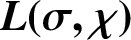
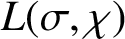
 $L(\sigma ,\chi )$
can be for fixed
 $\sigma \in (1/2,1)$
. Aistleitner et al. [Reference Aistleitner, Mahatab, Munsch and Peyrot2, Theorem 3] proved that there exists a constant
 $C(\sigma )$
such that for all sufficiently large q, there exists a nonprincipal character
 $\chi \pmod q$
such that
 $$ \begin{align} \begin{aligned} \log|L(\sigma,\chi)|\geq C(\sigma)(\log q)^{1-\sigma}(\log\log q)^{-\sigma}\quad \mathrm{for}\ 1/2<\sigma<1. \end{aligned} \end{align} $$
In [Reference Aistleitner, Mahatab, Munsch and Peyrot2, Theorem 1], they also showed that for all sufficiently large q, there exists a nonprincipal character
 $\chi \pmod q$
such that
 $$ \begin{align} \begin{aligned} |\log L(1,\chi)|\geq e^{\gamma}(\log\log q+\log\log\log q-C-\varepsilon)\quad \mathrm{for}\ \sigma=1, \end{aligned} \end{align} $$
where
 $C=1+\log \log 4\approx 1.33$
.
In this note, based on the framework constructed by Aistleitner et al. in [Reference Aistleitner, Mahatab, Munsch and Peyrot2], we give an explicit estimate for (1.1). Our main result is the following theorem.
Theorem 1.1. Let
 $\sigma \in (1/2,1)$
be fixed. For all sufficiently large q, there exists a nonprincipal character
 $\chi \pmod q$
such that
 $$ \begin{align*} \begin{aligned} \log|L(\sigma,\chi)|\geq A(\sigma)(\log q)^{1-\sigma}(\log\log q)^{-\sigma}, \end{aligned} \end{align*} $$
where
 $$ \begin{align*} A(\sigma):=\bigg(\frac{\sigma}{1-\sigma}+o_{\sigma}(1)\bigg)\bigg(\frac{\delta(\sigma)}{2}\bigg)^{1-\sigma}. \end{align*} $$
Here
 $0<\delta (\sigma )<1$
is defined by (2.2) and
 $o_{\sigma }(1)$
means that
 $o_{\sigma }(1)\rightarrow 0$
as
 $q\rightarrow \infty $
.
In fact, we can take
 $C(\sigma )=(\delta (\sigma )/2)^{1-\sigma }/(2-2\sigma )$
in (1.1). Note that for q large enough,
 $$ \begin{align*} \frac{1}{2-2\sigma}<\frac{\sigma}{1-\sigma}+o_\sigma(1)\quad \mathrm{for}\ \frac12<\sigma<1. \end{align*} $$
Therefore, we improve the lower bound of (1.1) by giving an explicit value for the constant.
In [Reference Aistleitner, Mahatab, Munsch and Peyrot2], the authors stated that it might be possible to optimise this constant by analysing carefully the zero-density estimates and the resonator used. This is the main purpose of this article.
For the case
 $\sigma =1/2$
, the resonator function needs a more complicated structure (which is not completely multiplicative) and requires a different approach from the one taken in this paper. In addition, the approximation of ‘good’ Dirichlet L-functions by a finite Euler product relies on the zero-density theorem for
 $\sigma $
in
 $(1/2,1)$
.
The proof of the theorem follows roughly the same path as the one taken for the lower bound (1.2) in the case
 $\sigma =1$
, but different parameters depending on
 $\sigma $
are required.
Soundararajan [Reference Soundararajan7] and Hilberdink [Reference Hilberdink5] presented slightly different versions of a technique, known as the resonance method, for studying large values of the Riemann zeta function. Theorem 1.1 is proved using the resonance method in the spirit of [Reference Soundararajan7].
2. Preparation for the proof
In this section, we will list some preliminary results which will be used in the proof of Theorem 1.1. The strategy can be broadly divided into the steps listed below.
Lemma 2.1. [Reference Davenport and Montgomery4, Section 4, (4)]
If
 $(a,q)=1$
, then
 $$ \begin{align*} \begin{aligned} \frac{1}{\varphi(q)}\sum_{\chi(\operatorname{mod}\, q)}\overline{\chi}(a)\chi(n)=\left\{ \begin{array}{@{}ll} 1 & \text{if } n\equiv a \,(\operatorname{mod}\, q) , \\ 0 & \text{otherwise.} \end{array}\right. \end{aligned} \end{align*} $$
2.1. Truncated approximation of
 $\mathrm{log}\, L(\sigma ,\chi )$

Let
 $Y=(\log q)^{{3}/{(\sigma -1/2)}}$
. Define
 $$ \begin{align*} \begin{aligned} F(\sigma,\chi,Y):=\sum_{p\leq Y}\frac{\chi(p)}{p^{\sigma}}. \end{aligned} \end{align*} $$
According to [Reference Aistleitner, Mahatab, Munsch and Peyrot2, Section 4, (30)],
 $$ \begin{align} \begin{aligned} \log L(\sigma,\chi)=F(\sigma,\chi,Y)+O(1) \end{aligned} \end{align} $$
for all characters
 $\chi \pmod q$
except for a set of ‘bad’ characters
 $D_B(q)$
of cardinality at most
 $q^{1-\delta (\sigma )}$
for some
 $\delta (\sigma )$
with
 $0<\delta (\sigma )<1$
. In fact, it is easy to show that we can take
 $$ \begin{align} \delta(\sigma)=\frac{\sigma-1/2}{7/4-\sigma/2}. \end{align} $$
2.2. Construction of the resonator function
Set
 $X=\tfrac 12\delta (\sigma )(\log q)(\log \log q)$
and, for primes
 $p\leq X$
, set
 $$ \begin{align*} A_p:=1-\bigg(\frac{p}{X}\bigg)^{\sigma}\quad \mathrm{for}\ 1/2<\sigma<1. \end{align*} $$
We set
 $A_1=1$
and
 $A_p=0$
for
 $p>X$
and extend our definition in a completely multiplicative way such that we obtain weights
 $A_n$
for all
 $n\geq 1$
. Now we define
 $$ \begin{align*} S(\chi):=\prod_{p\leq X}\frac{1}{1-A_p \chi(p)}. \end{align*} $$
Let
 $D_q$
denote the group of Dirichlet characters modulo q. Set
 $$ \begin{align*} \begin{aligned} \Delta_1:=\sum_{\chi\in D_q}F(\sigma,\chi,Y)|S(\chi)|^2 \end{aligned} \end{align*} $$
and
 $$ \begin{align*} \begin{aligned} \Delta_2:=\sum_{\chi\in D_q}|S(\chi)|^2. \end{aligned} \end{align*} $$
3. Proof of Theorem 1.1
By the choice of
 $X=\tfrac 12\delta (\sigma )(\log q)(\log \log q)$
, we immediately obtain
 $$ \begin{align*} \log |S(\chi)|^2=\log\prod_{p\leq X}\frac{1}{|1-A_p\chi(p)|^{2}} &\leq\log\prod_{p\leq X}\frac{1}{(1-A_p)^{2}} =2\sigma\sum_{p\leq X}(\log X-\log p)\\ &=2\sigma(1+o(1))\frac{X}{\log X} =(\sigma\delta(\sigma)+o(1))\log q. \end{align*} $$
Hence,
 $$ \begin{align*} \begin{aligned} |S(\chi)|^2\ll q^{\sigma\delta(\sigma)+o(1)}. \end{aligned} \end{align*} $$
Summing over bad characters gives
 $$ \begin{align} \begin{aligned} \sum_{\chi\in D_B(q)}|S(\chi)|^2\ll q^{1-\delta(\sigma)}q^{\sigma\delta(\sigma)+o(1)}=q^{1+(\sigma-1)\delta(\sigma)+o(1)}. \end{aligned} \end{align} $$
Write
 $$ \begin{align*} \begin{aligned} S(\chi)=\prod_{p\leq X}\sum_{\nu\geq0}(A_p \chi(p))^{\nu}=\sum_{n=1}^{\infty}A_n \chi(n). \end{aligned} \end{align*} $$
Then
 $$ \begin{align} \begin{aligned} \Delta_2=\sum_{\chi\in D_q}|S(\chi)|^2=\sum_{\chi\in D_q}\sum_{m,n=1}^{\infty}A_m A_n\chi(m)\overline{\chi(n)} =\varphi(q)\sum_{\substack{m,n=1\\ m\equiv n(\operatorname{mod}\, q)\\ (n,q)=1}} ^{\infty}A_mA_n\gg q^{1-o(1)}, \end{aligned} \end{align} $$
after observing that
 $\varphi (q)\gg q/\log \log q$
,
 $A_1=1$
and
 $A_n\geq 0$
.
Next note that
 $$ \begin{align} \begin{aligned} |F(\sigma,\chi,Y)|\leq\sum_{p\leq Y}\frac{1}{p^{\sigma}}\ll Y^{1-\sigma}=(\log q)^{{3(1-\sigma)}/{(\sigma-1/2)}}\ll q^{o(1)}. \end{aligned} \end{align} $$
 $$ \begin{align} \begin{aligned} \sum_{\chi\in D_B(q)}F(\sigma,\chi,Y)|S(\chi)|^2\ll q^{1+(\sigma-1)\delta(\sigma)+o(1)}. \end{aligned} \end{align} $$
By Lemma 2.1 and changing the order of summation,
 $$ \begin{align} \Delta_1=\sum_{\chi\in D_q}F(\sigma,\chi,Y)|S(\chi)|^2 &=\sum_{p\leq Y}\frac{1}{p^{\sigma}}\bigg(\sum_{m,n=1}^{\infty}A_mA_n\sum_{\chi\in D_q}\chi(p)\chi(m)\overline{\chi(n)}\bigg)\nonumber\\ &=\sum_{\substack{p\leq Y\\ p\nmid q}} \frac{1}{p^{\sigma}}\bigg(\varphi(q)\sum_{\substack{m,n=1\\ pm\equiv n(\operatorname{mod}\, q)\\ (n,q)=1}} ^{\infty}A_mA_n\bigg). \end{align} $$
For
 $p\leq Y$
and
 $p\nmid q$
, using the positivity and the completely multiplicative property of the coefficients
 $A_n$
,
 $$ \begin{align} \varphi(q)\sum_{\substack{m,n=1\\ pm\equiv n(\operatorname{mod}\, q)\\ (n,q)=1}} ^{\infty}A_mA_n &\geq\varphi(q)\sum_{\substack{m,n=1,p|n\\ pm\equiv n(\operatorname{mod}\, q)\\ (n,q)=1}} ^{\infty}A_mA_n \geq\varphi(q)\sum_{\substack{m,\ell=1\\ pm\equiv p\ell(\operatorname{mod}\, q)\\ (p\ell,q)=1}} ^{\infty}A_mA_{p\ell}\nonumber\\ &\geq A_p\varphi(q)\sum_{\substack{m,\ell=1\\ m\equiv\ell(\operatorname{mod}\, q)\\ (\ell,q)=1}} ^{\infty}A_mA_{\ell}=A_p\Delta_2. \end{align} $$
We deduce from (3.5) and (3.6) that
 $$ \begin{align} \begin{aligned} \Delta_1\geq\Delta_2\sum_{\substack{p\leq Y\\ p\nmid q}} \frac{A_p}{p^{\sigma}} =\Delta_2\bigg(\sum_{p\leq Y}\frac{A_p}{p^{\sigma}}-\sum_{\substack{p\leq Y\\ p|q}} \frac{A_p}{p^{\sigma}}\bigg). \end{aligned} \end{align} $$
Since
 $A_p=1-({p}/{X})^{\sigma }$
for
 $p\leq X$
and
 $A_p=0$
for
 $p>X$
,
 $$ \begin{align} \begin{aligned} \sum_{p\leq Y}\frac{A_p}{p^{\sigma}}=\sum_{p\leq X}\frac{A_p}{p^{\sigma}}=\sum_{p\leq X}\frac{1}{p^{\sigma}}-\sum_{p\leq X}\frac{1}{X^{\sigma}}. \end{aligned} \end{align} $$
By the prime number theorem and repeated integration by parts,
 $$ \begin{align} \begin{aligned} \sum_{p\leq X}\frac{1}{p^{\sigma}} &=\bigg(\frac{1}{1-\sigma}+o_{\sigma}(1)\bigg)\frac{X^{1-\sigma}}{\log X} \end{aligned} \end{align} $$
and
 $$ \begin{align} \begin{aligned} \sum_{p\leq X}\frac{1}{X^{\sigma}}=(1+o_{\sigma}(1))\frac{X^{1-\sigma}}{\log X}, \end{aligned} \end{align} $$
where
 $o_{\sigma }(1)\rightarrow 0$
as
 $X\rightarrow \infty $
(that is,
 $q\rightarrow \infty $
). Combining (3.8), (3.9) and (3.10),
 $$ \begin{align} \begin{aligned} \sum_{p\leq Y}\frac{A_p}{p^{\sigma}}=\bigg(\frac{1}{1-\sigma}-1+o_{\sigma}(1)\bigg)\frac{X^{1-\sigma}}{\log X}. \end{aligned} \end{align} $$
We observe that
 $$ \begin{align*} \begin{aligned} \sum_{\substack{p\leq Y\\ p|q}} \frac{A_p}{p^{\sigma}}=\sum_{\substack{p\leq X\\ p|q}} \frac{A_p}{p^{\sigma}}=\sum_{\substack{p\leq X\\ p|q}} \frac{1}{p^{\sigma}}-\sum_{\substack{p\leq X\\ p|q}} \frac{1}{X^{\sigma}}. \end{aligned} \end{align*} $$
Denote by
 $\omega (q)$
the number of distinct prime factors of q. We have the bound
 $\omega (q)\ll \log q/\log \log q$
. Also, we denote by
 $P(n)$
the nth prime. Then
 $P(n)\ll n\log n$
. Thus, by using the fact that
 $X=\tfrac 12\delta (\sigma )(\log q)(\log \log q)\gg \log q$
, we can write
 $$ \begin{align*} \begin{aligned} \sum_{\substack{p\leq X\\ p|q}} \frac{1}{p^{\sigma}}\ll\sum_{\substack{p\leq X\\ p\leq P(\omega(q))}} \frac{1}{p^{\sigma}}\ll\sum_{p\leq C_1\log q}\frac{1}{p^{\sigma}}\ll_{\sigma}\frac{(\log q)^{1-\sigma}}{\log\log q}=o_\sigma\bigg(\frac{X^{1-\sigma}}{\log X}\bigg)\quad\mathrm{as}\ X\rightarrow\infty \end{aligned} \end{align*} $$
and
 $$ \begin{align} \begin{aligned} \sum_{\substack{p\leq X\\ p|q}} \frac{1}{X^{\sigma}}\ll\sum_{\substack{p\leq X\\ p|q}} \frac{1}{p^{\sigma}}= o_\sigma\bigg(\frac{X^{1-\sigma}}{\log X}\bigg). \end{aligned} \end{align} $$
Combining (3.2), (3.7) and (3.11)–(3.12), we deduce that
 $$ \begin{align} \begin{aligned} \Delta_1\geq\Delta_2\bigg(\frac{1}{1-\sigma}-1+o_\sigma(1)\bigg)\frac{X^{1-\sigma}}{\log X}\gg q^{1-o(1)}. \end{aligned} \end{align} $$
Define
 $$ \begin{align*} D_G(q):=D_q \setminus D_B(q). \end{align*} $$
Combining (3.1), (3.2), (3.4) and (3.13) yields
 $$ \begin{align} \begin{aligned} \frac{\sum_{\chi\in D_G(q)}F(\sigma,\chi,Y)|S(\chi)|^2}{\sum_{\chi\in D_G(q)}|S(\chi)|^2} &\geq\bigg(\frac{1}{1-\sigma}-1+o_\sigma(1)\bigg)\frac{X^{1-\sigma}}{\log X}\\ &=\bigg(\frac{1}{1-\sigma}-1+o_\sigma(1)\bigg)\bigg(\frac{\delta(\sigma)}{2}\bigg)^{1-\sigma}\frac{(\log q)^{1-\sigma}}{(\log\log q)^{\sigma}}. \end{aligned} \end{align} $$
From (3.14),
 $$ \begin{align} \begin{aligned} \underset{\chi\in D_G(q)}{\max}|F(\sigma,\chi,Y)|\geq \bigg(\frac{1}{1-\sigma}-1+o_\sigma(1)\bigg)\bigg(\frac{\delta(\sigma)}{2}\bigg)^{1-\sigma}\frac{(\log q)^{1-\sigma}}{(\log\log q)^{\sigma}}. \end{aligned} \end{align} $$
Combining (2.1) and (3.15) completes the proof of Theorem 1.1.



