Introduction
Delirium is the most common neuropsychiatric disorder in the medical setting and characterized by abrupt and fluctuating disturbances in alertness or attention and cognition caused by underlying etiologies (American Psychiatric Association, 2013a). Despite being the most common neuropsychiatric disorder, its true prevalence has not yet been well determined. Most studies describe incidence rates during hospitalization, few prevalence rates, some of them at admission, and one occurrence rate (Table 1). Legitimately, it has been criticized that the general prevalence rates of delirium have only been estimated from specific patient populations, single-center studies not exceeding a few hundred patients, and pooled findings (Bellelli et al., Reference Bellelli, Morandi and Di Santo2016). Accordingly, this group made attempts to address these issues with a point prevalence study capturing delirium rates on a single day. Out of 1,867 patients aged 65 and more across 108 acute and 12 rehabilitation floors (Bellelli et al., Reference Bellelli, Morandi and Di Santo2016), 22.9% of patients were delirious. The highest prevalence rates occurred on neurological (28.5%) and geriatric services (24.7%), intermediate on orthopedic (20.6%) and general medical services (21.4%), and lowest in rehabilitation (14%). Nevertheless, while laudable, this approach may also introduce bias, as single-day assessments of delirium are not truly representative. In addition, this and most other studies captured delirium in the elderly, >65 of age.
Summarization of previous evidence of incidence, prevalence, and occurrence rates of delirium in various fields

Abbreviations: ICU, intensive care units; CCU, coronary care unit.
In summary, the following incidence rates for delirium in various medical settings have been reported to date (Table 1): for medical services, 3–29% for newly onset delirium (Siddiqi et al., Reference Siddiqi, House and Holmes2006; Maldonado, Reference Maldonado2017), and 18–35% for general medicine. In the medical intensive care unit (ICU), delirium occurs in 7–87% (Vasilevskis et al., Reference Vasilevskis, Han and Hughes2012; Inouye et al., Reference Inouye, Westendorp and Saczynski2014b; Maldonado, Reference Maldonado2017) and in the coronary care unit up to 26% of patients (Grover et al., Reference Grover, Ghormode and Ghosh2013; Maldonado, Reference Maldonado2017). For surgical services, incidence rates are 11–46% on general floors (Vasilevskis et al., Reference Vasilevskis, Han and Hughes2012; Maldonado, Reference Maldonado2017), 4.7–74% postoperatively, 22% for vascular surgery (Maldonado, Reference Maldonado2017), 11–46% for cardiac surgery, 13–50% for noncardiac surgery, and 12–41% for orthopedic surgery (Inouye et al., Reference Inouye, Westendorp and Saczynski2014b). For elderly patients, these rates have been found to be even higher. The prevalence rate of in-hospital 15–31% becomes delirious, and post-surgically 20–65% develops delirium (Inouye et al., Reference Inouye, Westendorp and Saczynski2014b; Bellelli et al., Reference Bellelli, Morandi and Di Santo2016; Maldonado, Reference Maldonado2017; Yam et al., Reference Yam, Shea and Chan2018). In cancer patients, the incidence rate reaches 45% (Lawlor et al., Reference Lawlor, Gagnon and Mancini2000).
The fewer studies capturing the prevalence rates of delirium indicated the following: in general medicine, on admission, rates are 10–31% (Siddiqi et al., Reference Siddiqi, House and Holmes2006), in-hospital 18–35% (Inouye et al., Reference Inouye, Kosar and Tommet2014a). For the elderly patients, on admission, 10.5–39% present delirious and, in-hospital, 25% are delirious (Inouye et al., Reference Inouye, Kosar and Tommet2014a; Bellelli et al., Reference Bellelli, Morandi and Di Santo2016; Yam et al., Reference Yam, Shea and Chan2018). In cancer patients, the general prevalence rate is 25–40% and in-hospital 25–50% (Vasilevskis et al., Reference Vasilevskis, Han and Hughes2012; Maldonado, Reference Maldonado2017). Moreover, in palliative care, the prevalence rate is 45% (Lawlor et al., Reference Lawlor, Gagnon and Mancini2000) and in terminally ill cancer patients 45–88% (Lawlor et al., Reference Lawlor, Gagnon and Mancini2000; Inouye et al., Reference Inouye, Kosar and Tommet2014a; Maldonado, Reference Maldonado2017). In the intensive care setting, rates range from 7% to 87% (Vasilevskis et al., Reference Vasilevskis, Han and Hughes2012; Inouye et al., Reference Inouye, Kosar and Tommet2014a; Yam et al., Reference Yam, Shea and Chan2018).
Furthermore, the risk for delirium by managing services has been studied even less: admission to neurological services increased the odds ratios for developing delirium twofold (Bellelli et al., Reference Bellelli, Morandi and Di Santo2016), admission to trauma and neurosurgery in the ICU 3.4- and 4.5-fold, respectively, as well as noncardiac thoracic surgery fields 3.5-fold (Inouye et al., Reference Inouye, Westendorp and Saczynski2014b).
It is notable that contrary to its incidence rates, the prevalence rates of delirium have not yet been sufficiently and systematically described. Even more, the association between managing services and risk for delirium is largely unknown. Therefore, this study assessed the prevalence rates of delirium in 28,118 patients across 35 services, such as medical, surgical, intermediate, and intensive care, over 1 year and — in addition — determined the odds ratios for developing delirium for those services.
Methods
Patients and procedures
All data in this prospective cohort study were collected at the University Hospital Zurich, a tertiary care center, from January 1st to December 31st 2014 from a quality improvement initiative aiming to improve the detection and management of delirium for all hospitalized patients, the DelirPath (Schubert et al., Reference Schubert, Schurch and Boettger2018).
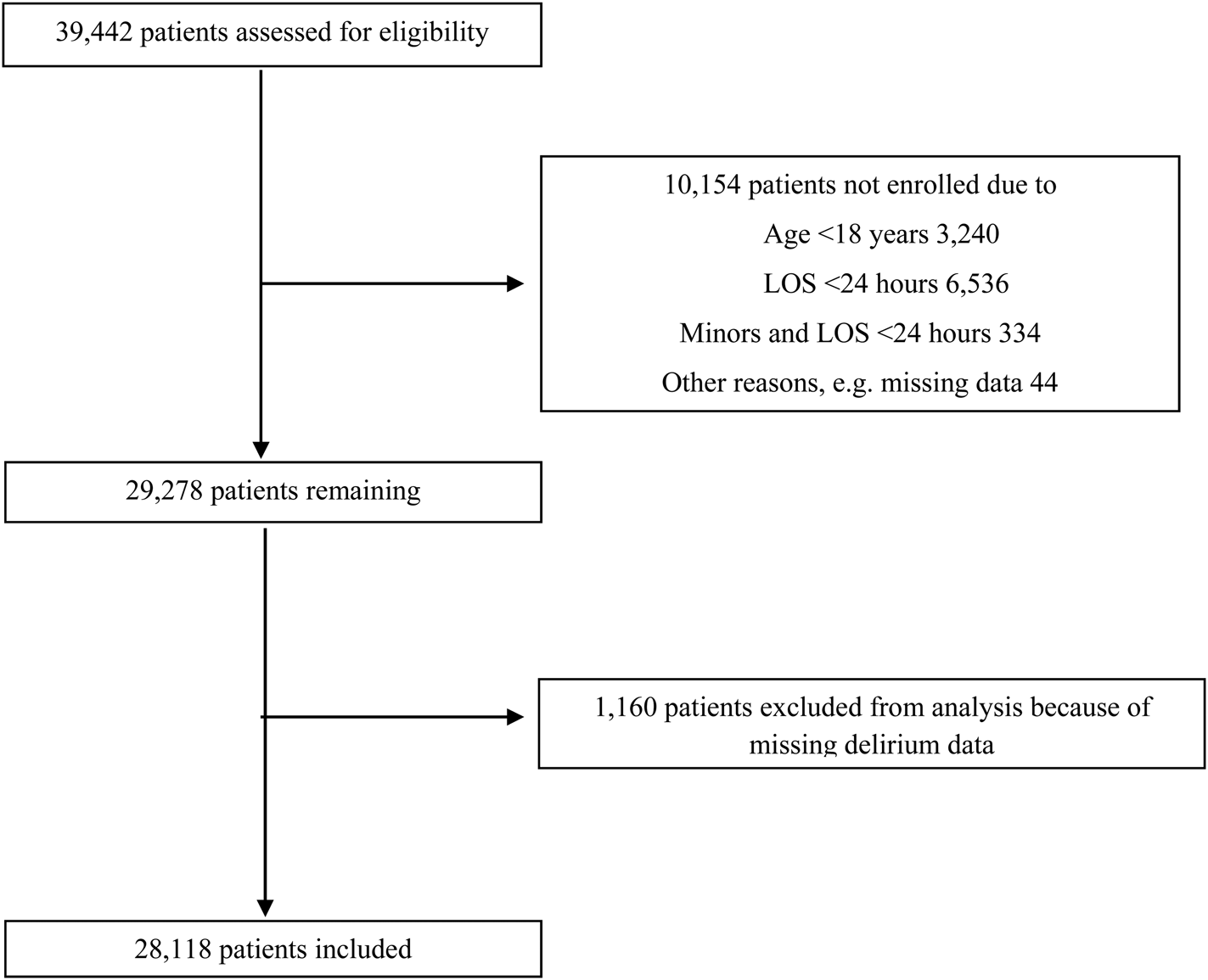
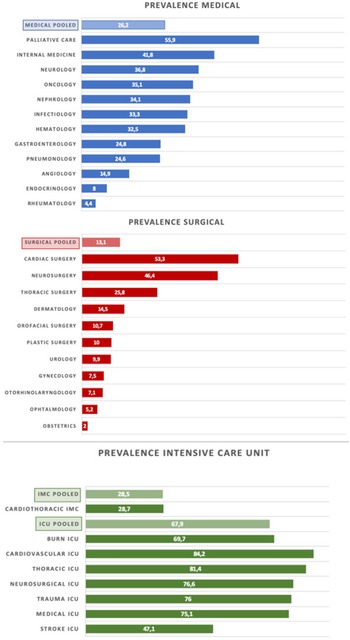
In 2014, 39,442 patients were admitted and registered in the DelirPath. Exclusion criteria were age <18, length of stay (LOS) <1 day, the combination of age and LOS, and missing data including the electronic patients assessment — acute care (ePA-AC), leaving 28,118 eligible patients from 35 services (Figures 1 and 2).
Flow diagram of patient selection. Abbreviation: LOS, length of stay.

Graphical representation of the prevalence rates of delirium for medical, surgical, intensive, and intermediate care services.

The DelirPath implements a screening algorithm with the Delirium Observation Screening (DOS) Scale (Schuurmans et al., Reference Schuurmans, Shortridge-Baggett and Duursma2003) and the Intensive Care Delirium Screening Checklist (ICDSC) (Bergeron et al., Reference Bergeron, Dubois and Dumont2001). On regular floors, the DOS scale was administered routinely three times daily during the first three days of admission in 65 years or older patients and based on the clinical evidence of incident delirium for all patients, i.e., in those <65 years. Once delirium was documented, it was continued three times daily until indication of remission. On the ICUs, the ICDSC was routinely performed thrice daily.
Nursing staff performed these instruments and was trained in a 4-h course with mandatory preceding eLearning and literature research with control of success. Furthermore, nursing staff was educated via case-reports, state-of-the-art lectures on epidemiology, as well as the diagnostic criteria of delirium, and performed the DOS scale.
In addition, nursing staff daily assessed various medical and functional parameters with the ePA-AC (Hunstein et al., Reference Hunstein, Sippel and Rode2012).
The respective managing departments, DOS or ICDCS, and ePA-AC scores were automatically retrieved from the electronic medical chart (Klinikinformationssystem, KISIM, CisTec AG, Zurich).
All reporting followed the STROBE statement (Vandenbroucke et al., Reference Vandenbroucke, von Elm and Altman2014). This study was approved by the ethics committee of the Canton of Zurich (KEK-ZH-Nr. 2012-0263). A waiver of informed consent was obtained from the committee.
Determination of delirium
The primary evaluation of delirium was based on the DOS scale (Schuurmans et al., Reference Schuurmans, Shortridge-Baggett and Duursma2003), the ICDSC (Bergeron et al., Reference Bergeron, Dubois and Dumont2001), and the DSM 5 (Diagnostic and Statistical Manual) (American Psychiatric Association, 2013a) construct based on the ePA-AC (Hunstein et al., Reference Hunstein, Sippel and Rode2012).
The DOS (Schuurmans et al., Reference Schuurmans, Shortridge-Baggett and Duursma2003) scale is a 13-item scale validated to indicate delirium according to DSM-IV criteria. Items include disturbances of consciousness (1), attention (2–4), thought processes (5 and 6), orientation (7 and 8), memory (9), psychomotor behavior (10, 11, and 13), and affection (12). Symptoms are rated on a scale (0–1) as not existent (0), sometimes to always existent (1), and unable to assess (–). The cutoff score for delirium is ≥3, and values were aggregated throughout recordings. This approach proved to be valid and correctly identified 91% of delirium diagnoses as determined by the Consultation-Liaison Psychiatry Service.
The ICDSC (Bergeron et al., Reference Bergeron, Dubois and Dumont2001) is a screening instrument with eight items based on the DSM-IV criteria specifically designed for the intensive care setting with two points: absent or present. This scale was designed for patients with limited communication abilities such as intubated patients. The items include the assessment of 1 — consciousness (comatose, soporose, awake, or hypervigilant), 2 — orientation, 3 — hallucinations or delusions, 4 — psychomotor activity, 5 — inappropriate speech or mood, 6 — attentiveness, 7 — sleep–wake cycle disturbances, and 8 — fluctuation of symptomatology. The maximum score is eight; scores of more than three indicate the presence of delirium. Each item is rated on the patient's behavior over the previous 24 h, and the inter-rater reliability between intensive care staff was considered adequate.
The ePA-AC is a nursing instrument administered daily assessing mobility, personal care and dressing, feeding, elimination, cognition and alertness, communication and interaction, sleeping, breathing, pain, pressure ulcers, and wounds.
However, since only one-third of patients were screened with the DOS and ICDSC indebted to the algorithm implemented, an approach defining delirium by implementing the DSM 5 criteria from the daily nursing assessment ePA-AC aggregated with DOS ≥3 and ICDSC ≥4 was chosen.
Statistical methods
Data analyses were performed with the Statistical Package for the Social Sciences (SPSS) version 25 and R statistical software version 3.5.2 for Windows. Descriptive characteristics are summarized depending on their parametric properties using means and standard deviations or medians and interquartile ranges for continuous variables, as well as percentages for categorical variables.
The data were tested with Shapiro–Wilk's test for the distribution of normality. Intergroup differences for continuous variables were computed using Student's t-test and the Mann–Whitney U-test depending on their parametric properties, and for categorical variables with Pearson's χ 2 test.
In the first step, the delirium construct based on DSM 5 was tested, and its agreement with the validated approach with a DOS cutoff ≥3 Cohen's κ was determined as a measure of concordance. The agreement was defined as 0.61–0.80 substantial and >0.80 perfect (Landis and Koch, Reference Landis and Koch1977).
In the next step, the data were dichotomized by the presence or absence of delirium, and later, further split into managing departments (N = 35). Then, simple logistic regressions were calculated to determine the sociodemogaphic and medical characteristics, as well as the prevalence rates of delirium for individual departments and the determination of the respective odds ratios (ORs) and with confidence intervals (CIs). P-values were adjusted for multiple testing by controlling the false discovery rate (50).
For all inferential tests, two-tailed tests were chosen and the significance level alpha (α) was set at p < 0.05
Results
Determination of delirium
In total, 947 patients received a delirium diagnosis as determined by a consultation-liaison (C-L) psychiatrist indicating a prevalence rate of 3.2%. Using the validated DOS cutoff ≥3 approach, a total of 3,069 patients with delirium were identified, and this approach was correctly identified 91.1% of delirium diagnoses and indicated a prevalence rate of 28.1%. However, only one-third of patients were screened (10,906/29,278), leaving two-thirds unscreened, so underrecognition of delirium was substantial.
The selected DSM 5 criteria — altered alertness or attention and cognition — aggregated with the DOS ≥3 approach based on the ePA-AC identified delirium in 5,984 patients — indicating a delirium rate of 20.4%, correctly identified 93.3% of delirium diagnoses, and revealed a rate of 84.2% undiagnosed delirium. This approach reached substantial bordering perfect agreement (Cohen's κ 0.76, p < 0.001) with the validated DOS and ICDSC cutoffs and included all patients (N = 28,118).
Characteristics of delirious patients
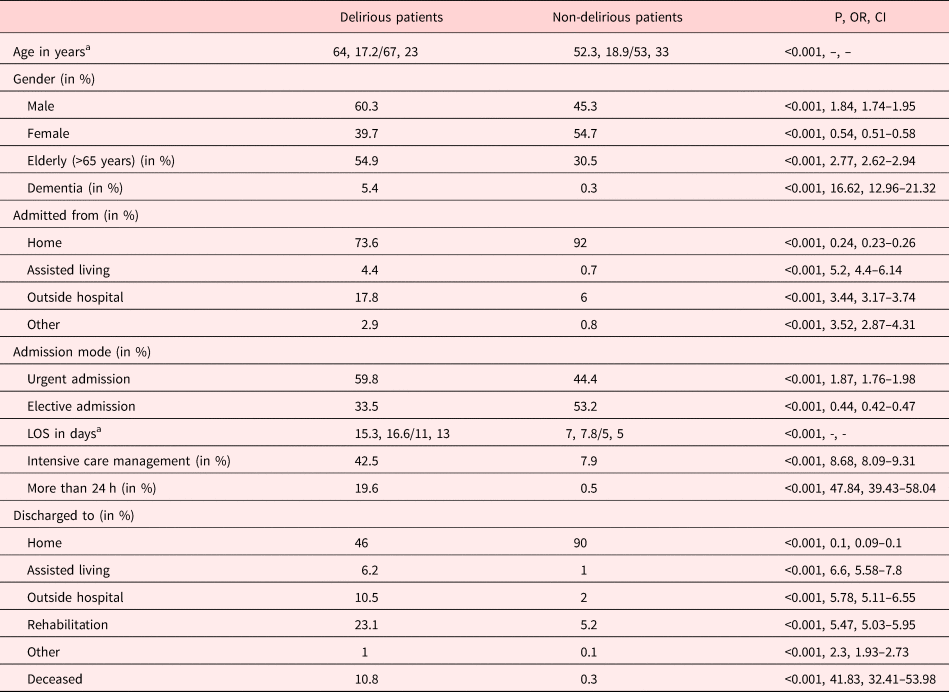
The sociodemographic and medical characteristics of the delirious patients were typical for this syndrome and are displayed in Table 2. The patients with delirium were older, i.e., more often 65 years or above (OR 2.77), predominantly male (OR 1.84), and carried a diagnosis of dementia (OR 16.62). Prior to admission, they resided less often at home (OR 0.24), rather required assisted living (OR 5.2), or were transferred from other hospitals (OR 3.44), and admitted as emergencies (OR 1.87), all indicating functional and physical impairment, as well as the severity of illness.
Sociodemographic and medical characteristics of the patients sample (N = 28,118)

a Mean, standard deviation (SD)/median, interquartile range (IQR), OR, odds ratio; CI, confidence interval.
Furthermore, these patients stayed twice longer in the hospital, and they were also managed at an increased rate in the ICUs. At discharge, their physical and functional impairment was greater, as indicated by increased requirement for assisted living (OR 6.6) either outside the hospital (OR 5.78) or in rehabilitation (OR 5.47) compared with their own residence (OR 0.1). Patients with delirium suffered from more severe illness as indicated by their increased mortality rate (OR 41.83).
Prevalence rates of delirium across managing services
Medical services
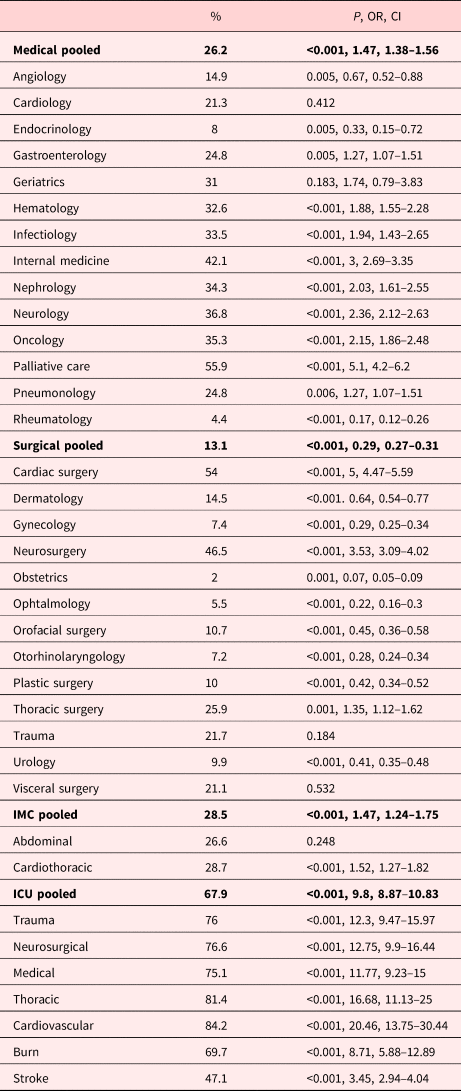
Generally, prevalence rates of delirium were substantial with few exceptions in the medical services (Table 3); the pooled prevalence rate was 26.2%.
Prevalence rates of delirium and risk for the managing services (N = 28,118)

Abbreviations: OR, odds ratio; CI, confidence interval; IMC, intermediate care services; ICU, intensive care unit. Bold values significance pooled services.
Exceeding 40%: The prevalence of delirium was highest in palliative care with 55.9% representing a more than fivefold increased odds for delirium, followed by internal medicine with 41% representing threefold odds.
Exceeding 30%: Prevalence rates of more than 30% occurred in the majority of medical services. Those were in descending order: neurology, oncology, nephrology, infectiology, hematology, and geriatrics. The odds for developing delirium for these services were ±2.
Ranging from 10% to 30%: Gastroenterology and pneumonology reached prevalence rates of almost 25% and increased the odds slightly. Cardiology was the only medical service not reaching significance. Notably, the overall prevalence rate was 20.4%; thus, angiology with its rate of 14.9% featured odds of less than 1 (0.69) or 31% reduced odds.
Less than 10%: Both endocrinology and rheumatology were services with the lowest prevalence rate of delirium with 8% and 4.4%, respectively. Consequently, the odds ratios for these services were even lower, 0.33 and 0.17, respectively.
Surgical and related services
Altogether, prevalence rates of delirium were diverse and rather low in these services with the exception of cardiac surgery (Table 3); the pooled prevalence rate was 13.1%.
Exceeding 40%: As mentioned, cardiosurgical services reached delirium rates of 53.3%, comparable to palliative care, and caused a more than fivefold increase in odds, followed by neurosurgery with 46.4% and 3.6-fold odds.
Between 10% and 30%: The only service exceeding the 20% prevalence mark was thoracic surgery with 25.8%, and neither trauma nor visceral provided conclusive results. Those services below the overall prevalence rate were dermatology (14.5%, OR 0.65), orofacial surgery (10.7%, OR 0.46), and plastic surgery (10%, OR 0.42).
Less than 10%: Many surgical or related services featured low delirium prevalence rates and odds ratios of less than 1, and these were urology, gynecology, otorhinolaryngology, and ophthalmology with rates between 10% and 5% and ORs of less than 0.5. The obstetrics service caused the lowest rate with merely 2%.
Intermediate and intensive care services
Of the intermediate care services, the rate for delirium was 28.7% and the odds ratios were increased by 52% in cardiothoracic care.
For the intensive care services, the delirium prevalence rates were the highest among services and the pooled rate was 67.8%. Services in excess of 80% were the cardiovascular ICU (84.2%, OR 20.46) and the thoracic ICU (81.4%, OR 16.68). Those in excess of 70% were the neurosurgical ICU (76.6%, OR 12.75), thoracic ICU (81.4%, OR 11.77), trauma ICU (76%, OR 12.3), the medical ICU (75.1, OR 11.77), and the burn ICU almost reached 70% (69.7%, OR 78.71). The only prevalence rate of less than 50% was found on the stroke unit (47.1%, OR 3.45).
Of the intensive and intermediate care services, cardiothoracic intermediate care — 41% increase — was the service with the weakest association to delirium.
Discussion
Summary of main findings
The novelty of this study is a systematic and comprehensive capturing of sociodemographic and medical characteristics of delirious patients, as well as determining the prevalence rates and risks for delirium by managing services in 28,118 patients over 1 year and thereby providing a clear picture if the impact of delirium in addition to confirming previous evidence.
Patients with delirium were older, men were more commonly affected, and an increased rate of dementia was noted. Generally, these patients were less commonly admitted from their homes rather than from institutions, i.e., assisted living and outside hospitals. Furthermore, they were admitted as emergencies, were hospitalized twice longer, and more often required intensive care management. Eventually, they less likely returned home, instead, needed institutionalization, i.e., assisted living, transferred to other hospitals and rehabilitation, or deceased.
Underdiagnosis of delirium remains a serious problem in the general hospital setting as indicated by a rate of 84.2%.
The total in-hospital prevalence rate of delirium was 20.4% of patients, pooled, on the medical services 26.2%, on the surgical services 13.1%, and on the intermediate and intensive care services 28.5% and 67.9%, respectively. However, prevalence rates diverged substantially: of the medical services, prevalence rates in palliative care, internal medicine, neurology, oncology, infectiology, and hematology were in excess (55.9–32.5%), whereas in endocrinology and rheumatology rates were less (8–4.4%). Of the surgical services, prevalence rates in cardiac- and neurosurgery were in excess (53.3% and 46.4%), whereas rates in gynecology, obstetrics, and otorhinolaryngology were less (2–7.5%). The prevalence rate for the cardiothoracic intermediate care services matched the medical services, and of the intensive care services, prevalence rates were substantial throughout (>70%); the stroke unit was at the lower end of rates with 47.1%.
Comparison to the existing literature
Overall, this study confirmed and elaborated findings from multiple studies in a single, large, and comprehensive sample. It is known that patients with delirium are older, male, and pre-existent dementias predispose to delirium, patients less often return home than institutions or deceased (Siddiqi et al., Reference Siddiqi, House and Holmes2006; Vasilevskis et al., Reference Vasilevskis, Han and Hughes2012; Inouye et al., Reference Inouye, Westendorp and Saczynski2014b; Maldonado, Reference Maldonado2017). However, the effect sizes of these characteristics of delirium have not yet been described in such a detail and comprehensive sample: delirious patients were 12 years older, being male increased the risk for delirium by 84%, and being demented 16-fold. Of note, the rate of dementias was rather low with a meager 5.4%. The general prevalence rate of dementia in patients admitted to the hospital is estimated to be between 15% and 42% (Handley et al., Reference Handley, Bunn and Goodman2019). However, these numbers usually derive from patient samples 65 years or older. In this sample, two-thirds of patients were younger than 65, likely explaining the lower rate.
The residence prior to admission of delirious patients has not yet been studied, although it is known that patients from assisted living have a worse outcome than those community-dwelling (Friedman et al., Reference Friedman, Mendelson and Bingham2008). From this study, patients with delirium were 76% less likely to be admitted from their homes rather they were referred from outside hospitals or admitted from assisted living (OR 3.44–5.2). For once, transfers from outside hospitals are characteristic for a tertiary care center, nonetheless, and for twice, it likely indicates a lower level of functioning. Although increased prevalence rates and underdetection of delirium have been described in the emergency room (Elie et al., Reference Elie, Rousseau and Cole2000), the obvious conclusion that the delirious patients are more frequently hospitalized as emergencies is new. Furthermore, albeit the association between delirium and prolonged hospitalization is well known, this is the first time to document this effect over 1 year and 35 services, and, the delirious patients stayed twice longer (15.3 vs. 7 days). Then, beyond the evidence of increased prevalence rates on the ICUs, intensive care management — even more ventilation for more than 24 h — increased the risk for delirium by more than factor 8 and close to 48, respectively. And last, even if increased rates of institutionalization and mortality in delirium have been published before, details such as a 90% reduced chance to return home, five to almost seven times increased chance to be transferred to either rehabilitation, an outside hospital, or assisted living are novel. In the end, delirium was associated with a 42 times increased risk for in-hospital mortality, and the overall-mortality reached 11%. In a specific elderly cohort, the mortality rate was 25.9% (Gonzalez et al., Reference Gonzalez, Martinez and Calderon2009).
The overall prevalence rate of delirium was 20.4% reflecting the current experience. Notably, the rate of undiagnosed delirium was 84.2% matching (Evans et al., Reference Evans, Weiner and Arora2016) and indicating the pressing need for alternate screening approaches. A DOS-based screening of elective patients identified 51.5% of delirious patients in a third of the sample correctly, however, would require screening all patients. As chosen in this study and previously recommended, the utilization of nursing screening instruments might be a superior approach providing daily screening for delirium and once indicated, rapid implementation of managing strategies. Thereby, clinically missed and unrecognized delirium could be detected as reflected by the rate of diagnosed delirium (N = 947), reflected by 3,069 patients with delirium as indicated by the DOS/ICDSC; however, only one-third of patients were screened and reflected by the combined approach DOS/ICDSC and ePA-AC covering all 28,118 patients and indicating 5,984 patients with delirium. Both the DOS/ICDSC and the DOS/ICDSC/ePA-AC constructs were highly accurate: First identified 91% patients with diagnosed delirium correctly and second identified 94% with diagnosed delirium correctly. Alternative approaches might be superior with respect to hospital resources and patient coverage.
As aforementioned, the prevalence rates of delirium remain rather elusive. Pooled findings summarizing the occurrence of delirium — incidence, prevalence, and occurrences — from numerous studies are displayed in Table 1.
This study focused on the periodic prevalence of delirium. This approach included previous reports and divergent approaches assessing the prevalence on admission and the incidence during hospitalization. Although — at first sight — this approach may seem disadvantageous; at hindsight, it is superior including both prevalence on admission and incidence during hospitalization.
Either the pooled findings of limited sample sizes disperse, e.g., postoperative 4.7–74%, or describe very specific patient groups such as the elderly, patients with hip surgery, laryngectomy, or head and neck surgery. Nonetheless, the 1-year prevalence in this study of the managing services generally matched the ranges described in Table 1.
Of note, of the medical services, prevalence rates in hematology and infectiology (32.5% and 33.3%) were lower than previously reported; however, those rates were derived from patients post stem cell-transplant or HIV/AIDS and sepsis, the previously reported rate of 29% in palliative care from younger patients.
The pooled prevalence rate for surgical services was lower with 13%; this finding is explained by large numbers of patients on obstetrics, gynecology, and dermatology with low rates of delirium likely biasing the rate downwards vs. previous reports. For cardiac and visceral surgery patients, the prevalence rates were specified. Instead of the previous ranges of 11–73% and 9–50%, rates were 53.3% and 21.1%, respectively, in this study.
For the ICUs, previous rates dispersed substantially, e.g., for all ICUs from 7% to 89%. These results confirmed the high end of the range to be more accurate, i.e., prevalence rates reached 67.9–84.2%.
Implications
This study confirmed the substantial underdiagnosis of delirium in the general hospital setting. One problem is clearly the detection of delirium, and — for this reason — various instruments have been created. Nonetheless, if these instruments are used, then likely the majority of patients have to be screened. Another approach using medical claim data (Gonzalez et al., Reference Gonzalez, Martinez and Calderon2009; Ryan et al., Reference Ryan, O'Regan and Caoimh2013; Meagher et al., Reference Meagher, O'Regan and Ryan2014; Bellelli et al., Reference Bellelli, Morandi and Di Santo2016; McCoy et al., Reference McCoy, Snapper and Stern2016) failed in the detection of delirium. A rather novel approach as favored in this study — using nursing assessment instruments in addition to screening instruments — has the potential to be superior. Furthermore, the impact of delirium on patients, their course of hospitalization, and disposition is substantial. Whether the timely detection and appropriate management will ameliorate these consequences remains to be studied. For the first time, prevalence rates have been comprehensively described in a large sample to notably confirm and specify pooled findings from specific patient population. Contrary to previous findings focusing on the elderly with various age definitions, this study captured delirium in patients from 18 to 102 years.
Strengths and limitations
This study has several strengths and few limitations. First, a large sample including all eligible patients across all departments over 1 year was used avoiding bias towards specific patient groups like the elderly. Second, it was possible to comprehensively describe these patients with respect to their sociodemographic and medical characteristics. On the downside, the patients’ population was representative of a tertiary care center, and the generalizability to other settings remains to be studied. Only one-third of patients were screened with the DOS and ICDSC, and an aggregated construct supplemented by nursing assessments chosen to avoid bias to the elderly and delirious in addition to omitting close to 20,000 patients. Although this approach identified 93.2% of delirium diagnoses correctly and achieved close to substantial agreement with the validated DOS/ICDSC approach, it has not yet been formally tested. Furthermore, pre-existent dementias were also retrieved from the medical records. In contrast to delirium diagnoses however, this approach is considered legitimate (Sommerlad et al., Reference Sommerlad, Perera and Singh-Manoux2018).
Conclusion
In summary, delirium continues to be underdiagnosed and is imperative to improve the detection of delirium, either with screening instruments or daily nursing assessments. Delirium had a substantial impact on the sociodemographic and medical course of patients, as well as healthcare utilization. Whether a better recognition will affect this adverse course remains to be studied. Furthermore, the prevalence rates of delirium were substantial and previous findings from specific patient groups or pooled findings were confirmed and specified across 28,118 patients and 32 services.
Conflicts of interest
None declared.