1 Introduction
In this paper, I present a typology of laryngeal co-occurrence restrictions, and provide experimental support for an analysis of this typology based on perceptual distinctness.
Laryngeal co-occurrence restrictions come in one of three varieties, schematised in (1). Languages with co-occurrence restrictions on laryngeal features may exhibit either long-distance dissimilation (1a), assimilation (1b) or a combination of assimilation and dissimilation (‘mixed’) (1c). In languages with the patterns I call ‘dissimilatory’ and ‘assimilatory’, roots with heterorganic and homorganic pairs of consonants exhibit the same co-occurrence patterns; in languages with the pattern I call ‘mixed’, heterorganic and homorganic pairs pattern differently. ‘T-K’ stands for any pair of heterorganic consonants, while ‘T-T’ stands for any pair of homorganic consonants; the apostrophe here stands for any laryngeally marked consonant, i.e. ejective, aspirate or implosive.
(1)


Co-occurrence restrictions on laryngeal features have various forms, which at first glance seem to be contradictory. Assimilatory and dissimilatory restrictions are opposites – what is prohibited in one type of language is precisely what is required in another. Mixed restriction languages are particularly puzzling, because the antagonistic requirements to assimilate and dissimilate coexist in different corners of the same language. This puzzling array of restrictions is understandable if markedness constraints evaluate contrasts between sets of roots in a language instead of individual forms.
The argument in this paper is that laryngeal co-occurrence restrictions are a unified phenomenon, and are best understood when the perceptual properties of laryngeal contrasts between roots are taken into account. The paper presents experimental support for a hierarchy of perceptual distinctness of laryngeal contrasts among roots, and develops an analysis of laryngeal co-occurrence restrictions based on systemic markedness constraints projected from this hierarchy. The central idea is that laryngeal co-occurrence restrictions are not prohibitions against certain configurations of laryngeal features, but rather are restrictions on the perceptual distinctness of contrasts among possible roots in a language. The operative constraints in laryngeal co-occurrence restrictions are not standard Optimality Theory (OT; Prince & Smolensky Reference Prince and Smolensky1993) markedness constraints. Rather, they are systemic constraints that evaluate the markedness of the set of possible contrasts in a language. This approach follows much previous work integrating systemic contrast markedness into phonological theory, including Contrast Preservation Theory (Łubowicz Reference Łubowicz2003) and the Dispersion Theory of Contrast (Flemming Reference Flemming1995, Reference Flemming2006, Padgett Reference Padgett2003, Sanders Reference Sanders2003, Ní Chiosáin & Padgett Reference Ní Chiosáin, Padgett and Parker2009).
The paper is organised as follows. The typology of laryngeal co-occurrence restrictions is laid out in §2, and §3 outlines the contrast markedness approach to the phenomenon. §4 reports the results of a perception experiment testing an individual's ability to distinguish laryngeal contrasts between pairs of roots. The analysis of laryngeal co-occurrence restrictions with systemic markedness is given in §5, building on the results of the perception experiment. §6 compares the systemic markedness approach with previous analyses of laryngeal restrictions, and §7 concludes.
2 The typology of laryngeal co-occurrence restrictions
I use the term laryngeal co-occurrence restriction to refer to phenomena where the laryngeal features of one consonant in a root are restricted on the basis of the laryngeal features of another, non-adjacent consonant. An example of such a restriction is a language that disallows two ejectives in a root; if one stop in a root is ejective, then any other stops in the root must not be ejective. Laryngeal co-occurrence restrictions are well attested for aspirates, ejectives and implosives, and voiced stops are also involved in a limited number of cases. Most laryngeal restrictions are manifested as static restrictions on the shape of roots in the lexicon, though a few cases exist with supporting alternations.
Co-occurrence restrictions are non-local. Interacting segments may be separated by vowels and consonants that have no role in the restriction. While this paper focuses on co-occurrence restrictions on laryngeal features, such restrictions are well attested for a variety of features, and there is no a priori reason why the claims made here for laryngeal co-occurrence restrictions should not extend to restrictions on other features as well. Best studied are restrictions on the co-occurrence of homorganic consonants, most commonly in Arabic (Greenberg Reference Greenberg1950, McCarthy Reference McCarthy1981, Reference McCarthy1986, Pierrehumbert Reference Pierrehumbert1993, Frisch et al. Reference Frisch, Pierrehumbert and Broe2004, Coetzee & Pater Reference Coetzee and Pater2008), though also documented for English (Berkeley Reference Berkeley1994), Javanese (Mester Reference Mester1986), Muna (Coetzee & Pater Reference Coetzee and Pater2008) and Tigrinya (Buckley Reference Buckley1997), among others.
The laryngeal restrictions reported in the literature can be divided into three classes, which, as noted above, I refer to as ‘assimilatory’, ‘dissimilatory’ and ‘mixed’ (those restrictions which show both assimilation and dissimilation). Dissimilatory and mixed restrictions are well documented by MacEachern (Reference MacEachern1999), while assimilatory restrictions are discussed in Hansson (Reference Hansson2001) and Rose & Walker (Reference Rose and Walker2004). These surveys are the main sources for the data discussed below, along with a few individual cases identified by other authors. Several of the patterns mentioned in this paper are also discussed and analysed in Mackenzie (Reference Mackenzie2009). As mentioned above, the majority of co-occurrence restrictions are static restrictions on the shape of roots in a language. The terms ‘dissimilatory’ and ‘assimilatory’ are not meant to imply that there is evidence for dissimilatory or assimilatory alternations in a given language, but rather that the shape of roots in the lexicon of that language shows disagreement or agreement in laryngeal features.
In languages with dissimilatory restrictions, stops in a root may not have the same laryngeal features. Marked laryngeal segments may co-occur with other plain stops or non-stop consonants, but not with other marked laryngeal segments. Shuswap (Salishan) exhibits a dissimilatory restriction on ejectives (Kuipers Reference Kuipers1974, MacEachern Reference MacEachern1999). Ejectives appear in roots with other non-ejective consonants, but no Shuswap root contains two ejectives. Examples are from Kuipers' dictionary (Reference Kuipers1974), transcribed into IPA; [t'] is a dental ejective that alternates in production with an ejective lateral affricate [tɬ’], and [ts’] is an ejective dental affricate.
(2)
The examples in (2) show that, while ejectives may occur in initial or final position in a root, two ejectives may not co-occur. In Shuswap, the majority of roots are monosyllabic, so interacting consonants are within the same syllable. As can be seen from the first example, [k'aɬt], *[k'aɬt'], however, interacting consonants may be separated by both vowels and consonants.
MacEachern (Reference MacEachern1999) also discusses Cuzco Quechua (Quechuan), which similarly shows a dissimilatory restriction on ejectives. Dissimilatory restrictions on aspirates are found in Souletin Basque (isolate) (Lafon Reference Lafon and Catalán1958), Ofo (Siouan) (Swanton Reference Swanton, Boas, Dixon, Hodge, Kroeber and Smith1909, Dorsey & Swanton Reference Dorsey and Swanton1912) and Sanskrit (Indo-Aryan) (Whitney Reference Whitney1885, Reference Whitney1889). An example from Souletin Basque is given in (3) (from MacEachern Reference MacEachern1999: 26). While roots with a single aspirated stop are well attested, roots with two aspirated stops are absent from the lexicon.
(3)
As in the Shuswap examples in (2), in Souletin Basque aspirates may occur in multiple positions in the root, but crucially may not co-occur. The root [galtʰo] shows that onset consonants may be separated by both a vowel and a consonant. Japanese also exhibits a well-known case of voicing dissimilation (see Ito & Mester Reference Ito and Mester2003 and references therein).
In languages with assimilatory restrictions, stops in a root are required to agree in laryngeal features. In assimilatory restrictions, exactly the structure that is disallowed in languages with dissimilatory restrictions is required. A good example of an assimilatory laryngeal co-occurrence restriction is found in Zulu (Bantu) (Khumalo Reference Khumalo1987, Hansson Reference Hansson2001). Zulu has a three-way laryngeal contrast between voiced, aspirated and ejective stops. In roots with two stops, these consonants are almost always drawn from the same series. Roots with two stops that disagree in laryngeal features are rare. Examples from Doke et al.'s dictionary (Reference Doke, Malcolm, Sikakana and Vilakazi1990) are given in (4).
(4)
Voiced, aspirated and ejective stops in Zulu may generally occur in either initial or final position of a CVC root, e.g. [bal] ‘yard’, [lub] ‘desire’, [pʰal] ‘roof’, [ɬupʰ] ‘annoy’, [p'aʧ] ‘work into a conical shape’, [ʧap'] ‘to spray out’ (Doke et al. Reference Doke, Malcolm, Sikakana and Vilakazi1990). Similar restrictions are also found in the closely related languages Ndebele, Xhosa and Swati (comprising the Nguni subgroup of the Bantu family), as well as in Chaha (Semitic), where the restriction holds over voiced, voiceless and ejective stops (Rose & Walker Reference Rose and Walker2004). A gradient assimilatory effect between ejective and plain stops is reported by Brown (Reference Brown2008) for Gitskan (Tsimshianic); pairs of stops that disagree in laryngeal features are statistically underrepresented in the lexicon. Assimilation between implosives and voiced pulmonic stops is found in Ijoid languages (Jenewari Reference Jenewari and Bendor-Samuel1989, Hansson Reference Hansson2001), as exemplified by the Kalabari Ijo data in (5) (from Hansson Reference Hansson2001: 155).
(5)
Assimilatory and dissimilatory restrictions enforce opposite requirements on the shape of roots in a language.
The third type of restriction shows both assimilatory and dissimilatory requirements, and thus I refer to it as a ‘mixed’ restriction. In languages with mixed restrictions, pairs of heterorganic stops are subject to a dissimilatory restriction, while pairs of homorganic stops show an assimilatory restriction. The distinction between heterorganic and homorganic pairs of stops is unique to languages with a mixed restriction; in the languages discussed above with dissimilation or assimilation, the restriction holds of all pairs of stops, regardless of place. Languages with mixed restrictions exhibit what MacEachern calls the identity effect; while pairs of non-identical stops sharing the same laryngeal features are disallowed, pairs of identical stops sharing the same laryngeal features are allowed. Mixed restrictions do not, however, just show an identity exception. Rather, they actually show laryngeal assimilation between otherwise identical stops, e.g. an ejective and a plain stop at the same place of articulation may not co-occur. Two examples of mixed restrictions are given in (6). In Chol (Mayan) (Gallagher & Coon Reference Gallagher and Coon2009: §2.2), pairs of non-identical ejectives are disallowed, but pairs of identical ejectives are grammatical. Relatedly, an ejective may co-occur with another, heterorganic stop but not with an otherwise identical stop. The example in (6b), from MacEachern (Reference MacEachern1999: 35), shows the same pattern for aspirates in Peruvian Aymara (see also Ayala Loayza 1988, Deza Galindo Reference Deza Galindo1989).
(6)
Mixed restrictions on ejectives are reported by MacEachern for Bolivian Aymara (Aymaran) (de Lucca Reference Lucca1987), Hausa (Afro-Asiatic) (Abraham Reference Abraham1959), Tzutujil (Mayan) (Dayley Reference Dayley1985) and Old Georgian (Caucasian) (Molitor Reference Molitor1952, Hopper Reference Hopper1973). Hausa also shows a mixed restriction on implosives. Aspirates are subject to mixed restrictions in Peruvian Aymara, Gojri (Indo-Aryan) (Sharma Reference Sharma1979) and Old Georgian.
The three types of laryngeal co-occurrence restrictions, dissimilatory, assimilatory and mixed, are schematised in (7).
(7)
It is important to note that the co-occurrence restrictions presented above cannot be reduced to positional restrictions on laryngeally marked stops. In all of the languages discussed, marked stops may occur in multiple positions in the root. It is thus the co-occurrence of laryngeal features in multiple positions in the same root that is restricted, not simply the appearance of certain segments in some prosodic positions. This is particularly relevant to dissimilation. If laryngeally marked stops are restricted to initial position, as they are in many languages, then the fact that two laryngeally marked stops do not co-occur in a root follows from this positional restriction, and does not constitute an independent phenomenon. The examples from Shuswap illustrate that co-occurrence, not position, is restricted. While ejectives may occur in initial or final position in a Shuswap root, two ejectives may not combine ([k'aɬt], [qʷits'], but *T'-K').
Some of the languages discussed above do exhibit ordering restrictions on laryngeal features in a root, though these restrictions do not obviate the need for an analysis of co-occurrence restrictions. In Bolivian and Peruvian Aymara, Souletin Basque and Bolivian Quechua, an ejective or aspirated stop may not follow a plain voiceless stop in the root (MacEachern Reference MacEachern1999), though ejectives and aspirates may otherwise appear non-initially. Representative examples from Bolivian Quechua are given in (8), from Ajacopa et al. (Reference Ajacopa, Cazazola and Pairumani2007), transcribed into IPA.
(8)
A final point about the data under consideration is that co-occurrence phenomena are most often restricted to roots. Combinations of stops that are illicit within a root morpheme may arise in affixed forms or in compounds. As a result, while interacting stops may be separated by intervening vowels and consonants, they are also often in adjacent syllables, as most of the languages in question have mono- or disyllabic roots.
In addition to languages with the three types of restrictions discussed above, there are also languages without non-local restrictions on laryngeal features. In a language of this type, roots may have zero, one or two laryngeally marked stops. Acoma (Keres) is an example of a language with no co-occurrence restriction on ejectives (Miller Reference Miller1965).Footnote 1 A sequence V'V, as in [spa'at'i], represents a glottalised vowel.
(9)
3 Outline of the proposal
This section outlines the conceptual side of the analysis of laryngeal co-occurrence restrictions. The formal analysis developed in §5 relies on systemic markedness constraints that evaluate the perceptual distinctness of contrasting roots in a language. The main idea is that the range of co-occurrence patterns reflect a unified grammatical pressure to maximise the perceptual strength of contrasts between forms in a language.
The possible requirements for laryngeal features on pairs of stops are not simply varied; they appear to be contradictory. The contradictory nature of the requirements poses a problem for analyses based on standard notions of markedness, since it is not possible to claim that one laryngeal configuration is universally more marked than another. Dissimilatory restrictions, for example, suggest that a single occurrence of a laryngeal feature in a root is less marked than multiple occurrences of that feature. Assimilatory restrictions lead to the opposite conclusion, that a single occurrence of a laryngeal feature is more marked than multiple occurrences.
In a theory with systemic markedness, it is not necessary to claim that either one (T'-K) or two (T'-K') instances of a laryngeal feature is inherently marked. Rather, what is marked is the contrast between these two types of forms. From this angle, restrictions on the co-occurrence of laryngeal features are not contradictory. Both dissimilation and assimilation avoid a contrast between forms with one and two instances of a laryngeal feature (T'-K vs. T'-K'). Considering only forms that differ as to whether a given stop is ejective or plain, a system with the potential four-way contrast between roots is more marked than a system with a contrast between forms with ejectives and a form with none. The idea is schematised in (10). Sets of contrasts are in curly brackets.
(10)
The set of roots in (10a) contrasts roots with two, one or zero laryngeally marked consonants. The sets in (10b, c) lack the 2 vs. 1 contrast in laryngeal features and maintain a contrast based on the existence vs. absence of a laryngeal feature, 2 vs. 0 in (10b) and 1 vs. 0 in (10c). Languages with sets of contrasting roots like (10a) are languages without co-occurrence restrictions. In languages with co-occurrence restrictions, the 2 vs. 1 contrast is neutralised and the result is either a 2 vs. 0 contrast (10b), as in languages with assimilation, or a 1 vs. 0 contrast (10c), as in languages with dissimilation.
Looking at co-occurrence restrictions in this light allows for a unified understanding of the three types of restrictions. Assimilatory, dissimilatory and mixed restrictions all neutralise the same contrast; they differ only as to the outcome of this neutralisation. In assimilatory restrictions, neutralisation is to forms with the same laryngeal features, regardless of place of articulation (T'-K'). In dissimilatory restrictions, the neutralised form has only a single laryngeally marked stop, again regardless of place of articulation (T'-K, T-K'). In mixed restrictions, roots with two heterorganic stops neutralise to forms with a single laryngeally marked stop (T'-K, T-K'), while roots with homorganic stops neutralise to forms where both stops agree in laryngeal features (T'-T').
In sum, the contrast markedness approach to laryngeal co-occurrence restrictions formalises the idea that assimilation and dissimilation are a unified phenomenon reflecting a preference for more distinct contrasts. The perceptual strength of laryngeal contrasts among roots is the subject of the following section.
4 The perceptual hypothesis and experiment
The foundational idea behind contrast markedness in the Dispersion Theory of Contrast is that less distinct contrasts are more prone to neutralisation than more distinct contrasts (Flemming Reference Flemming1995). To pursue a systemic markedness approach to laryngeal co-occurrence restrictions, it must be established that the contrast between one and two instances of a laryngeal feature, the contrast that is neutralised across restriction types, is perceptually weakest. In other words, it must be shown that the relation Δ([T'-K']:[T'-K])<Δ([T'-K]:[T-K]), Δ([T'-K']:[T-K]) holds, where Δ(X:Y) means ‘the perceptual distance between X and Y’ (Steriade Reference Steriade, Hanson and Inkelas2009). This section outlines a perception experiment that tests the relative perceptual strength of laryngeal contrasts between pairs of roots.
4.1 The hypotheses
All laryngeal restrictions share the property that the contrast between one and two instances of a laryngeal feature is neutralised. This observation leads to Hypothesis 1, given in (11).
(11)
The most ambitious hypothesis about the role of perception in laryngeal co-occurrence restrictions is that not only the existence of restrictions, as predicted by Hypothesis 1, but also the variation between the three types of restrictions is based in perception. While all three types of restriction neutralise the 2 vs. 1 contrast, which is claimed to be the weakest, all other laryngeal contrasts are not necessarily equal. Differences between the various types of restrictions may reflect different thresholds for the distinctness of allowable contrasts. Specifically, assimilation may be due to an additional perceptual asymmetry, namely that the contrast between two and zero instances of a laryngeal feature is stronger than the contrast between one and zero instances of a laryngeal feature. Neutralisation of the 1 vs. 0 contrast, either in all pairs of roots or only in pairs of roots with homorganic stops, may reflect the relative weakness of these contrasts relative to the 2 vs. 0 contrast. The preference for forms with multiple ejectives over roots with a single ejective may be explained by the relative perceptual distinctness of contrasts. The two relevant hypotheses are stated in (12).
(12)
Hypothesis 2 suggests a general preference for assimilation, while Hypothesis 3 aims to explain why assimilation may target only homorganic pairs of stops, as is the case in mixed restriction languages. If Hypothesis 1 is correct, the 2 vs. 1 contrast should be more difficult than the 1 vs. 0 contrast, regardless of place of articulation. The predictions of these three hypotheses are summarised in the four-tiered perceptual hierarchy in (13), where ‘<’ means ‘less distinct than’.
(13)
The hypotheses centre on claims about the relative distinctness or strength of a contrast. For some contrast category A to be ‘weaker’ than some contrast category B, subjects should have more difficulty discriminating pairs of forms that fall into category A than B (i.e. incorrectly think that pairs of different roots are the same). The experiment tests these hypotheses by presenting subjects with pairs of CVCV nonce roots that differ only in whether the consonants are ejective or plain. Subjects are then asked to decide whether the roots they hear are the same or different from one another (an AX discrimination task). If Hypothesis 1 is correct, subjects will perform better on pairs like [k'ap'i] and [kapi] (2 vs. 0), [k'api] and [kapi] (1 vs. 0 heterorganic) and [k'aki] and [kaki] (1 vs. 0 homorganic) than on pairs like [k'api] and [k'ap'i] (2 vs. 1). If Hypothesis 2 is supported, subjects should be better at accurately distinguishing pairs like [k'ap'i] and [kapi] (2 vs. 0) than pairs like [k'api] and [kapi] (1 vs. 0). Finally, if Hypothesis 3 is true, subjects will perform better on pairs like [k'api] and [kapi] (1 vs. 0 heterorganic) than on pairs like [k'aki] and [kaki] (1 vs. 0 homorganic).
4.2 Stimuli
The stimuli for this experiment are pairs of CVCV disyllables manually spliced together from recordings of South Bolivian Quechua. The stops in pairs of stimuli differ only as to whether the consonants are plain or ejective.
4.2.1 Creating the stimuli
The target stimuli have one of four laryngeal configurations: CVCV (no ejectives), C'VCV (one ejective, initial position), CVC'V (one ejective, medial position) or C'VC'V (two ejectives). Three places of articulation (labial, coronal and velar) and two vowel patterns ([a–i] and [i–u]) are used. Not all of these four desired laryngeal configurations are grammatical in Quechua, however, so it was not possible to record all four types of roots. Quechua is a dissimilating language that does not allow pairs of ejectives in a root. Additionally, as mentioned in §2, Quechua does not allow non-initial ejectives in roots with two stops (e.g. [sap'a] ‘a kind of basket’, but *[tap'a]). Consequently, nonce roots were constructed which conformed to the phonotactics of Quechua for the purposes of recording, and the experimental stimuli were made by splicing together individual syllables. The recorded roots took one of three grammatical laryngeal configurations in Quechua: CVCV (two plain stops), C'VCV (initial ejective, medial plain stop) or sVC'V (initial [s], medial ejective).
Recordings of a middle-aged female speaker of South Bolivian Quechua were made in Cochabamba, Bolivia, using a Marantz PMD660 solid-state recorder and Audio Technica 831b microphone. The speaker was asked to read the phonotactically legal nonce roots from a computer screen, embedded in the carrier phrase Noqa X simita qellqani ‘I wrote the word X’.
The experimental stimuli were made by splicing together CV sequences from the original recording. Stimuli were spliced together during the closure of the second C, keeping VC transitions intact and resulting in natural sounding stimuli. A stimulus like [k'api], for example, was made by splicing the first CV and the VC transition of [k'api] with the second CV of [kapi]; [k'ap'i] was made by splicing the first CV and VC transition of [k'api] with the second CV of [sap'i]. Initial and final syllables in the stimuli were always spliced from original initial and final syllables in the recorded speech.
Stimuli with two heterorganic stops were made in all four laryngeal patterns (CVCV, C'VCV, CVC'V, C'VC'V), while stimuli with two homorganic stops were only made in three (CVCV, C'VCV, CVC'V). Stimuli were put in pairs that fall into one of nine categories in (14), based on the type of laryngeal contrast. The four ‘different’ categories in (14b) are those that are relevant to the hypothesised hierarchy of contrast strength; no further ‘different’ contrasts were included in order to keep the experiment at a manageable length (e.g. 2 vs. 0 and 2 vs. 1 homorganic pairs were not included).
(14)
The ‘different’ pairs were presented in both possible orders (1–0 and 0–1; 2–0 and 0–2; 2–1 and 1–2). In stimuli pairs where one stimulus has only one ejective, the ejective could be in either initial or medial position (C'VCV or CVC'V). There are different numbers of unique stimulus pairs for each of the categories in (14), depending on whether the pairs have homorganic or heterorganic pairs of stops and whether order of presentation (for ‘different’ pairs) or position of ejection (for pairs with a form with a single ejective) is variable. Stimulus pairs were repeated if necessary to ensure that the total number of stimuli in each category was 48, resulting in a total of 432 pairs presented to each subject.
4.2.2 Acoustic properties of the ejective–plain contrast in the stimuli
To see what acoustic cues potentially underlie the results of the study, an acoustic analysis was conducted on the edited stimuli. Acoustic analysis serves two purposes. First, it verifies that cues to the ejective–plain contrast are present in all of the experimental stimuli, eliminating the possibility that any perceptual asymmetries result from acoustic irregularities. Second, if subjects show difficulty in perceiving the ejective–plain contrast in certain categories, as is predicted, we will know what acoustic properties are not being accurately perceived.
For each initial and medial syllable used in stimulus creation VOT, burst amplitude and voice quality of the following vowel were measured. VOT was measured in milliseconds from the beginning of the burst to the onset of periodicity in the following vowel. Burst amplitude was measured in arbitrary units directly off of the waveform by calculating the difference between the highest and lowest points in the waveform. Voice quality is quantified as the difference between the amplitude of H1 and H2 in the first 30 ms of the vowel (Ladefoged Reference Ladefoged2003).
Each unique sequence was measured once. For example, while [k'i] from [sak'i] was spliced into multiple stimuli (e.g. [pak'i], [tak'i] and [kak'i]), this sequence was only measured once. For all initial sequences, as well as medial sequences with an ejective, there were six unique tokens to measure. For medial sequences with a plain stop, there were twelve tokens. This asymmetry arises because no initial and medial sequence from the same natural utterance were spliced together. All medial syllables with ejectives were taken from an utterance with initial [s]. Medial syllables with plain stops were cross-spliced, so that [ki] in the stimulus [taki] was spliced from [t'aki] and [ki] in the stimulus [t'aki] was spliced from [taki].
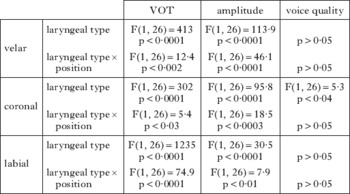
The measurements for each place of articulation were subjected to a two-way ANOVA, with position and laryngeal type as factors. For all three places of articulation, there was a significant effect of VOT and burst amplitude, along with a significant interaction between laryngeal category and position. For the alveolars, there was also a small main effect of vowel voice quality (p<0·04), but no interaction with position. The statistical results are reported in Table I.
Statistical analysis of acoustic corelates of contrasts in experimental stimuli.

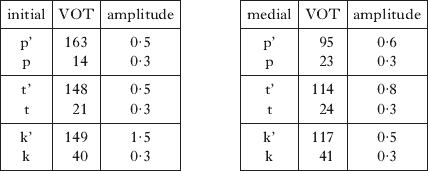
Mean values for amplitude and VOT for each consonant in initial and medial positions are given in Table II.
Average values for VOT and burst amplitude in experimental stimuli.
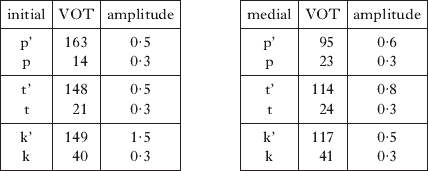
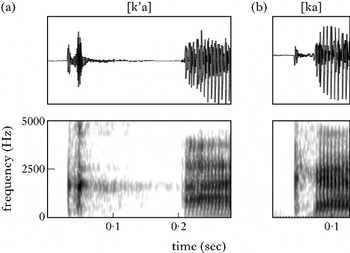
Acoustic analysis shows, as summarised in Tables I and II, that ejective and plain stops are distinguished by burst amplitude and VOT. These cues are reliably preserved in the spliced stimuli, since CV transitions are kept intact.Footnote 2 Any difficulty in accurately discriminating between ejectives and plain stops, then, cannot be attributed to conflicting cues in the signal. Sample spectrograms are given in Fig. 1 for the syllables [k'a] and [ka]. Differences in the acoustics of contrasts depending on place of articulation and position are taken into account in the analysis of the perceptual results presented in §4.4 below.
Comparison of a voiceless unaspirated and ejective velar stop in Quechua.

Finally, the stimuli were tested for any long-distance interaction between ejective and plain stops. The main hypothesis is that the ejective–plain contrast is perceptually weaker in roots with another ejective stop. One possible explanation for such an effect could be acoustic – an ejective may alter the production of a stop elsewhere in the root, making ejectives and plain stops acoustically more similar in roots with another ejective. In theory, the acoustic effect could be that ejectives following other ejectives have weaker bursts and shorter VOTs than other ejectives (e.g. [p'] in [k'ap'i] vs. [kap'i]), or that plain stops following ejectives have louder bursts and longer VOTs than other plain stops (e.g. [p] in [k'api] vs. [kapi]). Given the phonotactics of Quechua, only the latter possibility can be tested; forms with two ejectives are absent in the Quechua lexicon, as are forms with medial ejectives following plain stops. The VOT and burst amplitude of plain stops in medial position were compared, depending on whether the initial stop was ejective or plain. Neither measure was significantly different in the two contexts, according to a two-tailed paired t-test (p>0·05 for both measures). The differences in VOT between the two contexts showed a slight trend (p<0·09) for longer VOTs following ejectives than plain stops. The average values between the two contexts, however, differed by only 4 ms (28 ms following an ejective stop vs. 24 ms following a plain stop). It seems unlikely that such a small difference would have any perceptual effect, especially considering that the contrasting ejectives in medial position have an average VOT of 108 ms.
4.3 Procedure
Subjects were presented auditorily with pairs of nonce roots and asked to decide whether the roots they heard were the same or different from one another. Subjects indicated their response by pressing one of two clearly marked keys on a standard USB keyboard. Subjects listened to the stimuli through a pair of high-quality headphones, while looking at a computer screen. The stimuli were presented while the computer screen was black, with a 300 ms interstimulus interval. After the second stimulus, a green line appeared on the screen. Subjects were told to indicate their response as quickly as possible once the green line appeared, but not before. All subjects thus listened to both stimuli in their entirety before indicating their choice of ‘same’ or ‘different’. Response time was limited to 1500 ms. If subjects did not respond within this time, they automatically went on to the next trial.
The subjects were 19 speakers of American English with no exposure to a language with ejectives. English speakers were chosen as subjects instead of native Quechua speakers to avoid a phonological bias in perception. Quechua speakers or speakers of any language with restrictions on ejectives, are cognizant of restrictions or trends in the distribution of these sounds, and this knowledge may affect their perception of nonce roots. Thus, while Quechua speakers may perform in a way consistent with the hypotheses, it would not be clear if this performance was due to the Quechua speakers' grammar, or to some basic property of the perceptual properties of ejectives in different environments. The English subjects were told that the sounds they were hearing were not from English, and would sound foreign. All subjects performed at above chance on the experiment as a whole, and made very few mistakes on the ‘same’ pairs. Each subject listened to five trial pairs to accustom themselves to the stimuli and task. The experiment took about 20 minutes, including a break halfway through, and subjects were paid for their participation.
4.4 Results
Subjects' performance supports two of the three hypotheses. The 2 vs. 1 contrast is indeed weaker than other laryngeal contrasts, supporting Hypothesis 1. Additionally, the 1 vs. 0 contrast is significantly weaker than the 2 vs. 0 contrast, supporting Hypothesis 2. No difference was found between the 1 vs. 0 contrast in heterorganic and homorganic pairs of stops, and thus Hypothesis 3 was not supported.
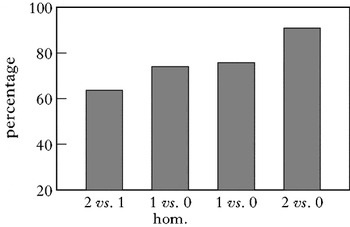
A contrast-coded mixed logit model (Jaeger Reference Jaeger2008) directly evaluated the hypotheses by testing for significant differences between correct responses on 2 vs. 1 and 1 vs. 0 categories (both 1 vs. 0 and 1 vs. 0 homorganic), 1 vs. 0 and 1 vs. 0 homorganic categories, and 1 vs. 0 (both 1 vs. 0 and 1 vs. 0 homorganic) and 2 vs. 0 categories. The model included random error effects for subject, as well as first stimulus and second stimulus (i.e. the individual items presented to the subject). As shown in Fig. 2, there was a significant difference between 2 vs. 1 and 1 vs. 0 (both 1 vs. 0 and 1 vs. 0 homorganic) contrast categories (β=1·38, z=11·69, p<0·0001), as well as a significant difference between the 1 vs. 0 (both 1 vs. 0 and 1 vs. 0 homorganic) and 2 vs. 0 contrast categories (β=−1·35, z=−9·72, p<0·0001). There was no significant difference between the 1 vs. 0 and 1 vs. 0 homorganic contrast categories (β=0·08, z=0·61, p>0·05), revealing that subjects' performance on the 1 vs. 0 contrast is not affected by the homorganicity or heterorganicity of the consonants. For discussion of mixed models and why these are appropriate for binary forced choice tasks, see Jaeger (Reference Jaeger2008).
Percentage correct by contrast category, averaged across all subjects.

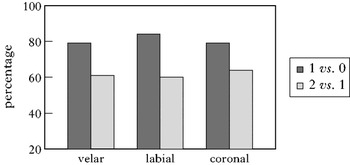
There are two factors other than the category of laryngeal contrast that could have influenced performance. First, it is possible that subjects' discrimination of the ejective–plain contrast varied depending on the place of articulation of the stop in question. Ejective bursts are much louder and VOT longer for stops at the velar place of articulation than at the labial or coronal places, as can be seen from the measurements in Table I. Figure 3 shows that while performance within a category differs somewhat depending on place of articulation, the hierarchy 2 vs. 1<1 vs. 0 holds for all places of articulation. Only the 1 vs. 0 and 2 vs. 1 categories are compared here, since only in these categories is there a single locus of contrast. Token pairs are categorised corresponding to whether the contrast between the two stimuli is on a labial, coronal or velar. For example, in the pair [k'api] – [kapi] the ejective–plain contrast is on a velar, while in [tip'u] – [t'ip'u] it is on a coronal. The graph in Fig. 3 shows that the overall effect is not an artefact of perceptual difficulties with contrasts at a single place of articulation, but rather holds across places of articulation.
Percentage correct for 1 vs. 0 and 2 vs. 1 contrast categories by place of articulation, averaged across all subjects.

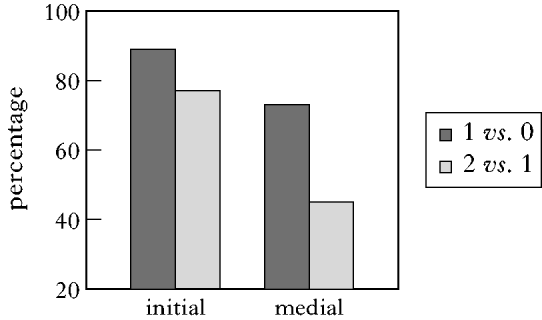
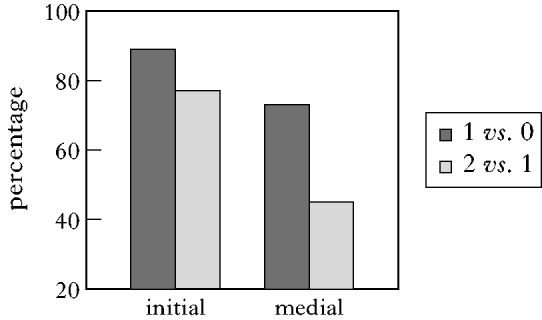
The second possible factor that could have affected the overall outcome is the position of the contrast. In the 1 vs. 0 and 2 vs. 1 conditions, the contrast that subjects were being asked to discriminate may be in either initial or medial position (e.g. [k'api] – [kapi] or [kap'i] – [kapi]). Figure 4 shows that while subjects are much better at discriminating initial contrasts than medial contrasts within a category, in each position performance on the 2 vs. 1 condition is worse than on the 1 vs. 0 condition. Subjects' difficulty on the 2 vs. 1 contrast is thus a function of the difficulty of that contrast, and is not significantly affected by place of articulation or the position of the contrast in the root.
Percentage correct by contrast categories contrast categories by contrast position, averaged across all subjects.
4.5 Discussion
The results of the experiment support the hypothesis that a contrast between one and two instances of an ejective in a root is more difficult to perceive than either a contrast between one and zero or between two and zero instances of an ejective in a root, thus Δ([T'-K']:[T'-K])<Δ([T'-K]:[T-K]), Δ([T'-K']:[T-K]). The central premise of a Dispersion Theory of Contrast account of laryngeal co-occurrence restrictions is satisfied – the contrast that is preferentially neutralised in laryngeal co-occurrence restrictions is the contrast that is perceptually weakest. The secondary hypotheses about further distinctions in the distinctness of laryngeal contrasts are partially supported. The 2 vs. 0 contrast is indeed the strongest, supporting the hypothesis that the preference for assimilation as opposed to dissimilation in some languages is perceptually based. Assimilation in laryngeal features improves the distinctness of roots in a language. No distinction was found between the 1 vs. 0 contrasts in heterorganic vs. homorganic pairs of stops. It is thus not clear that the distinction between roots with heterorganic and homorganic pairs of stops in mixed restriction languages is perceptually based. Though assimilation in mixed restriction languages may still reflect the same pressure for perceptual distinctness as assimilation in assimilatory languages (indeed, this is the claim made in the analysis in §5), the application of assimilation only to roots with homorganic stops cannot yet be given a perceptual explanation. Further research is necessary to explain the distinction between heterorganic and homorganic pairs of stops in mixed restriction languages.
The current results test the perception of only one laryngeal feature, ejection. Further experiments should reproduce the same results for other laryngeal features that are subject to co-occurrence restrictions, i.e. aspiration and implosion. Moreover, the current experiment used stimuli produced by a speaker of Quechua. The acoustic properties of ejectives (and other laryngeal features) may vary from language to language (Lindau Reference Lindau1984, Kingston Reference Kingston1985, Reference Kingston, Hargus and Rice2005). While the main cues to the ejective–plain contrast in Quechua were found to be burst amplitude and VOT, in other languages voice quality in the following vowel (creaky or modal) also distinguishes ejectives from plain stops. The effects of variation in the realisation of laryngeal features on the perception of laryngeal contrasts remains to be thoroughly explored.
5 An analysis within the Dispersion Theory of Contrast
5.1 Architecture of the grammar
The proposal in this paper is that laryngeal co-occurrence restrictions are driven by systemic markedness constraints on laryngeal contrasts. The particular set of contrasting root types in a given language is determined by the ranking of contrast markedness constraints that favour more perceptible contrasts over less perceptible contrasts, following the Dispersion Theory of Contrast (DT) framework of Flemming (Reference Flemming1995, Reference Flemming, Hayes, Kirchner and Steriade2004, Reference Flemming2006).
In DT, the grammar maps sets of input forms to sets of output forms, as opposed to the mapping of individual inputs to individual outputs in standard OT. The central hypothesis of the DT framework is that phonological patterns reflect grammatical pressures, formalised as systemic markedness constraints, to maximise the perceptual distinctness of contrasts. For the grammar to evaluate perceptual distinctness, sets of forms must be evaluated in parallel, and thus the grammaticality of a given form is dependent on what other forms it contrasts with.
The DT analysis of laryngeal co-occurrence restrictions presented in this section differs from a standard OT analysis in two ways: sets of inputs are mapped to sets of outputs, and the contrasts between output forms in a given set are evaluated by systemic markedness constraints. Systemic markedness constraints interact with standard input–output faithfulness constraints, which are evaluated as in standard OT. Systemic markedness constraints are universal, like standard OT markedness constraints, as they refer to language independent asymmetries in the perceptual distinctness of contrasts. The variation between languages is in the relative ranking of systemic markedness constraints with input–output faithfulness.
Some general motivation for systemic over non-systemic markedness constraints comes from segment inventories across languages, as discussed in Flemming (Reference Flemming, Hayes, Kirchner and Steriade2004, Reference Flemming2006). For example, the cross-linguistic preference for the peripheral vowels [i u] is formalised in standard OT as a fixed ranking of markedness constraints *[ɨ]≫*[i u]. This ranking, however, cannot account for the fact that the central vowel [ɨ] is preferred to the peripheral vowels [i u] in languages without a front–back contrast. Languages with only a height contrast in vowels never have [i] or [u] as the only high vowel; rather, the backness of a vowel varies depending on context, and tends to cluster around a central value. It is thus not the case that there is a difference in markedness of the three vowels [i ɨ u] in isolation, but rather that the contrast between a central and a peripheral vowel, [i – ɨ] or [ɨ – u], is more marked than the more distinct contrast between two peripheral vowels [i – u]. In the analysis of laryngeal restrictions, systemic markedness constraints take the place of standard OT markedness constraints on particular laryngeal configurations, like the Obligatory Contour Principle (OCP) or a non-local harmony constraint (see the specific proposals in Hansson Reference Hansson2001, Rose & Walker Reference Rose and Walker2004 and Mackenzie Reference Mackenzie2009). This analysis formalises the idea, presented earlier in §3, that certain combinations of laryngeal features are not marked in isolation; rather, certain contrasts in laryngeal configurations between roots are marked. The systemic analysis is explicitly compared with standard OT analyses of laryngeal restrictions in §6.
In both standard OT and DT, the role of the grammar is to map the rich base of all possible inputs to the set of attested forms in a given language. While in standard OT this mapping is modelled on individual forms, in DT the entire set of hypothetical forms is mapped onto the entire set of attested forms at once. The evaluation and interaction of constraints in DT tableaux are discussed further in the next subsection, once the systemic markedness constraints responsible for laryngeal co-occurrence restrictions have been introduced.
5.2 The constraints
Laryngeal co-occurrence restrictions reflect asymmetries in the perceptual strength of contrasts between roots with different laryngeal configurations. The experimental results reported in §4 reveal a three-tiered hierarchy in the perceptual distinctness of laryngeal contrasts in pairs of roots.
(15)
This hierarchy projects two systemic markedness constraints, defined in (16), corresponding to the two asymmetries in (15). I refer to the constraints that evaluate laryngeal contrasts between roots as laryngeal distance or LarDist constraints.Footnote 3
(16)
LarDist(2v1)-[F] penalises a minimal contrast in a given laryngeal feature between two roots each of which contains another segment specified for that feature. LarDist(1v0)-[F] is more general; it penalises a minimal contrast in a given laryngeal feature between two roots each of which contains another segment that can be specified for that feature. LarDist(2v1)-[F] penalises the weakest contrast on the scale in (15), while LarDist(1v0)-[F] penalises the next weakest contrast. There is no constraint against the 2 vs. 0 contrast, the strongest on the scale of laryngeal contrasts in (15) (cf. Gouskova Reference Gouskova2003).
LarDist(2v1) only penalises pairs of forms that contrast one and two instances of a laryngeal feature. LarDist(1v0), however, penalises pairs of forms with a 2 vs. 1 or 1 vs. 0 contrast in a laryngeal feature, or a contrast in the position of a laryngeal feature in the root, e.g. {k'api, kap'i}. Thus, pairs like {k'ap'i, k'api} (2 vs. 1), {k'api, kapi} (1 vs. 0) and {k'api, kap'i} (positional) all violate LarDist(1v0), while only a pair like {k'ap'i, k'api} (2 vs. 1) violates LarDist(2v1). The perception experiment in the preceding section found a hierarchy of perceptual strength between the 2 vs. 1, 1 vs. 0 and 2 vs. 0 contrasts, but did not explicitly test the relative strength of a positional contrast in laryngeal features. The hypothesis underlying the proposed constraints is that a positional contrast stands in the same place in the hierarchy as the 1 vs. 0 contrast; a pair like {k'api, kap'i} is presumed to be more easily distinguished than a pair like {k'ap'i, k'api}, but less easily distinguished than a pair like {k'ap'i, kapi}. Thus the grouping of a featural mismatch between segments, as in {k'api, kapi}, and a positional mismatch, as in {k'api, kap'i}, should form a natural class in perceptual terms. Future work must test this hypothesis.
(17) and (18) show how LarDist(2v1) and LarDist(1v0) evaluate pairs of roots that contrast in ejection. I characterise the collection of properties that distinguish ejectives from plain stops with the feature [ejective].
(17)
Only a pair like (17a), which contrasts one and two laryngeally marked stops, violates LarDist(2v1). For a pair of roots to violate LarDist(2v1)-[ejective], several conditions must be met. First, each root must have two segments that can contrast for [ejective]. In (17a), these segments are [k'] (x R1) and [p'] (y R1) in the first root and [k'] (x R2) and [p] (y R2) in the second. Second, the contrasting roots must be identical except that y R1≠y R2. This is true in (17a), as the only difference between the two roots is that y R1 is an ejective [p'] and y R2 is a plain stop [p]. Furthermore, x R1 and x R2 must both be [ejective], as is the case in (17a): x R1 is [k'] and x R2 is [k']. Finally, the roots must differ only in a single instance of [ejective]. In (17a), the only difference between the two roots is that y R1 is ejective and y R2 is not. This pair of roots thus violates LarDist(2v1)-[ejective].
(18)
LarDist(1v0)-[F] only penalises the 1 vs. 0 contrast in roots with another segment that contrasts for the given laryngeal feature. Consider the pair in (18b). This pair of roots violates LarDist(1v0)-[ejective], because each root contains two segments that contrast for [ejective] (x R1 is [k'], y R1 is [p], x R2 is [k] and y R2 is [p]), and the only difference between the two roots is that x R1 is [ejective], [k'], and x R2 is not, [k].
In (18), the contrast between an ejective and a plain stop is penalised in roots with another ejective or plain stop (the segments that contrast for [ejective]), as in the pairs {k'ap'i, k'api} and {k'api, kapi}, but not in roots with another nasal, as in the pair {k'ami, kami}. This distinction is necessary because languages with assimilatory restrictions neutralise the 1 vs. 0 contrast only in roots with two segments that contrast for the given laryngeal feature, as shown by the Chaha examples in (19). The examples here show that the contrast between [t] and [t'] is not possible in the context of another plain stop, [k] in (19a), but is possible in the context of a nasal, [m] in (19b).Footnote 4
(19)
It is thus necessary to distinguish between a 1 vs. 0 contrast in the context of another minimally contrastive consonant, e.g. {k'api, kapi}, and a 1 vs. 0 contrast in the context of a more dissimilar consonant, e.g. {k'ami, kami}.
While there is no experimental evidence supporting a perceptual distinction in contrast strength between the two environments in (19), the existence of a distinction (perceptual or otherwise) is an empirical fact. The requirement in languages with assimilatory restrictions is not that a laryngeal feature be realised more than once, but rather that a laryngeal feature be realised on all possible hosts in a given root. The hypothesised explanation for this fact is that perception of the 1 vs. 0 contrast is made more difficult by the presence of another potentially contrastive segment, i.e. the contrast in (19a) is weaker than that in (19b). Further experimental research is necessary to determine if this is in fact the case.
The constraints in (16) are in a stringency relation (Prince Reference Prince1997, de Lacy Reference de Lacy2002, Reference de Lacy2006). Any candidate that violates LarDist(2v1)-[F] also violates LarDist(1v0)-[F], but not vice versa. LarDist(2v1)-[F] penalises a contrast in [F] in the environment of another [F] segment anywhere in the root, e.g. {k'ap'i, k'api}. LarDist(1v0)-[F], however, penalises a contrast in [F] if there is another contrastive segment in the root regardless of whether that segment is marked for [F] or not. Contrasts like {k'ap'i, k'api} and {kap'i, kapi} both violate this constraint.
One additional systemic markedness constraint is necessary for the analysis, though it is not expressly supported by the experimental results. The general constraint LarDist(1v0)-[F] must have a more specific version, which penalises a 1 vs. 0 contrast between roots with specifically homorganic pairs of stops, e.g. {k'aki, kaki}. This constraint is necessary to account for mixed restriction languages where assimilation is required only between roots with homorganic pairs of stops. This constraint is defined in (20).
(20)
The hypothesis put forward earlier was that the distinction between homorganic and heterorganic pairs of consonants is perceptually based – the 1 vs. 0 contrast may be neutralised in only homorganic pairs of stops because this contrast is weaker in homorganic than in heterorganic pairs. While the experimental results reported above did not support the distinction between a 1 vs. 0 contrast in heterorganic and homorganic pairs of consonants in perceptual terms, future research into this area will hopefully reveal a perceptual or articulatory explanation for why assimilation may be restricted to only homorganic consonants, those pairs of segments that are made completely identical as a result of laryngeal assimilation. H-LarDist(1v0) and LarDist(1v0) stand in a stringency relation; the violations of H-LarDist(1v0) are a subset of those of LarDist(1v0), as can be seen in (21).
(21)
Systemic markedness constraints interact with input–output faithfulness constraints (McCarthy & Prince Reference McCarthy, Prince, Beckman, Dickey and Urbanczyk1995), which penalise contrast neutralisation. Consider (22).
(22)
Given a set of input forms showing minimal contrasts in [ejective], contrast neutralisation violates Ident[ejective], as shown in (23).
(23)
In (23a), the input form /k'ap'i/ is neutralised, violating Ident[ejective] once, due to the mapping of a form with two ejectives onto a form with only one ejective, either [k'api] or [kap'i]. In (23b), both forms with a single ejective are neutralised, incurring two violations of faithfulness because of the mapping of the plain stops in /k'api/ and /kap'i/ onto ejectives in [k'ap'i]. It could also be assumed that the forms /k'api/ and /kap'i/ are both mapped onto [kapi], still violating Ident[ejective] twice.
Given that the phenomenon of interest is the distribution of laryngeal features in roots, the analysis is presented with tableaux showing sets of roots that minimally contrast in laryngeal features. It should be kept in mind that the input in any tableau is the rich base, and that other constraints not shown in the tableaux are responsible for ruling out forms that are unattested for reasons orthogonal to laryngeal co-occurrence restrictions. The tableaux show only the smallest set of forms needed to represent the distribution of laryngeal features in the roots of a language.
5.3 The analysis of laryngeal co-occurrence restrictions
The variable ranking of Ident with LarDist(2v1) and LarDist(1v0) accounts for the difference between dissimilation and assimilation in laryngeal features. Three case studies illustrate the analysis.
5.3.1 Dissimilatory restrictions: Shuswap
Dissimilation in laryngeal features is exemplified by the patterning of ejectives in Shuswap (Salishan). Ejectives contrast with voiceless unaspirated stops, as shown in the inventory given in (24) (Kuipers Reference Kuipers1974, MacEachern Reference MacEachern1999).
(24)
No Shuswap root contains two ejectives. While ejectives may appear in the onset or the coda of a monosyllabic root, ejectives may not co-occur in a root. Some examples are given in (25), from Kuipers (Reference Kuipers1974).
(25)
The examples in (25a, b) show that ejectives freely co-occur with plain stops, and that plain stops freely co-occur with one another. Roots with two ejectives, as in (25c), however, are unattested.
In Shuswap, the majority of roots are monosyllabic, so interacting consonants are within the same syllable. As can be seen from the examples [kʷ'alt] and [qmut], however, interacting consonants may be separated by both vowels and consonants. The restriction represented by the examples in (25) and reported in MacEachern (Reference MacEachern1999) is confirmed through statistical analysis of the roots in Kuipers' (1974) dictionary. Out of the 903 roots extracted from the dictionary, none have two ejectives.
It should be noted that, while Shuswap has a contrast between glottalised and plain sonorants in addition to the ejective–plain contrast in obstruents, only the ejectives are clearly subject to a co-occurrence restriction. Ejectives may co-occur with glottalised sonorants, e.g. [t'uxʷnˀ] ‘scouring rush’, showing that the restriction does not apply to all pairs of glottalised consonants. Roots with pairs of glottalised sonorants are independently restricted, due to the general absence of glottalised sonorants in initial position. The distinction between ejectives and glottalised sonorants is likely due to the different auditory consequences of glottalisation on obstruents and sonorants (cf. Steriade's Reference Steriade1999 proposal that ejectives are [ejective] and glottalised sonorants are [creak]).
In a language with dissimilation, only the perceptually weakest contrast between forms with one laryngeally marked feature and forms with two laryngeally marked features is neutralised. In Shuswap, LarDist(2v1)-[ejective] outranks Ident[ejective], forcing neutralisation of the contrast between forms with one and two ejectives. Neutralisation is to forms with one ejective instead of a form with two ejectives because of the ranking of Ident[ejective] over LarDist(1v0)-[ejective] and H-LarDist(1v0)-[ejective]. Ident[ejective] prefers the candidate with more contrasting forms, even if the contrasts between those forms are not maximally perceptually distinct.Footnote 5
(26)
In (26), the sets of contrasting forms {[k'ap'i, k'api]} and {[k'ap'i, kap'i]} violate the highest-ranked constraint, LarDist(2v1)-[ejective], thus eliminating candidates (a), (b) and (d). These violations of LarDist(2v1)-[ejective] can be resolved either by eliminating the form with two ejectives, [k'ap'i], as in candidate (c), or by eliminating both forms with a single ejective [k'api] and [kap'i], as in candidate (e). Candidate (c) is preferred over candidate (e) by Ident[ejective], despite the three violations of lower-ranked LarDist(1v0) incurred by the pairs {[k'api, kapi]}, {[kap'i, kapi]} and {[k'api, kap'i]}. Like candidate (e), candidates (f)–(j) satisfy highest-ranked LarDist(2v1)-[ejective], but incur excessive violations of faithfulness, and are thus eliminated by high-ranking Ident[ejective]. The tableau in (27) shows the evaluation of contrasting pairs with homorganic stops. With H-LarDist(1v0)-[ejective] low-ranked, dissimilation holds regardless of place of articulation.
(27)
The analysis of Shuswap in (26) and (27) is a specific instantiation of the general ranking schema for dissimilation: LarDist(2v1)-[F]≫Ident[F] ≫LarDist(1v0)-[F], H-LarDist(1v0)-[F]. Given this ranking, neutralisation of the weakest contrast (2 vs. 1) is required. Neutralising the 2 vs. 1 contrast to forms with one laryngeal feature allows for three contrasting forms, as opposed to the two-way contrast that results from neutralisation to a form with two laryngeal features. When homorganic and heterorganic pairs of stops pattern uniformly, as in Shuswap, both LarDist(1v0)-[F] and H-LarDist(1v0)-[F] must be ranked below faithfulness.
5.3.2 Assimilatory restrictions: Chaha
Languages with assimilatory restrictions show a higher requirement for the perceptual distinctness of contrasting forms, allowing only the strongest 2 vs. 0 contrast in laryngeal features between roots. Chaha exhibits an assimilatory restriction in ejection that applies to the alveolar and velar stops [t t' k k']. The consonantal inventory of Chaha is given in (28), taken from Rose & King (Reference Rose and King2007).
(28)
Rose & King (Reference Rose and King2007) computed the O/E (Observed/Expected) ratio for pairs of alveolar and velar stops, which had a high frequency and even distribution in their database of Chaha roots. The other series of stops were excluded either because they were too infrequent in the database or because their distribution was skewed to a particular position. Rose & King's analysis showed that ejectives in Chaha are unattested in roots with other voiceless stops. Their results, glossing over order and position in the root, are given in (29) (here and below, ‘D’ and ‘G’ denote any voiced stop).Footnote 6
(29)
The examples in (30) show that pairs of voiceless unaspirated stops and pairs of ejectives may co-occur in Chaha, but voiceless unaspirated and ejective stops may not co-occur with one another (Rose & Walker Reference Rose and Walker2004: 475, citing Leslau Reference Leslau1979 and Banksira Reference Banksira2000).
(30)
Voiced stops may co-occur in pairs, with voiceless unaspirated stops or with ejectives (31).Footnote 7
(31)
Ejectives may not co-occur with the minimally contrastive series of voiceless unaspirated stops.Footnote 8, Footnote 9
The analysis of assimilation between ejective and voiceless unaspirated stops is given in the tableau in (32).
(32)
In assimilatory languages, LarDist(1v0) outranks Ident, and thus only the strongest 2 vs. 0 contrast is allowed. The ranking of LarDist(2v1) and H-LarDist(1v0) is irrelevant, since LarDist(1v0) penalises a superset of the candidates penalised by these two more specific constraints. LarDist(1v0)-[ejective] penalises the contrasts {[k'at'i, k'ati]}, {[k'at'i, kat'i]}, {[k'ati, kati]}, {[kat'i, kati]} and {[k'ati, kat'i]}, eliminating candidates (a)–(d), (f) and (g). Candidate (c), which shows dissimilation, loses due to the contrasts {[k'ati, kati]}, {[kat'i, kati]} and {[k'ati, kat'i]}. Candidates (e) and (h)–(j) all satisfy LarDist(1v0), but candidate (e) preserves two forms instead of one, and is thus preferred by Ident[ejective]. The formulation of LarDist(1v0) to penalise positional contrasts is crucial to the analysis of assimilation, as candidates (e) and (f) do equally well on faithfulness and low-ranking LarDist(2v1).
The tableau in (33) shows that assimilation also results when homorganic pairs of stops are considered.
(33)
LarDist(1v0)-[ejective] forces neutralisation of contrasts in ejection in roots with other voiceless stops, but not other voiced stops, as can be seen in the tableau in (34). Here, all combinations of ejective, voiceless and voiced stops are evaluated in parallel. The contrasts {k'adi, kadi} and {gat'i, gati} are not ruled out by LarDist(1v0), because [g d] bear the feature [voice] and thus cannot contrast for [ejective].
(34)
In Chaha, the ranking of LarDist(1v0)-[ejective] favours assimilation, as in candidate (c), over dissimilation, as in candidate (b). Candidate (d), which eliminates all forms with only a single ejective, incurs excessive violations of faithfulness. The winning candidate (c) neutralises the 1 vs. 0 contrast in roots with two voiceless stops, {[k'ati, kati]}, {[kat'i, kati]} and {[k'ati, kat'i]}, while maintaining the 1 vs. 0 contrast in roots with only one voiceless stop {[k'adi, kadi]} and {[gat'i, gati]}. The violations of LarDist constraints in (34) are given in (35).
(35)
Assimilatory restrictions, as in Chaha, are neatly accounted for with the same systemic markedness constraints that are operative in dissimilatory restrictions. The DT account of laryngeal co-occurrence restrictions views assimilatory and dissimilatory restrictions as two phenomena on the same scale, where assimilatory restrictions are more stringent with regards to the strength of allowable contrasts. Contrasts of different strengths are allowed or disallowed, depending on the relative ranking of LarDist constraints with Ident.
5.3.3 Mixed restrictions: Chol
Mixed restriction languages combine assimilation and dissimilation. The strength of allowable contrasts varies depending on the place of articulation of the co-occurring stops. For pairs of heterorganic stops, the restriction is dissimilatory, allowing the 1 vs. 0 contrast. In pairs of homorganic stops, only the stronger 2 vs. 0 contrast is permitted, resulting in an assimilatory restriction. Contrasts between pairs of homorganic stops are thus subject to a stronger restriction than contrasts between pairs of heterorganic stops. Chol, a Mayan language, shows a mixed restriction on ejectives, which contrast with voiceless unaspirated stops. The consonantal inventory of Chol is given in (36), modified from Gallagher & Coon (Reference Gallagher and Coon2009).
(36)
The examples in (37) show that ejectives may occur in either initial or final position in a CVC root. Pairs of identical ejectives are attested, and plain stops freely co-occur with one another, but pairs of non-identical ejectives are unattested. Moreover, an ejective may not co-occur with its non-ejective counterpart. The examples are from Aulie & Aulie (Reference Aulie and Aulie1978).
(37)
The Chol pattern combines assimilation and dissimilation. Assimilation in ejection is required between homorganic stops, but dissimilation is required between heterorganic stops. Both assimilation and dissimilation have been analysed in the previous subsections. The task here is to unify these analyses to account for the co-occurrence of these two patterns in a single language.
Mixed restrictions result when LarDist(2v1)-[F] and the specific H-LarDist(1v0)-[F] outrank Ident, but general LarDist(1v0)-[F] ranks below Ident. Given this ranking schema, a 1 vs. 0 contrast will be allowed between roots with pairs of heterorganic stops ({[k'ati, kati]}), as in (38):
(38)
However, only the stronger 2 vs. 0 contrast will surface in roots with homorganic stop pairs ({[k'ak'i, kaki]}, *{[k'aki, kaki]}).
(39)
The specific version of LarDist(1v0), which applies only to roots with homorganic pairs of consonants, allows for an account of mixed restriction languages. As in languages with assimilatory and dissimilatory restrictions, the 2 vs. 1 contrast is neutralised in mixed restriction languages. In (38), where roots with pairs of heterorganic stops are considered, the ranking of Ident over the general LarDist(1v0) favours dissimilation, as in candidate (b). The high ranking of the more specific H-LarDist(1v0) is irrelevant when roots with heterorganic stops are considered. When roots with pairs of homorganic stops are evaluated, however, the ranking of H-LarDist(1v0) over Ident favours assimilation, as in (39).
5.4 Summary and discussion
This section has shown that all three types of laryngeal co-occurrence restrictions can be accounted for with the variable ranking of Ident and LarDist constraints. The variety of long-distance restrictions on laryngeal features is accounted for without constraints explicitly demanding non-local assimilation or dissimilation. Rather, both assimilation and dissimilation result from the interaction of constraints favouring perceptually distinct contrasts between roots. The ranking schema for dissimilatory, assimilatory and mixed restrictions are given in (40).
(40)
There are 24 possible rankings of the four constraints proposed for the analysis of co-occurrence restrictions, the predictions of which are now considered.
Dissimilatory languages result when LarDist(2v1) outranks Ident, and Ident outranks LarDist(1v0) and H-LarDist(1v0). The relative ranking of these latter two constraints is irrelevant, and thus two of the 24 possible rankings result in a language with a dissimilatory co-occurrence restriction.
Assimilatory languages emerge whenever LarDist(1v0) outranks Ident. The position of LarDist(2v1) and H-LarDist(1v0) in the hierarchy has no effect on the outcome, due to the stringency relation between LarDist(1v0) and the two other LarDist constraints. LarDist(1v0) outranks Ident, deriving assimilation, in twelve of the 24 possible rankings.
Mixed restrictions require that LarDist(2v1) and H-LarDist(1v0) outrank Ident, and that Ident outrank LarDist(1v0). The relative ranking of LarDist(2v1) and H-LarDist(1v0) is irrelevant, and thus two of the 24 possible rankings yield languages with mixed restrictions.
In six of the 24 permutations, Ident outranks all LarDist constraints. This results in a language without co-occurrence restrictions on laryngeal features. Such languages are attested; the data from Acoma in (9) above show that roots in this language may have two, one or zero ejectives.
In the remaining two ranking permutations, H-LarDist(1v0) outranks Ident, but the other two LarDist constraints rank below Ident. In this scenario, a language is predicted with place-dependent assimilation in laryngeal features but no restriction on heterorganic stops. This pattern is schematised in (41).
(41)
This type of pattern is attested in a gradient fashion for voicing in Muna (Coetzee & Pater Reference Coetzee and Pater2008). In Muna, heterorganic voiced and voiceless stops co-occur as often as expected by chance, but homorganic pairs of stops that disagree in voicing are underattested. Pairs of heterorganic and homorganic stops that agree for voicing are all well attested. The relevant O/E values are given in (42), taken from Coetzee & Pater's analysis of roots in van den Berg & Sido's (1996) dictionary, which they graciously shared with me.Footnote 10
(42)
Further research may uncover additional languages with this type of pattern. The factorial typology of the proposed constraint set predicts languages with the three well-attested types of laryngeal co-occurrence restrictions, as well as languages without co-occurrence restrictions, and languages with place-dependent laryngeal assimilation as in (40). §6 compares these predictions with the typology predicted by non-systemic accounts of laryngeal co-occurrence restrictions, and shows that non-systemic accounts both over- and undergenerate.
5.5 The potential role of misperception and coarticulation
An alternative to the systemic approach to laryngeal co-occurrence restrictions proposed here is the diachronic explanation of these phenomena presented in Ohala (Reference Ohala, Masek, Hendrick and Miller1981, Reference Ohala and Jones1993). Ohala outlines a perceptual account of long-distance laryngeal restrictions based on misperception. The basic idea is that laryngeal features like ejection often affect adjacent segments, e.g. glottalisation on the following vowel, thus causing an analytical problem for the listener. For example, a listener hearing a form pronounced as [k'ap'i] must decide whether glottalisation on [p'] is in fact due to this segment being specified as an ejective, i.e. related to the underlying representation /k'ap'i/, or is simply a result of coarticulation with preceding [k'], i.e. related to the underlying representation /k'api/. Co-occurrence restrictions are the phonologisation of misanalysis. Dissimilation in the lexicon results when forms with two ejectives are misanalysed as forms with a single ejective because the cues to the second ejective are attributed to coarticulation; assimilation results when coarticulation between an ejective and a non-ejective is analysed as two ejectives.
Ohala's explanation for long-distance interactions in laryngeal features relies on hypothesised coarticulation between the laryngeal feature of a given stop and surrounding segments. This hypothesis can be tested through acoustic analysis of the production of laryngeally marked segments. It must be shown first that ejectives, aspirates and implosives all have coarticulatory effects on surrounding segments, and second that the attested degree of coarticulation creates an ambiguous percept.
There are a few reasons to think that confusion about the number of laryngeal features in a root is not based in coarticulation. First, while the cues to ejectives and aspirates may indeed be realised partially on the following vowel, this coarticulation is often unidirectional. That is, in the majority of languages ejectives are postglottalised and aspirates are postaspirated (Ladefoged & Maddieson Reference Ladefoged and Maddieson1984). Thus it seems unlikely that breathy voice or glottalisation would be attributed to a following consonant, e.g. that something like [k' pi] would be interpreted as /k'ap'i/. It seems equally unlikely that breathy voice or glottalisation spreads all the way through to the right edge of the second consonant, e.g. that /k'api/ would be realised as [k'p
 ], particularly given that in many languages a consonant may intervene between the two potential hosts for ejection or aspiration.
It is possible that coarticulation would lead to confusability in a language where ejectives and aspirates are preglottalised in coda position and postglottalised elsewhere, as is the case in many languages of the Pacific Northwest (see Steriade Reference Steriade1999, Howe & Pulleyblank Reference Howe and Pulleyblank2001). In a language of this type, a CVC sequence like [k'p] might be interpreted as /k'ap'/, as Ohala predicts. However, while it may be the case that coarticulation can lead to confusion about the number of laryngeal features in a root in some cases, this explanation certainly cannot cover all cases.
Ohala's account and the proposed systemic approach to laryngeal restrictions share the main idea that the ungrammaticality of forms with two laryngeally marked segments (*T'-K') or forms that disagree in laryngeal features (*T'-K) stems from the fact that these two types of forms are confusable with one another. The difference between the two approaches is that while Ohala attributes the perceptual confusability to the acoustic realisation of laryngeal features, the proposed analysis does not. The perceptual asymmetry documented in §4 arises in the absence of any coarticulation between stops; the cues to the ejective–plain contrast are identical across conditions. Further research is required to determine whether misperception could be due to coarticulation in some or all cases of long-distance laryngeal restrictions.
6 Previous approaches to laryngeal co-occurrence restrictions
This section summarises previous analyses of laryngeal co-occurrence restrictions and points out the ways in which these approaches both under- and overgenerate the typology of long-distance laryngeal patterns. The systemic approach proposed in this paper analyses laryngeal dissimilation and assimilation as related phenomena, and thus predicts a correlation between these two types of patterns that non-systemic approaches miss.
Without systemic markedness constraints, dissimilation and assimilation must be driven by distinct constraints. Previous studies of long-distance laryngeal restrictions have focused on either dissimilatory or assimilatory patterns. In this section, I examine the OCP-based analysis of laryngeal dissimilation developed by MacEachern (Reference MacEachern1999) and the correspondence-based approaches to laryngeal assimilation proposed by Hansson (Reference Hansson2001) and Rose & Walker (Reference Rose and Walker2004). The diverse range of constraints in these proposals pose two typological problems. First, there is no ranking of the attested constraints that accounts for languages with mixed restrictions. Second, the factorial typology of the non-systemic constraint set predicts unattested patterns.
6.1 The analyses
Assimilatory restrictions on laryngeal features have been analysed in the broader context of long-distance consonant assimilation by Hansson (Reference Hansson2001) and Rose & Walker (Reference Rose and Walker2004). In their framework, similar non-adjacent consonants interact via a correspondence relation, and corresponding output consonants may be required to agree in certain features. Both output correspondence and identity between corresponding output consonants are governed by ranked and violable constraints. The necessary constraints to account for laryngeal assimilation are loosely defined in (43). For formal definitions and detailed discussion, see Hansson (Reference Hansson2001) and Rose & Walker (Reference Rose and Walker2004).
(43)
The constraints requiring correspondence between output segments refer to similarity, allowing for an account of general laryngeal assimilation, and assimilation between only homorganic pairs of stops, as in languages with mixed restrictions. In (42), two constraints of this type are shown. Corr-T↔K requires correspondence between all pairs of stops (e.g. [t-k]), but not pairs of non-stops (e.g. [m-l]) or pairs of one stop and one non-stop (e.g. [t-m]), and Corr-T↔T requires correspondence only between pairs of stops that agree in place (e.g. [t-t']).
Assimilatory restrictions, where all stops are required to agree in laryngeal features, result when Corr-T↔K and CC-Ident outrank input–output faithfulness, as shown in (44). Subscripts indicate correspondence relations between output segments.
(44)
Assimilation in languages with mixed restrictions applies only to pairs of homorganic stops. This pattern arises when the more specific Corr-T↔T and CC-Ident[ejective] outrank input–output faithfulness, which in turn outranks the general constraint Corr-T↔K, as shown in the three tableaux in (45).
(45)
The tableau in (45a) shows assimilation in laryngeal features between pairs of homorganic stops, while (45b) shows that under the same ranking, pairs of heterorganic stops are not required to assimilate. With this constraint set, roots with two heterorganic ejectives will surface faithfully, as shown in (45c). Additional constraints are necessary to enforce dissimilation between heterorganic stops in languages with mixed restrictions, as discussed below in §6.2.
In the correspondence-based framework, assimilation may be required of all pairs of stops or only pairs of homorganic stops, depending on the ranking of the constraints that require correspondence. In languages with assimilation, all stops stand in correspondence, while in languages with mixed restrictions, only homorganic stops stand in correspondence, as schematised in (46).
(46)
Additional constraints are necessary to account for dissimilation in laryngeal features, as found in languages with dissimilatory restrictions and languages with mixed restrictions.
MacEachern observes that dissimilation in laryngeal features is among the many phenomena that have been attributed to the Obligatory Contour Principle (OCP) (Leben Reference Leben1973, Goldsmith Reference Goldsmith1976, McCarthy Reference McCarthy1986), which states that adjacent, identical features are disallowed. Following the formulation given by Suzuki (Reference Suzuki1998), MacEachern adopts a set of OCP constraints that penalise multiple occurrences of the same laryngeal feature in a root. Dissimilation results when OCP outranks faithfulness to input laryngeal specifications, as shown in (47).
(47)
In (47), high-ranked OCP rules out candidates with multiple ejectives, the desired result for languages with a dissimilatory restriction.
6.2 Accounting for mixed restriction languages
A grammar with both long-distance assimilation through correspondence and the OCP can account for assimilatory and dissimilatory restrictions. The necessary rankings are shown in (48).
(48)
The ranking of OCP[laryngeal] below IO-Ident[laryngeal] in assimilation and of CC-correspondence constraints below IO-Ident[laryngeal] in dissimilation is necessary and is discussed in §6.3 below.
While the rankings in (48) can account for both dissimilation and assimilation, a problem arises when trying to account for languages with mixed restrictions with the same constraint set. Mixed restriction languages show dissimilation in pairs of heterorganic stops and assimilation in pairs of homorganic stops. These patterns require both the OCP and output correspondence constraints requiring place-dependent harmony to outrank IO faithfulness. Given such a ranking, however, the result is complete neutralisation of laryngeal features in roots with homorganic stops, as shown in the tableaux in (49).
(49)
Dissimilation in laryngeal features between pairs of heterorganic stops is correctly predicted in (49a). The OCP is high-ranked, forcing dissimilation. Corr-K↔P is ranked below faithfulness, and thus pairs of heterorganic stops are not required to stand in correspondence and high-ranked CC-Ident[ejective] is vacuously satisfied. The problem is encountered when pairs of homorganic stops are considered, as in (49b). Corr-K↔K is high-ranked, forcing the stops to correspond, and thus CC-Ident[ejective] requires laryngeal agreement, favouring the candidates [k'x-k'x] and [kx-kx]. Since the OCP also outranks input–output faithfulness, the winning candidate is that which satisfies all high-ranking constraints by deleting laryngeal features entirely, [kx-kx], as opposed to the intended winner [k'x-k'x].
An anonymous reviewer points out that the problem in (49) can be solved by proposing distinct OCP constraints penalising heterorganic and homorganic pairs of laryngeally marked stops. In languages with dissimilation, a general OCP[ejective] constraint against all pairs of ejectives outranks IO-Ident[ejective]. In languages with a mixed restriction, however, only the more specific OCP[ejective]-heterorganic outranks IO-Ident, and the general OCP[ejective] is lower-ranked. This analysis of mixed restrictions is shown in (50).
(50)
In (50a), OCP[ejective]-heterorganic forces dissimilation in roots with heterorganic stops. This constraint is not violated by pairs of homorganic ejectives, and thus the candidate with complete neutralisation in (50b), [kx-kx], loses to the desired winner with assimilation [k'x-k'x]. The place-based split in OCP constraints is formally similar to the place-based split proposed for LarDist(1v0).
The predictions of the various rankings of OCP, CC-correspondence and IO-Ident constraints are considered next.
6.3 Further predictions
A grammar with both the OCP and CC-correspondence constraints predicts two unattested patterns. First, if constraints enforcing dissimilation and assimilation in laryngeal features are both high-ranked, languages with complete neutralisation of laryngeal features in roots with two stops are predicted. Consider the pattern schematised in (51), which is derived from the ranking in the tableaux in (52).
(51)
(52)
If constraints demanding both assimilation (Corr-K↔P and CC-Ident[ejective]) and dissimilation (OCP[ejective]) outrank input–output faithfulness, as in (52), a laryngeal contrast will only surface in roots with one stop (52c). Inputs with two ejectives (52a) or one ejective and one plain stop (52b) map to outputs with no ejectives.
This is exactly the prediction that is not made by a systemic account of co-occurrence restrictions. The problem in (52) is that independent constraints penalise forms with two ejectives (the OCP) or one ejective (CC-correspondence), and both types of constraints can be fully satisfied by deleting all laryngeal features. With systemic constraints, only the contrast between forms with one and forms with two ejectives is marked, and thus there is no motivation for eliminating both types of forms.
A second unattested pattern is predicted if the OCP is divided into heterorganic and general versions, as is necessary to account for languages with mixed restrictions. If only OCP[ejective]-heterorganic outranks faithfulness, a language is predicted with dissimilation in pairs of heterorganic stops, and no restriction on pairs of homorganic stops. This pattern is schematised in (53) and derived by the ranking in the tableaux in (54).
(53)
(54)
In (54a), an input with two heterorganic ejectives is mapped to a output with only a single ejective, in order to satisfy high-ranked OCP[ejective]-heterorganic. Inputs with a heterorganic ejective–plain pair surface faithfully, as in (54b). The tableaux in (54c, d) show that both roots with homorganic ejectives and homorganic ejective–plain pairs surface faithfully. OCP[ejective]-heterorganic does not penalise pairs of homorganic ejectives. With CC-correspondence constraints ranked below IO-Ident, homorganic ejective–plain pairs are also grammatical. The tableaux in (54a, b, d) show two winners, which differ only in whether the output stops correspond or not. The choice between these two candidates depends on the relative ranking of low-ranked Corr-K↔P and CC-Ident[ejective].
To my knowledge, the language predicted in (54) is unattested. While there are languages where dissimilation only applies to heterorganic pairs of stops, these are all languages with assimilation in pairs of homorganic stops, i.e. languages with mixed restrictions. The prediction that forms with one or forms with two laryngeally marked stops are only marked when they contrast with one another, as predicted by the systemic analysis, is supported by the typology.
7 Conclusion
I have a proposed a systemic account of laryngeal co-occurrence restrictions, formalising the idea that these non-local restrictions comprise a unified phenomenon that reflects a grammatical pressure for more distinct contrasts among roots. The key insight is that while languages with co-occurrence restrictions differ as to what laryngeal configurations are present on the surface, all types of restrictions neutralise the contrast between forms with one and two instances of a laryngeal feature. Experimental results support the hypothesis that the 2 vs. 1 contrast in laryngeal features is particularly prone to neutralisation because it is perceptually weakest. Subjects' performance on an AX discrimination task support a hierarchy of laryngeal contrasts between roots: 2 vs. 1<1 vs. 0<2 vs. 0. A family of stringently formulated systemic markedness constraints is projected from this perceptual hierarchy, such that weaker contrasts are dispreferred to stronger contrasts. The interaction of systemic markedness constraints on laryngeal contrasts between roots with input–output faithfulness neatly accounts for assimilatory, dissimilatory and mixed restrictions. These three types of restrictions are analysed as different points along a scale, where assimilatory restrictions are the most strict, allowing only the strongest 2 vs. 0 contrasts, and dissimilatory restrictions the most lax, neutralising only the weakest 2 vs. 1 contrast.
The systemic account captures the generalisation that roots with two laryngeally marked stops and roots with one laryngeally marked and one plain stop are only marked when they contrast with one another. No language with a laryngeal contrast neutralises both types of forms (*T'-K', *T'-K), showing that in the absence of a contrast there is no markedness pressure against either structure. A theory without systemic markedness predicts such a language, because independent markedness constraints must penalise both forms with two laryngeally marked stops and marked– plain pairs. This benefit of the systemic analysis of laryngeal co-occurrence restrictions is similar to the argument for systemic constraints made in §5.1 for vowel inventories. The typology of vowel inventories shows that central vowel qualities are not marked as such, but rather that the contrast between peripheral and central vowels is marked. In the context of laryngeal co-occurrence restrictions, the typology presented in this paper shows that individual laryngeal configurations are not marked in isolation; it is instead the contrast between certain laryngeal configurations which is marked.