Research efforts have informed our understanding of early social development. We know that infants are inherently sensitive to social stimuli, preferring facelike patterns (Fantz, 1963) and showing preference for their mother's voice (DeCasper & Fifer, 1980) from birth. Over the course of the first year of life, infants increasingly interact with caregivers in reciprocal ways, and concurrent with this blooming social awareness is the development of language. Infants are immersed in an environment that is laden with social and cultural influences (Tomasello, 1999; Trevarthen, 1988). Interactions are rich with affect, and serve to construct an intimate relationship between infant and caregiver (Werner & Kaplan, 1963). These caregiver–infant interactions are instrumental to the development of language conventions (Vygotsky, 1978), and have been found to follow a predictable developmental progression (Bakeman & Adamson, 1984; Ninio & Snow, 1996). However, questions remain regarding the specific mechanisms that underlie social language learning. A purpose of this study is to further understand the nature of specific components of social–communicative interactions between 12-month-old infants and their caregivers.
Investigations of language development frequently focus upon infant–caregiver interactions, as they provide the primary social context, and have been shown to vary in ways that affect language outcomes (Bruner, 1983). Some researchers have investigated the caregiver's contributions to these interactions, while others have focused primarily on the child's role. Caregivers vary in the quantity and quality of verbal input to their children, and the total amount of caregiver language influences the child's linguistic development (Hart & Risley, 1999; Huttenlocher, Haight, Bryk, Seltzer, & Lyons, 1991; Rollins, 2003). However, the facilitative effect of caregiver input may vary by conversational style. There is evidence that, at least for 9-month-olds, it is not just the total amount of caregiver verbal input that makes a difference, but specifically the amount of talk within child-centered utterances (Rollins, 2003). A child-centered conversational style follows into the child's focus of attention (e.g., saying “that's your ball” as the child looks at the ball). On the other hand, conversational style is directive when the caregiver attempts to change the child's focus of attention (e.g., saying “look at the ball” when the child is looking elsewhere). Caregiver child-centered language relates positively to language acquisition, whereas caregiver directive intents have a negative association with later language (Carpenter et al., 1998; Rollins, 2003; Rollins & Snow, 1998; Tomasello & Farrar, 1986).
Caregivers have also been found to contribute to dyadic interactions by providing multimodal communication that appears to be tailored to the intersensory perceptual abilities of infants (Gogate, Walker-Andrews, & Bahrick, 2001). As mothers synchronize the naming and showing of objects, they provide redundant information that enhances word–object relations and promotes language acquisition (Gogate, Bahrick, & Watson, 2000; Iverson, Capirci, Longobardi, & Caselli, 1999). Furthermore, caregivers may provide this “multimodal motherese” at the times when infants are most dependent upon intersensory input. Specifically, Gogate and colleagues (2000) found that caregivers of infants in the prelexical stage (5–8 months) were most likely to utilize multimodal communication. As children advanced in the development of lexical mapping, temporal synchrony declined. Nevertheless, caregivers of infants in the early lexical stage (9–17 months) have also been found to provide redundant information by using words in synchrony with object motion, particularly when targeting specific words (Gogate et al., 2000; Iverson et al., 1999).
In a similar vein, Schmidt and Lawson (2002) investigated the use of gesture in caregiver interactions with 24-month-old developmentally delayed children. The frequency of caregiver gesture with related descriptive speech made a significant positive contribution to language outcomes at 36 months. However, the frequency of caregiver gesture with nondescriptive speech or no speech made virtually no contribution. Caregiver gestures included pointing, holding out objects to display them, and modeling or demonstrating actions and properties of objects. Relevant descriptive speech included naming the focus of the gesture (e.g., holding out a ball while saying “it's a ball”) and speech describing an aspect of the situation related to the gesture focus (e.g., holding out a ball while saying “you can throw it”). Gestures with related descriptive speech are multimodal, and thus provide redundant information about the object or event being described. Schmidt and Lawson (2002) suggest that such caregiver input provides the child with nonverbal evidence that relates speech to its context, thereby contributing to lexical mapping and language development.
In addition to influencing language development, the social/linguistic interactions of caregivers and infants foster cognitive advances in the child. As caregivers attribute meaning to the actions of infants, they support the infant's development of an understanding of intention (Vygotsky, 1978). The regard for others as intentional agents with goals and goal-directed behavior transforms the way infants interact with important people in their lives (Tomasello, 1999). Recognizing that the intentions of their caregiver may be different than their own, they begin to check for the caregiver's focus of attention. The infant's ability to coordinate their attention between the caregiver and an object of mutual interest is evidence of intersubjectivity, defined as the active sharing of mental and emotional processes (Trevarthen, 1979). Coordinated joint attention, the outward manifestation of intersubjectivity, marks the onset of profound advances in language ability (Werner & Kaplan, 1963). In fact, 12-month-old infants' ability to coordinate attention between an object and a social–communication partner is considered crucial to language development (Carpenter et al., 1998; Rollins, 2003; Rollins & Snow, 1998; Tomasello, 1999; Tomasello & Todd, 1983). Children acquire the ability to engage in episodes of coordinated joint attention between the age of 9 and 12 months; however, at 9 months of age coordinated joint attention is relatively scarce and is not yet associated with later language ability (Bakeman & Adamson, 1984; Carpenter et al., 1998; Rollins, 2003).
Although emphasis has been placed on the role of coordinated joint attention in language learning, Bakeman and Adamson (1984) differentiated passive joint engagements from those that are coordinated. During episodes of passive joint engagement the caregiver and child are involved with the same object, but the child evinces little awareness of the adult. Thus, passive joint engagement does not depend on the child's understanding of others. During passive joint engagement, caregivers may discuss objects and narrate the ongoing activity (e.g., saying “you have the ball,” as the child plays). At times, caregivers display, demonstrate and animate objects (e.g., extending a toy cow toward the child and saying “moo”) to enhance the child's attention, although in passive joint engagement the child does not look at the adult. In contrast, episodes of coordinated joint engagement are those in which the caregiver and child are involved with the same object and the child shifts attention from the object to the adult (Bakeman & Adamson, 1984), actively monitoring the attentional focus and behaviors of the adult. The distinction between coordinated and passive joint engagement is the child's behavior, that is, the active monitoring of the adult's attentional focus. During coordinated joint engagement, cultural, social/affective, and linguistic conventions can be acquired (Tomasello, 1999) as the infant alternates her attention between an object of interest and another person.
Episodes of passive joint engagement are plentiful by 6 months of age, and remain so through the first birthday, whereas episodes of coordinated joint engagement are not abundant until 12 months of age or later (Bakeman & Adamson, 1984; Carpenter et al., 1998). Bakeman and Adamson (1984) suggest that during passive joint engagement caregivers scaffold the child's attentional skills by providing an implicit social context, and therefore, the potential for referential communication. In addition, multimodal motherese may support the child's attentional focus by providing intersensory redundancy that highlights the word–referent relation (Gogate et al., 2000; Schmidt & Lawson, 2002). Although coordinated joint engagement marks the child's understanding of others as intentional agents (Tomasello, 1999), both types of joint engagement offer essential ingredients for the normative processes of language development (Adamson, 1995).
Unfortunately, there is a dearth of research that has explored passive joint engagement in relation to coordinated joint engagement and its specific role in language acquisition. Recently, Rollins (2003) found that perceptually salient child-centered input (caregiver contingent comments [CCCs]) addressed to 9-month-old infants, related to better language outcomes at 12, 18, and 30 months of age. Because 9-month-olds engage in negligible amounts of coordinated joint attention (Bakeman & Adamson, 1984; Carpenter et al., 1998), CCCs presumably occurred during what Bakeman and Adamson (1984) defined as passive joint engagement. An underlying question for the current study concerns the role of passive joint engagement at 12 months of age, when children engage in increasing amounts of coordinated joint attention. Thus, research presented here addresses both coordinated and passive joint engagement states and the multimodal communication of caregivers in interactions with 12-month-old infants.
In this study we wanted to know if the interaction style and modality of these 10 caregivers varied with their infants' ability to actively share attention. That is, are there differences in the conversational styles employed by caregivers during the two joint engagement states? If so, how might these differences relate to the infant's later language? Furthermore, is gesture more likely to occur in combination with a particular conversational style, and does the caregiver's use of gesture make a contribution to language acquisition? Thus, the aims of this study of caregivers and their 12-month-old infants were twofold: to explore the role of caregiver gesture in association with conversational style and language learning and to identify variations in caregiver conversational style in association with infant joint engagement states and later language. Numerous studies have demonstrated the importance of caregiver input and infant coordinated joint attention in language acquisition (Bakeman & Adamson, 1984; Carpenter et al., 1998; Rollins, 2003; Schmidt & Lawson, 2002; Tomasello & Farrar, 1986); however, other infant engagement states have not been linked to later language. We expect that microanalysis of caregiver–infant interactions during both passive and coordinated joint engagement states will provide insight into reciprocal relations within these interactions. Thus, we hypothesize that the caregivers will behave differently in association with the two joint engagement states, and their use of conversational styles, talk, and gesture will vary in relation to episodes of joint engagement and later language accomplishments.
METHOD
Participants
The 10 caregiver–child dyads whose language and communication is reported here had previously participated in a prospective longitudinal study as part of the University of Texas at Dallas Language and Communication Database Project (Rollins, 2003). For the current study, only full-term (38–42 weeks gestation), monolingual, normal birth-weight children (at least 2500 g), who did not experience extensive medical complications at birth or other major illnesses, hospitalizations, or developmental disabilities, were included. The participants (6 girls, 4 boys) were all from well-educated families. Years of maternal education ranged from 12 to 18 (M= 15.5, SD = 2.07). All children were learning English as their first language, and none of the parents reported that their child experienced substantive exposure to another language. Nine dyads were mother and child, and one dyad consisted of an infant and a grandmother who was the primary caregiver.
Data collection
All participants were brought into the lab within 1 week of their 12- and 30-month birthdays and engaged in a caregiver–child interaction task. Laboratory visits were held in a child-friendly observation room with two-way mirrors on the front and back walls. Caregiver–child dyads sat facing each other and engaged in spontaneous play interactions using a standard set of age-appropriate toys. Adults were instructed to play with their child as they would typically. The infants were seated in an infant seat with a tray or on the floor. For all sessions, split-screen images were videotaped for later data reduction and analyses. In addition, parents completed a commercially available parental report instrument, the MacArthur Communicative Development Inventory: Words & Gestures (CDI: W&G; Fenson et al., 1993). Each CDI was either mailed directly to the parents along with a cover letter or was given to the caregiver during their visit to the laboratory. Parents completed the CDI: W&G when the infants were between 12 and 13 months (M= 12.10, SD = 0.316), and returned them to our facilities in a postage-paid envelope. Parents were told that they could contact the project if they had questions at any point.
Transcription
For each caregiver–infant dyad at the 12-month visit, 20 min of videotaped toy-mediated play was transcribed onto computer files and formatted in accordance with Codes for the Human Analysis of Transcripts (CHAT). CHAT is the standardized transcription system of the Child Language Data Exchange System (CHILDES; MacWhinney, 1991), an automated process for the study of child language acquisition. CHILDES includes analysis programs and is a widely used format for analyzing transcripts of conversational interactions. Each utterance was transcribed as a separate entry and subsequently coded for verbal and nonverbal information. Transcripts were verified by a second transcriber for content and checked for adherence to transcription conventions using the automatic checking facilities of the CHILDES system. Utterance boundaries were based primarily on intonation contour and, secondarily, on pause duration. No attempt was made to distinguish the number of unintelligible words in a string. Discrepancies in the transcription were resolved by consensus. Subsequently, transcripts were reduced to 16 min, eliminating portions of videotape in which interactions were not fully visible. Sixteen minutes was the total number of useable minutes common to all dyads. Thus, 16 min of interaction was used as the basis for all caregiver and child engagement measures to ensure that all dyads had equal opportunity to exhibit the behaviors under investigation.
Measures
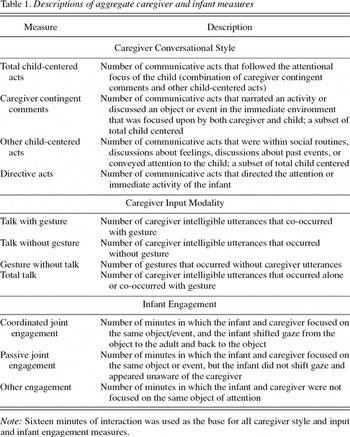
Microanalysis of the caregiver–infant interactions utilized aggregate measures of caregiver input and infant engagement (summarized descriptions are found in Table 1). In addition, more fine-grained measures were employed that reflect both the behaviors of the caregiver and the infant. Descriptions of language, aggregate, and fine-grained measures follow.

Language measures
VOCABULARY COMPREHENSION AT 12 MONTHS. The CDI: W&G (Fenson et al., 1993) was used to assess vocabulary comprehension at 12 months of age. The CDI comprehension measure has been found to be a valid and reliable measure of vocabulary comprehension for children in this age range who have mothers of similar educational background (Bates, Bretherton, & Snyder, 1988; Ring & Fenson, 2000; Thal, O'Hanlon, Clemmons, & Fralin, 1999). The CDI: W&G contains a vocabulary checklist of 396 words organized into categories such as animals, food and drink, body parts, people, and action words. Our measure of vocabulary comprehension was based on the sum of the items that parents marked on the checklist that their child “understands.” All 10 parents completed the CDI form when the infants were between 12 and 13 months. We chose to measure vocabulary comprehension rather than vocabulary production because the late talker literature indicates that comprehension is the more stable measure of language at this early age (Thal & Kactich, 1996).
LANGUAGE PRODUCTION AT 30 MONTHS. Children's productive language skill was assessed using each child's total score on the Index of Productive Syntax (IPSyn; Scarborough, 1990) at 30 months of age. The IPSyn total score assesses emerging morphosyntactic skills based on 100 utterances. IPSyn total score reflects the child's use of 56 syntactic and morphological forms, including elaborations within noun and verb phrases, questions, negations, and various sentence structures. IPSyn is a laboratory measure and was selected to provide a precise measure of the aspects of grammar that the child uses when interacting (Bates et al., 1988).
Aggregate measures
CAREGIVER CONVERSATIONAL STYLE. The Inventory of Communicative Acts—Abridged (INCA-A; Ninio, Snow, Pan, & Rollins, 1994) was used to code communicative intents. This system identifies and codes communicative intent at two levels: the level of social interchange and the level of utterance. The system was designed to provide exhaustive coding of the communicative attempts expressed by children of varying ages and their communication partners. Interchange/speech act combinations were assigned to four theoretically motivated categories: (a) total child-centered acts, (b) CCCs (Rollins, 2003), (c) other child-centered acts (other CC), and (d) directive acts. Total child-centered acts consists of the subsets, CCC and other CC, combined. Both CCC and other CC acts were communications in which the caregiver followed into the child's focus of attention, however the perceptual distance of the utterance distinguished them. CCC consisted of child-centered communications in which the caregiver narrated an ongoing activity related to the child's focus of attention or discussed an object on which both caregiver and child were focused. CCC did not include child-centered acts related to past or future events, thoughts, feelings, or other abstract referents. Note that CCC included only referents that did not require the child to make an inference. Included in CCC were communicative intents coded in INCA-A as Discuss Joint Focus (conversations about something observable that both participants attended to) accompanied by any speech act, and Negotiate Immediate Activity with a declarative statement or an approval (statements that provided information, praise, or approval regarding the immediate activity of the child or child and caregiver). The category of other CC acts included child-centered utterances associated with an abstract or perceptually distant referent, that is, those in which caregivers talked about the infant's feelings, discussed an immediate past event, marked a past event (e.g., “oops”), performed social/interactive routines (e.g., peek-a-boo), or showed attention to the infant (e.g., saying “yes” when the child had not made a bid for attention). These utterances were coded in INCA-A as Discuss Hearer's Feelings, Discuss Recent Event with a marking or statement, Mark an Event, Perform a Verbal Move in a Game, and Show Attention. The category of total child-centered acts consists of the combination of CCC and other CC acts. Finally, directive acts included utterances in which the caregiver directed the child's attention to an object or communicated to negotiate actions to be carried out. Directive acts included all INCA-A interchanges coded as Negotiate Immediate Activity with all speech act categories except for statements, approvals, performances and markings, and Direct Hearer's Attention (in which the caregiver directed the child's attention to something in the environment) with all speech act categories. Each of the categories of conversational style was measured by the number of communicative acts exhibited in 16 min.
CAREGIVER INPUT MODALITY. Three mutually exclusive measures of input modality were used in the current study: (a) talk with gesture, (b) talk without gesture, and (c) gesture without talk. In addition, we combined talk with gesture and talk without gesture to yield a fourth measure, (d) total talk. To code for caregivers' gestures, videotapes were reviewed and the transcripts were coded based on the descriptions of attention-focusing gestures by Schmidt and Lawson (2002). These were gestures used by the caregiver to overtly encourage the child to attend to an aspect of the immediate surroundings. Attention-focusing gestures occurred when the child was already focused on an object and the adult enhanced the child's attention by moving the object or demonstrating a property of the object. An attention-focusing gesture also occurred when the caregiver pointed and directed the child's attention to an object or event in the immediate environment.1
Attention-focusing gestures may occur within several INCA-A social interchange codes, such as Discuss Joint Focus, Negotiate Immediate Activity , and Direct Hearer's Attention.
INFANT ENGAGEMENT. Each of the three categories of infant engagement was measured by the number of minutes that occurred within the 16-min of interaction. The three categories of (a) coordinated joint engagement (CJ), (b) passive joint engagement (PJ), and (c) other engagement were coded according to Bakeman and Adamson (1984). CJ occurred when the infant and adult were focused on the same object, and the infant coordinated his attention between the object and the caregiver, looking back and forth from the object to the adult. In PJ, the infant and caregiver were involved with the same object, but the child showed little awareness of the caregiver's presence. The caregiver could offer verbal and nonverbal input related to the object and child, but the child focused only on the object. Both CJ and PJ reflected caregiver and infant attention to the same object of focus. Bakeman and Adamson (1984) defined four additional categories of engagement as: objects, when the infant played with objects alone; persons, when the infant played just with the adult (as in peek-a-boo); onlooking, when the infant observed another's activity; and unengaged, in which the infant appeared uninvolved with any specific person, object or activity. We were specifically interested in joint engagement states; thus, these four categories were combined into a composite that we called other engagement.
Further criteria for differentiating the joint engagement episodes were based on elaboration by Carpenter et al. (1998). In PJ, touching, continually gazing at, and/or talking about the object of the child's focus determined the caregiver's attention to the shared object. During CJ, the infant's coordination of attention was defined by her alternation of gaze from the object to the caregiver's face and immediately back to the object. However, an episode of CJ could begin with an intelligible word from the infant to the adult about the object, without necessarily looking at the caregiver's face.2
Only two infants expressed intelligible words, none of which marked the onset of an episode of CJ.
Fine-grained caregiver–infant measures
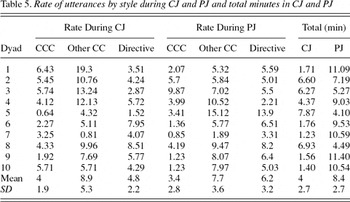
To determine whether caregiver conversational style varies with the degree to which infants actively share attention, measures of caregiver style during the two joint engagement states were calculated. These measures reflect the rate of caregiver utterances by style during each joint engagement state.
RATE OF CAREGIVER INPUT BY STYLE DURING CJ. First, for each dyad, we counted the total number of CCC, other CC, and directive utterances that occurred during CJ. Next, to determine the rate of a particular conversational style utilized during CJ, the count for each style of utterance was divided by the total number of minutes the infant spent in CJ. For example, a caregiver offering 15 CCC utterances during a total of 5 min of CJ, used a rate of 3 CCC utterances per minute during CJ.
RATE OF CAREGIVER INPUT BY STYLE DURING PJ. Total numbers of CCC, other CC, and directive utterances occurring during PJ were counted for each dyad. A measure of the rate of utterances in each style during PJ was calculated as the ratio of the total count to the number of minutes the infant spent in PJ. The caregiver might express 20 CCC utterances during a total of 10 min of PJ, using a rate of 2 CCC utterances per minute. Thus, the caregiver who used CCC at the rate of 3/min when their infant actively shared attention (during CJ), might use only 2/min when the infant appeared to be unaware of the caregiver's involvement (during PJ).
Reliability
A second rater independently coded 10% of the mother's communicative intentions. Cohen's kappa statistic, which takes account of chance agreement, was calculated. The kappa statistic was .85, which is considered to be “almost perfect” agreement according to guidelines established in Landis and Koch (1977). A second rater also coded 20% of the videotapes for both episodes and duration of infant engagement. Cohen's kappa statistic was .86, which is considered almost perfect agreement (Landis & Koch, 1977).
RESULTS
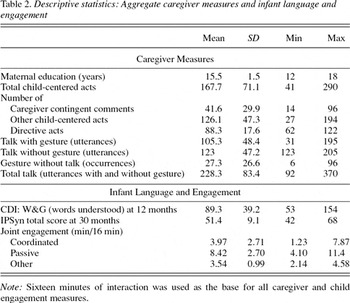
The goal of this research was to explore specific mechanisms within caregiver–infant interactions that support language acquisition. We began our analysis with aggregate measures, and progressively examined more fine-grained measures of caregiver and infant interactions. Descriptive statistics for aggregate caregiver and infant measures are found in Table 2. Presentation of the results begins with the background characteristics of this cohort in relation to infant language measures. In turn, we examine: (a) caregiver input modality and conversational style (Table 3), and (b) infant time in each joint engagement state in association with caregiver input, and in association with later language (Table 4). Finally, we turn to the more fine-grained analysis of caregiver behavior occurring specifically within coordinated and passive joint engagements (Table 5), and investigate correlations with infant language accomplishments.


Background characteristics
This sample of 10 caregiver–infant dyads consisted of four boys and six girls.3
A t test for independent means found no significant gender differences on any variables.
Vocabulary comprehension at 12 months, as measured by the CDI (Fenson et al., 1993), ranged from 53 to 154 (M = 89.3, SD = 39.2) words that parents reported their children understood. These CDI scores represent a range from the 30th to the 86th percentile, with the mean (M= 53.7, SD = 19.5) approximating norms for the general population. In addition, emerging syntactic skill, as measured by the IPSyn total score at 30 months of age (M= 51.4, SD = 9.1), was within age expectations (Scarborough, 1990).4
Scarborough reported a mean IPSyn score of 58.8 (SD = 10.67) for 30-month-old children, derived from a corpus of 100 utterances.
Aggregate measures
Caregiver input modality and conversational style
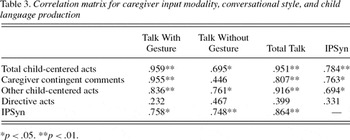
As can be seen in Table 2, caregivers varied in their use of talk and gesture, as well as in their use of child-centered and directive conversational styles. We wanted to understand how these caregiver variables might be related; thus, we examined the intercorrelations among conversational style and the use of talk and gesture. Table 3 suggests that our measures of child-centered conversational style (CCC and other CC) related to caregiver input modality. Specifically, CCC had a strong positive correlation with talk with gesture (r= .955, p < .000). Interestingly, a qualitative analysis revealed that all CCC co-occurred with gesture, suggesting that CCC may be an inherently multimodal conversational style. The category of other CC was positively associated with talk with gesture (r= .836, p < .01), as well as with talk without gesture (r= .761, p < .05). No correlations were found between a directive conversational style and any input modality. The child-centered variables and caregiver talk variables have similar relationships with later language (Table 3) and were not considered independent in subsequent analyses.
Infant engagement
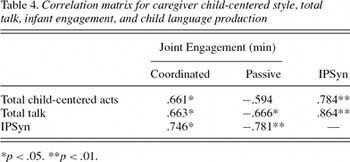
As expected among 12-month-old infants, each infant in the current study spent time in both CJ and PJ with their caregiver (Table 2). It is noteworthy that, on average, these infants spent about 50% of the total interaction time in PJ and only about 25% of the time in CJ. The mean total duration of infant time in CJ was approximately 4 min (SD = 2.7); however, the children varied from 1.2 min to as much as 7.9 min. Infants also varied considerably in the amount of time they spent in PJ (M= 8.4, SD = 2.7), but varied less in time spent in other engagement states (M= 3.5, SD = 0.99). Consistent with previous investigations (Carpenter et al., 1998; Tomasello & Todd, 1983), the total amount of time infants spent in CJ was correlated with later language proficiency as measured by the IPSyn (r = .746, p = .013).5
No correlations were found for the number of CJ episodes, or the mean length of the episodes, and later language production.
Next, we examined infant engagement in relation to input modality and caregiver conversational style. Because we found that the child-centered variables were strongly related to the caregiver talk variables (Table 3), we chose to use the aggregate measures of total child-centered acts and total talk in this analysis. As would be expected, total child-centered acts and total talk had similar relationships with CJ and PJ (see Table 4). Both total child-centered acts and total talk were positively associated with CJ (r= .661 and .663, respectively) and negatively associated with PJ (r= −.594 and −.666, respectively). No significant correlation was found between directive utterances and any of the engagement states.
Fine-grained measures
Caregiver conversational style during CJ and PJ
Our fine-grained analyses focused on caregivers' conversational style specifically within episodes of CJ and PJ. To this end the number of caregiver utterances per minute (i.e., rate) for each measure of conversational style was calculated separately for time spent in CJ and time spent in PJ (see Table 5). An underlying question for this study is whether caregiver conversational style varies in relation to infants' joint engagement state. If so, this variation might be expected to relate to later language accomplishments. We found that during CJ, the rate at which caregivers utilized a child-centered or directive style was not related to later language measures. In contrast, during PJ the rate of total child-centered acts correlated with IPSyn scores (r= .636, p= .048). Interestingly, the rate of CCC acts during PJ correlated with IPSyn (r= .825, p= .003), whereas the rate of other CC acts during PJ did not. In the current study, all CCC utterances were multimodal, as they co-occurred with gesture. Thus, our most fine-grained analysis revealed that on average, multimodal child-centered communication about perceptually salient objects or events (i.e., CCC) within PJ continued to be facilitative of later language.
SUMMARY AND DISCUSSION
This study has replicated a plethora of earlier research as well as extended those findings in important ways. Consistent with previous researchers we found the positive effects of caregivers' total talk and child-centered utterances (Huttenlocher et al., 1991; Rollins, 2003; Rollins & Snow, 1998; Tomasello & Farrar, 1986). Although others have studied caregiver conversational style and caregiver input modality, to our knowledge, investigators have not previously examined the intercorrelations among these specific caregiver variables. We found that caregivers' use of a child-centered conversational style was related to their use of talk with and without gesture. No such correlation was found for directive acts. In the current investigation, as in previous studies, both the total amount of caregiver talk and child-centered acts were related to later language outcomes, whereas directive acts were not. Recall, that total talk comprises both child-centered and directive conversational acts. The pattern of correlations found in this study suggests that the relationship between caregiver total talk and subsequent language development may be disproportionately influenced by caregivers' talkativeness within child-centered act (see Rollins, 2003, for a similar finding with caregivers' talk to 9-month-old infants).
Moreover, we found that when caregivers talked about objects or events that the infant was focusing on (CCC), they consistently employed attention-focusing gestures. That is, they attempted to enhance the child's attention by moving an object or demonstrating a property of the object while talking about the object or activity. This is consistent with what others have referred to as multimodal motherese (Gogate et al., 2000). Multimodal motherese may enhance the infant's attention by highlighting the object and linking it to the caregiver's talk.
We found a positive association between coordinated joint engagement and later language production, which is also consistent with past research. However, to our knowledge, few studies have examined the relationship between passive joint engagement and later language. We investigated this relationship and found a negative association between the amount of time infants spent in passive joint engagement and language outcome. As coordinated joint engagement is a consistent and robust predictor of language accomplishments, children who continue to spend much of their interaction time in passive joint engagement may not be as advanced in mechanisms that underlie social language learning. Indeed, children with language delay may spend a longer developmental time span prior to their ability to coordinate attention with a communication partner. For that reason, we wanted to understand if there were any facilitative effects of caregiver input during passive joint engagements. Preliminary evidence for this was found in 9-month-olds, who were not yet using robust amounts of coordinated joint attention (Rollins, 2003). Similarly, Schmidt and Lawson found a facilitative effect for multimodal caregiver interactions with language delayed children. Recall that CCC within PJ are those communicative acts in which the caregiver talks about the child's focus of attention but the infant does not look toward the adult. Our findings suggest that the rate at which caregivers' used CCC during passive joint engagements was related to later language. This was not the case for the rate at which caregivers used other child-centered or directive acts. Furthermore, we found CCC to be inherently multimodal. Thus, caregivers' use of CCC, a multimodal child-centered conversational style, while infants are only passively engaged, may be an important predictor of later language accomplishments. It is noteworthy that we found CCC to be multimodal across all engagement states. Recall that CCCs relate to objects or events in the immediate environment and do not require the child to shift attention or make an inference. Thus, caregivers' use of CCC minimizes the perceptual distance between the focus of attention and the caregiver talk, while gestures highlight the object and provide support for the child's attention, even at times when they are not actively engaged with the caregiver. As suggested by Gogate and colleagues (2000), caregivers provide redundant information that enhances word–object relations and potentially promotes language acquisition. Such caregiver support may be useful in both joint engagement states, but our study suggests that it may be particularly beneficial during passive joint engagement.
It is noteworthy that all mothers within our cohort were high school graduates, with maternal education ranging from 12 to 18 years (M= 15.5, SD = 2.07), and as such, had the potential to confound our results. That is, maternal education could bear on conversational style as well as language outcomes. Consistent with past studies, we found that on average mothers with more years of education talked more to their infants (Hart & Risley, 1999), and that total talk was related to later language (Huttenlocher et al., 1991).6
Our measure of later language ability was based on syntax (IPSyn), whereas Huttenlocher et al. (1991) used vocabulary as the outcome of interest.
In addition, a relationship was not found between caregivers' perception of their infants' language comprehension and our measure of later language learning. Early comprehension, although the best measure available, often does not relate to later language. Perhaps this has to do with the variation in the amount of time 12-month-old infants spend in the two joint engagement states, as well as with the conversational style employed by their caregivers.
These results may have important ramifications for evidence-based intervention. It is not that interactions with children who engage in extended amounts of passive engagement lack influence on later language. Rather, our findings suggest that it is the quality of the interaction that is important. In particular, children who have a preponderance of passive engagement may benefit when the verbal and nonverbal input of caregivers and clinicians is contingent upon the child's focus of attention. Child-centered multimodal interactions may reduce the cognitive load for the child by minimizing the perceptual distance between the caregiver's talk and its referent, thus supporting the development of language, even at times when the child appears unaware of the adult's involvement.
A weakness of this study is the small sample size, which limits the degree to which these findings can be generalized. It is noteworthy, however, that the study was powered to detect large effects. Indeed, many of the correlations in this study were similar in direction and magnitude to those already reported in the literature. Convinced that this small sample was able to replicate previous findings, we moved on to more fine-grained analyses, in particular, the interplay of caregiver input and infant engagement states. The results potentially add to our understanding of a socially constructed communication system, and may lend further support to a social pragmatic theory of language development. Of course, the correlations we have identified do not prove causality. However, the prospective nature of these cross-lagged correlations suggests that the use of CCC, particularly during periods of passive joint engagement may support language development.
In summary, our findings are consistent with prior research, and suggest that caregiver child-centered conversational style, multimodal communication, and infant joint engagement at 12 months of age make important contributions to language development. We found that CCC co-occurred with attention-focusing gestures, and that caregivers' use of this multimodal, child-centered conversational style, particularly during times when the child was only passively engaged, was associated with later language production. Importantly, the strong correlation between CCC during passive joint engagements and later language suggests that caregivers may maximize their influence on the child's linguistic accomplishments, even when the child lags behind in mechanisms that underlie social language learning.
ACKNOWLEDGMENTS
This research was supported by grants from the Timberlawn Foundation and the University of Texas at Dallas, School of Behavior and Brain Sciences, to the second author. We thank the children and families who participated in the study and Geoff Clark, Julie Clements, and Adriana Alves for their assistance with transcription, coding, and reliability.