Introduction
The term ‘septibranch’ is used informally here to refer to the group of bivalves with septibranch gills (Allen, Reference Allen2014). Living septibranch cuspidariids are highly specialized bivalves, with many anatomical features related to a carnivorous or saprophagic habit, such as the protractile siphons with sense organs, special stomach morphology, and septibranch gills (Yonge, Reference Yonge1928; Allen and Morgan, Reference Allen and Morgan1981; Morton, Reference Morton1987; Tëmkin and Strong, Reference Tëmkin and Strong2013). They can capture, fragment, and digest small prey (e.g., copepods, annelids, ostracods, foraminifers). They are active shallow burrowers, and even though they can be found in relatively shallow waters, they are conspicuous elements of deep-sea faunas, with more than a hundred species known from Atlantic hadal and abyssal regions (Allen, Reference Allen2011; Oliveira, Reference Oliveira2012). The shells can have a subcircular or trapezoidal general outline, and always have a variously developed posterior rostrum. They can have commarginal or radial ornamentation (or both).
The group is in need of revision, and its evolutionary history is poorly understood. Unfortunately, its fossil record is scarce (most probably due to the deep-water habitat of most species and the thin fragile shell) and, moreover, it can add very little evidence to the discussion because most key characters involve soft anatomy. As will be discussed later, previously known oldest recognized cuspidarioid records date from the Late Cretaceous (Heinberg, Reference Heinberg1979; Harper et al., Reference Harper, Hide and Morton2000, Reference Harper, Palmer and Hudson2002), and previous references from Triassic−Jurassic deposits are regarded as very doubtfully referable to this superfamily.
Here a new genus and species from Lower Jurassic (Pliensbachian) deposits of Argentina is described, its shell morphology is compared with fossil and living species referred to Cuspidariidae and other related groups, and the implications of this new record for a better understanding of the early history and phylogeny of the group are discussed.
Geologic setting and stratigraphy
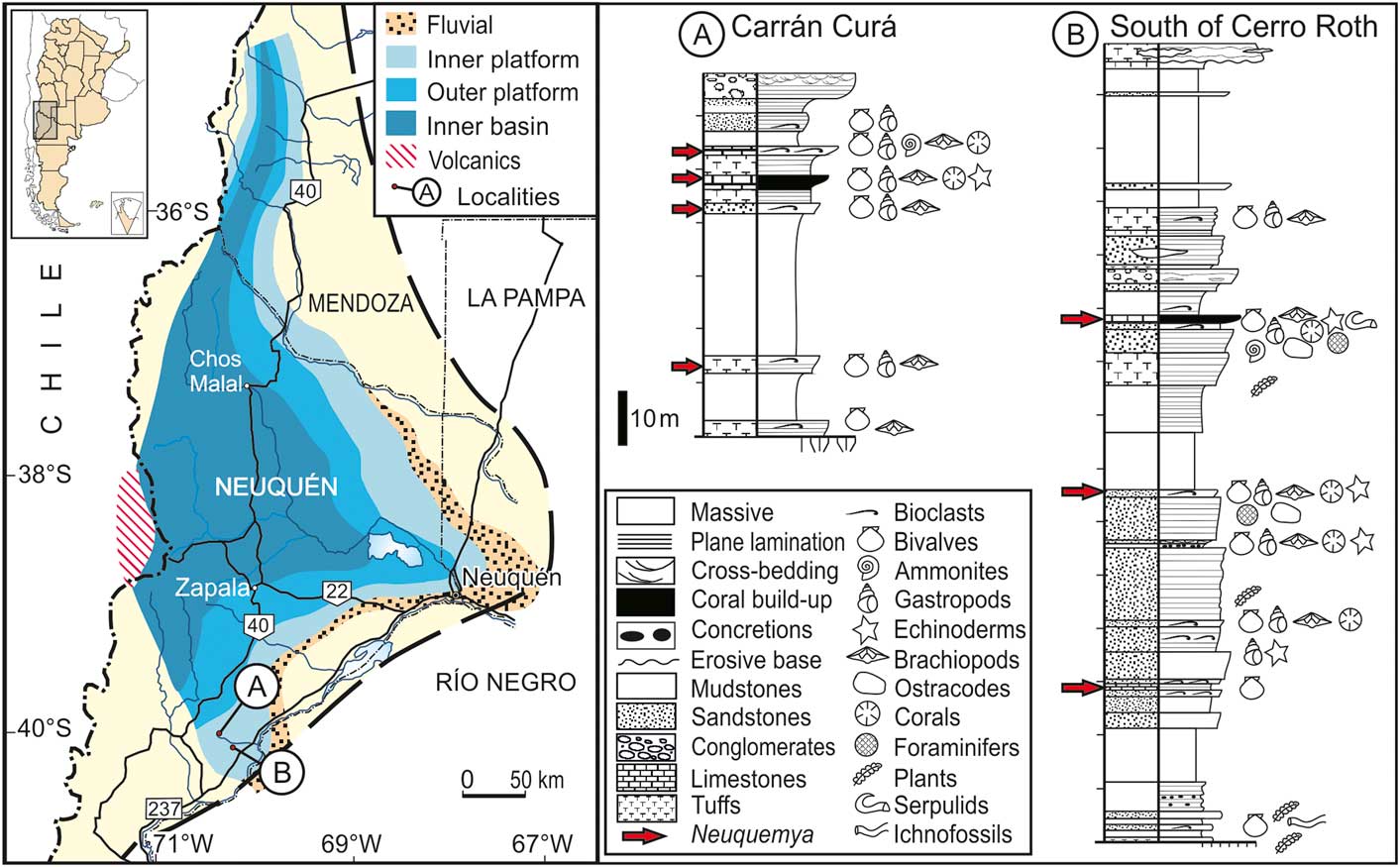
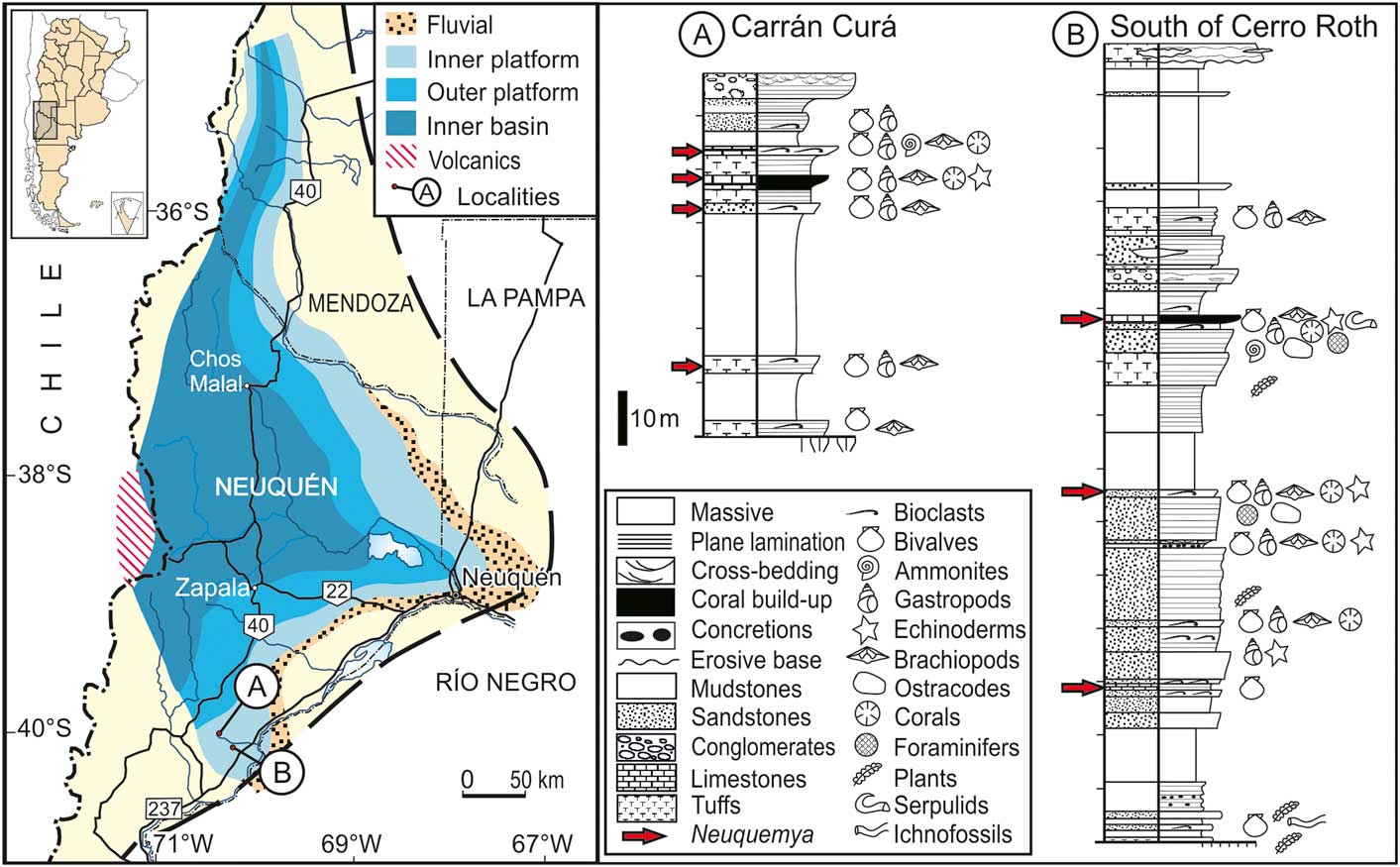
The material studied here was recorded from three localities near the southern end of the embayment of the Neuquén Basin in western Argentina (Fig. 1), in sublittoral deposits of Pliensbachian age. The setting is a back-arc basin that developed on the eastern margin of the Paleo-Pacific Ocean, with a complex depositional history spanning most of the Mesozoic (Uliana and Biddle, Reference Uliana and Biddle1988; Legarreta and Uliana, Reference Legarreta and Uliana1996, Reference Legarreta and Uliana2000). During Pliensbachian times, the marine transgression spread and reached the southern Neuquén Province, where a variety of marginal marine and littoral environments developed (Gulisano and Pando, Reference Gulisano and Pando1981) within the Cuyo Mesosequence (Legarreta and Gulisano, Reference Legarreta and Gulisano1989). Most specimens were found in the Piedra Pintada region. In this particular area, several lithofacies were recognized by Gulisano and Pando (Reference Gulisano and Pando1981, p. 561), and the new bivalve described here is associated with their “light coloured sandstones, mudstones and tuffs facies.” These sediments are interpreted to have been deposited in a moderate- to high-energy shoreface to foreshore environment, with frequent pyroclastic input. They were referred to the Lajas Formation (Weaver, Reference Weaver1931) by Gulisano and Pando (Reference Gulisano and Pando1981), but other authors use the local name Piedra Pintada Formation (Leanza, Reference Leanza1942) for these marine deposits (see Arregui et al., Reference Arregui, Carbone and Martínez2011).
Location map (left) and simplified logged sections (right) at Carrán Curá (A) and Cerro Roth (B) in southern Neuquén Province, Argentina. Beds with Neuquemya n. gen. indicated by arrows. Paleogeography after Legarreta and Uliana (Reference Legarreta and Uliana2000); sections adapted from Damborenea et al. (Reference Damborenea, Manceñido and Riccardi1975) and Damborenea (Reference Damborenea1987).
Some of the diverse Early Jurassic bivalve faunas of this region were systematically studied by Burckhardt (Reference Burckhardt1902), Jaworski (Reference Jaworski1915, Reference Jaworski1925), Weaver (Reference Weaver1931), Leanza (Reference Leanza1942), and Damborenea (Reference Damborenea1987, Reference Damborenea2002), but only Leanza (Reference Leanza1942) figured specimens referable to the species described here (as ‘Gen. et sp. indet.’).
Two main biofacies and seven sub-biofacies were recognized in these deposits based on the distribution of macroinvertebrate fauna (Damborenea et al., Reference Damborenea, Manceñido and Riccardi1975). The beds bearing the bivalves described here belong to sub-biofacies A2, characterized by taxonomically and ecologically highly diverse assemblages, dominated by epifauna with a large percentage of cemented organisms (Table 1).
Associated fauna in beds bearing Neuquemya leanzaorum n. gen. n. sp.

The time frame for this study is the local biostratigraphic scale based on the abundant, diverse, and stratigraphically significant cephalopod, bivalve, and brachiopod taxa, which is correlated with the international standard scale (see Riccardi, Reference Riccardi2008a, Reference Riccardib; Riccardi et al., Reference Riccardi, Damborenea, Manceñido and Leanza2011).
Materials and methods
Specimens were collected during several field trips at two localities (Cerro Roth and Carrán Curá; see Fig. 1) and recorded from another two (Cañadón de los Chilenos and Cerro Mesa) by Leanza (Reference Leanza1942), all of them in the Piedra Pintada region of southern Neuquén Province. The stratigraphic sections logged there were described by Damborenea et al. (Reference Damborenea, Manceñido and Riccardi1975, fig. 3) and Damborenea (Reference Damborenea1987, fig. 5). The accompanying fauna is both abundant and very diverse, comprising mostly epifaunal bivalves, brachiopods, gastropods, corals, and occasional ammonites and echinoids (see Table 1). The material was found in uppermost lower Pliensbachian beds (Austromorphites behrendseni Biozone), according to the local ammonite biozonation (Riccardi, Reference Riccardi2008a, Reference Riccardib; Riccardi et al., Reference Riccardi, Damborenea, Manceñido and Leanza2011).
The material comprises ~50 specimens, which were cleaned mechanically; rubber casts were made of some hinge regions. All specimens and rubber casts were coated with magnesium oxide to enhance sculptural details for photography.
Repositories and institutional abbreviations
The material is housed in the collections of the División Paleozoología Invertebrados, Museo de Ciencias Naturales de La Plata (MLP), Buenos Aires, Argentina, and Museo Carmen Funes, Plaza Huincul, Neuquén Province, Argentina (MCF-PIPH).
Systematic paleontology
Order Poromyida Ridewood, Reference Ridewood1903
(?) Superfamily Cuspidarioidea Dall, Reference Dall1886
(?) Family Cuspidariidae Dall, Reference Dall1886
Remarks
The shell characters of members of this family can be summarized as follows (see Allen and Morgan, Reference Allen and Morgan1981; Coan et al., Reference Coan, Valentich-Scott and Bernard2000, p. 546): shell aragonitic, inflated, inequilateral; anterior end rounded; posterior end with a rostrum in many; opisthogyrate or orthogyrate subcentral umbones; equivalve to slightly subequivalve; sculpture radial, commarginal, or absent; ligament opisthodetic; resilifer with lithodesma; pallial sinus vestigial; hinge plate narrow, edentate, sometimes with small cardinal tubercles and lateral ridges. These hinge structures are sometimes informally referred to as ‘teeth’ by some authors (Allen and Morgan, Reference Allen and Morgan1981; Coan and Valentich-Scott, Reference Coan and Valentich-Scott2012; Morton, Reference Morton2016), but there is no proper discussion about their origin, function, and significance. Some cuspidariids have intraperiostracal calcified spikes (Checa and Harper, Reference Checa and Harper2010).
Genus Neuquemya new genus
Type species
Neuquemya leanzaorum new genus new species, Pliensbachian of the southern Neuquén Basin, Argentina.
Diagnosis
As for the type species, by monotypy.
Etymology
From Neuquén, the name of the Argentinian province and sedimentary basin where this genus occurs, and the Greek myax, a sea mussel. Feminine.
Occurrence
Early Jurassic (Pliensbachian) of the southern Neuquén Province, west-central Argentina.
Remarks
As discussed above, and disregarding the long time gap in the fossil record, this new genus is doubtfully referred to Cuspidariidae because of its preserved shell features, similar to those diagnostic of many cuspidariid genera. It is also compared here (below) with some fossil pholadomyoid (s.l.) genera despite significant morphologic differences.
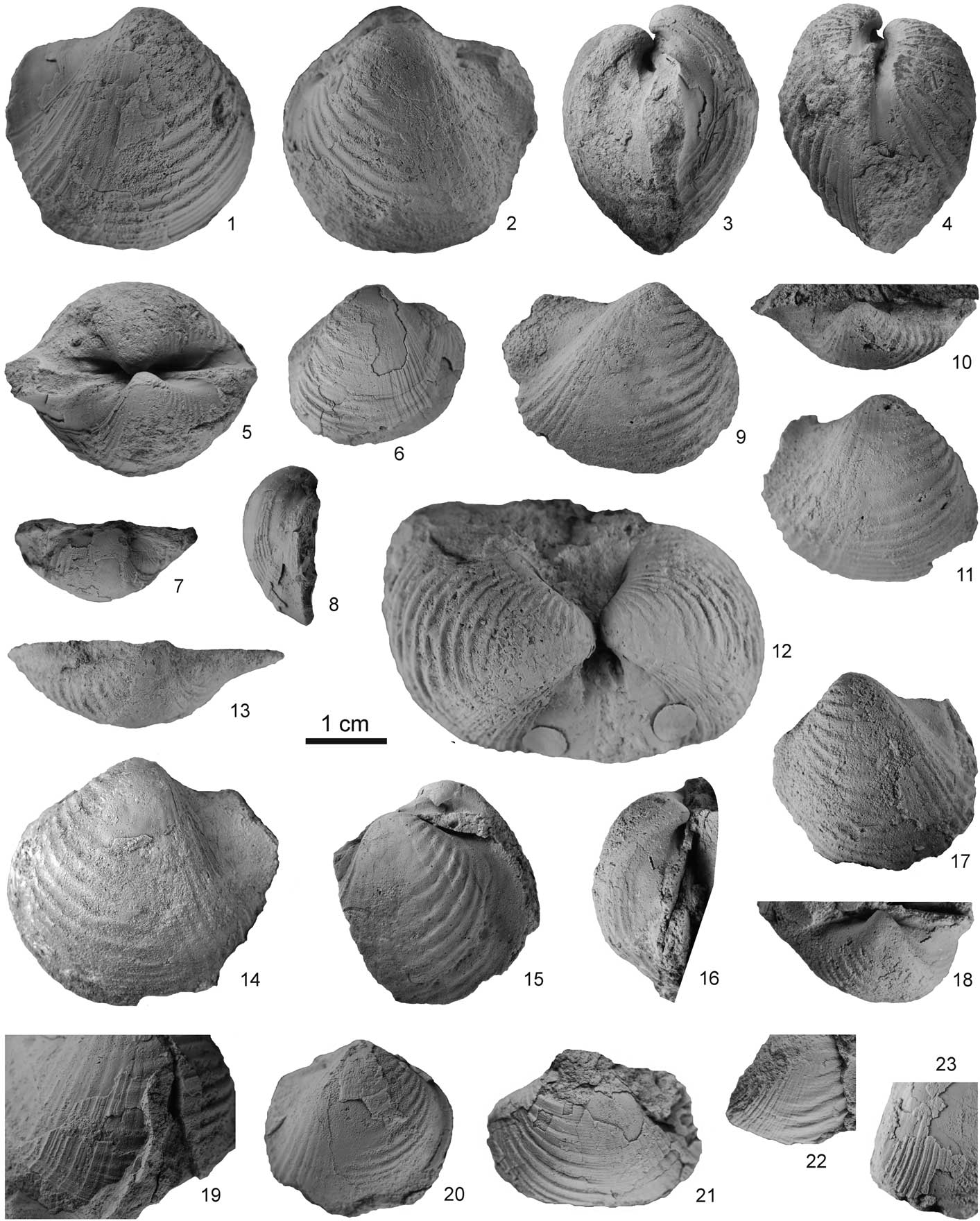
Neuquemya leanzaorum n. gen. n. sp.: (1–5) holotype, MLP 35767, in right lateral (1), left lateral (2), posterior (3), anterior (4), and dorsal (5) views; (6–8) left valve, shell partly preserved, MLP 35769a, in lateral (6), dorsal (7), and posterior (8) views; (9) right valve, paratype, MLP 35775, in lateral view; (10, 11) right valve, paratype, MLP 35774, in dorsal (10) and lateral (11) views; (12) specimen preserved with valves in butterfly position, paratype, MLP 6265a (same specimen illustrated by Leanza, Reference Leanza1942, pl. 19, fig. 3 as ‘Gen. et sp. indet.’); (13, 14) left valve, paratype, MLP 35773, in dorsal (13) and lateral (14) views; (15) specimen with both valves slightly displaced, paratype, MLP 35792, in right lateral view; (16–18) left valve, MLP 35776c, in oblique dorsoposterior (16), lateral (17), and dorsal (18) views; (19) shell partly preserved, paratype, MLP 35768, detail of right valve ornamentation; (20) right valve, MLP 35771a, in lateral view; (21) shell partly preserved, MLP 35770c, detail of left valve ornamentation; (22) shell preserved, MLP 35771f, detail of right valve ornamentation; (23) shell partly preserved, MLP 35772e, detail of right valve ornamentation. All figures to the same scale. All specimens are internal moulds except where otherwise indicated.
Neuquemya leanzaorum new genus new species
Figures 2.1–2.23, 3.1–3.12, 5.1–5.4
v 1942 Gen. et sp. indet., Leanza, p. 196, figs. 3, 4.
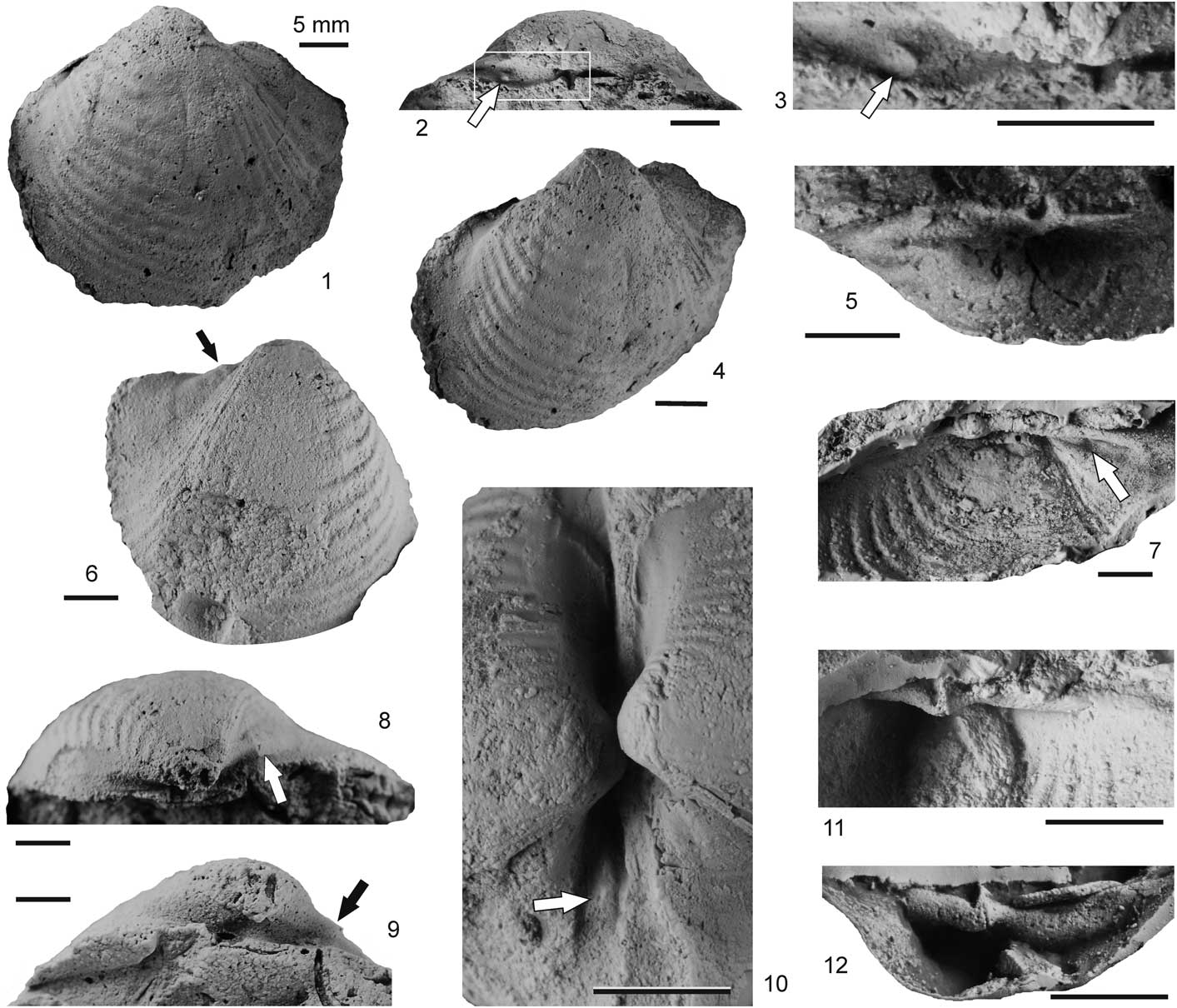
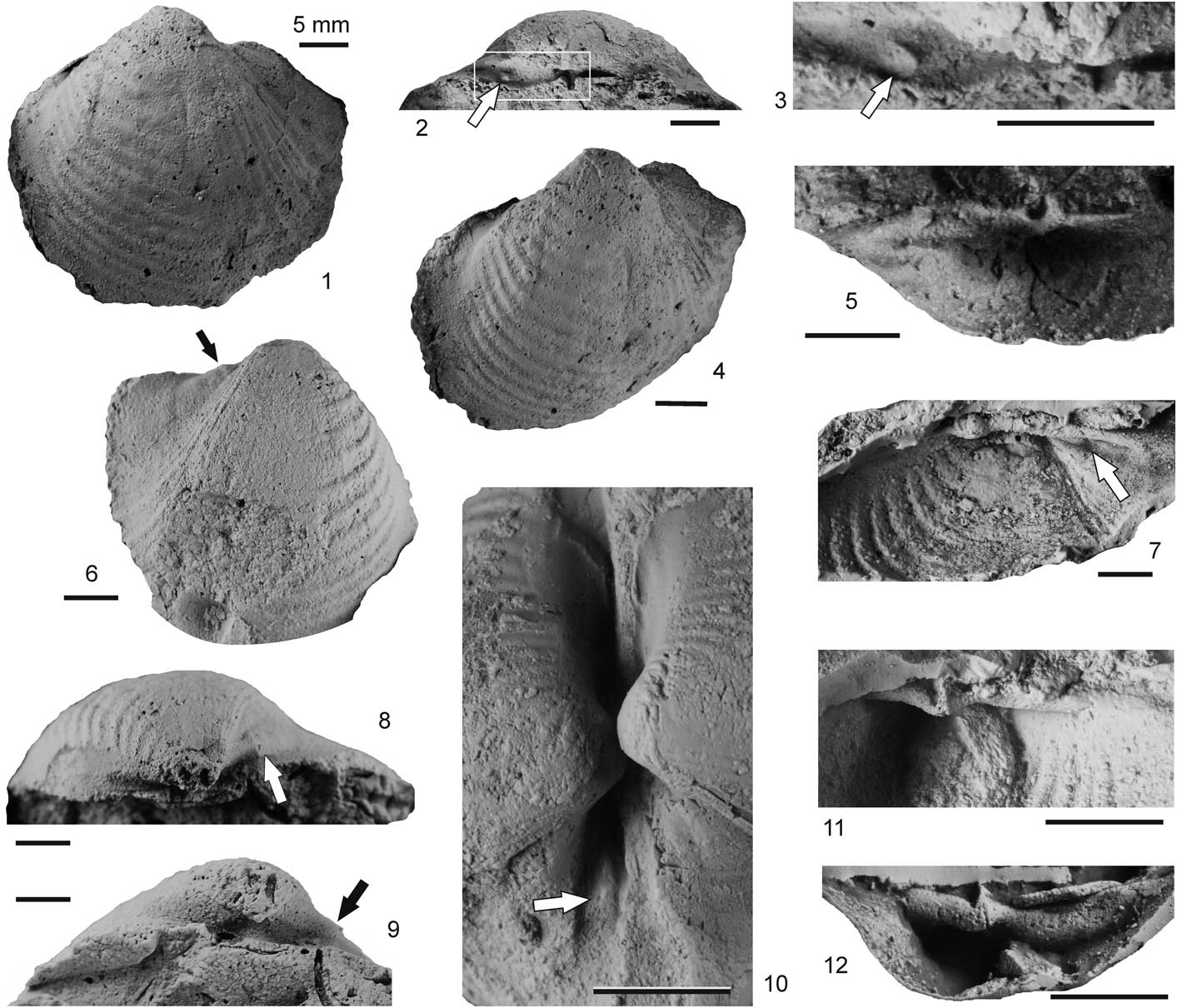
Neuquemya leanzaorum n. gen. n. sp.: (1–5) left valve, paratype, MLP 35785, in lateral left view (1), right view (2), detail of internal mold showing dorsal muscle scar (arrow) (3), tilted lateral view to show possible anterior adductor muscle scar (4), and ventral view of latex cast of hinge region showing hook-like protuberance (5); (6–9) right valve, paratype, MLP 35788, in lateral right view, with arrow indicating muscle scar (6), latex cast of hinge region, with arrow indicating muscle scar (7), dorsal view showing hinge and muscle scar (arrow) (8), and left view of internal mold, with arrow indicating muscle scar (9); (10) holotype, MLP 35767, view of internal mold of articulated valves, showing dorsal muscle scar in left valve (arrow); (11–12) latex cast of left valve hinge region showing hook-like protuberance, MLP 35790, in lateral (11) and ventral (12) views. Scale bars=5 mm.
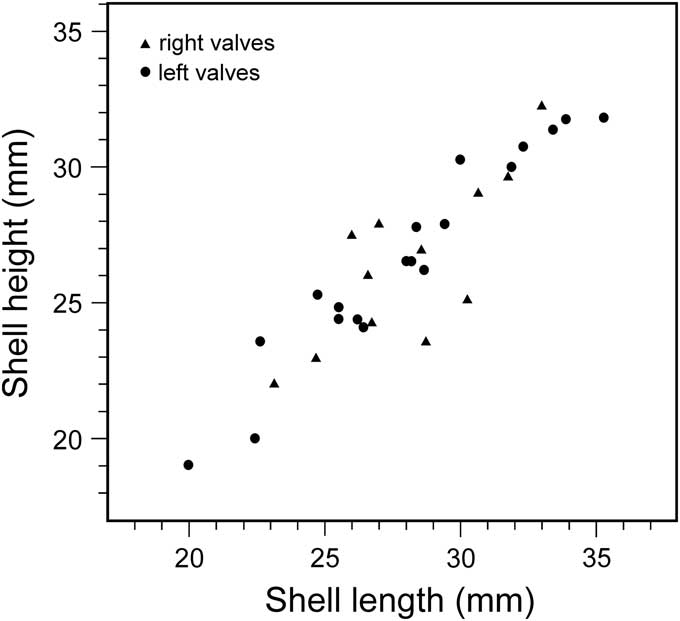
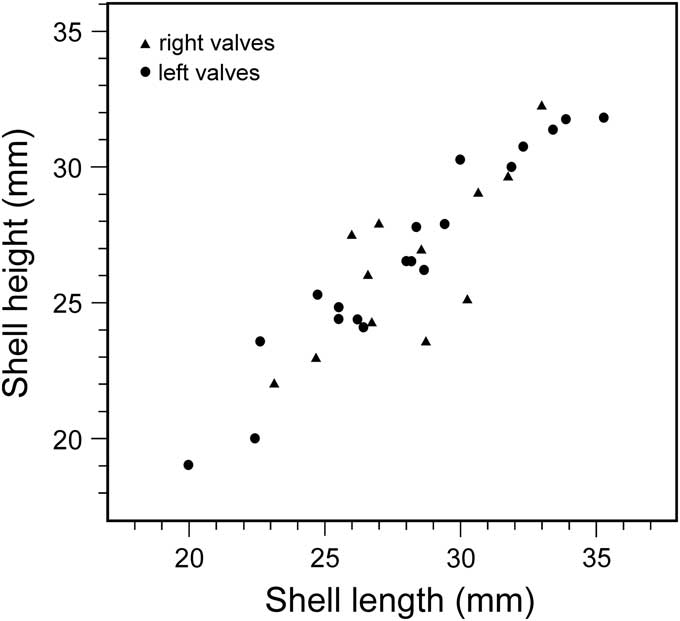
Length/height relationships of Neuquemya leanzaorum n. gen. n. sp.
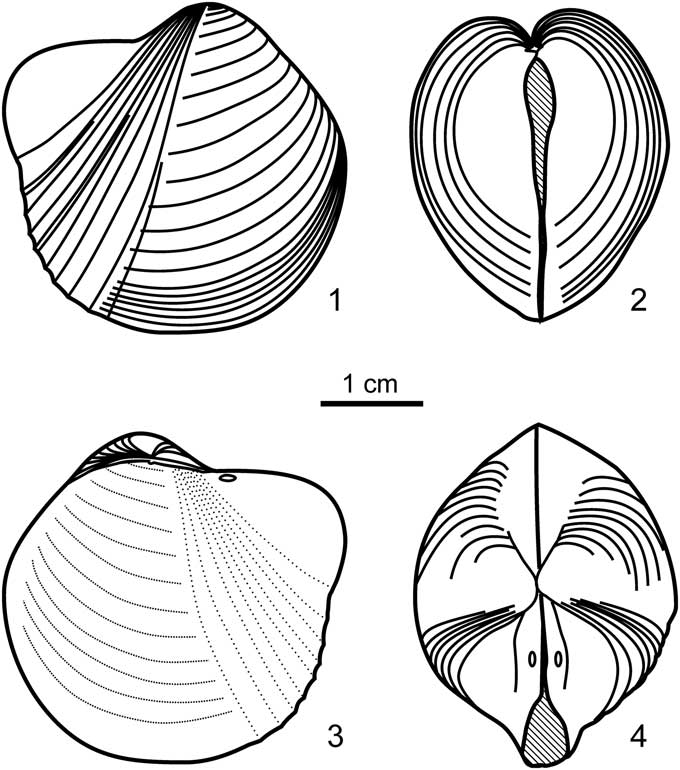
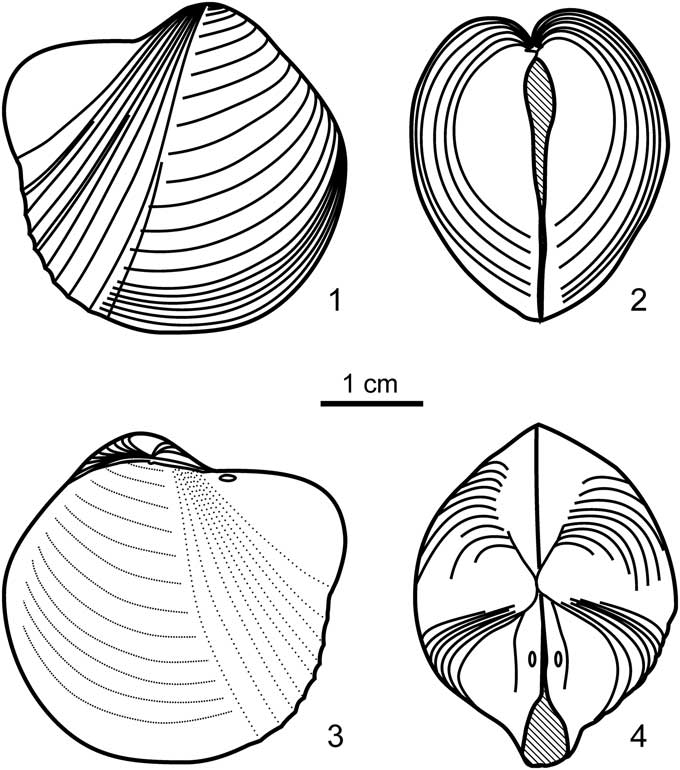
Neuquemya leanzaorum n. gen. n. sp., reconstruction of the shell, mostly based on the holotype specimen, MLP 35767: (1) right valve exterior; (2) posterior view; (3) right valve interior; and (4) dorsal view.
v 1975 Bivalvia indet. I; Damborenea et al., table 1.
Type specimens
Holotype, MLP 35767, a complete specimen with articulated valves, preserved as an internal mold with some shell fragments. Type locality and horizon: south of Cerro Roth, Piedra Pintada, Neuquén Province, Argentina; Piedra Pintada Formation, Pliensbachian. Paratypes: MLP 6265, 35768, 35773–35775, 35785, 35788, and 35792.
Diagnosis
Shell large for family, subcircular to trigonal in lateral view. Inequilateral inflated valves with short truncate rostrum and narrow posterodorsal siphonal gape. Umbones wide, opisthogyrous, placed just anterior to midlength. Ornamentation with radial ribs on posterior shell region and regular commarginal folds on anterior shell areas; rostrum surface smooth with growth lines only. Inner shell margins smooth. Hinge plate with small central thickening on each valve.
Occurrence
Early Jurassic (Pliensbachian) of southern Neuquén Province, west-central Argentina.
Description
Shell well inflated, nearly equivalve, very thin, large for family (to 35 mm long); valves inequilateral, circular to subtrigonal in lateral view, with short but clearly distinct rostrum. Posterodorsal margin straight to concave; all other margins curved; some specimens with straight or concave portion of margin just ventral to rostrum. Length equal to or only slightly exceeding height. Maximum length dorsally placed coinciding with rostrum in adult specimens (Fig. 2.1, 2.2, 2.14). Umbones wide, slightly opisthogyrous (Figs. 2.5, 3.8, 3.10), situated just anterior to midlength. Rostrum short, wide, compressed, truncate. Rostrum surface exteriorly convex, separated from remaining shell by shallow sulcus (Fig. 2.9) and by steep slope on disk surface marked by posteriormost radial ribs. Rostrum ending at posterodorsal narrow siphonal gape (Fig. 5.2, 5.4).
Three well-defined shell areas according to differing ornamentation patterns (Fig. 5.1). (1) Anterocentral region bears strong, round-topped, simple commarginal folds with steeper dorsal slopes. Folds separated by equally wide intervals; 4−6 folds/cm in central part of adult shells. Folds replaced by closer-spaced commarginal ornamentation toward shell margin in fully grown specimens (Fig. 2.1, 2.14). Most folds continuous; one specimen (MLP 6265a) with local discontinuities in ventral region. Well-preserved specimens with commarginal growth lines on top of folds (Fig. 2.21); one specimen (MLP 35771f) with folds slightly oblique to growth lines (Fig. 2.22). (2) Posterior region with thin radial ribs of unequal strength, thread-like, extending from umbo to shell margin, separated by wider intervals (Fig. 2.6), sometimes increasing in number toward shell margin by intercalation of thinner ribs at front of first order ribs (Fig. 2.19). Anteriormost radial ribs thinner, weaker, in some specimens with one or two overlapping commarginal ornamentation. Radial ornamentation variable in rib number (commonly 7–10, and to 20), density and strength, even on both valves of same specimen (Fig. 2.12). (3) Rostrum smooth, with growth lines only (Fig. 2.1, 2.6, 2.7).
Hinge plate narrow, centrally thickened in both valves; ligament characters not seen in available material; buttresses absent. Left valve bearing small, hooked, posteriorly curved ‘tubercle’ (Fig. 3.5, 3.11, 3.12); right valve with tubercle-like central thickening (Fig. 3.7); no posterior ‘teeth’ present.
Muscle scars indistinct, except for small relatively deep scar on posterior dorsal region at base of rostrum in both valves (Fig. 3.2, 3.3, 3.6–3.10), of unknown function (?posterior septal muscle scar, according to position and size). Some specimens also with very faint large impression in anterodorsal area of one left valve (MLP 35785), most probably of anterior adductor (Fig. 3.4).
Inner shell margin smooth. Commarginal folds and primary radial ribs visible on internal molds; anterior band of internal mold always smooth (Figs. 2.4, 2.5, 2.15, 3.8, 3.10). Fully mature specimens also with inner smooth band along ventral shell margin, corresponding to area with closely spaced commarginal ornamentation.
Etymology
The species name is dedicated to father and son paleontologists Armando and Héctor Leanza for their contributions to the knowledge of South American Mesozoic bivalves. A. Leanza preliminary described this taxon (1942) but left it in open nomenclature.
Materials
Holotype and paratypes (already mentioned), plus the following specimens: MLP 17724, 35769–35771, 35776–35784, 35786, 35787, 35789–35791, 35793, and MCF-PIPH 656.
The available material includes 21 left valves, 25 right valves, three specimens with both valves (one of them with valves open in butterfly position), and several shell fragments. Leanza (Reference Leanza1942, p. 196) mentioned six specimens from three localities: “Cañadón de los Chilenos, en las inmediaciones de la subida que conduce a la pequeña población de Sañicó; cumbre del cerro Mesa; ladera occidental del cerrito Roth.” Of these, only the two specimens originally figured by Leanza were located in the MLP collections: one left valve (MLP 6265b) and one almost complete shell with valves open (MLP 6265a), from Cañadón de los Chilenos, Piedra Pintada. All other specimens were collected by the authors and colleagues at various levels at Cerro Roth and Salitral Grande de Carrán Curá, Piedra Pintada area, southern Neuquén Province (Fig. 1).
Most specimens are disarticulated valves, preserved as internal or external molds; only a few show traces of the shell, which is very thin.
Measurements
The holotype (MLP 35767) is 32.3 mm long, 30.7 mm tall, and 25 mm thick (both valves). Length/height data are plotted in Figure 4.
Remarks
Leanza (Reference Leanza1942) described six specimens, but he did not compare them with other bivalve taxa, leaving the taxon in open nomenclature as ‘Gen. et sp. indet.’
Shell shape and size, the ornament pattern, and the short rostrum are comparable to those of Recent bathyal to abyssal species of Bathyneaera Scarlato and Starobogatov, Reference Scarlato and Starobogatov1983 (see revision by Krylova, Reference Krylova1993), but these shells are edentulous, i.e., they do not have hinge plate thickenings or tubercles. The shells of Bathyneaera, and its synonyms Semicardiomya Scarlato and Starobogatov, Reference Scarlato and Starobogatov1983 and Labromysa Bernard, Reference Bernard1989, are large for the family and their ornamentation pattern is strikingly similar to that of the new genus, with anterior and central slopes covered by spaced commarginal ribs, posterior slope with radial ribs, and rostrum smooth. Even the peculiar way in which a few of the anteriormost thin radial threads overlap the commarginal ornamentation in some Bathyneaera species is closely comparable with our new species. The type species B. hadalis (Knudsen, Reference Knudsen1970) (syn. Cuspidaria demistriata Allen & Morgan, Reference Allen and Morgan1981) has a relatively long rostrum and ~12 radial ribs covering the central and posterior part of the shell anterior to the rostrum (Allen and Morgan, Reference Allen and Morgan1981, fig. 33). Bathyneaera tillamookensis (Dall, Reference Dall1916) has a very similar shell shape, size, and number of anterior commarginal folds, but has fewer and stronger radial ribs (see illustrations by Allen and Morgan, Reference Allen and Morgan1981, fig. 39; Coan and Valentich-Scott, Reference Coan and Valentich-Scott2012, pl. 317). Another large comparable species is B. disa (Bernard, Reference Bernard1989), but this species has more numerous and sharper commarginal ridges (see Coan and Valentich-Scott, Reference Coan and Valentich-Scott2012, pl. 317).
A specimen referred to Myonera Dall, Reference Dall1886 from Eocene to Oligocene deep-water deposits was reported and figured but not described (Goedert, Reference Goedert1995). This small right valve is superficially similar to Neuquemya leanzaorum n. gen. n. sp. in shape and ornamentation (with fewer and stronger radial ribs), but other characters are unknown. Living Myonera species have similarly shaped shells but, again, posterior radial ribs are stronger and fewer, with only one rib in M. garretti Dall, Reference Dall1908 (see Coan and Valentich-Scott, Reference Coan and Valentich-Scott2012, pl. 321).
Some species of Cuspidaria Nardo, Reference Nardo1840, among them the Late Cretaceous C. moreauensis (Meek and Hayden, Reference Meek and Hayden1856) from western Canada and USA (Meek, Reference Meek1876; Dowling, Reference Dowling1917; Speden, Reference Speden1970), have strong commarginal plicae similar to the anterior ornamentation of Neuquemya leanzaorum n. gen. n. sp., but they have important differences in shell shape, size, the rostrum, and hinge details, and none has radial ribs. The living Antarctic species C. tenella E.A. Smith, Reference Smith1907 (pl. 2, fig. 14; see also Echevarría et al., Reference Echevarría, Damborenea and Manceñido2017, fig. 2D, E) has a large shell with a short rostrum and concentric ornamentation, similar in shape to Neuquemya leanzaorum n. gen. n. sp. but lacks radial ornamentation. Specimens from the Early Jurassic of Japan originally referred to Cuspidaria? can also have commarginal plicae, but they differ from N. leanzaorum n. gen. n. sp. by their small size, long rostrum delimited by a sharp carina, and lack of radial ornamentation (Hayami, Reference Hayami1958, Reference Hayami1959).
According to the drawings that illustrate the original description, the type species of Prolaria Healey, Reference Healey1908—P. sollasi Healey, Reference Healey1908 (p. 60, pl. 8, figs. 23–26) from the Late Triassic of Burma—has a moderately convex shell with a longer rostrum separated from the disk by a shallow but broad sulcus and a well-marked radial rib or carina. Despite the apparently wide distribution of this species, also recorded from China, Tibet, and Iran (see Ros et al., Reference Ros, Márquez-Aliaga and Damborenea2014), good illustrations are few. Shell ornamentation in Prolaria is very similar to that of the new genus, but the shape of the rostrum is different, being narrower, longer, and dorsally extended, separated from the disk by a carina and a broad sulcus. The former genus also has rows of minute granules covering the shell, which is compressed, edentulous, and has chondrophores in both valves, although not supported by buttresses. Some species referred to Prolaria, such as P. armenica Robinson, Reference Robinson1947 from Armenia (see Azaryan, Reference Azaryan1974, pl. 74, fig. 3), do not show a clearly developed rostrum and most probably belong instead in Burmesia Healey, Reference Healey1908.
Among fossil shells formerly referred to Verticordiidae, the specimens described as Euciroa ulrichi by Fleming (Reference Fleming1970, pl. 679, figs. 1–5), attributed to deep-water habitats in the Miocene beds of New Zealand, have a short, rostrate shell somewhat similar in shape and size to Neuquemya leanzaorum n. gen. n. sp., but the rostrum is separated from the disc by a distinct sulcus and the ornamentation consists of radial threads crossed by growth folds on the entire surface (internal characters are unknown). The genus Euciroa Dall, Reference Dall1881 is now placed in a separate family, the Euciroidae.
The Late Cretaceous laternulid Anatimya anteradiata Conrad, Reference Conrad1860 (p. 276, pl. 46, fig. 3) from the southern USA, has superficially similar ornamentation with anterior concentric furrows and posterior radiating lines, but the shell is compressed and nonrostrate, with a long, straight dorsal margin, prosogyrate beaks, both anterior and posterior gapes, and a long chondrophore in each valve supported posteriorly by a strong buttress (see also Stephenson, Reference Stephenson1941, p. 161, pl. 25, fig. 11). It is interesting that the genus Anatimya Conrad, Reference Conrad1860 has been mentioned (but not figured) from Late Jurassic−Early Cretaceous beds from Chile (Pérez and Reyes, Reference Pérez and Reyes1983).
Discussion
Affinities of the new genus
Almost all diagnostic features of cuspidariid shells are present in the Jurassic specimens from Neuquén here described, and thus the new genus and species are tentatively referred to this family. The alternative, which cannot be totally dismissed in the absence of soft body features, is to refer this material to a new higher taxon of unknown affinities. This alternative would imply that the shell of this taxon should be regarded as a remarkable instance of homeomorphy with the cuspidariids in all known characters.
Within cuspidariids, most genera with a known fossil record can be easily distinguished from Neuquemya n. gen. Shells of Cuspidaria differ from the newly described genus in that they usually have strongly rostrate, generally unornamented shells, but they share some hinge features, e.g., the presence of tubercle-like teeth. Shells of Cardiomya A. Adams, Reference Adams1864, a cosmopolitan genus well represented in shallow-water settings, e.g., Cardiomya costellata (Deshayes, Reference Deshayes1835) as figured by Morton (Reference Morton2016), can have small ineffective hinge ‘teeth’ similar to those of Neuquemya n. gen., but they have longer rostra and are ornamented by strong radial ribs on the entire shell except the rostrum.
In contrast, as mentioned in the specific comparisons, the shell shape and ornamentation pattern of the new genus is strikingly comparable with those of Recent Bathyneaera and Myonera.
Other Recent cuspidariid genera that have short, inflated shells are Tropidomya Dall, Reference Dall1886, which has commarginal ornamentation only, and Krylovina Coan and Valentich-Scott, Reference Coan and Valentich-Scott2012, which has a hinge with cardinal teeth similar to those of Neuquemya n. gen. but differs because it has a deep anterior radial furrow, lacks commarginal folds, has fewer and fainter radial ribs that also cover the rostrum, and has posterior adductor muscle buttresses.
Going back in time to Mesozoic records, the poorly known Triassic genus Prolaria deserves discussion here because its shell apparently has several characters in common with Neuquemya n. gen. Prolaria was originally included in a new family Burmesiidae by Healey (Reference Healey1908), related to the Laternulidae (see also Wanner and Knipscheer, Reference Wanner and Knipscheer1951, p. 61), but later the family was included in the Pholadomyoidea by Cox et al. (Reference Cox, Newell, Boyd, Branson, Casey, Chavan, Coogan, Dechaseaux, Fleming, Haas, Hertlein, Kauffman, Keen, LaRocque, McAlester, Moore, Nuttall, Perkins, Puri, Smith, Soot-Ryen, Stenzel, Trueman, Turner and Weir1969), and then again in the Pandoroidea (e.g., by Azaryan, Reference Azaryan1974; Hautmann, Reference Hautmann2001, p. 154). A detailed comparison with this peculiar genus could either reveal further relationships with Neuquemya n. gen. or allow disregarding them altogether, but a proper evaluation is hindered at the moment by the lack of good descriptions and figures of the type species of Prolaria and its specific variability. Nonetheless, the possibility that Prolaria could be closer to Neuquemya n. gen. than to Burmesia cannot be disregarded and it is potentially interesting to explore the early phylogenetic relationships of anomalodesmatan groups. Another very poorly known genus which might shed light on that subject is Pholadomyocardia Szajnocha, Reference Szajnocha1889 from the Jurassic (?) of Perú, which has a very large, inflated, smooth shell with a short rostrum, quite different to Neuquemya n. gen. in size and ornamentation. Pholadomyocardia is probably related to Megaporomya Ayoub-Hanna et al., Reference Ayoub-Hanna, Bengtson, Fürsich and Andrade2013 (Poromyidae) from Late Cretaceous of northern Brazil.
Laternulidae has a fossil record since the late Triassic. Shells of this family can be rostrate, but they are usually elongate and compressed, have chondrophores supported by buttresses in both valves, have a well-defined slit, and thus differ from Neuquemya n. gen. Likewise, some genera referred to the Cenozoic family Lyonsiidae, e.g., Allogramma Dall, Reference Dall1903, have a shell shape like the new genus, but ornament and internal characters are quite different. On the other hand, Poromyidae shells differ because they are nearly equilateral and not rostrate, and Periplomatidae differ because they have strongly inequivalve shells with slits on the beaks.
Mesozoic fossil cuspidariids have not been reported from South America, but they were occasionally included in Cenozoic faunal lists (e.g., Cardiomya spp. of Cantalamessa et al., Reference Cantalamessa, Di Celma and Ragaini2005, early Pleistocene of Ecuador), but no proper descriptions or illustrations were published.
Septibranch/cuspidarioid origin and the fossil record
Discussion of the relationships of septibranchs in general and cuspidariids in particular rests on assumptions about the possible origin (or origins) of the septum in these groups, triggered by their innovative (carnivorous) feeding habits (Allen and Morgan, Reference Allen and Morgan1981; Morton, Reference Morton1987) . Such remarkable changes in the mantle cavities probably produced only small alterations in shell morphology, and thus evidence from the fossil record is not expected to be conclusive.
The origin of higher diversity of living cuspidariids in deep habitats has been interpreted from an evolutionary point of view, synthesized by the opinions expressed by Yonge (Reference Yonge1928; see also Tëmkin and Strong, Reference Tëmkin and Strong2013). Yonge (Reference Yonge1928, p. 255) stated that “The question of the origin of the Septibranchs is one of the greatest interest … they cannot have evolved in the face of keen competition. The evidence we possess points to their having evolved in deep water … As they became more specialised and so more capable of surviving the keen competition for food which exists in the shallower seas, they worked their way back into shallower water. It is noteworthy that the most highly specialised of the three families of the Septibranchia, the Cuspidariidae, are found in the shallowest waters.”
The possible origin and evolution of the septibranch gill and the carnivorous habit was extensively discussed by Allen and Morgan (Reference Allen and Morgan1981, p. 534–541). Yonge and Thompson (Reference Yonge and Thompson1976, p. 228) had already dismissed as an instance of convergence the proposal by Runnegar (Reference Runnegar1974) of a close relationship between cuspidariids and nuculanids. Morton (Reference Morton1987) analyzed various anatomical features and concluded that the presumed ancestors of deep-water anomalodesmatans (including cuspidariids) should be pholadomyoideans. Oliveira and Sartori (Reference Oliveira and Sartori2014) recently described the arenophilic system (regarded as a synapomorphy of Anomalodesmata) in cuspidariids. In current classifications, cuspidariids are included within the Anomalodesmata (Carter et al., Reference Carter, Altaba, Anderson, Araujo, Biakov, Bogan, Campbell, Campbell, Chen, Cope, Delvene, Dijkstra, Fang, Gardner, Gavrilova, Goncharova, Harries, Hartman, Hautmann, Hoeh, Hylleberg, Jiang, Johnston, Kirkendale, Kleemann, Koppka, Kříž, Machado, Malchus, Márquez-Aliaga, Masse, McRoberts, Middelfart, Mitchell, Nevesskaja, Özer, Pojeta, Polubotko, Pons, Popov, Sánchez, Sartori, Scott, Sey, Signorelli, Silantiev, Skelton, Steuber, Waterhouse, Wingard and Yancey2011; Bieler et al., Reference Bieler, Mikkelsen, Collins, Glover, González, Graf, Harper, Healy, Kawauchi, Sharma, Staubach, Strong, Taylor, Tëmkin, Zardus, Clark, Gusmán, McIntyre, Sharp and Giribet2014). The traditional approach (e.g., Newell, Reference Newell1965; Bouchet and Rocroi, Reference Bouchet and Rocroi2010) recognized Septibranchia as an order or a ‘clade’ within the Anomalodesmata (=Pholadomyida). Septibranchs appear as monophyletic in some cladistic analyses (i.e., Harper et al., Reference Harper, Hide and Morton2000), but remain unresolved in others (Combosch et al., Reference Combosch, Collins, Glover, Graf, Harper, Healy, Kawauchi, Lemer, McIntyre, Strong, Taylor, Zardus, Mikkelsen, Giribet and Bieler2017).
Among the wealth of recent studies on bivalve phylogeny, the specific question of the origin of the carnivorous septibranch mode of life was addressed by Bieler et al. (Reference Bieler, Mikkelsen, Collins, Glover, González, Graf, Harper, Healy, Kawauchi, Sharma, Staubach, Strong, Taylor, Tëmkin, Zardus, Clark, Gusmán, McIntyre, Sharp and Giribet2014) in their comprehensive paper on bivalve phylogeny. They combined morphological and molecular data and suggested that shell characters (some of them preserved in the fossil record) are good morphological features to diagnose bivalve clades. Their results were congruent with those of Harper et al. (Reference Harper, Dreyer and Steiner2006) and proposed septibranchs as a clade within Anomalodesmata. On the other hand, a study by Combosch et al. (Reference Combosch, Collins, Glover, Graf, Harper, Healy, Kawauchi, Lemer, McIntyre, Strong, Taylor, Zardus, Mikkelsen, Giribet and Bieler2017), based on molecular data only, concluded that Verticordiidae and Cuspidariidae form a poorly supported clade of carnivorous bivalves, but that Poromyidae does not group with them.
There are many references in the fossil record of cuspidarioids from Triassic−Jurassic deposits, but these are only very doubtfully referable to this superfamily (Phillips, Reference Phillips1871; Bittner, Reference Bittner1895; Böhm, Reference Böhm1903; Broili, Reference Broili1904; Cossmann, Reference Cossmann1906; Healey, Reference Healey1908; Mansuy, Reference Mansuy1919; Cox, Reference Cox1929, Reference Cox1965; Cox and Arkell, Reference Cox and Arkell1948; Nakazawa, Reference Nakazawa1956; Hayami, Reference Hayami1958, Reference Hayami1959, Reference Hayami1975; Allasinaz, Reference Allasinaz1964; Kuntz, Reference Kuntz1967; Zhang et al., Reference Zhang, Lu and Wen1979; Yin, Reference Yin1989; Yin and Fürsich, Reference Yin and Fürsich1991; Fözy et al., Reference Fözy, Kazmer and Szente1994; Hudson et al., Reference Hudson, Clements, Riding, Wakefield and Walton1995; Szente, Reference Szente1995). Most of these are very small rostrate species with unknown internal characters. Some of these records were discussed by Harper et al. (Reference Harper, Palmer and Hudson2002, p. 766–767) and most were rejected from the superfamily; they will not be discussed further here. Those authors concluded that there is no unequivocal evidence of septibranchs before the Cretaceous, and regarded the material described by Speden (Reference Speden1970) as Cuspidaria moreauensis and C. ventricosa (Meek and Hayden, Reference Meek and Hayden1856), from the Maastrichtian of the USA, as the first true cuspidarioids. Harper et al. (Reference Harper, Palmer and Hudson2002, p. 767) also concluded that, based on the earliest evidence known at that time, the origin of septibranchs’ remarkable feeding behavior seemed to be a post-Cretaceous phenomenon.
Relevance of the new genus
The systematic affinities of Neuquemya n. gen. are relevant for understanding the early history of septibranch bivalves. This record indicates that at least the main aspects of shell morphology of this group were present as early as the Pliensbachian.
Coan et al. (Reference Coan, Valentich-Scott and Bernard2000, p. 547) and Coan and Valentich-Scott (Reference Coan and Valentich-Scott2012, p. 1001) agreed with Morton (Reference Morton1987) in a possible pholadomyoidean origin for cuspidariids and each suggested that this could have happened “perhaps before the Triassic,” but neither discussed the issue further. The material described here could provide new arguments in support of this statement.
Neuquemya n. gen. has striking similarities in shell morphology with undoubted cuspidariids, and these immediately suggest three relevant issues to be discussed: (1) certainty of its systematic affinities, (2) explanation of the long-time gap between records, and (3) explanation of the different environmental habits.
The first (and most significant) issue has already been discussed in the systematic section, and, as already said, the lack of soft body characters in the material here described (or, for that matter, in all the fossil record of the group) makes it impossible to attain certainty, because many diagnostic characters (e.g., the replacement of gills by muscular septa, or the presence of eversible siphons with sensory tentacles) cannot be assessed. Thus, the key question whether the diagnostic soft parts were already developed, or whether shell characters preceded them in phylogeny, is impossible to answer. The relatively deep posterodorsal muscle scars on the valves of Neuquemya leanzaorum n. gen. n. sp. have a position similar to the posterior septal muscle supporting the branchial septum in Cuspidaria (Yonge, Reference Yonge1928; Runnegar, Reference Runnegar1974, text-fig. 9), but of course they might equally belong to a strong pedal retractor.
The long-time gap between the species described here (Pliensbachian) and accounts of undoubtedly accepted cuspidariids (Maastrichtian) is not difficult to explain in a group mainly inhabiting deep waters, as a consequence of the scarcity of geologic records of deposits from those environments. Furthermore, it should be pointed out that all accepted fossil cuspidariid records were found in shallow-water deposits.
Regarding its paleoecology, the new species has a very restricted geographic and stratigraphic distribution, being limited to Pliensbachian beds of the Piedra Pintada area. This cannot be attributed to poor collecting; Lower Jurassic deposits of western Argentina have been extensively explored and the geographical and stratigraphic distribution of their benthic fauna is well known. The new species is relatively common (although never abundant or dominant) at certain levels (see location in Fig. 1), which are otherwise characterized by a very diverse benthic fauna (see Table 1) typical of a nearshore platform environment. There is no doubt that Neuquemya leanzaorum n. gen. n. sp. was autochthonous to this relatively high energy environment, as shown by the abundance and good preservation of the material, including whole shells, also taking into account the fragile nature of the thin shells. Thus, there is a clear contrast between this environmental setting and the paleoecologic preferences of living cuspidariids, which could be attributed either to a superficial homeomorphy of unrelated shells, or to a shift in depth range habits through time, as has happened in other invertebrates.
Acknowledgments
I thank J. Echevarría and M. Manceñido for fruitful discussions, and A. Riccardi for dating the ammonites; all of them (La Plata Natural History Museum) also participated in field trips and helped to collect the material. C. Oliveira (Universidade Federal do Rio do Janeiro) and A. Holmes (National Museum Wales) facilitated access to key literature. The careful reading and positive suggestions by E. Harper, an anonymous reviewer, and the Associate Editor M. Hautmann helped to improve the manuscript and are all greatly acknowledged. This research was mainly supported by several grants from CONICET (Consejo Nacional de Investigaciones Científicas y Técnicas, Argentina).