The consequences of substance abuse (i.e., heavy use and symptoms of substance abuse and dependence disorders) are some of the most significant, but preventable societal problems. For example, nicotine dependence is the leading preventable cause of mortality (World Health Organization, 2008), while alcohol use disorders are among the leading public health and safety problems (World Health Organization, 2011). Illicit drug- and alcohol-related crimes are also major burdens on the criminal justice system. Adolescent substance abuse is especially important, because it is associated with a more severe and persistent course into adulthood as well as with adult antisocial behavior (Clark, Kirisci, & Tarter, Reference Clark, Kirisci and Tarter1998; Hicks, Iacono, & McGue, Reference Hicks, Iacono and McGue2010). Substance abuse, however, is a complex phenotype resulting from the interplay of multiple person-level, contextual, and genetic risk factors (Zucker, Reference Zucker, Cicchetti and Cohen2006). In the present study, we used a longitudinal twin study to examine the gene–environment interplay among childhood personality traits, contextual risk factors in childhood and adolescence, and adolescent substance abuse.
Person-Level Risk Factors
The strongest and most consistent predictor of substance abuse is an early and persistent pattern of antisocial behavior (Iacono, Carlson, Taylor, Elkins, & McGue, Reference Iacono, Carlson, Taylor, Elkins and McGue1999; Zucker & Gomberg, Reference Zucker and Gomberg1986). Evidence for this comes in the form of robust longitudinal associations between childhood antisocial behavior and later substance abuse in both epidemiological and high-risk samples (Armstrong & Costello, Reference Armstrong and Costello2002; Zucker, Reference Zucker, Cicchetti and Cohen2006). Closely related risk factors are personality traits associated with negative emotionality and behavioral undercontrol (Krueger, Caspi, Moffitt, Silva, & McGee, Reference Krueger, Caspi, Moffitt, Silva and McGee1996). The combination of antisocial behavior and disinhibited personality traits is often referred to as the externalizing or behavioral disinhibition pathway to substance abuse and is associated with a higher familial loading, earlier onset, and more severe and persistent course in adulthood (Hicks et al., Reference Hicks, Iacono and McGue2010; Iacono et al., Reference Iacono, Carlson, Taylor, Elkins and McGue1999; Iacono, Malone, & McGue, Reference Iacono, Malone and McGue2008; Zucker, Reference Zucker, Cicchetti and Cohen2006). Although the effects are weaker and less consistent, internalizing distress (depression and anxiety) and extraversion/positive emotionality have also been associated with substance abuse (Chassin, Pitts, DeLucia, & Todd, Reference Chassin, Pitts, DeLucia and Todd1999; Hussong, Jones, Stein, Baucom, & Boeding, Reference Hussong, Jones, Stein, Baucom and Boeding2011; Kaplow, Curran, Angold, & Costello, Reference Kaplow, Curran, Angold and Costello2001; King, Iacono, & McGue, Reference King, Iacono and McGue2004; Shelder & Block, 1990; Sher, Grekin, & Williams, Reference Sher, Grekin and Williams2005; Zucker, Chermack, & Curran, Reference Zucker, Chermack, Curran, Sameroff, Lewis and Miller2000).
Hicks, Iacono, and McGue (Reference Hicks, Iacono and McGue2012) recently used an empirical approach to identify the childhood characteristics present prior to the initiation of substance use that best predicted later adolescent substance abuse using the 11-year-old cohort (N = 2,510) of the Minnesota Twin Family Study (MTFS; Iacono et al., Reference Iacono, Carlson, Taylor, Elkins and McGue1999). They identified two relatively independent personality traits among the extensive age 11 assessment that accounted for the majority of child-related risk for substance abuse at age 17. The first trait, called socialization, emerged as the strongest predictor among the externalizing-related content and was characterized by a willingness to follow rules, accept adult supervision, and endorse conventional moral and ethical values. After accounting for socialization, traits related to social engagement and assurance, thrill seeking, and lack of anxiety and fear also predicted substance abuse at age 17. This second trait, named boldness, was associated with high extraversion/positive emotionality and low internalizing, and is conceptually similar to low behavioral inhibition (Fox, Henderson, Marshall, Nichols, & Ghera, Reference Fox, Henderson, Marshall, Nichols and Ghera2005; Kagan, Reference Kagan1994). Low socialization (r = –.45) and boldness (r = .21) each predicted a composite measure of substance abuse at age 17, over and above childhood disruptive behavior disorders, parental externalizing disorders, and a composite measure of contextual risk factors at age 11. Taken together, low socialization and boldness provided a parsimonious assessment of the childhood person-level risk for adolescent substance abuse.
Contextual Risk Factors and Person–Environment Transactions
Substance abuse is also associated with a variety of risk factors related to family, peer, school, and neighborhood contexts (Hawkins, Catalano, & Miler, Reference Hawkins, Catalano and Miller1992; Zucker, Reference Zucker, Cicchetti and Cohen2006; Zucker, Donovan, Masten, Mattson, & Moss, Reference Zucker, Donovan, Masten, Mattson and Moss2008). Notably, the link between externalizing behaviors and these contextual risk factors tends to follow a typical developmental sequence, culminating in early initiation of substance use and escalation to substance abuse by late adolescence (Granic & Patterson, Reference Granic and Patterson2006; Patterson, DeBaryshe, & Ramsey, Reference Patterson, DeBaryshe and Ramsey1989). This sequence has many of the earmarks of a developmental cascade, wherein exposure to one contextual factor often leads to exposure to another contextual risk factor, a process that is further moderated by person-level risk factors. Specifically, high-risk rearing environments are characterized by poor parent–child relationships, harsh and inconsistent discipline, lax parental monitoring, and parental substance abuse, which provides children with access and models for use. Such ineffective parenting and family management practices in combination with “difficult” temperament traits (high negative emotionality and behavioral undercontrol; Thomas & Chess, Reference Thomas and Chess1977) then result in child conduct problems, which in turn are often followed by academic failure and disengagement as well as rejection by prosocial peers. Failure to bond with these socializing agents then increases the likelihood of depressed mood and hostility, and deviant peer affiliation. Deviant peer affiliation sets the stage for an early initiation and rapid escalation of substance use in adolescence and concomitant problem behaviors (e.g., delinquency and precocious and risky sexual behavior; Jessor & Jessor, Reference Jessor and Jessor1977). Reinforcing these processes, broader contextual factors such as family money and legal problems, parental conflict and divorce, and neighborhoods characterized by high rates of poverty, crime, and residential instability are also associated with adolescent substance abuse (Appleyard, Egeland, van Dulumen, & Sroufe, Reference Appleyard, Egeland, van Dulmen and Sroufe2005; Buu et al., Reference Buu, DiPiazza, Wang, Puttler, Fitzgerald and Zucker2009; Hawkins et al., Reference Hawkins, Catalano and Miller1992). These contextual risk factors are interrelated, and exposure is disproportionately spread across the population, such that people are typically exposed to not just one but multiple risk factors (Appleyard et al., Reference Appleyard, Egeland, van Dulmen and Sroufe2005; Deater-Deckard, Dodge, Bates, & Pettit, Reference Deater-Deckard, Dodge, Bates and Pettit1998; Hicks, South, DiRago, Iacono, & McGue, Reference Hicks, South, DiRago, Iacono and McGue2009).
Just as contextual risk factors are not independent of one another, neither are they independent of child characteristics, because the child's behavior both elicits responses from others and guides the child's selection into circumstances characterized by further contextual risks. For example, Hicks, Iacono, et al. (Reference Hicks, Iacono and McGue2012) found that low socialization at age 11 was highly correlated with concurrent contextual risk factors, including antisocial peer affiliation, academic failure and disengagement, lack of prosocial peers, poor parent–child relationships, and stressful life events impacting the family context. Thus, tendencies to greater negative emotionality and behavioral undercontrol in early childhood may be magnified and reinforced by experiences both within and outside of the control of the person, defining person–environment transactions that may ultimately manifest in substance use and abuse in adolescence.
Selection by and Mediation of Person-Level Risk Factors for Substance Abuse
Delineating the interplay between person-level and contextual risk factors that characterize the development of adolescent substance abuse can be made more tractable by positing two sequential mechanisms: selection and mediation. Here, selection refers to the process by which a person-level characteristic such as low socialization increases exposure to environmental contexts that promote risk for substance abuse. A simple association, however, is not sufficient to demonstrate selection, because it is equally plausible that a contextual risk factor such as antisocial peer affiliation could result in low socialization. A prospective association provides stronger evidence of selection, but it is still not sufficient because the association could be due to the stability of the environmental context. For example, given that children low in socialization tend to affiliate with antisocial peers in childhood, they are likely to continue to do so in adolescence. Thus, in the present study, we inferred a selection effect when there was a prospective association between a person-level trait in childhood and contextual risk in adolescence, after accounting for the stability of contextual risk since childhood.
Selection may then be followed by mediation, the process by which a distal risk factor influences a more proximal risk factor. The proximal risk factor then is the mediator or intervening variable that in turn influences the outcome (Baron & Kenny, Reference Baron and Kenny1986). That is, at least part of the influence of the distal risk factor on the outcome is accounted for by its effect on the more proximal risk factor. Strong evidence of mediation requires that (a) a distal factor that is a person-level characteristic contributes to a more proximal factor that is contextual in nature, and (b) the contextual risk factor in turn contributes to a later person-level outcome. For example, low socialization in childhood, a person-level characteristic, may predict antisocial peer affiliation in midadolescence, an environmental context. Antisocial peer affiliation in midadolescence may then predict substance abuse in late adolescence, a person-level outcome, and account for some or all of the effect of low socialization on substance abuse. By examining patterns of longitudinal associations for evidence of selection and mediation, one can begin to delineate mechanisms underlying risk for a complex phenotypic outcome such as substance abuse.
Gene–Environment Correlation (rGE)
When the prospective data are also genetically informative, as in the case of a longitudinal twin study, selection and mediation analyses can be extended to include the underlying genetic and environmental influences. In particular, transactions between person-level and contextual risk factors in the prediction of adolescent substance abuse likely involve one or more rGEs, specifically passive, evocative, or active processes (Scarr & McCartney, Reference Scarr and McCartney1983). For example, ineffective parenting practices have been shown to exhibit genetic influences (Wade & Kendler, Reference Wade and Kendler2000), partially due to their association with heritable personality traits (Prinzie, Stams, Dekovic, & Reijntjes, Reference Prinzie, Stams, Dekovic and Reijntjes2009). Children of such parents thus both receive genetic vulnerabilities to a difficult temperament and experience adverse home environments. This is known as passive rGE, because the child's exposure to both the genetic and environmental risk factors is not dependent on the child's behavior. From here, evocative mechanisms may also begin to characterize rGE processes, such that a child's genetically influenced behaviors, such as temperament traits, may evoke negative responses from others, including parents, that shape those contexts and further exacerbate risk (Eisenberg et al., Reference Eisenberg, Zhou, Spinrad, Valiente, Fabes and Liew2005; Kochanska, Friesenborg, Lange, & Martel, Reference Kochanska, Friesenborg, Lange and Martel2004). Active rGE mechanisms may also come into play, because temperamental characteristics may lead the child to seek out (i.e., select into) experiences and contexts associated with greater risk, such as antisocial peers. As a consequence of these developmental processes, genetic influences also contribute to contextual circumstances, which help to account for why putatively environmental measures exhibit heritable variance (Plomin & Bergeman, Reference Plomin and Bergeman1991). When there are common genetic influences on person-level traits and contextual variables in the presence of selection and mediation, there is strong evidence of active rGE processes. That is, genetic influences are involved in the extent to which individuals are exposed to environmental experiences that then increase risk for outcomes such as substance abuse.
Current Study
We sought to delineate the interplay between the child personality traits of socialization and boldness and contextual risk in the development of adolescent substance abuse, utilizing the longitudinal assessments of the MTFS and the conceptual framework of selection, mediation, and active rGE. This model included child personality traits at age 11 (predictors), contextual risk at age 14 (mediator), and substance abuse at age 17 (outcome). First, we examined selection effects of personality traits at age 11 on contextual risk at age 14, after accounting for the stability of contextual risk from ages 11 to 14. We focused on socialization and boldness because these two traits tap the most potent person-level risk factors in childhood in this sample (Hicks, Iacono, et al., Reference Hicks, Iacono and McGue2012). In addition, these traits exhibited different patterns of associations with contextual risk; low socialization had strong correlations with most contextual risk factors, while boldness was relatively independent of contextual risk. Therefore, we hypothesized that selection effects and rGEs with contextual risk would be present for low socialization but absent for boldness. We also examined developmental change in the contextual variables from ages 11 to 14 as well as gender differences, because exposure to contextual risk tends to increase from childhood to adolescence, and boys tend to experience greater risk exposure than girls (Moffitt, Caspi, Rutter, & Silva, Reference Moffitt, Caspi, Rutter and Silva2001; Rutter, Caspi, & Moffitt, Reference Rutter, Caspi and Moffitt2003).
Second, we examined whether contextual risk at age 14 would mediate the effects of low socialization and boldness on substance abuse at age 17. Since mediation effects are dependent on selection effects, we predicted mediation effects for low socialization but not for boldness. Given its strong association with substance abuse, however, we also anticipated that low socialization would have a significant direct effect on substance abuse. We also predicted that contextual risk at age 14 would mediate the effects of contextual risk at age 11, because exposure to contextual risk at age 14 was more proximal to substance abuse at age 17.
Third, we used the twin data to estimate the genetic and environmental influences contributing to the associations among child personality traits, contextual risk, and adolescent substance abuse. Detection of common genetic influences on personality traits and contextual risk in the presence of selection and mediation would be strong evidence for active rGE processes in the development of adolescent substance abuse.
Method
Sample
Participants were the 2,510 male and female twins that comprise the age 11 cohort of the MTFS (Iacono et al., Reference Iacono, Carlson, Taylor, Elkins and McGue1999; Keyes et al., Reference Keyes, Malone, Elkins, Legrand, McGue and Iacono2009), a community-based longitudinal study investigating the development of substance use disorders. All twins were born in the state of Minnesota. Families were identified using public birth records for the years 1977–1984 and 1988–1994 and located using publically available databases. Over 90% of eligible families were located, and over 80% agreed to participate in an intake assessment the year the twins turned 11 years old. The only exclusionary criteria were that families live within a day's drive of the University of Minnesota and that neither twin had a physical or mental handicap that would interfere with participating in the daylong assessment at the university laboratories. Participating families were representative of the Minnesota population of the target birth years in terms of parental education, socioeconomic status, and history of treatment for mental health problems. Consistent with the demographics of Minnesota for these target birth years, 96% of the sample was of European American ancestry. In addition to the age 11 intake assessment (M = 11.8 years, SD = 0.43 years), we also utilized data from the age 14 (M = 14.9 years, SD = 0.55 years) and age 17 (M = 18.1 years, SD = 0.63 years) follow-up assessments. Retention rates were excellent for both the completed age 14 (93.0%) and the ongoing age 17 (80.5%) assessments.
The sample included 784 monozygotic (MZ; 50.3% male) and 471 dizygotic (DZ; 46.9% male) same-sex twin pairs. Zygosity was determined by the agreement of three estimates: parental responses to a standard zygosity questionnaire, MTFS staff evaluation of physical similarity, and comparison of ponderal and cephalic indexes and fingerprint ridge counts. All study protocols were reviewed and approved by an institutional review board.
Assessment
Boldness and socialization at age 11
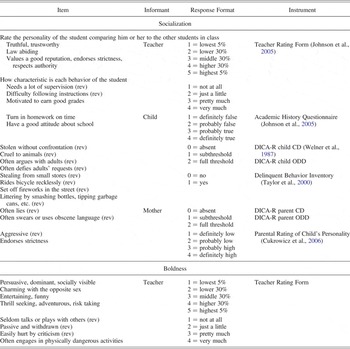
Hicks, Iacono, et al. (Reference Hicks, Iacono and McGue2012) used the present sample to identify the profile of behaviors, personality traits, and attitudes present prior to the initiation of substance use that provided maximal prediction of adolescent substance abuse. Items were selected from the extensive age 11 assessment that best predicted a composite measure of substance use and abuse (alcohol, nicotine, and illicit drugs) at the age 17 follow-up assessment. Analyses yielded two distinct personality trait dimensions called socialization and boldness. The items for the socialization and boldness scales are listed in Table 1. The socialization scale includes 20 items (α = 0.80) from teacher, child, and mother reports of personality traits, psychiatric symptoms of oppositional and antisocial behavior, and academic attitudes. The boldness scale is composed of 9 teacher-rated items (α = 0.80) of personality traits and behaviors. High scorers on socialization were characterized by willingness to conform to rules and adult supervision and to endorse conventional moral and ethical values. High scorers on boldness were characterized by high sociability, social assurance and dominance, stress resilience and lack of anxiety, and thrill seeking. Socialization and boldness are uncorrelated (r = –.01, ns). Hicks, Iacono, et al. (Reference Hicks, Iacono and McGue2012) provided extensive validity evidence for the socialization and boldness scales, as well as further details on the sources of the items.
Items of the socialization and boldness scales

Note: rev, reverse keyed; DICA-R, Diagnostic Interview for Children and Adolescents Revised; CD, conduct disorder; ODD, oppositional defiant disorder.
Contextual risk at age 11 and 14
Several putative environmental variables that are known risk factors for adolescent substance abuse were assessed at the age 11 and age 14 assessments, including peer, family, and school contexts as well as stressful life events. Since all of these environmental variables were correlated with each other (mean r = .27 and .37 at ages 11 and 14, respectively) and substance abuse, we calculated a composite measure of contextual risk at age 11 and 14. This composite was more strongly associated with substance abuse and provided a more reliable measure of contextual risk than any single indicator.
A detailed description of the individual environmental measures has been reported elsewhere (Hicks et al., Reference Hicks, South, DiRago, Iacono and McGue2009) and included twin and teacher ratings of the proportion (“all my friends” to “none of my friends”) of each twins' friends that engaged in various antisocial (get in fights, skips school, steals, drinks alcohol, smokes cigarettes; α = 0.85) and prosocial (gets good grades, liked by other kids; α = 0.85) behaviors (Walden, McGue, Iacono, Burt, & Elkins, Reference Walden, McGue, Iacono, Burt and Elkins2004) using a 19-item questionnaire. Because several antisocial peer items related to substance use, we excluded these items to avoid criterion contamination with our outcome measure of substance abuse. Quality of the parent–child relationship was assessed using the Parental Environment Questionnaire (Elkins, McGue, & Iacono, Reference Elkins, McGue and Iacono1997), a 50-item questionnaire indexing several aspects of the parent–child relationship (conflict, involvement, and positive regard; αs = 0.82–0.69). Twins and mothers completed ratings of the mother–child and father–child relationships. An overall parent–child relationship variable was calculated by taking the mean rating across informants and then averaging ratings for the mother–child and father–child relationship (r = .67 and .60 at age 11 and 14, respectively, for mother–child and father–child relationship quality). The school environment was assessed using several indicators of each child's academic context, including twin and mother ratings on a 7-item (α = 0.83) scale of attitudes about school (“good attitude about school” and “enjoys attending school”), cumulative grade point average, and expectation of educational attainment (e.g., high school, bachelor degree; Johnson, McGue, & Iacono, Reference Johnson, McGue and Iacono2005). An academic composite score was calculated by taking the mean z score for academic attitudes, grade point average, and expectations averaged across the twin and mother informants (r = .77). Stressful life events were assessed using a structured interview administered to each twin (Bemmels, Burt, Legrand, Iacono, & McGue, Reference Bemmels, Burt, Legrand, Iacono and McGue2008). We focused on 16 events related to family functioning, including parental discord and divorce and family money, legal, and mental health problems (intraclass correlations across members of a twin pair were .81 and .85 at ages 11 and 14, respectively). Stressful life events at age 14 refer to events that occurred over the past 3 years. Finally, contextual risk composites for age 11 and 14 were calculated by taking the mean of the standardized scores on antisocial peers, prosocial peers (reversed), parent–child relationship quality (reversed), academic engagement (reversed), and stressful life events.
Substance abuse at age 17
A composite of adolescent substance use and abuse was calculated using 10 measures of alcohol, nicotine, and marijuana use and symptoms of abuse/dependence assessed using an expanded version of the Substance Abuse Module of the Composite International Diagnostic Interview (Robins, Babor, & Cottler, Reference Robins, Babor and Cottler1987). This included Diagnostic and Statistical Manual of Mental Disorders (4th edition) symptoms of alcohol, nicotine, and marijuana abuse and dependence; past 12-month frequency of alcohol, nicotine, and marijuana use; and quantity measures, including average number of drinks per occasion, maximum number of drinks consumed in 24 hr, average number of cigarettes smoked per day, and number of lifetime marijuana uses. A log(x + 1) transformation was applied to all variables, and the mean z score across the 10 measures (mean correlation across measures = .58) was used as the substance abuse composite score at age 17.
Data Analysis
We examined developmental change in contextual risk, including mean-level changes and rank-order stability (Pearson correlations) from ages 11 to 14. We also examined mean-level gender differences at each age. Linear mixed models were used to adjust for the dependent twin observations. Next, we fit path analysis models to examine (a) selection effects of boldness and socialization on contextual risk at age 14, after accounting for the stability of contextual risk from age 11 to 14, and (b) whether contextual risk at age 14 mediated the effects of boldness, socialization, and contextual risk at age 11 on substance abuse at age 17. In this case, mediated or indirect effects were the products of the effects of the age 11 variables on contextual risk at age 14 and the effect of contextual risk at age 14 on substance abuse at age 17. Using Cohen's conventions (Cohen & Cohen, Reference Cohen and Cohen1983), a product of 0.01 indicated a small indirect effect, 0.09 a medium indirect effect, and 0.25 a large indirect effect. Path analysis models were fit in Mplus 5.1 (Muthén & Muthén, Reference Muthén and Muthén2007), including estimation of the direct and indirect effects using the MLR estimator and COMPLEX type to adjust the standard errors for the correlated twin observations. Because of the large sample size, only effects at p < .001 are described as statistically significant.
We also conducted biometric analyses by taking advantage of the genetically informative nature of the twin data to investigate the extent to which selection effects could be attributed to genetic influences, which would provide evidence for active rGE. Biometric analysis is based on the assumption that the variances and covariances among a set of observed variables is due to three latent variables: additive genetic (A), shared environment (C), and nonshared environment (E). These variance components are estimated based on the patterns of covariances between MZ twins (who share 100% of their genes) and DZ twins (who share on average 50% of their segregating genes); model fitting then generates what are commonly referred to as the ACE parameter estimates. Additive genetic effects (i.e., those that can be summed across genetic loci) contribute to twin similarity and are inferred if the MZ correlation is greater than the DZ correlation. Shared environmental effects are environmental influences that contribute to twin similarity and are inferred if the DZ correlation is greater than one-half the MZ correlation. Nonshared environmental influences are environmental effects that contribute to differences between members of a twin pair and are inferred if the MZ correlation is less than 1.0. Measurement error is also subsumed in the nonshared environmental variance component.
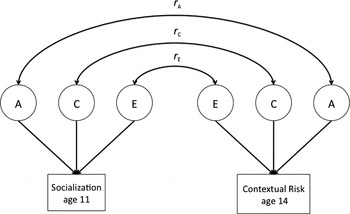
This univariate model can be extended to the bivariate case to estimate genetic and environmental contributions to the covariance between variables. Using the bivariate biometic model (Figure 1; this is equivalent to a Choleksy decomposition), genetic and environmental influences on the covariances among variables can be estimated by comparing MZ and DZ differences on the cross-twin, cross-trait correlations. For example, if the correlation between socialization at age 11 in one twin and contextual risk at age 14 in the other is greater for MZ twin pairs than for DZ twin pairs, this indicates an additive genetic contribution to the covariance between socialization at age 11 and contextual risk at age 14. This genetic covariance can then be standardized on the total additive genetic variance of the two variables to estimate a genetic correlation (r G), which provides an index of the amount of heritable variance that overlaps between the two variables. Shared environmental and nonshared environmental correlations (r C and r E, respectively) can be estimated using similar procedures. An alternative analysis is to examine the extent to which genetic, shared, and nonshared environmental influences contribute to the observed (i.e., phenotypic) correlation between two variables. This is of interest because even when observed correlations, and thus genetic correlations, are low, the observed association may be strongly genetically influenced. All biometric models were fit using the computer program Mx (Neale, Boker, Xie, & Maes, Reference Neale, Boker, Xie and Maes2004).
Bivariate biometric model. A, additive genetic variance component; C, shared environmental variance component; E, nonshared environmental variance component. The genetic correlation (r A) is an estimate of the amount of overlapping additive genetic variance between the two measures. The shared environmental correlation (r C) is an estimate of the amount of overlapping shared environmental variance between the two measures. The nonshared environmental correlation (r E) is an estimate of the amount of overlapping nonshared environmental variance between the two measures.

Results
Mean-level change, rank-order stability, and gender differences in contextual risk from ages 11 to 14
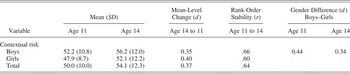
Table 2 provides the means and standard deviations for contextual risk at ages 11 and 14, reported separately by gender. To aid interpretation, the composites have been converted to a T score metric with the age 14 variables standardized on the age 11 scores. From ages 11 to 14, there was a moderate increase in exposure to contextual risk for both boys and girls. There was relatively high rank-order stability in exposure to contextual risk from age 11 to 14 for both boys and girls. Boys experienced moderately greater exposure to contextual risk than girls at both age 11 and age 14. Finally, boys also had lower socialization (d = –0.65) and slightly higher boldness (d = 0.12) scores as well as higher levels of substance abuse at age 17 (d = 0.38) than girls.
Descriptive statistics mean-level change over time, rank-order stability, and gender differences for contextual risk

Note: d, Cohen d = M 2 – M 1/√(SD 12 + SD 22)/2. All ds and rs > |.10| are significant at p < .001. To aid interpretation, all scores were converted to a T-score metric, standardized on the age 11 variable for the full sample.
Correlations among variables
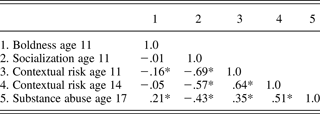
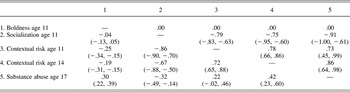
Table 3 provides the correlations among boldness and socialization at age 11, contextual risk at age 11 and 14, and substance abuse at age 17. Boldness at age 11 had a modest negative association with contextual risk at age 11 but was unrelated to contextual risk at age 14. Socialization at age 11 had large negative associations with contextual risk at ages 11 and 14. Socialization and boldness at age 11 had moderate negative and positive associations with substance abuse at age 17, respectively. Substance abuse at age 17 had moderate and large positive associations with contextual risk at ages 11 and 14, respectively.
Phenotypic correlations among study variables

*p < .001.
Selection effects for contextual risk at age 14
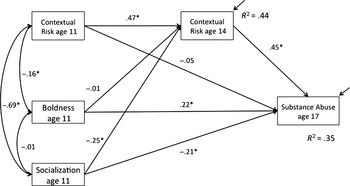
Next, we fit a path analysis model to the correlations among boldness and socialization at age 11, contextual risk at ages 11 and 14, and substance abuse at age 17. Path diagrams for this model are presented in Figure 2. Contextual risk was moderately stable from age 11 to 14, even after controlling for socialization and boldness at age 11. Low socialization at age 11 had a selection effect on contextual risk at age 14, because its effect was significant after accounting for the stability of contextual risk from ages 11 to 14. That is, even after controlling for the stability in contextual risk, low socialization in childhood predicted greater exposure to contextual risk in adolescence. In contrast, boldness was unrelated to contextual risk at age 14; therefore, childhood boldness was not associated with exposure to contextual risk in adolescence.
Boldness, socialization, and contextual risk at age 11 are predictors of contextual risk at age 14. The age 11 variables and contextual risk at age14 are predictors of substance abuse at age 17. Socialization and contextual risk at age 11 also have indirect effects on substance abuse at age 17 that are mediated via contextual risk at age 14. *p < .001.

Direct and indirect effects on substance abuse at age 17
We then examined the direct and indirect effects of boldness and low socialization at age 11 and contextual risk at ages 11 and 14 on substance abuse at age 17. After controlling for the age 11 variables, contextual risk at age 14 had a large effect on substance abuse at age 17. Contextual risk at age 11 did not have a direct effect on substance abuse at age 17. However, contextual risk at age 11 did have a significant indirect effect (β = 0.47 × 0.45 = 0.21, p < .001) on substance abuse at age 17 via its association with contextual risk at age 14. Low socialization at age 11 had a significant direct (β = –0.21, p < .001) effect on substance abuse at age 17, as well as a significant indirect effect (β = –0.25 × 0.45 = –0.11, p < .001) via its association with contextual risk at age 14. Boldness at age 11 had a significant direct effect (β = 0.22, p < .001) on substance age at age 17. Since boldness was unrelated to contextual risk at age 14, however, it did not have a significant indirect effect (β = –0.01 × 0.45 = 0.00, ns) on substance abuse at age 17. The three age 11 variables accounted for 44% of the variance in contextual risk at age 14. Together, boldness and low socialization at age11 and contextual risk at ages 11 and 14 accounted for 35% of the variance in substance abuse at age 17.Footnote 1
Genetic and environmental correlations
Table 4 provides the MZ and DZ correlations for boldness, socialization, contextual risk at ages 11 and 14, and substance abuse at age 17, and their ACE parameter estimates. Boldness was highly heritable with no shared environmental influences. The other variables each exhibited moderate heritability (A = .29 to .49) and moderate to large shared environmental influences (C = .30 to .55). Each variable had modest to moderate nonshared environmental influences (E = .16 to .29).
Monozygotic (MZ) and dizygotic (DZ) correlations and estimates of additive genetic (A), shared environmental (C), and nonshared environmental (E) variance components (95% confidence intervals)

Table 5 provides the genetic and shared environmental correlations among the variables. These correlations estimate the extent to which genetic and environmental influences overlap among the variables. If a person-level variable (e.g., low socialization) has both a selection effect and a genetic correlation with a contextual risk factor, this is strong evidence of an active rGE; that is, a person-level variable is associated with increased exposure to contextual risk, and at least part of that association is due to genetic influences.
Genetic and shared environmental correlations (95% confidence intervals)

Note: Genetic correlations below the diagonal, and shared environmental correlations above the diagonal. Boldness had no shared environmental variance; therefore, all its shared environmental correlations were constrained to zero.
Boldness had modest negative genetic correlations with contextual risk at ages 11 and 14. In other words, genetic influences contributing to greater boldness at age 11 were also associated with less exposure to contextual risk at ages 11 and 14. The genetic correlation between boldness and socialization was near zero, indicating the genetic influences on these traits were independent. In contrast, there was substantial overlap in the genetic influences on low socialization and contextual risk at ages 11 and 14 (mean r A = |.75|). Given the selection effects detected in the path analysis, this is strong evidence of an active rGE between low socialization at age 11 and contextual risk at age 14. Each variable also had a modest to moderate genetic correlation with substance abuse at age 17 (mean r A = |.32|). Boldness showed no shared environmental influences and so had no shared environmental correlations with the other variables. The shared environmental correlations among low socialization, contextual risk at ages 11 and 14, and substance abuse at age 17 were all large (mean r C = |.80|), suggesting a large common shared environmental risk factor underlying all these variables. All the nonshared environmental correlations were small (mean r E = |.09|), indicating the nonshared environmental influences on the variables were relatively independent.
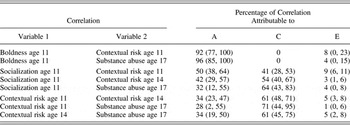
To delineate the etiological source of the associations among the variables, we also estimated the extent to which the observed associations among the variables were due to additive genetic, shared environmental, and nonshared environmental influences (see Table 6). Virtually all of boldness's modest associations with contextual risk at age 11 and substance abuse at age 17 were due to common genetic influences (we did not estimate the genetic and environmental influences on the association with contextual risk at age 14 because the phenotypic correlation was not significant). Genetic and shared environmental influences each accounted for about half of the associations between low socialization and contextual risk at ages 11 and 14, while genetic influences accounted for about one-third and shared environmental effects two-thirds of the association between low socialization and substance abuse at age 17. Genetic influences accounted for roughly one-third and shared environmental influences about two-thirds of the associations between contextual risk at ages 11 and 14 and substance abuse at age 17. Nonshared environmental influences accounted for modest amounts of the associations among the variables.
Percentage of correlation attributable to additive genetic (A), shared environmental (C), and nonshared environmental (E) effects (95% confidence intervals)

Note: Boldness had no shared environmental variance; therefore, all shared environmental influences on its correlations were fixed to zero. The results for the association between boldness at age 11 and contextual risk at age 14 are not reported because the phenotypic correlation was not statistically significant.
Genetic and environmental influences on selection and mediation
To better delineate the rGE correlation, we also extended our examination of selection and mediation to include the underlying genetic and environmental influences on these processes. Though we established that genetic influences on low socialization overlap with contextual risk at age 14, we did not yet know the extent to which these genetic influences were unique to low socialization (active rGE) or overlapped with genetic influences on contextual risk at age 11. In addition, we did not yet know the extent to which genetic influences on low socialization directly increased risk for substance abuse at age 17, or alternatively, were mediated by contextual risk at age 14. That is, genetic influences on low socialization may increase risk for substance abuse indirectly by increasing exposure to contextual risk at age 14.
We answered these questions by using an equation for calculating standardized beta weights (i.e., measures of the partial association between two variables after adjusting for a third variable), using correlations among the predictor and outcome variables: β = r Y1 – r Y2r 12/1 – r 212, where the subscript Y refers to the criterion variable (e.g., substance abuse at age 17), and 1 and 2 refer to the predictor variables (e.g., low socialization at age 11 and contextual risk at age 14). To examine the unique genetic and environmental influences of the predictor variables, we simply applied this formula to the genetic and environmental correlations among socialization at age 11, contextual risk at ages 11 and 14, and substance abuse at age 17. For example, the beta weight for the genetic variance of contextual risk at age 11 on the genetic variance of contextual risk at age 14 accounting for the genetic variance of socialization at age 11 is (see Table 5 for the genetic correlations): .72 – (–.67 × –.86)/1 – (–.862) = .55.
We examined predictors of contextual risk at age 14, quantifying the unique effects of the genetic and shared environmental influences of low socialization and contextual risk at age 11 on contextual risk at age 14. The beta weights on the genetic variance were –.20 (=−.67 − [.72 × −.86]/1 − [−.862]) for socialization at age 11 and .55 for contextual risk at age 11. Thus, genetic influences on low socialization and contextual risk at age 11 accounted for a total of 53.1% of the genetic variance in contextual risk at age 14: 4.0% (–.202) was attributable to genetic influences unique to low socialization, 30.2% (.552) was attributable to genetic influences unique to contextual risk at age 11, and 18.9% (–.20 × .55 × –.86 × 2)Footnote 2 was attributable to genetic influences common to low socialization and contextual risk at age 11. Thus, we were able to account for the majority of the genetic variance in contextual risk at age 14, with the bulk of this attributable to genetic influences specific to earlier (age 11) contextual risk, a smaller but notable amount due to genetic influences contributing to both earlier contextual risk and low socialization, and a small contribution due to genetic influences specific to low socialization.
The beta weights on the shared environmental variance of contextual risk at age 14 were –.36 (=−.75 − [.78 × −.79]/1 − [−.792]) for socialization and .50 (=.78 − [.75 × −.79]/1 − [−.792]) for contextual risk at age 11. Shared environmental influences on low socialization and contextual risk at age 11 accounted for 66.1% of the shared environmental variance in contextual risk at age 14. Thus, we identified the source of two thirds of the shared environmental influences on contextual risk at age 14, with most of this emerging from shared environmental influences common to low socialization and contextual risk at age 11 (28.1%; –.36 × .50 × –.79 × 2) or to shared environmental influences unique to contextual risk at age 11 (25.0%; .502). A smaller, but notable, amount (13.0%; –.362) was attributable to shared environmental influences unique to low socialization. These results indicate that both genetic and shared environmental influences on low socialization contribute to its selection effect for greater contextual risk in adolescence.
Next, we examined the genetic and shared environmental influences on substance abuse at age 17, specifically the extent to which contextual risk at age 14 mediated those genetic and shared environmental influences on low socialization that contributed to substance abuse at age 17. The beta weights on the genetic variance of substance abuse at age 17 were –.07 (=−.32 − [.42 × −.67]/1 − [−.672]) for socialization and .37 (=.42 − [.32 × −.67]/1 − [−.672]) for contextual risk at age 14. As such, 78% of the genetic influences on low socialization that contributed to substance abuse at age 17 were mediated by contextual risk at age 14. This estimate was derived by first calculating the indirect genetic effect of socialization via contextual risk at age 14, which equals the product of the genetic correlation between socialization and contextual risk at age 14 and the partial genetic effect of contextual risk at age 14 on substance abuse at age 17: –.67 × .37 = –.25. Next, the indirect genetic effect of socialization on substance abuse at age 17 was divided by the total effect (i.e., the genetic correlation between socialization and substance abuse): –.25/–.32 = .78. This indicates that the mechanism by which genetic influences on low socialization increased risk for substance abuse at age 17 was via increased exposure to more proximal contextual risk factors. Together, the genetic influences on low socialization and contextual risk at age 14 accounted for 17.7% of the genetic variance of substance abuse at age 17. Most of this overlap was due to genetic influences on contextual risk at age 14 (13.7%; .372), with a small amount attributable to genetic influences common to low socialization and contextual risk at age 14 (3.5%; –.07 × .37 × –.67 × 2). After accounting for contextual risk at age 14, almost none (0.5%; –.072) of the genetic influences on substance abuse at age 17 were attributable solely to low socialization.
The beta weights on the shared environmental variance of substance abuse at age 17 were –.61 (=−.91 − [.86 × −.75]/1 − [−.752]) for socialization at age 11 and .41 (=.86 − [.91 × −.75]/1 − [−.752]) for contextual risk at age 14. Only 33% of the shared environmental influences on low socialization that contributed to substance abuse at age 17 were mediated by contextual risk at age 14 (indirect effect of socialization = –.75 × .41 = –.30; –.30/–.91 = .33). Together, low socialization and contextual risk at age 14 accounted for 91.5% of the shared environmental variance of substance abuse at age 17. Over one-third was attributable to shared environmental influences on low socialization only (37.2%; –.612), with a similar amount (37.5%; –.61 × .41 × –.75 × 2) attributable to shared influences common to low socialization and contextual risk at age 14. A smaller, but notable, amount (16.8%; .412) was due to shared environmental influences on contextual risk at age 14 only. These results show that most of the shared environmental influences on substance abuse at age 17 were present in childhood and persisted through adolescence via increased exposure to more proximal contextual risk factors.
Discussion
Using a longitudinal twin study, we sought to delineate the mechanisms underlying the interplay among the child personality traits of boldness and socialization and contextual risk in the development of adolescent substance abuse. We found that low socialization in childhood was associated with increased exposure to contextual risk in midadolescence, which in turn increased risk for substance abuse in late adolescence. Both genetic and shared environmental influences on low socialization contributed to selection into high-risk contexts, strong evidence of active rGE. In contrast, boldness was unrelated to contextual risk and had a direct effect on substance abuse that was solely attributable to common genetic risk. We discuss the major findings and their implications in turn.
Developmental change and gender differences in contextual risk
Just as personality traits exhibit normative patterns of developmental change (Roberts & DelVecchio, Reference Roberts and DelVecchio2000; Roberts, Walton, & Viechtbauer, Reference Roberts, Walton and Viechtbauer2006), so do contextual variables. Exposure to contextual risk associated with substance abuse increased from age 11 to 14. This shift was likely a consequence of children gaining greater autonomy and taking more active roles in selecting their environmental contexts, consistent with the selection effects observed for low socialization. This often results in tension with parents and other authority figures and a temporary disengagement from socializing agents that maintain normative attitudes and behaviors (family, school, and prosocial peer contexts; Moffitt, Reference Moffitt1993). Overall, the contextual risk composite exhibited relatively high 3-year stability, a level of stability that was comparable to the stability of personality traits over this age range (Roberts & DelVecchio, Reference Roberts and DelVecchio2000). In terms of gender differences, boys experienced greater exposure to contextual risk than girls at both age 11 and age 14. Again, this was likely a consequence of person–environment transactions, as boys also exhibited lower socialization scores.
Selection and mediation
Results of the path analysis revealed that socialization was integral to these person–environment transactions, because it contributed both to stability and to change in contextual risk from ages 11 to 14. We use the term selection to refer to these processes, because low socialization traits accentuated existing environmental contexts. For example, after accounting for low socialization, the stability coefficient for the contextual risk composite from age 11 to age 14 dropped from .64 to .47; that is, low socialization accounted for some of the stability in contextual risk. In addition, low socialization predicted increases in contextual risk in adolescence, net the effect of prior levels of contextual risk in childhood. In turn, contextual risk at age 14 was a strong predictor of substance abuse at age 17. As such, contextual risk partially mediated the effect of low socialization on adolescent substance abuse. In other words, an important mechanism by which childhood socialization increased risk for substance abuse was indirect, via its effect of increasing exposure to contextual risk in adolescence.
Low socialization, however, also had a direct effect on adolescent substance abuse. Even after adjusting for differences in the environmental context in both childhood and adolescence, low socialization was associated with greater adolescent substance abuse. In addition to increasing contextual risk, low socialization also represents a person-level propensity to push the bounds of societal norms and restrictions on behavior (i.e., externalizing or behavioral disinhibition), in addition to seeking out environments that facilitate this tendency (Iacono et al., Reference Iacono, Malone and McGue2008). The intoxicating effects of many substances may exacerbate this tendency, creating a natural person–environment affinity. However, low socialization seems to be a marker of both person-level and contextual risk that accumulates over time, eventually culminating in various maladaptive outcomes such as substance abuse in adolescence.
Similarly, the trait of boldness increased risk for adolescent substance abuse, even after accounting for contextual risk and socialization. In contrast to low socialization, however, boldness did not exhibit the same interplay with contextual risk, as selection and mediation effects were absent. As such, boldness appeared to be a primarily person-driven variable, largely insensitive to the environmental context. For example, boldness is conceptually linked to low behavioral inhibition, a trait defined in studies of young children as a combination of lack of shyness, low social and object fear, and comfort in novel and potentially frightening situations, and it is hypothesized to reflect individual differences in evolutionarily prepared fear reactions (Fox et al., Reference Fox, Henderson, Marshall, Nichols and Ghera2005; Kagan, Reference Kagan1994). Boldness has also been linked to psychopathy (Patrick, Fowles, & Krueger, Reference Patrick, Fowles and Krueger2009), in particular, the interpersonal traits that are associated with reduced fear potentiated startle (Vaidyanathan, Hall, Patrick, & Bernat, Reference Vaidyanathan, Hall, Patrick and Bernat2011). In addition, Blonigen, Hicks, Krueger, Patrick, and Iacono (Reference Blonigen, Carlson, Hicks, Krueger and Iacono2008) showed that scores on a measure of boldness-related psychopathic traits failed to exhibit mean-level change from ages 17 to 24, a period associated with large changes in both the environmental context and the personality traits linked to low socialization (i.e., decreases in negative emotionality and behavioral undercontrol; Blonigen, Carlson, Hicks, Krueger, & Iacono, Reference Blonigen, Carlson, Hicks, Krueger and Iacono2008; Roberts, Caspi, & Moffitt, Reference Roberts, Caspi and Moffitt2001). Rather than increasing exposure to contextual risk then, boldness may increase risk “in the moment,” via its impact on the immediate decision to use substances, perhaps due to reduced fear reactivity and a bias toward potential reward over concern for harmful consequences in risky situations.
rGE processes
Biometric analyses revealed a high degree of overlap in the genetic and shared environmental influences on low socialization and contextual risk at age 11. In turn, genetic and shared environmental influences on these two variables accounted for much of the genetic and shared environmental influences on contextual risk at age 14. While low socialization had unique genetic and shared environmental influences on contextual risk at age 14, these effects were smaller than the common influences with preexisting contextual risk. This suggests that low socialization and contextual risk at age 11 have large effects in shaping exposure to contextual risk in adolescence, via selection and maintaining stability in the environmental context.
In turn, contextual risk at age 14 mediated nearly all the genetic influences of low socialization on adolescent substance abuse. In contrast, low socialization accounted for a large portion of the shared environmental influences on adolescent substance abuse, even after accounting for contextual risk at age 14. This suggests that much of the shared environmental influences on adolescent substance abuse were present in childhood. This is consistent with previous MTFS studies that have reported shared environmental influences contributing to childhood disruptive behavior disorders (Burt, Krueger, McGue, & Iacono, Reference Burt, Krueger, McGue and Iacono2003), adolescent problem behavior (McGue, Iacono, & Krueger, Reference McGue, Iacono and Krueger2006), early substance use (Walden et al., Reference Walden, McGue, Iacono, Burt and Elkins2004), and their associations with contextual risk factors (Keyes, Iacono, & McGue, Reference Keyes, Iacono and McGue2007). In contrast, the association between boldness and adolescent substance abuse was almost entirely due to common genetic influences. The weak associations between boldness and the contextual risk factors were also attributable to common genetic influences.
These findings indicate that low socialization and boldness were markers of two independent pathways to adolescent substance abuse. Mechanisms underlying these different pathways may be reflected in their different heritability estimates; specifically, boldness exhibited high heritability and no shared environmental influences, while socialization exhibited moderate heritability and moderate shared environmental influences. To the extent genetic influences on low socialization contributed to substance abuse, they did so mostly by selection into environments that increase access to substances and a culture to violate norms.
It is also important to note that the biometric analyses assumed that the ACE effects are independent. If these assumptions are violated, however, it has systematic influences on the parameter estimates (Purcell, Reference Purcell2002). Most notable for the present case, if the additive genetic and shared environmental influences are correlated, estimates of the shared environment will be biased upward. As such, the shared environmental influences on low socialization that then contributed to adolescent substance abuse may be a combination of passive, evocative, and active rGE processes that began in early childhood and continued to shape contextual risk into late adolescence. Future research then should focus on delineating these shared environmental and potential rGEs at earlier ages to help delineate processes that contribute to an early emerging high-risk developmental trajectory for adolescent substance abuse. We used a composite measure of contextual risk that combined the effects of several environmental risk factors. A goal of future research will be to determine if the same selection and mediation effects are present for socialization and different environmental risk factors (e.g., peers, family, and school).
In contrast, boldness's effects on adolescent substance abuse were direct and due entirely to genetic influences. The challenge for future research is to investigate the psychological processes that underlie these direct, heritable influences. Based on its connections with low behavioral inhibition and psychopathy, boldness may also be a marker of biologically driven individual differences in evolved fear reactivity that bias individuals toward making risky choices in contexts in which immediate rewards may be more salient than longer-term punishment.
To conclude, we were able to gain valuable insights into the interplay between child personality traits and environmental risk factors in the development of adolescent substance abuse, specifically socialization-related traits selected for high-risk environmental contexts that then increased risk for substance abuse. These selection effects were due to common genetic and shared environmental influences. Socialization and boldness, however, also had direct effects on adolescent substance abuse not accounted for by contextual factors. Future work should continue to examine the interplay between person-level and environmental risk factors on substance abuse over the life span, including reciprocal effects of substance abuse on developmental changes in personality and the selection of environmental contexts.