The importance of sustaining public health workers has recently been highlighted during the multiple waves of the COVID-19 pandemic response. State and local public health workers are essential responders to pandemics and other types of disasters and emergencies. They organize and provide community health services and direct health care as disaster events unfold. Public health workers also experience personal disaster-related challenges while concurrently providing care to others. Reference Cocker and Joss1 Although studies have examined the psychological consequences of disaster among public health workers, Reference Akbayrak, Oflaz and Aslan2–Reference Fullerton, McKibben and Reissman7 fewer have focused on factors influencing the time to recover in this population to estimate time for being ready for the next event. Similarly, there has been limited progress toward developing predictive models for use in planning response and recovery of disaster workers.
Identification of predictive factors of time to recovery can provide actionable strategies for leadership to promote readiness for subsequent disasters. Resilience, identified as the ability to bounce back, or withstand, adapt, and recover quickly from a traumatic event Reference Abramson, Grattan and Mayer8,Reference Hansel, Osofsky and Speier9 is one perspective on rapid recovery. The elements of resilience, however, are less often examined, and resilience remains a difficult concept to operationalize. Identification of specific protective factors that predict shorter time to recover following disasters, a practical definition of resilience, is important and can be enabled through the development of predictive models that detect factors influencing the length of time needed to recover between disasters.
Examining the specific work-related, community, and individual factors before and during disasters may help to predict the time to recover. A systematic review of studies examining risk and protective factors among disaster responders found that occupational factors, such as duration of disaster-related employment, yielded mixed findings, suggesting the need to further study the effects of work-related factors on disaster recovery. Reference Brooks, Dunn and Amlôt10 Lower work productivity (measured as presenteeism; eg, reduced concentration, working more slowly) Reference Stewart, Ricci and Chee11 has been associated with adverse outcomes, including PTSD. Reference Brooks, Dunn and Amlôt10,Reference Berninger, Webber and Cohen12–Reference Corrigan, McWilliams and Kelly14 In contrast, social support has been found to have a protective role during disasters and may be predictive of shorter recovery time. Higher levels of social support have been associated with lower work-related stress and more resilience, Reference Kansky and Diener15,Reference Shoji, Bock and Cieslak16 as observed among health-care workers examined 10-12 mo after they responded to Hurricanes Harvey and Maria. Reference Powell, Yuma and Scott17
Some experiential factors have been identified as associated with longer recovery times. These include higher trauma exposure, which has been associated with mental health problems, including posttraumatic stress disorder (PTSD), depression, anxiety, and distress postdisaster. Reference Brooks, Dunn and Amlôt10,Reference Chang, Lee and Connor18 Initial emotional distress and negative experiences during a disaster, including feelings of helplessness, hopelessness, anxiety, fear, and horror, have also been associated with adverse consequences postdisaster. Reference Weiss, Marmar and Metzler19,Reference Biggs, Fullerton and Reeves20 As responders are often in disaster-affected communities—including in the present pandemic—their personal disaster exposure, which may include injury to themselves/family members and damage to their homes/property, has similarly been associated with increased distress and posttraumatic stress and depressive symptoms and less resilience posthurricane. Reference Powell, Yuma and Scott17,Reference Perrin, Digrande and Wheeler21,Reference Fullerton, Ursano and Liu22 A better understanding of the relationship of these work- and disaster-related factors to the length of time to recovery, and thus their roles in resilience, is critical to promote readiness in disaster workers.
To better understand recovery and its predictors, we sought longitudinal data of public health workers with relevant variables. In 2005, there were 27 named storms, 14 of them hurricanes, resulting in the most hurricanes identified in a single season. 23 Hurricanes Dennis, Katrina, Rita, and Wilma were among the strongest that made landfall in Florida, with Katrina, Rita, and Wilma identified as Category 5 strength during their most severe periods over several southeastern US states. They together incurred over $124 billion in losses. 23 In Florida, Hurricane Katrina was a Category 1 storm, incurring approximately $630 million in damages, primarily centered in southern Florida.
Using data from a 2-wave prospective cohort survey which examined the post-2004 (and, therefore, pre-2005) and post-2005 hurricane seasons provides a unique opportunity to examine recovery in public health workers of the Florida Department of Health (FDOH) and investigate the utility of a predictive model that can be applied to aid disaster management during repeated disaster events. In particular, this study, therefore, examines the association of individual and interpersonal factors before the 2005 hurricanes with time to recover after the 2005 hurricanes in FDOH public health workers. Development of models identifying targets for intervention to speed recovery time following disaster can be translated to policy and be a critical aspect of preparedness for repeated disasters, providing leadership with actionable strategies for interventions that are essential to disaster preparation planning.
Methods
Participants and Procedures
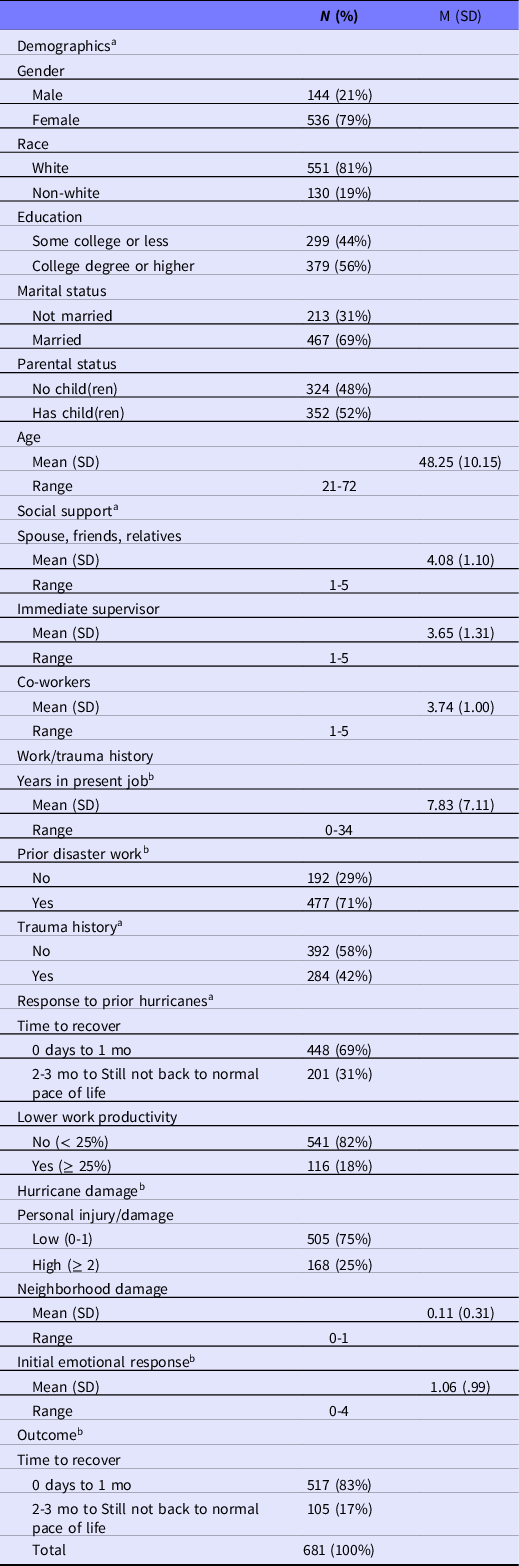
The current prospective cohort study, a part of a larger study examining responses to the 2004 and 2005 hurricane seasons, Reference Fullerton, Herberman Mash and Wang5 examines FDOH personnel who worked during the 2004 and 2005 hurricane seasons. Assessment occurred 1 mo before the 2005 hurricanes, in June 2005 (Time 1 [T1]), and 1 y later (approximately 9 mo after the 2005 hurricane season), in June 2006 (T2). Participants were 681 public health workers whose ages ranged from 21 to 72 y (M(SD) = 48.3(10.15) y). The majority of participants were female (79%; n = 536), White (81%; n = 551), and currently married (69%; n = 467), and 56% (n = 379) had a BA/BS degree or higher.
Study participation was voluntary. Questionnaires and a project description were distributed to all FDOH employees at each time point using personnel e-mail distribution lists. All participants indicated agreement to participate by completing and returning a questionnaire that was transmitted electronically and de-identified. Participants were informed that the questionnaires included items regarding their work and personal experiences before and since the 2005 hurricane season. The study was approved by the Institutional Review Board of the Uniformed Services University of the Health Sciences in Bethesda, Maryland.
Measures
Time to Recover
Participants were asked the following item that assessed perceived length of time to recover following the 2004 hurricane season at T1 (1 mo before the 2005 hurricane season) and at T2 (9 mo following the 2005 hurricane season): “Following the hurricanes, how long did it take you to return to your normal activities and pace of life?” This item included the following response options: (1) NA, there was no change in my normal activities and pace of life; (2) 2-3 d; (3) 1-2 wk; (4) 1 mo; (5) 2-3 mo; (6) Still not back to normal pace of life. Responses were dichotomized to indicate (1) shorter time to recover (No change in normal activities and pace of life to 1-2 wk recovery time); and (2) longer time to recover (1 mo or longer) categories.
Work Productivity
Work productivity at T1 was assessed using a component of the Work and Health Interview, which specifically assesses presenteeism. Reference Stewart, Ricci and Chee11,Reference Stewart, Ricci and Leotta24 Participants indicated the percentage of time that work performance was reduced within the past 2 wk on each of 5 items using a 5-point scale: (1) losing concentration; (2) repeating a job; (3) working more slowly than usual; (4) feeling fatigued; and (5) doing nothing at work. Response options included: (1) “none of the time (0%)”; (2) “some of the time (25%)”; (3) “half of the time (50%); (4) “most of the time (75%)”; and (5) “all of the time (100%).” Scores were dichotomized, with high being 25% average reduced performance. As in previous research with this sample, Reference McKibben, Fullerton and Ursano25 we did not examine the last (sixth) item of the scale that assesses the amount of time that participants took to start working after arriving at their workplace, which is typically used to calculate the hourly equivalent of lost productivity time costs. Instead, our focus was on behaviors associated with work productivity, examining a disaster response population in which working hours and occupational roles and tasks could range widely.
Work and Trauma History
Work history was assessed at T2 with a single item that asked participants how many years they had been working at their present job. In addition, a single item asked whether they had ever worked in a disaster response before the 2005 hurricanes (Yes/No). Exposure to a traumatic event before the 2004 hurricane season was assessed (Yes/No).
Social Support
Participants’ experience of social support from 3 sources (ie, spouse, friends, and relatives; immediate supervisor; and co-workers) were separately assessed at T1 with the following item for each social group: “How much could each of these people be relied on when things got tough at work?” Response options ranged from 1 (“hardly at all”) to 5 (“a great deal”).
Initial Emotional Response
Initial emotional response during the 2005 hurricanes was assessed at T2 with 5 separate questions. Participants were asked: “At any time during the hurricanes did you feel: (1) frightened; (2) helpless; (3) anxious; (4) horrified; or (5) hopeless?” Response options to each item ranged from 0 (“not at all”) to 4 (“extremely”). A mean initial emotional response total score was calculated from responses to the 5 items.
Personal Injury/Damage
Personal injury/damage during the 2005 hurricanes was assessed at T2 with the following question: “What kinds of problems or damage did you experience during the hurricane season?” The individual-level hurricane injury/damage variable was calculated based on whether participants had experienced any of the following 6 events during each of the 4 hurricanes: loss of electrical power; damage to vehicle; injury or harm to self; injury or harm to spouse/significant other; and injury/harm to children or injury/harm to pets. The possible range of personal injury/damage scores for the 4 hurricanes was 0-24, and a median split identified low and high levels of injury/damage. Those reporting 2 or more of the events during the 4 hurricanes were considered to have high hurricane-related personal injury/damage (T2 2005 hurricanes): n = 151; 24%). Dichotomizing this variable with 0 or 1 hurricane event signifying low injury/damage allows for the severity and degree of the personal hurricane impact to be assessed.
Community Hurricane Damage
To control for the level of the individual’s community damage, we used FEMA county data for the storms in 2005, 26 and identified the zip code level of FEMA public and individual assistance received. Each zip code was scored based on its highest community storm damage across the 4 storms to index the level of individual and public assistance received. We combined levels to create 5 levels of public assistance and, therefore, community storm damage. The level of community storm damage ranged from none (0) to individual assistance only (1) to increasing levels of public assistance with FEMA categories A to G (scored 2, 3, and 4). This level-2 variable was then centered.
Statistical Analysis
Potential risk factors for time to recovery were analyzed using logistic regression analyses. Mean levels of social support at T1, mean total scores of initial emotional response at T2, and rates of time to recovery and lower work productivity at T1 were computed using descriptive statistics, and are presented in Table 1. Univariate logistic regression analyses examined socio-demographics (age, gender, education, race/ethnicity, and marital status at T1), trauma history (T1), time to recover and lower work productivity (T1), past disaster work experience (T2), disaster-related characteristics (personal injury/damage and community storm damage effects related to the 2005 hurricanes at T2), and initial emotional response (T2) as predictors of time to recover following the multiple hurricanes in 2005 (T2). A multivariate model was conducted that examined all risk and protective factors that were significant at the univariate level. We examined the extent to which the relationship of a significant risk factor (ie, initial emotional response) to time to recover may have been modified by specific variables by including variable interactions separately in our final model. Logistic regression coefficients were exponentiated to obtain odds ratios (OR) and 95% confidence intervals (CI). Diagnostic performance of the final model using risk prediction was evaluated by calculating the area under the curve (AUC) of the final model, as well as sensitivity, specificity, and the positive predictive value (PPV) among the 5% and 10% of participants at the highest predicted risk. Statistical analyses were conducted using SPSS software Version 25. 27
Demographics, social support, work and trauma history, response to prior hurricanes, hurricane damage, and initial emotional response

a T1 (Time 1) = Assessment 1 mo before the 2005 hurricane season (June 2005).
b T2 (Time 2) = Assessment 9 mo following the 2005 hurricane season (June 2006).
Results
The estimated response rate for participants who were able to be contacted at Time 1 was 65.1% (recruitment details in Fullerton et al., 2013). Reference Fullerton, McKibben and Reissman7 Among those who participated at Time 1 and could be reached at Time 2, the estimated response rate was 74% (ie, attrition rate = 26%). One month before the 2005 hurricanes (ie, at T1), 31% of participants (n = 201) reported that recovery from the previous hurricanes took at least 2-3 mo, and 18% (n = 116) reported lower work productivity, identified by at least a 25% reduction in work performance (Table 1). At baseline (T1), mean social support from participants’ spouse, friends, and relatives was 4.08 (SD = 1.10), from immediate supervisor was 3.65 (SD = 1.31), and from co-workers was 3.74 (SD = 1.00), indicating that the sample generally received high levels of social support. At T2, the mean total initial emotional response score was 1.06 (SD = 0.99; range 0-4). At T2, 17% of participants (n = 105) indicated that it took at least 2-3 mo to feel back to their normal pace of life after the recent hurricanes.
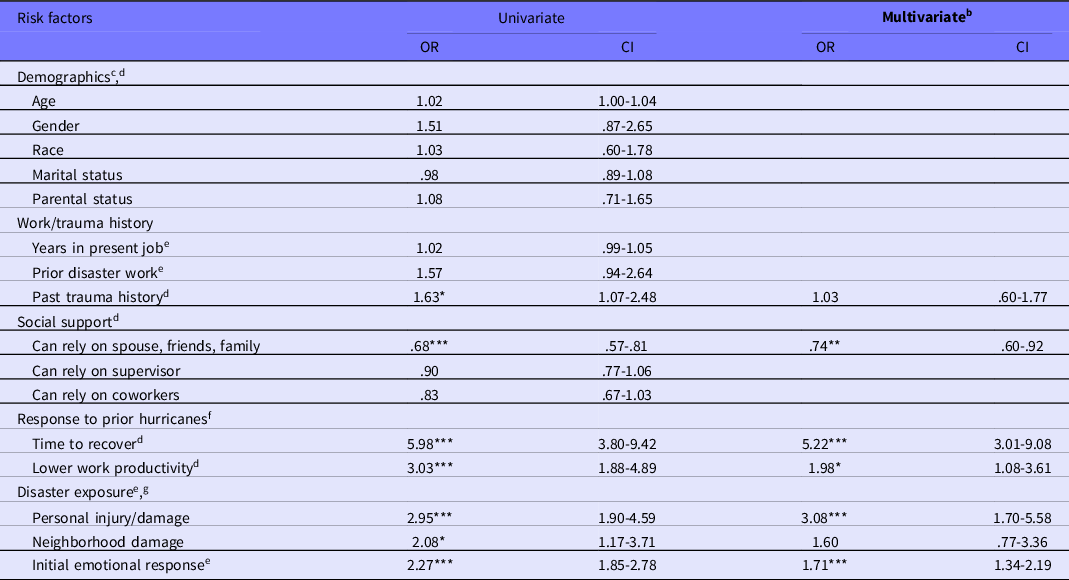
In univariate models predicting time to recover at T2, trauma history (OR = 1.63 [95%CI = 1.07-2.48]; χ2 = 5.11), less social support from spouse, friends, and family (OR = .68 [95%CI = .57-.81]; χ2 = 18.73), longer time to recover at T1 (OR = 5.98 [95%CI = 3.80-9.42]; χ2 = 59.79), lower work productivity at T1 (OR = 3.03 [95%CI = 1.88-4.89]; χ2 = 20.75), greater personal injury/damage (OR = 2.95 [95%CI = 1.90-4.59]; χ2 = 23.18), and greater storm damage (OR = 2.08 [95%CI = 1.17-3.71]; χ2 = 6.20) at T2, and higher initial emotional response at T2 (OR = 2.27 [95%CI = 1.85-2.78]; χ2 = 61.38) were associated with a longer time to recover (Table 2).
Time to recover: Relationship of demographic characteristics and predisaster factors a

Note: Multivariate model n = 543.
a Predictor variables include demographic characteristics (T1), and work/trauma history (T1/T2), social support (T1), time to recover and lower work productivity (T1), hurricane damage (T2), and initial emotional response (T2) factors.
b The multivariate model includes all variables that were significant at the univariate level.
c Gender: Male = 0, Female = 1; Education: Some college or less = 0, College degree or higher = 1; Race: Non-white = 0, White = 1; Marital status: Unmarried = 0, Married = 1; Parental status: No child(ren) = 0, Has child(ren) = 1.
d T1 (Time 1) = Assessment 1 mo before the 2005 hurricane season.
e T2 (Time 2) = Assessment following the 2005 hurricane season.
f Time to recover (T1): Shorter time to recover (no change in normal activities and pace of life to 1-2 weeks’ time to recover = 0; Longer time to recover (1 mo or longer time to recover) = 1. Lower work productivity (T1): Low (< 25% reduced work performance) = 0, High (≥ 25% reduced performance) = 1.
g Individual and/or family hurricane injury/damage from the 2005 hurricanes: Low (0-1) = 0, High (≥ 2) = 1.
*P ≤ 0.05, ** P ≤ 0.01, *** P ≤ 0.001.
A multivariate model that included all factors that were significant at the univariate level (Table 2) indicated that less social support (OR = .74 [95%CI = .60-.92]; χ2 = 6.99), longer time to recover from the previous hurricanes (OR = 5.31 [95%CI = 3.06-9.21]; χ2 = 35.24) and lower work productivity at baseline (OR = 1.93 [95%CI = 1.07-3.50]; χ2 = 4.76), higher levels of personal injury/damage at T2 (OR = 3.05 [95%CI = 1.71-5.43]; χ2 = 14.23), and higher initial emotional response at T2 (OR = 1.73 [95%CI = 1.35-2.21]; χ2 = 19.29) were associated with longer time to recover. Trauma history and personal hurricane injury/damage were no longer significant at the multivariate level. We also examined the interactions of initial emotional response with other significant factors (ie, social support, time to recover (T1), lower work productivity, and personal injury/damage) in separate models, but these interactions were not significant in any model. The AUC of the final model was 0.84. Using predicted probabilities from this model, the 5% of participants with the highest predicted risk of greater time to recover included 21.5% of participants with longer time to recover (2-3 mo or longer; ie, sensitivity of 21.5%), with a specificity of 98.5% and PPV of 74.1% at that threshold. Among the 10% of participants with the highest predicted risk of a prolonged time to recover, sensitivity of the model = 37.6%, specificity = 95.6%, and PPV = 63.6%.
Discussion
Public health workers often must respond to repeated disaster events, including after natural disasters and the present COVID-19 pandemic waves. Therefore, the time it takes to recover, reset, and be ready to go again is important to understand, to anticipate the capabilities of the work force to respond to a repeat event. The current study administered a survey to the public health workforce with the goal of providing managers information regarding factors associated with a longer time to recover. Study findings, including the identification of subgroups of individuals and work-related, individual, and community factors related to increased risk, can be translated to policies and interventions that promote recovery. Reference Greenland28 However, further research focused on these particular factors is needed to confirm these findings. Such work may indicate actionable recommendations, such as baseline measures administered before and directly following disaster exposure to detect those at risk and aid in targeting interventions to assist in rapid recovery. Thus, the identified factors may provide leadership with actionable targets to be incorporated in interventions and are essential to disaster preparation, which can foster recovery and readiness for potential multiple disasters.
Among study participants, baseline social support from one’s spouse, friends, and family was associated with a shorter time to recover. Perceived social support has previously been found to buffer a variety of negative responses, including distress, anxiety, depression, and posttraumatic stress, following trauma experiences Reference Powell, Yuma and Scott17,Reference Guilaran, de Terte and Kaniasty29–Reference Stanley, Hom and Chu31 and is strongly associated with postdisaster resilience. Reference Rodriguez-Llanes, Vos and Guha-Sapir32 The present study indicates that the source of social support, primarily from close personal relationships, predicts time to recover, as compared to support from co-workers or supervisors. This is noteworthy, as it would be expected that those who share similar responsibilities in disaster response would understand the unique demands and challenges. There may be critical time periods in which different sources of support are most important for different outcomes. This requires further study. In a study of women firefighters, Reference Stanley, Hom and Chu31 although support from supervisors, coworkers, and friends/family were each related to fewer posttraumatic stress symptoms, participants specifically cited supervisor support as more strongly associated with lower symptom severity. However, the current study suggests that those in one’s personal life may offer a respite from the stresses of disaster work, which can result in a shorter time to recover. The role of specific sources of support in time to recovery of public health workers merits additional examination in future studies across various outcomes. Supervisor and coworker support during disaster work may be important in different aspects of disaster work, such as team cohesion, decreased errors, and protection from specific work-related stressors.
In the current study, predisaster lower work productivity was associated with a longer time to recover. Lower work productivity at baseline suggests that the individual was having difficulty concentrating at work and performing work responsibilities before the hurricanes of 2005. Of note, previous disaster experience and years in one’s present job were not significantly related to time to recover in univariate or multivariate models. Past traumatic event exposure was initially a significant predictor of time to recovery, but was no longer significant in the multivariate model. Understanding whether prior exposure and past disaster work were similar to or different from the present hurricane response experiences may be important for further understanding the lack of association of prior exposure with recovery. As previous research has yielded mixed findings regarding the influence of prior work-related and/or personal trauma exposure on disaster response, the role of past trauma experience, specifically for disaster workers, should be a focus in future research on recovery time. Furthermore, as criteria used to define trauma exposure have progressed over the different versions of the Diagnostic and Statistical Manual of Mental Disorders, 33 with the addition of repeated exposures and inclusion of different conditions associated with witnessing traumatic events, for example, assessment of trauma exposure may need to be reconsidered in future research examining trauma history.
Greater initial emotional experiences to the disaster, including anxiety, fear, hopelessness, helplessness, and horror, were found to be associated with a longer time to recover. Individual factors may both predispose individuals to adverse peritraumatic experiences Reference Lewis, Platts-Mills and Liberzon34 and, as shown here, also be associated with recovery postdisaster. Reference Birmes, Brunet and Coppin-Calmes35,Reference Gandubert, Scali and Ancelin36 Peritraumatic distress symptoms have been associated with negative long-term psychological outcomes in first responders and community residents following disasters. Reference Marmar, McCaslin and Metzler37 , Reference Norris, Friedman and Watson38 Such reactions may be seen or noted by supervisors and, therefore, used in identifying who may recover sooner versus later. Interventions that provide psychological care during and immediately following disaster exposure, such as Psychological First Aid (PFA) and specific leadership behaviors, may offer opportunities for acute disaster care to foster more rapid recovery, Reference Hobfoll, Watson and Bell30 and can be examined as interventions to speed recovery time postdisaster.
Personal injury and property damage was associated with delayed recovery. Although the personal impact of the hurricanes was associated with time to recover, the level of the individual’s community storm damage was not, suggesting that the direct personal experience has a distinct influence on recovery. This suggests that attention to the personal impact of disasters on public health workers by leadership through informal and formal support resources, time off, and specific resources may facilitate disaster recovery. Our final model demonstrated a high AUC with reasonable PPV, suggesting that producing tools that target factors found to be predictive of prolonged recovery through assessments administered to workers before and directly following disaster exposure can assist leaders in identifying those at highest risk and providing interventions to foster more rapid recovery. In particular, individual and group interventions can be developed that address specific needs, such as strengthening social support and providing education that prepares workers for expectable trauma experiences and stress management predisaster, identifying those who experience increased emotional responses during the disaster for targeted support postdisaster, and provision of resources for those who report challenges related to personal injury or property damage. Further research is needed to better understand these risk and protective factors. Important tools that rely on timely administration, such as disaster-specific trainings and triage, have previously been developed to assist in other aspects of disaster care, and are important to consider in fostering rapid recovery. Reference Fannin, Brannen and Howell39,Reference Brannen, Barcus and McDonnell40
The present study has important limitations. It focuses on an important population of public health workers, and can directly inform research on public health workers and other first responders; however, its generalization to other populations is limited and requires further study. The results on surveys may have been affected by participant recall. In addition, the higher proportion of females in the study sample (although accurately reflecting the gender composition of the FDOH 41 ) may limit generalizability to wider populations. Although the data of the present study were collected in 2005 and 2006, given the increased prevalence of hurricanes related to climate change, understanding public health response to serial hurricanes remains important and timely. However, results may be limited by changes that have occurred over time and within communities. Our work productivity measure (presenteeism) scale did not include a sixth item focused on time to begin work, as the occupational roles, responsibilities, and schedules of the participants varied widely. Although exclusion of this item did not allow for calculating the hourly equivalent of lost productivity costs, we believe that the items provide a useful and valid measure of specific dimensions of decreased work productivity.
Findings suggest that enhancing predisaster social support for disaster workers may be beneficial in reducing time to recover. Specifically, it is important for interventions to target risk factors before disaster (eg, decreased work productivity), during disasters (eg, greater initial emotional response), and postdisaster (eg, personal injury/damage). Use of pre- and postdisaster assessments and establishing trainings and interventions that directly address identified risk and protective factors pre- and postdisaster may help foster a more rapid recovery. Attention to these factors, if supported by additional research, may provide actionable areas for intervention by leadership and is essential to disaster planning and readiness in public health workers.
Disclaimer
The opinions expressed in the manuscript are those of the authors and, therefore, do not necessarily reflect the views of the Department of Defense, the Uniformed Services University of the Health Sciences, or Henry M. Jackson Foundation for the Advancement of Military Medicine.