In part 1, we focused on President Barack Obama’s selection of lifetime appointees to the lower federal courts of general jurisdiction during the 113th Congress (the first half of his second term). We placed those appointees within the context of the entire Obama judicial appointments record over his first 6 years in office. We noted the backgrounds and attributes of those confirmed and compared them to the cohorts of the president’s four immediate predecessors. We observed that although the Senate of the 113th Congress confirmed 109 of the 123 nominees as well as 20 of the 22 nominated to the appeals courts of general jurisdiction, the confirmation process was far from smooth (Slotnick, Goldman, and Schiavoni Reference Slotnick2015). Now we turn to confirmation politics during the 113th.
Partisan gridlock was a fairly accurate description of the confirmation process during the early months of the 113th. One particular locus of contention centered on the filling of four vacancies on the US Court of Appeals for the District of Columbia. Republicans were adamantly opposed to filling those vacancies claiming that they were unnecessary given the workload of the circuit. But Democrats believed that the real reason was the desire of Republicans to maintain the conservative majority on the circuit, which obviously would be upended by Obama appointees. Continued obstruction of the filling of the DC Circuit vacancies was the proverbial straw that broke the camel’s back, coming on unprecedented obstruction and delay of mostly noncontroversial district judge nominees, added to the routine delaying tactics since the start of the Obama presidency. This led to a historic confrontation in the Senate that resulted in the so-called nuclear option being adopted by a simple majority of the Senate. This in effect ended the filibuster of judicial nominees by reducing the number of votes needed to cut off debate of a nomination from 60 to a simple majority. The details of the DC Circuit conflict and the adoption of the rule change will be recounted here. We also offer a broader assessment of the implications of filibuster reform by way of the so-called nuclear option.
Obstruction not only was a matter of the minority using the filibuster knowing that achieving 60 votes to break it was extremely difficult; it also took another form, the use of the blue slip by members of the minority party. In the pages ahead we will be telling the story of the blue slip’s use to obstruct Senate Majority Leader Harry Reid’s nominee by Reid’s Republican colleague from Nevada. We will also tell the story of the administration’s efforts to break deadlocks elsewhere by brokering package deals with Republican senators.
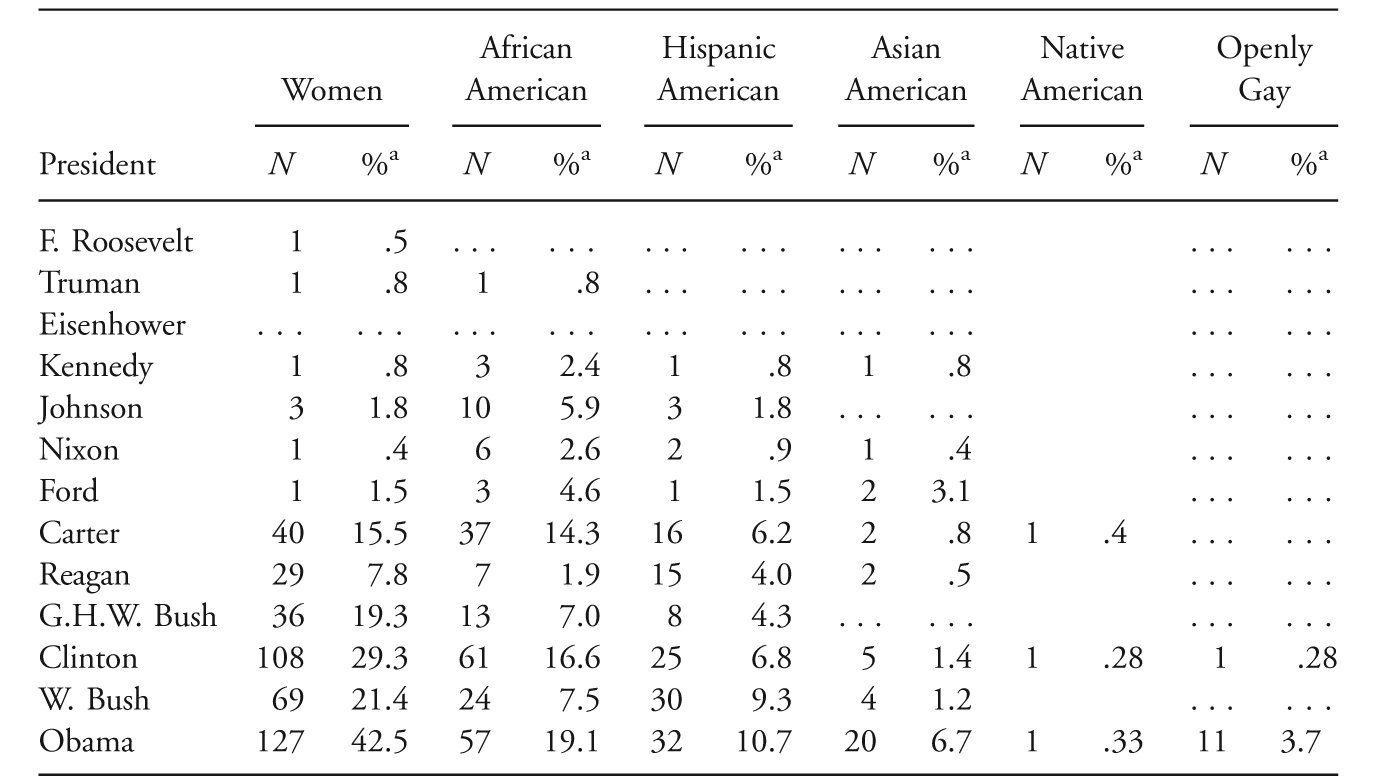
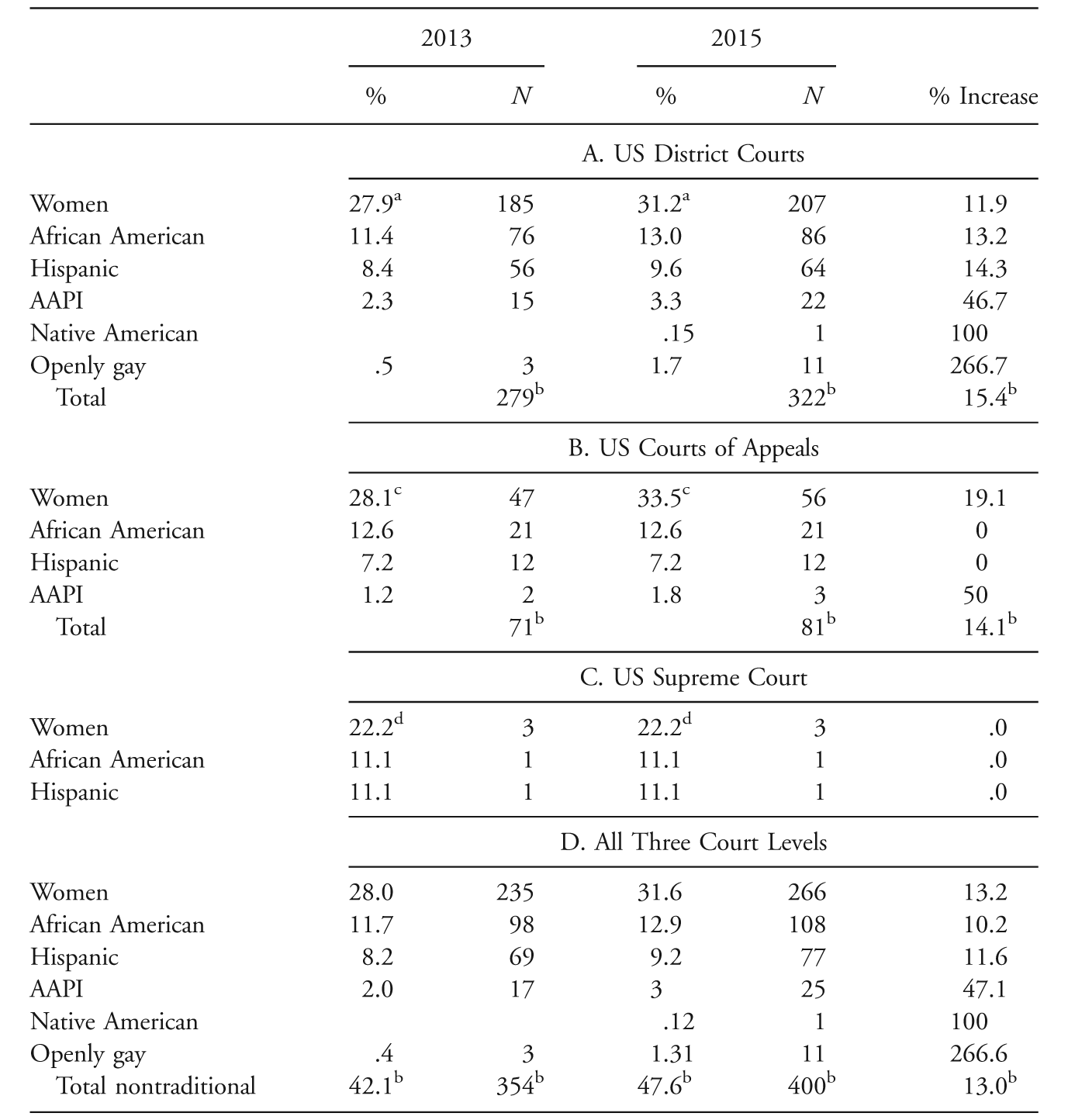
At the end of the day (and the 113th Congress), President Obama was able to place on the bench a remarkably diverse group of appointees. We devote special attention to the various forms of diversity that characterize Obama’s appointees: racial, gender, sexual preference, and experiential. We also discuss the political impact of Obama’s appointments on the partisan makeup of the bench. We conclude this article with informed speculation as to what is in store for judicial nominations for the remainder of the Obama presidency.
As noted in the first part of this article, our sources of data were the in-depth interviews we conducted with the key players in the confirmation process.Footnote 1 Statistics were derived from the judicial questionnaires nominees completed as well as various websites on the Internet. Political party data in some instances were obtained from registrars of voters.
The Battle for the DC Circuit Court of Appeals: Going Nuclear
Any understanding of the Obama administration’s efforts to seat judges on the critically important Court of Appeals for the DC Circuit would be incomplete and lacking in nuance were it to preclude consideration of the inextricable linkage between confirmation politics regarding the circuit and the Senate Democrats’ invocation of the so-called nuclear option, which ultimately allowed Obama’s DC Circuit nominees to be confirmed with a simple majority vote, effectively removing the possibility that Senate Republicans, in the minority in the 113th Congress, could stop them through the successful use of their power to filibuster. It is equally the case that any effort to understand the politics of confirmation to the DC Circuit during the Obama years acontextually, without considering the inextricable link between the efforts of President George W. Bush to fill vacancies on the circuit to those of President Obama, would be equally flawed. As with so much else in the decades of partisan conflict in judicial selection politics to the lower federal bench, the US district courts and the US courts of appeals, albeit with the stakes immeasurably higher for the DC Circuit, generally acknowledged to be second in importance in the federal judicial system to the US Supreme Court, the thrust of “the story” depends on one’s political vantage point.
For Republicans and those on the political right, the DC Circuit story during the Bush years was dominated by the failure to confirm successfully one of President Bush’s very first judgeship nominees, Miguel Estrada, to the DC Circuit bench, despite trying to do so from 2001 to 2003. Estrada was a young, high-profile conservative with impressive credentials who, with the kind of “seasoning” DC Circuit experience could provide, would become an ideal Hispanic American candidate for a future Supreme Court vacancy. The lengthy effort by Republicans to bring Estrada to the Senate floor for a confirmation vote culminated in 2003 in seven failed cloture votes to overcome a Democratic filibuster, and reluctantly concluding that he could not be confirmed, Estrada withdrew his candidacy from further consideration. Opposition to Estrada was largely based on characterizations of his extreme conservative views and concerns about what he might become. Democratic senators pointed to Estrada’s lack of prior judicial experience, despite his “well qualified” rating from the American Bar Association, his alleged evasiveness in answering questions during his nomination hearing, and the administration’s refusal to turn over his written work from his service in George H. W. Bush’s Justice Department. Estrada’s treatment and defeat by a Democratic filibuster were characterized as unprecedented by his supporters and seen as analogous to and nearly as egregious as President Reagan’s Supreme Court nominee, Robert Bork’s defeat by a Senate floor vote in 1987. Indeed, in the eyes of conservative supporters, Estrada had, effectively, been “Borked.”
If Miguel Estrada served as a DC Circuit rallying cry early on in the W. Bush years, a comparable scenario emerged later in Bush’s presidency with the failure to obtain DC Circuit confirmation for Peter Keisler in 2006 and 2007 to the seat vacated through John Roberts’s promotion to chief justice. Keisler, like Estrada, was a youthful conservative “highflyer” with all the bona fides that would make him an attractive nominee to the conservative Republican base. Keisler was a cofounder of the Federalist Society, a bastion of conservative thinking and a veritable cradle for the emergence of strong conservative nominees for the federal courts. He had served as a law clerk to Robert Bork on the DC Circuit as well as on Bork’s ill-fated Supreme Court nomination in the Reagan White House. In W. Bush’s administration, Keisler was heavily involved in defending the president’s Global War on Terror. His pedigree rankled Senate Democrats, and like Estrada, he was seen as a potential Republican Supreme Court nominee should a vacancy arise. Keisler’s nomination languished in the Senate Judiciary Committee and never reached the Senate floor. We think it is noteworthy that our sources on the Republican right never failed to bring up the cases of Miguel Estrada, Peter Keisler, and, indeed, even Robert Bork, perceived confirmation wounds inflicted nearly a decade, a decade and a half, and almost 30 years ago, respectively, when the subject turned to discussion of President Obama’s nominations and the Democratically controlled Senate’s efforts to seat judges on the DC Circuit Court of Appeals.
For their part, Democratic observers of the same historical period told a very different story. The failed nominations of Estrada and Keisler were characterized as extremely rare examples of nominees, chosen with their well-known ideology as a primary nomination criterion, who were simply too far outside of the political mainstream to withstand Senate scrutiny. For such observers, the more compelling story of the DC Circuit during the W. Bush years was the president’s great success in seating four judges on that appellate tribunal: John Roberts in 2003, Janice Rogers Brown in 2005, Thomas Griffith in 2005, and Brett Kavanaugh in 2006, albeit not without significant opposition that could often be characterized as ideologically driven. John Roberts was confirmed to the court in 2003 by unanimous consent in the Republican-controlled 108th Congress after not being confirmed when the Democrats controlled the Senate in the 107th Congress. Janice Rogers Brown, a staunchly conservative libertarian, saw her nomination returned to the president in the 108th Congress but was ultimately confirmed after renomination in the 109th Congress by a vote of 56–43, with Senator Barack Obama among the naysayers. Brown’s confirmation was part of a negotiated settlement fashioned by a bipartisan group of senators (including John McCain, a fact of considerable interest in the battle over President Obama’s DC Circuit nominees) known as the Gang of Fourteen. The “gang’s” primary goal was avoidance of the majority Republicans’ need to resort to the nuclear option as a mechanism to confirm several judges whose nominations were being held up by Democratic filibusters. Under the terms of the agreement, which allowed the Senate filibuster rule to survive, Rogers Brown was among those specifically identified whom the seven Democratic signatories agreed to vote for in invoking cloture, thereby ensuring an end to the filibuster effort. Prospectively, nominees would be filibustered only under “extraordinary circumstances,” as defined by each signatory’s own discretion and judgment. Griffith was confirmed by a vote of 73–24 while Brett Kavanaugh’s confirmation process was stalled for nearly 3 years before being confirmed by a vote of 57–36, with Senator Obama, once again, among the naysayers. Kavanaugh’s background included working on the Starr Report calling for the impeachment of President Clinton, participating in the investigation of the suicide of Clinton aide Vincent Foster, serving on the legal team working for W. Bush in Florida during the critical 2000 presidential election recount processes, and subsequently taking a leading role in the W. Bush White House in helping to identify and secure the confirmation of conservative judgeship candidates.
The broader point here is not to question the legal credentials of any of these nominees or their suitability for holding a seat on the DC Circuit Court of Appeals. Rather, our aim is to underscore that partisans on both sides of the aisle subscribed to two different versions of reality. While W. Bush failed to seat Miguel Estrada or Peter Keisler on the critical DC Circuit Court, he was ultimately successful in appointing four judges with stellar conservative credentials to the circuit, his two failed nominees notwithstanding. In the end, President Obama was equally successful in seating four judges to the DC Circuit, although, as our analysis suggests, partisan obstruction in the Obama case extended beyond the specific nominees to the court itself and any effort to fill its vacancies. In such a circumstance, in the absence of the kind of compromise negotiated by the Gang of Fourteen, a bipartisan group of Senate moderates in the W. Bush years, the Democrats felt compelled to resort to a filibuster rules change, the nuclear option, to gain confirmation for the president’s DC Circuit nominees.
Specifically, while Democratic filibusters during the W. Bush years were focused on a subset of judicial nominees deemed the most doctrinaire conservatives, Republican filibusters causing obstruction and delay in President Obama’s second term extended far beyond judicial nominees to include an unprecedented number of presidential nominees to positions in the executive branch. In the months leading up to filibuster reform, these included nominations to the positions of Environmental Protection Agency administrator; secretary of labor; three members of the National Labor Relations Board (NLRB), including its prospective chairman; the nominee to be the NLRB’s general counsel; the director of the Bureau of Alcohol, Tobacco, Firearms, and Explosives; an assistant secretary of defense; the director of the Office of Personnel Management; and the director of the Federal Housing Finance Agency. According to one member of the president’s judicial selection team, what the Republicans were pursuing was tantamount to a broad-based policy of “nullification, filibustering institutions and offices, rather than people based on qualifications. That finally built up a lot and, then … they went ahead and filibustered the DC Circuit.”
Second, as implied above, the climate for compromise exemplified by the Gang of Fourteen that avoided a nuclear outcome in the W. Bush years did not exist or materialize in 2013 in a Senate including many new members whose elections were won with Tea Party support. Finally, comparisons of all nominees to the DC Circuit during the W. Bush and Obama years suggest false equivalencies. At bottom, it is difficult to conclude that the Obama DC Circuit nominees resided as far to the liberal left on an ideological continuum as those nominated by W. Bush were located on the conservative right.
Despite this picture, there existed some hope and even expectation at the start of the 113th Congress in 2013 that things would run more smoothly for judicial confirmation processes generally as well as for nominees to the DC Circuit in the spirit of a gentleman’s agreement between Democratic Senate Majority Leader Reid and Republican Minority Leader McConnell to lower the cloture time for debating sub-cabinet-level appointees as well as district court judgeship candidates. As noted by a staff member for the majority leadership team,
We thought it was going to work much differently. … McConnell agreed to use the filibuster only in rare circumstances. Unfortunately, he couldn’t deliver on his promise with some members of his caucus. … McConnell doesn’t over promise, but at the same time he wasn’t really driving the train. It was his right flank. … They just kept poking and prodding and making things so much more difficult than they needed to be. It wasn’t like we were running roughshod over them. We included them in things from the beginning. I think we really tried to work in good faith. But there were so many people who were so disappointed in the outcome of the 2012 election that they took things to an extreme.
In addition to the failure of the gentleman’s agreement to work as he anticipated, this same Democratic aide noted a “break point” that occurred soon after a temporary fix was negotiated, analogous to what the earlier Gang of Fourteen had accomplished, allowing for the staffing of positions on the NLRB. “We reached a crisis point over the summer and McCain and … others got together and said, ‘We’re not going to do this rules change. We’re going to do this agreement. We’re going to let you staff the NLRB.’ They did this outside of McConnell. I think McConnell was ticked off. Certainly the Ted Cruz faction was livid. But we reached that crisis point and I thought we were done. Things will go back to normal.” Soon, however, it became apparent that this would not be the case. “But we were right back in the soup with the DC Circuit. And it was interesting … because we had … some … senators … almost taunting us after we reached the brink on the NLRB. They thought if Reid wasn’t going to do it then, he wasn’t going to do it. … No one thought Reid had the votes which was the most interesting part. He had the votes. Even with the NLRB, we had the votes then—and we had the votes again when we had to change the rules for the DC Circuit.”
During this period, as suggested, two interesting dynamics focusing on Majority Leader Reid that were highly related yet, ultimately, separable questions helped to frame the question of whether the Democrats would pursue filibuster reform to break the DC Circuit logjam. Did Harry Reid have the votes to do it and, as importantly, did he have the will? On the question of votes, it was pretty clear that several newer members of the Democratic caucus, many of whom had not experienced institutional life as members of the minority, supported and sought a fundamental rules change. Two senators in particular, neither members of the Senate’s Judiciary Committee, led this charge. One liberal group activist noted, “Some interesting dynamics occurred during the past two years. There was a shift of power … away from the Senate Judiciary Committee to … Merkley [Democrat from Oregon] and Udall [Democrat from New Mexico] who, through thick and thin, through good times and bad times, were pushing a rules change.” A senior Democratic leadership staff member agreed: “There was a wing of the newbies, the folks who weren’t there when we were in the minority, who were the agitators, and pretty relentless agitators in the Tuesday Caucus lunch meetings where this decision grew and became a reality. That and the Democratic base who care about this sort of thing were agitating for it.” This joining of resolve was not lost on a staff aide to a Judiciary Committee Democrat: “I think it was the Senate Democrats’ willingness to go all out and not back down. I think that was energizing in both this body as well as outside. And I think it was an interesting moment of Democrats actually caring and fighting for judicial nominations in a way that is rarely seen in the Senate Dems.”
Such support notwithstanding, there remained serious concerns over whether Senator Reid could count on Democratic Senate icons considered “institutionalists” who revered the Senate’s rules, norms, and traditions and whose votes would be necessary to bring about the fundamental rules change for the filibuster being considered. Undoubtedly the most central figure in this group was Patrick Leahy, the longest-tenured Senate Democrat and long-term chair of the Senate Judiciary Committee. Our interviews suggested that Leahy’s decision to support the rules change took shape over time and, in the end, was precipitated by the DC Circuit controversy. A Judiciary Committee majority staff aide noted,
We often talk here about the Patti Millett story. The filibuster of her nomination really troubled him, because he thinks long term. He’s heard all of the arguments about why it should just be a majority vote. But the change in demeanor from the summer, where we almost had a rules change … then we heard positive things being said about Patti Millett, the nomination, the nominee, nothing but positive things—and also things like, “We should evaluate them individually on the merits.” “She looks like an excellent candidate” becomes, in November, the same member [John McCain] who’d been involved in the Gang of Fourteen in 2005 came down to the floor [of the Senate] to say, “I deem this an extraordinary circumstance.” Her nomination, a completely noncontroversial nomination. We were trying to work with them. And I truly believe, and … Senator Leahy alluded to this in a floor statement, that had it not been for her filibuster, it would be quite surprising that we would have seen a rules change.
Once Senator Leahy was on board with the rules change, other senior Democrats, such as Diane Feinstein, would soon follow, and it became clear in the Democratic caucus that filibuster reform could be accomplished.
It is impossible to know with certainty what exactly tipped the balance for Senator Reid to invoke the rules change, a filibuster reform that had been in the realm of possibility ever since President Obama first took office and encountered great difficulty in seating his judicial nominees. Why now, in the 113th Congress in President Obama’s second term? Those outside observers most cynical about Reid’s ultimate decision to pursue the rules change have suggested that there was an element of the personal for Reid. For one, Republican obstruction had hit home. He, himself, had been embarrassed when he was unable to secure confirmation to the US District Court for Nevada of his favored candidate, Elissa Cadish, nominated by President Obama in early 2012. Cadish’s nomination never received a Judiciary Committee hearing and was eventually withdrawn because Republican Senator Dean Heller, Reid’s junior home state colleague from Nevada, refused to return a blue slip to the committee, which would have allowed her nomination to move forward. More central to the DC Circuit, one group advocate suggested that those seeking a rules change “were getting nowhere until a case was decided by the DC Circuit involving the placement of hazardous waste in Nevada at Yucca Mountain.” Senate aides did not dispute that Reid was miffed at the defeat of his favored nominee by the Judiciary Committee’s (and Chairman Leahy’s) willingness to adhere to its norm allowing home state senators to defeat judicial nominees through a blue slip veto, and they admitted he would be aware of any DC Circuit Court decisions affecting his home state. Nevertheless, they remained dismissive of claims that he invoked the rules change for personal reasons.
Perhaps the most compelling reasons offered for Reid pulling the trigger on invoking the nuclear option were much simpler. Democratic aides suggested that earlier on in the struggle to confirm DC Circuit judges, while Senator Reid had the votes, he may have lacked the will. “You can fight up to a point. But things have to go on. You can’t just deny government from functioning.” Summarizing the position Reid found himself in, Nan Aron, president of the liberal advocacy group the Alliance for Justice concluded, “There was no choice, there was absolutely no choice about the need to change the rules. The Republicans completely overplayed their hand. … They made a huge strategic error and thought that Reid would never actually go forward with this rules change and they were wrong” (interview, January 6, 2015). A Democratic leadership aide added, “When he finally did it, he was gung-ho. He firmly believed in doing it.”
Perhaps ironically, at the beginning of President Obama’s second term, few on the Democratic side would have chosen “going nuclear”as the best vehicle for breaking the judicial logjam, especially since so many of the current players, senators and advocacy groups alike, had been against such an approach during the W. Bush years when it appeared the Republicans would invoke such a rules change in 2005, prior to the compromise resolution brought about by the Gang of Fourteen. As Nan Aron noted, “Changing the rules was not anything that anyone in the Senate or White House or advocacy groups started out thinking was a good thing. In fact, many of us had been very vocal supporters of the filibuster … during the Bush years. So nobody ever expected anything like that would be in play. But they … blocked everyone. And they were losing the argument in the public, to the extent that anyone in the public cared. The New York Times, some newspapers editorialized against the wholesale blockade of judges. So this was the only real option available to the Senate.” The fact that there appeared to be little or no alternative, notwithstanding, when the rules change came about, many were taken by surprise. Consultant Vincent Eng explains that “I was working very closely with Robert Wilkins [who would become the fourth Obama nominee confirmed to the DC Circuit]. We had discussed a number of times where the possibility of going nuclear was, the pros and the cons. But, quite frankly, I think it caught everybody by surprise. Obviously, it was a very happy day for Robert and his nomination, knowing that he would get confirmed. But it took all of us by surprise” (interview, January 7, 2015). A Democratic Senate leadership aide confirmed, “I don’t think anybody really knew that we were going to go nuclear until it actually happened.”
Interestingly, what surprised the Democrats was seen by many on the right as the natural unfolding of events. Curt Levey, president of the conservative Committee for Justice, recalled, “I probably said to you two years ago that it seemed inevitable that we were moving towards the nuclear option. Reid was getting as much as he could each time and he wasn’t going to be satisfied” (interview, January 8, 2015). In a similar vein, a senior aide to a Senate Judiciary Committee Republican charged that changing the rules was a violation of the compromise struck between Senators Reid and McConnell in early 2013, “where the minority agreed to certain changes in the rules and in exchange for that Senator Reid said on the floor that we will not pursue any rules changes absent regular order.” He also noted that “the majority threatened to change the rules very often. And with that hanging over your head, the threat of the change, it became clear to a lot of people that that was the end that was sought, not something that they were pushed to do. … Each time that Reid threatened to employ the tactic … he got what he wanted, he got his nominations confirmed. … And if he does that every time and the minority capitulates every time … could we envision it? Yeah, we could envision it.”
In effect, what transpired, as it had in 2005, was a very high-stakes game of chicken between two highly partisan coalitions with little constructive dialogue aimed at a mutually beneficial solution. Whereas, in 2005, the Gang of Fourteen surfaced to forge such a solution and avoid the Republican resort to the nuclear option, most analysts concluded that, in 2013, the Republicans miscalculated both the votes and the Democrats’ resolve while also seriously erring in their opposition to the specific nominees in the DC Circuit battle. And, in this regard, the White House’s eventual nomination strategy for the DC Circuit, so very different from what George W. Bush had done previously, played a huge role in fashioning the administration’s ultimate success in seating four judges to the DC Circuit, the same number as the W. Bush administration before it.
When George W. Bush became president, his first 11 judgeship nominees, all to the US Circuit Courts of Appeals, were introduced to the public in a White House Rose Garden ceremony. The nominees included two strong conservative candidates for the DC Circuit Court, John Roberts and Miguel Estrada. President Obama’s nominations came more slowly and with little fanfare, with his first nominee in March 2009, David Hamilton to the Seventh Circuit Court of Appeals. A chief judge and 14-year veteran of the US District Court, Hamilton had the strong support of his home state senator, the senior Republican in the Senate, Richard Lugar. Nevertheless, his confirmation required the overcoming of strong opposition, including a filibuster. Obama did not name a single candidate for a DC Circuit vacancy until September of 2010 with the nomination of Caitlin Halligan. While Halligan had strong legal credentials and liberal bona fides, she was not the iconic figure on the political left that Estrada and Roberts had been on the Republican right when they were nominated. Halligan had served for 6 years as solicitor general of the State of New York, during which time she had run afoul of the National Rifle Association and other gun lobbying interests for embracing a legal theory that would hold the gun industry responsible for crimes committed with firearms. Persevering through periods of Senate inaction as well as successful filibusters, Halligan was renominated in January 2011, June 2012, September 2012, and January 2013 before she withdrew her candidacy in March 2013. The failure to seat Halligan occurred despite the existence of four vacancies on the DC Circuit, leaving President Obama as the first president since Woodrow Wilson to fail to confirm a DC Circuit judge in his first term in office.
For a second vacancy on the DC Circuit, the president nominated Sri Srinivasan in June 2012 and then, again, in January 2013 after the nomination had been returned by the Senate. He was unanimously confirmed to the court in May 2013. In the Democratic liberal base, however, Srinivasan’s confirmation was met by a mixed reception. While he possessed excellent legal credentials and received considerable mention as a potential and “safe” Supreme Court nominee should a vacancy arise during Obama’s second term, Srinivasan struck liberals as an “establishment” nominee who, in his legal practice, often represented corporate interests in controversies with labor. In addition, his resume included service in the solicitor general’s office during the presidency of George W. Bush. For the left, he fell far short of the DC Circuit “victories” that W. Bush had scored with John Roberts, Janice Rogers Brown, and Brett Kavanaugh. If President Obama was to leave a legacy on the DC Circuit, it would largely depend on what transpired with the three remaining vacancies on that critical court during the president’s second term.
Once Srinivasan was unanimously confirmed, many Senate Republicans expected the pressure to seat additional judges on the DC Circuit to abate. Given the reality that President Obama put forward only two nominees to the circuit through the beginning of his second term despite the existence of three vacancies (with a fourth arising in 2013), it was not anticipated that he would take an aggressive posture toward the remaining openings on the court. For their part, many Senate Republicans felt that arguments about the DC Circuit’s relatively low caseload could win the day and that any subsequent nominee could be obstructed and delayed for a lengthy period. At worst the president would confirm one more DC Circuit nominee. In our interview with a senior staff aide to a Republican Judiciary Committee member, the workload defense of Republican opposition was joined with tit-for-tat logic equating the situation in 2013 with that of 2005. “I think the record is clear that all the minority was doing during the DC Circuit debate was trying to hold the then current majority to the same standard that they established when the DC Circuit debate was held in the last administration. … If you look at the arguments the then Senate minority made in the debates during the last administration, based on caseload, or in the case of Miguel Estrada that he didn’t hand over stuff from the SG’s office … those were the precise things, the same standard that we were trying to hold them to during this administration.”
What was not anticipated was the actual strategy that the White House followed of simultaneously nominating three prominent candidates to the court, two of whom were women and one of whom was an African American man. Aides to a Senate Democrat on the Judiciary Committee confirmed that “it was the White House that decided when to send them up. They rolled the nominations out in the Rose Garden at the same time. But when the materials came in, which is usually the starting point, not the date of the nomination, Patti Millett’s nomination came in first and a week or so later came Pillard and, then, Wilkins.” Millett, a sterling nominee with superb legal credentials, would be the “first one up,” and the most difficult among the three to oppose on the merits of her candidacy. With Millett’s candidacy coming to the fore and two additional nominees queued up behind her, it would be difficult for the Republicans to sustain a caseload argument that would provide a credible justification for keeping all three seats vacant. Indeed, arguments questioning the “need” for additional judges on the circuit rang hollow for a number of reasons. An aide to a Senate Democrat on the Judiciary Committee pointed out with regard to other circuits such as the Tenth, “Even if you take away the argument that every lawyer knows, that the DC caseload is more complex than the Tenth Circuit … we were confirming nominee after nominee on the Tenth Circuit with lower caseloads.” Further, and more germane to present politics, “when Roberts was confirmed by a voice vote to the DC Circuit, by any measure, the caseload was lower than it was when we were voting on Patti Millett.” Adding additional fuel to the Democratic case for its three nominees, W. Bush was successful in seating two additional DC Circuit judges on June 10, 2005, more than 3 months before John Roberts resigned his seat on September 29, 2005, when he was elevated to the Supreme Court. That the workload strategy was a weak gambit for objecting to DC Circuit nominees was even noted by strong conservative voices such as Curt Levey. “A lot of Republicans on the Hill seemed to just think that saying the DC Circuit was underworked, that was their main argument, along with a little bit of ‘We need to apply a level of higher scrutiny to the DC Circuit and look what they did to Estrada.’ I never thought that was a powerful argument.”
On a number of levels, the White House nomination strategy could be given high marks. As Michelle Schwartz, justice programs director at the Alliance for Justice saw it,
I don’t think the nuclear option would have happened with a different set of nominees. It worked out with those three because … Millett … was first. And nobody said anything bad about Millett. And then they said, “We don’t want to confirm her because we don’t want to confirm anybody.” And everybody else kind of became linked in with that. And they would have to be filibustering two women and an African American man. And having had Caitlin Halligan already, “okay so now we’re filibustering three women in a row. But you let the guy through.” All of those things together. It’s hard to know what would have happened without everything. It was a perfect storm. (Interview, January 6, 2015)
This metaphor was repeated in several of our interviews, including that with a senior Democratic Senate leadership aide. “It was the perfect storm. It’s who they [the nominees] were. They weren’t crazy people. They were highly qualified. They [the Republicans] made poor decisions in who they blocked, as far as goading us into the nuclear option.”
According to virtually all of our sources on both sides of the partisan divide, both within the Senate and among the advocacy groups, the Republicans had a reasonable alternative to blocking all three nominees. They could have delayed Patricia Millett’s nomination for a time but, ultimately, allowed it to be confirmed by the Senate. Successfully seating Millett, President Obama would have had two appointees on the DC Circuit. While there would have been a great deal of angst, push, and shove expended on the Pillard and Wilkins nominations, blockage of their confirmations likely would not have resulted in the invoking of the nuclear option by the Democrats. As argued by People for the American Way’s (PFAW’s) Marge Baker, had Millet been confirmed, “I think that would have totally defused it. We were able to make the case that they were taking obstruction to fundamental new levels that were fundamentally antidemocratic. If they would have let one nominee through, we would have been fighting about numbers” (interview, January 7, 2015). A senior Democratic Judiciary Committee aide added that, with Millett’s confirmation,
It’s hard not to see that the winds would have gone out of the sails in terms of the rules change. She was so unquestionably qualified and noncontroversial that it was a sea change from what “extraordinary circumstances” was supposedly meant to be by the Gang of Fourteen. And it was also a wholesale vote. It was very clear that this was about this court, not this nominee, and it was for this seat and any seats going forward. … The decision of Republican members overreaching on the Patti Millett nomination is what turned things. … This was no longer going to be about fairness and the individual merits of the person, creating some controversy. You couldn’t argue that with Millett. There was nothing.
Underscoring the special role of the Millett nomination in the playing out of the DC Circuit confirmation battle, PFAW’s senior legislative counsel Paul Gordon noted, “In the committee hearing the Republicans had no objections to her. They didn’t even manufacture something. They came right out and said, ‘We think you’re great, we think you’re qualified’” (interview, January 7, 2015). Marge Baker added, “It was this notion that they had this right as senators giving their consent to prevent the president from filling these three vacancies on the court, and so openly and brazenly doing it.”
In short, the Republicans made a fatal miscalculation in successively filibustering all three DC Circuit nominees, rarely reaching the merits of the individual candidacies but, instead, seemingly questioning the right of this president to perform his constitutional duty to appoint judges. Central to this overreaching by the Republicans was, in effect, the implicit view that President Obama’s efforts to fill vacant seats on the DC Circuit Court constituted, in and of itself, an “extraordinary circumstance” permitting a filibuster under the Gang of Fourteen’s 2005 agreement. For a senior Democratic staff member who had worked in the Senate in 2005, the decision by Senator John McCain, one of the architects of the 2005 language, to use that language on Patricia Millett “was another turn of the screw. That standard meant something to those of us who knew the specific terminology of the Gang of Fourteen. It really meant that they were all in. That the entire Republican caucus was all in. That if this, Patti Millett, became exceptional, the wholesale filibuster of multiple seats on the court would follow. It was a total game changer.” On the other hand, a senior Republican Judiciary Committee staff aide downplayed McCain’s use of the “extraordinary circumstances” language to oppose Millett. “The so-called extraordinary circumstances agreement … was reached by a particular group of senators who were signatories to it for a particular time period. For that Congress and that Congress only by its own terms. For the signatories of that agreement it might have extended, but any member can use whatever standards he or she deems is appropriate.”
While it is technically true that the extraordinary circumstances standard did not bind anyone in 2013, even the 2005 signatories to the agreement, the larger point is that it was being used by Senator McCain and, by implication, others for opposing Patricia Millett. That reality, when compared to the W. Bush nominees in 2005 to whom the standard did not, apparently, apply (such as for Janice Rogers Brown’s confirmation to the DC Circuit), created an untenable false equivalency in the eyes of the Democrats that underscored just how far the rules of the game had changed between the nuclear confrontations of 2005 and 2013. This was, indeed, a “game changer.” The conclusion that to some degree the Senate Republicans had brought the nuclear option on themselves was not lost on commentators on the conservative side of the spectrum such as the Committee for Justice’s Curt Levey. “I felt like there was no point in pushing Reid to use the nuclear option on the DC Circuit. It would have been better to make a deal. … I think it would have been better to stop one or two of them … leaving Millett out of it.”
The invocation of the nuclear option by Majority Leader Reid and the Senate Democrats broke the DC Circuit logjam and allowed three judges to be confirmed to that court. But what did “going nuclear” mean for judicial selection more generally, beyond the confines of the DC Circuit during the 113th Congress? And how will the decision of the Democrats to let the genie out of the bottle, altering filibuster rules so that judges could now be confirmed by a simple majority vote, affect the judicial selection process well beyond the Obama presidency? These are questions to which we now turn.
What Did the Nuclear Option Accomplish? Beyond the DC Circuit
In our interviews, the most extreme attribution of impact to the rules change came from a Democratic Senate leadership aide: “Twenty-five percent of the roll call votes with nominees confirmed after the nuclear option were confirmed with less than 60 votes. They would have absolutely been blocked.” Such a view, however, treating final confirmation merits votes as fungible with votes on cloture to end a filibuster is difficult to sustain. Curt Levey, for example, disputed the notion that all those ultimately confirmed with under 60 votes would have been blocked in a pre–rules change world. “That’s clearly not true. There are people where the cloture motion has succeeded and they’ve gotten less than 60 votes on confirmation, so that’s just factually wrong.” Christopher Kang, deputy counsel to the president, observed,
I look at all of the press about the nuclear option, or filibuster reform, and its impact, and it feels a little bit overstated. … There’s a lot of talk about how the filibuster reform sort of flipped a switch and, then, all of a sudden all of these judges went through. I don’t think that’s true. They didn’t all suddenly go through. It took further leadership to file cloture on every single nominee and time and effort to go through that cloture process. Two, that doesn’t account for the blue slip process, which limits the president’s selections in the first place [discussed in detail below]. And, three, there were many nominees who had been nominated long before the filibuster reform and probably were not affected much by it.
It is also important to note that cloture votes and merits votes may both mean something quite different when taken in a postnuclear world. Marge Baker, for example, underscored how the voting calculus for confirmation might change. “The fight became how do you get to 51, not how do you get to 60. So different people were in play in getting to 51.” That said, Michael Zubrensky, deputy assistant attorney general in the Office of Legal Policy, noted, “All of these folks who were confirmed after the nuclear option, on the cloture votes it was pretty much party line. On the merits, most nominees were confirmed unanimously. There were very few on the merits with significant numbers of ‘No’ votes. I think the protest votes on the nuclear option were at the cloture level. Some Republican senators were even voting against cloture for judges that they had previously supported. But it was just a protest vote. And then they voted for them on the merits” (interview, January 8, 2015).
Voting conventions aside, it is difficult to escape the conclusion that the nuclear option had an important impact on the outcome of judicial selection in the 113th Congress, beyond the DC Circuit, although that impact may not always have been a direct consequence of the rules change per se or completely transparent. Thus, on one level, the consequences of the rules change on district court confirmation outcomes could be characterized as minimal since there is virtually no history of significant delay of district court confirmations via filibustering and none whatsoever of such nominees being defeated by a long-term failure to attain cloture. And, as Christopher Kang noted, “No district court judge has been defeated on the floor since Ronnie White, ironically now confirmed [discussed further below]. So I do think all of those judges would have continued to be confirmed. … I think all of the district court judges would have gotten through—although probably not as quickly without the filibuster reform.”
In addition to picking up the pace of confirmations, as Christopher Kang observed, “[An] interesting thing that the filibuster reform had an effect on was the volume of nominees that Senator Reid could file cloture on—four or five nominees a week. It allowed Senator Reid to set his own agenda. This was at the expense of other items on his agenda—so it wasn’t costless in that regard—but I think allowing Senator Reid to set his own pace and the leadership he demonstrated was perhaps the biggest impact of filibuster reform.”
In the end, following the expedited path to attaining cloture that the rules change allowed, coupled with the limits placed on debate in cloture proceedings on district court nominees that predated the rules change, a significant impact was felt in the absolute number of postnuclear judicial confirmations. One senior Democratic Judiciary Committee staff member concluded, “I’m actually convinced that there’s no way we would have come close to the numbers that we got, even the people who had 60-something votes, I still think would have been under threat.” A Democratic leadership aide added, “The number of judges we got through was pretty amazing. I don’t think anybody necessarily understood, even if we did go nuclear, how many nominees we’d be able to get through. … There were people who were confirmed who would not have been confirmed had we not gone nuclear.”
Conjecture on who such people would have been is, of course, a risky and problematic enterprise. That said, several circuit court nominees who were confirmed readily come to the fore. Curt Levey, who in a nonnuclear world would have been an active opponent of a number of nominees advocating on behalf of the Committee for Justice, opined, “I think [David] Barron would have been stopped. [Cornelia] Pillard probably would have been stopped. [Pamela] Harris, my gut feeling is no, but that’s just a guess.” A senior Senate Judiciary Committee staff member offered a somewhat more expansive list. “I think you can definitely identify nominees, mostly circuit nominees, who would not have been confirmed had it been 60. Pam Harris, Barron, [Michelle] Friedland, Owens, Wilkins. Maybe Millett and Pillard. And also [district court nominee] Ronnie White.” Marge Baker added that “there were other nominees where there would have been big fights that might have gotten through. But there would have been fights. But the more important thing is that they would have run out the clock,” accentuating the critical importance of the maintenance of an expedited pace to reach the numbers of confirmations that were accomplished.
Finally, in assessing the impact of the rules change, it must be stressed that the implications of invoking the nuclear option went well beyond the confirmation of individual nominees to include, in the eyes of some, critical symbolic changes in the prevailing judicial confirmation environment. As the Alliance for Justice’s Nan Aron concluded, all one has to do
is go back to the debates on Roberts and Alito where liberal groups asked the Democratic leadership to block those two justices. We had very serious meetings but they were never serious about using the filibuster. And that just fed into this ongoing assumption that Democratic senators don’t really care about judgeships. And it wasn’t until the nuclear option became viable after the blockage of the three DC Circuit judges that people sat back and said, “Okay, this is new, this is different. Senator Reid is taking some leadership on this issue and standing up.” And that, in turn, caused the White House after the rules were changed to say, “We have an opportunity to fill some of these Circuit Court seats.” It was a critically important moment, because I can’t think of another time when Democrats really stood up and said, “We’re not taking this anymore.”
Will There Be Nuclear Fallout?
Despite the great success the Obama administration enjoyed seating judges in the 113th Congress, there were many, including some supporters of the administration’s judicial selection goals and performance, who, nevertheless, expressed grave concerns about the prospects for “nuclear fallout” from the Senate majority’s actions. In the words of a long-serving Senate Democratic leadership aide,
I did not favor the nuclear option because I started when we were in the minority. And I remembered the crazy people that the other side tried to get confirmed. I felt that the folks who were pushing for this, the senators who were new and didn’t understand, and the advocates who were pushing for it, who I remember screaming at us when we were in the minority about blocking nominees that they opposed, for them to come back and push so hard on this I thought was just irresponsible. … The fact remains, we choose the rules, and when there’s a Republican president who nominates ideologues, who aren’t the equivalents of the folks who we nominated, they’re going to be able to put them through and there’s nothing that we can do to stop them. And we’ll have nobody to blame but ourselves. I thought there was a lot of shortsightedness and short memories. … The pain we will feel was pushed off. … It will be the consequences the Democrats face when they’re in the minority with a Republican president.
As Vincent Eng asked, “What kind of retribution will there be and how will that play out going forward?” Hinting strongly at the likely answer, an aide to a senior Republican Judiciary Committee member commented, “It was a very bad idea for Reid to do in the first instance because of the damage it did to the institution. But, whatever the rules are, there needs to be one set for both Democrats and Republicans. So that has to be a guiding principle. … It was unfortunate … for the majority to invoke the so-called nuclear option. But putting the genie back in the bottle is not an easy thing to do. That’s not advisable.” As a Democratic leadership aide admitted, “They’ll quickly realize that what’s good for the goose is good for the gander.”
Democratic concerns about the postnuclear future were not primarily focused on immediate Republican retribution in the Senate of the 114th Congress with its new Republican majority because, as a leadership aide commented, “The situation was [already] so bad that there wasn’t much room to go down. … As far as souring relations between the parties, they were pretty bad.” Nevertheless, as a second leadership aide pointed out, the Democrats did experience some reaction with great immediacy.
You saw McConnell say, “You’re going to regret this day sooner than you think.” We didn’t regret the rules change, but McConnell made good on his promise to create even more gridlock. And, so, you saw the marathon sessions at the end of 2013. … We got back to the nuclear winter where we had to file [cloture] on every nominee whom we brought to the floor. And we got minimal cooperation. Ambassadors to Africa, career people. They were mad about the rules change and they had to retaliate. But some of the things they did to retaliate ended up hurting our country abroad. Hurting us in other ways.
In Nan Aron’s view, however, the immediate costs were neither surprising nor, necessarily, very much different than they would have been without the Democrats having invoked the rules change. “My sense is that they would have been just as obdurate and resistant to confirming judges with or without the change in the Senate rules.” Even when taking the longer view and conceding that the nuclear tables would be turned under a prospective Republican presidency coupled with a Republican Senate, Michelle Schwartz, also of the Alliance for Justice, downplayed the significance of such an eventuality. “I don’t think there was a cost. I don’t see what the cost is. Democrats never used the filibuster the way that Republicans did.” While such a view may not be shared by observers on the other side of the partisan divide, it is also the case that, even if true, past Democratic behavior would not, necessarily, dictate future Democratic confirmation strategy in a context in which their worst fears about a Republican president’s prospective judgeship choices came true. In such a scenario, the nuclear fallout could prove to be more than the Democrats bargained for as projected by Curt Levey. “And they knew that. That the next time there’s going to be a Republican president and a Republican Senate that they’re going to be sorry. How can they not be?”
Interestingly, despite seeing a prospective advantage for the Republicans in the future, Levey offered a thoughtful critique of the rules change, in the long run, premised in its absolute reliance on majority rule for confirming federal judges.
We think of the battle over the nuclear option as being a short-term political battle. Who does it help right now? But I think that in the long term, it’s really going to be transformative. When we look back 20 years from now, and I don’t think the judicial filibuster is coming back, we’re not going to remember who it helped in 2014. … I think we’re going to remember the way it transformed the whole process because, roughly half the time, the president’s party will control the Senate. Under those situations, and it’s usually with less than 60, half the time now you’re going to have a president who, basically, can appoint whomever they want. And I really think that changes the nature of judicial nominations. Looking back, that will really be the thing that’s memorable about the last two years, even though right now we’re focusing on the immediate politics. You’re putting people on the bench for life. I certainly understand the idea of giving tremendous deference to executive appointments. But judicial appointments? I really think that if you’re going to put someone on the bench for the rest of their life, it should be reasonable to require a supermajority, and I think that’s really a good thing for the judiciary. I don’t like the idea that one president appoints as many liberals and the next president appoints as many conservatives. I don’t think that’s what the founding fathers had in mind. If there were some way, and I don’t pretend that there is, to appoint a bunch of nonideologues to the bench that would be ideal. I think that’s how the judiciary should function. By requiring 60 votes, you get a little bit closer to that. Now we’re going to have a situation where the president can appoint whatever ideologues he wants.
Levey’s argument on behalf of requiring supermajorities to confirm judges is provocative. Democrats would contend, however, that it fails to solve the situation we have examined on the DC Circuit Court of Appeals in which, prior to invoking the nuclear option, they appeared to face a predicament in which they were unable to appoint anyone to the court, regardless of their qualifications or their ideology. In their view, the 60 vote rule for confirming judges had evolved to the point where it had broken down. Further, it should be noted that, even under the less arduous majority rule imposed by the Democrats for moving nominees to floor votes and subsequent confirmation in the Senate, there still remained mechanisms, including requiring cloture to be filed and reached on every nominee, that could slow the process down enormously, even, perhaps, to the point of running out the clock for confirmation calendar time on the Senate’s agenda.
Indeed, this was a tactic the Republicans attempted to employ as the Senate session of the 113th Congress began to wind down. The tactic might have succeeded if not for a strategic parliamentary error by Texas Senator Ted Cruz. Cruz held the Senate in session through a planned weekend recess in December in an effort to force a vote on a declaration that President Obama’s executive actions on immigration policy were unconstitutional. This maneuver ultimately failed on the merits. With additional floor time available, however, Senator Reid was able to process confirmations for 12 additional district court judges. It was clear throughout the 113th Congress that Reid was willing to commit an unusual amount of floor time to confirming judges, particularly after the November 2014 election signaled that the Republicans would be taking over majority status in the 114th congressional session starting in January 2015. In this instance, Senator Cruz’s actions helped to afford Reid the opportunity to clear the Senate floor of pending judgeship nominations that he may not otherwise have been able to confirm.
Whatever Cruz’s role in allowing them, such lame-duck confirmations were viewed by Republicans as breaking with Senate norms. As argued by a senior Republican Judiciary Committee aide, the confirmations were “done in a way that was inconsistent with past practice with respect to confirming nominees.” Of the 12 lame-duck confirmations,
11 were reported out [of committee] during the lame duck. And of those 11, three had their hearings during the lame duck. It’s called a lame duck because there are members who are voting who have just been voted out or are retiring and it is a time to wrap up business that was done earlier in the Congress, not a time to start new business and try to get it done by the end of the year. Historically, the notion is that you want to let the new members have the opportunity to weigh in and have their voices heard. It’s unfortunate that they did that heading out the door because it’s just inconsistent with the way it has been done in the past. It’s important to recognize that history and tradition matter. There are important reasons for it. It’s for new members.
Senior Democratic Judiciary Committee staff members had a different view of the importance of such traditions and what they considered to be arbitrary markers.
Heading down to the wire of those last 12 nominees to get confirmed we were really pushing hard. Why not? There were these artificial statements made by Senator Grassley. “We’ve never had a nominee who was reported out in the lame duck and confirmed in that lame duck.” Yes we did. We had Dennis Shedd and Michael McConnell, the two of them very controversial circuit court judges who were reported out and confirmed. Okay, but maybe we never had a hearing lame duck and [the nominee] reported and confirmed the same year. What are these artificial frames of reference to say, “This is how we do or don’t do things”? There was so much framing in the past year.
Democratic Senate staff members accentuated the importance of getting these judges “done” before the end of the congressional session. One asserted, “I think it was very important for us to clear the deck so we’ve given the Republicans a pretty clear slate.” That said, he predicted that “the real story in the next Congress will be Republicans tying people up in committee. … If Senator Grassley wants to tie people up in committee, I’m sure he will.”
The Blue Slip System and the 113th Congress
We have suggested that there are a number of ways in which Senate advice and consent processes can still be bogged down even with the existence of a purely majoritarian postnuclear filibuster rule for confirming judges. Indeed, invocation of the nuclear option, which altered dramatically the ability of minority senators to block judicial nominees, inevitably raises a question about the place of the blue slip system in ongoing advice and consent processes. Where the majority has imposed its will through filibuster reform, can a situation logically coexist in which a single home state senator can unilaterally derail a judicial confirmation? Yet following the blue slip convention, when a judicial nomination is received, the Senate Judiciary Committee provides each home state senator with a blue slip, which the senator can use to comment on the nominee. Under the practice followed by Judiciary Committee Chair Patrick Leahy, a home state senator’s failure to return the blue slip brings to a halt any further committee processing of the nominee, including the holding of a confirmation hearing. This blue slip system, to which we now turn, played a central role during the 113th Congress in keeping many vacancies unfilled and can continue to do so even in postnuclear option confirmation processes.
Importantly, our interviews revealed critical and widely recognized analytical distinctions drawn between filibusters and blue slip vetoes. Perhaps most importantly, such distinctions were sufficiently compelling for Chairman Leahy that, while he was ultimately supportive of invoking filibuster reform at the institutional level, he never altered the committee’s blue slip system. As Nan Aron noted, “Leahy has been such an adamant defender of it and refuses to waver.” A senior staff aide to a Judiciary Committee Democrat confirmed the senator’s belief “that someone should not be confirmed, even if the lower threshold institutionally remains, if there is strong opposition by the home state’s senator.” This is a reality that was brought home, as we have seen, even to the majority leader, as Harry Reid’s own preferred district court nominee in Nevada, Elissa Cadish, ultimately withdrew her nomination after the committee failed to obtain a blue slip release from Reid’s Nevada colleague, Republican Senator Dean Heller. One Democratic Senate aide admitted that “Senator Leahy’s office took a lot of flak for that. The blue slip creates the need for some cooperation and Senator Reid was ticked off.” That said, another senior Democratic staff member acknowledging Reid’s frustration added, “But it’s the chair’s prerogative, and Senator Reid is not the sort of leader who forces his chairs to do something that they don’t want to do. He did push on Leahy, but not that hard, because it was Leahy’s call.”
“Leahy’s call,” quite clearly, is consistent with our characterization of him as a strong Senate “institutionalist,” a point highlighted by his initial reluctance to support the institutional filibuster reform. Any effort to justify the blue slip system once filibuster reform has occurred starts with the recognition of what the committee norm is aimed at accomplishing. As a senior staff aide to a Judiciary Committee Democrat put it,
Even in a post–rules change world, why wouldn’t the dean of the Senate want to protect other senators in being consulted? People who talk about rules change, [and ask] shouldn’t that have changed the blue slip rule don’t understand the nature of the Senate and how senators actually do look out for each other vis-à-vis the other branches of government. … The story of the blue slip is really about consultation. … [Leahy] wants to make sure that this president, and future presidents, whether it’s his party or not, is actually working with senators and negotiating with them. … From the stories he tells, there used to be more open communication and constant conversation, because you need cooperation. In a more politicized partisan environment, it’s true that’s going to give more power to the party opposite the president. That’s true. But he has the long view of that and it stems from his institutional feelings about the Senate. … He still wants to make sure that even this president consults him on future nominations, and he knows that if it happens in his neighboring state, and that senator doesn’t get consulted, he should stand up for that senator’s rights because his state is next.
Echoing this posture, a minority Republican Senate aide confirmed that the blue slip system,
albeit not a Senate rule, is a practice that goes back roughly a hundred years and it is a practice that is valuable. And it’s valued by both majority and minority members. … It’s good for the process. … The more senior members who have served in the body long enough to have seen it from every conceivable scenario, majority with your own party in the White House, majority with the opposite party in the White House, minority with your own party and minority with the opposite party in the White House—if you’ve witnessed it from every perspective, you appreciate why it has stood the test of time.
To many, these are sharp and meaningful distinctions that can justify continuation of the blue slip system as well as, simultaneously, support the invoking of radical filibuster reform, the nuclear option. A Senate Democratic Judiciary Committee aide explained, “When people were talking about the blue slip system not being addressed with the rules change there was some implicit thematic marriage. ‘Why, if you’re doing that, aren’t you doing this?’ But it goes back to the Patti Millett story. I think the rules change was about systematic obstruction to filling a court regardless of who the nominee is. That’s very different than making sure that the first branch and the second branch are working together and consulting.” This distinction also rang true for a minority Republican Senate Judiciary Committee aide who recognized that support for filibuster reform did not necessitate similar support for altering the blue slip system, even among majority Democrats. “The use of the filibuster is underappreciated by the majority when they have the White House. The same is not true with the blue slip process because that matters to Democrats, right now, today—because the White House might not want to nominate their preferred candidates. So, as opposed to the filibuster debate where you have to try to convince Democrats that, at some time in the future, this may matter to them, the blue slip matters to them today.”
Historically, as the Committee for Justice’s Curt Levey noted of the blue slip, “It’s always been used as a small ‘p’ political rather than a big ‘P’ political. They didn’t think of it as a way to block nominees in general. They just used it as a way to have leverage over the president.” A senior Democratic Judiciary Committee aide further underscored the blue slip’s role in assuring the Senate’s institutional role in judicial selection.
If we didn’t have something that gave teeth to advice and consent, especially the advice part and being consulted, then it [the president’s appointment power] could be abused. And we actually did see it abused in the [W.] Bush years. Some home state senators were not consenting and Bush would nominate people over their objection. And you know what happened to those judges? They did not get confirmed. … And that’s a story that I feel like people missed. … And I think part of that is the story of the Senate. Senators represent their states. They protect each other’s interests in representing their states, especially when it comes to district court nominees.
In a sense, the blue slip is “a threshold issue. The blue slip is not the end, as the Boggs example [discussed below] shows us. Just because the president and the senators agreed that Boggs would make a good district court nominee, that does not speak for all 100 senators. However, it should be a threshold checkoff on whether they [the home state senators] have been consulted and whether there will be strong opposition.”
As a practical matter, in the complicated Senate world,
with all the things that go on in the Senate … you need to yell and scream to get what you want on the agenda. … If someone’s not there before the president moves forward, before the Judiciary Committee moves forward, let’s move on to the next nominee who has two home state senators that strongly support. There’s lots of … nuance that relates to the practical purpose of the blue slip. It’s really the threshold of how do we make sure that there’s going to be a champion. So I think it’s really important not just to see it as people using it as a veto. … It’s also an early “tell” as to whether the person is confirmable. … The blue slip is one piece in a link of things that have to happen for a nomination to go through.
As suggested above, and noted by Kyle Barry of the Alliance for Justice, the blue slip process is one that is capable of being abused, and therein lies the possible rub. With the virtually unprecedented numbers of confirmations achieved in the 113th Congress, it is easy to miss the point that they disproportionately occurred in Blue states where the administration worked largely, and successfully, with Democratic senators to identify candidates and fill seats. In the wake of the 113th Congress, the overwhelming majority of pending judicial vacancies reside in Red or Purple states where the presence of one or two Republican senators with the blue slip prerogative changes the nature of judicial selection. As Barry notes, “That’s something we’ve definitely been frustrated by at times. It gives an inordinate amount of power to a single senator to shut down a nomination entirely. Our view is it certainly makes sense to have some means to ensure that a home state senator has some say in who serves as a judge in their district. But in many cases, the courtesy is abused such that it goes well beyond that—even in cases where the senator has signed off on a nominee” (interview, January 6, 2015). Potential difficulties abound in situations in which the home state senators fail to identify candidates and/or refuse to sign off on any potential nominee suggested by the White House. Given any president’s understandable reluctance to nominate judges who will not pass blue slip muster, a good deal of vacancy gridlock can result, and as Nan Aron notes, “I can think of a number of instances where really good people couldn’t be nominated because of the blue slip,” where, in effect, a senator has succeeded in exercising a “preemptive” blue slip veto.
Blue slip abuse can be difficult to recognize and equally difficult to remedy. Christopher Kang, deputy counsel to the president, worked with the White House Office of Legislative Affairs to work through blue slip issues with senators. He noted at the outset that, at times, objections to prospective nominees are difficult to divine. “Part of what our difficulty has been on these blue slips is it’s just difficult to engage some senators, generally. So, sometimes they’ll object to a candidate and we’ll have no idea why.” As Kang further underscores, there is a spectrum of understandings that senators take to the blue slips ranging from seeing it as assuring “consultation” to a prerogative that implies much, much more. “One of the biggest issues is how different senators react to the blue slip. Some senators have an approach like Senator [Lindsey] Graham, who talks about this all the time: ‘A Democratic president is not going to nominate who I would nominate, but he’s president, and elections have consequences.’ These senators will return their blue slips on nominees that they might not personally agree with all of the time. Other senators have the view that ‘I have a blue slip and I’m going to use it to ensure you nominate who I want you to nominate. Otherwise, this won’t go forward.’”
While some are critical of the implications of an approach in which a senator may return the blue slip, allowing the process to move forward, and then oppose the nominee in a subsequent confirmation vote on the merits, Kang is not. Indeed, he has a good deal of respect for home state senators who take that approach to expressing opposition.
There have been a handful of judicial nominees who have had their blue slips returned by Republican home state senators who then turn around and oppose the nominee on the Senate floor. … I don’t think there’s anything contradictory about that at all. Returning a blue slip does not have to mean “approval” to the extent that you will vote for the nominee yourself. Really, all returning the blue slip does is allow somebody to move forward to a committee hearing and vote and to not unilaterally veto them. So I have a tremendous amount of respect for the senator who will return a blue slip for somebody they might not personally agree with, would not have nominated themselves, but still don’t think that there’s anything disqualifying about the person. If more senators viewed the blue slip like that, maybe it would be a little bit easier for all of us to find nominees and continue filling the bench.
In a sense, what Kang is suggesting is that there’s nothing wrong with the blue slip system per se but, rather, just those situations in which it has been subject to abuse. “The blue slip system itself is just about consultation. And I don’t see anything wrong with the blue slip system when it works well, when all the parties come together in good faith. But it’s when senators abuse that blue slip system that we run into trouble. And that’s been a piece of this process that’s been very difficult to work with.”
Kang also raised a concern that the confidentiality necessary to negotiate in good faith is sometimes abused. “When a senator says that he or she is not going to support a nominee and not return a blue slip on a nominee, we take them at their word. Unfortunately, sometimes, these senators will tell outside stakeholders or the press that they’re still thinking about it, or they haven’t made a decision, or that it’s up to the White House. We do our best not to talk about private conversations with senators so this can put potential candidates in an unfair position and make it difficult to find consensus nominees.”
Ratcheting up the scale of possible abuses of the system occurs in a situation in which the senator’s returned blue slip turns out to be a “false positive,” followed by active and aggressive opposition to a nominee on the floor beyond simply voting against the nominee. While a very rare circumstance, without question, the most egregious example of such an occurrence was the case of Ronnie White, first nominated by President Bill Clinton to a district court seat in Missouri in 1997. The Missouri senators returned their blue slips on White, a justice on the Missouri Supreme Court and, later, the first African American chief justice of that court. White’s nomination passed through the Judiciary Committee stages of the confirmation process without incident, only to become the rarest of circumstances, a district court judge nominee who would be defeated on the Senate floor in the subsequent confirmation vote. What had transpired between his nomination and confirmation vote was a change in the position of home state Republican Senator John Ashcroft, whose passive acquiescence at the blue slip stage (along with that of fellow Republican Senator Christopher Bond) grew into vitriolic opposition when the nomination was brought to the Senate floor. Senator Ashcroft, who was engaged in a difficult reelection challenge in Missouri, seized on White’s candidacy as an example of a prospective judge who was soft on crime and, in particular, the death penalty. The campaign mounted against White was characterized as having racial overtones and blended in with the ongoing politics of the Senate race in Missouri. Just before the Senate’s confirmation vote, in a closed-door Republican caucus meeting, Ashcroft implored his colleagues to vote against White and claimed that his own personal credibility (and possibly his reelection) was at stake here. White’s nomination was defeated in a strict party line vote of 54–45 on the Senate floor, the first time a judicial nominee had been defeated in a confirmation vote in the Senate in over a decade. Ashcroft went on to lose his reelection bid, in a close race, to his Democratic opponent, with the controversy over Ronnie White seen as one among a number of issues that affected the result.
If Ashcroft’s reelection defeat served as any solace to Ronnie White, who continued his service as justice and, later, chief justice of the Missouri Supreme Court, there is also a “rest of the story” element that closed the circle on White’s nomination that took place in the 113th Congress. For in November of 2013, more than a decade and a half after his failed nomination by President Clinton, Ronnie White was renominated by President Obama to the same district court in Missouri’s Eastern District. This time, there would be no shocking confirmation surprise, and he was confirmed as a federal district court judge in July of 2014, by a divided partisan vote of 53–44, reflecting the wide gulf still separating the Democrats and Republicans on postnuclear confirmation votes. Indeed, it is highly likely that, without the filibuster rules change, White would not have been able to be brought to the Senate floor as the 54 votes he gained to impose postnuclear cloture were well short of the 60 that would have been required under the prenuclear filibuster rules.
The White confirmation was a very special and bittersweet milestone for Democratic staff members whose service extended back to his earlier defeat. Citing the White confirmation as one that would likely not have come to pass without the filibuster reform, one such staff member characterized “the redemption of Ronnie White” as “really moving and powerful.” Interestingly, the second White nomination underscores how a more cooperative approach to the blue slip can function to avoid a seeming abuse of the system. “Here is Senator Blunt. Although he didn’t support Ronnie White he had to and actually did consent and allow him to be both nominated and go forward. … And one thing that’s interesting about Ronnie White is the difference between support and opposition.” Contrasting the two confirmation settings, Senator Ashcroft was characterized as
coming out of the bushes to attack Ronnie White at the one-yard line and convincing his entire caucus to join him versus, one, working with and negotiating with the administration and deciding that makes sense. He was not treated fairly. And he [Senator Blunt] did not work against Ronnie White here. He basically allowed it to go forward and did not do anything to stop him. [Although Blunt did vote “Nay” both on invoking cloture and on the ultimate confirmation vote.] And it was so interesting. Because so much about this place is binary. It’s strong support or strong opposition. … And this was one where [they] worked this very hard to make sure that it was predictable, if nothing else. Senator Leahy had some conversations with Senator Blunt. “I don’t want any surprises. I want to make sure that you’re okay with this because we’ve been through it before.” And that was really powerful.
We have suggested ways in which the blue slip system can be utilized that go well beyond its fundamental goal of ensuring consultation between the president and home state senators. When such incidents occur, both the executive and the Judiciary Committee chair have little effective recourse. For the president, there is a necessity of taking the longer view extending beyond the judicial selection issue of the moment. As noted by Christopher Kang, “Long term, we tend to be repeat players with these senators whether it’s on judicial nominations or anything else we’re working on. If the senator says ‘No’ and you do it anyway, that may have some collateral impact. Also, long term, we would like to see these vacancies filled.” For the Judiciary Committee chair, there remains the hypothetical possibility of altering or, perhaps, even ending the blue slip process, which is “just” a committee norm and tradition, not a rule per se. It has been suggested that this was even considered by Chairman Leahy after the filibuster rules change when Republicans relied heavily on the blue slip process to stall Judiciary Committee processes. One advocacy group leader took note that “Leahy made a statement where he pretty much suggested that he was open to changing the blue slip,” while another commented that “he was clearly angered by the abuse.” Yet, as a practical matter, Senator Leahy had very few realistic options. As a Judiciary Committee Democratic staff member opined, “Let’s say that we change the blue slip. Do you think that six months out from an election where we’re probably going to lose the majority is the time?” As Vincent Eng points out, “Leahy has a strong argument to make with Grassley if he wants to ignore the blue slip rule. Leahy was hammered by everybody on the issue including the White House and advocacy groups. Given the level of collegiality that’s generally seen in the Judiciary Committee, I suspect that they will honor the blue slip.”
As Eng implies, different occupants of the Judiciary Committee chairmanship have offered different conceptions of what the blue slip system actually requires. During the years when Ted Kennedy chaired the committee, he appeared to have altered the rule, such that he would not unilaterally table a nomination in instances in which a blue slip was not returned; rather, he would bring the nomination before the committee for a vote on whether or not to proceed. There is little evidence, however, that this process was ever utilized. During the presidency of W. Bush, Committee Chairman Orrin Hatch allowed several circuit court nominees to proceed to a committee hearing and vote even though two blue slips were not returned.
Despite such putative deviations from the blue slip tradition, federal judicial nominees face a virtually impregnable confirmation hurdle, without the acquiescence of both home state senators, regardless of their majority or minority status. This is a point strongly brought home by a Republican Judiciary Committee staff member who noted that, even during periods of blue slip system ambiguity, “no district court nominee was processed out of the committee absent that blue slip and no circuit court nominee was ever confirmed absent the blue slip.”
In the real world of Senate traditions where doing away with the blue slip system does not seem possible or, indeed, pragmatic, Chairman Leahy did institute a reform that was intended to make the operation of the system more open to public scrutiny while, perhaps, also working to minimize abuses. As a Democratic Judiciary Committee staff aide explained, Senator Leahy
made the blue slip transparent. He warned every member that “this piece of paper is not going to be confidential between you and me. I am going to make whatever you send me on the blue slip paper public so that there will be more accountability.” Because what he had experienced was senators saying publicly they supported someone and then privately writing on the blue slip, “Don’t move this judge.” And that, he thought, was completely unfair. One of the first decisions he made was to make it transparent so there would be some political accountability for that home state senator. And if the blue slip is not returned, he would report that as well. Make that public as well.
At the end of the day, it is important to underscore, as a senior Democratic Judiciary Committee staff aide did, that it is not the blue slip system, per se, that protects the interest of home state senators in judicial selection but, rather, the underlying justification for that system that would still prevail even without the existence of the Judiciary Committee norm. “I think people are looking for an answer to the obstruction that goes on and this [the blue slip system] is an easy thing to point to. That’s the problem, without really understanding, that it’s just a piece of paper. It represents a lot but it’s just a piece of paper. If we got rid of it today, it wouldn’t change the fact that people would [still] need buy in from the home state senators, that there’s a need to talk to them, and that our Constitution requires advice as well as consent.”
Judicial Selection in the 113th Congress: Successes, Failures, and Points in Between
Thus far, our view of judicial selection and confirmation politics during the 113th Congress, the first half of President Obama’s second term in office, has created a portrait of substantial success on a number of levels. For one, from the perspective of numbers alone, there are few congressional sessions that measure up to the president’s confirmation record during this period. Further, one can point to the president’s unanticipated success in seating three judges on the DC Circuit Court of Appeals and, as well, the 12 lame-duck confirmations won in the waning days of the congressional session. Beyond these clear administration victories, there were numerous judicial selection opportunities that played out in the context of the states. Here, selection and confirmation processes were subject to the different conventions that defined senatorial prerogatives in each of these state settings, as well as the implications such conventions had for blue slip politics.
There is a wide variance in how senators handle their advice and consent role in nomination politics within the states, as explained by a staff member on the Judiciary Committee.
The home state senators, it’s up to them and their home state colleagues to figure out how to set it up with the White House. You have split delegations, two Democrats and two Republicans. By and large the home state senators sit down with their colleague and they say, “How do you want to do this? Do you want to do one and then I’ll do one? Do you want to work together on both of them?” There are all kinds of different ways and we don’t normally get involved. Occasionally, we get calls just to get ideas. … New members will call and ask, “We have a vacancy coming up. How do offices typically handle it?” And we’ll say “some of them set up interview committees and some of them don’t.” Just give them the options that different members tend to use. Every state delegation has their own little processes that they follow.
The particular approach taken in a state clearly has implications and consequences for nomination and blue slip politics. As Christopher Kang explained, “In every case where we try to find a nominee we are necessarily constrained by the blue slip system and, when we’re not as constrained, we have more options and flexibility.” In a small Purple state such as Nevada, where judgeship vacancies are not plentiful, no convention for sharing the “advice” part of the senatorial advice and consent power exists, a reality that, as noted, resulted in the inability of Senate Majority Leader Harry Reid to have his preferred choice for a coveted district court vacancy, Elissa Cadish, confirmed over the blue slip veto exercised by Nevada Republican Senator Dean Heller. Eventually, a nominee passing the blue slip scrutiny of both home state senators, Richard Boulware II, was confirmed to the seat.
In other states, generally larger ones such as Pennsylvania and Illinois, different conventions exist for suggesting prospective judicial nominees. A Judiciary Committee staff member noted that, in Pennsylvania, “they have a split delegation and they’ve had an agreement that goes back a number of years and they do it three to one. When your party occupies the White House you get three for every one that the other member gets. And if the party in the White House switches, that switches.” Here, as long as the two senators play by their own rules, and the White House follows suit with a nomination, blue slip acquiescence to the nominees will not be an issue.
In states with multiple vacancies existing at one time, an additional possibility exists—that of a “package” of nominees agreed to by the senators, regardless of their party, and the White House. Such “package deals” have a lengthy history in judicial selection politics. Understandably, they are somewhat more likely to occur when a president faces a Senate delegation in which at least one senator is from the nonpresidential party. At bottom, nomination packages are a mechanism through which the White House can negotiate to avoid blue slip vetoes of high-priority nominees they wish to see confirmed. Indeed, as a Republican Judiciary Committee staff member revealed of the 113th Congress, “These packages … are not a new thing. This year there were dozens [of nominees] held up by the blue slip process. … The packages we saw over the last Congress were a product of a process that’s been going on for a long time.”
Commenting on the wisdom of negotiating packages to fill multiple vacancies, PFAW’s Marge Baker offered a widely shared assessment. “Package deals are good if they produce results that you can live with.” What one can “live with” is, of course, in the eyes of the beholder. Christopher Kang, who often served as the administration’s lead “negotiator” for potential packages, described a case-by-case process. “It’s a balancing act … to try to find nominees that both the president can nominate and that home state Republican senators can support. Some Republican home state senators are more agreeable than others.” Looking ahead to the 114th Congress with its preponderance of vacancies in Red and Purple states, Kang pondered, “Will there be more packages? How do you decide when you fill these vacancies and when do you think the president would feel comfortable in nominating someone, but also the Republican home state senator would approve their moving forward. Over the next two years, that’s going to be the challenge—handling the blue slip.”
In several settings, including Arizona and Florida, “handling the blue slip” ultimately worked to assure confirmations, albeit not always without controversy. A Senate Judiciary Committee Democratic staff member perceived very positive “negotiated settlements” in these states: Arizona, with six district court judges all confirmed on the same day in May 2014 (including Rosemary Marquez, who waited almost 3 years between her original nomination and confirmation), and Florida (with a total of seven district court judges confirmed during the congressional session).
A better story than abuses and how this administration has worked with Republican senators is Arizona. The state of Arizona nominees, when they came through, were really impressive. The first female Native American and not just her. There was other great diversity in that package. And [Republican Senator] Rubio and [Democratic Senator] Nelson working very well in Florida? I think the story of the last six years with people always talking about blue slips, what about Florida? And what about Arizona? We’ve actually made great progress [in these states] with people with higher aspirations than willful political motives not to work well with the president.
In discussing these successes and how they came about, Christopher Kang explained,
The president nominated Rosemary Marquez without knowing for certain whether the Republican home state senators would return their blue slips. They didn’t say “no,” and we thought they could—and should—return them, but obviously that didn’t happen right away. … In 2013, Senators McCain and Flake suggested all six nominations. [Marquez’s name also had been suggested by Arizona’s Democratic delegation in the House of Representatives.] It was very clear, obviously, that we continued to support Rosemary Marquez who had been nominated two years prior, we appreciated that she was on their list. And overall, it was a pretty good list. I actually don’t know the party affiliation of most nominees, but I wouldn’t be surprised if some of the nominees from Arizona were Republicans. But, looking at everyone’s records, they had conducted themselves well as lawyers and judges and we felt pretty good that they would be good judges on the federal level.
Of the process pursued to reach an accord, Kang continued, “There’s constant outreach. And, as more and more vacancies come up, there’s more of an effort to engage to fill them. And, frankly, that’s also when the senators start to feel more pressure from the legal community. Those six vacancies in Arizona were all judicial emergencies. … These empty slots have a big impact. Both on the sitting judges, but also on the legal community as a whole and their ability to move cases.”
Two state settings, Georgia and Texas, with multiple federal judgeship vacancies, including seats on the US Circuit Courts of Appeals that serve their states, are exemplars of Red states that generated the greatest attention and significant controversy in the judicial selection realm during the 113th Congress, and for very different reasons. The Obama administration first became engaged in a controversy with Georgia’s Republican Senators Johnny Isakson and Saxby Chambliss in the 112th Congress, when a seeming two-person package of district court nominees failed to be consummated. The nomination of Natasha Silas, strongly supported by the administration, was, effectively, vetoed by the senators through their withholding of their blue slip acquiescence, while Obama’s nomination of Linda Walker, who was originally suggested by the Georgia senators, was allowed to expire by Senate Democrats in the absence of forward movement on the Silas front. At the same time, also left to languish in the 112th Congress was the nomination of Jill Pryor, an Obama nominee strongly supported for the Eleventh Circuit Court of Appeals.
At the start of the 113th Congress in January 2013, Jill Pryor’s nomination to the Eleventh Circuit bench was resubmitted, and what followed for the course of almost a year were negotiations over multiple district court seats and a second Georgia vacancy on the Eleventh Circuit. During this time frame, the Pryor nomination continued on hold. Christopher Kang reports, “In Georgia, the senators actually publicly recommended Jill Pryor for a district court vacancy, so we knew that they were willing to support her for a lifetime federal judgeship. They just had a different view of which level.” The setting was one in which, Kang added, “I think that confluence came together to help us more naturally come to a package.”
In the end, the Georgia package was done on a grand scale, to include five district court and two Eleventh Circuit nominees, an outcome that was not, necessarily, anticipated throughout the process. In addition to Jill Pryor, a sitting district court judge from Georgia, Julie Carnes, who had been appointed by George H. W. Bush over two decades earlier in 1991, was elevated to the circuit, thereby creating an additional district court vacancy. The district court nominees were Mark Cohen, Leigh May, Eleanor Ross, Michael Boggs, and Leslie Abrams.
The package generated a great deal of controversy among liberal advocacy groups, most particularly because of the inclusion of Michael Boggs and the elevation of Carnes. One group advocate admitted, “I think they had to do that in Georgia. Otherwise we wouldn’t have gotten anyone. Having said that, I wish the White House hadn’t agreed to the package. Boggs is the laughingstock of that package but, to me, the more dangerous one is Julie Carnes. I just can’t imagine a Republican president elevating a very liberal Democratic district court judge to a court of appeals seat. I think that’s going to be damaging given the makeup of the Eleventh Circuit. I wouldn’t have settled for that. I would have pushed harder. I would have demanded another person.”
Clearly, however, most of the vitriol over the package was reserved for Michael Boggs’s inclusion in the mix. As another group leader commented, “There were so many people who were so upset with that nomination. People all over the country were really upset by that. There were so many different issues. And it sent a very powerful message that people pay attention to this. There have to be acceptable outcomes, and Boggs was not acceptable.” Boggs’s “issues” were, indeed, many for the advocacy groups and included, at various times, his stances as a state legislator and judge to keep the Confederate emblem on the Georgia state flag, his embracing of several restrictive measures constraining abortion rights, and his opposition to same-sex marriage. Additional liberal opposition was aimed at the inclusion in the deal of Mark Cohen, a senior staff aide to former Republican Georgia Senator Zell Miller, who, as a litigator, had defended Georgia’s allegedly discriminatory voter identification law.
Explaining the administration’s actions, Christopher Kang asserted, “We were able to accept a package of nominees who the president thought would be good judges. That’s not to say we agreed with every decision they ever made. But with Judge Boggs in particular, we focused on his judicial record and, on balance, between his judicial record, his leadership on criminal justice reform, and his qualifications to be a federal judge, he was included in the package.” Administration support notwithstanding, opposition to Boggs arose from civil and abortion rights groups as well as Georgia House Democrats and the Congressional Black Caucus. After his hearing, many prominent Democratic senators voiced their doubts, and in due course, Majority Leader Harry Reid announced his opposition to Boggs’s candidacy while Judiciary Committee Chair Patrick Leahy indicated that he was not confirmable. While the rest of the Georgia package was confirmed by the Senate, the Boggs nomination was allowed to lapse.
A senior Judiciary Committee Democratic staff aide applauded the Georgia outcome on many levels.
They originally agreed on six nominees and then, what happened, which was great, there was a seventh nominee who came down the pike, Leslie Abrams, who had the strong support of the civil rights community, the strong support of the Georgia House Dems, and the strong support of Chairman Leahy. And we were able to negotiate, and Chairman Leahy was able to leverage, making sure that the blue slip came in from the home state senators who were trying to just keep it to their six-member package. So, at the end of the day she [Abrams] gets confirmed and Judge Boggs does not. So, the original package was six, it became seven nominees. Of the six who got confirmed, five were women, there was diversity. It really turned out to be an impressive package for Georgia.
This final outcome struck some as resulting from a strategic error on the part of the Georgia senators and/or the failure of the administration to push hard enough for Michael Boggs. Curt Levey of the Committee for Justice asked, “Could Obama have interceded? The obvious answer was ‘Yes.’ Was that too much to expect, given that he hasn’t been very visible in fighting for anything but Supreme Court nominees? To answer my own question, ‘No’ and ‘Yes.’ Publicly fighting for Boggs but, behind the scenes, I suspect he didn’t do a lot.” Taking issue with this characterization, a Democratic leadership staff aide said, “From the White House’s perspective, they did what they needed to do. They got the blue slips done. If you run into a buzz saw in the Senate because somebody becomes so toxic, as Boggs became, there’s not much you can do. The White House can say, ‘We did everything on our end. We nominated him, we tried to fight for this guy.’” Also, the White House press secretary publicly affirmed the president’s support for the Boggs nomination during the Senate’s consideration.
Most of our interviewees denied that a strategic error had been made by the Georgia senators in not having Boggs confirmed first. As noted by a Judiciary Committee Democratic staff aide, “The Georgia senators realized how long these vacancies had been pending and that it would reflect poorly on them within their state if they took an ideological stance that it has to be all or nothing. There was some talk in the press that it was an all or nothing package, but Senator Leahy said, ‘I didn’t sign off on that. And 98 of us didn’t sign off on all or nothing. We don’t vote on packages. You might have a package with regard to nominations. We weigh the merits of each individual nominee, and that’s our role under the Constitution.’” Adding the White House perspective, Christopher Kang pointed to Senator Isakson’s explanation. “If you look at Senator Isakson’s statement, his view was that the package would all be nominated and that was the extent of the agreement. Having fulfilled that agreement everybody could consider these nominees on their merits. And on their merits, these other nominees all deserved unanimous support.”
It remains the case, nevertheless, that the endgame of the Georgia package resulted in, as a Republican Judiciary Committee staff aide put it, “a teachable moment. If there’s a lesson that comes out of this … it’s that if you make an agreement, you have to make sure that agreement is going to be honored by the members up here. Otherwise, it might not be what you thought it was. Going forward, if members are … going to negotiate an agreement with the White House, they probably want to make sure that they have some sort of an understanding about how those nominees are going to be handled.”
Perhaps the most difficult state judicial selection scenario to profile and the final example we will consider is the state of Texas, which, to date, has not been a party to any package of nominees negotiated between the Obama administration and Republican Senators Cornyn and Cruz. Presently, Texas is home to the largest number of judicial vacancies, seven on its US district courts and two Texas seats on the Fifth Circuit US Court of Appeals. This represents a significant improvement, however, over its previous position, as three Texas district court seats and one Fifth Circuit seat were filled in the 113th Congress, and three district court nominees from Texas were among the few Obama candidates confirmed by the 114th Congress in 2015. It still appears, however, that Texas represents the primary example, the poster child for judicial selection obstruction and delay. While one could, in fact, conclude that is the case, as have many liberal advocacy groups including the Alliance for Justice, whose considerable activity in judicial selection politics continues to focus on the state, in reality, the Texas situation is quite complex and not easy to characterize.
To understand the place of Texas in federal judicial selection politics, one must start with an understanding of the processes the state’s senators employ to unearth and recommend prospective nominees. Those processes, as described by a Republican Judiciary Committee staff aide, are exacting (or exceedingly slow, depending on your perspective) and thorough (or cumbersome). “The Texans have an evaluation committee, 35 lawyers on it and anyone can apply. And they all get in there and they get interviewed. And some of those are then sent to the members [Senators Cornyn and Cruz] and they have this elaborate process.” A senior Democratic Judiciary Committee staff member was ambivalent in addressing the question of whether the Texas processes were unduly slow.
Stalling is one of those gray areas where it’s tough to know. We have this situation in Texas where they have a gigantic selection commission. Some people could say that’s stalling and some people could say that, when Kay Bailey Hutchison left the Senate and Senator Cruz came, he has a right to put on his own people. And these are people with full-time jobs, they work 40 hours a week. So I think that’s a much more gray area to figure out if that’s abuse. If you had a firebrand saying “I’m not going to give you any recommendations” or “I’m only sending you my college roommate,” I think that’s much more clear abuse, but that’s not what we see. I know a lot of people do have questions about Texas specifically, but I would say that when Ted Cruz gets elected he does have the right. It’s not abuse for him to disagree to whatever Kay Bailey Hutchison has agreed to.
The view that Texas utilizes a very slow process but, at the end of the day, produces good results, albeit at a snail’s pace, was a common refrain in our interviews across many points on the political spectrum. A senior Democratic Judiciary Committee staff member volunteered, “The three that got confirmed in December were actually really great.” While agreeing that “the process is very slow,” Vincent Eng adds, “The senators have great faith in the committee that is vetting the candidates. The names that have come out of there, by and large, everyone has been pleased with. It’s huge. Logistically, just arrangements to have all the committee members there when they have interviews is very onerous.” Interestingly, Eng concludes, “Elevating the issue would not be helpful. If groups over-engage in Texas, that’s a bad thing. It would just get Cruz more engaged.”
And, indeed, even the groups that have been highly critical of the pace of judicial selection in Texas have not taken issue with the nominees who have emerged and been confirmed from these processes. The Alliance for Justice’s Michelle Schwartz granted that “in Texas, they take a really, really, really long time but, in the end, they come out with people who are pretty decent.” Marge Baker agreed that “the district court nominees have not been bad.” From the perspective of the White House, Christopher Kang added, “We continue to work with the Texas senators. And I tell this to everybody. My only complaint … is that it’s a much slower process than I’d like it to be. But when you look at the results and see the pretty good judges who are coming out of there? It turns out they have a lot of nominees. It’s going to be slow. But these are nominees I feel good about.”
Perhaps the major sticking point for those critical of the Texas processes is the speed with which the senators notify their selection committee of vacancies and, as well, their failure to move on prospective vacancies when a judge announces his or her intention to retire or take senior status. Thus, as Marge Baker notes, “Texas has a number of future vacancies and the senators are deliberately not moving to address those. They could very easily have their commission come up with potential nominees to fill the vacancies they already know are coming up and they are not being asked to do that and it slows the process down.”
Additionally, as argued by a Senate Judiciary Committee Democratic staff aide, the senators do have a responsibility to address the unusual vacancy crisis that exists in their home state. “They have the accountability of the vacancies. It’s embarrassing to have more vacancies than any other state. They get pressure about it from members behind the scenes too. Even during the immigration markup. ‘We need to get more judges on the border and you’re not even sending in names.’” Such an argument, however, does not ring true for those seemingly content to wait the clock out on Texas vacancies, hoping for the election of a Republican president in 2016, such as Curt Levey. “Among people who follow it, it’s noteworthy that there’s a disproportionate number in Texas. If the past is any measure, the idea that there’s a particular circuit or state that has a lot of vacancies never gets traction. … How many people in the nation are riveted by judicial emergencies?”
Advocacy Groups and Judicial Selection in the 113th Congress
We have focused extensively on the DC Circuit confirmation battles and the invocation of the nuclear option in order to understand judicial selection processes and their outcomes during the first half of President Obama’s second term in office. These two central themes also offer a useful palette for examining the activity of advocacy groups. Groups can be active players in both support of and opposition to specific nominees, and they can affect the judicial selection process in other ways.
In past iterations of our judicial selection studies, we portrayed the effective work of conservative advocacy groups in generating grassroots support for judgeship candidates among the Republican Party’s conservative base. Conversely, groups from the political left, with occasional success, mounted campaigns to oppose selective nominees. We also suggested that, writ large, the judicial selection issue has been more successful motivating conservative groups on the political right and their followers, either in support of or in opposition to nominees, than it has for the liberal left. This appears to be the case because many controversial “social” issues that serve as primary rallying cries for the political right, such as restricting or banning of abortion and protecting traditional conceptions of marriage, have so often ended up being addressed in the courts.
The 113th Congress offers a somewhat unusual instance in which advocacy groups on the left were successful in raising the profile of judicial selection politics for the Democratic base in a manner that allowed these groups to serve as effective supports for the administration’s selection goals and efforts. Liberal groups could reach the Democratic base by underscoring the critical importance of staffing the DC Circuit, the putative second-highest court in the land. They could also illuminate concerns explored earlier, that is, the allegation that through Republican obstruction and delay of judicial nominees, even noncontroversial district court nominees, the president was being deprived of his right to pursue his constitutional duty to appoint judges while the Senate was abdicating its responsibility to play its constitutional role to advise and consent. The active and successful posture taken by liberal advocacy groups had an impact on groups taking the other side in judicial selection politics. Indeed, once the nuclear option was invoked, as Curt Levey of the Committee for Justice noted, groups opposing selective Obama nominees generally scaled back their activity regarding opposition to these candidacies. “There was just no point. … I was much less active in that area. The Committee for Justice isn’t just [about] judicial nominations. Our ultimate goal is the rule of law. So we speak out on a variety of constitutional issues [and] I focused more on that and less on nominees. Some groups continued to grind away, but I felt what was the point? I’ve always thought that you should pick your battles.”
For understanding group activity and success in the 113th Congress, as in any other time frame, it is important to recognize the tenuous environment in which groups must negotiate a fine line in their advocacy efforts, be it on behalf of or against a nominee. As one senior aide to a Senate Democrat in the leadership put it, “With the folks who go down, the only reason they go down is because of group advocacy. But on the folks who get through, sometimes group advocacy can be unhelpful in highlighting that someone is controversial. So that’s a tough strategic call to make. And sometimes the groups will tone it down to help get somebody through that they want.”
From the group’s perspective, however, there may often be a felt necessity to “succeed,” and sometimes, the need for making nuanced and pragmatic choices may not be recognized. As one liberal group advocate perceived their predicament, “Every time we get somebody who is more progressive it’s a do or die moment for us. Because if that nominee, a real progressive nominee, doesn’t get confirmed it’s unspoken but, I think, sincerely felt, that the White House will never nominate somebody like that again. And that it’s up to us, and that it will be our fault and we can never ask for somebody like that again.”
How one perceives group advocacy can depend, of course, on one’s vantage point. Thus, for example, an aide to a Judiciary Committee Democrat pointed out the realities when a group’s frustration with the process leads to extending its reach too far, even when it is clear that a prospective nominee faces an uphill battle including, perhaps, the use of a blue slip by a home state senator to derail the nomination. “A lot of people say, ‘Well, we just want him to nominate someone.’ And advocates will be out there fighting for them. That’s what happens—but I don’t think it is very practical. I don’t think people get the ends that they’re really looking for, with the amount of energy it would take for one district judge to be confirmed under that method. It would take an enormous amount of time and energy on one district judge.”
In short, the trick for successful group advocacy in judicial selection processes, as political consultant Vincent Eng notes, is quite simple. “Organizations that take a more pragmatic approach to the process will find that they are more successful than organizations that don’t.” As described by a senior Senate Judiciary Committee aide, it is critical for advocacy groups to approach their goals with nuance.
We hear from advocates “Oh, this person needs to be nominated.” But they need to ask this person very pointed questions that might be problematic to the Senate. You can’t just say “missed opportunity” and blame it on the White House. If it was a missed opportunity, it was probably an error on many people’s parts, the White House, the advocates and whomever to not be looking for people and asking the very hard questions very early on versus thinking that you could just recommend anyone and have them go through and blame the White House for not doing it. There’s a lot of nuance to what we do here.
In the eyes of this aide, such nuance and pragmatism characterized the approach that liberal group advocacy generally took during the 113th Congress. “‘Let’s get in there, let’s take our time’ rather than criticizing our friends in a way that, maybe, we don’t find very sophisticated. ‘Let’s get in and get all the nominees that we can.’ You can’t win them all. You can’t make sure that every person that you wanted nominated gets there. But you have to keep doing what you’re doing and there was a lot of great effort by the groups and … the added bonus of having more … judges than any time since the 96th Congress.” Vincent Eng characterized this pragmatic group dynamic that ultimately defines a group’s success. “Part of an advocate’s role is to ask for a 10 and settle for a 7. … Regardless of Democrat or Republican, without someone asking for a 10, you’re never going to get to 7.”
When “friendly” group advocacy, the administration, and critical players in the Senate’s advice and consent processes work relatively cohesively, as has most often been the case with conservative advocacy groups and their Republican governmental counterparts, groups may even find that the nature of their advocacy changes and they take on a greater participatory posture. Such was a development that one liberal group leader described during the 113th Congress. “We’ve shifted our activities somewhat to actually identifying and recruiting people for judgeships. We’re much more involved earlier in the game than we were even two years ago. We’re working with Senate offices a lot more. Suggesting nominees, making phone calls. That’s new for us.”
The leader of another advocacy group spoke in similar terms. “We’re in touch all the time with the White House in terms of where they are and what they can tell us. Situations that they’re worried about. They take suggestions from us. The access has always been there, but I think the sense of collaboration is greater now than it has been at other times. There is a real understanding of where we could, how we could help. Similarly on the DC Circuit there was a really good coordination between us and the White House.”
Vincent Eng’s take on advocacy groups entering such a relationship and taking on a more participatory role is that “it’s not rocket science. I know what the White House wants for many of these seats. There has to be a match. For the most part, the White House has been very good about it. Every candidate that organizations put forward, they always take a look at them. In many situations they get interviewed and they go forward.”
The consequences of group advocacy in the 113th Congress can be seen in several specific confirmation settings. For example, Curt Levey credits such support as being an important factor in confirming David Barron to a seat on the US Court of Appeals for the First Circuit. Initially, it appeared that opposition to Barron’s nomination would be mounted from among liberals because of discomfort over a secret memo he had written while serving in the Office of Legal Counsel in the Obama Justice Department. In short, the memo offered a legal justification for the use of drone strikes in targeting American citizens, without judicial processes, in support of the war on terror. According to Levey, “The left groups made a difference because one of his vulnerabilities was something that might anger the left. So it counts for something when the left says he’s okay.” Regarding another nomination, as we have seen, it is highly likely that liberal groups’ unhappiness with Michael Boggs on civil rights issues drove a good deal of the Senate opposition to his district court nomination and doomed his candidacy.
In a very different situation engaging liberal group efforts, the move to process the lame-duck confirmations discussed earlier, a senior Judiciary Committee aide admitted, “We were really worried that senators were going to get on airplanes on December 11th. If you’re not on the committee living and breathing judicial nominations, it turns out that you’re not thinking about them all the time. So everyone was going to go home. The groups really did a good job getting some of the grassroots calling to say, ‘Stay in and get all these nominations done.’”
On the biggest stage of the congressional session, the advocacy groups were given high marks for pressing the arguments for filling the DC Circuit vacancies and fostering support for invoking the nuclear option to do so, both in the Senate chamber and within the Democratic base support structure. As Marge Baker pointed out, “I think there was a sea change in terms of people understanding the importance of this court. It was very apparent how critical the DC Circuit was and a broader constellation of groups became involved.” A Democratic leadership aide concluded, “In the perfect storm sense, it was ripe for them to make a difference. If they hadn’t weighed in in the way they did, maybe it wouldn’t have happened. Their voices often matter.” Accentuating the point, Vincent Eng added, “I do think that the win on … the nuclear option has changed the perspective of the progressive groups. A lot of the groups felt that they didn’t have much of a voice, they felt that they were being steamrolled on a lot of nominees, who was nominated, who wasn’t nominated. I do think the recent wins showed that groups can be effective.”
At the broadest level, liberal group advocacy on the DC Circuit battle and the invoking of the nuclear option may, in the long run, have raised the ante on the importance of judicial selection as an issue to the Democratic left, particularly in the context of the 2016 election, creating a scenario that more resembles the place that the issue has historically held among the political priorities characterizing the Republican right base. Nan Aron pointed to “the Fix the Senate Now Coalition that grew up around changing the Senate rules and that was a real force behind this effort.” Echoing the point, Marge Baker added,
The fight over the DC Circuit and its connectedness to the rules change brought in a much broader swath of the progressive community than had ever been engaged before. The coalition was broad and active. It remains to be seen what happens in the next couple of years. But gearing up to 2016, the broader progressive community will have been energized and engaged in a way that they haven’t been before about the significance of the courts for a presidential election. … There are plans to get people mobilized, keep people mobilized. You don’t want to lose the fact that there has been some energy and people feel good about what got accomplished this year. So we want to keep building on that.
Before leaving our discussion of group activity in judicial selection processes in the 113th Congress and during the Obama administration more generally, some mention should be made of the return to a formal role for the American Bar Association’s Standing Committee on the Federal Judiciary, which, since the Eisenhower years, has evaluated prospective federal judicial nominees, in an advisory capacity to the president, prior to the submission of a formal nomination. While during the W. Bush years the committee continued to perform its evaluative role, its ratings were done only after the actual nomination of prospective judges and at the behest of members of the Judiciary Committee, not the president. For his part, President Bush removed the ABA Committee from the administration’s judicial selection processes in a 2001 letter in which White House Counsel Alberto Gonzales cited their “quasi official role” as “preferential treatment” that was neither “appropriate [nor] fair.”Footnote 2
During the Obama administration, the ABA Committee was reinstated to its traditional advisory role to the president. As is the case in any administration, President Obama would not relish the prospect of going forward with a nominee that the ABA deemed “not qualified.” Administration officials have had an ongoing dialogue with the ABA, particularly with respect to the issue of experience. Christopher Kang, deputy counsel to the president, indicated, “Over the years, there have been some candidates that the ABA has found ‘not qualified,’ including some whom I continue to believe are ‘qualified.’ But it’s all about understanding the context and the reasons for that rating—understanding where the candidates are and where the ABA is coming from. There hasn’t been one yet whom the president has chosen to nominate notwithstanding the ‘not qualified’ rating, but obviously, he reserves the right to do so.” Importantly, disputes with the ABA have never devolved to that point, a fact that Vincent Eng attributed to Christopher Kang, who “has a very, very good sense of calibrating where candidates will fall [on the ABA rating] when he evaluates them. And I know it’s something that he thinks about a lot when candidates are recommended by the groups. Chris has done a remarkable job. He has established himself as a sound, reliable and engaged individual.”
Diversity on the Bench
At this point in Obama’s tenure it is almost unimaginable to discuss judicial selection without highlighting the administration’s historic contribution to diversity on the federal bench. Building on the “firsts” of his first term, during which 61.8% of Obama’s appointees were nontraditional, the administration continued its efforts to shape the judiciary. Here are a few highlights:
-
• Sri Srinivasan is the first Asian American/Pacific Islander (AAPI) judge to serve on the prestigious DC Circuit.
-
• Women were confirmed to district courts in two of the four states in which no woman previously had served (New Hampshire and Montana); the first AAPI judge was confirmed to district courts in Massachusetts, Maryland, and the District of Columbia; and eight openly gay judges were confirmed.
-
• Diane Humetewa is the first and only Native American woman ever to serve as a lifetime-appointed federal judge. She is currently serving on the US District Court, District of Arizona.
These historic firsts are not surprising given the high proportion of nontraditional appointees during Obama’s first 6 years. Out of 299 appointments to lifetime judgeships on courts of general jurisdiction, 193 (64.5%) were nontraditional, that is, were not straight white males. As table 1 notes, 127 women were confirmed, which accounts for over 40% of Obama’s appointees. Of these 127 women, 32% were women of color. The proportion of women confirmed far exceeds that of any previous president (including Clinton, who made the largest impact on diversifying the federal bench prior to Obama). African American appointees also enjoyed great success, as they made up almost 20% of those confirmed, and Obama’s 32 Hispanic American appointees made up 10.7% of his total appointments. Both proportions are higher than in any previous administration. However, the most striking comparison across presidential administrations is for AAPI and openly gay individuals. During his first 6 years in office, Obama appointed 20 AAPI and 11 openly gay judges to the federal bench. The AAPI appointees constituted almost 7% of those confirmed over Obama’s first 6 years in office; the next-largest proportion is 1.4% during Clinton’s tenure, a noteworthy difference. Furthermore, by naming 11 openly gay individuals to the bench, Obama appointed more LGBT jurists than had ever served as federal judges in the entire history of our nation. Proportionately, in every category he has exceeded prior administrations. He lags Clinton only in the absolute number of African Americans appointed to the bench, and as deputy counsel to the president Christopher Kang noted, “we certainly will [be ahead] by the end of the [114th] Congress.”
Nontraditional Lifetime Judicial Appointees to Federal Courts of General Jurisdiction by Presidential Administration from Franklin Roosevelt through Barack Obama’s First Six Years
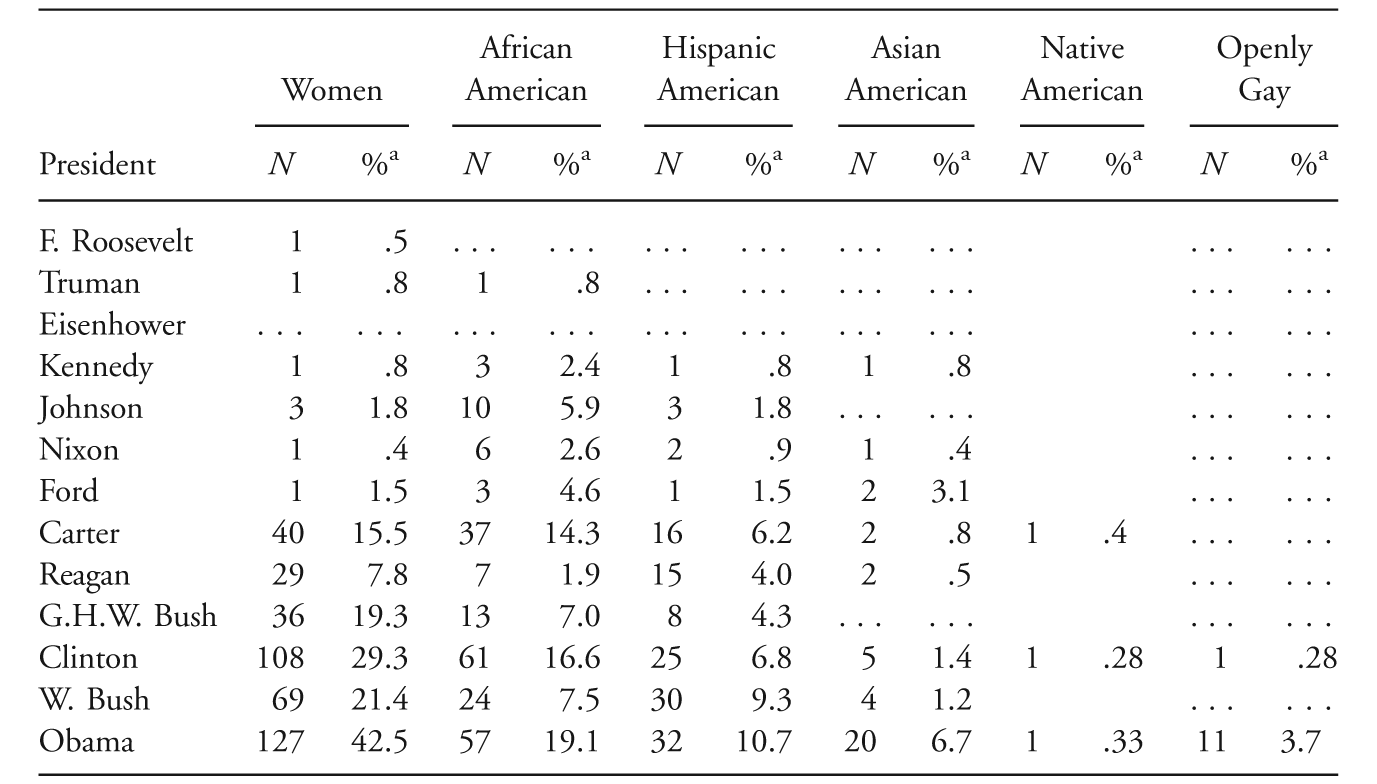
a Percentage of total number of appointees to lifetime judgeships on courts of general jurisdiction (US district courts, US appeals courts, and US Supreme Court).
Another useful evaluation is to compare what Obama had already accomplished by the end of his first term to what new happened in the subsequent 2 years. As of January 1, 2013, 28% of judges in active service were women, an increase of 10.8% from when he took office (table 2). In terms of racial and ethnic diversity, 11.7% of federal judges were African American, 8.2% were Hispanic American, and 2% were AAPI, an increase of 7.7%, 15%, and 112.5%, respectively. Finally, less than 1% of federal judges were openly gay, but this still represents a 200% increase from the start of Obama’s first term. Overall, the percentage of nontraditional judges in active service (when not double counting women who also belong to a racial minority group or who are openly gay) totaled 42.1% at the end of the 112th Congress. This represents a noteworthy 8.6% increase for his first term.
Proportion of Nontraditional Lifetime Judges in Active Service on Courts of General Jurisdiction: January 1, 2013, and January 1, 2015
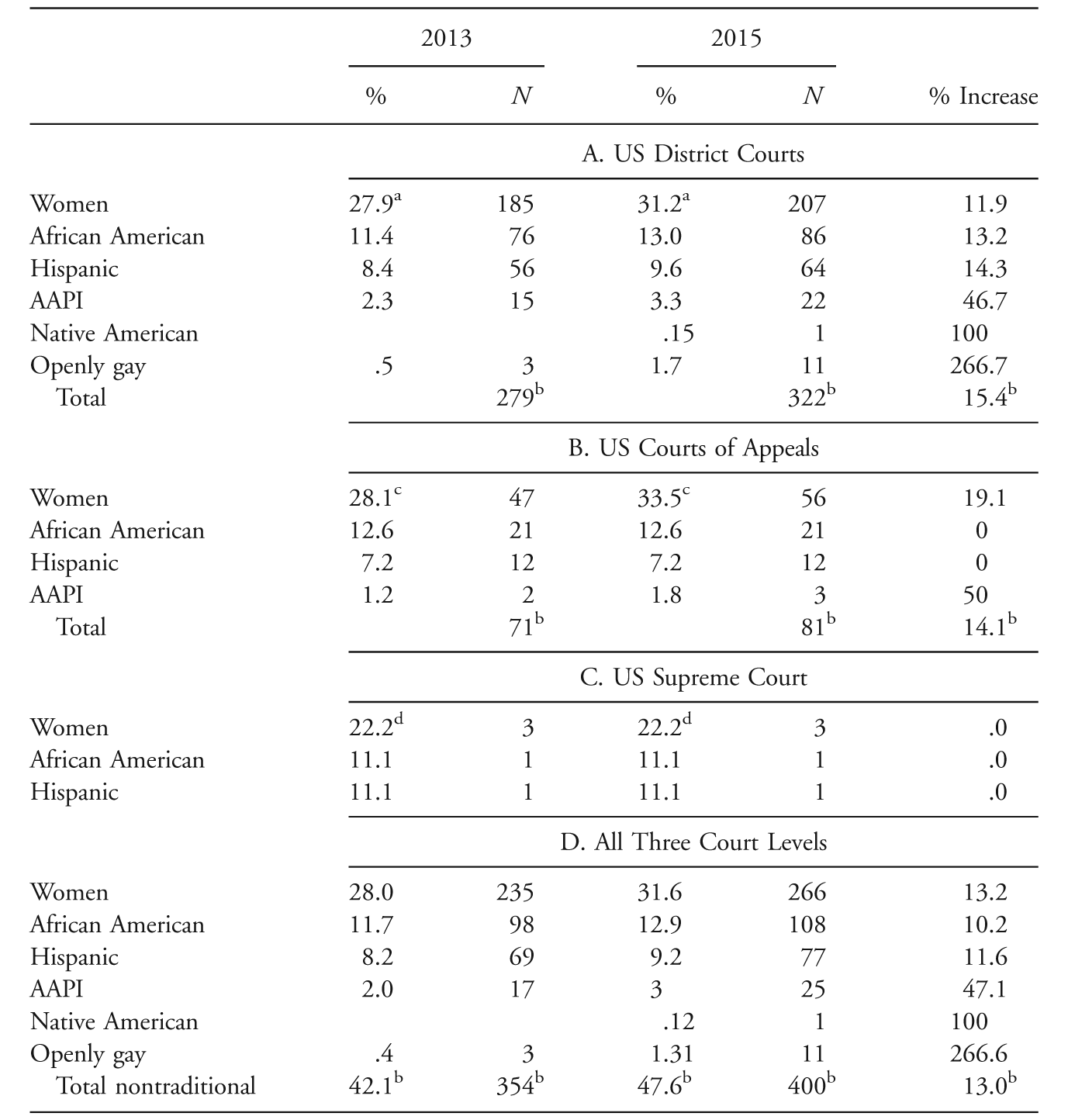
a Out of 664 authorized lifetime positions on the US district courts. Some double and triple counting is inevitable. In 2015, 69 women also were African American, Hispanic, Asian American/Pacific Islander (AAPI), Native American, or openly gay. Additionally, there were five women who fit into two other nontraditional categories. There was also one openly gay African American man and one man who identified as both African American and Hispanic. Both double-counted and triple-counted individuals are included only once for the purposes of calculating total nontraditional judges.
b Totals and percentages do not double count those who were classified in more than one category.
c Out of 167 authorized lifetime positions on the numbered circuits and the US Court of Appeals for the DC Circuit, all courts of general jurisdiction. Some double counting is inevitable. In 2015, 11 women also were either African American, Hispanic, or AAPI.
d Out of nine authorized positions on the US Supreme Court. One woman was also Hispanic.
From our interviews with Christopher Kang, it is clear that he thought of the first-term successes as a benchmark by which they would measure their efforts during the second term. “What we’ve done after the president’s first term is use those statistics as a new frame of reference. … Based on our efforts in the first term, even if there was less diversity in the second-term confirmations, the overall percentages might not change much. We wanted to make sure that we continue to meet the standards we set for ourselves in the first term and not simply rely on those overall figures.”
By all measures they were able to meet their goals, illustrated by the impact Obama’s second set of nominees had on the overall racial and gender diversification of the federal bench: as of January 1, 2015, 47.6% of judges were nontraditional, an increase of 13.0% during the 113th Congress (table 2). When we look at each individual category, the results are even more notable. At the end of the 113th Congress, 31.6% of judges in active service were women, an increase of 13.2% during the first half of his second term. In terms of racial and ethnic diversity, 12.9% of federal judges were African American, 9.2% were Hispanic American, and 3% were AAPI, an increase of 10.2%, 11.6%, and 47.1%, respectively. Finally, just over 1% of federal judges were openly gay, but this still represents a 266% increase during the last 2 years. There is no mistaking that, according to Kang, the administration’s attention to diversity is creating a judiciary “that more closely looks like the population of the country.”Footnote 3
District Courts
These trends hold when examining the district courts separately, where the proportion of nontraditional judges at the end of the 113th Congress is 48.5%—an increase of 15.4% from the preceding term. Every group made gains—women, +11.9%; African Americans, +13.2%; Hispanic Americans, +14.3%; AAPI, +46.7%; Native Americans, +100%; and openly gay individuals, +266.7% from the beginning to the end of the first 2 years of Obama’s second term.Footnote 4
Most obviously, the Obama cohort was able to further diversify the district courts because 63% of his appointees were nontraditional. Also, as we discuss throughout our article, Obama was more successful in getting his nominees confirmed during the 113th Congress. When combined—a larger cohort of judges, of whom the vast majority were nontraditional—the result is a 15.4% increase from the preceding term. One cautionary reminder, however, is that the president can affect bench diversity only if he is able to appoint nontraditional judges to seats previously held by a “traditional” judge—that is, a straight white male. Obama has benefited from comparable constancy in the proportion of vacancies being created by nontraditional judges leaving the bench. During his first term, approximately 42% of vacancies were created by nontraditional judges, and this crept up only slightly to 45% during the 113th Congress. Going forward, Obama’s record over his final 2 years will depend in large part on his continued success in obtaining confirmation of a large and diverse set of appointees to counter what may be an increase in nontraditional judges leaving the bench.Footnote 5
The aggregate increase in diversity is diminished a bit when we look at individual district courts. During the 113th Congress, women fared best as they were appointed to nine district courts in which there previously had been none; that leaves only six in which there has never been a female judge.Footnote 6 African American judges were confirmed to two district courts in which there previously had been none, but there are still 35 district courts (39%) that have never seated an African American judge. Sixty-two courts remain without Hispanic representation (68%) after Obama added only one Hispanic judge to a court in which none had previously served. AAPI judges are present on district courts in only nine states, but President Obama is credited with appointing the “first” AAPI jurist to district courts in two of those nine during the 113th Congress.
When considering the totality of his appointments, at the start of Obama’s presidency, 14 district courts had never seated a nontraditional judge; at the end of 6 years, this number dropped to four.Footnote 7 Furthermore, it is worth noting that many of the district courts that have remained all white straight male are the smallest courts in the nation and thus provide fewer appointment opportunities. However, if these opportunities arise, it is likely that Obama will attempt to offer the “first” nomination.
Courts of Appeals
Largely because the filibuster rules change removed the logjam of President Obama’s nominees, he was able to secure confirmation for 20 out of 22 nominees, of whom 14 (70%) were nontraditional. The new cohort certainly added to the aggregate diversification of the appeals courts: when not double counting women who also belong to a racial minority group or are openly gay, the proportion of nontraditional judges on the courts of appeals is 48.5%, an increase of 14.1% (or 10 seats) over Obama’s first term (table 2). During the 113th Congress, the majority of the president’s circuit judge appointees were women. This surpasses the previous benchmark of 35% female circuit judges in a single term, also set by Obama. However, in contrast to the district courts, the net gain of diverse seats in the courts of appeals came almost exclusively from the addition of women.
Over the past 2 years no Hispanic appeals court judge was confirmed to the bench and only one AAPI and one African American judge were confirmed. With the departure of Judge Andre Davis, one of President Obama’s first appointees to the Fourth Circuit, the net gain for African Americans is zero. Currently, there are no Native American or openly gay appeals court judges, nor have there ever been.Footnote 8
Obama’s appellate appointments during the 113th Congress led to a majority of nontraditional judges on two additional circuits—the Eleventh and DC—which, when added to the Second, Fourth, and Sixth, totals five circuits in which the majority of judges are nontraditional. This exceeds what W. Bush accomplished during his entire presidency. Gender diversity increased on seven courts of appeals (the Third, Fourth, Eighth, Ninth, Tenth, Eleventh, and DC Circuits) and decreased on one (the Fifth Circuit). Presently, all of the geographic circuits have at least two sitting female judges. The Ninth Circuit boasts the most female judges in absolute numbers (10), but the Sixth Circuit lays claim to more women proportionately (46%).Footnote 9
Less significantly, racial and ethnic diversity increased on only the DC Circuit and decreased on the Fourth. Owing to Obama’s appointments in his last term, every geographic circuit now has seated an African American; however, Hispanic judges have yet to serve on four of the 12 circuit courts of general jurisdiction (the Sixth, Seventh, Eighth, and DC Circuits). AAPI jurists currently sit on the Second, Ninth, and DC Circuit Courts.
Table 3 aggregates district courts by circuit. The table also lists the percentage of women judges in each district and compares the percentage of African Americans, Hispanics, and AAPI to the percentage of each group in the circuit’s general population, since we expect states with more diverse populations to also have more diverse courts.Footnote 10 Women have the greatest presence on district courts within the Second, Eleventh, and DC Circuits and the lowest within the Sixth and Third Circuits.Footnote 11 The Sixth and Seventh Circuits saw the largest percentage increase (40%) with a net gain of four seats each during the 113th Congress. Notably, the number of women serving on district courts in the Fourth Circuit, which includes Maryland, North Carolina, Virginia, West Virginia, and South Carolina, has doubled during Obama’s first 6 years—from eight to 16. Similarly, there are 50% more women serving on district courts in the First Circuit now than when Obama took office.
Diversity on the District Courts, January 1, 2015: Active Judges Aggregated by Circuit
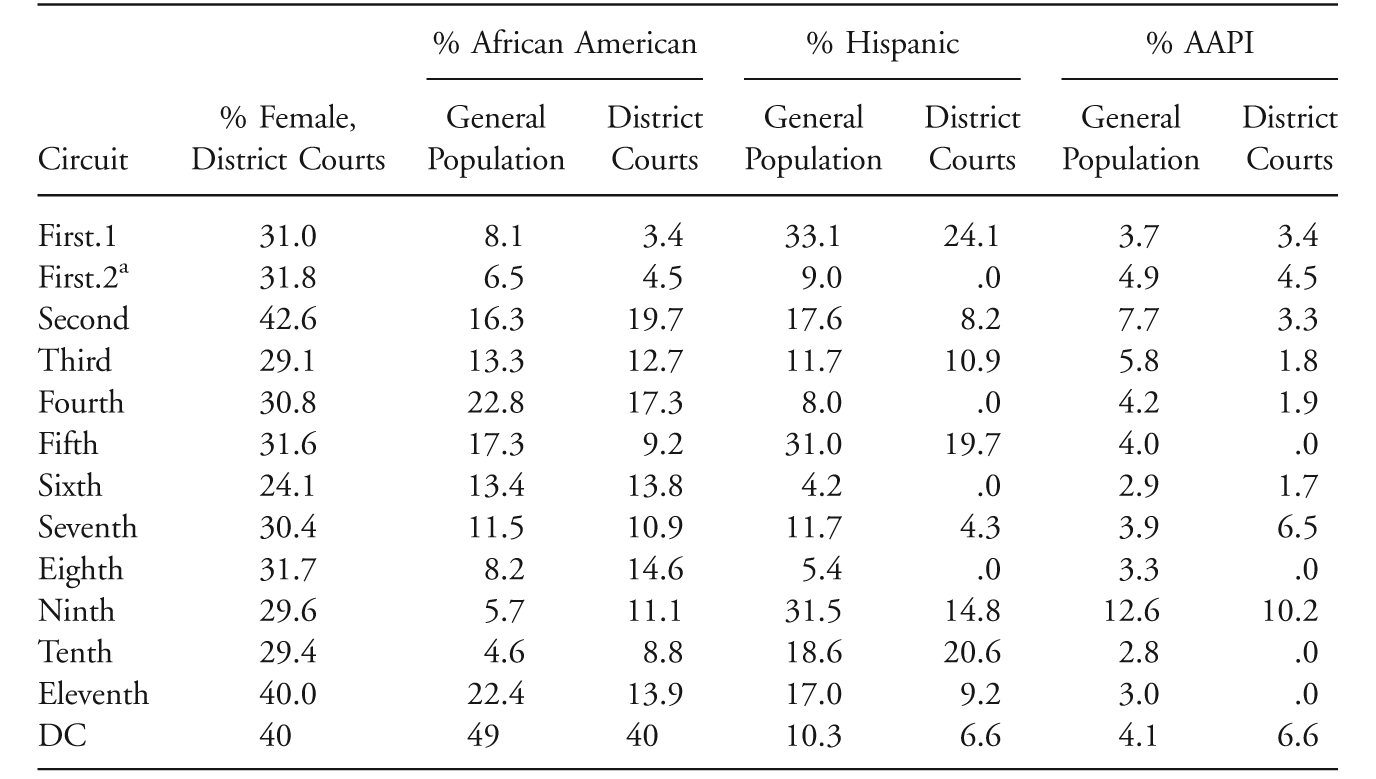
Note.—Data on the 2014 general population are compiled from the US Census Bureau. Note that according to the standards set by the Office of Management and Budget and implemented by the Census Bureau, race and Hispanic origin (ethnicity) are separate and distinct concepts, and when collecting these data via self-identification, two different questions are used.
a Excluding Puerto Rico.
The highest concentration of African American district judges is in the Second Circuit, which benefited from the addition of four new African American appointees. The Fourth Circuit has the second-highest percentage, and it also is the circuit with the largest population of African Americans.Footnote 12 However, comparing overall representation on the bench to the general population, only five circuits have African American representation on the courts equal to or greater than their representation in the population (the Second, Sixth, Eighth, Ninth, and Tenth Circuits). The largest “overrepresentation” occurs on district courts within the Ninth Circuit, where 11.1% of the active district court judges are African American compared to 5.7% of the population. Conversely, there are seven circuits in which African Americans are underrepresented at the trial level, with the largest disparities occurring in the most southern circuits (the Fifth and Eleventh Circuits)
Underrepresentation is even more acute for Hispanic Americans, despite 43% population growth over the past decade according to the latest census; the states within the First, Fourth, Sixth, and Eighth Circuits have no Hispanic district judges, and relative to their representation in the population, the Seventh and Ninth Circuits have very few. The highest congruence between population and judicial representation is in the Third and Tenth Circuits.
Owing to Obama’s historic record of appointing AAPI judges to the bench, they are present on district courts within eight circuits, of which he appointed the first AAPI judge on five. This underscores the fact that Obama is not simply appointing AAPI jurists to district courts in states where they are already represented, that is, New York and California.
There are no AAPI judges on districts within the Fifth, Eighth, Tenth, and Eleventh Circuits, despite having a very large (and growing) presence in Texas and Florida, according to the US Census Bureau.Footnote 13 District court representation roughly equals that of the general population in the First and Ninth Circuits, and it is not particularly surprising that the highest concentration of AAPI district judges is in the Ninth Circuit—10.2%—since it also is the circuit with the largest population of AAPI (12.6%). Finally, with the confirmation of Judge Derrick Kahala Watson, the US District Court for the District of Hawaii is the first federal court in US history with a majority of AAPI judges.
Experiential Diversity
While the White House received nothing but accolades from liberal advocacy groups for the focus on nominating nontraditional judges to the bench, some advocacy groups were not as kind about what they perceived to be an overrepresentation of prosecutors and corporate lawyers. This criticism appears to have diminished a bit over the past 2 years, possibly because of “experiential diversity” becoming a more important factor in the administration’s judicial selection process. One advocate from a left-leaning group emphasized this point. “We have been singularly focused on this question. A minuscule number of judges have been public interest lawyers. … I do believe the White House listened. The White House started tracking experiential diversity.” Christopher Kang agreed, explaining, “Just as the judiciary benefits from people with different experiences, different backgrounds, there are people who have experience in a wide range of the legal profession. So what we’re continuing to try to do is encourage people who have different legal experience to think about applying to be a federal judge.”
This point was stressed by Elana Tyrangiel, principal deputy assistant attorney general in the Office of Legal Policy in the Department of Justice. “As part of our vet process, part of what we have a window into is some of the diversity of the people going to the bench, including experiential diversity, and that is something that we note and is part of the discussion” (interview, January 8, 2015). Michael Zubrensky added, “The White House always asks senators for three candidates for every judicial vacancy. That’s a practice that goes back in time. To the extent that there’s a choice among names, the White House will factor in experiential diversity.” This last point emphasizes that, especially at the district court level, the White House is dependent on home state senators to generate a list of names from which the administration selects the final candidate. In response to some of the criticisms from left-leaning advocates about the lack of professional diversity, a staff aide to a Judiciary Committee Democrat made this suggestion: “Groups who complain about that underestimate the role of the home state senators in suggesting nominees. They should be directing that criticism at the senators, not the president.”
Whether or not the White House or senators should be held responsible for the perceived lack of attention to professional diversity earlier in Obama’s tenure, clearly the White House is focused on getting the message out that this is now on its radar screen. Most telling is a comparison of two infographics from the White House website. In the first, from September 2013, there is very little attention paid to experiential diversity, focusing mainly on gender, racial, and ethnic diversity. However, in the second, published in December 2014, an entire section is devoted to “experiential diversity,” which highlights the fact that “eighty-nine percent of President Obama’s judges have worked outside of private law firms,” among other statistics.
While the administration did indeed ramp up its public annotation of experiential diversity, many of our interviewees emphasized the complexity of “measuring” this kind of diversity as a possible reason why it was perceived as less important. Christopher Kang explained, “It’s very easy for me to rattle off the statistics for women and minorities, and openly gay candidates who have become judges. It’s a little bit harder to talk about experiential diversity because one lawyer can fall into four or five different categories, so counting them becomes harder to quantify. But that is—and has been—an incredibly important part of how we think about the judiciary.” Regardless of the difficulty in quantifying this kind of diversity, the administration acknowledges that it is incumbent on it to target a pool of candidates with wide-ranging experiences to ensure experiential diversity is reflected on the bench.
Concluding Thoughts
It is clear that the administration has enjoyed great success in reshaping the judiciary to better reflect the populace in terms of race, gender, and sexual orientation. As a Democratic senatorial aide noted, “You look at these statistics, it’s really trailblazing. They’ve done an amazing job in diversifying the bench. It will pay dividends down the road. Our country is changing and people are going to be able to walk into a courtroom and see a judge who looks like them. It’s really been a sea change.” The administration and left-leaning advocates alike see this as a long-term, as well as short-term, victory, believing that their making diversification of the judiciary such a public priority will affect the way future presidents view judicial selection. Indeed, each side seems optimistic that it will be easier going forward now that many of the barriers have been broken. As Marge Baker of PFWA observed, “There has been a qualitative change. The expectations are different. It would not be an issue for a Republican president to nominate an openly gay nominee, which would not have been the case before.”
However, not all our interviewees viewed the focus on diversity as a positive. A representative from a conservative advocacy group lamented that a Republican president may feel pressure to include diversity among his criteria in judicial selection. “I think this country is only getting more politically correct, not less, so there’s going to be as much or more pressure on the next president. The next president is going to want to have his own first, there won’t be a lot left, but they’ll figure out something.”
It’s not simply the pressure to consider diversity that seems to bother the right. From the same advocate:
Obama has made diversity a high priority. I often say, unlike in something like admissions, it’s impossible to know … to what degree he’s lowering the standard. Now you might say that he’s not lowering the standard at all, but of course you are. The priority that you can put on anything can only add up to 100%. … If you put more priority on what school they went to, you can put less on what they’ve accomplished as a lawyer. If you put more on their gender, you can put less on [something else]. So if a huge part of that 100% is used up on sexual orientation, color and gender then you can’t put as much on merit. So, I think it’s inevitable that there’s been some lowering of standards to achieve that. … So the more anxious you are to pick an African American, the less strength you can put on other things. So it’s inevitable. It’s simple logic. You’re not supposed to say it, but it’s simple logic. I’m not saying that these people are not qualified. I’m saying there’s got to be some lowering of standards. And I don’t begin to know how big that is.
Naturally the administration does not share this view. In many of our discussions at the Department of Justice, the Senate Judiciary Committee, and the Office of Legal Policy, each emphasized that they had no difficulty finding qualified nontraditional candidates. Christopher Kang underscored this point. “There is a growing diversity of the legal profession. There are so many more qualified ‘nontraditional’ lawyers out there who are at that level now of becoming good candidates to be judges.”
Partisan Makeup of the Bench
It took 6 years and a near-record-setting number of district court appointments, but President Obama was finally able to shift the overall partisan balance on the lower federal courts in the Democrats’ favor. At the start of the 113th Congress the proportion of authorized seats on lower federal courts held by judges appointed by Democratic presidents was 44.1%. It had increased to 53.3% as the 113th ended (see tables 4 and 5). When vacancies are excluded, the overall percentage increases to 55.2%. This is noteworthy when one considers that when Bill Clinton left office after 8 years, despite having appointed the largest cohort of district judges of any president and the second-largest complement of appellate judges (after Reagan), only 49% of all active lower court judges were appointed by Democrats. Another reference point: at this same point in W. Bush’s second term, he had increased the proportion of Republican appointees by only 1.5% (51.1 to 52.6).
Makeup of Federal Bench by Appointing President, January 1, 2015 (Lifetime Positions on Lower Courts of General Jurisdiction)

Note.—Percentages were rounded to 100%.
a Does not include temporary district court judgeships.
Judgeships by Party (%)
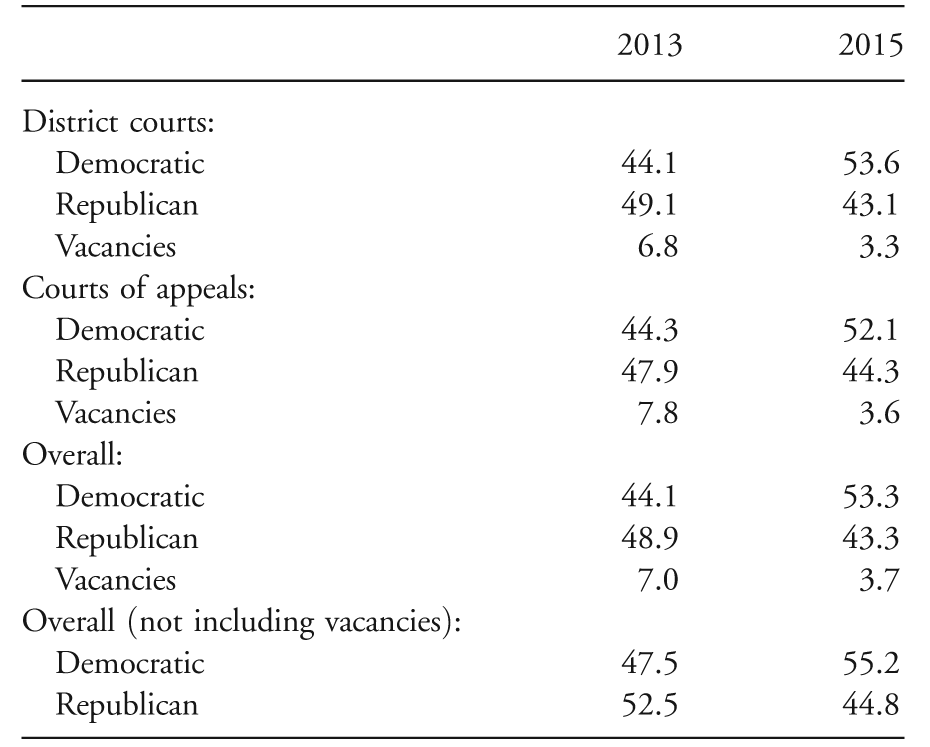
While it is instructive to examine the overall partisan change on lower courts, we also separately analyze the district courts and courts of appeals, as they tell two somewhat different stories.
District Courts
Owing primarily to the administration’s ability to fill a large number of the vacancies left at the end of the 112th Congress, Obama was able to increase the proportion of authorized seats on district courts held by Democratic appointees by 9.5%, tipping the partisan balance from majority Republican to majority Democratic. As shown in table 5, at the beginning of the 113th Congress, Democratic appointees held 44.1% of the total authorized positions for the district courts, and by the end, the percentage had increased to 53.6%; when not including vacancies the proportion grows to 55.5%. Obama’s imprint on the district courts during the 113th Congress extends the trend we saw during the 112th when the proportion increased by 6.8%.
During the 113th Congress, Obama obtained confirmation of 109 district court judges out of 123 nominations (88.6%) from 131 appointment opportunities, bringing the total confirmations for his first 6 years in office to 250.Footnote 14 Obama appointees accounted for 37.0% of federal district judges in active service at the end of the 113th.Footnote 15
As we discussed earlier, Obama’s successes at the district court level during the 113th Congress can be explained in part by the limited bipartisan rules reform agreed to in January 2013, which offered an expedited path to confirmation for district courts by allowing district court nominees to be confirmed with only a fraction of precious floor time. Additionally, Obama was able to fill a majority of the 45 vacancies left at the end of the 112th Congress.Footnote 16 At his 6-year mark, only 22 district court vacancies remained. Finally, while during the 111th and 112th Congresses a large majority—nearly 71%—of “new” vacancies were created by Democratic appointees leaving active service, this trend slowed during the 113th.Footnote 17 Of the 74 vacancies that occurred between 2013 and 2014, only 53% were from Democratic appointees leaving active service. Since the president’s ability to alter the partisan makeup of the bench is contingent on his ability to replace appointees of the other party with his own, the slowdown of Democratic departures from the bench helped Obama significantly.
Also notable is that of the 86 judges who left active service on the federal district courts during the 113th Congress, 41 (47.4%) were Clinton appointees. This represents the “generational effect,” which theorizes that the overall complement of departing judges in any given administration is dominated by the appointees of a specific predecessor of the same party as the sitting president. Carter appointees departed during Clinton’s administration, Reagan appointees departed during W. Bush’s 8 years, and now we see Clinton appointees leaving in abundance. In fact, nearly 58% of active Clinton judges left the district court during Obama’s first 6 years in office.
As Obama’s second term winds down, maintaining the Democratic edge in appointments into the future will depend on two things: (1) continued partisan equilibrium of judges leaving active service, which may be difficult given that Clinton appointees still make up 16% of active service judges; and (2) Obama’s ability to appoint a critical mass of district court judges during his last 2 years. However, considering the current state of the confirmation process—as we write at the end of January 2016, only 11 district court nominees have been confirmed and there are 59 vacancies—chances are President Obama will not be able to shift the partisan balance in the district courts much further during the 114th Congress.
Courts of Appeals
Turning our attention to the courts of appeals reveals a somewhat different picture. In terms of confirmations, Obama was significantly more successful during the first half of his second term than in previous years; he secured confirmation of 20 out of 22 nominations (90.9%) compared to 12 out of 21 (57.1%) and 15 out of 22 nominations (68.2%) during the 112th and 111th, respectively. This proportion of confirmations was at a level not seen for at least 20 years and increases his overall confirmation rate to 72.3% for the first 6 years.Footnote 18 Not surprisingly given this record achievement, Obama was finally able to attain a Democratic majority on the courts of appeals: 44.3% of authorized seats on the courts of appeals were held by judges appointed by Democratic presidents at the start of Obama’s second term, and this number increased to 52.1% at the end of his 6 years in office (+7.8%). Moreover, taking into account only active judges, the Democratic advantage is even larger: 54.0% of active judges are Democratic appointees.
In a comparison of district courts to courts of appeals, a difference emerges when we analyze the size of the Obama cohort relative to that of other presidents. Whereas 37% of active service district judges were appointed by Obama, his appointees accounted for only 27.5% of the federal courts of appeals judges in active service at the end of the 113th, still lagging the W. Bush cohort of 30.5%.
However, and most importantly, the president can affect the balance on the bench only if he is able to appoint judges to seats previously held by the opposing party or newly authorized seats. This is where Obama’s confirmations to the appeals court truly make their mark. Of his 47 total appointments, 25 were to seats in which the incumbent was appointed by a Republican and one was to a new seat (55.3%). Also, similarly to the district courts, we saw partisan equity in departures from the bench. At the courts of appeals, 53.8% of those who left active service were appointed by Democrats, which is almost identical to the 53.5% we saw at the district court level. This means that going forward, Obama does not have to play as much “catch-up.” Indeed, Obama may be able to more greatly affect the overall partisan makeup of the bench because, at the court of appeals level, the Clinton cohort seems to be retiring and resigning at a far lower rate. While the vacancies created at the district court level were disproportionately attributed to Clinton judges leaving the bench, here we see an equal divide: two judges left active service from each of the previous administrations—Carter, Reagan, H. W. Bush, Clinton, and W. Bush.
In total, over his first 6 years, Obama had 80 appointment opportunities to the courts of appeals for which he submitted 65 nominations. He succeeded in getting 47 nominees confirmed (59%), which is slightly less than the 250 of 384 opportunities at the district court level (65%).
Another way to evaluate the impact of a president’s appointees on the partisan makeup at the appellate level is to aggregate by circuit and examine how many courts have Republican-appointed majorities or vice versa.Footnote 19 Analyzing Obama’s first 6 years in this manner confirms the considerable impact of his appointees at the appellate level. At the start of Obama’s presidency, nine of the 12 geographical circuits had Republican-appointed majorities, one had a Democratic-appointed majority, and two were evenly divided.Footnote 20 After his first 6 years in office, however, only four courts had Republican majorities and eight had Democratic majorities.Footnote 21 That means that seven courts of appeals on which Republican appointees had a majority or were evenly split at the start of his term now have Democratic-appointed majorities—the First, Second, Third, Fourth, Tenth, Eleventh, and DC.Footnote 22 The First and Tenth Circuits shifted during the 113th Congress as we had predicted they would: recent vacancies created by republican judges leaving active service combined with the Obama administration’s increased promptness in offering nominees almost guaranteed the swing, but the DC circuit was not as predictable given the long history of entrenched partisan warfare over nominations to the court. However, as detailed in the text, once the dust settled after the filibuster rules change, three Obama appointees were confirmed to the DC Circuit, guaranteeing a Democratic majority on that court well into the future.
Besides shifting the partisan balance on courts of appeals, Obama also made significant strides in decreasing the number of courts on which Republicans, particularly W. Bush nominees, constitute a supermajority. When he entered office, six of the 12 geographical circuits had Republican supermajorities, where Republican appointees occupied at least twice the number of seats as Democratic appointees.Footnote 23 At the end of 6 years, only three remained—the Fifth, Seventh, and Eighth Circuits.
Besides detailing the partisan alignment of active judges, the data in table 4 also underscore the impact of judges opting to take senior status, since the number of senior judges is more than half the number of active judges on each court level. While senior judges have reduced caseloads, they nonetheless are a critical component of the judiciary, which is especially true in an era when the federal judiciary is rarely fully staffed yet the courts are faced with heavy (and growing) caseloads. Republican appointees make up a clear majority of senior judges—54% and 64% on the district courts and courts of appeals, respectively—and certainly the strong Republican majority has an impact on judicial decision making. Even with the increase in Clinton judges taking senior status, especially at the district court level, in the absence of a dramatic rise in the number of full retirements by senior judges, Republicans will have the numerical advantage for many years to come.
One final measure of Obama’s impact on the partisan makeup of the bench solidifies our conclusion that his appointments during the 113th Congress were especially consequential. Combining both court levels and including both active and senior judges, 50.6% of all judges currently hearing cases were appointed by Democratic presidents.
Looking Ahead
With the loss of Democratic Party control of the Senate in the 2014 congressional elections, the question at the beginning of the 114th Congress (and President Obama’s last 2 years in office) was how the president’s legacy would be affected. Certainly, there was a sense that the legacy was already essentially finished because with Republican control of the Senate, Obama nominees would make little headway toward confirmation. This expectation was reinforced when Senate Majority Leader Mitch McConnell revealed in an interview that he did not anticipate the Senate confirming either new circuit court nominees or a Supreme Court nominee were a vacancy to arise.Footnote 24
In late July 2015, as the Senate was winding down its work in anticipation of the August recess, Democratic Senator Charles Schumer took to the Senate floor to complain about the excruciatingly slow rate of judicial confirmations since the start of the 114th Congress. He noted that “more than a half year into this new Congress, the Republican leadership has scheduled votes on only five federal judges.”Footnote 25 Republican Senate Judiciary Committee Chair Chuck Grassley countered that the lame-duck confirmations in the 113th should be considered part of the 114th’s record. He argued, “had we not confirmed those 11 judicial nominees during the lame duck last year, we’d be roughly at the same pace we were for judicial confirmations this year compared to 2007.” And Grassley added, “put that in your pipe and smoke it.”
Interestingly, during the fall of 2008, before the presidential election, Senate Judiciary Committee Chair Patrick Leahy cleared 10 Bush district court nominees who were confirmed despite misgivings by some Democrats anticipating that an Obama victory would have preferred leaving those positions vacant so that the new president would fill them. If Republicans McConnell and Grassley continue to obstruct and delay Obama nominees with the result that only a relative handful are confirmed during the 114th Congress, Democrats can be expected to respond in kind once the shoe is on the other foot. As of this writing (January 25, 2016), the confirmation record of the 114th Congress looks grim. There have been only 11 district court judges confirmed and one judge to the appeals courts of general jurisdiction (there was also one confirmation to the US Court of Appeals for the Federal Circuit, a court of specialized jurisdiction). This is the lowest confirmation rate since 1947, when Harry Truman faced a Republican Senate and only 10 judges were confirmed (Goldman Reference Goldman1997, 81). As a result, the vacancy rate on the lower federal courts has markedly increased—in contrast to the decreases during the last 2 years of the Clinton and W. Bush presidencies when the Senate was not controlled by the party of the president.Footnote 26
Filling a Supreme Court vacancy presents a very special case. As long as Republicans believe that they will elect a Republican president in 2016, there will be little incentive to confirm an Obama nominee to fill a Supreme Court vacancy should one occur. Nevertheless, media attention would be focused on the Court, and were President Obama to nominate a particularly attractive individual, there might be considerable pressure placed on Senators McConnell and Grassley to allow the nomination to proceed and to come to an up or down vote on the floor of the Senate. For example, it is not hard to visualize the president nominating Sri Srinivasan to fill a vacancy. Srinivasan, a moderate and a person of color, would be the first Asian American to be named to the Court. He was unanimously confirmed by the Senate to the DC Circuit in 2013; thus it would be difficult for Republicans to assert principled objections to Srinivasan. There are other potential nominees, of course, who one would think would be acceptable to all but the most extreme ideologues and partisans in the Senate. Of course, there is no expected vacancy as none of the current membership of the Court has given any indication that stepping down is under consideration.
How then can we sum up Obama’s judicial legacy thus far? As suggested in both parts of this article, the president’s judicial appointments legacy has already been established. Will he be able to improve on it during the life of the 114th Congress? Thus far, the evidence suggests only marginally at best. Will Republican hardball on judicial confirmations return to haunt them? If the past is any indication, the vicious cycle will continue, underscoring the old adage that what goes around comes around.