INTRODUCTION
As recreational uses of the countryside continue to expand in urbanized societies (Anderson & Keith Reference Anderson and Keith1980; Boyle & Samson Reference Boyle and Samson1985; Hill et al. Reference Hill, Hockin, Price, Tucker, Morris and Treweek1997; Ikuta & Blumstein Reference Ikuta and Blumstein2003; Stankovich & Blumstein Reference Stankovich and Blumstein2005), there is a need to improve knowledge of factors driving human disturbance of wildlife (Carney & Sydeman Reference Carney and Sydeman1999; Fernández-Juridic et al. Reference Fernández-Juridic, Vaca and Schroeder2004; Blumstein Reference Blumstein2006).
Typically wildlife managers use alert distance (AD, i.e. the distance at which an animal begins to exhibit alert behaviours to an approaching human) (Fernández-Juridic et al. Reference Fernández-Juridic, Jiménez and Lucas2001; Stankovich & Coss Reference Stankovich and Coss2006) or flight initiation distance (FID, i.e. the distance at which an individual flees from an approaching human) to determine species-specific critical thresholds of disturbance (Burger & Gochfeld Reference Burger and Gochfeld1991; Blumstein et al. Reference Blumstein, Anthony, Harcourt and Ross2003; Cooper et al. Reference Cooper, Pérez-Mellado and Hawlena2006; Goss-Custard et al. Reference Goss-Custard, Triplet, Sueur and West2006) and hence to establish set-back distances to minimize human disturbance on wildlife (Bonenfart & Kramer Reference Bonenfant and Kramer1996; Yorio & Quintana Reference Yorio and Quintana1996; Blumstein Reference Blumstein2003; Blumstein et al. Reference Blumstein, Anthony, Harcourt and Ross2003; Finney et al. Reference Finney, Pearce-Higgins and Yalden2005; Geist et al. Reference Geist, Liao, Libby and Blumstein2005). FID usually ranges between 44% and 50% of the alert distance, according to the ‘fixed-slope rule’ (Cardenas et al. Reference Cardenas, Shen, Zung and Blumstein2005; Gulbransen et al. Reference Gulbransen, Segrist, del Castillo and Blumstein2006).
Here we specifically analyse some key determinants of the FID of a large ground-nesting gull species (the yellow-legged gull Larus michahellis). We aim to explore the weight of two variables which can be actively managed, with the goal of making wildlife observation and conservation more compatible. Hence, we are not aiming to investigate all determinants of FID, but only those which can be controlled by management.
METHODS
Study sites
We visited 15 colonies of yellow-legged gull with a variable number of visitors and density of breeding pairs. Eleven colonies were located along the Spanish and French Mediterranean coasts (Cap Caveaux, Fontagne, Plane Island and Congloué Island [Marseille], Medes Island and Ebro Delta [Catalonia], Columbretes Island, Benidorm Island and Penyal d'Ifach [Valencia], Grosa Island [Murcia] and Dragonera Island [Majorca]), two were located along the Iberian Atlantic (Cies and Ons) and two were located on the Mediterranean coast of northern Africa (Congreso and Rey, Chafarinas archipelago). In three colonies (Cies, Ons and Columbretes) we were able to distinguish between zones visited by people versus reserve zones, and these were treated as separate colonies (distinguished as ‘visited’ or ‘unvisited’).
Response variable
We recorded FID by walking along a straight line towards the closest gull or group of gulls, standing within its breeding colony and randomly approaching a target gull, until it was flushed. Gulls taking flight as a consequence of the flushing of the gull previously measured were not recorded to avoid lack of independence in the data (Roberts & Evans Reference Roberts and Evans1993). We then repeated the process during a variable time span (range 15–120 minutes) obtaining a number of samples per colony strongly related to the size of the colony (Pearson's r = 0.69; 95%CI = 0.34–0.88). We analysed a total of 1081 distance measurements for the whole set of colonies. As our aim was to measure the variable influence of gull density and number of visitors on gull disturbance, we selected the mean FID of each colony as the response variable, after checking for normality of FID distribution. Hence, mean FID was a reliable descriptor of the central tendency of the distribution. Starting distance (Blumstein Reference Blumstein2003; Cooper Reference Cooper2005) was not recorded because the bias this can introduce is negligible for our purposes of comparing average FIDs among colonies with different previous exposure to visitors. Approaches towards gulls were made at constant speed and with a constant number of researchers (mode = 2; range = 2–4), since FID is known to vary depending on approaching velocity and number of people (Geist et al. Reference Geist, Liao, Libby and Blumstein2005; William Reference William2006; but see Bonenfant & Kramer Reference Bonenfant and Kramer1996), although again these biases are irrelevant for the purposes of our study. We used an infrared telemeter (LRM 900 Scan) to record the distance between observers and gulls. Since targeting the gull at the precise moment of taking off to estimate FID was not feasible, we pointed with the light beam to the closest reference location (for example a rock or vegetation) from where gulls took off. This way we managed to obtain a reliable estimate of FID. Distances lower than 10 m were counted by means of paces, because the apparatus could not provide readings for objects located <10 m apart. A FID values of 0 was assigned to gulls approached to <1 m. FID was measured instead of alert distance because behavioural clues are more clear-cut for FID. Nevertheless, FIDs can easily be converted to alert distances.
Explanatory variables
The mean number of visitors and number of breeding gull pairs for each island was obtained from unpublished reports of regional governments, when data of our own were unavailable. Most colonies were visited during the breeding season at the same breeding stage (i.e. birds incubating eggs) to prevent any possible influence of breeding stage on FID, except for the four French colonies which were visited late in the season (16–28 June). However we pooled all colonies together because of small sample size to detect relevant differences in FID in relation to breeding stage. We considered the mean number of human visitors during the months of April and May in Mediterranean colonies and the mean number of visitors in May and June in Atlantic colonies, since breeding is delayed there in relation to the Mediterranean colonies. When an island was not visited regularly by people, other than occasional researchers, we entered two in our data matrix as the number of visitors for that colony. Inclusion of a low value number was appropriate for our analytical design and prevents zero inflation in the data set, which may affect data analysis. Density was calculated as the number of breeding pairs divided by the surface area occupied by the colony.
Statistical analysis
To analyse the influence of number of visitors and gull density on FID, we modelled the mean values of the FID by means of a general linear model with number of visitors, and gull density as explanatory variables. Mean FID and density were square rooted and number of visitors log transformed to achieve a better fit of the linear model. Parameters were estimated both by means of maximum likelihood and Bayesian inference. The precision of the estimates was assessed by means of its 95% confidence intervals and 95% credible intervals, respectively, as was its statistical significance by checking whether the value 0 was contained within the intervals.
RESULTS
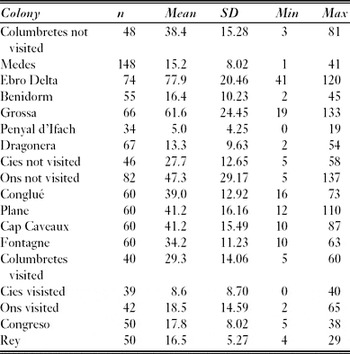
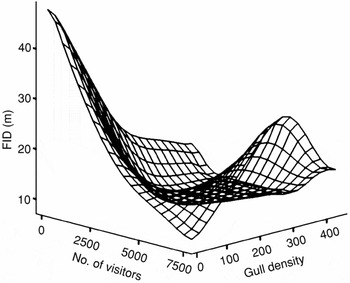
FID varied in magnitude among colonies (Table 1). The lowest FID values were reached in colonies with high number of visitors and low densities of gulls (for example Cíes visited, Penyal d'Ifach, Dragonera, Ons visited and Benidorm), followed by colonies with almost no human frequentation but high gull densities (Medes, Rey and Congreso) (Fig. 1). The largest FIDs occurred in colonies with almost no human visitation and low gull densities (Ebro Delta). Colonies with few visitors and intermediate gull densities had higher FIDs (for example the Marseille islands).
Mean, standard deviation, range and sample size of the flight initiation distance of each study colony of the yellow-legged gull Larus michahellis.

Relationship of FID to number of human visitors and breeding gull density.

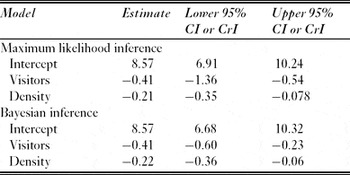
Linear modelling showed an inverse relationship between FID and both density and number of visitors, the latter having greater weight than the former on mean FID (Table 2). Results were similar regardless of the inferential method used to obtain parameter estimates. Both explanatory variables were statistically significant but the level of uncertainty differed between parameters. Increasing the number of visitors by 100 tended to reduce FID by 60 m, however it was necessary to increase gull density by 100 units for FID to decrease by 40 m. The linear model with the two explanatory variables of management interest explained c. 65% of the overall variance in FID (r2 = 0.64; adjusted r2 = 0.59).
Results of general linear model of mean flight initiation distance as a function of breeding gull density and number of human visitors using maximum likelihood (CI = confidence interval) and Bayesian inference (CrI = credible interval).

DISCUSSION
FID as a useful metric to measure disturbance sensitivity in ground-nesting seabirdss
The utility of FID as a measure of sensitivity to disturbance has been much discussed (Fowler Reference Fowler1999; Beale & Monaghan Reference Beale and Monaghan2004). It is well known that birds from isolated islands lose their antipredatory behaviour and do not flee from predators or humans (Blumstein & Daniel Reference Blumstein and Daniel2005). Nevertheless, penguins become stressed when faced with human visitors (Ellemberg et al. Reference Ellemberg, Mattern, Seddon and Jorquera2006) and stressed birds have reduced breeding success.Cliff-nesting seabirds, which rely on the security of their nesting habitat also do not flee from human visitors but this behaviour is not true habituation and cliff-nesting seabirds pay a reproductive cost from human disturbance (Beale & Monaghan Reference Beale and Monaghan2004). In contrast, in ground-nesting gulls, which have not lost their anti-predatory mechanisms, the FID is a reliable metric of sensitivity to disturbance. Gill et al. (Reference Gill, Norris and Sutherland2001) suggested that flying away when faced with human presence does not necessarily represent a response to disturbance, but only a reflection of body condition or availability of places to move to. The fact that yellow-legged gulls were flushed at shorter distances when breeding density was high did not in our view reflect their not having an alternative place to go (they could just keep flying over the colony) but a response to the risk of having their nests predated by conspecifics. According to optimal escape theory, the FID results from the balance between the costs of staying and the costs of fleeing (López Reference López2000; Cooper Reference Cooper2003; Cooper et al. Reference Cooper, Pérez-Mellado, Baird, Baird, Caldwell and Bit2003). We think that in dense colonies the risk of predation by conspecifics may overcome the assessment of risk by the incoming predation-free predators and hence FIDs become very small (see Anderson & Keith Reference Anderson and Keith1980; Carney & Sydeman Reference Carney and Sydeman1999). In fact, intense conspecific predation on chicks may occur among large ground-nesting gulls, after nests have been unattended because of research activity in colonies (A. Martínez-Abraín et al., unpublished data 2003), especially if gulls are food stressed.
Management applications
Despite retaining their antipredatory mechanisms, yellow-legged gulls showed a marked tendency to habituate rapidly to human visitors, since FIDs decreased with increasing number of visitors, as in other ground-nesting gull species outside breeding colonies (Webb & Blumstein Reference Webb and Blumstein2005). Managers in charge of ground-nesting gull colonies with large numbers of visitors should optimally limit human visitation to those areas of the colony with low densities of breeding gulls to minimize disturbance and facilitate observation of gulls. At colonies with low levels of human disturbance, managers should concentrate human visits on sub-colonies with high gull densities.
To allow habituation to take place, people should move along well-established pathways, since gulls quickly learn that visitors do not abandon their tracks and hence do not constitute a menace (Ikuta & Blumstein Reference Ikuta and Blumstein2003; McClung et al. Reference McClung, Seddom, Massaro and Setiawan2004). The calculation of the set-back distances (distance from the pathways to the colony; Rodgers & Smith Reference Rodgers and Smith1995) is an iterative process which must be calculated for each specific colony, owing to the heterogeneity among colonies of the same species. In this sense, using the parameter estimates obtained in our modelling can be useful to predict FID on a case-by-case basis depending on bird density and human frequentation for each local population. Managers can use double the value of mean FID, that is, the alert distance, as a safe set-back distance.
Contrary to findings for cliff-nesting seabirds, we found that human visits to ground-nesting gull colonies do not need to be banned or restricted temporarily or spatially, but simply ordered and redistributed on the basis of number of visitors and nesting density in each subcolony. This can also have implications for better scheduling of research intrusions in breeding colonies (Robert & Ralph Reference Robert and Ralph1975; Ellison & Cleary Reference Ellison and Cleary1978).
ACKNOWLEDGEMENTS
We thank Alicia Montesinos, Fernando Escribano, Alberto Velando, Cristóbal Pérez, Francisco Sierra, Toupa, Marc Bosch, Jennifer Dabat (Conservatoire-Etudes des Ecosystèmes de Provence-Alpes du Sud), Elena Villuendas, Francisco J. Abraín, Xell Genovart, Jan Oro, Isabel Afán and Irene Salicini for help with field work. The Parque Nacional de las Islas Atlánticas, Parc Natural de les Isles Medes, Parc Natural de Serra Gelada e islotes, Parc Natural de Sa Dragonera, Parc Natural del Delta de l'Ebre and Organismo Autónomo de Parques Nacionales (MIMAM) y Jorge Mouriño (ARCEA) provided information on numbers of gull pairs and visitors at several colonies and gave permission for field work. Funds were provided by Consellería de Medio Ambiente (Generalitat Valenciana).