Introduction
Individuals in Western countries are living longer, and the proportion of healthy older adults is increasing (Kergoat & Légaré, Reference Kergoat, Légaré, Arcand and Hébert2007), both of which are largely attributable to advances in medical practice, changes in public health policies, and emphasis on preventive medicine and healthy lifestyles (Sandhu & Barlow, Reference Sandhu and Barlow2002). In acknowledging the changing and diverse needs and lifestyles of the elderly population, many western countries such as Canada have transitioned from promoting institutionalized living to encouraging independent living. Normal aging is associated with changes to sensory, motor, and cognitive abilities and with an increased risk of developing diseases known to contribute to potentially disabling conditions such as cerebrovascular accidents (stroke), diabetes, and myocardial infarctions (Mazer, Gélinas, & Benoit, Reference Mazer, Gélinas and Benoit2004). These conditions may affect an older person’s ability to use transportation, and preserving autonomy in mobility in the elderly remains a challenge (Bendixen, Mann, & Tomita, Reference Bendixen, Mann and Tomita2005).
The private car has been shown to be the most widely used mode of transportation in older adults, whether self-driven or driven by another family member or friend (Hendrickson & Mann, Reference Hendrickson and Mann2005). The use of private car is not surprising, especially since driving represents for many a sense of autonomy, and is an instrumental activity of daily living often necessary for a person’s independent functioning in the community.
In order to get around in the community, elderly non-drivers might use a variety of transportation modes, including adapted transportation (ie. transportation service provided to persons having a significant and persistent incapacity rendering them unable to use regular public transit services, using an adapted minibus or taxi), bicycling, public transportation, taxis, volunteer transportation services, and walking. Difficulties (e.g., unreliability, cost, safety issues, limited access, lack of knowledge of available services) with using taxis, public transport, and adapted transport are known to restrict their use (Hendrickson & Mann, Reference Hendrickson and Mann2005; Sanders, Polgar, Klosek, & Crilly, Reference Sanders, Polgar, Klosek and Crilly2005). Due to the growing number of older adults living independently in the community, the prevalence of seniors experiencing difficulties in using transportation is increasing. These obstacles can potentially impact seniors’ ability to participate in social and other activities in the community.
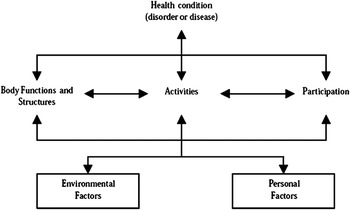
Participation is a term used by the International Classification of Functioning, Disability and Health (ICF) (see Figure 1) developed by the World Health Organization in 2001. Participation is defined as actions and tasks required to engage in organized social life and includes involvement in community life, recreation and leisure, and in religion and spirituality (World Health Organization, 2001). This model suggests that body functions, body structures, activities, and participation are interrelated. These components are influenced by personal factors (intrinsic characteristics of the individual, such as age or education) and environmental factors (extrinsic factors specific to the environment in which the individual lives, such as physical accessibility or special programs for older adults) (Rimmer, Reference Rimmer2006). Participation restrictions occur when an individual cannot accomplish a task within a life situation or when they have difficulty in fulfilling a social or other role.
The International Classification of Functioning, Disability and Health (ICF) WHO (2001) (World Health Organization, 2001).

Other models have been developed to conceptualize the construct of participation and include the Disability Creation Process (DCP) (Fougeyrollas, Noreau, Bergeron, Cloutier, Dion, & St-Michel, Reference Fougeyrollas, Noreau, Bergeron, Cloutier, Dion and St-Michel1998) and the Canadian Model of Occupational Performance (CMOP) (Canadian Association of Occupational Therapists, 1997), among others. These models are helpful for conceptualizing participation and offer a slightly different perspective than the ICF (Participation Team, 2005; Rochette, Korner-Bitensky, & Levasseur, Reference Rochette, Korner-Bitensky and Levasseur2006). We used the ICF as a conceptual framework for this study because it provides an international taxonomy for classifying and measuring function, disability, and health, and it lets us apply standard concepts and terminology across the lifespan (Jette, Tao, & Haley, Reference Jette, Tao and Haley2007; World Health Organization, 2001). Moreover, the ICF is a useful tool for identifying the factors that may enhance or impede participation (Rimmer, Reference Rimmer2006).
Participation among older adults involves both daily activities required for survival (e.g., nutrition, personal care, mobility, communication) and social roles necessary for adults’ well-being (e.g., interpersonal relationships, leisure) (Fougeyrollas et al., Reference Fougeyrollas, Noreau, Bergeron, Cloutier, Dion and St-Michel1998). Participation results from the interaction between the person’s characteristics and his/her environment, factors that can act as either facilitators or barriers.
Older age is characterized by transitions and changes in function (Herzog, Ofstedal, & Wheeler, Reference Herzog, Ofstedal and Wheeler2002); consequently, maintaining well-being and quality of life are important. Well-being and quality of life can be achieved through a person’s devoting more time to actions and tasks related to community life, recreation and leisure, religion and spirituality, and spending time with family and friends (Herzog et al., Reference Herzog, Ofstedal and Wheeler2002). In fact, maintaining an active and engaged lifestyle, with high levels of participation, has been associated with (a) better physical and mental health (Badger, Reference Badger1998; Herzog et al., Reference Herzog, Ofstedal and Wheeler2002; Ishikawa, Tamakoshi, Yatsuya, Suma, Wada, Otsuka et al., Reference Ishikawa, Tamakoshi, Yatsuya, Suma, Wada and Otsuka2006; Lovden, Ghisletta, & Lindenberger, Reference Lovden, Ghisletta and Lindenberger2005), (b) functional ability (Avlund, Lund, Holstein, & Due, Reference Avlund, Lund, Holstein and Due2004; Kono, Kai, Sakato, & Rubenstein, Reference Kono, Kai, Sakato and Rubenstein2007), and (c) longevity (Badger, Reference Badger1998; Dalgard & Lund Haheim, Reference Dalgard and Lund Haheim1998; Herzog et al., Reference Herzog, Ofstedal and Wheeler2002; Hsu, Reference Hsu2007; Lennartsson & Silverstein, Reference Lennartsson and Silverstein2001; Rodriguez-Laso, Zunzunegui, & Otero, Reference Rodriguez-Laso, Zunzunegui and Otero2007). In particular, involvement in leisure activities enhances health, fitness and health-related quality of life, provides greater happiness, and lowers the risk of dementia and premature death (Fine, Reference Fine2000; Karp, Paillard-Borg, Wang, Silverstein, Winblad, & Fratiglioni, Reference Karp, Paillard-Borg, Wang, Silverstein, Winblad and Fratiglioni2006; Nilsson & Fisher, Reference Nilsson and Fisher2006; Onishi, Masuda, Suzuki, Gotoh, Kawamura, & Iguchi, Reference Onishi, Masuda, Suzuki, Gotoh, Kawamura and Iguchi2006; Verghese, Lipton, Katz, Hall, Derby, Kuslansky et al., Reference Verghese, Lipton, Katz, Hall, Derby and Kuslansky2003). Therefore, participation and leisure activities contribute to successful and healthy aging.
Although it is known that participation declines with increasing age (Desrosiers, Noreau, & Rochette, Reference Desrosiers, Noreau and Rochette2004; Desrosiers, Bourbonnais, Noreau, Rochette, Bravo, & Bourget, Reference Desrosiers, Bourbonnais, Noreau, Rochette, Bravo and Bourget2005; Wilkie, Peat, Thomas, & Croft, Reference Wilkie, Peat, Thomas and Croft2006), the factors associated with increasing or decreasing levels of participation have not been extensively studied. Many authors support the need for assisting older adults to use appropriate transportation modes in order to preserve participation in the community (Eberhard, Stutts, Burkhardt, Finn, Hunt, Staplin et al., Reference Eberhard, Stutts, Burkhardt, Finn, Hunt and Staplin2006; Hendrickson & Mann, Reference Hendrickson and Mann2005; Stephens, McCarthy, Marsiske, Shechtman, Classen, Justiss et al., Reference Stephens, McCarthy, Marsiske, Shechtman, Classen and Justiss2005), but to date, no studies have specifically examined the link between transportation and participation.
In this cross-sectional study, our objectives were to compare participation according to primary transportation mode used, and to estimate the association between transportation, personal factors, and environmental factors with participation among older adults living in the community.
Methods
Participants
The study consisted of ninety individuals aged 65 and older, living in the community in the Greater Montreal Region. Excluded from the study were those who could not communicate in either French or English, who resided in assisted living residences, nursing homes, other long-term care facilities, or who had severe communication or cognitive deficits (as determined by the interviewer at the initial encounter).
Procedures
Ethical approval was obtained from the Centre for Interdisciplinary Research in Rehabilitation of Greater Montreal. Participants were recruited from (a) four medical practices in different regions of greater Montreal, (b) advertisements in two magazines geared to the elderly clientele, (c) pamphlets placed in four pharmacies located in different regions, and (d) personal contacts. The recruitment strategy was chosen to generate a sample as representative as possible of the general population over 65 years of age including participants with various levels of health status and social backgrounds.
Potential participants were screened for eligibility upon initial contact. Older adults who were eligible and agreed to participate were asked to provide informed consent. A one-hour interview conducted by the same bilingual occupational therapist was done either face-to-face (when provided written consent) or by telephone (when provided verbal consent), depending on each participant’s preference. Data were collected on primary transportation mode used, participation, personal factors (age, gender, education, working status, and overall functioning), and environmental factor (main co-resident). “Main co-resident”, categorized as living with a spouse, living with a relative, friend or other person, or living alone, was chosen as the most accurate measure of an older adult’s social environment. Although the physical environment is important because it can influence participation, it is particular to every individual’s living space and geographical region. This study focused on personal factors and was not designed to identify individual environmental situations.
Measures
Transportation mode used
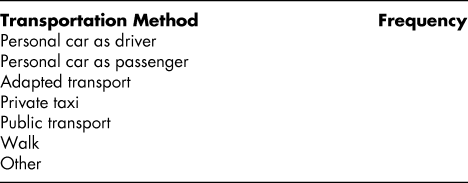
A questionnaire (Appendix 1) developed by the research team was used to measure the frequency of use of various transportation options: private automobile (driver or passenger), walking, public transport, and adapted transport/taxi. These options were selected because they are the transportation modes used most frequently in studies on the elderly population (Eberhard et al., Reference Eberhard, Stutts, Burkhardt, Finn, Hunt and Staplin2006; Hendrickson & Mann, Reference Hendrickson and Mann2005). The primary mode of transportation selected by the participants on the questionnaire was the mode of transportation they used most frequently for their outside activities. Prior to the study, we pretested this questionnaire, for clarity, on two individuals who met the study’s inclusion criteria.
Participation
Although there is no tool developed specifically to measure participation in older adults, two outcome measures were selected: the Craig Handicap Assessment and Reporting Technique (CHART) and Nottingham Leisure Questionnaire (NLQ). Both are relatively short to administer, have clear scoring instructions, demonstrate good psychometric properties, and have been used in research studies with an elderly population. The tools measure complementary aspects of participation: CHART is a global participation tool, and the NLQ focuses on participation in leisure activities.
The Craig Handicap Assessment and Reporting Technique (CHART) CHART is designed to be administered by interview, either in person or by telephone, and contains 32 questions to quantify the extent to which individuals fulfill various social roles (Whiteneck, Charlifue, Gerhart, Overholser, & Richardson, Reference Whiteneck, Charlifue, Gerhart, Overholser and Richardson1992). It includes six separate areas of participation: (a) physical independence (ability to sustain a customarily effective independent existence); (b) cognitive independence (ability to sustain customarily effective independence without the need for supervision); (c) mobility (ability to move about effectively in surroundings); (d) occupation (ability to occupy time in the manner customary to that person’s sex, age, and culture); (e) social integration (ability to participate in and maintain customary social relationships); and (f) economic self-sufficiency (ability to sustain customarily socio-economic activity and independence) (Whiteneck, Brooks, Charlifue, Gerhart, Melick, Overholser et al., Reference Whiteneck, Brooks, Charlifue, Gerhart, Melick and Overholser1988). This last domain was not evaluated in our study as participants were reluctant to disclose this information.
Each domain was scored on a 100-point scale, and a total score was computed by summing all individual domains. The maximum total CHART score in this study was 500, with higher scores indicating less disability, or higher social and community participation. The measure has high test-retest reliability over a one-week interval, from r = 0.80 to 0.95 for individual dimensions and r = 0.93 for the overall score. Validity was supported by differences in total CHART scores between two known groups, independently rated by rehabilitation professionals on levels of handicap (Whiteneck et al., Reference Whiteneck, Charlifue, Gerhart, Overholser and Richardson1992). CHART has been used in several studies of older adults with stroke (Korner-Bitensky, Desrosiers, & Rochette, Reference Korner-Bitensky, Desrosiers and Rochette2008; Larson, Kirschner, Bode, Heinemann, Clorfene, & Goodman, Reference Larson, Kirschner, Bode, Heinemann, Clorfene and Goodman2003; Segal & Gillard, Reference Segal and Gillard1997; Segal & Schall, Reference Segal and Schall1995).
The Nottingham Leisure Questionnaire (NLQ) NLQ measures participation in 30 different leisure activities rated on a 3-point scale (regularly, occasionally, never) (Drummond & Walker, Reference Drummond and Walker1994). It provides two scores: the overall leisure score (TOTL) and a total leisure activity score (TLA). The TOTL score, which ranges from 0 to 60, is the sum of the frequencies of all the activities carried out, with higher scores denoting more-frequent participation in leisure activities. The TLA is the total number of activities in which an individual engages, regardless of frequency. This score ranges from 0 to 30 with higher scores indicating participation in a greater variety of different activities. Test-retest reliability indicated that 6 items had excellent agreement, 15 items had good agreement, and 9 items had fair agreement, suggesting acceptable test-retest reliability (Kappa = 0.44 to 0.94) (Drummond, Parker, Gladman, & Logan, Reference Drummond, Parker, Gladman and Logan2001). This tool has been used in at least one other study of older adults living in the community (Oakley & Pratt, Reference Oakley and Pratt1997).
Personal and environmental factors The interviewer gathered data on the participants’ personal factors (age, gender, education, and employment) and environmental (main co-resident) factor (see Appendix 1). The PULSES profile was developed to assess overall functioning in aging individuals in six different domains: (a) physical condition, (b) upper limb functions, (c) lower limb functions, (d) sensory components, (e) excretory functions, and (f) mental and emotional status (Moskowitz, Reference Moskowitz1985). Scores range from 6 to 24, with higher scores indicating greater impairment. Studies have described this tool as valid, reliable, and sensitive to change (Granger, Albrecht, & Hamilton, Reference Granger, Albrecht and Hamilton1979; Marshall, Heisel, & Grinnell, Reference Marshall, Heisel and Grinnell1999). These personal and environmental factors were selected because they are related to social participation in the elderly population, as recent studies have suggested (Agahi, Kozma, & Parker, Reference Agahi, Kozma and Parker2006; Bukov, Maas, & Lampert, Reference Bukov, Maas and Lampert2002; Gagliardi, Spazzafumo, Marcellini, Mollenkopf, Ruoppila, Tacken et al., Reference Gagliardi, Spazzafumo, Marcellini, Mollenkopf, Ruoppila and Tacken2007).
All questionnaires were translated from English to French by a professional translator who works specifically in the rehabilitation field, and the accuracy was verified by two bilingual rehabilitation researchers. Questionnaires were administered in the participant’s preferred language.
Statistical Analysis
Descriptive statistics (means, standard deviations, frequencies) were used in the analyses of the socio-demographic data for each of the five transportation categories and for the total sample.
To compare social participation according to primary transportation mode used (main objective), non-parametric tests were used as the data from the CHART scores were skewed and not normally distributed. Additionally, non-parametric tests were used to account for the small sample size for the adapted transport/taxi transportation category. Kruskal-Wallis tests were conducted to examine differences in social participation scores between transportation categories. Subsequent Mann-Whitney U tests were used to evaluate pairwise comparisons of the transportation modes and to determine where the differences occurred. Due to the large number of actual tests and potential for a type 1 error, a Bonferroni adjustment was used with a p-value of 0.005. To control for differences in the personal and environmental factors across the transportation categories, we used linear regression modeling. All factors were included in the model simultaneously, with the driver transportation category serving as a reference group.
To estimate the association between each personal and environmental factor with each of the three outcome scores (secondary objective), linear regression was used. Residual plots were inspected to verify linearity, normality, and homoscedasticity assumptions for all univariate and multiple regression models. Robust regression (Colin, Reference Colin2002) was carried out to identify potential outliers and leverage points. Collinearity was then assessed based on tolerance, variation of inflation, and eigenvalues. Regression shrinkage (Lasso) (Tibshirani, Reference Tibshirani1996) and least-angle regression (LAR) (Efron, Hastle, Johnstone, & Tibshirani, Reference Efron, Hastle, Johnstone and Tibshirani2004) methods were applied as a starting point for further analysis to identify the most parsimonious model for each of the three outcome scores. All statistical tests were conducted using SAS/STAT software v. 9.1.3.
Results
Descriptive Findings
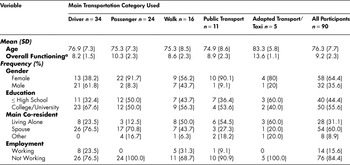
Participants’ ages ranged from 65.0 to 93.3 years (M = 76.3 years; SD = 7.7). Over one third of all participants (37.8%) drove a car as their primary mode of transportation, more than one quarter (26.7%) were passengers, and a lesser proportion used walking (17.8%), public transport (12.2%), and adapted transport/taxi (5.5%) (see Table 1). Differences in the distribution of several of the personal and environmental factors between the transportation categories were noted. There was a higher proportion of males (61.8%) in the driver category, and a higher proportion of females in all other transportation categories: passengers (91.7%), walking (56.2%), public transport (90.1%), and adapted transport/taxi (80.0%).
Demographic characteristics according to primary mode of transportation used

a measured by the PULSES Total Score
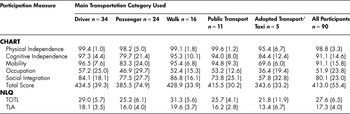
Overall participation scores (see Table 2) were highest for drivers, walkers, and those using public transport as their main mode of transportation. Study participants with the lowest participation scores were passengers and those using adapted transport/taxi. Results were lowest in the occupation domain of CHART as compared to other CHART domains across all five transportation categories. Scores in the mobility domain of CHART were lowest for those in the adapted transport/taxi category.
Participation scores according to primary mode of transportation used [Mean (SD)]

CHART = Craig Handicap Assessment and Reporting Technique
NLQ = Nottingham Leisure Questionnaire
Relationship between Participation and Primary Transportation Mode
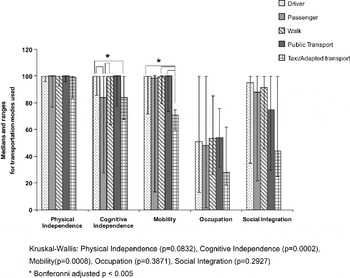
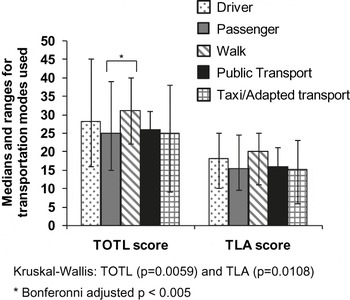
Primary transportation mode used was associated with the cognitive independence and mobility domains of CHART (p < .005) (see Figure 2). More specifically, drivers had higher scores than passengers and those using adapted transport/taxi, and those who walked had higher scores than passengers (p < .005) in the cognitive domain. In the mobility domain, drivers, those who walked, and those using public transport had higher scores compared to those using adapted transport/taxi (p < .005). Regarding leisure activities, those who walked participated at a higher frequency than passengers (p < .005) (see Figure 3). When controlling for age, gender, overall functioning, education, employment, and main co-resident, transportation remained significantly associated with CHART but not with scores on the TOTL and TLA scores of NLQ.
Median scores on the Craig Handicap Assessment and Reporting Technique (CHART) domains according to primary transportation mode used.

Median scores on the Nottingham Leisure Questionnaire (NLQ) according to primary transportation mode used.

Transportation, Personal and Environmental Factors: Effect on Participation
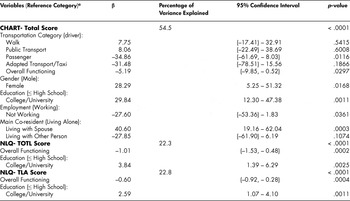
Five personal and environmental factors were individually significantly associated with CHART total scores: (a) age, (b) overall functioning, (c) education, (d) employment, and (e) main co-resident. Only age, overall functioning, and education were significantly associated with both NLQ scores. Transportation (walking, public transport, driving, adapted transport/taxi, passenger), overall functioning (an increasing PULSES score denotes lower functioning), gender (female, male), education (college/university, high school or less), employment (working, not working), and main co-resident (living with spouse, living alone, living with other) were retained in the best model associated with higher levels of participation. These variables accounted for 54 per cent of the variance in the CHART total scores (see Table 3). For NLQ, only two factors – overall functioning and education – were found to contribute to the best model; these two variables accounted for 22 and 23 per cent of the variance for the TOTL and TLA scores respectively (see Table 3).
Best model for transportation, and personal and environmental factors associated with participation outcomes

a All of the following factors were included in the analysis: transportation category, age, gender, overall functioning, education, employment, and main co-resident.
CHART = Craig Handicap Assessment and Reporting Technique
NLQ = Nottingham Leisure Questionnaire
Discussion
Transportation and Participation
The results of this study indicate that older drivers, walkers, and those using public transport reported higher levels of overall participation compared to those using adapted transport/taxi. Specifically, participants who primarily walk had the highest level of participation in leisure activities; however, this is likely due to differences in the characteristics of the transportation categories (e.g., gender, overall functioning). Driving requires a high level of cognitive and motor function as well as independent mobility, skills necessary to seek out and engage in community activities (Mazer, Gélinas, & Benoit, Reference Mazer, Gélinas and Benoit2004). In one study, the amount of mobility in the community was reported to be greater in those who were drivers as compared to non-drivers who must rely on family or friends for their outings (Hendrickson & Mann, Reference Hendrickson and Mann2005). In addition, walking and using public transportation involves a high degree of autonomy, adequate orientation and perceptual skills, a high degree of physical ability, as well as the ability to plan and navigate to one’s destination. Older adults who maintain a certain degree of skill are those most likely to be autonomous in their mobility within the community and capable of planning and executing their participation in leisure and other community activities.
Previous studies have shown that having access to transportation can facilitate participation among the elderly (Gagliardi et al., Reference Gagliardi, Spazzafumo, Marcellini, Mollenkopf, Ruoppila and Tacken2007; Ishikawa et al., Reference Ishikawa, Tamakoshi, Yatsuya, Suma, Wada and Otsuka2006). Individuals who are dependent on others for transportation are most likely to request assistance for outings perceived as necessary, such as grocery shopping and medical appointments, and leisure activities may not be prioritized (Bendixen et al., Reference Bendixen, Mann and Tomita2005). A study conducted on 239 community-dwelling elderly Japanese people found that men with easy access to public transportation engaged in outside activities more frequently than those without easy access (Ishikawa et al., Reference Ishikawa, Tamakoshi, Yatsuya, Suma, Wada and Otsuka2006). Our findings confirm that participation varies according to the mode of transportation used.
Factors associated with participation
Levels of participation differed according to various factors, specifically gender, overall functioning, and education. This study found that a larger proportion of males were drivers while females used all other modes of transportation more frequently. Older women often require assistance getting around outside the home because the majority of drivers among the elderly are male, and being female has been strongly associated with driving cessation (Bendixen et al., Reference Bendixen, Mann and Tomita2005; Mann, McCarthy, Wu, & Tomita, Reference Mann, McCarthy, Wu and Tomita2005). Nonetheless, our results show that females had a higher overall participation score compared to males.
Previous studies have shown that older males and females have different participation levels in various activities and roles (Agahi et al., Reference Agahi, Kozma and Parker2006; Bukov et al., Reference Bukov, Maas and Lampert2002; Desrosiers et al., Reference Desrosiers, Noreau and Rochette2004; Gagliardi et al., Reference Gagliardi, Spazzafumo, Marcellini, Mollenkopf, Ruoppila and Tacken2007; Sorensen, Axelsen, & Avlund, Reference Sorensen, Axelsen and Avlund2002). This finding may be due to differences in the conceptualization of participation. Measures used to assess participation differ in the type and distribution of the items included (Dahan-Oliel, Gélinas, & Mazer, Reference Dahan-Oliel, Gélinas and Mazer2008).
Our findings indicate that individuals with poor overall functioning as measured by PULSES were less likely to use spontaneous transportation categories (driving, public transport, walking) compared to healthier individuals, resulting in an increased dependence on others with respect to transportation (passenger, adapted transport/taxi). This results in a loss of spontaneity in transportation and, consequently, in decreased participation. Impaired older individuals are more likely to devote their time and resources to self-care tasks, and are less able to pursue other activities related to participation, such as leisure activities (Bendixen et al., Reference Bendixen, Mann and Tomita2005; Griffin & McKenna, Reference Griffin and McKenna1998). Studies have suggested a bidirectional relationship between health and participation; health influences participation, and participation improves health (Agahi et al., Reference Agahi, Kozma and Parker2006; Dergance, Calmbach, Dhanda, Miles, Hazuda, & Mouton, Reference Dergance, Calmbach, Dhanda, Miles, Hazuda and Mouton2003; Griffin & McKenna, Reference Griffin and McKenna1998). Bendixen et al. (Reference Bendixen, Mann and Tomita2005), in their study of 616 frail elderly individuals, found that the number of trips taken and the number of places visited decreased in those with poorer visual function, lower self-esteem, lower quality-of-life scores, higher medication use, and with higher depressive symptoms. A Danish study investigated the relationship between health (functional ability) and participation, and found that functional ability was a predictor of participation in women (Sorensen, Axelsen, & Avlund, Reference Sorensen, Axelsen and Avlund2002). Although both studies found that healthier individuals had higher levels of participation compared to those with poorer health, the relationship between transportation mode and participation was not explored.
Individuals with higher education generally have higher incomes than their less educated counterparts, and socio-economic status has been associated with the kind and level of activities in which individuals engage (Agahi et al., Reference Agahi, Kozma and Parker2006; Griffin & McKenna, Reference Griffin and McKenna1998). Previous studies have confirmed that older individuals with higher education participate more than individuals with less education (Agahi et al., Reference Agahi, Kozma and Parker2006; Bukov et al., Reference Bukov, Maas and Lampert2002; Gagliardi et al., Reference Gagliardi, Spazzafumo, Marcellini, Mollenkopf, Ruoppila and Tacken2007).
Importance of the Study
Participation in leisure activities has a beneficial effect on the health of older adults and may contribute to successful aging by (a) reducing the risk of premature death (Dalgard & Lund Haheim, Reference Dalgard and Lund Haheim1998; Hsu, Reference Hsu2007; Lennartsson & Silverstein, Reference Lennartsson and Silverstein2001; Rodriguez-Laso et al., Reference Rodriguez-Laso, Zunzunegui and Otero2007), (b) protecting against dementia (Karp et al., Reference Karp, Paillard-Borg, Wang, Silverstein, Winblad and Fratiglioni2006; Verghese et al., Reference Verghese, Lipton, Katz, Hall, Derby and Kuslansky2003) and disability (Avlund et al., Reference Avlund, Lund, Holstein and Due2004), (c) predicting happiness (Onishi et al., Reference Onishi, Masuda, Suzuki, Gotoh, Kawamura and Iguchi2006), and (d) improving overall function (Kono et al., Reference Kono, Kai, Sakato and Rubenstein2007; Lovden et al., Reference Lovden, Ghisletta and Lindenberger2005).
Our study provides novel and clinically important findings on transportation as well as the personal and environmental factors associated with participation in a large cohort of community-dwelling older adults. Promoting participation and involvement in leisure activities is an important issue for the health of our growing population of older adults, especially since participation has been shown to have a positive association with successful aging. Encouraging mobility in the community using a variety of transportation modes, including walking, should therefore be a priority in rehabilitation. To design appropriate, individualized, and client-centered interventions, it is important that researchers and therapists identify the personal and environmental factors that may enhance or impede the type and frequency of participation. Additionally, once those factors are identified, they might then be promoted or attenuated by therapists to help optimize participation in older adults.
Study Limitations and Future Directions
The outcome measures we used in this study to assess participation were not developed specifically for older adults living in the community, and we did not conduct validity studies in this population. The items included in these measures might therefore not be completely relevant to all older adults (e.g., items related to paid work in the occupation domain of CHART), and other more relevant items may not be included. Because the objective of this study was not to compare the participation of older adults to norms, but rather to make comparisons within the sample of older adults according to transportation modes used, the effect of using these measures was consistent across all groups.
The generalizability of this study’s findings is most relevant to older individuals living in urban areas, since individuals living in rural areas have different socio-demographic traits, transportation needs, and available resources. In addition, some transportation categories that were examined had few participants, reducing our power to detect associations.
Personal and environmental factors other than those included in this study may play a role in participation by older adults. Other personal factors such as personality, motivation, participation at younger ages, and environmental factors such as accessibility to resources, services, and policies, are possible factors that might influence participation by older adults (Dahan-Oliel et al., Reference Dahan-Oliel, Gélinas and Mazer2008). Previous studies have suggested that low income is a limiting factor to alternative transportation use (Mann, McCarthy, Wu, & Tomita, Reference Mann, McCarthy, Wu and Tomita2005; Sanders et al., Reference Sanders, Polgar, Klosek and Crilly2005; Stephens et al., Reference Stephens, McCarthy, Marsiske, Shechtman, Classen and Justiss2005); however, this could not be confirmed in our study since the majority of our participants did not want to disclose their annual income. Further studies on transportation and participation should include a larger sample size in order to investigate a greater diversity of personal and environmental factors.
Conclusion
Our findings indicate that older individuals who primarily use spontaneous and accessible modes of transportation and do not depend on other individuals or service providers – that is, those who drive, walk, or use public transportation – have higher levels of overall participation. Conversely, those who depend on other individuals or service providers for their transportation were found to participate less. It is likely that when accessible transportation is unavailable, people tend to limit their participation in social and leisure activities. Higher education and better overall functioning were additionally associated with greater frequency and variety of participation in leisure activities. This study suggests that clinicians should consider older adults’ use of transportation in an attempt to maximize their participation. Encouraging the older adults to engage in a variety of transportation modes, especially those that enable them to be spontaneous, should be a priority in rehabilitation. In addition, clinicians should consider individual personal and environmental factors that may affect participation, as these may be important in the planning of individualized interventions to optimize participation.
APPENDIX 1: Sample questions from the transportation, and personal and environmental factors questionnaire
1. Gender:
□ male
□ female
2. What is the last level of school you completed?
□ Less than Elementary
□ Completed elementary
□ High School
□ College/Trade School
□ University
3. If you think of a typical week, for how many outings did you use each of the following transportation options?

Note:
The questionnaire used was administered by the interviewer, and was not used in a self-report format.