Introduction
From 18–24 April 1955, twenty-nine nationsFootnote 1 of Asia and Africa gathered in the city of Bandung in West Java, to convene the First Asia-Africa Conference (see Figure 1). Within Indonesia, this conference, affectionately known as the A-A Conference (hereafter AAC), still holds monumental significance for its post-independence national narrative, by placing Indonesia and its leader Sukarno firmly on the map of the post-war world.Footnote 2 Outside of Indonesia, the conference gained the popular appellation of the ‘Bandung Conference’ and came to represent the mythical moment when the combined dynamism of the newly decolonized, independent states of Asia and Africa monopolized the centre stage in international relations. Having been excluded, the dominant actors of the Cold War watched anxiously from afar as the exuberant Afro-Asian pageantry took place in the hitherto little known city of Bandung. The conference was the culmination of an initiative led by the five host countries—Indonesia, India, Pakistan, Ceylon and Burma, collectively known as the Colombo Powers. Apart from Egypt, Ethiopia, Liberia, Libya, Sudan, and the Gold Coast, the rest of the invitees were from Asia. As the only former colonial power, Japan was included, whilst Israel, North Korea and South Korea were excluded.
Kemayoran Airfield, Jakarta, the arrival of Carlos Romulo of the Philippines (in a white suit with a panama hat in the centre), with the flags of the participating twenty-nine nations.
Source: Muhammad Yamin, Kebudajaan Asia-Afrika, Perpustakaan Perguruan Kementerian P. P., Djakarta, 1955.

The progress of the conference was by no means smooth as underlying global tensions created by the Cold War influenced power dynamics at Bandung, where some states such as Pakistan, the Philippines and Thailand saw themselves as unofficially representing Western or, more precisely, American interests, colliding with the group of neutralist countries headed by India, Burma and Indonesia. The decision to invite the People's Republic of China contributed in large part to creating the tension during the conference.Footnote 3 Yet it was also thanks to the adept diplomacy of Zhou Enlai that the conference was saved from irreparable fracture and disintegration. Famously, the conference nearly broke up in the eleventh hour when an ad-hoc committee headed by Gamal Abdel Nasser could not agree on the wording on peaceful co-existence. LIFE magazine's write-up of the conference almost gleefully focused on these fissures, such as in ‘Sir John Tears Off Chou's False Front’ or ‘Nothing Good Happens to a Chagrined Nehru’.Footnote 4 Therefore, the final communiqué published on 24 April, incorporating the Ten Bandung Principles, was a miraculous feat of collective determination. In the final hour, the Asian and African leaders deemed it politically more expedient to demonstrate their symbolic solidarity than to let the whole undertaking fail, in the full glare of the world media, over disagreements caused by the pressures of the Cold War. As Carlos Romulo reminisced in 1956, Bandung was the ‘first flowering of the spirit of this new Asia and Africa’.Footnote 5
The historiography of the Bandung Conference falls largely into two dominant narratives. On the one hand, there exists the tradition of conceptualizing it as the culmination of the long arduous ‘road to freedom and independence’ of the newly created Asian and African states. This perspective situates the Bandung Conference as the significant symbolic moment in the history of decolonization, whilst at the same time, heralding a new era for Afro-Asia as a new collective force in international politics. The two key works, though entirely different in nature, that contributed to creating and defining this tradition are George McTurnan Kahin's The Asian-African Conference and Richard Wright's The Color Curtain, both published in 1956. Kahin was a Southeast Asian specialist at Cornell University researching in Indonesia at the time of the conference. He gained access as a member of the press, and interviewed some of the key organizers after the conference, as well as stopping over in India, Burma, Pakistan, Ceylon, and Egypt to conduct further interviews. In his lucid and well-considered analysis, Kahin concludes that the conference was a ‘unique and significant event’:
This successful assertion of Asian and African personality tended to beget an increased self-confidence among many of the delegates, manifesting itself in a greater determination to share more fully with the West in decisions affecting the interests of their countries.Footnote 6
Richard Wright was then already a famous African-American writer-in-exile in Paris, and was so deeply inspired by the historic gathering of Asian and African nations that he felt compelled to make a personal pilgrimage to the époque-making event. His book, The Color Curtain, remains the only one that popularized the conference to the general readership. Wright's pervading legacy lies with the romanticizing of the emotional unity exhibited at the Bandung Conference, arising out of what he called ‘emotional nationalism’.Footnote 7
Once the initial euphoria over Bandung subsides, the realpolitik perspective quickly overshadows the initial perspective, by critiquing the conference as a failed political project. Accordingly, the only ‘tangible’ outcome of the conference was the articulation of the ten principles which became the basis of the final communiqué. Not only did Bandung not produce any direct consequence worthy of note such as the creation of a new regional institution, it exposed the irreconcilable ideological division amongst the participating states that began to define the realignment of states in the emergent environment of the Cold War.Footnote 8 As the Cold War intensified, Zhou Enlai's Herculean diplomatic efforts at Bandung became a distant memory as the reality of China's relations with its neighbouring states became exposed, as well as the general hardening of the East-West divide in the Afro-Asian world in the 1960s.Footnote 9 As a contemporary concern, political scientists and specialists of international relations dominated the literature for decades after the event.Footnote 10 In this vein, G. H. Jansen whose book on the Nonalignment and the Afro-Asian States (1966) was influential as one of the few books that dealt with Bandung at any length.Footnote 11 Within this atmosphere of the Cold War, Roeslan Abdulgani's The Bandung Connections (1981) emerged as a belated and much needed Indonesian insider's account as the chairman of the Joint Secretariat of the conference.
What liberated the historiography from the stranglehold of the Cold War was the sudden denouement of the bipolar paradigm in 1989. Just after the fortieth anniversary of the conference in 1996, Brenda Gayle Plummer wrote about the nexus of the American civil rights movement and American foreign policy, and how these trajectories intersected with Bandung amongst other things.Footnote 12 As the Bandung Conference attracted an inordinate amount of contemporary African-American interest, this line of enquiry opened up possibilities for writing a transnational history of the civil rights movement, linking it not only with Bandung but also with connections in Africa,Footnote 13 including a revisionist account of Richard Wright and his ‘misrepresentation’ of Indonesia.Footnote 14
The golden anniversary in 2005 triggered a new wave of scholarly interest in the conference. Jamie Mackie's Bandung 1955 (2005) reiterated the significance of the unity of the Bandung moment.Footnote 15 This was followed by Kweku Ampiah's The Political and Moral Imperatives of the Bandung Conference of 1955 (2007) which is a multi-archival international history shedding light on Japan's attempt to exert ‘independence’ in foreign policy vis-à-vis the United States through immediate post-Occupation diplomacy.Footnote 16 Vijay Prashad's The Darker Nations (2007) argued most persuasively that the ‘Bandung Spirit’ came to mean ‘that the colonized world had now emerged to claim its space in world affairs, not just as an adjunct of the First or Second Worlds, but as a player in its own right.’Footnote 17 See Seng Tan and Amitav Acharya's Bandung Revisited (2008)—a collection of essays on the international history of the conference, which included new findings from South African, Chinese, Indian, Indonesian, and American perspectives. Most importantly, Acharya and Tan argued that ‘the main legacy of Bandung was not so much strategic or organizational, but educational and normative’.Footnote 18
Derek McDougall and Antonia Finnane's edited volume, Bandung 1955 (2010), adds to the growing literature by introducing connected histories of Bandung. Of particular interest is Antonia Finnane's chapter on Zhou Enlai's diplomatic prowess at Bandung in the Chinese film ‘Zhou Enlai in Bandung’ released in 2003.Footnote 19 In Christopher J. Lee's edited volume, The Bandung Moment (2010), he persuasively brings together many different strands that came to represent Bandung in later years, particularly illuminating the inter-relationships between the Bandung nations. In that sense, the Bandung experience provided a nodal point for a variety of post-colonial, post-Bandung experiences, and Lee's volume manages successfully to open up the field for future studies.Footnote 20
On the whole, much of the new wave of literature in the post-Cold War era underlines the significance of the original theme of the symbolic moment in international diplomacy, but it also opens up the field substantially by fostering a multiplicity of enquiries, connecting intra-regional and inter-regional histories with the conference. The literature shows no signs of abating as the Bandung Conference continues to enjoy a renaissance in the current scholarly environment that is conducive to investigations that privilege pluralities and complexities.Footnote 21
Diplomacy as theatre
What has become evident in the above survey of the literature is that the Bandung Conference continues to be regarded as the symbolic moment of international diplomacy in the history of Asia and Africa in the twentieth century, enjoying a revival after the demise of the Cold War framework. As not all diplomatic events are regarded as being symbolic in nature, we must investigate why Bandung is still considered to be significant in this respect. It requires more expansive thought about the nature of diplomacy as encompassing elements, which are more normatively defined than outcome orientated. To this end, the Bandung Conference is a prima-facie case of how a diplomatic event can be highly significant without producing so-called concrete results. So, how can a meaningful understanding of what constitutes the symbolic in international diplomacy be arrived at?
First, it can be argued that an event can be meaningful by the very act of staging it, because it confers symbolic meaning. The most obvious case of this type of event is royal pageantry, particularly the crowning ceremony, which is entirely symbolic in nature.Footnote 22 It is the process of pageantry or the performance of pageantry itself that is meaningful because it lends legitimacy not only to the actor, but through the participation of the audience, to the whole event. Similarly, the symbolic meaning of the Bandung Conference can be explained as a collective crowning ceremony or inauguration ceremony of post-colonial Asia and Africa, represented by the twenty-nine delegations, in turn, representing some 1.4 billion people worldwide. It is this collective force that made the event itself iconic, as a decisive moment of the twentieth century. Hence, ‘Bandung was, in a manner of speaking, a historical pageant, symbolizing the coming of the age of Asia and Africa’.Footnote 23
It is worth noting, too, that an event can be made symbolic because ‘contemporary processes…identify an event as noteworthy and significant, thus giving it historical status, often to the exclusion of other events’.Footnote 24 In other words, an event can draw attention to itself because of the heightened sense of perceived importance attached to it by contemporaries who create information about it and disseminate it. And, this process involves a certain amount of evaluative recognition. Hence, the process of ‘historical canonization’—to borrow a term from Postlewait—occurs in how some historical events become more important than others.Footnote 25
What needs to be examined is the process or the enactment of the event because this, in turn, produces symbolic meanings. Through the framework of ‘diplomacy as theatre’ this paper will demonstrate how symbolic meanings were produced during the Bandung Conference, in part through the ‘staging’ of the conference. The dramatization of diplomacy through performative acts can play a significant part in diplomacy, insofar as some diplomatic events are as much about public performances as they are about behind-the-scenes negotiations.Footnote 26 Notwithstanding the agenda of individual participating states, often conflicting and contentious, the fact of their attendance and determination to conclude it on a positive note, underlines the collective recognition of what was really at stake at Bandung—namely, to assert Afro-Asian solidarity at a historic moment. This diplomatic performance lent legitimacy symbolically to the twenty-nine participating states as a new collective actor in international relations. What is striking about Bandung is that it was an act of confident assertion vis-à-vis the ruling elite of international society, and not a passive act of seeking acceptance.Footnote 27
As I have already argued elsewhere, it is important to pay attention to the ‘place’ where diplomacy takes place because such a local focus enables us to understand the dynamics of connections between national politics and international diplomacy.Footnote 28 Although it is beyond the scope of this paper to examine more general ramifications of the conference for national politics of participating countries, an examination of the Indonesian scenario can provide a useful insight into how the Bandung Conference might have been used politically by other participating nations, as an important instrument of national consolidation in the early days of the post-colonial Afro-Asian world. Using the theatre analogy has implications in terms of drawing out the boundary of intellectual enquiry.
In principle, theatre has three components: stage, performers and audience.Footnote 29 The city of Bandung is referred to here as the stage for the conference. By expanding the notion of stage to incorporate the city itself as a theatrical space, includes a wider range of performers. Obviously, there are principal actors such as Sukarno, Nehru, Zhou Enlai, and Nasser. Strictly speaking, the people of Bandung were actual audiences to the theatre of diplomacy taking place in their local city. However, the local audience must be re-defined as performers in their own right, as their role lends credence to the whole event and, indeed, forms an integral part of the iconography of the conference. Finally, this draws the third component of the theatre—the audience.
The rest of this paper will demonstrate how the city of Bandung was prepared as the stage for a diplomatic theatre, including an example of ‘diplomatic performance’ at work. An expanded conclusion will offer some analysis of how the Indonesian political context might have had some bearing on the diplomatic theatre that unfolded in Bandung.
Bandung as a stage in international diplomacy
It was clear from the beginning that the national pride of the newly created Republic of Indonesia was at stake in hosting the Asia-Africa Conference. According to Ali Sastroamijoyo, prime minister of the Republic of Indonesia, it was on his initiative that Indonesia became host to the international conference when he broached the subject at the meeting of the Colombo Powers—Indonesia, India, Pakistan, Ceylon and Burma—in December 1954 in the Javanese city of Bogor.Footnote 30 After the conference, one of the conferees made unpleasant remarks about the host in an international magazine that, ‘These beggars will never learn’, referring to the allegedly poor standard of hospitality offered.Footnote 31 Quite clearly, the Indonesians had to prove their detractors wrong in order to recover from this humiliation. To this end, Roeslan Abdulgani, a senior Indonesian official, was appointed as Secretary-General of the Joint Secretariat to oversee the entire preparations for the April conference. Indonesians were determined to play the ‘good host’ at the historic event.Footnote 32
A considerable amount of care and attention went into the detailed planning of the conference. Even deciding on the opening day of 18 April 1955 became a diplomatic feat. There were many restrictions that the Joint Secretariat had to take into consideration: for one, Ramadan would begin on 24–25 April, which would make it difficult for most Arab countries to attend. Then, the Burmese premier, U Nu could not leave Burma until 16 April because of the Buddhist sacred days. In the event, Monday 18 April seemed the only viable date for the opening, and the Ramadan considerations had meant that it had to end on 23 April. However, there was also a symbolic meaning attached to the 18 April, purely as a diplomatic gesture to appease the Americans who were getting edgy about the Asia-Africa Conference. In order to remind the Americans of their colonial past, Sukarno had alluded, in his opening speech, to the famous midnight ride made by Paul Revere, a young patriot, on 18 April 1775, from Boston to Concord, immortalized by Longfellow in his poem, ‘Tales of a Wayside Inn’.Footnote 33
Why was Bandung chosen and not Jakarta, which would have been a more natural choice being the capital of Indonesia? In modern times, Bandung was a significant city in the Dutch colonial world; the Dutch had even considered moving the capital of the Dutch East Indies from Batavia to Bandung in the 1920s. This was partly responsible for the remarkable range of Art Deco buildings that stand in Bandung as both the Dutch and colonial Dutch architects competed to turn the city into a vision of colonial modernity, giving it a ‘European feel’.Footnote 34 Situated in a cool mountain resort area, Bandung satisfied the basic criteria of having internationally acceptable standards of conference venues and accommodation.Footnote 35 Clearly, Bandung was not just any Indonesian city but a special one, even for the post-colonial Indonesian elite, many of whom had spent their formative years in Bandung as students and as ‘freedom-fighters’—the most famous being Sukarno himself.
What remained unmentioned was the fact that Bandung was the stronghold of the Darul Islam Movement (Islamic State Movement), which was challenging the legitimacy of the Republic of Indonesia. In August 1949, the Darul Islam under the leadership of Kartosuwirjo had declared an autonomous Islamic State of Indonesia in West Java. The Republic of Indonesia had considered the declaration as tantamount to a rebellion against the federal state, and proceeded to outlaw the movement. However, the Darul Islam was symptomatic of the underlying pressure placed on the Republic, which was established on secular principles, from various groups of Muslim Indonesians who sympathized with the idea of creating an Islamic Indonesia of one kind or another. In fact, the Republic was facing constant separatist threats in other parts of the Indonesian archipelago as the unitary, federal vision of the Republic continued to be challenged in regions such as Aceh, Sulawesi and Kalimantan, all of which claimed political autonomy. Not all of them were Islamic in orientation, as South Maluku which also declared autonomy, was predominantly Christian. These challenges continued to be mounted against the Republic until the late 1950s and into the mid 1960s.Footnote 36
In the light of the above, hosting a major international conference in the heartland of the separatist Islamic ‘state’ takes on a different meaning. It allowed the Republic a legitimate excuse for mobilizing large numbers of police and military forces into the region to exert central authority in the name of security. This harsh reality of the newly created Republic of Indonesia underlines what might have been a shared background for many new states at Bandung—that gaining political independence was still a work-in-progress, as even the newly gained statehood could not be taken for granted.
In any case, the city of Bandung and its people felt rightly proud of their city being chosen as the centre of Asia and Africa or, more accurately, the world, for a week in April 1955. The local newspaper, Pikiran rakjat called Bandung ‘Europe in the Tropics’—‘Here in this privileged mountain-city, we always have spring and summer: Bandung is in fact a combination of the splendours of Europe and the blessings of the tropics’.Footnote 37 On 12 April, the same paper published an ‘Ode to Bandung’:
Brother Karno [Sukarno] started the nationalist revolutionary fire in Bandung.
So Bandung you are the first source of the nationalist revolutionary movement because in the middle of your heart, Brother Karno spread the fire of the nationalist revolution.
Your garden is full of flowers so you get the name, ‘Bandung City of Flowers’.
Because your girls and women are attractive, you get the name, ‘Paris of Java Island’.
Bandung tried to gain another name, a better one from the existing names.
So in history, your name will be mentioned as ‘Bandung the Source of Glory of Asia and Africa’.Footnote 38
Staging the City
In thinking of Bandung as a stage for the greatest diplomatic theatre to unfold, we need to consider spatially how the stage was created in the third largest city in Indonesia. As a matter of practicality, the city had to find space to absorb for one week between two and three thousand visitors, representing the twenty-nine delegations, the media, as well as a substantial number of unofficial visitors. Administratively, the Joint Secretariat created a special conference zone, referred to as the ‘AAC zone’ in the city-centre, with Jalan Asia Afrika (where the principal venue and hotels stood), Jalan Alun Alun (the city square where the central mosque stands) and Jalan Braga (the famous street of cafes, restaurants and nightlife) marking the southern boundary, and stretching out northwards and eastwards to hillier suburbs where the residences of heads of delegations were located. The primary venue, Freedom Building (Merdeka Building) was situated on Jalan Asia Afrika, whilst the secondary venue, Dwi-Warna was situated on Jalan Diponegoro, a good three to four kilometres away. The official designation of the AAC zone had the effect of creating a spatial separation between the city as it was, and the temporary stage that was being specially prepared at its core.
For a period of four months before the conference, the city of Bandung underwent a major face-lift. Swift renovations were carried out to the conference venues, 14 major hotels including Savoy Homann with its stunning, curvaceous Art Deco front by the Dutch architect, A. A. Albers, Grand Preanger, Astoria, Orient, individual residences allocated to the heads of delegations, the central mosque, airport, and railway station.Footnote 39 Main AAC thoroughfares such as Jalan Asia Afrika were literally scrubbed by workers on their hands and knees, and given a lick of fresh white paint. As one weekly magazine wrote, ‘Reader, have you seen the main road scrubbed so clean? This kind of strange happening is occurring…precisely on the main road in front of Homann and Preanger’.Footnote 40 Having cleaned ungainly sights of messy small vendors off the streets in the AAC zone, as well as kicking out long-term hotel dwellers to make room for the visitors, Bandung was truly becoming ‘super de lux’, as clean as the brand of the Indonesian soap, Lux, opined a Chinese Indonesian weekly magazine.Footnote 41 Nobody was left unscathed by the intense preparatory work which got under way. The rich were particularly affected as they were asked to give up their residences to host the heads of delegations, as well as the delivery of their brand new luxury cars effectively confiscated by the Joint Secretariat to be used to ferry conference delegates around the city. Journalists who could not afford car rentals had to resort to renting a becak (pedicab) with a driver. Interestingly, the authorities colour-coded the cars to distinguish heads of delegations from the rest, as they were provided with bright yellow, orange and red Mercury cars, whilst others were allocated Plymouth Belvederes in sea green.Footnote 42
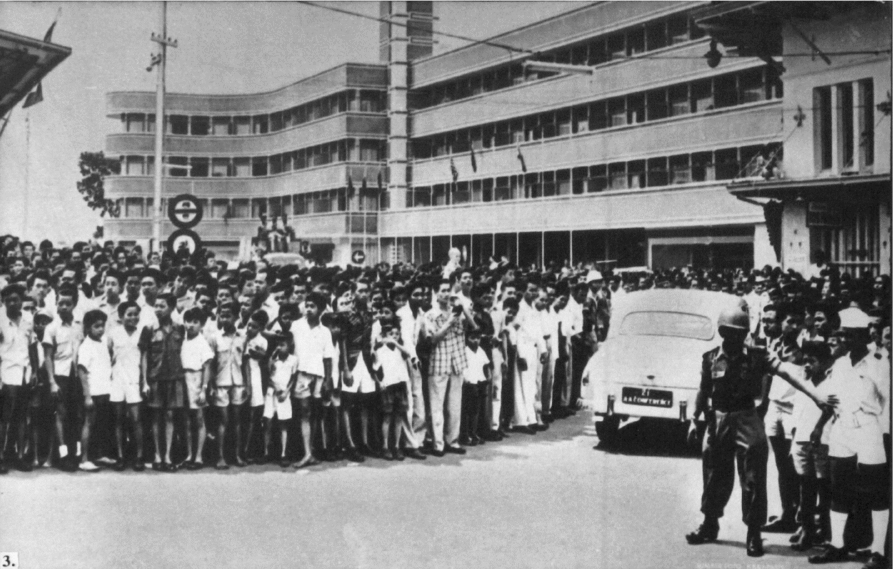
In the light of the seriousness of the security threat from the Darul Islam, it was extraordinary that pedestrians did not require special permission to meet the AAC guests, but simply had to report to the guards at the hotels.Footnote 43 In this way, pedestrians could enter the conference zone unhindered as long as they did not obstruct the delegates and the working of the conference. This gesture of public spiritedness on the part of officialdom afforded once-in-a-lifetime opportunities to the people of Bandung to approach conference delegates face to face, and even ask for autographs. In front of the conference buildings, specially designated waiting areas were created for the public in order to catch glimpses of delegates (Figure 2).Footnote 44
The people of Bandung in front of Hotel Savoy Homann.
Source: Bidakara Savoy Homann Hotel.
Even though special considerations were made for public access in Bandung, it fell short of the Asian Relations Conference held in New Delhi in 1947 when a huge marquee had been erected to accommodate the public as participants in the conference, yet the fact that the people of Bandung were allowed close physical proximity not just to ordinary delegates but also to high-profile statesmen, did lend a special atmosphere to the whole occasion. It allowed for a continuous interaction between conference delegates and the people, almost as though a weeklong street theatre was being staged. In this respect, everyone metamorphosed into an actor, as they played their respective roles with apparent enthusiasm and relish. One local weekly reported a typical scene during the conference with the palpable sense of popular excitement:
But as soon as the siren from the police motorcycle was heard, people ran out of the shops and, in restaurants, waitress[es] bringing out the food ordered by the guests, consciously or unconsciously put down the food on one of the tables and ran outside. People who want to eat have to wait and but [sic] they also ran outside. It was crowded outside, people who ride bicycle[s] they stopped as well as those who used other kinds of vehicles. Everyone stopped. Because the blaring siren means that one of the delegations is about to pass.Footnote 45
In the latter part of the twentieth-century, international conferences became increasingly defined by the sense of distance imposed between the people and the delegates, due to the ever-growing concern for total security, as was evident in the visual images of the Belgrade Conference only six years later in 1961.Footnote 46
The Freedom Building
President Sukarno who studied civil engineering at the Bandung Institute of Technology in 1921 understood the power of architecture, and wanted it to work as an integral part of the stage set for the most significant international conference to ever take place in Indonesia. Under his rule of ‘guided democracy’, he launched a number of monumental constructions in Jakarta to create a post-colonial capital in the 1960s, the most famous being the National Monument starting in 1961.
The choice of the Freedom Building (see Figure 3) as the principal venue of the conference has some significance worth mentioning. It was built originally in 1895 as the Concordia Society Club, an elite Dutch social club. When Sukarno visited Bandung to inspect the conference preparations on 7 April 1955, he suddenly announced his decision to rename the venues of the conference to better reflect the spirit of the conference and of the newly independent Indonesia as the host country. Hence, the old Concordia Society Club was rechristened the ‘Freedom Building’ to be used as the principal venue where the plenary sessions took place; whilst the second venue, Dana Pension Fund Building was renamed ‘Dwi-Warna’ (‘Two-Colour’ symbolizing the red and white of the Indonesian national flag) where political, economic and cultural committees sat in session. Sukarno's vision for creating a post-colonial Bandung extended to renaming the streets. In this way, Jalan Raya Timur (Great Eastern Road) became Jalan Asia Afrika and Jalan Alun Alun Barat became Jalan Masjid Agung.Footnote 47 However, the Municipal Government of Bandung grumbled that Sukarno had single-handedly made the decision without consulting the city beforehand.Footnote 48 In any case, Sukarno remained dissatisfied with the poor standard of what he considered a slap-dash effort at renovation of the key conference sites, especially the fact that the main building lacked ‘inspiration’. According to Roeslan Abdulgani, the Secretary-General of the Joint Secretariat of the conference,
Freedom Building (Gedung Merdeka).
Source: Photograph taken by the author.
…Brother Karno said to me, ‘what do you, or Ali [Ali Sastroamijoyo, the prime minister] either, know about architecture? I am a civil engineer and I know all about the ins and outs of architecture. The interior of the Concordia Building must be inspiring. Everyone sitting inside it must be inspired. Don't be so prosaic. Not so dry. Not like a book of laws—that's all that Ali knows about, being a lawyer. You know what I think—Met juristen kun je nooist een revolusi beginnen. You can't make a revolution with jurists! They have no inspiration. Whereas the participants need to be enfolded in inspiration! For that reason, change the interior of this building! Just you do what I tell you!’Footnote 49
It was made clear that the newly renamed Freedom Building was going to be an architectural symbol of Indonesia, as a symbolic act of deconsecrating the building from its Dutch colonial past.Footnote 50 It was converted into the Museum of the Asian-African Conference in 1980 to commemorate the twenty-fifth anniversary of the conference.Footnote 51
The positioning of the Freedom Building as an iconic post-colonial national monument tells only one side of the story, however, as the building has a more complex history than first meets the eye. The Concordia Society Club as it was then known, underwent a major renovation in 1921 by the Dutch colonial architect, Charles Prosper Wolff Schoemaker who taught Sukarno as a student. C. J. van Dullemen who recently published a comprehensive work on Schoemaker's oeuvre, noted that there was a special bond between Schoemaker the teacher and Sukarno the student.Footnote 52 As a notable building in Bandung, it was occupied by the Japanese during the Second World War, and renamed temporarily as Yamato Hall (Yamato kaikan).Footnote 53 Therefore, tempting though it is to read metaphorically a narrative of the decolonization of Indonesia in the symbolic selection of the Freedom Building by Sukarno, Sukarno's personal relationship with the building as evidenced through his intimate relationship with his architect-mentor, Schoemaker, till the latter's death in 1949, coupled with his professional involvement in some of the iconic colonial architecture in Bandung, reveals a more nuanced background, and complicates the picture altogether. In some sense, this underlying complexity was characteristic of the Bandung experience generally.
The Freedom Walk
World statesmen as key diplomatic actors are often perceived by audiences to be personifications of the states they represent; hence, the giving of a strong stage performance becomes even more critical to creating a positive national image in international politics. Such accoutrements as speech-delivery, dress, and bodily comportment such as posture and gesture, are all part and parcel of creating a demeanor appropriate to a ‘person in power’ and ‘person of power’. According to Erving Goffman, ‘[a] “performance” may be defined as all the activity of a given participant on a given occasion which serves to influence in any way any of the other participants’.Footnote 54 Needless to say, non-verbal communication plays a substantial part in creating these images. Indeed, it is most often the ‘performative’ aspect of diplomacy that gives any meaning to diplomacy as far as the general public is concerned because it is the only aspect visible to non-participants.
We now turn to examine an example of what I call a ‘theatrical performance’ that left a lasting impact on the popular reception of the conference. As we have already seen above, one characteristic of the way in which the stage was set in Bandung was the official provision made to allow for close physical access of the people of Bandung to conference delegates. This became a critical factor in contributing to a certain festival-like atmosphere during the conference, as there was a continual spatial interaction between the people and delegates in the AAC zone. The key AAC streets such as Jalan Asia Afrika and Jalan Diponegoro where the conference venues were situated, remained busy with school children, housewives, and the general public at large, as they eagerly waited for world statesmen to emerge from meetings to catch a glimpse of them, but also to enjoy watching foreigners going about busily conferencing in Bandung. A young American photographer, Lisa Larsen, who was contracted by the LIFE magazine to cover the conference together with Howard Sochurek, was often mentioned in the local press as an object of popular admiration.Footnote 55
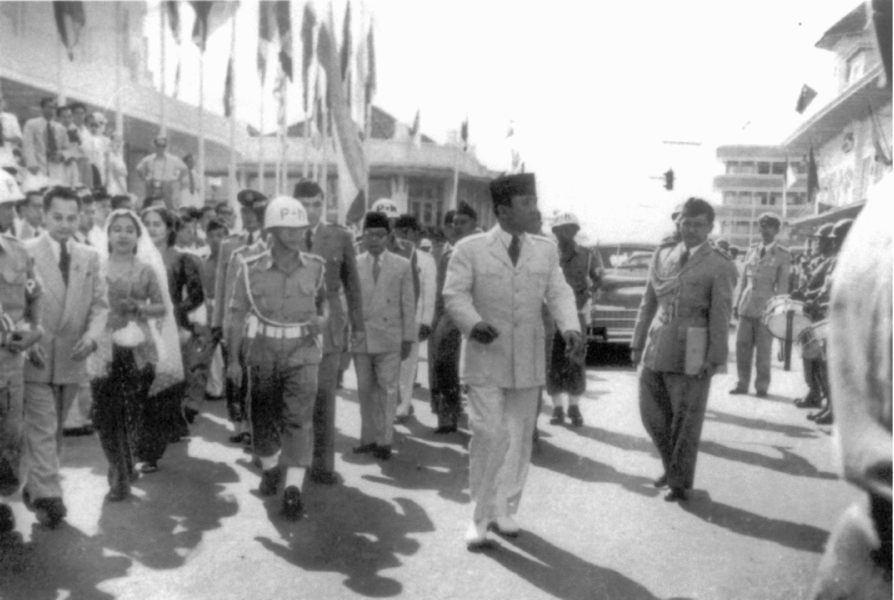
In the midst of this generally festive atmosphere, the most memorable instance of ‘ritual citation’ emerged from the conference—the famous ‘walk’ made by delegates to the Freedom Building along Jalan Asia Afrika (see Figure 4). It all came about because the Joint Secretariat had asked the delegates to walk from Hotel Savoy Homann (50 metres away) or Grand Hotel Preanger (100 metres away) to attend the plenary session to avoid traffic congestion around the Freedom Building at the opening ceremony of the conference. Those key leaders who were given individual residences further north in the conference zone, arrived in their Mercury cars to Jalan Asia Afrika, and got out to walk the final few yards to the Freedom Building.Footnote 56 As if on cue, delegates emerged from the hotels in separate national units—so the audience could watch the spontaneous procession of different national groups. To the delight of the crowd, some delegations were clothed in their national dress. It is this brief walk that became the most iconic ‘site/sight of interaction’ between the Asian and African leaders and the people of Bandung, when the latter could enjoy the sight of these famous statesmen at close quarters, wave at them, take photos of them and, if very lucky, get their autographs and even a handshake. The spontaneity of the occasion produced powerful visual imagery of the great men of Asia and Africa striding purposefully towards the Freedom Building amidst cheering local crowds, and came to represent the iconography of the Bandung Conference in later years.
President Sukarno (with Vice-President Hatta and Mrs Fatmawati Sukarno in white veil) arriving at the Freedom Building.
Source: Bidakara Savoy Homann Hotel.
The local newspaper described the scene:
In the early morning, they [the people of Bandung] gathered in the street in front of Homann and Preanger, the traffic is not a problem because only cars with the special sign can pass through Jalan Asia Afrika. But on this special day, there is no car in front of Freedom Building. A file of military personnel and the military band lined up neatly in front of the conference building, and kept the road open for the state representatives. Representatives…go from Hotel Homann to Freedom Building, and they walk like dignitaries. Both on the left and right side, policemen in uniform accompany them. Delegations wear a variety of clothes, each according to their national dress. Cambodia and Vietnam attracted a lot of attention because we rarely, if not never, see their national dress. Cambodia with the white jacket and black long pants and long shoes, and Vietnam wore some kind of a robe in yellow colour. But the most unique is the clothes of…the Minister from the Gold Coast. His black skin is covered by yellow and green cloth, which gives a contrast.Footnote 57
Nehru, Nasser and Zhou Enlai easily won the popularity poll—they were the biggest crowd-pullers and crowd-pleasers. No doubt part of their charisma can be explained by the fact that these very men embodied the power and the spirit of a nationalist or revolutionary struggle. One local Chinese woman exclaimed excitedly, ‘I want to see Zhou Enlai!’Footnote 58 Although she was standing in the glaring midday sun, she looked contented to have secured a place at the front in order to get a good view of the handsome leader from China. On the visual impact of Zhou, Star Weekly (a Chinese magazine published in Indonesian) wrote excitedly, ‘people could not stop talking about Zhou's eyebrows which were thick and black’.Footnote 59 Nor could the people stop talking about his light grey jacket. Zhou wore the Mao suit when he was conferencing, but when invited to meet the local Chinese population, he dressed in a Western suit.Footnote 60 Thus, Zhou consciously manipulated his dress according to different political audiences, underlining the importance of the politics of dress.Footnote 61 It is worth mentioning that Bandung had a substantial local Chinese population of around 40,000 by 1945, as the second largest ethnic group.Footnote 62 Notably, Indonesia's distance from China shrank substantially during this period, resulting in the signing of the first trade agreement in 1953, and the historic signing of the Sino-Indonesian Dual Nationality Treaty in Jakarta by Zhou immediately after the Bandung Conference.Footnote 63
An interesting example of the power of communication can be seen in the case of the ritual created spontaneously between Nehru and the crowd. Every time Nehru waved at the crowd, the latter would respond with a chorus of ‘Merdeka, pak!’ (Freedom, sir!).Footnote 64 In fact, ‘merdeka’ or ‘freedom’, a rallying call associated with the Indonesian revolution, became a bonding call during the AAC because on many other occasions, the crowd took to responding enthusiastically to statesmen with ‘merdeka!’Footnote 65 Needless to say, Sukarno and Vice-President Hatta were both greeted every time with an enthusiastic ‘merdeka!’ by the crowd.Footnote 66 On the opening day, Zhou had not quite realized that he had to perform to the crowd as he promptly went inside the Freedom Building without waving at the crowd. Upon realizing his mistake, he quickly did a retake of this entry, by immediately reappearing at the top of the steps of the building and waved at the crowd, so that they could see his face.
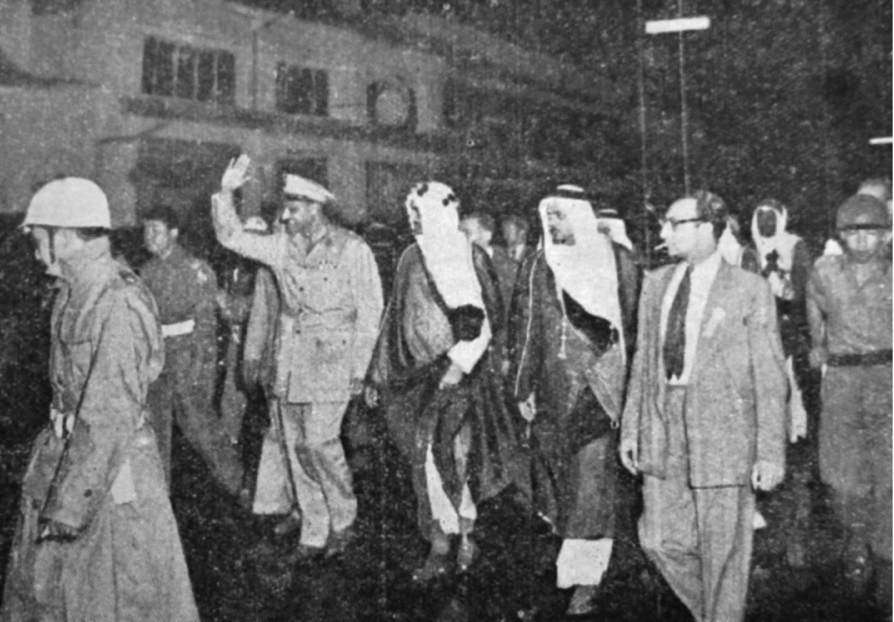
On the other hand, Gamal Abdel Nasser elicited an adoring gaze from the crowd of a different order (see Figure 5). Nasser was a young revolutionary icon of the time, ‘with his virile appearance and his military uniform, he received special attention. His kind face and his smile and his hand which was always waving, make him very popular, and he is only thirty-seven years old…’.Footnote 67 His infectious smile was a potent diplomatic weapon, with which he won over the crowd time and time again. A gushing fan said, ‘No wonder he can start a revolution in Egypt…his body is so virile, his hand is so strong that it can destroy steel’.Footnote 68 Thus, somehow the very body of Nasser is seen to symbolize the virility of the new Egypt. Indeed, Nasser's stature as a leading statesman of the Arab world was consolidated, no doubt in part due to the strong stage performance he gave at Bandung.Footnote 69
Nasser on the Freedom Walk with Prince Feisal of Saudi Arabia.
Source: Buku Peringatan Konperensi Asia-Afrika, Inhua, Jakarta, 1955.
Therefore, the walk—more appropriately termed as the ‘Freedom Walk’ (Merdeka Walk) is significant for our purpose of understanding the power of performance in international diplomacy. It acted as a crucial form of non-verbal communication between the leaders and the crowd, its symbolic meaning reaching out even to audiences globally who observed this performance through the media. ‘Walk’, ‘wave’, ‘smile’ are all integral components of non-verbal communication.Footnote 70 According to Michael Braddick, ‘gestures can be a powerful means of communicating affirmation and solidarity…’. Moreover, ‘gesture serves as a means of assertion for individuals in themselves, or as embodiments of a group—the gentry, the godly, or the nation, for example’.Footnote 71 Accordingly, these physical movements speak out to the people as non-verbal forms of communication, and create a spontaneous shared space between the leaders and the people. Indeed, charismatic leaders like Nasser understood well the value of communicating and reaching to the public in this manner. Creating a rapport with the local audience was an extremely effective way of creating a rapport by proxy with national and international audiences. Also, some of these leaders knew how to develop a special rapport with the crowd, and for the crowd to feel that they were not just celebrities but an embodiment of their body politic. People felt an emotive bond with them, overcoming national boundaries.
One final point to make about the walk is that it acted as ‘a parade of nations’. Just as the still photograph of the twenty-nine flags of the participating nations flying at Jakarta's Kemayoran Airfield symbolized the birth of Afro-Asia (Figure 1), the Freedom Walk of twenty-nine national delegations represented the ever-expanding group of nations that made up Afro-Asia. The fact that Sudan and the Gold Coast attained independence in 1956 and 1957 respectively makes this walk even more poignant. Hence, the walk was replete with symbolic weight: on the one level, it can be seen as a walk to freedom for the participating nations, the attaining of freedom symbolized by the Freedom Building; on another level, for those nations still fighting to attain independence, it was a visual performance of the political process of decolonization that they were going through at that time. Because many of these delegations decided to emphasize their national identity by wearing their national dress for the Opening Ceremony, the Freedom Walk turned into a striking theatrical ‘parade of nations’ capturing public fascination.
Conclusions
To this day, the Bandung Conference stands as the most significant moment for Indonesian diplomacy. Incontrovertibly, the fact that the conference took place in Bandung, Indonesia, had a significant impact on the way it was organized, implemented and enacted as an international diplomatic event. Indeed, much has been made in the existing literature about the theatricality of Indonesian political culture, as influential works by Clifford Geertz, for instance, have argued.Footnote 72 This concluding section considers how the Indonesian political context worked as an underlying ‘script’ to the diplomatic theatre in Bandung. To this end, focus will be on three themes, namely the ‘unity’ of the Republic, Sukarno's role, and the first Indonesian general elections. Ultimately, the symbolic significance of the conference was paramount to Indonesian national politics.
Acting as the principal host to the Bandung Conference, the newly established Republic of Indonesia had created for itself a considerable political capital, first and foremost, as the undisputed legitimate government of the Indonesian archipelago in the eyes of the international community. The Republic's position as the legitimate unitary government of the Indonesian archipelago was not entirely secure in 1955, mainly because of the challenges mounted against the federal state by a number of autonomous regions. It has been suggested previously that the conference was held in Bandung partly to reinforce the presence of the Republic in the heartland of the Darul Islam Movement. This forthright demonstration of the Republic's legitimacy might have been enacted for the benefit of other autonomous regions, namely Aceh, Sulawesi, South Maluku and Kalimantan. To this extent, Sukarno was in large part preaching to the Indonesians when he repeatedly emphasized the fundamental importance of the ‘Unity in Diversity’ (Bhinneka Tunggal Ika) in his opening speech of the conference on 18 April:
Sisters and Brothers, Indonesia is Asia-Africa in small. It is a country with many religions and many faiths. We have in Indonesia Moslems, we have Christians, we have Civa-Buddhists, we have people with other creeds. Moreover, we have many ethnic units such as Achenese, Bataks, Central Sumatrans, Sundanese, Central Javanese, Madurese, Torajas, Balinese, etc. But thank God, we have our will to unity. We have our Pancha Sila. We practice the ‘Live and let live’ principle, we are tolerant to each other, Bhinneka Tunggal Ika—Unity in Diversity is the motto of the Indonesian state. We are one nation.Footnote 73
Moreover, the strength of the unity of the Republic and the accompanying international approbation through the success of the conference would also give major impetus towards a favourable resolution of the West Irian issue, which was fast embraced as a new goal of Indonesian nationalism.
Thus, the conference became an important ‘political theatre’ where the Republic mobilized many signs of Indonesian nationalism to muster popular support and acceptance of the new regime. Symbolic performances of the Republic included the staging of the conference, the creation of the AAC zone, and flagging the revolutionary symbol of ‘merdeka’ (freedom) as the new national symbol of Indonesia, by renaming the Freedom Building and Jalan Asia Afrika, for instance. We have witnessed the effectiveness of ‘merdeka’ as a unifying call because of the enthusiastic responses of the people of Bandung.Footnote 74 These ‘performative’ acts of independence and nationhood helped to reinforce the sense of unity in the Republic by rekindling recent popular experiences of the Indonesian revolution, whilst at the same time, they acted as symbols of unity of the Afro-Asian world by reinforcing the sense of solidarity of the twenty-nine nations.
Sukarno was a superb actor, who not only understood the importance of ‘performance’ and ‘performativity’ in his brand of revolutionary politics but, also, in the self-construction of the revolutionary icon—‘Sukarno’. After independence, Sukarno's speeches became even more syncretic or, for the want of a more accurate term, ‘pan-Indonesian’, by the inclusion not only of Dutch and Western words but also other regional languages of the Indonesian archipelago.Footnote 75 Therefore, his approach to constructing a collective Indonesian identity through his national slogan of ‘Unity in Diversity’ was most exuberantly reflected in the way he chose to speak to the Indonesian people. The Bandung Conference played an important role for Sukarno because it enabled him ‘to appear, once again, as the great unifier—as the leader of a united nation, which was, itself, emerging as a leader of the third world’.Footnote 76 Indonesia's central role in the conference left a lasting impact on the mentality of the Indonesian elite as it gave them a sense of self-importance and pre-ordained purposefulness in world affairs as leaders of the Afro-Asian world.Footnote 77 Typically, Sukarno himself explained it simply: ‘The Afro-Asian countries look up to Indonesia. Many have adopted our Pantja Sila. They respect our tough stand’.Footnote 78 According to his biographer, J. D. Legge, Sukarno ‘became almost a personification of the idea of “Indonesia” and symbol of the national challenge to the mystique of colonial authority’, to the extent that ‘he staked his claim to be one of the major spokesman for the whole Afro-Asian world’ at Bandung.Footnote 79 Ultimately, the grand scale of the conference and the symbolic vision of Afro-Asia it successfully projected had an unmistakable hand of Sukarno’s.Footnote 80
One of the most significant considerations in interpreting Indonesia's role at the Bandung Conference was the first general election on 29 September 1955. In 1954–1955, therefore, all politicians in Indonesia operated with one eye on the forthcoming elections, and all political considerations were affected by this, including the Bandung Conference. In the months immediately preceding the conference, the political opposition (mainly Masyumi and the Socialist Party of Indonesia) attempted repeatedly to discredit the Ali Sastroamijoyo Cabinet for using the conference as a ‘delaying tactic’ in the holding of the elections, which had been delayed for the umpteenth time, as the cabinet focused on the AAC alone from January 1955.Footnote 81 Prime Minister Ali Sastroamijoyo regarded Indonesia's bold bid for a leadership role in internationalism as an extension of its nationalist goals.Footnote 82 As the general election approached, all the key political parties had made the Bandung Conference a central plank for their professed anti-colonialist policies.Footnote 83 Feith argues that Indonesia came out of the conference extremely well as ‘[d]iplomatic professionalism and the symbols of anticolonialism proved to be a powerful combination’.Footnote 84 Sure enough, Sukarno's speech to celebrate the Republic's independence on 17 August 1955, the annual event of the Indonesian political calendar, made explicit references to the role that Indonesia and, by extension, he himself had played in the conference: ‘Under the schedule of Asia Africa Conference, the Republic of Indonesia has contributed to eliminating some of the international tensions and now we can continue to create mutual understanding and world peace’.Footnote 85 In this sense, it may not be an exaggeration to say that ‘diplomatic performances’ by the Republic's leaders made a considerable impression on the Indonesian electorate as the conference created a golden opportunity for public relations, hobnobbing with world statesmen such as Nehru, U Nu, Zhou, Nasser, and Mohammed Ali, helping to project Indonesian leaders as world leaders.
Furthermore, the role of the people (rakjat) has been central in the Indonesian narrative of national revolution.Footnote 86 Sukarno in particular had staked his entire political legitimacy on the unique relationship he had established with the people, especially as the physical proximity of the people to leaders was considered fundamental to revolutionary dynamics in Indonesia. From this perspective, it made political sense to allow the people of Bandung proximity to famous world leaders as evidenced in the Freedom Walk, as if to let the Indonesian people enjoy the fruit of Indonesian independence. This underlines the importance of the people of Bandung as role-players in the conference, demonstrating popular support for the diplomatic theatre at Bandung.
Understanding the Indonesian ‘script’ of the Bandung Conference helps to illuminate symbolic meanings in the performative dimensions of international diplomacy conducted at the conference, which was mobilized in part to meet political exigencies facing the Republic in 1955. To this end, the framework of ‘diplomacy as theatre’ offers a valuable heuristic device to explore the production and reproduction of symbolic meanings generated by acts of diplomatic performance. Understanding symbolic meanings of diplomatic events has long been under-developed as a field of intellectual enquiry. We need to give more thought to exploring new ways of making sense of normative legacies of international diplomacy.