Prolongation of the QTc is shown to increase the risk of cardiac arrhythmias and sudden cardiac death.Reference Garson, Dick and Fournier1 Krasner et alReference Krasner, Girdwood and Smith2 reported a transient increase in the QTc among 24 adult patients undergoing elective mitral valve replacement that lasted for 2 days after cardiopulmonary bypass. Of note, in this subset of patients, there was a positive correlation between a prolonged QTc and arrhythmia, specifically ventricular extrasystoles and bigeminy. The pre- to post-operative QTc change was statistically higher in this subgroup. QTc prolongation is seen among some of our children undergoing open heart surgery for the treatment of congenital cardiac disease. However, to our knowledge, no one has performed a detailed characterisation of QTc changes after cardiopulmonary bypass among children with congenital cardiac disease. The primary aim of this study was to prospectively determine whether there is a change in QTc on pre- versus post-operative electrocardiograms following surgery for congenital cardiac disease. In addition, a secondary aim was to identify predictor variables that correlate with changes in the QTc. Specifically, we hypothesised that this prolongation may be related to cardiopulmonary bypass time. Finally, we sought to determine whether there is a difference in outcome variables such as incidence of post-operative arrhythmias, length of intensive care unit stay, and length of hospital stay that were associated with perioperative QTc changes.
Methods
Subjects
Routinely performed pre- and post-operative electrocardiograms were prospectively analysed on all patients under 18 years of age undergoing cardiopulmonary bypass for congenital cardiac disease between October, 2006 and June, 2007 at a single centre. This 9-month sampling period was selected based on the availability of the researchers and accessibility of the data. Subjects were excluded from analysis if there was a new bundle branch block, ventricular pacing postoperatively, or an uninterpretable electrocardiogram as these outcomes precluded meaningful pre- and post-operative QTc comparison. For the included patients, serial electrocardiograms in accordance with standard clinical practice were analysed as part of the study during their hospital stay. The pre-operative electrocardiogram was collected at the pre-operative visit while the very first electrocardiogram performed on the day of surgery was deemed to be the post-operative electrocardiogram. None of the patients received antiarrhythmic medications or other agents known to prolong the QT interval in the perioperative period.
Collected data
The primary outcome variable studied was QTc on pre- and post-operative electrocardiograms. Secondary outcome variables including arrhythmia, diminished cardiac function, duration of mechanical ventilation, and length of intensive care unit and hospital stay were also collected. Predictor variables included cardiac diagnosis, specific cardiothoracic procedure with attention to those requiring coronary manipulation, cardiopulmonary bypass time, cross-clamp time, use of modified ultrafiltrate, all perioperative medications, and all perioperative electrolyte measurements. The electrolyte data were obtained in the intensive care unit at the time of the post-operative electrocardiogram.
Electrocardiogram data
QTc was measured in all leads and corrected using Bazett's formula.Reference Bazette3 In cases where the end of the T-wave was ambiguous, the point in which the steepest slope of the descending limb of the T-wave bisects the isoelectric line was used to establish the termination of the T-wave.Reference Postema, De Jong, Van der Bilt and Wilde4 Lead II QTc measurements were utilised for analysis when the electrocardiogram signal was interpretable. Otherwise, QTc measurements from leads V4 or V5 were used. Measurement of the QRS duration was also obtained pre- and post-operative intervention to ensure that changes in the QTc were not secondary to changes in QRS duration.Reference Berul, Sweeten, Dubin, Shah and Vetter5, Reference Rautaharju, Zhang, Prineas and Heiss6 For any patient with an increase in post-operative QRS duration, the measured QT interval was adjusted to account for the change in QRS duration as follows:

where ΔQRS duration = post-operative QRS duration−pre-operative QRS duration in milliseconds. The adjusted QT interval is then corrected for rate using Bazett's formula as described above. Despite patients with the new right bundle branch block being excluded from the primary analysis, for completeness, the JTc was measured on the pre- and post-operative electrocardiograms performed on these patients and compared using 360 milliseconds as the upper limits of normal.Reference Berul, Sweeten, Dubin, Shah and Vetter5 The final measured electrocardiogram variable was change in ST segment elevation or depression. Any post-operative ST segment change that was greater than 2 millivolts was considered significant. To minimise bias, the observer performing the electrocardiographic measurements was blinded to the study date and therefore unaware of which electrocardiogram was performed pre- or postoperatively.
Statistics
The rates of QTc prolongation before and after surgery were compared using McNemar's test. All categorical risk factors for QTc prolongation were compared using Fisher's exact test. When multiple comparisons of categorical risk factors were necessary, the Freeman–Halton test was implemented. A Student's t-test was used to compare continuous data sets when the variances were similar, whereas the unequal t-test with Satterthwaite's adjusted degrees of freedom was used for continuous data comparison with unequal variances. Pre- and post-change scores in QTc, JTc, and QRS duration were assessed using paired t-test. The percentage of patients with JTc greater than 360 milliseconds was compared pre- and postoperatively using Fisher's exact test. This JTc value represents two standard deviations above the mean.Reference Berul, Sweeten, Dubin, Shah and Vetter5 A subset of the study patients was randomly selected and the QTc measurement was obtained by a separate blinded observer. A Pearson's correlation coefficient was established between the two observers’ measurements and the percentage of agreement. The two observers’ QTc measurements were highly correlated with an R 2 of 0.85 and p-value of less than 0.0001 with an inter-observer difference of 5.9%.
Change in p-values of less than 0.05 was considered to be statistically significant. All statistical calculations were performed using SAS Enterprise Guide 4.2 and SAS 9.2 (SAS Institute Inc., Cary, North Carolina, United States of America).
Results
Subject characteristics
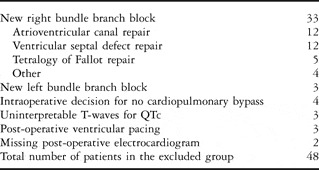
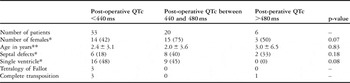
A total of 107 consecutive patients meeting initial inclusion criteria were enrolled during the study period. We excluded 48 patients from the analysis due to one or more exclusion criteria as shown in Table 1. QTc analysis was performed on the remaining 59 patients as shown in Tables 2 and 3 that form the basis of this study. Table 2 provides a synopsis of the demographic data using comparisons of the patients with new QTc prolongation to those without new QTc prolongation. Septal defects and single ventricles constituted 41 out of the 59 patients, and therefore statistical comparisons were made for these groups. However, no particular lesion was associated with new QTc prolongation. None of the single ventricle patients had QTc prolongation greater than 480 milliseconds. A somewhat larger proportion of females was noted in patients with post-operative QTc between 440 and 480 milliseconds; however, this did not achieve statistical significance. The age of the patients in each subgroup was not different.
Reason for excluded patients.

Patient demographics.

Data are presented as numbers and percentages (in parentheses) or mean ± standard deviation
Comparison were made using the Freeman–Halton test* and ANOVA test**
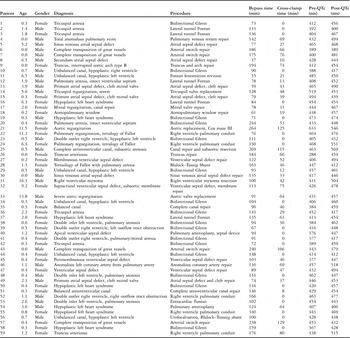
Study patients’ diagnosis, procedure, cardiopulmonary bypass/cross-clamp time, and pre- and post-operative QTc measurements.

QTc measurements
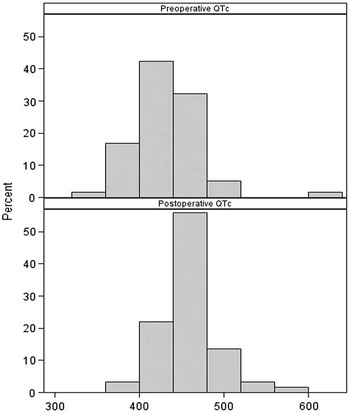
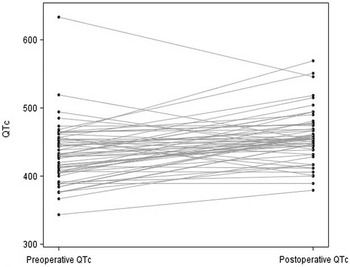
The pre- and post-operative measurements of QTc were symmetrical, approximately normally distributed, but contained a few outliers (Fig 1).
Histograms of pre- and post-operative QTc values show an approximate normal distribution. Comparison of values were made with a paired Student's t-test.

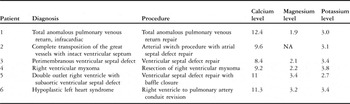
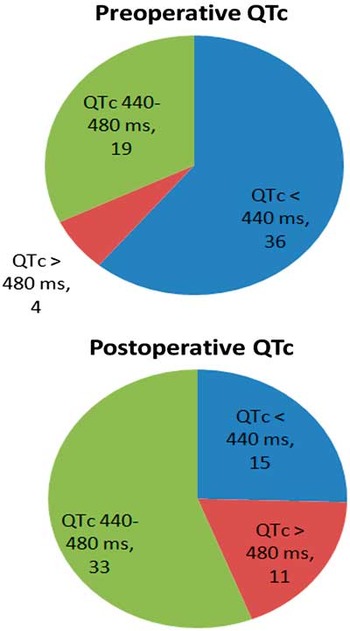
The average of all post-operative QTc measurements was 25 milliseconds longer than the pre-operative values. The 95% confidence limit measured 15–36 milliseconds with a p-value of less than 0.0001. The average pre- and post-operative QTc measurements were 432 and 457 milliseconds, respectively. There were 26 of 59 patients (44%) who had new QTc prolongation greater than 440 milliseconds; 6 of 59 patients (10%) had new post-operative QTc prolongation greater than 480 milliseconds. The principal diagnosis and procedure for the six patients with new QTc prolongation greater than 480 milliseconds are noted in Table 4. Patient 5 listed in this table had a low potassium level; however, the follow-up electrocardiogram showed a QTc of 493 milliseconds despite electrolyte correction. Only one patient, patient 2, had a procedure involving coronary manipulation. Despite Figure 2 showing that some of the children's QTc values regressed to the mean, a larger proportion of patients had QTc prolongation postoperatively (75%) compared to those with QTc prolongation preoperatively (38%). These differences in proportions reached statistical significance given a p-value less than 0.001. Figure 3 shows the proportions of QTc measurements pre- and postoperatively.
Diagnosis and procedure for patients with new QTc prolongation >480 ms.

The QTc scores regress to the mean, exemplified by the larger scatter in values in the baseline compared to the final measurements.

Pre- and post-operative count of patients with QTc values that are normal, between 440 and 480, and greater than 480 milliseconds. Proportions were compared using McNemar's test.

QRS duration and ST segment changes
There was no significant difference between pre- and post-operative QRS duration with a p-value of 0.12 in the study cohort. A total of 11 patients had an increase in the QRS duration postoperatively with a range of 10–30 milliseconds. After correcting for changes in the QRS duration, three patients initially characterised as having post-operative QTc greater than 440 milliseconds now had adjusted QTc values in the normal range. None of the patients with QTc measurements greater than 480 milliseconds were affected by adjusting for QRS duration. The ST segments were depressed by 2 or more millivolts in only six patients. The average post-operative QTc for these patients – 463 milliseconds – was not significantly different from those without ST segment changes – 456 milliseconds with a p-value of 0.76.
JTc measurements
The largest group of patients were excluded from the study on the basis of the new right bundle branch block. For completeness, an analysis of JTc measurements before and after surgery was performed on this group of 33 patients who were otherwise excluded from the analysis. The mean JTc for the group was 320 milliseconds preoperatively and 370 milliseconds postoperatively. This 50-millisecond difference was statistically significant with a p-value of 0.0001. Of the 33 patients who were excluded due to the new right bundle branch block, 16 had a JTc greater than 360 milliseconds postoperatively, whereas only 4 of the 33 patients had a JTc greater than 360 milliseconds preoperatively. The p-value for this comparison measured 0.0029.
Outcomes
Of the 26 study patients with new post-operative QTc prolongation, the majority (67%) normalised their QTc within an average of 60 hours after the first post-operative electrocardiogram. Of the six patients with new post-operative QTc prolongation greater than 480 milliseconds, only one had normalised by the time of discharge. In the remaining five patients, serial post-operative electrocardiograms showed QTc measurements trending downwards but still ranged 452–464 milliseconds at the time of discharge. None of the patients with QTc prolongation greater than 480 milliseconds had post-operative arrhythmia. There was one patient with QTc prolongation greater than 440 milliseconds who had one episode of non-sustained ventricular tachycardia in the early post-operative period that did not require therapy. This patient had an aortic valve replacement and was noted to have mild to moderately depressed systolic ventricular function by echocardiogram. Patient 21 had a pre-operative history of atrial fibrillation; however, she had no post-operative arrhythmia. Of note, the pre-operative QTc measured greater than 600 milliseconds in this patient. None of the patients had a pre-operative history of ventricular arrhythmia. Patients with QTc prolongation did not have a prolonged intubation time, intensive care unit level of care, or hospital stay when compared to patients with normal QTc values postoperatively.
Risk factors for post-operative QTc prolongation
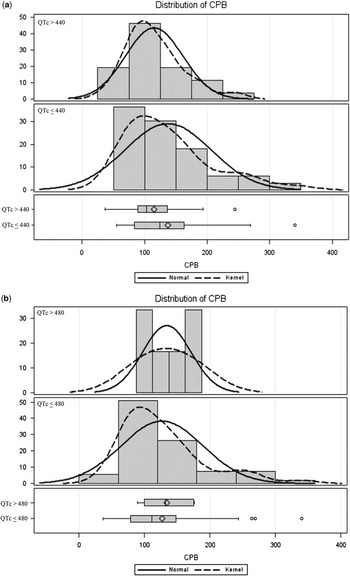
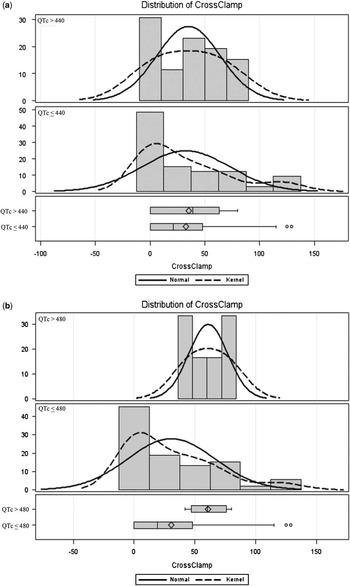
The mean cross-clamp and cardiopulmonary bypass time for patients with new QTc measurements over 480 milliseconds were 61 and 134 minutes, respectively.
These patients had, on average, 30 minutes more cross-clamp time than those with QTc measurements less than 480 milliseconds with a p-value of less than 0.003. The cardiopulmonary bypass time was 7 minutes longer in those patients with new QTc prolongation greater than 480 milliseconds; however, this difference did not achieve statistical significance with a p-value less than 0.78 (Figs 4 and 5). Cross-clamp time was not statistically different when comparing patients with and without new QTc prolongation greater than 440 milliseconds; the actual average cross-clamp time measured 35 versus 32 minutes, respectively, with a p-value of less than 0.78. Similarly, cardiopulmonary bypass time was also not significantly different between these patients with and without new QTc measurements greater than 440 milliseconds; the average cardiopulmonary bypass time measurements were 115 versus 137 minutes, respectively, with a p-value of less than 0.15 as shown in Figures 4 and 5.
(a) Cardiopulmonary bypass time versus presence of QTc prolongation greater than 440 milliseconds. (b) Cardiopulmonary bypass time versus presence of QTc prolongation greater than 480 milliseconds. Comparison made with Student's t-test and unequal t-test with Satterthwaite's adjusted degrees of freedom.

(a) Cross-clamp time versus presence of QTc prolongation greater than 440 milliseconds. (b) Cross-clamp time versus presence of QTc prolongation greater than 480 milliseconds. This comparison was noted to be statistically significant with a p-value of 0.003. Comparison made with Student's t-test and unequal t-test with Satterthwaite's adjusted degrees of freedom.

The mean cross-clamp time for all included patients measured 33.6 minutes with a standard deviation of 4.6. There were four patients who had a cross-clamp time greater than 2 standard deviations above the mean. After excluding these four patients, the remaining 55 had a pre-operative QTc of 428 milliseconds and a post-operative QTc of 455 milliseconds. This 27-millisecond difference was statistically significant with a p-value of less than 0.001. Thus, when controlling for excessively high cross-clamp time, the QTc remains increased postoperatively.
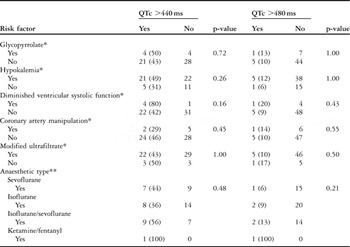
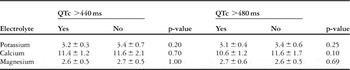
Additional variables including medications, electrolyte abnormalities, and ventricular dysfunction were investigated to determine any statistical associations with a new QTc prolongation. None of these variables achieved statistical significance (see Tables 5 and 6). There were seven patients who had procedures that required a form of coronary artery manipulation. These operations were an arterial switch procedure for four patients, an aortic valve replacement for two patients, and an anomalous left coronary artery repair for one patient. Table 3 again describes the procedures for the included patients. None of these procedures had a statistical association with new QTc prolongation of either greater than 440 or 480 milliseconds as shown in Tables 5 and 6.
Risk factors for new post-operative QTc prolongation.

Data are presented as numbers and percentages (in parentheses)
Comparison made using the Fisher's exact test* and Freeman–Halton test**
Two patients were missing glycopyrrolate data. One patient had no post-operative echocardiogram to assess ventricular function
Electrolyte levels for patients with and without new post-operative QTc prolongation.

Data are presented as mean ± standard deviation
Discussion
Transient prolongation of the QTc indeed occurs in a proportion of children after cardiothoracic surgery for congenital cardiac disease. A subset of patients develop QTc prolongation greater than 480 milliseconds. Despite not being shown in this study, it is generally believed that this degree of prolongation may put patients at risk for ventricular arrhythmias.Reference Schwartz, Moss, Vincent and Crampton7, Reference Priori, Schwartz and Napolitano8 Like Krasner et al's study,Reference Krasner, Girdwood and Smith2 our study shows that in the majority of our patients, this phenomena is transient in nature. Significant QT prolongation was associated with longer cross-clamp time. Despite the precise aetiology of this phenomenon being unknown, one may speculate that this association of higher cross-clamp time with new QTc prolongation greater than 480 milliseconds is related to transient ischaemia during the surgical intervention. The hypothesis that QTc prolongation may be related to the length of ischaemia is in keeping with other studies that have shown transient prolongation of QTc during myocardial infarction and balloon coronary angioplasty in adult patients.Reference Kenigsberg, Khanal, Kowalski and Krishnan9, Reference Kawabata, Hirao and Takeshi10 In addition, there are case reports of patients presenting with QT prolongation during myocardial ischaemia that resolved after a coronary intervention.Reference Bijl and Verheugt11, Reference Rebeiz and Al-Khatib12 Interestingly, our study did not show an association between those procedures requiring direct coronary artery manipulation and QT prolongation. Other factors may influence the QTc prolongation as the QTc increase was still noted when controlling for patients with very high cross-clamp times.
Our study is underpowered to definitively determine the frequency of adverse events related to this transient QT prolongation, but our anecdotal experience and the results of this study suggest that this phenomenon does not pose a significant risk to the majority of patients because of its transient nature and the highly monitored environment of the post-operative setting.
In individuals in whom QT prolongation persists at hospital discharge, careful follow-up with repeat electrocardiography seems prudent to document normalisation of the QT interval. In those patients whose corrected QT interval remains prolonged, formal assessment by a cardiologist experienced in the diagnosis and management of long QT syndrome is warranted.
Limitations
Our study is limited by the fact that electrocardiograms were obtained based on clinical indications rather than study design, despite the prospective nature of the trial. In addition, since only one electrocardiogram was obtained per day, the time to normalisation could be overestimated in this study. The study exclusion criteria also created a potential selection bias in that patients with certain congenital cardiovascular lesions were eliminated from the study in greater numbers than others. For example, patients with ventricular septal defect, complete atrioventricular canal, and tetralogy of Fallot tended to be excluded in greater numbers due to the new right bundle branch block patterns frequently incurred during these procedures. In a post hoc analysis, these excluded patients had a prolongation in JTc after surgery. Finally, this study did not address follow-up after discharge from the hospital, and nor did it assess for genetic abnormalities that may predispose certain individuals to longer QT intervals.
Conclusion
A modest transient increase in the QTc is seen in the majority of children undergoing operative intervention for the treatment of congenital cardiac disease. In almost half of the patients (44%), this QTc prolongation exceeded the normal value of 440 milliseconds. More significant QTc prolongation with QTc values in excess of 480 milliseconds was seen in 10% of the study population. The precise aetiology of QTc prolongation in this setting is unknown; however, it appears to be associated with longer cross-clamp times. Fortunately, in this cohort, the observed QTc prolongation was transient and not associated with clinical adverse outcomes.
Acknowledgement
The authors would like to thank Stephanie M. Moriarty, Cardiac Surgery, Cardiac Nurse Practitioner; Deborah Walter, Cardiac Surgery, Pediatric Nurse Practitioner Cardiology; and Terri Palinkas, Cardiology, Heart Institute Research Coordinator for their contributions.