



Introduction
The jamun (Syzygium cumini [L] Skeels), a member of family Myrtaceae is one of the important underutilized evergreen fruits widely distributed throughout tropical and sub-tropical region in India as well as in certain pockets of the lower Himalayan ranges up to an elevation of 1600 m (Mishra et al., Reference Mishra, Singh, Kumar, Singh, Singh, Swamy and Ghosh2014). It is an important indigenous fruit tree of India, originated from Indonesia and India, now growing abundantly in Southern Asia (Periyathambi, Reference Periyathambi2007) and the Pacific Islands. It is widely cultivated in the Indo-Gangetic plains. Jamun is also known by other common names viz., Java plum, black plum, jambul and Indian blackberry, etc. Jamun has been attributed in the Indian folklore medicine system to possess several medicinal properties (Warrier et al., Reference Warrier, Nambiar and Ramankutty1996). The fruit is a good source of anthocyanins, iron, pectin, phenols and protein (Ghosh et al., Reference Ghosh, Pradhan, Mishra, Patel and Kar2017). Leaves and small twigs are used for feeding cattle, particularly during summer and dry spell.
Jamun tree canopy is characterized by profuse foliage which substantially affects light availability in different inner canopy layers. Owing to cross-pollination and seed propagation, enormous variability is available in jamun with respect to vegetative growth, aspects of spread, leaf shape, tree shape, canopy architecture, fruiting habit, maturity (June–August), fruit yield and quality. New vegetative shoots emerge as terminal growth on the previous season twigs in two distinct flushes, i.e. from February to May and August to October. The flush, which appears in the month of February, provides maximum growth and flowering. Flowering occurs in terminal as well as auxiliary inflorescences on 5-month to 1-year-old branches.
It is one of the most hardy fruit crops that can easily be grown even in areas where other fruits fail to establish (Singh et al., Reference Singh, Bajpai, Singh and Reddy2007). Due to wider adaptability, jamun may be a suitable fruit crop in semiarid, arid, saline, sodic, ravine, degraded and wasteland areas where it is difficult to grow other fruit crops. In climate change scenario, it may be a potential fruit crop for resource-poor areas of tropical and subtropical region.
Jamun is a vigorous tree; hence, canopy management is important for ensuring maximum utilization of light, ease of cultural operations and maximizing the productivity and quality. Crowded canopy in jamun trees causes decreased light availability in different inner canopy layers. This in turn affects flowering, fruiting and productivity. Positive effects of diffuse light on plant growth have been well recognized and have been applied to natural communities (Norman and Miller, Reference Norman and Miller1971; Norman and Arkebauer, Reference Norman and Arkebauer1991). However, so far no information is available about the relative ability of individual leaves to utilize direct vs. diffuse light for photosynthesis (Brodersen et al., Reference Brodersen, Voglmann, Williams and Gorton2008). Effects of direct vs. diffuse light may be different at leaf level as compared to canopy level. Within canopy, light distribution is influenced by direction of light, fraction of diffuse or direct light incident on the canopy as well as canopy architecture (Li et al., Reference Li, Heuvelink, Dueck, Janse, Gort and Marcelis2014). Canopy architecture has substantial impact on light distribution and photosynthesis (Sarlikioti et al., Reference Sarlikioti, de Visser, Buck-Sorlin and Marcelis2011).
In tree crops having multilayered canopy, light availability in different layers is affected by foliage structure as well as canopy architecture (Maddonni et al., Reference Maddonni, Otegui and Cirilo2001; Acreche et al., Reference Acreche, Briceno-Felix, Sanchez and Slafer2009). To enhance gross primary production, direct diffuse light ration is important rather than absolute direct or diffuse light (Bodin and Franklin, Reference Bodin and Franklin2012). However, so far no systematic work has been carried out to find out the impact of crown architecture on light availability, flowering, fruiting, yield and quality of jamun. Hence, the present study was conducted with the objective to study the impact of the different tree crown architectures on flowering, fruiting, yield and fruit quality of jamun in subtropical region.
Materials and methods
The present study was conducted for three consecutive years (2017–2019) at the experimental farm of ICAR – Central Institute for Subtropical Horticulture, Lucknow (India), located at 26° 45′ to 27° 10′ N latitude, 80° 30′ to 80° 55′ E longitude and 123 m above mean sea level. The study area falls under humid subtropical region. Fully grown, 10-year-old jamun trees of the genotype CISH J-37 (Jamwant) planted at 5 m × 5 m spacing (400 plants/ha) were selected for the study.
Experimental plants were planted in pits (90 × 90 × 90 cm) dug during the summer months. Young plants were allowed 3–5 well-spaced scaffold branches 60 cm above from the ground level to develop the main framework. It was followed by pruning to regulate tree size and shape to achieve the desired architecture of the canopy with a network of primary, secondary and tertiary branches. Treatments (i.e. tree architectures – control, open centre and palmette) were imposed from the beginning of the experiment in young plants by removing the undesired branches to properly maintain the desired crown architecture.
Light interception study
Light availability (direct vs. diffuse light) study was conducted with the help of hemispherical photography done by HemiView canopy analyser Version 2.1 (Delta-T Devices Limited, Cambridge, UK). Canon SLR camera with fisheye lens for DCM9 camera was used in the device with linear 180 lens selection. The basic model for the estimation of solar radiation was used for the estimation of direct and diffuse light. The instrument was placed beneath the tree canopy on a tripod 1.5 m above ground level. Light intensity was measured with lux meter (PCE instruments, PCE-LM 4).
Photosynthesis and gas exchange parameters
For the study of gas exchange parameters viz., photosynthesis rate, stomatal conductance, vapour pressure deficit and transpiration rate, CIRAS-3 portable photosynthesis system (PP Systems International, Inc. Amesbury, MA, USA), i.e. infrared gas analyser was used. In CIRAS-3 portable photosynthesis system, ambient conditions were selected for CO2 and H2O reference (chemicals were removed – both CO2 and H2O absorber columns were empty). After approximately 10 min, warm up time system performed several periodic zero and differential balance cycles and gradually stabilized and frequency reduced to every 30 min. After approximately 5 min, CO2 reference, CO2 analysis, H2O reference and H2O analysis were stable. CO2 and H2O differential was 0.0 (±1). Ambient and leaf temperature was same (±0.2°C). Light availability and gas exchange parameters were recorded weekly between 10.00 h and 11.00 h from April to August. Forth fully expanded mature leaf was selected for recording observations. Observations were recorded in 20 leaves (five leaves in each direction viz., east, west, north and south) and five readings were recorded in each leaf. Average of weekly data of each month was calculated and expressed as mean of the particular month. Year-to-year variability in the averaged monthly data was non-significant. Thus, mean monthly data of both the year were pooled and mean values are given in the figures and tables. Performance of trees was consistent during both the years; hence, average of monthly data of both the years has been presented in the tables and figures.
Flowering and fruiting characters
For flowering data, 100 inflorescences in each tree (25 inflorescences in each direction, i.e. east, west, north and south) were tagged in each plant and observations were recorded from tagged inflorescences. Finally, 100 fruits from each tree, i.e. 25 fruits from each direction viz., east, west, north and south were taken for observations and analyses.
Number of days from 1 January to 5% flower appearance has been expressed as days to start flowering and number of days from 1 January to 95% flower appearance has been expressed as days to end flowering. Number of days from 1 January to fruit at pin head stage has been denoted as days to fruit set and number of days from 1 January to fruit at harvesting stage has been mentioned as days to maturity. Fruit length and fruit width were measured with the help digital Vernier calliper. Weight of ten representative fruits of different sizes at ripe stage was recorded with the help of electronic pan balance and average is expressed as fruit weight (g).
Biochemical parameters
Total soluble solids at full ripe stage (ready to eat) was measured with the help of the refractometer and expressed as °Brix. The edible portion of fruits was crushed and homogenized by the pestle and mortar method without peeling off the skin. The homogenized sample was transferred into a 100 ml volumetric flask and 50% ethanol was added to maintain the volume up to the mark. The mixture was shaken manually and then filtered. Filtrate was centrifuged to obtain a clear supernatant liquid, which was subsequently used for the various assays. The extracts were stored at −20°C. All tests were performed within a week. Total anthocyanin contents in fresh (ready to eat) fruits were measured by pH differential method using cyanidin hydrochloride as standard (Cheng and Breen, Reference Cheng and Breen1991). Total phenol contents (TPC) were estimated by spectrophotometric method (Shimadzu UV 2550 spectrophotometer) using Folin–Ciocalteu reagent method (Slinkard and Singleton, Reference Slinkard and Singleton1977). Ascorbic acid estimation has been done by spectrophotometric method using dichlorophenol indophenol dye solution (Davis and Masten, Reference Davis and Masten1991). Scavenging DPPH free radical activity was determined by the method described by Yue and Xu (Reference Yue and Xu2008). An aliquot of 0.2 ml of the test solution was mixed with 1.8 ml of DPPH solution (0.1 mmol/l) in a spectrophotometer cuvette for 30 min at 25°C in the dark. The absorbance was measured at 0 and 30 min under wavelength 517 nm, respectively. Then, the difference of the absorbance was calculated and then converted to μmol of Trolox equivalent/litre based on the standard curve of Trolox. Total dietary fibre content was determined using the AOAC method (Reference Horwithz2005).
The fruit yield of each individual tree was recorded at harvest and average is expressed as fruit yield per tree.
Statistical analysis
The experiment was conducted for three consecutive years (2017–2019) in randomized block design with three treatments (viz., control, open centre and palmette) and seven replications. Two plants were maintained in each replication. Observations were recorded from the same plant for three consecutive years. Data presented are mean of three consecutive year data. Data for each parameter were evaluated for statistical significance using two-way analysis of variance (ANOVA) to compare means, considering training system and parameter as independent variables. The individual parameter among three crown architectures (viz., control, palmette and open centre) has been assessed by computation of least significant difference taking ‘t’ values for error d.f. at the 5% level of significance. Letters given as superscripts in the data indicate statistically significant parameter at 5% (P ≤ 0.05) level of significance. WASP (Web Agri Stat Package) of ICAR – Central Coastal Agricultural Research Institute, India (https://ccari.res.in/waspnew.html) was used for statistical analyses. Group comparison of diffuse light, direct light, leaf area index (LAI), photosynthesis rate (A), stomatal conductance (gs), vapour pressure deficit (VPD), transpiration rate (E) as seven groups, tested for significance over months (April to August) and clustering of these groups, was done. Membership probability of these groups for significance was tested and confirmed by canonical discriminate function.
Results
Significant variation in diffuse light availability beneath the trees of different crown architecture was found. In control trees, diffuse light availability beneath the tree varied from 69.7 ± 2.22% in April to 65.6 ± 2.07% in August. In the palmette canopy, diffuse light availability ranged from 59.3 ± 1.90% in April to 50.4 ± 1.59% in August; whereas in trees with open centre canopy architecture, it varied from 55.0 ± 1.76% in April to 46.0 ± 1.45% in August (Table 1). Quite the reverse, direct light availability in control trees was found to vary from 30.4 ± 0.97% in April to 34.4 ± 1.13% in August. For the palmette trees, it ranged from 40.7 ± 1.30% in April to 49.6 ± 1.64% in August, and in open centre trees, it ranged from 45.0 ± 1.44% in April to 54.1 ± 1.78% in August (Table 2). A non-significant difference was found in the intensity of direct light measured 1.5 m above ground level beside treated and control trees. Intensity of direct light ranged from 139.1 ± 6.05 to 139.7 ± 6.07 watt/m2/s in April to 147.9 ± 6.43 to 148.3 ± 6.45 watt/m2/s in August (Table 3). Miniscule difference in light intensity between treatments might be due to slight temporal variation, wind velocity as well as other environmental factors. In contrast, significant variation in the intensity of diffuse light beneath the trees was observed. During the month of April, it ranged from 2.9 ± 0.12 watt/m2/s in control to 3.5 ± 0.15 watt/m2/s in open centre. Similarly, in August diffuse light ranged from 5.4 ± 0.24 watt/m2/s in control to 5.9 ± 0.26 watt/m2/s in open centre (Table 4). Moreover, radical difference in LAI was also found in control, palmette and open centre trees. In control trees, LAI ranged from 4.1 ± 0.13 in June to 4.6 ± 0.16 in April, in palmette canopy architecture LAI ranged from 2.5 ± 0.08 in June to 3.6 ± 0.12 in April, whereas in open centre trees it was 2.02 ± 0.06 in June and 2.9 ± 0.10 in April (Table 5).
Diffuse light availability at ground level beneath the tree in jamun (Syzygium cumini [L.] Skeels)

Values represent means ± s.e.
Different superscripts denote statistically significant difference (P < 0.05).
Data presented are mean of three consecutive year data (2017–2019).
Direct light availability at ground level beneath the tree in jamun (Syzygium cumini [L.] Skeels)

Values represent means ± s.e.
Different superscripts denote statistically significant difference (P < 0.05).
Data presented are mean of three consecutive year data (2017–2019).
Intensity of direct light in jamun (Syzygium cumini [L.] Skeels) orchard

Values represent means ± s.e.
Data presented are mean of three consecutive year data (2017–2019).
Intensity of diffuse light in jamun (Syzygium cumini [L.] Skeels) orchard

Values represent means ± s.e.
Different superscripts denote statistically significant difference (P < 0.05).
Data presented are mean of three consecutive year data (2017–2019).
Leaf area index (LAI) of jamun (Syzygium cumini [L.] Skeels) tree canopy

Values represent means ± s.e.
Different superscripts denote statistically significant difference (P < 0.05).
Data presented are mean of three consecutive year data (2017–2019).
Ample variation in photosynthesis rate of leaves in control, palmette and open centre trees was found. Instantaneous photosynthesis rate in control trees varied from 9.5 ± 0.35 μmol CO2/m2/s in August to 12.5 ± 0.43 μmol CO2/m2/s in June. In palmette canopy architecture, it was 10.4 ± 0.39 μmol CO2/m2/s in August and 13.5 ± 0.46 μmol CO2/m2/s in June. Similarly, in open centre trees, it ranged from 11.68 ± 0.43 μmol CO2/m2/s in August to 15.7 ± 0.54 μmol CO2/m2/s in June (Table 6). Correspondingly, maximum stomatal conductance was found in open centre trees. Stomatal conductance increased from April to June and then a gradual decline was recorded during the month of July and August. In control trees stomatal conductance ranged from 35.8 ± 1.30 mmol H2O/m2/s in August to 53.7 ± 1.90 mmol H2O/m2/s in June. Similarly, in palmette canopy architecture, it ranged from 47.0 ± 1.69 mmol H2O/m2/s in August to 62.7 ± 2.21 mmol H2O/m2/s in June, and in open centre trees, it varied from 61.3 ± 2.21 mmol H2O/m2/s in August to 88.90 ± 3.14 mmol H2O/m2/s in June (Table 7). Similarly, leaf-to-air vapour pressure deficit (VPD) was maximum in June and minimum in August. In control trees, VPD ranged from 1.1 ± 0.04 kPa in August to 2.3 ± 0.08 kPa in June. In palmette trees, VPD was found to vary from 1.3 ± 0.04 kPa in August to 2.4 ± 0.08 kPa in June. Maximum VPD was found in open centre trees which varied from 1.9 ± 0.06 kPa in August to 3.9 ± 0.13 kPa in June (Table 8). In accordance with this, minimum transpiration rate was found in August and maximum in June. In control trees, transpiration rate varied from 1.2 ± 0.05 mmol H2O/m2/s in August to 1.9 ± 0.06 mmol H2O/m2/s in June. In palmette trees, it was found to vary from 1.6 ± 0.069 mmol H2O/m2/s in August to 2.1 ± 0.07 mmol H2O/m2/s in June and in open centre trees 1.8 ± 0.07 mmol H2O/m2/s in August to 2.6 ± 0.08 mmol H2O/m2/s in June (Table 9).
Net photosynthesis rate (μmol CO2/m2/s) of jamun (Syzygium cumini [L.] Skeels) tree leaves

Values represent means ± s.e.
Different superscripts denote statistically significant difference (P < 0.05).
Data presented are mean of three consecutive year data (2017–2019).
Stomatal conductance (mmol H2O/m2/s) of jamun (Syzygium cumini [L.] Skeels) tree leaves

Values represent means ± s.e.
Different superscripts denote statistically significant difference (P < 0.05).
Data presented are mean of three consecutive year data (2017–2019).
Vapour pressure deficit (kPa) of jamun (Syzygium cumini [L.] Skeels) tree leaves

Values represent means ± s.e.
Different superscripts denote statistically significant difference (P < 0.05).
Data presented are mean of three consecutive year data (2017–2019).
Transpiration rate (mmol H2O/m2/s) of jamun (Syzygium cumini [L.] Skeels) tree leaves

Values represent means ± s.e.
Different superscripts denote statistically significant difference (P < 0.05).
Data presented are mean of three consecutive year data (2017–2019).
Modulation of direct–diffuse light ratio was found to induce early flowering. In open centre trees, flowering was recorded at day 92 ± 1.33 from 1 January, whereas in palmette at day 95 ± 1.33 and in control at day 98 ± 1.67. Similarly, early completion of flowering was also found in open centre trees, i.e. at day 99 ± 1.67 as compared with palmette (at day 103 ± 1.67) and control trees (at day 107 ± 1.67). In open centre trees, fruit set was observed at day 132 ± 1.33, whereas in palmette and control trees at day 135 ± 1.33 and at day 139 ± 1.33, respectively. Days to fruit maturity is important for harvesting and post-harvest management of fruits. In open centre canopy architecture, early fruit maturity was found, i.e. fruits matured at day 176 ± 1.67; whereas in palmette and control trees, fruits matured at day 180 ± 1.67 and 186 ± 1.67, respectively (Table 10).
Impact of crown architecture on days to flowering, fruit set and maturity of jamun (Syzygium cumini [L.] Skeels) pulp

Values represent means ± s.e.
Different superscripts denote statistically significant difference (P < 0.05).
Data presented are mean of three consecutive year data (2017–2019).
In open centre, palmette and control trees, average fruit length was 3.4 ± 0.08, 2.9 ± 0.07 and 2.3 ± 0.07 cm, respectively. Similarly, average fruit width in open centre, palmette and control trees was 2.6 ± 0.07, 2.4 ± 0.07, 2.2 ± 0.07 cm, respectively. Significant variation in fruit weight was also found among all the three canopy architectures. Average fruit weight was 8.3 ± 0.15, 9.6 ± 0.15 and 10.4 ± 0.15 g in control, palmette and open centre trees, respectively. Furthermore, fruit yield per tree was found to vary from 62.3 ± 1.53 kg in control, 73.5 ± 1.65 kg in palmette to 86.7 ± 1.33 kg in open centre trees. Increase in fruit length, width, weight and total yield of open centre canopy architecture might be due to congenial microclimate leading to proper hormonal regulation. In the fruits of different crown architectures, substantial variation in fruit quality traits was also found. Noteworthy, variation was recorded in total soluble solid content of fruit of control, plamette and open centre trees which was 9.0 ± 0.15, 9.9 ± 0.14 and 12.2 ± 0.14°Brix, respectively (Table 11).
Impact of crown architecture on fruit characters of jamun (Syzygium cumini [L.] Skeels) pulp

Values represent means ± s.e.
Different superscripts denote statistically significant difference (P < 0.05).
Data presented are mean of three consecutive year data (2017–2019).
Anthocyanin and TPC in control, palmette and open centre crown architecture varied from 207.7 ± 6.63, 208.3 ± 6.65, 212.5 ± 6.8 mg/100 g and 209.7 ± 7.20, 212.3 ± 7.29, 219.6 ± 7.54 mg gallic acid equivalent (GAE)/g, respectively. In addition, ascorbic acid content was found to vary from 51.3 ± 1.65 mg/100 g in control, 52.9 ± 1.70 mg/100 g in palmette to 54.2 ± 1.74 mg/100 g in open centre. Total antioxidant capacity (DPPH value) ranged from 33.5 ± 1.169 in control, 35.7 ± 1.24 in palmette to 41.3 ± 1.43 in open centre crown architecture. Considerable variation in the fibre content of fruit pulp was also found which ranged from 0.51 ± 0.02, 0.53 ± 0.02 and 0.59 ± 0.02% in control, palmette and open centre crown architecture, respectively (Table 12).
Variation in chemical characteristics of jamun (Syzygium cumini [L.] Skeels) pulp

Values represent means ± s.e.
Different superscripts denote statistically significant difference (P < 0.05).
Data presented are mean of three consecutive year data (2017–2019).
Pictorial illustration of different training systems depicts that open centre canopy architecture harvests maximum available solar radiation (Fig. 1). Group comparison of diffuse light, direct light, leaf area index (LAI), net assimilation rate (A), stomatal conductance (gs), vapour pressure deficit (VPD) and transpiration rate (E) as seven groups tested for significance over months, i.e. April to August, inferred that diffuse light, direct light, LAI, A, gs, VPD and E have significant variations over months (Table 13). ANOVA-based clustering showed that crown architecture had prominent impact on groups 3 and 4 (leaf area index and net assimilation rate) and groups 6 and 7 (vapour pressure deficit and transpiration rate), which were found to aggregate together (Fig. 2). Membership probability again shows high probability of groups 3 and 4 (leaf area index and net assimilation rate) as well as groups 6 and 7 (vapour pressure deficit and transpiration rate) (Fig. 3). In canonical discriminate function, groups 3 and 4 (leaf area index and net assimilation rate) and groups 6 and 7 (vapour pressure deficit and transpiration rate) group together separately which proves the impact of crown architecture on these parameters (Fig. 4).
Pictorial presentation of training systems.

ANOVA for group (diffuse light, direct light, LAI, A, gs, VPD, E) over 5 months

Significance (value < 0.05).
Data presented for each month are the mean of data for that month from three consecutive years (2017–2019).
ANOVA-based clustering of seven groups (diffuse light, direct light, LAI, A, gs, VPD, E). *Groups on the ‘X’ axis: (1) diffuse light, (2) direct light, (3) leaf area index (LAI), (4) photosynthesis rate (A), (5) stomatal conductance (gs), (6) vapour pressure deficit (VPD), (7) transpiration (E).

Membership probability of seven groups (diffuse light, direct light, LAI, A, gs, VPD, E). *Vertical columns show probability of seven member components (groups). Each group is represented by three vertical columns. Groups 1, 2 and 5 have 100% probability, whereas groups 3, 4, 6 and 7 have partial probability. Group 1: diffuse light, group 2: direct light, group 3: leaf area index (LAI), group 4: photosynthesis rate (A), group 5: stomatal conductance (gs), group 6: vapour pressure deficit (VPD), group 7: transpiration (E).

Canonical discriminate function of seven groups. Group 1: diffuse light, group 2: direct light, group 3: leaf area index (LAI), group 4: photosynthesis rate (A), group 5: stomatal conductance (gs), group 6: vapour pressure deficit (VPD), group 7: transpiration (E). Groups 1, 2 and 5 are depicted separately, these groups and their centroid are scattered. Groups 3, 4, 6 and 7 have highest possible multiple correlation and have overlapping centroid.

Discussion
Solar radiation reaching tree top is composed of light (direct and diffuse light) scattered by the atmosphere (Bird and Riordan, Reference Bird and Riordan1986). Intensity of light coming to tree top remains same in all the trees. Leaves in different layers of canopy enhance diffuse light component. Diffuse light increases photosynthesis rate at community level, because of more even distribution of light (Geider et al., Reference Geider, Delucia, Falkowski, Finzi, Grime, Grace, Kana, Roche, Long, Osborne, Platt, Prentice, Raven, Schlesinger, Smetacek, Stuart, Sathyendranath, Thomas, Vogelmann, Williams and Woodward2001; Urban et al., Reference Urban, Janous, Acosta, Czerny, Markova, Navrátil, Pavelka, Pokorný, Šprtová, Zhang, Špunda, Grace and Marek2007). However, positive effect of diffuse light may not be able to compensate for the reduction in the light transmission, as found at leaf level in the present study. Effects of direct and diffuse light on photosynthetic process are different at the leaf and canopy level (Brodersen and Vogelmann, Reference Brodersen and Vogelmann2007). Due to reduction in light level, plant growth and fruit development do not accelerate. Light scattered by canopy has different spectral composition as compared to that diffused by environmental factors (clouds, aerosols and air pollutants, etc.) (Brodersen et al., Reference Brodersen, Voglmann, Williams and Gorton2008), hence this differently affects fruit growth and yield. Under intense direct light, chloroplasts move to periclinal walls, shading other chloroplasts and thus reduce photoinhibition (Gorton et al., Reference Gorton, Williams and Vogelmann1999); this helps to maintain photosynthesis as found in open centre crown architecture. Under diffuse light, chloroplast movement to the periclinal walls is not complete (Williams et al., Reference Williams, Gorton and Witiak2003); this causes lower absorptance (Brodersen and Vogelmann, Reference Brodersen and Vogelmann2007) as evident in control tees. Variation in the availability of direct and diffuse light as well as light intensity in control, palmette and open centre trees affects leaf pigments, metabolites, primary productivity and fruit quality. More leaf area index (LAI) in control trees affects light availability and tree growth in the inner canopy layers (Calvo-Rodriguez and Sanchez-Azofeifa, Reference Calvo-Rodriguez and Sanchez-Azofeifa2016).
Although diffused light increases productivity at the community level, leaf-level photosynthesis rates may be lower as found in the present study (Brodersen et al., Reference Brodersen, Voglmann, Williams and Gorton2008). Studies of canopy light environments (light intensity and diffuseness) and photosynthesis at leaf and canopy scales are challenging (Williams et al., Reference Williams, Rastetter, Pol and Shaver2014). In fact, no studies have been performed in crops grown at different levels of diffuseness with similar incident light intensity on the top of the crop (Li et al., Reference Li, Heuvelink, Dueck, Janse, Gort and Marcelis2014). Different processes are functioning at different levels within the plant community (Brodersen et al., Reference Brodersen, Voglmann, Williams and Gorton2008). At leaf level, diffuse light leads shallow penetration than direct light in sun-grown leaves like jamun. A greater proportion of diffuse light reflects from the surface of leaves, and less light enters the leaf for photosynthesis. The unequal absorptance of direct and diffuse light and the extent to which a change in the directional quality and intensity of light affects photosynthesis at the leaf level is yet not known clearly (Brodersen and Vogelmann, Reference Brodersen and Vogelmann2007). Hence, such studies in fruit tree orchards will help to manage tree crown architecture for enhancing production. Weaker penetration of diffuse light into the mesophyll of sun-grown leaves leads to a more heterogeneous saturation of electron transport capacity and lowers its CO2 concentration drawdown capacity in the intercellular airspace and chloroplast stroma. This decoupling of light availability from photosynthetic capacity under diffuse light generates a decline in photosynthesis (Earles et al., Reference Earles, Théroux-Rancourt, Gilbert, McElrone and Brodersen2017) as found in the present study.
Morpho-physiological characteristics of plant organs such as stomata are affected by their prevailing microclimate (Sultan, Reference Sultan2000; Niinemets, Reference Niinemets2007). Sensitivity of stomata to different light levels varies in different species (Li et al., Reference Li, Kromdijk, Heuvelink, van Noort, Kaiser and Marcelis2016); however, within-species variation in stomatal response to direct and diffused light might be due to variation in microclimate, as found in the present study.
Diffuse and direct light condition differently affects growth and development of reproductive organs. Development of flowers and fruits is adversely affected under shaded condition in inner canopy layers. Delayed flowering and fruiting and poor fruit quality traits in the diffuse light condition (control) found in the present study are in conformity with earlier findings viz., reduced flowering (Jackson, Reference Jackson1980), increased fruit abscission (Byers et al., Reference Byers, Carbaugh, Presley and Wolf1991), reduction in fruit size (Warrington et al., Reference Warrington, Stanley, Tustin, Hirst and Cashmore1996) and reduction in internal fruit quality (Warrington et al., Reference Warrington, Stanley, Tustin, Hirst and Cashmore1996) under shaded/low light condition.
Increase in anthocyanin content of fruits due to crown architecture management might be vital to improve fruit quality. Anthocyanins provide pigmentation to fruits and serve as natural antioxidants (Bagchi et al., Reference Bagchi, Sen, Bagchi and Atalay2004). Edible anthocyanins possess a broad spectrum of therapeutic and anti-carcinogenic properties. In addition, an increase in phenolic compounds was also found which have beneficial effects on health including anti-inflammatory, antiviral, antimicrobial and antioxidant activity. Jamun fruits are good source of ascorbic acid and other natural antioxidants (Benvenuti et al., Reference Benvenuti, Pellati, Melegari and Bertelli2006); an increase in these compounds indicates production of better quality fruits. Slight increase in fibre content in fruits was found, such fruits may help to lower blood cholesterol and reduce the risk of heart disease (Jones et al., Reference Jones, Lineback and Levine2006) and diabetes (Abdul-Hamid and Luan, Reference Abdul-Hamid and Luan2000).
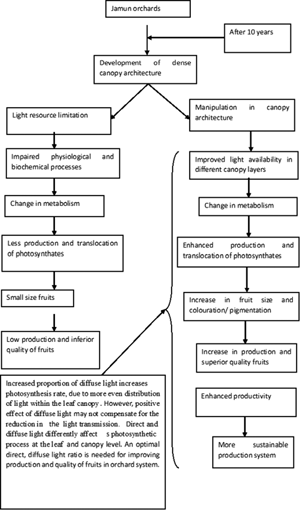
The present study revealed that there is considerable variation in light distribution within the canopy due to crown architecture management which might be contributing to fruit size, yield and quality. Understanding about how diffuse vs. direct light affects photosynthesis and other plant processes in a particular tree crop ultimately helps to determine the proportion of diffuse or direct light a plant receives and needed for enhancing production (Brodersen and Vogelmann, Reference Brodersen and Vogelmann2007). Therefore, it becomes increasingly important to understand how much direct and diffuse light penetrates leaves and how the directional quality of light affects photosynthesis at the leaf level as well as during flowering, fruiting and fruit quality traits.
ANOVA-based clustering approach for similarity aggregation was applied and similar traits were found to cluster together. Moreover, membership probability analysis showed that there was a high probability of the impact of crown architecture on these groups (groups 3 and 4 [leaf area index and net assimilation rate] and groups 6 and 7 [vapour pressure deficit and transpiration rate]). Canonical discriminant analysis, a multivariate technique was used to determine the correlation between these variables and showed that crown architecture significantly affects leaf area index, net assimilation rate, vapour pressure deficit and transpiration rate.
Conclusion
Crown architecture of the tree affects direct vs. diffuse light available to leaves in the inner canopy layers. The effects of direct and diffuse light on plant processes are different at leaf and community level. Understanding the difference in plant processes under direct vs. diffuse light condition may help to predict the response of fruit crops to changing light/environmental conditions and standardize canopy architecture accordingly. Crown architecture management may be a useful strategy to enhance fruit quality and production of underutilized fruit crops like jamun.
Data availability statement
This manuscript is based on basic study; no specific software/data have been used. Data will be made available on reasonable request.
Acknowledgements
The authors are thankful to the Director, ICAR – Central Institute for Subtropical Horticulture, Lucknow (India) for providing necessary facility and keen interest in the study.
Author contributions
A. K. Trivedi: conceptualization, investigation, collection and processing of data, writing original draft. A. K. Singh: curation, writing, review and editing. K. K. Mishra: data collection, methodology, analysis. G. S. Vishen: data collection, methodology, analysis.
Funding statement
The present study was conducted under institute project ‘Conservation and utilization of genetic resources for improvement of Jamun fruits for higher productivity and quality’. Hence, no external financial support was involved.
Competing interests
On behalf of all authors, the corresponding author states that there is no conflict of interest.
Ethical standards
Not applicable.



