Chicago's Jane Addams once observed that ‘the preoccupied adult’ was ‘prone to use the city street as a mere passageway from one hurried duty to another’.Footnote 1 Children playing, she argued, could offer a moment of relief from this. This could also be the case with strikes. As strikers challenged conventional uses of public space, albeit temporarily, they subverted urban power relations, claiming collective rights and refusing to bow to employers’ or police pressure to go back to their homes and workshops.Footnote 2 On the streets, strikers constructed an alternative public sphere, which brought attention to their cause.Footnote 3 Indeed, as this article demonstrates through an examination of garment strikes that swept Chicago in 1910–11 and London in 1912, strikers’ use of urban space informed strategies and contributed to their successes.
Space is important in two main ways. First, the way space is used produces and reproduces economic, political and cultural power. Second, space is also produced through social interaction, and in this way it alters the relations of class, gender and race.Footnote 4 While public space reflects the differential power of capital and the state, space is not always used as corporations, architects, city planners or government bodies intended. Working-class communities, for example, often re-purposed the physical space around them, by turning streets and parks into extensions of their homes.Footnote 5 Such re-purposing reminds us of the wide variety of ways people engaged with urban space. Jessica Ellen Sewell argues that not only is space used in different ways, but there are different landscapes: imagined, experienced and built. The discursive imagined landscape is comprised of the diverse ways individuals understand their environment. The experienced landscape refers to the material interactions between people and their environment. The built landscape consists of the actual buildings, pavements and buses that physically occupy space.Footnote 6
This idea of imagined, experienced and built landscapes can be employed to analyse urban social relations. In this article, drawing heavily on newspapers, I show how different understandings and uses of urban space influenced, limited and drew attention to strikers’ actions.Footnote 7 While there are multiple studies of space and labour and a number of good comparative labour and gender histories, few have conducted spatial studies of strikes in a comparative context. Yet the comparative approach has much to offer.Footnote 8 In particular, the comparative method can encourage scholars to think in broader terms. In the case here, strikers shift from being simply protesters occupying London's or Chicago's streets, to being the entrance point to analyses of the spatial organization of urban life, and the comparative approach enables us to appreciate more clearly the role of the city. As Deborah Cohen notes, the comparative method can also push historians to privilege ‘how’ questions over ‘why’ questions, as the context becomes as important as cause and effect.Footnote 9 Imagined, experienced and built landscapes are that context, and this approach encourages us to put them front and centre.
Bringing space to the forefront of this comparison highlights differences between the two cities’ cityscapes, and reveals the ramifications of spatial difference for the strikes’ effectiveness. In Chicago, large factories and the city's grid layout facilitated the initial spread of the strike and the maintenance of picket lines. In London, parades and mass meetings proved to be more effective ways of dealing with London's smaller workshops and criss-crossing web of streets. This approach also draws attention to the relative calm and orderly nature of these two strikes in contrast to those these cities experienced in the late nineteenth century, strikes which included widespread violence and destruction of property.Footnote 10
I argue the strikers drew attention to their struggles through their use of the city streets, and that occupying these spaces helped unify the strikers and thus strengthen the strike. As Henri Lefebvre notes, ‘spatial relations are also social relations’.Footnote 11 The strikers’ use of the city thus became symbolic of their workplace struggle. The streets were a more inclusive space than the union hall or negotiating table and enabled marginal workers to find a place to voice their demands and make their presence known. In addition, city streets, which were used in different ways by different groups of people, were sites of collective action and of public displays of solidarity.Footnote 12 The public engaged with these strikes through their use of public space, a factor ultimately as important to their success as union–employer negotiations. Not only does this study reveal the way in which the dynamics of relations in space contributed to the strikes’ success, but it also gives us new insight into the strikes’ internal hierarchies and divisions. Both these strikes were notable as moments of unity between men and women and a variety of different ethnic groups. Nevertheless, an approach that incorporates a spatial analysis shows that gender and ethnicity continued to divide strike meetings and rallies.
London and Chicago
Cities have both formal and informal rules defining neighbourhoods, industrial sites and green spaces. Most cities have clear distinctions between heavy industrial and residential districts, but the distinction between residential, retail, financial and lighter manufacturing areas is often less clear. Such distinctions that do exist are perceived and/or enforced via legal and material means including zoning, the location of transport networks and city ordinances or temporary injunctions restricting public gathering or access to various locales, though these do not mean compliance. Furthermore, ethnic, racial and class distinctions between residents have a spatial dimension that divide and define parts of a city, creating Italian, black or working-class neighbourhoods with distinct cultures, while notions of ‘proper’ feminine behaviour informed women's use of urban space.Footnote 13
While London's and Chicago's labour movements were similar in many ways, their industrial and demographic make-up differed starkly.Footnote 14 Many of these differences derive from London's far longer and more haphazard development. Growing slowly over centuries, by 1911 the 693 square miles of Greater London with a population of 7,251,358 offered a thoroughly cosmopolitan cityscape.Footnote 15 As an imperial capital, London had attracted migrants and immigrants for centuries, and by the 1910s was incredibly ethnically diverse, even though immigrants constituted a far smaller proportion of the population than in Chicago. The combination of the late arrival of formal planning to London and the city's relative absence of heavy industry resulted in an intertwining of residential, retail and light industrial properties throughout the city, particularly in the oldest and most central districts. Attempts to clean up and bring architectural coherence to parts of the West End, the city's central residential and business district, were contentious and difficult to implement. This, along with the vast range of private building companies, ensured that the district continued to be architecturally diverse.Footnote 16 Throughout the West End, small dwellings sat atop workshops and behind elaborate shops servicing the wealthy; working-class markets occupied side streets a stone's throw from open spaces like Leicester Square; and public parks, museums and theatres were interspersed with housing for rich and poor.Footnote 17
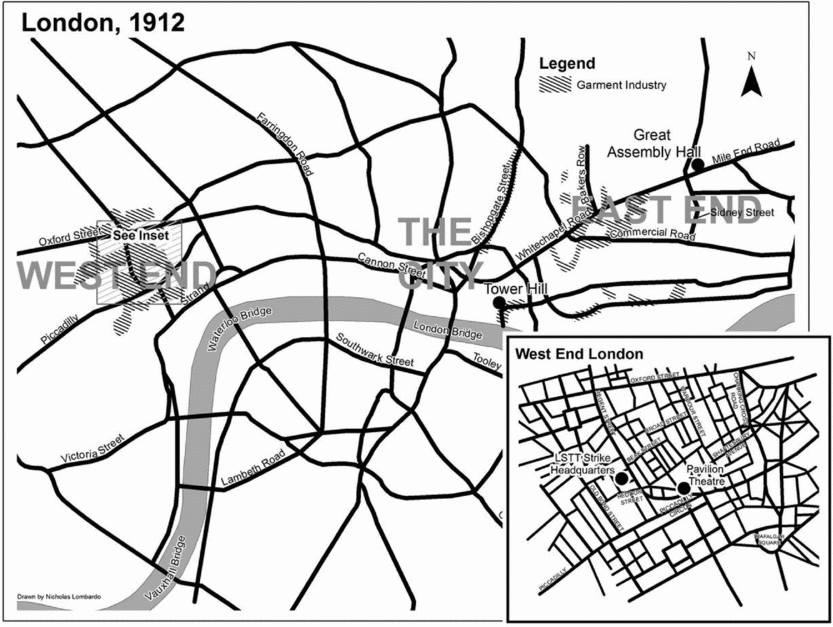
Outside the West End, distinct districts were slightly clearer. Nevertheless, Henry James noted in the 1870s, London was a ‘strangely mingled monster’. His fellow American Jack London commented 30 years later that wherever you were, ‘abject poverty’ was within a five-minute walk.Footnote 18 Wealthy residential neighbourhoods occupied the city's north and west districts, while middle-class neighbourhoods carved out a space for themselves amidst larger factories in the south. By contrast, the East End, with its small workshops and docks, was a distinctly working-class and immigrant area.Footnote 19 Despite having a far smaller ethnic community – 19 per cent of Stepney's population was foreign-born in 1911 – than Chicago, this combined with the poverty of the area meant many Londoners imagined a distinctly different London in the East End.Footnote 20 This imagined divide between East and West and between British-born and immigrant workers resulted in the development of two largely independent union movements within the London garment trade based on ethnic and spatial background (Figure 1). Workers in the West End trade, which included highly skilled bespoke work as well as a cheaper ready-to-wear trade, were represented by British-led craft unions. In contrast, workers in the East End trade, dominated by ready-to-wear and ‘slop’ clothing for colonial workers, organized into a variety of Jewish unions and more inclusive British-led trade unions.Footnote 21 In the context of the 1912 strike, the imagined divide between East and West became an advantage for the strikers, as journalists found the symbolic and physical uniting of immigrant and ‘British’ labour movements particularly worthy of comment.
London map: London, with the West End, 1912. The shaded areas roughly indicate the location of men's garment production. Sources: C. Smith and Son's Tape Indicator Map of London (London, 1910); P.G. Hall, The Industries of London since 1861 (London, 1962).

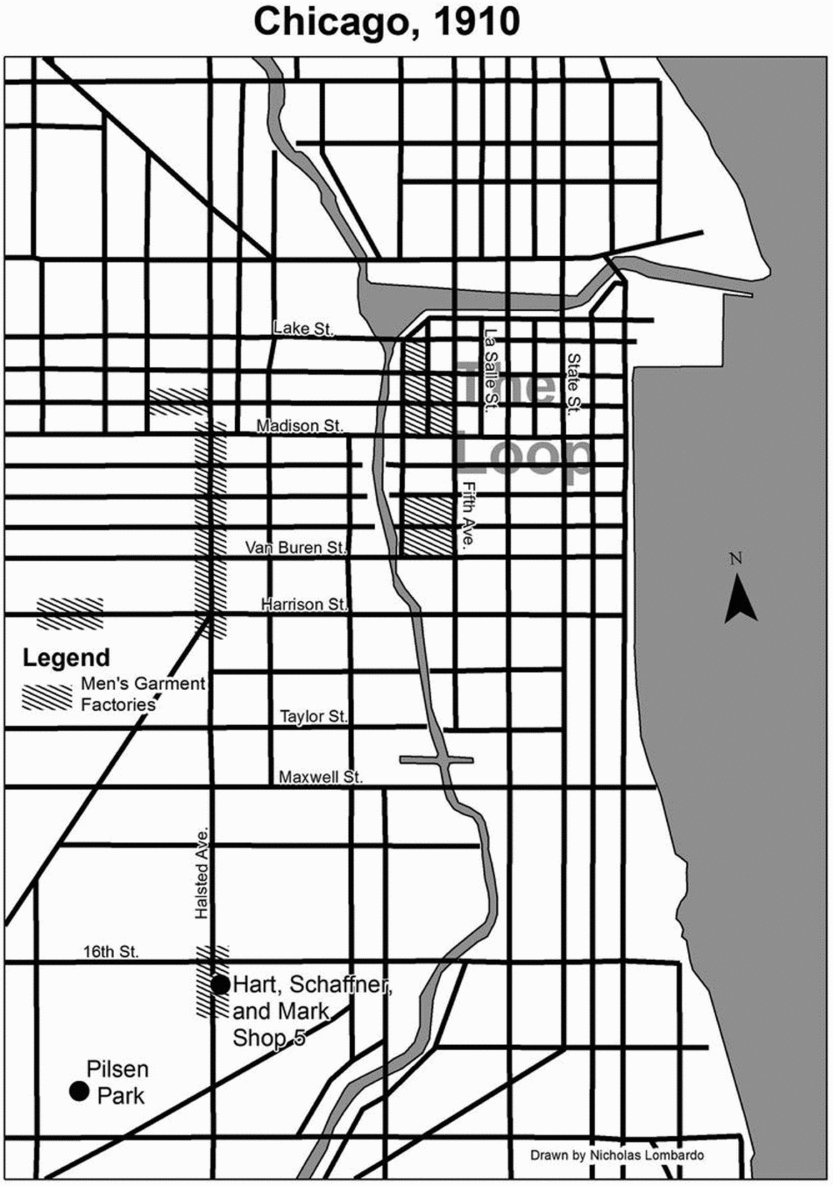
Rapidly raised out of the prairies in the mid-nineteenth century and rebuilt after the fire of 1871, Chicago's 179 square miles, with a 1910 population of 2,185,283, were more deliberately planned to rival the likes of New York and Philadelphia and to represent the city's status as gateway to the West.Footnote 22 Surrounded by farmland and connected to both eastern cities and western farms via water and rail, Chicago – ‘hog butcher for the world’ – assumed the role of supplier of steel, grain and, most importantly, meat to the east.Footnote 23 Chicago had a highly differentiated landscape. Heavy industry and stockyards occupied the South Side while tall, modern office buildings and grand temples of consumerism dominated the Loop and the surrounding downtown core. As in London, this core was also home to light industry, although by the early twentieth century, many companies, including clothes-making, had begun to move towards larger, more modern factories and workshops, which required larger spaces, leaving the core, and the Loop in particular, a little less ‘mingled’ than London's West End (Figure 2).Footnote 24
Chicago map: Chicago 1910. The shaded areas roughly indicate the concentration of men's garment factories. Sources: The Rand-McNally New Standard Map of Chicago (Chicago, 1910); Center for Urban Studies, University of Chicago, Mid-Chicago Economic Development Study, vol. II: Technical Analysis and Findings, Economic Development of Mid-Chicago (Chicago, 1966).
Residentially, the wealthy tended to live to the north, with working-class and immigrant neighbourhoods, apparently worse than their London equivalents, occupying the south and west. One British visitor in the mid-1890s viewed these working-class districts as ‘a vast wilderness of shabby houses’ that betrayed ‘a disregard for human life which is more than half barbarous’.Footnote 25 Chicago's working class was far more ethnically diverse than London's. By 1910, 78 per cent of all Chicagoans were foreign-born or the children of foreign-born parents and the city was quite divided between native-born and immigrant districts.Footnote 26 The West Side was home to European immigrants, with Eastern European Jews dominating the area around Halstead and Maxwell Streets, the heart of the garment district. As one reporter remarked, from this junction ‘one can walk the streets for blocks and see none but Semitic features and hear nothing but the Hebrew patois of Russian Poland’.Footnote 27 Although Chicago was not neatly divided into discrete ethnic neighbourhoods – most city blocks had a mix of ethnicities – Chicago was an ethnic patchwork quilt divided by class and race.Footnote 28 Despite this heterogeneity, many Chicagoans imagined ethnically homogeneous neighbourhoods and just as in London, this imagined Chicago entered the strikers’ arsenal as a weapon they used to draw attention to their protests.
Despite differences in layout, size, population and industrial make-up, the central districts of London and Chicago were very similar. Across ethnic, racial and class differences, Londoners and Chicagoans shared similar experiences of their city centres, as people from all walks of life visited the West End and Loop, to shop, dine, go to the theatre or go to work. In addition, working-class districts, with the exception of Chicago's Black Belt, shared a similar ethnic diversity. While Chicago certainly had more immigrants, London's working population was far from wholly ‘English’. Their homes were also similar. Most workers rented accommodation, both single and multiple dwellings, while the possibility of owning even a small house was out of the reach of most families.Footnote 29 In both cities, the working-classes spilled out into the neighbourhood, frequently local parks, pubs, union halls, churches and street corners.Footnote 30 Furthermore, both cities had sections – Chicago's Back of the Yards and Black Belt and London's East End – that were ‘off limits’ for upper-class people except when ‘slumming’.Footnote 31 The wealthy in Chicago were more easily able to escape the hullabaloo; there was more space to build on and their individual lots were larger.Footnote 32 In contrast, while large houses were not absent in London, far greater population density meant everything was closer together. Londoners and Chicagoans thus shared much in the ways they imagined, experienced and built their cities. In comparing the two strikes we see that the strategies that were most successful were those that challenged or subverted these imagined and experienced cities through atypical uses of the built environment.
The strikes
Two significant garment strikes played out within these urban landscapes. The Chicago strike started on 22 September 1910 when a group of 16 female trouser seamers, led by 17-year-old Hannah Shapiro, walked out of Shop 5 of clothing giant Hart, Schaffner and Marx in a spontaneous protest against low wages.Footnote 33 Although they and the majority of their co-workers were not unionized, Shapiro's complaints of wage cuts and increased workloads were increasingly common grievances and men and women from across the industry quickly joined them in their protest. One union organizer concluded that the most recent cut ‘was the last straw on the camel's back’, before going on to explain that Hart, Schaffner and Marx shops were the ‘biggest slave pens in the clothing industry in America and the wages are the poorest paid of any shop in the city’.Footnote 34 However, the lack of unionization delayed the United Garment Workers (UGW) general strike call until 26 October, by which time 20,000 workers were already out.Footnote 35 Thousands more joined them, until between 40,000 and 45,000 workers, around two-thirds of the city's entire garment workforce, were on strike, virtually tying up the city's men's garment industry.Footnote 36
Due to the absence of organized leadership at the beginning, the Chicago strikers’ demands were not clearly articulated in the early days of the strike. But as the UGW took control, strikers demanded wage increases, arbitration and a closed shop. The demand for a closed shop became divisive; radical strikers refused the agreements reached with employers in late December and early January because they failed to include a closed shop. Ultimately, though, these strikers were overruled. On 14 January, the Joint Strike Conference Board accepted an agreement that allowed for union representation and ended the Hart, Schaffner and Marx strike. This still left 30,000 workers out, but declining funds and increasingly demoralized strikers pushed the UGW to end the strike on 3 February 1911. The strike, however, did not go down in the history books as a failure; its successes have made it one of the most thoroughly investigated strikes in Chicago's history.Footnote 37 Workers, particularly those at Hart, Schaffner and Marx, secured significant improvements, including arbitration. More importantly, the strike brought fresh blood into the labour movement, workers who went on to form the Amalgamated Clothing Workers of America, one of the most important unions of mid-twentieth-century America.Footnote 38
Across the Atlantic, the strike that began on May Day 1912 with 6,000 tailors and tailoresses walking out was far less spontaneous. Nevertheless, led from the outset by the London Society of Tailors and Tailoresses (LSTT), it, too, became a large affair as thousands of members of other garment unions and non-unionists stopped work. While the strike started in the West End, by 8 May it had spread to the East End, and at its peak, 50,000 workers, around one third of the industry's labour force, were out on strike.Footnote 39 Although newspapers presented this as a single strike, the division between the West and East End industries essentially created two separate strikes with entirely different unions leading them and two sets of demands. In its demands, the LSTT, representing the West End, outlined detailed changes to the London log, which turned piece rates into time rates, and called for ‘better workshop accommodation’.Footnote 40 The East End strikers had a more general demand, namely for ‘better wages and a ten-hours working day’.Footnote 41
Lasting less than four weeks, the London strikes’ successes varied tremendously because of the more fractured nature of the industry. The East End strike ended first, on 25 May, with the workers winning wage increases, a twelve-hour day and a closed shop.Footnote 42 The West End strike did not have as clear an end as some employers conceded but others did not. By 5 June 1912, however, as the Daily Herald reported, strikers ‘were returning to work for the present after a determined fight for justice’.Footnote 43 While the immediate material gains of the strikes were limited, they made an important, but often overlooked, contribution to a widespread movement of worker mobilization in the early twentieth century. Eric Hobsbawm has argued that ‘The great city was far too large to form a real community’, but these strikes suggested it was at least possible to temporarily unite workers in a single industry across the city.Footnote 44 Indeed, one East End Jewish leader noted that the strike's greatest accomplishment was ‘to strengthen the friendship between Jewish and non-Jewish workers’, a result not without a spatial dynamic.Footnote 45
As soon as the strikes began, strikers in both cities brought attention to their cause through a variety of intentional and incidental uses of urban space. Their most obvious strategy was to establish their presence in public spaces. This served two purposes; it publicized the strike and unified the strikers. The very act of walking out and then occupying the streets at the very least raised workers’ spirits and stimulated class consciousness. In both cases, the purpose and meaning of the strike was strengthened. In London, one paper noted that West End pickets’ visit to the City saw ‘hands [begin] to come out’ there too.Footnote 46 Across the Atlantic, many teenage strikers noted that they joined the Chicago strike because of what they saw on the streets. In one telling case, young garment workers recalled that ‘there was a big noise outside, and we all rushed to the windows, and there we see [sic] the police beating the strikers – clubbing them on our account, and when we saw that we went out’.Footnote 47 While such violent scenes became all too common in Chicago, they did not play out in London as far as we know. Nevertheless, public displays were central to the character and outcome of both strikes. As one London journalist quipped, a ‘demonstration is as necessary to a strike as a dinner is to a cause. It imparts the desired enthusiasm and raises courage to the sticking point’.Footnote 48 Workers’ use of public space created a range of possibilities for how the Chicago and London garment strikes would proceed.
As the strikes developed, the different urban geographies influenced strikers’ actions. Both the East and West End garment districts were dependent on outwork and were characterized by small – sometimes just two or three employees – independently owned workshops within which employers often lived as well as worked. In contrast, Chicago's garment industry was organized around larger – with an average of 20 to 30 workers – newer workshops, many owned by a few large employers such as Hart, Schaffner and Marx. These larger shops, coupled with Chicago's grid pattern, allowed picket lines to play a central role in strike strategy. The long sight lines of Chicago's streets enabled spectacles such as worker parades to be seen and heard from afar; even picket lines of two or three strikers walking in circles could draw attention to the strike. This was the case with the Shop 5 walkout, as Shapiro and her co-workers walked out onto Halstead Street to start the strike. Halstead was a long, straight, broad street running north–south a few blocks west of the Loop. Dotted with garment shops, it was not surprising that the strike spread rapidly once the strikers took to the streets and that picket lines remained a very visible and essential part of the strike.
While picket lines, and especially violence involving women on those picket lines, brought attention to the strike in Chicago, London's web of short, narrow, criss-crossing streets, allowing one to see little more than 100 metres, if that, meant that picket lines played a less prominent role in the coverage of that strike. This criss-crossing was particularly characteristic of Soho and east Mayfair, where the West End strike was headquartered. In such streets, neither picket lines nor parades past garment shops could have the same effect as in Chicago.Footnote 49 Indeed, when the issue was debated in the House of Commons, Home Secretary Reginald McKenna noted that there was no way for the police to count those involved in ‘peaceful persuasion’ but that the numbers gathered were not alarming.Footnote 50 London was not without open spaces, however, and London's strikers often had the greatest impact when they, following a long line of previous protesters, gathered in parks or large theatres.Footnote 51 Indeed, because the protest at the actual workplace was largely out of sight, parades down the main thoroughfares and mass meetings at centrally located theatres in some ways had an even greater impact upon Londoners because they challenged their imagined cities by seeming to appear out of nowhere and taking workers to places they did not belong.
The different role that the built environment had in Chicago and London is evident from the early press coverage. Rather than provide reports of picket lines strung out from shop to shop as in Chicago, the London press described a crowd of 3,000 who gathered at the Pavilion Theatre in Piccadilly Circus, in the centre of the West End, to decide whether or not to go on strike. The Pavilion dominated Piccadilly Circus and, with its marble and freestone exterior, it seemed an unlikely place for workers to call a strike. However, unlike in Chicago, there were few large union halls in London; it was thus fairly common to rent theatres for such purposes.Footnote 52 Similar spatial dynamics meant that the official strike call in the East End also began with a meeting in a rented hall. On 8 May in the Great Assembly Hall on Mile End Road, a main east–west artery, workers voted ‘unanimously’ in favour of the strike.Footnote 53 This meeting was even larger than that at the Pavilion and could not be contained within the building; in addition to those inside the hall there were almost 9,000 people outside who listened to speeches from six different platforms.Footnote 54
While the sheer numbers of such large meetings altered these halls’ and theatres’ normal usage, other gatherings of strikers reaffirmed conventional organizations of space, particularly in terms of gender. At least one mass meeting in London grouped all of the female speakers together. And a report on one Chicago union hall meeting with both male and female speakers demonstrated this segregated space vividly: 500 strikers sat facing a stage, ‘the men sitting on one side, the women on the other’.Footnote 55 To some degree, working-class men and women continued to occupy separate spaces at rallies and meetings, while picket lines and parades brought men and women together.
Once the strikes had started, the presence of many young women among the workers meant that the strikers’ presence on the streets subverted the conventional gendering of urban space.Footnote 56 Men and women from all walks of life crossed paths on city streets and fears that distinctions between class, gender, race and ethnicity would be undermined preoccupied many commentators.Footnote 57 Although strikers in both cities donned their finest clothes to maintain respectability and play into contemporary ideas about women's moralizing force, women's involvement in the strikes took them to the margins of ‘ladylike’ behaviour. While working-class women daily walked Chicago's and London's streets as they shopped and went to and from work, they were rarely worthy of comment. However, large groups of young working-class women on picket lines, singing in parades or gathering at parks and halls did not go unnoticed. Violence on Chicago's picket lines made striking women all the more shocking, thoroughly subverting the traditional role of women in public space.Footnote 58 The different gender politics of the two cities also shaped the way the strikes played out. In London, it was necessary for women strikers to devise a strategy of protest that differed from that of suffragettes, who dominated the radical gender politics of the day. The result was that in order to distance themselves from suffragettes, London's garment workers engaged in far less violence than in Chicago.Footnote 59 Instead, in London, female strikers claimed the respectability of skilled workers. Acts such as wearing measuring tapes, a marker of a bespoke tailoress, around their necks spoke to their class affiliation and separated them from the suffragettes’ guerrilla actions.Footnote 60
Although Chicago was the site of more violence, it was also home to the most dramatic claim of respectability as female college students and wealthy supporters joined the strikers on the picket lines.Footnote 61 While there was precedent for cross-class and intergenerational co-operation, it was rarely on public display. Settlement houses like Jane Addams’ Hull House took older middle- and upper-class reformers into working-class neighbourhoods, but before the strike their activities happened in closed spaces, out of the sight of fellow Chicagoans. This changed during the strike as ‘aristocratic pickets’, as the Chicago Tribune disparagingly labelled them, joined their younger working-class sisters on the streets. This cross-class solidarity on the working-class street subverted the spatial dynamics of the city and drew even more attention to the strike.Footnote 62
With the exception of a few middle- and upper-class women associated with the Fabians or the Women's Trade Union League, there was no such cross-class dynamic in London. Tensions between middle- and working-class women in London during the strike reflected broader tensions between the labour movement and the suffrage movement. The strikers and suffragists used the same meeting hall – the Pavilion – and crossed each other's paths as women strikers collected contributions to the strike fund. Although suffrage women also took to the street for their cause, when confronted with women strikers their response was ‘icily sympathetic’ and sent ‘cold shivers down the back’. The strike bulletin concluded that these women ‘regard[ed] themselves as the divinely appointed dispensers of properly discriminating charity to the “lower” orders’.Footnote 63 The whole incident suggests the discomfort these respectable wealthy suffragists felt at being publicly confronted by a striking worker. Unlike in Chicago, in this instance the London strike failed to overcome the distinctions between the leisured and working classes despite using the same space – the Pavilion – in similar ways to demand change.
Picket lines
As female workers’ interaction with Chicago and London's elite women reveals, strikes altered the workers’ daily routines in the city and the strikers’ and other peoples’ experiences of urban space. In Chicago, this was most evident on the picket lines, while, as we shall see in the next section, in London this was achieved through parades. Picketing women workers in Chicago stepped into a complex gendering of public space. As they walked the streets around the factories with male workers, challenged male strike-breakers and faced male police, they presented a more aggressive femininity. This inspired a number of responses that collectively reveal the gendering of Chicagoans’ imagined city.
At the very beginning of the Chicago strike, journalists ignored the women, most likely because of their youth.Footnote 64 Once the strike grew and women's roles became so central and dramatic that they could no longer be sidelined, some observers responded aggressively to the female strikers’ transgression of respectable public behaviour. One policeman told the secretary of the Chicago Women's Trade Union League to ‘go home and wash your dishes’.Footnote 65 Others reacted more viciously. The presence of so many police on the streets inevitably resulted in violence, which newspapers readily reported. The Chicago strike frequently made the front pages with headlines such as ‘Police Slug Girls and Beat Strikers in Garment War’, ‘Police Provoke Riot, Beat Helpless Women and Arrest Citizens’, ‘Raging Cops Beat Garment Strikers’ and ‘Armed Mob Led By Girl in Fight’.Footnote 66 The story that accompanied that final headline described how 14-year-old Josie Milweski led a charge on the police with the battle cry, ‘Get together, men; charge them. Go for the police’.Footnote 67 The reporter accentuated the subversion and inversion of gender norms by emphasizing Milweski's youth as well as the fact that she led ‘men’ into battle. Neither Milweski's experience nor its coverage were isolated events. Such images of powerful and unfeminine female characters accentuated the dangers of the strike and provided women with the opportunity to forge new public and private understandings of gender roles and relations. Groups of women were not only on streets where they did not belong; they were also engaging in inappropriate behaviour.
Other commentators played on the transgression of accepted feminine behaviour by highlighting female strikers’ femininity. Reports of the Chicago strike regularly noted the contrast between the ‘girl’ pickets and the police sent to monitor their behaviour. Thus, an official union history later recounted ‘twenty-one or twenty-two’ temporary police officers ‘holding the street’ while ‘three, rather small women’ walked back and forth in front of them.Footnote 68 One newspaper report of a woman striker who urged the crowd to attack the police and who herself attacked an officer also emphasized her femininity. Depicting Stazie Jencik as ‘a defenseless slightly built woman’, the writer contrasted her to the ‘big hulk in uniform’ who ‘smashed her face in with his fist’.Footnote 69 While all these reports sensationalized women's use of public space, they also suggest that once the strike had been going on for a month or so Chicagoans had begun to re-imagine their city through the strike's lens. Indeed, journalists rarely judged the strikers; one even observed that ‘Many women with babies in their arms took part in the rioting’ without further comment.Footnote 70
Strikers’ brought attention to their acts by subverting conventional imaginings and experiences of the city streets and capitalizing on the specific form of the built landscape. We have already seen the power of the picket lines on the Chicago grid. The clear distinction between the city's manufacturing areas and the retail and financial districts centred in the Loop gave the Chicago strikers an extra weapon, one which the Chicago Daily Socialist used with great effectiveness. As Robert Lewis has noted, Chicagoans were ‘trapped in daily routines’ and ‘saw little of the vast metropolis in which they lived’.Footnote 71 The garment strike, however, subverted commercial routines and opened up the possibility of new forms of social interaction in urban space. The Chicago Daily Socialist, for example, took strikers away from picket lines and union halls and into the commercial centre of the city, the Loop. The paper published two special strike editions on 19 November and 18 December and turned striking teenage girls into newspaper sellers.Footnote 72 These young, single, working-class, female ‘newsies’ hawked their wares on street corners throughout the Loop, taking the strike right into the retail and financial heart of the city. As they did so, their gender and youth further subverted Chicagoans’ imagined and experienced landscapes.
Parades
London's strikers found parades and rallies more effective than picket lines at drawing attention to their cause. But, it was a different sort of attention. There were no scandalous headlines depicting violence in London, nor is there a record of middle- and upper-class supporters joining the strikers on the picket lines in London. Instead, they joined forces in mass rallies. However, the juxtaposition of wealthy ‘ladies’ with working-class ‘factory girls’ had far greater resonance on a picket line of two or three than it did at meetings of hundreds or even thousands of people. The comparison thus reveals that size is not the only thing that matters when examining how space was occupied or what that occupation meant. A London protest of hundreds might seem more transgressive on the surface, but the smaller cross-class picket lines in Chicago were more personal and more easily threatened segregated class-based imaginings and experiences of the city.
During the London demonstrations, parades with music, songs and banners brought a festive air to the normal humdrum of urban life. Jane Addams noted at the time and many scholars have noted since, parades possessed ‘magic power . . . to formulate the sense of companionship and solidarity’, which are particularly important during a strike.Footnote 73 Although large numbers of strikers could be seen as threatening by passers-by, newspaper representation of the parades tended to focus on their festive and exotic side, in particular their music. Music in the street had a long history in London; according to James Winter it ‘was one of the few aspects of urban life that just about everyone could enjoy’.Footnote 74 One London paper described a demonstration on Soho's Broad Street as ‘packed with foreigners, French, Swedish and German tailors and tailoresses’.Footnote 75 Highlighting the crowd's exotic nature, an apparently more noteworthy feature in London than Chicago, the journalist continued: ‘short, dark-skinned women . . . looked down from narrow windows at the seething crowd’. The article also drew attention to the younger, presumably British, women who brought ‘an element of levity’ as they linked arms and ‘pushed their way through the crowd, singing snatches of music-hall songs’. Ten days later, the same paper reported ‘Hilarious scenes’ where ‘some 2,000 tailors and tailoresses on strike paraded the principal streets of the “tailoring world”, headed by pipers and drummers and girls bearing aloft on two poles “guy” trousers cut clumsily in black cloth and meant to be emblems of the “blacklegs” who have returned to work’.Footnote 76 Both articles’ attention to women's roles suggests some degree of novelty. Working-class women were a normal part of Soho's daily hustle and bustle. During the strike, though, they were not shopping or going to work. Rather, they were laughing, singing and turning the streets into a stage.
The festive atmosphere these parades created, while to some degree an inevitable consequence of such large-scale strikes, also had strategic advantages. It presented non-aggressive strikers to the public, to some extent fulfilling their expected gender roles – men leading, women singing – and thereby undermined the accusations of violence or intimidating picket practices that employers readily used to get arrests or injunctions. It also had the potential to publicize the strike to new groups of people, people who may not have read the papers or walked straight past picket lines, but who would stop to watch a band-led parade or listen to the strikers sing.Footnote 77 But there was a downside to such a positive ambiance. There was the chance that the festive atmosphere could trivialize the strike, hide the economic hardships a stoppage brought for strikers or make it appear as if the strikers were simply having a holiday. One onlooker of the aforementioned Broad Street parade noted, ‘Poor things! . . . they don't have much joy in life. It is work from morning till night with them and 3s. 6d. a week is about the most they earn. This is a holiday for them, and they are out to enjoy themselves.’Footnote 78 Despite such misunderstandings, by turning city streets into music halls the strikers ultimately brought attention to their cause.
Cosmopolitan strikers
Reflecting the two cities’ cosmopolitan workforces, both strikes involved a wide range of ethnicities and capitalized on both real and imagined ethnic geographies. In London, the presence of ‘foreigners’ on the streets and the coming together of Jewish immigrants and British Gentiles were newsworthy. Unlike in Chicago, immigrants were a tiny minority in London and, with few exceptions, were rarely looked on favourably by those in power. This strike brought this foreign population on to London's streets and into London's papers. Indeed, journalists were quick to note that ‘foreign labour’ outnumbered British three to one in the garment trade and characterized the meeting that saw the strike spread to the East End as a ‘strangely cosmopolitan gathering’.Footnote 79
What was so ‘strange’ about this particular example of cosmopolitanism was the ethnicity of the new, cross-town strikers. The view that the West End and East End were different cities populated with different people had a long history and was intricately connected to the division between skilled and unskilled labour. As early as 1860, Henry Mayhew noted: ‘In passing from the skilled operative of the West-end, to the unskilled workman of the Eastern quarter, the moral and intellectual change is so great, that it seems as if we were in a new land.’Footnote 80 By the 1910s, increased immigration gave greater purchase to Mayhew's perceived change. The West End garment workers and residents represented a variety of different Northern European ethnic groups, including many Britons, many of whom lived within walking distance of their workplace. On the other side of the city, Eastern European Jewish immigrants dominated the East End trade, which was located in the most densely populated immigrant neighbourhood in London. This ethnic and spatial separation was reflected in the labour movement; entirely different unions organized the East and West End workers. Strikes that occurred within the Jewish community often remained contained within the Jewish community and were often unsuccessful as a result. The joining together with West End strikers provided an opportunity for their protest to receive greater attention.
Nevertheless, the East End strike was fought in the East End and support from the local Jewish community was essential, especially because of the paucity of Jewish unions’ funds. The strike was thus both cosmopolitan and parochial. The Jewish Bakers’ Union donated bread to the strike canteens, other Jewish unions levied their members for the striking garment workers, and the Yiddish theatre donated several performances’ takings to the strike fund.Footnote 81 The strikers also found support from Jewish political organizations. East End bookbinder Morris Mindel recalled that his branch of the Jewish Workers’ Circle gave ‘great support to the strikers’ and ‘sought to turn public opinion in their favour’.Footnote 82 Ethnic geographies, which marginalized and isolated East End Jews, in these circumstances created supportive spaces to keep strikers going. The same was true in Chicago, although there the whole of the South and West Sides of the city were ethnic enclaves and ethnic groups were in no way marginal within the labour movement. Nevertheless, ethnic identities and community support proved to be as important in Chicago as in London.
Chicago's ethnic geographies were deeply imbricated in the working through of the strike. While picket lines were critical to the organization of the strike, parades played an important role in the strike's cultural character. Several of the Chicago parades followed routes from the garment shops to the ethnic neighbourhood of the group marching. On 13 November, for example, 5,000 Bohemian and Polish strikers ‘marched, cheering and waving flags and banners, through the streets of the southwest side to the music of four bands’.Footnote 83 Their numbers doubled as they arrived at Pilsen Park, in the heart of the Bohemian community on the Lower West Side. In taking strikers away from the sites of conflict, these parades were more about community building than publicity. The act of taking to residential streets countered the isolating consequences of spread-out ethnic communities and often strengthened strikers’ identification with that ethnic neighbourhood, which could in turn strengthen the strike.Footnote 84 Once again, the cosmopolitan elements of the strike were paralleled by a parochial form of identity building.
While ethnic communities and spaces played an important part in both cities, London's ethnic landscape gave its strikers an additional means of publicity. It was not surprising, given the clear ethnic and spatial distinction between East and West, that many journalists represented the London strike as a moment of ethnic unity. Once the East End joined the strike, papers noted that ‘all grades, all classes and nationalities . . . were banding together’, although in demands and organization the strikes were, in fact, rather independent from one another.Footnote 85 The strikers capitalized on this divide between East and West and used London's geography to their advantage by physically coming together on Tower Hill in the middle of the city and then walking east to Stepney Green. The strikers were well aware of the significance of a joint meeting of East and West and advertised the rally accordingly: ‘The Great Strike: Unity between East and West’ read the flyers.Footnote 86
Tower Hill was a perfect location for their meeting. Located on the eastern edge of the financial district of the ‘City’, the grassy area was a stone's throw from the Tower of London. It had a long and bloody history as the favoured site for important public executions but also more generally as a site for public gatherings. The symbolism was not lost on the press; one journalist implied the historic significance of this meeting: it was ‘one of the most cosmopolitan [crowds] that has ever been witnessed on that historic open space in the City’.Footnote 87 It is surprising, though, that instead of walking towards the centre of power the strikers walked to Stepney Green, a marginal area in the city's hierarchy of powerful and symbolic public spaces. Hyde Park and Trafalgar Square were more popular sites of mass meetings and protest, but neither fit the strikers’ needs well. Both of these were centrally located, but given that a large crowd was coming from the east, Tower Hill's location between the West and East Ends was more convenient and perhaps benefited from the absence of associations with working-class violence.Footnote 88 To then walk east to Stepney Green made sense. The green was a blank slate, was significantly closer, and a march of West End workers through the East End made a bolder statement than the reverse.
Conclusion
One Chicagoan commented that ‘the great third party to every industrial dispute’ was the public; an opinion shared by many on both sides of the Atlantic.Footnote 89 I would add to that a fourth party – the urban space in which strikers, employers and the public lived, worked and protested. In both London and Chicago, strikers capitalized on their fellow city dwellers’ imaginings and experiences of the city to bring attention to their cause. Particular aspects of the strikes – violence, young women on the streets in large numbers and crowds of immigrants speaking their native languages – drew journalists’ attention because they made good copy, but they made good copy because they subverted spatial norms. Studying these strikes together reveals the similarities in the gendering of urban space. In both cities, strikers played with similar gender norms and manipulated them to the advantage of their respective strikes. But they also had to tailor their activities to suit very different built, industrial and social environments: a grid versus a web of streets, larger corporation-owned shops versus small independent shops, an ethnic city versus ethnic minorities. Paying careful attention to the local settings of these strikes enables us to appreciate the significance of urban space to strike strategies. City streets, as much as a conference table, were a vital field for contestation. Space limited some strategies and provided other opportunities as strikers fought hard to re-imagine their cities. Ultimately, strikes, if they are successful, are moments of unity. But if we consider them as moments when urban space is reconfigured, then we see that this unity does not only come from the act of stopping work. Strikes are also acts of re-claiming the streets and re-identifying with a particular neighbourhood. Through these actions, workers are able to take control of parts of the city normally controlled by others, and, as a result, refashion the contest to their own ends.