INTRODUCTION
Screening for distress and/or unmet needs is recommended to identify patients who would benefit from intervention (Howell & Olsen Reference Howell and Olsen2011; Holland & Bultz Reference Holland and Bultz2007). Various methods have been studied for their ability to identify patient reported problems, ranging from a battery of comprehensive measures (unmet needs, quality-of-life, depression, and anxiety) to simple measures such as the distress thermometer (DT) used in conjunction with a problem checklist. Identification of patients with distress and unmet needs and a requirement for supportive care services is a challenge to nurses working in ambulatory cancer settings where the volume of patients is high. However, clinical nurses express concern that screening will identify too many patients and will significantly increase their workload (Absolom et al., Reference Absolom, Holch and Pini2011). In this paper, we assess the ability of the DT to correctly identify those patients at most need of supportive care services to help direct the practice of cancer nurses.
DISTRESS AND ITS USE IN NURSING PRACTICE
Distress was identified by the National Comprehensive Cancer Network as an effective umbrella term representing “the range of emotional concerns patients with cancer experience.” Distress was also seen to “not carry the stigma of other words sometimes used for emotional symptoms” (Holland & Bultz, Reference Holland and Bultz2007, p. 3). To date, the literature on distress has been dominated by those taking distress to be an indicator of the need for referral to a psychosocial health professional, with the term used interchangeably with anxiety, depression, stress, strain, and discomfort (Ridner, Reference Ridner2004). Although this emphasis on the psychological aspects of distress has been beneficial in promoting and accessing holistic, person-centered care, nursing authors acknowledge a much wider potential remit than assessment of the need for referral to psychosocial services (Howell & Olsen, Reference Howell and Olsen2011).
While distress can be understood as an emotional construct, these emotions can manifest as the result of a diverse range of physical, practical, social, and psychological impacts of having cancer and receiving cancer treatment. Common problems requiring identification by the nurse in the ambulatory setting include pain, weight loss, treatment side effects such as mucositis, skin reactions and vomiting, concerns related to managing self-care as a requirement of treatment, and information needs in addition to emotional concerns such as anxiety and depression. All of these problems can result in patient distress; however they may best be resolved with clinical or informational rather than psychological interventions. There is a clear need for nurses to not only recognize distress in cancer patients, but also identify the manageable causes of distress to guide nursing practice. It is critical to understand the causes of distress that can be managed in the front line and those which require referral to a psychosocial specialist.
WHAT DO WE KNOW ABOUT WHAT PREDICTS DISTRESS?
There is some evidence that patient characteristics contribute to distress. For example, van Scheppingen et al. (Reference van Scheppingen, Schroever and Smink2011) found higher distress in younger patients and those who were female. In contrast, those patients who had prostate cancer and were treated with radiotherapy alone had lower distress. Lower levels of education have also been associated with higher distress in prostate cancer patients (Steginga et al., Reference Steginga, Occhipinti and Dunn2001). Disease factors may also play a part in predicting distress with patients with more advanced or recurrent disease and higher symptom burden reporting higher distress (Lintz et al., Reference Lintz, Moynihan and Steginga2003; Rosenfeld et al., Reference Rosenfeld, Roth and Gandhi2004). Although numerous studies have reported on the relationships between unmet needs, health-related quality-of-life, psychological morbidity, and increased distress in people with cancer (Balderson & Towell, Reference Balderson and Towell2003; Roth et al., Reference Roth, Kornblith and Batel-Copel1998; Ream et al., Reference Ream, Quennell and Fincham2008), it is unclear what role these factors play in predicting distress, beyond that which can be attributed to patient characteristics. Knowledge of this will assist nurses to appropriately triage patients presenting with symptoms of distress.
This study sought to assess the ability of the DT to accurately identify patients with a wide range of clinical problems that may manifest as distress in the clinical setting and require intervention. We were interested in: (1) understanding what the recommended cut-off score for clinically significant distress (4 and above) actually represented in the clinical setting to give guidance to nurses undertaking and responding to screening assessments and (2) examining the contribution of quality-of-life, unmet needs, and psychological morbidity to explaining variance in distress scores after controlling for the effect of differences in patients' demographic and medical characteristics.
METHODS
Design and Setting
This study reports the pre-treatment baseline data collected as part of a randomized controlled trial evaluating a nurse-led supportive care intervention for men with prostate cancer commencing radiotherapy at a specialist cancer hospital in Melbourne, Australia. The trial was approved by the local Human Research Ethics Committee.
Patient Population
Eligibility criteria for the trial included a confirmed diagnosis of prostate cancer; commencing external beam radiotherapy (with or without brachytherapy) with curative intent; and able to understand English. Patients with cognitive or psychological impairment and/or previous radiotherapy treatment were excluded, as were patients who were too sick (as advised by treatment team); being treated with palliative intent; or having seed brachytherapy.
Recruitment and Assessment Procedures
A consecutive sample of eligible patients was identified from outpatient clinic and treatment lists between January 2007 and December 2009 by a trained research assistant. Potential participants were approached prior to commencing radiotherapy treatment and written informed consent was obtained before completing the questionnaire. Permission to collect basic demographic and clinical information from medical records was sought from patients who chose not to participate in the trial. Reasons for refusal were also requested and recorded.
Measures
Demographic and medical information was collected from medical records and directly from patients as part of the questionnaire. The questionnaire also included patient reported outcome measures assessing global distress, psychological morbidity, prostate cancer-specific health-related quality-of-life (HRQoL) domains, unmet supportive care needs and cancer treatment-related concerns.
Global distress was assessed with the single-item DT (Roth et al., Reference Roth, Kornblith and Batel-Copel1998), a self-report measure designed for use with cancer patients. Patients use an 11-point visual analogue scale (0 to 10) to indicate the amount of distress experienced in the past seven days. Evidence suggests it is effective in distinguishing distressed from non-distressed patients using a cut-off score of 4 (Jacobsen et al., Reference Jacobsen, Donovan and Trask2005).
Psychological morbidity was assessed with the 14-item hospital anxiety and depression scale (HADS), a self-report measure designed to screen for distinct dimensions of anxiety (HADS-A) and anhedonic depression (HADS-D) in non-psychiatric hospital departments (Zigmond & Snaith, Reference Zigmond and Snaith1983). Patients use a 4-point Likert-type scale to rate the extent to which each of the 14 statements resembles how they felt in the last week. Subscale scores are used to identify borderline (8–9) and probable cases (11–21) of anxiety and anhedonic depression. Both subscales demonstrated acceptable internal consistency (both alpha >0.75) and construct validity in a large heterogeneous cancer sample (Smith et al., Reference Smith, Selby and Velikova2002).
Prostate cancer-specific HRQoL domains were assessed with the 26-item expanded prostate cancer index composite short-form (EPIC-26) (Szymanski et al., Reference Szymanski, Wei and Dunn2010), an abbreviated version of the 50-item long form (Wei et al., Reference Wei, Dunn and Litwin2000). Items comprising the short-form map to four health-related quality-of-life (HRQoL) domains: urinary, bowel, sexual, and hormonal. Patients use 4- and 5-point Likert-type scales to respond to items. Responses are linearly transformed to a 0 to 100 scale and then averaged across domains to create domain summary scores. Higher domain scores indicate better HRQoL. Individual domains have demonstrated high correlations with long-form versions (all r ≥ 0.96), as well as high internal consistency (all alpha ≥ 0.70) and test-retest reliability (all r ≥ 0.69) (Szymanski et al., Reference Szymanski, Wei and Dunn2010).
Unmet supportive care needs were assessed with the supportive care needs survey short-form with revised response format (SCNS-SF34R), an abbreviated version of the 59-item long-form (Bonevski et al., Reference Bonevski, Sanson-Fisher and Hersey2000) completed with a simplified response scale. Items comprising both forms map to five needs domains: psychological; health system and information; physical and daily living; patient care and support; and sexuality. For the SCNS-SF34R, patients use a 4-point Likert-type scale ranging from 1 (no need) to 4 (high need) to rate levels of need for help in the last month. Subscales comprising the SCNS-SF34R with revised response format have demonstrated high internal consistency (all alpha > 0.80) and construct validity in a prostate cancer sample (Schofield et al., Reference Schofield, Gough and Lotfi-Jam2011). Responses to items within each domain can also be summed to create raw Likert summated scores then linearly transformed to a 0 to 100 scale. Higher scores indicate higher levels of unmet need.
Cancer treatment-related concerns were assessed with the Cancer Treatment Scale (CaTS) (Schofield et al, Reference Schofield, Gough and Ugalde2012). The 25-item CaTS comprise two subscales assessing patients' sensory/psychological and procedural concerns since being told about their upcoming treatment. Both subscales have demonstrated high internal consistency (both alpha > 0.90), construct validity and divergent validity with HADS-A.
Statistical Analysis
All data were analyzed through the Statistical Package for the Social Sciences, Windows Version 18.0 (SPSS, Chicago, IL, USA). For the EPIC-26, HADS and SCNS-SF34R and CaTS, missing item scores were replaced with the mean of other item scores within relevant subscales or domains, if at least half the items in that domain were answered (Fayers et al., Reference Fayers, Curran and Machin1998). DT and HADS-A and -D scores were also recoded to three separate dichotomous variables identifying probable cases of distress, anxiety, and anhedonic depression, respectively, using recommended cut-offs. For HADS scales, the higher cut-off of 11 points (rather than eight points) was used, as the lower cut-off is poorly supported in relevant validation studies in samples of cancer patients (Carey et al., Reference Carey, Noble and Sanson-Fisher2012; Luckett et al., Reference Luckett, King and Butow2010).
Descriptive statistics were used to summarize sample characteristics and, where relevant, study outcomes for the full sample. Relative frequencies were computed for dichotomous variables identifying probable cases of distress, anxiety, and anhedonic depression; then, cross-tabulations were used to examine the relationship between DT and HADS classifications. Next, Pearson's chi-square and t-tests were used to compare distressed and non-distressed patients on demographic and clinical variables and scales comprising the HADS, EPIC-26, SCNS-SF34R, and CaTS. Effect size estimates (phi and Cohen's d as appropriate) were calculated to quantify the size of differences between distressed and non-distressed patients (Cohen, Reference Cohen1988). Given there are well-documented issues associated with the analysis of continuous variables converted into categories (including lack of cross-study comparability), Pearson's correlations were also used to assess the relationship between responses to the DT and other study measures.
Finally, hierarchical multiple regressions, in which sets of covariates were added sequentially, was employed to examine the contribution of variable sets to explaining variance in DT scores, yielding a series of four regression models. Model 1 included demographic characteristics (age, marital status, employment status, English as a first language), Model 2 added prior treatment variables (androgen deprivation therapy, prostatectomy), Model 3 added EPIC-26 domain scores and Model 4 added HADS, and SCNS subscale scores. EPIC-26 domain scores were entered before HADS and SCNS subscale scores are these were assumed to be causally antecedent (Cohen et al., Reference Cohen, Cohen and West2003), reflecting pre-existing symptoms and bother primarily associated with prior cancer-related treatments and possibly also ageing. Demographic characteristics, on the other hand, were entered first to ensure the effects attributed to later sets were not due to demographic differences. Change in R 2 (ΔR 2) was calculated to determine the significance of variable sets after controlling for preceding ones. Standardized beta coefficients were used to assess the relative contribution of each variable to the solution; however, these were interpreted in conjunction with structure coefficients given substantial correlations between predictor variables. With correlated predictors, structure coefficients provide critical insight into which predictors “do or could produce the predicted outcome scores” (Courville & Thompson, Reference Courville and Thompson2001). Influential observations and regression assumptions were assessed using standard procedures before deciding upon the final models (Cohen et al., Reference Cohen, Cohen and West2003; Hair, Reference Hair, Black and Babin2006).
RESULTS
Sample Characteristics
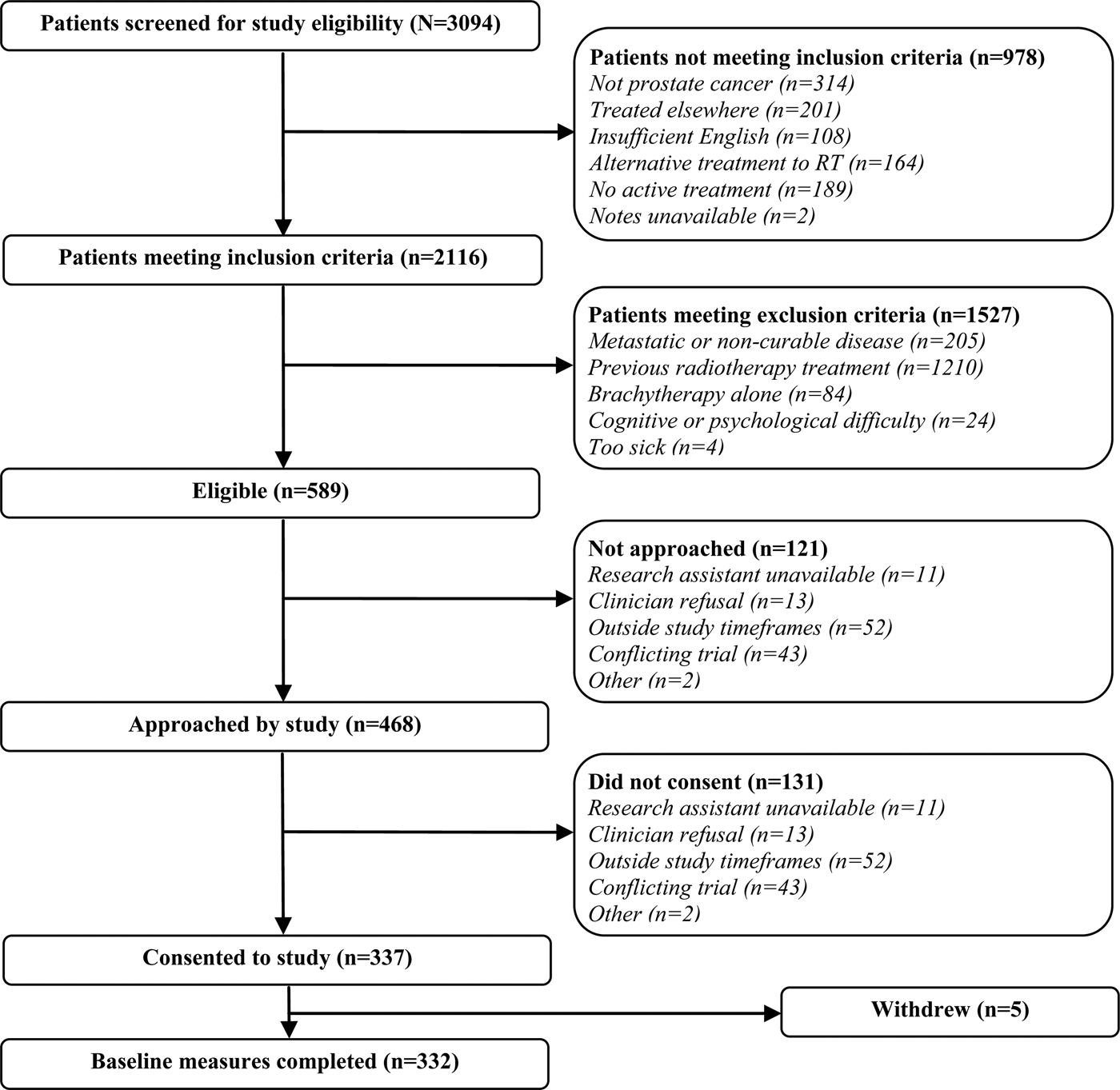
Of the 468 eligible patients approached by the study, 337 consented to participate (72.0%) and 332 completed the baseline measures reported here (Fig. 1). None of the associations between patient demographic or clinical characteristics and response status or group differences between participants and those who chose not to participate were significant.
Participant flow following CONSORT guidelines.

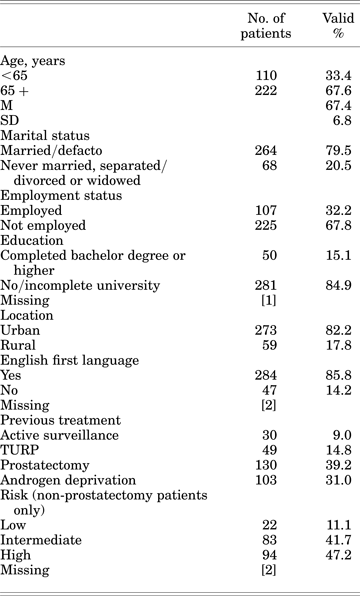
Most participants were 65 years or older (67.6%), married or in a defacto relationship (79.5%), and unemployed or retired (67.8%). Many had undergone previous treatments including prostatectomy (39.2%), androgen deprivation therapy (ADT: 31.0%), and/or a transurethral resection of the prostate (TURP: 14.8%). Demographic and clinical characteristics of the sample are presented in Table 1.
Sample characteristics
Notes: Risk group determined based on D'Amico et al. system, where risk relates to post-therapy PSA failure. Namely, patients with American Joint Commission on Cancer Staging (AJCC) clinical T stage T1a or T2a and PSA level ≤10 ng/mL and biopsy Gleason score ≤ 6 were classified low risk; patients with AJCC clinical T stage T2b or 10 <PSA level ≤ 20 ng/mL or biopsy Gleason score of 7 were classified intermediate risk; and patients with AJCC clinical T stage T2c or higher or PSA level > 20 ng/mL or biopsy Gleason score ≥ 8 were classified high risk.
Prevalence of Distress
The mean DT score was 1.96 (SD = 2.22), the median score 1 (IQR = 0–3). As such, scores on the DT were highly positively skewed (Fisher skewed coefficient = 9.13). In total, 65 (19.7%) men scored 4 or more on the DT.
Relationship between Probable Cases of Distress and Probable Cases of Anxiety and Anhedonic Depression
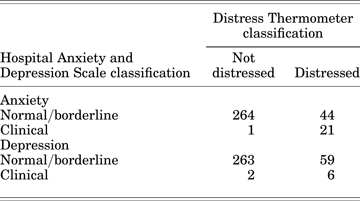
A cross-tabulation of DT and HADS subscale classifications is provided in Table 2. A substantial minority of men who reported clinically significant levels of distress also reported clinically significant levels of anxious symptomatology (n = 21, 32.3%). In contrast, very few men reported clinically significant levels of both distress and depressive symptomatology (n = 6, 9.2%).
Cross-tabulation of distress thermometer and hospital anxiety and depression scale subscale classifications
Profiles of Distressed and Non-Distressed Patients
Demographic and Clinical Characteristics
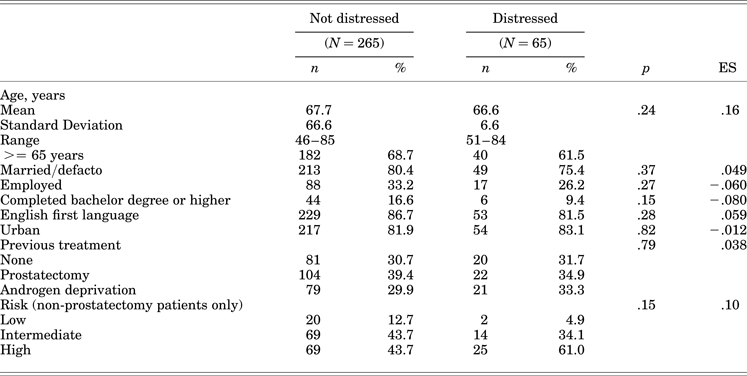
Descriptive data for the demographic and clinical characteristics by DT classifications are provided in Table 3, as are the relevant test statistics and effect size estimates. Distressed and non-distressed participants did not differ in terms of mean age and there was no association between DT classification and marital status, employment status, education, English as a first language, residential location, previous treatment, or risk related to post-therapy PSA failure for non-prostatectomy patients (all p > 0.05). The majority of the non-prostatectomy patients who were classified as distressed, however, were also classified as high risk (61%).
Patient demographic and medical characteristics by distress thermometer classification
Notes: p-value for comparison of DT score-based subgroups. ES: effect size, ES for age: Cohen's d (small, 0.2; medium, 0.5; large, 0.8), ES for all other variables: phi (small, 0.1; medium, 0.3; large, 0.5).
P-value for comparison of DT score-based subgroups.
Married/defacto versus single, separated/divorced or widowed; Employed versus not employed; Completed bachelor degree or higher versus not; Urban versus rural.
Again, risk based on D'Amico et al system, where risk relates to post-therapy PSA failure.
Patient-Reported Outcome Measures
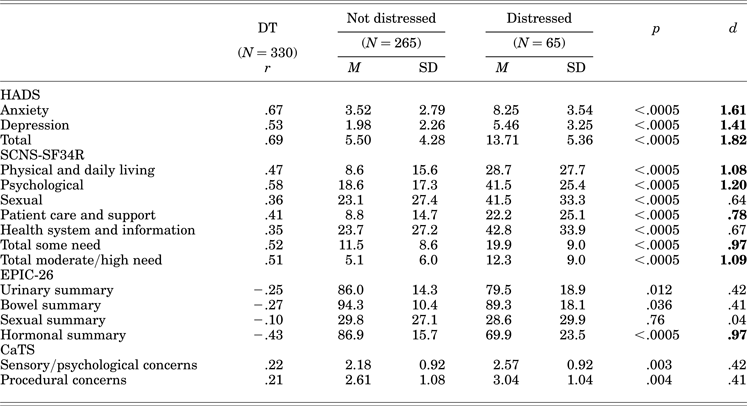
DT scores showed moderate to strong relations with subscales comprising most measures apart from the EPIC-26 urinary, bowel, and sexual summaries and subscales comprising the CaTS (Table 4). Further, without exception, men classified as distressed based on their DT scores obtained significantly higher mean scores on both HADS (both p < 0.0005), all five SCNS (all p < 0.0005), and both CaTS subscales (both p < 0.005), indicating higher levels of psychological symptoms, unmet needs, and cancer treatment-related concerns, respectively. They also obtained significantly lower mean scores on all scales comprising the EPIC-26 (all p < 0.05), apart from the sexual summary (p = 0.76), indicating lower prostate cancer-specific quality-of-life. Critically, differences on HADS and SCNS subscales were large-sized, as was the difference on the EPIC-26 Hormonal summary.
Patient-reported outcome measures by Distress Thermometer score and Distress Thermometer classification
Notes: For HADS scales, higher scores reflect higher levels of symptomatology; for SCNS-SF34R, higher scores reflect higher levels of needs; and for EPIC-26 domains, lower scores reflect lower quality-of-life related to relevant symptoms. p-values relate to t-tests of differences between DT-based subgroups; if Levene's test for equality of variances was significant, equal variances were not assumed in the test for equality of means. Cohen's d interpreted as: 0.2, small difference; 0.5, medium difference; and 0.8 large difference. Cohen's d indicating large differences in bold for emphasis.
Predictors of Distress
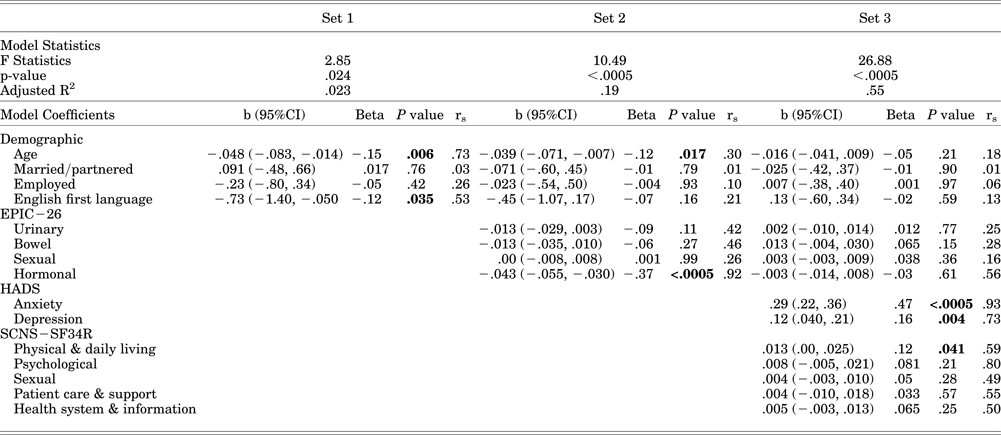
Investigation of the assumptions of regression for the planned hierarchical analysis including four variable sets indicated a serious problem of multi-collinearity. One major source of multi-collinearity was the association between prior ADT and EPIC-26 hormone summary scores, which resulted in statistical suppression, so the regression model was revised. In this case, the prior treatment variables were removed from the regression model and the hierarchical analysis was re-run. The prior treatment variable set was chosen, because bivariate relations between these variables and distress were negligible and the change in R square for this set was very small and not significant (ΔR 2 = 0.004, p = 0.50). Table 5 details the results of the final hierarchical regression showing the contribution of demographic, prostate cancer-specific HRQoL and psychosocial (including psychological morbidity and supportive care needs) variable sets to explaining variance in DT scores.
Hierarchical regression results for Distress Thermometer scores
Notes: b: unstandardised regression coefficients, CI: confidence interval, Beta: standardised regression coefficients, rs: structure coefficient (= zero−order correlation between predictor and outcome divided by the multiple correlation). For demographic variables, married/partnered, employed and English first language compared to not. The R2 for the initial model = .035; ΔR2 = .18 for Model 2 (p < .0005); and ΔR2 = .36 for Model 3 (p < .0005).
The demographic variable set accounted for a small but significant proportion of variance in DT scores (p = 0.024). Within this set, age and English as a first language were significant predictors (p = 0.006 and p = 0.03,5 respectively). Older age and English as a first language were associated with lower distress scores. The prostate cancer-specific HRQoL variable set accounted for a significant proportion of variance in DT scores beyond the demographic set (p < 0.0005). Together, they accounted for an extra 19% of variance in DT scores, but the hormonal summary was the only significant predictor within this set (p < 0.0005). Lower hormonal summary scores (indicating lower quality-of-life) were associated with higher levels of distress. Notably, however, the structure coefficients for the urinary and bowel summary scores (r s = 0.42 and r s = 0.46, respectively) indicated that these variables also had sizeable predictive ability.
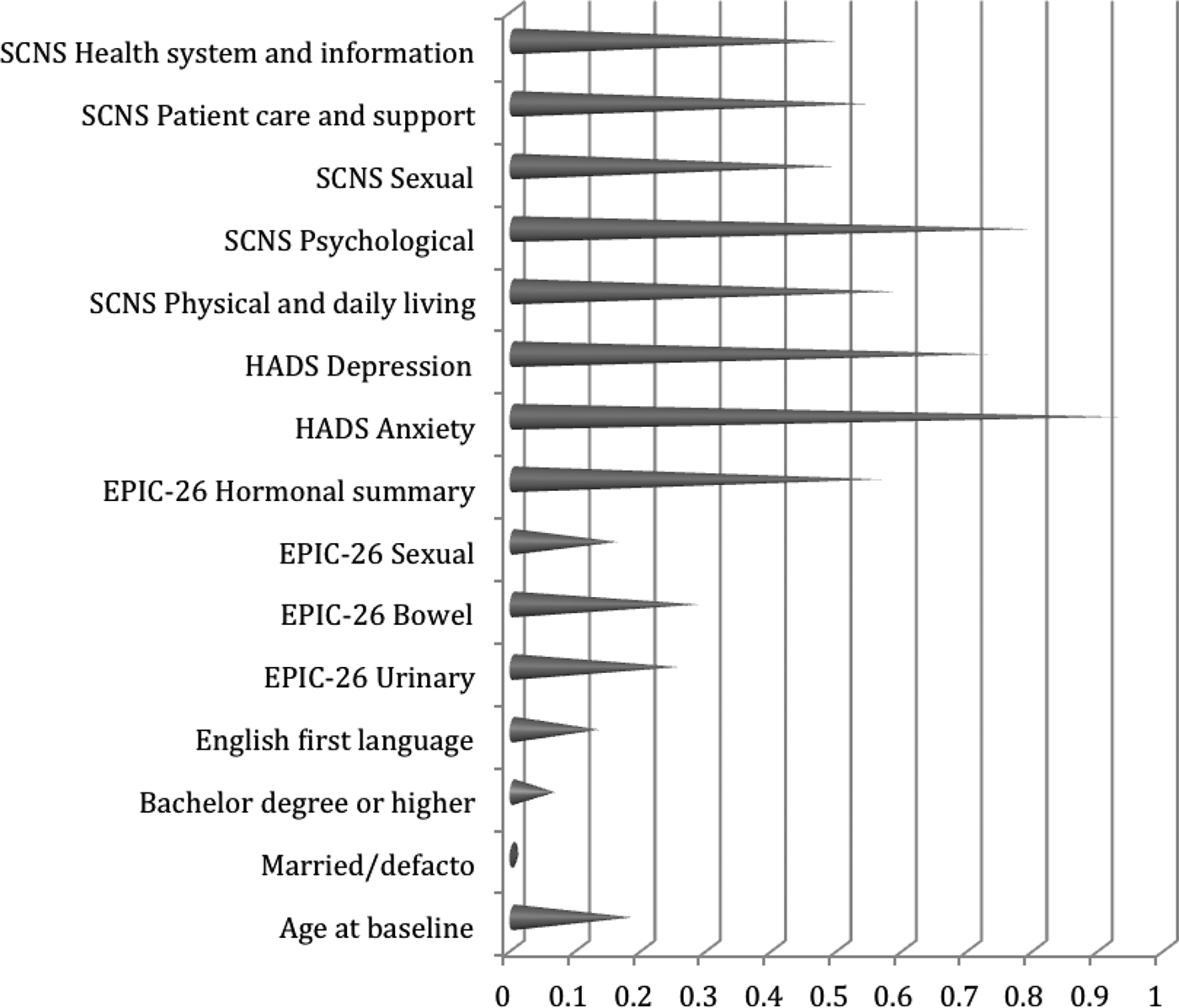
Finally, the psychosocial variable set accounted for a significant proportion of variance in DT scores after partialling out the effects of differences in demographic characteristics and prostate cancer-specific HRQoL (p < 0.0005). Together, variables in this set accounted for an extra 36% of variance in DT scores. Within this set, anxious and depressive symptomatology and unmet physical and daily living needs were significant predictors (p < 0.0005, p = 0.004 and p = 0.041, respectively). Higher levels of anxious and depressive symptomatology and higher levels of unmet physical and daily living needs were associated with higher levels of distress. Nevertheless, the bar chart of structure coefficients for the analysis including all three variable sets indicates considerable predictive power for the EPIC-26 hormonal summary and the other four SCNS needs domains (Fig. 2). In total, 55% of the variance in DT scores was accounted for by variables comprising the demographic, prostate cancer-specific HRQoL and psychosocial sets.
Bar chart of structure coefficients for the hierarchical regression analysis including all three variable sets.
DISCUSSION
Overall this sample of men with prostate cancer exhibited low levels of distress consistent with van Scheppingen et al.'s (Reference van Scheppingen, Schroever and Smink2011) finding that patients with prostate cancer and those who are older had lower rates of distress.
Importantly, a distress score of 4 or higher accurately identified all but 1 of 22 patients with HADS score indicative of clinical anxiety and all but 2 of 8 patients with HADS scores indicative of clinical depression. Nurses in a clinical setting can be confident that a simple screen with the Distress Thermometer will identify those patients at most risk of psychological morbidity. Taken together with other indicators of risk for depression, such as being younger, minimal nursing assessment using the DT at entry to a radiotherapy service can facilitate early referral for further psychosocial assessment.
A further group of participants with distress were identified that would not have been identified if using psychological morbidity screening using HADS alone. Additionally, the distress score was able to identify participants more likely to have higher physical symptomatology, higher unmet needs, more concerns about treatment and poorer quality-of-life. This indicates that a distress thermometer score of four can help identify many patients who require more in-depth assessment of their symptoms, needs and concerns. A distress score of four can rapidly identify many patients where the nurse needs to undertake further assessment and respond with the provision of information, self-care advice and tailored intervention to address these potential contributors to distress. Many of these interventions can be initiated by nurses in the clinic and may reduce the need for referral for specialized psychological intervention. An important future question would be to understand whether early intervention following initial screening can help reduce psychological morbidity over time.
The hierarchical regression analysis conducted in this study found the strongest predictors of distress to be anxious and depressive symptomatology as measured by the HADS. This is not surprising given that the HADS was used to determine the DT cut-off score of 4 during initial development. The important thing to note from this analysis is that many of the other scales are also good predictors of DT scores, supporting the argument that distress is multi-determined rather than psychological morbidity alone. Notably, however, quite a lot of variance in other patient-reported outcome measures was not shared with distress scores (as indicated by the square of relevant correlations) (Cohen et al., Reference Cohen, Cohen and West2003), supporting the need to include more targeted assessment of other domains in screening programs. In this study, the DT demonstrated good ability to identify those patients who required further assessment and intervention at entry to radiotherapy and would have assisted the nurse in prioritizing those patients requiring further assessment, frontline intervention and/or referral. As less than 20% of patients scored 4 or higher, nursing concerns of being overwhelmed by the needs of these patients does not appear to be justified. The contribution to DT score by disease specific factors such as prostate-related quality-of-life, also suggests that patients with a higher DT score should be further assessed using brief disease and treatment specific tools to help determine appropriate interventions.
A limitation of this study is that we utilized the DT alone, without the problem checklist that is normally utilized in clinical settings and were therefore unable to identify if the problem checklist accurately identifies concerns that relate to unmet needs, prostate cancer specific quality-of-life or symptoms. It is possible that the problem checklist as an adjunct to the DT would have helped to identify the three patients with indicative psychological morbidity scores on HADS and would have helped to direct the attention of the nurse to those symptoms and concerns needing attention.
In summary, the findings of this study support the utility of the DT to accurately and easily identify those patients with prostate cancer most likely to have higher unmet needs, higher symptom burden, higher psychological morbidity and higher treatment-related concerns. We therefore support its use as a screening tool in the prostate cancer radiotherapy setting. Further research of this kind would be useful to assess its utility to accurately identify those patients at most need of nursing assessment, support and triage to supportive care services.
ACKNOWLEDGEMENTS
This study was funded by the National Health and Medical Research Council (Project Grant 509143). Associate Professor Penelope Schofield currently holds a National Health and Medical Research Council Career Development Award, ID 628563. An earlier version of this paper was presented at the International Psycho-oncology Society Conference, Brisbane 2012.