Introduction
Fasciolosis used only to be considered of relevance in animals such as cattle and sheep, as it caused significant economic losses to the global agricultural community. However, an increasing number of reports have indicated that this infection is becoming a serious public health problem in humans, especially in South America, Egypt and Iran, with sporadic cases also being reported throughout Europe (McManus & Dalton, Reference McManus and Dalton2006).
This chronic infection can persist for several years in cattle and sheep, and up to 13 years in humans. This results in the production of a large number of eggs, which are transported in the bile juices to the intestine and finally to the faeces, contributing to transmission of the infection (Mas-Coma et al., Reference Mas-Coma, Angles, Esteban, Bargues, Buchon, Franjen and Strauss1999, Reference Mas-Coma, Barques and Valero2005; McManus & Dalton, Reference McManus and Dalton2006).
Helminth drug resistance has become a significant problem, with drug use also being associated with other diverse problems, such as the pathology arising after treatment and drug residue issues. Moreover, the high cost of treatment, consumer demand for chemical-free food, and other concerns regarding the environment and animal welfare, imply that the future control of fasciolosis will depend on the development of an effective vaccine. However, the development of such a vaccine has been slow due to the complexities of the Fasciola hepatica life cycle, and the ability of this parasite to evade and modulate host immune responses (Dalton & Mulcahy, Reference Dalton and Mulcahy2001; Mulcahy et al., Reference Mulcahy, O'Neill, Donnelly and Dalton2004).
Data reviewed by McManus & Dalton (Reference McManus and Dalton2006) suggest that some molecules, such as L-cathepsins, glutathione S-transferase (GST), leucine aminopeptidase (LAP) and fatty acid binding proteins (FABP), have the potency to induce different levels of protection in laboratory and large animal models. However, due to evident differences between parasite exposure in experimental vaccine trials and in field conditions, it is difficult to predict how well these vaccine candidates would perform under the variable environmental conditions occurring in the real situation.
Molecular biology has played a central role in identifying a number of promising vaccine antigen candidates (Knox et al., Reference Knox, Redmond, Sauce and Newlands2001). However, the new generation of vaccines, particularly those based on recombinant proteins to DNA, are likely to be less immunogenic than traditional vaccines (O'Hagan et al., Reference O'Hagan, MacKichan and Singh2001). In fact, variations found between the authentic F. hepatica antigens and those produced by recombinant expression might be due to differences in glycosylation (Reszka et al., Reference Reszka, Cornelissen, Harmsen, Biénkowska-Szewczyk, de Bree, Boersma and Rijsewijk2005).
Immunological adjuvants are substances used in combination with an antigen in order to produce a more robust immune response than that resulting from the antigen alone. A key issue in adjuvant development is toxicity, so despite the extensive evaluation of a large number of candidates over many years, the only adjuvants currently approved by the US Food and Drug Administration are aluminium-based mineral salts (generically called alum). The most appropriate adjuvant depends to a large extent on the type of immune response that is required for protective immunity. However, for many infectious diseases, the relationship between immune response and the protective immunity has yet to be established. Therefore, in many situations adjuvant selection remains rather empirical (O'Hagan et al., Reference O'Hagan, MacKichan and Singh2001).
In regard to F. hepatica infection, there is strong experimental evidence to suggest that cattle can mount a protective immune response following immunization with crude parasite extracts (Spithill & Dalton, Reference Spithill and Dalton1998), constituting a natural source of antigens. In the present study, we have evaluated the ability of total homogenate (TH) of F. hepatica conjugated with alum to protect cattle against experimental fasciolosis. To determine the efficiency of this new combination, we compared it with TH of F. hepatica conjugated with Freund's complete adjuvant (FCA), which is considered one of the most effective adjuvants.
Materials and methods
Antigens
TH of F. hepatica was prepared according to a procedure described by Cervi et al. (Reference Cervi, Rubinstein and Masih1992). Briefly, adult F. hepatica worms were obtained from infected bovine livers at the local abattoir and homogenized by mechanical disruption in a tissue grinder containing phenylmethyl-sulphonyl fluoride. The supernatant obtained at 10,000 g was fractionated and stored at − 20°C until used. The protein concentration was determined by the procedure of Lowry et al. (Reference Lowry, Roserbrough, Farr and Randall1951).
Animals
A total of 36 six-month-old San Ignacio biotype bull calves were randomly assigned into four groups of nine animals each: normal control, infection control, alum-TH and FCA-TH. These animals were maintained at the Catholic University of Cordoba facilities, a fluke-free area. Following institutional guidelines, all experimental protocols were approved by the Animal Experimentation Ethics Committee, Faculty of Chemical Sciences, National University of Cordoba.
Faecal samples were examined to confirm the absence of F. hepatica and other parasites in all animals before they were included in the experiment.
Immunization and infection
Calves were immunized subcutaneously three times at three-week intervals with TH (250 μg/dose) emulsified with an equal volume of alum or FCA for the first immunization and alum or Freund's incomplete adjuvant for the second and third immunizations. Three weeks after the third immunization, animals were orally infected with 250 metacercariae (Baldwin Aquatics Inc., Monmouth, Oregon, USA).
Weekly faecal samples were collected from all calves, starting from day 140 (80 days after infection) until slaughter. Egg count was performed by the McMaster method (Roepstorff & Nansen, Reference Roepstorff and Nansen1998) and expressed as HPG (number of eggs per gram of faeces). Moreover, the animals were weighed every week until slaughter.
Fifteen weeks after infection, animals were slaughtered, the livers were removed and the flukes were recovered. Hepatic damage was evaluated considering different parameters such as size, parenchymal consistency, and dilatation, necrosis and fibrosis of the bile ducts.
Proliferation of peripheral blood mononuclear cells (PBMC)
Blood samples were collected under sterile conditions. Mononuclear cells were obtained using a density gradient (Histopaque 1.077, Sigma Aldrich, St. Louis, Missouri, USA). Then cells were suspended in RPMI 1640 medium supplemented with 10% fetal calf serum, l-glutamine (2 mm), gentamicin (50 μg/ml), β-mercaptoethanol (5 × 10− 5 m), and cultured in 96-well microtitre plates (3 × 10⁵ cells/well) with TH (150 μg/ml) for 6 days. Finally, cells were pulsed for 18 h with 1 μCi [3H]thymidine. The tritiated thymidine incorporation into cellular DNA was measured in triplicate using a Beta liquid scintillation counter.
Analysis of antibody response by ELISA test
The 96-well microtitre plates (Greiner bio-one, Frickenhausen, Germany) were coated with F. hepatica TH (5 μg/ml) in 0.1 m sodium carbonate buffer and incubated overnight at 4°C. Plates were washed before being blocked for 1 h at 37°C. Then plates were incubated with respective sera for 2 h at 37°C. Bound antibodies were detected using peroxidase protein A (294 U/mg, Sigma) and the substrate ortho-phenylendiamine. The enzyme reaction was stopped with 4 n sulphuric acid and sample absorbances were read at 450 nm (Microplate reader, BIO-RAD, Hercules, California, USA).
Immunoblot analysis
TH of F. hepatica was separated by sodium dodecyl sulphate-polyacrylamide gel electrophoresis (SDS-PAGE, 10%) and then transferred on to a nitrocellulose membrane. The nitrocellulose membrane was blocked for 1 h at room temperature. After three washes (Tris-buffered saline), the membrane was incubated with sera of control and immunized animals overnight at 4°C. After three washes, the membrane was incubated with protein A-peroxidase for 1 h at room temperature. Finally, after three washes, the blots were developed using the substrate 4-chloro-1-naphthol and hydrogen peroxide.
Statistical analysis
The data were analysed statistically by using the Student's t-test, with a value of P < 0.05 being considered significant. Results are expressed as means ± SD.
Results
Alum-TH immunization efficiently decreases the parasite burden
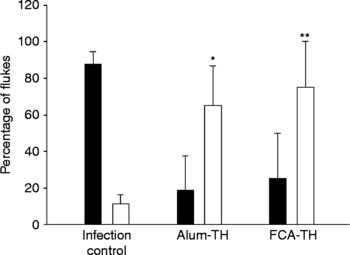
Fifteen weeks after challenge with F. hepatica metacercariae, animals were slaughtered and the parasites from the bile ducts and liver tissue were recovered (table 1). Compared with the infected group, the immunized animals with alum-TH and FCA-TH showed a significant reduction in fluke burden of 85.9% and 96.8%, respectively, as well as a marked reduction in the released eggs in faeces (89% and 57%, respectively). Moreover, in both immunized groups, a significant increase of smaller worms was found (fig. 1), which could possibly indicate a negative effect on fluke growth. However, the alum-TH immunized group had much lower hepatic damage than the FCA-TH group, and less effect on weight gain (table 1).
Differences between infected and immunized groups after infection. Alum-total homogenate (alum-TH) immunized animals were efficiently protected from F. hepatica infection. Groups were subcutaneously immunized three times at three-week intervals with TH (250 μg/dose) emulsified with an equal volume of alum or Freund's complete adjuvant (FCA) for the first immunization and alum or Freund's incomplete adjuvant for the second and third immunizations. Metacercarial challenge was made 3 weeks after the last boost.

Significance levels are indicated as: *P < 0.000009 and **P < 0.0000002, with respect to the infection control group. HPG = number of eggs per gram of faeces. Significance of liver damage: +, slight damage; ++, moderate damage; ++++, severe damage.
a Weight gain of normal control group: 22 ± 10 kg/month.
Size classification of recovered flukes from infection control and immunized groups. Recovered flukes from alum-TH immunized animals are smaller than those in the infection control group. Worms were evaluated according to their size and separated into two groups, large ( ≥ 1.5 cm, black bars) and small ( < 1.5 cm, white bars). Bars represent the mean percentages of flukes within each group ± the standard deviations. Significance levels are indicated as: *P < 0.045 and **P < 0.03, with respect to the infection control group.

An early specific PBMC proliferative response is successfully mounted by alum-TH immunization
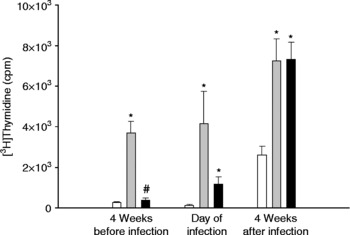
To determine if immunized groups presented a specific cellular immune response to F. hepatica antigens, proliferation assays of PBMC were performed. After metacercarial challenge, both immunized groups showed a significant increase in the antigen-specific proliferation compared to cells from animals of the infected group (fig. 2). However, only alum-TH was efficient in inducing an early antigen-specific proliferation, which took place 4 weeks before infection.
Proliferative response of peripheral blood mononuclear cells (PBMC) of infection control and immunized animals. Alum-TH immunization (grey bars) induces a strong PBMC proliferative antigen-specific response even before metacercarial challenge. Mononuclear cells (3 × 10⁵/well) were cultured with total homogenate (150 μg/ml) for 6 days, before being pulsed for 18 h with 1 μCi [3H]thymidine. Proliferation was measured by 3H incorporation and expressed as counts/minute (cpm). The tritiated thymidine incorporation into the cellular DNA was determined in triplicate and the results are represented as the means ± the standard deviations of each group (white bars, infection control; grey bars, alum-TH; black bars, FCA-TH). Significance levels are indicated as: *P < 0.05, with respect to the infection control group; #P < 0.0002 with respect to the alum-TH group.

Alum-TH immunization induces specific antibody production before metacercarial challenge
To determine if immunized groups presented a specific-antibody immune response to F. hepatica antigens, an enzyme-linked immunosorbent assay (ELISA) was performed.
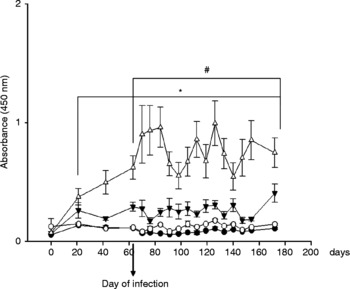
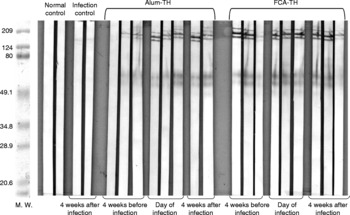
Both immunized groups presented specific antibody production to F. hepatica antigens before metacercarial challenge. This response increased up to the ninth week of treatment and then remained relatively constant up to the end of the experiment (fig. 3). Furthermore, with an immunoblot analysis, it could be observed that specific antibodies of the immunized groups recognized protein components of TH which were not evident in the infected group (fig. 4). Therefore, this observation suggests that these proteins are potential targets for immune system cells, and their recognition could be important in acquiring protection in the presence of this infection.
Kinetics of F. hepatica specific antibodies in immunized and infection control groups. Fasciola hepatica specific antibodies in the alum-TH immunized group were detected before infection. Serial serum samples were collected and the presence of TH F. hepatica specific antibodies was evaluated. The levels of specific antibodies were determined in triplicate and the kinetic response is represented for each group: ●, normal control; ○, infection control; ▾, alum-TH; △, FCA-TH. Significance levels are indicated as: *P < 0.05, with respect to the normal control group; #P < 0.05, with respect to the infection control group.

Immunoblot analysis of F. hepatica specific antibodies. A different pattern in protein components of F. hepatica TH recognized by specific antibodies was observed between the infection control and the alum-TH immunized group. An immunoblot analysis was carried out with collected sera from 4 weeks before infection, infection day, and 4 weeks after infection.

Discussion
Cattle immunized with alum-TH showed a mean reduction in fluke burden of 86%, which represents an encouraging result compared to many other experimental vaccines which have had varying success in protecting cattle and other ruminants. Amongst previous trials, those carried out with cathepsin L1 and cathepsin L2 peptidases combined with a high molecular-sized haem protein induced more than 70% protection (Dalton et al., Reference Dalton, McGonigle, Rolph and Andrews1996); glutathione S-transferase showed a reduction in fluke burdens of 49–69% (Morrison et al., Reference Morrison, Colin, Sexton, Bowen, Wicker, Friedel and Spithill1996); and FhSmIII(M) antigen isolated from F. hepatica adult worm extracts induced 55% protection (Hillyer et al., Reference Hillyer, Haroun, Hernandez and De Galanes1987). Furthermore, recent work has not obtained better results. In this regard, in the induction of immunity against F. hepatica in sheep with mimotopes of cathepsin L, the highest protection level observed after challenge was 47.61% (Villa-Mancera et al., Reference Villa-Mancera, Quiroz Romero, Correa, Ibarra, Reyes Pérez, Reyes Vivas, López Velázquez, Gazarian, Gazarian and Alonso2008). The present work demonstrated that total crude extracts of F. hepatica, a natural source of antigens, together with alum (an adjuvant approved by the US Food and Drug Administration), induced a significant reduction in fluke burden compared to the infected group, as well as a smaller size of the recovered flukes, indicating a possible negative effect on fluke growth.
In addition to solving the technical and scientific problems, helminth vaccines must also be approved by regulatory agencies and obtain public acceptance for commercial application. With regard to veterinary vaccine application, the appropriate criteria for measuring helminth vaccine efficacy differ from those accepted for bacterial and viral vaccines (where sterile immunity is feasible) (Mulcahy et al., Reference Mulcahy, O'Neill, Donnelly and Dalton2004). Mathematical models suggest that vaccines need only to be 60–80% effective against Trichostrongylus infection in sheep in order to provide substantial benefits (Barnes et al., Reference Barnes, Dobson and Barger1995), and these models could be transferable to other current helminth vaccine candidates. Therefore, vaccines capable of maintaining low parasite burden levels or providing a transmission blocking effect, while still maintaining a level of infection sufficient for immune challenge, represent the ideal situation (Mulcahy et al., Reference Mulcahy, O'Neill, Donnelly and Dalton2004).
Human fasciolosis is always associated with endemic animal infection, so vaccination of animals to prevent infection and block disease transmission could play a major role in eliminating human infection in these endemic regions (McManus & Dalton, Reference McManus and Dalton2006).
The immune response necessary for protection may differ from that generated during natural infection, and it is well known that many parasites can manipulate the host immune response to their favour (Mulcahy et al., Reference Mulcahy, Joyce, Dalton and Dalton1999). Therefore, the most appropriate liver fluke vaccine should be composed of several protective antigens that may elicit protection through different mechanisms, involving both antibody and cellular components (McManus & Dalton, Reference McManus and Dalton2006).
The immunized animals with alum-TH presented a significant reduction in fluke burden, a marked reduction in the released eggs in faeces, less effect on weight gain, as well as a significant increase in antigen-specific cell proliferation and antigen-specific antibody production developed prior to F. hepatica metacercarial challenge. Although similar results were found in the FCA immunized group, these animals showed more significant hepatic damage and a strong effect on weight gain. Moreover, if we consider the side-effects associated with the administration of FCA (Claassen et al., Reference Claassen, de Leeuw, de Greeve, Hendriksen and Boersma1992; Kleinman et al., Reference Kleinman, Kier, Diaconu and Lass1993), we can conclude that alum-TH formulation seems to be a good alternative for future vaccination against cattle fasciolosis.
In our immunoblot assay, the heaviest protein component that was recognized in a more prominent way by specific antibodies found in immunized groups, probably represented the F. hepatica haemoglobin (200 kDa) described by McGonigle & Dalton (Reference McGonigle and Dalton1995). The other protein component observed could represent a 65 kDa antigenic component from F. hepatica NEJs (newly excysted juveniles), recognized in sera from calves at chronic stages of fasciolosis studied by van Milligen et al. (Reference van Milligen, Cornelissen and Bokhout2000), among others. Finally, taking into account that the infected group presented lower levels of TH protein-component-specific antibodies than immunized groups, we suggest that these TH proteins could be potential targets of immune system cells, and their recognition could be important in protection against infection. In addition, purification of these TH components might be considered for future vaccine candidates.
Acknowledgements
This work was supported by grants from Agencia Nacional de Promoción Científica y Tecnológica (ANPCYT). We would like to thank native speaker, Dr Paul Hobson, for revision of the manuscript. L.G., M.C.S., J.B. and A.P.G. are recipients of fellowships from Consejo Nacional de Investigaciones Científicas y Tecnológicas, Argentina. D.T.M. is a member of the Research Career of Consejo Nacional de Investigaciones Científicas y Tecnológicas, Argentina.