Introduction
In France, it is estimated that more than 850,000 people have Alzheimer's disease (AD) and related disorders, which affects 6.4% of people aged 65 years and over, and shows a trend of increasing numbers of new cases (Ankri, Reference Ankri2009). AD is a devastating disease that changes intellectual functioning and personality. Moreover, there is no cure nor prevention strategies (Cutler and Hodgson, Reference Cutler and Hodgson2001; Proctor et al., Reference Proctor, Martin and Hewison2002; Corner and Bond, Reference Corner and Bond2004). Based on a representation of severe dementia, perception of AD is based on a combination of fears of mental disease, aging and dependence (Clarke, Reference Clarke2006). Fear of dementia may have a negative impact on awareness of symptoms and thus may represent an obstacle to early diagnosis. Yet, early diagnosis allows patients a greater chance of benefiting from existing treatment, which can have a positive effect on maintaining patients’ current level of functioning. Moreover, diagnosis enables education of those who care for them, preventing them becoming over-burdened and facing a crisis situation (Iliffe et al., Reference Iliffe2005).
Health education campaigns to encourage diagnosis-seeking behavior generally target the first signs of AD, but, to be effective, they need to focus on the social perceptions associated with the fear of developing the disease.
Only a small numbers of studies have been published on social perception of AD in the community (Werner, Reference Werner2005). In the Facing Dementia Survey, Bond et al. (Reference Bond, Stave, Scanga, Vincenzino, O'Connel and Stanley2005) assessed the awareness of and behaviors surrounding AD among the general population, and among patients and caregivers, and showed that fear was common among older adults, while other studies have focused on sociocultural or ethnic differences (Roberts et al., Reference Roberts, Connell, Cisewki, Hipps, Demissie and Green2003; Connell et al., Reference Connell, Roberts and McLaughlin2007). Cutler and Hodgson (Reference Cutler and Hodgson2001) looked into factors associated with fear of developing AD by comparing middle-aged caregivers looking after a parent with the disease, and people of the same age with no family history. Werner (Reference Werner2002), using a sample of 186 individuals with no family history of AD, examined links between fear of developing the disease and sociodemographic factors and state of health. Laforce and McLean (Reference Laforce and McLean2005) compared knowledge of AD and fear of developing the condition in young adults. Lastly, Yeo et al. (Reference Yeo, Horan, Jones and Pendleton2007) analyzed associated factors in older subjects who were in good health. To our knowledge, the present study is the first to be based on a representative sample of the French population, comparing attitudes towards AD between different age groups.
The current French Government “Plan Alzheimer 2008–2012” provides measures for improving the population's attitudes to the disease. This makes previous identification of contributing factors to the population's perception essential. Therefore, we examined the influence of age, proximity to AD, people's perceived health status, and knowledge and beliefs about AD. These factors were derived from the Health Belief Model (HBM) (Janz et al., Reference Janz, Champion, Strecher, Glanz, Rimer and Lewis2002). According to this model, fear arises from two cognitive processes: (1) an individual's awareness of their own susceptibility to develop a condition, and (2) an individual's perception of the seriousness of its consequences. We hypothesized that these cognitive processes were at work in the general population's attitude towards AD, with sociodemographic variables such as age, sex, education level and income level aggravating or attenuating the perceived threat. We hypothesized strong links in particular between fear of developing AD and aging.
Methods
Sample
In October 2008, a cross-sectional telephone survey was performed in France to evaluate the population's perception of Alzheimer's disease. The nationally representative sample was composed of French-speaking people aged 18 years and over. Non-random stratified sampling was used; quotas were set by sex, age, socio-professional category of the head of the consumption unit, after stratification by region and area of residence. Residential telephone numbers were randomly drawn from the national white pages (n = 21,500). The 2013 completed interviews represented 10.9% of all numbers called. The sample size was predetermined as 2000, and each number was used in order to fill in the quotas. The survey was conducted by a private company (BVA Institute) which obtained authorization from the French data protection authority (CNIL), which is responsible for the protection of privacy and individual rights. Before the beginning of the interview, interviewers informed each participant of his or her right to refuse to take part in the study or the possibility of withdrawing their consent at any time with no negative consequences. Verbal consent was obtained for telephone interviews.
Instruments
Trained professional interviewers applied a structured questionnaire. The questionnaire was compiled based on questionnaires that had been used in similar studies (Corner and Bond, Reference Corner and Bond2004; Connell et al., Reference Connell, Roberts and McLaughlin2007) and adjusted with the collaboration of healthcare professionals, sociologists, psychologists and members of Alzheimer associations. The survey was introduced as being based on the French population's understanding of health problems conducted by the National Institute for Prevention and Health Education. This was done so as not influence participants’ responses to the open-ended questions about attitudes and perceptions on AD.
The dependant variable was the personal fear of developing AD. Participants were asked to rate the extent to which they feared seven health risk or diseases listed in Figure 1 (AIDS, smoking-related illnesses, depression, heart problems, traffic accidents, cancer, AD). The list was randomly ordered for each interview. For each health risk or disease the answer was rated on a 4-point scale (1 = “not at all”; 4 = “very much”). In further analyses, participants who reported fearing AD “very much” and “a little” were compared to participants who reported fearing “not really” and “not at all” (0 = “not at all or not really”; 1 = “a little or very much”).
Personal fear of developing health risk or disease, according to age.

The independent variables used in this study were the following:
Proximity to the disease. Participants were asked: “Have any of your close relatives, friends or colleagues been suffering from AD ?”. If “yes”, people were asked if they “offered some support for activities of daily living to this person ?” Using these two items, a composite indicator was created with three categories: 1 = “Not known someone with AD”; 2 = “known but not cared for”; 3 = “cared for someone with AD”.
Self-perceived health. A single item was used for assessing the subjective perception of health. The 4-point scale was recoded in two categories: 0 = “excellent to good”; 1 = “poor to very poor”.
Level of information and knowledge. The self-perceived level of information was based on the question “Do you consider yourself properly informed about AD?” (0 = “No”; 1 = “Yes”).
To assess their level of knowledge, participants were first asked to rate the extent to which they considered six signs or symptoms were related to early stages of AD. Three items were positively related with early stages of AD (for example “to have difficulties remembering the way to go home”), and three items were not considered as specific symptoms (for example “to have a headache”). Each item was rated on a 4-point scale, ranging from 1 = “completely agree”, to 4 = “completely disagree”. A composite score of all items was created (range 0–24; Cronbach's α = 0.67), with higher scores indicating higher levels of knowledge. In a similar way, participants were asked to answer a second series of questions focusing on factors that possibly might prevent the disease. Three factors (for example “to eat fruit and vegetables regularly”) were considered as effective and three factors as not effective (for example “to live in a unsafe environment”). A composite score of all items was created (range 0–24; Cronbach's α = 0.73), with higher scores indicating higher levels of knowledge.
Severity of the disease. At the beginning of the interview, participants were asked to report the three diseases they considered the most serious. This open-ended question was recoded in a two-category variable, separating 0 = “Do not consider AD as one of the three most serious diseases” and 1 = “Consider AD among the three most serious diseases”.
Opinions and beliefs. Participants were asked to rate if which they agreed with a list of opinions or beliefs: “It's normal to lose your memory as you get older”; “there's nothing you can do to avoid getting AD”; “there are effective treatments against AD”; “a cure for AD will be found in your lifetime”; “more and more people are affected by AD”; “AD can have devastating effects on the sufferer's family”; “AD is often hereditary”. For each item, the 4-point scale was recoded as a binary indicator (0 = “disagree”; 1 = “agree”).
Sociodemographics. The sociodemographic variables considered were: sex (0 = “male”; 1 = “female”), age (1 = “18–34 years”; 2 = “35–64 years” ; 3 = “65 years and over”), living conditions (0 = “cohabitant”; 1 = “alone”), level of education (0 = “lower than secondary”, 1 = “secondary or higher”) and level of income per consumption unit (1 = “less than €900/month”, 2 = “between €900 and €1499€/month”, 3 = “€ 1500 and over/month”).
Statistical analysis
Percentages, means and standard deviations were used to describe the sample and the main variables. T-tests and χ2 analyses were used to explore associations between the fear of AD and each independent variable. In order to determine the strongest characteristics of people who personally feared developing AD, multivariate logistic regressions were performed using sociodemographic variables as control (gender, age, living conditions, level of education and level of income) and those independent variables significantly associated with personal fear in univariate analysis at 5%.
The sample was weighted by sex, age, socio-professional status and geographic location to match the French population. Weights were drawn up from the 2005 National Census. Only weighted results are presented.
All analyses were performed using STATA 10 (StataCorp, 2007, College Station, TX).
Results
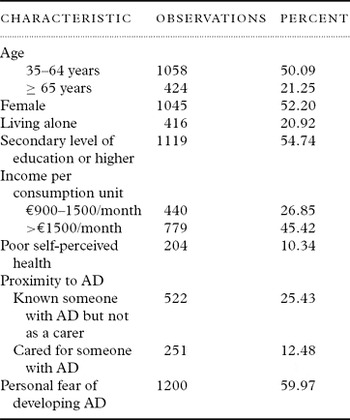
The survey comprised 2013 randomly selected French adults; their characteristics are presented in Table 1. Because a weighting procedure was applied, this sample was representative of the national French population.
Sample characteristics (n = 2013)

Personal fear of developing Alzheimer's disease
In total, 1200 (59.97%) participants reported being personally afraid of developing AD. Nevertheless, as illustrated in Figure 1, AD was reported as causing less personal fear than cancer or traffic accidents, yet more fear than heart disease, and far more fear than AIDS or depression (Figure 1).
Predictors of personal fear of developing AD
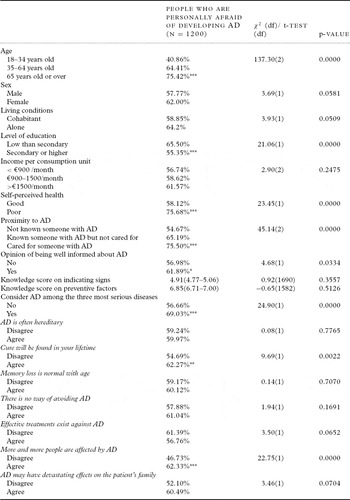
Associations between personal fear of developing AD and the independent variables are presented in Table 2. Sociodemographic variables, as well as variables significantly associated with the dependent variable at 5%, were entered into the logistic regression.
Univariate associations between the personal fear of developing Alzheimer's disease and independent variable

Notes. Percentages and χ2 results reported for dichotomous variables; means (standard deviations) and t-test results reported for continuous variables. df = degrees of freedom. Missing values are dropped in the analysis.
*p<0.05; **p < 0.01; ***p < 0.001.
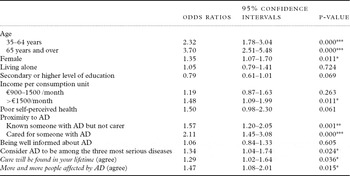
The final model (Table 3) demonstrates that personal fear of developing AD is associated with female gender (odds ratio (OR) = 1.35; 95% confidence interval (CI) = 1.07–1.70; p < 0.05) and higher levels of income (OR = 1.48; CI = 1.09–1.99; p < 0.05). People knowing someone with AD (OR = 1.57; CI = 1.20–2.05; p < 0.01) or who have cared for someone with AD (OR = 2.11; CI = 1.45–3.08; p < 0.001) were significantly more likely to fear developing AD themselves. This attitude was significantly higher among people who considered AD as one of the three most serious diseases (OR = 1.34; CI = 1.04–1.74; p < 0.05) and among those who agreed with the opinion that “more and more people are affected by AD” (OR = 1.47; CI = 1.08–2.01; p < 0.05) or that “a cure will be found in your lifetime” (OR = 1.29; CI = 1.02–1.64; p < 0.05). Self-perceived level of information and actual level of knowledge were not associated with personal fear.
Results of multivariate logistic regression with the personal fear of developing Alzheimer's disease as dependent (N = 1506)

Notes: Apart from sex, living conditions, level of education and level of income, significant variables at a threshold of 5% in univariate associations were introduced in the model. N varies depending on the number of missing values which are dropped from the models.
*p < 0.05, **p<0.01, ***p < 0.001.
Personal fear of Alzheimer's disease in the different age groups
As shown in Table 2, age was strongly and linearly associated with personal fear of AD, with the highest percentage being in the elderly group (75.42%; χ2(2) = 137.30; p < 0.001). This finding was significant even after adjustment by level of education, level of income or self-perceived health (Table 3).
In order to explore if predictors of personal fear of AD were similar for each generation, we performed multivariate logistic regressions separately for each age group. Sociodemographics were entered systematically into the models, as were variables significantly associated in univariate analyses at 5%.
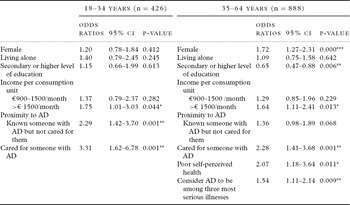
For the 18–35 age group, independent variables entered into the logistic regression model were proximity of the disease (χ2 (2) = 30.346; p < 0.001), the beliefs that “effective treatments exist for AD” (χ2 (1) = 4.457; p < 0.05), and that “more and more people are affected by AD” (χ2 (1) = 13.641; p < 0.001). In the final model, reported in Table 4, young people on higher incomes were more likely to fear developing AD (OR = 1.75; CI = 1.01–3.03; p < 0.05). Proximity of the disease was strongly associated with personal fear, with caregivers having a higher probability of having this attitude (OR = 3.31; CI = 1.62–6.78; p < 0.001).
Results of logistic regressions with the personal fear of developing Alzheimer's disease as dependent variable: models for the 18–34 age group and the 35–64 years group

Notes. Apart from sex, living conditions, level of education and level of income, final models was based on significant variables at a threshold of 5% in univariate association. N varies depending on the number of missing values which are dropped from the models.
*p < 0.05; **p<0.01; ***p < 0.001.
For the middle-aged group (35–64 years), significant associations were found between personal fear of developing AD and self-perceived health (χ2 (2) = 9.200; p<0.01), proximity of the disease (χ2 (2) = 18.994; p < 0.001), severity of the disease (χ2 (2) = 9.846; p <0.01), and the belief that “more and more people are affected by AD” (χ2 (2) = 7.527; p < 0.01). Table 4 presents results of the final logistic regression. Personal fear of developing AD was higher among females (OR = 1.72; CI = 1.27–2.31; p<0.001), with lower level of education (OR = 0.65; CI = 0.47–0.88; p < 0.01) but a higher level of income (OR = 1.64; CI = 1.11–2.41; p < 0.05). Poor self-perceived health, being a caregiver of someone with AD and considering AD as one of the three most serious conditions increased significantly the risk of fearing AD in the 35–64 years age group.
For the oldest group (65 years and over), personal fear of developing AD was higher among people who lived with a cohabitant (82.21% vs 68.14%; χ2 (1) = 7.882; p < 0.01), who had a low level of education (78.69% vs 69.18%; χ2 (1) = 4.551; p<0.05), who didn't feel well informed about AD (83.76% vs 72.82%; χ2 (1) = 4.813; p < 0.05) and among those who agreed with the belief that “a cure for AD will be found in your lifetime” (79.85% vs 68.55%; χ2 (1) = 5.736; p<0.05). However, no significant predictor was found in multivariate logistic regression.
Discussion
We have examined factors associated with personal fear of developing AD, in particular the influence of age, proximity to the disease, people's perceived health status, knowledge and beliefs.
Our results confirmed that AD provokes fear among the general population in France, with 60% fearing the development of AD in later life. This proportion was higher than that found in other surveys (Werner, Reference Werner2002; Cutler and Hodgson, Reference Cutler and Hodgson2001).
Our results support three major findings. First, fear was present at all ages, although it reached a peak among people aged 65 years and over. Second, fear was not experienced in the same way by all adults but rather depended on stage of life. Third, age strongly influenced other factors associated with fear.
For young people, it was the perceived severity of AD and their own proximity to the disease which most influenced their personal fear of developing the condition. The perceived severity of dementia has already been evidenced in a previous qualitative study (Pin Le Corre et al., Reference Pin-Le Corre, Benchiker, David, Deroche, Louassarn and Scodellaro2009). In this study, which was based on focus groups, AD was described using terms such as “plague” and “disaster” and thus was associated with a perception of being inevitable and indiscriminate.
In contrast with results from Laforce and McLean (Reference Laforce and McLean2005), who identified a greater fear among younger individuals, our findings showed middle-aged individuals to be the most fearful of AD, in particular women with a negative perception of their own health status. This pivotal generation considered AD not only to be a personal threat for the future but also as a current strain, since middle-aged women are often caring for a parent with dementia (Roberts and Connell, Reference Roberts and Connell2000).
Among the elderly, personal vulnerability contributes to fear probably because illness is more likely to occur with aging and because the elderly feel ill-prepared and powerless to cope with it (Corner and Bond, Reference Corner and Bond2004; Yeo et al., Reference Yeo, Horan, Jones and Pendleton2007). Also, older people generally have a more negative view of their own physical health (Gautier et al., Reference Gautier, Kubiac, Collin, Beck, Guilbert and Gautier2007). Age is an acknowledged risk factor for AD but is also associated with frequency of benign memory complaints (Derouesné et al., Reference Derouesné, Rapin and Lacomblez2004). Anxiety, isolation and low self-esteem, all linked to aging, may even aggravate memory problems now that the latter has become a socially accepted complaint (Derouesné et al., Reference Derouesné, Rapin and Lacomblez2004). Fear of AD may also reflect negative feelings linked to the prospect of growing old. Because elderly people commonly attribute health conditions to uncontrollable external factors (Denoux and Macaluso, Reference Denoux and Macaluso2006), they feel helpless in the face of an illness which cannot be prevented. Consequently, they expect the solution to come from external sources (which was expressed by their belief that treatment would still become available during their lifetime).
The importance of personal proximity in perceived threat has been thoroughly explained in the literature, not only for AD but also for other conditions (Roberts and Connell, Reference Roberts and Connell2000; Laforce and McLean, Reference Laforce and McLean2005; Rimmer et al., Reference Rimmer, Wojciechowska, Stave, Sganga and O'Connell2005; Cutler and Hodgson, 2007). Proximity amplifies susceptibility due to sharpened perception of negative consequences (loss of autonomy, devastating impact on family life) (Roberts and Connell, Reference Roberts and Connell2000; Bond et al., Reference Bond, Stave, Scanga, Vincenzino, O'Connel and Stanley2005; Rimmer et al., Reference Rimmer, Wojciechowska, Stave, Sganga and O'Connell2005).
Contrary to other surveys (Cutler and Hodgson, Reference Cutler and Hodgson2001; Proctor et al., Reference Proctor, Martin and Hewison2002; Werner, Reference Werner2003), we have not found any association between knowledge and fear. This may possibly be explained by the fact that our survey only contained a single item on the impact of AD on the patient's family (an issue frequently addressed in the media) but instead contained questions on the hereditary nature of AD, prevention and treatment, items about which little is known among the general population (Yeo et al., Reference Yeo, Horan, Jones and Pendleton2007).
While the HBM has guided us in evidencing factors of (1) perceived susceptibility to develop AD, such as age and proximity to people with dementia, and (2) the individual's perception of serious issues like growing prevalence, the question of how to reduce the fear of developing AD needs still to be addressed. Factors of personal susceptibility are not modifiable. Yet, perceived severity may be modified by changing the population's lack of understanding concerning major differences between benign memory complaints and dementia, the benefits of psychosocial support interventions on caregivers’ and patients’ quality of life, the effectiveness of psychotherapy on patients’ behavioral changes and carers’ depression, and the possible impact of early medication on delaying disease progression.
Which cues to action might be useful? Following the idea of the HBM, easy-to-follow actions reinforcing feelings of self-efficacy are needed. Self-efficacy (Bandura, Reference Bandura1982) is determined by a personal belief in one's own ability to do something and on having the necessary resources. To increase self-efficacy it is also necessary to support individual efforts and to develop and offer resources in the community.
Cues to action that trigger a diagnosis for those who fear developing dementia are needed. The latter should not only be offered memory assessment but also regular follow-up and psychological support. An early and accurate diagnosis can help them to identify reversible conditions and reduce fear. Moreover, as simple lifestyle changes contribute to reducing the risk of dementia, the general population has to be educated on these issues. Furthermore, people have to know that they will be offered psychosocial support in case of dementia, and that this can be set in place from the very onset of the disease through later stages.
Family caregivers’ fear may be reduced by offering them education programs on how to manage their care-recipient, particularly if the latter presents behavioral problems. Moreover, education allows them to better cope with personal stress and to find available community support more easily. It may also augment perceived social support.
Our study has several limitations. First, the survey is restricted to a description of attitudes, opinions and perceptions about AD and was not conceived for explanatory or comparative purposes. The cross-sectional perspective of this survey does not allow for causal conclusions regarding associations between evidenced factors and personal fear. Our current findings could be extended with a follow-up survey on the French population's perception over three years. Second, fear is a multidimensional attitude (Roberts and Connell, Reference Roberts and Connell2000; Werner, Reference Werner2003), whereas in our survey fear was reduced to “personal fear of developing the disease”. Lastly, our survey did not investigate the impact of fear on stigmatization of people suffering from dementia.
Conclusion
This survey showed that the fear of developing AD in later life is considered to be one of the most serious fears held by the French population. Age strongly influenced personal susceptibility and perceived severity, as did proximity to the disease. Other factors, such as perceived state of health, increased the perception of threat, while sociodemographic factors, such as gender, modified their effect.
Reduction of fear requires a process of change which should focus on feelings of self-efficacy (seeking a diagnosis, adopting a healthy lifestyle) and be prompted by cues to action (information, education, availability of community support). This requires education of the general population and the effective coordination of resources in the community. This process must draw on concerted actions by all partners and policy-makers including patients, family caregivers and healthcare professionals.
Conflict of interest
None.
Description of authors’ roles
Stéphanie Pin was responsible for the analysis and editorial assistance. Inge Cantegreil-Kallen wrote the paper and provided theoretical references.
Acknowledgments
The survey was entirely financed by the National Institute for Prevention and Health Education (INPES). The authors wish to thank the survey working group, as well as those responsible for the study and the interviewers of the BVA Institute who enabled the survey to be carried out.