There is little debate that monetary contraction was a central cause of the Great Depression in the United States. The U.S. money supply declined 33 percent between the business cycle peak in August 1929 and the trough in March 1933.1
Financial panics were widespread, real interest rates rose sharply, and credit contracted greatly. The Federal Reserve's failure to respond to the banking panics and plummeting output during the Great Depression is surely one of the great mysteries of the 1930s. Why would a central bank, explicitly formed less than 20 years earlier to deal with financial instability, do so little during the worst financial and economic crisis of the twentieth century?
In their classic study, Milton Friedman and Anna Schwartz argue that the Federal Reserve allowed the money supply to plummet because of ineptitude and poor leadership.2
In their view, the monetary contraction was a monumental policy mistake caused by a flawed model of the economy and a power vacuum at the Federal Reserve. Recent scholarship, however, has argued that U.S. adherence to the gold standard was the fundamental constraint on monetary policy. Barry Eichengreen, Peter Temin, and Ben Bernanke suggest that the Federal Reserve could not act to stem panics or stimulate production because expansion could lead to devaluation.
The Great Depression, in the gold standard view, was not the preventable result of gross policy mistakes, but the inevitable consequence of the United States's determination to remain on a system of fixed exchange rates.
A key component of the gold standard story is the possibility that aggressive Federal Reserve action could cause a speculative attack on the dollar. In the interwar period, capital was sufficiently immobile that the United States could engage in significant open market operations without generating huge gold outflows through the conventional arbitrage mechanism. Furthermore, by 1929 the United States held such large gold reserves that even substantial gold losses were unlikely to threaten U.S. adherence to the fixed parity.4
Therefore, the main channel through which Federal Reserve actions might jeopardize the gold standard was expectations: aggressive monetary expansion could lead market participants to doubt the U.S. commitment to the gold standard. Proponents of the gold standard view believe that the Federal Reserve did not act because it understood that expansionary actions were likely to lead to expectations of devaluation and a rapid, catastrophic loss of gold.
This article tests this central premise of the gold standard view by examining in detail the open market purchase program of 1932. In the spring of 1932, the Federal Reserve finally embarked on a program of rapid monetary expansion. In just 20 weeks, the Federal Reserve purchased $1,080 million worth of U.S. government securities, more than doubling its holdings of government debt.5
This episode provides a laboratory for examining the effects of Federal Reserve actions on expectations.
We examine estimates of the expectation of devaluation derived from forward exchange rates and interest rate differentials. If the Federal Reserve's actions led investors to doubt the U.S. commitment to the gold standard, this should have shown up as a rise in the forward exchange rate between the dollar and the currencies of countries widely thought to have been firmly attached to gold, such as France and Switzerland. Similarly, expectations of devaluation should have led to a rise in U.S. nominal interest rates relative to those of countries viewed as committed to the gold standard. We find little evidence of an effect of the monetary expansion on either of these measures. Expectations of devaluation measured using forward exchange rates actually fell slightly both with the start of the program in February 1932 and with its acceleration in April. They then rose slightly in late May, when open market purchases were holding steady at a moderate level, but fell again well before there was any indication the program was going to stop. Interest rate differentials also fell with the start of the program, and then remained low throughout the spring and summer of 1932.
We also examine the narrative record to see if there were expectations of devaluation or fear of a speculative attack among either Federal Reserve officials or market observers. We find scant evidence of such sentiments. The leaders of the Federal Reserve expressed little concern about a loss of credibility. We find that the Federal Reserve stopped the program not because it feared a speculative attack, but because it thought it had accomplished its goals and because it was difficult to maintain consensus in favor of action among the 12 Federal Reserve banks. We also find that neither American nor British news sources saw evidence of significant investor concern as a result of the open market purchase program.
Generalizing our findings from 1932 to the rest of the early 1930s is difficult. The scale of open market purchases and economic conditions in 1932 may have been quite different from the necessary scale and economic conditions in other years of the Great Depression. Nevertheless, we argue that an action similar to the 1932 expansion might have been both possible and effective in stemming the downturn had it been undertaken in 1930 or 1931. In this way, our analysis of the 1932 monetary expansion supports the view the American Great Depression was largely the result of inept policy, not the inevitable consequence of a flawed international monetary system.
OPEN MARKET OPERATIONS IN 1932
Before using the 1932 expansion as a crucial case study, it is useful to review the operation of the interwar gold exchange standard and the nature of the 1932 policy action. It is also important to examine whether the public, both in the United States and abroad, was aware of the program and perceived it as a dramatic break from previous policy.
Open Market Operations under the 1930s Gold Exchange Standard
Given that the United States was on the gold exchange standard, it is reasonable to ask whether open market operations could have any effect at all. After all, a central lesson of open-economy macroeconomics is that in a small open economy with fixed exchange rates and perfect capital mobility, a monetary expansion that puts downward pressure on domestic interest rates relative to world rates results in an offsetting loss of foreign exchange. As a result, it ultimately has no effect on the money supply or domestic interest rates.
There are two main reasons why open market operations, such as those undertaken in 1932, could have increased the American money supply even if the United States was on a credible fixed exchange rate system. First, capital mobility was limited in the interwar period because of factors such as transportation costs and inefficiency in the banking system. David Peel and Mark Taylor show that deviations from covered interest parity between the dollar and sterling would not be arbitraged unless the deviation exceeded 50 basis points.6
Peel and Taylor, “Covered Interest Rate Arbitrage.”
They also find that deviations from covered interest parity were quite persistent even outside this remarkably wide neutral band. Therefore, open market operations could result in an expansion of the money supply that reduced U.S. interest rates by 50 basis points or more without triggering immediate gold flows.
7 Obstfeld and Taylor, “Globalization,” look more broadly at international capital mobility in the nineteenth and twentieth centuries. Using a variety of measures, they conclude that capital mobility declined dramatically after World War I and remained low until the postwar era.
Second, because the United States was a large country, U.S. open market operations could affect world interest rates. As a result, the U.S. interest rate could fall by more than 50 basis points without triggering gold flows. This suggests that the possible increase in the U.S. money supply was even larger than the arbitrage findings suggest. Michael Bordo, Ehsan Choudhri, and Anna Schwartz argue that the large-country assumption is indeed appropriate for the United States in the 1930s.8
Bordo, Choudhri, and Schwartz, “Was Expansionary Monetary Policy.”
They present simulations that indicate that substantial open market operations in the United States would not have caused large gold outflows even under the extreme assumption of perfect capital mobility.
The 1932 Open Market Purchase Program
In 1932 the Federal Reserve decided to use its powers to increase the money supply. A consensus in favor of expansion grew gradually in early 1932. In an address on 8 January, George L. Harrison, Governor of the Federal Reserve Bank of New York, bemoaned the decline of bank credit over the last few years. He went on to argue that to arrest this decline, “the Federal Reserve Banks are in a position at the present time and on the basis of their present gold supply to expand Federal Reserve credit to their members by some 3 1/2 billion dollars.”9
Harrison Papers, “Introductory Remarks by Governor Harrison to the New York State Bankers Association,” 8 January 1932.
In February, Congress passed the Glass-Steagall Act, which effected a substantial change in collateral requirements for the Federal Reserve. Under the original Federal Reserve Act, the Federal Reserve had to hold gold as backing for 40 percent of notes, and eligible (private-sector) securities for the remaining 60 percent. Because the Federal Reserve typically did not hold enough such private bills, it ended up using gold to back substantially more than the statutory minimum. The Glass-Steagall Act allowed the Federal Reserve's large holdings of government securities to be used as collateral for Federal Reserve notes, thus freeing up large quantities of gold to back increases in the money supply.
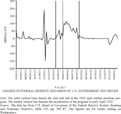
Once passage of the Glass-Steagall Act was assured, the Federal Reserve began to expand the money supply gradually. At its meeting on 24 and 25 February, the Open Market Policy Conference (hereafter OMPC), the precursor of the modern Federal Open Market Committee, authorized the purchase of $250 million in government securities at a rate of approximately $25 million per week.10
Harrison Papers, “Minutes of the Meeting of Governors,” 24 and 25 February 1932, p. 7.
These initial open market purchases are evident in
Figure 1, which shows the weekly change in Federal Reserve holdings of U.S. government securities.
11 The Federal Reserve Bank of New York also lowered the discount rate on eligible paper from 3.5 percent to 3 percent in February 1932 and from 3 percent to 2.5 percent in June. The Federal Reserve Bank of Chicago lowered its discount rate from 3.5 percent to 2.5 percent in June 1932. The other Federal Reserve banks left their discount rates unchanged at 3.5 percent throughout the period of the open market purchase program. The data are from U.S. Board of Governors of the Federal Reserve System, Banking and Monetary Statistics, table no. 115, p. 441.
We have drawn a solid line in
Figure 1 at the last observation before the start of open market purchases, which is 24 February.
FIGURE 1 CHANGE IN FEDERAL RESERVE HOLDINGS OF U.S. GOVERNMENT SECURITIES
At its next meeting, on 12 April, the OMPC decided to dramatically accelerate the program of monetary expansion. The OMPC authorized the Executive Committee to purchase an additional $500 million in government securities and recommended “that these purchases, at least in the initial weeks, should be at a rate as rapid as may be practicable.”12
Harrison Papers, “Meeting of Joint Conference of the Federal Reserve Board and the Open Market Policy Conference,” 12 April 1932, p. 5.
Because the April meeting represented a dramatic acceleration of the open market purchase program, we have drawn in another line (this one dashed) at the last observation before the acceleration, which is 6 April.
Figure 1 shows that the open market purchases continued in May and June, but at the reduced rate of approximately $50 million per week. By mid-June, the consensus in favor of aggressive expansion had begun to wane.13
At its meeting on 16 June, the Executive Committee of the OMPC unanimously agreed that “sufficient purchases of government securities should be made to keep excess reserves of member banks at a figure between $250,000,000 and $300,000,000,” a range that encompassed the prevailing level of excess reserves (Harrison Papers, “Minutes of the Meeting of the Executive Committee of the Open Market Policy Conference,” 16 June 1932, p. 2). The prevailing level of excess reserves is given in the accompanying “Preliminary Memorandum for the Open Market Executive Committee,” 16 June 1932, p. 1.
However, open market purchases were not curtailed dramatically until early July. At its meeting on 14 July, the OMPC indicated that “except in unusual or unforeseen circumstances purchases should not exceed 15 million dollars a week.”
14 Harrison Papers, “Minutes of the Meeting of the Open Market Policy Conference,” 14 July 1932, p. 3.
By the statement week of 30 July 1932, open market purchases were effectively zero. We have drawn a solid vertical line in
Figure 1 at 13 July because this was the last observation under the 1932 open market purchase program.
Was the Public Aware of the Federal Reserve's Actions?
The rapid monetary expansion could have sparked devaluation fears only if the public was aware of it. Because the Federal Reserve released balance sheet data each week and these data were presented in a number of news sources, there can be little doubt that the information was available. However, to see if the Federal Reserve's actions were likely to have entered the public's consciousness, we examine the coverage of the open market purchase program in the financial press in the United States and abroad. In particular, we examine reports in the Commercial and Financial Chronicle (abbreviated as Chronicle in what follows), the premier business paper in the United States, and in the Economist, a key international financial publication. The Chronicle is a particularly useful source because it also excerpted stories on financial issues from general papers, such as the New York Times.
The proposal and passage of the Glass-Steagall Act was the subject of several long articles in the Chronicle in mid-February 1932. The paper clearly felt that the new legislation set the stage for monetary expansion. It stated on 13 February: “The purpose is perfectly plain, the country is to be flooded with credit and with currency on the idea that thus it will be possible to stop deflation.”15
Chronicle, 13 February 1932, p. 1070.
The
Chronicle reported the increase in Federal Reserve purchases of government securities starting in late February. However, because discounts were falling at the same time, the paper suggested that “[n]o distinct sign of any change [in policy due to the passage of the Glass-Steagall Act] is as yet discernible.”
16 Chronicle, 12 March 1932, p. 1818.
The
Economist also gave extensive coverage to the Glass-Steagall Act and its possible effects on American monetary policy.
17 See, for example, Economist, 20 February 1932, p. 394; and 27 February 1932, p. 461.
Unlike the Chronicle, it also saw a distinct move toward monetary ease in the early spring. It said on 19 March:
Federal Reserve Bank operations this week support the view that with the passage of the Glass-Steagall Bill … the system would enter the open market, purchase Government securities, and thereby ease credit and add to the supply of free gold at the same time…. Beyond question the central banking authorities are determined to pursue further an easy-money campaign designed to stop what they regard as at least too rapid deflation.18
Economist, 19 March 1932, p. 627.
There was extensive press coverage of the acceleration of open market purchases approved in mid-April. According to an article in the Chronicle on 16 April: “On Wednesday, April 13, Governor George L. Harrison … revealed that the Federal Reserve System had embarked upon a new ‘easy money’ policy through open market purchases of Government securities at an accelerated speed, both as to rate and volume.”19
Chronicle, 16 April 1932, p. 2774.
The
New York Times stated: “By entering upon a policy of controlled credit expansion, designed to turn the deflation in bank credit and to stimulate a rise in prices, the Federal Reserve System has undertaken the boldest of all central bank efforts to combat the depression.”
20 New York Times quoted in the Commercial and Financial Chronicle, 16 April 1932, p. 2774.
The Federal Reserve's monetary expansion was the subject of lead articles in the Chronicle over the next few weeks. The Chronicle commented frequently on the rapid pace and the extreme size of the monetary expansion. On 23 April it wrote of the rate of purchases: “This is certainly going it fast.”21
Chronicle, 23 April 1932, p. 2957.
On 30 April it referred to the “Federal Reserve easy money policy, pursued with such diligence and on such an overwhelming scale.”
22 Chronicle, 30 April 1932, p. 3141.
The foreign press was also very aware of the Federal Reserve's actions. The
Economist, for example, reported the Federal Reserve's purchases of government securities each week and stated on 30 April: “The Reserve Banks are thus continuing and intensifying their easy money policy.”
23 Economist, 30 April 1932, p. 950.
There is no evidence that the public was aware of the Federal Reserve's intention by mid-June to scale down its program. Indeed, on 18 June the Chronicle wrote: “there has been no change whatever in Reserve policy with regard to the purchase of United States securities.”24
Chronicle, 18 June 1932, p. 4368.
Several articles in the
Chronicle in late June also reported that the Federal Reserve was continuing with its monetary expansion program.
25 See, for example, Chronicle, 25 June 1932, p. 4531.
In early July, the Chronicle noticed that open market purchases had declined dramatically. It did not, however, act as though an obvious change in policy had occurred or that the decline was necessarily permanent.26
Chronicle, 9 July 1932, p. 169.
On 23 July the
Chronicle wrote: “It is to be observed, however, that though the further acquisition of U.S. Government securities during the week has been relatively small, there has nevertheless been
some increase …. In other words the process of expansion still continues.”
27 Chronicle, 23 July 1932 p. 504, italics in original.
The
Economist also saw no signs that the open market purchase program was ending. On 16 July it declared: “Federal Reserve cheap money policy is unshaken.”
28 Economist, 16 July 1932, p. 120.
Thus, it appears that as late as mid-July, the public was not aware that the open market purchase program was effectively ended.
EMPIRICAL EVIDENCE ON DEVALUATION EXPECTATIONS
Motivation
The well-publicized expansionary open market operations in 1932 could possibly have led people to doubt the U.S. commitment to the gold standard. If such doubts had been severe enough, the United States could have experienced a catastrophic loss of gold and been forced off the gold standard. This possibility is formalized in the “first generation” models of speculative attack due to Paul Krugman and expanded in a large subsequent literature.29
In the Krugman model, the government attempts to maintain a fixed exchange rate while issuing domestic credit to finance an excessively expansionary fiscal policy. Eventually, when reserves fall below a crucial threshold level, a speculative attack occurs.
Obviously, no such attack occurred in 1932. But this does not rule out the possibility that the monetary expansion led to more moderate doubts about the U.S. commitment to the gold standard. If expansion led to a moderate loss of credibility, this would have shown up in a rise in market expectations of devaluation. This implication of monetary expansion is also contained in the first-generation speculative attack models. In Krugman's original deterministic formulation, instantaneous devaluation expectations remain zero until the time of the attack. However, devaluation expectations measured far enough into the future to capture the attack would show the deterioration. Furthermore, the assumption of the Krugman model that people have complete information and can perfectly forecast the time of the attack is obviously unrealistic. In the stochastic version of the model by Robert Flood and Peter Garber, expectations of devaluation gradually increase as fundamentals deteriorate due to monetary expansion.30
Flood and Garber, “Collapsing Exchange-Rate Regimes.”
Thus, a test of the hypothesis that the 1932 monetary expansion led to a loss of credibility involves looking for the predicted change in devaluation expectations. To examine such expectations of devaluation, we use the relationship between forward exchange rates and spot rates. If the open market purchase program led to expectations of devaluation, forward dollar exchange rates should have risen relative to spot rates during the program. The use of forward rates to measure expectations of devaluation is standard in studies of both modern and historical episodes.31
See, for example, Flood and Garber, “Collapsing Exchange-Rate Regimes”; Svensson, “Assessing Target Zone Credibility”; Rose and Svensson, “European Exchange Rate Credibility”; Hallwood, MacDonald, and Marsh, “Credibility”; and Eichengreen and Hsieh, “Sterling.”
We also use interest rate differentials to measure devaluation expectations. A basic arbitrage condition implies that interest rates on identical assets should be the same across countries except for transactions costs and expectations of exchange rate changes. Therefore, if American interest rates rose relative to foreign rates, we can deduce that investors' expectations of dollar devaluation had risen.
Data
The data on spot and forward exchange rates that we use are from Paul Einzig.32
Einzig, Theory, appendix 1, pp. 449–81. The data were collected from the weekly circular published by the Anglo-Portuguese Colonial and Overseas Bank, Ltd. The rates given are for the Saturday of each week, provided that the market was open on Saturday. Otherwise, they are for the last observation before Saturday.
Einzig's data show the spot exchange rate and the three-month forward rate between various currencies and the British pound. We infer spot and forward rates between the dollar and various currencies by dividing the rate between the dollar and the pound by the rate between the relevant alternative currency and the pound.
33 Calculating the dollar/other currency spot and forward rates by taking the ratio of each currency to the pound may add measurement error to the exchange rate quotations. Direct evidence on the size of the measurement error can be deduced by comparing our indirect quotations derived from Einzig with direct quotations from contemporary publications. We compare our indirect measure of the dollar/French franc spot rate for the first six months of 1932 with the rate given in the Commercial and Financial Chronicle. This comparison shows that our indirect observations are very close to the direct quotations. The difference is typically less than one-tenth of 1 percent and never more than a few tenths of 1 percent.
The particular currencies that we consider are the French franc, the Swiss franc, the Dutch guilder, and the Belgian belga. We choose these four currencies because we are interested in expectations of dollar devaluation caused by American open market operations. Therefore, we want to consider currencies thought to be firmly wedded to gold in this period. France, Switzerland, the Netherlands, and Belgium, four of the “gold-bloc” countries, satisfy this criterion. Eichengreen discusses the fact that countries that were home to international financial centers, specifically the Netherlands and Switzerland, felt it was crucial to maintain convertibility and stability.34
Eichengreen, Golden Fetters, p. 288.
France and Belgium had also made it clear they were determined to remain on gold. In July 1933 these four countries (and a few others) issued a joint declaration affirming their commitment to the gold standard, and Switzerland, France, and the Netherlands did not finally devalue until October 1936.
35 For this reason, most movements in the spot and forward rates of the dollar relative to these currencies should reflect expectations about the American commitment to gold.
We calculate expected dollar devaluation from these data by taking the difference in the logarithms of the forward rate and the spot rate. We multiply the log difference by 100 to express it as the expected percentage devaluation.36
As discussed in Svensson, “Assessing Target Zone Credibility,” it is sometimes desirable to correct this simple measure of devaluation expectations for mean reversion of the spot rate. If the spot rate is temporarily low for some reason, the forward rate might be high relative to the spot rate not because of a loss of credibility, but because people understand that spot rates typically return to their normal level. To construct a measure of expected dollar devaluation net of mean reversion, we estimate the mean reversion of the spot rate (relative to each of the currencies we examine) over the period 30 June 1928 to 27 June 1931. We then subtract the predicted change in the spot rate due to mean reversion from the simple measure of expected devaluation. Because movements in the spot rate are very small in our sample period, this corrected series yields results qualitatively similar to those using the simple expected devaluation series.
Similar data on spot and forward exchange rates are available from other sources for this period. Both the Economist and the Financial Times report the spot rate and the three-month forward premium or discount each week for the pound against a large number of currencies.37
Both the Economist and the Financial Times are published on Saturdays. The data in the Financial Times are explicitly for Fridays and those for the Economist are most likely for that day as well. Because the Einzig data are for Saturdays when available, this is an obvious potential source of differences. The Financial Times gives ranges for both the spot rate and the forward premium. We take the midpoints of the ranges as our observations.
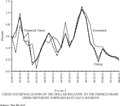
shows a comparison of the expected devaluation of the dollar relative to the French franc measured using exchange rate data from Einzig, the
Economist, and the
Financial Times. This comparison shows that the three sources are very similar. There are minor differences, most likely due to the particular brokers surveyed and differences in whether daily averages or end-of-day figures were reported. Another notable characteristic is that the Einzig series is virtually always confirmed by one or the other of the alternative series, whereas each of the alternatives has some idiosyncratic observations. The same is true of comparisons of the three sources for the other three currencies we examine. For this reason, we use the Einzig data in the rest of our analysis.
FIGURE 2 EXPECTED DEVALUATION OF THE DOLLAR RELATIVE TO THE FRENCH FRANC USING DIFFERENT FORWARD RATE DATA SOURCES
Weekly data on interest rates for the same set of countries are more difficult to find. Most sources, such as the Economist and the Financial Times, report the central bank discount rate for a number of countries, but not an open market rate. The Commercial and Financial Chronicle, however, reports the open market discount rate for Paris and Switzerland each week.38
The Chronicle is published on Saturdays, so the weekly interest rate data are most likely for Fridays.
Such private discounts are equivalent to bankers' acceptances in the United States. Although the exact horizon of the data is never stated in the
Chronicle, private discounts are inherently short term, and 90 days was the most common horizon. Therefore, we use as our American comparison series the open market rate on 90-day prime bankers' acceptances. For consistency with the foreign data, we collect this data from the
Commercial and Financial Chronicle as well.
39 For the United States, the Chronicle lists bid and ask rates separately, and the two typically differ by one-eighth of a percentage point. We use the ask rate because this is the series conventionally reported when only one value is reported. As a result, it is likely to be similar to the foreign data.
To measure devaluation expectations, we subtract the foreign interest rate from the American rate. This difference should show the expected devaluation of the dollar. We divide the simple interest differential by four because the 90-day interest rates are expressed at an annual rate. Therefore, to see how much the dollar is expected to depreciate over the 90-day period, one needs to convert the annual-rate data to quarterly rates.
Behavior of Devaluation Expectations
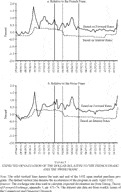
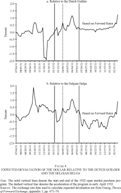
Figures 3 and 4 graph expected devaluation of the dollar relative to each of the four comparison currencies for July 1931 to March 1933. Both figures show expected devaluation derived from the relationship between forward and spot exchange rates. Figure 3, which shows expected devaluation of the dollar relative to the French franc and the Swiss franc, also includes expected devaluation derived using interest rate differentials. In each figure we have placed solid vertical lines to denote the beginning and end of the 1932 open market purchase program. We have also drawn a dashed line to denote the acceleration of the program in early April.40
Because the exchange rate data are for Saturdays, the last observation before the program, which was initiated at the meeting on 24 and 25 February 1932, is 20 February. The decision to accelerate the program was made at the meeting on 12 April 1932, so the last observation before the acceleration is 9 April. The last observation at least partly under the program, which was effectively terminated at the meeting on 14 July 1932, is 16 July.
FIGURE 3 EXPECTED DEVALUATION OF THE DOLLAR RELATIVE TO THE FRENCH FRANC AND THE SWISS FRANC
FIGURE 4 EXPECTED DEVALUATION OF THE DOLLAR RELATIVE TO THE DUTCH GUILDER AND THE BELGIAN BELGA
One fact that is evident from the figures is that expected dollar devaluation measured using forward rates behaved quite similarly across the four comparison currencies during this period. These four currencies were rarely expected to move relative to each other.41
One exception to this general pattern involves the Netherlands at the end of 1931. There was clearly a short period when the guilder was expected to depreciate relative to the other gold-bloc currencies.
Thus, the data appear to support our supposition that it was expectations about the American commitment to the gold standard that were driving movements in the series, not questions about the commitment of the foreign countries.
Figure 3 shows that when measured by interest rate differentials, the behavior of expected dollar devaluation relative to the French franc is very similar to the behavior of expected dollar devaluation relative to the Swiss franc (though somewhat different from expected dollar devaluation measured using forward rates). This again suggests that developments in the United States were driving movements in these series.
42 Monthly data on rates on private discounts for all four of the gold-bloc countries we consider, as well the rate on prime bankers' acceptances in the United States, are available from U.S. Board of Governors of the Federal Reserve System, Banking and Monetary Statistics, table no. 172, pp. 656–59 and table no. 120, pp. 450–51. The monthly interest rate differentials are very similar across the four comparison countries, suggesting that the weekly differentials for France and Switzerland given in Figure 3 can be treated as indicative of those for all of the gold-bloc countries.
The behavior of expected dollar devaluation measured using forward rates shows little evidence that the open market purchase program led to fears that the United States would abandon the gold standard. All four series show a small fall in expectations of devaluation following the passage of the Glass-Steagall Act and the first rounds of open market purchases in late February 1932. Even more tellingly, expectations of devaluation fell again with the dramatic announcement of the program's acceleration in mid-April. At the time when the program was front-page news and open market purchases were the largest (mid-April to mid-May), expectations of devaluation were flat or declining.
Figures 3 and 4 show that there was a slight rise in expectations of devaluation measured using forward rates about two-thirds of the way through the 1932 program. The three-month forward rate rose slightly relative to the spot rate for all four currencies in late May and early June. However, the expected dollar devaluation was small. The maximum expected devaluation during the 1932 experiment ranged from 1.38 percent, for the dollar relative to the belga, to 2.84 percent, for the dollar relative to the Swiss franc. (For comparison, in September 1931, Britain devalued by 26 percent relative to the dollar.) Not only was the rise in expectations of devaluation in May and June small, it was largely uncorrelated with developments in the open market purchase program. As Figure 1 shows, open market purchases slowed in mid-May and remained steady at the lower level over the next six weeks.
Finally, devaluation expectations based on forward rates declined precipitously in mid-June, at least three weeks before open market purchases were seriously curtailed. As Figure 1 shows, this decline corresponds to a time when the Federal Reserve was holding open market purchases constant at a moderately expansionary level. Perhaps more importantly, as discussed in the first section, there was no news about the program that can explain the drop in devaluation expectations in mid-June. It is most definitely not the case that people expected the program to end. The Federal Reserve was continuing to buy bonds and, as described above, we find no discussion that this was expected to change soon.
If anything, the behavior of expected devaluation measured using interest rates shows even less evidence that the open market purchase program caused investors to doubt the U.S. commitment to the gold standard. The interest differentials in Figure 3 show that U.S. short-term interest rates fell very slightly relative to those in France and Switzerland at the start of the 1932 monetary expansion in late February 1932. They fell more dramatically with the acceleration of the program in April 1932, and then remained low until early 1933.
That the interest rate differentials behave somewhat differently from expected devaluation measured using forward exchange rates is not surprising. As discussed in the first section, substantial capital immobility in the pre–World War II period allowed large deviations from interest parity. The fact that expected devaluation measured using interest rates is always below that measured using forward rates probably reflects slight differences in the riskiness of the assets in the United States relative to those in the comparison countries.
The fact that interest rates declined in the United States with the start of the open market purchase program suggests that the program had the intended salutary effect on liquidity and credit availability. That the interest differential did not rise at any point in the spring of 1932 is evidence that any effects of the open market purchase program on the perceived credibility of the U.S. commitment to the gold standard were very small.
Statistical Tests
Although the graphical analysis suggests little correlation between the open market purchase program and expectations of devaluation, it is useful to test this conclusion more formally. This is particularly true for the expectations of devaluation based on forward rates, because they rose slightly during the program, while those based on interest rates clearly fell.
Our goal is to determine whether the open market purchase program caused expectations of devaluation to differ from what they would otherwise have been. It is therefore natural to consider regressions of the form
where EXPDEVt is a measure of expected devaluation of the dollar relative to some other currency, OMt is an indicator of the open market purchase program, and et reflects all other influences on expected devaluation. Our interest is in b, the impact of the program on expected devaluation.
One obvious complication in estimating b is that et is not white noise. As Figures 3 and 4 show, movements in the measure of expected dollar devaluation were highly persistent. To deal with this, we model et as following an AR–1 process.43
A regression of the OLS residuals from each of the regressions on six own lags shows strong evidence of first-order serial correlation and little evidence of higher order serial correlation in et. The t-statistic on the first lag is typically well above 10, while the coefficients on higher lags are rarely significant at standard levels. We use the Hildreth-Lu procedure for dealing with first-order serial correlation in our estimation. An obvious alternative to the AR–1 correction, which imposes a structure on the serial correlation of et, is to estimate the regression by OLS and then correct the standard errors using the Newey-West procedure. One disadvantage of the Newey-West procedure is that it tends to undercorrect in small samples such as we have (for a discussion of this bias, see den Haan and Levin, “Practitioner's Guide”). More importantly, it does not take into account that devaluation expectations were relatively high before the start of the 1932 program. Because an AR–1 assumption appears to be a reasonable approximation in our case, making use of this information increases the efficiency of the estimates.
There are two natural ways to specify the indicator of the open market purchase program, depending on the mechanism through which it potentially affected expectations. One possibility is that the program affected expectations simply through its existence and news reports that it was occurring. In this case, the appropriate measure is a dummy variable for the weeks the program was in existence. Alternatively, there may have been great uncertainty about how expansionary the program was likely to be. As a result, people may have placed particular emphasis on the scale of open market operations in forming their expectations. In this case, the appropriate measure is a dummy variable for the weeks the program was in existence calibrated by the weekly level of open market purchases.44
To calibrate the dummy variable we multiply it by open market purchases (in millions of dollars) in the corresponding week. The exchange rate data, and hence the dummy variable, are for Saturdays. The open market purchases data are for the week ending the Wednesday before. This discrepancy in timing is actually desirable because the Federal Reserve balance sheet data were reported in a number of news sources on Saturday. Therefore, the news impact of the open market purchases as of Wednesday would largely occur on Saturday. It is important to note that it would not be appropriate to simply include the entire time series of open market purchases in the regression. Open market purchases during the 1930s almost surely had an endogenous component; the Federal Reserve did at times move them in response to fears of devaluation. During the 1932 expansion, in contrast, the decision to expand had been made and the variation in open market purchases was related to factors other than devaluation expectations. The third section discusses these other factors in detail.
The sample used for estimation is the period when all five countries under consideration were on the gold standard. It begins with 30 June 1928, the first observation after France officially returned to gold. It ends with 4 March 1933, just before the U.S. suspension of convertibility. We run the regressions separately for expected dollar devaluation (based on forward rates) relative to each of the currencies considered.
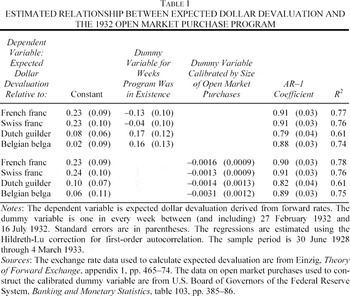
Table 1 reports the results. The coefficient estimates confirm the impression given by the graphs: there is little correlation between expectations of devaluation and the open market purchase program. When we use the simple dummy variable, the estimates of b are all small and not significantly different from zero, and for two of the currencies they are of the opposite sign from that predicted by the gold standard hypothesis. When we use the calibrated dummy, all of the estimates of b are of the wrong sign.45
The estimated autoregressive coefficient is quite high and highly statistically significant in all of the regressions, confirming the view that a correction for serial correlation is necessary. The relatively high R2 of the regressions, despite the insignificance of the indicator of the open market purchase program, is due to the fact that the autoregressive component accounts for much of the variation in expected devaluation.
This is surely a result of the fact that the slight rise in devaluation expectations that occurred during the program happened after open market operations had been scaled back somewhat. However, the estimates are insignificant for three of the four currencies, and mainly serve to dramatize the point that there is not the strong positive relationship between open market operations and devaluation expectations implied by the gold standard hypothesis. Thus, the statistical evidence suggests that the 1932 open market purchase program did not cause expectations that the dollar would be devalued relative to the currencies of the gold-bloc countries.
We have examined the robustness of the regression estimates along many dimensions. Starting the sample period with 10 October 1931, just after Britain's devaluation in September 1931, has no important effect on the results. Similarly, specifying the dummy variable to start with the dramatic acceleration of the program in April 1932 rather with than the gentle beginning in February has virtually no impact. Calibrating the dummy variable using the lagged level of open market purchases, the average level of open market purchases over the previous three weeks, or the average level of open market purchases since the start of the program also has no noticeable effects. Finally, to see if the existence of the program and the scale of open market purchases mattered jointly or one clearly dominated the other in its effects on expectations, we include the simple and calibrated dummy variables together in the regressions. The results are little different from when the two variables are entered separately. In short, there is no statistical evidence that the 1932 open market purchase program had a significant effect on expectations of devaluation.
Devaluation Expectations in Other Episodes
One concern with this analysis is the possibility that forward rates and interest differentials might not reveal expectations of devaluation that are nonetheless present. This could occur if the forward exchange market or the market for private discounts were thin, or imperfect in some other sense. One way to check for such imperfections is to look at devaluation expectations derived from forward rates and interest rates in episodes when such expectations are widely thought to have been present.
Two such episodes are provided by the French experiences of 1934 and 1935. Eichengreen describes how a political crisis in early February 1934 led to expectations of fiscal and monetary expansion.46
Eichengreen, Golden Fetters, pp. 355–56.
These expectations led to fears of devaluation of the franc and a large loss of French gold in the first two weeks of February. On 31 March 1935 Belgium devalued. Eichengreen suggests that this, together with the French government's pursuit of “New Deal style” expansionary monetary and fiscal policies, again led to fears of devaluation of the franc in May 1935.
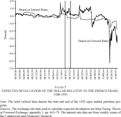
47 Figure 5 shows the expected devaluation of the dollar relative to the French franc for the extended period 1928–1935 measured using both forward rates and interest rates. Because the dollar was rebenchmarked to gold in January 1934, movements in the dollar/franc series starting in February 1934 were almost surely driven primarily by expectations about the franc. Because the graph shows expected dollar devaluation, a negative number is expected devaluation of the franc.
FIGURE 5 EXPECTED DEVALUATION OF THE DOLLAR RELATIVE TO THE FRENCH FRANC, 1928–1935
Figure 5 indicates that both French episodes show up much more strongly in the data than does the 1932 American open market purchase program. During the February 1934 episode, expectations measured using forward rates changed from an expected franc appreciation of around 1 percent to an expected franc devaluation of 1.5 percent. For comparison, in the 1932 U.S. expansion, expectations changed only from an expected dollar devaluation of about 0.5 percent to an expected dollar devaluation of 1 percent. Thus, the change in the 1934 French episode was roughly five times as large as the change in the 1932 American episode. This same pattern holds even more strongly in the May 1935 French episode. Expected franc devaluation measured using forward rates rose from 0.5 percent to 6.25 percent, and remained above 3 percent for several weeks. These episodes show that forward rates can provide evidence of devaluation expectations in the interwar period.
The May 1935 episode also shows up in interest rate differentials. The interest differential (U.S. rate minus the French rate) fell from around −0.5 percentage point in early May to −1.5 percentage points in mid-June. However, there was only a trivial fall in the interest differential in the February 1934 episode. Thus, while interest differentials can sometimes capture devaluation expectations in the interwar era, it appears that factors such as imperfect capital mobility and changes in risk can cause them to be an imperfect indicator.
An episode when fears of U.S. devaluation are commonly thought to have been present was late September and early October 1931. Britain's abandonment of the gold standard on 21 September 1931 could certainly have shaken confidence in the U.S. commitment to gold. And, indeed, a substantial quantity of gold flowed out of the United States in the six weeks following Britain's devaluation, suggesting increased concern about the stability of the dollar.
Figures 3 and 4 show that this episode led to the largest upward spike in our measures of expected dollar devaluation in the Depression era. Expectations of dollar devaluation relative to the French franc measured using forward exchange rates, for example, rose from approximately zero in the week before Britain's departure to +2 percent in mid-October. On average, the rise in devaluation expectations measured using forward rates is about three times as large in 1931 as during the 1932 open market purchase program. Devaluation expectations measured using interest rate differentials also spiked up in the fall of 1931, whereas they fell in the spring of 1932.
Although the 1931 episode clearly stands out in the time series for expected dollar devaluation, the expectations of devaluation were fairly modest. Friedman and Schwartz and Charles Kindleberger stress the Federal Reserve's rapid response to the gold drain.48
Friedman and Schwartz, Monetary History, p. 317; and Kindleberger, World, pp. 165–66.
That the Federal Reserve Bank of New York raised its discount rate 200 basis points between 8 October and 16 October 1931 may have quickly calmed any fears about the U.S. commitment to the gold standard. Another possibility discussed by both Kindleberger and Lester Chandler is that the gold drain was due to the Bank of France's desire to improve the appearance of its balance sheet following the losses caused by Britain's departure, rather than genuine fear that the United States was going to devalue.
49 Kindleberger, World, pp. 164–65; and Chandler, American Monetary Policy, pp. 168–69.
Thus, expectations of American devaluation may genuinely have been fairly modest, as the data indicate.
The American experience in early 1933 provides a similar type of corroborating evidence. Because the United States suspended gold convertibility in March 1933, it is often presumed that expectations of devaluation must have been rampant during this period. And yet, the expected dollar devaluation series (relative to the French franc) given in Figure 5 shows no rise in the first two months of 1933. Expectations of devaluation measured using both forward rates and interest rates did spike up in early March, but even then the level of expected devaluation was relatively small. Our reading of the narrative evidence suggests that this picture of devaluation expectations derived from forward rates and interest rates is accurate, whereas the common presumption is not.50
Wigmore, “Was the Bank Holiday,” provides several reasons why people might have expected devaluation of the dollar in early 1933, but little direct evidence that such expectations were actually present.
Perhaps the best evidence that devaluation fears were minimal in early 1933 is the fact that the gold price of the dollar remained constant for more than a month after the suspension of convertibility. Following emergency legislation surrounding the Bank Holiday, gold convertibility and gold exports were suspended by executive order on 10 March 1933. This left the dollar free to depreciate. However, according to Friedman and Schwartz, it was only after a further executive order on 20 April and a speech by Roosevelt that made it clear he favored depreciation that the price of the dollar fell relative to the remaining gold-bloc currencies.51
Friedman and Schwartz, Monetary History, p. 464.
If the dollar had been widely expected to depreciate in early 1933, the fall in the price would have occurred as soon as convertibility was suspended.
A systematic reading of the Commercial and Financial Chronicle also suggests that devaluation fears were minimal. Throughout December and early January, uncertainty about the U.S. commitment to the gold standard and the possibility of devaluation were not discussed. Instead, the Chronicle contained numerous references to the fact that “gold is flowing into the country in a perfect stream.”52
Chronicle, 7 January 1933, p. 3.
On 25 February 1933 the
Chronicle expressed concern that “another scare seems to have developed abroad as a result of these inflation propositions and a new eruption of banking troubles in various parts of the United States and withdrawals of gold for export and for earmarking on foreign account are again proceeding on a large scale.”
53 Chronicle, 25 February 1933, p. 1243.
But, it went on to say: “Of course the United States has enormous supplies of the metal.”
54 The
Chronicle also reacted positively to Roosevelt's choice for Secretary of the Treasury, saying: “[fears] of a departure from sound economic principles … may now be dismissed.”
55 When the Bank Holiday and suspension of convertibility were declared in early March, the
Chronicle saw some fears of devaluation, but suggested that they were short-lived “owing to the assurances against inflation given by the new Administration in Washington and the vigorous steps for control of the banking crisis.”
56 Chronicle, 11 March 1933, p. 1605.
The absence of fears in early 1933, followed by only modest fears that were quickly resolved, is consistent with behavior of devaluation expectations shown in
Figure 5.
NARRATIVE EVIDENCE ON DEVALUATION EXPECTATIONS
Another way to check the empirical evidence is to examine the narrative record. We look at the records of the Federal Reserve and the financial press to see if either monetary policymakers or informed observers feared a speculative attack on the dollar as a result of the 1932 open market purchase program.
Was the Federal Reserve Concerned about a Speculative Attack?
The beliefs and motivations of the Federal Reserve are well documented in the papers of George L. Harrison, Governor of the Federal Reserve Bank of New York. The Harrison Papers contain the minutes of the Open Market Policy Conference, of which Harrison was the chairman, and the memoranda of meetings of the Board of Directors of the Federal Reserve Bank of New York. They also contain a plethora of office memos and correspondence to and from Harrison.
The Harrison papers provide no evidence that the Federal Reserve was concerned that the open market purchase program would trigger fears of devaluation. When one member asked about possible international repercussions at the 12 April meeting of the Open Market Policy Conference where the program was accelerated, he was quickly reassured:
Governor Calkins raised the question whether a policy of this sort would be followed by large foreign withdrawals of funds, and Governor Harrison replied that there might be some withdrawals but he did not believe these would be sufficient to prove embarrassing.57
Harrison Papers, “Meeting of Joint Conference of the Federal Reserve Board and the Open Market Policy Conference,” 12 April 1932, p. 4.
Indeed, the gold standard constraint was hardly mentioned in the initial or ongoing discussion of the program. The only exception to this pattern occurred at the meeting of the Board of Directors of the New York Federal Reserve Bank on 21 April. Eugene Meyer, Governor of the Federal Reserve Board, said:
[T]here are two chief obstacles to the success of our present credit policy:
- The talk of inflation in this country and of our ability to stay on the gold standard which is prevalent here and abroad.
- The reluctance of some of the Federal reserve banks to cooperate wholeheartedly in the program.58
Harrison Papers, “Memorandum: Meeting of Board of Directors,” 21 April 1932, p. 204.
Meyer's concerns about the gold standard were not echoed or discussed by anyone else at the meeting. Moreover, Meyer himself seemed to believe that these concerns mainly argued against lowering the discount rate, not in favor of ending the open market purchases.
A retrospective study of American monetary policy written by E. A. Goldenweiser, Director of the Division of Research and Statistics of the Board of Governors in the 1930s, confirms the Federal Reserve's lack of fear about gold losses and a speculative attack in 1932. In discussing the 1932 open market purchase program, Goldenweiser writes: “a Federal Reserve Bank could be forced to suspend by an excessive gold drain, but no such drain was in prospect and the possibility of suspension for such a reason was not contemplated.”59
Goldenweiser, American Monetary Policy, p. 161.
In May 1932 substantial quantities of gold began to flow out of the United States, primarily to France, but also to Switzerland, the Netherlands, and Belgium. The Federal Reserve attributed these gold flows to various factors, most of them unrelated to Federal Reserve actions. Governor Harrison stated:
The greatest stimulus of the gold efflux has of course been the delay in dealing firmly with our public finances, although undoubtedly this has been contributed to by some misconception and even mistrust abroad concerning the various official steps taken to alleviate our domestic banking and business situation.60
Harrison Papers, “Letter to Governor Fancher,” 8 June 1932.
Governor Meyer also believed that disturbances such as the passage by the House of the Goldsborough bill, which set as an explicit target of Federal Reserve policy reflation to 1926 levels, “had occasioned an unfavorable reaction in Europe and some gold withdrawals.”61
Harrison Papers, “Minutes of the Meeting of the Joint Conference of the Federal Reserve Board and the Open Market Policy Conference,” 17 May 1932, p. 1.
The Federal Reserve believed firmly that “only a very small part of this change in the System's gold position and the reserve ratio is attributable to purchases of government securities. Most of it has been due to the repatriation of foreign central bank dollar funds, which very probably would have occurred regardless of the policy of the System.”
62 Harrison Papers, “Letter to Governor McDougal,” 5 July 1932, p. 2.
The case of the French repatriation (which was by far the largest of the repatriations) provides clear evidence of both the motivation of the foreign central banks and the Federal Reserve's interpretation of the gold outflow. On 15 January 1932 Harrison thanked Governor Moret for informing him of the Bank of France's plan to withdraw its earmarked gold from the United States.63
Harrison Papers, “Cable to Governor Moret, Bank of France,” 15 January 1932.
A subsequent letter on 9 March from Moret to Harrison explained that “the monetary Law of June 25, 1928, implicitly imposed upon the Bank of France the obligation to liquidate its foreign assets.”
64 Harrison Papers, “Letter from Moret (Bank of France),” 9 March 1932, p. 2.
Harrison responded to Moret on 3 April, saying: “[W]e have felt for some time that it would be desirable rather than hurtful from the point of view of our position to have the Bank of France gradually repatriate its dollar balances.”
65 Harrison Papers, “Letter from Harrison to Moret,” 3 April 1932.
Then in June, the Federal Reserve became concerned that the gradual repatriation was unsettling expectations. (And, indeed, the small hump in expected dollar devaluation shown in
Figures 3 and
4 corresponds to this period of French repatriation of gold.) To dispel the uncertainty, Harrison sent Moret a telegram on 9 June asking him to “favorably consider the advisability of earmarking promptly and at one time all your remaining holdings of approximately $93,000,000.”
66 Harrison Papers, “Telegram from Harrison to Moret,” 9 June 1932.
Moret readily agreed to Harrison's request.
In addition to having known about the intention of the European central banks to withdraw gold before the advent of the 1932 open market purchase program (and, indeed, having encouraged them to do so), the Federal Reserve expressed the view that the resulting gold outflow was a reason to undertake further monetary expansion, not a sign that the program should be stopped. The minutes of the February meeting of the OMPC record that:
Governor Harrison further pointed out that the country's gold stock had been reduced by about $100,000,000 in the first two months of the year, with no offsetting gains to the market, and that further gold losses at the rate of about $50,000,000 a month were to be anticipated. The purchase of government securities would have the effect of offsetting this gold loss and preventing it from causing an increase in rediscounts.67
Harrison Papers, “Minutes of the Meeting of Governors,” 24 and 25 February 1932, p. 5.
The Chronicle reported that in a speech in late April, Treasury Secretary Ogden Mills declared that “the Federal Reserve program of buying Government securities could be fully justified on the ground of replacing exported gold and hoarded currency.”68
Chronicle, 30 April 1932, p. 3142.
During the height of the gold withdrawals in early June, Harrison argued to his directors “that he thought it would be a mistake to let up on our program at this point, in view of the country's heavy gold losses during the past week.”
69 Harrison Papers, “Memorandum: Meeting of Board of Directors,” 2 June 1932, p. 234.
Even James McDougal, Governor of the Federal Reserve Bank of Chicago, generally a staunch opponent of the open market operations, approved of their use to sterilize the gold outflows. In a letter to Harrison on 9 July, McDougal informed him that, “While purchases by the System for the purpose of offsetting gold exports were probably justified, we believe that the additional purchases made were much too large.”
70 Harrison Papers, “Letter from McDougal to Harrison,” 9 July 1932, p. 1.
Public Perceptions of the Credibility of the Gold Standard
Clearly, the Federal Reserve seems to have been remarkably unconcerned that expansionary open market operations would reduce the credibility of the U.S. commitment to the gold standard in 1932. To see if other informed observers were equally sanguine, we consider the reports in the Commercial and Financial Chronicle and the Economist.
The Economist thought that, if anything, the passage of the Glass-Steagall Act and the early monetary expansion increased the credibility of the U.S. commitment to the gold standard. It said on 27 February: “the loans of the Reconstruction Corporation combined with the Reserve Bank measure ought to put a brake on security deflation and remove some of the unfounded nervousness as to this country's retention of the gold standard.”71
Economist, 27 February 1932, p 461.
On 12 March it reported that “Wall Street does not anticipate any stimulation to the gold outflow, except, perhaps, temporarily, and the Reserve feels itself well able to meet all demands for gold likely to be made upon it.”
72 Economist, 12 March 1932, p. 573.
The Chronicle railed against the Glass-Steagall bill because it felt it would be inflationary.73
See, for example, Chronicle, 27 February 1932, p. 1415.
However, there was no discussion of possible repercussions for the gold standard. The
Chronicle only emphasized that the new collateral provision “does not change the real gold position of the Reserve banks (which is exceptionally strong) in the slightest degree.”
74 Chronicle, 27 February 1932, p. 1415.
Once large open market operations began in April, however, the Chronicle expressed concern that this policy had led to a loss of confidence in the dollar. For example, during the week that the OMPC accelerated the monetary expansion, the Chronicle said of the open market operations: “That there is menace in them, in the fears at least aroused abroad, appears in the resumption of gold exports.”75
Chronicle, 16 April 1932, p. 2775.
However, by the third week of the program, concerns over a potential devaluation had receded from the pages of the
Chronicle. On 7 May the
Chronicle once again discussed fears of a potential devaluation, but attributed them not to the current monetary expansion, but to the House's passage of the Goldsborough bill. Furthermore, the
Chronicle reassured its readers that the “Federal Reserve banks, however, are so strongly fortified with holdings of gold … that the fear apprehended does not appear likely to come to pass unless Congress should become positively mad in its follies.”
76 Chronicle, 7 May 1932, p. 3327. Sumner, “News,” also surveys the press for expectations of devaluation during the early 1930s. He finds some evidence of such expectations in the spring of 1932, but his news sources also attribute them primarily to budget conflict and expansionary legislation (such as the Goldsborough Bill) before Congress at the time.
The Economist was enthusiastic about the acceleration of open market purchases in April. It reported that the program “will help to stop deflation without bringing on dangerous inflation, it is felt by the sponsors of the policy, and at the same time there will be no danger of abandonment of the gold standard.”77
Economist, 30 April 1932, p. 967.
The
Economist was unconcerned about U.S. devaluation throughout the program. For example, it stated on 23 April: “The absurd rumours recently afloat in Paris over banking troubles here [in Washington] or the danger of departure of the country from gold were greatly disliked but were not taken seriously.”
78 Economist, 23 April 1932, p. 911.
In May, it stated: “The present rate of Federal Reserve Bank operations could continue a year or more without endangering the gold reserve …. No responsible person in the financial community seriously believes the country will be allowed to drop the gold standard.”
79 Economist, 14 May 1932, p. 1075.
When gold exports to Europe accelerated in late May and early June, the Chronicle editorialized that “the large gold outflow reflects deep distrust of the performances in the United States—the Federal Reserve policy of large-scale purchases of United States Government securities and the various propositions finding favor or being urged in Congress involving expenditures of billions of dollars.”80
Chronicle, 11 June 1932, p. 4198.
The
Economist also repeatedly mentioned the gold outflow in May and early June. It, however, attributed them primarily to Congress's failure to balance the budget and other expansionary legislative actions. For example, it discussed on 14 May “the strong movement of European currencies against the dollar, attributed mainly to anxieties over the Goldsborough Bill's passage.”
81 Economist, 14 May 1932, p. 1075.
In early June it stated: “continual gold losses are calculated to bring home to public opinion and also Congress at Washington the need for balancing the national finances.”
82 Economist, 4 June 1932, p. 1222.
The
Economist at no time expressed fear that the open market operations were causing the gold flows.
Clear evidence that the gold flows were causing unsettled expectations, rather than reflecting fears of devaluation, is provided by the relief expressed at their end. On 10 June the New York Times reported that “the Bank of France seems to have ceased its sales of dollars on Thursday (June 9), and this sufficed to cause recovery in American exchange to a rate at which gold exports were no longer possible.” It went on to say that:
Up to this time, the mere fact of a continuous drainage of gold from the American market is the factor which has given most encouragement to speculators for the fall in dollar exchange. But that means that if and when the outflow terminates, the only recourse of bears will be to cover.83
Reprint of New York Times article from 10 June 1932 in the Commercial and Financial Chronicle, 18 June 1932, p. 4411.
The Economist expressed the same view when it stated: “Equally keen is the feeling of relief that the major gold movements are probably at an end and that sentiment will not be so frequently disturbed by the publicity given to the gold outflow.”84
Economist, 25 June 1932, p. 1405.
Why Did the Federal Reserve End the Monetary Expansion?
If the Federal Reserve was not concerned about a speculative attack, why did it cease its open market purchases after only five months? Our reading of the Harrison papers suggests that the Federal Reserve decided to slow the monetary expansion in mid-June in part because its model of monetary policy led it to believe that monetary conditions were already loose and that further purchases would be of little use. As discussed by Elmus Wicker, David Wheelock, and Allan Meltzer, Federal Reserve officials in the 1930s focused on bank borrowing and excess bank reserves as their main indicators of monetary ease or tightness.85
Wicker, “Federal Reserve Monetary Policy”; Wheelock, “Member Bank Borrowing”; and Meltzer, History.
For example, on 12 May Harrison told the Board of the Federal Reserve Bank of New York that: “The best yardstick to use [for measuring the success of monetary policy] … would be the figures of member bank reserves.”
86 Harrison Papers, “Memorandum: Meeting of Board of Directors,” 12 May 1932, p. 218.
More importantly, policymakers at the Federal Reserve believed that once excess reserves were plentiful, further monetary easing could do little to stimulate recovery. At the same meeting, Harrison stated that:
When the figures of member bank reserves are sufficiently high to produce adequate pressure upon the banks and to provide adequate credit for business as recovery sets in, we shall probably have done our part. If the commercial banks can't or don't use the credit which we provide, that is another problem.87
A related view was that, because expansion would be ineffective when there were already large quantities of excess reserves, it did not make sense to expand when the demand for funds was low. Instead, Federal Reserve officials believed that the best time to expand was when confidence was high, or at least improving. For example, in reviewing the origin of the open market purchase program on 30 June, Harrison said: “It was thought best, however, not to use our ammunition until the chances of effective response from the banking and business community would favor the success of our undertaking.”88
Harrison Papers, “Memorandum: Meeting of Board of Directors,” 30 June 1932, p. 246.
This model of the economy hastened the end of the open market purchase program in two ways. First, in late May and early June, some Federal Reserve officials believed that the program had already worked. The program had made excess reserves plentiful and so further expansion was not needed. On 26 May Harrison told his directors that “excess reserves of member banks are now at about the point where it had been thought they should be maintained.”89
Harrison Papers, “Memorandum: Meeting of Board of Directors,” 26 May 1932, p. 230.
Goldenweiser recounts that “Federal Reserve authorities felt that their monetary policy had made bank credit expansion possible and that they were powerless to induce banks to lend more freely or even to arrest loan liquidation.”
90 Goldenweiser, American Monetary Policy, pp. 161–62.
Second, when a wave of banking panics in Chicago in late June led Federal Reserve officials to fear that widespread banking difficulties were about to begin again, some monetary policymakers concluded that further open market purchases would have no impact. Harrison, for example, said that: “There is no sense … in our purchasing Government securities merely as an offset to currency hoarding. That is an impossible task and an inversion of our program, which was based on a revival of confidence in the banking and credit structure.”
91 Harrison Papers, “Memorandum: Meeting of Board of Directors,” 7 July 1932, p. 264.
As discussed by Gerald Epstein and Thomas Ferguson and by Meltzer, conflict among the twelve regional Federal Reserve banks also played a role in ending the program.92
Epstein and Ferguson, “Monetary Policy”; and Meltzer, History.
On 5 July Harrison informed his directors that the Federal Reserve Banks of Chicago, Philadelphia, and Boston were reluctant to continue the open market operations. He concluded that “if the other large Federal reserve banks are unwilling to proceed with the program, we cannot carry the burden for the entire System, while our reserve percentage is the lowest of any bank in the System.”
93 Harrison Papers, “Memorandum: Meeting of Executive Committee [of Board of Directors],” 5 July 1932, p. 255.
Owen D. Young, deputy chairman of the Board of Directors of the Federal Reserve Bank of New York, added that “if we cannot have the continuous participation of the Federal Reserve Banks of Boston and Chicago in the System program, I am for suspending the program.”
94 Why the Federal Reserve Bank of Chicago chose to drop out of the program when it did is a matter of some debate.95
Epstein and Ferguson, “Monetary Policy,” argue that the Federal Reserve Bank of Chicago withdrew from the open market purchase plan because the monetary expansion was adversely affecting the profits of Chicago banks. This story of regulatory capture has been disputed by Coelho and Santoni, “Regulatory Capture.”
Harrison told his directors on 23 June “that Governor McDougal, always a reluctant follower of the System program, is now more reluctant than ever to participate heavily in purchases of Government securities because of the demands which may be made upon his bank as a result of the recent closing of a number of small banks in Chicago.”
96 Harrison Papers, “Memorandum: Meeting of Board of Directors,” 23 June 1932, p. 244.
There is some evidence that the Chicago Board of Directors subscribed to the view that banking panics made further increases in reserves useless. Young had talked to several of the Chicago directors and reported that:
[T]hey say what is the use of going ahead if bank failures are to continue and hoarding of currency to be renewed. In these circumstances they hold it to be futile to talk of the pressure of excess reserves upon member banks because, either there won't be any excess reserves or the banks will prefer the cost of carrying them to their use.97
Harrison Papers, “Memorandum: Meeting of Board of Directors,” 14 July 1932, p. 273.
Governor McDougal of Chicago cited as his reason for abandoning the program the notion that:
[P]urchases made were much too large and have resulted in creating abnormally low rates for short-term U.S. Government securities…. [T]hese rates are abnormally low and have been artificially created by pouring a large excess of funds into the market which it does not need.98
Harrison Papers, “Letter from McDougal to Harrison,” 9 July 1932, p. 1.
The conflict between the Federal Reserve Banks of New York and Chicago that ultimately ended the monetary expansion program reflected deeper structural problems of the early Federal Reserve System.99
This structural flaw is discussed extensively by Friedman and Schwartz, Monetary History, in other contexts, but is not stressed in their discussion of the abandonment of the 1932 open market purchase program.
The Federal Reserve had been purposely set up as a decentralized system of 12 relatively autonomous central banks. Each bank had to back its note issues with eligible assets. Consequently, each Federal Reserve bank paid attention to its own reserves, and not to system-wide reserves. For example, on 23 June Harrison complained to his directors that the Federal Reserve Bank of New York had shouldered most of the burden of the open market operations and that “it is just as important for this bank to watch its reserve position as for any bank in the System.” Harrison also argued that with the reserve ratio of the Federal Reserve Bank of New York at 50 percent and that of the Federal Reserve Bank of Chicago at 75 percent, “it is difficult to see why we should pump funds into the market which will then be siphoned off to Chicago.”
100 Harrison Papers, “Memorandum: Meeting of Board of Directors,” 23 June 1932, pp. 243–44.
In addition, until the Banking Act of 1933 was passed, each Federal Reserve bank could undertake its own open market operations. The OMPC had been established in 1930 to coordinate the activities of the twelve banks, but each bank could refuse to participate in the decision taken by the Conference. As a result, even during the few times when it was absolutely clear to the majority of the Federal Reserve's governors that expansionary monetary policy was urgently needed, such as the spring of 1932, the decentralization of policy resulted in paralysis. As Owen Young cogently summarized, under the institutional framework of 1932, “you may have two or three banks dictating the policy of the System at a critical time, just because of their ability to block a System program.”101
Harrison Papers, “Memorandum: Meeting of Board of Directors,” 14 July 1932, p. 273.
This is exactly what happened in the summer of 1932.
SUMMARY AND IMPLICATIONS
Modern research has argued that the Federal Reserve did not use, and indeed could not have used, monetary expansion to counteract deflationary forces in the early 1930s because of the gold standard. According to this view, significant expansion would have led to expectations of devaluation and eventually a speculative attack on the dollar. Understanding this, the Federal Reserve refused to act despite the overwhelming monetary and real decline.
Our article has used the one episode in the Great Depression when the Federal Reserve undertook expansion as a partial test of this view. In the spring of 1932, the Federal Reserve engaged in a significant monetary expansion that was well understood by the public and perceived to be very large. However, conventional measures show virtually no sign of expectations of devaluation. The forward exchange premium for the dollar relative to the currencies of countries firmly wedded to gold barely moved, and certainly not in response to news about Federal Reserve actions. Similarly, interest rate differentials between the United States and gold-bloc countries did not rise during the program.
The narrative evidence confirms that the 1932 program did not threaten the credibility of the U.S. commitment to the gold standard. The records of the Federal Reserve show no signs that monetary policymakers feared a speculative attack. The Federal Reserve stopped the program not because it feared international repercussions, but because a flawed model of the economy led its leaders to believe that they had accomplished their goals, and because its diffuse power structure made action of any sort difficult to sustain. The financial press also contains little evidence that the expansionary policy generated fears of devaluation. Reports suggest that the open market purchase program was largely greeted as needed relief by both American and foreign market participants, not as a sign of reduced commitment to gold.
That the United States undertook a significant monetary expansion in the spring of 1932 without threatening the gold standard is not proof that the Federal Reserve could have taken larger actions or acted at other times in the Great Depression without causing a speculative attack. At a fundamental level we will never be able to answer the question of what would have happened had the Federal Reserve responded aggressively in 1930 and 1931, because it did not do so. But, it is possible to think about whether our findings for 1932 are likely to generalize to other times and other actions.
One question involves the size of the action. In the spring of 1932, the Federal Reserve bought just over $1 billion of government debt. But, by February 1932, M1 had declined by roughly $5 billion from its pre-Depression high and the money multiplier had collapsed because of repeated banking crises. As a result, open market operations of more than $1 billion (though surely substantially less than the full $5 billion) would have been needed to return M1 to its pre-Depression level. We have no evidence that a larger monetary expansion could have been undertaken in 1932 without shaking confidence in the American commitment to the gold standard. On the other hand, Friedman and Schwartz and Bennett McCallum argue that open market operations of $1 billion, had they been undertaken in 1930 or 1931, might well have been enough to keep the money supply growing normally.102
Friedman and Schwartz, Monetary History, pp. 391–95, and McCallum, “Could a Monetary Base Rule.”
Open market operations of this magnitude could have stemmed the early panics and thus prevented the collapse of the money multiplier. Thus, it is certainly possible that open market operations no larger than those that occurred in 1932 could have been crucial in preventing, or at least greatly mitigating, the Great Depression had they been taken before conditions became so severe.
Another set of issues concerns whether expansionary actions would have been possible in 1930 or 1931, or as well tolerated early in the Great Depression as they were in 1932. One practical issue involves collateral requirements. Whether the Federal Reserve held enough “free gold” to back a substantial increase in the money supply before passage of the Glass-Steagall Act in February 1932 allowed government bonds to serve as collateral is a matter of debate: Friedman and Schwartz and Chandler argue yes, while Eichengreen disagrees.103
Friedman and Schwartz, Monetary History, pp. 399–406; Chandler, American Monetary Policy, pp. 182–86; and Eichengreen, Golden Fetters, pp. 296–97.
At some level, however, this question may be of little importance. Given that Congress and the President favored expansion, it seems possible that had the Federal Reserve wished to expand in 1930 or 1931 but found itself constrained by the collateral requirements, a bill such as the Glass-Steagall Act might have been forthcoming.
A more fundamental issue involves the environment under which actions were taken. By the time monetary expansion was attempted in 1932, Britain had abandoned the gold standard, the United States had taken firm steps to defend the gold standard in October 1931, and the world economy had been languishing in depression for more than two years. These developments could have affected the likelihood that a monetary expansion of a given size might cause a speculative attack. For example, the fact that the Federal Reserve had undertaken contractionary actions in October 1931 to reassure investors of the U.S. commitment to the gold standard could have made investors less nervous in 1932. Likewise, prolonged depression may have made the public so grateful for action of any kind that they were unconcerned about devaluation. On the other hand, Britain's rapid abandonment of gold could have provided dramatic evidence of the very real possibility of massive devaluation. As a result, investors may well have been more skittish in 1932 than in 1930 or 1931.
One piece of evidence that monetary expansion would have been as well tolerated in the early years of the Depression as it was in 1932 is provided by developments following the stock market crash of 1929. In late 1929, the Federal Reserve actually expanded quite dramatically. Federal Reserve holdings of U.S. government securities increased by $397 million between 23 October 1929 and 18 December 1929.104
Data are from U.S. Board of Governors of the Federal Reserve System, Banking and Monetary Statistics, table 103, p. 384.
Yet, this short-lived expansion had no effect on expectations of devaluation. Expected devaluation of the dollar relative to the four gold-bloc currencies, measured using forward exchange rates, was very slightly negative (indicating expected appreciation of the dollar), and virtually constant for all four comparison currencies in November and December 1929. U.S. interest rates also fell relative to French and Swiss rates in the same eight-week period.
None of this discussion is, or indeed ever could be, conclusive. It is certainly possible that the needed monetary expansion early in the Depression would have caused a speculative attack, and thus the Federal Reserve was right not to attempt it. But, our evidence from the one time that the Federal Reserve undertook monetary expansion in the early 1930s is that the Federal Reserve actually had substantial room to maneuver. For this reason, we are inclined to agree with Friedman and Schwartz that the Federal Reserve's failure to act was a policy mistake of monumental proportions, not the inevitable result of the U.S. adherence to the gold standard.