INTRODUCTION
There is growing recognition in Canada, and elsewhere around the world, that we are facing a “rising tide” of adults with dementia; an umbrella term used to describe a large class of disorders characterized by the progressive deterioration of cognitive and functional ability, ultimately resulting in death (Alzheimer Society of Canada, 2010). The majority of those diagnosed with dementia will be cared for by immediate family members in the community. It is estimated that 60–80% of dementia care is provided by informal caregivers; this number is projected to rise with the concomitant increase in the number of those affected by dementia (Alzheimer Society of Canada, 2010). As dementia progresses, the affected individuals' care needs change and dementia family caregivers (DFC) are faced with increasing challenges over a period of many years. For example, many caregivers will try to keep their loved ones at home well into the later stages of the disease; factors such as family loyalty, religious faith, and emotional connection to the individual may make this a decision fraught with contradictions. The changes in the individuals' care needs may stretch the emotional, psychological, physical, and social limits of caregivers. In many cases, the individual will require additional formal care services or admission to a long-term care facility. It is estimated that up to 90% of individuals with end-stage dementia can be expected to receive care in a long-term care facility (Givens et al., Reference Givens, Kiely, Carey and Mitchell2009).
Although dementia has increasingly been acknowledged in the literature as a life-limiting illness, it is generally not regarded as a terminal condition by DFC or health care providers (Forbes, Bern-Klug & Gessert, Reference Forbes, Bern-Klug and Gessert2000; Lopez, Reference Lopez2009; Wolf-Klein et al., Reference Wolf-Klein, Pekmezaris and Chin2007). Failure to recognized the terminal nature of this disease may lead to aggressive and burdensome interventions, poor pain and symptom management, inadequate care planning, and significant unmet needs for both the individual and their family caregivers (Mitchell et al., Reference Mitchell, Teno and Kiely2009; Mitchell, Kiely & Hamel, Reference Mitchell, Kiely and Hamel2004). An encouraging survey, conducted in the United States, identified that 94% of hospice and 74% of palliative care program directors had provided care for a person with a primary diagnosis of dementia in the last 12 months (Torke et al., Reference Torke, Holtz and Hui2010). This is significantly higher than previously reported; in 2005, the proportion of hospice patients had a primary diagnosis of dementia was 7% in United States and 2% in the United Kingdom (Robinson et al., Reference Robinson, Huges and Daley2005). It is not known whether or not referral for these services is being conducted in a timely manner and if these services are meeting the needs of persons with dementia and their caregivers.
A basic tenet of palliative care is that the patient and family constitute the unit of care. Thus, in addition to caring for the person with dementia, health care providers must also anticipate and respond to the needs and expectations of family members. In the case of dementia, family caregivers are a particularly vulnerable group in need of support, owing to their high risk for psychological, social, physical, and existential distress (Schulz et al., Reference Schulz, Mendelsohn and Haley2003).These burdens are in part due to the behavioral problems associated with dementia; the significant impairment that occurs, particularly in advanced dementia; and the length of time family members are required to remain in the caregiving role (Hurley, Volicer & Blasi, Reference Hurley, Volicer and Blasi2000). Since dementia has such significant impacts upon the families of those affected, it has been referred to as a disease of the family (Albinsson & Strang, Reference Albinsson and Strang2003).
A challenge in understanding the needs of DFC within the purview of dementia as a terminal illness rests on the fact that literature in this area is dispersed across disciplines and not specifically grounded within the realm of palliative care. It is imperative therefore, that this disparate literature be pulled together in order to develop a rich understanding of the unique needs of DFC in order to mitigate distress and suffering. The objective of this article is to describe the domains of DFC needs and their impact on the delivery of palliative care services. Models of DFC needs throughout the dementia trajectory and a palliative care service delivery model for those dying with dementia and their caregivers are presented.
METHODS
A literature search pertaining to dementia family caregivers and palliative/end-of-life care was conducted using the databases Medline, CINHAL, Ageline, PsychInfo, and Scopus for articles published in the English language between 1997 and 2011. The following search terms were used: “caregivers” in combination with “dementia,” “needs,” “palliative care,” “end-of-life care,” “burden,” and “distress.” The articles were read and reviewed to identify (1) the major themes in the literature related to DFC needs, and (2) the gap between DFC needs and the current model of palliative care service delivery.
RESULTS
Based on a thorough reading of the literature, the domains of DFC needs were identified to encompass three broad categories: (1) physical, emotional, and psychological needs; (2) information and decisional-support needs, and (3) instrumental support.
Domains of Dementia Family Caregivers Needs
Physical, Emotional, and Psychological Needs
Providing care to a person with dementia may significantly affect the caregivers' physical, emotional, and psychological well-being. In a survey of 221 caregivers, 35% reported that their general health had worsened since they assumed the role of caregiver; the effects were even more profound when the caregiver lived in the same residence as the care recipient (Black et al., Reference Black, Gauthier and Dalziel2010). Regardless of their habitation status, all caregivers reported feeling tired, stressed, helpless, depressed, and lonely. Research has shown that dementia caregiving can be burdensome and stressful to family members and contributes to the high prevalence of anxiety and depression in this population (Joling et al., Reference Joling, van Hout and Schellevis2010; Schulz et al., Reference Schulz, Belle and Czaja2004). DFC experience higher levels of depressive symptoms, emotional distress, and physical strain when compared to those caring for older adults with physical impairments (Cuijpers, Reference Cuijpers2005; Ory et al., Reference Ory, Hoffman and Yee1999). In many cases, depressive symptoms develop within 18 to 24 months of initiating the caregiving role (Joling et al., Reference Joling, van Hout and Schellevis2010). Caregivers who exhibit depressive disorders are not only more likely to report a lower quality of life but are also less able to provide the requisite care to their family members with dementia.
Studies conducted with DFC also describe the impacts of this role on their physical well-being, including increased risk of cardiovascular disease, impaired wound healing, decreased immunity, and reduced likelihood to engage in preventative health behaviors (Schulz & Martire, Reference Schulz and Martire2004). Poor health among caregivers leads to limited mobility and social interaction with others; thus, their social support network is diminished. Further, the stress on DFC is reinforced in a climate where dementia care remains the responsibility of an individual caregiver. It is possible that collective interventions or programming might alleviate some of the burdens and stresses on these individuals.
DFC also report unique emotional and psychological needs owing to the nature of the illness. In particular, caregivers report greater emotional strain due to the changes in cognition, mood, and behavior of the individual with dementia (Ory et al., Reference Ory, Yee, Tennstedt and Schulz2000). For many caregivers, feelings of guilt, ambivalence, isolation, and a profound sense of grief and loss are the predominant emotional responses to the demands of caregiving. In addition, these responses may differ based on the gender of the caregiver and his/her relation to the care recipient. For example, spousal caregivers report different psychosocial responses and needs than adult-children caregivers (Sanders et al., Reference Sanders, Ott and Kelber2008).
Guilt and Ambivalence: For DFC, feelings of guilt, obligation, and regret can emerge at various points along the disease trajectory. However, the majority of these feelings arise when the person must be institutionalized (Albinsson & Strang, Reference Albinsson and Strang2003; Meuser & Marwit, Reference Meuser and Marwit2001; Sanders et al., Reference Sanders, Ott and Kelber2008). At this juncture, the needs of the care recipient far exceed the abilities of the DFC to continue to provide ongoing care in the community. When long-term care placement is required, DFC often expresses feeling that they have let the person down or broken their promises to the care recipient (Sanders et al., Reference Sanders, Butcher and Swails2009). This transition can also highlight the sadness that marks the end of a long-standing relationship. DFC may express guilt over their response to the person with dementia; for example, they may become angry, impatient, or judgmental toward the person and attribute cognitive changes to the person “being difficult” rather than recognizing it as a symptom of the dementia (Sanders et al., Reference Sanders, Ott and Kelber2008). Feelings of guilt and regret are not benign, as DFC who expresses these feelings may experience higher levels of grief (Sanders et al., Reference Sanders, Ott and Kelber2008).
Isolation: The intensity of caregiving required by persons with dementia can place family caregivers at risk of feeling isolated. As the disease progresses, DFC are increasingly responsible for the physical care of the individual. In addition, there comes a time when DFC is vital to ensuring the safety of the care recipient. Over time, this 24-hour surveillance of the person can lead to chronic strain and feelings of isolation/restriction among DFC (Black et al., Reference Black, Gauthier and Dalziel2010; Sanders et al., Reference Sanders, Ott and Kelber2008). It also contributes to the high need for respite by this group of caregivers (Albinsson & Strang, Reference Albinsson and Strang2003). The intensive, time-consuming nature of caring for persons with dementia can lead to a socially isolated environment in which caregivers find they lack both formal and informal socio-emotional support (Gaugler et al., Reference Gaugler, Kane and Kane2005). If caregivers are not able to speak with someone regarding their experiences and concerns about caregiving, they may experience existential isolation (Albinsson & Strang, Reference Albinsson and Strang2002), which is predictive of feelings of role overload, role captivity, and abandonment (Gaugler et al., Reference Gaugler, Anderson and Leach2004; Sanders et al., Reference Sanders, Ott and Kelber2008).
Grief and Loss: While people tend to associate the intense emotions of grieving with a physical death, grief, and its corresponding manifestations accompany any experience of loss. For DFC, loss is routinely experienced from the moment of diagnosis to the time of the person's death; as a result, grief appears to be a constant, yet hidden, companion of dementia (Doka, Reference Doka and Doka2004). DFC witnesses a variety of losses in persons with dementia as their disease progresses; for example, the loss of cognitive capacity, communication abilities, emotional connectedness, and personal identity (Meuser & Marwit, Reference Meuser and Marwit2001).
Although losses are ongoing for the care recipient, the care provider may also grieve over the loss of their previous life and the freedoms they enjoyed before assuming the caregiving role (Holley & Mast, Reference Holley and Mast2009). The loss of social and recreational activities, loss of control over life events, loss of well-being, and loss of occupation are additional losses experienced by DFC (Loos & Bowd, Reference Loos and Bowd1997). Taken together, these losses can trigger the experience of grief among many caregivers prior to the death of the care recipient (Meuser & Marwit, Reference Meuser and Marwit2001). Research has suggested that this anticipatory grief negatively influences the physical, emotional, and social well-being of caregivers and affects post-death bereavement and grief resolution (Albinsson & Strang, Reference Albinsson and Strang2003; Schulz et al., Reference Schulz, Boerner and Shear2006).
Several studies have examined the nature and trajectory of grief among DFC. Ponder and Pomeroy (Reference Ponder and Pomeroy1996) suggested that the caregiver's grieving process has a particular flow over time that is associated with the progression of the care recipient's dementia. In their model, caregivers move through the phases of denial, over-involvement, anger, guilt, and acceptance. However, movement through these phases is not linear; instead, caregivers have reported high grief intensity in the first two years of caregiving, followed by a decrease during the third and fourth years, and a rebound that occurs between the fifth year and the time of the care recipient's death. Garand et al. (Reference Garand, Lingler and Deardorf2011) further explicated that high levels of anticipatory grief are reported in the early stages of caregiving, particularly among those caring for a person newly diagnosed with cognitive impairment. This type of pattern was also noted in a study that explored the grief responses among spouse and adult-child caregivers of dementia patients in various stages of the disease (Meuser & Marwit, Reference Meuser and Marwit2001). For adult-children caregivers, grief is nearly curvilinear, as its intensity is minimal in the early stages, highest in the moderate stages, and lessened in the severe stages of dementia. For spousal caregivers, grief increases linearly from early to late stages. The caregivers in this study also experienced different emotional grief reactions during the different stages of dementia. In adult-children, guilt, anger, and frustration are predominant when grief is highest (middle stages). In the late stages of the disease, these caregivers experience sadness, longing, and loneliness. A slightly different emotional landscape emerges for spousal caregivers; sadness is central in the early and middles stages of the disease, while anger, confusion, frustration, and feelings of uncertainty are dominant in the later stages.
Diwan, Hougham and Sachs (Reference Diwan, Hougham and Sachs2009) explored the chronological patterns and issues that precipitate grieving over the course of dementia caregiving. Of the 87 caregivers interviewed, 71% reported that they grieved at some point prior to the death of the person with dementia. A temporal pattern of grieving was reported; some caregivers identified grieving at one specific point in time, usually triggered by a precipitating factor (e.g., diagnoses, symptom manifestations, nursing home placement), while others reported grieving episodically or continuously throughout the course of the disease. The results of these studies support the notion that grief is inherent to dementia caregiving and that this grief extends from the moment of initial diagnosis until sometime after the death of the care recipient.
Information Needs and Decisional-Support Needs
A significant role played by DFC is that of surrogate decision-maker, a role in which many caregivers feel unprepared and unsupported, especially when making decisions regarding end-of-life care (Caron et al., Reference Caron, Griffith and Arcand2005; Caron, Griffith & Arcand, Reference Caron, Griffith and Arcand2005; Forbes et al., Reference Forbes, Bern-Klug and Gessert2000). Many DFC have reported that they lack the knowledge required to make informed decisions (Chang et al., Reference Chang, Easterbrook and Hancock2010). When such information is lacking, DFC construct their own personal interpretations of the progression of dementia. As a result, they may make poor judgments regarding the acceptability and usefulness of aggressive medical interventions in the treatment of expected clinical outcomes. Too often, older adults dying with dementia undergo aggressive interventions, which may contribute to a “bad” death and, as a result, may cause suffering and a decreased quality of life in the final weeks to months of life (Mitchell et al., Reference Mitchell, Kiely and Hamel2004; Sachs, Shega & Cox-Hayley, Reference Sachs, Shega and Cox-Hayley2004). When DFC understand the expected clinical course of dementia and its poor prognosis, they are less likely to insist on such interventions (Mitchell et al., Reference Mitchell, Teno and Kiely2009), and report increased capabilities in managing care, especially related to behavioral problems and the demands of activities of daily living (ADL) (Peeters et al., Reference Peeters, Van Beek and Meerveld2010).
Decision making for persons with dementia may be further complicated by the fact that they have not had discussions with their family caregivers or formal care providers regarding their wishes and preferences for care as their illness progresses. The reasons for this are multi-faceted and include: lack of a sense of urgency, limited knowledge of the disease trajectory, lack of a consistent care provider, personal discomfort with the topic, and inability to conceptualize the dying trajectory (Caron et al., Reference Caron, Griffith and Arcand2005; Hertzberg, Ekman & Axelsson, Reference Hertzberg, Ekman and Axelsson2001; Marziali, Shulman & Damianakis, Reference Marziali, Shulman and Damianakis2006). At times, family caregivers may learn implicitly that the health of their family member with dementia is declining due to their exclusion in participating in regular social activities (Hennings & Keady, Reference Hennings and Keady2010). The failure to directly discuss or making erroneous assumptions regarding family members' needs for information contributes to caregiver distress (Hebert et al., Reference Hebert, Schulz and Copeland2008). It is imperative therefore, that health care providers engage in communication that discusses the possibility of death, is specific about goals and expectations, avoids euphemisms, and is accurate and timely as the primary way to manage uncertainty and thereby, prepare family caregivers for the decisional role and ultimately the death of their loved one (Hebert et al., Reference Hebert, Schulz and Copeland2009; Lopez, Reference Lopez2009; Norton & Talerico, Reference Norton and Talerico2000; Parker et al., Reference Parker, Clayton and Hancock2007; Pashby, Hann & Sunico, Reference Pashby, Hann and Sunico2009). Additionally, the profound and progressive changes in verbal communication abilities of persons with dementia may preclude their ability to actively participate in such discussion as their disease progresses. However, research has suggested that individuals with mild to moderate cognitive impairment (i.e., scores of 18 to 26 on the Mini-Mental State Examination [MMSE]) are capable of making informed care decisions, choosing a proxy decision-maker, and consistently stating their preferences regarding concrete events, such as food choices (Feinberg & Whitlatch, Reference Feinberg and Whitlatch2002). Decisions are too often made “in the moment” when significant extrinsic events occur and, at this juncture, persons with dementia are unable to express their wishes (Black et al., Reference Black, Fogarty and Phillips2009).
Care plans must be tailored to the preferences, needs, and goals of the care recipient before profound changes occur in their communication abilities. Therefore, it is imperative that health care providers recognize early opportunities to discuss dementia prognosis, including the possibility of death; decision-making strategies; and the optimal clinical care of older adults with dementia in order to mitigate their suffering.
Instrumental Support Needs
In contrast to family caregivers of individuals with other life-limiting illnesses, such as cancer, DFC provide a substantial amount of care, which mainly occurs in the community and over a long period of time. Studies have shown that DFC in the community spend more hours per week assisting with ADLs when compared to non-dementia caregivers and that this assistance is needed over a greater length of time (McCarthy, Addington-Hall & Altmann, Reference McCarthy, Addington-Hall and Altmann1997; Ory et al., Reference Ory, Hoffman and Yee1999). For example, 50% of individuals with dementia required assistance for over a year with five or more of the reported ADL activities as compared with 9% of cancer patients.
The demands on DFC increase substantially when care recipients display neuropsychiatric symptoms, such as delusions, agitation, depression, irritability, and disinhibition. When affected individuals reported three or more of these symptoms, they also required an additional 28.7 hours per week of supervision and 18.2 hours of active help from caregivers (an increase from 10.9 hours and 10.2 hours, respectively, for those without neuropsychiatric symptoms) (Okura & Langa, Reference Okura and Langa2011). Studies have also reported that the behavioral and psychological symptoms of dementia, such as those described above, are associated with increased caregiver burden, depression, and institutionalization (Gaugler et al., Reference Gaugler, Anderson and Zarit2004; Sorensen & Conwell, Reference Sorensen and Conwell2011; Volicer, Hurley & Blasi, Reference Volicer, Hurley and Blasi2003); however, the strength of these associations has been challenged (Black & Almeida, Reference Black and Almeida2004).
In comparison to non-dementia caregivers, DFC have also been reported to be more negatively affected by their caregiving responsibilities in terms of their employment, recreational/leisure activities, and relationships with other family members (Ory et al., Reference Ory, Hoffman and Yee1999) Black et al. (Reference Black, Gauthier and Dalziel2010) studied DFC from the baby boom generation (i.e., those 44 to 64 years of age) and reported that 71% experienced work disruptions due to caregiving responsibilities, 50% used up vacation time for caregiving duties, and 14% reported being forced to either retire early or resign from their job. The responsibilities associated with employment can place caregivers in a precarious situation where they must try to balance multiple roles. Often, these demands will place great strain on working caregivers, putting them at higher risk of work/family conflict, feelings of role overload, and depression (Wang et al., Reference Wang, Shyu and Chen2011). Many DFC have reported needing to make significant sacrifices in order to meet the many demands placed on them. These sacrifices may contribute to feelings of lower satisfaction in the caregiving role. DFC have reported feeling less rewarded by the caregiving experience when compared to cancer caregivers (35% vs. 60%) (McCarthy et al., Reference McCarthy, Addington-Hall and Altmann1997).
As a result of the heavy physical and emotional care needs of individuals with dementia, many of whom require vigilant and constant supervision over a protracted period of time, DFC have been identified as requiring formal support services (instrumental supports), such as home care and respite care. In surveys of hospice/palliative care program administrators (Torke et al., Reference Torke, Holtz and Hui2010), and dementia and palliative care staff (Albinsson & Strang, Reference Albinsson and Strang2003), the need for respite care has emerged as a significant and unique need among DFC. This may help to explain dementia caregivers' perception that the services offered by hospice programs, such as respite, volunteer, and nursing services, may confer greater benefits to the caregiver rather than the care recipient (Casarett et al., Reference Casarett, Takesaka and Karlawish2002).
DISCUSSION: IMPLICATIONS FOR PALLIATIVE CARE SERVICE DELIVERY
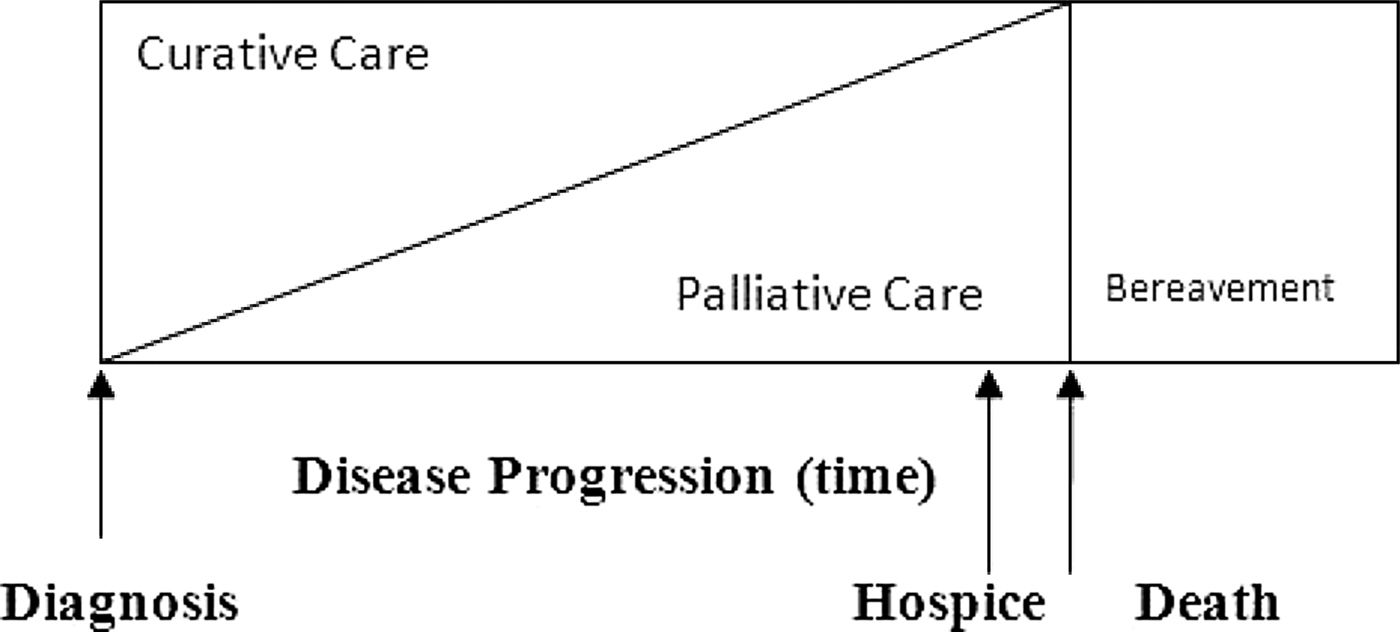
If we accept that dementia is a life-limiting illness, then in order to provide palliative care to this population, we must examine the current model of care delivery. The most widely accepted view of palliative care is presented in Figure 1; this picture, developed according to the disease progression and treatment course of cancer, depicts the notion that a disease follows a predictable course with a period of marked decline in the final months of life. As the disease progresses, palliative care takes priority over acute interventions. This more active role of palliative care generally occurs in the last six months of life, a time when many individuals become eligible for hospice funding. For family caregivers, this eligibility may also allow them to avail themselves of income support programs, such as the Compassionate Caregiver Benefit in Canada.
Traditional Model of Palliative Care.

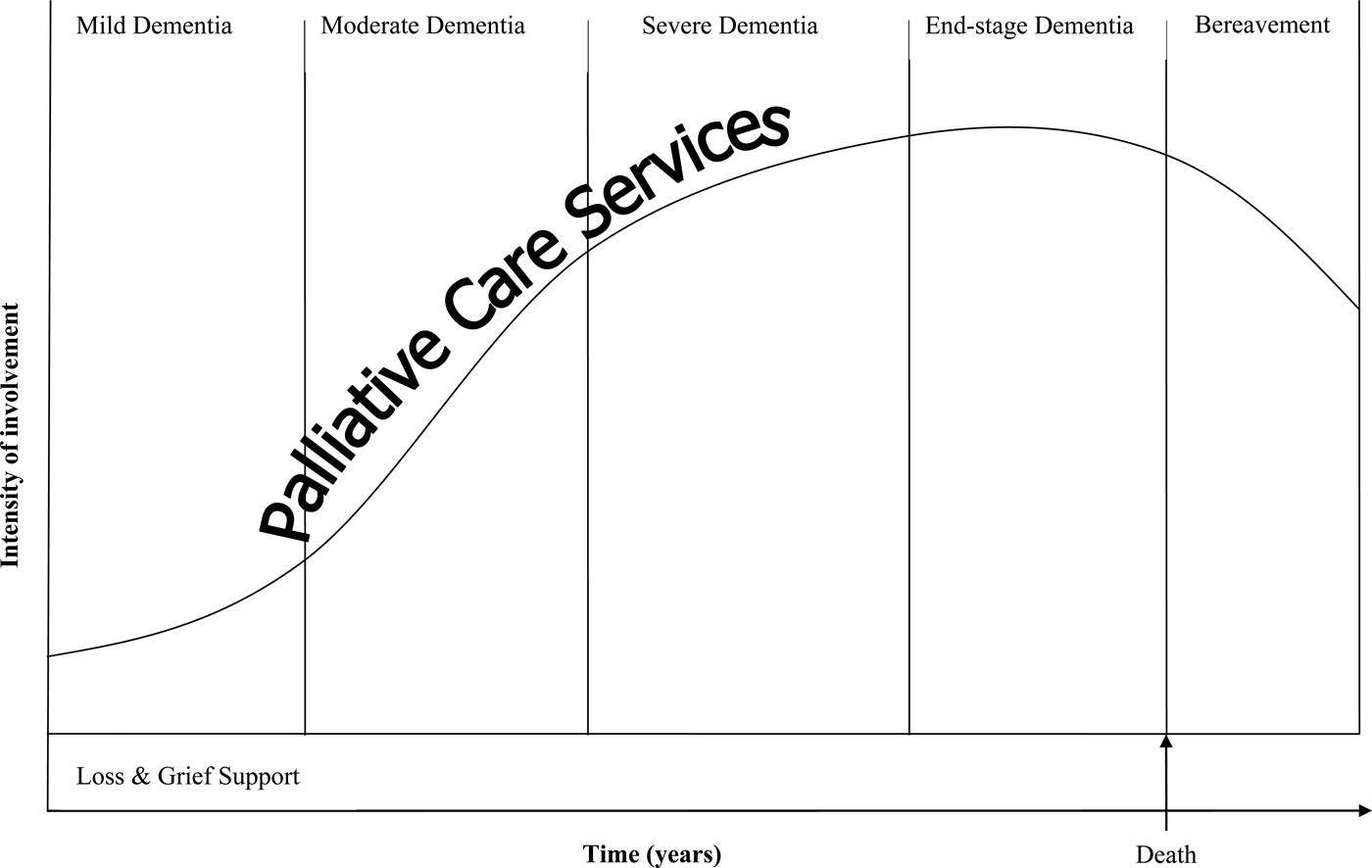
In considering the needs of DFC as previously presented, the current delivery model is problematic for those with dementia and will not adequately meet the unique needs of DFC. Based on the increasing prevalence of dementia in our aging population, the protracted nature of dementia, the communication difficulties associated with the disease, and the high levels of need among DFC (many of whom are also aging), the intensity of palliative care involvement must be moved “upstream” before the older adult reaches the end phase of the disease (Fig. 2). The intensity of this involvement will not be linear; instead, it will follow the pattern of needs outlined previously. As such, it will be initiated at the time of diagnosis and its intensity will increase during the moderate to severe phase of the disease, tapering off in the end stages. This suggestion is supported by other researchers (Covinsky, Reference Covinsky2004; Diwan, Hougham & Sachs, Reference Diwan, Hougham and Sachs2004; Schulz et al., Reference Schulz, Mendelsohn and Haley2003; Torke et al., Reference Torke, Holtz and Hui2010), who recognized that the need for palliative care involvement and services may be greatest in the early stages of dementia. For example, DFC may benefit from receiving grief support at the moment of diagnosis. As the illness progresses, drawing on the knowledge of palliative care practitioners to assist DFC's with advance care planning, providing ongoing grief support and respite care may mitigate suffering and distress in this population.
Intensity of Palliative Care Services based on Progression of Dementia.
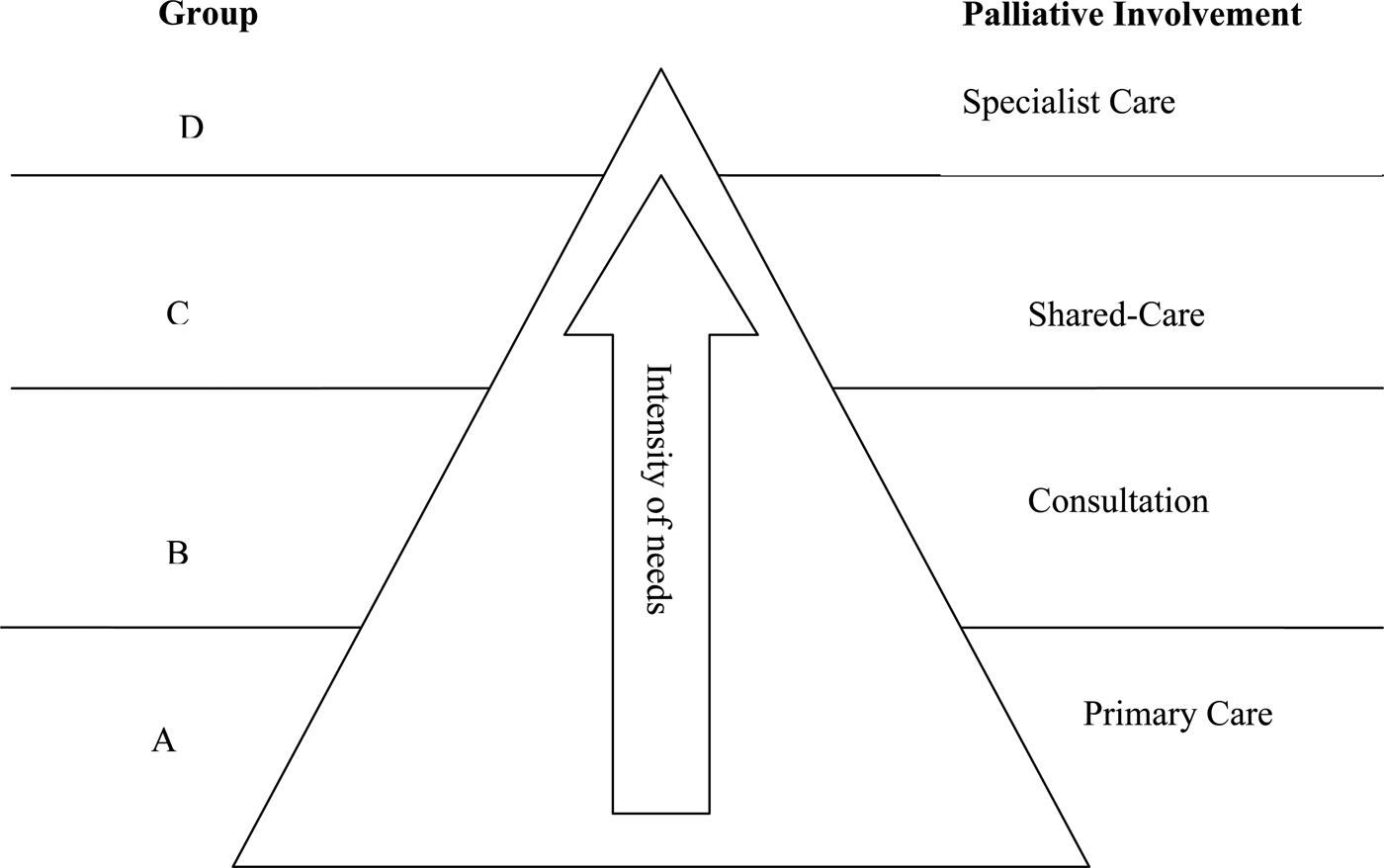
In order to adopt such a change in practice, we must first acknowledge that palliative care is a much broader concept than hospice care, without the limits of time or prognosis (Mahon & Sorrell, Reference Mahon and Sorrell2008). Second, we must shift our assumption that all persons with dementia have palliative care needs that can only be met by palliative care specialists. Finally, we must acknowledge that palliative and dementia care can be well integrated from the point of diagnosis to the time after the care recipient's death. Figure 3 presents a model (modified from that proposed by Palliative Care Australia (2005) that outlines the levels of palliative care provider and service intensity and, thus, provides guidance for instituting the aforementioned changes.
Population-based palliative care for individuals with dementia (Adapted from Palliative Care Australia).
The acuity and complexity of care recipients' and DFC needs, albeit physical, emotional, social, spiritual, or instrumental, define the level of integration between dementia care and palliative care services delivered within this model. In this manner, care recipients and family caregivers may move between different levels of care throughout the dementia trajectory. The vast majority of persons with dementia and DFC will fall into Group A, as their palliative care needs are most easily and effectively met by primary health care providers with general palliative care knowledge, including community and long-term care nurses, family physicians, and those with more specialist gerontological and dementia care education. As an individual's illness progresses or if a DFC were to experience sporadic or occasional exacerbations of psychosocial, physical, or existential/spiritual distress, consultation from specialist palliative care services, with ongoing care being provided by their primary care providers (Group B) is required. Supporting DFC at this juncture might involve the inclusion of a palliative care consultant in initial advance care planning sessions to facilitate discussion or the provision of training programs to help family caregivers manage challenging behaviors in the community. A subset of persons with dementia and/or their family caregivers will have needs that require more intensive care, which is best achieved through ongoing collaboration and shared care arrangements between the primary care provider and palliative care specialist (Group C); for instance, when a DFC is found to be experiencing high levels of grief or psychological distress, a palliative care practitioner will follow this individual on a regular basis in the community. A small sub-group of dementia patients and/or their family caregivers (Group D) will have complex care needs that require direct ongoing involvement from specialist palliative care services, either in the community or in designated in-patient/hospice beds. Supporting DFC within this group may involve the provision of respite care within hospice facilities.
This integrated model of collaborative care is built on a population-based approach with defined levels of care and clear role delineation. The model recognizes and respects the relationship between primary care providers, care recipients, and DFC. Additionally, the expertise of specialist palliative care providers is used more effectively and provides opportunities for formalized education and collaboration with generalist providers. Since this model includes existing care providers, who are already known to the DFC, to provide most palliative care services to this population, it may help to remove caregivers' misconceptions regarding the nature of palliative care. Using health care providers who are known to DFC helps bridge the worlds of dementia and palliative care to achieve the highest quality of care for the person with dementia and their caregivers.
Many of the fundamental principles and philosophical premises of palliative care complement the person-centered care approach advocated by dementia experts. Person-cantered care affirms the personhood and value of the individual, recognizes the person's capacity for communication regardless of verbal impairment, and seeks to provide whole person care (Downs, Small & Froggatt, Reference Downs, Small and Froggatt2006; Kitwood, Reference Kitwood1997). Family caregivers are recognized as playing a key role in maintaining personhood and advocating on behalf of the individual (Russell, Middleton & Shanley, Reference Russell, Middleton and Shanley2008). In this regard, person-centered care focuses on the strengths, functions, and relationships of the individual rather than their disabilities or disease (Gaspard & Roberts, Reference Gaspard and Roberts2009). Moving palliative care upstream and integrating it with person-centred dementia care will help achieve the greatest benefits for persons with dementia and their family caregivers.
CONCLUSION
Supporting DFC requires the integration of palliative care services and expert dementia care practices in a model tailored to the intensity of individuals' needs. The research literature on DFC provides a wealth of information on the challenges they face and the unique needs that emerge over the course of their caregiving career. By engaging palliative care providers early in the course of the dementia trajectory and adopting a collaborative approach to care, the highest level of quality care and support may be achieved for this growing cohort of caregivers.
ACKNOWLEDGEMENTS
The authors gratefully acknowledge Angela Miller with the Manitoba Centre for Nursing and Health Research for her editorial guidance.