INTRODUCTION
A considerable amount of empirical research has established a strong link between narrative abilities in the early preschool period and emergent literacy (Feagans, Reference Feagans, Feagans and Farran1982; Snow, Reference Snow1983) and early reading skills (Paris & Paris, Reference Paris and Paris2003; Peterson & McCabe, Reference Peterson and McCabe1983), as well as later literacy skills and academic success (Fazio, Naremore & Connell, Reference Fazio, Naremore and Connell1996; Feagans & Applebaum, Reference Feagans and Appelbaum1986; Fiorentino & Howe, Reference Fiorentino and Howe2004; Tabors, Snow & Dickinson, Reference Tabors, Snow, Dickinson, Tabors and Dickinson2001). Improvements in narrative skills for preschool children thus could be expected to enhance their later success in school. However, despite substantial evidence for the important consequences of narrative development on academic and cognitive skills and abilities, only limited progress has been made in understanding how these narrative skills can be facilitated. The primary aims of the present study are to investigate whether explicit and engaging teaching of narrative structure accelerates narrative development, and to determine whether this effect is enhanced when children make active choices at various points in the story.
Constructivist theories regarding fictional narrative suggest that understanding goal-based episodes, or causal sequences, is a crucial skill necessary for the proficient comprehension and production of narratives (Stein, Reference Stein, Franklin and Barten1988; Trabasso & Nickels, Reference Trabasso and Nickels1992; van der Broek, Lorch & Thurlow, Reference van den Broek, Lorch and Thurlow1996). In accordance with this perspective, the acquisition of a ‘story schema’ (Johnson & Mandler, Reference Johnson and Mandler1980; Stein & Glenn, Reference Stein, Glenn and Freedle1979) that clarifies the links between story components has been suggested to be central in children's advances in their narrative ability. Stories that follow such a schema have been shown to be better comprehended and recalled by both adults and children than those that do not abide by a story schema (Hudson & Nelson, Reference Hudson and Nelson1983; Mandler & Johnson, Reference Mandler and Johnson1977). Stein and Glenn's (Reference Stein, Glenn and Freedle1979) story grammar model listed six story grammar categories: Setting, Initiating events, Internal responses of the protagonist including goal formation by the protagonist, Attempts made by the protagonist to achieve the goal, Direct consequences of the attempt made by the protagonist, and the protagonist's Reactions to the consequences. Other models of story grammar have also been proposed which frame similar components in a slightly different way (e.g., Johnson & Mandler, Reference Johnson and Mandler1980; Mandler, Reference Mandler1978; Stein & Albro, Reference Stein, Albro and Bamberg1997).
Previous research findings converge to show that children who are about seven years old are able to include some major orientation and setting information, initiating events, attempts, and consequences in stories that they generate, in stories that they retell, and in comprehension assessments. However, the overall complexity levels handled by younger, preschool children are much lower. Furthermore, children between the much-studied ages of four and five years still demonstrate multiple limitations on the causal linking of story components (Peterson & McCabe, Reference Peterson and McCabe1994). Finally, empirical evidence also indicates that four- to five-year-olds are far less likely than seven- to ten-year-olds to generate or recall ‘complete’ episodes, i.e., stories containing initiating events, attempts and consequences (Stein & Albro, Reference Stein, Albro and Bamberg1997; Stein & Glenn, Reference Stein, Glenn and Freedle1979).
Few studies have been conducted to facilitate narrative development in preschool children. Among published studies showing some modest narrative gains by preschool children, no study has shown clear gains in complexity of story grammar components comprehended or produced (Bowyer-Crane et al., Reference Bowyer-Crane, Snowling, Duff, Fieldsend, Carroll, Miles and Hulme2008; Feagans & Farran, Reference Feagans and Farran1994; Gillam, McFadden & Van Kleeck, Reference Gillam, McFadden, Kleeck, Fay, Windsor and Warren1995; Hayward & Schneider, Reference Hayward and Schneider2000; Peterson, Jesson & McCabe, Reference Peterson, Jesson and McCabe1999; Zevenbergen & Whitehurst, Reference Zevenbergen, Whitehurst, van Kleek, Stahl and Bauer2003). A review of narrative intervention studies suggests that successful intervention methods included repeated story-telling and/or explicit teaching of story grammar elements (Petersen, Reference Petersen2011).
The impact of choice on learning
Research evidence suggests that when individuals are allowed to affirm their sense of autonomy by choosing aspects of an activity, they exhibit enhanced intrinsic motivation, persistence, task performance, and perceived competence (Patall, Cooper & Robinson, Reference Patall, Cooper and Robinson2008). In a study by Cordova and Lepper (Reference Cordova and Lepper1996), children were provided with computer instruction for math skills and a critical manipulation was whether or not they had control over choices regarding incidental aspects of the task (e.g., the character's name or the specific icon that represented them in the activity). The results of this study show that providing subjects with choice and control over some aspects of the task resulted in increased engagement and persistence of learning efforts by the children. Similarly, in literacy tutoring using computer software, Nelson and colleagues incorporated extensive built-in active choice options for deaf, autistic, and multiply handicapped children in their learning episodes (Nelson, Heimann & Tjus, Reference Nelson, Heimann, Tjus, Adamson and Romski1997). In one study directly testing out choice effects, deaf children achieved greater literacy gains when they made active choices in this computer-supported context compared to when they did not (Nelson, Prinz, Prinz & Dalke, Reference Nelson, Prinz, Prinz, Dalke and Martin1991).
Current study
Despite the fact that story grammar structure has been well specified and heavily emphasized as crucial for complex narrative, the process by which children acquire story structure knowledge is less well understood. The current study aims for enhancing children's complexity of narrative by explicitly highlighting story grammar structure during engaging teaching episodes. In addition, a key second feature of the current study is that half of the children participating in the intervention were assigned to a choice condition, and were given control over how the story unfolded – they were able to choose elements such as the character, problem, and solution. The provision of choice on how the story develops was expected to increase children's attentional focus, intrinsic motivation, and depth of engagement in the story teaching activities in line with similar effects seen in math and literacy interventions (Cordova & Lepper, Reference Cordova and Lepper1996; Nelson & Arkenberg, Reference Nelson, Arkenberg, Moody and Silliman2008; Nelson et al., Reference Nelson, Heimann, Tjus, Adamson and Romski1997; Nelson et al., Reference Nelson, Prinz, Prinz, Dalke and Martin1991; Nelson, Welsh, Camarata, Heimann & Tjus, Reference Nelson, Welsh, Camarata, Heimann, Tjus, Nelson, Aksu-Koc and Johnson2001). This in turn was expected to increase attention to and processing, encoding, and abstraction of story grammar structures as well as overall story content. It is therefore hypothesized that children assigned to the choice condition will score higher on all narrative measures at post-intervention testing compared to children assigned to the no-choice intervention condition.
METHOD
Participants
The study sample included twenty-nine typically developing children (14 male, 15 female), aged 3;1 to 5;4 (M=3·86, SD=0·69), recruited from two local daycares. Due to attrition of the sample across the study, complete data for only twenty-six subjects was obtained at the final testing point. The sample was majority Caucasian (76%), which is representative of the local state college population. All testing was conducted on site at the daycares, which mostly included children of faculty, staff, and students at the university. Signed consent was obtained from the parents of each child who participated in the study.
Group matching
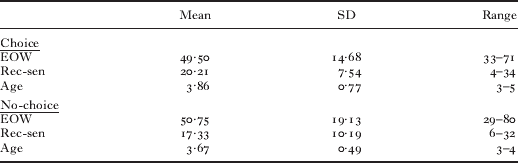
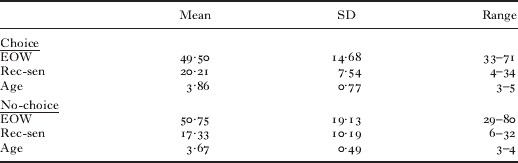
Half of the children were assigned to a ‘choice’ group, and half of the participants were assigned to the ‘no-choice’ group (after attrition, 14 children remained in the choice group, and 12 remained in the no-choice group). Children assigned to the two groups were individually matched on their expressive vocabulary, as measured by the Expressive One Word Picture Vocabulary Test (Gardner, 1990), and their syntax understanding, as measured by the Recalling Sentences subtest of the Clinical Evaluation of Language Fundamental – Preschool (Wiig, Secord & Semel, 1992). Children were also matched for age and gender across the two intervention conditions. See Table 1 for the group demographics at pre-test after accounting for attrition.
Language matching using raw language scores at pre-test for attrited sample (N=26)
PROCEDURES
Measures
Story-telling ability
Story-telling was elicited from the children at pre-test and at post-test by using a 29-page wordless picture book (referred to as the familiar book), A Boy, a Dog and a Frog (Mayer, Reference Mayer1967). In addition to this book, an unfamiliar book One Frog Too Many (Mayer, Reference Mayer1975) from the same series was used at post-test to elicit story-telling from the children. The child's page-by-page narrative picture walk was recorded using a micro-cassette recorder. Transcripts of the story-telling were coded for story grammar components constituting the main causal sequence or ‘episode’ of the story: initiating event, problems, attempts, consequences, and reactions. A score was given for number of times that these components occurred in their narrative. For example, if the child talked about the ‘big frog biting the little frog’ on page 6 of the unfamiliar book, then this was counted as a correct identification of a problem. An inter-rater reliability analysis using the Kappa statistic was performed on the pre-test familiar book data to determine consistency among raters. Across two raters (graduate students in psychology), the inter-rater reliability for this measure, using Cohen's kappa, was k=0·92, p<·001.
The telling of the story by the child during the ‘picture walk’ through the wordless picture books was followed by a prompted comprehension phase (Paris & Paris, Reference Paris and Paris2001). The examiner guided the page-turning and pointed to specific pictures related to a series of seven comprehension questions. Five of these questions targeted explicit information and required identification and understanding of the following story grammar components: setting, characters, initiating event, problem, and resolution/consequence. The latter three questions asked the child to identify what was happening in a particular picture and why. The remaining two questions required the children to make inferences from the pictures about the characters' feelings and causality, for example, ‘Why did the boy and the dog leave the pond?’ The scoring rubric was borrowed from the 2-point rubric designed by Paris and Paris (Reference Paris and Paris2001): incorrect (0 points), partial response (1 point), or correct response (2 points), yielding a total possible score of 14 on this measure for each of the two picture books. Across two raters, the inter-rater reliability for this measure, using Cohen's kappa, was k=0·91, p<·001.
Story-retelling ability
A standardized story-retelling task, the adapted version of the Bus Story (Glasgow & Cowley, Reference Glasgow and Cowley1994), was used to assess children's story-retelling ability in this study. The story has a total of twelve pictures with a corresponding 168-word script that was read to the child by the experimenter. The child was then asked to retell the story with the aid of the pictures. The children's retelling was recorded using a micro-cassette recorder. The Bus Story narrative transcripts were scored for overall content (information score) according to instructions provided by Glasgow and Cowley (Reference Glasgow and Cowley1994). This test has adequate test–retest (r=0·70) and inter-rater (r=0·66) reliability for scoring the information contained within the child's narrative. Narratives were given one or two points for each item that was accurately retold from the story script (e.g., ‘there was a naughty bus’). Possible raw scores on the information variable ranged from 0 to 53 points. Narrative items that were conceptually highly similar to the original story content were awarded full points, and narrative items that were slightly different from the original story got partial credit. Thus, story information that was given credit on this measure was all related to the story grammar components and required an understanding of story structure. A comprehensive manual with detailed examples was provided to the raters. Two pairs of coders coded the data for the two time-points and inter-rater reliabilities were found to be k=0·86, p<·001 and k=0·88, p<·001, respectively. Raw scores were converted to standard scores referring to the age norms, and these standard scores were used in subsequent analyses.
Intervention materials
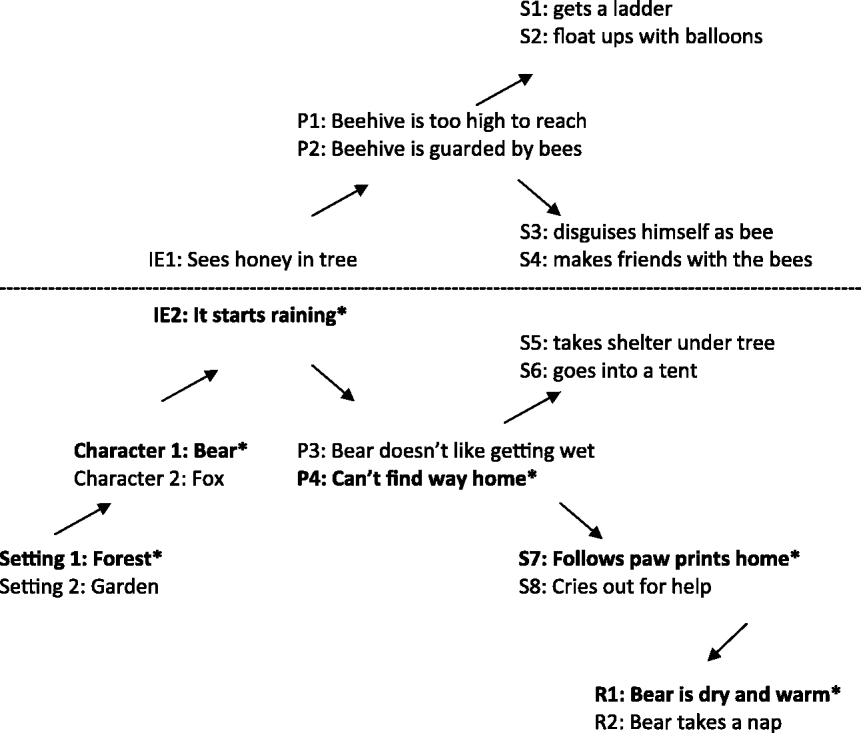
A total of eight different story sets were constructed for the intervention, each containing two possible alternatives for any given story grammar element (see Figure 1 for sample template). The six story grammar components taught were as follows: setting (where the story takes place), character (the protagonist), initiating event (beginning of story), problem (an obstacle and the character's reaction to the obstacle), solution (an attempt to solve the problem), and resolution (including the consequence of the solution as well as the character's reactions). Once the story templates had been created for the stories, picture cards (clipart cartoon images printed out and pasted on 3-inch by 5-inch index cards) were created that corresponded to each story grammar component for each of the eight stories. Finally, paragraphs corresponding to all the different possible combinations of story grammar components were constructed for each story. The combinations of elements allowed for the creation of many different possible stories from the same set of materials.
Story template for Bear and Fox story used in intervention. A possible sequence of story components that could have been selected by a child is illustrated using boldface and asterisks.

Intervention procedures
Both groups were presented with a total of sixteen stories across eight sessions. The later half of the sessions presented new stories constructed from the eight sets of story materials, so that each child saw the same storyline only once. The two groups completed similar interventions, varying only on the manipulation of choice. The children in the choice group were presented with choice at six different points in the story, corresponding to the story grammar components being taught. The no-choice group completed an intervention that was otherwise identical to the first except that children were not offered choice for any of the six components. Both intervention conditions involved seven to eight sessions, each session being 10–15 minutes long, conducted over the span of four weeks. The mean length of session did not statistically differ between the choice condition (M=11·54 minutes), and the no-choice condition (M=10·62 minutes) (t(12)=1·73, p=·10).
In the choice condition, children were asked by an adult experimenter to choose a picture card at the appropriate point in the story sequence from two possible options for each of the six story grammar components targeted in the study. For example, the experimenter would say to the child, ‘Next, we need to choose a problem for our story. Do you want the problem to be that the beehive is too high for the bear to reach or do you want the problem to be that the beehive is guarded by angry looking bees?’ Once all the six picture cards had been laid out, the experimenter then read the child the corresponding pre-written story paragraph that matched the set of components that they had selected.
The procedure was identical for the no-choice intervention condition except that story grammar components were instead preselected for the children and so the children watched the experimenter create the complete story. The experimenter told the children what each picture card represented, as they were placed in front of the child. For example, the experimenter would say, ‘Next we need a problem for our story. Here's a picture of a beehive sitting high up on a branch of a tree’. After the six pictures cards had been laid out, the corresponding pre-written story paragraph was read to the child. Thus, story grammar elements were highlighted in multiple ways through labeling, pictorial representation, and story reading, but the number of repetitions was equivalent across both the choice and no-choice conditions.
RESULTS
Story-telling results after all children had completed intervention
Production of story grammar components in children's narrative
Table 2 contains the results for the story grammar component analysis of children's page-by-page story-telling of the unfamiliar book presented for the first time at post-test. Comparisons of total number of story components constituting causally connected episodes in children's narratives (i.e., total number of initiating events, problems, attempts, consequences, and reactions) revealed that children assigned to the choice intervention included more story components (M=15·50, SD=2·82) in their narratives compared to children assigned to the no-choice condition (M=11·25, SD=3·57), (t(24)=3·39, p<·01, d=1·32). Furthermore, these differences were found to be most prominent for number of problems and attempts included in the children's narratives. Children assigned to the choice intervention included a higher number of problems (M=3·57, SD=1·16) in their narratives, compared to children assigned to the no-choice condition (M=2·00, SD=1·04), (t(24)=3·61, p=·001, d=1·42). Children assigned to the choice intervention also included a higher number of attempts (M=2·50, SD=1·09) compared to children assigned to the no-choice intervention (M=1·00, SD=0·60), (t(24)=4·24, p<·001, d=1·70).
Children's production of story grammar components in story telling at post-test (unfamiliar story)

note: N=26; means, standard deviations, t-values, significance values, and effect sizes for each measure are presented.
Overall story grammar comprehension scores
A 2 (choice vs. no choice)×2 (pre-test vs. post-test) ANOVA was conducted on prompted comprehension scores for the familiar picture book, revealing a significant main effect for time (F(1, 23)=83·25, p<·001, η2=·784), and a trend for the main effect of intervention type (F(1, 23)=2·02, p=·168). A significant interaction was not observed (F(1, 23)=0·79, p=·381). Consistent with the main effect for time observed, paired t-tests revealed that children in both the choice and no-choice condition improved significantly in their prompted comprehension scores from pre-test to post-test. For the familiar picture book, children in the choice group scored significantly higher at post-test (M=11·62, SD=1·39) compared to pre-test (M=7·15, SD=2·64), (t(12)=7·94, p<·001, d=2·11), as did children in the no-choice group, scoring a mean of 10·00 (SD=2·48) at post-test compared to a mean score of 6·33 (SD=2·90) at pre-test (t(11)=5·29, p<·001, d=1·36).
A post-hoc t-test also revealed that for the familiar wordless picture book at post-test, children assigned to the choice condition had a significantly higher mean score (M=11·61 points, SD=1·39) than children assigned to the no-choice condition (M=10·00 points, SD=2·49), (t(23)=2·03, p=·05, d=0·80). As an informative good contrast, there was no significant difference in performance on this measure at pre-test, as children assigned to the choice condition's performance (M=7·43 points, SD=2·73), did not differ significantly from children assigned to the no-choice condition (M=6·33 points, SD=2·90), (t(24)=0·98, p=·33).
For the unfamiliar picture book presented only at post-test, choice emerged as a significant factor as children assigned to the choice condition had a significantly higher mean story grammar comprehension score (M=11·29 points, SD=2·01) compared to children assigned to the no-choice condition (M=9·33 points, SD=2·87), (t(24)=2·03, p=·05, d=0·79).
Story-retelling task results
Production of story grammar components in retelling task
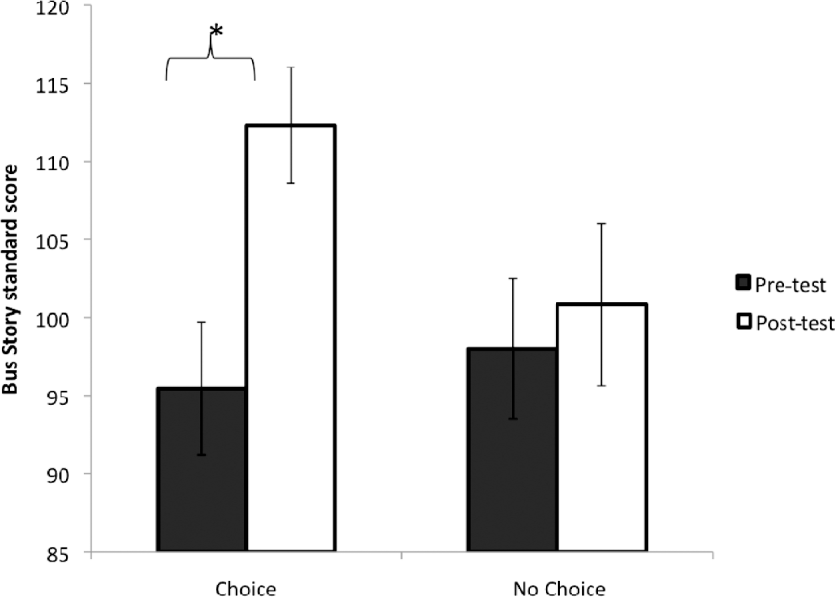
To examine gains in Story Information scores on the Bus Story retelling task, a 2 (pre–post)×2 (choice vs. no choice) ANOVA was conducted (See Figure 2 for graphic depiction of these results). A significant interaction was observed (F(1, 23)=5·12, p<·05, ηp2=·182), and post-hoc analyses revealed that children assigned to the choice condition had significantly higher Story Information scores at post-test (M=112·31, SD=13·39) compared to pre-test (M=95·46, SD=15·33), (t(12)=4·42, p<·001, d=1·17). Children assigned to the no-choice condition, however, did not significantly differ in performance on this task across the two assessment points (t(11)=0·57, p=·58).
Comparison of story information scores on the Bus Story retelling task by children assigned to the choice condition and no-choice conditions at pre-test and post-test.
DISCUSSION
As predicted, after only four weeks (approximately 1·5 hours) of intervention, children assigned to the active-choice condition showed multiple and significant skill advantages in story grammar knowledge and production compared to children assigned to the no-choice condition. These advantages for the active-choice group can be attributed to intervention procedures considering that children in this condition were closely matched on vocabulary and syntax prior to intervention to the no-choice children.
An advantage for the choice-intervention was seen in children's narrative production skills for a post-test wordless picture book new to the children. Children assigned to the choice condition included a significantly greater number of story grammar components that constitute connected episodes in their narratives at post-test compared to children assigned to the no-choice intervention. Furthermore, these differential gains in narrative production skills were most prominent for the number of problems and attempts included in their narratives; two story grammar components that were specifically targeted in the intervention and are central to causal sequences in stories.
A differential advantage for children assigned to the choice intervention was also found in a post-test story-retelling task. Children in the choice condition improved in their scores on the story-retelling task from pre-test to post-test, but the children in the no-choice condition did not. Children's narrative performance in this task likely reflected two processes – how well they comprehended the initial story as told by the experimenter, plus their own narrative production skills. The replication of this narrative advantage across two different contexts – a wordless picture book and a standardized story-retelling task – further validates the effectiveness of the choice intervention in significantly boosting story script knowledge that supports and facilitates narrative performance.
And finally, an advantage was also observed at post-test for choice children in their comprehension scores for questions targeting identification and reasoning about particular story events, as well as identification of character emotions and motives.
Provision of choice has not been studied as a factor before in research on children's narrative skills acquisition. However, clues to why choice proved to be a potent factor in children's skill gains in the present narrative intervention can be found in other developmental research. For example, giving children choices has been shown to be related to increased attention and engagement in previous research on mathematics tutoring (Cordova & Lepper, Reference Cordova and Lepper1996). In addition, in multiple studies of successful facilitation through software of reading skills in severely delayed readers, the provision of content choices during sentence construction activities has been viewed as a central contributor to learning. More specifically, the choices are believed to play a central role in enhancing the children's attentional, motivational, and pattern abstraction systems (Nelson et al., Reference Nelson, Heimann, Tjus, Adamson and Romski1997; Nelson et al., Reference Nelson, Prinz, Prinz, Dalke and Martin1991). By extension from this prior work, then, provision of choice in the present intervention could have dynamically nudged the children toward higher motivational engagement, more focused attention, and more effective processing of grammar elements. Furthermore, as choice children got to witness across multiple occasions how different story structure sequences unfolded depending on certain choices that they actively made from pairs of options/choices they were shown, it is inferred that these children were dynamically nudged toward paying closer attention to, and abstracting, these story structure sequences.
We did not directly measure the ‘choice’ children's presumed higher levels of attention and social–emotional engagement. However, several prior research studies aiming to combine high challenges in language together with very high social, motivational, and attentional engagement demonstrated, from videotape analysis, that greater learning of syntax or literacy skills occurred when children showed higher levels of engagement on these indicators: animated voice, smiling, and following of a partner's topic (Hayley, Camarata & Nelson, Reference Hayley, Camarata and Nelson1994; Nelson et al., Reference Nelson, Welsh, Camarata, Heimann, Tjus, Nelson, Aksu-Koc and Johnson2001; Nelson & Arkenberg, Reference Nelson, Arkenberg, Moody and Silliman2008; Nelson, Craven, Xuan & Arkenberg, Reference Nelson, Craven, Xuan, Arkenberg, Hudson, Fivush, Bauer and Lucariello2004). Future narrative teaching research should include measurement not only of such ‘engagement’ indicators but also of indicators (such as task persistence) of what many have termed ‘intrinsic motivation’ (Cordova & Lepper, Reference Cordova and Lepper1996). Future research with refinements in measures along these lines could help identify which of the many factors in the present active-choice narrative intervention are most strongly contributing to the demonstrated gains in children's skills in story grammar structure and in overall narrative richness.
One of the limitations of the current study is a limited sample size. While the sample size of the current study is comparable to the typical sample size for prior narrative intervention studies, it still presents certain constraints on the kinds of analyses that can be conducted. Another limitation of the study is that children in the intervention encountered simple stories. Future interventions should assess the impact of more complex stories with a greater number of choices on the narrative abilities of children. In addition, research should examine how making active choices impacts learning in language-delayed children and in other SES and cultural groups. A recent review of narrative intervention studies with language-impaired children found that some successful intervention methods included explicit teaching of story grammar elements, but the review urges cautious interpretation because of limitations in experimental control and sample sizes (Petersen, Reference Petersen2011).
In conclusion, the current intervention provides empirical support for the theoretically motivated assumption that offering a preschool child the ability to choose story elements as well as manipulate the trajectory of the story contributes to a favorable ‘dynamic mix’ for fostering improved narrative skills. The central hypothesis for this study was confirmed as active-choice children made stronger gains in narrative production and comprehension skills than children in an explicit story grammar teaching intervention without provision of choices. At the same time, the present results invite more thorough exploration of how theoretical notions in dynamic systems may be translated into workable language teaching procedures with children (Nelson & Arkenberg, Reference Nelson, Arkenberg, Moody and Silliman2008; Thelen & Smith, Reference Thelen and Smith1994).
Results for the current study indicate that the stronger gains in narrative production by the preschool children in the choice group may reflect a shift to a highly consolidated story schema or story script. Over time, if these kinds of multiple gains in narrative skills could be extended to many learning episodes, such narrative complexity gains would be expected to in turn lead to improvements in future literacy and academic achievement as well.