

Published online by Cambridge University Press: 25 April 2006
The Spanish, French, Dutch, and Luxembourg referenda on theConstitutional Treaty are the latest, but certainly not the last,flashpoints in a contentious European Union. The era in which EUpolitics was determined by national and European elites ended about15 years ago. With the Maastricht Accord of 1991, decision making onEuropean integration entered the contentious world of partycompetition, elections, and referenda.
The Spanish, French, Dutch, and Luxembourg referenda on the Constitutional Treaty are the latest, but certainly not the last, flashpoints in a contentious European Union. The era in which EU politics was determined by national and European elites ended about 15 years ago. With the Maastricht Accord of 1991, decision making on European integration entered the contentious world of party competition, elections, and referenda.
From December 1991 through December 2005 referenda on Europe were held in 19 of the 25 member states in the EU, and that number would have climbed to 21 if Portugal and the UK had not suspended referenda after defeats in France and the Netherlands. For Portugal, it would have been the first ever referendum on an EU issue; for the UK, the first one since 1975. Belgium, Germany, Greece, and Portugal remain the only EU countries that have not (yet) held a referendum on a major EU issue. Of the 27 EU referenda that have taken place since the Maastricht Accord (1991), six have ended in defeat for governments.1
Denmark (1992: Maastricht Treaty), Denmark (2000: EMU), Ireland (2001: Nice Treaty), Sweden (2003: EMU), France (2005: Constitutional Treaty), and the Netherlands (2005: Constitutional Treaty). This does not include no-votes in Switzerland (1992), on accession to the European Economic Area, and in Norway (1994), on accession to the European Union.
What motivates attitudes on Europe? Territorial identities appear influential. The reason for this derives from the dual nature of governance. Governance is a means to achieve collective goods by coordinating human activity. Efficient governance should be multi-level because externalities and scale economies vary across policies. But governance is also an expression of community. Citizens care—passionately—about who exercises authority over them. The functional need for human cooperation rarely coincides with the territorial scope of community. This tension is, we believe, a key to understanding the path of European integration.
The causal power of identity struck us about five years ago when we were pouring over new data on national political parties. We expected to see a strong association between a party's position on the economic left/right dimension (summarizing economic distribution and the role of the state in the economy) and its stance on European integration. But a non-economic left/right dimension, measured along libertarian vs. authoritarian lines (Kitschelt 1994), proved to be a more powerful predictor.2
This non-economic dimension summarizes several non-economic issues—ecological, life-style, and communal. In some countries, environmental protection and sustainable growth are core issues; in others, it is traditional values rooted in a secular/religious divide; in yet others, immigration and nationalism predominate. We therefore describe the poles of this dimension with composite terms: Green/Alternative/Libertarian (or Gal) and Traditionalism/Authority/Nationalism (or Tan).
Several recently published articles find identity to be a powerful influence on the public's attitudes toward European integration (Diez Medrano 2003; Herrmann, Brewer, and Risse 2004; McLaren 2002). Since 1992, when the European Union's public opinion instrument, Eurobarometer, began to ask questions about identity, the proportion of EU citizens who describe themselves as exclusively national (e.g. British, French or Greek only), rather than national and European, European and national, or European only, has varied between 36 and 46 percent, with no discernable trend. Research shows that such individuals are considerably more likely to express Euroskeptical opinions than those with inclusive identities.
Younger, educated, and more informed people are more likely to embrace some European identity than are older, less educated, less informed people. This raises the possibility that we are seeing a reaction against Europe on the part of a declining section of the population (Citrin and Sides 2004: 172-3).
The European Union internalizes relations among countries. Conflicts that were formerly played out in international relations are now negotiated in the Council of Ministers and the European Parliament. The politicization of European integration has increased the political salience of conceptions of group membership. A result is that conflict in Europe has been transformed in the direction of pre-material, rather than post-material, values.
A theory of regional integration should tell us about the political conflicts that constrain jurisdictional architecture: conflicts that determine not just the particular deals that are hammered out from time to time, but the fundamental direction of reform.
Neofunctionalism and intergovernmentalism conceived of European integration as an elite-driven affair. Neofunctionalists, including Ernst Haas, Joseph Nye, and Philippe Schmitter, argued that demands for integration arise from interest groups which form transnational coalitions. Intergovernmentalists, including Andrew Moravcsik (1998), assumed that interest pressures are bottled in national arenas. But neofunctionalists and intergovernmentalists agreed that the key players are functional economic interests, and that they operate as interest groups lobbying decision makers.
An elite perspective is plausible so long as EU decision making does not appear on the public's radar screen. However, recent research shows that public opinion on European integration has become rather well structured (van der Eijk and Franklin 2004), is connected to the basic dimensions that frame contestation in European societies (Hix 1999; Marks and Steenbergen 2004), and is expressed not only in EU referenda but also in national elections (Evans 2005; Tillman 2004). As a result, the incentives facing elites have been transformed. When European issues are salient for the public, governments, i.e., party leaders in positions of government authority, anticipate the effect of their decisions on public opinion—or face the consequences in elections and referenda.
While we share with neofunctionalism and intergovernmentalism the view that regional integration is triggered by a mismatch between efficiency and the existing structure of authority, we do not expect the outcome to reflect interest group pressures. When an issue is politicized, the preferences of the public and of political parties come into play, and these preferences are shaped by conceptions of territorial identity.
Group affinities are powerful sources of political conflict (Massey 2002), and the very success of the European project has precipitated a spirited defense of national culture and sovereignty. Preferences rooted in identity are often linked to subjective self-interest, but they cannot be reduced to efficiency or to the distribution of economic benefits. This suggests that one should be open-minded—agnostic—about whether the jurisdictions that humans create are, or are not, efficient. Functional pressures are one thing, regime outcomes are another. Hence, the term postfunctionalist.
The logic of our argument is that four developments are decisive for the future of the European Union. The first is politicization. In time past, observers said that European integration was driven by a permissive consensus; since the early 1990s, it is more appropriate to speak of a constraining dissensus. When European issues are debated in high quorum decision making, interest groups take a back seat. While most issues are never raised in such debate, some basic topics—including enlargement, European social policy, European foreign policy, and the Constitutional Treaty—engage political parties and the general public in referenda and national elections.
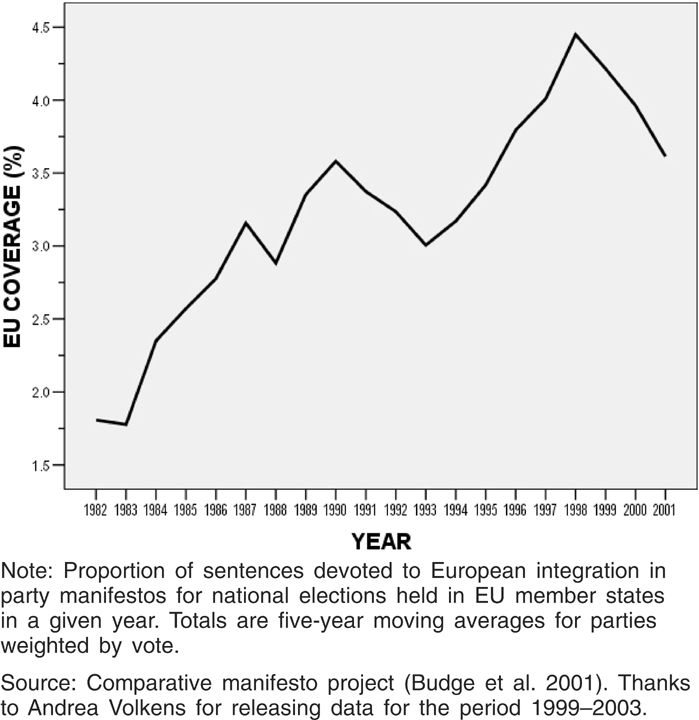
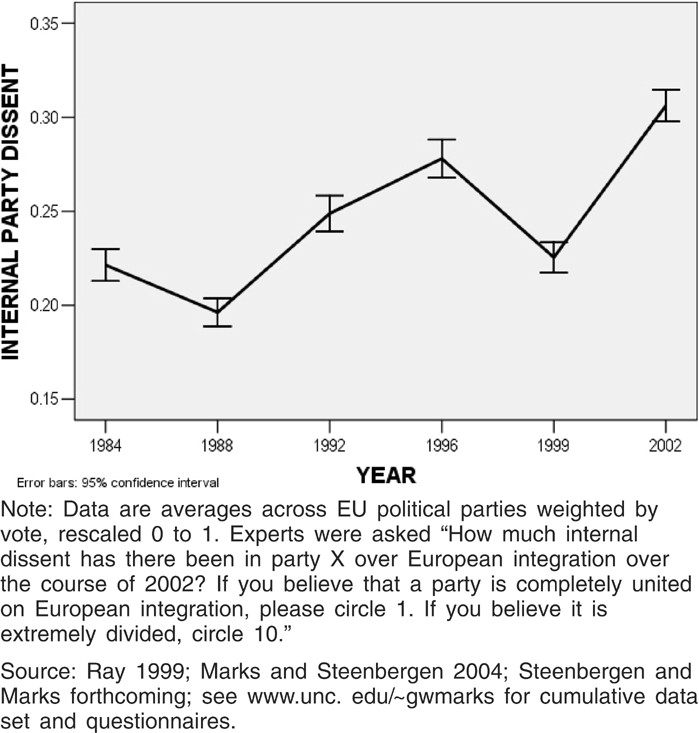
Several data projects have arrived at the conclusion that the salience and contentiousness of European integration have increased over the past decade-and-a-half. European issues have come to feature prominently in the media, in the strategies of social movements, in public opinion, and in national elections (Kriesi 2005; Imig and Tarrow 2001, van der Eijk and Franklin 2004). Figure 1 reveals that the salience of European integration for political parties has increased since the early 1980s. Figure 2 displays dissent within parties on Europe since 1984.

European Integration in National Election Manifestos

Dissent inside National Parties on European Integration
Politicization implies that the causality of regional integration in Europe has changed. The term was first used by neofunctionalists, and we share their insight that regional integration transforms decision making as integration deepens. But the way it has done so is surprising.
A second development that influences European integration is populism. In most European countries, governments have come to realize that they need the formal acquiescence of their publics in referenda to go ahead with European reform. Parliamentary votes are not deemed sufficient. Public referenda are required, even in countries, such as the UK and the Netherlands, where the parliament is formally supreme. No scholar or practitioner predicted this. Because European integration has transformed democratic politics in its member states, the process of European integration has itself been transformed.
Referenda are not neutral decision making instruments. Referenda side-line political parties because they divorce preferences over a single decision—e.g. to join the EU, or not; to have a Constitutional Treaty, or not—from the context of party representation in parliament or party control of government. In national elections, party leaders can squash internal dissent on the ground that it implies that a party is ineffective and therefore not worth voting for. Referenda, by contrast, weaken the control of party leaders, create dissension within parties, and empower single issue entrepreneurs.
Third, as a result of politicization and populism, territorial identities have come to play a decisive role in European integration. Publics are less alert to the economic consequences of integration than are elites or interest groups, and most citizens lack the inclination or time to evaluate the cues they receive. Citizens who do not regard the issue as extremely important are more easily swayed by appeals to identity than are the attentive minority. Parties appealing to exclusive national identity have taken the initiative in public debate.
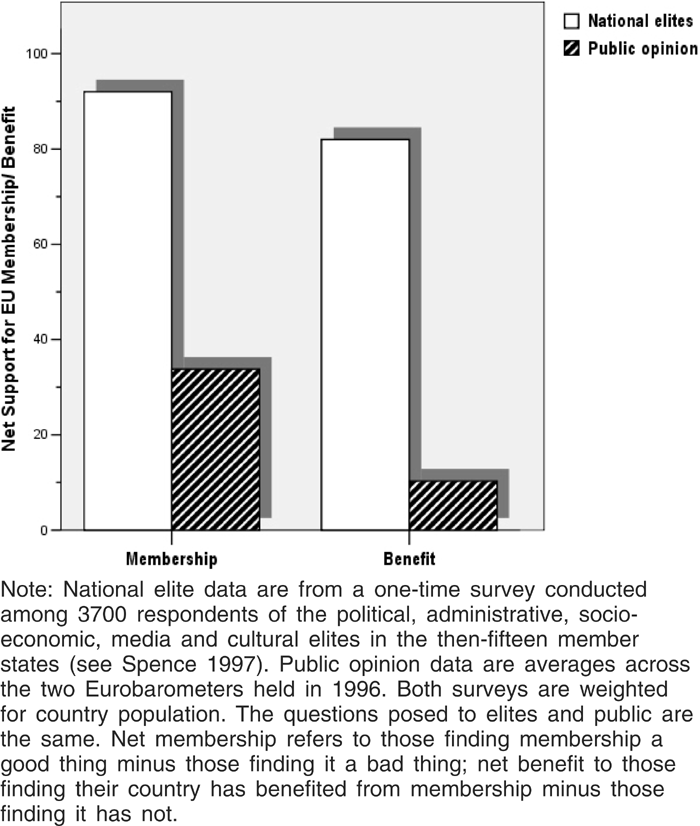
Fourth, politicization and populism have energized a long-standing gap between elites and the public. The public is more Euro-skeptical than the elite in every EU country, and in most countries the difference is huge. Figure 3 illustrates this for 1996, the one year when the same questions were asked to elite and citizen samples. The absolute level of public opinion support has declined somewhat since the mid-1980s, but this is not the most important development. The material change is that the public can no longer be ignored.

The Elite-Public Gap on European Integration
Politicization, populism, identity politics, and the elite/public gap have shaped the causal logic and the outcomes of European integration. They imply the following:
One possible response to these pressures is to insulate European institutions from party competition by delegating to functionally specific jurisdictions. Elsewhere, we describe these as type 2 jurisdictions which are created to solve particular policy problems, such as setting a technical standard or managing a public good or bad (Hooghe and Marks 2003). There are many examples in the EU, including independent European agencies for aviation, drug addiction, the environment, food safety, maritime safety, medical product evaluation, training, work safety and health, and vocational training. Type 2 jurisdictions loosen the link between identity and governance. They are flexible with respect to territorial coverage, and they generally deal with problems amenable to Pareto optimal solutions. Instead of encompassing territorial communities, type 2 jurisdictions coordinate individuals who share some geographical or functional space, for example, as machinery exporters, part-time workers, medicine consumers, or shippers. Membership in such functional communities is extrinsic: It encompasses one aspect of one's identity, and an individual, no matter where he or she is living, can belong to several. What is more, there is no obvious limit to the number of functionally specific jurisdictions.
There is a second way in which ruling elites could lower the heat: by avoiding behavior that ignites EU referenda. They could do so by a) making fewer treaties or b) negotiating treaties that escape referendum treatment. If, as we argue, it makes sense to endogenize referenda in a theory of regional integration, why should one not also endogenize treaties? Treaties, like referenda, are instruments of purpose. If the referendum could be eliminated, not a few political leaders would breathe a sigh of relief. Could one not stem referenda by cutting off their source—the grand treaties?
Another possibility would be to call the bluff of the Euroskeptics by raising the stakes in an up-or-down vote on membership. The proportion of citizens who would like to scrap the European Union has never exceeded 15 percent since Eurobarometer polling began in 1973. Would such a referendum not split defenders of the national?

European Integration in National Election Manifestos

Dissent inside National Parties on European Integration

The Elite-Public Gap on European Integration