

Introduction
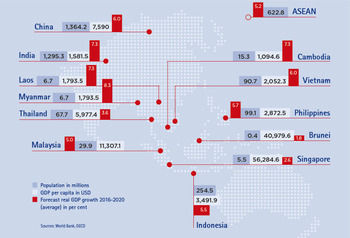
A historic milestone or just business as usual? The Association of Southeast Asian Nations (ASEAN) established the ASEAN Economic Community (AEC) on 31 December 2015. This move was met with different reactions and views on what exactly had been achieved. The ASEAN Secretariat praised the AEC as “a major milestone in the regional economic integration agenda in ASEAN, offering opportunities in the form of a huge market of US$2.6 trillion and over 622 million people” and pointed to the fact that “in 2014, AEC was collectively the third largest economy in Asia and the seventh largest in the world” (ASEAN 2016). Figure 1 provides a snapshot of the member states’ economies. However, this community is anything but the originally envisioned single market and production base in the common international understanding of the terms. According to most assessments, both political and economic concerns are to blame for the slow process towards a real ASEAN economic community. Yet, official ASEAN voices and politicians across Southeast Asia have frequently rejected these views as Eurocentric. Time and again, in interviews that this author has conducted since the early 1990s, decision-makers have pointed to the fact that ASEAN is not comparable to the European Union and, thus, that any progress towards achieving the AEC should not be measured against the European model of economic integration. Tellingly, Jacques Pelkmans's comprehensive volume on the AEC begins with the following words: “Understanding ASEAN's economic integration model is a genuine challenge” (Reference Pelkmans2016: 1). This article addresses these simple but important questions: What has precisely emerged in Southeast Asia and to what extent has ASEAN progressed on the path of economic community building?Footnote 1 In doing so, the article adopts a largely neutral and unbiased perspective, assessing the AEC on the basis of what the ASEAN member states have actually agreed on. However, the verdict does not seem to change markedly even if ASEAN's own far-reaching vision of deep economic integration is applied as the sole baseline for analysis. Hence, I will argue that ASEAN scores high on the political, legal, institutional, and technical frameworks that govern regional economic integration. A multitude of agreements on the facilitation of the free flow of goods and services, intraregional investments, customs harmonization, standards, and non-tariff barriers to trade, to name the most relevant ones, could be expected to lead – at least gradually – to an economic community. Actual implementation, however, lags significantly behind the timelines of the stated objectives. The process of implementing the AEC is not without success stories (particularly in the fields of customs and technical standards), but a single market is currently out of reach and might not even be necessary and desirable for the time being. It should also be noted that a critical view on the AEC should not be misunderstood as an attempt to discredit the tremendous economic success of the Southeast Asian nations. As the South China Morning Post aptly pointed out: “The AEC economies have collectively grown faster than any other Asian economy save China since the beginning of the century. During that same time span, GDP has expanded fourfold, per capita income threefold, and foreign direct investment inflows fivefold. The poverty rate has halved” (Low Reference Low2016). At the same time, it is easy to succumb to the fallacy of attributing the rapid and successful economic development of Southeast Asia as a region to the existence of ASEAN as the regional organisation. Some contribution is likely but a causal link does not necessarily exist.
Asian economies at a glance. (Source: German Asia-Pacific Business Organisation (OAV), 2016).

Before we look at the empirical findings in detail, it is necessary to begin with a few reflections on the concepts of regionalism and integration to determine where ASEAN is placed in current discourses.
Does ASEAN Represent a Distinct Type of Regionalism and Economic Integration?
The idea of the regionalisation of international relations refers to the underlying, often undirected, processes bringing adjoining states, societies, and economies into intensified interaction. Through this interaction, members of a particular cluster of states may be said to have a distinctive orientation to each other and may be said to constitute a region. The term regionalism is more complex. According to Joseph Nye, “in the descriptive sense [it means] … the formation of interstate associations or groupings on the basis of regions; and in the doctrinal sense, the advocacy of such formations” (Reference Nye1968: vii). Thus, while regionalisation is what happens, regionalism can be understood as a conscious orientation by actors to bring about specific forms of regionalisation. In other words, “we may refer to regionalism as the structures, processes and arrangements that are working towards greater coherence within a specific international region in terms of economic, political, security, socio-cultural and other kinds of linkages” (Dent Reference Dent2008: 7).
In the debate on regionalism, it has become commonplace to distinguish between an older generation of regionalism (under the label of ‘regional integration’ these were studies that mainly focused on the process of European integration) in the 1950s and 1960s and a more recent wave of regionalism (the ‘new regionalism’) which started in the late 1980s. Traditional theories of regionalism (or ‘old regionalism’) are closely associated with the scholarly works of the 1950s and 1960s, with Europe being the principal base for empirical studies. David Mitrany (1943) and Jacob Viner (Reference Viner1950) are acknowledged as two of the most influential pioneers in this area. While Mitrany is considered the father of functionalism – which focuses on the common interests and needs shared by states and postulates a gradual transfer of authority and sovereignty from the state to a supranational level (that is, new regional agencies at a level above traditional nation states) in functional, technical, and economic areas – Viner made ground-breaking contributions to the analysis of international trade. His work was later refined and built upon by many other scholars like Béla Balassa (Reference Balassa1961), who described regional economic integration as a linear process occurring in five different stages (see Figure 2).
Stages of regional integration. (Source: Dent 2008)

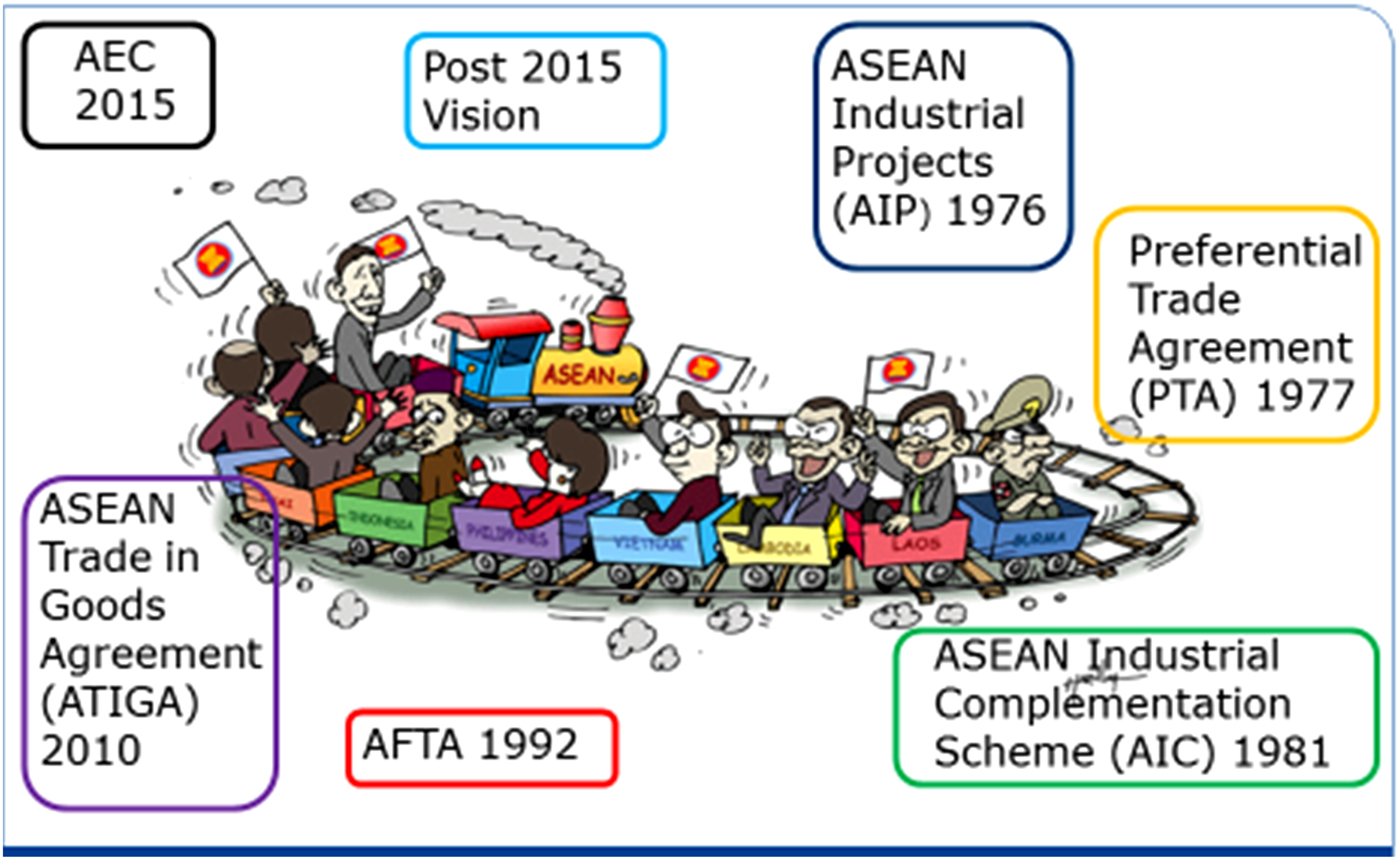
Milestone agreements on regional integration in Southeast Asia: Is ASEAN going around in circles? (Source: the author)Footnote 2

No regional group in modern times has reached the ultimate stage of regionalism, a fully integrated economic and political union, although the EU has come very close to achieving this goal. However, the EU, which comprises 28 member states, started from humble beginnings in 1958 with the formation of the European Coal and Steel Community (ECSC) and then the European Economic Community (EEC) by six countries. Yet the European integration process has never been linear and straightforward and has had to overcome many hurdles along the way. The new regionalism debate was mainly triggered by the stagnation and spill-backs to European regionalism – often referred to as the period of ‘Eurosclerosis’ – in the 1970s.
Apart from their focus on economic integration, ‘old’ theories or approaches to regionalism were predominately concerned with peace, and tended to see the nation state as the problem rather than the solution. ‘New regionalism’ considers novel aspects, particularly those focused on conditions related to globalisation, and is prominently linked to Footnote 2 aspects of economic governance (Hettne Reference Hettne2005). As Harrison contended, “New regionalists go so far as to claim that contemporary capitalism and its territorial configuration are best regulated and governed in and through the decentralization of socioeconomic decision-making and associated policy implementation to sub-national institutional frameworks and supports” (Reference Harrison2006: 22). According to Hettne, one of the main proponents of new regionalism, “the two processes of globalisation and regionalisation are articulated within the same larger process of global structural change” (Reference Hettne, Hettne, Inotai and Sunkel1999: 2). Väyrynen further adds that “national actors may … perceive regionalism as a defence mechanism against the competitive pressures arising from the globalization process” (2003: 32). Meanwhile, the Inter-American Development Bank has observed that “an increasing number of countries are relying on formal regional integration to mediate the forces of globalization” (2002: 24).
In addition to the strong linkages between the “new regionalism” debate and discourses in international political economy, social constructivists have also discovered regionalism as a preferred empirical focus. There can be little doubt that a sense of regional consciousness has emerged in many world regions and that states have actively promoted the idea of mutual co-operation. Regardless of whether regions need to be defined in geographical terms or can also be thought of as socially constructed “imagined or cognitive regions” (Väyrynen Reference Väyrynen2003: 37), identity is one of the most important and solid pillars of regionalism, whether this pillar is based on geographical concepts or has a foundation underpinned by norms and values. This is where ASEAN comes into play as one of the most important empirical case studies of a process of regional integration based on shared norms and a – at least emerging – common regional identity (for one of the most prominent contributions on this, see Acharya Reference Acharya2000 and Reference Acharya2001). This also applies to Europe, but while European regionalism is characterised by treaties and legally binding commitments, Southeast Asia has followed a non-legalistic approach to inter-governmental co-operation based on the so-called ASEAN way of soft institutions, open regionalism, co-operative security, non-binding decision-making, convention, and consensus building. The ASEAN way is based on the premise that the moral power of informal procedures can determine relations between actors as effectively as legally binding rules. The former – so the argument goes – has allowed for more flexibility in dealing with the specific policy challenges of regional governance than the latter.
Can the Southeast Asian states achieve deep economic integration and, indeed, a single market based on the non-legalistic ASEAN way and thus become the first example of an integrated entity of the new regionalism era which does not follow the traditional approach towards economic integration defined by binding and enforceable national commitments? This has to be considered the mother of all questions at the centre of any analysis of the AEC.
The History of Economic Integration in Southeast Asia
Economic community building in Southeast Asia has been in the making for almost five decades and clearly has not followed the linear approach described by Balassa (see above).
The foreign ministers of Indonesia, Malaysia, the Philippines, Singapore, and Thailand took the first tentative and cautious steps when they founded ASEAN in 1967. The organisation was later joined by Brunei, Cambodia, Laos, Myanmar, and Vietnam. However the general and vague provisions of the Bangkok Declaration, ASEAN's founding document, does not include any firm commitment to regional economic integration. The declaration simply stresses the desirability of collaboration and mutual assistance on matters of common interest in the economic field among other areas of potential cooperation. It was only a decade later, in 1977, that the ASEAN member states signed a Preferential Trading Arrangement (PTA) as a first serious effort to strengthen regional economic relations.
By the early 1990s, tariffs on some 16,000 goods within the PTA framework had been reduced. While this figure looked impressive on paper, it amounted to only about five per cent of total intra-ASEAN trade. Excluded were the main export and import products, which remained protected by high tariff barriers. The member states also demonstrated some creativity in listing products under the PTA with little or no relevance for intraregional trade – snow ploughs and nuclear reactors are oft-noted examples.
The PTA nevertheless signified an important milestone as it marked the end of some member states’ – especially Indonesia's – categorical resistance to trade liberalisation. After several subsequent and mostly failed strategies in support of economic integration, a major breakthrough was achieved when, in 1992, the member states agreed on the gradual implementation of an ASEAN Free Trade Area (AFTA). In this regard, AFTA was very clearly a reaction and response to globalisation and, thus, a child of the ‘new Regionalism’. The year 1992 saw the signing of the NAFTA agreement, final preparations for the full implementation of the European Single Market, and Bill Clinton setting his sights on economic integration in the Asia-Pacific region. The seeming international move towards economic regionalism happened against the backdrop of the GATT Uruguay Round, which entered troubled waters and finally foundered in December 1990 in Brussels. Although the GATT negotiations were later revived and eventually successfully concluded, in the early 1990s, regionalism emerged forcefully as a way of mitigating the challenges of post-Cold War globalisation, if not as an alternative to it. ASEAN did not want to be left out.
The Asian financial crisis of 1997–1998 interrupted the process of realising the AFTA vision. However, the ASEAN heads of states and governments provided a fresh impetus to realising it at their summit meeting in Bali in 2003. The Declaration of ASEAN Concord II envisioned building an ASEAN economic community to “establish ASEAN as a single market and production base” by 2020 (ASEAN 2003). In 2007, the ASEAN Economic Community (AEC) Blueprint set out a framework and roadmap for implementation and shortened the deadline to 2015 (ASEAN 2008).
The ASEAN Economic Community (AEC): The Official View
The AEC is based on four ‘pillars’:
-
• single market and production base,
-
• competitive economic region,
-
• equitable economic development, and
-
• integration into the global economy, committing ASEAN to working towards maintaining ‘ASEAN Centrality’ in its external economic relations, including, but not limited to, its negotiations for free trade agreements (FTAs) and comprehensive economic partnerships (CEPs).
Each pillar is defined by detailed implementation objectives, timelines, and action points. For example, the single market and production base comprises five core elements: free flow of goods, free flow of services, free flow of investment, freer flow of capital, and free flow of skilled labour. Progress towards achieving the agreed goals is monitored through the ‘ASEAN Scorecard’ mechanism established in 2008.
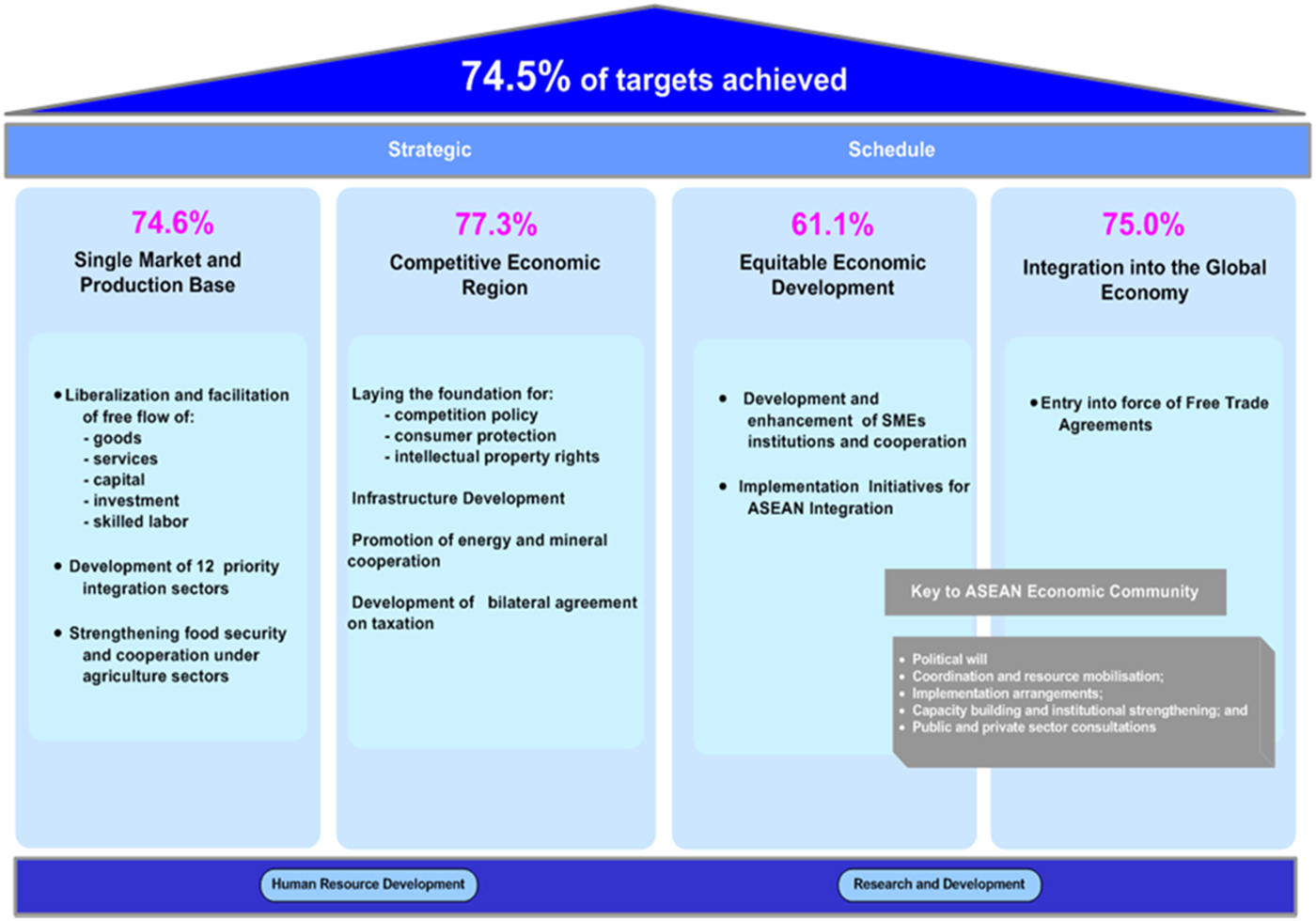
However, until recently the Jakarta-based ASEAN Secretariat was neither mandated nor in a position to assess the progress of AEC implementation independently. Instead, it prepared the scorecard based on data provided by the ASEAN member states. Consequently, the approach to monitoring and disseminating data on regional economic integration was largely driven by political motives and incentives, for example, the needs of national governments and ASEAN collectively to demonstrate substantial progress towards the implementation of the AEC. In 2013, the ASEAN Scorecard reported that 74.5 per cent of all agreed measures to achieve the single market and production base had been fully implemented by October 2012 (ASEAN 2013).
Figure 4. In late 2014, an independent assessment by the Asian Development Bank Institute painted a more sober picture and concluded that the December 2015 deadline for realising all four pillars of the AEC would be missed due to an “overly ambitious timeline and too many ill-thought-out initiatives” (Balboa and Wignaraja Reference Balboa and Ganeshan2014). Another study expects complete implementation of the AEC in its current form only by 2030 (Deloitte 2014). Probably as a result of widespread criticism of the Scorecard mechanism, the ASEAN Secretariat has not published any updates since 2012. Instead, the Secretariat has opted to prepare confidential scorecards (in coordination with the ASEAN ministerial sectoral bodies) for the senior economic official meetings (SEOM) only. Figure 4 above is taken from a PowerPoint presentation by an unnamed ASEAN official, which was posted online and refers to the ‘confidential’ 2013 update. In addition, the Secretariat developed so-called ‘Priority Deliverables’ for the AEC, which have not been made public either. However, the ASEAN Secretariat published an ‘ASEAN Integration Report’ on the occasion of the ASEAN summit in November 2015 (ASEAN Secretariat 2015). Unlike the Scorecard, the information presented in the Integration Report is not based on the member states’ self-assessment but on the largely independent evaluation of the ASEAN Integration Monitoring Office at the Secretariat. Thus, while still generally positive, the Report puts forward markedly more nuanced findings than the Scorecard.
AEC implementation from 2008 to 2012 according to the Scorecard. (Source: ASEAN 2013)

Per capita GDP (nominal) in ASEAN in US dollars, 2014. (Source: the author, based on ASEAN statistics)

A More Sober Analysis: Shallow Integration
The AEC reflects the same hesitant pattern of regional collaboration that was evident under the PTA and other economic cooperation ventures, including the AFTA. To many observers, ASEAN is a prime example of ‘shallow integration’ that is based mainly on political motives and not economic factors. More precisely, such arrangements are characterised by the “use of economic instruments to pursue political objectives” (Ravenhill Reference Ravenhill2010: 179). Helen Nesadurai points to the Southeast Asian preference for “mixed trade regimes that accommodate both trade liberalization and protection” due to the “central role of economics played in politics and the close government-business relations embedded within patronage networks that shape a good many economic policy choices, including trade policy” (Reference Nesadurai and Robison2012: 318).
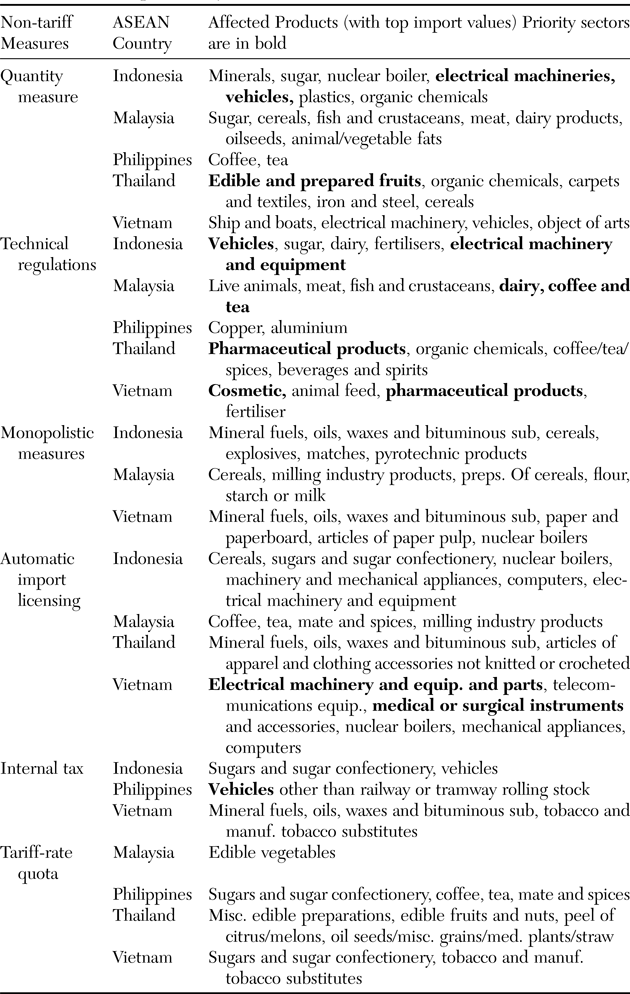
The AEC implementation process provides evidence of this assessment. On the positive side, and most decisively perhaps, tariffs in intraregional trade have been substantially reduced. Yet this achievement is put into perspective by creeping protectionism based on non-tariff measures (NTMs). The number of such measures has been steadily increasing in the largest ASEAN economies. From 2009 to 2013, a total of 186 non-tariff measures were put in place. The majority of these are quantity-control measures (quotas) and technical regulations. The products that are mostly affected by non-tariff measures are shown in Table 1. Surprisingly, the twelve priority sectors,Footnote 3 which the ASEAN states identified for accelerated integration, are actually among the top products affected by NTMs (Pasadilla Reference Pasadilla2013: 26).
Affected products by NTM (Source: Pasadilla Reference Pasadilla2013)

At the same time, progress in realising the goals of liberalising investment and capital flows has been slow. With the exception of Singapore, the services trade is also limited due to restrictions in most member economies (Pasadilla Reference Pasadilla2013). The AEC also comprises provisions for labour mobility in high skills sectors. ASEAN currently has Mutual Recognition Agreements (MRAs) in place for six sectors and framework agreements for two others. MRAs exist for the following occupations: engineering, nursing, architecture, medicine, dentistry, tourism, surveying (framework), and accountancy (framework). In principle, these MRAs provide the basis for the recognition of national skills, experiences, and accreditations across ASEAN, and thus the free movement of labour in the aforementioned professions. However, implementation has been slow and the “restrictive labor policies held by several South East Asian countries demonstrates the lack of political and public will to pursue increased labor mobility” (Chipman Koty Reference Chipman Koty2016). According to World Bank data, Cambodia, Malaysia, and the Philippines have “virtually closed” or “completely closed” (Thailand) their borders to professional services (accounting, auditing, and legal services) from other member states (WTO Services Trade Restrictions Database).
In short, the main hurdle in the process of implementing the AEC is the mismatch between political ambitions and the capabilities and, often, the political will – or, maybe, the political autonomy – of several member states to walk the walk. One of the striking characteristics of the regional integration process in Southeast Asia is the gap between ambitious political goals (the vision for economic integration as spelled out in the AEC Blueprint and the ASEAN Charter) and the realities of substantial development gaps, nationalism, and the prevalence of vested interests, or what Lee Jones calls the “socio-political contestation over the distribution of economic power and resources” (Reference Jones2015: 666). The argument is between the sizable number of pro-liberalisation technocrats and international proponents of deeper integration, on the one hand, and, on the other, a broad range of political, bureaucratic, and economic actors who, for various reasons, prefer the status quo (Jones 2015). Such a setting is not uncommon for processes of regional integration. In ASEAN, it is intensified by considerable disparities in technical and institutional capacities, economic development, and political priorities. Thus, the basic conditions for creating common regimes or even for harmonising national legislative frameworks and enforcement practices among the members are not yet in place.
Should a faster pace of implementation really be expected against the backdrop of the high degree of diversity in Southeast Asia? This area includes some of the richest, but also some of the poorest, states in the world. On the UNDP Human Development Index, Singapore is in eleventh position, with Brunei (31st) also being placed in the group of countries that have achieved “very high human development”. At the lower end of the spectrum, Laos (141st) and Cambodia (143rd) are just within the category of “medium human development”, while Myanmar (148th out of 173) is the only member state still under “low human development” (UNDP 2015: 47–50). Singapore's per capita GDP is almost 58 times greater than Cambodia's. By comparison, the ratio between the largest and smallest per capita GDP in the EU is only roughly fifteen to one (between Luxembourg and Bulgaria). Significant gaps also exist with regard to infrastructure, which is a crucial factor in the context of regional economic integration. Land and air transport (e.g. paved roads as a percentage of total roads) and the energy sector (access to electricity as a percentage of population) constitute particularly wide gaps between ASEAN-6, the original founder countries of Indonesia, Malaysia, the Philippines, Singapore, and Thailand, along with Brunei on the one hand, and Cambodia, Laos, Myanmar, and Vietnam on the other (OECD 2013: 249). Furthermore, major disparities have been noted with regard to levels of economic freedom. According to the Heritage Foundation's Index of Economic Freedom 2015, Singapore (number 2 in the world) leads ASEAN in economic freedom by scoring top marks in areas such as its legal system and property rights, freedom to trade internationally and in devising useful regulations. Malaysia, at 58, Indonesia, 76, Brunei, 62, Philippines, 67, and Cambodia, 52, are placed in the second quartile. Vietnam (109) and Thailand (103) are in the third quartile, while the worst performing country in ASEAN, Myanmar, is at 146. Thailand received a low score because of its weak legal system and protection of property rights. Cambodia on the other hand, got a low score for placing strict controls on the movement of capital and people (The Nation 2015). Economic disparities are coupled with significant differences in political systems in a region where democracies co-exist with authoritarian regimes.
To date, even the lowest level of economic integration – regional free trade – has not been fully achieved in Southeast Asia, not even among the ‘old’ ASEAN-6 members. The oft-cited figure according to which 99 per cent of trade among the ASEAN-6 has been liberalised is misleading. In reality, the figure does not include total regional trade volume as the baseline but indicates the share of the total number of goods that are included in the ASEAN Trade in Goods Agreement (ATIGA), a main element of the AEC, and for which import duties have been eliminated. Most ASEAN member states have made use of an extensive and ever-expanding exclusion system and placed products on the Temporary Exclusion List, the Sensitive and Highly Sensitive List, or the General Exclusion List. For example, rice – one of the most important commodities in regional trade – is excluded from ATIGA.
A further issue is the under-utilisation of ATIGA: less than ten per cent of intra-ASEAN trade makes use of AFTA concessions (Hill and Menon Reference Hill and Jayant2014: 8). The relative insignificance of the ATIGA regime is partly related to the Rules of Origin (RoO) documentation required. RoO are a central element of any free-trade agreement as duties and restrictions are usually determined based on the country of origin. Hence, RoO are used to define where a product was made. The cost of proving origin (e.g. for computation of costs, invoicing, or other documentation) can be high, especially for small and medium-sized enterprises (SMEs) from less-developed economies.
ASEAN's value added (VA) rule is simple in principle – it requires that products qualifying for preferential tariff treatment under ATIGA must have 40 per cent “regional value content”. But it is difficult to comply with this. Exporters from ASEAN member states are often not in a position to accumulate the necessary local or regional content. This is partly due to a high degree of production fragmentation. Roughly half of ASEAN trade is in electronics and machinery, where production networks are widespread. Consequently, the product content from non-ASEAN sources is often high, making it difficult to meet the 40 per cent VA rule (Chia Reference Chia2010: 25). The documentation process for exporters to prove RoO and to benefit from preferential tariff treatment is called ‘Form D’. Surveys show that many businesses are unaware of the existence of this process. In addition, ASEAN's industries are dominated by SMEs, which account for between 95 per cent and 98 per cent (according to different estimates) of all association enterprises. Depending on the respective country, they provide between 50 per cent and 95 per cent of all employment, contribute between 30 per cent and 53 per cent of national GDPs, and provide between 13 per cent and 31 per cent of exports. At the same time, most of these have little interest and opportunity to expand across national borders given their very small size and specialisation in local markets. It seems hardly realistic to suggest that a small Thai company in the agriculture processing or retail sector with a total of ten employers could or should approach the emerging regional ASEAN market in a similar way as the global giant, Swarovski, with some 25,000 employers, does (Dosch Reference Dosch2013: 41–42). “Many SMEs are inward looking. Networks and linkages require fundamental shifts in business strategies, which SMEs may not be able to achieve because of a lack of resources and knowledge” (Asian Development Bank Institute 2015: 8).
The formal establishment of the AEC has not only increased the knowledge of the structures and mechanisms of regional economic integration but also raised both expectations and concerns among businesses.
For many businesses in the region 31 December 2015 was thus a magic date. Many of them were expecting markedly increased opportunities but private sector firms in the region's less developed economies, and in particular, micro, small and medium-sized enterprises (MSMEs), were awaiting the date with apprehension. Many of them fear that they will have to compete with much bigger companies, which are better prepared to operate in an enlarged market. (Rüland Reference Rüland2016: 1130)
There is still a lack of comprehensive analysis regarding private sector perceptions of AEC and the strategic decisions companies take in response to the opportunities, but also possibly constraints, of deepening regional integration. In the case of Indonesia, where 99 per cent of businesses are classified as MSMEs, “there is ample debate over the structural handicaps these firms face. Frequently mentioned in this respect are infrastructure bottlenecks, lack of access to credit, inadequately skilled workers, endemic corruption and red tape, an uncertain legal system, outdated technologies and management problems” (Rüland Reference Rüland2016: 1130). At the same time, in Vietnam company owners or directors of about a dozen SMEs in Hanoi, Hoh Chi Minh City, and two provinces have almost unanimously stressed the advantages of the AEC, and some mentioned that they have already expanded their business activities to neighbouring countries due to the AEC. In particular, most hope that the AEC will facilitate easier access to Myanmar as the most promising new market and production base in the region.Footnote 4 However, this opinion snapshot should not be taken as representative of the majority view in Vietnam.
Even if a positive private sector sentiment towards the AEC was indeed on the rise, for the reasons explained above, intra-ASEAN trade as a percentage of ASEAN's total trade has grown only marginally since the late 1990s and has been virtually stagnant for the past decade (see Figure 6). It is also important to note that three member states account for 71 per cent of intra-ASEAN trade volume. Singapore's exports and imports within ASEAN represent about 34 per cent, Malaysia's, 20 per cent, and Thailand's, 17 per cent.Footnote 5
Share of Intraregional Trade as Percentage of Total ASEAN Trade, 1998–2014. (Source: the author, based on ASEAN statistics)

To be sure, ASEAN still has one of the highest intra-regional trade volumes in the world. While the value is significantly smaller than the EU's, where the share of intra-regional trade stood at 62 per cent of total trade in 2013 (Eurostats 2015), it is markedly larger than Africa's or the Middle East's (Figure 7). Then again, not too much importance should be attached to such figures as they do not necessarily provide evidence of any of ASEAN successes but rather stand for the structural weaknesses and even failures of several other regional organisations. For example, MERCOSUR, the most important South American regional organisation, has been paralysed by Argentine-Brazilian rivalry while African states have favoured the widening of regional cooperation (resulting in a proliferation of organisations) over a deepening of integration.
Intra-regional Trade as a Percentage of Total Trade of Selected Regions, 2002, 2010 and 2013. (Source: the author, based on WTO and ASEAN statistics)

The relatively small size of the ASEAN market and the outward-orientation of the member states are other important factors standing in the way of deeper economic integration. Overall, the national economies are more competitive than complementary in structure. They produce a narrow range of similar primary products and labour-intensive manufactured goods for export. Although there have been some recent improvements, intra-industry specialisation and the regional division of labour based on comparative advantage are not yet well developed. Foreign direct investment entering the region is closely associated with intra-industry trade, especially in the automotive and electronics industries. There is also a divergence effect in relation to ASEAN's external FTAs with China, Japan, Korea, and India, as well as Australia and New Zealand (Dosch Reference Dosch2013: 22)
Intra-ASEAN trade has grown at a much slower pace than ASEAN's total trade. Since 2000, the general trend has been, first, a decrease in ASEAN's trade volume with the United States and the EU and, second, a substantial increase in ASEAN's trade with other Asian economies (except Japan, see Figure 8). This is particularly the case for China, which is now ASEAN's largest trading partner (see Figure 9).
ASEAN Exports to Major Trade Partners, 2000–2013, in US dollars (millions). (Source: the author, based on WTO statistics)

ASEAN-China Trade 2000–2014 in US dollars (millions). (Source: the author, based on WTO and ASEAN statistics)

This growing extra-regional orientation is reflected by the fact that most member states individually, and ASEAN collectively, have been increasingly active in negotiating bilateral and multilateral trade FTAs with third countries and organisations. As of mid-2015, Singapore had a total of 22 extra-regional trade agreements (bilateral and multilateral treaties in goods or services) in place, followed by Malaysia (12), Thailand (10), Vietnam (9), Philippines (8), Laos (8), Indonesia (7), Brunei (7), Myanmar (6), and Cambodia (5).Footnote 6 Hence, with regard to ‘Integration into the Global Economy’, one of the four pillars on which the AEC is based, ASEAN has made visible progress.
Some (Modest) Successes
Razeen Sally (2015) points out that “incremental progress, not a utopian leap to EU-style top-down, institution-heavy integration, is probably the best ASEAN can expect given its political realities”. This gradual approach is not without its successes, even in the context of creating a regional single market and production base. While implementation has not been as fast as had been hoped and expected, the progress in some sectors is indisputable.
The AEC Blueprint stipulates that simple, harmonised, and standardised trade and customs processes, procedures, and related information flows are expected to reduce transactional costs in ASEAN. In particular, the ASEAN Customs Vision and the related Strategic Plan of Customs Development aim to, among other targets, integrate customs structures; modernise tariff classification, customs valuation, and origin determinations, and establish ASEAN e-Customs; smoothen customs clearance processes; and strengthen human resources development in the customs sector.
Data from the Global Trade Enabling Report (‘The Enabling Trade Index’), which has been published by the World Economic Forum since 2008, shows that between 2009 and 2014, customs procedures became more efficient and transparent (Drzeniek Hanouz et al. Reference Hanouz, Margareta, Geiger and Doherty2014; Lawrence et al. Reference Lawrence, Hanouz and Moavenzadeh2009). As a result, the cost of importing and exporting has indeed been reduced. The index uses several indicators to measure the efficiency of customs administration and import-export procedures, and the transparency of border administration. Figure 9 shows notable improvements across ASEAN. For example, the Philippines has seen an efficiency increase of 0.6 from a value of 3.7 (2009) to 4.3 (2014). The higher the score (on a scale from 0 to 7), the more efficient and transparent is the respective border administration.
Staying with the example of the Philippines, a closer look at the individual indicators on which the report's assessment is based reveals that the country has improved its customs-related procedures in all categories. According to the data of the 2009 and 2014 reports (see Figure 10),
-
• the efficiency of the customs clearance process increased from 2.6 to 3.0 (on a scale of 0 to 5);
Figure 10.Efficiency of Border Administration 2009 and 2014. (Source: the author, based on the Global Trade Enabling Reports 2009 and 2014). *Date for Brunei (2009 and 2014), Laos and myanmar (2009) were not available.

-
• the number of days it takes to complete the import procedure was reduced from sixteen to fourteen while the number of days for the export procedure was cut slightly from sixteen to fifteen;
-
• the number of documents needed was reduced from eight to seven for imports and from four to three for exports; and
-
• the cost to import a container decreased significantly from US$819 to US$660, while the cost to export a container fell even more markedly, from US$816 to US$585.

In the Philippines and elsewhere in the region, the achievements in the customs sector are prominently linked to externally funded support. Since 2005, up to 2000 technical-assistance and capacity-building projects in about 50 different sectors have been conducted to achieve the customs-related goals set out in the AEC Blueprint and related agreements. Virtually all of these interventions have been funded through multimillion-dollar donor programmes, including the ASEAN Programme for Regional Integration Support (APRIS) and the follow-up ASEAN Regional Integration Support from the EU (ARISE; both European Union), the ASEAN Trade Pilot Program: Single Window (United States Agency for International Development/USAID), the ASEAN-Australia Development Cooperation Program Phase II (Australia), Support for ASEAN Integration (Japanese International Cooperation Agency/JICA), and dozens of projects focusing on individual ASEAN member states.
No other aspect of economic integration has attracted more donor attention than customs harmonisation. It is in the natural interest of OECD donors to ease the access of exporters to the Southeast Asian markets and thereby strengthen trade relations. In customs harmonisation and in other fields of the AEC, for instance, in the area of technical standards, the European Union has played a particularly important role. Based on its own history and legacy, the EU has generally been a longstanding supporter of regional integration in developing countries. Support to regional organisations lies at the core of the EU's trade-related assistance to other countries and regions. Between 2007 and 2013, the EU allocated €79 million of official development assistance for the support of regional integration in Asia. Of this amount, 46 per cent, or €31.7 million, was assigned to ASEAN.
Although at first glance this does not appear to be an enormous amount, the support is significant. ASEAN's official annual budget of US$16.2 million (2013) – the sum of ten equal contributions of the member states – covers little more than the operational budget of the ASEAN Secretariat. ASEAN's own funds are insufficient to provide the financial means for the realisation of the AEC. A recent independent evaluation of the EU's cooperation with Asia found that:
the EU is seen as ASEAN's most trusted and relevant partner, given the importance of the European integration process as a reference point (but not necessarily a model) for ASEAN's own regional integration […] The EU has made a significant and effective contribution to the strengthening of the legal and institutional settings that form the pillars of economic integration in ASEAN. The EU […] support has addressed the crucial and central agendas in this process—such as standards, SPS, IPR, statistics—and thereby has helped ASEAN move closer to achieving the vision of the ASEAN Economic Community 2015. (Particip 2014: 30)
For example, the much-celebrated ASEAN Harmonized Cosmetic Regulatory Scheme of 2003, which stands as the most effective attempt at product regulation to date, is almost entirely based on the European Cosmetic Directive of 1976 (Pente Reference Pente2014: 66). To be sure, despite the EU's leverage vis-à-vis ASEAN, the European integration process cannot and should not be considered as a blueprint for Southeast Asia. There are striking historical, political, economic, and institutional differences between the two regions. Most importantly, the EU is a supra-national organisation, with the European Commission (EC) as its executive arm. The EC, which comprises a workforce of 33,000 officials, has the power to propose legislation, implement decisions, uphold the body of EU treaties, and manage the day-to-day affairs of the EU. By contrast, ASEAN is an intergovernmental organisation in which the member states retain national sovereignty. Unlike the EC, the ASEAN Secretariat does not possess executive powers. The small office, with just 300 employees, mainly coordinates regional cooperation in economic and other fields within Southeast Asian and in ASEAN's relations with external partners. It also facilitates and monitors progress in the implementation of ASEAN treaties and decisions.
Concluding Remarks
What has ASEAN achieved in terms of economic community building? While it can be concluded that, at least in some sectors, important progress has been made and that the AEC is not just political window dressing, ASEAN still has a long way to go, and the AEC will remain a work in progress long beyond 2015. This finding is very visibly reflected by the Nay Pyi Taw Declaration on the ASEAN Community's Post-2015 Vision. It rebrands the AEC as the ASEAN Economic Community for 2016–2025, which “includes an integrated and highly cohesive economy, a competitive, innovative and dynamic ASEAN, a resilient, inclusive and people-oriented, people-centred ASEAN, enhanced sectoral integration and cooperation, and a global ASEAN” (ASEAN 2014: 3). The emphasis on a people-oriented and people-centred ASEAN seemingly acknowledges the fact that regional economic integration is as much a top-down approach as it is a bottom-up phenomenon. In a mutually reinforcing process, governments create the structural frameworks to facilitate a widening and deepening of cross-border economic interactions while non-state actors, most prominently and decisively, private companies, take their own initiatives to create business opportunities beyond national markets for themselves. ASEAN's problem is that neither dimension is yet fully developed.
It would be wrong, however, for governments to blame the private sector for not taking advantage of existing rules. The emergence of a ‘regional mindset’ among businesses would be an important step. But this ‘regional mind set’ can only translate into a substantial expansion of regional activities if governments establish the appropriate regulative structures. ASEAN has deliberately rejected a legalistic approach to regional integration that would be based on stringent regulatory frameworks. ASEAN, instead, has developed an alternative approach to regional community building widely known as the ‘ASEAN Way’. It rests on the pillars of informal, non-binding, and consensus-oriented intergovernmental cooperation. There can be no doubt that the ASEAN Way has served the organisation well and provides a suitable foundation for effective cooperation in a large number of policy fields. However, economic integration cannot work on the basis of non-binding agreements. If member states are allowed to opt-out at any time, or to choose not to implement agreed actions, integration is hardly achievable. Yet, this is exactly what happens under the ‘ASEAN minus-X’ formula that guides almost every aspect of liberalisation and integration. This formula allows member states to jump on the bandwagon in their own time. ASEAN members are trying to achieve far-reaching visions of economic community building without the necessary modifications to the traditional ASEAN Way.
ASEAN's members have committed to establishing the AEC with its precise targets and action plans. Hence, the oft-heard argument that legally binding decision-making would be an alien concept in the Southeast Asian context is no longer a convincing excuse for the delay in the implementation process.
The question remains, though, whether deep economic integration is truly needed or even desirable for a region as diverse and outwardly oriented as ASEAN. To some extent, ASEAN created this dilemma for itself. It has – possibly prematurely – announced its intention to establish a single market. Now it will somehow have to find a way to achieve this goal or it is likely to lose credibility. It is worth noting that despite the often frustratingly slow progress toward regional integration, ASEAN is still the most effective and coherent organisation among the non-European regional organisations. But the success of the AEC will be measured against ASEAN's own visions and roadmaps – not the shortcomings and failures of regional-cooperation agreements and organisations in other parts of Asia, Latin America, and Africa.