I want to consider a time and a place lodged in my own past – the state of Nevada in the decade of the 1950s – and to locate my earliest reckonings with that world, insofar as I can revisit them after nearly half a century spent on other continents, within a wider grasp of the palimpsestic overlay that constitutes any and every culture. Gordon Brotherston has written in his landmark Book of the Fourth World that “deciphering” the Fourth World – the world of Native America – “means entering the history of both its internal relations and its five-hundred-year encounter with the West.” And he begins another of his chapters, the one entitled “Configurations of Time,” with the crucial question “Who entered whose history?”Footnote 1 Like all of us alive now, I arrived very belatedly in the five hundred years that trouble Brotherston at this macro level. As a very junior member of my father's 1950s field trips in northern Nevada, I had no idea of who else's history than that of my own family I was entering, as I happily collected grasshoppers in the sagebrush. Nor can I claim to have been posing even the most elementary forms of Brotherston's question to my boyhood self. However, as the need for historical understanding presses ever more heavily on all of us, I have been preoccupied with trying to answer permutations of such a question with increasing insistence in my individual conscience. The present study is a report on findings.
Let me begin with a more detailed stating of where I start from in terms of personal memory. During my largely American childhood my family went on collecting trips “out West” on behalf of my father, a cytogeneticist and evolutionary theorist. His work was then on chromosomes of particular species of grasshopper found in Arizona, Utah, California and Nevada, which the rest of the family helped him to collect in various sites. Of late I have sought to understand the variously layered Americas that I began to discover (and some that I significantly missed seeing or knowing about) in the Humboldt Range of Nevada in the early 1950s when I was aged five and six, and then again in 1957, when I was turning twelve.
When tired of catching grasshoppers I would search for arrowheads, of which there were many strewn about in the now sparsely populated areas of Nevada that constituted our collecting sites and that had clearly been hunting grounds in a Native American past. I wanted to know more about the people that had previously lived and hunted in the same areas where I was spending hot boyhood summers, about what their lifestyle had been, about why they were no longer there. (Descendents of such peoples may well have been there, in towns or population clusters that we sporadically passed through, but with my untrained eyes of a white American child I could not distinguish them from anyone else.) In that part of the USA most such arrowheads as are in the Nevada portion of my collection were made of volcanic glass, called obsidian, whereas my more extensive arrowheads from the region of Austin, Texas, where we lived for the rest of the year that we weren't on field trips, are in different colours of chert.
I also discovered a small forged spur at the edge of a disused mineshaft, again in the Humboldt Range of Nevada, quite some way from the famous Comstock Lode region opened up after 1859. Who, by the way, was this person Humboldt, after whom a river and county of Nevada had been named?Footnote 2 Or Comstock, who gave his name to a wide layer of quartz under the crust of the earth in a particular other region of the state?Footnote 3 As we drove around the deserted and depopulated area, my parents told me that it was here that an American author named Mark Twain had spent early years and written a book named Roughing It. Who was this Twain, or rather Samuel Clemens, to call him by the real name under which he published this, his second book? Why had he dwelt for a period in what was still in my 1950s childhood so dry and inhospitable a part of North America, however one might come to love and adapt to its harsh brightnesses? I knew from the hard soils we slept on at night, and from the simple camp foodstuffs that my mother cooked on a Primus stove every evening (badly burning her arm once in the process) that we ourselves were “roughing it” somewhat. So this unknown, dead author's work rather drew my boyhood imagination – to see what there was in common, so to speak, between the reality of roughing it and its literary representation.
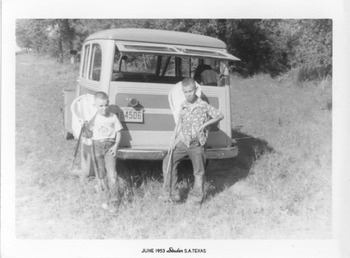
Here were indubitable signs of former presences, of people in each others' histories – those of Native Americans, of mining settlers and of authors describing earlier trips of exploration – all of which I have only in later years begun to sift through in my imagination and subject to critical thinking. This has meant trying to read my memories of camping in the sagebrush in that dry heat, and working our butts off every day with grasshopper nets, in terms of larger, historical and scientific contexts. A photograph taken by my father shows a young Jonathan and his elder brother Nicholas, accoutred with grasshopper nets, and for the rest kitted out in jeans, “sneakers,” and (in the case of my brother) a simple but colourfully patterned shirt of the kind that my mother would run up on a cheap domestic sewing machine for each of us before we set out on such trips.
The author and his elder brother on a 1950s family field trip.

The snapshot is set against the family collecting vehicle, a Willys Jeep of the period. We had had to return to a Genetics Research station on Long Island in New York for the winter of 1952–53 for a highly political reason – though I did not know it at the time – and that accounts for the place name Cold Spring Harbor on my T-shirt. There on Long Island, with my father no longer in receipt of a salary from the University of Texas, we had been supported as a family by charitable donation from other researchers in the same laboratories, including the pioneering geneticist and later Nobel Prize-winner Barbara McClintock.
Both my arrowhead collection and my spur are integral to my meditation. As someone without real nationality (because moved on from continent to continent throughout infancy, childhood and adolescence) the arrowheads and spur figure in lieu of what for others may be attachment to nation. They are my “personal sacred,” so to speak. In fact, my broken bits of volcanic glass are mostly unsuccessful and discarded attempts at arrowheads, rather than the finished thing. But precisely for that reason they are testimony to a different life of hardship than any I was experiencing under canvas, decades or even centuries later than their makers abandoned them because they broke. As already indicated, I do not remember seeing Native Americans in those years in Nevada, though my family were very interested in the Navaho reservations of states further to the south. (My mother in the late 1950s was already turning from her first, Cambridge, training in economics towards her later studies in anthropology.) History books inform me that it was probably the fairly peaceful Northern Paiute tribe that had been moving about that north-west corner of Nevada before significant white settlement, or just possibly Western Shoshones or Washoes.
Moreover, there is a strange and sad irony in something Samuel Clemens wrote, not in Roughing It, but in fictive letter form to a St. Louis newspaper in 1862 from Carson City, Nevada. Ostensibly communicating to his mother, the persona of the writer debunks her idealization of Indians by drawing a down-to-earth portrait of Native American lifestyles among the Washoe tribe. Rather than hunting the “timid deer” of James Fenimore Cooper's imaginings, the “principle article of diet” (as Clemens calls it) of the people he describes was, precisely, what I had been sent to catch for a different, scientific and mid-twentieth-century purpose – namely grasshoppers.Footnote 4 Clemens's fictive letter of a settler to his mother back home in Missouri is an account disdainful of her idealizations, and precisely “not gleaned from Cooper's novels, Madam, but the result of personal observation.” In so being, it is disdainful also of the tribespeople themselves, in ways that now seem offensive.Footnote 5 For example, of “Hoop-de-doodle-do, head chief of the Washoes,” Clemens writes an extensive portrait, a representative portion of which reads,
If you desire to know what he smells like, let him stand by the stove a moment, but have your hartshorn handy, for I tell you he could give the stink-pots of Sebastopol four in the game and skunk them. Follow him too, when he goes out, and burn gun powder in his footsteps; because wherever he walks he sheds vermin of such prodigious size that the smallest specimen could swallow a grain of wheat without straining at it, and still feel hungry. You must not suppose that the warrior drops these vermin from choice, though. By no means, Madam – for he knows something about them which you don't; viz, that they are good to eat. There now. Can you find anything like that in Cooper?Footnote 6
On the part of Clemens (still in his early phase as a writer), this is coloured in its own right quite as much as anything in Cooper. In fact, rather than objectivity, it achieves a status more like that of symbolic reality, just as do Cooper's accounts of Native Americans from a different end of the ideological spectrum. For instance, in Cooper's Pioneers certain of the people of Templetown so expect silver to be discovered in the surrounding hills that they become convinced that Natty Bumppo and Chingachgook have already found it, and are exploiting the source before anyone else is able to access it. (I shall return later to dreams of silver, and “speculation” as part of the historical imagination.)
After more than fifty years my own first memory of a Native American, secure and sharply etched though it appears in my mind's store of images, may also be more symbolic than reliable. Family recounting may well have added touches of colour to the prematurely wizened woman on a donkey in the Navaho Reservation of Utah, whom I seem to see again – knitting a shawl and smoking a pipe, as she also (and simultaneously) suckles her child and slowly drives a flock of dusty sheep across the unmade road that we are travelling along in that Willys Jeep of ours. I was a million miles from any understanding of how much of the day-to-day work in remaining Navaho communities might devolve upon women, just as I was incapable of seeing that so many of the menial tasks of our own 1950s collecting trips – apart from driving of the vehicle, which was a man's job – were performed by my mother. It is little exaggeration to say that she was a slave to the requiting, wherever and whenever possible, of the family's every need. With the benefit of hindsight, I can see that we were then scarcely a decade away from feminist subversion of many of the determining attitudes about men's and women's roles in this matter of daily familial chores. But from what I can remember of my boyhood assumptions, we might as well have been light years from the overthrow of certain patriarchal complacencies. Only now, after years of reading in others' work, can I see that
gender is an inescapable dimension of differential power relations, and cultural memory is always about the distribution of and contested claims to power. What a culture remembers and what it chooses to forget are intricately bound up with issues of power and hegemony, and thus with gender.Footnote 7
I specifically remember a mother who ceaselessly worked, as no one else in the rest of the family, for the common welfare of us all. That was her major role in those far off days of the 1950s – a role that she was virtually powerless to protest, and indeed would perhaps not even have thought to protest. But these very realizations on my part are only made possible from a cultural point of view which in the intervening decades has witnessed notable contestation over distribution of power within Western family structures. Let me therefore give some account of intervening influences that have shaped the way I now remember.
In his preface to the English translation of Les Lieux de mémoire (1992) (Realms of Memory), Pierre Nora wrote in 1996 of “a new kind of history,” “exemplified by the … attempt to write … in multiple voices.” He glossed this more particularly as
a history … less interested in events themselves than in the construction of events over time, in the disappearance and re-emergence of their significations; less interested in “what actually happened” than in its perpetual use and misuse, its influence on successive presents. … In short, a history that is … a “rememoration” … interested in memory not as remembrance but as the overall structure of the past within the present: history of the second degree.Footnote 8
Over recent decades there have been many different exhumations of lost signification as well as critique of others' “use and misuse” of the past, and questions, in particular of a political order, always remain as to where our current history is carrying us. My own concern with Nora's “new kind of history” based in “rememoration” takes me in other directions than those of the Gallic particularities that he and his colleagues were mainly concerned to explore, but I am keenly interested in the general issues he specifies, particularly how the past is structured in the present.
Properly speaking, we need to go back almost a decade before Nora's quoted formulations for still deeper – and specifically American – grounding to my opening title term, rememories. Students of literature, of history and of culture in the widest senses owe a huge debt of understanding to Toni Morrison, who in her novel Beloved used this neologism in contexts that in turn become graven in the “memory” of all serious readers. At the most profound level, the entire novel functions for the reader as rememoration on Morrison's part of traumas arising from slavery, which revisit personal subjects in the form of hauntings. In that work she was probing, amidst so much else, the mystery of cultural transmission that happens “when you bump into a rememory that belongs to somebody else,” as the main character Sethe puts the point in her explanation to her living daughter Denver. At the general level of culture, our concern is with things, places or persons that may have changed beyond initial recognition, or even disappeared entirely – died no less, in the specific case of persons – but still haunt the present, as in the case of Sethe's deceased daughter Beloved. Sethe uses a lesser explanatory example to Denver: “If a house burns down, it's gone, but the place – the picture of it – stays, and not just in my rememory but out there, in the world … ”.Footnote 9 In some remarkable exposition of the implications of this moment in Morrison's novel, Marianne Hirsch has stressed how Sethe “underscores the materiality and intersubjectivity of memory.” This intersubjectivity, and what Hirsch also calls “intergenerational transmission”Footnote 10 – the idea that one “bumps into” others' memories and that, furthermore, they become mysteriously available to, or even constitutive of, oneself, the more one concentrates on a specific place or people as it has evolved over generations – are especially important in supplementing my own imperfect memories in the present article.
What I write here involves, precisely, Nora's sense of “multiple voices,” speaking in my particular case from the soil of Nevada where I spent in my boyhood those many months under canvas that I have already begun to account for. Understanding the different historical layering of those voices, and how and in what form they signify now, seems an imperative of humanistic study. Indeed, humanities disciplines as well as poets, novelists and producers of memoirs have recently turned towards far richer fathomings of cultural history, and very frequently “memory mapping” by given writers has been crucial to a new understanding of how the present bears so many traces from the past. In Britain recently, the writings, originally in German, by W. G. Sebald (so prematurely taken from life in a road accident in December 2001) have remapped not least the East Anglian region, in relation to violences and traumas both intrinsic to it and on a wider European scale.Footnote 11 Still in Britain, the cultural geographer Iain Sinclair has allowed us to see multiple past lives and material contexts in London and its surroundings, in the vast writings that he has undertaken across a lifetime, some of them collectively with others.Footnote 12 Among American cultural geographers, Kenneth Foote's Shadowed Ground: America's Landscapes of Violence and Tragedy speaks resonantly to the focus of this essay.Footnote 13 I have already touched on what I call my “personal sacred,” arising from intense memories as well as from material artefacts collected in the Nevada of my childhood. But we need to relate any such personal senses of the sacred to Foote's reflections on whether there has, or has not, been general “sanctification” of cultural sites or collective memories, most specifically in landscapes that were the loci of particular violences and tragedies in the past, such as massacres of Native Americans by settlers, or vice versa. Foote is highly expressive about degrees to which there has so far been insufficient understanding of the often painful American past:
At present the American landscape seems excessively shaped by the belief that acknowledging the darker side of violence will detract from society's positive and often heroic accomplishments. Sites that do not fit an idealized, patriotic vision are ignored or hidden in the landscape. Yet hiding these sites makes it more difficult to come to terms with the full range of events that have shaped American life. Perhaps the point is that many more events could and should be openly acknowledged in landscape as a step toward a more encompassing view of the roles played by violence and tragedy in American society. Casting light on many of the forgotten sites may be one way of pushing back the shadow that violence and tragedy have cast over the American past.Footnote 14
Dwelling as I later do on the so-called Battle of Pyramid Lake of 12 May 1860 between white settlers and native Paiutes, at Big Bend in the Truckee River Valley in Nevada, is intended as a contribution to all that Foote calls for here, by way of deeper acknowledgement of terrible violences that have soaked American soil with tragic blood. In this particular battle the Paiute warriors were victorious, amidst scenes of horror that we re-experience when reading vivid early accounts. But in the overall settlement of the West, Native Americans were driven off their ancient hunting grounds, often to the point of extinction, leading to what Foote underscores as “difficulties of reconciling the conflicts over memory and history in attempts to understand the conquest of Native American peoples.”Footnote 15 The root of the problem for the descendants of the majority culture is that “to celebrate the heroism of Native Americans resisting the destruction of their cultures flies in the face of an entrenched frontier mythology that celebrates the perseverance of white settlers in driving these cultures to extinction.”Footnote 16
All that said, however, memory is so much harder to suppress, or harry to extinction, than are individual lives or the minorities which they constitute, because memory goes on haunting the larger, circumambient culture in forms of rememory. That, as I have already been contending, is the large claim of much recent historical writing, as well as of work by cultural geographers. It is confirmed too by all that a Native American writer such as Leslie Marmon Silko has drawn together from the rememories of Native Americans – and thereby made available for the collective memory of all Americans – in her devastating accounts of exploitation of Indian lands and possessions by whites in Ceremony (1977) and her witnessing of drastically changed Native American lifestyles in Storyteller (1981). Ceremony in particular charts a mental connection made by its main Pueblo character Tayo – between his belief that Whites are steeped in a “lie which they had wanted him to learn: only brown-skinned people were thieves; white people didn't steal, because they always had the money to buy whatever they wanted,” and the rather more global perception that
if the white people never looked beyond the lie, to see that theirs was a nation built on stolen land, they would never know that they were still being manipulated by those who knew how to stir the ingredients together: white thievery and injustice boiling up the anger and hatred that would finally destroy the world.Footnote 17
At an appropriate point in my meditation I shall return to Silko's devastating account of nuclear testing upon formerly aboriginal lands in the USA, which follows hard upon the realizations by Tayo just quoted.
Throughout what I write here, I am highly conscious of cultural critics such as Marianne Hirsch and Ross Chambers, who theorize the transmission of traumatic memory between generations and individuals.Footnote 18 We need to be asking persistently a question framed well by Chambers: what does it mean “for a culture to be haunted by a collective memory – the memory of painful events that few, if any, living members of the culture may have directly perpetrated or suffered from in their own persons,” but that may be experienced so intensely as to become confused sometimes with “painful personal memories,” as those earlier episodes are “lived through” in processes of rememory? This question is especially important in cases where “the consciousness of injustice, otherwise known as a sense of guilt, inhabits the living, not the dead,” even if the dead themselves would seem to “remain restless” precisely from this fact that the living are “prevented by guilt from completing the normal process of mourning that would lay them [the dead, that is] to rest.”Footnote 19 In making these claims, Chambers was considering the Holocaust in Europe, but his formulations are relevant also to North American historical legacies: slavery on the one hand, or persecution and slaughter of Native American peoples on the other. There are many instances in US history that are sufficient grounds for such transmission of guilt from the past, even though it may be of a kind that many Americans alive today have not yet experienced, as I certainly still had not throughout my childhood and early maturity. Hirsch stresses that there are “deadly risks” involved in becoming so attentive to rememories from “the world of the dead”: “not just the threat but the certainty” of our becoming haunted by the unresolved nature of the past. And yet, for all that, Hirsch writes as one who can see better than most that we must go on dealing with the unresolved – specifically through “strategies of identification, projection, and mourning ” – especially in matters as important as the different holocausts of Europe and North America of recent centuries.Footnote 20
A book that resorts to many disciplines in its linking of the destinies of different peoples with whom I too deal (Native and settler Americans in particular) is Rebecca Solnit's Savage Dreams: A Journey Into the Landscape Wars of the American West (1994). I shall take up some of Solnit's specific judgements on both nineteenth- and twentieth-century contexts in Nevada. One generality that she articulates merits immediate attention. When Solnit declares that the places in Nevada of which she writes “bring together histories which may seem unrelated – and when they come together it becomes possible to see new connections in our personal and public histories and stories, collisions even,”Footnote 21 she is producing (as it were) an important variant to what Nora had been saying about the “overall structure of the past in the present.” It is as though she were declaring that what Nora calls “the construction of events over time” is often performed by peoples with very different interests at stake, particularly where land and territory are in question, and who hence tell stories in which they or their ancestry interacted in ways that remain politically conflictual in the present. This politically unresolved vision of things – complex pasts from which the lineages of ongoing present conflict and contestation may be traced – is one of the most radical factors in any history that we may be called upon to understand. It is something about which there is a need to be particularly sensitive in any relating of personal memory to knowledge gleaned in later phases of study.
The issue of contested memory has been very well defined by Marianne Hirsch and Valerie Smith in “Feminism and Cultural Memory,” their introduction to the special edition of Signs that they edited in 2002 (Vol. 28, No. 1). The way they take up the matter is embedded in a passage which in its entirety speaks to the issues of transmission of culture that I am dealing with in the present piece:
Individuals and groups constitute their identities by recalling a shared past on the basis of common, and therefore often contested, norms, conventions, and practices. These transactions emerge out of a complex dynamic between past and present, individual and collective, public and private, recall and forgetting, power and powerlessness, history and myth, trauma and nostalgia, conscious and unconscious fears or desires. Always mediated, cultural memory is the product of fragmentary personal and collective experiences articulated through technologies and media that shape even as they transmit memory. Acts of memory are thus acts of performance, representation, and interpretation. They require agents and specific contexts. They can be conscious and deliberate; at the same time, and this is certainly true in the case of trauma, they can be involuntary, repetitious, obsessive.Footnote 22
My own task throughout the present meditation on Nevada has been as far as possible to unscramble the “complex dynamic between past and present” spoken of here by Hirsch and Smith. From the outset, although dealing with what was initially only a personal past, I knew that I needed to write about others' memories as well as my own; about, precisely, “individual and collective, public and private, recall and forgetting, power and powerlessness.” In mediation and transmission “history and myth” are often so intertwined over long decades or centuries as to have become inseparable. Throughout, there has therefore been no alternative but to become a “conscious and deliberate” interpreter, no matter how involuntary, unpremeditated or even traumatic may have been the original experiences to those undergoing them in the past.
To return to the specific locality of Nevada, it is of further interest, in particular where “layering” is in question (in this case precultural, geological formations), that in 1905 twenty-five specimens of ichthyosaur, including some of the largest in the world and the most complete ever found in North America, were brought back from the Humboldt Range to Berkeley. Today the locality forms part of Berlin-Ichthyosaur State Park in Nevada; ichthyosaurs can be seen partially excavated, still embedded in the rock matrix. Amazement at the rock and sea levels of this ancient landscape had in fact been expressed by some of the first serious published writing about it by nineteenth-century settler culture, in the Oakland California firm of Thompson and West's 1881 History of Nevada: with Illustrations and Biographical Sketches of Its Prominent Men and Pioneers, written and supervised through publication by Myron Angel:
To the thoughtful man there was much to study. The facts that the valley of the Humboldt was the bottom of the ancient sea; that the waves, at some distant period, rolled hundreds of feet above the present water level, were a source of constant wonder. Far up on the sides of the mountains could be seen the terraces of the former beach or water level. Every fragment of obsidian or petrifaction was a subject of wonder, and a text for numberless thoughts. The white sands and colored clays were the relics of by-gone ages, when the whale and other monsters of the deep sported over the present mountains and plains.Footnote 23
Already in these sentences by Angel from 1880 or 1881 we see a wonderment that is giving rise, as though spontaneously in the settler – spectator, to a kind of prose poetry at the strangeness of creation. Land, ocean and living things have undergone vast changes of relationship; what is now rock had not always been so, and what was “former beach or water level” is now to be seen “on the sides of the mountains.” Here were “alkali plains, covered in part with sage-brush, with now and then a tuft of bunch-grass; basaltic rocks, twisted and contorted in the great convulsions of nature, over which the lizard darted in his daily hunt for a dinner of insects.” These protean factors of nature potentially turn the “average emigrant” settler from someone worn out by the exhausting climate into a person liable to contemplative astonishment: “The ancient lava beds, with basaltic or columnar crystallization, and the intervening or protruding rocks, twisted and contorted with the changing of the alkaline bases, were exposed to the inspection of the curious and the studious.”
Although elsewhere in the large Thompson and West volume there had been detailed treatment of “Indians, and their Wars in Nevada” (the title of Chapter XX), at this later point in the writing the representative white settler, an ox-driver, measures himself not by standards of an older human presence, but against quite a different set of living desert beings:
How the horned toad, lizards, crickets, rabbits, and sage-hens managed to survive and maintain a tolerable appearance of vitality passed the understanding of the average ox-driver who wended his weary, toilsome way towards the setting sun. What such a country was made for – so useless, so God-forsaken – was the standing question always entering into consideration.Footnote 24
Very large questions of existence are raised here, but not those of cultural encounter with a human other.
The separate place in Thompson and West's History devoted to that searing topic of warring between settlers and Native Americans had in fact been impressive for 1881, in its attempt to give both sides of the larger story. In its build-up to the so-called Battle of Pyramid Lake, “the most disastrous conflict to the whites ever waged in what is now the State of Nevada,”Footnote 25 the producers of the volume even went to considerable lengths to obtain a balanced narrative of events:
The publishers of this work, desiring the most minute particulars of this most important Indian war of Nevada, in the latter part of 1880 dispatched one of their corps of writers to thoroughly examine the ground and interview all whites and Indians who could be found who had participated in the fatal battle. In company with the Acting Indian Agent, Maj. W. H. H. Wasson, he visited the Pyramid Lake Reservation, obtained an interpreter, a Pah-Ute named George Quip, who spoke the English language fluently, and with numerous veteran savages traversed the battle-ground, spending three days in the examination. The Indians were assured that whatever statement they should make would never be used against them, and with such assurances they gave a detailed account of the whole affair.Footnote 26
Despite a term like veteran savages, with the use of which we surely have problems in the present age, the lengths to which the firm of Thompson and West went to ensure impartiality in their treatment of the encounter is impressive; notably so, in a volume mainly about settler culture in Nevada, which had been produced only a score of years after the battle in question.
The resultant report first focusses upon the grievances of the Paiutes, as expressed in their war council before the battle:
In the latter part of April, 1860, the Pah-Utes congregated at Pyramid Lake from all over the extensive territory, for the purpose of holding a council. The object of the gathering was to decide what they should do, in view of the fact that the whites were rapidly encroaching upon their lands; killing their game; and cutting down their orchards. (Thus referring to the pine-nut trees).
In what is reported to the chosen writer, acting through his interpreter George Quip, possibly the most poetically charged speech in council is that spoken by Chief Numaga, counselling against war. Its poetic forcefulness in large measure arises from the grandeur of its fatalism, focussed in a series of fast-changing analogies for why the whites will prove invincible:
“You would make war upon the whites,” he said; “I ask you to pause and reflect. The white men are like the stars over your heads. You have wrongs, great wrongs, that rise up like those mountains before you; but can you, from the mountain tops, reach and blot out those stars? Your enemies are like the sands in the bed of your rivers; when taken away they only give place for more to come and settle there. Could you defeat the whites in Nevada, from over the mountains in California would come to help them an army of white men that would cover your country like a blanket … ”.Footnote 27
The similes continue to follow thick and fast, in this one-paragraph condensation of what is claimed was an hour-long speech in council.
By contrast, the account of the preparations by the whites have a different kind of fatalism, since this is a battle that they will lose, and with terrible numbers of dead, in spite of the fact that Numaga was correct as to Indian defeat over the longue durée. The force of leaderless settlers that gathers “was a heterogeneous mixture of independent elements, poorly armed, without discipline; and they did not believe the Indians would fight.” Their unpleasant rashness, based in a sense of the worthlessness and expendability of Indian lives, is well captured in the 1881 report: “Many started on the expedition with the watchword of ‘An Indian for breakfast and a pony to ride,’ contemplating the pleasure of sacking Pah-Ute villages, capturing their squaws and ponies, killing a few warriors, and running the balance out of the country.”Footnote 28
The description of the actual battle and the overthrow of the white party's shallow expectations of victory prove painful to read, so graphic is the description. Eventually, on the part of the whites, there is full-scale retreat. “The unfortunate man whose animal gradually lost his position in the advance and fell to the rear, found himself slowly and with certainty slipping into the arms of death.” Nothing is spared the reader in the account of the slaughter of whites who had thrown away their arms as part of a plea to the Indians that they be spared. “Further questioning revealed the details of a scene that no artist could paint or pen portray.” The volume at this point proceeds to describe what it has just protested no writing could possibly represent adequately:
a scene where the victims, tortured by fear into madness, rode among their slayers with outstretched arms, pleading and begging for life; crying in vain for mercy, while the jeering devils, flushed with victory and drunk with blood, laughed at their supplications, played for a time with their frenzy, and then ended their miseries.Footnote 29
From the words “jeering devils” onwards, the description clearly loses some of its earlier, carefully maintained objectivity. Certainly when, a few short paragraphs later, Thompson and West's volume states that “a detachment of United States soldiers under Captain Stewart, and volunteers under Col. Jack Hays defeated the Indians as a chastisement for their outrages,” the genteel term chastisement glosses over a larger history of white suppression of Native America. But we should not forget that this was an overall report that, in its summary of Chief Numaga's speech in the Paiute council before the Battle of Pyramid Lake, had been able to see deep into Native American fears as to what white suppression might feel like, and how inevitable that suppression seemed to a wiser, more fatalistic Indian consciousness of what the impending years of historical encounter held in store. And we should be mindful, furthermore, of certain of the barbarities committed by white explorers in the period that had preceded settlement and the mining boom in Nevada. In his journal of a second expedition of 1842–43 to what he himself named the Great Basin plateau between the Sierra Nevada mountains and the Rockies, John C. Freemont and his party intervened in disputes between Southern Paiutes and Mexicans, and Kit Carson, the expedition's guide, along with another member of Freemont's party, scalped Indians whom they captured, one of them while he was still alive. As Solnit affirms, “Freemont's recounting of the event is one of the goriest moments in his expedition journals.”Footnote 30
My spur found at the edge of a disused mineshaft is the remnant of another aspect of the same history, that of prospecting for precious metals by a rush of speculators. It constitutes on my own part (both as a child and now as an adult) a different kind of quest and speculation. I well remember picking up pieces of quartz everywhere and being told by my father that the glint in them was almost certainly “fools' gold,” i.e. iron pyrites, and not the real thing. Admittedly, significant amounts of very real gold and silver had been discovered in Nevada within the (already mentioned) Comstock Lode of quartz in 1859, attracting back in an eastward direction many hopeful individuals and their families from California, where they had mostly not made successes already, but been among the larger number of those that came to prospect but were disappointed. Relatively few among the totality of “miners-forty-niners” were successful here in Nevada either, as my childhood noting of far-flung and abandoned wood cabins and mineshafts in the Humboldt Range seemed to attest, by their very desolation. Solnit quotes the vivid reactions of John Muir as early as the 1870s to the Great Smoky Valley in central Nevada, as a region that had already by then declined into what seemed like age-old ruination:
ruins that seem as gray and silent and time-worn as if the civilization to which they belonged had perished centuries ago. … [Y]ou everywhere come upon these dead mining towns, with their tall chimney stacks, standing forlorn amid broken walls and furnaces, and machinery half buried in sand, the very names of them already forgotten.Footnote 31
I can affirm from boyhood memory that what Muir had called this “mountain-barred wilderness” still contained in the 1950s many of the factors of desolation described and enumerated by him in the 1870s.
Samuel Clemens was probably highly representative of the period in his confession (based precisely on a prospecting venture into Humboldt County) that he “expected to find masses of silver lying all about the ground.” “I expected to see it glittering in the sun on the mountain summits,” he writes in Roughing It:
The first opportunity that offered, I sauntered carelessly away from the cabin, keeping an eye on the other boys, and stopping and contemplating the sky when they seemed to be observing me; but as soon as the coast was manifestly clear, I fled away as guiltily as a thief. … Then I began my search with a feverish excitement that was brim full of expectation – almost of certainty. I crawled about the ground, seizing and examining bits of stone, blowing the dust from them or rubbing them on my clothes, and then peering at them with anxious hope. … Up and down the rugged mountain side I searched, with always increasing interest and always augmenting gratitude that I had come to Humboldt and come in time.”
As Clemens's recounting of this Humboldt incident goes on to reveal, there is a bitter human lesson to be drawn from it all:
I could go further … and lay it up among my treasures of knowledge, that nothing that glitters is gold. … I learned then, once for all, that gold in its native state is but dull, and unornamental stuff, and that only low-born metals excite the admiration of the ignorant with an ostentatious glitter. However, like the rest of the world, I still go on underrating men of gold and glorifying men of mica. Commonplace human nature cannot rise above that.Footnote 32
This representative incident of excitement followed by disillusionment suggests that even my spur – which I have carried with me all my life, and have personally come to consider my talisman of hope, and symbol of the worth that comes of putting effort into all that is attempted – was in fact probably a lost or discarded accoutrement of someone who had hoped and expended effort in vain.
And there are other matters to consider, in the cultural palimpsest that constitutes Nevada of the 1950s. Throughout that decade extensive and only semi-secret nuclear testing was going on in a desert region of the south of the state. As Keith Schneider, writing in a foreword to Carole Gallagher's 1993 publication of photographs and oral testimony, America Ground Zero: The Secret Nuclear War, has neatly summed up for us, after graphically describing a first test bomb dropped from an Air Force B-50 bomber at dawn on 27 January 1951:
Thus began the most prodigiously reckless program of scientific experimentation in United States history. Over the next 12 years, the government's nuclear cold warriors detonated 126 atomic bombs into the atmosphere at the 1,350-square-mile Nevada Test Site. Each of the pink clouds that drifted across the flat mesas and forbidden valleys of the atomic proving grounds contained levels of radiation comparable to the amount released after the explosion in 1986 of the Soviet nuclear reactor at Chernobyl.Footnote 33
Atmospheric tests were succeeded by many more years of underground testing. A further fact that Schneider did not point out was that some of the Nevada tests turned the very sand of the desert into a new, obsidian-like substance. One is left stupefied and disturbed here by connections that cannot be avoided, between older Native American weaponry – the arrowheads I mentioned earlier – exquisite in form when not broken (even if unfinished), and the obscenely formless glass created as a by-product of explosions of the postmodern age. Some of the nuclear bombs tested in Nevada may even have obliterated, by absorption, earlier obsidian implements and other remnants of Native American culture. Apparently “governing agencies have produced volumes of archaeological reports on the place, describing relics of mining shacks and travelers' wagons as well as Paiute and Shoshone artifacts,” so at one level of government there was clearly knowledge of the signs of previous human culture that underwent destruction in the long age of nuclear tests, “in a land considered worthless enough it could be poisoned and bombed to hell without much public outcry.”Footnote 34
The Nevada test site had not been the first in the USA. In Leslie Marmon Silko's novel Ceremony, already referred to for its accounts of the relativities of Native American lifestyles as opposed to those of white Americans succumbing to the “lie” of their “nation built on stolen land,” the Pueblo protagonist Tayo reaches a “point of convergence” in the landscape between earlier nuclear test sites:
Trinity Site, where they exploded the first atomic bomb, was only three hundred miles to the southeast, at White Sands. And the top-secret laboratories where the bomb had been created were deep in the Jemez Mountains, on land the Government took from Cochiti Pueblo: Los Alamos, only a hundred miles northeast of him now, still surrounded by high electric fences and the ponderosa pine and tawny sandrock of the Jemez mountain canyon where the shrine of the twin mountain lions had always been. There was no end of it; it knew no boundaries; and he had arrived at the point of convergence where the fate of all living things, and even the earth, had been laid. … From that time on, human beings were one clan again, united by the fate the destroyers planned for all of them, for all living things; united by a circle of death that devoured people in cities twelve thousand miles away, victims who had never known these mesas, who had never seen the delicate colors of the rocks which boiled up their slaughter.Footnote 35
Tayo, not long returned himself from Second World War action in the Pacific, is at this moment in the novel discovering that even the ancient place of Indian ceremony that he has come to, near Gallup in New Mexico, is a mesa of the kind that “the destroyers” had laid waste to, in their testing at the so-called Trinity Site near Alamogordo in New Mexico of an implosion-design plutonium bomb of the type for later use on Nagasaki in Japan. What is so important in Tayo's perception of things (and, we can be sure, in his creator Silko's) is that the sacred sites of Native Americans – places such as “where the shrine of the twin mountain lions had always been” – have been desacralized by the “top-secret laboratories” and “high electric fences.” Above all, the destruction of landscape on the one hand – the “boiling up” of “the delicate colors of the rocks” (rocks and colours of mesas that I so distinctly remember from my childhood) – and the destruction of “all living things” on the other, beginning with inhabitants of the faraway Japanese cities of Hiroshima and Nagasaki, are presented as part and parcel of what “the destroyers” have planned for the entire earth. By the term destroyers, we have little alternative but to understand Silko to mean successive US governments. Tayo's former enemies were the Japanese, by whom he had been kept in horrific captivity towards the end of the war. However, by this late point in the novel Tayo has long since realized that Native Americans, Japanese and even innocent Whites – indeed the entire human race – have common cause now, in the face of destruction on a scale that will spare no one.
Rebecca Solnit too provides trenchant critique of what she calls this “strange, pointless war being waged against the landscape.”Footnote 36 She describes the hugeness of the Nevada Test Site, itself in 1951 hewn out of the even larger Nellis Air Force Range, which had been established during the Second World War, ten years earlier in 1941, “in what was one of the most uninhabited places in the country – but wasn't wholly uninhabited.”Footnote 37 Key to Solnit's entire account of both the Nevada Test Site and the Yosemite National Park in California are her revelations about “landscape wars” (to use the term from her book's subtitle) that had wrested, and continue to wrest, these locations from native peoples, for whom they were hunting grounds and balanced ecosystems for centuries before such intervention. In the case of the Nevada site, Solnit's contention is that it was the federal American state's notion that the landscape was “widely thought to be worthless already” that allowed them arrogantly to suppose they could rehearse in it for year after year the end of the world, sometimes detonating several bombs in rapid succession.Footnote 38 (In the case of Yosemite something like the opposite notion, of the landscape's amazing natural beauties, led in the later nineteenth century, after the Mariposa War of 1851, to its rapid arrogation from Native Americans, not thought worthy of exclusive or even partial rights to ongoing use of it as a home and hunting ground.Footnote 39) Throughout her book, Solnit stresses that the Western Shoshone people have never ceded their land for the Nevada Test Site, and that they continued to hunt on the Nellis Range after 1941. The vigorous activism of the Western Shoshone in anti-test struggles since the inception of tests in the 1950s is closely documented, including the fact that a representative of their National Council, Chief Raymond Yowell, signed along with many other nations in 1990 the People's Comprehensive Test Ban. This was taken to the UN in 1991, with approval for such a comprehensive test ban expressed by every participating nation with the exception of the United States and Britain.Footnote 40 Tests in Nevada had all along violated the Treaty of Ruby Valley signed with the Western Shoshone in 1863. But then, this was far from being the first time that the United States government or indeed individual whites had abrogated the terms of this treaty.Footnote 41
The nuclear testing in Nevada and (earlier) New Mexico was only part of Cold War preparedness to fend off the communist threat. Already by 1952–53, a Harvard-trained mathematician who had worked at the test site of Los Alamos, New Mexico was turning his experiences there and of the nation more generally into a form of song that few Americans could have fully and “objectively” appreciated, unless they shared, or at any rate could respond to, his satirical stance on American nuclear activities. Instead of the customary “love-of-place” sentiments of the country-and-western genre that it ostensibly represents, Tom Lehrer's pastiche cowboy song, “The Wild West Is Where I Wanna Be,” has catchy but lethally aimed lines such as those of its first stanza:
At any time in history acronyms can hide more sinister realities condensed in them. Here the Atomic Energy Commission (AEC) is no sooner hinted at than it is followed by a typical country-and-western hoopla, “yea-hah,” as though immediately to cover over what is scarcely being revealed in any case. In the next stanza Lehrer's own “'Fifties cool” as he wears his sombrero and Levis in the “clean desert breeze” – somewhat à la James Dean – is undercut by hints that this is in actuality a deadly landscape of atomic testing:
Much as a nineteenth-century frontiersman, Lehrer renounces the comfort zone of the USA's northeastern cities to head out west, the only clouds on the otherwise idyllic western landscape being “mushroom”-shaped ones (of obvious and sinister origin):
This was an age of great fear of spies, as well as of enemy bombs, and the two anxieties were intimately connected in the public imagination. Ethel and Julius Rosenberg were tried and convicted of spying for the Soviet Union and passing nuclear secrets to them, and both executed in the electric chair on 19 June 1953. Lehrer pokes fun in the fourth and final stanza of his song at the atmosphere of surveillance on the part of the state:
What Lehrer had more fully suggested in his spoken warm-up to this song was that simply to live in the USA of the period was to be a kind of spy – of realities that always exceeded the commonplace. But others too were always already spying – on oneself:
A few years ago I worked for a while at the Los Alamos scientific laboratory in New Mexico. I had a job there as a spy. No, I guess you know that the staff out there at that time was composed almost exclusively of spies … of one persuasion or another.
“Spies … of one persuasion or another” is phraseology that suggests America was by no means politically uniform, however much the FBI and other agencies of the state, never wholly successfully, were constraining it to become so. Lehrer is making light of the American people's concern that employees at key military installations such as Los Alamos might include “moles” of nastier persuasions than any that were desired.Footnote 42
What I certainly did not grasp on our summer trips out West of 1950 and again of 1951, or later (after we had been granted visas to re-enter the USA in 1956) on a collecting trip of 1957, was that, in the craziest of senses, my family was the communist threat – or at any rate considered a significant enough part of it that we had had to leave in 1953 and reside in Australia for three and a half years. The facts are more or less the following. In 1951 deportation proceedings were initiated against my parents on the grounds that they had both been members of the Communist Party of Great Britain from 1932 to 1935, and that therefore their entry into the United States in 1947 had been illegal, even if not intentionally so on their parts. Transcripts show that under investigation my father declared that when after the war he and my mother had sought visas for permanent entry into the USA, a young woman in the American Consulate in London “took down the particulars on a typewriter, very rapidly,” and that he at no time had any intention of making false statements. The fact of their having formerly been communists was freely and frankly admitted to the investigating officer in 1951, but the case was decided against them by a hearing officer in January 1952 and by the Central Office in April of that year.Footnote 43 An appeal to the Board of Immigration Appeals was taken, argued and eventually dismissed in February 1953. However, in a decision of May 1953 the board did at least withdraw the order of deportation on the understanding that we would depart voluntarily, which as a family we duly did in June of that year.
We were allowed back into the USA late in 1956. I have many of the records in a file of old family documents. In his letter of application for visas for himself, my mother, my brother and myself (my sister had been born in Texas in 1948 and therefore did not need a visa), my father stated the following:
I deeply regret that this application must, as far as my wife and myself are concerned, be made under §212 (a) (28) (I) of the Immigration and Nationality Act of 1952, since we were both members of the Communist Party of Great Britain, which we joined when students in 1932 and broke with early in 1935. I enclose a number of affidavits and statements from reputable and distinguished persons, testifying to our active and sincere opposition to Communism over the past 21 years and that our entry would be in the public interest of the U.S. These include statements from Mr. Gordon Walker, made when he was a member of the British Cabinet and affidavits from over thirty noted American scientists including fourteen members of the U.S. National Academy of Sciences.Footnote 44
Many well-known figures had indeed sent affidavits testifying to the exemplary democratic beliefs of my father and mother, and stressing that their perceived political aberration – that brief involvement with the most threatening of “-isms” – was entirely in the past. Patrick Gordon Walker's two separate affidavits sent from his office in Downing Street as secretary of state for commonwealth relations are models of brevity, alongside some of the more expansive prose of helpful American friends who were doing their utmost for my parents. The first of Gordon Walker's affidavits, about my father, sticks to essentials:
I knew Mr. Michael J. D. White very well for some years in the middle ’thirties in England. Before I met him he had been a Communist. During the years that I knew him he was not only no longer a Communist, but actively worked against them, especially at London University where he succeeded in winning over students who had been under the influence of Communists. His anti-Communist activity was open and proclaimed.
Gordon Walker's affidavit relating to my mother is still more brief and to the point: “I knew Mrs. Isobel Mary White for several years in England in the middle 'thirties. She was an active and open opponent of Communists and Communism; though she had earlier been sympathetic to their cause.”Footnote 45
American scientists had, as I have suggested, been rather more expansive in their affidavits. They were voluble in their praise of my father as a scientist, and affirm the degree to which he and my mother adhered to, practised and publicly proclaimed their belief in wholesome democratic principles. Ernst Mayr writes of my father that
it is quite obvious through his words and deeds that he has accepted the American democratic ideals explicitly and implicitly. When one makes an analysis of his published works, one can easily find confirmation of his true political ideals. Throughout the period 1947–1954 (during which the official communist view was a condemnation of natural selection, and of the ideas of Weismann, Morgan and other Western scholars), White vigorously and consistently represented the Western viewpoint in his publications. Nothing could demonstrate more conclusively his true views.Footnote 46
What is striking is the confidence with which scientific publications of worth are held to incorporate liberal and democratic principles.
I am here airing the phrasing of some of these documents of half a century ago to give a more exact idea of how such contentious matters – the great ideological divide between communism and American democracy – were thought through in public prose by and about prominent persons. A number of scientists from the East Coast, South, Mid-west and West wrote on behalf of my father and mother, and for this kindness I should not wish to be (or in any way sound) ungracious, as a member of a younger generation. It is all too easy to underestimate the intellectual and personal traumas caused by the politics of earlier periods, because one has likewise underestimated the complexities of context. Nevertheless, I am struck by how clearly black-and-white the issues are felt to be in such affidavits. For instance Professors M. Demerec, B. P. Kaufmann and Barbara McClintock, all of the Carnegie Institution's Department of Genetics at Cold Spring Harbor, where we had gone first in 1947, and then again in 1952 during the eye of the anticommunist storm as it was affecting us as an individual family, testify both to Michael White's scientific stature and to his democratic beliefs:
As a scientist, Dr. White is by far the outstanding figure in his field. … Because of these unusual attributes, there is no doubt that his residence in the United States would be in the public interest. In our association with Dr. White, and in our many conversations with him, his attitude, statements and behavior have testified to his respect and admiration for the political ideals and institutions of this country, and to his deep conviction in the principles of democracy exemplified by the form of government of the United States of America.Footnote 47
Possibly the most touching affidavit of all is written by neighbours (also as it happens university people) from our days in Austin, Texas between 1950 and 1953 – touching because of what it suggests about southern neighbourhood kindliness and community in those days, of a kind I can just remember. What Professor Carey C. Thompson and his wife Louise so generously wrote suggests that their knowledge of my parents consisted in what gets revealed in the closeness of American community existence:
We knew them as colleagues at the University of Texas and as neighbors, only one house removed, during the period 1950–1953. Our association as neighbors was especially close, particularly in view of the fact that we all had children of about the same age who played together constantly. Hardly a day passed without some rather close association. We certainly feel that over this period of time and through these professional and personal contacts we came to know the entire family very well indeed.
The Thompsons went on to stress, among much else affirming my parents' detestation of “an authoritarian-type of answer to the world's economic and social problems,” that one of the strong motivations for my family emigrating to America after the war was “their belief in and sympathy with the type of economic and political organization which they felt they could find here in the United States of America.” Half a century later I find those formulations rather innocent but also deeply moving. Here were people willing to testify in 1956, during a period of still rather heated anticommunism, that their neighbours of a few years back, although former communists in the United Kingdom, were exceptionally fine people. As they affirm in closing, “We would certainly be very happy to have them as neighbors and countrymen once more. We feel that they would be useful, worthy, and loyal members of any community in this country in which they might locate.”
Well, we located in Columbia, Missouri, at the close of 1956; not back in Texas, nor farther west in Nevada. However, by 1958 we were on our way back to Australia, the country that had provided us temporary refuge, and where my parents were to live out the rest of their lives, barring trips abroad. Back in the United States for that couple of years in the late 1950s we had all been able to consider our time spent in Australia, and to choose to move there not out of necessity this time, but on the basis of merits we had discovered in our three and a half years already spent there. I remember being the only one of the five in our family who wanted to stay in the United States. My strange relationship with Nevada built up through long hot summers camping there must have played some part in my wish that we were not once again leaving this nation of such intense lifestyles. And yet, at this distance in time, I am able to remind myself almost daily of the strange irony that the Australian period of my life (essentially my adolescence and early adulthood, although I return as often as I can), about which I feel so enduringly positive, only came to pass because of McCarthyism in the USA.
For a close to this rememoration, let me return to my earlier line of consideration of Nevada itself and of what is revealed in the larger picture of America by focus on that state. Its isolation and distance from significant actions elsewhere on the globe has sometimes, paradoxically, been the very cause of its importance to them. This was certainly so in the case of the unimpeded, because relatively uncontested, development of its nuclear testing zone. In recent years unmanned “robot” Predator aircraft, piloted by personnel stationed at the aforementioned Nellis Air Force Base in the desert near Las Vegas, have been used in the delivery of Hellfire missiles to aid American soldiers on the ground in Iraq more than seven thousand miles away. In the words of Kurt Scheible, aged forty-one, air force major with a past flying B-1 strategic bombers, “When I'm back in Nellis, I can be flying a mission over Iraq with the Predator, and then go home and take my children out to a ball game.”Footnote 48 In such cases the distance of the doer of the deed from the effects of his action is worrying, not least because it forces a disjunction of cause and effect. Shakespeare formulated long ago, in the words he gave to Brutus, that “Th'abuse of greatness is when it disjoins remorse from power” (Julius Caesar, II, i, 18–19). Requiring officers to fly “pilotless” Predator aircraft is a special case of one of the greatest nations on earth engineering a frightening gap between the exercise of its power and any physical witnessing of another culture's history-in-the-making that might give rise to remorse, whether individual or general. At one level, as has often been pointed out by others, the skills deployed in flying such pilotless aircraft simulate computer-game activities, the only difference being (and it is crucial) that in computer games one's dead enemies can return in the next game to be blown up all over again.
What I am left asking myself is, how might I still more deeply connect my various childhood experiences of Nevada with later accretions of adult knowledge? Some of the layers I have touched on include fossil ichthyosaurs; an earlier Native American presence; a settler mining culture that followed and largely displaced the former from its hunting grounds and trails; a mid-nineteenth-century literature by Samuel Clemens recording settler hardship; then, jumping almost a century into the very 1950s of my own boyhood consciousness, the new sciences of nuclear fission on the one hand, about which I can remember little or no discussion in my family (in spite of my having been born in the UK at almost the very hour that over Japan was dropped the first atom bomb on Hiroshima) and of genetics on the other, which was all my father ever seemed to think seriously about.Footnote 49 Throughout my early family life there was virtually no discussion in our household of politics. I suppose my parents had been too badly hurt in their own history of exclusion from the USA, and then the difficult business of getting back into that nation, to want to dwell explicitly on the wider consequences of McCarthyism. It must have been a subject of great repression, which is the only explanation I can come up with for the fact of my brother and sister and I not discovering anything about the particular circumstances of our leaving and returning to the USA in the 1950s until many years later when we were adults, and only then via different channels than directly from our parents.
I am aware that any mélange such as my own – of recall tinted with personal emotion, and of semi-fictional with actual history – prompts questions as to the degree of contamination of all cultural memory. Contamination is a word with so many negative associations, especially in an essay that has dwelt upon nuclear testing: in terms of historicity, it insinuates a kind of pollutant “fall-out.” But the fusion of so many sources – material, speculative, scientific – has positive aspects. Fantasy and imagination are essential to intellectual enquiry, driving the desire for ever more meaningful understanding. (Sigmund Freud, whom I have not otherwise brought into the reckoning, defined scientific creativity in a letter to Sandor Ferenczi as the interplay between “daringly playful fantasy and relentlessly realistic criticism.”Footnote 50) The points at which illumination becomes “glorious technicolor,” if you like, are fascinating precisely because so problematic. So – amid hints of celluloid cowboy-and-Indian stereotypes, and of a denim-clad and T-shirted kid of the 1950s – I have attempted to fathom some relations between science and the imagination, history and the new. Seeking to achieve adult mapping of these particular American layers might hopefully function as a methodology for engagement with cultural history of other times and lieux de mémoire.
For myself, there is so much enduring violence in what I have been considering that I am left with the conclusion that there is profound connection between the earlier American history that I have rehearsed and such phenomena as the present deployment of unmanned Predator planes from a Nevada Air Force base. My work has been in no small measure a quest to facilitate by some degree what Kenneth Foote saw as the difficulties in coming to terms with the full range of events that have shaped American life, and to provide one such “more encompassing view of the roles played by violence and tragedy in American society” as he has called for.Footnote 51 The analyses contained in this piece have dwelt upon nothing less than a perennial culture of violence – or violence of culture (to reverse and further complicate the terms)Footnote 52 – although I would readily admit that it may be one that is neither more nor less evidenced by my focus on Nevada than it might have been had I taken many another place in the USA, or indeed elsewhere on the globe, as a point of departure. I must leave the exploration of such different contexts to others.
At the personal level I have sought to cope with what Antonio Gramsci once defined as the multiple, contradictory and arbitrary nature of individual empirical evidence. Gramsci understood more profoundly than most that to look at individual movements in history (his own example in the given instance was the Italian Risorgimento) has always been intrinsically difficult, because of “the inconsistency and gelatinousness of the organism being studied” – in his case, the new nation under construction.Footnote 53 As he was to suggest in another meditation on the Risorgimento, “the traditions, mentalities, problems and solutions” are “multiple, contradictory, often highly individual and arbitrary by nature, and … not at the time seen in unitary ways.”Footnote 54 At a meta-level I hope it is not too grandiose to claim that, locating myself in a particular time and place, Nevada of the 1950s, and in full consciousness of the gelatinousness of such a subject when one also uses it as a springboard into other times and places, I have been attempting a poetics of what it is to perceive just some of the intricately layered past of nature and of culture. As we grow older, each of us garners these complexities in individually inflected ways, as our critical and imaginative store. For this is surely what constitutes, perceptually speaking, most of what is important in our lives, with the notable exception of love.