Introduction
Smoking is one of the main causes of non-communicable diseases (NCD) and preventable deaths worldwide. 1 Despite the downward trend in its prevalence since the beginning of the century, especially in high-income countries,Reference Dias-Damé, Cesar and Silva 2 its impact on public health and the need for government actions aimed at the reduction of smoking at a population-based level are still of utmost importance. In some low- and middle-income countries, the habit of smoking is growing, and it is expected that by 2030 more than two-thirds of tobacco-related deaths will occur. 3
Maternal smoking is associated with several harmful effects on their offspring during their life course, including low birth weight, newborn sudden death, childhood overweight, impaired lung function, respiratory infections and NCDs during adulthood.Reference Milner, Rao and Greenough 4 – Reference Doherty, Grabowski, Hoffman, Ng and Zelikoff 11 It has also been shown that parental smoking is a determinant factor of later offspring smoking, increasing the risk for respiratory diseases during adulthood, including lung cancer, asthma and chronic obstructive pulmonary disease, which are responsible for a quarter of all hospitalizations in Brazil.Reference Doherty, Grabowski, Hoffman, Ng and Zelikoff 11 – Reference Menezes, Minten and Hallal 13
Wheezing is one of the main symptoms of asthma, 14 and Brazil, according to the World Health Survey (2002–2003), has one of the highest prevalence of self-reported wheezing (24%) among people over 18 years of age.Reference Sembajwe, Cifuentes and Tak 15 Although it has been shown that maternal smoking is associated with wheezing during the 1st year of life,Reference Burke, Leonardi-Bee and Hashim 16 few studies regarding the topic have focused on other life periods. The available literature shows that the damage caused by maternal smoking on intrauterine development of the respiratory system remains throughout life, particularly during childhood and adolescence;Reference Hayatbakhsh, Sadasivam and Mamun 17 – Reference Akuete, Oh and Thyne 19 therefore, studying their clinical consequences during these life periods is of great importance.
This study aims to evaluate the association between parental smoking during pregnancy and wheezing during childhood/adolescence (11 and 15 years of age) in individuals from a prospective birth cohort in southern Brazil.
Methods
In 1993, a new birth cohort in Pelotas, a southern Brazilian city, was initialized. All hospital live births in the city were identified. Newborns whose mothers lived in the urban area were examined and their mothers were interviewed. From 5265 eligible newborns, 5249 took part in the longitudinal study (0.03% refused). Later in 2004–2005 and 2008–2009, all the cohort members were sought and these children were followed-up at ages 11 and 15, with a response rate of 87.5% and 85.7%, respectively. Household interviews were conducted in both follow-ups and, just at 15 years, participants were also interviewed in a center for measures and exams. Follow-up and baseline study methodologies have been published elsewhere.Reference Victora, Araujo and Menezes 20 – Reference Araujo, Menezes and Vieira Mde 22
Mothers or the newborn’s caregivers responded to a short questionnaire at the perinatal period, collecting demographic, socioeconomic and behavioral variables. In addition, newborn anthropometric variables were obtained from hospital records. At the 11- and 15-year-old follow-up visits, demographic, socioeconomic and behavioral variables were obtained, as well as data on wheezing symptoms during the previous year.
For this study, our main outcomes were as follows: (1) wheezing during the last 12 months at 11 and 15 years of age (yes/no); (2) number of wheezing crises during the last 12 months at age 11 and 15; (3) persistent wheezing, defined as the presence of wheezing during the last 12 months in both follow-up visits (11 and 15 years); and (4) medical asthma diagnosis at age 15, reported by the adolescent’s mother. Wheezing was reported by the mother at age 11 and by the adolescent at age 15. In both follow-up visits, a standardized questionnaire was used.Reference Asher and Weiland 23 The question exploring wheezing symptoms at age 11 was as follows: ‘Since <month> last year, has <child’s name> had chest wheezing?’ and ‘Since <month> last year, how many wheezing crises <child’s name> had?’; and the question at age 15 was as follows: ‘Since <month> last year, did you have chest wheezing?’ and ‘Since <month> last year, how many wheezing crises you had?’. For self-reported asthma diagnosis at age 15, the adolescents’ mothers were asked the following: ‘During the lifetime, doctor said that your son/daughter had asthma?’. At baseline, the mother was asked about smoking during pregnancy (yes/no) and exposure to second-hand smoking at home. The mother also reported the average number of cigarettes smoked per day in each trimester. With this information, we created our main exposure variables, and estimated the mean number of cigarettes the mother smoked during the whole pregnancy (mean cigarettes/day). In addition, using both parents’ smoking data (yes/no), we created the variable ‘Parents smoked during pregnancy’, categorized as the following: ‘neither smoked’, ‘just one smoked’ and ‘both smoked’.
We performed descriptive and univariate analyses using χ2-tests. In addition, we used Poisson regression models with robust variance to estimate crude and adjusted prevalence ratios (wheezing at 11 or 15 years) and risk ratios (RR; number of crises and persistent wheezing).Reference Barros and Hirakata 24 Multiple-variable models were adjusted for confounding factors [gender, skin color, family income at birth (quintiles), mother schooling at birth, birth weight, type of birth and parental history of asthma] and possible mediators (adolescent smoking, physical activity and nutritional status). The analysis was adjusted for mediators to isolate the specific biological effect of smoking during fetal life. Moreover, we included mother and partner smoking during pregnancy together in adjusted models. For the purpose of statistical significance, we selected the lowest P-value between heterogeneity and trend tests. If the trend test was the lowest for P-value, we also tested for deviation from linearity. In order to check for deviation, we subtracted the value of the Wald test for the model, including the exposure variable as continuous from the model with the exposure variable as categorical. The same was done for the model’s degrees of freedom. If the value did not reach the threshold for the Wald test according to the number of degrees of freedom, we would consider that deviation from linearity was not present and P-values for trend were used. We used Stata version 12.2 (Stata Corp., College Station, TX, USA).
Visits at 11 and 15 years of age in the 1993 cohort received approval from the Pelotas Federal University, Ethics Institutional Review Board (letters 029/2003 and 158/07, respectively).
Results
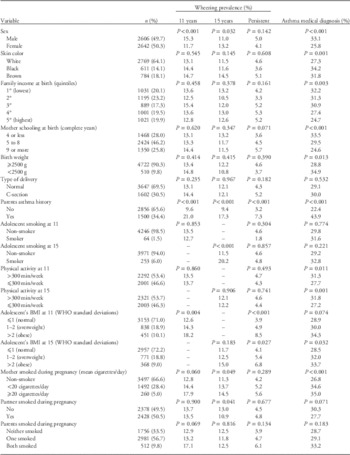
In 2004–2005, we interviewed 4452 subjects and 4325 in 2008–2009. In total, 13.5% and 12.1% had at least one wheezing episode during the last 12 months at 11 and 15 years of age, respectively. Persistent wheezing was observed in 4.6%, whereas lifetime asthma diagnosis evaluated at 15 years of age was 29.5%. Sample distribution and prevalence according to each independent variable are described in Table 1. We observed that boys have a higher prevalence of wheezing at age 11; whereas at age 15, wheezing is more prevalent among girls. Parental history of asthma was associated with higher prevalence of wheezing at 11 and 15 years of age, as well as persistent wheezing. Adolescent smoking was positively associated with wheezing at age 15 but not at age 11. In both age groups, nutritional status was inversely related to the prevalence of persistent wheezing. Maternal smoking was positively associated with the prevalence of wheezing. On the other hand, asthma diagnosis was associated with all sociodemographic and biological variables, except for type of delivery, partner smoking and adolescent smoking (Table 1).
Description of sample characteristics, the 1993 Pelotas Birth Cohort

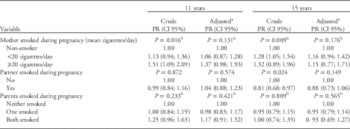
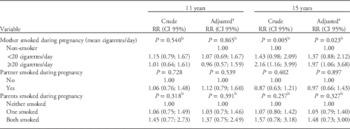
Table 2 shows that, in the crude analyses, maternal smoking was associated with a higher risk of wheezing at 11 years of age; however, after adjustment, the magnitude of the association was reduced and the confidence interval included the unity. Partner or both parents smoking was not associated with wheezing in the previous year. On the other hand, Table 3 shows an association between maternal smoking during pregnancy and the number of wheezing crises at age 15, showing that offspring of mothers who smoked ⩾20 cigarettes per day had nearly twice the number of crises compared with children of mothers who did not smoke, even in the adjusted analyses (RR=1.97, 95% CI 1.06–3.68).
Crude and adjusted analysis of smoking during pregnancy and wheezing in the last 12 months (at 11 and 15 years): 1993 Pelotas Birth Cohort

PR, prevalence ratios; BMI, body mass index.
a Adjusted for sex, skin color, birth weight, type of delivery, mother schooling at birth, family income at birth, parents’ asthma history, adolescent smoking, BMI, physical activity (at the time of follow-up).
b Trend analysis.
Crude and adjusted analysis of smoking during pregnancy and number of wheezing crises in the last 12 months (at 11 and 15 years), 1993 Pelotas Birth Cohort

RR, risk ratios; BMI, body mass index.
a Adjusted for sex, skin color, birth weight, type of delivery, mother schooling at birth, family income at birth, parents’ asthma history, adolescent smoking, BMI, physical activity (at the time of follow-up).
b Trend analysis.
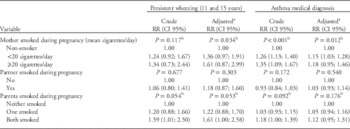
Risk of persistent wheezing was 36% higher (RR=1.36, 95% CI 0.97–1.91) in individuals whose mothers smoked <20 cigarettes per day and 61% higher (RR=1.61, 95% CI 0.87–2.99) in those whose mothers smoked more than 20 cigarettes per day during pregnancy. Although the individual estimates were not statistically significant, trend analysis showed an increase for the risk of persistent wheezing, suggesting a dose-response relationship with the number of cigarettes smoked by the mother during pregnancy (P=0.034). Similar to this finding, adolescents whose mothers smoked during pregnancy had a higher risk to have a self-reported asthma medical diagnosis compared with those whose mothers did not smoke during that period (for <20 cigarettes/day, RR=1.15 and for ⩾20 cigarettes/day, RR=1.18; P=0.012 for trend). No association was found for partner smoking during pregnancy (Table 4).
Crude and adjusted analysis of smoking during pregnancy and persistent wheezing and asthma medical diagnosis (11 and 15 years of age): 1993 Pelotas Birth Cohort

RR, risk ratios; BMI, body mass index.
a Adjusted for sex, skin color, birth weight, type of delivery, mother schooling at birth, family income at birth, parents’ asthma history, and adolescent smoking, BMI and physical activity (15 years).
b Trend analysis.
Discussion
We found an association between maternal smoking during pregnancy and the number of wheezing crises, persistent wheezing at age 15 and asthma medical diagnosis, even after adjusting for confounders and mediators, especially in mothers who smoked ⩾20 cigarettes/day. On the other hand, there was no association between smoking of the partner during pregnancy and wheezing and asthma diagnosis outcomes. This indicates that adolescent wheezing is specifically associated with the mother’s smoking during pregnancy, suggesting a direct fetal effect.
This study was carried out with rigorous methodological control, but some limitations should be mentioned. Maternal smoking during pregnancy, being a socially reprehensible behavior, may have been underreported by mothers as previously shown in other studies.Reference Dietz, Homa and England 25 However, we did not consider this bias in our results, as there is no reason to think that maternal smoking underreported at the moment of birth was related to the report of wheezing crises in the subject’s adolescence. On the other hand, despite being widely used in epidemiological studies, wheezing questions involving a 12-month period recall could have measurement errors; however, once again, these errors most likely happened at random and it would not imply that this research presents a recall bias. On the other hand, the presence of symptoms such as wheezing has often been used as a proxy for asthma in epidemiological studies; however, our wheezing outcome cannot be considered as an asthma diagnosis. It has been proposed as a better outcome that the use of wheezing symptoms and history of asthma medication, even when we did have information on medication, referred to a different period to the one asked for wheezing crises, therefore it was not possible to combine this information and use a better outcome. In order to improve our findings, we performed an analysis including medical asthma diagnosis, with similar results with persistent wheezing but with lower effect size.
On the other hand, this cohort has information on spirometer at age 15. Analysis including reversibility (variability in pre- and post-bronchodilator tests >12% of predicted FEV1) and obstruction (FEV1/FVC ratio<90%) according to Global Initiative for Asthma 26 was done, finding no association (Supplementary Table). This might be because most of the asthmatic patients in this cohort had some kind of treatment, and more severe and chronic cases might also be the most medicated subjects and the best controlled.
Most studies used the variable pack/year of smoking as the exposure. Nevertheless, we did not have this kind of information in our cohort, which is the reason we used number of cigarettes/day. Nonetheless we consider this a reliable way of measuring smoking during pregnancy. Another potential confounder, hospitalizations during the first years of life, was not possible to be included in the adjusted analysis, as we did not have this kind of information for the entire cohort, but only for a subsample of 20% (<1000 individuals), which would have reduced the statistical power for our analyses. Finally, at age 11, questions on wheezing were made to the mother, whereas at 15 years of age to the adolescent, having probably at this last follow-up a more sensitive estimate than at age 11. In addition, postnatal tobacco exposure was not evaluated, and consequently we were not able to identify whether the effect of tobacco exposure occurring during pregnancy is independent from postnatal exposure, and also establish whether fetal life is a critical period for mother’s smoking. Nevertheless, it has been postulated that wheezing during childhood and adolescence is a transient condition, because of the development of intrauterine abnormalities, as most of the respiratory tract development occurs during fetal life.Reference Henderson, Sherriff, Northstone, Kukla and Hruba 27
Despite these limitations, our study has the strength of having a longitudinal design and is one of the few studies conducted in low- and middle-income countries that prospectively assess the association between maternal smoking during pregnancy and asthma symptoms in adolescence. The high rates of follow-up are also another strong point of the study, reducing a possible self-selection bias. The way of measuring the exposure – number of cigarettes smoked during pregnancy – may provide preliminary evidence of a possible causal association between heavy smoking during pregnancy and wheezing in adolescence. In addition, it is plausible to think that the effect of smoking during pregnancy on adolescent wheezing could be an effect of residual confounding, as this exposure could be determined by many unmeasured environmental variables, which could also determine later offspring diseases. Nevertheless, we found an association only with mothers smoking during pregnancy. Moreover, if residual confounding was biasing our association, partner smoking would have also been related to wheezing during adolescence, as probably both, mother and partner, share the same unmeasured environmental variables. This suggests that the association found in this study is not due to residual confounding, increasing the possibility of causal inferences.
Although our study did not find an association between maternal smoking during pregnancy and wheezing in the last year, measured as a dichotomous outcome, several studies in the literature report a positive association between this exposure and outcome. Nevertheless, we should say that many of these studies used cross-sectional designs.Reference Garcia-Marcos, Mallol, Sole and Brand 28 – Reference Xepapadaki, Manios and Liarigkovinos 32 However, a significant number of cohort studies, conducted mainly in high-income countries, present similar results.Reference Henderson, Sherriff, Northstone, Kukla and Hruba 27 , Reference Duijts, Jaddoe and van der Valk 33 – Reference Tanaka, Miyake, Sasaki, Ohya and Hirota 38 On the other hand, if we consider only studies from low- and middle-income countries, literature is scarce, and regardless of design the results remain inconsistent.Reference Garcia-Marcos, Mallol, Sole and Brand 28 , Reference Chatkin and Menezes 39 , Reference Menezes, Hallal and Muino 40 Most studies have been carried out only in infants and children, for instance, a multicenter study in Latin America and Europe, the International Study of Wheezing in Infants found that 1-year-old children of mothers who smoked during pregnancy had a 50% increment on the risk of recurrent wheezing.Reference Garcia-Marcos, Mallol, Sole and Brand 28 A similar result was found in Boston with children of the same ageReference Gold, Burge and Carey 34 and in London with infants <6-months old.Reference Henderson, Sherriff, Northstone, Kukla and Hruba 27 This pattern persists even in little older children (6–7 years of age) in studies conducted in BrazilReference Chatkin and Menezes 39 (RR=1.70, 95% CI 1.00–2.90) and in GreeceReference Xepapadaki, Manios and Liarigkovinos 32 with preschool children (42 months) (OR=1.47, 95% CI 1.11–1.96). On the other hand, an Australian cohort of 14-year-old adolescents, using data on spirometry, bronchial responsiveness and respiratory symptoms, found that maternal smoking during pregnancy was associated with wheezing and current asthma.Reference Hollams, de Klerk, Holt and Sly 41 Apparently, the magnitude of the effect of maternal smoking during pregnancy on wheezing in the last year tends to decrease with increasing age of the individuals, but this is not seen in all populations.Reference Henderson, Sherriff, Northstone, Kukla and Hruba 27 , Reference Gold, Burge and Carey 34 , Reference Chatkin and Menezes 39 , Reference Hollams, de Klerk, Holt and Sly 41 – Reference Pattenden, Antova and Neuberger 43
Pattenden et al.,Reference Pattenden, Antova and Neuberger 43 in a pooled analysis of 12 studies, with children between 6 and 12years of age, reported an odds ratio for wheezing of 1.25 (95% CI 1.14–1.37) in offspring of mothers who smoked during pregnancy, with a decrease on the effect when adolescent smoking was included in the model (OR=1.12 95% CI 1.04–1.22). Neumann et al.Reference Neuman, Hohmann and Orsini 42 conducted a similar analysis, but with younger European cohorts (4 to 6 years old), finding an odds ratio of 1.39 (95% CI 1.08–1.77) for wheezing in the last year and 1.65 (95% CI 1.18–2.31) for asthma. The magnitude of our results is similar to these studies but not statistically significant in the model with a dichotomous outcome.
An expressive number of adolescents had self-reported asthma medical diagnosis during their life time and the results from the analysis associating this respiratory disease with maternal smoking during pregnancy were consistent with the associations of this exposure and persistent wheezing outcomes. These findings were also consistent with previous studies that found, as the report of wheeze, a major risk of asthma diagnosis during childhood in those who were exposed to maternal smoking in fetal life.Reference Gilliland, Li and Peters 30 , Reference Xepapadaki, Manios and Liarigkovinos 32 , Reference Lux, Henderson and Pocock 35 , Reference Neuman, Hohmann and Orsini 42
Nonetheless, despite the lack of association with wheezing in the last year (dichotomous outcome), maternal smoking during pregnancy was associated with number of wheezing crises and persistent wheezing in a dose-respondent relationship. This may suggest that the effect of gestational smoking is related to the severity of asthma symptoms rather than with a simple episode of wheezing during the year before the interview.
In spite of the fact that fetal airway development could be damaged by maternal smoking during pregnancy and consequently their offspring could develop respiratory diseases during life, based on Baker’s hypothesis of ‘fetal programming’,Reference Singhal and Lucas 44 the mechanisms by which this operates remain uncertain.Reference Henderson, Sherriff, Northstone, Kukla and Hruba 27 , Reference Neuman, Hohmann and Orsini 42 Some authors suggest that the toxins produced by tobacco consumption can freely cross the utero–placental barrierReference Stocks and Dezateux 6 and may decrease the fetus’s growth potential and general development. Morphological and physiological differences have been found in the respiratory tract of fetuses exposed to active smoking in animal modelsReference Milner, Rao and Greenough 4 and children who suffered sudden infant death.Reference Elliot, Vullermin and Robinson 45
In conclusion, we found an association between smoking during pregnancy and number of wheezing crises at age 15, as well as persistent wheezing at 11 and 15 years. The lack of association with partner smoking suggests a direct biological effect of the mother smoking during pregnancy on fetal life and consequently on asthma symptoms during adolescence.
Acknowledgment
A language editor reviewed this manuscript; however, the authors are entirely responsible for the scientific content of the paper.
Financial Support
This analysis was supported by the Wellcome Trust, the National Council for Scientific and Technological Development (CNPq) and the Rio Grande do Sul State Research Support Foundation (FAPERGS) of Brazil. Earlier phases of the 1993 cohort study were funded by the European Union, the National Program for Centers of Excellence (PRONEX/CNPq, Brazil) and the Ministry of Health (Brazil).
Conflicts of Interest
None.
Ethical Standards
The authors assert that all procedures contributing to this work comply with the ethical standards of the relevant national guidelines and with the Helsinki Declaration of 1975, as revised in 2008, and has been approved by the institutional review board of the Federal University of Pelotas for all follow-ups.
Supplementary material
To view supplementary material for this article, please visit http://dx.doi.org/10.1017/S2040174414000555.