Today's elderly population chooses to live at home for as long as possible. This group suffers from a variety of chronic diseases, resulting in an increased demand for new assistive technologies for home use to meet the needs of daily life and activities. This has led to the development of an “intelligent bed,” equipped with sensors/detectors that can assist patients in their daily living, facilitate the work of health professionals (HPs), and improve the quality of care. The intelligent bed uses the framework of a medical bed and includes, among others, an out of bed detector, a moisture detector, and a catheter bag detector. The functions of the intelligent bed are described in the Methods section. A prototype of the intelligent bed has been tested in the iCare project by elderly patients in Soenderborg Municipality in Denmark from May 2012 to October 2012. The overall goal of the iCare project was to test and evaluate the intelligent bed from the perspectives of HPs, bedridden users, and their families.
The aim of this sub-study of the iCare project was to explore how HPs experience and use the intelligent bed in patients’ homes. A health professional in this context is a person who has received minimum 14 months of both theoretical and practical clinical education. The experiences of the patients and their families will be reported in another study.
The following scientific databases were searched: PubMed, Google Scholar, IEEE Xplore, and ScienceDirect. The search terms were: “intelligent bed,” “health technology assessment,” “patient-centered care,” “HP,” “telemedicine,” “Telehealth,” and “user experience.” The literature review was performed from 2005 to 2013. Only studies published in English were considered. Citations with abstracts were downloaded to EndNote 7.0 and screened by three reviewers: the first author, the last author, and a research assistant mentioned in the acknowledgement. If none of the reviewers could exclude the article according to the research topic, then the rest of study would be reviewed. When there was disagreement on inclusion of an article, all the reviewers made decisions together by reading its content. Accepted papers were categorized by the research focus: systematic review, design, implementation, or evaluation of technology.
As the intelligent bed is a new concept and product, a review of the literature yields little concrete evaluation data. We have not been able to identify any studies that could serve as a parallel to the kind of intelligent bed tested in the iCare project. Closely related to the intelligent bed are smart home technologies, that is, the use of sensors to monitor and observe the environment, or specific devices such as the stove or home lighting. However, comparing to the intelligent bed, smart home technology focuses on providing convenience to everyone. Yonezawa et al. have developed a care system inside the bed to prevent patients from falling out of bed (Reference Yonezawa, Miyamoto and Maki1). An intelligent bed robot system was proposed to assist the movement and posture of patients in the bed (Reference Jung, Do and Kim2). A pressure sensor system on the bed was tested to evaluate the sleep quality of its users (Reference Gaddam, Kaur, Gupta and Mukhopadhyay3). These studies were conducted on a small-scale basis or in a laboratory environment. In these studies, the local social-cultural context, clearly relevant to the implementation of the intelligent bed, was artificially simplified. Furthermore, most of the previous studies focus on achieving some specific technical functions from an engineering perspective. The experiences of patients and HPs using the intelligent bed were inadequately reported. However, suggestions from patients and HPs on the use of the intelligent bed are critical to its successful implementation (Reference Hatler4). These oversights represent a knowledge gap between the theoretical design and practical use of the intelligent bed, particularly concerning contextual differences (Reference Kidholm, Ekeland and Jensen5).
SUBJECTS AND METHODS
Description of the Intelligent Bed
The intelligent bed has been developed through a user-driven innovation process with workshops. The intelligent bed is based on a communication platform that includes gateways that allow transmission and integration of data from detectors on the bed, ensuring that care staffs obtain timely information about patient's status. The bed consists of the following functions listed in Table 1.
Functions of the Intelligent Bed

The bed information is sent directly from the bed, by means of mobile devices, or from a central database to the responsible HP carrying out care or monitoring the patient. The system integration allows various HPs to receive the dedicated information to meet the needs of changing personnel during work shifts throughout the week. Data are stored in a central database to ensure documentation of the care and work process, and the same data are transmitted to the mobile device of the person in charge of the information and related activity. The transmission architecture provides secure and safe management of the bed information.
The HP receiving the data acknowledges receipt by means of their mobile device and may then decide if it is necessary to visit the patient to act on the information received. A “call back” function also enables the HPs to contact the patients directly to clarify their needs. One HP had a personal digital assistant (PDA) on which all messages from the intelligent beds were received. The HP then communicated the information to appropriate colleagues responsible for the client, or who happened to be in the area where the client lived. If the HP does not react to the messages sent from the intelligent bed, the message is automatically forwarded to a backup phone. The message is sent three times to the HP's PDA before being forwarded to the backup phone. During the evening shift, there are also three PDAs, one for each team, and one backup phone. During the night shift, two HPs cover an entire district, and they have the backup phone with them on their shift and receive the messages from the intelligent beds.
Five super users were selected. Among them, three were from the day shifts and two were from the evening/night shifts. Their tasks were to facilitate the implementation process of the intelligent bed. They were assigned to educate their colleagues on the use of the intelligent bed and gave a timely response when the colleagues have questions on operating the beds.
Study Environment
The intelligent bed was tested in collaboration with the Department of District Nursing in Soenderborg Municipality. Most of their patients are elderly and require different levels of assistance. The HPs used smart phones, PDAs, and computers in their daily work of taking care of the elderly. During the daytime, each HP had eight to ten patients whom they visit. There were seventeen HPs on duty during the evening shift, and they carried out an average of twenty-three visits per evening. During the night shift, two HPs covered each district and made approximately twenty visits per night.
Target Group
The intelligent bed has been tested by twenty-eight patients in the homecare system. The criteria for selecting the patients to test the bed were the following: (i) relatively equal numbers of female and male; (ii) they must have had an identified care need that used as many functions of the intelligent bed as possible; (iii) a wide range of physical and mental (in-)capacities.
Of the twenty-eight patients, sixteen were female and twelve were male. The sixteen women had a mean age of 70.7 (youngest, 43; oldest, 89), while the men in the study had a mean age of 76.9 (youngest, 67; oldest, 96). One patient died during the study after testing the intelligent bed for 12 weeks, and another moved to a nursing home due to worsening health status.
Ethical Considerations
The Ethical Committee system was asked if the study had to be reported to the Ethical Committee. They responded that the study did not have to be reported, as the functions of the bed did not directly intervene or show any negative effect on the care of the patients in homecare according to the research protocol. The study was performed according to the Helsinki Declaration and the guidelines of the Ethical Committee system. All patients included in the study signed an agreement of informed consent before participating in the project. The study was reported to the Danish Data Protection Agency in the spring of 2011. All participants are anonymous.
Authors’ Backgrounds and Theoretical Framework
Before commencing the data collection and analysis, it was critical to acknowledge how the individual perspectives and philosophies of various authors would have a major impact on the research process. Hence, the research group has conducted several internal discussions on various theories, data collection techniques, analytical approaches, and local contextual factors in relation to the research. The purpose was to obtain a comprehensive understanding of the research questions from different perspectives and to minimize knowledge gaps within the group resulting from their diverse educational and cultural backgrounds. It was noted that our research group consists of scholars from several disciplines, including clinical science, engineering, management, and political science, from both Denmark and China. This gave us a comprehensive mix of relevant expertise with which to study the phenomenon and review the practices of the participants on different levels, both within the organizations and among them. We understand that the adoption of the intelligent bed technology is a dynamic process, and that human beings are both an individual and societal unit in the implementation of any new technology.
The theoretical framework of this study is based on learning theory. Learning theory refers to how a learning process affects the knowledge and values of an organization (Reference Argyris and Schon6). As the intelligent bed is a prototype, the HPs had no experience in using the intelligent bed before this study. Hence, a learning perspective can help elucidate the learning barriers that HPs must overcome to successfully operate the intelligent bed and carry out effective user care. We paid special attention to the model of “double loop learning,” to understand how learning to operate new technology affects organizational strategies, including organizational learning mechanisms and the design and implementation of workflows, and how these affect the new technology in turn. This framework sheds light on factors that have affected the adoption of the intelligent bed and the performance of daily care tasks as well.
Study Design
The overall study design is inspired by case study methodology (Reference Yin7). This design facilitates identifying inter-relationships between social phenomena and their context (Reference Denzin and Lincoln8). It enables the researcher to explore the experiences of HPs using the intelligent bed in the specific situations that arise in the course of their work. Data triangulation techniques have been applied to ensure the validity and reliability of the research (Reference Golafshani9). Documentation study, participant observation, and semi-structured qualitative interviews have been conducted to provide different sources of evidence. They were performed by the first author, the fifth author, the last author, and a research assistant.
In the following section, the different data collection techniques are described.
Logbook
A logbook was used to document the process of data collection and reflection during the study. In this manner, the assumptions, ideas, and observations of the researchers could be linked to the phenomenon objectively. The data from the logbook were then taken into account in the analysis.
Documentation Study
Documentation was conducted three months before the test began (Reference Ritchie, Lewis and Nicholls10). The purpose was to obtain basic knowledge concerning the social, cultural and economic context, as well as the local healthcare strategies used in information technology and telemedicine in the municipality of Soenderborg and the homecare service. A range of documentary materials was studied before identifying the data collection techniques and process. We reviewed the homepages of the local government, health institutions, and industries pertinent to our research. We also studied the local newspaper and on-line reporting on this topic, to better understand the use of the new technology in this region.
Participant Observations
Participant observation was performed in the homecare service from August 2011 until the end of the study (Reference Kawulich11). The purpose was to gain insight into the workflows of the HPs, the organizational culture, the procedures in delivering healthcare services, and the HPs’ attitudes toward new technologies. The observations took place in the following situations and totaled 45 hours: (i) training sessions with HPs on how to use the intelligent bed; (ii) meetings of HPs and between HPs and their supervisors; (iii) HPs at work during day, evening, and night shifts.
At the monthly steering committee meeting, the observations were reported so that the project management and homecare management teams could discuss the issues that arose and carry out necessary interventions. These interventions had either an organizational or technical character.
The researchers documented the interventions carried out in a logbook, and the data have been used for further analysis.
Although we are aware of the classic criticism that interventions of this kind may influence a study's results, data from participant-observation were used to give the project management and management in the homecare service a more precise picture of the implementation process. The participant-observation data were used by the project and homecare management teams to make organizational and technical improvements to the intelligent bed and to provide better operating information to the HPs.
Qualitative Interviews
The purpose of the interviews was to gain insight into the experiences and attitudes of the HPs with regard to the use of the intelligent bed in the daily care of elderly patients. Participants in the interviews were either: (i) HPs who worked directly with the intelligent bed on a daily basis (daytime, evening, and night); or (ii) management and administration staff of the homecare service.
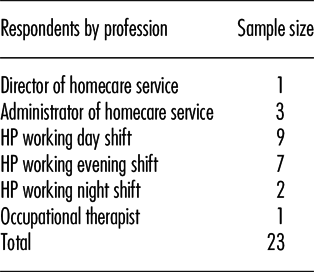
A total of twenty-three participants were interviewed individually before, during, and after the implementation of the intelligent bed, in either their office or a meeting room (Reference Patton12). A focus group interview was conducted afterward for 1 hour, to identify missing information and verify the data obtained from the individual interviews. The age distribution of participants was between 19 and 60 years, and the average age was 43.5 years. Of the twenty-three persons interviewed, twenty-two were female. Table 2 provides an overview of the participants.
Overview of Participants Interviewed

The interviews were carried out using semi-structured interview guidelines, and all interviews were tape recorded. The interviews lasted from 60 to 90 minutes. The participants are anonymous. The interviews were transcribed.
The interviews were carried out by the first and last author of this article and by a research assistant. The first author of this sub-study does not speak Danish, so the interviews were translated into English. The English version of the interviews was validated by a native Danish speaker and by the last author of this study.
Data Analysis
Data analysis was conducted after the test of the intelligent bed (Reference Brinkmann and Kvale13). The analysis included data from notes and reflections from the log book, documents, observations, and transcribed qualitative interviews. The main qualitative method used in analysis was analytic induction approach (Reference Ratcliff14;Reference Thomas15). The software program Nvivo 9.0 was applied to code the data. A combination of etic and emic coding was used as well. A predefined list of topics or categories was not used to avoid bias and facilitate to identify new topics and patterns.
The analysis of data followed the following steps:
-
• Design of a code tree, comprised of nodes, descriptions/definitions of nodes, and child nodes, was carried out during dialogue sessions within the research group. The code tree was constructed based on the central concepts (in vitro nodes), from the theoretical framework of learning theory (in vivo nodes), from qualitative interviews carried out with informants, and from participant observation. When formulating the concepts from the respondents, five qualitative interviews with HPs were analyzed and coded on the basis of initial impressions.
-
• The remaining interviews were then transcribed and reviewed to gain an overall impression of the topics, context, etc.
-
• Rough coding of all interviews was conducted in Nvivo 9.0.
-
• Refined coding was carried out following a review of the coded material and adjustments to both the code tree and the coding of interviews, for example, node merging. The passages were analyzed with reference to the context.
-
• The next step aimed at the identification of topics and patterns, and the interpretation was widened to include a framework of understanding beyond the respondent. What was the topical content of the interview, and what motivated the informant's views? What was the scope of potential actions? An in-depth interpretation was included in this phase and compared with a conventional understanding. In this phase, the interviews were analyzed to draw inferences regarding motivations and underlying perceptions.
-
• In the final phase, data were analyzed based on the theoretical framework to be able to derive effects and generate causal explanations.
-
• The analysis was performed by the first author, the fifth author, the last author, and a research assistant introduced in the acknowledgement. The last two persons transcribed all the Danish interviews. The first two persons then translated the interviews into English. The coding of all interviews was conducted together by these four persons both in English and Danish. These researchers then conducted a joint work on designing and refining the code tree, identifying topics and patterns and widening the interpretations. When there is disagreement between interpretations, the rest of the authors were invited to comment and reach agreement. The final draft was sent to the participants for review and verified in a focus group interview with the super users.
The application of a computer program for qualitative data coding is associated with several biases and limitations. First, a decontextualization of data may occur. Second, the program was developed based on grounded theory (an inductive approach), which is at odds with the combined etic and emic coding strategy used in this study. Third, when using a computer program, there is a risk of distancing the researchers from the data.
Minimizing Methodological Bias
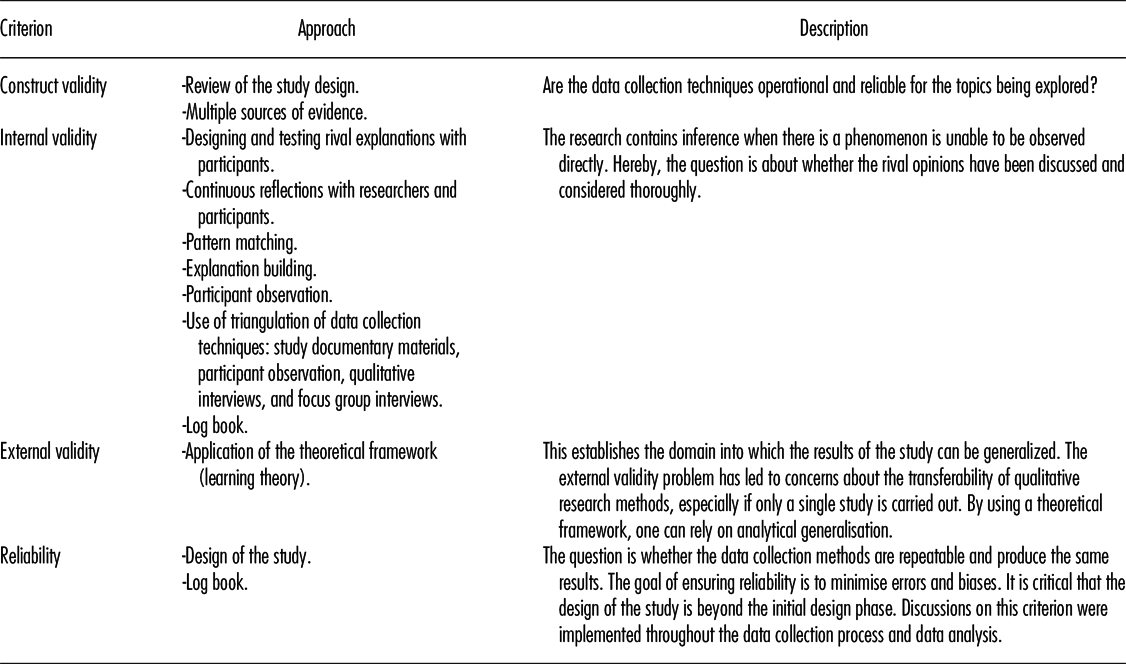
A triangulation of data collection techniques has been used to minimize methodological bias, improve construct validity, and establish quality in the study design. Four tests have been carried out, on construct validity, internal validity, external validity, and reliability, respectively. These criteria and approaches are elaborated in Table 3 (Reference Yin7).
Tests of Validity and Reliability

Table 3 illustrates how the four criteria are incorporated to the study design by using different approaches. The tests were conducted by the first author, the fifth author, and the last author.
FINDINGS
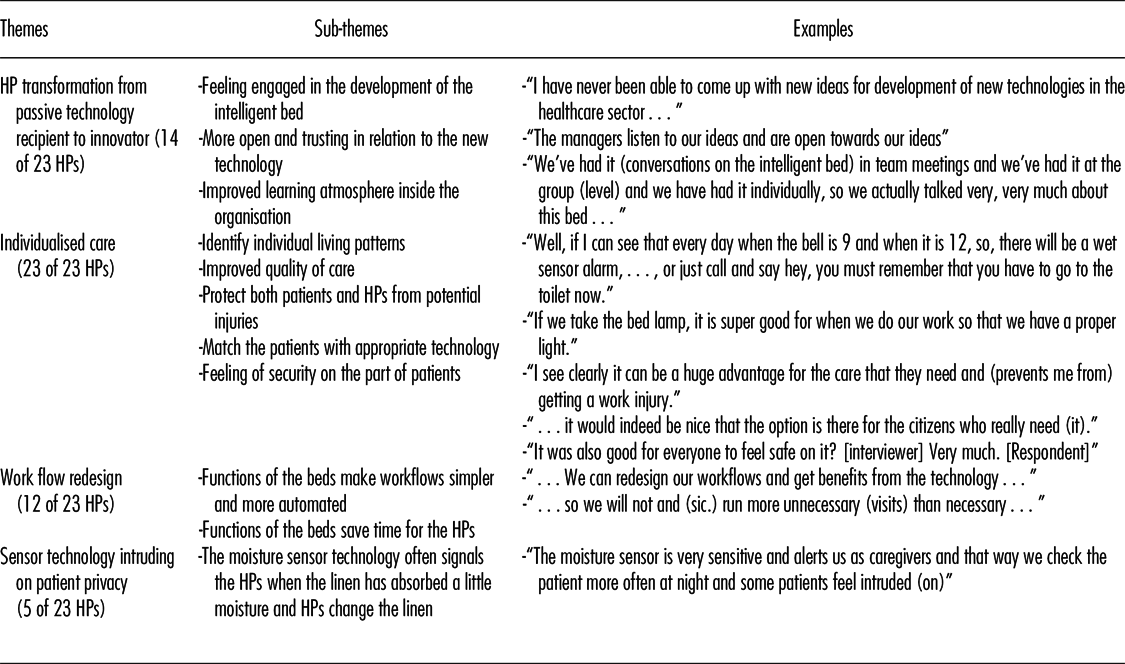
The findings of the analysis of the data are described in Table 4. The HPs were proactive about sharing their experiences with the intelligent bed. They believed their advice was considered carefully in the development of the intelligent bed, and they were happy about that. They expressed confidence in the intelligent bed, especially with regard to its future. We found that when HPs had questions about using the beds. They were able to get assistance immediately. This phenomenon encouraged the HPs and gradually improved the learning atmosphere internally.
Impact of the Intelligent Bed on the HPs’ Work

The individual health situations of the patients varied. The HPs stated that by using bed functions such as the moisture detector, they were able to identify a pattern of incontinence for some patients, which allowed them to implement shorter or fewer visits while still meeting patients’ needs. It improved the quality of care and prevented the patients from lying in a wet bed for an extended period of time. We have found that in some cases, the health situation of the patients worsened rapidly over time, which called for continuous reflection and adaption of the beds’ functions to meet the patients’ changing needs.
Functions like the user voice call provided an additional way to communicate with the HPs, other than landlines or mobile phones. It was also much easier for the patients to press the button for this function than to dial an HP's phone number. This benefit was especially significant for patients who were disabled. Because this function facilitated communication, we observed more frequent dialogue between the patients and the HPs, which had a positive effect on quality of care, improving their interpersonal relationships.
The applications of the intelligent bed reduced the number of unnecessary visits by homecare staff, and this was planned in the work schedule before implementation. Unnecessary visits frustrate HPs and increase their workload overall. We observed this in the testing district, after the HPs became more familiar with the functions of the intelligent bed. The HPs were able to be aware of the living pattern of the patients, for instance, the time of changing the catheter urine bag can be estimated by the HPs. They gradually adjusted their work routines during ongoing discussions on how to integrate the advantages of the bed into the schedule throughout the implementation process.
Some patients preferred not to be disturbed at night, or had a healthy spouse who preferred more privacy. We were told by the HPs that some of the patients turned off the bed at night. In this case, the bed would not perform any of its electronic functions.
DISCUSSION
The aim of this sub-study of the iCare project has been to explore how HPs experience and use the intelligent bed in patients’ homes. A review of the literature has shown that this is the first study to report on how HPs experience the implementation of the intelligent bed.
One theme identified in the analysis was the transformation of the HPs from passive technology recipients into active innovators involved in the development of the intelligent bed. The study did not identify any barriers to using the new technology in the HPs’ performance of clinical tasks and collaboration with the elderly (Reference Dinesen and Toft16–Reference Lee, Martinez and Ma18). The fact that the concept of the intelligent bed is being developed through a user-driven innovation process may also have had an effect on the HPs and other stakeholders, facilitating a learning process in the homecare service organization.
Patient health status and need for care can change rapidly, and the bed's functions may not always suit their needs. This indicates that the design of the intelligent bed must be standard-based with a module design perspective (Reference Martinez, Escayola and Trigo19). The applications can then be made more flexible and responsive to patients’ needs. Some studies advocate this strategy, but within a larger system, such as the smart home (Reference Sixsmith20;Reference Pietrzak, Cotea and Pullman21). We have not identified any study with such a finding that examines the intelligent bed technology described here.
Following the implementation of the intelligent bed, the workflows of the HPs were redesigned. This demonstrates the potential of this technology for the current healthcare delivery system. The HPs stated that the intelligent bed helped to reduce unnecessary visits, saving travel time to patients who do not need assistance (Reference Blozik, Wildeisen, Fueglistaler and von Overbeck22;Reference Casey, Hayes and Heaney23).
Unlike in other studies, the HPs we interviewed did not believe that their patients were subject to any stress due to being monitored (Reference Boise, Wild and Mattek24;Reference Courtney25). However, the HPs pointed out that the patients themselves found that bed functions like the moisture detector intruded on their privacy. Some patients, especially those with a spouse nearby, preferred not to be disturbed, especially at night. This feedback reminded us to consider the social context when patients have relatives living in close proximity.
One limitation of this study is that the intelligent bed was tested on a small scale and over a short period of time. If more beds had been tested for a longer period of time, more robust effects would have been identified. Second, only one HP in the test was male; gender differences might affect the results.
CONCLUSION
Health professionals involved in the introduction of the intelligent bed experienced a transformation from passive technology recipients to innovator. All health professionals who used the intelligent bed were able to provide more individualized care for their elderly clients. It is suggested that functions of the intelligent bed can result in the redesign of workflows and time savings for the health professionals in providing care of the elderly patients. The staffs found that the new technology intruded on the privacy of some patients. Future research is needed to test the intelligent bed in a large-scale clinical context to identify its economic and organizational effects.
CONFLICTS OF INTEREST
The authors have no conflicts of interest to declare.