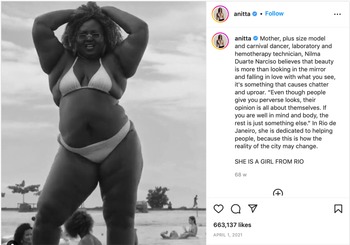
In spring 2021, one of the latest Brazilian musical superstars to try to break into the Anglophone market named Anitta began a new online campaign in an attempt to create a buzz among her fans. First, Anitta posted a series of photos on Instagram. Some were black and white pictures of women from Rio de Janeiro, including fashion models and women who do not often receive positive media attention due to unconventional beauty and body shape. Most posts included such phrases as ‘SHE IS A GIRL FROM RIO’ and ‘#BrazilianBeauty’.Footnote 1 Some posts were educational, featuring commentary about the nationally celebrated musical genres samba and bossa nova in the history of Rio de Janeiro and Brazil writ large. Some of the photos were air-brushed, pastel-filtered glamour shots of Anitta in modest beachwear from the late 1950s and early 1960s, while other photos featured gritty, hyperreal images of darker skinned women from Rio today in sexy yet quite revealing swimsuits,Footnote 2 as shown in Figures 1 and 2.Footnote 3
(Colour online) Post from Anitta's Instagram account on 1 April 2021 of Nilma Duarte Narciso.

(Colour online) Post from Anitta's Instagram account on 2 April 2021 of Loreta Burlamaqui.

Like many musicians following the successful promotional strategies for new pop music on social media, Anitta posted photos and commentary that were at once innovative for Anitta (prior to this, she had avoided making political statements about her music), but also in keeping with industry trends of taking advantage of her following on Instagram to build anticipation for the release – the strategy clearly signalled that something big was coming through hints directed towards online ‘stans’, or obsessive fans.Footnote 4 Anitta's posts portrayed a type of inward facing didacticism, instructing fans on how to interpret the forthcoming release. A similar mode of didactic social media strategy has been a regular feature of artists as diverse as Beyoncé, Taylor Swift, and Lil’ Nas X, all of whom attempt to balance teasing their fans and teaching them how to interpret what is coming. In a recent example from Beyoncé, she used promotional material around The Lion King: The Gift (2019) to educate her fans about the Afrobeats artists with whom she collaborated for the album. That publicity primed her fans for the visual album Black is King (2020), released a year later on Disney's streaming video service.Footnote 5 Much like Beyoncé's committed ‘Beyhive’ of fans did in the past for Beyoncé, committed Anitta fans calling themselves ‘Anitters’ also worked together to apply pressure to Anitta's label, Warner, to throw more of its corporate weight behind Anitta to make her music breakthrough in the United States through tactics such as strong-arming streaming music services to place her music at the top of popular editorial playlists.Footnote 6 Anitta's campaign and the behaviour of her fans caught the attention of scholars and fans alike. In a telling anecdote, Anitta's social media strategy was big enough news in Brazil that I was contacted five days after the song's release by an arts and entertainment reporter from a top Brazilian newspaper to comment on it due to my expertise on Brazilian music in transnational media.Footnote 7
In 2013, Anitta emerged as Brazil's strongest contender in a generation to crossover to the US mainstream rather than the more demographically limited markets for world or Latin music aficionados.Footnote 8 She has been growing her public in Brazil and Latin America since the early 2010s, and has made no secret of her desire to break into the US market.Footnote 9 She appeared on Major Lazer's 2017 hit dance track, ‘Sua Cara’, alongside Pabllo Vittar, Brazil's most popular drag queen. ‘Sua Cara’ crossed many thresholds of international popularity, becoming the first Brazilian song to dominate the dance/electronic chart since 1990.Footnote 10 Between 2017 and 2021, Anitta's most popular tracks outside of Brazil had been collaborations with established artists in other markets, especially urban Latin artists such as J. Balvin and US hip hop acts such as Cardi B. Anitta's big 2021 move, ushered in with her themed social media campaign, broke with that previous strategy: she released the solo record ‘Girl from Rio’, a pop-trap song to the tune of ‘Garota de Ipanema’ (‘The Girl from Ipanema’) – easily the most famous song from Brazil of all time.Footnote 11 Anitta's new song played with that melody (a descending minor third to a major second sung as G–E–D over a syncopated bossa nova rhythm) to critique the dominant image of women from Brazil that has circulated in the Global North – especially the United States, France, and the United Kingdom – since the late 1950s.Footnote 12 This image was so dominant that by the mid-1960s a lithe young woman from Brazil was often dubbed a ‘girl from Ipanema’ to reference the exoticized and heteronormative sexual appeal and innocence described in the bossa nova song. The lyrics of Anitta's song upend the reputation of ‘classy’ and light-skinned carioca women from the wealthy neighbourhoods of the South Zone of Rio de Janeiro where bossa nova first emerged.Footnote 13 This was the image that Brazil promoted abroad starting in the late 1950s. Yet, the classy archetypal woman from the South Zone has never been the image that international publics have attached to the ideal of Brazilian women from Rio. For many, Brazilian women have been idealized as sexualized and of mixed race. Here is where Anitta's Instagram promotional campaign and the song take on a broader political meaning. By juxtaposing the ideal of ‘women from Rio’ that the Brazilian elite celebrated with reality, Anitta was sending her fans a message about beauty and class that was unlikely to cross international boundaries and went against the grain of how Brazil promotes itself.
While Anitta's campaign to break big in the Anglophone market has been a hit and miss effort, she is part of a broader trend of artists redefining what kind of Brazilian music finds success in the international market through viral musicking.Footnote 14 Prior to the 2010s, the Brazilian artists that have had the most enduring international success had done so through the collaboration of intermediaries and established market trends that trade on the country's musical brand. Much like other countries that leverage their unique musical offerings for economic power, Brazil has emphasized its diversity by appealing to either samba-derived genres or regional musical traditions that fortify Brazil's brand differentiation or uniqueness.
This article situates Anitta's song and video within a different tendency, one where artists from genres outside the main markers of the national brand attain a global audience by utilizing the aesthetics of online virality. In so doing, these songs point towards an epistemic shift in the transnational mediation of Brazilian popular music since the end of the Second World War. I show how the politicized message about the national and international image of Brazilian women in ‘Girl from Rio’ experienced a type of ‘digital fatigue’ where semiotic ties to a song become unmoored through digital circulation.Footnote 15 By focusing on the transformation of politicized messages to stereotypes via viral musical media, I show how the environment for transnational success requires easy associations to spread.
Much of the scholarship on loss or degradation in the digital circulation of music focuses on compression and transmission of music files (e.g., bit rates, codecs, and playback devices) as well as the material consequences of such widespread sharing on the lives of musicians (e.g., more labour for less remuneration).Footnote 16 While these studies make important inroads about bodies and movement, they do not address what happens when a dance and music trend supersaturates multiple markets in the twenty-first century. This is due in part to how repetition meets bodies and digital circulation. Just as bodies fatigue from excessive physical movements, especially repetitious actions that lead to strain, digital fatigue expresses the exhaustion of meaning that comes from circulation and movement via digital media once a dance fad or trend takes off at a massive scale and well beyond the control on the part of institutional forces. This is in contrast with dance fads of the past that spread through deliberate efforts on the part of the media industries via dance studios and instructors.Footnote 17 Like other theories of the transformation of semantic content in digital media, digital fatigue addresses the meeting point of digital circulation via mass media and virality and the embodied and intimate experiences of moving to music at the heart of dancing. Whereas scholars such as Kiri Miller and Wayne Marshall outline the interaction and spread of dancing and listening bodies and digital media through specific platforms (gaming consoles and mobile phones), I extend this fatiguing to the lossy effects of semantic content traversing national borders and multiple markets via viral transmission on social media.Footnote 18 In Anitta's case, this unmooring of her feminist message about national and transnational images of Brazilian women was the result of altering her strategy to appeal to publics on TikTok, Spotify, and, eventually, MTV and terrestrial radio. The context of musical virality is key for understanding how Anitta's message in ‘Girl from Rio’ changed and disappeared. Once this was evident, Anitta and Warner shifted strategies, thereby abandoning the political impulse of the song's initial rollout. While some of this article focuses on the international legibility of the feminist message she intended for her fans and the broader Brazilian public, it also takes seriously how her fans, the ‘Anitters’, interacted with the recent changes in musical promotion through social media and streaming services, cheering her success even when Anitta's message was sure to be lost.
In what follows, I pay special attention to how certain images of Brazil have circulated through popular music recordings and accompanying press by highlighting who has been making those choices. I highlight Anitta's play with the expectations of social class and race that have much to do with the changes in the transnational media environment since the growth of viral musical circulation in the last decade. To construct this analysis of Anitta's ‘Girl from Rio’ and her particular viral strategy, I start with a brief overview of the history of what kinds of Brazilian popular music have been promoted abroad, showing how women, in particular, have been racialized and sexualized in the process. There is a difference between the stereotyping and loss of semantic meaning of Portuguese lyrics of crossover Brazilian hits of the past and what has occurred with ‘Girl from Rio’. To get to the heart of this, I also tackle the role of internet memes and virality in framing transnational musical popularity from Brazil to the United States. I highlight tensions in the music that Anitta has recorded throughout her career, showing how ‘Girl from Rio’ challenges musical stereotypes about Brazil while also using them for more success in social media.
Brazil's musical brand and exotic appeal
Brazilian popular music has been circulating in the Global North since the early twentieth century when the Afro-Brazilian dance genre the maxixe found audiences in the ballroom dance circuits of the United States and France.Footnote 19 This was followed by the far better publicized and politicized case of President Getúlio Vargas using the instrumental vernacular genre choro and samba to promote Brazil's interests abroad in the 1930s as part of his Estado Novo or ‘New State’.Footnote 20 Elsewhere, I argue that this melding of musical and political interests of the powerful resulted in a type of musical branding for the country and that it continued through cultural intermediaries in various guises for decades.Footnote 21 These intermediaries effectively curated Brazil's musical brand to build soft power to secure favourable trade deals and international investment. This resulted in the celebration and valorization of certain types of Brazilian music well above others: samba became Brazil's main musical export, and the imagery and music related to samba in carnival became impossible to avoid as part of Brazil's image through the expansion of popular media in the post-war period. The use of samba to build soft power was especially evident in the identities of the performers promoted abroad. In the late 1930s and 1940s, Afro-Brazilian music, as performed by the white singer and entertainer Carmen Miranda on the Broadway stage and Hollywood film, cemented the idea of Brazil as a tropical paradise whose African roots were implied but not seen in visual media. Women, in particular, did most of the work of attracting the attention of Anglophone audiences,Footnote 22 alongside changes in how Brazil's intellectual elite conceived the role of Afro-Brazilian culture, especially the mulata, as valuable to Brazilian society.Footnote 23 In general, brands derive their strength through differentiation and perceptions of value or prestige; Brazil's musical brand, based in samba, worked through a logic of racial difference.Footnote 24
To this day, many aspects of Brazilian culture are symbolically linked to samba in international-facing discourses, such as in descriptions of the Brazilian football team's style of play and the Rio de Janeiro carnival competition among samba schools getting the majority of international attention.Footnote 25 Because samba emerged as the defining national style at the moment when the country's elite was starting to embrace Afro-Brazilian culture instead of erasing it, it often appears alongside the idea of the country as a ‘racial democracy’ in language about Brazil. When bossa nova initially started to circulate in the Global North through its appearance in the 1959 award-winning French film Orfeu Negro (Black Orpheus), it was therefore not surprising that film depicted the style as originating from a Black musician living in the favelas – that was the image that was circulating in visual media at the time. In truth, far from being Black favela music, bossa nova was largely created by and for white musicians living in the wealthy neighbourhoods of the South Zone.Footnote 26 That initial international misunderstanding of bossa nova as Black was in keeping with Brazil's history of representing its music as the product of a racial democracy, despite the contradictions of the country suppressing so much Afro-Brazilian culture in its history.
The Brazilian performers who have most captivated Anglophone audiences have been women, most often light-skinned and mixed-race women branded and promoted as sexual objects. In the bossa nova period of the 1960s, Astrud Gilberto forged a career in the United States. She rode the bossa nova trend as far as it would take her, presenting to the world a version of Brazilian music that was completely separate from contemporary trends in Brazil. That pattern reoccurred many times between the 1960s and Anitta's ‘Girl from Rio’.Footnote 27 In each case, the women who found widespread success due, in part, to the popular image of each of them as sexual objects and racial Others, often through a combination of depictions in the music press (which was dominated by white men) and deliberate choices on their part in response. The formula has largely worked and, in recent decades, other women musicians from Brazil have attempted to play into this model as a path to greater success.Footnote 28
The most pertinent illustration of this, especially in the context of Anitta's critique, is how fans understood Astrud Gilberto. At the height of her career in the 1960s, she often sang slightly flat due to singing so softly, and many understood that as part of her sexual appeal. She got her start in the US market by singing the English lyrics to ‘The Girl from Ipanema’ (‘Garota de Ipanema’) in the Getz/Gilberto sessions. That recording resulted in the English-only radio edit that dominated the US charts in 1964. The widespread appeal of that recording, in particular, cemented bossa nova as ‘sexy’ music through a narrow image of Brazilian women.Footnote 29 Because of the close linkage between Astrud Gilberto and the hit song – Gilberto was often called ‘the girl from Ipanema’ in much of her international press – that moniker also often followed other Brazilian female artists who were trying to break into Anglophone markets, equating an unattainable, lithe teenage girl on a beach in Rio with Brazilian womanhood. Over a half century later, the discourses surrounding ‘The Girl from Ipanema’, its ties to Brazil's musical brand, and the legacy of both for exoticizing Brazilian women are fertile grounds for Anitta to critique through the music and imagery associated with the song.
The video for Anitta's ‘Girl from Rio’ premiered on YouTube on 30 April 2021. It opens with the familiar strains of ‘The Girl from Ipanema’ played by flute and acoustic guitar (violão) in a bossa nova style as the camera opens to a cartoonish beachfront in Rio de Janeiro. This cartoon beach includes many of the iconic images of the city's beaches rendered in a pastel colour palette: beach umbrellas, the undulating curvy designs of the city's stone sidewalks, the Dois Irmãos (‘Two Brothers’) mountains visible from Leblon and Ipanema beaches, and the gondola to Pão de Açucar (‘Sugar Loaf’) mountain at Urca beach. Anitta sits on her side wearing red lipstick and matching artificially dyed red hair in a heavily styled coiffure straight out of the late 1950s. Her clothing also references that period: a modest, striped bathing suit that covers her arms, with a matching hat and white spherical earrings. There are images of her being chauffeured in a mid-century car and wearing a short, sleeveless dress and go-go heels from a slightly different era. Four men wearing matching retro swim costumes soon join her for a brief dance sequence before she starts singing, to the melody of ‘The Girl from Ipanema’: ‘Hot girls where I'm from / we don't look like models / tan lines, big curves / and the energy flows / you'll be falling in love / with the Girl from Rio.’ The first words we hear are in English, and they reference the dominant international preconception about Brazilian womanhood as exotic and highly sexualized.
A trap beat enters the mix as she sings, ‘Let me tell you about a different Rio / The one I'm from but not the one that you know.’ The cartoonish beach setting and vintage glamour give way to an unfiltered scene of a municipal bus arriving at a beach that is clearly not the iconic locations depicted in the opening cartoon landscape.Footnote 30 The filter on the images moves from one full of air-brushed pastels to a hyperreal filter where each body glistens with tanning oil, water, and sweat. That hyperreality is mirrored in the music with rhythmic textures on the hi-hat that musicologist Justin Adams Burton has described as ‘inhumanly fast’ making it the defining feature of trap music.Footnote 31
Since their emergence in hip hop in the early twenty-first century, trap beats index contemporary Blackness in popular music due to their links to Atlanta-based hip hop production and its global reach. Sociologist Corey Miles extends this reading to argue for the liberatory potential of trap beats for Black women to position them as modern actors within the hip hop tradition.Footnote 32 In this instance, the trap beat signals both that the time period has shifted and articulates it with the Black feminist corners of hip hop, but it is also Anitta's link with different sets of musical values: hip hop meeting different segments of Rio de Janeiro, not just the upper crust of the South Zone. Thus, it makes sense that we see Anitta leaving the bus as other passengers exit through its windows.
At this point we see a beach scene for Rio's working classes in the present. The swimwear is revealing, showing off bodies of all shapes and sizes. There are men exercising in public workout areas, couples getting intimate in the water, people eating barbecue on the beach, and Anitta getting shaved on her backside and upper thighs. This scenario is intercut with the opening one, of a vintage, filtered Anitta in various scenes where she addresses such taboo topics as just learning that she has another brother from a different mother.
Although images of the present-day beach scene in the video are not what the city of Rio de Janeiro promotes to tourists or investors, they depict a part of the culture. The contrast between the images of Anitta in a wig from the past and the present-day working-class beach highlights the reality of what one would see at beaches far from Rio de Janeiro's glitzy South Zone. While visitors to Rio de Janeiro may see a diversity of body types at a wealthy beach in the Leblon, Ipanema, and Copacabana neighbourhoods, the video displays a beach-going public that does not care who is watching. This is key. Generally, the beach-going public in Rio expresses strong preferences for which beach is ‘theirs’, with the colloquial expression of ‘minha praia’ (‘my beach’) extending to preferences for a wide variety of personal taste in daily life. If a local goes to one of the big tourist beaches, there is a widespread understanding of what that will mean when it comes to vendor and tourist behaviour. What Anitta shows off in the video is a version of Rio de Janeiro that disregards any desire to please tourists and upper-class values. When combined with some of the taboo subjects addressed in the lyrics of the song, the end result is an image of Rio de Janeiro (and Brazil) that is quite distant from the historic trends in what version of Brazil cultural brokers have promoted for decades. This is not the Rio de Janeiro or Brazil ‘pra inglês ver’, a saying that expresses that there is a version of Brazil on display just for international (‘English’) eyes. Audiences with little to no knowledge of the history of class-based beauty standards in Brazil will notice the critique in this video.
When I started field research among the independent record labels in Rio de Janeiro and São Paulo in 2007, I frequently asked record label owners and A&R executives why they promoted certain artists the way that they do. In one memorable conversation with Olivia Hime, owner of Biscoito Fino records (located in Botafogo in Rio de Janeiro's Zona Sul), she emphasized an interest in promoting ‘a música de boa qualidade’, or ‘good quality music’. Based on the label's output, ‘good quality music’ appealed to the country's elite classes and was steeped in the country's musical traditions, especially those based in samba.Footnote 33 Biscoito Fino and other labels like it are institutional gatekeepers. They cater to the kinds of people who shop at chic stores and who can afford to spend exorbitant prices for special editions of re-releases on the label's catalogue. These are also the kind of people who largely have dominated discussions, debates, and criticism of Brazilian music. That influence is widespread in Brazilian music textbooks, magazine articles, and even recent profiles of Brazilian artists who have found international audiences.Footnote 34 Up until recently, the lion's share of the music that reached said audiences was filtered through the tastes of these elite. The emergence of the internet as a primary driver of musical distribution has exposed the major gaps in the country's international promotional strategy, especially as concerns genres that find audiences through viral media on social media.
Memes, virality, and Brazilian popular music
Finding new transnational audiences is generally a challenge, and viral moments are necessary for Brazilian artists performing in genres that anthropologist and critic Hermano Vianna describes as Brazil's ‘parallel music’, such as those performing tecnobrega and forró.Footnote 35 These are the genres that are by all accounts extremely popular in Brazil, but their audiences belong to demographics that the gatekeepers would rather not celebrate.Footnote 36 They do not live in the country's cultural centres and/or they are significantly less wealthy than the country's elite. Vianna's essay details other genres despised by critics yet adored by huge swaths of Brazilian people, and directly addresses the differences between the popular culture as celebrated by seminars, books, and documentaries in the cultural centres of the country (São Paulo and Rio de Janeiro) and the realities of what is enjoyed by people of more modest financial means. In the last decade, these culturally prescriptive books and documentaries have expanded to podcasts and YouTube essays to reinforce similar taste-making regimes to those discussed by Byrd McDaniel in this issue.Footnote 37 Importantly, the lovers of parallel music are not the kind of impoverished people whose experience of poverty is easy to capture on film (in contrast to the hillside favelas or shanty towns that have become huge draws of international filmmakers and media).Footnote 38 Like suburban and rural poverty elsewhere, the big signals of struggle are less visibly obvious and include such factors as malnutrition and exposure to dangerous environmental factors (infestation and toxins). In noting this divide, Vianna is in dialog with sentiments best expressed by ethnomusicologist Andrew Mall in his study of Christian music in the United States – that many popular music researchers study the music that has already attracted a significant amount of their energy as fans or that has been taught in their institution, resulting in a ‘self-perpetuating system in which only certain areas of inquiry are suitable subjects of scholarship’.Footnote 39 Similar recursive systems have been at play in criticism and scholarship about Brazil's parallel musics.
The importance of musical virality to national branding through music lies in its ability to elude elite systems of elite national self-fashioning. These systems are so powerful that while some Brazilian parallel genres are profitable enough that even the country's most influential brokers begrudgingly acknowledge their power. For example, in a 2015 interview I conducted with Pena Schmidt, the musical events curator of the Centro Cultural São Paulo (Cultural Centre of São Paulo), he addressed the rising popularity of sertanejo, a type of rural Brazilian musical analogue to country music in the United States. At that moment, it was on the precipice of taking over the Brazilian music industry even as few people working in the record industry wanted that to be the case.Footnote 40 Thus, elite gatekeepers control the international image of Brazil through national policy and, while some work in record labels, they are not reducible to them. Major record labels will follow profit where it leads them for genres they do not wish to promote abroad.
Similarly, when I was first conducting research among independent record labels based in Rio de Janeiro in 2007, nearly all industry workers I interviewed did not want to invest in carioca funk, another parallel genre that at the time had been extremely popular among marginalized youth and was gaining traction in the international music blogosphere. (Carioca funk is also the genre that got Anitta her foothold in the Brazilian market in the early 2010s.) At the time, one industry veteran attributed this lack of investment to the differing practices of funk artists themselves in largely choosing not to engage with traditional modes of distribution.Footnote 41 Like many parallel genres that have achieved widespread international fame despite the lack of institutional support, funk eventually ascended to the world stage through the internet (in this case, music blogs), despite still-tentative support by national institutions.Footnote 42 Even when the internet was a major factor in disrupting the country's musical brand, as some scholars have noted, most of these breakthroughs of parallel music on a national scale occurred through mixtures with traditional genres such as samba.Footnote 43 Those mixtures allowed them to be legible through that lens of national self-fashioning for the elite, echoing Andrew Mall's point about recursive systems. Whatever breakthroughs happened in the past began with local scenes that still depended on clubs and a basic musical infrastructure.Footnote 44 Only recently has virality and the semantic fatigue that comes from that mode of digital circulation become a factor.
The sea change that ‘Girl from Rio’ represents for Brazil in international media is due, in part, to the capacity for viral musical logics to disrupt long-held patterns of what types of images and sounds index the country abroad. To illustrate this point, consider that Brazil is one of the most online cultures in the world (ranked fourth, behind China, India, and the United States),Footnote 45 although its users exhibit differing relationships to social media and the internet in general.Footnote 46 There are more memes taken from telenovelas, soap operas that run during primetime, and much of the activity on social media has moved to large group messaging on platforms such as WhatsApp. Indeed, this localized approach to mobile telephone apps resonates with the platforms used by Brazilians are similar in some ways to the modes of circulation discussed by Achondo in this volume.Footnote 47 However, while Brazilian internet users do not dominate social media spheres in the way Anglophone users do, their numbers and influence are large enough to have inspired viral trends, including widely adopted JPEG and GIF memes.Footnote 48 In addition to the ways in which online musical cultures have contributed to massive shifts in Brazil's domestic independent music sector, viral internet logic has also transformed what kind of music becomes popular as a type of spreadable media in other international markets.Footnote 49
Prior to Anitta's success, the biggest viral breakthrough was a live recording of a pop sertanejo song called ‘Ai, se eu te pego’ by Michel Teló. The runaway success of that song was due in large part to its attachment to a viral dance meme performed by footballers in Brazil, starting with icon Neymar, after they scored a goal. The dance featured the motion of a hip thrust accompanied by both arms extending downward on both sides of the body – a widely recognized gesture emulating masculine sexual copulation, which in this case was regularly danced by women in the audience for Teló's performances. For his part, Teló embraced Neymar's role in the song's popularity and even performed with him on the top Brazilian television network, Globo, for ‘Show da Virada’ in 2011 – the network's annual New Year's Eve broadcast special.Footnote 50 Videos of Neymar's dance in Brazil were the first major indication of the possibility of a Brazilian musical style not just finding international audiences but also doing well outside previous routes of distribution and promotion. Football is one of Brazil's claims to fame and the strength of the country's players means that football memes are a key aspect of the sport as entertainment in the age of the internet. Generally, GIFs of footballers circulate after big games when they do something impressive. In this case, the dance circulated due in part to Neymar's charismatic presence in national mass media in Brazil. It made the leap to international mass mediation, a global musical meme if you will, when Portuguese footballer Cristiano Ronaldo, then a player for Real Madrid, danced to the choreography of the song after scoring a goal. The dance gestures follow the song lyrics which are about sexual conquest. The chorus of the song is as follows:
The song's lyrics also led to the generation of additional memes. For example, MTV Brasil made a JPEG that circulated widely in 2011–12. The joke of the image is that the lyrics are so simple and repetitive, they can be expressed through a flow-chart (Figure 3). The song's viral success eventually led to Cuban-American dance-pop superstar Pitbull producing a version in early 2012 that was intercut with English and Spanish. Pitbull's intervention was then remixed multiple times, and those remixes were played on terrestrial radio in markets where his music was already widely popular. In those media, Telo's song would have struggled to achieve this level of circulation if it were not for viral internet popularity. On the other hand, by the time it reached Anglophone audiences, most of the song's vulgar lyrical content was completely lost in translation (quite literally) while the sexual gestures only remained for those publics that saw the videos. By that point, the dance had already been digitally fatigued. Much of this likely had to do with Portuguese not being widely understood outside Brazilian, Portuguese, and diasporic communities across Europe and North America. It also pointed to the future possibility of non-English language music doing well via memes and other forms of viral musicking. Within a year, Psy's ‘Gangnam Style’ eclipsed ‘Ai, se eu te pego’ in terms of virality and proved that a song could be lyrically and culturally incomprehensible to Anglophone audiences and still be hugely popular – so long as it provided fodder for audiovisual meme-making and circulation.
(Colour online) Still from an MTV Brasil short by designer Max Demien ‘Fórmula do Sucesso’ (‘Success Formula’) poking fun at the lyrical repetition in ‘Ai, se eu te pego’ that circulated in 2012. This image circulated as GIF and JPEG in addition to the short video by Max Demien.

It is worth repeating that Teló's song was not audibly linked to any styles that the Brazilian government promoted abroad as part of its national brand through national policy, unlike the overwhelming majority of previous international successes from Brazil. It also bore some echoes of the reluctant embrace of other fads. The song's sexually explicit dance moves were only slightly more blatant than the lambada, the would-be dance craze promoted in Europe and the United States in 1989 and 1990 despite not being popular outside Brazil's northeast (though it did become widely popular in Brazil after its international success).Footnote 51 ‘Ai, se eu te pego’ belongs to a sub-genre of contemporary sertanejo called sertanejo universitário that freely mixes with pop music tendencies, such as rock instrumentation and an emphasis on melodic hooks, and openly treats topics of romance and sexuality with frank vulgarity (that props up machismo). The genre has had the split distinctions of being exceptionally popular within Brazil and of not being promoted nationally or internationally. Telo's success was in spite of genre. In contrast, when Marília Mendonça, one of the most popular contemporary (and feminist) sertanejo stars of the late 2010s, died suddenly in a plane crash in 2021, few outside of Portuguese language markets took notice.
The biggest difference between what happened for Michel Teló in 2011–12 and Anitta in 2021 is due to changes in how contemporaneous social media could be used for musical promotion and viral spread. In the months immediately preceding the release of ‘Girl from Rio’, another bossa nova-based melody circulated through TikTok – a social network where people share short videos that has been important in promoting new musical artists since 2019. The song ‘Castaways’ from the children's television show The Backyardigans initially aired in 2005. It is based on bossa nova, but is written with children as the main audience. Starting in March 2021, the song accompanied a series of videos largely due to a combination of childhood nostalgia of TikTok's main demographic: Gen-Z and younger millennials. ‘Castaways’ features an acoustic guitar playing a simplified bossa nova rhythm with harmonic progressions that featured relatively complex chords such as Fmaj7, F♯min6, and Gm7 played with low voicings. Given the unmistakable bossa nova foundations of the viral song, it could have portended greater success for a trap-bossa in the platform's viral musical networks. However, after Anitta released ‘Girl from Rio’, it largely did not do well on the streaming music charts outside of Brazil. On TikTok, the political message was far from successful and in most cases, was thoroughly diluted. While some Brazilian users posted videos celebrating diverse bodies dancing in bikinis, plenty of other videos featured bodies conforming to traditional beauty standards echoing the dance moves at the beginning of Anitta's video. More tellingly, some used the song to simply signal that they were at the beach with long shots featuring women in swimsuits. In one example, a woman slowly takes off her clothes to reveal that she's in a bikini before jumping into a pool with a view of Rio de Janeiro's coastline. She then looks out at the beach.Footnote 52 In a contrasting humorous example, the song becomes a type of muzak playing in the background while a Brazilian creator explains the difference between how vendors at Rio's beaches selling coconut water treat tourists (gringos) versus locals.Footnote 53 The political message, while there, had been fatigued by repeated use on viral media (TikTok) which, as I show below, was later compounded by Anitta and Warner altering their strategy.
In his article on the Ghanaian viral dance fad Azonto, Jesse Weaver Shipley describes how viral dance music fads shift in meaning due to what one azonto dance producer describes as ‘digital fatigue’.Footnote 54 While the concept has been used widely when talking about the consumption of ebooks versus print books (i.e., the user's eyes experience digital fatigue while reading off a tablet), applying the concept to viral dance fads from the Global South is helpful due to the intricacies of digital circulation when styles break through into other markets. Shipley's contact, producer Panji Anoff, explains how the endless repetition through one's body is where the fatigue originates: ‘you take a beat, loop it, and repeat it infinitely. This affects the way you listen, think, feel. Over time it creates digital fatigue; this endless repetition in your body.’Footnote 55 In the case of the repetition of the ‘Girl from Rio’ videos on TikTok, the repetition eventually led to videos that ignored or obscured the meaning of the song, eventually leading to the song simply signalling a dance and Rio de Janeiro's beach.
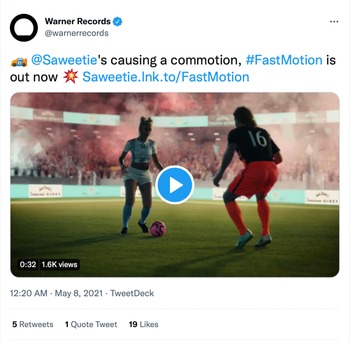
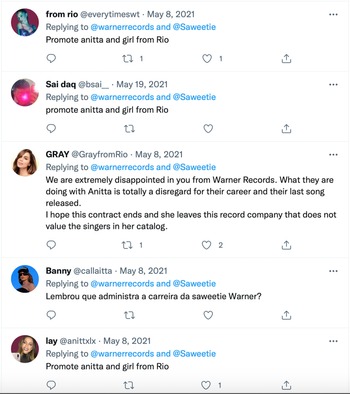
Yet, the song's initial lacklustre performance on international charts (while doing extremely well in Brazil) led to Anitta's stans, the Anitters, to complain publicly that Anitta's label, Warner, was not putting enough of its influence behind her efforts to break into the US charts. While ‘Girl from Rio’ appeared on a few mainstream playlists, such as Spotify's ‘Pop Rising’, it never dominated, despite being released in time to be a ‘song of the summer’. Within a week of the song's release, Anitters took to Twitter to complain to Warner's main account that they were failing Anitta, sometimes using the hashtag #FreeAnitta to indicate that she should leave her contract (and clearly drawing from the #FreeBritney hashtag and related activism to end pop star Britney Spears’ conservatorship). Payola has an extensive history in Brazil, and it seems that these fans wanted Warner to use its leverage to force Anitta onto playlists. Figures 4 and 5 shows fans tweeting at Warner.Footnote 56 The last tweet, in particular, states, ‘I hope this contract ends and she leaves this record company that does not value the singers in her catalog [sic]’. While it is unclear that these fan complaints spurred Warner to alter strategy, they did point to the disappointment and surprise many Brazilians following this case felt that the song did not break through more broadly.
(Colour online) Twitter screencaptures of a promotional Warner Records twitter post.

(Colour online) Twitter screencaptures of Anitters rallying in support of Anitta in reply to the promotional Warner Records twitter post.

Following the viral spread and initial digital fatigue of the song that was largely limited to Brazilian markets, the next attempt to break into US markets was a new version of ‘Girl from Rio’ featuring controversial hip hop star DaBaby – just before he faced a firestorm of criticism for making homophobic remarks about HIV/AIDS.Footnote 57 In this new version of ‘Girl from Rio’, the feminist message is largely gone. DaBaby spends much of the video looking directly at Anitta's breasts and raps about taking ‘a jet to fly out to Rio to have some sex’. While much of the rest of the song remains intact, the remix video obscures the political message of vintage, elite Rio of the past versus the reality of the present. Instead, it gives DaBaby the attention that previously would have gone to the variety of women on that beach. Yet, this was the version of the song that circulated on radio in the United States. This is a stark contrast to the message about Brazilian womanhood that appeared all over Anitta's initial marketing campaign for the song. The travels of this song show how a combination of overt decisions on the part of a musician and her record company and the fatiguing of semantic content through virality intensifies stereotypes. Even when considering viral musicking and the efforts of committed fans, stereotyping via semantic simplification seems to be necessary to gain the attention of international publics.
Conclusion
The metrics for success and the efforts to gain it are changing rapidly for international artists. In the early 2010s, Anitta made a name for herself through her pop approach to baile funk – famously connected to the favelas in Rio de Janeiro. As many scholars have noted, funk music has been targeted by the state and, despite its popularity, continues to be a site of aggressive policing and noise abatement measures.Footnote 58 In her early years, her associations with funk were so strong that she was often dubbed MC Anitta; however, the kind of music Anitta sang in her early career was a type of melodic, pop-oriented funk called ‘funk melody’. When I first started to follow the international coverage of funk melody in the early 2010s, it was often riddled with complaints about how blatantly commercial and radio-friendly it sounded, as opposed to the street party sounds of other types of funk music.Footnote 59 Anitta has also claimed to be from the favela. While she was brought up as an artist in the Maré favela, she is technically from Honório Gurgel, a nearby neighbourhood in the North Zone of Rio de Janeiro – an area that is not the morro (‘hill’) of the favela but rather the poorer neighbourhood of the peripheral zones of the city. Over the last few years, Anitta has enthusiastically crossed so many genres that she is an excellent index of how the values around genre in Brazilian popular culture are shifting. In addition to her collaborations with stars in the United States and urban Latin markets, she has also collaborated with sertanejo artists and established mainstream artists such as Caetano Veloso. She has been clear from the outset that she wants to be a pop diva and conquer markets. In the first episode of her Netflix TV show, one of the commentators openly compared her efforts to those of Carmen Miranda in the 1940s. She sings fluently in English and Spanish and she is unafraid of bucking middle-class ideas of respectability, at times calling herself favelada and malandra.Footnote 60
In a lot of ways, what Anitta is doing here is in keeping with the early history of viral musical memes discussed by musicologist Paula Harper.Footnote 61 In her research, Harper shows that being in ‘bad taste’ through decontextualization is almost always the point. For her part, Anitta seems to have ridden the song as far as it will take her. She appeared on the MTV VMA's in September 2021 singing a portion of ‘Girl from Rio’ – the first Brazilian musical artist to appear on the award show in its history. However, it is worth noting that she was not included in the main broadcast, but rather part of a Burger King-sponsored spot, and she only performed the first half of the song. By and large, her Brazilian fans reacted to her appearance with an ecstatic response, well beyond the Anitters, and they only praise her for achieving such widespread international exposure. For an artist from outside the Anglophone pop music world to be competing in the US pop music business at this level, the way that she is attempting and by some measures succeeding means that she must walk a careful line between subverting and reinforcing stereotypes. That she has done so through the logic of musical virality and digital circulation has afforded her enough space from her initial music video to be able to deny any responsibility for the negative stereotypes that she is perpetuating. It is the kind of multi-layered performance that many Brazilian artists have had to contend with throughout the last hundred years. Thus far, there has been no backlash against Anitta for what happened in this case. Indeed, it has been the opposite; like many Brazilian breakthroughs on the international stage in the past, her success has been celebrated at home.
The travels of ‘Girl from Rio’ demonstrate the possibilities of how appealing to viral media and online communities can disrupt the traditional routes through which a country's musical brand is decided and maintained. It is ironic that the song itself is a critique of Brazil's self-curation, yet in its travels on TikTok and in its remix, much of the critique is cast off in favour of broadening the audience (and accomplishing the goal of disrupting the path of distribution and promotion). In this example, we see an artist who is willing to do almost anything to get her music to cross over into new markets – even if that means diluting or erasing her political message. Through the logic of memes and viral music, the larger aim seems to escape predictable semantic meanings. This was the case with Michel Teló, in which his song about sex tempered its obscenity through circulation. It continues with Anitta. Except in the case of Anitta, she runs the risk of becoming yet another Brazilian woman cast as a ‘Girl from Ipanema’, the antithesis of the message in the song and video. While the critiques of this imagery may be at the core of what she presented to Brazil, that does not seem to matter when so much changes in digital circulation across platforms, contexts, and more.