


The American public currently displays higher levels of political attitude polarization than ever before (Arbatli and Rosenberg Reference Arbatli and Rosenberg2021). A growing number of Americans on either side of the Democratic-Republican divide view the other side unfavorably (Nadeem Reference Nadeem2022). Alongside rising tribalization comes deepening ideological differences and growth in political animosity (Iyengar, Sood, and Lelkes Reference Iyengar, Sood and Lelkes2012; Iyengar et al. Reference Iyengar2019; Moore-Berg, Hameiri, and Bruneau Reference Moore-Berg, Hameiri and Bruneau2020). Researchers have shown that policy preferences and self-reported ideology increasingly align with partisanship, and that race is strongly associated with political attitudes, behaviors, preferences, and political engagement (Abramowitz and Saunders Reference Abramowitz and Saunders2008; Baldassarri and Gelman Reference Baldassarri and Gelman2008; Druckman, Peterson, and Slothuus Reference Druckman, Peterson and Slothuus2013; Kinder and Winter Reference Kinder and Winter2001; McCarty, Poole, and Rosenthal Reference McCarty, Poole and Rosenthal2016).
A considerable body of research studies political divisions between parties and racial groups, typically examining the effect of race on political attitudes and behaviors and the ability of minority groups to translate their preferences into electoral and policy outcomes (Banducci, Donovan, and Karp Reference Banducci, Donovan and Karp2004; Branton Reference Branton2009; Broockman Reference Broockman2014; Cameron, Epstein, and O’Halloran Reference Cameron, Epstein and O’Halloran1996; Lowande, Ritchie, and Lauterbach Reference Lowande, Ritchie and Lauterbach2019). Less research, however, considers how surface-level similarities among members of racial minority groups may conceal political cleavages among subgroups. Yet, recent trends provide suggestive evidence of political subgroup formation within minority racial groups, as Republican gains among Black and Latino men have played a major role in recent elections (e.g., Galbraith and Callister Reference Galbraith and Callister2020; Philpot Reference Philpot2017). Given that important racial categories (e.g., Latina/o/x, Asian American) were created to promote shared interests and senses of linked fate among individuals with diverse ethnic and regional backgrounds (Lien Reference Lien2001), limited attention to political subgroups within broader minority racial groups is an important research omission.
Our study fills this gap by examining political fracturing with a focus on the Asian American electorate. We use the term political fracturing to refer to the formation of pluralistic political subgroups that coalesce around shared political ideology, identity, trust, engagement, and issue opinions within broader racial groups. Political fracturing is distinct from polarization in two ways. First, while political polarization relates to ideological differences between parties (Abramowitz and Saunders Reference Abramowitz and Saunders2008; Lee Reference Lee2009; Poole and Rosenthal Reference Poole and Rosenthal2001), research on American politics describes growing tensions not only in terms of ideology but also in terms of political identity, trust in government, and issue opinions (Baldassari and Gelman Reference Baldassarri and Gelman2008; DellaPosta Reference DellaPosta2020; Iyengar, Sood, and Lelkes Reference Iyengar, Sood and Lelkes2012; West and Iyengar Reference West and Iyengar2022). Second, racial minorities face structural barriers to political participation that affect political trust (Verba, Schlozman, and Brady Reference Verba1993), and minority voters often assign different meanings to partisanship and ideology questions than White voters (Jefferson Reference Jefferson2024; Philpot Reference Philpot2017). These two intertwined trends highlight the need to account for political trust and engagement as well as for how ideology, identity, and issue opinion questions may elicit categorically different responses for racial minorities when studying political subgroup divisions within minority racial groups (see also Gaines and Lien Reference Gaines and Lien2025).
While prior studies typically focus on the policy preferences of Black, Latina/o/x, and White Americans (Castillo Reference Castillo2022; Galbraith and Callister Reference Galbraith and Callister2020; Jefferson Reference Jefferson2024; Lu Reference Lu2021), Asian Americans are now the fastest-growing minority group in the United States, projected to be 10% of the population by 2060, and are positioned to be a potential new swing vote (Lee and Ramakrishnan Reference Lee and Ramakrishnan2021; Liang Reference Liang2024; Masuoka, Ramanathan, and Junn Reference Masuoka, Ramanathan and Junn2019; Qin Reference Qin2024; Ramakrishnan Reference Ramakrishnan2021). At the same time, the Asian American electorate contains a plurality of ethnicities and nationalities ranging from diverse areas, like India and Pakistan to Vietnam, Mongolia, and Japan. The sheer number of subgroups included in the “Asian American” umbrella category causes considerable ambiguity in how Asian Americans determine their own and others’ group membership (Junn and Masuoka Reference Junn and Masuoka2008; Lee and Ramakrishnan Reference Lee and Ramakrishnan2020; Lien et al. Reference Lien2021; Yamashita Reference Yamashita2022; Zhang Reference Zhang2025). While scholars agree that such pluralism may create fractured subgroups with distinct political attitudes and behaviors, the nascent body of research on political divisions within the Asian American electorate has been limited to isolated analyses of issue opinion and political participation.
We advance prior studies by capitalizing on uniquely rich data provided by the 2016 Collaborative Multiracial Post-Election Survey (CMPS) to measure and analyze the sources of political fracturing in a nationally representative sample of Asian Americans. By including a battery of eight questions on political ideology, identity, trust, engagement, and issue opinions, our analysis is able to detect the existence of novel political subgroups within the Asian American electorate that are not clearly identifiable from single-item measures. We first capitalize on latent class analysis (LCA) to assess the prevalence of political fracturing among Asian American respondents. LCA is appealing for our purposes, as it allows us to empirically assess to what extent respondents’ answers to questions on political identity, ideology, engagement, trust, and issue opinion cluster into meaningful categories. By testing different model solutions, we can determine whether responses collate into a single majority group (suggestive of no fracturing) or a plurality of subgroups (suggestive of fracturing). We are further able to analyze the differences between subgroups to isolate the survey answers that dictate subgroup membership.
In addition to describing political fracturing within the Asian American electorate, we also examine its sources. Past research suggests that ethnic differences among Asian Americans may drive political fracturing (Kim Reference Kim2021), while other research traces political differences to demographic factors, such as age, income, and level of education. We test each explanation for group membership, and we introduce religion as an underexplored factor by highlighting its role in political socialization and belief systems (Jones-Correa and Leal Reference Jones-Correa and Leal2001; Verba, Schlozman, and Brady Reference Verba, Schlozman and Brady1995). We find that respondents are roughly evenly distributed across latent classes that broadly capture liberal, conservative, and ambivalent political subgroups. Regression analyses suggest that these patterns are partly explained by ethnicity and partly by differences in age, education, and religion between ethnicities. Collectively, findings uncover new evidence of political fracturing among Asian Americans and highlight the importance of accounting for within-group political divisions in research on minority politics.
Background
Prior research has come to mixed conclusions on the cohesiveness of the Asian American electorate (Drouhot and Garip 2021). On the one hand, Asian Americans tend to vote liberal and have displayed a strong tendency to support the Democratic Party since the 1990s (Kuo, Malhotra, and Mo Reference Kuo, Malhotra and Mo2017; Zhou and Patterson Reference Zhou and Patterson2021). The same set of social issues have been found to motivate Asian Americans regardless of ethnicity, such as concerns about the economy and healthcare (Vaishnav and Labh Reference Vaishnav and Labh2023). Additionally, Asian Americans have historically been racialized as “foreigners” regardless of nativity status or ethnic history, which has typically shaped Asian American opinions on immigration policy (Yellow Horse et al. Reference Horse2021).
On the other hand, studies suggest that structural barriers to political participation may obscure political fracturing. Many Asian Americans have recent histories of migration that inhibit political participation (Lee and Kye Reference Lee and Kye2016; Lee and Ramakrishnan Reference Lee and Ramakrishnan2020; Su Reference Su2021; Wong, Lien, and Conway Reference Wong, Lien and Conway2005), and Asian Americans are contacted by political organizations less frequently than other racial groups (Masuoka, Ramanathan, and Junn Reference Masuoka, Ramanathan and Junn2019; Phan and Garcia Reference Phan and Garcia2009; Wong and Ramakrishnan Reference Wong and Ramakrishnan2023). Asian Americans are also less likely to vote, less likely to be reached out to, and less likely to participate in civic organizations compared to other racial groups (Lee and Kye Reference Lee and Kye2016; Wong and Ramakrishnan Reference Wong and Ramakrishnan2023). For example, among Asian American youth who did not vote, 22% avoided the ballot because they believed they did not know enough about politics, over double the national average of 9% (de Guzman and McGeady Reference de Guzman and McGeady2023).
Mixed evidence on shared interests in contemporary Asian American politics motivate a small body of recent research on subgroup variation. This work finds that that country of origin can create differences in issue opinion (Kim Reference Kim2021; Tran and Warikoo Reference Tran and Warikoo2021; Yang and Charles Reference Yang and Charles2021), political participation (Lien Reference Lien2004; Masuoka et al. Reference Masuoka2018; Wong et al. Reference Wong2011), and political preferences (Yeung Reference Yeung2024). For example, Kim (Reference Kim2021) uses LCA to examine ethnic variation in issue opinions among Asian Americans. He finds that although there is some evidence of ethnic differences in issue opinions, Asian American issue opinions are mostly cohesive and that policy differences typically correspond to other demographic factors, such as age, education, and income. Alternatively, in a study of political participation, Masuoka et al. (Reference Masuoka2018) find that differences in institutional barriers to voter incorporation among distinct ethnic groups strongly shapes voting differences between Asian ethnic groups.
In sum, while recent studies provide important insight to ethnic variation in Asian American political attitudes and behavior, it has typically focused on issue opinions and political participation in isolation. We build on this research in several ways. First, we incorporate a battery of survey measures on ideology, identity, trust, and engagement in addition to issue opinions to more precisely measure the size, membership, and characterizing features of latent political subgroups that are not fully captured by single-item measures. Second, we capitalize on uniquely rich data to capture a broader range of Asian American ethnicities than in prior studies to assess to what extent documented political fracturing is rooted in ethnicity. Third, we consider religion, which has received considerable attention in research on Black and Latina/o/x politics but has received less attention in Asian American politics (though, see Wong Reference Wong2015).
Prevalence of Political Fracturing and Its Sources
Current work suggests two possibilities on the prevalence and underpinnings of political fracturing within the Asian American electorate. First, prior research emphasizes shared group interests among Asian Americans (Collet Reference Collet2005; Gibson Reference Gibson2022; Lee and Ramakrishnan Reference Lee and Ramakrishnan2021; Wong and Shah Reference Wong and Shah2021). Shared interests can lead voters to form common political opinions and identities and motivate similar levels of political engagement (Kuo, Malhotra, and Mo Reference Kuo, Malhotra and Mo2017; Masuoka et al. Reference Masuoka2018; Sadhwani Reference Sadhwani2022). Studies also suggest that Asian Americans experience similar patterns of racialization and racial exclusion. Asian Americans are often viewed by non-Asian Americans—especially White Americans—as “Asian” or “foreigners” regardless of ethnic history or nativity (Kim Reference Kim1999; Li and Nicholson Reference Li and Nicholson2021; Lien Reference Lien2001; Wong and Ramakrishnan Reference Wong and Ramakrishnan2023). Shared group interests and racialization experiences may therefore contribute to common ideologies, issue opinions, political identities, and levels of political engagement.
Alternatively, Asian Americans display high diversity in regard to ethnicity and migration history (Lee, Ramakrishnan, and Wong Reference Lee, Ramakrishnan and Wong2018; Wong and Shah Reference Wong and Shah2021). Light-skinned Asian Americans, such as East Asians, tend to experience relative social privileges as “honorary Whites” when compared to darker-skinned Asian Americans, such as Hmong or Laotian Asians, who tend to be treated as “collectively Black” (Bonilla-Silva Reference Bonilla-Silva2004). Additionally, different Asian ethnic groups have distinct histories of racial trauma that may affect political preferences. For example, Japanese Americans were incarcerated in barbed-wire camps during World War II, while Chinese Americans were racially profiled as vectors of disease during the COVID-19 pandemic (Chung Reference Chung2001; Oh Reference Oh2022). Asian ethnic groups also have different historical patterns of migration to the United States. Chinese laborers were the first large migration, with mass movement starting in the 1850s as part of the California gold rush (Daniels Reference Daniels1988). Large-scale Japanese immigration came later, when Chinese migrants were already facing exclusion, and South Asian migration even later, with their experiences also being characterized by racist blowback and their association with British colonialism (Lee Reference Lee2015b). The rate of South Asian immigration is now a leading source of immigration, having overtaken historical patterns of majority-East Asian immigration (Hanna and Batalova Reference Hanna and Batalova2021).
Studies also show that history has a persisting effect on Asian American politics. Asian Americans with relatively high socioeconomic statuses and those immigrating from formerly Communist countries tend to be more conservative than other Asian American groups (Kochhar and Cilluffo Reference Kochhar and Cilluffo2018; Lee Reference Lee2015a). During the Cold War, for example, Chinese Americans were seen as the dominant group within Asian America and became racialized as an anti-Communist model minority, despite Chinese expats avoiding explicit party affiliation in the United States (Hsu Reference Hsu2015; Wong Reference Wong2008). Chinese Americans currently tend to view eliminating affirmative action as a higher policy priority and typically display higher support for the Republican party than some other Asian American ethnic groups (Lee and Ramakrishnan Reference Lee and Ramakrishnan2021; Ramakrishnan et al. Reference Ramakrishnan2016; Su Reference Su2021; Zheng Reference Zheng2019). Notably, Vietnamese Americans are typically even more likely to identify as Republican than Chinese Americans (Schaeffer Reference Schaeffer2023), likely due to residual anti-Communist sentiment from the Vietnam War (Le Reference Le2009). Scholars have also found evidence of ethnicity effects on issue opinion and candidate preference (Ramakrishnan et al. Reference Ramakrishnan2016; Zheng Reference Zheng2019), and that differences may also exist along the lines of religion and socioeconomic status among recent migrant “New Americans” (Kurien Reference Kurien2025).
Taken collectively, the above research and reasoning provide three hypotheses on the prevalence and sources of political fracturing among Asian Americans. First, studies describing low rates of political participation and differences in political opinions between Asian American ethnic groups suggests that, descriptively, there will be political fracturing. Specifically, we expect that the configurations of answers to survey questions on political ideology, identity, trust, engagement, and issue opinions will coalesce across several distinct political subgroups with comparable sizes and no clear majority subgroup. We draw out political engagement as an especially important aspect of political fracturing because Asian Americans face disparities in outreach and recent immigration hinders engagement through lack of political knowledge and language barriers. Thus, our first hypothesis is that there will be political fracturing among Asian Americans characterized by the existence of multiple comparably sized political subgroups, and that political ambivalence will be an important axis of that fracturing.
Second, prior studies suggest that ethnic histories will contribute to political fracturing due to differences in racial trauma, immigration, histories, and homeland tensions between ethnic groups. Prior literature suggests that Japanese and Indian Americans will be more likely to exhibit liberal orientations, while Chinese and Vietnamese Americans will be more likely to exhibit conservative orientations, due to differences in histories of migration and experiences of communism. Conversely, we expect Thai and Filipino Americans to be more ambivalent toward politics due to contemporary structural exclusions and recent migration histories that limit political participation (DeSipio, Masuoka, and Stout Reference DeSipio, Masuoka and Stout2008; Oh Reference Oh2013). This provides our second hypothesis that ethnicity will contribute to political subgroup membership; specifically, Japanese and Indian Americans will be more likely than other Asian American ethnic groups to exhibit liberal orientations, that Chinese and Vietnamese Americans will be more likely than other Asian American ethnic groups to exhibit conservative orientations, and that Thai and Filipino Americans will more likely than other Asian American groups to exhibit politically ambivalent orientations.
Third, studies suggest that differences in age, education, and income will partly explain the effect of ethnicity on political fracturing, as age composition, education, and income independently contribute to political attitudes and behaviors and vary by ethnicity. Thus, our third hypothesis is that age, education, and income will partly explain the effect of ethnicity on political subgroup membership.
Role of Religion
In addition to assessing demographic effects, we also explore the role of religion. Prior studies describe how religiosity and participation in voluntary associations, like churches, play a role in shaping political attitudes and behaviors by providing civic skills and circulating political information (Jones-Correa and Leal Reference Jones-Correa and Leal2001; Verba, Schlozman, and Brady Reference Verba, Schlozman and Brady1995). Access to organizational resources via religious institutions also increases trust in government and faith in political efforts (Calhoun-Brown Reference Calhoun-Brown1996), and political beliefs are typically related to religious views (Gorski and Perry Reference Gorski and Perry2022; Layman Reference Layman1997; Wald and Calhoun-Brown Reference Wald and Calhoun-Brown2014; Wong Reference Wong2015).
We expect that the diversity of religious orientations held by Asian Americans partly explains ethnicity effects on political fracturing. Religion can drive political participation in the form of voting (Gerber, Gruber, and Hungerman Reference Gerber, Gruber and Hungerman2015), especially for racial minorities who already face barriers to voting access (Armaly, Buckley, and Enders Reference Armaly, Buckley and Enders2022). Religion has been shown to affect political ideology (Schnabel Reference Schnabel2021) and partisan identity (Smith et al. Reference Smith2025), as religions vary in the extent to which they emphasize values that lend themselves to distinct belief systems, especially those related to individualism or collectivism (Esposito and Voll Reference Esposito and Voll1996; Moore Reference Moore2016; Wald and Calhoun-Brown Reference Wald and Calhoun-Brown2014; Weber Reference Weber1904). Moreover, Asian American ethnic groups differ in their access to organizational resources provided by religious institutions depending on their own religious affiliation. For example, Buddhist and Hindu temples accounted for 5.2% of the religious congregations recorded by the 2020 U.S. religious census compared to 59% accounted for by Evangelical Protestant Christian churches.
In sum, prior research suggests that religion will partly explain the effect of ethnicity on political fracturing due to the role that religious affiliation plays in shaping political ideology, identity, and access to organizational resources that spur political engagement and circulate political information. This provides our fourth hypothesis that religious membership will partly explain the effect of ethnicity on political subgroup membership.
Data & Methods
We use data from the 2016 CMPS, a random-recruit-to-web survey (Frasure et al. Reference Frasure2022). The CMPS is uniquely suited to our research purposes as it is a representative minority-focused sample, with translations into Chinese (simplified and traditional), Korean, and Vietnamese. The survey includes questions that have a unique relevance to Asian Americans, such opinions on affirmative action (contentious among Asians in the United States), and country of origin. These data thus allow us to include a battery of measures on political ideology, identity, trust, engagement, and issue opinions to capture political fracturing and to measure how it varies by ethnicity.
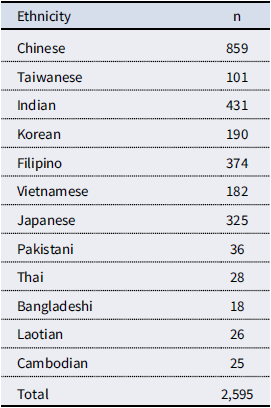
Of the CMPS sample, 2,991 respondents both identified as Asian and reported their ethnicity. After listwise deleting 396 respondents (14%) who did not answer one or more of the questions used to measure political fracturing, this left 2,595 respondents. Our analysis includes 12 self-reported ethnicities: Chinese, Taiwanese, Indian, Korean, Filipino, Vietnamese, Japanese, Pakistani, Thai, Bangladeshi, Laotian, and Cambodian. Some ethnic groups, such as Laotian, Thai, and Pakistani appear infrequently in the data (Table 1). Since low cell counts can bias statistical estimates in LCA, we replicate all analyses in Appendix A (Tables A1-A4) by combining smaller groups with larger ones based on geographic proximity to provide eight grouping with larger cell counts. Results from these analyses are consistent with those reported below.
Respondents by ethnicity in 2016 CMPS data

Political Fracturing
We capture political fracturing by including a battery of eight survey questions to measure political ideology, identity, trust, engagement, and issue opinion and by conducting LCA on the responses to the eight survey items. Appendix B provides details on question wording and response options. Political ideology is captured with self-reported ideology on a liberal-conservative scale. Political identity is captured by measuring whether respondents self-identify as Democrat, Republican, or Independent. We capture political engagement in two ways. First, we include respondents’ vote in the 2016 election as a measure of electoral participation. Second, we include a measure of political interest that increases in value when respondents express more interest in politics. Trust in government has been linked to political engagement both broadly and specifically for racial minorities (Devine Reference Devine2024; Levi and Stoker Reference Levi and Stoker2000; Peterson et al. Reference Peterson2020). A body of work finds racial minorities who have low faith the government will guard against discrimination by participating at higher levels (Kende et al. Reference Kende2023; Lien Reference Lien2006; Wu, Wilkes, and Wilson Reference Wu, Wilkes and Wilson2022). We capture trust in government by measuring whether respondents report trusting the federal government “to do what’s right” (Citrin and Stoker Reference Citrin and Stoker2018).
We choose three issue opinion questions that are particularly salient to Asian Americans: immigration, affirmative action, and the Black Lives Matter (BLM) movement. Immigration is a salient issue for Asian Americans due to the high immigration population relative to the general population (Tran Reference Tran2024) and due to significant variation among ethnic groups in the recency of migration experiences (Ramakrishnan et al. Reference Ramakrishnan2025). Affirmative action is a divisive topic for Asian Americans since certain groups, such as Indian Americans, are more likely to indicate support (Ruiz, Tian, and Krogstad Reference Ruiz, Tian and Krogstad2023), while others, such as Chinese Americans, are relatively likely to oppose affirmative action (Poon et al. Reference Poon2019). Prior studies also find that Asian Americans’ ethnic histories may affect their views toward Black Americans and support for movements intended to benefit Black Americans (Gaines and Lien Reference Gaines and Lien2025; Yamashita Reference Yamashita2022). The immigration measure captures whether respondents believe that immigration has a positive or negative impact on their communities. The affirmative action measure captures respondents’ support for policies intended to increase representation of under-represented minorities on college campuses. The BLM measure captures respondent support for the BLM social movement on a five-point scale.
Demographic Variables and Religion
In addition to political fracturing and ethnicity, we also include respondent sex, age, self-reported income, and self-reported education. Religion is captured using a categorical measure of seven self-reported categories: Catholic, Protestant, “other” Christian, Muslim, Hindu, Buddhist, and atheist/agnostic/non-religious. Descriptive statistics are provided in Appendix C.
Analytic Strategy
Our primary empirical task is to assess the extent and sources of political fracturing among Asian Americans. In line with prior studies (Kim Reference Kim2021), we assess political fracturing with LCA. LCA is suited for studying populations that have similar exterior characteristics but qualitatively different configurations of those characteristics (Weller, Bowen, and Faubert Reference Weller, Bowen and Faubert2020). Unlike alternative latent variable methods, such as factor analysis and principle component analysis, LCA is primarily interested in detecting nominal (unordered) latent variables, which may arise from systematically different combinations of answers to survey questions. As our first hypothesis highlights political ambivalence as a qualitatively distinct political division that is not easily situated on a liberal-to-conservative continuum, addressing our research question requires an analytic method capable of capturing qualitative differences between groups that are not easily quantified using latent continuous variables.
Our first hypothesis is that, descriptively, political fracturing should exist among Asian Americans and that ambivalence should be an important axis of this fracturing. Empirically, this can be tested by fitting multiple model configurations, retaining the solution that maximizes model fit, and assessing the relative size and composition of each resulting latent class. Three empirical patterns can be detected to falsify our descriptive hypothesis on political fracturing: (1) a single cluster provides the best-fitting solution to LCA, (2) the best-fitting solution contains multiple clusters but most respondents belong to a single large cluster, and (3) none of the clusters that emerge from LCA contain content emblematic of political ambivalence. These three empirical patterns would respectively suggest no statistically detectable political fracturing, substantively limited political fracturing between a majority subgroup and multiple smaller subgroups, or that ambivalence is not a salient dimension of political fracturing.
We conducted the LCA using the poLCA package in R (Linzer and Lewis Reference Linzer and Lewis2011). Following recommended best practice, we began with a single latent class and iteratively increased the number of classes, comparing information criteria to determine the best performing model (Masyn Reference Masyn and Little2013; Nylund-Gibson and Choi Reference Nylund-Gibson and Choi2018). Comparing across 1, 2, 3, and 4 class configurations, a three-class solution provided the best-fitting model (Appendix D, Tables D1–D4). The three-class solution provides the basis for our descriptive analysis on the prevalence and characteristics of political fracturing among Asian Americans. In the second stage of our analysis, we examine sources of political fracturing by predicting membership in each of the three latent classes as a function of respondent ethnic group, age, religion, education, income, and gender using logistic regression. We replicate all analyses using the 2020 wave of the CMPS data in Appendix E (Tables E1–E4), finding substantively similar results.
Results
Latent Class Analysis
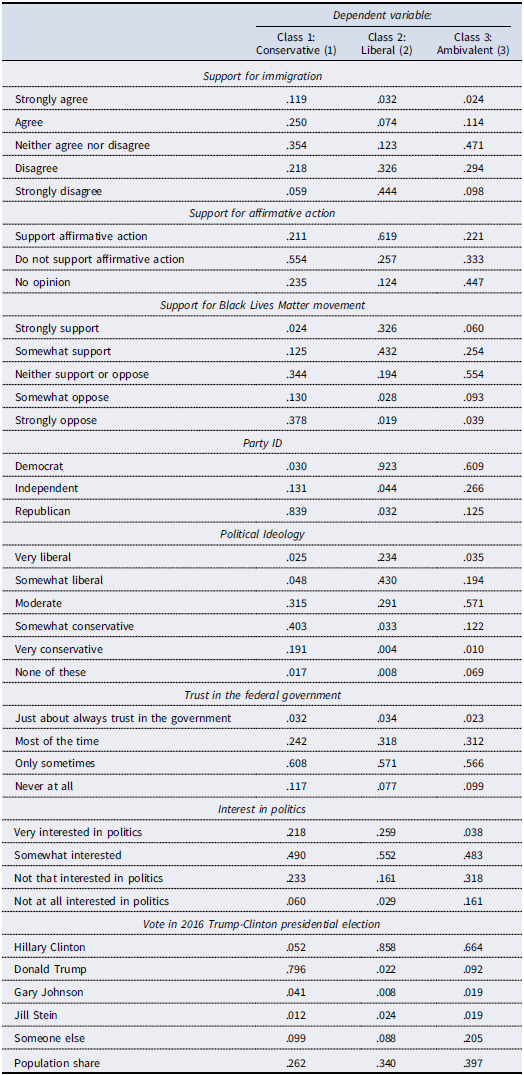
Table 2 reports the conditional probability of class membership by survey question. Roughly 26.2% of the sample is classified in Class 1, 34.0% is classified in Class 2, and 39.7% is classified in Class 3. The relative performance of a three-fit solution over a single-fit solution (Appendix D) is consistent with our expectations on the presence of political fracturing. This interpretation is further supported by the comparable sizes of each class, which suggests that combinations of survey question answers sort respondents into qualitatively distinct clusters with pluralistic representation.Footnote 1 As we detail below, these differences are especially important given that Democrat-leaning voters tend to disperse between Classes 2 and 3. Thus, although over 70% of Asian American voters voted Democrat in 2016 (AALDEF 2017), our results suggest that many of those voters did not exhibit support for key issues—affirmative action, BLM, and immigration—that mobilized more liberal Asian American voters.
Latent class analysis model displaying the estimated class-conditional response probabilities of each class. That is, each cell displays the probability of that class to give that response

Class 1 contains roughly 26% of respondents and exhibits key markers of conservatism. 85.80% of respondents in Class 1 identify as Republican and 60.06% identify as politically conservative. While only 61% of Class 1 respondents registered to vote and 58.3% voted in 2016, 82.10% expressed support for Trump over alternative presidential candidates. Only 21.15% of Class 1 respondents expressed support for affirmative action in higher education, and 51.48% opposed the BLM movement. As in other classes, there is low trust in the federal government—60.95% only sometimes trusted the federal government, and 11.98% never trusted the federal government. 48.08% of Class 1 respondents report being somewhat interested in politics and 21.89% report high interest. This class aligns with the line of research and media attention that has outlined a conservative splinter of Asian Americans who vote Trump, identify as conservative, and hold right-wing views on policy issues.
Class 2 contains roughly 34% of respondents and broadly expressed liberal orientations. 94.18% of Class 2 respondents identify as Democrat, 69.52% identify as liberal, and 87.10% expressed support for Clinton over alternative presidential candidates in the 2016 presidential election. Moreover, 64.84% of Class 2 respondents support affirmative action, 78.77% thought immigrants had a positive impact on their communities, and 78.08% support the Black Lives Matter movement. Like Class 1, Class 2 has relatively high levels of engagement: 58.68% registered to vote, 56.85% voted in the 2016 election, and 84.13% reported being either highly or somewhat interested in politics. 64.27% had low levels of trust in the federal government.
Consistent with our first hypothesis, Class 3 respondents stand out in terms of political ambivalence. Although Class 3 leans weakly Democrat in partisan identification and vote choice, they differ from Class 1 and 2 in terms of political interest, voting, identity, and ideology. Most Class 3 respondents identify as Democrat (60.02%), but the proportion of respondents in Class 3 that identify as Independent is 28.19%, over double Class 1 (12.43%) and far higher than Class 2 (2.85%). Similarly, although 66.63% of Class 2 supported Clinton in 2016, 21.19% supported “somebody else” in the 2016 election, over double Classes 1 (9.47%) and 2 (8.22%). 49.66% of Class 3 respondents report being uninterested in politics, compared to 30.03% of Class 1 and 15.88% of Class 2. Moreover, only 43.24% of Class 3 respondents registered to vote and 39.41% voted in 2016, compared to 61% registration and 58.3% voting in Class 1 and 58.58% registration and 56.85% voting in Class 2.
Hibbing and Theiss-Morse (Reference Hibbing and Theiss-Morse2002) reason that neutral opinions, lack of political participation, and low interest in politics are characteristic features of political ambivalence.Footnote 2 Hence, while roughly 59.44% of Class 3 identified as moderate, higher than both Class 1 (30.47%) and Class 2 (26.83%), Class 3 respondents also systematically reported low levels of political interest and neutral opinions on key social issues suggestive of ambivalence. 46.40% of Class 3 reported holding “no opinion” on affirmative action policies intended to increase minority representation on college campuses, compared to 23.08% in Class 1 and 10.27% in Class 2. The modal category for Class 3 on immigration was also “no opinion” (48.13%), compared to 35.06% of respondents in Class 1 and 11.07% in Class 2. 56.47% of Class 3 respondents neither supported nor opposed the BLM movement, compared to 34.32% of Class 1 and 17.81% of Class 2. The low levels of political interest combined with neutral opinions on immigration, affirmative action, and BLM—divisive issues for Asian Americans—and relatively low rates of voting and voter registration provide support to our hypothesis that ambivalence will be an axis of Asian American political fracturing.
Variation by Ethnic Group
LCA provides support to our first hypothesis that political fracturing should exist among Asian Americans, and that political ambivalence will be an important source of political fracturing. We now examine to what extent ethnicity, specifically the demographic and religious composition of different ethnic groups, shapes political fracturing by using logistic regression to analyze latent class membership among respondents.
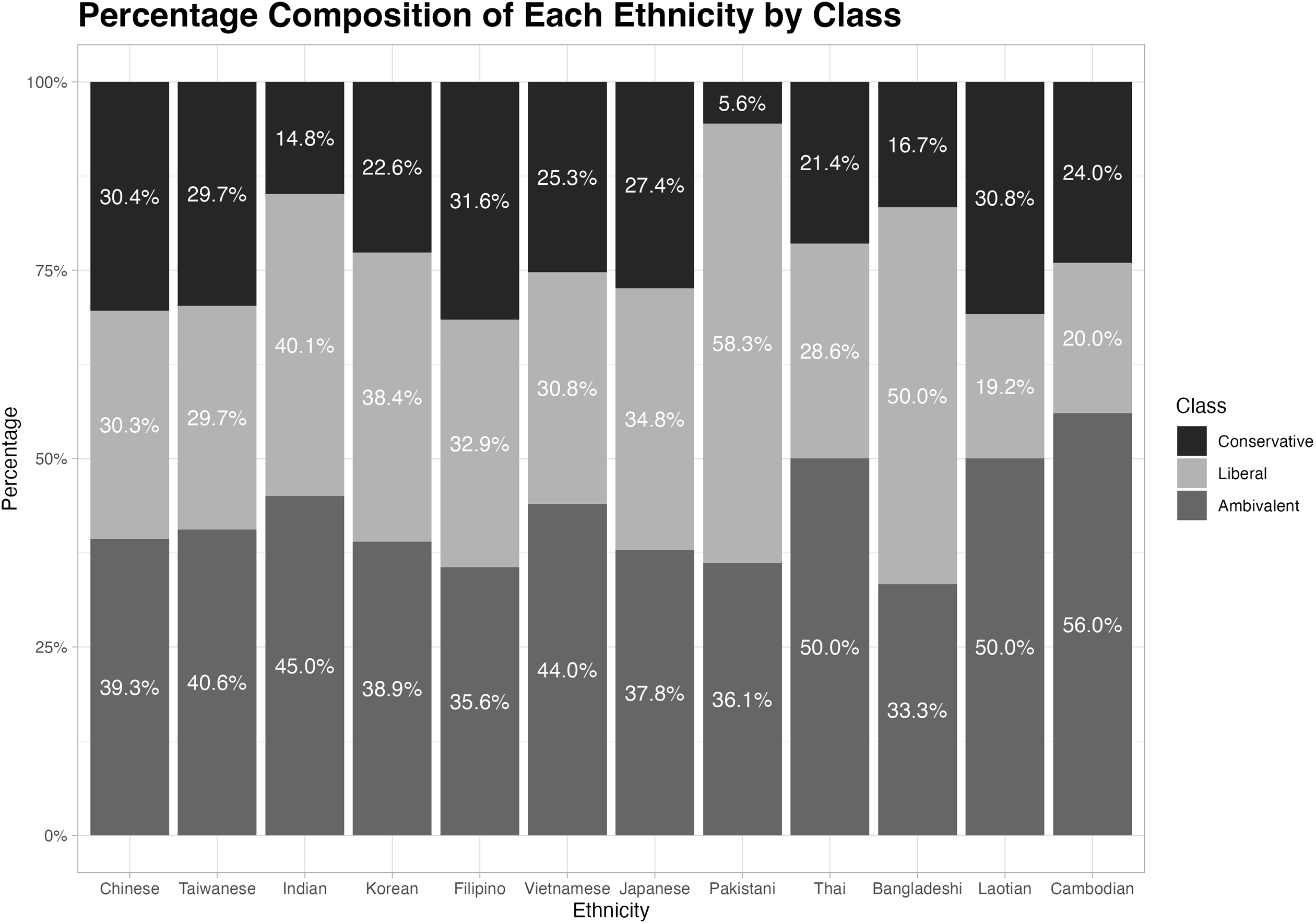
Figure 1 plots the class composition of each ethnic group, while Figure 2 plots the ethnic composition of each class. Among Chinese, Vietnamese, and Southeast Asians, the proportion of respondents classified in Class 3 (ambivalent) is larger than those classified in Class 2 (liberal). Chinese and Taiwanese respondents are evenly split between the classes, whereas only 15% of Indian respondents appear in Class 1 (conservative). Roughly one-third of the respondents in Class 1 (conservative) are Chinese American. A chi-squared test confirms statistically significant differences in the ethnic composition of each class (22, p < .001).
Percentage composition of each ethnicity by class.

Figure 1. Long description
A stacked bar graph compares the percentage composition of each ethnicity by class. The horizontal axis lists different ethnicities: Chinese, Taiwanese, Indian, Korean, Filipino, Vietnamese, Japanese, Pakistani, Thai, Bangladeshi, Laotian, and Cambodian. The vertical axis represents the percentage, ranging from 0 percent to 100 percent. Each bar is divided into three segments representing different classes: Conservative, Liberal, and Ambivalent. The color scheme includes black for Conservative, gray for Liberal, and dark gray for Ambivalent. Key values for each ethnicity are as follows: Chinese: Conservative 30.4 percent, Liberal 30.3 percent, Ambivalent 39.3 percent. Taiwanese: Conservative 29.7 percent, Liberal 29.7 percent, Ambivalent 40.6 percent. Indian: Conservative 14.8 percent, Liberal 40.1 percent, Ambivalent 45.0 percent. Korean: Conservative 22.6 percent, Liberal 38.4 percent, Ambivalent 38.9 percent. Filipino: Conservative 31.6 percent, Liberal 32.9 percent, Ambivalent 35.6 percent. Vietnamese: Conservative 25.3 percent, Liberal 30.8 percent, Ambivalent 44.0 percent. Japanese: Conservative 27.4 percent, Liberal 34.8 percent, Ambivalent 37.8 percent. Pakistani: Conservative 5.6 percent, Liberal 58.3 percent, Ambivalent 36.1 percent. Thai: Conservative 21.4 percent, Liberal 28.6 percent, Ambivalent 50.0 percent. Bangladeshi: Conservative 16.7 percent, Liberal 50.0 percent, Ambivalent 33.3 percent. Laotian: Conservative 30.8 percent, Liberal 19.2 percent, Ambivalent 50.0 percent. Cambodian: Conservative 24.0 percent, Liberal 20.0 percent, Ambivalent 56.0 percent.
Composition of each class by ethnicity.

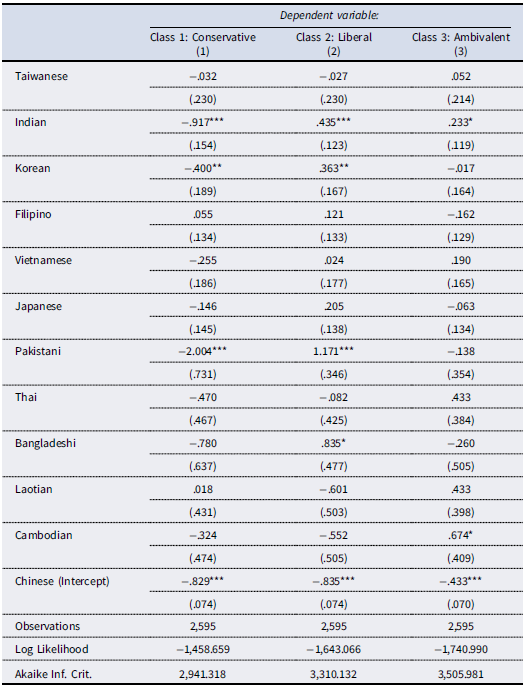
Table 3 presents results from logistic regression predicting respondents’ class membership as a function of ethnicity. Compared to Chinese Americans, Koreans, Indians, and Pakistanis are much less likely to appear in Class 1. This relationship reverses for Class 2, where Koreans, Indians, Pakistanis, and Bangladeshis are much more likely to be grouped into Class 2 compared to Chinese Americans. In contrast, there are few significant differences between ethnic groups when predicting membership in Class 3. The exceptions are Indians and Cambodians, who are significantly more likely to belong to Class 3 as compared to Chinese Americans. These results support our second hypothesis that ethnicity should contribute to political fracturing by shaping differences in political subgroup membership, especially between conservative-leaning Class 1 and liberal-leaning Class 2.
Simple logistic regression prediction by class

Table 3. Long description
The table presents results from logistic regression predicting respondents’ class membership as a function of ethnicity. It includes three classes: Conservative, Liberal, and Ambivalent. The table has 14 rows and 4 columns. The columns are labeled as Class 1: Conservative, Class 2: Liberal, and Class 3: Ambivalent. The row labels include different ethnic groups: Taiwanese, Indian, Korean, Filipino, Vietnamese, Japanese, Pakistani, Thai, Bangladeshi, Laotian, Cambodian, and Chinese. Each cell contains values representing the logistic regression results for each ethnic group within the respective class. The table also includes statistical significance indicators such as asterisks. The bottom of the table lists the number of observations, log likelihood, and Akaike Information Criterion values for each class.
Note: *p < .1; **p < .05; ***p < .01.
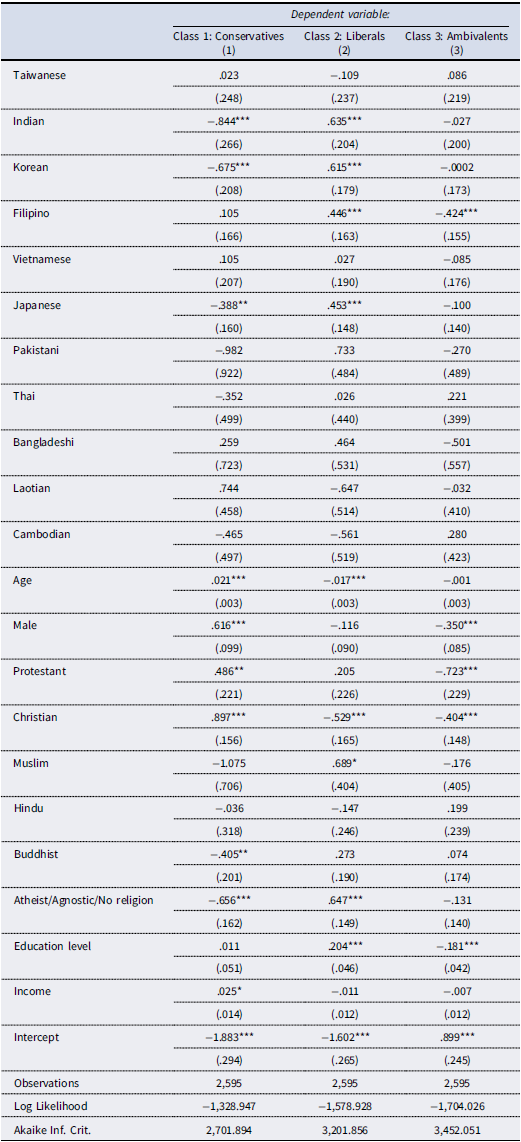
Table 4 includes controls for age, gender, religion, education, and income. Membership in conservative Class 1 is positively correlated with age and identifying as male. Respondents who are highly educated are more likely to be in liberal-leaning Class 2 than ambivalent Class 3. Religious differences are also apparent. Protestants and respondents who identified as “other” Christian are more likely to appear in Class 1 than Catholics and are less likely to appear in Class 3. Buddhists are less likely to appear in Class 1 when compared to Catholics, while Muslim and non-religious respondents are more likely to be classified into Class 2. “Other” Christians, Protestants, highly educated respondents, and men are less likely to belong to Class 3 when compared to Catholics, respondents with relatively low levels of education, and women.
Logistic regression prediction by class

Note: *p < .1; **p < .05; ***p < .01.
Importantly, including controls attenuates key ethnic differences in earlier models and uncovers new ones. The Filipino American group has gained significance and is now more likely to be classified into Class 2 and less likely to be classified into Class 3 compared to Chinese Americans. Japanese Americans now similarly are less likely to be classified into Class 1 and more likely to be classified into Class 2 compared to Chinese Americans. However, the Pakistani, Bangladeshi, and Cambodian groupings lost predictive power for all classes, suggesting that these ethnicity effects are explained by the contributions of education, age, and religion. These findings support our third and fourth hypotheses that age, education, and religion will partly explain the effects of ethnicity on political subgroup membership.
Taken in sum, our results uncover new evidence of political fracturing within the Asian American electorate. Respondents’ answers to a battery of eight survey questions on political ideology, identity, trust, engagement, and issue opinion coalesce around three distinct clusters that broadly align with conservative-leaning (Class 1), liberal-leaning (Class 2), and ambivalent (Class 3) political subgroups of Asian Americans. While ethnicity contributes to membership in distinct classes, results also indicate that some ethnic differences are explained by variation in religion, education, income, and age between ethnic groups.
Discussion
Our findings advance research on Asian American politics by describing the prevalence of political fracturing and evaluating its sources. By accounting for a broad range of questions on political ideology, identity, trust, engagement, and issue opinions, we report new evidence of political subgroup divisions that broadly sorts respondents into three political subgroups: conservative-leaning, liberal-leaning, and ambivalent. While findings indicate that ethnicity matters in creating these political subgroup divisions among Asian Americans, we also find effects from age, income, education, and religion that partly explain the effects of ethnicity on subgroup membership. These results advance current debates by providing new evidence of political fracturing within the Asian American electorate, assessing its relationship with ethnicity, and considering the effect of religion.
Previous research finds evidence that ethnicity affects issue opinions and political participation among Asian Americans (Kim Reference Kim2021; Masuoka et al. Reference Masuoka2018; Sadhwani Reference Sadhwani2022; Wong and Shah Reference Wong and Shah2021). Our results advance this research by including a broader range of ethnic groups and political attitudes, behaviors, and orientations than prior studies. By including questions related to ideology, identity, engagement, trust, and issue opinions simultaneously, we find evidence that political ambivalence provides a particularly important source of political fracturing, and that political ambivalence is not strongly associated with ethnicity in fully specified models (Table 4). Prior work has found that common identities that build on shared experiences and senses of linked fate help to create intergroup coalitions (Lien Reference Lien2001; Merseth Reference Merseth2018; Nicholson, Carter, and Restar Reference Nicholson, Carter and Restar2018; Sonenshein Reference Sonenshein1989; Wallsten and Nteta Reference Wallsten and Nteta2016; Pérez et al. Reference Pérez2023; Pérez, Vicuña, and Ramos Reference Pérez, Vicuña and Ramos2025; Tokeshi Reference Tokeshi2023). Our results suggest that Asian Americans who share common experiences of low educational achievement and Catholicism are likely to be disinterested in politics and hold few opinions on key issues. Thus, an important direction for future research is to explore whether some shared experiences (e.g., educational attainment, Catholicism) may offset certain ethnic groups’ representation in intergroup coalitions.
Moreover, the descriptive finding that roughly one third of respondents can be classified as ambivalent complicates a popular narrative of Asian Americans gaining political power based on current demographic growth projections. Our findings suggest that a significant cross section of this electorate holds few opinions on major social issues and expresses limited interest in politics. While prior research shows that even particularly difficult to reach Asian Americans can be engaged in civic efforts (Wong Reference Wong2008), our findings suggest that activists looking to get out the Asian American vote must contend with not just a widely varied electorate in terms of ethnicity, culture, religion, language, and history, but also with an electorate that is largely ambivalent to key social issues, trust in government, partisanship, and political interest.
Although research on Black and Latina/o/x politics directs considerable attention to how religion generates senses of linked fate and common interest (Jones-Correa and Leal Reference Jones-Correa and Leal2001; Verba, Schlozman, and Brady Reference Verba, Schlozman and Brady1995), religious diversity among Asian American ethnic groups has received relatively less attention as a possible source of political fracturing. Our results provide new evidence that religion partly explains the effect of ethnicity on political fracturing among Asian Americans, likely due to inconsistent access to religious institutions and variation in different belief systems. Future work can expand on our results by assessing how religion effects vary by ethnicity and by testing how much of the effect of religion on political fracturing can be attributed to differences in institutional access as opposed to political beliefs.
Scholars typically reason that minority groups can gain political power by creating coalitions, but coalition formation may be jeopardized by substantial attitudinal and behavioral heterogeneity in constituent groups. Most recently, Latina/o/x Americans have acted as crucial voters that exhibit a mix of liberal aligned policy priorities (e.g., immigration policy) with conservative policy priorities (e.g., abortion), and these issue opinions often vary by histories with Catholicism and Communist regimes (Corral and Leal Reference Corral and Leal2024; Irizarry Reference Irizarry2024; Segura Reference Segura2012). Scholars of Latina/o/x and Asian Americans have previously detected partisan fracturing within the group due to different identity attachments (Pérez, Lee, and Luna Reference Pérez, Lee and Luna2025; Zheng Reference Zheng2019), and future studies can expand on our results by evaluating the prevalence of political fracturing among other minority racial groups.
Racial minorities also vary intra-group by level of political engagement. Evidence that different political “styles” of engagement vary across racial and ethnic groups, (Kim Reference Kim2019), and that effect of religion on political engagement varies across African American immigration status (Smith Reference Smith2013), suggests that other racial minorities are affected by the same sociodemographic forces that predict the political ambivalence we find in our study. Detecting ambivalence among racial minority groups can shed light on their political opinions and behavior and has important normative implications (Pérez and Cobian Reference Pérez and Cobian2024). Political ambivalence in a hyperpolarized environment is somewhat surprising, particularly for Asian Americans, who have been characterized in opposite manners: both as apolitical and as growing in numbers and political influence (Wong et al. Reference Wong2011). Our findings suggest that an identifiable subgroup of politically ambivalent Asian Americans exists, and that the factors that predict ambivalence, such as lower levels of education and identification as Catholic, can be traced to structural barriers present in the United States rather than ethnic heterogeneity. This suggests that similar structural factors may influence other minority groups. Further studies should target to what extent within-group divisions among non-Asian American racial minorities vary by levels of political ambivalence.
Though recent efforts to mobilize Asian Americans have proven successful, particularly through appeals to self-interest (Lai Reference Lai2022), various ethnic groups become involved for different causes, suggesting that widespread mobilization may remain elusive. As our findings suggest, the likelihood of individual mobilization may be affected by a variety of demographic factors, notably ethnicity and religion, that behave structurally to create political fracturing. However, studies also show these same factors have the potential to engage Asian Americans into partisan or ideological groups. As such, it is currently unclear whether political fracturing dilutes Asian American political influence by creating internal divisions, or whether it creates opportunities for intergroup coalitions by aligning some segments of the Asian American electorate into highly motivated subgroups. While participation may vary over time as ambivalent voters sometimes awaken from inactivity to swing elections, our results suggest that efforts to mobilize Asian American votes are likely to run against important barriers to participation in the forms of low interest and neutral opinions on otherwise divisive issues (e.g., BLM, affirmative action, and immigration). Future research should examine the impact of political fracturing and related personal characteristics such as socioeconomic status and ethnic status in research on group mobilization and coalition formation involving politically fractured subgroups. Additionally, generational differences within Asian ethnic groups (particularly those with longer migrational histories) may also prove a source of division. For example, recent work on Chinese Americans suggests that opinions on affirmative action are split by generational cohort (Leung and Song Reference Leung and Song2021). Lastly, mixed-ethnicity Asians, despite growing as a substantial minority of many major ethnic groups, were excluded from our study and require further study.
In sum, we capitalize on granular data to measure political fracturing among Asian Americans. Results provide evidence of within-group political fracturing consistent with conservative-leaning, liberal-leaning, and ambivalent political subgroups. While this fracturing can be partly traced to ethnicity, we also find considerable contributions from age, education, and religion, especially among the ambivalent subgroup. The position of ambivalence in Asian American political fracturing may pose problems for Asian Americans political influence even as the group continues to grow and highlights the need for further research on within-group political divisions in contemporary scholarship on minority group politics.
Supplementary material
The supplementary material for this article can be found at https://doi.org/10.1017/rep.2026.10082.
Acknowledgments
We thank Meghana Sankaran for formative conversations and efforts that helped to develop this project.
Financial statement
This research did not receive any specific financial support.
Competing interests
The authors declare none.



 Open access

