Chronic pain (CP) is a multi-determined medical condition (Wang et al., Reference Wang, Hah and Carroll2009) characterized by constant or sporadic pain with duration of at least three months (Merksey & Bogduk, Reference Merksey and Bogduk1994). It seems to result from an interplay of both pathophysiological mechanisms (Pergolizzi et al., Reference Pergolizzi, Ahlbeck, Aldington, Alon, Coluzzi, Dahan, Huygen, Kocot-Kępska, Mangas, Mavrocordatos, Morlion, Müller-Schwefe, Nicolaou, Pérez Hernández, Sichère, Schäfer and Varrassi2013) and psychological factors (Edwards et al., Reference Edwards, Dworkin, Sullivan, Turk and Wasan2016). The prevalence of CP is reported to be between 12% and 51% in the Western population (Breivik et al., Reference Breivik, Collett, Ventafridda, Cohen and Gallacher2006; Fayaz et al., Reference Fayaz, Croft, Langford, Donaldson and Jones2016), with great impact on the quality of life of CP patients, both in their social and work-related capacities (Breivik et al., Reference Breivik, Eisenberg and O’Brien2013).
The multifactorial nature of CP demands integrative multidisciplinary approaches such as behavioral interventions (Scascighini et al., Reference Scascighini, Toma, Dober-Spielmann and Sprott2008). Cognitive-Behavioral Therapy seems to be an effective psychological approach for CP management (Williams et al., Reference Williams, Eccleston and Morley2012). Nevertheless, in the last two decades, behavioral approaches (not exclusively, but including) to CP have integrated a new focus of intervention: Fostering an acceptance and non-judgmental stance towards internal experiences (e.g., thoughts, emotions, physical sensations underlying the experience of pain) while focusing on valued actions, instead of considering pain reduction as the primary therapy goal (McCracken & Eccleston, Reference McCracken and Eccleston2003; McCracken & Vowles, Reference McCracken and Vowles2014). In addition, a new venue for research and intervention in CP seems to focus on the role of self-compassion (SC) and its beneficial effects, including on CP patients.
Self-compassion is described as the sensitivity to respond to one’s personal suffering with kindness (Neff, Reference Neff2003), accompanied by a genuine motivation to act in a way that alleviates that suffering (Gilbert, Reference Gilbert2005). Overall, evidence suggests that SC is negatively correlated with depressive and anxious symptoms (MacBeth & Gumley, Reference MacBeth and Gumley2012). Interventions that focus on SC seem to be effective in reducing psychopathology (Wilson et al., Reference Wilson, Mackintosh, Power and Chan2019) and in increasing health-related behaviors (Biber & Ellis, Reference Biber and Ellis2019).
The interest in exploring SC in CP is both theory and evidence based. SC is hypothesized to be part of a soothing-affiliative system of affect regulation. This system stems from mammalians’ evolutionary history of attachment (Gilbert, Reference Gilbert2005, Reference Gilbert2010, Reference Gilbert2014). Indeed, SC has been related to physiological processes relevant to pain regulation, such as vagally-mediated heart-rate variability (Rockliff et al., Reference Rockliff, Gilbert, Mcewan, Lightman and Glover2008), and oxytocin-endorphin systems (Rockliff et al., Reference Rockliff, Karl, Mcewan, Gilbert, Matos and Gilbert2011). Further, research suggests that SC is a relevant psychological process in CP (Vowles et al., Reference Vowles, Sowden and Ashworth2014), which has been related to less emotional distress and depressive symptoms (Costa & Pinto-Gouveia, Reference Costa and Pinto-Gouveia2013), to greater pain acceptance, lower levels of depression, stress and anxiety (Carvalho et al., Reference Carvalho, Gillanders, Palmeira, Pinto-Gouveia and Castilho2018), and lower levels of pain catastrophizing and pain disability (Wren et al., Reference Wren, Somers, Wright, Goetz, Leary, Fras, Huh, Rogers and Keefe2012). Also, compassion-related interventions have been proved to be beneficial in CP, enhancing chronic pain patients´ ability to be self-compassionate (Chapin et al., Reference Chapin, Darnall, Seppala, Doty, Hah and Mackey2014; Parry & Malpus, Reference Parry and Malpus2017). However, scientific literature still lacks a comprehensive discussion on the relationship between SC and pain-related outcomes (relevant in CP), as well as on the efficacy of compassion-related interventions in CP.
The aim of this study was to conduct a systematic review on the evidence of: (a) The efficacy of compassion-based interventions in CP; and (b) the association between SC and pain-related outcomes (e.g., pain intensity, pain interference, and pain acceptance). This systematic review extends previous theoretical reviews (Purdie & Morley, Reference Purdie and Morley2016) by providing a systematic analysis that focus on SC (and not compassion in general) in CP. Also, to our knowledge, this is the first systematic review of compassion-based interventions in CP.
Method
Protocol and Registration
This systematic review was developed in accordance to the Preferred Reporting Items for Systematic Reviews and Meta-Analyses (PRISMA) guidelines (Moher et al., Reference Moher, Liberati, Tetzlaff and Altman2009) and registered in the International Prospective Register of Systematic Reviews (PROSPERO) (CRD42019122112). It includes both observational and interventional studies. Ethics committee approval is not applicable.
Information Sources and Search Strategy
A systematic research was performed in four electronic databases: MEDLINE, EMBASE, PsycINFO and the Cochrane Library from inception until April 2020. The following terms were used to search for studies on the databases: "Chronic pain" or “persistent pain”, in combination with "self-compassion" or "compassion" or "kindness" or "soothing" or “common humanity”. Furthermore, additional eligible studies were drawn from the reference lists of the studies used on this paper.
Eligibility Criteria
We divided this systematic review into two questions that were analyzed separately, since there are two different aims. The first goal was to examine whether changes in pain-related outcomes occur following compassion-based interventions. The second, to evaluate the patterns of cross-sectional associations between SC and pain outcomes.
In Question 1, we included studies that involved adult patients diagnosed with CP (pain for more than three months, any kind of CP diagnosis) who participated in compassion-based psychological interventions that assessed at least one pain outcome. In Question 2, we included studies that involved samples of adults with CP, that tested cross-sectional correlations between SC and pain outcomes.
We excluded studies with children and adults diagnosed with acute pain. We did not consider case reports, reviews, opinion pieces, editorials, comments, news, letters, and grey literature. Only papers written in English, Portuguese or Spanish were considered.
Study Selection
The selection of the studies was performed in three stages, each by two reviewers (the same two reviewers for the three stages). Titles and abstracts were screened in the first stage, followed by full-text screening in the second stage. In both stages, a third reviewer solved any disagreement that did not reach a consensus.
Amongst the 51 studies considered for full-text screening, interobserver agreement during this phase was calculated using kappa statistic (k) (Viera & Garrett, Reference Viera and Garrett2005). In the third stage, studies were divided into two groups, according to the review questions. Missing or incomplete data were requested from the authors of given study.
Risk of Bias Assessment
Two reviewers assessed the risk of bias of each of the included studies. When necessary, a third reviewer solved disagreements between studies that have not reached a previous consensus between the two reviewers.
We used the quality assessment tools of National Heart, Lung, and Blood Institute (NHLBI) to evaluate the risk of bias of observational studies, cross-sectional studies, non-randomized controlled trials (RCT) and uncontrolled trials. These scales contain a list of criteria with key concepts, which are evaluated with yes, no or other (cannot determine, not applicable or not reported). A final quality rating, between good, fair and poor, is attributed based on previous criteria (NHLBI, 2020).
The Cochrane risk of bias tool was used for RCTs. It covers six domains of bias: Selection bias, performance bias, detection bias, attrition bias, reporting bias, and other bias. Each domain can be assessed as low risk, unclear or high risk of bias, according to each item (Higgins et al., Reference Higgins, Altman, Gøtzsche, Jüni, Moher, Oxman, Savović, Schulz, Weeks and Sterne2011).
Data Extraction and Synthesis
Data extraction and study quality assessment were performed by one reviewer and checked by a second reviewer, using a standardized form, created in Microsoft Excel. For articles included in Question 1, the extracted data contained: Study characteristics (study design, pain location, pain duration, enrolment criteria), patient demographics (gender, age), interventions characteristics (components, duration, type, professionals), and pain outcomes. For articles included in Question 2, we collected study characteristics, patient demographics, pain outcomes, SC scale, and correlation between pain outcome and SC. In the case of missing or incomplete data, clarification was requested by email to the corresponding author of the selected article.
Results
Study Selection
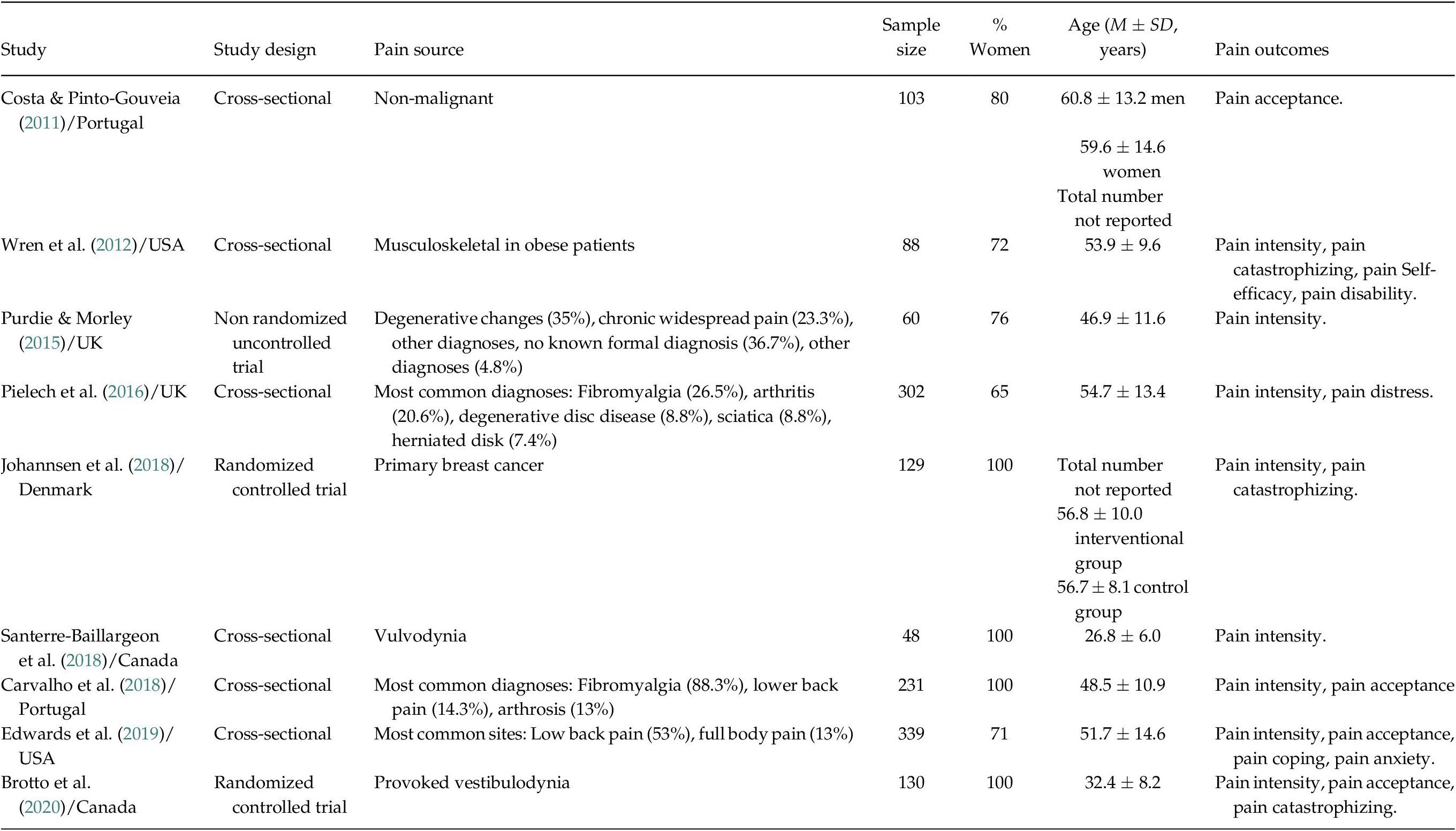
The results of the literature search are illustrated in the PRISMA flowchart depicted in Figure 1. Initially, 506 articles were identified from the databases and two identified from other sources. After review of titles and abstracts and removal of duplicates, 51 were assessed for full-text screening. We excluded 35 articles on the second phase. We identified 16 studies that fulfilled our criteria for inclusion in qualitative analysis: Seven articles for Question 1 and nine for Question 2. Full-text screening took place with substantial agreement between reviewers (inter-rater agreement 90.2%, k = 0.77). In Question 1, we excluded three interventional studies which covered multi-component interventions not exclusively nor mainly focused on SC (although they included SC elements in psychological intervention) (Boselie et al., Reference Boselie, Vancleef and Peters2018; Flink et al., Reference Flink, Smeets, Bergbom and Peters2015; Peters et al., Reference Peters, Smeets, Feijge, van Breukelen, Andersson, Buhrman and Linton2017). The characteristics of the selected studies are presented in Table 1 (Question 1) and Table 2 (Question 2).
PRISMA Flow Diagram
Note. PRISMA flow diagram from Moher et al., Reference Moher, Liberati, Tetzlaff and Altman2009; n = number.

Characteristics of Studies Question 1

Note. M = mean; N.A. = not applied; SC = self-compassion; SD = standard deviation; UK = United Kingdom; USA = United States of America.
a Fibromyalgia Impact Questionnaire, a measure of functional status of participants, which included a visual analogue scale answer format to refer to pain.
Characteristics of Studies Question 2

Note. M =mean; N.A. = not applied; RCT = randomized controlled trial; SD = standard deviation; UK = United Kingdom; USA = United States of America.
Question 1
Study Characteristics
For Question 1, we included seven studies of compassion-based interventions, in a total of 253 participants with CP. One study had as patients their own wait-list controls (n = 12) (Chapin et al., Reference Chapin, Darnall, Seppala, Doty, Hah and Mackey2014).
In this group of studies, mean age of patients ranged from 48.3 to 51.7 years, with a study presenting a mean age band between 20-59 years (Parry & Malpus, Reference Parry and Malpus2017) and other between 47-76 years (Gooding et al., Reference Gooding, Stedmon and Crix2020). The majority of the participants were women. In three studies (Carson et al., Reference Carson, Keefe, Lynch, Carson, Goli, Fras and Thorp2005; Chapin et al., Reference Chapin, Darnall, Seppala, Doty, Hah and Mackey2014; Ziemer et al., Reference Ziemer, Fuhrmann and Hoffman2017) ethnicity was described, and most participants were Caucasian. The intervention was delivered in group format in five studies, guided by one or two clinical psychologists (Carson et al., Reference Carson, Keefe, Lynch, Carson, Goli, Fras and Thorp2005; Gooding et al., Reference Gooding, Stedmon and Crix2020; Montero-Marin et al., Reference Montero-Marin, van Gordon, Shonin, Navarro-Gil, Gasión, López-del-Hoyo, Luciano and Garcia-Campayo2020; Parry & Malpus, Reference Parry and Malpus2017; Penlington, Reference Penlington2019), in class meetings guided by a compassion instructor in one study (Chapin et al., Reference Chapin, Darnall, Seppala, Doty, Hah and Mackey2014), and through individual online exercises in a single study (Ziemer et al., Reference Ziemer, Fuhrmann and Hoffman2017). Two interventional studies tested a SC writing exercise (Gooding et al., Reference Gooding, Stedmon and Crix2020; Ziemer et al., Reference Ziemer, Fuhrmann and Hoffman2017) and four studies tested interventions that used compassion meditation and/or imagery exercises such as loving-kindness intervention (Carson et al., Reference Carson, Keefe, Lynch, Carson, Goli, Fras and Thorp2005), compassion cultivation training (CCT) (Chapin et al., Reference Chapin, Darnall, Seppala, Doty, Hah and Mackey2014), and compassion-focused therapy (CFT) (Parry & Malpus, Reference Parry and Malpus2017; Penlington, Reference Penlington2019). Four studies (Gooding et al., Reference Gooding, Stedmon and Crix2020; Parry & Malpus, Reference Parry and Malpus2017; Penlington, Reference Penlington2019; Ziemer et al., Reference Ziemer, Fuhrmann and Hoffman2017) did not have a control condition, 1 had a wait-list control condition (Chapin et al., Reference Chapin, Darnall, Seppala, Doty, Hah and Mackey2014), 1 had a standard care control condition (Carson et al., Reference Carson, Keefe, Lynch, Carson, Goli, Fras and Thorp2005), and 1 had a relaxation condition as control (Montero-Marin et al., Reference Montero-Marin, van Gordon, Shonin, Navarro-Gil, Gasión, López-del-Hoyo, Luciano and Garcia-Campayo2020). All interventions were performed through weekly sessions; five with a duration of 120 minutes per session (Chapin et al., Reference Chapin, Darnall, Seppala, Doty, Hah and Mackey2014; Gooding et al., Reference Gooding, Stedmon and Crix2020; Montero-Marin et al., Reference Montero-Marin, van Gordon, Shonin, Navarro-Gil, Gasión, López-del-Hoyo, Luciano and Garcia-Campayo2020; Parry & Malpus, Reference Parry and Malpus2017; Penlington, Reference Penlington2019), one with 90 minutes (Carson et al., Reference Carson, Keefe, Lynch, Carson, Goli, Fras and Thorp2005), and one with 20 minutes (Ziemer et al., Reference Ziemer, Fuhrmann and Hoffman2017). One comprised three sessions (Ziemer et al., Reference Ziemer, Fuhrmann and Hoffman2017), four comprised eight sessions (Carson et al., Reference Carson, Keefe, Lynch, Carson, Goli, Fras and Thorp2005; Montero-Marin et al., Reference Montero-Marin, van Gordon, Shonin, Navarro-Gil, Gasión, López-del-Hoyo, Luciano and Garcia-Campayo2020; Parry & Malpus, Reference Parry and Malpus2017; Penlington, Reference Penlington2019), one comprised nine sessions (Chapin et al., Reference Chapin, Darnall, Seppala, Doty, Hah and Mackey2014), and one had a total of 12 sessions (Gooding et al., Reference Gooding, Stedmon and Crix2020). The samples involved mixed musculoskeletal pain in four studies (Chapin et al., Reference Chapin, Darnall, Seppala, Doty, Hah and Mackey2014; Gooding et al., Reference Gooding, Stedmon and Crix2020; Parry & Malpus, Reference Parry and Malpus2017; Ziemer et al., Reference Ziemer, Fuhrmann and Hoffman2017), low back pain in one study (Carson et al., Reference Carson, Keefe, Lynch, Carson, Goli, Fras and Thorp2005), non-malignant unspecified pain in one study (Penlington, Reference Penlington2019) and fibromyalgia in one study (Montero-Marin et al., Reference Montero-Marin, van Gordon, Shonin, Navarro-Gil, Gasión, López-del-Hoyo, Luciano and Garcia-Campayo2020).
Outcomes
Different compassion-related approaches were followed in the seven included interventional studies. One study tested a loving-kindness meditation intervention (Carson et al., Reference Carson, Keefe, Lynch, Carson, Goli, Fras and Thorp2005), which included didactic presentations, group exercises and discussions, and a home assignment based on 10-30 minutes audio-guided loving-kindness meditation exercises (consisting of recalling positive feelings of connection to a loved one, focusing on these feelings of kindness in the present moment, and employing silent mental phrases to direct these positive feelings towards a loved one). They showed significant reductions in pain intensity and usual pain comparing pre- and post-tests, without significant changes in control group. Meanwhile, reductions were observed in usual pain, worst pain, Pain Rating Index when comparing pre and follow-up tests. Additionally, the mean pre-post effect size for improvements in pain intensity and usual pain in the intervention group was .42.
One study was an online intervention (Ziemer et al., Reference Ziemer, Fuhrmann and Hoffman2017), in which participants were instructed to write once a week, for 20 minutes, about their CP experience on a self-compassionate perspective. There was a significant decrease in average reported pain intensity following SC writing, but it did not reveal any difference in chronic pain acceptance (activity engagement and pain willingness). While average illness intrusiveness scores decreased for SC intervention, it was not significant. Illness intrusiveness was used here as a measure of health-related quality of life in chronic pain, higher scores indicating greater interference as a result of chronic pain and its treatment. In addition, regression analyses indicated that pain catastrophizing was not a significant moderator for any of the outcome variables in the study.
One study was a CCT, which included didactics specific to compassion meditation (no pain-related didactics were provided), in-class meditation practices and group discussions (Chapin et al., Reference Chapin, Darnall, Seppala, Doty, Hah and Mackey2014). Here, pain intensity was significantly reduced at post-treatment compared to enrolment and standard treatment, instead of pain interference which had not significant differences. Paired t-tests showed significant improvements for pain acceptance pre- and post- intervention.
One study conducted an attachment-based compassion therapy (ABCT) (Montero-Marin et al., Reference Montero-Marin, van Gordon, Shonin, Navarro-Gil, Gasión, López-del-Hoyo, Luciano and Garcia-Campayo2020) focused on: (i) Developing self-directed kindness through breathing mindfulness exercises; (ii) compassionate body-scan; (iii) decreasing self-criticism with self-compassionate exercises; and (iv) developing interpersonal compassion through practices that foster gratitude, forgiveness and compassion towards others.
Three studies conducted compassion-focused therapy (CFT) based on psychoeducation regarding the affect regulation systems underlying the theoretical model of CFT (Gilbert, Reference Gilbert2005). This therapy considered the impact of these systems on psychological health and pain, mindfulness and compassion meditation practices, group discussions, between-sessions mindfulness, and compassion meditation exercises. It should be noted that, although the three interventions were CFT, in one of them compassion exercises were more focused on loving-kindness (Penlington, Reference Penlington2019), another one was more focused on compassionate imagery (e.g., safe place, compassionate self) (Parry & Malpus, Reference Parry and Malpus2017), and the last one was more focused on compassionate writing and soothing exercises (Gooding et al., Reference Gooding, Stedmon and Crix2020). Parry & Malpus (Reference Parry and Malpus2017) indicated that participants submitted to CFT reported lower scores for pain-related anxiety, higher scores of pain willingness and activity engagement. Penlington (Reference Penlington2019) reported that pain intensity reduced slightly after the intervention (effect size .23), pain distress showed a greater reduction (effect size .47) and there was a slight improvement of pain self-efficacy (effect size .36).
Although all studies included compassion-based interventions, the majority of them did not measure SC. Three of them evaluate SC through a self-compassion scale (SCS): Parry & Malpus (Reference Parry and Malpus2017) used 26-item SCS, Ziemer et al. (Reference Ziemer, Fuhrmann and Hoffman2017) used a 12-item SCS and Montero-Marin et al. (Reference Montero-Marin, van Gordon, Shonin, Navarro-Gil, Gasión, López-del-Hoyo, Luciano and Garcia-Campayo2020) the Spanish version of the SCS. Parry & Malpus (Reference Parry and Malpus2017) reported higher scores for SC, on the opposite in Ziemer et al. (Reference Ziemer, Fuhrmann and Hoffman2017) there was no significant change in SC. Montero-Marin et al. (Reference Montero-Marin, van Gordon, Shonin, Navarro-Gil, Gasión, López-del-Hoyo, Luciano and Garcia-Campayo2020) showed that ABCT group had significant improvement compared with relaxation condition for SC component.
Question 2
Study Characteristics
For Question 2, a total of nine studies evaluated the relationship between pain outcomes and SC, in a total of eight different outcomes and 1430 participants. Six out of nine studies were cross-sectional and three were interventional studies from which we collected baseline data before or after the intervention.
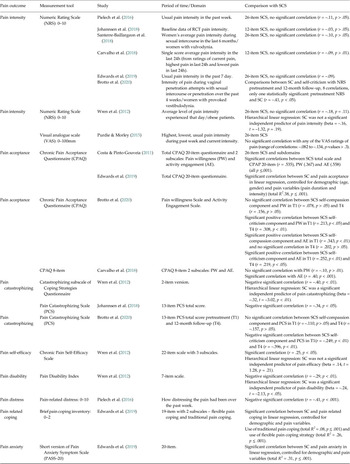
The studies related to Question 2 reported the following pain outcomes: Pain intensity, pain acceptance, pain catastrophizing, pain self-efficacy, pain disability, pain distress, pain coping and pain anxiety. The results of the different pain outcomes are summarized in Table 3.
Pain Outcomes for Question 2

Note. AE = activity engagement; CPAQ = Chronic Pain Acceptance Questionnaire; NRS = Numerical Rating Scale; PCS = Pain Catastrophizing Scale; PW = pain willingness; RCT = randomized controlled trial; SC = self-compassion; SCS = self-compassion scale; VAS = Visual Analogue Scale.
Outcomes
Each of the eight pain outcomes related with SC is presented in the following paragraphs. In most articles (Costa & Pinto-Gouveia, Reference Costa and Pinto-Gouveia2011; Edwards et al., Reference Edwards, Pielech, Hickman, Ashworth, Sowden and Vowles2019; Pielech et al., Reference Pielech, Bailey, McEntee, Ashworth, Levell, Sowden and Vowles2016; Purdie & Morley, Reference Purdie and Morley2015; Santerre-Baillargeon et al., Reference Santerre-Baillargeon, Rosen, Steben, Pâquet, Macabena Perez and Bergeron2018; Wren et al., Reference Wren, Somers, Wright, Goetz, Leary, Fras, Huh, Rogers and Keefe2012), SC was measured using the 26-item SCS (Neff, Reference Neff2003). SCS has been used as a total score or as six subdomains (self-kindness, common humanity, mindfulness, self-judgment, isolation and overidentification). The items are self-report rated from 1 (almost never) to 5 (almost always), with higher scores meaning higher levels of SC (Neff, Reference Neff2003). Two studies (Carvalho et al., Reference Carvalho, Gillanders, Palmeira, Pinto-Gouveia and Castilho2018; Johannsen et al., Reference Johannsen, O’Connor, O’Toole, Jensen and Zachariae2018) included the short-form 12-item version of SCS (Raes et al., Reference Raes, Pommier, Neff and van Gucht2011). Brotto et al. (Reference Brotto, Bergeron, Zdaniuk and Basson2020) used the two-factor model of SCS: SC factor and self-criticism factor.
Self-Compassion and Pain Intensity
Pain intensity was the most common outcome reported among studies addressing the relationship between pain outcomes and SC. It was reported in eight out of nine studies (Brotto et al., Reference Brotto, Bergeron, Zdaniuk and Basson2020; Carvalho et al., Reference Carvalho, Gillanders, Palmeira, Pinto-Gouveia and Castilho2018; Edwards et al., Reference Edwards, Pielech, Hickman, Ashworth, Sowden and Vowles2019; Johannsen et al., Reference Johannsen, O’Connor, O’Toole, Jensen and Zachariae2018; Pielech et al., Reference Pielech, Bailey, McEntee, Ashworth, Levell, Sowden and Vowles2016; Purdie & Morley, Reference Purdie and Morley2015; Santerre-Baillargeon et al., Reference Santerre-Baillargeon, Rosen, Steben, Pâquet, Macabena Perez and Bergeron2018; Wren et al., Reference Wren, Somers, Wright, Goetz, Leary, Fras, Huh, Rogers and Keefe2012). To measure pain intensity, these studies used either the Numeric Rating Scale (NRS), from 0 (no pain) to 10 (worst pain possible) (Brotto et al., Reference Brotto, Bergeron, Zdaniuk and Basson2020; Carvalho et al., Reference Carvalho, Gillanders, Palmeira, Pinto-Gouveia and Castilho2018; Edwards et al., Reference Edwards, Pielech, Hickman, Ashworth, Sowden and Vowles2019; Johannsen et al., Reference Johannsen, O’Connor, O’Toole, Jensen and Zachariae2018; Pielech et al., Reference Pielech, Bailey, McEntee, Ashworth, Levell, Sowden and Vowles2016; Santerre-Baillargeon et al., Reference Santerre-Baillargeon, Rosen, Steben, Pâquet, Macabena Perez and Bergeron2018), or the 0-100mm Visual Analogue Scale (VAS) (Purdie & Morley, Reference Purdie and Morley2015; Wren et al., Reference Wren, Somers, Wright, Goetz, Leary, Fras, Huh, Rogers and Keefe2012).
However, depending on the study, the scales were applied to different temporal measurements (last day, average, maximum, minimum during last week or last six months) and to different pain locations. Most studies did not reveal any significant association between pain severity and SC. In one RCT (Brotto et al., Reference Brotto, Bergeron, Zdaniuk and Basson2020), with women with provoked vulvodynia, out of eight correlations performed between SC and self-criticism, with NRS pre-treatment (P1) and 12 months follow-up (P2), score on vaginal pain intensity was correlated negatively with SC (r = -.41, p < .05).
Self-Compassion and Pain Acceptance
Four studies evaluated the association between pain acceptance and SC (Brotto et al., Reference Brotto, Bergeron, Zdaniuk and Basson2020; Carvalho et al., Reference Carvalho, Gillanders, Palmeira, Pinto-Gouveia and Castilho2018; Costa & Pinto-Gouveia, Reference Costa and Pinto-Gouveia2011; Edwards et al., Reference Edwards, Pielech, Hickman, Ashworth, Sowden and Vowles2019). In three of them (Brotto et al., Reference Brotto, Bergeron, Zdaniuk and Basson2020; Costa & Pinto-Gouveia, Reference Costa and Pinto-Gouveia2011; Edwards et al., Reference Edwards, Pielech, Hickman, Ashworth, Sowden and Vowles2019), the degree of pain was assessed through the Chronic Pain Acceptance Questionnaire (McCracken et al., Reference McCracken, Vowles and Eccleston2004). This is a 20-item self-report questionnaire, comprising two subscales: The activity engagement subscale (AE) and the pain willingness (PW) subscale. Higher results mean higher pain acceptance. One study (Carvalho et al., Reference Carvalho, Gillanders, Palmeira, Pinto-Gouveia and Castilho2018) used the shorter eight-item version (Fish et al., Reference Fish, McGuire, Hogan, Morrison and Stewart2010).
Costa & Pinto-Gouveia (Reference Costa and Pinto-Gouveia2011) concluded that the SC total scale has a moderate positive correlation with acceptance of pain total scale (r = .535, p ≤ .001) and AE (r = .558, p ≤ .001), and a weak positive correlation with PW (r = .367, p ≤ .001). This was also confirmed by Carvalho et al. (Reference Carvalho, Gillanders, Palmeira, Pinto-Gouveia and Castilho2018), whose work showed that AE had a positive moderate association with SC (r = .40, p < .001), although PW did not correlate significantly with SC. Also, Edwards et al. (Reference Edwards, Pielech, Hickman, Ashworth, Sowden and Vowles2019) evidenced that SC is positively associated with pain acceptance in cross-sectional linear regression, when controlled for demographic and pain variables. The overall model was significant, with SC accounting for 29% unique variance in pain acceptance scores (R2 = .38, p < .001) (Edwards et al., Reference Edwards, Pielech, Hickman, Ashworth, Sowden and Vowles2019). Brotto et al. (Reference Brotto, Bergeron, Zdaniuk and Basson2020) compared SC domain, self-criticism domain and AE, and PW at P1 and P2. This work showed significant associations between: (i) Self-criticism and PW at P1(r = .213, p < .05) and P2 (r = .308, p < .01); (ii) SC domain and AE only at P1 (r = .343, p < .01); and (iii) between self-criticism and AE in both periods (P1: r = .252, p < .01; P2: r = .219, p < .05).
Self-Compassion and Pain Catastrophizing
Three studies reported a negative significant association between SC and pain catastrophizing (Brotto et al., Reference Brotto, Bergeron, Zdaniuk and Basson2020; Johannsen et al., Reference Johannsen, O’Connor, O’Toole, Jensen and Zachariae2018; Wren et al., Reference Wren, Somers, Wright, Goetz, Leary, Fras, Huh, Rogers and Keefe2012). In the work of Wren et al. (Reference Wren, Somers, Wright, Goetz, Leary, Fras, Huh, Rogers and Keefe2012), pain catastrophizing was measured by the brief two-item version of the catastrophizing subscale of the Coping Strategies Questionnaire (Jensen et al., Reference Jensen, Keefe, Lefebvre, Romano and Turner2003). Patients were asked how often they experienced each item (“it is terrible and I feel it´s never going to get any better” and “I feel I can´t stand it anymore), on a seven-point Likert scale from 0 (never) and 6 (always). In this study (Wren et al., Reference Wren, Somers, Wright, Goetz, Leary, Fras, Huh, Rogers and Keefe2012), correlational analysis found that SC was negatively associated with pain catastrophizing (r = -.40, p < .01). In the hierarchical linear regression (HLR), SC was a significant independent predictor of pain catastrophizing (β = -.32, t = -3.02, p < .01).
The remaining studies (Brotto et al., Reference Brotto, Bergeron, Zdaniuk and Basson2020; Johannsen et al., Reference Johannsen, O’Connor, O’Toole, Jensen and Zachariae2018) used the total score of 13-item Pain Catastrophizing Scale (Sullivan et al., Reference Sullivan, Bishop and Pivik1995), which comprises three components: Rumination, magnification and helplessness. Patients report the degree to which certain thoughts and feelings are associated with their experienced pain, from 0 (not at all) to 4 (all the time); higher scores mean higher levels of pain catastrophizing. Johannsen et al. (Reference Johannsen, O’Connor, O’Toole, Jensen and Zachariae2018) showed a weak negative correlation between pain catastrophizing and SC (r = −.34, p < .05). Brotto et al. (Reference Brotto, Bergeron, Zdaniuk and Basson2020) revealed no significant correlation between pain catastrophizing and SCS self-compassion domain (both P1 and P2), and negative correlation between pain catastrophizing and SCS self-criticism domain, in P1 (r = -.249, p < .01) and P2 (r = −.396, p < .01).
Other Pain Outcomes
One study (Wren et al., Reference Wren, Somers, Wright, Goetz, Leary, Fras, Huh, Rogers and Keefe2012) explored the association between SC and pain self-efficacy through the 22-item Chronic Pain Self-Efficacy Scale (Anderson et al., Reference Anderson, Dowds, Pelletz, Edwards and Peeters-Asdourian1995). This scale contains three subscales (self-efficacy for pain control, for physical function and for coping with symptoms), which are averaged to achieve a total score, higher scores represent higher self-efficacy for pain. Correlational analysis found that SC was associated with pain self-efficacy (r = .25, p < .05). Whereas, in the HLR, conducted to examine the contribution of SC to pain self-efficacy, SC was not a significant predictor of pain self-efficacy (β = .14, t = .128, p = .21).
One study (Wren et al., Reference Wren, Somers, Wright, Goetz, Leary, Fras, Huh, Rogers and Keefe2012) tested the association between SC and pain disability. Pain-related disability was measured with the Pain Disability Index, a seven-item scale that measures the degree of a patient´s disability within seven life domains (Tait et al., Reference Tait, Chibnall and Krause1990). Patients classified each item from 0 (no disability) to 10 (total disability); higher scores indicating higher level of disability. This study showed that, in the correlational analysis, patients experiencing higher levels of SC reported less pain disability (r = -.29, p < .01), and that in the HLR, SC was a significant independent predictor of pain disability (β = -.24, t = -2.13, p < .05) (Wren et al., Reference Wren, Somers, Wright, Goetz, Leary, Fras, Huh, Rogers and Keefe2012).
One study (Pielech et al., Reference Pielech, Bailey, McEntee, Ashworth, Levell, Sowden and Vowles2016) showed that the level of pain-related distress had a negative association with SC (r = -.41, p < .001). Patients reported how distressing the pain had been over the past week, on a scale of 0 (not distressing) to 10 (extremely distressing).
Edwards et al. (Reference Edwards, Pielech, Hickman, Ashworth, Sowden and Vowles2019) tested the association between SC and pain related coping. This outcome was measured using the 19-item Brief Pain Coping Inventory-2 (McCracken et al., Reference McCracken, Eccleston and Bell2005), which contains two subscales: (i) Use of flexible pain coping strategies (psychological flexibility); and (ii) use of traditional pain coping strategies (exercise, relaxation, distraction and positive self-statements). Flexible coping strategies include pain acceptance and pain-related distress. For each item, patients were asked to refer the number of days in which they had used each coping strategy, in the last week. Items were then summed and higher scores mean higher utilization of coping strategies. To test the relationship between SC and both mentioned subscales, the authors conducted a cross-sectional linear regression, controlling for demographic and pain variables. SC accounted for a significant and unique amount of variance in use of flexible pain coping strategies (total R2 = .26, p ≤ .001) and in use of traditional pain coping strategies (R2 = .08, p ≤ .001) (Edwards et al., Reference Edwards, Pielech, Hickman, Ashworth, Sowden and Vowles2019).
Edwards et al. (Reference Edwards, Pielech, Hickman, Ashworth, Sowden and Vowles2019) tested the association between SC and pain anxiety using the 20-item short version of Pain Anxiety Symptom Scale (McCracken et al., Reference McCracken, Zayfert and Gross1992). This scale assesses four domains corresponding to aspects of pain anxiety: Cognitions, physiological anxiety symptoms, fear of pain, and attempts at escape/avoidance of pain. Patients were asked to evaluate how frequently each item occurred, from 0 (never) to 5 (always). SC had a negative association with patient anxiety and accounted for a significant and unique amount of variance in pain anxiety (total R2 = .31, p ≤ .001).
Risk of Bias Assessment
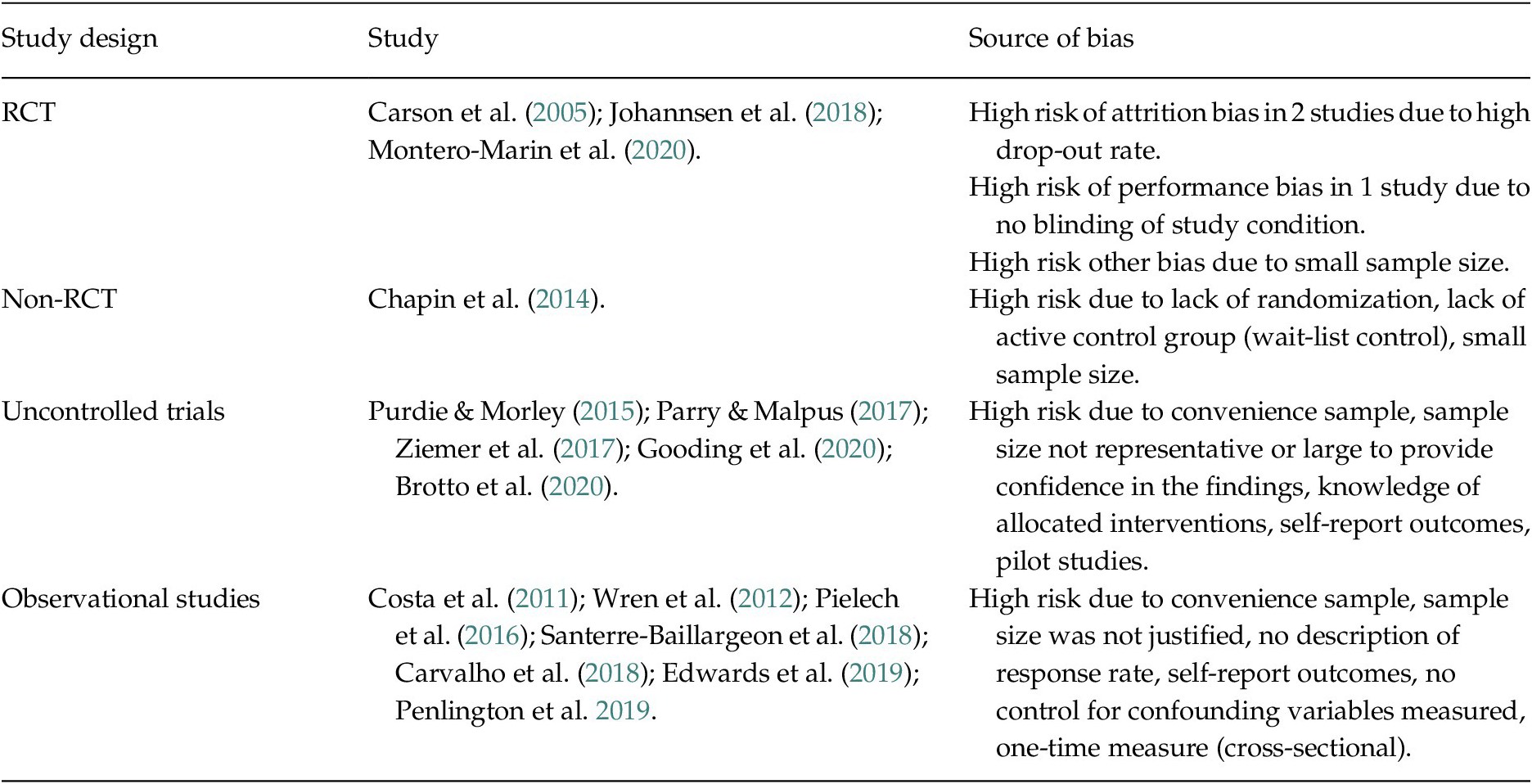
Table 4 shows a summary of the included articles evaluated with NHLBI quality assessment tools and with the Cochrane risk of bias tool. Overall, the observational studies in the review were rated as poor, with a high risk of bias due to convenience samples, small sample size, self-reported outcomes, absence of control for confounders, and cross-sectional design.
Risk of Bias Assessment of Studies

Note. RCT = randomized controlled trial.
From a total of nine interventional studies (found through the searches), three were RCT, one was non-RCT and five were uncontrolled trials. Most of the studies had high risk of bias due to lack of randomization, not representative or large sample size, and knowledge of allocated interventions.
Discussion
Discussion of Question 1: the Efficacy of Compassion-Based Interventions in CP
In this study, we performed a systematic review of compassion-related interventions in CP. To our knowledge, this is the first study to sum up evidence of the impact of these interventions in relevant CP outcomes.
The heterogeneity of the interventions included in the current study (i.e., different formats and different exercises/strategies to cultivate compassion) precludes us from establishing definitive conclusion regarding the efficacy of compassion-based interventions in CP. However, results seem to overall suggest that compassion-related interventions present benefits for patients with CP. In fact, regarding the efficacy of the compassion-related interventions (Question 1), it should be noted that the 7 included studies (Carson et al., Reference Carson, Keefe, Lynch, Carson, Goli, Fras and Thorp2005; Chapin et al., Reference Chapin, Darnall, Seppala, Doty, Hah and Mackey2014; Gooding et al., Reference Gooding, Stedmon and Crix2020; Montero-Marin et al., Reference Montero-Marin, van Gordon, Shonin, Navarro-Gil, Gasión, López-del-Hoyo, Luciano and Garcia-Campayo2020; Parry & Malpus, Reference Parry and Malpus2017; Penlington, Reference Penlington2019; Ziemer et al., Reference Ziemer, Fuhrmann and Hoffman2017) addressed different types of interventions, not only in format (e.g., face-to-face group, online), but also in content (e.g., some with psychoeducation on pain, some with writing, some with mindfulness and compassion meditation). Indeed, a deeper discussion is warranted regarding the concept and definition of compassionate-based intervention, which seems to include a heterogeneous set of interventions (Kirby, Reference Kirby2017). Although not specific to CP, different compassion interventions that vary according (but not exclusively) to their theoretical underpinning can be identified: Compassion-Focused Therapy (CFT) (Gilbert, Reference Gilbert2005, Reference Gilbert2014), Mindful Self-Compassion (MSC) (Neff & Germer, Reference Neff and Germer2013), Attachment-Based Compassion Therapy (ABCT) (Campayo & Demarzo, Reference Campayo and Demarzo2015), CCT (Jazaieri et al., Reference Jazaieri, McGonigal, Jinpa, Doty, Gross and Goldin2014), and loving-kindness interventions (Hofmann et al., Reference Hofmann, Grossman and Hilton2011). Thus, the differences in the conceptualization of the compassion construct (Muris & Otgaar, Reference Muris and Otgaar2020; Neff et al., Reference Neff, Whittaker and Karl2017), as well as in the assertion of the necessary core components of a compassion-based intervention, creates challenges in examining if overall compassion interventions are empirically sound.
Only three of the seven studies reported a measurement of SC, and one of them used the short form of the SC scale (Montero-Marin et al., Reference Montero-Marin, van Gordon, Shonin, Navarro-Gil, Gasión, López-del-Hoyo, Luciano and Garcia-Campayo2020). The SC scale with 26-items is the most frequently used scale to measure SC in literature (Neff, Reference Neff2003). In addition, not all of these three interventions have the same improvements in the SC scale. Although the SC writing exercise in Ziemer et al. (Reference Ziemer, Fuhrmann and Hoffman2017) did not change SC, changes in SC scores were associated with a decrease in illness intrusiveness and an increase in activity engagement and pain willingness scores, when controlling for pre-intervention scores.
Regarding changes in pain outcomes following compassion-based interventions, although the results show promising findings, they should be interpreted with caution. Nine different pain outcomes were evaluated: Pain intensity, pain interference, pain acceptance, pain anxiety, pain catastrophizing, pain self-efficacy, pain distress and pain disability. It is clear that there is no consensus on appropriate pain measures - for example, even the same outcome was measured using different scales in different studies. Furthermore, we are not able to compare these interventions given that they are different types of compassion-based interventions with mixed results, with different time point assessments of post treatment data, and with different pain diagnoses.
Discussion of Question 2: The Association between SC and Pain-Related Outcomes
Also, the current review sought to examine the patterns of association between SC and relevant pain-related outcomes. However, the results of the nine selected articles (Brotto et al., Reference Brotto, Bergeron, Zdaniuk and Basson2020; Carvalho et al., Reference Carvalho, Gillanders, Palmeira, Pinto-Gouveia and Castilho2018; Costa & Pinto-Gouveia, Reference Costa and Pinto-Gouveia2011; Edwards et al., Reference Edwards, Pielech, Hickman, Ashworth, Sowden and Vowles2019; Johannsen et al., Reference Johannsen, O’Connor, O’Toole, Jensen and Zachariae2018; Pielech et al., Reference Pielech, Bailey, McEntee, Ashworth, Levell, Sowden and Vowles2016; Purdie & Morley, Reference Purdie and Morley2015; Santerre-Baillargeon et al., Reference Santerre-Baillargeon, Rosen, Steben, Pâquet, Macabena Perez and Bergeron2018; Wren et al., Reference Wren, Somers, Wright, Goetz, Leary, Fras, Huh, Rogers and Keefe2012) are limited. First, few studies explored the same outcome and different studies used different instruments to measure the same construct. Second, different time periods and the heterogeneity of the samples hinder comparisons between studies. Third, different studies opted for different versions of the self-compassion scale (SCS); some used the longer 26-item version, and others used the short 12-item version. This limitation is not exclusive to the CP context. In fact, the generic measurement of SC (not only in the context of CP) is the topic of a broad undergoing discussion. Regarding the self-compassion scale (SCS) and its psychometrics, two main positions can be identified. One argues that the original factor structure of six subscales and 1 total score is sound both in theoretical and empiric terms (Neff, Reference Neff2016, Reference Neff2019). The other posits that a two-factor structure is the best approach and the most robust way of using the SCS (Muris & Otgaar, Reference Muris and Otgaar2020; Muris et al., Reference Muris, van den Broek, Otgaar, Oudenhoven and Lennartz2018). On a practical perspective, some authors use the total score or the six-factor structure and others the two-factor structure, creating additional challenges in establishing definitive conclusions.
Overall, research on the association between pain intensity and SC shows an absence of significant correlation except for a single study (Brotto et al., Reference Brotto, Bergeron, Zdaniuk and Basson2020), which showed a negative moderate correlation. It has been hypothesized that compassion may be rooted in affiliative affect regulation systems that control pain modulation processes and neurotransmitters (e.g., oxytocin, vasopressin). However, these results seem to indicate that pain intensity is not significantly correlated to SC. It should be noted that the only study in which pain intensity correlated with SC was conducted in vaginal pain during penetration, while most of the other studies were focused on musculoskeletal pain. A possible justification is that sexual-related pain is experienced with more toxic psychological emotions (e.g., shame) than overall musculoskeletal pain, and thus SC plays a more relevant role. More studies should be conducted to better understand the role of SC in pain intensity according to the locus and type of pain.
SC was positively associated with pain-acceptance in two studies (Costa & Pinto-Gouveia, Reference Costa and Pinto-Gouveia2011; Edwards et al., Reference Edwards, Pielech, Hickman, Ashworth, Sowden and Vowles2019) and with AE in a single one (Carvalho et al., Reference Carvalho, Gillanders, Palmeira, Pinto-Gouveia and Castilho2018). Costa & Pinto-Gouveia (Reference Costa and Pinto-Gouveia2011) compared SCS subdomains with PW and AE. The study evidenced that patients with more AE and more willingness to pain presented more kindness, mindfulness and common humanity, which are core elements of SC. Our findings are consistent with the concept that SC is significantly related to acceptance, in particular acceptance of pain. Indeed, the overlapping of SC with related constructs, such as mindfulness and acceptance, is being discussed in literature, given that these constructs are conceptualized as highly related. For example, a core aspect of being self-compassionate is mindful awareness of personal suffering which implies a stance of non-judgment and unconditional acceptance (Neff & Dahm, Reference Neff, Dahm, Ostafin, Robinson and Meier2015; Neff & Tirch, Reference Neff, Tirch, Kashdan and Ciarrochi2013).
Two studies (Johannsen et al., Reference Johannsen, O’Connor, O’Toole, Jensen and Zachariae2018; Wren et al., Reference Wren, Somers, Wright, Goetz, Leary, Fras, Huh, Rogers and Keefe2012) reported that CP patients who have more SC, may experience less pain catastrophizing. One of them included only patients with obesity and with musculoskeletal pain, and the other included women treated for primary breast cancer. One study (Brotto et al., Reference Brotto, Bergeron, Zdaniuk and Basson2020) confirmed this association only for the self-criticism domain of SC. Given that pain catastrophizing is a psychological process of being entangled with the anticipation of pain-related catastrophe, this implies that catastrophizing is a threat-focused process. SC, on the other hand, is an affiliative affect regulation process that fosters warmth and soothing and deactivates the threat-focused affect systems. Also, the inherent present moment awareness, entailed in SC, implies a distancing stance towards difficult experiences (such as pain), which can interrupt catastrophizing.
Several pain outcomes were correlated with SC in a single study: Pain self-efficacy, pain disability, pain distress, pain related coping, and pain anxiety. Self-efficacy is defined as one´s belief in one´s ability to accomplish a specific outcome (Bandura, Reference Bandura1997). A Turkish study demonstrated that SC is associated with self-efficacy for learning in university students (Iskender, Reference Iskender2009). Wren et al. (Reference Wren, Somers, Wright, Goetz, Leary, Fras, Huh, Rogers and Keefe2012) confirmed this association in CP obese patients. Regarding the association between SC and pain disability, a study found a significant negative association. Pain disability consists of the impairment resulting from the impact of CP on daily life. SC, in addition to being a response to personal suffering and difficulties, with warmth and kindness, is also a behavioral-oriented psychological process, i.e., it motivates engaging in personal valued actions, which in turn leads to less disability. This may be related to the fact that SC seems to result in less depressive symptoms because it entails engaging with acceptance in valued activities (Carvalho et al., Reference Carvalho, Gillanders, Palmeira, Pinto-Gouveia and Castilho2018).
Theoretical and empirical models of SC predicted that it would be related with improved wellbeing and reduced emotional distress (Gilbert, Reference Gilbert2010; Neff & Germer, Reference Neff, Germer, Seppälä, Simon-Thomas, Brown, Worline, Cameron and Doty2017). Other studies examined the relationship between SC and psychological distress in adolescents and found that higher levels of SC were associated with lower levels of distress (Marsh et al., Reference Marsh, Chan and Macbeth2018; Pielech et al., Reference Pielech, Bailey, McEntee, Ashworth, Levell, Sowden and Vowles2016). Overall, these findings show that SC can reduce pain interference, instead of pain intensity itself.
General Discussion
This review has several strengths. First, although we can find topical reviews (Purdie & Morley, Reference Purdie and Morley2016) on SC in CP, this is the first systematic review focusing on this subject. Also, our review is based on two well-defined questions that allowed addressing two relevant and related topics: (a) Is promoting SC useful in CP?, and (b) what role does SC play in CP? If we manage to understand the relation between SC and CP, it is more likely for us to develop specific evidence-based compassion-focused interventions which will be effective for CP management. The scales used in the studies included in this review were validated, and language was not a boundary since all studies included in full-text stage were written in English.
However, this review has several limitations, reflecting the early stage of research of compassion in CP. First, since RCTs were limited, data from non-randomized studies and observational studies were included, thus contributing to a poorer-quality evidence. Second, many studies had high risk of bias due to the lack of randomization, absence of control group, unblinded study condition, high drop-out rate and small sample size. These limitations are related to the fact that some of the included studies are pilot studies (Carson et al., Reference Carson, Keefe, Lynch, Carson, Goli, Fras and Thorp2005; Chapin et al., Reference Chapin, Darnall, Seppala, Doty, Hah and Mackey2014; Parry & Malpus, Reference Parry and Malpus2017; Ziemer et al., Reference Ziemer, Fuhrmann and Hoffman2017). Future research should be conducted in representative samples, with control groups (for example relaxation condition (Montero-Marin et al., Reference Montero-Marin, van Gordon, Shonin, Navarro-Gil, Gasión, López-del-Hoyo, Luciano and Garcia-Campayo2020), psychoeducation, and psychological treatment as usual), larger samples and for longer follow-up periods, in order to assess the effects of compassion-based interventions in CP with more accuracy. Third, many studies had convenience samples and used self-reported outcomes. Since self-reported questionnaires may entail social desirability bias, future studies should consider the inclusion of other types of measures (observational ones), such as the number of doctor visits and type of medication. Due to the cross-sectional nature of these results, they can only be interpreted in terms of associations and, therefore, causality cannot be drawn. In this context, we cannot rigorously conclude whether SC alters pain outcomes or vice versa. In addition, studies included in our analysis addressed different pain sources such as musculoskeletal pain, vulvodynia, and oncologic pain. The different physio-pathological mechanisms deter us from establishing definitive conclusions. Finally, most studies had a predominance of women and some of them included only women conditions such as vulvodynia (Brotto et al., Reference Brotto, Bergeron, Zdaniuk and Basson2020; Santerre-Baillargeon et al., Reference Santerre-Baillargeon, Rosen, Steben, Pâquet, Macabena Perez and Bergeron2018), limiting further generalization to other genders.
Our review addresses compassion-based interventions that are theoretically hypothesized to increase SC and improve pain outcomes. Future studies are needed to explore the mediators of this relationship.
Since the evidence provided by RCT was insufficient, our review included also observational studies, non-RCT and uncontrolled studies. Some of the included articles were single group studies, with pre- to post-intervention responses. This design is common in systematic reviews of emerging treatments and might continue to be an important evidence base for certain interventions (Paulus et al., Reference Paulus, Dahabreh, Balk, Avendano, Lau and Ip2014).
The current systematic reflects early evidence, given that it could not produce more robust data due to lack of standardization. Nevertheless, this review contributes to summarize knowledge on CP and SC and can drive future investigations to embrace more homogenous efficacy parameters for this type of intervention.
Considering the heterogeneity among studies and the overall poor-quality assessment, we could not draw definitive conclusions on the efficacy of compassion-based interventions nor on the association between SC and pain outcomes. However, this systematic review organizes and summarizes the available literature on these topics, leveraging the development of large-scale, high-quality trials in this research area.