Implications
In sheep production, weaning of lambs can be very stressful for both the dam and the offspring. Therefore, it is important to develop methods to minimize the behavioural and physiological responses to weaning. The present data show that administration of luteal levels of progesterone modifies the behavioural and physiological responses of the ewe to weaning indicative of reduced stress. Furthermore, treating ewes with progesterone to induce or synchronize oestrus, a relatively common practice in dairy sheep production, does not affect milk production.
Introduction
The ewe–lamb bond is selectively established during the first 1 to 2 h after lambing (Poindron et al., Reference Poindron, Levy and Keller2006). From then on, the young progressively achieve nutritional and social independence from the dam (Weary et al., Reference Weary, Jasper and Hötzel2008), culminating in natural weaning when lambs are 4 to 5 months old (Arnold et al., Reference Arnold, Wallace and Maller1979). However, according to Napolitano et al. (Reference Napolitano, Rosa and Sevi2008), in sheep production systems lambs are separated from the dams at an earlier age, which may provoke behavioural and physiological responses indicative of stress in both the ewe and the lamb. For example, after abrupt separation from the lamb, ewes increase the frequency of vocalizations (Orgeur et al., Reference Orgeur, Mavric, Yvore, Bernard, Nowak, Schaal and Levy1998 and Reference Orgeur, Bernard, Naciri, Nowak, Schaal and Levy1999) and the time spent standing, and reduce the time they spend lying and ruminating (Cockram et al., Reference Cockram, Imlah, Goddard, Harkiss and Waran1993). In addition, weaning of the lambs provokes physiological changes in ewes, including an increase in cortisol concentration (Pérez-León et al., Reference Pérez-León, Orihuela, Lidfors and Aguirre2006). Although to the best of our knowledge there is no information on sheep, in cows the albumin serum concentration decreases and total serum protein increases during the first few days after weaning of calves (Ungerfeld et al., Reference Ungerfeld, Hötzel, Scarsi and Quintans2011). In this sense, it has been reported in lambs that repeated restraint and isolation generate a decrease in serum total protein concentration (Apple et al., Reference Apple, Minton, Parsons and Unruh1993). In addition, early separation from the ewe decreases the antibody titre of the lamb (Napolitano et al., Reference Napolitano, Marino, De Rosa, Capparelli and Bordi1995). Thus, considering that weaning in farm animals is one of the most stressful management practices for the dam, it is important to develop alternatives to minimize these responses.
Besides many important reproductive functions, it has been widely reported that progesterone (P4) has anxiolytic and sedative effects in rodents through the union of its metabolites that contain 3α-hydroxyl group to the γ-aminobutyricacidA (GABAA) receptor (Lambert et al., Reference Lambert, Cooper, Simmons, Weir and Belelli2009). More specifically, it has been observed that those metabolites bind to the GABAA receptor in sheep central nervous system-isolated tissue in vitro (Crossley et al., Reference Crossley, Walker, Beart and Hirst2000), indicating that this could be the pathway of its anxiolytic and sedative effects. In rats, these metabolites provoke a decrease in corticotropin-releasing hormone mRNA expression, and thus the secretion of adrenocorticotropic hormone and glucocorticoids, reducing the physiological (Patchev et al., Reference Patchev, Hassan, Holsboer and Almeida1996; Barbaccia et al., Reference Barbaccia, Serra, Purdy and Biggio2001; Brunton et al., Reference Brunton, McKay, Ochedalski, Piastowska, Rebas, Lachowicz and Russell2009) and behavioural (Bitran et al., Reference Bitran, Shiekh and McLeod1995) responses to stressors. Therefore, P4 administration may decrease the stress response, which could be utilized in farm animals during stressful management.
With this in mind, we hypothesized that the administration of luteal levels of P4 reduces the behavioural and physiological responses of ewes indicative of stress to abrupt weaning of their lambs. Thus, our first aim was to determine whether the administration of luteal levels of P4 reduces the behavioural and physiological responses of ewes to abrupt weaning of lambs. As P4 treatment may affect milk yield and/or composition, and consequently affect lamb development, it may affect the stage of the natural weaning process of lambs, and thus result in different responses of treated and untreated ewes to abrupt weaning. To the best of our knowledge, there are no published studies determining the effects of luteal P4 concentration on milk yield and composition. However, as we could not discard a possible effect of P4 on lamb development through ewes’ milk production, we conducted a second experiment to study this possible pathway of P4 action on the ewes’ responses to abrupt weaning of their lambs. Thus, a complementary aim was to determine whether the administration of luteal levels of P4 affects ewes’ milk yield and composition and the BW of their lambs.
Material and methods
Location and animal management
The study was conducted at Estación Experimental La Estanzuela of the Instituto Nacional de Investigación Agropecuaria (INIA), Uruguay (34°2′S), during the non-breeding season (October and November, spring), with 26 multiparous single-lambing Polwarth ewes (a wool-producing breed that is characterized by a strong maternal behaviour). The ewes remained grazing on improved pastures. From the day of lambing, the sex and weight of the lambs were recorded daily for each ewe.
Experiment 1
Fifteen female lambs and ewes that weighed 47.4 ± 1.6 kg (mean ± s.e.m.) and had a body condition score of 1.9 ± 0.1 (scale 1 to 5, where 1 = emaciated and 5 = obese; Russel et al., Reference Russel, Doney and Gunn1969) were used. At 25 to 35 days after lambing, the ewes were allocated to two experimental groups, which were homogeneous according to lambing day. Seven ewes received P4 treatment for 32 days (group E1-P4) and eight untreated ewes were used as controls (group E1-C). Treated ewes received an intravaginal P4-releasing device (Controlled Internal Drug Releasing (CIDR), 0.3 g P4; Pfizer, Auckland, New Zealand) 30 days after lambing. New CIDR devices were inserted on Days −19, −8 and 0 (Day 0 = weaning). E1-C ewes were managed as E1-P4 ewes when CIDRs were exchanged or withdrawn. On Day −5, each of the two groups of ewes was moved to different paddocks measuring 40 × 30 m2 and with a minimum of 15 m between them, where they grazed on white clover and alfalfa and had free access to water. At weaning, which was performed at 0630 h of Day 0 (at 59 days after lambing), the lambs were taken to another paddock where they had no visual, olfactive or auditive interactions with their dams.
Blood samples
Ewes were bled via jugular venipuncture on Days −35,−29,−23,−19,−13,−8,−4, 0 and 3. Samples were collected in tubes without an anticoagulant and centrifuged for 10 min at 1500 × g, and the serum was separated and frozen at −20°C.
Behavioural recordings
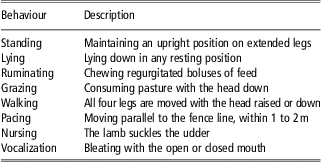
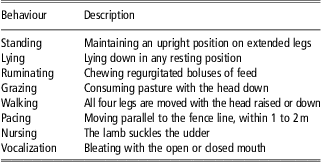
Four trained observers recorded eight different behaviours (Table 1; standing, lying, walking and pacing, which are mutually exclusive, and grazing and ruminating, which are also mutually exclusive behaviours) of individual ewes in each group from Days −3 to 3, using 10 min scan sampling. All ewes were marked with different colours around the body to allow recording of their activity from outside the paddock. Data were recorded daily during two observation periods: from 0730 to 1030 and 1630 to 1930 h, totalling 38 times per day. Vocalizations were recorded for a 30 s period every 10 min using 0/1 sampling (Lehner, Reference Lehner1996). In addition, all nursing events were recorded before weaning (Days −1, −2 and −3) during the same observation periods.
Ewes’ recorded behaviours
Progesterone measurement
We measured P4 on samples collected on Days −35 and −29 to verify whether any ewe was cycling spontaneously. With the same purpose, P4 was also measured on Days −8 and 0 in E1-C ewes. One E1-C ewe that had a serum concentration of 11.5 nmol/l of P4 on Day 0 was excluded from the experiment, resulting in seven ewes in the E1-C group. We also measured P4 in serum samples obtained on Days −29 (immediately before the CIDR was inserted), −23, −19, −13, −8, −4, 0 and 3 in E1-P4 ewes to characterize the P4 profile during the treatment period.
Serum P4 was measured at the Laboratorio de Técnicas Nucleares, Facultad de Veterinaria, Montevideo, Uruguay, using a solid-phase radioimmunoanalysis kit (Coat-a-Count, Siemens, Los Angeles, CA, USA). The analytical sensitivity of the assay was 0.25 nmol/l, and the intra-assay coefficient of variation was under 12%.
Serum protein measurements
Total protein and albumin concentrations were determined in serum samples collected on Days −4, 0 and 3; serum globulin concentration was calculated by subtracting the serum albumin concentration from the serum total protein concentration (Säkkinen et al., Reference Säkkinen, Tverdal, Eloranta, Dahl, Holand, Saarela and Ropstad2005) on Days −4, 0 and 3. Serum total protein and serum albumin concentrations were measured using the Biuret technique and a commercial kit (Bio-Systems, Barcelona, Spain), respectively.
BW of lambs
BW of the lambs was recorded on Days −29, −13, −4 and 0.
Experiment 2
Milk yield and composition were determined in 11 ewes that had lambed during the same period as the ewes used in experiment 1. These ewes weighed 46.2 ± 1.7 kg and had a body condition score of 2.02 ± 0.03 and were managed under the same conditions as the ewes in experiment 1. At 31 to 44 days after lambing, the ewes were divided in two experimental groups, homogeneous according to lambing day and initial milk production (1.35 ± 0.13 kg/day). At 35 days after lambing, six ewes were treated with CIDRs (group E2-P4) for 16 days (a new device introduced on Day 44), and five ewes remained as untreated controls (group E2-C). E2-C ewes were managed as E2-P4 ewes when CIDRs were exchanged or withdrawn.
Milk yield and composition
All ewes were manually milked before P4 treatment, on Days 24 and 35 after lambing, and during P4 treatment, on Days 44, 47 and 51 after lambing. Milk production was estimated using an oxytocin milking technique previously validated by Sphor et al. (Reference Sphor, Banchero, Correac, Osórioa and Quintans2011). In brief, lambs were shifted to another paddock and all ewes were injected i.m. with 5 IU of oxytocin (Hipofamina, Laboratorios Dispert, Montevideo, Uruguay) and were milked completely. Four hours later, ewes were milked again using the same protocol and then reunited with their lambs. Daily milk production was calculated according to the procedure described in Doney et al. (Reference Doney, Peart, Smith and Louda1979) by extrapolating the total quantity of milk obtained after the 4 h period to a 24 h period.
Milk composition, including milk fat, protein and lactose, was assessed in a sample of milk taken from each ewe, preserved in lactopol (2-bromo-2-nitropropano-1,3-diol) and frozen at −20°C. Milk composition was determined in the Laboratorio de Calidad de Leche (INIA La Estanzuela) using a Lactoscan Milk analyzer (Nova Zagora, Bulgaria).
Statistical analysis
Each behaviour is expressed as a percentage of observations and presented as mean ± s.e.m. Frequency of nursing was compared by ANOVA. Frequency of other behaviours, BW of lambs, serum total protein, albumin and globulin concentrations (experiment 1), and milk yield and composition (experiment 2) were compared between treatments using an ANOVA for repeated measurements, by means of a mixed model of SAS (2003; SAS Institute, Cary, NC, USA). The model considered the treatments (E1-P4 v. E1-C and E2-P4 v. E2-C), time, and interaction between treatments and time as fixed effects, and the ewe in each group as a random effect. The mean value calculated from the data recorded before P4 treatment in experiment 1 in each variable was included as a covariable in the model. Post-hoc comparisons were made with LSD.
Results
Experiment 1
Serum concentrations of P4 were within physiological luteal values in all E1-P4 ewes throughout the treatment period (11.3 ± 1.4 nmol/l). The BW of lambs increased with time (P = 0.001) in both groups, with no differences between them (BW on Day −29: 11.4 ± 0.3 kg; BW on Day 0: 18.6 ± 0.5 kg).
The percentage of observations in which ewes were recorded nursing before weaning of the lambs did not differ between groups (8.8 ± 1.2% v. 10.4 ± 0.4% for groups E1-P4 and E1-C, respectively; P = 0.11).
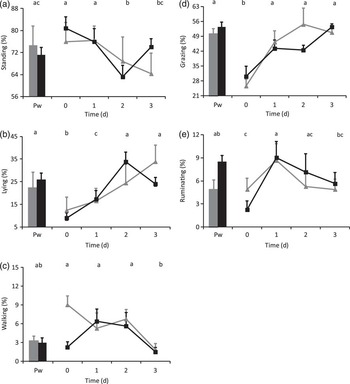
All other behaviours changed with time (P < 0.01). The percentage of observations in which ewes were recorded standing tended to increase on Day 0 (P = 0.1; Figure 1a) and did not differ between treatments. The percentage of observations in which ewes were lying decreased on Day 0 (P = 0.0001), and there was an interaction between time and treatment (P = 0.03). The interaction was explained by the finding that, while there was no change in the percentage of observations in which E1-P4 ewes were observed lying from Days 0 to 1, it increased in E1-C ewes during the same period (P = 0.05; Figure 1b). The percentage of observations in which ewes of the E1-P4 group were recorded walking tended to be greater than that recorded for E1-C ewes (P = 0.09) during the entire observation period (Figure 1c). Moreover, the percentage of observations in which ewes were recorded walking tended to increase on Day 1 in both groups (P = 0.1) and returned to basal values on Day 3.
Frequency (mean±s.e.m.) of records in which ewes were observed: (a) standing, (b) lying, (c) walking, (d) grazing and (e) ruminating before and after weaning in ewes treated with progesterone-releasing device (CIDR) for 32 days (grey bars and  $$$$
) and in untreated ewes (black bars and -▪-). PW: the pre-weaning period, represented by the histogram; the value is the mean of the 3 days preceding weaning (Days −3 to −1). Time is in relation to the day of weaning (Day 0). Different letters show significant differences between the days (P < 0.01).

The percentage of observations in which ewes were recorded grazing decreased on Day 0 in both groups (P = 0.0001), and returned to basal values on Day 1 (Figure 1d). The percentage of observations in which ewes were ruminating decreased on Day 0 in both groups (P = 0.04; Figure 1e), and returned to basal values on Day 1.
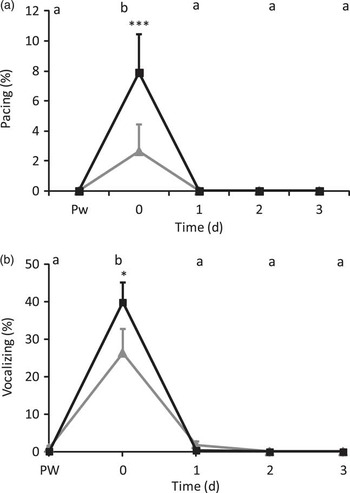
The percentage of observations in which ewes were recorded pacing on Day 0 (Figure 2a) was greater in E1-C ewes than in E1-P4 ewes (P = 0.0007). Similarly, the percentage of observations in which ewes were recorded vocalizing on Day 0 (Figure 2b) was greater in E1-C ewes than in E1-P4 ewes (P = 0.04).
Frequency (mean±s.e.m.) of records in which ewes were observed (a) pacing and (b) vocalizing before and after weaning in ewes treated with progesterone-releasing device (CIDR) for 32 days ( $$$$
) and in untreated ewes (-▪-). PW: the pre-weaning period; the value is the mean of the 3 days preceding weaning (Days −3 to −1). Time is in relation to the day of weaning (Day 0). Different letters indicate significant differences between the days (P < 0.0001). * and *** indicate differences between groups (P < 0.05 and P < 0.001 respectively).

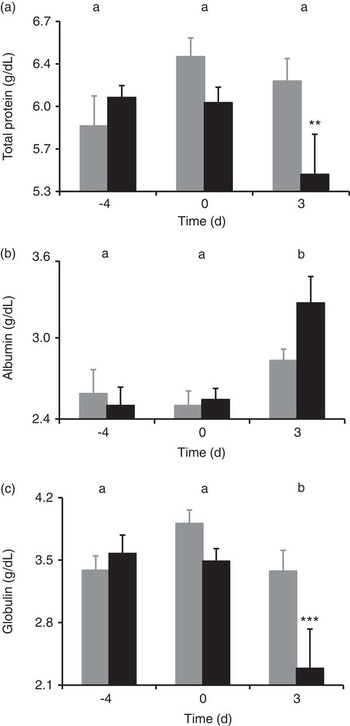
Ewes of the E1-P4 group presented greater values of serum total protein concentration compared with E1-C ewes (P = 0.04). There was an interaction between time and treatment in serum total protein concentration (P = 0.05): although there was no change in the serum total protein values in E1-P4 ewes from Days 0 to 3, the levels decreased in E1-C ewes (P = 0.04; Figure 3a). Serum albumin and globulin concentrations changed with time (P = 0.0002 and P = 0.001, respectively). Serum albumin concentration presented a tendency for a group effect, and for an interaction between time and treatment (P = 0.08 and P = 0.1, respectively; Figure 3b). Ewes of the E1-P4 group presented greater concentration of serum globulin compared with E1-C ewes (P = 0.002). There was an interaction between time and treatment in serum globulin concentration (P = 0.01) explained by the finding that on Day 3 E1-P4 ewes presented values of serum globulin concentration that were greater than those presented by E1-C ewes (P = 0.0008; Figure 3c).
Total protein (a), albumin (b) and globulin (c) concentrations (mean ± s.e.m.) before and after weaning in ewes treated with a progesterone-releasing device (CIDR) for 32 days ( $$$$
) and in untreated ewes (-▪-). Time is in relation to the day of weaning (Day 0). Different letters indicate significant differences between the days (P < 0.001). ** and *** indicate differences between groups (P < 0.01 and P < 0.001 respectively).

Experiment 2
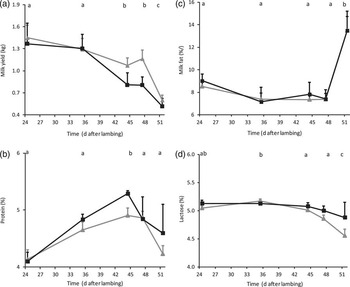
There were no differences between groups in terms of milk yield, protein, fat and lactose content (Figure 4a to d). Milk yield decreased with time (P < 0.0001), and all milk components analysed changed with time (P < 0.004).
Milk yield and composition (mean ± s.e.m.) in ewes treated with progesterone-releasing device (CIDR) for 16 days ( $$$$
) and in untreated ewes (-▪-). Different letters indicate significant differences between the days (P < 0.005).

Discussion
Confirming our hypothesis, the physiological and behavioural responses to abrupt weaning indicative of stress was attenuated by P4 treatment in ewes. The main behavioural (pacing and vocalizing) and most physiological (serum total protein and globulin concentrations) variables considered, all of which indicate a stress response of ewes to abrupt weaning of lambs, were less pronounced in P4-treated ewes than in untreated ewes. These results are in agreement with previous studies in rodents, in which it was demonstrated that P4 reduces stress response and anxiety (Barbaccia et al., Reference Barbaccia, Serra, Purdy and Biggio2001). Moreover, it is interesting that those differences were clearly detected even with the low number of animals used in the experiment. At the same time, the lack of effect of P4 treatment in ewes’ milk yield or composition, lambs’ BW, and nursing frequency indicate that the differences in stress response were not a consequence of an advancement of the natural weaning process due to a decrease in milk production. Therefore, our results confirm the existence of an effect of P4 treatment in the ewes’ sensibility to abrupt weaning. Although our experimental procedures do not allow us to conclude in relation to the underlying mechanisms, we can speculate that P4 is just a substratum for the active molecules, which are probably the metabolites that contain the 3α-hydroxy group (Lambert et al., Reference Lambert, Cooper, Simmons, Weir and Belelli2009). Although more studies may be necessary for more definitive conclusions, these results open an interesting alternative for minimizing the effects of stressful managements in farm animals.
Weaning of lambs caused a decrease in serum total protein and globulin concentrations in untreated ewes, a response that was prevented or mitigated by P4 treatment. Untreated ewes presented a decrease in serum total protein concentration after weaning of the lambs, as has been observed in lambs after a stress response (Apple et al., Reference Apple, Minton, Parsons and Unruh1993). In our study, the reduction in serum total protein concentration in untreated ewes after weaning of lambs is explained by the decrease in serum globulin concentration. In this sense, Napolitano et al. (1995) reported that early separation from the ewe decreases the antibody titre of the lamb. Therefore, the lower serum globulin concentration in untreated ewes may reflect a state of immunodeficiency (Allison, Reference Allison2012), considering that their values reflect hypoglobulinaemia (Hearly and Falk, Reference Hearly and Falk1974). Although in recently weaned lambs the susceptibility to gastrointestinal parasites increases (Orgeur et al., 1999), it is possible that P4 treatment may reduce the susceptibility to disease in ewes after weaning.
To the best of our knowledge, this is the first complete characterization of the behavioural response of ewes to abrupt weaning of lambs. The general response is in agreement with that previously described in ewes (Napolitano et al., 2008) and cows (Weary and Chua, Reference Weary and Chua2000; Flower and Weary Reference Flower and Weary2001; Ungerfeld et al., Reference Ungerfeld, Hötzel, Scarsi and Quintans2011). In summary, rapid and marked responses were observed on the day of weaning of the lambs, followed by a quick return to the original frequencies. The increase in the percentage of observations in which ewes were recorded pacing and vocalizing, and the reduction in lying after weaning, may be related to the fact that bleating and locomotion are used by dams to localize and reunite with their lambs. The short period during which these behaviours were displayed may be explained by the ineffectiveness of these responses. These behaviours, as well as the physiological response, involve an important energetic cost. Thus, the rapid reduction in those behaviours may be related to the lack of positive results of these energetic costly behaviours, which should not be maintained over time (Weary and Fraser, Reference Weary and Fraser1995).
Another relevant finding from this study was that the administration of luteal levels of P4, which may vary between 3.2 and 11.4 nmol/l in ewes (Bartlewski et al., Reference Bartlewski, Beard and Rawlings1999), did not affect milk yield or composition. This confirms and expands results from a study by Smith and Inskeep (Reference Smith and Inskeep1970), who reported that treatment with progestagens (medroxiprogesterone and flurogestone acetate) had no effect on ewes’ milk production. The few published studies relating P4 to ewes’ milk production were carried out in superovulated ewes (Manalu et al., Reference Manalu, Sumaryadi and Satyaningtijas2000), or under supra-physiological P4 concentrations provoked by treating ewes that had a corpus luteum with exogenous P4 (McKusick et al., Reference McKusick, Wiltbank, Sartori, Marnet and Thomas2002). In our experiment, all ewes were non-cyclic and the P4 concentrations provoked by our treatment were similar to those observed in a normal luteal phase. This allowed us to discard the possible effects of physiological luteal P4 concentrations on milk yield and composition.
These results are interesting from a productive perspective, as P4 treatment may be an interesting alternative for decreasing the behavioural and physiological responses indicative of stress in ewes to abrupt weaning of lambs. In addition, we showed that P4 treatment did not affect milk production, and thus this treatment could be utilized in dairy ewes to induce or synchronize oestrus without affecting milk production. However, as the long treatment period applied in our study may be difficult to implement, it would be beneficial to test the effectiveness of short treatments or single P4 injections.
In conclusion, P4 treatment reduced the ewes’ behavioural and physiological changes after weaning of their lambs, and thus the energetic cost of these responses displayed after one of the most stressful situations for sheep. Moreover, this effect was not mediated by changes in milk yield and composition, or by the lambs’ BW.
Acknowledgements
The authors acknowledge Josefina Tourón, Patrícia Abraham and Santuza Hermes for their help with data collection. Financial support was provided by PEDECIBA (Uruguay) and INIA. M.J. Hötzel was supported by CNPq, Brazil.