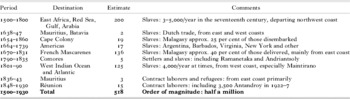
Despite much work in recent decades on the slave trades to and from Madagascar, the role and impact of the Big Island (Madagascar) and its people in the African diasporas of the Indian Ocean is poorly known.Footnote 1 The weight of the Malagasy population, estimated by contemporaries at between 3 and 4 million in 1800, and the broad dispersion of more than half a million Malagasy speakers about the Western Indian Ocean as forced laborers and migrants to destinations as diverse as the Swahili coast, the Red Sea, the Arabian Peninsula, the Persian Gulf, South Asia, Indonesia, the Cape of Good Hope and all of Madagascar's neighboring islands during the last 500 years puts Malagasy, historically speaking, among the most widely dispersed language communities at the conjunction of Southeast Africa and the Western Indian Ocean.Footnote 2 Based primarily on the work of other scholars, Table 1 draws together conservative estimates for unfree migrations departing Madagascar and suggests that more than half a million people involuntarily exited the island between 1500 and 1930. What is particularly distinctive about Malagasy dispersions into the Indian Ocean is that, although the Big Island's speech varieties (dialects) are rather diverse, contemporary observers generally reported that Malagasy formed intercommunicating language communities in the areas of their disembarkation. This is testified to especially in the European slave societies at the Cape of Good Hope and the Mascarenes. Future research on other Indian Ocean destinations of enslaved Malagasy speakers may reveal the same linguistic phenomenon there.Footnote 3
Involuntary Malagasy migrations by destination, 1500–1930Footnote 1 (conservative estimates of embarkations in thousands)

1 Sources: 1500–1800 to East Africa, the Red Sea, the Persian Gulf, Arabia, the Comores, and South Asia, including Goa and other European outposts, excepting Dutch colonies. Frenise A. Logan, ‘The British East India Company and African slavery in Benkulen, Sumatra, 1687–1792’, Journal of Negro History, 41 (Oct. 1956), 339–48, esp. 341–2; Stephen Ellis, ‘Un texte du XVIIe siècle sur Madagascar’, Omaly sy Anio, 9 (1979), 151–66; James C. Armstrong, ‘Madagascar and the slave trade in the seventeenth century’, Omaly sy Anio, 17–19 (1984), 211–33; R. J. Barendse, ‘Slaving on the Malagasy coast, 1640–1700’, in Sandra Evers and Marc Spindler (eds.), Cultures of Madagascar: Ebb and Flow of Influences (Leiden, 1995), 137–55; R. J. Barendse, The Arabian Seas: The Indian Ocean World of the Seventeenth Century (Armonk NY, 2002), 259–74; Thomas Vernet, ‘Le commerce des esclaves sur la côte swahili, 1500–1750’, Azania, 38 (2003), 69–97. The estimate relies primarily on annual average embarkations reported in the last two of these sources extended through the period but reduced to far more conservative levels. It is likely that such annual estimates were more a reflection of capacity than actual exports, and they do not account for periodic fluctuations to lower levels.
1638–47 to Dutch Mauritius and Batavia. François Cavche, ‘Relation dv voyage qve François Cavche de Roven à fait à Madagascar, Isles adjacentes, & coste d'Afrique, Recueilly par le Sieur Morisot, Auec des Notes en marge’, in Claude Barthélemy Morisot (ed.), Relations veritables et cvrievses de l'Isle de Madagascar, et dv Bresil, Auec l'Histoire de la derniere Guerre faite au Bresil, entre les Portugais et les Hollandois, Trois Relations D'Egypte, & vne du Royaume de Perse (Paris, 1651), 22, 37–8; Armstrong, ‘Madagascar and the slave trade’, esp. Table 3, 230–31; P. J. Moree, A Concise History of Dutch Mauritius, 1598–1710: A Fruitful and Healthy Land (London, 1998), 31–2, 36; Barendse, The Arabian Seas, 261–3, 269–74.
1654–1860 to the Cape Colony. James C. Armstrong and Nigel A. Worden, ‘The slaves, 1652–1834’, in Richard Elphick and Hermann Giliomee (eds.), The Shaping of South African Society, 1652–1840 (Middletown CT, 1989), 110–22, esp. 112, 121; Fritz Ponelis, The Development of Afrikaans (Frankfurt-am-Main, 1993), 12; Robert Carl-Heinz Shell, Children of Bondage: A Social History of the Slave Society at the Cape of Good Hope, 1652–1838 (Hanover NH, 1994), 41; Robert Carl-Heinz Shell, ‘The Tower of Babel: the slave trade and creolization at the Cape, 1652–1834’, in Elizabeth A. Eldredge and Fred Morton (eds.), Slavery in South Africa: Captive Labor on the Dutch Frontier (Boulder, 1994), esp. 12, 15; Nigel Worden, ‘Slavery and amnesia: towards a recovery of Malagasy heritage in representations of Cape slavery’, in Ignace Rakoto (ed.), L'esclavage à Madagascar: aspects historiques et résurgences contemporaines (Antananarivo, 1997), 55; Robert C.-H. Shell, ‘The twinning of Maputo and Cape Town: the early Mozambican slave trade to the slave lodge, 1667–1731’, in Vijayalakshmi Teelock and Edward A. Alpers (eds.), History, Memory and Identity (Port Louis, 2001), 185; John Edwin Mason, Social Death and Resurrection: Slavery and Emancipation in South Africa (Charlottesville, 2003), 22. According to Armstrong and Worden, ‘the major single regional source for Cape slaves during the Company period was Madagascar’, and Malagasy constituted the ‘overwhelming majority’ of Company slaves. Based on 64,000 disembarkations at the Cape, Madagascar's estimated share of 25 per cent is 16,000. This figure is inflated by 15 per cent, to some 18,400, to reflect departures from Madagascar. The number in the table includes an estimated 1,000 Malagasy-speaking Prize Negroes landed at the Cape between 1808 and the 1860s.
1664–1730 to the Atlantic. Destinations also include Saint Domingue, Montserrat, Nevis, New York and New England, among others. The Harvard/DuBois Institute Trans-Atlantic Slave Trade Database on CD ROM (1st edn.) records 12,764 slaves embarked at Madagascar for the Atlantic in this period. David Eltis et al. (eds.), The Trans-Atlantic Slave Trade: A Database on CD-ROM (Cambridge, 1999). The forthcoming second edition of the database increases this figure by some 4,000. See also James Trenchard Hardyman, ‘The Madagascar slave-trade to the Americas, 1632–1830’, Studia, Revista Semestral, 11 (Jan. 1963), 501–21; Virginia Bever Platt, ‘The East India Company and the Madagascar slave trade’, William and Mary Quarterly, 26 (1969), 548–77; Elizabeth Donnan (ed.), Documents Illustrative of the History of the Slave Trade to America (4 vols.) (New York, 1969 [1930–5]), III, 14, 405–8, 439–42, 444 n.6; Allan Kulikoff, ‘The origins of Afro-American society in tidewater Maryland and Virginia, 1700 to 1790’, William and Mary Quarterly, 35 3rd ser. (April 1978), Table 1, 232; Anne Molet-Sauvaget, ‘Madagascar et les colonies d'Amérique pendant la grande période de la piraterie européenne (1680–1700): contexte et documents de base’, Études Océan Indien, 13 (1991), 7–63, esp. 11, 17–18. Vessels not counted in the foregoing documentation (and whose cargos of slaves are not tallied in the table) participated in the trade. The Swift, for example, delivered slaves to New England, selling two young boys at the Cape of Good Hope during its passage in early 1698: Anne Molet-Sauvaget, ‘La disparition du navire “Ridderschap van Holland” à Madagascar en février 1694’, in Claude Allibert and Narivelo Rajaonarimanana (eds.), L'extraordinaire et le quotidien: variations anthropologiques, hommage au Professeur Pierre Vérin (Paris, 2000), 482, 492–3.
1670–1831 to the French Mascarenes. Richard B. Allen, ‘The Mascarene slave-trade and labour migration in the Indian Ocean during the eighteenth and nineteenth centuries’, Slavery and Abolition, 24 (2003), 41, Table 3. Midpoint figures between Allen's high and low estimates are provided here (134,000), plus 2,000 Prize Negroes landed at Mauritius or transferred there from the Seychelles between 1808 and the late 1860s.
1790–1835 to the Comoro Islands. Ramanetaka to Governor of Mauritius, Island of Johanna, 2 Sept. 1829, MNA.HB.20.24; Ramanetaka to William Nicolay, Moaly [Mohély], 15 Ahamadi 1838 [13 Jan. 1838], MNA.HB.9.81; Josefa Rasoamaka to Davidra Johns Andrianado, Simeon Andrianomana, Davidra Ratsarahomba, Ramiadana, Rafaralahy, Ribta, and Mariane, Moaly [Mohély], 23 Asorotany [25 April] no year [1849–50], LMS.AO.2.3.B; Ramiandrasina to James Cameron, Johanna [Anjouan], 14 Oct. 1854, ACCL.SC.SGGL.GMS.91.25–8; Jean Martin, Comores: quatre îles entre pirates et planteurs (2 vols.) (Paris, 1983), I, 83–166, 206; Gill Shepherd, ‘The Comorians and the East African slave trade’, in James Watson (ed.), Asian and African Systems of Slavery (Berkeley, 1980), 73–99, esp. 78–80.
1801–1890 to regions of the Western Indian Ocean and Atlantic. Hardyman, ‘The Madagascar slave-trade’; Gwyn Campbell, ‘Madagascar and the slave trade, 1810–1895’, Journal of African History, 22 (1981), 214–26; Gwyn Campbell, ‘Madagascar and Mozambique in the slave trade of the Western Indian Ocean, 1800–1861’, in William Gervase Clarence-Smith (ed.), The Economics of the Indian Ocean Slave Trade in the Nineteenth Century (London, 1989), esp. 185; Gwyn Campbell, ‘Madagascar and the lave trade in the South-West Indian Ocean’, in Vinesh Y. Hookoomsing (ed.), Globalization and the South-West Indian Ocean (Réduit, 2000), 102. The estimate relies primarily on the annual average exports reported for various intervals in the last of these sources, but reduces the resulting total by approximately one half.
1836–1843 to Mauritius. Edward Baker to David Johns and J. J. Freeman, Piton, 17 Dec. 1840, LMS.ILMAU.2.4.B, 1–2; Edward Baker to Revd. J. J. Freeman, Mauritius, 26 Oct. 1841, LMS.ILMAU.2.4.D, 1–3; David Johns to J. J. Freeman, Port Louis, 31 May 1841, LMS.ILMAU.2.4.D, 1; Charles Pridham, An Historical, Political and Statistical Account of Mauritius and its Dependencies (London, 1849), 392; Jocelyn Chan Low, ‘Des engagés malgaches pour l'île Maurice vers le milieu du XIXe siècle’, Revue Historique de l'Océan Indien, 1 (2005), 46–61.
1848–1930 to Réunion. François Renault, Libération d'esclaves et nouvelle servitude: les rachats de captifs africains pour le compte des colonies françaises après l'abolition de l'esclavage (Abidjan, 1976), 189, but esp. 34–92; Hubert Gerbeau, ‘Engagées and coolies on Réunion Island: slavery's masks and freedom's constraints’, in P. C. Emmer (ed.), Colonialism and Migration: Indentured Labour before and after Slavery (Boston, 1986), 209–36; L. Rivaltz Quenette, ‘De l'esclavage à l'engagisme, les motivations réelles’, in U. Bissoondoyal and S. B. C. Servansing (eds.), Slavery in South West Indian Ocean (Moka, 1989), 45–73; Jean-François Samlong, Les engagés malgaches à La Réunion (1922–1930) (Saint-Denis, 1995); Michèle Marimoutou-Oberlé, Les engagés du sucre (Saint-Denis, 1999), 119, 137, 139; Hubert Gerbeau, ‘De la traite dans l'Océan indien à l'engagisme: les anticipation d'un gouverneur de Bourbon au début du 19ème siècle’, Cahiers des Anneaux de la Mémoire, 2 (2000), 39–60; Laurent Sermet, ‘La fin de l'engagisme à Ste. Marie de Madagascar’, Cahiers des Anneaux de la Mémoire, 2 (2000), 111–27; Norbert Benoît, ‘Des engagés africains’, in Jean-Clément Cangy et al. (eds.), L'esclavage et ses séquelles: mémoire et vécu d'hier et d'aujourd'hui (Réduit, 2002), 201–7.
Gwyn Campbell has written that the engagée trade to the Mascarenes from Africa and Madagascar is far higher than these sources suggest. He estimates some 397,660 arrivals of both slaves and engagées at the Mascarenes during the nineteenth century, as opposed to about 180,000 slaves (Richard Allen) and about 35,000 contract laborers (François Renault and others, above). His estimates, without explanation for the discrepancy, are nearly double those of a collective of scholars who have worked on this issue. It should be noted that Campbell's figures are based largely on contemporary estimates of annual embarkations from East Africa and Madagascar, and these are not linked to any corresponding data for actual arrivals in the Mascarenes, to Mascarene population censuses, or to other evidence for the presence of so many new Africans and Malagasy in the islands. For these reasons, they are not adopted here. Gwyn Campbell, An Economic History of Imperial Madagascar, 1750–1895 (Cambridge, 2005), Table 9.3, 238.
According to published estimates, between 1500 and 1900 some 2.1 million continental Africans were coercively moved into the Indian Ocean region from the eastern side of Africa, representing some 13 per cent of all of Africa's combined external slave trades during that interval.Footnote 4 When the some half-million Malagasy who departed the Big Island after 1500 are added to the estimated 2.1 million Africans who forcibly left the eastern coasts of the continent into the Indian Ocean in the same period, they comprise nearly 20 per cent of the total and probably the single largest native speech community among slaves and contract laborers entering the Indian Ocean diaspora from these two regions. The language and identity history of Malagasy beyond their home island remains to be written. But perhaps nowhere is the task as easy to commence as in the Mascarene islands of the Western Indian Ocean.
French settlement in the Mascarenes developed as an outgrowth of the French East India Company's établissement at Fort-Dauphin, southeast Madagascar, the first French colony in the Indian Ocean (1642–74).Footnote 5 Early on, some of the male settlers in Madagascar, many of whom had learned to speak some Malagasy by cohabiting with Malagasy women, were banished for insubordination by governors Pronis and Flacourt to uninhabited Bourbon. Others left for Bourbon of their own volition, taking Malagasy wives and dependants with them. When, in late 1674, the French were pushed from Madagascar after a massacre of more than half their number, a contingent of the survivors eventually washed up on Bourbon. By these several means, Malagasy were among the foundational settlers of Bourbon, and the Big Island's women soon insinuated themselves into the ‘white’ families of the island.Footnote 6 Linguist Robert Chaudenson argues that these early settlers from Madagascar brought a number of vernacular terms into the French creole lexicon of the island.Footnote 7 At the same time, Big Islanders carried their mother tongue with them, founding the Malagasy speech communities of the island in the parler of southeast Madagascar.
From the beginning, colonial development in the Mascarenes depended heavily on the nearby Big Island of Madagascar for both food and labor. When French colonists first settled at Île de France in 1721, they brought many enslaved Malagasy laborers with them. The propinquity of Madagascar and ready availability of captives there was the primary reason for the Big Island's weighty role in Mascarene history during the eighteenth century. Lying below the Indian Ocean's shifting system of monsoons (which fizzle out below about 10 degrees south latitude), Madagascar is situated downwind from the two colonial islands in steady northeast trades. Sailing vessels running with the breezes could expect to cover the 900 kilometers separating the Mascarenes from the Big Island in four to five days. The return voyage was considerably more lengthy and arduous. Depending on weather and wind conditions, it could take from one week to more than three to reach Île de France and Bourbon from Madagascar's east coast.Footnote 8 From the 1720s to about 1775, Madagascar supplied between 50 and 70 per cent of servile disembarkations at the Mascarenes.Footnote 9 Colonial censuses record Malagasy as forming majorities of about 60 per cent or more in the two islands' slave populations during the 1720s and 1730s, a share that weakened over the following decades as the number of creoles grew.Footnote 10 Until the end of the slave trade into the islands in the early 1830s, some 135,000 of the more than 300,000 slaves disembarked at the French Mascarenes – or about 40 per cent of the total – hailed from Madagascar.Footnote 11
As a result of its preponderance within the eighteenth-century subaltern majority, Malagasy quickly became the most prevalent tongue spoken as a first language on the two islands. Malagasy from various parts of the Big Island conversed with each in their own tongues on their oceanic passage and on the farms, plantations, workplaces and towns of the colonial islands.Footnote 12 The opposite was true of slaves arriving in the Mascarenes from the African continent. While the Bantu languages of East Africa are closely related and more slaves disembarking in the Mascarenes after about 1775 spoke them than spoke Malagasy, they are not on the whole mutually intelligible. A missionary working among slaves in Bourbon noted in 1773 that those newly arriving from East Africa included ‘Macoaïs, Monomotapas, Monoïmugis, Sainiens, Kerimbiens and Mozambiques, each speaking different languages’.Footnote 13 Writing several decades later of his anti-slaving missions on the East African coast, Fairfax Moresby noted that when Mascarene merchants took any contingent of African slaves aboard they ‘found they were strangers to each other's language’.Footnote 14 The range of ethnic identities and languages among Africans in the Mascarenes prevailed against their combination in the colonial islands as a single linguistic group or the extensive employment of African vernaculars. Linguistically, therefore, intercommunicating Malagasy in Bourbon and Île de France were considerably more visible and influential as a community than Africans, even when these latter outnumbered them from the late eighteenth century.
Not only were Malagasy parlers employed by persons born on the Big Island, during the eighteenth century they served as a contact language within the Mascarene subaltern population, allowing the enslaved of other origins to avoid the emerging French creole in at least some of their conversations.Footnote 15 ‘I find in the last census of Saint-Paul and its dependencies’, wrote a missionary in 1764 of a Bourbon parish:
nearly 2000 creole slaves—and it is [the part of the island] where they are most numerous—1800 Malagasy, 500 Africans (caffres) and 160 Indians. From this it can be seen that in this flock of black skin Malagasy is the dominant language, which the other nations and especially the creoles, more or less understand (entendent). Footnote 16
The clerical author reported an exceptionally high number of creole slaves – they formed a slight majority in Saint-Paul parish, an anomaly for the islands at this time – yet the Malagasy vernacular was still spoken and understood by creoles as well as ‘the other nations’ having no Malagasy origins. Neither a native-born majority nor an emerging French creole language eliminated Malagasy – both key assertions in most Mascarene creole studies. During the eighteenth century a similar prevalence of the Malagasy tongue within servile populations applied in other parts of Bourbon and in Île de France, where creole slaves remained a minority until about 1830. Malagasy speech varieties facilitated communication within the servile population and its many ‘nations’, for a time competing with the French creole of the islands as a medium of interlingual communication. Although it probably lost its status as a contact language understood and spoken by persons originating from Africa and elsewhere after the French Revolution, the Malagasy vernacular did not disappear from the Mascarenes until well after the abolition of slavery, for persons from Madagascar and their children continued to speak it among themselves even past mid-century.Footnote 17 And in both the late eighteenth and early nineteenth centuries some of the East Africans disembarking at the Mascarenes had transited through Madagascar, as is well known by historians of the region. Some of these ‘Mozambiques’, as they were called, learned to understand and speak Malagasy along their complicated routes to Bourbon and Île de France.Footnote 18
Malagasy parlers have received scant attention in Mascarene history. Heretofore the Big Island's vernacular has been considered important only insofar as it contributed to the French creoles and to Bourbon place names.Footnote 19 Robert Chaudenson, for example, argues that the replacement of vernacular languages by French creole occurred very early in the eighteenth century, by about 1720, just as the Bourbonnais creole took shape.Footnote 20 In her fascinating study of creolization in eighteenth-century Île de France, Megan Vaughan demonstrates convincingly how ‘a slave destination can become a place of origin within a lifetime’, delineating some of the main lines of slaves' transformed cultural lives in a new environment. Focusing nearly exclusively on the French creole and cultural creolization, however, Vaughan sees ethnic particularity and vernacular languages playing little role within enslaved communities.Footnote 21 Likewise, historical studies of Mauritian creole find little room for Malagasy. It is thought that the extremely small West African contingent of slaves played a role in the formation of the island's French speechways, but not Malagasy.Footnote 22 Yet if creolization elsewhere entailed a rapid loss of vernaculars, this was not so with Malagasy in the Mascarenes. Many slaves on the islands were bilingual in both Malagasy and French throughout the eighteenth century and well into the nineteenth. These included not only persons born in Madagascar, but creoles and individuals of East African origin as well.
The linguistic history of the Mascarenes must be rethought in light of these patterns of native language persistence, for both the competence of ‘saltwater’ slaves in the French creoles and the precocious disappearance of the Malagasy vernacular have been overstated. When the Revd. David Johns of the London Missionary Society (LMS) arrived in colonial Port Louis, Mauritius, directly from Madagascar in 1836, he reported that: ‘I find hundreds of the Malagasy here [ex-slaves living in the town primarily] who can speak the language perfectly well’.Footnote 23 Thousands more across the island and in Bourbon employed the language, even though their share of the subaltern population dwindled in the early decades of the nineteenth century. As testified in LMS Archives, British and Malagasy missionaries of the LMS evangelized among Malagasy apprentices, ex-apprentices and freedmen in Mauritius from 1835 to at least 1860, teaching and preaching in both French creole and Malagasy. When he visited Mauritius in 1850, J. J. Freeman, a one-time missionary in Madagascar and then Foreign Secretary of the LMS, preached in Port Louis and at Moka in the Malagasy tongue to nearly 400 ex-apprentices and Christian refugees from Madagascar.Footnote 24 Although the LMS did not labor on Bourbon, which remained a French colony, a similar retention of the Malagasy vernacular prevailed there. In the 1850s, Jesuit missionaries interested in Madagascar created a center for linguistic study and translation into the Big Island's vernacular at La Ressource, drawing on the expertise of both recently arrived Malagasy students and the existing Malagasy language community of the island. They produced dictionaries, grammars, catechisms and other works of sacred literature in the parlers of the Big Island's east coast.Footnote 25
MISSIONARIES AND SLAVES
The best evidence for the use and influence of the Malagasy vernacular in the Mascarenes during the eighteenth century comes from the evangelistic work of Catholic missionaries of the order of Saint-Lazare or the Congrégation de la Mission as it was known (personnel of the order are known as Lazarists).Footnote 26 The Parisian archives of the Congrégation de la Mission at its headquarters on the rue de Sèvres were pillaged during the French Revolution and little remains of the once voluminous correspondence between clerics in the Mascarenes and their superiors in the metropole.Footnote 27 What escaped theft and the flames that followed has been garnered over the years into registers and copy books readily offered to interested researchers in the quiet reading room just a stone's throw from Paris's celebrated Bon Marché department store.Footnote 28 For the eighteenth-century missions to the Mascarenes, a significant amount of what remains are the records of one Philippe-Albert Caulier, who labored on Bourbon for 22 years between 1749 and 1771, 18 of which were spent in the principal administrative center of Saint-Denis on the island's northwest coast.
The Lazarists' involvement in the Western Indian Ocean had commenced a century earlier. Nearly a dozen Lazarist missionaries had been despatched over the years to the French East India Company's first Indian Ocean colony, in mid-seventeenth-century southeast Madagascar. Most of them died within months or a few years of arrival, but collaborative work with French translators, Malagasy interlocutors, and Governor Etienne de Flacourt resulted in a printed dictionary and catechism of the local tongue in 1657–8.Footnote 29 After this time, Lazarists and their Malagasy assistants catechized and baptized hundreds of people in their own language around their home base at Fort-Dauphin.Footnote 30 Long after the demise of the Company's colony in Madagascar, the Propaganda Fide in Rome nominated the Lazarists to serve Bourbon.Footnote 31 The first Lazarist priests arrived in the colonial island in December 1714, alighting from a vessel hailing from France's établissement at Pondichéry on the Coromandel coast of India. By 1764 some ten Lazarists were laboring on Bourbon among a population of about 20,000 slaves and 5,000 whites, with numbers rapidly rising. Of the slaves in that year, over 9,000, or just under half, were Malagasy.Footnote 32 On Île de France in the same period, a similar number of Lazarist priests labored among a population of between 18,000 and 20,000 slaves, of whom probably a comparable share were Malagasy speakers.
Lazarist missionaries in the colonial Mascarenes were sent in part to fulfill the obligations of masters under the Lettres patentes of 1723 that required slaveowners to instruct and baptize their servants according to the doctrines of the Roman Catholic Church. The Lettres patentes were a Mascarene version of the Antillean Code noir issued by Louis XIV nearly four decades earlier, in 1685, but differed in their provision for the Christianization of slaves in that the burden for providing instruction and baptism was laid not upon colonial authorities but upon the habitants (colonists, homesteaders) who owned them.Footnote 33 The result of the provision was to deprive missionaries wishing to minister to slaves of the legal and moral right to make public claims on authorities and masters to access them; it provided slaveowners with maximum leeway to control the degree to which they exposed their human property to Christian doctrines and to the direction of priests and catechists.
Because Mascarene populations were composed of slaves and freeborn, the Lazarists were instructed by the Company and their ecclesiastical superiors in Paris to minister to both. The situation in the Mascarenes differed from that of the French Antilles, where priestly labor tended to be organized along racial lines and where certain clergy were dedicated to slaves as curés des nègres.Footnote 34 ‘A minister in the colonies must be two persons at the same time’, wrote Père Caulier explaining the challenge on Bourbon: ‘that of a parish priest toward all the parishioners in general [i.e., the whites], and that of a missionary toward all the blacks and slaves'.Footnote 35 In practice, because the demographic revolution early in the century brought servile majorities of 80 per cent and more to both Mascarene islands and whites in the islands showed a general disinclination for things of the Church, Lazarists spent much of their time with enslaved persons rather than with their owners.
Historians Hubert Gerbeau, Claude Prud'homme and Amédée Nagapen have all written how a lackluster adherence to Christianity on the part of the two islands' whites, their opposition to Christian instruction of their involuntary labor force, the provisions of the Lettres patentes and the anticlerical dimensions of the French Revolution effectively deprived Mascarene slaves of much exposure to the Catholic Church.Footnote 36 This may have been true in a general sense, and especially when seen from the early nineteenth century, when, after the Revolution and the disbanding of the Lazarist order, Mascarene churches were nearly empty and few priests could be found on the islands (no more arrived after the onset of the Revolution). But the engagement of certain Lazarists with at least a subset of the slave population suggests that there were many times and places in which foreign clerics and slaves encountered and communicated with each other.
Although slaves formed some 80 per cent of the Bourbon population, reaching them proved especially difficult as they were scattered upon the habitations of the islands and were far from sedentary. Constantly on the move, some labored on multiple estates, among which they shuttled as the agricultural seasons progressed or as the work regimes of different crops required. Others were sold, bartered, rented and bequeathed in the islands' lively market in servile labor.Footnote 37 Slaves, wrote Père Caulier, are ‘sometimes in one Church, sometimes in another, sometimes in none, and with near impunity failing to attend mass, confession, the fast, abstinence and other similar duties’.Footnote 38 Clearly, Lazarists interacted only with a small share of slaves in any particular year, and as the servile population increased into the nineteenth century with a concurrent attrition in priests over the French Revolution, contact only deteriorated from then. ‘Parochial services in the strict sense of the word’, confirmed Caulier, ‘only concern the whites and the domestics who are found within striking distance of our Churches; some two-thirds of our flock are like unknowns and half strangers by the distance of their living places’.Footnote 39
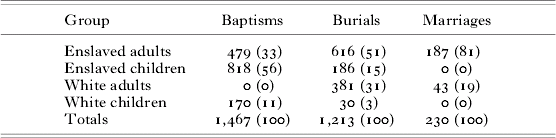
But if most slaves proved difficult to reach, Caulier's statistics for the Parish of Saint-Denis between 1753 and 1763 (Table 2) indicate that he spent most of his time ministering to them. Slaves accounted for nearly 90 per cent of baptisms performed in Saint-Denis, more than 80 per cent of marriages and two-thirds of burials. More than half of the burials registered among whites were of ‘sailors and others coming from passing ships’ and only temporarily in the island, so, in allocation of ecclesiastical effort to the permanent population of the colony, slaves received the lion's share of Caulier's time. ‘The class of blacks require as you see’, Caulier admitted to his correspondents in Paris, ‘a single priest entirely devoted to their sanctification in each district. They are in any case our most numerous flock and our principal object’.Footnote 40
Sacraments administered in Saint-Denis parish, 1753–1763Footnote 1 (Column percentages in parentheses)

1 Philippe-Albert Caulier to M. T. H. Pave, St. Denis, îsle Bourbon, 25 février 1764, ACM, Recueil 1504, 183r.
In their parish churches, Caulier and his colleagues on Bourbon and Île de France regularly offered training in the catechism to the children of both freeborn and slaves.Footnote 41 Though conducted separately, in many respects the catechism of master and servant proceeded along similar lines. The session of an hour or so spent once a week with both groups was to commence with song, followed by prayers and crowned with teaching of the catechism and the gospel through the question-and-answer format typical of this method of inculcating the tenets of faith into young minds.Footnote 42
The slaves' catechism is conducted immediately after the high (grand) mass, and that of the free persons at two o'clock. This is an important exercise to which we must apply ourselves. One can hardly spend less than an hour at this, or at least three good quarters of an hour. We begin with the song Come, come spirit etc. and that of the Virgin, I greet you Mary, etc., or some other hymn. Following this the prayers are said up to the Lord's Prayer while kneeling. Then the gospel of the day is read to the free, and for that there must be a certain number who learn in the schools or with their families [how to read the scriptures]. From there we proceed to the questions as they are in the small catechism employed in the island, in which nothing should be changed. Only some related questions can be added, or a few reflections proper to inculcate in them the truths that are contained in them. The first exercise is for the youngest. As for those who are more advanced, they are required to recite a lesson from the historical catechism of Fleury.Footnote 43 For slaves who know the little catechism sufficiently, it should be enough to set them to the fuller instructions that follow the more condensed. It is particularly the subjects of Baptism, Penitence and the Eucharist they must be taught to master. It is [also] a good idea when beginning the catechism to have them repeat the primary lessons of the gospel that they have heard in mass and to bring them to understand their practical consequences. Experience shows that these measures inculcate fully in them the principal truths of the religion.Footnote 44
Methods for consideration of the gospel of the day, then, depended upon social status and mapped literacy onto the contours of race, for while free children were required to read the gospel lesson in front of their peers, having been coached in the art of the book at home, slaves were asked merely to recall the lesson verbally as it had been delivered during the preceding mass. As elsewhere in European slave colonies, masters in the Mascarenes were generally averse to allowing their slaves to read, and Lazarists surrendered themselves to these restrictions. Caulier termed the verbal training slaves received in weekly catechism ‘le travail de la parole’ (the work of the word), a phrase that might equally describe most evangelical work that Lazarists in the Mascarenes carried out among slaves.Footnote 45
Conducted separately in the question-and-response method, the catechism of the free incorporated literacy and emphasized the individuality of children by eliciting individual responses from them. Slaves who fell under the weekly instruction of Lazarist missionaries, on the other hand, were exercised collectively and in an exclusively oral method, responding to the questions in unison along with their priest, who spoke slowly and in ‘good’ French to teach the children proper grammar and pronunciation (perhaps this was to counteract the creeping influences of creolization?).Footnote 46 Not only did weekly catechism in the churches serve to inculcate enslaved children with the doctrines of the Church, it was one way in which those born on the islands or who arrived there as young children were taught the language of their masters and exercised in building a creole identity. When compared to the individual interrogation of the free, the collective catechizing of slave children symbolizes why bondmen and women appear so infrequently as individuals or as named persons in the Lazarist archive.
VERNACULAR EVANGELISM
To view the Lazarists primarily as instructors in French and its creole, however, is to miss much of their interaction with slaves, for weekly French catechism in the churches was limited to a youthful minority who tended to interact intensively with their masters. Weekly parish instruction in French was offered only to those well-established slaves (by and large domestics) who were brought to the church by their masters and offered for regular tuition under its priest. And, of course, such recurrent training in the Catholic catechism was restricted to children. As Table 2 suggests, a third of Caulier's baptisms in the mid eighteenth century were of adult slaves, among whom he spent much time. The challenges of instructing and baptizing the islands' servile adults – we should not assume they learned the French creole with facility – placed heavy linguistic demands on the limited Lazarist personnel. Explaining how Lazarists approached newly arrived slaves, Père Teste wrote in 1762 that ‘we must first think of training them (les dégrossir), humanizing them and teaching them in our language and in the exercises of religion, a task requiring some years’.Footnote 47 Many slaves never made it through ‘some years’ of training to communicate with their priests or fellow creole slaves in French, or to receive religious instruction in the creole patois of the islands. Servile mortality rates on the islands ran particularly high.Footnote 48
Commenting on the broad mix of Indian Ocean tongues he found within the servile population of the islands, Père Caulier once exclaimed that ‘it would take a second Pentecost to speak all these barbarian languages’.Footnote 49 Yet while there is little evidence that Lazarists seriously attempted to learn any of the many tongues of East Africa spoken by disembarking slaves, they made clear efforts to reach Malagasy slaves in the ‘barbarian’ speech of the Big Island. Vernacular evangelism in the parlers of Madagascar is not emphasized in much of the clerical communication with France, but priests and their helpers resorted to the vernacular of the Big Island on many occasions during their interactions with the newly arrived and ill-disposed. In working with Malagasy slaves ignorant of the French language, Lazarists in the Mascarenes could draw on the linguistic capital of evangelistic experience and vernacular texts produced by their forebears in the Company's settlements of Fort-Dauphin, Madagascar, a century earlier. In the mid-1730s, as the boom in coffee production with servile labor coughed thousands of Malagasy onto the shores of Bourbon, the mother congregation in Paris despatched materials for learning the language of the Big Island to Père Igou (these were most likely Flacourt's dictionary and catechism).Footnote 50 Similar gifts may have been addressed to his colleagues. Acknowledging receipt of the materials, Igou replied with an apology.
I am indebted to you for the books you had the kindness to send me, and although they are for acquiring the language of the island of Madagascar they are useless to me because I am too old to learn a foreign language. I will keep them safe for those who are young and who will come after me so they can apply themselves to learn this language if they would like to. It is true in these islands that [acquisition of Malagasy] is not absolutely necessary because of the ease with which slaves learn French, for it does not take more than a year to make them understand what we teach them.Footnote 51
Aptitudes and appetites for foreign languages differed considerably among the missionaries, as did assessments of how quickly and easily bondmen and bondwomen acquired the French creole of the islands. But Igou's response that he was ‘too old’ to learn the language and that it was ‘not absolutely necessary’ to acquire Malagasy confirmed the prevalence of that language at Bourbon. Igou may well have passed the books to Père Caulier and other missionaries of the second generation despatched to the islands, for subsequent Lazarist personnel were clearly aware of the works, and drew on them. A young man when he arrived in Bourbon in 1749, Caulier, as we have seen, spent much time evangelizing among the slaves, ‘whose language I spoke’.Footnote 52 ‘Speaking the language of Madagascar and Africa (parlant la langue Madag caret Caffre), I found myself able to advance catechumens and neophytes more in knowledge of the Religion during three months than [former colleague Davelu] and the other missionaries were capable of doing in four years’, wrote Caulier of vernacular evangelization.Footnote 53 Père Caulier's boastful reference to knowledge of the ‘Caffre’ (East African) language in addition to Malagasy is curious. What language could it have been? I have seen no other reference to Lazarists speaking or working in African languages in Caulier's writings or in any other documents on the Mascarenes. Although it seems unlikely by the phrasing, it is possible Caulier meant to refer to the emerging French creole of the slaves rather than to Malagasy and African languages separately. Whatever the case, Caulier's statement about his linguistic capacities suggests he was probably more interested in vernacular evangelization than his colleagues.
That Caulier might be especially invested in the native tongue of Madagascar is in part explained by his location in Saint-Denis, where most newly arriving captives were first disembarked before being distributed to the island's habitations. Many of these ‘raw’ slaves arrived in a sickly state after their physically and emotionally trying ordeals of capture and transport. At Saint-Denis they, together with sufferers flowing into the city from the island's estates, were attended to by doctors who crowded about the port and earned their living by caring for servile patients at the expense of those who owned them: ‘The private surgeons each have their own hospital in which they treat the slaves sent to them from here and there. [Saint-Denis] is also where ships ordinarily touch, and consequently also the sick of the fleets and the slaves of the new trade, of which the hospitals are more or less filled, often by scores and sometimes by hundreds’.Footnote 54 Such hospitals were particularly good places to encounter Malagasy speakers and to learn the customs of the Big Island, and for this reason the Lazarists viewed them as training fields for those who were planning to commence missions on nearby Madagascar (which never materialized). Père Durocher, for example, was ‘in charge of the hospital [of Port Louis on Île de France] for some ten years, waiting to begin this important mission’.Footnote 55 The hospital in question was the government hospital, and not a private one of the sort described by Caulier at Saint-Denis. Two stories in height, it boasted ‘five hundred beds for the sick’ and offered considerable human resources for practising vernacular evangelism.Footnote 56
In addition to the hospitals and the vernacular work of their predecessors in Madagascar, Lazarists enjoyed at their disposal another important resource for learning and teaching in Malagasy: interpreters drawn from the enslaved Malagasy on their ecclesiastical plantations. The terms of the agreement between the Congrégation de la Mission and the Company in 1712 stipulated that Lazarist priests arriving in Bourbon would receive a single slave to assist them and a modest plot of land on which to sustain themselves.Footnote 57 But as many of their counterparts did in the French Antilles and elsewhere, missionaries in the Mascarenes accumulated land and slaves of their own, setting their servants to a diversity of tasks, including both the cultivation of cash crops – the sale of which supported their broader activities – and assisting them in necessary clerical duties.Footnote 58
As populations swelled and more land was allocated to newly arriving European habitants, missionaries were obliged to turn towards farming to feed themselves rather than to continue hunting, as they had done during the early decades of the century.Footnote 59 By the last quarter of the eighteenth century some ecclesiastical estates had grown quite fat. That serving the parish of Port Louis on Île de France had ‘more than sixty slaves with a herd of cattle or cows of about the same number’, while those of Pamplemousses and Grand Port were even richer in both labor and livestock. As a result, one dissenter wrote that the plantations ‘metamorphose most of the missionaries into planters (habitants), that is to say cultivators and merchants, and as a result separates them from their principal purpose’.Footnote 60 From the hunter-clerics of the early eighteenth century, Lazarists were becoming a class of gentlemen priests with estates to manage and an entourage of servile acolytes to provide their subsistence and assist them in their ecclesiastical work.
But the plantations served a broader purpose, argued the missionaries: bondmen and bondwomen serving on them were to set an example of proper Christian life and behavior for other slaves on the islands. For this reason, the Lazarists were keen to keep their slaves from serving the compulsory labor that governors of the islands levied upon the habitants' captives in order to maintain roads, bridges, ports and other works of public utility. ‘The corvées’, argued Caulier, ‘occurring from one end of the island to the other, disturb the blacks who are subject to them. The missionaries since 1714 have always anticipated freeing their slaves of these dangerous occasions and keeping them continually under their watch, so by their good manners they provide an example to the other blacks’.Footnote 61 Malagasy were among the slaves on these showcase gardens of the Church. The clerics of Île de France suffered a painful loss when three Malagasy families successfully escaped from an ecclesiastical plantation and set out for their native Big Island by boat (this sort of flight was common and at times successful).Footnote 62 Intended by the clerics as beacons of the faith, the plantations, to be sure, were not always exemplary places on which to live. Lazarist missionaries were mostly deprived of their slaves and plantations during the French Revolution, but until then priests enjoyed the material and evangelistic assistance of their bonded estate laborers.Footnote 63
The Lazarists' servile helpers proved especially useful in saving the souls of those arriving from Madagascar who were ailing and expected to die, of those coming into the hospitals from nearby estates, bodies and spirits frayed by their labors on the habitations, and of the older slaves in general, who appear to have had a poor command of the island's French creole. ‘One must proceed differently towards the very old or even the young when they are in danger of death’, noted Père Teste, of Malagasy slaves on Bourbon, ‘We babble (balbutie) as we can in their language, we employ the interpreters we can lay our hands on, and when they show some interest in associating with religion we baptize them’.Footnote 64 Caulier confirmed these methods of approach to the newest arrivals and the dying, methods which appear to have incorporated a hodgepodge of languages and the recourse to vernacular manuscripts. Explaining the work of providing last rites to dying slaves arriving aboard ship in Saint-Denis, Caulier noted that ‘we employ interpreters when we don't know the language … We anoint them at the first mortal attack under the promise that they will lead a pure and Christian life if they escape death’.Footnote 65 He elaborated in his ‘Directoire des paroisses’, a handbook for guiding fellow missionaries in the islands:
As for adults arriving sick, if they are in danger, but especially if in imminent danger, an interpreter must be employed to instruct them in the principal mysteries of Religion, of the necessity of baptism for salvation; to bring them to ask forgiveness from God for all their sins, to consign themselves to his mercy and the merits of our Lord Jesus Christ, and to unite in his death and love God with all their hearts. But because few interpreters capable of making them listen to these truths can be found, it is useful (expédient) to have a notebook in which they are expressed in the Malagasy language, even if it is only to guide and assist the interpreters to explain in an effective manner to these poor dying slaves.Footnote 66
Transformed in effect into catechists, Caulier's Malagasy ‘interpreters’ were despatched with Christian instructions set in writing in the vernacular to ‘dictate’ to slaves ‘word for word’ the content of important tenets of the faith.Footnote 67 Heavily influenced by the vernacular sacred language in Flacourt's Petit catéchisme composed in southeast Madagascar a century earlier, the Lazarists' notebooks of vernacular instruction also reflected homespun linguistic investigations into Malagasy in the Mascarenes and served as the basis for later publications. Caulier's evangelistic notebooks were the acknowledged ancestors of the vernacular Catéchisme abrégé he published in 1785.Footnote 68 But the vernacular notebooks are interesting in another respect, for they suggest that at least some of the missionaries' ‘interpreters’ had been taught to read their native tongue in the Roman alphabet that Lazarists employed to write it. Verbal evangelism in the vernacular flowed from early literacy work and in turn informed it. Some of the first native readers of Malagasy were ecclesiastical slaves in the Mascarenes.
As for the sick and dying slaves from Madagascar, ‘They are required at first to learn or to mumble our French, and when in danger of death, an interpreter is employed to anoint them, after they show more or less certain signs of faith and conversion to the Religion’.Footnote 69 Since these first – and occasionally final – instructions were sometimes served up in Malagasy, sometimes in French, and often by Malagasy interpreters who were already instructed in a vernacular Catholic creed, a certain number of Malagasy were presented with Christianity in their own language and by their compatriots, who appear to have been empowered to anoint them as well as to instruct them in Malagasy when efforts in French inevitably foundered. If slave catechists were versed by their clerical masters in the vernacular words of faith as set out by the scribbling of Roman-character Malagasy in notebooks, probably few Lazarists were privy to the more lengthy and unguided conversations in Malagasy that slave catechists held with their diseased, aged or dying compatriots – or to those between newly arrived slaves and those who had been in the colonies for some time.
An explanation for the promotion of ecclesiastical slaves to the roles of interpreters, anointers and baptizers can be found in the missionaries' attempts to christen sick and dying slaves, which often met with resistance until interpreters speaking the same language were brought in to explain the procedure. ‘They frequently attribute the death of their comrades to the Baptism they saw them receive’, Caulier wrote of the reticence of sick slaves in the hospitals to allow themselves to be anointed. They ‘conclude that it is a kind of poison or enchantment, and they refuse to admit it except in the manner that criminals resign themselves to torture. The words of their old comrades [however] reassure them efficaciously’.Footnote 70 How ‘efficacious’ this ‘reassurance’ by ‘old comrades’ from the Big Island may have actually been in times of ‘torture’ we cannot judge, but it was inevitable that, in speaking with their countrymen in words of faith and about their plight, servile catechists departed from the tight scripts of religious instruction set out in notebooks from which they were required by clerics to read. Unfortunately, precisely what enslaved Big Islanders said to each other during such dramatic encounters remains largely lost to us. Lazarists were convinced that most adult slaves learned more about Christianity from each other than from their encounters with the priests.Footnote 71
COMPARATIVE REFLECTIONS
The Mascarenes and the Cape of Good Hope are in many respects unique in the history of European colonial slave systems. Their setting in the Indian Ocean brought servile labor from the north and east as well as from the African mainland and especially from the world's fourth-largest island, Madagascar.Footnote 72 The proximity of the Big Island, the importance of Malagasy in the servile population, and the constant ebb and flow of information, goods and people between the colonies, on the one hand, and Madagascar, on the other, set both areas off from plantation societies in the Americas, whose sources of labor generally lay farther away across the ocean and which seldom sustained ongoing social relations with them and their languages. Important consequences of these features were the lasting influence of the Malagasy tongue in the colonial Mascarenes and at the Cape into the mid nineteenth century and the interest of missionaries in evangelizing in the Big Island's vernacular there and in producing notebooks of instruction, some of which were later published.Footnote 73
Two primary tracks of evangelization characterized ecclesiastical labor in the Mascarenes. Lazarist priests offered weekly catechetical instruction after mass in French to slave children sent to them by conscientious masters. As for children of between five and ten years arriving in the slave trade, they too were usually baptized (probably in the vernacular) and commended to their masters for the earliest instruction.Footnote 74 Adults, on the other hand, presented missionaries with a number of problems and were seldom seen with the regularity of children. No doubt this was due in large part to their value on the habitations and in the towns and the reluctance of masters to part with them for religious instruction, even at weekends. Lazarists and adult slaves tended to encounter one another episodically, but over the years missionaries came in contact with thousands of the islands' captive laborers. Missionaries posted at the hospitals and those whose parishes included the administrative centers of Saint-Denis and Port Louis paid especial attention to sick slaves and captives newly arriving in the islands, a steadily increasing number over the decades. Among ‘saltwater’ slaves, efforts were sometimes made to communicate in French, when it was possible, but priests frequently found themselves employing assistants from Madagascar to converse with ailing Malagasy in the vernacular and to deliver them training in Church doctrines drawn from prepared theological notebooks in the tongue of the Big Island.
The work of the word in dual languages among slaves was not entirely unique to the Mascarenes. Vernacular evangelism seems to have been of particular interest to Jesuits, who were enjoined by their founder to learn the languages of their evangelistic subjects. In her study of Catholic missions in the French Antilles, Sue Peabody writes that certain Jesuits employed ‘native’ catechists to instruct new arrivals of their own ethnic affiliations and tongues. Some missionaries claimed even to have translated ‘the Lord's Prayer, the Hail Mary, and the Apostles Creed, the Ten Commandments, etc. into their languages’, but most catechetical instruction, she argues, took place in the French creole of the islands and under the direct supervision of French catechists. To my knowledge, none of the vernacular documents Jesuits mentioned have been discussed by researchers.Footnote 75 In seventeenth-century colonial Cartagena de Indias (Colombia), the major port of entry for slaves in Spanish America, some Jesuits sought to teach Catholic doctrines directly in captives' vernaculars. One of the foremost proponents of this method was Father Alonso de Sandoval, who published a poorly known treatise on the merits of vernacular instruction among slaves and the suitedness of Jesuits to the task. Like some Jesuits in the French Antilles, Sandoval employed servile translators to evangelize among African captives in Cartagena, but little vernacular literacy work seems to have resulted from the mission. Nor did Sandoval's methods appear to be widely adopted by the members of his order.Footnote 76
The problem confronting many evangelists in the Americas was the same as that commented upon by Lazarist missionaries working with East African slaves in the Mascarenes: a single African language seldom emerged among a large block of slaves to make catechetical instruction in the language worthwhile. And the great distance of the colonies from the African origins of those languages deprived evangelists of useful resources for successful work in the vernaculars (such as free collaborators from those regions or the possibility for missionaries to travel to where the languages were spoken or to consult with merchants conversant in them). Even Central Africans in the Americas who, in contrast to those from western regions of the continent, came from ‘a largely linguistically and culturally homogeneous region’, do not seem to have employed an African contact language among themselves sufficiently developed to convince missionaries to devote significant resources to vernacular evangelism.Footnote 77 While at times and places missionaries in the Americas chose to evangelize or administer sacraments in African vernaculars, such efforts tended to founder.
Evangelism in the Malagasy vernacular in the Mascarenes was never particularly widespread, but it persisted until at least the French Revolution, if not beyond, by dint of the significant proportion of slaves who spoke the language. Père Flageollet seems to have employed a Malagasy-language manuscript catechism at Moka, on Île de France/Mauritius, during the early nineteenth century.Footnote 78 In Mauritius, the LMS re-commenced evangelism in Malagasy after the ending of slavery there, as I mentioned towards the beginning of this article, and continued to work among communities of freed Malagasy beyond 1850. The language of the Big Island was important enough to have found its way into both manuscript and print in the colonial islands. The first book printed in Île de France (1773) was a Malagasy–French lexicon, the unacknowledged ancestor of the Mascarene literature of domestic production. The vernacular notebooks of Père Caulier also resulted in the publication of a Malagasy-language catechism in 1785.Footnote 79 Other manuscript vocabularies, dictionaries and grammars of Malagasy, prepared in the islands by those interested in Madagascar and drawing on servile and mercantile networks with knowledge of the Big Island, served as early language reference materials for Welsh Protestant missionaries David Jones and David Griffiths, who were later involved in vernacular evangelism and biblical translation in Madagascar.Footnote 80 In the Mascarenes, the ‘travail de la parole’ of Lazarist missionaries not only underscored the presence of Malagasy and the multilingualism of slaves but represented an important stage in the development of a Malagasy Roman-character literacy that later facilitated written communication among Big Islanders throughout the Western Indian Ocean.