INTRODUCTION
Trematode infections in domestic ruminants caused by Fasciola gigantica, Fasciola hepatica, paramphistomes, Schistosoma bovis and Dicrocoelium hospes are known to be present in Tanzania (Mahlau, Reference Mahlau1970; Hyera, Reference Hyera1984; Kassuku et al. Reference Kassuku, Christensen, Monrad, Nansen and Knudsen1986; Keyyu et al. Reference Keyyu, Monrad, Kyvsgaard and Kassuku2005; Walker et al. Reference Walker, Makundi, Namuba, Kassuku, Keyyu, Hoey, Prodohl, Stothard and Trudgett2008) and are considered to be major constraints to cattle production (Mwabonimana et al. Reference Mwabonimana, Kassuku, Ngowi, Mellau, Nonga and Karimuribo2009; Swai and Ulicky, Reference Swai and Ulicky2009; Mellau et al. Reference Mellau, Nonga and Karimuribo2010; Komba et al. Reference Komba, Komba, Mkupasi, Mbyuzi, Mshamu, Luwumba, Busagwe and Mzula2012; Nzalawahe and Komba, Reference Nzalawahe and Komba2013; Nzalawahe et al. Reference Nzalawahe, Kassuku, Stothard, Coles and Eisler2014). In Kenya, deliberate infection of Boran cattle with F. gigantica metacercariae caused production losses from the combination of liver condemnations and reduction in liveweight gain to the value of US$23.41 (10·34%) per head (Wamae et al. Reference Wamae, Hammond, Harrison and Onyango-Abuje1998). In northern Tanzania, estimated annual losses have been reported of US$18 000 due to liver condemnation in Arusha abattoir (Mwabonimana et al. Reference Mwabonimana, Kassuku, Ngowi, Mellau, Nonga and Karimuribo2009), and US$1780 due to liver condemnation and US$5943 due to weight loss caused by chronic fasciolosis at Hai town abattoir (Swai and Ulicky, Reference Swai and Ulicky2009). In Iringa region, Ministry of Livestock Development and Fisheries staff describe acute intestinal paramphistomosis as a cause of death of weaner calves (personal communication).
The occurrence of trematode infections typically depends on the presence and distribution of freshwater snail intermediate hosts (Schillhorn van Veen, Reference Schillhorn van Veen, Folaranmi, Usman and Ishaya1980; Brown, Reference Brown1994) which in turn varies with the climatic conditions (Mungube et al. Reference Mungube, Bauni, Tenhagen, Wamae, Nginyi and Mugambi2006). The highest rate of trematode infections in cattle in Africa has been reported to occur in areas of extended annual rainfall associated with wetlands and marshy areas (Yilma and Malone, Reference Yilma and Malone1998; Pfukenyi et al. Reference Pfukenyi, Mukaratirwa, Willingham and Monrad2006) and irrigation activities (Traore, Reference Traore1989; Nzalawahe et al. Reference Nzalawahe, Kassuku, Stothard, Coles and Eisler2014) with risk decreasing in areas with shorter wet season (Yilma and Malone, Reference Yilma and Malone1998; Pfukenyi et al. Reference Pfukenyi, Mukaratirwa, Willingham and Monrad2006). The other areas that have been reported to favour the occurrence of trematode infections includes wet and humid areas (Majok et al. Reference Majok, Zessin, Baumann and Farver1993) and areas with high stocking rate of animals (Cheruiyot, Reference Cheruiyot1983). Previous epidemiological studies of trematode infections in cattle (Kassuku et al. Reference Kassuku, Christensen, Monrad, Nansen and Knudsen1986; Makundi et al. Reference Makundi, Kassuku, Maselle and Boa1998; Keyyu et al. Reference Keyyu, Monrad, Kyvsgaard and Kassuku2005) in Iringa Rural District were primarily conducted in the highlands (altitude ~1500 m) which are characterized with high annual rainfall, and wet grazing lands (Makundi et al. Reference Makundi, Kassuku, Maselle and Boa1998).
Since the study of 2005 rainfall has declined and in the lowland area there have been extensive droughts. Thus further studies were required to compare the highland and lowland areas and to have a scientific basis for recommending what control regimes should be instated for bovine trematode infections in Iringa District.
MATERIALS AND METHODS
Description of the study area
This study was conducted in Iringa Rural District, Iringa Region, in the southern highlands of Tanzania. The eastern part of the District is a highland area comprising numerous hills and valleys with many permanent rivers, streams and ponds, while the western side is semi-arid flat lowland, characterized by dry grazing land with thickets and scattered bushes (Makundi et al. Reference Makundi, Kassuku, Maselle and Boa1998). The level of annual rainfall ranges between 500 and 2700 mm, with the lowland areas receiving less than 600 mm (Iringa District Council, 2013) and climatic conditions for the year of the study (2013) were typical of long term trends for the District. Village cattle keepers practice communal grazing under a traditional management system which is not restrictive and grazing land and water are freely available to all cattle. Highland and lowland villages are generally far enough apart that there is little movement of cattle between the two. The highlands are rich in permanent water bodies including rivers, streams, irrigation canals, pools and swampy areas, and cattle generally graze in their home villages where pasture and water are ample throughout the year. In the lowlands there are only a few permanent water bodies (the Ruaha river, the Mtera dam and artificially constructed pools found in a few villages). Here, cattle keepers are mainly pastoralists (e.g. Maasai, Manga'ti) and agro-pastoralists (Sukuma) with large herds which they tend to move to other parts of Tanzania (e.g. Mbeya, Dodoma and Coastal region) during the dry season in search of more abundant pastures and water supplies. Tanzanian shorthorn zebu is the predominant cattle breed, with the ‘Iringa Red’ type being commonest in highland villages while the Maasai zebu type is common in lowland villages. Products containing the fasciolicides albendazole, nitroxynil and oxyclozanide are available in this area, although doubts are often expressed about their quality and financial constraints mean that farmers rarely treat animals unless they show severe clinical signs of disease.
Study design, sample size and selection of the study villages
A cross-sectional study was carried out from February to March 2013 to determine the prevalence of trematode infections in cattle, while visits for identification of the potential snail intermediate hosts were conducted at two inspection time-points in March and September 2013. The cross-sectional study was conducted using a cluster-sample design, with villages as clusters. Study villages were selected using probability proportional to size, based on their cattle populations reported by the local District Veterinary Office. Sample size was estimated using Bennett's formula for cluster sample surveys (Bennett et al. Reference Bennett, Woods, Liyanage and Smith1991). A total of 15 study villages were selected and for purposes of subsequent analyses further divided into two groups according to altitude, namely highland villages located at altitudes 1500 m above the sea level or greater and lowland villages located at altitudes below 1500 m.
Coprological examination
A total of 450 cattle were selected and faecal samples were collected per rectum, and processed using the Flukefinder® (Richard Dixon, ID, USA), a double sieving concentration method, in accordance with the manufacturer's instructions. Briefly, fecal samples were fixed with 70% ethanol to prevent hatching of S. bovis eggs on exposure to freshwater during sample processing. Faeces (2 g) were mixed with 30 mL of water, poured into the Flukefinder® unit and flushed well with water. Larger fecal debris were retained by the larger diameter sieve (125 nm) and discarded, while fecal material including trematode eggs retained in the smaller diameter sieve (30 nm) was back washed into a 100 mL plastic cup. This was allowed to settle for 5 min, then the supernatant was poured off and the sediment poured into a petri dish. Water was added to fill the petri dish, and then the contents were allowed to settle again for 30 sec before pouring off the supernatant. Three drops of methylene blue were added to the remaining sediment which was examined for the presence of trematode eggs using a dissecting microscope. Eggs were identified morphologically using standard keys (Soulsby, Reference Soulsby1982; Valero et al. Reference Valero, Perez-Crespo, Periago, Khoubbane and Mas-Coma2009).
Sampling of snails and cercarial harvesting
At each village area liaison took place with a local authority representative and local guide who knew the area was recruited to identify water bodies frequented by cattle. Snails were collected in March (mid-wet season) and September (mid-dry season) to identify water bodies that could serve as potential transmission sites for trematodes throughout the year; some are mainly frequented by cattle herds during the wet season and then up until the mid-dry season when they tend to dry up, whereas others serve mainly as water sources in the late dry season. The scooping method as described by Coulibaly and Madsen (Reference Coulibaly and Madsen1990) was undertaken for 20–30 min at each site visited. Collected snails were identified using morphological keys (Mandahl-Barth, Reference Mandahl-Barth1962; Frandsen et al. Reference Frandsen, McCollough and Madsen1980; Brown, Reference Brown1994). Collection of snails was conducted between 11:00 and 14:00, following which counting, identification and placing in beakers lasted until 16:00. Cercarial shedding was achieved by placing each snail in a 10 mL beaker filled with 6 mL of distilled water and exposing to light overnight. The following morning water in each beaker was poured into the Petri dish, and examined at 40× magnification for the presence of cercariae. If no cercarial shedding was observed, snails were further exposed to the light till afternoon, then re-examined. The harvested cercariae were identified morphologically using published keys (Frandsen and Christensen, Reference Frandsen and Christensen1984).
Statistical analysis
Data were collated in Microsoft Excel 2007 and imported into R version 2.15.0 software for statistical analysis (R Development Core Team, 2012). Occurrence of potential trematode vectors was analysed by logistic regression, using altitude as the explanatory variable. Trematode infections of cattle were analysed similarly, using observation of intermediate host snails and age and sex of cattle as additional explanatory variables. Model comparisons were conducted by analysis of deviance using Akaike's information criterion to ascertain the minimum adequate model in each case. Differences in prevalence of trematode infections among cattle of varying age, sex and location were determined by χ 2 tests.
RESULTS
Cattle population
The age distribution of the 450 cattle in the study was 31 (6·9%), 97 (21·6%) and 322 (71·6%) calves, weaners and adults, respectively. Among the 150 cattle sampled in highland villages, the age distribution was 6 (4·0%), 27 (18·0%) and 117 (78%) and among the 300 cattle sampled in lowland villages 25 (8·3%), 70 (23·3%) and 205 (68·3%), respectively, for the same age groups. Although there were relatively fewer adult cattle in the highland village sample and more calves and weaners in the lowland village sample, this difference was not significant (χ 2, 2 d.f. = 5·35, P = 0·069). Ten of the cattle sampled were identified as being of the ‘Iringa Red’ type, all located in two highland villages (Ilalasimba n = 9, Ndiwili n = 1), the remainder all being of the Maasai zebu type.
Trematode infections in cattle
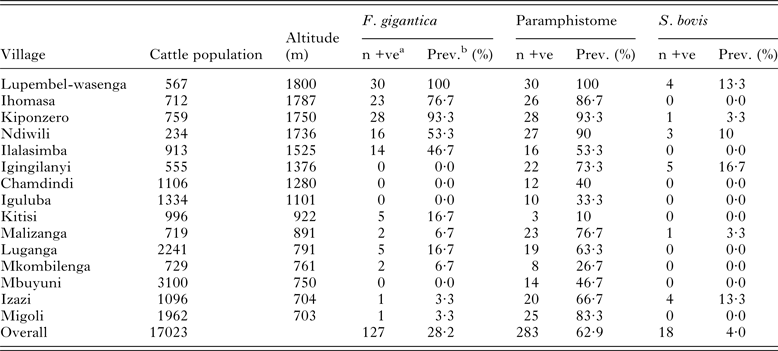
Eggs of F. gigantica, paramphistomes and S. bovis were identified by coprological examination of cattle. These infections were detected in 127 (28·2%), 283 (62·8%) and 18 (4·0%) of the 450 cattle examined, and in 11 (73·3%), 15 (100%) and 6 (40%) of the 15 villages, respectively (Table 1). Adult cattle had the highest prevalence of trematode infections (Table 2). The differences in prevalence between the age groups was statistically significant for F. gigantica (P < 0·05) and paramphistomes (P < 0·001) but not for S. bovis. The highest prevalences of F. gigantica, paramphistomes and S. bovis were observed above 1500 m (Table 2).
Egg-patent trematode infections in cattle in study villages in Iringa Rural District, Tanzania

30 cattle sampled at random per village, n = 450 overall.
a n +ve: number of cattle positive by coprological examination.
b Prev.: prevalence.
Egg-patent trematode infections in different age-groups of cattle in Iringa Rural District, Tanzania

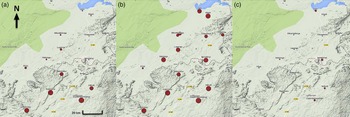
The differences in prevalence between the highlands and lowlands were highly significant for F. gigantica (P < 0·001) and paramphistomes (P < 0·05) but not for S. bovis (P > 0·1). The prevalence of trematode infections among study villages showed extensive spatial variation (Table 3 and Fig. 1) and ranged from 0 to 100% for F. gigantica and paramphistomes and 0–16·7% for S. bovis. The highest individual village prevalences of F. gigantica and paramphistomes, both 100%, were observed at Lupembelwasenga, the highland village at greatest altitude (1800 m), whereas for S. bovis it was at Igingilanyi (1376 m) in the lowlands (Table 1). In the two highland villages (Ilalasimba and Ndiwili) where both breed types were observed, 5 of 10 (50%) Iringa Red cattle and 25 of 50 (50%) Maasai zebu cattle had egg-patent infections with F. gigantica, whereas 4 of 10 (40%) Iringa Red and 39 (78·0%) of 50 Maasai Zebu had egg-patent paramphistome infections, the difference being significant (P = 0·024, Fisher's exact test). None of the 10 Iringa Red cattle were found to be excreting S. bovis eggs; indeed S. bovis was not observed in any cattle in Ilalasimba, where 9 of these 10 cattle were located, and nor were S. bovis eggs observed in feces the single Iringa Red animal examined in Ndiwili, although they were present in 3 of 29 Maasai zebu cattle examined at that site.
Distribution of trematode infections in cattle in villages in Iringa Rural District. Circles proportional to prevalence. (a) Fasciola gigantica: smallest circles (Chamdindi, Igingilanyi, Iguluba and Mbuyuni) 0% prevalence; largest circle (Lupembelwasenga) 100% prevalence; (b) Paramphistomes: smallest circle (Kitisi) 3% prevalence; largest circle (Lupembelwasenga) 100% prevalence; (c) Schistosoma bovis: smallest circles (Ihomasa, Ilalasimba, Chamdindi, Iguluba, Kitisi, Luganga, Mkombilenga, Mbuyuni, Migoli) 0% prevalence; largest circle (Igingilanyi) 16·7% prevalence. Dashed lines show demarcation between lowland (top left) and highland (bottom right) areas.

Egg-patent trematode infections in cattle in highland and lowland areas of Iringa Rural District, Tanzania

Concurrent infections of all 3 trematode parasites were observed in 7 (1·6%) of the cattle examined, while 112 (24·9)% had mixed infection with F. gigantica and paramphistomes, significantly more often than expected by chance (χ 2 = 48·5, P < 0·001) if the 2 were independent; these mixed infections were seen in greater than expected numbers in the highlands (n = 102 [68%], χ 2 = 17·2, P < 0·001), but not the lowlands (n = 10 [3·3%], χ 2 = 0·75, P = 0·39). Fecal egg counts for F. gigantica ranged from 0 to 298, for paramphistomes from 0 to 625 and for S. bovis from 0 to 2 eggs g−1, respectively, with the highest numbers from cattle in the highlands.
In cattle in which both F. gigantica and paramphistome eggs were detected in feces (n = 112), there was a significant positive correlation between the log-transformed egg counts (r 2 = 0·244, P < 0·001). No correlation was observed between egg counts in cattle with mixed infections with F. gigantica and S. bovis (r 2 = 0·0733, P = 0·557), or with paramphistomes and S. bovis (r 2 = 0·00585, P = 0·795).
Distribution of snails
During March 2013 (wet season), a total of 431 trematode intermediate host snails were collected at selected water bodies in highland areas, including 140 Bulinus forskalli, 111 Biomphalaria pfeifferi, 95 Lymnaea natalensis, 55 Bu. africanus and 30 Bulinus tropicus. Avian schistosome cercariae were shed by some of these snails (20 Bi. pfeifferi, 11 L. natalensis, 10 Bu. forskalli, 8 Bu. africanus and 2 Bu. tropicus), but none shed cercariae of mammalian trematodes. During the same period, 80 intermediate host snails were collected at lowlands sites, including 39 Bi. pfeifferi, 19 Bu. forskalli, 10 Bu. africanus and 12 Bu. tropicus. Again, avian schistosome cercariae, but not mammalian trematode cercariae were shed by some of these snails (4 Bu. forskalli, 4 Bi. pfeifferi and 2 Bu. africanus). Melanoides tuberculata and Bellamya constricta were also collected at some lowland sites, but not examined for cercarial shedding as they were are not well recognized as intermediate hosts for trematodes.
During September 2013 (dry season), 309 intermediate host snails were collected at selected water bodies in highland villages, including 100 Bu. africanus, 83 L. natalensis, 78 Bi. Pfeifferi and 48 Bu. tropicus. Gymnocephalous cercariae were detected in 13 L. natalensis and 2 Bu. africanus. Amphistome cercariae were found in 1 Bi. pfeifferi. Mammalian Schistosoma cercariae were found in 7 Bu. africanus and 1 Bu. tropicus. Avian Schistosoma cercariae were found in 4 L. natalensis and 2 Bi. pfeifferi. During the same period, 33 intermediate host snails were collected at selected water bodies in lowland villages, including 23 Bi. pfeifferi and 10 L. natalensis. None of these snail shed cercariae. Melanoides tuberculata and Be. constricta were also collected at these lowland sites.
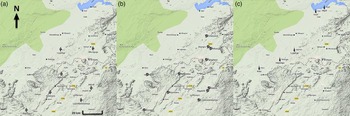
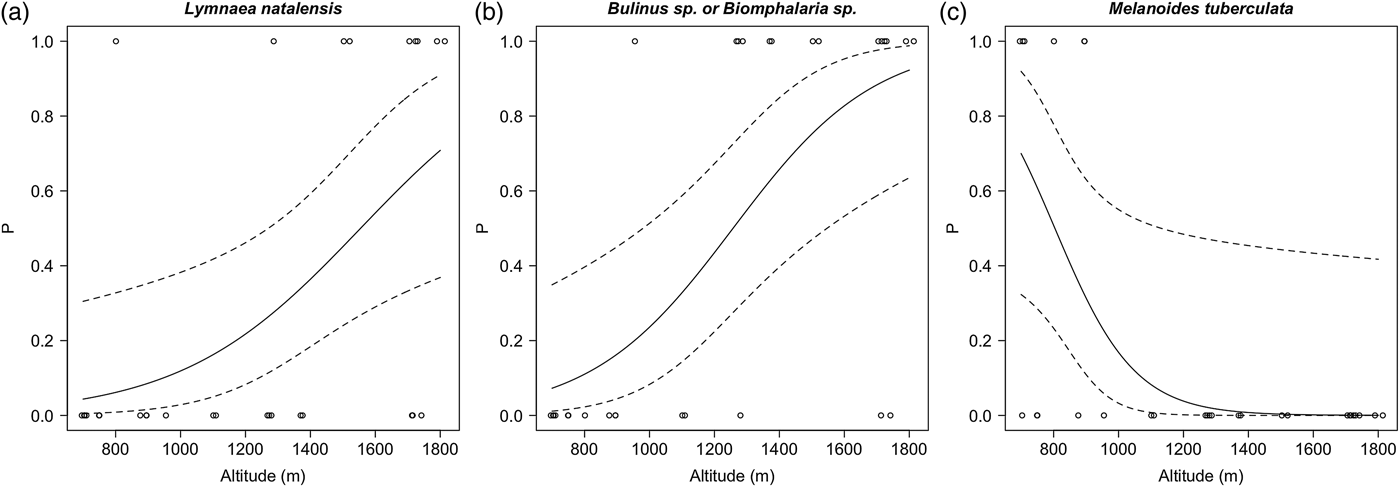
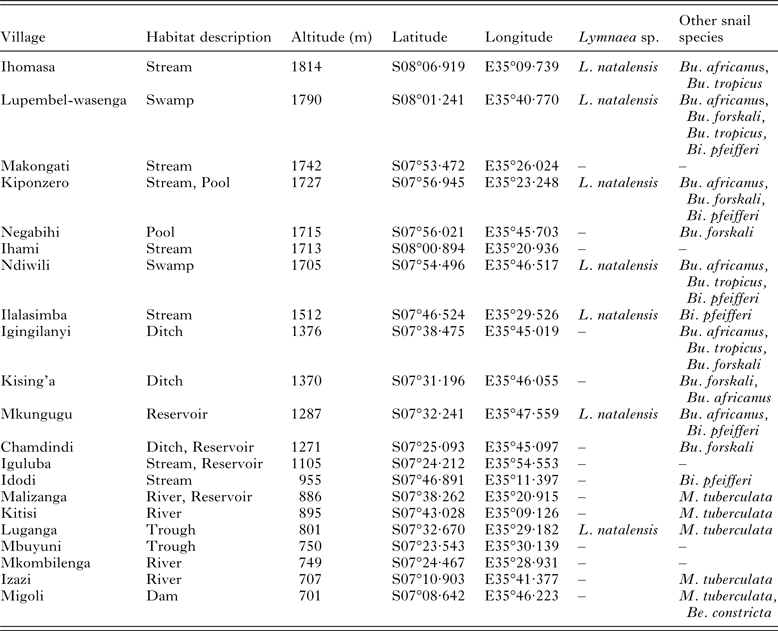
Of the water bodies visited (Table 4 and Fig. 2), 8/10 (80·0%) in the highlands and 12/19 (63·2%) in the lowlands areas, were found to harbour intermediate host snail species. Lymnaea natalensis and Bi. pfeifferi were found at 9 and 8 sites at altitude ranges of 801–1814 m and 955–1790 m, respectively, whereas Bulinus species were found at 11 sites at altitudes ranging from 1268 to 1814 m. Melanoides tuberculata and Be. constricta were restricted to the lowlands at altitudes ranging 696–895 m. The number of sites harbouring snail intermediate hosts differed significantly between the highlands (>1500 m) and lowlands (<1500 m) for L. natalensis (Fisher's exact test: P < 0·01) and Bi. pfeifferi (Fisher's exact test: P < 0·05) but not for Bulinus species (Fisher's exact test: P = 0·22). Logistic regressions showed a significant effect of altitude on the incidence of L. natalensis (P < 0·01), Bulinus sp. or Bi. pfeifferi (P < 0·001), all of which were more likely to be found at higher altitude, and M. tuberculata (P < 0·001), more likely at lower altitude (Fig. 3).
Distribution of intermediate host snails in water bodies in Iringa Rural District. Snail symbols: intermediate host snails observed; solid squares snails not observed. (a) Lymnaea natalensis; (b) Bulinus sp. or Biomphalaria sp.; (c) Melanoides tuberculata.

Altitude and occurrence of intermediate host snails in Iringa Rural District. Solid lines: fitted logistic regression model; dotted lines: 95% confidence interval. (a) Lymnaea natalensis. Regression co-efficients: intercept −5·618 (s.e. 2·127); altitude = 0·003614 (s.e. 0·001458); P occurrence 0·5 at altitude 1554 m; (b) Bulinus sp or Biomphalaria sp. Regression co-efficients: intercept −5·745 (s.e. 1·989); altitude = 0·00457 (s.e. 0·001542); P occurrence 0·5 at altitude 1257 m; (c) Melanoides tuberculata sp., Regression co-efficients: intercept 6·546 (s.e. 3·416943); altitude −0·008142 (s.e. 0·004045); P occurrence 0·5 at altitude 804 m.

Occurrence of snails at water bodies in Iringa Rural District, Tanzania

Linear modelling of trematode prevalence
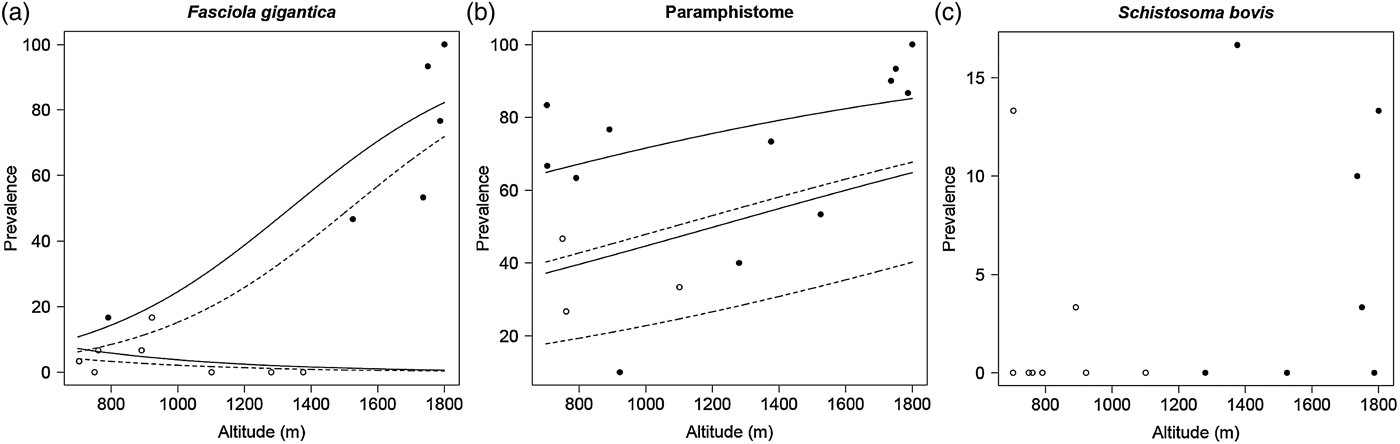
Fasciola gigantica, paramphistome and S. bovis prevalences in cattle were modelled using altitude, observation of intermediate host snails and age and sex of cattle as explanatory variables (Fig. 4). Altitude, observation of L. natalensis and age of cattle were retained in the minimum adequate model for F. gigantica prevalence, while altitude and observation of any (potential) intermediate host snail and cattle age were retained for paramphistome prevalence. Simplified models using altitude as the only explanatory variable were used to calculate altitudes at which 50% prevalence would be expected using −intercept/coefficient. Prevalences increased with altitude, such that the model for F. gigantica (coefficient 0·004687, s.e. 0·0004359; intercept −7·276, s.e. 0·6633) predicted 50% prevalence at 1552 m and that for paramphistomes (coefficient 0·001533, s.e. 0·0002562; intercept −1·240, s.e. 0·3028) predicted 50% prevalence at 809 m. Prevalence of S. bovis was too low for an adequate model.
Altitude and trematode infections in cattle in Iringa Rural District: fitted logistic regression models. Symbols: village prevalences in cattle; solid lines: fitted models for adult cattle (age ⩾24 months); dotted lines: fitted model for juvenile cattle (age <24 months). (a) Fasciola gigantica. Open symbols, lower solid and dotted lines: villages where Lymnaea natalensis not observed; closed symbols, upper solid and dotted lines: villages where L. natalensis observed. Regression co-efficients: intercept −1·569 (s.e. 1·420); L. natalensis present −3·469 (s.e. 1·726); age >24 months 0·5957 (s.e. 0·3591); altitude −0·002266 (s.e. 0·001610); L. natalensis present:altitude 0·005586 (s.e. 0·001723); (b) Paramphistomes. Open symbols, lower solid and dotted lines: villages where no intermediate host snails observed. Closed symbols, upper solid and dotted lines: villages where (potential) intermediate host snails (L. natalensis, Bulinus sp., Biomphalaria sp. or Melanoides tuberculata) observed. Regression co-efficients: intercept −2·254 (s.e. 0·3711); (potential) intermediate host snails present 1·136 (s.e. 0·2736); age > 24 months 1·007 (s.e. 0·2306); altitude 0·001032 (s.e. 0·0002802); (c) Schistosoma bovis. Open symbols: no intermediate host snails observed. Closed symbols: intermediate host snails (Bulinus sp., Biomphalaria sp.) observed. (Prevalences too low for reliable model fitting).

DISCUSSION
The present findings and previous studies (Keyyu et al. Reference Keyyu, Monrad, Kyvsgaard and Kassuku2005: Nzalawahe et al. Reference Nzalawahe, Kassuku, Stothard, Coles and Eisler2014) in Tanzania and elsewhere in Africa (Pfukenyi et al. Reference Pfukenyi, Monrad and Mukaratirwa2005) revealed that with F. gigantica and paramphistomes are the predominant egg-patent trematode infections of cattle. While S. bovis was less prevalent in cattle investigated in this study, it is clearly an important parasite in Iringa District and the wider region (De Bont et al. Reference De Bont, Vercruysse, Southgate, Rollinson and Kaukas1994; Makundi et al. Reference Makundi, Kassuku, Maselle and Boa1998; Pfukenyi et al. Reference Pfukenyi, Monrad and Mukaratirwa2005; Yabe et al. Reference Yabe, Phiri, Phiri, Chembensofu, Dorny and Vercruysse2008). Keyyu et al. (Reference Keyyu, Monrad, Kyvsgaard and Kassuku2005) recorded prevalences of 44·9% for F. gigantica and 82·7% for amphistomes in cattle above 1200 m altitude, consistent with the prevalences of 111/210 (52·9%) for F. gigantica and 161/210 (76·7%) for paramphistomes in villages in our study above this altitude (Table 1). Makundi et al. (Reference Makundi, Kassuku, Maselle and Boa1998) found 8 (3·9%) of 205 cattle in villages in Iringa District to be infected with S. bovis, a prevalence similar to the 4% in the present study.
Fasciola gigantica and paramphistome infections were more prevalent in cattle of the highlands (74·0 and 84·7%, respectively) compared with the lowlands (5·3 and 52·0%, respectively). Fasciola gigantica and paramphistome infection prevalences were both significantly higher in adult cattle than in weaners (P < 0·05), reflecting their greater length of exposure to infection (Waruiru et al. Reference Waruiru, Kyvsgaard, Thamsborg, Nansen, Bøgh, Munyua and Gathuma2000; Keyyu et al. Reference Keyyu, Monrad, Kyvsgaard and Kassuku2005; Pfukenyi et al. Reference Pfukenyi, Mukaratirwa, Willingham and Monrad2006). Despite there being only 10 cattle of the Iringa Red type in the study sample, there was significantly a lower rate of egg-patent paramphistome infections (40%) in these cattle than in Maasai zebu-type cattle (78%) in the same villages. The small number of animals involved means these results should be interpreted with caution, and no evidence of breed association with susceptibility was found for either F. gigantica or S. bovis.
Distribution of intermediate host snails was broadly consistent with that of trematode infection in cattle, in keeping with understanding of their vectorial competence. Linear modelling of the data showed that villages above approximately 1550 m had over 50% prevalence of F. gigantica and greater than 50% likelihood of presence of its principal intermediate host L. natalensis. The detection of F. gigantica infections in cattle in some lowland villages where L. natalensis intermediate hosts were not found, might be due to either migration of cattle herds to wetter areas during the dry season, or to the presence of temporary water bodies acting as focal points for trematode transmission during the rainy season and early dry season, and possibly harbouring snails washed from the highlands by flood water.
Villages above 1260 m had greater than 50% likelihood of Bulinus or Biomphalaria sp. being present. Bulinus africanus and Bu. forskalli act as primary intermediate hosts for S. bovis (Kumar, Reference Kumar1999), while Bu. tropicus also act as intermediate hosts for S. bovis after previous infection with paramphistomes (Southgate et al. Reference Southgate, Brown, Rollison, Ross and Knowles1985, Reference Southgate, Brown, Warlow, Knowles and Jones1989). Although too few S. bovis infections were detected in cattle to allow modelling of its relationship to altitude, its observed distribution in cattle roughly corresponded presence of these intermediate hosts in the more easterly part of the study area (Figs 1c and 2b).
Paramphistomes use a wide range of aquatic snails as their intermediate hosts including Lymnaea sp., Bulinus sp. and planorbid species (e.g. Biomphalaria sp.). Although it was not possible to identify paramphistomes to species level on the basis of egg morphology, previous studies have identified Calicophoron microbothrium and Cotylophoron jacksoni in cattle slaughtered in Iringa (Keyyu et al. Reference Keyyu, Kassuku, Msalilwa, Monrad and Kyvsgaard2006). Bulinus tropicus is recognized as an intermediate host for C. microbothrium, while intermediate hosts for C. jacksoni are poorly described (Kumar, Reference Kumar1999). With the sole exception of L. natalensis present at 801 m in Luganga village, Lymnaea, Bulinus and Biomphalaria sp. were not found at any sampling site below 900 m in altitude (Table 4). Nevertheless, paramphistomes occurred in cattle at all sampling sites below this altitude, and at high prevalence in 4 locations (Migoli: 703 m, 83·3% prevalence; Izazi: 704 m, 66·7%; Mbuyuni: 750 m, 46·7%; and Malizanga: 891 m, 76·7%). Melanoides tuberculata were encountered in many of these low altitude sites (Table 4) consistent with the possibility that this snail species is involved in transmission of paramphistomes as reported in an experimental study in Zimbabwe (Chingwena et al. Reference Chingwena, Mukaratirwa, Kristensen and Chimbari2002).
The highest risk of trematode infection in cattle in East and southern Africa has been reported to occur in areas of high annual rainfall, with risk decreasing in areas of shorter wet season (Malone et al. Reference Malone, Gommes, Hansen, Yilma, Slingenberg, Snijders, Nachtergaele and Ataman1998; Pfukenyi et al. Reference Pfukenyi, Mukaratirwa, Willingham and Monrad2006). High rainfall favours the development and survival of the developmental stages in intermediate host snails, whereas arid areas are generally unsuitable for occurrence of trematode infections in cattle. In addition to high rainfall and suitable temperatures for the survival of the snails, the Iringa highlands provide a number of wet/swampy grazing areas, streams, rivers and reservoirs which allows snail activity throughout the year. In contrast, the lowlands are characterized by dry grazing lands with low rainfall and high temperatures, especially during the dry season. Cattle have access to few natural water bodies and reservoirs hence snail habitats have a highly focal distribution. Moreover, the majority of ditches and reservoirs that harbour Bulinus and Biomphalaria species during the rainy season dry up by the middle of the dry season, resulting in a seasonal transmission pattern. The longer period of transmission explains why trematode burdens are higher in cattle in the highlands. Similar findings have been reported in Zimbabwe (Pfukenyi et al. Reference Pfukenyi, Monrad and Mukaratirwa2005, Reference Pfukenyi, Mukaratirwa, Willingham and Monrad2006). In Uganda, Ogambo-Ongoma (Reference Ogambo-Ongoma1972) and Howell et al. (Reference Howell, Mugisha, Davies, LaCourse, Claridge, Williams, Kelly-Hope, Betson, Kabatereine and Stothard2012) found high prevalences of trematode parasites (F. gigantica and paramphistomes) at low altitudes (<1500 m), but this might be due to the different eco-climatic conditions in their study areas (Malone et al. Reference Malone, Gommes, Hansen, Yilma, Slingenberg, Snijders, Nachtergaele and Ataman1998).
Gymnocephalous cercariae were shed by L. natalensis and Bu. africanus while mammalian Schistosoma cercariae and amphistome cercariae were found in Bu. africanus, Bulinus forskali and Bi. Pfeifferi, respectively. The shedding of gymnocephalous, amphistome and mammalian Schistosoma cercariae suggested the presence of Fasciola, paramphistomes and S. bovis/Schistosoma haematobium infections in the snails. Avian Schistosoma cercariae and Xiphidiocercariae which are not of veterinary importance were found in all 3 genera of snails.
Intermediate host snails were found to shed cercariae of veterinary/medical importance during the dry season (September 2013) and but not the wet season (March 2013) and only in highland areas but not the lowlands. This is consistent with the higher prevalence of F. gigantica and paramphistome infection in cattle in the highlands compared with the lowlands, and with earlier results (Keyyu et al. Reference Keyyu, Monrad, Kyvsgaard and Kassuku2005) that showed the proportion of cattle with egg patent infections increased during the course of the dry season, peaking at the end of the dry season and the early part of the wet season.
The observation of greater than expected numbers of mixed infections with F. gigantica and paramphistomes, especially in highland areas (P < 0·001), suggests that in these areas either they may share intermediate host species, e.g. L. natalensis, or that their respective intermediate hosts have similar environmental distributions. The significant positive correlation (r 2 = 0·244, P < 0·001) between the log-transformed egg counts in cattle in which both F. gigantica and paramphistome eggs were detected in feces was consistent with the assertion that interactive infections between these two trematode types are mutually inclusive (Yabe et al. Reference Yabe, Phiri, Phiri, Chembensofu, Dorny and Vercruysse2008). As in previous studies (Yabe et al. Reference Yabe, Phiri, Phiri, Chembensofu, Dorny and Vercruysse2008), no such correlation was observed between infections with F. gigantica and S. bovis infections or between infections with paramphistome and S. bovis.
This study has established that trematode parasites (F. gigantica and paramphistomes) are prevalent in cattle of Iringa Rural District, with those in the highlands worse affected than those in the lowlands. These observations suggest that interventions for the control of F. gigantica and paramphistomes are currently needed in the highlands (Keyyu et al. Reference Keyyu, Kyvsgaard, Kassuku and Willingham2003). Intervention could be based on anthelmintic treatment of cattle, which would require assessment of the effectiveness of the locally available flukicides, and control of intermediate hosts, which likewise would require detailed investigation of seasonal snail population dynamics and infection rates. Moreover further studies are needed at lowlands area to confirm the involvement of M. tuberculata in the transmission of paramphistomes.
ACKNOWLEDGEMENTS
The authors acknowledge the cooperation of local staff within the District Veterinary Office and Veterinary Investigation Centre in Iringa and of farmers in Iringa Rural District during the period of study. Field and technical assistance from Mr D. S. Mwangoka, R. A. Kassuku, A. Manyesela, L. P. Msalilwa and Miss. J. Longo was highly appreciated.
FINANCIAL SUPPORT
This work was supported by the Leverhulme-Royal Society African Award Scheme (JN, AAK, JRS, GCC and MCE) and the University of Bristol (GCC and MCE).