China is facing a language endangerment crisis, with approximately half of its languages endangeredFootnote 1 – far above the 20 per cent background rate for Asia as a whole.Footnote 2 Numerous studies on individual languages paint a similarly grim picture of widespread endangerment.Footnote 3 And although this crisis impacts both the Han majority and ethnic minorities, the latter seem particularly affected: in 2000, 10 out of China's 55 minority nationalities maintained their minority language at a rate below half of their official population, evidence of massive language loss.Footnote 4
Xu Shixuan argues that this high rate of endangerment is a result of economic globalization, urbanization, the marginalization of minority languages, and pressure from dominant languages.Footnote 5 These “dominant” languages include not only the national language (putonghua 普通话) but also regionally dominant varieties of “Chinese”Footnote 6 as well as ethnic minority languages (including Mongolian, Lahu 拉祜语, Nuosu Yi 诺苏彝语, and Lisu 傈僳语). The dynamics underlying language endangerment in China are therefore more complex than universal assimilation to putonghua. In this article, we contribute to our expanding understanding of these complexities with a case study of the Gochang language (guiqiong 贵琼语), spoken by Tibetans in Sichuan province.
Any study of language endangerment in China must be considered in light of our evolving understanding of the country's linguistic diversity. David Bradley notes that, “China is one of the last places on earth where there are large numbers of unreported and undescribed languages.”Footnote 7 Tibet provides a case in point.Footnote 8 An emerging consensus among linguists is that it is “no longer viable” to consider “Tibetan” as a single language;Footnote 9 instead, it constitutes a family containing multiple languages.Footnote 10 In addition to these “Tibetic” languages, Tibetans in China also speak some 26 non-Tibetic languages.Footnote 11 Furthermore, in addition to Tibetans, Tibet is home to at least 14 other formally recognized ethnic groups (minzu 民族), who speak 33 different languages. Taken together, the non-Tibetic languages spoken in Tibet by Tibetans and members of other ethnic groups are referred to as Tibet's minority languages.Footnote 12 The language we focus on, Gochang, is one such language. We refer to it here as an “invisible” language, since it is unrecognized by the state and hence is invisible to the official gaze which determines the allocation of material and moral resources to language communities. Invisible languages spoken by Tibetans, such as Gochang, make up nearly half (26 out of 60) of Tibet's minority languages.
Research on endangerment among Tibet's minority languages is an emerging field. A preliminary discussion of the topic concluded that while language endangerment among Tibet's minority languages appears widespread, “[much] remains to be learned about the shared, and different, fates” of these languages.Footnote 13 Gerald Roche and Hiroyuki Suzuki, combining data from Lewis, Simons and Fennig with their own sociolinguistic typology, estimate that approximately two-thirds of Tibet's minority languages are endangered.Footnote 14 Case studies of individual languages also suggest that endangerment is widespread. Mátyás Balogh reports that Henan Oirat (Qinghai) is “critically endangered,” while Tunzhi describes Rta'u (Sichuan) as “clearly endangered.”Footnote 15 John van Way and Bkrashis Bzangpo claim that Nyagrong Minyag (Sichuan) is “hanging from a precarious ledge,” with many speakers shifting to the local Tibetic variety, a situation also described by Robert Fried in reference to the Manegacha language (Qinghai).Footnote 16 Katia Chirkova reports that the Lizu language (Sichuan) is endangered “due to the decreasing number of fluent speakers and the ongoing shift towards Chinese,”Footnote 17 and that the Duoxu 多续 language (Sichuan) is “terminally endangered.”Footnote 18 The Namuyi language (Sichuan) has been described as “very much an endangered language.”Footnote 19 These studies are suggestive of widespread endangerment among Tibet's minority languages. Here, we add to this picture with a case study of the Gochang language of western Sichuan.
Gochang is typically referred to as guiqiong, a pinyin 拼音 rendering of the local pronunciation of the language's name.Footnote 20 It is spoken primarily in the valley and tributaries of the Dadu River 大渡河Footnote 21 in north-eastern Kangding 康定Footnote 22 municipality in Kardze Tibetan Autonomous Prefecture.Footnote 23 The area where the language is spoken was, until 1949, known as Gotang,Footnote 24 and was ruled over by a local hereditary king.Footnote 25 Gochang is an oral language, spoken by about 10,000 people, and is classified as a Qiangic language, and thus only distantly related to the Tibetic languages. Most Gochang speakers are officially classified as Tibetans (zangzu 藏族). This study highlights salient features of the endangerment of Gochang, thus providing important insights into the complex ways in which national language and ethnic policies interact with statist development to produce language endangerment, particularly for China's “invisible” languages.Footnote 26
Language Endangerment and Vitality
Our study of Gochang adopts a “language endangerment” approach, a framework that emerged in the 1990s, in recognition of a global language endangerment crisis.Footnote 27 This approach quickly spread to China.Footnote 28 One of the central methods of the language endangerment approach has been the systematic assessment of language endangerment through the concept of language vitality. Language vitality models provide rubrics for assessing language endangerment and sustainability within the context of a particular linguistic, social, political and cultural environment.Footnote 29
We adopt the UNESCO Language Endangerment and Vitality Framework in our discussion.Footnote 30 This model assesses vitality according to nine factors: intergenerational language transmission; absolute number of speakers; proportion of speakers within the total population; trends in existing language domains; response to new domains and media; materials for language education and literacy; government and institutional language attitudes and policies, including official status and use; community members’ attitude towards their own language; and urgency for documentation. For each category – except number of speakers – UNESCO ranks results on a scale from 0 to 5.
Our description is based on both primary and secondary literature, as well as the second author's status as a Gochang speaker. She is intimately familiar with the area and has a broad network of relatives, friends and associates throughout Gotang with whom she consulted. We also visited Gotang in January and July of 2016 and visited most Gochang-speaking villages. The significance of our contribution lies in bringing our Tibetological, historical and anthropological perspectives to this topic, which has so far only been examined by linguists working primarily with Chinese literature.
Language Diversity in Sichuan's Tibetan Regions
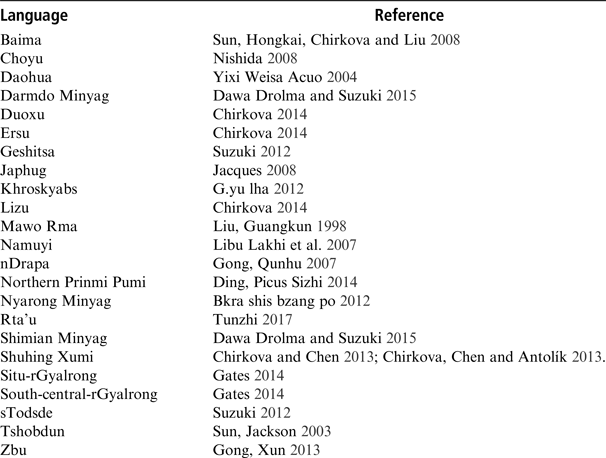
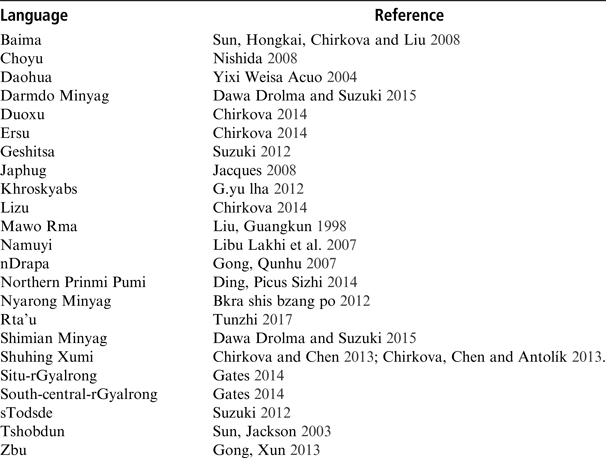
Linguistic diversity in Tibet generally increases with population density, meaning that it increases from west to east across the Tibetan Plateau. The vast majority of minority languages spoken by Tibetans in China are spoken only in Sichuan province.Footnote 31 These indigenous languages are spoken in NgawaFootnote 32 Tibetan and Qiang 羌 Autonomous Prefecture, Kardze Tibetan Autonomous Prefecture and several adjacent counties to the east of this area where Tibetans live, as well as within Liangshan 凉山 Yi Autonomous Prefecture. Table 1 lists these languages with reference to literature on each.
Languages Spoken by Tibetans in Western Sichuan
Knowledge of western Sichuan's linguistic diversity stretches back to the 18th century, when vocabularies for Duoxu, Lizu, Baima, and Situ rGyalrong were assembled.Footnote 33 Studies by Westerners date back to the mid-19th century, with wordlists of various languages published between 1853 and 1936.Footnote 34 Brief, and generally unflattering, mentions of the region's languages also appeared in the reports of missionaries and others.Footnote 35 Yudru Tsomu has documented the intensifying production of ethnographic knowledge about Sichuan's Tibetan regions after 1911 as part of the Republican effort to incorporate the region.Footnote 36 This includes Jiang Wuji's account of Gotang, which we draw on.Footnote 37
A long hiatus in publishing on the languages of western Sichuan followed 1949. Although some linguistic research was conducted as part of the ethnic identification project between 1953 and 1959, very little was published in the 1950s and 1960s.Footnote 38 During the Cultural Revolution, work on minority languages ceased, but then gradually resumed after 1978, and flourished in the 1980s.Footnote 39 An important milestone during this period was Sun Hongkai's study published in 1983, and re-published in English in 1990 under the title “Languages of the ethnic corridor of western Sichuan”; this article introduced international linguistics audiences to many of western Sichuan's languages for the first time.Footnote 40
Research on the languages of the region has steadily increased since then, and has intensified in the 21st century. It is only since 2005 that many of the region's languages have been described in detail for the first time. Increasing interest in these languages can also be seen in the convening of a series of international conferences, beginning in 2008, on the “Sino-Tibetan Languages of Western Sichuan.” Much of the work being done on these languages remains descriptive, although some sociolinguistic research is now starting to emerge.Footnote 41
The Linguistic Vitality of Gochang
Intergenerational language transmission
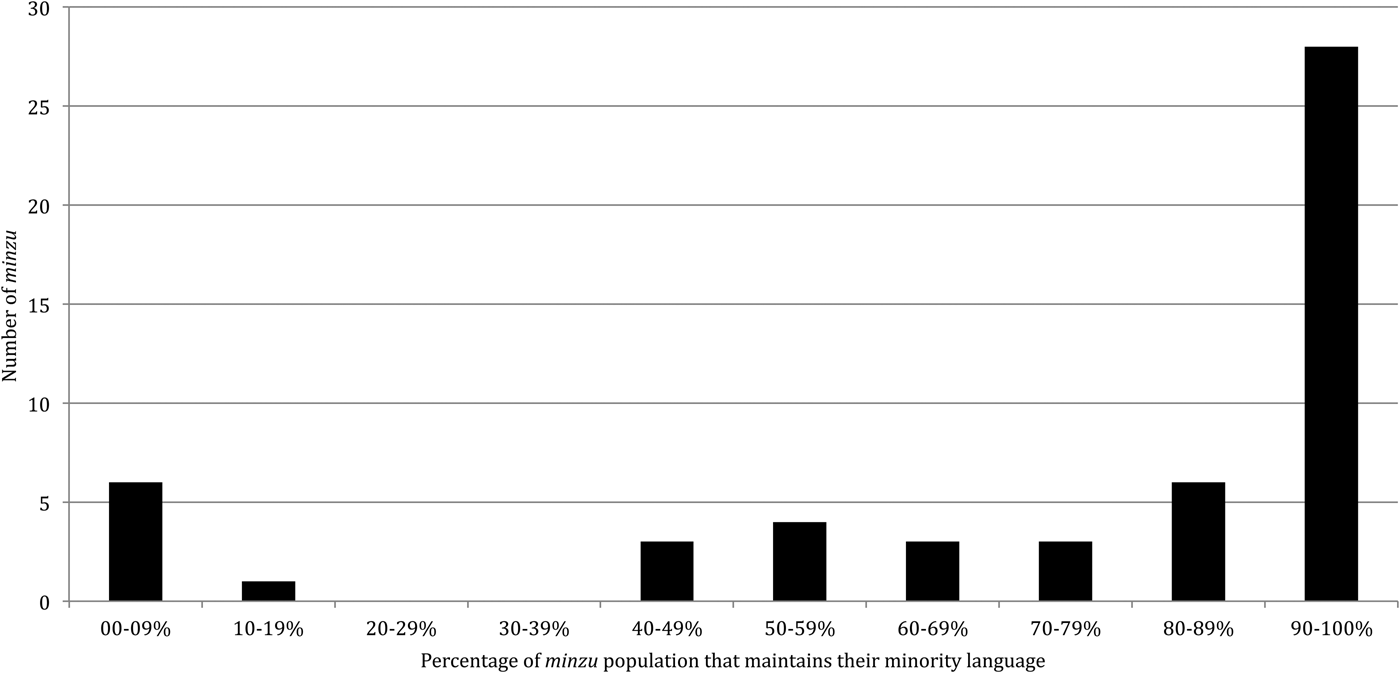
Intergenerational language transmission is widely regarded as the most important criterion in determining language vitality.Footnote 42 Jiang Li and Song Lingli both suggest that the intergenerational transmission of Gochang has ceased, while Yuan Li, Jin Ming and Cao Rong together report that less than 10 per cent of “young people” can speak Gochang.Footnote 43 Our observations suggest that intergenerational transmission was interrupted relatively recently. For reasons we explore below, most children aged around ten and below are now dominant in Sichuan Chinese, while those above ten are bilingual in Sichuan Chinese and Gochang. In light of this, we classify the language as “definitively endangered” – “the language is used mostly by the parental generation and up.”Footnote 44 Gochang is thus joining a number of other languages in China that are being replaced by local varieties of Chinese.Footnote 45 Figure 1 highlights the extent of language shift among China's ethnic minorities.
Language Maintenance among Ethnic Minorities in China

Absolute number of speakers
In consultation with written and oral sources, Jiang estimates that there are 9,677 Gochang speakers, and an additional almost 3,000 “listeners” with passive competence in the language, giving a total of 12,677 people who are able to understand Gochang.Footnote 46 Jiang also notes that “over 1,000” Han Chinese also speak Gochang, so the total of speakers should therefore perhaps be 10,677.Footnote 47 This figure can be contrasted with Sun's estimate of 7,000 speakers, Huang Bufan's of 6,000, and Song's of 3,000.Footnote 48 Within China, over a third of the languages listed in the 18th edition of Ethnologue (104 languages, or 35 per cent) have populations of 10,000 or fewer speakers.
Proportion of speakers within the total population
The third UNESCO criterion refers to the relative proportion of people who speak the language within a total population, wherein that total population “may refer to the ethnic, religious, regional, or national group with which the speaker community identifies.”Footnote 49 Here, we offer three estimates of the proportion of speakers vis-à-vis different definitions of the “reference population,” based on local, ethnic and national populations.
The first estimate focuses on the former territories of the Gotang King, roughly corresponding to the area for which Jiang collected population data. She states that there are a total of 16,359 Tibetans in the area, and among these, 9,677 speak Gochang. Therefore, just under 60 per cent (59.15 per cent) of Tibetans in the former Gotang territory speak Gochang. This, however, excludes the non-Tibetan population of the region, which is significant, primarily owing to the urban population of Guza town, which Li Na lists as 50,000.Footnote 50
Since the 1980s, Guza has grown from a collection of eight villages and a handful of administrative offices surrounded by fields to a dense cluster of multi-storey buildings. Rapid growth was instigated by economic reform and the implementation of the household responsibility system. Simultaneously, several technical schools (zhongzhuan 中专) were opened. In the late 1980s, the demographic balance between locals and migrants tipped, minoritizing the Gochang-speakers in Guza. Urban growth intensified owing to an artisanal gold-mining boom from the late 1990s to mid-2000s. Local tertiary education institutes were upgraded, consolidated and expanded from 2004 and 2013, leading to a growth in staff, student populations and service-provider populations. In 2011, around 500 Gochang-speaking households were resettled following the damming of the Dadu River.Footnote 51 In addition to permanent resettlement, rotating migration is also common. Many adults spend most of the year outside the village, undertaking migrant labour in Guza or other places, leading to rural abandonment. In Weishe 为舍 village, only 12 people out of approximately 330 residents live in the village year-round, while in Yazi 芽子 village, only seven or eight of the 20 houses were thought to be inhabited year-round. This seasonal migration by villagers is not only incentivized by the financial gains to be had from migrant labour, but also facilitated by “grain-for-green” policies, which, since their implementation in 2000, have divorced people from their rural subsistence base.Footnote 52
A related issue has been Han immigration to Gotang. Although dating back to the late Qing, Han immigration has intensified since the 1980s. Permanent resettlement of Gochang-speakers to Guza, rural abandonment, rotating migration, and Han immigration have all resulted in the demographic minoritization of Gochang speakers in Gotang.Footnote 53
Within the ethnic context, Gochang speakers constitute only 0.16 per cent of the total Tibetan population.Footnote 54 In total, Tibetans who speak a minority language constitute 4 per cent of the total Tibetan population.Footnote 55 Even if we take the entire linguistic minority population of Tibetans as a referent population, Gochang speakers only constitute approximately 4.5 per cent.
Finally, within the People's Republic of China (PRC), Gochang speakers constitute a mere 0.00076 per cent of the total. However, this should be noted in light of the fact that about one-third of China's languages have populations similar to or smaller than that of Gochang.
Looking at these three demographic frames – local, ethnic and national – the proportion of Gochang speakers within the total population can be thought of as somewhere between “severely endangered” (a minority speak the language) and “critically endangered” (very few speak the language). Urbanization and immigration have been key drivers of the demographic minoritization of Gochang speakers, similar to many other endangered languages throughout China.Footnote 56
Trends in existing language domains
A “domain” is a sociolinguistic context in which a language is used – the “major institutions in society: e.g. the family, the work sphere, education, religion, entertainment and the mass media, the political party, the government, etc.”Footnote 57 UNESCO's use of domains in its language vitality framework is based on Joshua Fishman's hypothesis that in order for a language to be vital, it must have “domain specificity,” i.e. have certain domains where it is used exclusively.Footnote 58 UNESCO classifies domains into “new” and “existing” without providing operational definitions of these terms, and so we divide “new” from “existing” with 1949 and the founding of the PRC as a watershed.
Regarding the agricultural domain, Jiang points out that Gochang has a rich agricultural vocabulary and “not only contains original names for grains, crops and fruit trees, [but] also contains distinctive ways of sowing, detailed names of various parts of a tilled field, and specified names of various parts of earliest tilling device.”Footnote 59 Otherwise, Tibetan appears to dominate domains beyond subsistence and domestic tasks.
Oral traditions constituted a significant aspect of popular culture in the era before mass media. In Gotang, oral traditions were overwhelmingly in a local pronunciation of literary Tibetan. Songs were mostly sung in Tibetan, and although locals understood the general meaning, they could not understand individual lines of text or isolate specific words. This follows a pattern common among Tibet's linguistic minorities, who often spoke one language but sang in another.Footnote 60 Speeches given on such occasions as weddings were also in Tibetan, and again, this has parallels elsewhere in Tibet. One important oral tradition – the recitation of the Epic of King Gesar – consisted of both spoken and sung sections; spoken portions were in Gochang while sung portions were in Tibetan. Completing the spectrum of oral traditions, we find folktales which, although told in Gochang, were typically based on Tibetan templates, such as the Story of Salt and Tea and The Frog Rider.Footnote 61
Religion is another important domain in Gotang.Footnote 62 The three main religious practitioners in the region – loumu (Buddhist monks), gongma (household tantric specialists) and amcho (lay Buddhist specialists) – all make use of Tibetan language scriptures. The monks, moreover, reinforce this close relation between Tibetan Buddhism and the written Tibetan language by offering free Tibetan literacy classes to local children during school holidays, as well as maintaining libraries of Tibetan-language books at the two monasteries. The dominance of Tibetan script in this domain not only conferred upon it a specific role in the local language ecology but also conferred prestige, rooted in sacred power, upon the language.
Jiang provides useful observations on other domains in Gotang prior to 1949.Footnote 63 There were two primary schools in the area, which enrolled a total of 28 students and taught in Chinese. Meanwhile, legal appeals were made to village headmen, presumably in Gochang, but could be escalated until they reached the local government, at which level Chinese would have been used. Jiang also states that the Gotang King and some local headmen were fluent in Chinese and could also read it, whereas commoners in Gotang, other than in a few communities along the river, could not speak Chinese.
Based on the above description, the situation regarding existing domains can be described as one of “multilingual parity,” “whereby the non-dominant language is used in informal and home contexts and the dominant language is used in official and public contexts.”Footnote 64 The “dominant” language in this case was Tibetan, but Chinese also played a limited role. Gochang was used in domestic and subsistence contexts, and Tibetan was used in most formal contexts, although elites used Chinese. The intense contact with Tibetan is attested to, in part, by the existence of numerous Tibetan loanwords in Gochang.Footnote 65 The social bilingualism in Gotang was a classic example of diglossia, where a local vernacular existed alongside “a very divergent, highly codified … superposed variety, the vehicle of a large and respected body of written literature, either of an earlier period or in another speech community, which is learned largely by formal education and is used for most written and formal spoken purposes but is not used by any section of the community for ordinary conversation.”Footnote 66 Similar diglossic situations seem to have pertained for many of Tibet's minority languages;Footnote 67 more broadly, the great scriptural traditions of China likely bound the vast majority of the country's “invisible” languages into some form of diglossic relation with a literary language and, possibly, associated oral traditions.
Response to new domains and media
UNESCO states that, “If the communities do not meet the challenges of modernity with their language, it becomes increasingly irrelevant and stigmatized.”Footnote 68 As new domains – for example, mass media, state bureaucracy, formal education – appear, they are typically filled by state-sponsored dominant languages, resulting in minority languages being “restricted to use in the home and perhaps among friends.”Footnote 69 This marginalization, in turn, frequently causes speakers of minority languages to feel that their language is “useless,” leading to its abandonment.Footnote 70 Furthermore, the proliferation of new domains enforces notions of the language's uselessness when it becomes apparent that the language “is increasingly unable to talk about all the new things and ideas that are being introduced from the modern world.”Footnote 71 In the discussion that follows, we see that Gochang has, indeed, been excluded from most new domains in favour of Chinese, both the standard and the local vernacular forms.
We have already seen above how the Republican period witnessed attempts to establish Chinese-language state institutions, including schools and legal services, in Gotang. However, these never had a strong impact, and it was not until after the region was “liberated” in 1950, and particularly after June 1951 when local military resistance was definitively quashed, that the national government came to exert significant direct influence in the area. Today, the main government offices of the Gotang region are located in Guza town, with smaller offices in townships and some outreach services such as medical clinics in villages. Although these offices conspicuously display Tibetan script,Footnote 72 the language used within them is exclusively Chinese. Therefore, locals must use spoken and written Chinese for a host of bureaucratic tasks such as negotiating tax payments, obtaining a construction permit or business licence, requesting permission for a change in land usage or residential registration, receiving student financial aid or poverty alleviation subsidies, registering newborn children or deaths, or applying for medical rebates. State-owned or operated businesses, such as the postal service and banks, also use Chinese. In all these official contexts, even if both interlocutors know Gochang, some form of Chinese is used.Footnote 73
Meanwhile, all local educational services are now located in Guza; the closure of village primary schools began in the early 21st century. Guza is home to two kindergartens (one private, one public), a primary school, a junior middle school,Footnote 74 and two tertiary education institutions – Sichuan Minzu College (Sichuan minzu xueyuan 四川民族学院) and a medical college (Ganzi zangzu zizhizhou weisheng xuexiao 甘孜藏族自治州卫生学校). Local participation in formal schooling increased sharply after compulsory education policies began to be enforced in 2007–2008, requiring all students to complete nine years of education, from primary to junior middle school. And although kindergarten is not compulsory, most locals feel that it is required in order for children to be competitively placed in their later schooling. The language of instruction at all of these institutions is Chinese – no Gochang is used.Footnote 75 Students can board at school from grade three upwards, which increases their exposure to Chinese.
Finally, in regard to media, locals have access to television in both putonghua and Tibetan (Amdo, Khams, and U-Tsang varieties of Tibetan).Footnote 76 Elders, who typically understand neither Chinese nor Tibetan well, prefer to watch Tibetan stations, as song and dance performances predominate on these channels. Meanwhile, adults and youths, who understand Chinese but not Tibetan, prefer to watch Chinese language stations. Radio is also available in both languages, but Chinese predominates. Popular music is in both Chinese and Tibetan, but Korean and English songs can also be heard locally. In terms of print media, locally available newspapers and books are primarily in Chinese; only one bookstore in Guza sells Tibetan books. The only form of media where Gochang is used is social media, particularly the popular messaging service WeChat, which enables locals to exchange voice messages in Gochang.
In summary, then, the last 60 years have seen the appearance of numerous new domains in Gotang. Some of the new domains are in direct competition with existing ones. New media forms, for example, are replacing oral traditions. This therefore brings Tibetan and Chinese, as local prestige languages, into direct competition. On the other hand, even when new domains are not in direct competition with existing ones, they impact Gochang's vitality by creating institutions for social prestige and mobility that are associated exclusively with the dominant language. In this context, we rate Gochang as the lowest possible rank for this criterion, “inactive,” meaning that, “The language is not used in any new domains.”Footnote 77 In this respect, Gochang is in a similar predicament to all of China's “invisible” languages,Footnote 78 as well as most of the smaller, formally recognized languages.Footnote 79
Materials for language education and literacy
In introducing this criterion, the UNESCO guidelines note that “Education in the language is essential for language vitality.”Footnote 80 And although they concede, along with Lenore Grenoble and Lindsay Whaley, that “the relationship between literacy and language vitality is a rather complex matter,” the UNESCO guidelines nonetheless conclude that literacy is positively correlated with vitality.Footnote 81
Gochang is presently unwritten and so there are no materials for literacy; there are also no audio-visual materials that would enable this language to be learned as a spoken language. We therefore place Gochang in the lowest possible level in the scale for this criterion – “no orthography is available to the community.” As with the response to new domains, this inactivity in the literary domain is mirrored by all of China's invisible languages, as well as most of the smaller, formally recognized minority languages, representing a significant shortcoming in state-led language management.Footnote 82
Government and institutional language attitudes and policies, including official status and use
The UNESCO guidelines for this criterion refer to the dominant population's treatment of non-dominant language groups, with the clarification that the dominant population might be nationally or regionally dominant. This clarification is significant for Gochang, which is dominated by putonghua at the national level, Sichuan Chinese at the local level, and Tibetan within an ethnic framework. The UNESCO guidelines state that the linguistic ideologies of the dominant population “may inspire linguistic minorities to mobilize their populations toward the maintenance of their languages, or may force them to abandon them.”Footnote 83 They also distinguish between policies that support, discourage, or prohibit the use of a minority language.
Regarding government attitudes and policies, we can begin by noting that the constitution of the PRC explicitly states that all minorities have the freedom to use and develop their language.Footnote 84 This constitutional freedom is enacted through law via such measures as the Education Law of the People's Republic of ChinaFootnote 85 and the Regional Ethnic Autonomy Law of the People's Republic of China.Footnote 86 Despite these robust provisions, serious shortcomings in implementation exist.Footnote 87 Furthermore, the only language that is actually named in any of these legal mechanisms is putonghua, with its mandatory use being enshrined in the Law of the People's Republic of China on the Standard Spoken and Written Chinese Language.Footnote 88 There is, otherwise, no register of officially recognized languages. Instead, legal texts refer to “the language of the area” or “the native language commonly adopted in a region.” In theory, this absence of official designation for languages and the reliance on “local conditions” mean that small languages such as Gochang could be used in formal government institutions, such as schools, courts, hospitals and bureaucracies, at a local level.Footnote 89 Hans-Christian Schnack refers to such flexibility at the local level as “spaces of discretion,” where vague wording in policy can empower low-level leaders in ways that serve local linguistic interests.Footnote 90 In practice, however, the vagueness in language policy typically means that a single language, usually a written standard, is chosen as the paradigmatic language for each of China's 55 minority ethnic groups and promoted in their ethnic autonomous regions. This ambiguity, and the default recourse to ethnic policy as language policy, has created China's “invisible” languages and their vulnerable situation. In the Tibetan case, this means that written Tibetan is the only minority language which all Tibetans, in practice, have the freedom to use and develop, regardless of whether they actually speak it as a mother tongue or not.
In the context of government policy, we classify Gochang as receiving “differentiated support,” which signifies that the “dominant language is the sole official language, while non-dominant languages are neither recognized nor protected.” In this respect, Gochang is not only in a similar predicament to the 26 “invisible” languages spoken by Tibetans, but to all of the languages in China that lack recognition: 243 of the 298 recognized in Ethnologue.
In addition to formal government attitudes and policies, it is also important to consider Gochang within its ethnic and cultural setting, that of Tibetan society. Although Gochang speakers are surrounded primarily by Han Chinese, they identify with their ascribed Tibetan identity. Administratively, Gochang speakers also live within a Tibetan autonomous prefecture. How they are perceived and treated by Tibetans therefore matters to Gochang speakers.
Tibetan attitudes towards Gochang speakers could be described as ambiguous at best. Other Tibetans typically regard Gochang speakers as Tibetan, and consider their language to be an aberrant Tibetan “dialect.” The language is significantly stigmatized, being generally considered less pure and sophisticated than standard Tibetan, not only because of its unintelligibility with local Tibetic varieties but also because it is unwritten. While Tibetans in places such as Kangding typically refer to Gochang using neutral terms like yul skad (local speech) and Go thang skad (Gotang speech), they also use the decidedly pejorative logs skad, which might be translated as “non-standard speech” or “jargon,” thus cementing an association between the language and a socially marginalized identity. Local Tibetans typically consider Gochang speakers to be Sinicized, an attribute with decidedly negative connotations. An equally problematic label is that Gochang speakers are hybrids, neither fully Tibetan nor Chinese, an opinion expressed to us, for example, by the monks who were holding Tibetan classes in the Guza monastery. These negative attitudes towards the language and its speakers are compounded by the poor image that Guza has locally as a violent, chaotic and dangerous boomtown.
It is unclear how these attitudes from the broader Tibetan community should be graded in the UNESCO framework. Here, we merely note that Gochang speakers, although not subject to explicit assimilatory pressures from the larger Tibetan population, are subject to negative attitudes. This situation seems to more broadly reflect the situation of all of Tibet's “invisible” languages, which are subject to attitudes in the wider Tibetan population that are, at best, ambivalent, and at worse deeply pejorative. Among “invisible” languages more broadly in China, we expect similarly ambivalent attitudes among their titular ethnic population to prevail, although this appears to be mollified somewhat in the few cases where “invisible” languages are codified in writing.Footnote 91
Community members’ attitudes towards their own language
The authors of the UNESCO guidelines note that “a positive attitude is critical for the long-term stability of a language,”Footnote 92 an assertion that is supported by research on the relationship between linguistic attitudes and language endangerment, maintenance and revitalization.Footnote 93
Song's survey of 95 Gochang-speakers under the age of 30 found that their attitudes were mostly negative.Footnote 94 Respondents described Gochang as limited (shiyong shoudao xianzhi 使用受到限制), rustic (tu 土), useless for expressing one's thoughts (bu bianyu biaoda 不便于表达), and of limited value as a communicative medium (bu bianyu goutong 不便于沟通). In comparison, putonghua and Sichuan Chinese were described as more useful (youyong 有用) and elegant (timian 体面), with most prestige being attached to putonghua.Footnote 95 Song also found that Gochang speakers were typically pessimistic about the fate of their language, with a majority of respondents saying that Gochang would either disappear or “merge” with Sichuan Chinese or putonghua in the future.
In addition to these negative attitudes recorded by Song, we can note a lack of explicit, positive discourses among Gochang speakers about their language; no one praises the language or advocates for its maintenance. Furthermore, Gochang speakers do not link their language with their Tibetan ethnicity. Although they do feel a sense of belonging and familiarity when encountering other Gochang speakers outside of Gotang, this shared identity is local rather than ethnic. This association between language and location is deeply significant in China, where ethnicity is both compulsory and public and has a legitimacy that subordinates localized identities and their related languages.
Given this situation, we optimistically rate community members’ attitudes as a “two” at most – “Some members support language maintenance; others are indifferent or may even support language loss,”Footnote 96 but more likely a “one” – “No one cares if the language is lost; all prefer to use a dominant language.”Footnote 97 Negative and indifferent attitudes have also been reported as contributing to language endangerment elsewhere in China.Footnote 98
Urgency for documentation
Language documentation aims to create a record of a language that is both comprehensive and representative, which can thus facilitate a wide range of future analyses by linguists, along with revitalization and other community-led efforts.Footnote 99 The UNESCO guidelines claim that both the amount and the quality of existing documentation are important for language vitality insofar as documentation “helps members of the language community formulate specific tasks, and enables linguists to design research projects together with members of the language community.” Although the guidelines emphasize the importance of written records, they also mention “transcribed, translated, and annotated audiovisual recordings of natural speech.”Footnote 100
We rate the current level of documentation as “inadequate” – “only a few grammatical sketches, short word-lists, and fragmentary texts; audio and video recordings do not exist, are of unusable quality, or are completely unannotated”;Footnote 101 Yuan, Jin and Cao concur.Footnote 102 There is a grammar of Gochang in English,Footnote 103 as well as Sun's brief sketch and Song's monograph;Footnote 104 however, all of these are descriptions of the language rather than documentation. Furthermore, we are unaware of any recordings that are available to the community. In terms of the broader context of language documentation in China, we note that although Xu provides a long list of language documentation projects in China, the amount of work currently being done is vastly disproportionate to the scale and urgency of the task.Footnote 105
Conclusion
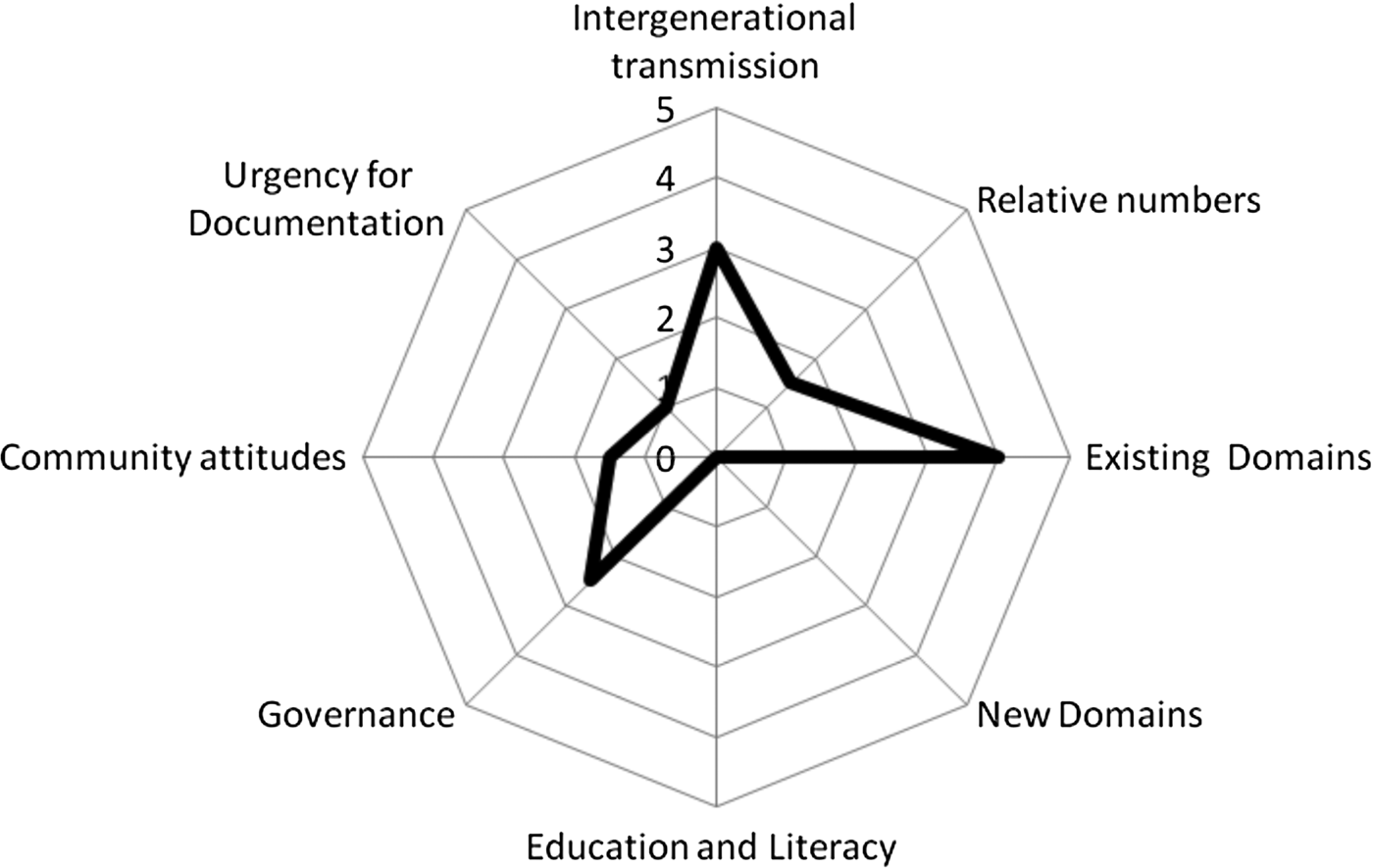
We consider that within the UNESCO language vitality framework, Gochang should be classified as “definitely endangered,” a result supported by previous research.Footnote 106 Looking through the nine criteria, we see the following. Intergenerational transmission has been declining and appears to have largely ceased within the last five years. The language has a relatively small number of speakers, who constitute a small minority on a number of levels: locally, ethnically, and nationally. Since 1949, multilingual parity between Tibetan and Gochang has been replaced by inegalitarian bilingualism in which new domains have proliferated and been occupied by Chinese. Gochang is not written or taught in schools, and very limited documentation exists. Neither government policies nor attitudes of mainstream Tibetan society support the language. Meanwhile, speakers of the language are, for the most part, indifferent to its fate. Gochang is therefore endangered primarily owing to a combination of demographic minoritization through urbanization and immigration, with sociopolitical minoritization through the language's exclusion from new domains (see Figure 2).
Visualization of the Vitality of Gochang within UNESCO's Language Vitality and Endangerment Framework

What does Gochang tell us about linguistic diversity in western Sichuan and among Tibet's invisible languages more generally? Probably the most important dynamic described here is the shift from stable, Tibetan–Gochang diglossia, to unstable, Chinese-dominated inegalitarian bilingualism, leading to language shift. Many of the minority languages spoken by Tibetans are likely to be in a similar situation. A second important aspect is the impact of urbanization on Gochang, essentially minoritizing the language in its traditional homeland and resulting in a rapid language shift. With urbanization increasing across Tibet, many of the region's minority languages are likely facing a similar fate. These languages are also likely to be in a similar context to Gochang in being poorly documented, unwritten, and subject to assimilatory government policies and negative social attitudes from mainstream Tibetan society. Future studies of the vitality of Tibet's minority languages could therefore adapt the UNESCO framework to give less attention to criteria which are stable across languages, (for example, on literacy and documentation), and give more attention to other criteria by expanding them for local salience, as we have done here – for example, by recognizing the need to look at both formal state policy and the informal policies of mainstream Tibetan society.
Finally, what can Gochang tell us about language endangerment in China more broadly? To what extent can it help us to understand why half of China's languages are currently endangered? Like many languages in China, Gochang faces two primary challenges. The first is its disembedding from a restricted local context and its re-embedding into a national one. This disrupts the relatively stable pattern of multilingualism that pertained in Gotang until recently, and was similar to the many stable multilingualisms which existed throughout China until recently. The second is the way in which the language has become endangered primarily through exclusion. The proliferation of new domains has been state-driven, a result of simultaneous modernization and state-building. The state's failure to include languages like Gochang in new domains is primarily a result of their invisibility – their lack of formal recognition by the state owing to the use of ethnic policy as a default language planning tool. This categorical exclusion results in the erasure of “invisible” languages from planning and policy, leading to their exclusion from institutions built by the state, thus bringing about their endangerment. Such languages face an entirely different predicament from those which are formally associated with a recognized minzu, as these languages are both re-embedded within and reproduced by state institutions.
At present, it seems that two changes in policy and practice could alter this trend. One would involve a process of formal language recognition, as distinct from ethnic recognition, in order to provide a framework for the inclusion of multiple languages for each of China's 56 ethnic groups in order to counteract the tendency to employ ethnic policy as default language policy. A second change might be that local governments could take advantage of the present lack of such a register, and the vague wording of language policy and law, to improvise informal processes of recognition that allow “invisible” languages to be included into local institutions such as education, media and government. If neither of these changes takes place, we should expect to see a deepening of China's language endangerment crisis, with an increasing endangerment and probably loss of more languages in the future. The broader social consequences for China of this ongoing, deepening crisis remain to be seen.
Acknowledgement
Gerald Roche's research for this article was funded by the Australian Research Council, under the auspices of a Discovery Early Career Research Award project entitled “Ethnicity and Assimilation in China: The Case of the Monguor in Tibet” (DE150100388).
Biographical notes
Gerald Roche is an ARC Discovery Early Career Research Fellow at the University of Melbourne's Asia Institute. His most recent publications have appeared in Modern Asian Studies, The International Journal of the Sociology of Language, and Asian Ethnicity.
Yudru Tsomu is currently associate professor at the Center for Tibetan Studies of Sichuan University. She received her PhD from Harvard University and was a postdoctoral fellow at Stanford University.