

For decades, archaeologists have been developing methodologies that help them infer the activities that took place in and around ancient structures. Many researchers have worked under the assumption that material remains discovered in activity area contexts are direct evidence of the activities that took place there (cf. Binford Reference Binford1964:425). However, numerous ethnoarcheological studies have shown that, because people usually clean activity areas, especially those that are used repeatedly, such remains are only very rarely left in or near the spaces where they were originally used (Binford Reference Binford1978; Deal Reference Deal1985; Dunnel and Stein Reference Stein and Teltser1989; Fladmark Reference Fladmark1982; Hayden and Cannon Reference Hayden and Cannon1983; Murray Reference Murray1980; Schiffer Reference Schiffer1978).Footnote 1 Thus, the thousands of ceramic sherds, bones, lithics, and other finds that are so ubiquitous on archaeological sites are often not excavated from primary contexts and so do not usually yield information about how space was used within and around ancient structures.
In this article, we address this problem through the collection and analysis of microartifacts. Microartifacts, otherwise referred to as microdebris, microrefuse, or microresidue, consist of tiny (yet visible) pieces of ceramic, bone, chipped stone, shell, and other remains that become embedded in archaeological contexts as a result of human activity (Homsey-Messer and Humkey Reference Homsey-Messer and Humkey2016; Sherwood Reference Sherwood, Goldberg, Holliday and Ferring2001).Footnote 2
Several researchers trace the analysis of microartifacts to Gifford, who as early as Reference Gifford1916 analyzed microartifactual remains in shell middens in California (Homsey-Messer and Ortmann Reference Homsey-Messer and Ortmann2016:1; Foster Reference Foster2009:103; Rainville Reference Rainville2005:17). Further examination of microartifacts and their distributions took place in the interim largely within the framework of research on site formation processes. Scholars like Michael Schiffer and Judith McKeller noted that artifact size directly affects methods of disposal. The “size-sorting effects of clean-up activities” (Schiffer Reference Schiffer1983:679, Reference Schiffer1987:267; see also Hull Reference Hull1987; Stein and Teltser Reference Stein and Teltser1989) amply documented in the ethnographic record (Binford 1978; Hayden and Cannon Reference Hayden and Cannon1983; Kramer Reference Kramer1979, Reference Kramer1982; Murray Reference Murray1980; O'Connell Reference O'Connell1987; Schiffer Reference Schiffer1978; Watson Reference Watson1979) later became known as the McKellar Hypothesis. The McKellar Hypothesis states that, although large artifacts can accumulate in single or occasional use sites, smaller artifacts are more likely to characterize primary deposits in habitually cleaned activity areas (McKellar Reference McKellar1983). In further elaboration upon this rule, Arnold (Reference Arnold1990), Hayden and Cannon (Reference Hayden and Cannon1983), and Schiffer (Reference Schiffer1983, Reference Schiffer1985, Reference Schiffer1987) concluded, first, that the distribution of artifacts that can be collected visually, referred to here as macro-artifacts, is a poor indicator of activity area location and character, and second, that the distribution of microartifacts is perhaps the most direct evidence available to archaeologists seeking to explore how space was used.Footnote 3 Citing ethnoarcheological and experimental archaeological research in various regions, LaMotta and Schiffer eventually articulated what has become the premise of microartifactual analysis by saying, “microartifact studies on the floor matrix are required for isolating reliable samples of primary refuse from assemblages in well maintained houses” (LaMotta and Schiffer Reference LaMotta, Schiffer and Allison1999:21).
Although the analysis of microartifacts has been discussed periodically, this practice has yet to be incorporated as part of standard archaeological practice (Homsey-Messer and Ortmann Reference Homsey-Messer and Ortmann2016:1). The purpose of this article is, therefore, to test if, and how, a methodology that has been employed with relative success in some areas can be profitably applied in a region where it is not commonly utilized—namely the southern Andes. We seek to evaluate the utility and applicability of microartifactual analysis by enumerating the practical application of a program of microartifact analysis and by highlighting the benefits, and the limitations, of this methodology.
MICROARTIFACT ANALYSIS
Microartifact analysis refers to the archaeological techniques employed to recover, identify, and interpret the presence, density, and spatial patterning of microartifacts (Sherwood Reference Sherwood, Simek and Polhemus2001). Microartifacts are the tiny remnants of ceramics, bone, lithics, metals, shell, and other remains that become embedded in archaeological loci as a result of habitual human behavior (Chenault Reference Chenault, Phillips and Ware2002; Dunnell and Stein Reference Dunnell and Stein1989; Homsey-Messer and Ortmann Reference Homsey-Messer and Ortmann2016; Hull Reference Hull1987; Ortmann and Schmidt Reference Ortmann and Schmidt2016; Rosen Reference Rosen1989; Sherwood Reference Sherwood, Goldberg, Holliday and Ferring2001). There is no uniform definition of the size of a microartifact. However, many researchers consider microartifacts to be fragments of material remains less than 1 cm in diameter (Rainville Reference Rainville2005:17; Sherwood Reference Sherwood, Goldberg, Holliday and Ferring2001:328–329). Since it is very difficult to accurately sort microartifacts less than 1 mm into the relevant subcategories (see below), and since microartifacts of this size do not dramatically change the weight ratios of microartifacts in the samples here analyzed, we chose 1 mm as the lower size limit of microartifacts included in this study.
Microartifacts enter the archaeological record in a variety of ways, including, but not limited to, discard, breakage, abandonment, trampling, crafting, knapping, construction, food processing, and food consumption. Since microartifacts are too small to be easily gathered and are therefore often trampled into the soil matrixes of ancient surfaces (Metcalf and Heath Reference Duncan and Heath1990; Murray Reference Murray1980; Rosen Reference Rosen1989; Schiffer Reference Schiffer1983, Reference Schiffer1987), these tiny fragments of culturally significant debris are likely to remain in or near the context where they were originally produced (Chenault Reference Chenault, Phillips and Ware2002; Foster Reference Foster2012; Homsey-Messer and Ortmann Reference Homsey-Messer and Ortmann2016; Parker Reference Parker, Parker and Foster2012; Pawlikowski Reference Pawlikowski2010; Rainville Reference Rainville2005, Reference Rainville and Müller2015; Ullah Reference Ullah2009, Reference Ullah, Parker and Foster2012). The basic assumption underlying the methodology discussed in this article is, therefore, that, in most cases, microartifacts found in primary contexts are the direct residue of human action, and that their density and distribution reflect the spatial patterning of the behaviors that produced them (Chenault Reference Chenault, Phillips and Ware2002; Homsey-Messer and Humkey Reference Homsey-Messer and Humkey2016; Pawlikowski Reference Pawlikowski2010; Rainville Reference Rainville, Parker and Foster2012; Sherwood Reference Sherwood, Goldberg, Holliday and Ferring2001).
We acknowledge that microartifacts may be deposited in tertiary contexts, and thus some of the data recovered could represent “background noise” that exists in soils that come to make up the archaeological contexts we were sampling (Rosen Reference Rosen1989). To measure this potential, we extracted 16 control samples from tertiary contexts around the surfaces that are the focus of research (Sherwood Reference Sherwood, Goldberg, Holliday and Ferring2001). All 16 of the control samples contained no identifiable microartifacts.
A total of 59 microartifactual samples were extracted from eight distinct architectural units dating to two discrete periods at the archaeological site of Tumilaca la Chimba in southern Peru. Except for control samples, all samples subjected to microartifactual analysis were excavated exclusively from the soil matrices of earthen surfaces (Chenault Reference Chenault, Phillips and Ware2002).
Samples were excavated by laying out a 25-×-25-cm square that, unless preservation did not allow, was placed in the southwest corner of the 1-×-1-m excavation quadrant (cf. Parker Reference Parker, Parker and Foster2012; Rainville Reference Rainville2005).Footnote 4 We extracted only the thin, densely packed matrix of each use surface to segregate the resulting sample from the subsurface fill. Because the use-surface matrices were never deep, average sample size ranged from 1 to 3.5 liters, and the resulting extraction square rarely penetrated more than 1 to 3 cm (cf. Homsey-Messer and Humkey Reference Homsey-Messer and Humkey2016).
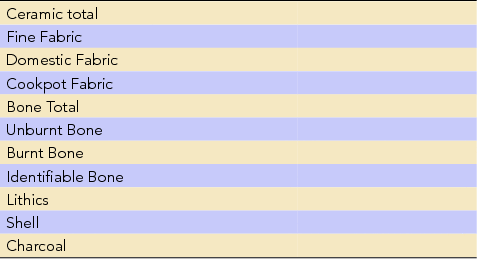
Once extracted, samples were washed in a 1-mm screen to remove silts and debris too small to be analyzed without specialized equipment. The dried samples were then sorted into size fractions using a set of nested geologic sieves. Microartifacts were separated from noncultural debris and sorted into seven broad material categories, including ceramics, bone, lithics, charcoal, shell, microbotanicals, and “special” remains (cf. Chenault Reference Chenault, Phillips and Ware2002; Homsey-Messer and Humkey Reference Homsey-Messer and Humkey2016; Parker Reference Parker, Parker and Foster2012, Parker et al. Reference Parker, Foster, Nicoll, Kennedy, Graham, Smith, Hopwood, Hopwood, Butler, Healey, Uzel and Jensen2009; Rainville Reference Rainville2005, Reference Rainville and Müller2015; Ullah Reference Ullah, Parker and Foster2012). Some of these categories could be further divided. For example, ceramic microdebris was subdivided based on fabric type into a fine, medium (or “domestic”), and cookpot fabric categories.Footnote 5 Bone microdebris were divided into two categories: unburnt bone and burnt bone, and any bone microdebris that exhibited significant morphological characteristics was separated in to a category called “potentially identifiable bone.” We used the “special” category for remains like fish scales, seeds, guinea pig (cuy) feces, and beads (Table 1; Rainville Reference Rainville2005).
Microartifactual Categories Utilized at Tumilaca la Chimba.

All categories of microartifactual remains were weighed using an Ohaus Pro digital scale that is capable of accurately measuring an artifact weighing as little as one one-hundredth of a gram. The resulting weights were then entered into a spreadsheet programmed to divide the total from each microartifact category by the total volume of the sample (Supplemental Table 1). The results are therefore expressed as weight per liter of excavated floor matrix (cf. Homsey-Messer and Humkey Reference Homsey-Messer and Humkey2016; Rainville Reference Rainville2005, Reference Rainville, Parker and Foster2012).Footnote 6 In addition to calculating the ubiquity of microartifacts in each sample, samples emanating from individual rooms or patios were aggregated by adding the total weight of microartifacts in each category and dividing that by the total liters of sampled floor matrix. Because special finds—like bones or seeds that can be identified to the species or genus level, manufactured items such as beads or needle points, and diagnostic organic remains like animal feces—were only rarely recovered from microarchaeological samples, we employed a presence/absence rather than a ubiquity measure for these types of remains.
ASSUMPTIONS AND LIMITATIONS
Our analysis of the microartifacts in this article relies on the results of a number of studies of microartifact creation, deposition, and preservation (especially Arnold Reference Arnold1990; Chenault Reference Chenault, Phillips and Ware2002; Dunnell and Stein Reference Dunnell and Stein1989; Fladmark Reference Fladmark1982; Hull Reference Hull1987, Metcalfe and Heath Reference Duncan and Heath1990; Murray Reference Murray1980; Peacock Reference Peacock1989; Rosen Reference Rosen, Goldberg, Nash and Petraglia1993; Sherwood Reference Sherwood, Goldberg, Holliday and Ferring2001; Sherwood et al. Reference Sherwood, Simek and Polhemus1995; Stein and Teltster Reference Stein and Teltser1989). Nevertheless, like any methodology that attempts to bridge the gap between artifacts and behavior, we are both bound by the limitations of our datasets and forced to make a number of assumptions about the meaning of specific artifact categories.
Bone microdebris can only rarely be identified to the species level. In some cases, the data do allow the identification of the remains of small animals such as birds, rodents or fish (Parker Reference Parker, Parker and Foster2012; Parker et al. Reference Parker, Foster, Nicoll, Kennedy, Graham, Smith, Hopwood, Hopwood, Butler, Healey, Uzel and Jensen2009), but the majority of bones recovered represent the comminuted remains of medium or large animals. Small fragments of bone can become deposited in the archaeological record in a variety of ways. Small animals such as mice, rats, or birds could have died or been killed on or near a use surface. If their remains were never removed, their bones could have found their way into the soil matrices of earthen surfaces. The comminuted remains of medium or large animals may have been inadvertently incorporated into building materials such as adobe bricks or mud plaster. Construction, erosion, or replacement could, therefore, be responsible for the deposition of bone microdebris on use surfaces. However, two lines of evidence lead us to believe that the bone microdebris recovered in this study result from primary contexts that were created as the result of human agency. First, if we assume that small animals such as mice, rats, and birds are not likely to have been the object of habitual human exploitation, then we would expect their remains to appear in fill contexts where natural site formation processes could be responsible for their deposition (Rosen Reference Rosen1989). Interestingly, although some rodent bones have been discovered in the supra-floor fill above many of the contexts sampled in this study,Footnote 7 no bird bones and only two rat bones were recovered from microartifactual samples taken from use surfaces. Second, the fact that our control samples were completely free of any microartifacts suggests that the bone and other microdebris recovered from the soil matrices of earthen surfaces represent the residue of human agency. We therefore propose that the bone microdebris accumulated on earthen surfaces during episodes of butchering, cooking, or eating.
Utilizing methodologies applied at the site of Kenan Tepe in southeastern Turkey (Foster Reference Foster2009, Reference Foster2012; Parker Reference Parker, Parker and Foster2012; Parker et al. Reference Parker, Foster, Nicoll, Kennedy, Graham, Smith, Hopwood, Hopwood, Butler, Healey, Uzel and Jensen2009), we subdivided bone microdebris into three categories: unburnt bone, burnt bone, and potentially identifiable bone. Our assumption is that the presence of burnt bone microdebris is an indicator of meat preparation or consumption.Footnote 8 The category of potentially identifiable bone was reserved for bones or bone microdebris that retain morphological characteristics that may give us information about the genus or species.
The interpretation of fish remains (bones and scales) is more clear-cut. Although it is possible that fish remains could have been present, for example, in sediments used to make adobe bricks or mud plaster, the fragility of fish remains makes it highly unlikely that they would survive this process intact. We assume, therefore, that remains identified as belonging to fish represent the residue of fish processing or consumption.
The category of “red lithics” used in this study refers to a local red chert that was utilized to manufacture a variety of lithic tools excavated at Tumilaca la Chimba. In all cases in which red lithic debris has been identified, we can be quite confident that it belongs to one category of material used to make cutting or scraping tools (Hull Reference Hull1987; Rosen Reference Rosen1989).
Although ceramic microdebris is not usually difficult to identify, it is perhaps the most difficult microartifact category to interpret. In the case of Tumilaca la Chimba, intensive study of the macro-ceramic remains (cf. Homsey-Messer and Humkey Reference Homsey-Messer and Humkey2016) suggests that two fabric types are indicative of pots that served specific functions. “Fine fabric” was used by both the Tumilaca and the Estuquiña cultures to create bowls and cups whose primary function was serving.Footnote 9 Similarly, cooking vessels were also composed of a particular fabric type we refer to as “cookpot fabric.” A third, medium-grade fabric that is referred to locally as “domestic fabric” was also identified. An analysis of the macro-remains of ceramics constructed using this fabric type suggests that various types of jars and other utilitarian vessels were created using this fabric type. Given these observations, our assumption is that ceramic microdebris consisting of cookpot fabric can be equated with food preparation with a high degree of confidence. Similarly, fine fabric ceramic microdebris also can be equated with food consumption with a high degree of confidence. Our final assumption is that ceramic microdebris made up of domestic fabric is likely the remains of vessels that served multiple functions, including storage and transport.
The final categories of microartifacts utilized in this study are charcoal and shell. Our interpretation of the presence and ubiquity of charcoal is relatively straightforward: since we have no evidence that fire was used to create plaster or other building materials, we assume that spikes in charcoal microdebris are the result of heating, cooking, or some form of craft production involving the use of fire. Our interpretation of shell microdebris is also relatively straightforward: we assume that shell microdebris represents the remains of marine animals and could be indicative of either the consumption of such animals or the use of shell to create ornaments or other artifacts.
THE SITE OF TUMILACA LA CHIMBA
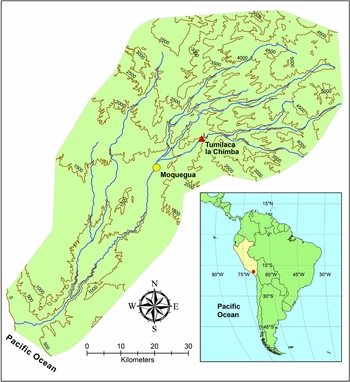
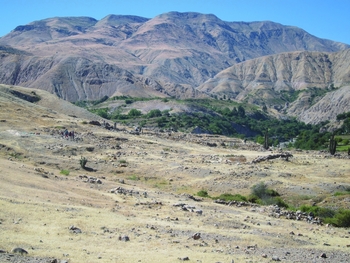
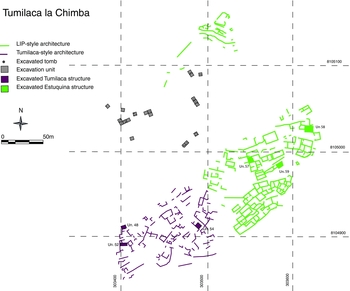
The focus of the research detailed here is the archaeological site of Tumilaca la Chimba, which is located in the Upper Moquegua Valley in southern Peru (Figure 1). At an altitude of 1,900 masl, the site rests on a bluff overlooking the Tumilaca River only a few miles above where it merges with the Torata River to form the Moquegua River (Figure 2). Occupation at Tumilaca la Chimba includes a Tumilaca (terminal Middle Horizon) occupation that is partially overlain by a subsequent Estuquiña (Late Intermediate period) village (Figures 2 and 3; also see Bawden Reference Bawden, Rice, Stanish and Scarr1989; Bermann et al. Reference Bermann, Goldstein, Stanish, Watanabe, Rice, Stanish and Scarr1989). The Tumilaca occupation has been dated both by ceramic cross-dating and radiocarbon to ca. A.D. 950–1250. Architecture is visible on the surface as low stone-wall foundations that likely once supported adobe or vegetable matter superstructures. Architectural units from the Tumilaca phase follow a standardized pattern. Facing east, they consist of two rooms opening onto an exterior patio space.
Map of Moquegua River Valley showing the location of the site of Tumilaca la Chimba (map courtesy of John Hicks).

View of Tumilaca la Chimba.

Plan of Tumilaca la Chimba showing standing architecture and excavation units analyzed in this study. Red lines indicate Tumilaca architectural units. Red boxes indicate the location of excavated Tumilaca architectural units. Green lines indicate Estuquiña architectural units. Green boxes indicate the location of excavated Estuquiña architectural units.

An analysis of the ceramic typology from the Estuquiña occupation at Tumilaca la Chimba suggests that these remains date to ca. A.D. 1250–1470 (Feldman Reference Feldman, Rice, Stanish and Scarr1989). Although construction is more haphazard, with single-faced walls consisting of irregularly sized and arranged stones, the remains of Estuquiña structures stand considerably higher and are better preserved than their Tumilaca conterparts (Conrad Reference Conrad and Aldenderfer1993). Approximately 35 Estuquiña rooms arranged in clusters around patio spaces have been identified (Figure 3). In addition, one large plaza is clearly evident. The Estuquiña remains at Tumilaca la Chimba also include a fortification complex on the summit of the adjacent peak.
HISTORICAL CONTEXT
State-level political organization was first instituted in the Moquegua Valley in the Middle Horizon when Wari and Tiwanaku immigrants arrived from their heartlands in the Ayacucho Valley and Tititcaca Basin (respectively) and created colonial administrative centers. The imperial presence of both states collapsed in the Moquegua Valley around A.D. 1000 (Williams Reference Williams2002). The immediate aftermath of the collapse of Tiwanaku authority in Moquegua was characterized by processes of state fragmentation (Bandy Reference Bandy2001; Couture and Sampeck Reference Couture, Sampeck and Kolata2003; Graffam Reference Graffam1992; Tainter Reference Tainter1988; Vranich Reference Vranich2001; Yoffee and Cowgill Reference Yoffee and Cowgill1988).
The cultural complex that was established in the wake of state collapse in the Moquegua Valley is known locally as Tumilaca. Tumilaca settlements were mostly built in previously uninhabited locations. Many Tumilaca settlements are found in defensive locations—for example, on hilltops or ridgelines rising above the valley bottom (Bawden Reference Bawden and Aldenderfer1993; Bermann et al. Reference Bermann, Goldstein, Stanish, Watanabe, Rice, Stanish and Scarr1989; Owen Reference Owen2005; Owen and Goldstein Reference Owen and Goldstein2001; Sims Reference Sims, Schwartz and Nichols2006). Investigation at Tumilaca sites indicates substantial stability in many spheres of life. Tumilaca residential architecture and pottery are similar to earlier styles (Bawden Reference Bawden, Rice, Stanish and Scarr1989, Reference Bawden and Aldenderfer1993; Goldstein Reference Goldstein1985, Reference Goldstein2005; Stanish Reference Stanish1989). Burial practices and domestic rituals were also largely maintained by post-collapse communities (Goldstein Reference Goldstein2005; Sharratt Reference Sharratt2011, Reference Sharratt, Korpisaari and Chacama R.2015, Reference Sharratt and Faulseit2016; Sharratt et al. Reference Sharratt, Williams, Cerna, Starbird, Vranich, Klarich and Stanish2012). Non-metric dental trait analysis confirms that the occupants of Tumilaca sites were biologically related to the original Tiwanaku immigrants (Sutter and Sharratt Reference Sutter and Sharratt2010). Thus, although the collapse of the Tiwanaku state represented a major change in the overarching political organization in Moquegua, substantial cultural and biological continuity is evident in its immediate aftermath.
Beginning around A.D. 1250, radical changes in architecture, material culture, and burial practices are apparent in the archaeological record of the Moquegua Valley. The dominant cultural presence in the middle and upper valleys during this period is called Estuquiña. Estuquiña sites are often fortified and located in defensible locations on hilltops. Estuquiña ceramic assemblages lack the Tiwanaku forms and decorative motifs that were largely maintained by Tumilaca communities. Textiles are also different from those of the Tiwanaku and Tumilaca (Clark Reference Clark1993). Human burials are found within and outside residential structures instead of in the spatially segregated cemeteries that were favored by Tiwanaku and Tumilaca mourners (Burgi et al. Reference Burgi, Williams, Buikstra, Clark, Cerna, Pino, Rice, Stanish and Scarr1989; Williams Reference Williams1990; Williams et al. Reference Williams, Buikstra, Clark, Cerna, Pino, Rice, Stanish and Scarr1989).
THE ANALYSIS OF MICROARTIFACTS FROM TUMILACA ARCHITECTURAL UNITS AT TUMILACA LA CHIMBA
Archaeological remains belonging to the Tumilaca culture at Tumilaca la Chimba consist of several dozen architectural units (Figures 2 and 3). These structures are, generally speaking, quite small. They consist of one, or sometimes two, small roofed spaces fronted by a larger patio area. On average, roofed spaces measure approximately 3 m × 4 m and associated patios measure approximately 3 m × 7 m. Walls are constructed of stone foundations and had adobe superstructures. Use surfaces in Tumilaca architectural units consist of thin layers of densely packed earth that can be easily distinguished from supra- and subsurface deposits by their consistency and by macro-artifacts that are regularly found lying on such surfaces.
A total of 19 samples ranging in size from .8 to 1.5 liters were extracted from floor matrices of Tumilaca structures. In addition to these floor samples, nine control samples were taken from surrounding fill and adobe debris.
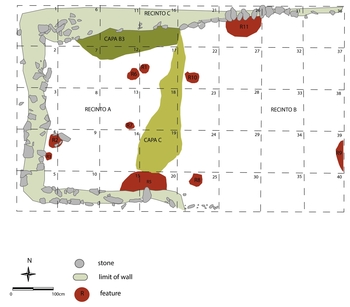
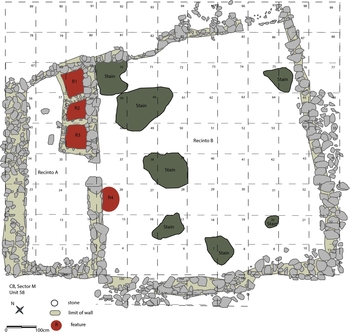
Unit 48. Unit 48 consists of two abutting rooms measuring approximately 3 m × 2.5 m each (Recinto A and Recinto B respectively; see Figure 4). These rooms open to a rectangular patio area (Recinto C) measuring approximately 6.5 m × 4 m. The northernmost room (Recinto A) contained two rectangular stone-lined features that presumably served as storage bins. Six soil samples measuring a total of 5.85 liters were extracted from floor matrices within this structure. In addition, two control samples (totaling 2.6 liters) were taken from the surrounding fill.
Plan of Unit 48.

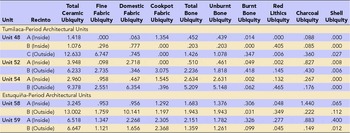
A number of hypotheses about the use of space in Unit 48 can be drawn from the microartifactual data (Table 2). First, calculations of the total ubiquity of ceramics microdebris show that this category of microartifact is concentrated in the patio area (Recinto C). If we break down the ceramic microdebris into its constituent categories (fine fabric, domestic fabric, and cookpot fabric),Footnote 10 it becomes clear that the remains of serving vessels made of fine fabric are concentrated in the patio area while cookpot debris occurs almost exclusively in the northern inside surface of Recinto A. It is also interesting to note that the patio area (Recinto C) exhibits the highest concentration of both burnt and unburnt bone.
Ubiquity of Microartifacts from Units 48, 52, 54, 58, and 59.

The distribution of ceramic microdebris in Unit 48 suggests that cookpots were used, either for cooking or preparing food, on the inside surface of Recinto A, the same room that contained two features that we suspect were storage bins. The spike in fine fabric ceramics debris, along with the fact that the highest concentrations of bone occur on Recinto C, suggests that this outside patio area was a locational focus of meat consumption and may also have been the locus of butchering activities. We can also say that of the very minor amount of lithic debris that was discovered in Unit 48, most was recovered from Recinto B. The fact that Recinto B exhibits only very small quantities of all categories of microdebris suggests that this may have been the sleeping quarters for the inhabitants of Unit 48. No obsidian and very little shell was recovered in the analyzed samples from this unit. In contrast, some obsidian was recovered in the macro-remains. These data suggest that, although the users of this structure may have had access to obsidian, obsidian artifacts were not manufactured or modified in this location. Furthermore, the lack of shell in both the macro- and the microartifacts suggest that the inhabitants of this structure likely had little access to nonlocal foods.
Unit 52. Unit 52 is a very different kind of structure from Unit 48. It consists of a single interior space measuring approximately 4 m × 4 m (Recinto A) that opens to a square patio area (Recinto B) of approximately the same size (Figure 5). Four 1-liter soil samples were extracted from floor matrixes in this structure (two from the inside surface and two from the patio area). Two control samples measuring 1.5 liters were also taken from the surrounding fill. Like in Unit 48, fine fabric ceramic microdebris as well as burnt and unburnt bone microdebris are concentrated in the patio area (Recinto B; see Table 2). There is also a spike in the remains of domestic fabric ceramic microdebris on the inside surface of Recinto A. Interestingly, in this one-room structure, cookpot microdebris is exclusively found in the patio surface. These data suggest that the outside patio surface was the locus of both cooking and eating. The inside surface of Recinto A probably served as a sleeping area, although the presence of the majority of the domestic fabric ceramic microdebris on this surface suggests that storage and/or transportation vessels were also kept or used there. Shell and lithic microdebris were negligible, suggesting that the inhabitants of this structure had little or no access to nonlocal resources.
Plan of Unit 52.

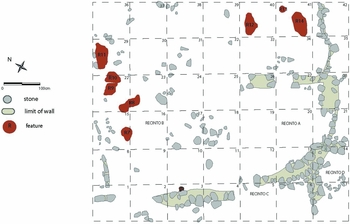
Unit 54. Unit 54 is yet a third type of architectural unit. Located in the middle of the Tumilaca village is an area measuring approximately 6 m × 10 m that is defined by a low, poorly constructed wall (Figure 6). Excavations in Unit 54 identified a separation of space, with a single small room (Recinto A) measuring approximately 3 m × 3 m in the southeast corner. The rest of Unit 54 is made up of patio area. An L-shaped area representing about one-third of the structure (approximately 3 m × 3 m wide, 5 m north-south, and 5 m east-west) was excavated.
Plan of Unit 54.

Overall, the distribution of microdebris in Unit 54 follows trends evident in units 48 and 52 (Table 2). For example, spikes in the fine fabric ceramic microdebris as well as unburnt bone microdebris are evident in the patio area, while most of the cookpot microdebris is concentrated on the inside surface of Recinto A. These data suggest that cookpots were utilized more regularly on the inside surface (in Recinto A), while butchering and perhaps the consumption or preparation of meat took place in the outdoor patio area. Interestingly, Unit 54 yielded far more domestic fabric microdebris than either of the other units. Furthermore, the majority of that microdebris was recovered from floor matrices in the patio area (Recinto B). We theorize that spikes in bone and domestic fabric microdebris, combined with the unusual architectural layout of Unit 54, may indicate that Unit 54 served as a staging area where transport and/or storage vessels were frequently utilized and where the carcasses of large mammals were processed. Following a trend seen in the other Tumilaca structures, shell and obsidian microdebris are almost nonexistent in this unit.
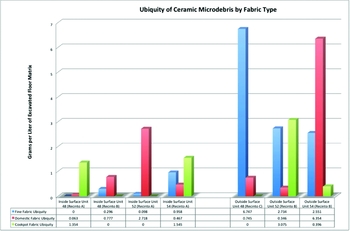
Units 48, 52, and 54 Compared. A comparison of the microartifactual data from structures dating to the Tumilaca period (Terminal Middle Horizon) at Tumilaca la Chimba reveals a number of consistent trends. Although the sample size is still small,Footnote 11 the patterns of microdebris accumulation on inside and outside surfaces is distinct. Figure 7 juxtaposes the ubiquity of microdebris from the various ceramic fabric types emanating from inside and outside surfaces. As noted above, it is clear that the accumulation of fine fabric microdebris is overwhelmingly concentrated on outside surfaces while, with the exception of Unit 54, microdebris from cookpots is most common on inside surfaces. Microdebris from ceramics composed of domestic fabric occurs on both inside and outside surfaces although in varying amounts.
Comparison of the ubiquity of microdebris of the various ceramic fabric types emanating from inside and outside surfaces of Units 48, 52, and 54.

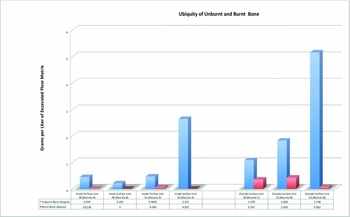
The distribution of unburnt and burnt bone microdebris also falls into consistent patterns. In all three structures examined, both categories are much more prominent on outside surfaces. The exception is, again, Unit 54 (which has an unusually high accumulation of unburnt bone on both inside and outside surfaces), although the amount emanating from the outside surface is nevertheless almost twice that from the inside surface (Figure 8). These data support the hypothesis that Unit 54 may have served as some sort of communal space where activities such as butchering were carried out. It should also be noted that all three sampled structures have very little lithic microdebris, and shell microdebris is consciously absent from all of the analyzed samples.
Comparison of the ubiquity of unburnt and burnt bone microdebris from inside and outside surfaces of Units 48, 52, and 54.

The architectural layout, combined with the microartifactual data presented here, supports the hypothesis that some, but not all, of the structures examined are domestic in nature. From these data, we hypothesize that units 48 and 52 were likely domestic structures, while Unit 54 may have been a communal space. The limited size and scope of units 48 and 52 suggests that the household units dwelling in these structures were small and probably consisted only of members of an immediate family. Community ties and spatial limitations may also have necessitated the construction and use of communal spaces like Unit 54, where cooperative activities such as butchering and perhaps weaving or brewing could be carried out by larger corporate groups.
Daily activities were likely segregated within domestic structures. In houses that consisted of two interior rooms and a patio area (such as Unit 48 [Figure 4]), one interior room may have been dedicated to sleeping (Figure 4, Recinto B). The microartifactual signature of such spaces appears to be the relative scarcity of all microartifact categories (Table 2, Recinto B). The second room in three-space room structures appears to be the locus of food preparation and storage. This is indicated by the abundance of cookpot microdebris and, in the case of Unit 48, the existence of stone-lined storage bins. In smaller houses consisting of one interior space and one patio space (like Unit 52 [Figure 5 and Table 2]), cooking took place in the patio area (indicated by the abundance of cookpot microdebris), and the interior space was dedicated to sleeping and storage (as indicated by the concentration of domestic fabric microdebris and the relative lack of other microdebris categories). In these cases, the ubiquity of microdebris from fine fabric plates, bowls, or cups, as well as the distribution of bone microdebris, suggests that terminal Middle Horizon households utilized outside patio spaces for eating. The distribution of microdebris from storage and transport vessels (domestic fabric) suggests that such vessels were stored or utilized on both interior and exterior surfaces. The only exception to this is in three-room houses where one interior room, which was likely dedicated to sleeping, did not contain evidence of storage. The only category of lithic microdebris identified at Tumilaca la Chimba, referred to here as “red lithics,” is very rare (although not completely absent) in all of the sampled structures. These data suggest that lithic tool manufacture and modification were not undertaken at the household level and/or that the inhabitants of these households had limited access to red lithic tools or raw materials. It should also be noted that two categories of data are conspicuously absent from the microdebris: obsidian and shell. Although the lack of data cannot be used to support a hypothesis, it is certainly tempting to speculate that households examined as part of this study lacked access to exotic foodstuffs like shellfish. In addition, these data suggest that none of these structures were the locus of obsidian tool manufacture or modification.
THE ANALYSIS OF MICROARTIFACTS FROM ESTUQUIÑA ARCHITECTURAL UNITS AT TUMILACA LA CHIMBA
Estuquiña architectural units at Tumilaca la Chimba are larger than their earlier Tumilaca counterparts. Use surfaces in Estuquiña structures consist of relatively thick (averaging between ca. 1 cm and 3 cm), densely packed earth. Use surfaces were distinguished, first, by the obvious difference between the density and consistency of the surface matrices and, second, by the contrast between these contexts and the surrounding strata. In addition, Estuquiña use surfaces are characterized by relatively large quantities of flat-lying macro-artifacts such as ceramic fragments and bones. Thus far, two Estuquiña structures have been completely excavated. To this sample we can add a large patio area from a third structure. In total, this dataset thus includes 31 separate floor matrix samples ranging between .8 and 3.0 liters in volume. The total amount of soil analyzed is 39.7 liters. An additional seven control samples, totaling 9.3 liters, were taken from fill layers around these structures.
Unit 58. Unit 58 consists of one interior room (Recinto A) measuring approximately 3 m × 7 m and a large patio area measuring approximately 7 m × 7 m (Figure 9). Together, the interior room (Recinto A) and adjoining patio (Recinto B) form a roughly trapezoidal structure that narrows in width at the northern end. Walls are single faced and constructed of irregularly shaped stones.
Plan of Unit 58.

Table 2 displays the aggregated microartifactual data from Unit 58. Four times the amount of ceramic microdebris was recovered on the outside surface of this structure as on the inside surface. Interestingly, when we break these data down by fabric type, it is clear that most of this disparity consists of domestic fabric that likely derives from transport or storage vessels. This spike in domestic fabric ceramic microdebris suggests that habitual activities involving the use of ceramics constructed of domestic fabric were frequently carried out in this space (Recinto B). If we consider the other categories of ceramic data, it is clear that some of the same trends visible in the earlier Tumilaca houses are also visible in this Estuquiña structure. To begin with, the ubiquity of cookpot microdebris is slightly higher on the inside surface (Recinto A). Evidence of cooking can also be found in the distribution of burnt bone and charcoal microdebris, which appear in greater quantities on the same surface (Recinto A). Evidence for serving, in the form of microdebris of vessels constructed of fine fabric is, like in the earlier Tumilaca structures, concentrated in the patio area (Recinto B).
Microartifact samples from the large interior room in Unit 58 (Recinto A) also yielded an unusual number of special finds including bones and organic remains that can be grouped into categories by species or type. This includes a of number anchovy vertebra, a substantial amount of guinea pig (cuy) feces, the jaw of a small rodent, probably a rat or mouse, a large number of molle seeds, and tooth fragments emanating from one or more large mammals (presumably llama or alpaca).
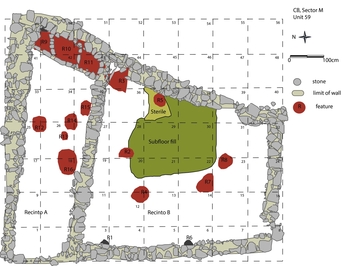
Unit 59. Unit 59 consists of a single interior space measuring approximately 3 m × 7 m flanked by a large trapezoidal patio area measuring approximately 6 m × 5–7 m (Figure 10). This structure is composed of single-faced walls consisting of irregularly shaped stones. Tapering significantly at the eastern end, the trapezoidal shape of Unit 59’s patio area is more pronounced than that of Unit 58.
Plan of Unit 59.

Table 2 shows that ceramic microdebris is almost evenly split between inside and outside surfaces in Unit 59. Interestingly, the ubiquity of fine fabric microdebris is higher on the inside surface (Recinto A). The same is true of lithics, bone, charcoal, and shell. These data suggest that there was less segregation of activities by the inhabitants of this structure and that many activities that may have been customarily relegated to patio areas were also carried out indoors. Although cookpot microdebris is slightly higher in the patio area (Recinto B), the ubiquity of charcoal and burnt bone on the inside surface (Recinto A) supports the hypothesis that cooking may still have been carried out on the inside surface. Interestingly, this is the only structure from which an appreciable amount of shell was recovered. This finding is paralleled by red lithic microdebris. These data support the hypothesis that the inhabitants of this structure had preferential access to specific resources such as seafood. Furthermore, the presence of red lithic microdebris may be an indicator of craft in the form of specialized lithic production or modification.
Like Unit 58, the interior surface of Unit 59 (Recinto A) yielded a variety of bones and organic remains that can be grouped into categories by species or type. This includes several scales from relatively large fish, anchovy vertebra, large amounts of guinea pig (cuy) bones and feces, and bone fragments that likely emanated from a large mammal.
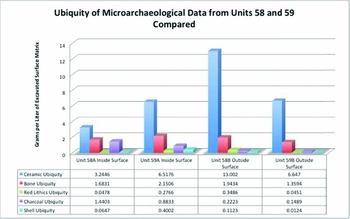
Units 58 and 59 Compared. A comparison of the relative large number of floor samples analyzed from units 58 and 59 (n = 22, vol. = 32.2 liters [Figure 11]) presents an intricate view of the Estuquiña village at Tumilaca la Chimba. To begin with, evidence for various types of foods (including fish, large mammals, and guinea pig [cuy]) and cooking and serving equipment, as well as the layout of the architectural units, all support the hypothesis that Units 58 and 59 are the remains of domestic structures. These data also suggest that there was significant variation in how space was used by the inhabitants of these two structures. Although the data support the hypothesis that, in Unit 58, cooking likely occurred on the interior surface and serving may have occurred in the patio area, in Unit 59, the data suggest that these activities were carried out in both interior and exterior spaces. The data also suggest that the inhabitants of Unit 59 may have had more access to shell, the remains of which may indicate either that this household had more access to seafood, or that this household utilized shell in craft production. Finally, the prevalence of domestic fabric microdebris from the outside surface of Unit 58 suggests significant economic and/or social differentiation between these households.
Comparison of aggregated microartifact data from Units 58 and 59.

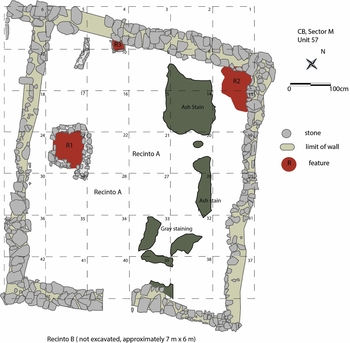
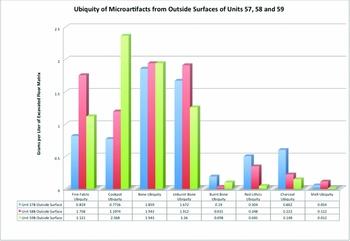
Unit 57 Exterior Surface. Unit 57 is a rectangular structure, defined by single-faced walls of irregular stones that are preserved to 1.5 m in height. The structure consists of two spaces of approximately the same dimensions (6 m × 7 m) that are divided by a wall and linked by a single doorway (Figure 12). Only one of the two rooms has thus far been excavated (Recinto A). Our interpretation is that this is an exterior space, and the unexcavated room is an interior space. Unit 57 differs significantly from units 58 and 59 in that the interior space (Recinto B) is almost twice the size of the interior spaces in units 58 and 59. This also means that Unit 57 is, overall, significantly larger than units 58 and 59.Footnote 12 Given that only one room has so far been excavated, it is not possible to compare inside and outside surfaces from this unit. Instead, Figure 13 juxtaposes the microartifactual data from the three Estuquiña patio areas (from units 57, 58, and 59).
Plan of Unit 57.

Comparison of the aggregated microartifact data from the exterior (patio) areas from Units 57, 58, and 59.

If we use as a baseline the suppositions based on the comparison of inside and outside surfaces from units 58 and 59, then a comparison of these three patio areas may support a number of hypotheses (Figure 13). First, the outside surface of unit 57 has the least amount of cookpot fabric microdebris of the three patio surfaces compared. At the same time, the ubiquity of unburnt bone microdebris is very similar to units 58 and 59. These data support the hypothesis that, although meat processing may have been carried out in this patio area (Recinto B), cooking was likely not an activity habitually practiced there. Second, although there are clearly a number of activities that may produce charcoal, the fact that the outside surface of Unit 57 produced far more of this material category than the comparable surfaces in either Unit 58 or Unit 59 may be an indication that some activity or activities involving the use of fire were carried out in the patio area of Unit 57 with higher regularity than in either of the other two patio areas.
It is also interesting to note all three of these surfaces clearly lack shell microdebris. The only place where shell microdebris was found in any frequency is the inside surface (Recinto A) of Unit 59. The data from Unit 57 therefore support the hypothesis that only some Estuquiña households had regular access to seafood or shell raw materials. Finally, Figure 13 shows that the patio area in Unit 57 produced higher amounts of red lithics than any other surface analyzed. This, of course, brings up the question of whether or not Unit 57 may have been the location of specialized lithic production.
DIACHRONIC ANALYSIS: TUMILACA AND ESTUQUIÑA ARCHITECTURAL UNITS
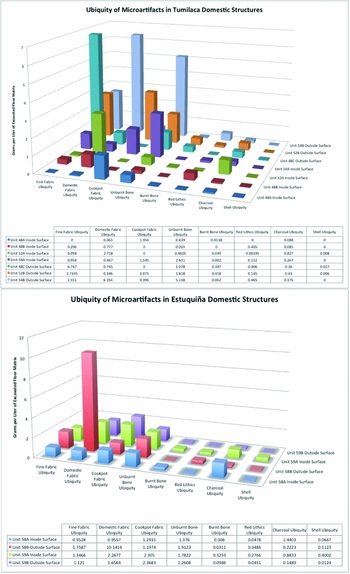
The first observation that comes to the fore when comparing the Tumilaca architectural units (Units 48, 52, and 54) to the Estuquiña architectural units (Units 57, 58, and 59) is that many of the microartifact categories are more evenly distributed between interior and exterior surfaces in the later Estuquiña domestic structures than in the earlier Tumilaca domestic structures. Figure 14 compares the ubiquity of microartifactual data in Tumilaca and Estuquiña domestic structures. We suggest that the more jagged overall appearance of the upper portion of this figure, which represents data from the Tumilaca architectural units, is a reflection of a more segmented formalized use of space. In contrast, apart from the spike in the domestic fabric microdebris in Unit 58, the data from the Estuquiña domestic structures are relatively uniform. This suggests that habitual activities were less segregated in the Estuquiña domestic structures than they were in the Tumilaca domestic structures, where either limitations of space, cultural tradition, or a combination of the two appear to have regulated more tightly how space was used.
Comparison of the ubiquity of microdebris in Tumilaca and Estuquiña architectural units.

Data also suggest that Estuquiña household economies were more diversified than their Tumilaca counterparts. Although we have argued that not all of the architectural units examined here were necessarily domestic spaces, of the domestic spaces that were examined, those belonging to the Estuquiña cultural tradition yielded relatively large quantities of anchovy bones and a number of scales from larger fish. In addition, parts of the teeth of large mammals (probably alpaca or llama) and copious evidence for domestic guinea pig were recovered in the microartifact samples. Although we cannot exclude the possibility that these resources were also exploited by the inhabitants of the earlier Tumilaca village, the fact remains that we have solid evidence for the exploitation of these resources in the Estuquiña phase. These data suggest, first, that the inhabitants of the Estuquiña village had access to resources from the Pacific.Footnote 13 Such resources likely included dried or salted fish, but probably did not include fresh mollusks. The inhabitants of the Estuquiña village may also have had access to highland resources as evidenced by the camelid dental fragments. Although more research needs to be carried out before definitive statements about economic networks during the Tumilaca phase can be made, the data gathered thus far support the hypothesis that Tumilaca household economies were much more spatially restricted. The fact that even red chert, which was available within the larger Moquegua River region, is rare in Tumilaca domestic structures suggests that domestic economies were hyper-locally oriented.
Remains classified under the heading of “special finds” also suggest that Estuquiña household economies emphasized two important products for which we have no microartifactual evidence from the Tumilaca households: guinea pigs (cuy) and beer (chicha).Footnote 14 The evidence for the domestic breeding of guinea pigs (cuy) in Estuquiña households is overwhelming. These data include copious amounts of guinea pig bones and feces. Interestingly, the data show that guinea pigs (cuy) lived largely, if not exclusively, on interior surfaces, where they may have either run free or been kept in pens. The discovery of relatively large numbers of molle seeds may also reveal an important aspect of Estuquiña culture and potentially an important difference between Tumilaca and Estuquiña domestic economies. A number of scholars have discussed the use of molle seeds for brewing an alcoholic beverage known as chicha de molle (Goldstein and Colman Reference Goldstein and Coleman2004; Goldstein et al. Reference Goldstein, Goldstein, Williams, Jennings and Bowser2009). Although not conclusive, the discovery of molle seeds in Estuquiña domestic structures is strong evidence that chicha de molle was brewed by the inhabitants of the Estuquiña domestic structures. In light of this observation, it is possible that the spike in domestic fabric microdebris on the outside surface of Unit 58 may represent the remains of chicha boiling or fermentation vessels.
DISCUSSION
The purpose of this article is to enumerate the principles and procedures behind an underutilized archaeological field technique and to detail the results of the application of that technique at a particular site in the southern Andes. In addition, we sought to explore the utility and the limitations of this methodology and to test its applicability for Andean archaeology. In reviewing the results of this project, a number of conclusions are immediately apparent. First, two lines of evidence support the hypothesis that microdebris excavated from the matrices of earthen surfaces represent primary residue of human action and are therefore a good indicator of the locational focus of habitual behavior (Dunnell and Stein Reference Dunnell and Stein1989; Homsey-Messer and Ortmann Reference Homsey-Messer and Ortmann2016; Hull Reference Hull1987; Ortmann and Schmidt Reference Ortmann and Schmidt2016; Rosen Reference Rosen1989; Sherwood Reference Sherwood, Goldberg, Holliday and Ferring2001). The first line of evidence can be seen in the comparison of a large number of control samples taken from surrounding fill with the samples extracted from the matrices of earthen surfaces. The fact that none of the control samples produced microdebris from any of the measured categories supports the hypothesis that the microdebris extracted from use surfaces is, in fact, culturally contingent (Sherwood Reference Sherwood, Goldberg, Holliday and Ferring2001).Footnote 15 The second line of evidence to support this hypothesis lies in the consistency of the data from the various domestic units analyzed. In no cases were we confronted with data so anomalous as to suggest that some samples were tainted or that the ubiquity of any particular category of microartifact was the result of processes other than human action.
With that said, we also found that there are many limitations to microartifact research. Simply put, the analysis of the ubiquity and distribution of microartifacts is not a silver bullet. The success of the microartifactual research is contingent upon the characteristics of the material culture at a given archaeological site. For example, this study was greatly aided by the fact that two of the three ceramic fabric types that make up both the Tumilaca and the Estuquiña ceramic corpus (fine fabric and cookpot fabric) can be equated with categories of ceramics that serve a particular function. One disadvantage of the material culture at Tumilaca la Chimba is the fact that the only lithic category we were able to identify is that of “red lithics.” Based on the material culture from other sites, our assumption is that there must also be a local gray chert that may have been used to make cutting and/or scraping tools and that we have yet to identify macro- or microartifacts composed of this material at Tumilaca la Chimba. It is possible that other lithic categories do not exist. However, this may instead be due to poor preservation, the curation of lithic tools, or the luck of excavation. In any case, missing an entire category of lithics, if that is in fact what we are doing, is a serous impediment. Finally, the nature of the architectural remains, although extraordinarily well preserved, limited the research questions that we could ask of the emerging data. This is due to the fact that almost all of the architectural units at Tumilaca la Chimba consist of two-spaced structures—one rectangular interior room and one larger exterior patio area. Although this consistency meant that comparisons between units could be easily drawn, the limited number of discrete spaces in each structure meant that, in all but one unit, the spatial segregation of activities could be made only between inside and outside surfaces. Except in one case (Unit 48), the architectural characteristics of the structures studied did not allow us to segregate different types of interior spaces, for example, nor did they allow us to isolate work areas among exterior spaces. In retrospect, it is clear that more complex architectural units consisting of various interior and exterior spaces would lead to a more intricate analysis. One of the main take-away points from this study is, therefore, that microartifact analysis is not applicable at all sites. Generally speaking, research on microartifacts is most productive when the sampled contexts consist of the matrices of heavily utilized earthen surfaces (Chenault Reference Chenault, Phillips and Ware2002). Furthermore, the nature of the material remains, including the level of preservation, the types of raw materials used, the nature of the surviving architecture, etc., all condition the type of microartifactual analysis that can be undertaken. Finally, and perhaps most importantly, this study has clarified that microartifact analysis should not be seen as a stand-alone analytical tool. Clearly, conclusions drawn through microartifact analyses could be greatly enhanced by combining them with other categories of data emanating from, for example, ceramic, faunal, botanical, and architectural analyses (Dunnel and Stein Reference Stein and Teltser1989; Rainville Reference Rainville, Parker and Foster2012).
CONCLUSION
The results of the research outlined in this article suggest that microartifact analysis is an effective methodology that can contribute greatly to the archaeologist's tool kit (Homsey-Messer and Ortmann Reference Homsey-Messer and Ortmann2016; Johnson et al. Reference Johnson, Pritchard and Poplin2016). Data derived from the analysis of microartifacts can be used to address relatively small-scale questions about what kinds of activities were undertaken by particular households. Such data give us an intimate view into the lives of real people in the past. In fact, it may be one of the most effective methods of researching the personal histories of individuals or corporate groups and, for this reason, we feel that microartifact analysis should be included as an important component of household archaeological research (Rainville Reference Rainville, Parker and Foster2012). However, the most powerful use of microartifactual data lies in theories that can be drawn from the comparison of microartifactual datasets. Comparing data from particular spaces or groups or spaces that are separated either spatially or chronologically can lead to hypotheses that address issues far beyond the individual household (e.g. Foster Reference Foster2009, Reference Foster2012). Such issues may include, for example, questions about community organization, social differentiation, craft specialization, and resource access. We anticipate that, with continued refinement of sampling, processing, and interpretive methodologies, this technique will eventually become an essential part of archaeological praxis.
Acknowledgments
Excavations in the residential sectors at Tumilaca la Chimba were supported by the National Science Foundation (BSC 1347166 & DDIG 0937303), the National Geographic Society (9096-12), and the Curtiss T. and Mary G. Brennan Foundation. Microarchaeological research at Tumilaca la Chimba was supported by the Office of the Vice President for Research at the University of Utah. Excavations at Tumilaca la Chimba were conducted with permission from the Ministerio de Cultura del Perú, Lima (RDN 1350/INC; RDN 301–2012; RDN 24–2015). Thanks to P. Ryan Williams, Sofia Chacaltana Cortez, Donna Nash, Manuel Lizárraga Ibáñez, Susan deFrance, Michael Moseley, Caleb Kestle, the Museo Contisuyo, and the Tumilaca la Chimba excavation crews. Bradley would like to acknowledge “my little virtuoso” (who is not so little any more), Tabitha Rose, as well as Janet, Cecilia, Sheila, and Max for assistance in this research.
Data Availability Statement
All of the data are available in Supplemental Table 1, which is online and downloadable as an .xlsx file.
Supplementary Material
To view supplementary material for this article, please visit http://doi.org/10.1017/aap.2016.3.