

Recent work (Miron, Rauscher, Reyes, Gavel, & Lechner, Reference Miron, Rauscher, Reyes, Gavel and Lechner2012; Miron, Wicklund, Diestelmann, Moore, & Schroeder, Reference Miron, Wicklund, Diestelmann, Moore and Schroeder2015) has proposed a theoretical framework for investigating the types and functions of sensory modalities of relating in romantic relationships. This work has examined romantic interactions at a more basic level of analysis than did prior work (e.g., Gulledge, Gulledge, & Stahmannn, Reference Gulledge, Gulledge and Stahmannn2003; Karandashev et al., Reference Karandashev, Zarubko, Artemeva, Neto, Surmanidze and Feybesse2016) by distilling romantic physical behaviours into five basic sensory modalities: sight, hearing, touch, bodily sensations (e.g., body texture, temperature, and smell) and a substitute modality of relating. The last sensory modality refers to ‘relating to the partner indirectly via an object that is imbued with the partner's essence or persona’ (Miron et al., Reference Miron, Rauscher, Reyes, Gavel and Lechner2012, p. 69). The goal of the current study was to investigate how gender differences in romantic couple members’ orientations toward these five sensory modalities differentially predict relationship outcomes for male and female partners.
Gender Differences in the Use Of and Preferences For Sensory Modalities
Previous research indicates men and women prefer different types of physical affection. Gulledge et al. (Reference Gulledge, Gulledge and Stahmannn2003), for instance, found that while women preferred cuddling and holding hands more than men, men preferred kissing on lips and backrubs or massages more than women. Across studies, in interactions within cross-gender pairs, men are more likely to initiate touch than women (Gallace & Spence, Reference Gallace and Spence2010). While men are more likely to initiate physical affection than women during dating (Guerrero & Anderson, Reference Guerrero and Andersen1991, Reference Guerrero and Andersen1994; Willis & Briggs, Reference Willis and Briggs1992), no difference in initiation of physical affection was found among couples dating seriously. In contrast, Willis and Briggs (Reference Willis and Briggs1992) found that after marriage, women tend to initiate physical affection more frequently than men. One explanation for these differences was proposed by Hall and Veccia (Reference Hall and Veccia1990), who argue that men are more likely to initiate physical affection (especially sexual types of physical affection) because of sex-role expectations, whereas women may be more likely to initiate physical affection later in the relationship as a way of maintaining the relationship, intimacy, and passion. Supporting this view, Guerrero and Andersen (Reference Guerrero and Andersen1994) found that men initiated touch significantly more in casual romantic relationships, but women initiated touch more in married relationships.
Transactional Processes in Romantic Relationship
The literature reviewed above suggests that touch may be a sensory modality that is more important to men than to women in romantic interactions. Women appear to rely on touch behaviours later in the relationship to promote relationship satisfaction. However, it is also possible that each gender may prefer and use different sensory modalities to maintain the relationship. Here we propose a transactional model of romantic sensory interactions, according to which male and female intimates adapt to the specific context of their romantic relationships by embracing and managing different sensory domains of interactions with their partners. Given that most work on gender differences in sensory modalities (e.g., touch) was carried out decades ago, it was important to examine whether those findings would be replicated when testing our conceptual model.
To our knowledge, no research has explored transactional processes with regard to male and female intimates’ differential employment of sensory modalities to maintain the relationship. Prior work on transactional processes has focused primarily on dyadic coping and how a stressed partner communicates his/her stress to the non-stressed partner and how the non-stressed partner reacts to the other partner's stress (the systematic-transactional model [STM]; Bodenmann, Reference Bodenmann1995). Recent work (Vedes et al., Reference Vedes, Hilpert, Nussbeck, Randall, Bodenmann and Lind2016) revealed that different types of love style have differential effects on dyadic coping with stress for men and women. Especially for women, eros (physical attraction) and agape (liking and commitment) — two love styles that involve a strong partner orientation — are associated with better dyadic coping and higher relationship satisfaction.
Our current work advances the prior work on transactional coping processes in romantic couples by underscoring the importance of differential management of sensory modalities by male and female partners in order to maintain relationship satisfaction, love, and commitment. The work we reviewed suggests that men may prefer touch and thus be in charge of managing touch behaviours in order to maintain the relationship. Thus, men's higher preference for touch (compared to their female partners) should lead to higher relationship satisfaction in men. In contrast, women may prefer different dimensions of sensory interaction than men do, such as sight and hearing, and thus women's higher preference for these modalities, compared to their male partners, should lead to higher satisfaction in women.
At a first glance, our predictions appear to be in contradiction with findings indicating that couple members’ similarity in touch perception predicts higher relationship satisfaction (Taylor Enochson & Wiseman, Reference Taylor Enochson and Wiseman1999). Taylor Enochson and Wiseman (Reference Taylor Enochson and Wiseman1999) found that wife-husband congruency with regard to their use of two types of touch (therapeutic touch and hugging) predicted higher relationship satisfaction (supporting a similarity hypothesis). However, differences in casual touching, such as putting one's arm around one's partner, was associated with greater marital satisfaction (supporting a complementary hypothesis). From a relationship management account, complementarity in terms of sensory orientations may facilitate better relationship outcomes, because women and men may divide up the domains of romantic interactions, along the line of gender expectations. Indeed, according to Deaux and Major's (Reference Deaux and Major1987) social-constructionist model of gender, gender-typed behaviours are created and maintained by the transaction of the person and the social context. For instance, this social constructionist approach may account for why men talk more than women in mixed-gender interactions, as men may do so in order to dominate their social interactions with women (Leaper & Ayres, Reference Leaper and Ayres2007). Romantic couples who report the highest levels of relationship quality (i.e., love and harmony) are more likely to include one individual who is dominant and one individual who is submissive than romantic dyads who experience low levels of relationship quality (Markey & Markey, Reference Markey and Markey2007).
Applying this approach to romantic sensory interactions, it follows that women and men are oriented toward different sensory domains of romantic interactions because of the different demands of the situations in which romantic interactions occur, in combination with implicit and explicit gender expectations governing these romantic interactions. Specifically, men are in charge of initiating intimacy (Hall & Veccia, Reference Hall and Veccia1990; Gallace & Spence, Reference Gallace and Spence2010) and therefore may come to value touch and bodily sensations more than women. In contrast, women are in charge of maintaining the relationship, and may accomplish this through the use of other modalities such as hearing or sight. Indeed, compared to men, women are more relationship-oriented (Cross, Bacon, & Morris, Reference Cross, Bacon and Morris2000) and usually more responsible for maintaining and managing the romantic relationship (Acitelli, Rogers, & Knee, Reference Acitelli, Rogers and Knee1999; Canary & Wahba, Reference Canary, Wahba, Canary and Dindia2006). Moreover, evidence suggests that men are more visually oriented than women when it comes to sexuality (e.g., they react more strongly than women to visual opposite-sex stimuli; see Rupp & Wallen, Reference Rupp and Wallen2008, for a review). Thus, it is possible that women have adapted to provide visual stimulation in order to initiate and maintain relationships. For instance, research on gender differences on romantic courtship tactics suggests that women are more likely than men to alter their appearance, style their hair, wear makeup, or wear stylish clothes, to make themselves more appealing to men during courtship (Buss, Reference Buss1988). These findings indicate that men are highly responsive to visual stimuli, which are important cues of reproductive power (Buss, Reference Buss1988), and that women use these cues to initiate relationships.
Overview of the Hypotheses
In the current study, we tested heterosexual couples’ preferences for five sensory modalities of relating with their partner. Participants were also asked to complete measures of passionate love, relationship satisfaction, liking, and commitment as relationship outcomes. We computed difference scores between male and female sensory orientation, and between male and female sensory modality importance respectively for each dyad, to predict relationship outcomes. Orientation difference scores were created by subtracting men's sensory modality orientation scores from their female partners’ sensory modality orientation scores for each of the five types of modalities (touch, bodily sensations, hearing, sight, and the substitute modality). The same procedure was used to compute Importance difference scores (i.e., Male Importance for each modality minus Woman Importance for each modality). Computing difference scores allowed us to assess the discrepancies in sensory orientations and sensory importance ratings within each romantic dyad. The use of difference scores is consistent with other work (Smith, Becker, Byrne, & Przybyla, Reference Smith, Becker, Byrne and Przybyla1993; Cupach & Metts, Reference Cupach and Metts1995) that employed this statistical method to assess attitude (dis)similarity between relational partners’ sexual attitudes.
We predicted that higher differential orientations toward touch and body sensations and higher differential importance of touch and bodily sensations would predict men's higher relationship outcomes (Hypotheses 1A and 1B). We also predicted that, given the division of sensory modalities within couples, higher differential orientations/higher differential importance of the other modalities, that is, hearing, sight, and the substitute modality, would predict women's higher relationship outcomes (Hypotheses 2A and 2B). The following regression equations were used for men and women, separately, to test these two sets of hypotheses:
 $$\begin{eqnarray}
&&{\rm{Y}}{{\rm{\text{'}}}_{{\rm{RelationshipOutcome}}}} = {{\rm{\beta }}_1}{ \times _{{\rm{DifferenceTouchOrientation}}}}\nonumber\\
&&\quad +\, {{\rm{\beta }}_2}{ \times _{{\rm{DifferenceSightOrientation}}}}\nonumber\\
&&\quad +\, {{\rm{\beta }}_3}{ \times _{{\rm{DifferenceHearingOrientation}} + }}{{\rm{\beta }}_4}\nonumber\\
&&\quad{ \times _{{\rm{DifferenceBodySensationsOrientation}}}}\nonumber\\
&&\quad +\, {{\rm{\beta }}_5}{ \times _{{\rm{DifferenceSubstituteOrientation}}}}
\end{eqnarray}$$
 $$\begin{eqnarray}
&&{\rm{Y}}{{\rm{\text{'}}}_{{\rm{RelationshipOutcome}}}}{\rm{ = }}{{\rm{\beta }}_{\rm{1}}}\nonumber\\
&&\quad{ \times _{{\rm{DifferenceTouchImportance}}}}{\rm{ + }}{{\rm{\beta }}_{\rm{2}}}{ \times _{{\rm{DifferenceSightImportance}}}}\nonumber\\
&&\quad{\rm{ + }}\,{{\rm{\beta }}_{\rm{3}}}{ \times _{{\rm{DifferenceHearingImportance}}}}_{\rm{ + }}{{\rm{\beta }}_{\rm{4}}}\nonumber\\
&&\quad{ \times _{{\rm{DifferenceBodySensationsImportance}}}}{\rm{ + }}{{\rm{\beta }}_{\rm{5}}}\nonumber\\
&&\quad{ \times _{{\rm{DifferenceSubstituteImportance}}}}
\end{eqnarray}$$
Method
Participants
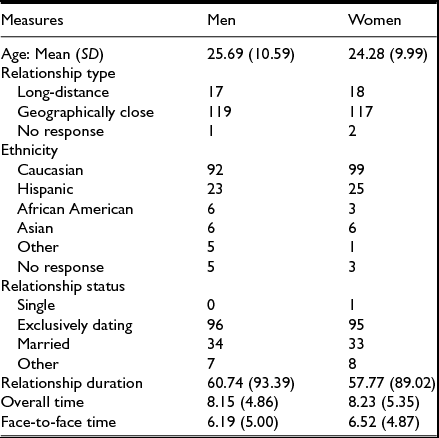
In total, 141 romantic couples from the United States participated in this study. Four couples were excluded from the analyses for the following reasons: two couples had scores on multiple measures that were between 3 and 6 standard deviations away from the mean on those measures. In addition, two couples who were homosexual were excluded from the analyses because we were interested in sensory orientations in heterosexual couples (i.e., gender differences). Participants’ age, ethnic background, relationship type, relationship status, relationship length (months), overall time spent together (hours/day) and time spent face to face (hours/day) are displayed in Table 1. Participants who were native Spanish speakers completed the Spanish version of the survey (n = 8 couples). Even though the native Spanish speakers (effective n = 7 couples, as data from one couple were excluded from the analyses due to being outliers, as described above) were older and had been in the relationship longer than native English speakers, the native Spanish speakers and the native English speakers did not differ on love, liking, satisfaction, and commitment, all Fs < 2.16, all ps > .14, nor did they differ on any of the 10 orientation and importance difference scores, all Fs < 2.31, ps > .13 (with one exception; there was a larger difference between men and women's touch importance ratings for the native Spanish speakers than for native English speakers, but the difference was marginally significant, p = .09).
Demographic Characteristics of the Sample

Note: Ages ranged from 17 to 77 years for women and from 17 to 75 years for men. Numbers in parentheses denote standard deviations. Duration of relationship was measured in months, and overall time and face-to-face time were measured in hours per day.
Procedure
The study was approved by the first author's university Institutional Review Board (IRB# 971436). We employed three recruitment methods to increase the diversity of our study sample. Some participants were tested in the first author's university laboratory. These were all college students seeking to complete a research participation requirement for an Introductory Psychology course, who brought their current romantic partner to the lab, in exchange of extra credits. Both members of the couple were invited into a research room and asked to read and sign the consent form, if they agreed to participate. Afterwards, they were asked to complete the study questionnaire in separate rooms. Upon the completion of the surveys, participants were given an information sheet to read and asked if they had any questions.
A second set of the participants were recruited through a snowball procedure, by recruiting acquaintances of the undergraduate and graduate research assistants working on this project. These participants were approached face to face and were asked to first read and sign the consent forms, provided they agreed to participate, and then complete the questionnaires at that time. Some participants handed the research assistants the completed questionnaires in person, while others completed the questionnaires at home. Couples were instructed to complete the questionnaires independently. Each partner was asked to place the questionnaire in the provided manila envelope and seal his/her own envelope before returning it to the researcher.
A third set of participants who lived in a different city were also recruited through a snowball procedure and were mailed the consent forms and questionnaire. These couples returned the signed consent form in a clasp envelope provided to them and completed the questionnaire and then sealed and placed the questionnaire in a small envelope provided to protect the confidentiality of their questionnaire responses. The two small envelopes were then placed into a clasp envelope and mailed back to the researcher. An email with information about the study goals was sent immediately after the completion of the survey to those who lived outside of the city after the first author received the completed surveys by mail.
Measures
Sensory modality orientations
Participants answered a set of questions aimed at measuring their orientation toward using touch, hearing, sight, bodily sensations, and the substitute channel. The items were adapted after Miron et al.’s (Reference Miron, Rauscher, Reyes, Gavel and Lechner2012) Preferred Channels of Relating Scale. Participants were asked to rate their level of agreement with each of the scale items ranging from 1 (strongly disagree) to 9 (strongly agree).
Touch orientation (seven items)
Touch orientation was assessed using items such as ‘I want to touch my partner all the time’ and ‘If I don't see my partner for a while, I crave for his/her touch’ (Cronbach's αs were .82 for men and .85 for women).
Hearing orientation (four items)
Hearing orientation was assessed with items such as ‘I yearn to hear my partner's voice’ and ‘I love hearing my partner talk’ (αs were .66 for men and .79 for women).
Sight orientation (two items)
Sight orientation was measured with these two items: ‘I enjoy watching my partner do even routine things (e.g., read the newspaper)’ and ‘I enjoy looking at my partner’. Reliability for was low for male participants, α = .43, but acceptable for women, α = .63.
Bodily sensations orientation (four items)
Bodily sensations orientation was measured with items such as ‘I love my partner's scent’ and ‘I love how my partner's body sometimes radiates warmth’ (αs = .68 for both men and women).
Substitute orientation (six items)
Substitute orientation was measured with items such as ‘I keep an article of clothing of my partner's that contains his/her scent’, ‘I listen to saved voicemails from my partner when I miss him/her’ and ‘I look at photos of my partner when I miss him/her’ (αs = .75 for both men and women).
Importance of sensory modalities
Participants answered a series of questions designed to assess the importance of each of the sensory modalities in their romantic relationship, using a 9-point scale ranging from 1 (not at all important) to 9 (extremely important). Specifically, participants were instructed to rate ‘the extent to which you find each of the following channels of relating important’. The importance of the following five sensory modalities or channels of relating was assessed: touch, sight, hearing, bodily sensations, and the substitute modality.
Touch importance (four items)
Importance of touch was assessed by asking participants to rate the importance of touching the partner, kissing the partner, hugging the partner, and holding the other close or cuddling the other (αs = .84 for men and .81 for women).
Sight importance (three items)
Importance of sight was assessed by asking participants to rate the importance of looking at their partner, looking into the other's eyes, and watching the other do things (αs = .67 for men and .71 for women).
Hearing importance (three items)
Importance of hearing was assessed by asking participants to rate the importance of listening to the other, talking with the partner, and hearing the voice of the partner (αs =.75 for men and .79 for women).
Bodily sensations importance (three items)
Importance of bodily sensations was assessed by asking participants to rate the importance of smelling the other's scent, feeling the texture of the partner's hands, face, or hair, and feeling his/her body warmth (αs =.77 for both men and women).
Substitute channel importance (two items)
Importance of substitute channels was assessed by asking participants to rate the importance of having an object that reminds them of the other and writing to the other (letters, email messages, texting). Reliability for male participants’ ratings was low, α = .37, but acceptable for women, α = .60.
Relationship satisfaction
Relationship satisfaction was assessed with an adapted version of the Kansas Marital Satisfaction Scale (Crane, Middleton, & Bean, Reference Crane, Middleton and Bean2000), which included five items, each evaluated on a 7-point scale ranging from 1 (extremely dissatisfying) to 7 (extremely satisfying); for example, ‘How satisfied are you with your relationship?’ and ‘How satisfied are you with the quality of the everyday interactions that you have with this person?’ (Cronbach's αs were .92 for men and .95 for women).
Passionate love
A factor analysis of the 12 love items used in prior work (Miron et al., Reference Miron, Rauscher, Reyes, Gavel and Lechner2012; Miron et al., Reference Miron, Wicklund, Diestelmann, Moore and Schroeder2015) uncovered two factors, passionate love (six items) and liking (five items). (One item — ‘How positively or negatively do you feel about your partner?’ — was not included in either index because it loaded on the first factor for women and on the second factor for men). For women, the first factor (passionate love) accounted for 36.48% of variance (eigenvalue = 6.67), whereas the second factor (liking) accounted for 35.31% of variance (eigenvalue = 1.23). For men, the first factor (passionate love) accounted for 33.68% of variance (eigenvalue = 6.25), whereas the second factor (liking) accounted for 32.85 % of variance (eigenvalue = 1.07). The Passionate Love index contains six items: To what extent are you in love with this person?; To what extent are you crazy about this person?; How passionate would your rate your relationship with this person?; How intense are your feelings for this person when you are in his/her presence?; How intense are your sensations in the presence of this person?; and How physically attractive is this person to you? (Cronbach's αs = .90 for both men and women). All items were assessed on 11-point scales ranging from 0 (not at all) to 10 (extremely).
Liking
The second factor, Liking, included the following five items: ‘How attractive is this person's personality to you?’; ‘Overall, how attractive is this person to you?’; ‘How much do you like this person?’; ‘How much do you care about this person?’; ‘To what extent do you accept this person for who he or she is?’ (αs = .86 for men and .91 for women). All items were assessed on 11-point scales ranging from 0 (not at all) to 10 (extremely).
Commitment
We measured participants’ commitment to the partner with the following two items: ‘How committed to this person do you feel?’ and ‘When you think of the future, to what extent is this person involved?’ (αs = .88 for men and .85 for women). Both items were assessed on 11-point scales ranging from 0 (not at all) to 10 (extremely).
Relationship characteristics
We measured the duration of each relationship in years/months (converted to months), time spent with the partner per day (including face-to-face time, Internet and phone time; in hours), and time spent face to face with the partner per day (in hours).
Results
Predicting Relationship Outcomes Based on Differential Sensory Modalities Orientations
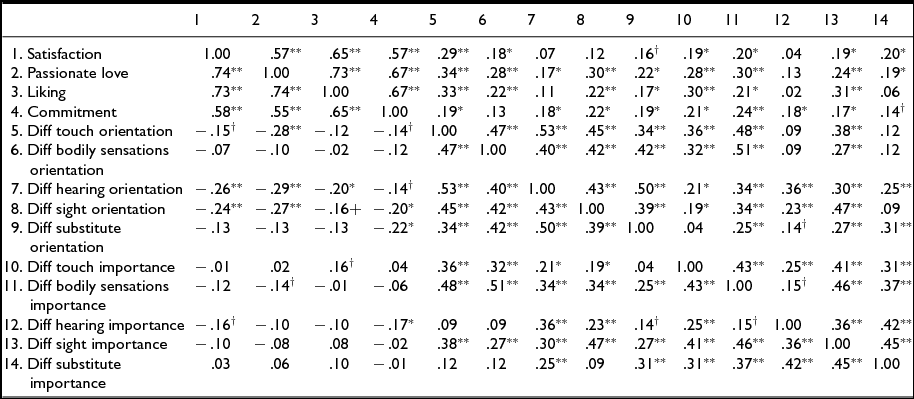
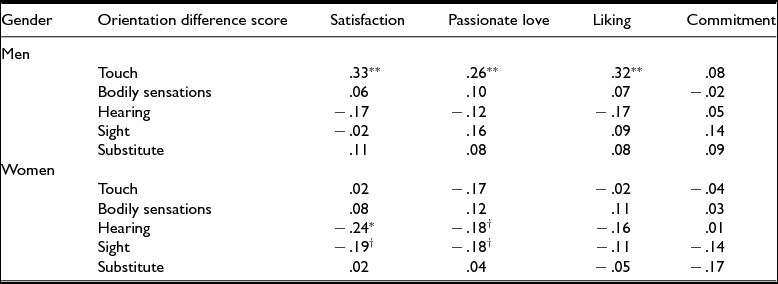
Table 2 displays the zero-order correlations between the orientation difference scores and relationship outcomes for men (above the diagonal), and for women (below the diagonal). Four regression analyses were conducted for each gender. For each relationship outcome (relationship satisfaction, passionate love, liking, and commitment), the difference sensory orientation scores were entered simultaneously (see Equation 1). Table 3 displays the results of these regression analyses for men and women, separately.
Correlations Among Sensory Orientation Difference Scores, Sensory Importance Difference Scores, and Relationship Outcomes for Men and Women

Note: N = 137 couples. **p ≤ .01 (2-tailed), *p ≤ .05, † p ≤ .10 (2-tailed). Diff = Difference. The correlations above the diagonal are for male participants, whereas the correlations below the diagonal are for female participants.
Sensory Orientation Difference Scores Predicting Relationship Outcomes

Note: N = 137 couples. **p ≤ .01, *p ≤ .05, † p ≤ .10.
Relationship satisfaction
Supporting Hypothesis 1A, the more men preferred touch compared to their female partners, the more satisfied they were, βtouch = .33, p = .002. All the other effects were not significant, all other βs < .18, all ps > .11. Supporting Hypothesis 2A, the more women were oriented toward using hearing and sight in their romantic interactions compared to their male partners, the more satisfied they were, βhearing = −.24, p = .032, and βsight = −.19, p = .066, although the last effect was only marginally significant.
Passionate love
Supporting Hypothesis 1A, the more men were oriented toward the use of touch compared to their female partners, the more passionately in love they were with their partners, βtouch = .26, p = .013, all other βs < .16, all ps > .10. Supporting Hypothesis 2A, the more women were more oriented toward the use of sight and hearing compared to their male partners, the more passionately in love they tended to be, βsight = −.18, p = .064, and βhearing = −.18, p = .089, although these effects were only marginally significant. For women too, a higher orientation toward touch predicted passionate love, but the effect was weaker and not statistically significant, βtouch = −.17, p = .109.
Liking
Supporting Hypothesis 1A, the more men were oriented toward touch compared to their female partners, the more liking they reported for their partners, βtouch = .32, p = .003, all other βs < .17, all ps > .12. Unexpectedly, differential orientations for sensory modalities did not predict liking for women, all βs < .16, all ps > .15.
Commitment
Differential sensory orientations across couples did not predict commitment for men, all βs < .14, all ps > .14, nor for women, βs < .18, all ps > .10.
Predicting Relationship Outcomes Based on Differential Sensory Modality Importance
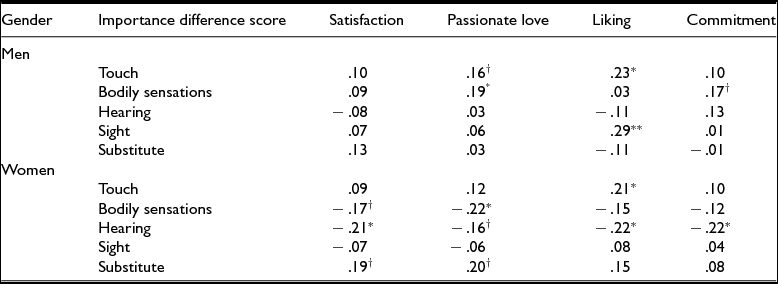
Four regression analyses were conducted for each gender. For each relationship outcome (relationship satisfaction, passionate love, liking, and commitment), the difference sensory importance scores were entered simultaneously (see Equation 2). Table 4 displays the results of these regression analyses for men and women separately.
Sensory Importance Difference Scores Predicting Relationship Outcomes

Note: N = 137 couples. **p ≤ .01, *p ≤ .05, † p ≤ .10.
Relationship satisfaction
Unexpectedly, differential importance of sensory modalities across couples did not predict satisfaction for men. As predicted by Hypothesis 2B, the more women rated hearing as more important than did their partners, the more satisfied they were, βhearing = −.21, p = .036. Unexpectedly, the more important women tended to rate bodily sensations (β = −.17, p = .10), and the less important they rated the substitute modality to be (β = .19, p = .07), compared to men, the more satisfied they tended to be. However, these effects were marginally significant.
Passionate love
Supporting Hypothesis 2A, the more men rated bodily sensations as more important than their partners, the more passionately in love they were, βbodily sensations = .19, p = .05. Supporting Hypothesis 2B, the more important women considered hearing to be, the more passionately in love they were, βhearing = −.16, p = .10 — a marginally significant effect. Unexpectedly, the less relatively important women considered the substitute modality, the more passionately in love they tended to be, βsubstitute = .20, p = .056. The more important women rated bodily sensations compared to men, the more passionately in love they were, βbodily sensations= −.22, p = .032.
Liking
Supporting Hypothesis 1B, the more men rated touch as more important compared to their partners, the more liking they reported, βtouch = .23, p = .017. Also, the more men rated sight as more important compared to women, the more liking they reported, βsight = .29, p = .005. Supporting Hypothesis 2B, the more women rated hearing as more important, the more liking of their partner they reported, βhearing = −.22, p = .023. The more women rated touch as less important compared to their partners, the more liking they reported, βtouch = .21, p = .034.
Commitment
Supporting Hypothesis 1B, there was a marginally significant relationship between men's importance of bodily sensation and their reported satisfaction: the more men rated bodily sensations as more important than did their partners, the more committed they tended to be, βbodily sensations = .17, p = .09. Supporting Hypothesis 2B, the more women rated hearing as comparatively more important, the more committed they were, βhearing = −.22, p = .024.
Additional Analyses
Gender differences
Paired-samples t tests were conducted to investigate whether there were any gender differences on relationship outcomes, sensory orientations, and importance of sensory modalities. There were no significant gender differences on relationship outcomes measures, with the exception of a marginally significant gender effect on passionate love, indicating that women tended to be more passionately in love than men, t(136) = 1.87, p = .064. There were several gender differences on sensory orientations, indicating that compared to men, women were more orientated toward using the substitute channel, t(136) = 2.27, p = .025, and toward bodily sensations, t(136) = 3.39, p = .001. Finally, there was a significant gender difference on importance of hearing, with women rating hearing as more important than did men, t(136) = 3.30, p = .002, and a marginally significant gender difference on touch importance, as women again rated touch as somewhat more important than did men, t(136) = 1.67, p = .098.
Discussion
Transactional Processes in Relationships
The data suggest some support for our transactional model of romantic sensory interactions. Specifically, we found that while men's relationship satisfaction, passionate love, and liking were driven by higher valuing of touch, women's relationship satisfaction, passionate love, liking, and commitment were primarily predicted by their higher valuing of hearing. While for men touch positively predicted relationship outcomes in 5 out of the 8 regressions, for women, touch predicted relationship outcomes in only 1 out of 8 regressions, and even in that case, women's higher touch orientation predicted lower liking. While for women hearing positively predicted relationship outcomes in 6 out of 8 regressions, for men hearing never predicted any of the relationship outcomes. Little support was found for the hypothesis that higher valuing of sight and of the substitute channel would predict better relationship outcomes for women across measures. Similarly, little support was found for the hypothesis that higher differential valuing of bodily sensations would predict higher relationship outcomes for men across measures. Overall, it appears that men and women prefer different sensory modalities in their romantic interactions, with men relying primarily on touch and women on hearing. These findings point to a division of the non-verbal (touch) and verbal sensory modalities (hearing) within heterosexual couples to maintain committed and satisfying relationships.
Contradicting our hypotheses, higher valuing of bodily sensations and touch predicted passionate love for both men and women. In retrospect, this finding can be easily accounted by a biological explanation that suggests that these sensory modalities have similar functions for both men and women — to maintain sexual desire and passionate love for the partner. Passionate love is thus driven by non-verbal sensory behaviours (touch and bodily sensations) for both men and women because sexual desire is biologically based and highly affected by physical, non-verbal cues about one's romantic partner's body. This is an important finding, as couple similarity in sexual attitudes (and thus by extension to our work, similarity in orientations toward touch and bodily sensations) was found to be correlated with higher relational and sexual satisfaction for both men and women (Cupach & Metts, Reference Cupach and Metts1995). Although differential importance of touch predicted liking for both men and women, these associations were in opposite directions — higher touch importance predicted liking in men, whereas lower touch importance in women predicted their liking of their partner. This indicates that passionate love and liking may have different motivational underpinnings in romantic relationships for the two genders.
Past work has shown that women are more likely than men to use the substitute modality (smelling and sleeping with or in the clothing of the partner; McBurney, Shoup, & Streeter, Reference McBurney, Shoup and Streeter2006; Shoup, Streeter, & McBurney, Reference Shoup, Streeter and McBurbey2008) and that individuals often use objects as substitutes for their partners as a coping mechanism when managing physical distance in the relationship (Jurkane-Hobein, Reference Jurkane-Hobein2015) or to gain some level of comfort (Shoup et al., Reference Shoup, Streeter and McBurbey2008). However, we found little evidence that women's orientation (or men's orientation, for that matter) toward the substitute modality predicts positive relationships outcomes. In fact, on two occasions, women's higher importance of the substitute modality marginally predicted lower satisfaction and lower passionate love in women. Given that we did not predict these findings and these findings were marginally statistically significant, they should be interpreted with caution. Nevertheless, future work should investigate the role of this modality in maintaining relationships, particularly long-distance relationships, in which frequent face-to-face sensory interaction is not possible.
Women's Sensory Orientations
Women's higher valuing of hearing positively predicted a host of relationship variables for women, from liking to commitment. These findings are important as they support the assumption that women are assigned the role of listeners and communicators in charge of facilitating verbal interactions with their male partners. This finding is consistent with previous research indicating that while men tend to talk significantly more than women, women strategically utilise patterns of speech to form and foster relationships (Leaper & Ayres, Reference Leaper and Ayres2007). This suggests that women may rely primarily on hearing to sustain the relationship and to remain committed to the partner and the relationship. Listening to the partner and talking to the partner (hearing) may thus be an important relationship maintenance strategy women use. The use of hearing involves a compassionate attitude toward the partner and a focus on the partner's needs. Having a compassionate attitude toward the partner is associated with provision of social support (e.g., Collins et al., Reference Collins, Kane, Metz, Cleveland, Khan, Winczewski and Prok2014). Women tend to be more personally committed than men (Adams & Jones, Reference Adams, Jones, Adams and Jones1999). Research has also documented that the wife's commitment to the relationship is predictive of both her own and her husband's satisfaction, whereas the husband's commitment is only related to his own level of satisfaction (Hendrick, Hendrick, & Adler, Reference Hendrick, Hendrick and Adler1988). This suggests that women's engagement with their partners in the verbal domain may fulfill an essential goal of maintaining the relationship.
Past research suggests that when couples have entered a committed phase in their relationship, women tend to initiate physical affection more frequently in order to maintain the bond (Guerrero & Andersen, Reference Guerrero and Andersen1991, Reference Guerrero and Andersen1994). However, our work partially contradicts these findings as it suggests that women may move away from touch and embrace verbal modalities such as hearing. This finding is, however, consistent with other work (Emmers & Dindia, Reference Emmers and Dindia1995) indicating that men's perceptions of their partners’ touch increased from the casually dating to the seriously dating stage and decreased from the seriously dating to the married stage. No decrease in women's perceptions of their partners’ touch was found. This suggests that there may be a decrease in women's touching of their male partners as the relationship progresses, which works against male partners’ preferences for touch. Touch was found to have important functions for both men and women as touch is associated with enhanced positive affect in the partner and with intimacy and positive affect in the actor (Debrot, Schoebi, Perrez, & Horn, Reference Debrot, Schoebi, Perrez and Horn2013). Participants who were touched more often during a one-week period also reported better psychological wellbeing six months later (Debrot et al., Reference Debrot, Schoebi, Perrez and Horn2013).
Men's Sensory Orientations
Men's higher differential preference for touch consistently predicted men's relationship outcomes, including relationship satisfaction, passionate love and liking, and their higher differential importance of bodily sensations predicted higher passionate love. Higher differential importance of sight also predicted higher liking in men. Men's reliance on non-verbal modalities such as touch, sight, and bodily sensations may be borne out in gender differences in reproductive strategies (Willis & Dodds, Reference Willis and Dodds1998). Men feel more comfortable with sexual intimacy than they do with non-sexual intimacy, such as emotional intimacy or non-sexual physical affection (L'Abate, Reference L'Abate2001), and report initiating sexual and physical affection more frequently than their female partners (Dworkin & O'Sullivan, Reference Dworkin and O'Sullivan2005). Moreover, men's stronger orientations toward touch match societal expectations about men as the initiators of sex (Mongeau, Carey, & Williams, Reference Mongeau, Carey, Williams, Canary and Dindia1998). Men fall in love sooner than women and are more likely than women to say ‘I love you’ (Dion & Dion, Reference Dion and Dion1973; Harrison & Shortall, Reference Harrison and Shortall2011). This may be a byproduct of two processes: (1) men being more interested in sex than women (Buss, Reference Buss2006); and (2) men being more likely than women to equate love with sexual desire (Harrison & Shortall, Reference Harrison and Shortall2011).
Importance of Transactional Sensory Processes in Romantic Interactions
To our knowledge, no research has explored transactional processes with regard to male and female intimates’ differential orientations toward sensory modalities. Prior work on transactional processes has primarily focused on dyadic coping in response to stressors affecting one romantic partner (Vedes et al., Reference Vedes, Hilpert, Nussbeck, Randall, Bodenmann and Lind2016). Our current work advances this prior work by underscoring the importance of division of sensory romantic domains, which may serve to maintain relationship satisfaction, love, and commitment.
One insight from our work is that men may be primarily responsible for maintaining the relationship via employment of touch and that engagement with this sensory modality should be considered a relationship-oriented behaviour employed by men. In general, when men adopt relationship-oriented behaviours, women are happier (Acitelli, Reference Acitelli1992; Acitelli et al., Reference Acitelli, Rogers and Knee1999; Sullivan & Baucom, Reference Sullivan and Baucom2005). More specifically, more frequent partner hugs are associated with lower blood pressure and heart rate in women (Light, Grewen, & Amico, Reference Light, Grewen and Amico2005). A recent experiment by Ditzen et al. (Reference Ditzen, Neumann, Bodenmann, von Dawans, Turner, Ehlert and Heinrichs2007) found that women who received physical partner contact (standardised neck and shoulder massage) before being exposed to a laboratory stressor exhibited significantly lower cortisol and heart rate responses to the stressor compared to women who received verbal support or received no social interaction from their romantic partner. These findings suggest that touch provided to women by their male romantic partners has beneficial effects on stress reduction, whereas verbal social support alone does not reduce stress responsiveness.
Nevertheless, other work suggests that the husbands’ relationship talk positively predicts the wives’ marital wellbeing, whereas the wives’ relationship talk did not predict wives’ own marital wellbeing (Acitelli, Reference Acitelli1992). This work suggests that wives may be happiest when husbands talk extensively about the relationship. Our findings are consistent with these results, as we found that engaging with their male partner in the verbal domain through hearing positively predicts women's relational satisfaction, passionate love, liking, and commitment. There is less research, however, on how men react to women's use of hearing in their relationship. In fact, Acitelli's (Reference Acitelli1992) work found that husbands’ marital satisfaction was not related to either spouse's relationship talk, consistent with our findings that men value other sensory modalities than hearing in their interactions with their partners.
Finally, it should be noted that gender differences across couples do not explain our results, as paired-samples t-test analyses indicated that women were more oriented toward the substitute and bodily sensations modalities and rated hearing and touch as being more important compared to men. The within-couples analyses that we performed by computing difference scores for sensory orientations and for modality importance, respectively, tell a different story that points to differential sensory orientations and interaction patterns in male and female partners.
Limitations, Implications, and Future Work
The use of self-report questionnaires is a limitation in this study as actual behaviours may be different from reported behaviours. In future studies, other methods should be employed such as diary methods, which would require romantic partners to keep daily track of their actual use of and preference for sensory modalities, and their feelings of love, liking and commitment to the partner (see Laurenceau & Bolger, Reference Laurenceau and Bolger2005, for a methodological paradigm). Longitudinal studies are also needed to investigate the effects of differential employment of sensory modalities by men and women on relationship outcomes such as divorce and/or relationship longevity. While our study assessed sensory orientations and preferences in romantic couples, future work could investigate how actual use of sensory modalities by male and female partners affects their relationship. If men and women indeed utilise different sensory modalities in their interactions with the romantic partner, relationship researchers and therapists may use this knowledge to help couples accommodate each other's sensory preferences.
Experimental research is also needed to further test the causal effects of differential use of touch by men and of hearing by women, in their relationships, over a set period of time. Such an experimental paradigm would require that male and female couple members follow a script that directs them to employ either touch, hearing, or both sensory repertoires in their interactions with their romantic partner. Such a paradigm can also be used to study adaptation processes in response to decreased or increased use of certain sensory modalities (touch or hearing) by one's partner. Guerrero, Jones, and Burgoon (Reference Guerrero, Jones and Burgoon2000) used such a paradigm and found that in high intimacy couples (i.e., couples in which one of the partners was instructed to act warmer and behave more non-verbally interested in their partner), romantic couples reciprocated with increased positive non-verbal and verbal romantic behaviours. This means that these partners became more facially and vocally pleasant, and more fluent as well as more verbally oriented toward the partner — as evidenced by a higher number of positive statements about the partner and the relationship. In contrast, in low-intimacy couples (i.e., in which one of the partners was instructed to act colder and more disinterested in their partner in a second conversation), the decrease in positive verbal and non-verbal behaviours by the partner led participants to become less non-verbally pleasant and more verbally hostile. These participants were also more likely to engage in verbal repair strategies (e.g., asking the partner whether something was wrong). It appears that the use of sensory modalities by one romantic partner results in reciprocation via the use of the same sensory modality, but also results in compensation strategies occurring primarily in the verbal domain. It would be also important to test whether the gender of the partners moderates these effects. Finally, while studies have found very little differences between heterosexual and homosexual relationships in terms of sexual desire, sexual satisfaction, or sexual communication (Holmberg & Blair, Reference Holmberg and Blair2009), future work should explore whether different transactional processes occur in homosexual relationships, in which there may be a lesser division of the sensory modalities.
Our research is the first step in identifying the sensory orientations of heterosexual male and female intimates and the predictive effects of these orientations on relationship satisfaction, love, liking, and commitment. Future work should pay attention to couple members’ differential sensory orientations when designing relationship-maintenance strategies and should further test the role of these sensory modalities in romantic relationships.
Financial Support
This research received no specific grant from any funding agency, commercial or not-for-profit sectors.
Conflict of Interests
None.
Ethical Standards
All procedures contributing to this work comply with the ethical standards of the relevant national and institutional committees on human experimentation and with the Helsinki Declaration of 1975, as revised in 2008.