Introduction
Computed tomography (CT) scans of the temporal bones are commonly requested by otolaryngologists during routine and emergency patient management. The scans are used for pre-operative planning, to aid diagnoses, and to detect and examine complications or disease processes. The radiologist's accompanying report is vital; it is used to guide surgery and dictate the type of surgery needed. For a large number of radiologists, the report is the only manifestation of their expertise, training and experience; the report thereby constitutes their primary means of providing patient care.Reference Sistrom and Langlotz1
Temporal bone CT is undertaken at the request of the referring clinician. A radiologist sanctions the request and provides a report based on the information provided by the clinician. Many clinicians regard the radiology report as definitive, believing it to be an objective report that is unlikely to differ between radiologists.Reference Rickett, Finlay and Jagger2
Some clinicians argue that withholding clinical details from the radiologist helps to provide a more objective and unbiased report.Reference Rickett, Finlay and Jagger2 Contrary to this, a recent systematic review showed that the provision of clinical information improved the diagnostic accuracy of reports without introducing bias.Reference Boonn and Langlotz3 Other studies have demonstrated that the provision of inadequate clinical information is more likely to result in an inaccurate report, whereas detailed clinical information increases the likelihood of the report being clinically relevant.Reference Leslie, Jones and Goddard4 These effects are likely to be more significant for complex imaging studies such as temporal bone CT, where previous surgery can mimic disease processes and vice versa (e.g. cholesteatoma).
In a recently published survey, over 87 per cent of radiologists indicated that additional clinical information was needed for the adequate completion of their reports.Reference Loy and Irwig5 However, the time it would take to obtain this additional information often prevented radiologists from doing this, despite the fact that such information may change or modify the reports.Reference Loy and Irwig5
It is important that clinicians provide valuable, accurate information on their radiology scan request. As well as increasing the clinical applicability of radiological reports, this would prevent unnecessary patient irradiation, and prevent delays in diagnosis and treatment. In order to assess and improve our departments' practice in this regard, a two-cycle prospective audit was designed and undertaken.
This study sought to evaluate the information provided on temporal bone CT scan requests against guidelines issued by the Royal College of Radiologists on the standards for reporting and interpreting imaging investigations.6 The main objective was to improve clinical practice by: minimising the number of inappropriate requests, and increasing the diagnostic precision and clinical applicability of radiological reports. We focused on identifying the information considered vital to the radiologist for interpretation of the imaging investigation findings, and constructed an easily adopted checklist to guide the clinicians requesting a temporal bone CT scan.
In the absence of national (and international) guidelines on which information to provide when requesting a temporal bone CT scan, guidelines were based on the Royal College of Radiologists' standards for reporting and interpreting imaging investigations.6 This document sets forth generic guidelines for all imaging requests. According to our ‘gold standard’, 100 per cent of the temporal bone CT scan requests and reports should meet the relevant local guidance.
Materials and methods
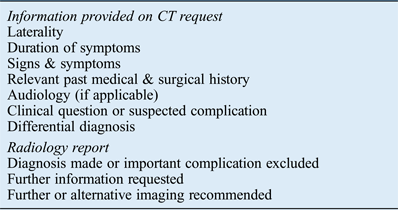
A data collection proforma was designed based on the Royal College of Radiologists' guidelines,6 (Table I) and an initial prospective audit was conducted. Data from all temporal bone CT scan requests and reports issued between 1 January and 30 September 2011 were collected prospectively. Both the radiologists and the doctors who requested the temporal bone CT scans were blinded to the audit process in order to avoid bias.
Criteria assessed1

CT = computed tomography
There were a total of 164 temporal bone CT scans. Each scan was assigned a number, and a computerised random number generator was used to select 100 of the scans. The requests and reports issued were evaluated independently by two authors (AQ and GG) using the proforma; any discrepancies were resolved via discussion and subsequent mutual agreement. A report was considered clinically relevant if it helped to confirm or exclude a diagnosis relating to the clinical presentation, or if it excluded important complications relating to a particular presentation or symptom.
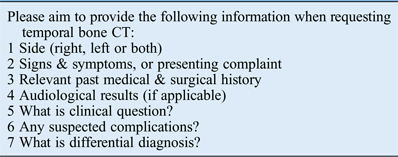
An action plan was initiated following the departmental presentation of the results. This resulted in the development of new departmental guidelines (Table II). In addition, a training session on temporal bone CT scan requests was introduced as part of the induction programme for junior ENT doctors. The radiologists interpreting the scans were unaware of the audit, and were blinded from the primary audit cycle results and the new departmental guidelines (in order to avoid bias).
Departmental guidelinesFootnote *
* For temporal bone computed tomography scan requests (within the ENT department, Queen's Medical Centre, Nottingham). CT = computed tomography
A prospective reassessment was conducted three months later, to close the audit loop and evaluate outcomes. All scan requests and reports issued between 1 February and 1 May 2012 were collected (n = 56). A total of 50 scans were randomly selected, and the requests and reports were assessed using identical methods to those described (above) for the first cycle. During each cycle, all temporal bone CT scans were interpreted by the same three consultant neuroradiologists.
Following advice from a statistician, data were analysed using a two-proportion Z-test; this statistical test is commonly used to compare proportions from two randomly selected population groups.
Results
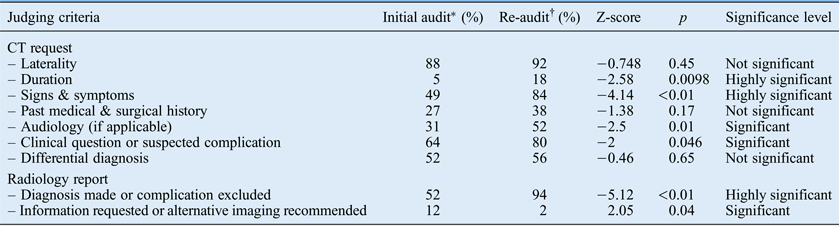
Following the introduction of the guidelines and the training sessions for junior ENT doctors, the percentage of temporal bone CT reports indicating a diagnosis or excluding an important complication increased from 52 to 94 (p < 0.01) (Table III). This statistically significant and clinically relevant improvement was related to the increase in information provided on request forms. Subgroup analysis highlighted the potential importance of the following items of information (p < 0.05): audiology results, a specific clinical question, and the duration and description of signs and symptoms.
Audit cycle results
*Total n = 100. †Total n = 50. CT = computed tomography
The percentage of CT temporal bone scans where further clinical information was requested by the radiologist, or an additional or alternative imaging modality recommended, dropped from 12 to 2. This difference was statistically significant (p < 0.05). Importantly, this reduction minimised the number of patients likely to undergo unnecessary radiation.
A subgroup analysis of all temporal bone CT scan requests from both cycles (n = 150) demonstrated that those requests with detailed clinical information were more likely to lead to a clinically relevant report. The provision of a differential diagnosis on the request form had the greatest impact on this outcome (p < 0.01) (Table IV).
Importance of criteria for radiological diagnosis
*Total n = 100. †Total n = 50.
Discussion
Within our department, one of the largest in the UK, temporal bone CT is conducted for various elective and emergency purposes, ranging from pre-operative planning (e.g. for cochlear implantation or cholesteatoma surgery) to management of suspected malignant otitis externa or acute mastoiditis. Thus, the information sought by referring clinicians differs significantly. The radiologists' report should be tailored accordingly. If the radiological report does not provide the appropriate information needed by the surgeon, delays in patient diagnosis and treatment can occur. These delays comprise the leading cause of litigation against otolaryngologists in the UK.Reference Savage and Weiner7
Prior to the implementation of the new guidelines and the training sessions for junior ENT doctors, almost half of the temporal bone CT reports did not support a diagnosis or failed to exclude clinically relevant complications. Thus, these reports were not immediately clinically applicable. Following the intervention, the quality of the information provided to radiologists improved, which increased the clinical relevance of the report. The audit results showed a statistically significant improvement (p < 0.01) in the clinical relevance of the reports (i.e. the reports provided or confirmed the diagnosis, or excluded potentially serious complications that required further attention), which might be considered the primary indicator of intervention success. Furthermore, the additional information, provided according to our new guidelines, led to a reduction (from 12 to 2 per cent) in the number of temporal bone CT scan requests subsequently felt to be inappropriate or lacking in detail (where further information was required by the radiologist prior to completing a report) (p < 0.05).
The relatively high number of inappropriate scan requests and non-diagnostic radiological reports found prior to the intervention might be explained by the fact that the majority of requests were made by junior doctors, an observation made during data collection. This is perhaps not surprising given the frequent rotation of junior doctors, with little or no previous experience in otolaryngology, for whom the indications for complex imaging like temporal bone CT may be unclear. Hence, the relevant information (e.g. information regarding signs and symptoms), the clinical question and the differential diagnosis, may not always be provided, despite knowing there is an obvious need for imaging. This may reflect a wider concern regarding the lack of ENT undergraduate training in the UK.Reference Powell, Cooles, Carrie and Paleri8
The increase in the proportion of clinically relevant radiology reports cannot be explained by an improvement in reporting, as the radiologists were not aware of this audit. Furthermore, the same group of head and neck radiologists (three specialists) issued the CT reports both before and after the audit. In addition, the radiologists subsequently confirmed that they had not undergone additional specific training for temporal bone CT reporting since the audit begun.
Following the implementation of the guidelines and training, the junior doctors requesting the scans became more aware of the indications for temporal bone CT. As a result, additional, relevant information was provided on the request, which minimised the number of inappropriate requests and facilitated radiological interpretation. Our department now routinely provides training on temporal bone CT scan requests as part of junior doctor induction.
This audit also demonstrated the significant impact (p < 0.05) that the provision of the following items of information had on the potential diagnostic value of the CT reports: the differential diagnosis, the clinical question, the audiological findings, the duration of signs and symptoms, and the patient's history.
• Accurate interpretation of temporal bone computed tomography (CT) scans depends on provision of adequate clinical information
• In our hospital, clinical information was often absent, compromising radiologists' reports
• Prior to intervention, half the temporal bone CT reports were not immediately clinically applicable
• New guidelines and training improved clinical relevance of reports and reduced unnecessary scans
• Knowledge of symptom duration, audiology findings, differential diagnosis and clinical question improved clinical relevance
Limitations of this audit relate to the differences in the number of scans used for each cycle and the time frame over which the data were collected. Furthermore, data were collected by the authors themselves, creating the potential for observer bias; however, this was limited through the use of a standardised proforma.
Conclusion
Temporal bone CT is commonly used in otolaryngology, in emergency and elective situations; the indications for temporal bone CT vary widely. Optimising its use has important positive implications for patient care, safety, experience, time management and cost. This audit demonstrated the significant impact that the implementation of guidelines and training can have on the quality of temporal bone CT reports. In the current study, this intervention had a positive, direct effect on patient management. The study also provides evidence to support the argument that additional clinical information aids rather than inhibits correct radiological interpretation.
As there are no national (or international) guidelines on the information to be provided in requests for this specialist investigation, we devised our own. Our results demonstrate the positive impact of our devised guidelines on patient care and departmental efficiency. However, further work is needed to assess the efficiency and financial impact of these changes.
Acknowledgement
We would like to thank Mr Christopher Joyce, Nottingham City Hospital, for his advice and support with statistical analysis.