Introduction
Most psychiatric and neurodegenerative illnesses are characterized by cognitive impairments (Wunderli et al., Reference Wunderli, Vonmoos, Niedecker, Hulka, Preller, Baumgartner, Kraemer, Seifritz, Schaub, Eich-Höchli and Quednow2016; Claesdotter et al., Reference Claesdotter, Cervin, Åkerlund, Råstam and Lindvall2018; Jagust, Reference Jagust2018; Wang et al., Reference Wang, Pradhan, Coughlin, Trivedi, DuBois, Crawford, Sedlak, Nucifora, Nestadt, Nucifora, Schretlen, Sawa and Barker2019). These deficits have a deleterious effect on patients' quality of life and are severely impairing real world functioning (Millan et al., Reference Millan, Agid, Brune, Bullmore, Carter, Clayton, Connor, Davis, Deakin, DeRubeis, Dubois, Geyer, Goodwin, Gorwood, Jay, Joels, Mansuy, Meyer-Lindenberg, Murphy, Rolls, Saletu, Spedding, Sweeney, Whittington and Young2012). Previous research has described trans-diagnostic impairments in various cognitive domains in patients (Millan et al., Reference Millan, Agid, Brune, Bullmore, Carter, Clayton, Connor, Davis, Deakin, DeRubeis, Dubois, Geyer, Goodwin, Gorwood, Jay, Joels, Mansuy, Meyer-Lindenberg, Murphy, Rolls, Saletu, Spedding, Sweeney, Whittington and Young2012). In particular, deficits in executive functions, working memory, and decision-making are among the most common affected domains in psychiatric disorders and have been observed in highly prevalent illnesses like depression, schizophrenia, and substance use disorders (Jessen et al., Reference Jessen, Mandl, Fagerlund, Bojesen, Raghava, Obaid, Jensen, Johansen, Nielsen, Pantelis, Rostrup, Glenthøj and Ebdrup2019). While some existing pharmacological treatments have been shown to improve cognitive performance, these effects are small (Désaméricq et al., Reference Désaméricq, Schurhoff, Meary, Szöke, Macquin-Mavier, Bachoud-Lévi and Maison2014). Other currently used drugs such as first-generation antipsychotics may even worsen cognitive functions (Hill et al., Reference Hill, Bishop, Palumbo and Sweeney2010). Deficits in cognitive abilities are therefore a highly important trans-diagnostic dimension in psychiatric and neurological disorders with a great need for improved treatment (Millan et al., Reference Millan, Agid, Brune, Bullmore, Carter, Clayton, Connor, Davis, Deakin, DeRubeis, Dubois, Geyer, Goodwin, Gorwood, Jay, Joels, Mansuy, Meyer-Lindenberg, Murphy, Rolls, Saletu, Spedding, Sweeney, Whittington and Young2012).
Pharmacological studies offer the opportunity to causally investigate the contribution of specific receptors and therefore elucidate the neuropharmacological basis of cognitive deficits. This knowledge is urgently needed for the development of specific and novel treatment approaches. Alterations in serotonin (5-HT) 2A receptor binding has been reported in various psychiatric disorders such as schizophrenia (Talvik-Lotfi et al., Reference Talvik-Lotfi, Nyberg, Nordström, Ito, Halldin, Brunner and Farde2000), depression (Bhagwagar et al., Reference Bhagwagar, Hinz, Taylor, Fancy, Cowen and Grasby2006), and obsessive–compulsive disorder (Perani et al., Reference Perani, Garibotto, Gorini, Moresco, Henin, Panzacchi, Matarrese, Carpinelli, Bellodi and Fazio2008). Furthermore, this receptor is widely distributed in brain regions important for cognition and learning (Zhang and Stackman, Reference Zhang and Stackman2015). However, pharmacological studies investigating the role of this receptor system in humans are rare.
Lysergic acid diethylamide (LSD) is a classical hallucinogenic compound and has been shown to transiently induce subjective psychedelic experiences as well as alterations in brain activity and connectivity via agonistic activity on the 5-HT2A receptor (Preller et al., Reference Preller, Herdener, Pokorny, Planzer, Kraehenmann, Stämpfli, Liechti, Seifritz and Vollenweider2017, Reference Preller, Burt, Ji, Schleifer, Adkinson, Stämpfli, Seifritz, Repovs, Krystal, Murray, Vollenweider and Anticevic2018a, Reference Preller, Schilbach, Pokorny, Flemming, Seifritz and Vollenweiderb). The administration of LSD therefore offers the opportunity to causally elucidate the role of the 5-HT2A receptor in human cognition. Two recent studies reported that LSD subjectively decreased concentration and increased the self-report of cognitive disorganization (Schmid et al., Reference Schmid, Enzler, Gasser, Grouzmann, Preller, Vollenweider, Brenneisen, Muller, Borgwardt and Liechti2015; Carhart-Harris et al., Reference Carhart-Harris, Kaelen, Bolstridge, Williams, Williams, Underwood, Feilding and Nutt2016). Yet, objective measures of cognitive abilities under LSD are still lacking. Therefore, the present study investigated the acute effects of LSD on executive functions, spatial working memory, and risk-based decision-making using computerized and standardized tests provided by the Cambridge Neuropsychological Automated Test Battery (CANTAB). Furthermore, while previous studies point to the involvement of the 5-HT2A receptor in LSD-induced effects (Kraehenmann et al., Reference Kraehenmann, Pokorny, Aicher, Preller, Pokorny, Bosch, Seifritz and Vollenweider2017; Preller et al., Reference Preller, Herdener, Pokorny, Planzer, Kraehenmann, Stämpfli, Liechti, Seifritz and Vollenweider2017, Reference Preller, Schilbach, Pokorny, Flemming, Seifritz and Vollenweider2018b), the contribution of this receptor subtype to alterations in cognitive processes is unknown. To be able to investigate the specific role of the 5-HT2A receptor in cognition, we blocked this receptor subtype via the pre-treatment of LSD with the 5-HT2A receptor antagonist ketanserin. We hypothesized that (1) LSD impairs executive functions, spatial working memory, and risk-based decision-making and (2) that these alterations are attributable to LSD's agonistic activity on the 5-HT2A receptor.
Methods
Participants
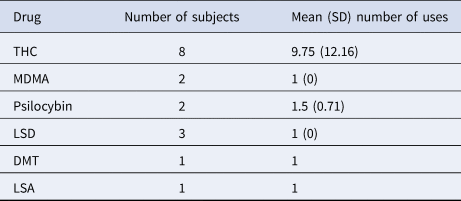
Twenty-five healthy participants (19 men, 6 women, mean age ± SD: 25.24 ± 2.79, mean verbal IQ ± SD: 108.4 ± 9.2) were enrolled in the study. All participants underwent a screening procedure at the Department of Psychiatry, Psychotherapy and Psychosomatic, Psychiatric Hospital, University of Zurich consisting of a psychiatric interview (M.I.N.I., Sheehan et al., Reference Sheehan, Lecrubier, Sheehan, Amorim, Janavs, Weiller, Hergueta, Baker and Dunbar1998), laboratory test (blood chemistry and urinalysis for drug and pregnancy screening), and a routine medical examination including electrocardiogram. Verbal intelligence was measured with the German version of a multiple choice vocabulary intelligence test (Lehrl, Reference Lehrl2005). Volunteers were included when they were 20–40 years of age and willing to refrain from consuming psychoactive drugs at least two weeks before the first experimental session and during the study. Drug use during the three months prior to inclusion in the study is shown in Table 1. The exclusion criteria were personal or first-degree relative history of psychiatric disorders, acute or chronic physical illness, cardiovascular diseases, history of head trauma, neurological diseases such as migraine headaches and epilepsy, history of drug dependence or abuse, a previous significant adverse response to a hallucinogenic drug, and pregnancy or lactation. Before participating, all participants gave their written consent after having received detailed written and oral information about the aims of the study, and the effects and possible risks of the substances administered in accordance with the Declaration of Helsinki. The study was approved by the Ethics Committee of the Department of Public Health of the Canton of Zurich, Switzerland, and the use of LSD was authorized by the Swiss Federal Office for Public Health, Department of Pharmacology and Narcotics, Berne, Switzerland. The current data were collected as part of a larger study (Kraehenmann et al., Reference Kraehenmann, Pokorny, Aicher, Preller, Pokorny, Bosch, Seifritz and Vollenweider2017; Preller et al., Reference Preller, Herdener, Pokorny, Planzer, Kraehenmann, Stämpfli, Liechti, Seifritz and Vollenweider2017, Reference Preller, Schilbach, Pokorny, Flemming, Seifritz and Vollenweider2018b) and the study was registered at clinicaltrials.gov (NCT02451072).
Drug use in the last 3 months prior to study inclusion in the study sample (n = 25)

THC, tetrahydrocannabinol; MDMA, 3,4-methylenedioxymethamphetamine; LSD, lysergic acid diethylamide; DMT, N,N-dimethyltryptamine; LSA, d-lysergic acid amide.
Study design and experimental procedures
This study employed a double-blind, randomized, placebo-controlled, within-subject design with three experimental sessions, each separated by at least two weeks. All participants underwent three drug conditions: placebo + placebo (Pla), placebo + LSD (LSD), and ketanserin + LSD (Ket + LSD). One hour after the intake of the first capsule (placebo: 179 mg mannitol, 1 mg aerosil, p.o.; or ketanserin: 40 mg, p.o.) the second one (placebo: 179 mg mannitol, 1 mg aerosil, p.o.; or LSD: 100 µg, p.o.) was administered. All substances were filled in identical looking gelatine capsules. A urine test for drug-screening and pregnancy-test was conducted at the beginning of each experimental session before drug administration. Participants completed the Intra/Extra-Dimensional shift task (IED), Spatial Working Memory task (SWM), and Cambridge Gambling Task (GCT, CANTABeclipse 5.0.12, Cambridge Cognition Ltd., Cambridge, UK) on a computer with a 18″ touch-sensitive screen (Elo Touch Solutions) in a quiet room 220 min after the administration of the second capsule. Task order was the same for all participants and sessions. Total time required to complete the three tasks was approximately 25 min. Participants completed the Five Dimension Altered State of Consciousness (5D-ASC) questionnaire (Dittrich, Reference Dittrich1998) 720 min after the second drug intake to retrospectively rate subjective drug effects.
Questionnaire and cognitive tasks
Altered States of Consciousness Rating Scale
The 5D-ASC (Dittrich, Reference Dittrich1998) was used to assess subjective drug effects in each session. Scores were calculated for eleven validated subscales (Studerus et al., Reference Studerus, Gamma and Vollenweider2010): experience of unity, spiritual experience, blissful state, insightfulness, disembodiment, impaired control and cognition, anxiety, complex imagery, elementary imagery, audio-visual synesthesia, and changed meaning of percepts. Results of the 5D-ASC data are expressed as percentage scores of maximum absolute subscale values.
Executive functions: Intra/Extra-Dimensional shift task
The IED is a test of rule acquisition and cognitive shifting and represents a computerized analog of the Wisconsin Card Sorting test. Besides attentional set-shifting the task measures different cognitive abilities such as discriminative learning, reversal learning, formation of an attentional set, shifting of attention within the same dimension (intra-dimensional shift, IDS) and between different perceptual dimensions (extra-dimensional shift, EDS) (Owen et al., Reference Owen, Roberts, Polkey, Sahakian and Robbins1991; Pantelis et al., Reference Pantelis, Wood, Proffitt, Testa, Mahony, Brewer, Buchanan, Velakoulis and McGorry2009). Perceptual dimensions are operationalized via two stimulus characteristics (purple-filled shapes or white lines). Attentional set-shifting is a measure of cognitive flexibility and executive functions. The task consists of nine learning stages, during which the participant first has to focus on shapes or lines within a relevant dimension (IDS) and then shift attention to a previously irrelevant dimension (EDS, stage 8, for a detailed description see Pantelis et al., Reference Pantelis, Wood, Proffitt, Testa, Mahony, Brewer, Buchanan, Velakoulis and McGorry2009). The measures of performance on this task are: number of stages completed (stages completed), total number of errors made across all stages adjusted for stages not completed (number of errors adjusted) representing a measure of subject's efficiency in attempting the test, the number of errors on individual stages (number of errors), and the mean time to reach a decision within individual stages (total latency). While the orbitofrontal cortex and the posterior parietal cortex have been shown to be more involved during the reversal stages of the IED, the ventrolateral prefrontal cortex (PFC) selectively governs attentional set-shifting (EDS stage) (Dias et al., Reference Dias, Robbins and Roberts1996; Hampshire and Owen, Reference Hampshire and Owen2006; Owen et al., Reference Owen, Roberts, Hodges, Summers, Polkey and Robbins1993).
Working memory: Spatial Working Memory task
The SWM is a self-paced task during which an increasing number of boxes (four, six, and eight) is presented in four trials on the screen. Participants are supposed to find blue tokens which are hidden inside the boxes by touching the boxes and thereby opening them. In each trial, the same number of tokens has to be found as the number of boxes presented on the screen. Participants are informed that once a token has been found within a particular box, the box will not be used again to hide a token. This tests measures executive functions (strategy score) as well as working memory errors (between and within errors). Between errors occur when a participant revisited a box in which a token had previously been found, whereas within errors are the number of times a participant revisited a box already found to be empty during the same search sequence. Strategy score describes the use of an efficient search strategy by beginning with a particular box and then returning to that box when a blue token was found to start the new search sequence. High strategy scores represent poor use of a strategy. Performance of the SWM relies on frontal lobe integrity (Owen et al., Reference Owen, Downes, Sahakian, Polkey and Robbins1990, Reference Owen, Sahakian, Semple, Polkey and Robbins1995, Reference Owen, Morris, Sahakian, Polkey and Robbins1996).
Risk-based decision-making: Cambridge Gambling Task
The CGT assesses decision-making and risk-taking behavior outside a learning context. Participants start the task with 100 points. They are presented with 10 boxes on the screen. The boxes are either red or blue. The ratio of red and blue boxes varies across trials (9:1, 8:2, 7:3, 6:4, 5:5). Participants have to decide whether a randomly hidden token is more likely to be in a red or blue box. Subsequently, participants bet on their decision by selecting a proportion of their points. The proportion of points (5%, 25%, 50%, 75%, 95%) that can be selected are presented in either ascending or descending order. The outcome measures of this task are: the proportion of trials on which subjects chose the more likely outcome (quality of decision-making), the proportion of current points that the subject stakes on each gamble when the more likely outcome is selected (risk taking), and deliberation time (mean latency from presentation of the colored boxes to subject's choice of which color to bet on). The CGT has been shown to be sensitive to the manipulation of the serotonergic system in particular in orbital prefrontal regions (Rogers et al., Reference Rogers, Everitt, Baldacchino, Blackshaw, Swainson, Wynne, Baker, Hunter, Carthy, Booker, London, Deakin, Sahakian and Robbins1999). Furthermore risk adjustment assessed with the CGT relies on integrity of the ventromedial PCF and the insula (Clark et al., Reference Clark, Bechara, Damasio, Aitken, Sahakian and Robbins2008).
Statistical analysis
Data were analyzed using STATISTICA 8.0 for Windows (StatSoft). For 5D-ASC ratings, a repeated-measures ANOVA with drug (Pla, LSD, Ket + LSD) and subscale (experience of unity, spiritual experience, blissful state, insightfulness, disembodiment, impaired control and cognition, anxiety, complex imagery, elementary imagery, audio-visual synesthesia, changed meaning of percepts) as within-subject factors were computed. For CANTAB outcome variables (IED: number of errors adjusted, numbers of errors, and total latency; SWM: between errors, within errors, and strategy; CGT: quality of decision-making, risk taking, and deliberation time) repeated-measures ANOVAs with drug (Pla, LSD, Ket + LSD) as within-subject factor was computed. For the IED stage (1–9) was introduced as an additional within-subject factor. For the SWM, stage (4, 6, 8 boxes) was introduced as additional within-subject factor. For the CGT risk ratio (9:1, 8:2, 7:3, 6:4) was introduced as additional within-subject factors. Tukey post-hoc comparisons followed significant main effects or interactions. Further, multiple linear regression analyses using the enter method were calculated to predict significant LSD-induced changes in the CANTAB endpoints (change scores LSD minus placebo). The eleven subscales of the 5D-ASC (change score LSD minus placebo) and verbal IQ were entered as predictors. Statistical comparisons of all data were carried out on a significance level set at p < 0.05 (two-tailed).
Results
5D-ASC
There was a significant drug × subscale interaction [F (20,480) = 15.10, p < 0.000001] (Fig. 1), a significant main effect of subscale [F (10,240) = 16.62, p < 0.000001] and a significant main effect of drug [F (2,48) = 85.06, p < 0.000001]. Tukey post-hoc tests revealed that LSD significantly increased all subscale scores compared to Pla and Ket + LSD (all p < 0.0001) except for anxiety (p > 0.7). There were no significant differences between Pla and Ket + LSD in any subscale score (all p > 0.9).
Subjective drug effects assessed with the 5D-ASC questionnaire 720 min after, the second, substance administration. LSD significantly increased all scale scores compared to Pla and Ket + LSD (all p < 0.0001, corrected), except for anxiety (p > 0.7, corrected). Data are expressed as mean + SEM. ***p < 0.0001, corrected.

Intra/Extra-Dimensional shift task
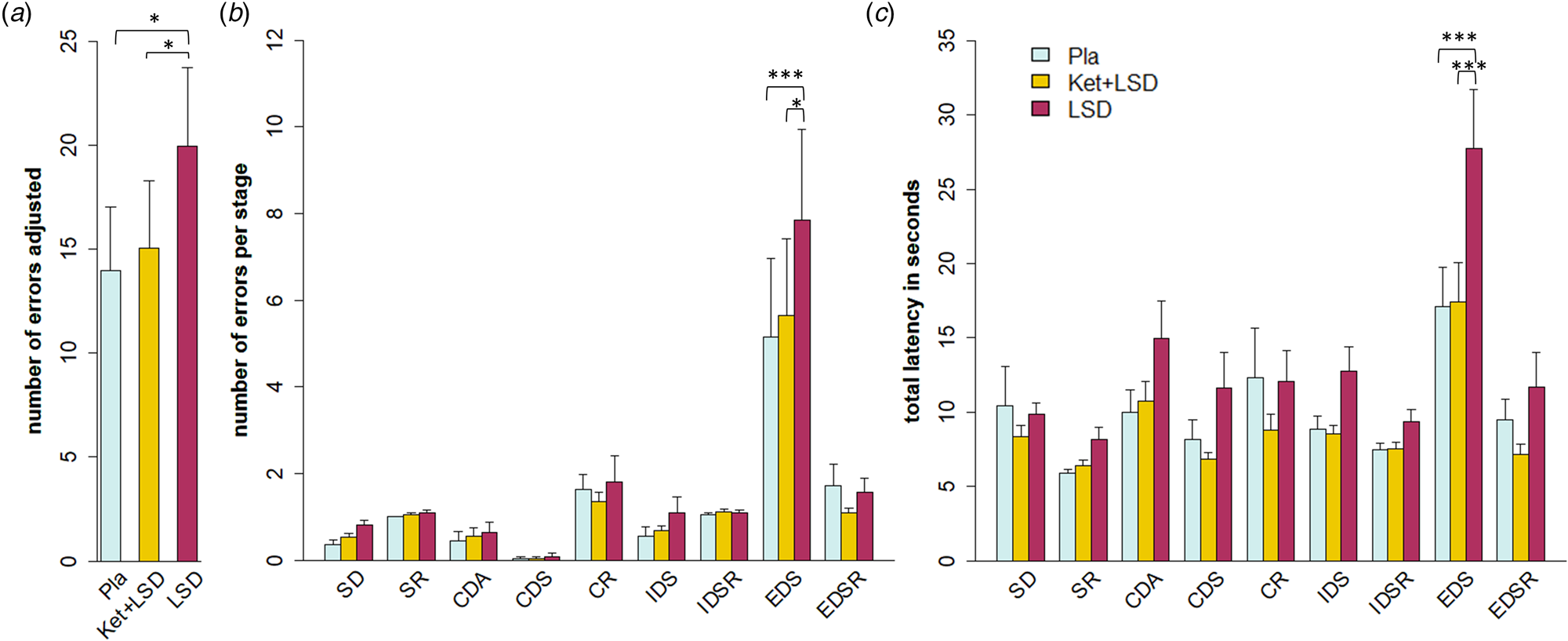
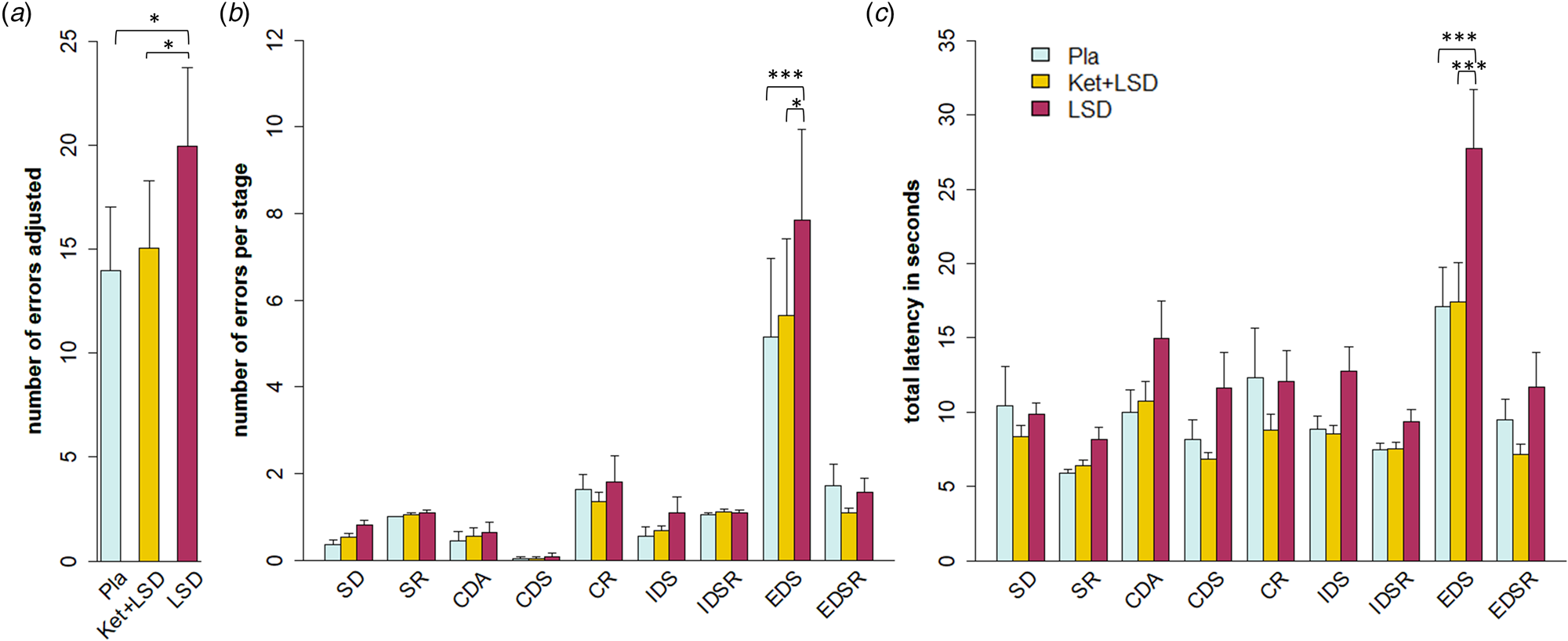
The stages completed did not differ between drug conditions [F (2,48) = 1.5, p > 0.2; mean (SD) Pla: 8.84 (0.11), Ket + LSD: 8.76 (0.13), LSD: 8.68 (0.15)]. However, for number of errors adjusted, there was a significant effect of drug [F (2,48) = 4.9, p < 0.05)] with more errors in the LSD condition [mean (SD) = 19.96 (18.78), 95% CI 14.66–26.12] compared to Pla [mean (SD) = 13.96 (15.40), 95% CI 12.03–21.43, p < 0.05] and Ket + LSD [mean (SD) = 15.04 (16.22), 95% CI 12.66–22.56, p < 0.05] (Fig. 2A). To further investigate at which stage the errors occurred, we computed a repeated-measures ANOVA with stage and drug as within-subject factors. We found a significant drug × stage interaction [F (16,384) = 1.81, p < 0.05] (Fig. 2B), a significant main effect of stage [F (8,192) = 9.10, p < 0.00001], and a significant main effect of drug [F (2,48) = 4.50, p < 0.05]. Tukey post-hoc tests revealed that LSD significantly increased the number of errors in stage 8 (EDS) [mean (SD) = 7.84 (10.51), 95% CI 8.20–14.62] compared to Pla [mean (SD) = 5.16 (8.97), 95% CI 7.00–12.48, p < 0.0001] and Ket + LSD [mean (SD) = 5.64 (8.90), 95% CI 6.95–12.38, p < 0.01], but not in any other stage compared to both, Pla and Ket + LSD (all p > 0.9). There were no significant differences in the number of errors in any stage between Pla and Ket + LSD (p > 0.9). For total latency, there was a significant drug × stage interaction [F (16,384) = 1.94, p < 0.05] (Fig. 2C), a significant main effect of stage [F (8,192) = 12.47, p < 0.00001], and a significant main effect of drug [F (2,48) = 7.46, p < 0.01]. Tukey post-hoc tests revealed that LSD significantly increased latency in stage 8 (EDS) [mean (SD) = 27.73 (20.00), 95% CI 15.62–27.83] compared to Pla [mean (SD) = 17.10 (13.19), 95% CI 10.30–18.35, p < 0.0001] and Ket + LSD [mean (SD) = 17.40 (13.38), 95% CI 10.45–18.62, p < 0.0001], but not in any other stage compared to Pla (p > 0.6) or Ket + LSD (p > 0.7). There were no significant differences in total latency scores in any stage between Pla and Ket + LSD (all p > 0.9).
Intra/Extra-Dimensional shift task. Panel (A) displays the total number of errors adjusted for stages completed. LSD significantly increased the number of errors adjusted compared to Pla and Ket + LSD (both p < 0.05, corrected). Panel (B) displays the number of errors in each stage. LSD significantly increased the number of errors in the EDS stage compared to Pla (p < 0.0001, corrected) and Ket + LSD (p < 0.01, corrected). Panel (C) displays the total latency (mean time to reach a decision within individual stages). LSD significantly increased latency in the EDS stage compared to Pla and Ket + LSD (both p < 0.0001, corrected). Data are expressed as mean + SEM. *p < 0.01, corrected; ***p < 0.0001, corrected. IED stages: SD, simple discrimination; SR, simple reversal; CDA, compound discrimination adjacent; CDS, compound discrimination superimposed; CR, compound reversal; IDS, intra-dimensional shift, IDSR, intra-dimensional shift reversal; EDS, extra-dimensional shift; EDSR, extra-dimensional shift reversal.
Spatial working memory
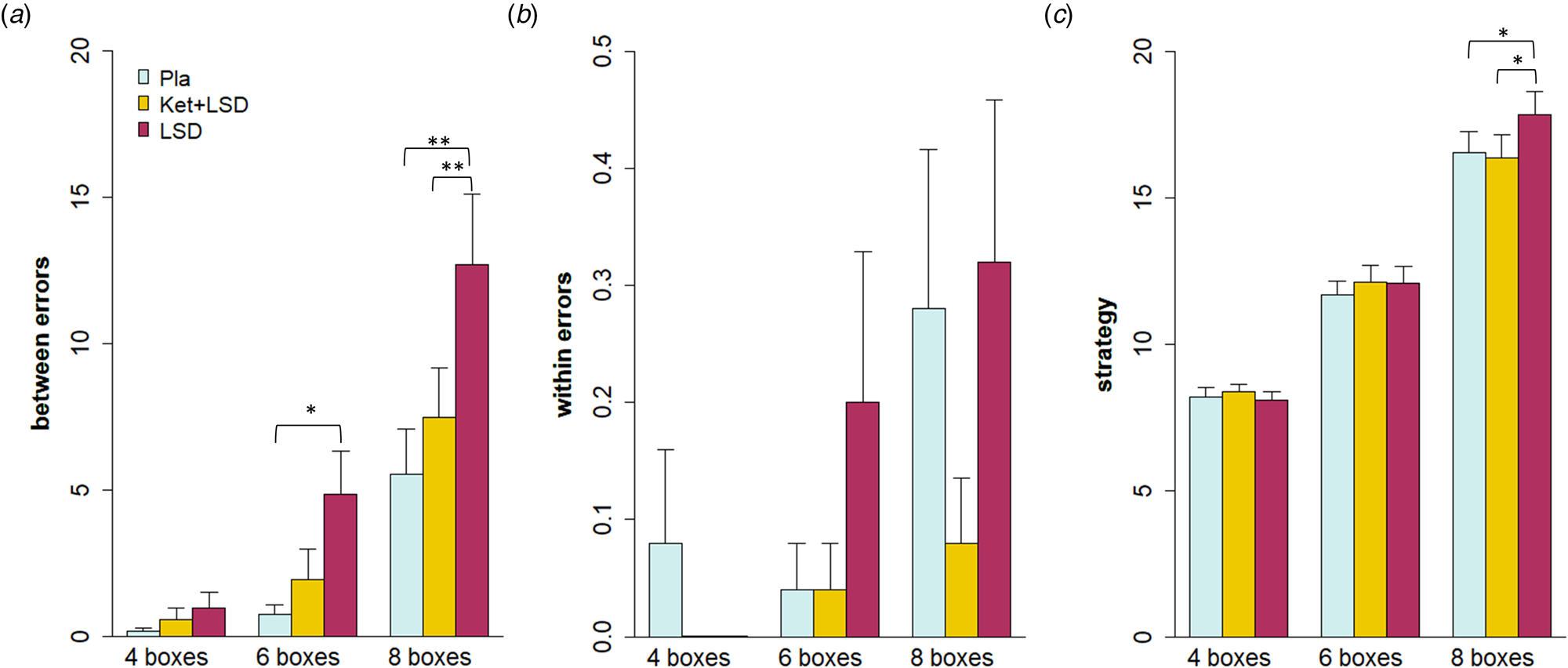
For between errors, there was a significant drug × stage interaction [F (4,96) = 4.59, p < 0.01] (Fig. 3A), a significant main effect of drug [F(2,48) = 7.14, p < 0.01], and a significant main effect of stage [F (2,48) = 34.88, p < 0.00001]. Tukey post-hoc tests revealed that participants made significantly more between errors in the LSD condition [mean (SD) = 4.84 (7.41), 95% CI 5.79–10.31] than in the Pla condition when six boxes were presented [mean (SD) = 0.72 (1.72), 95% CI 1.34–2.39, p < 0.01]. Further, LSD significantly increased between errors [mean (SD) = 12.68 (12.03), 95% CI 9.40–16.74] when eight boxes were presented compared to both Pla [mean (SD) = 5.52 (7.83), 95% CI 6.12–10.90, p < 0.001] and Ket + LSD [mean (SD) = 7.48 (8.36), 95% CI 6.53–11.63, p < 0.001]. There were no significant differences in the number of between errors between Pla and Ket + LSD at any stage (all p > 0.6). For within errors, there was no significant drug × stage interaction [F (4,96) = 1.00, p > 0.4] or main effect of drug [F (2,48) = 1.84, p > 0.1] (Fig. 3B). However, we found a significant main effect of stage [F (2,48) = 5.09, p < 0.01]. For the strategy score, there was a significant drug × stage interaction [F (4,96) = 4.11, p < 0.01] (Fig. 3C), a significant main effect of stage [F (2,48) = 205.50, p < 0.00001], but no significant main effect of drug [F (2,48) = 1.48, p > 0.2]. Tukey post-hoc tests revealed that the strategy score was increased (reflecting poor use of a strategy) under LSD [mean (SD) = 17.84 (3.88), 95% CI 3.03–5.40] compared to Pla [mean (SD) = 16.52 (3.72), 95% CI 2.91–5.18] and Ket + LSD [mean (SD) = 16.36 (4.02), 95% CI 3.14–5.60] when eight boxes were presented (both p < 0.01). There was no significant difference in the strategy scores between Pla and Ket + LSD at any stage (all p > 0.9).
Spatial Working Memory task. Panel (A) displays between errors. LSD significantly increased the number of between errors when six boxes were presented compared to Pla (p < 0.01, corrected). When eight boxes were presented, LSD significantly increased between errors compared to Pla and Ket + LSD (both p < 0.001, corrected). Panel (B) displays within errors. There were no significant drug effects for the number of within errors. Panel (C) displays the strategy scores. LSD reduced the use of an efficient search strategy when eight boxes were presented compared to Pla and Ket + LSD (both p < 0.01, corrected). Data are expressed as mean + SEM. *p < 0.01, corrected; **p < 0.001, corrected.

Cambridge Gambling Task
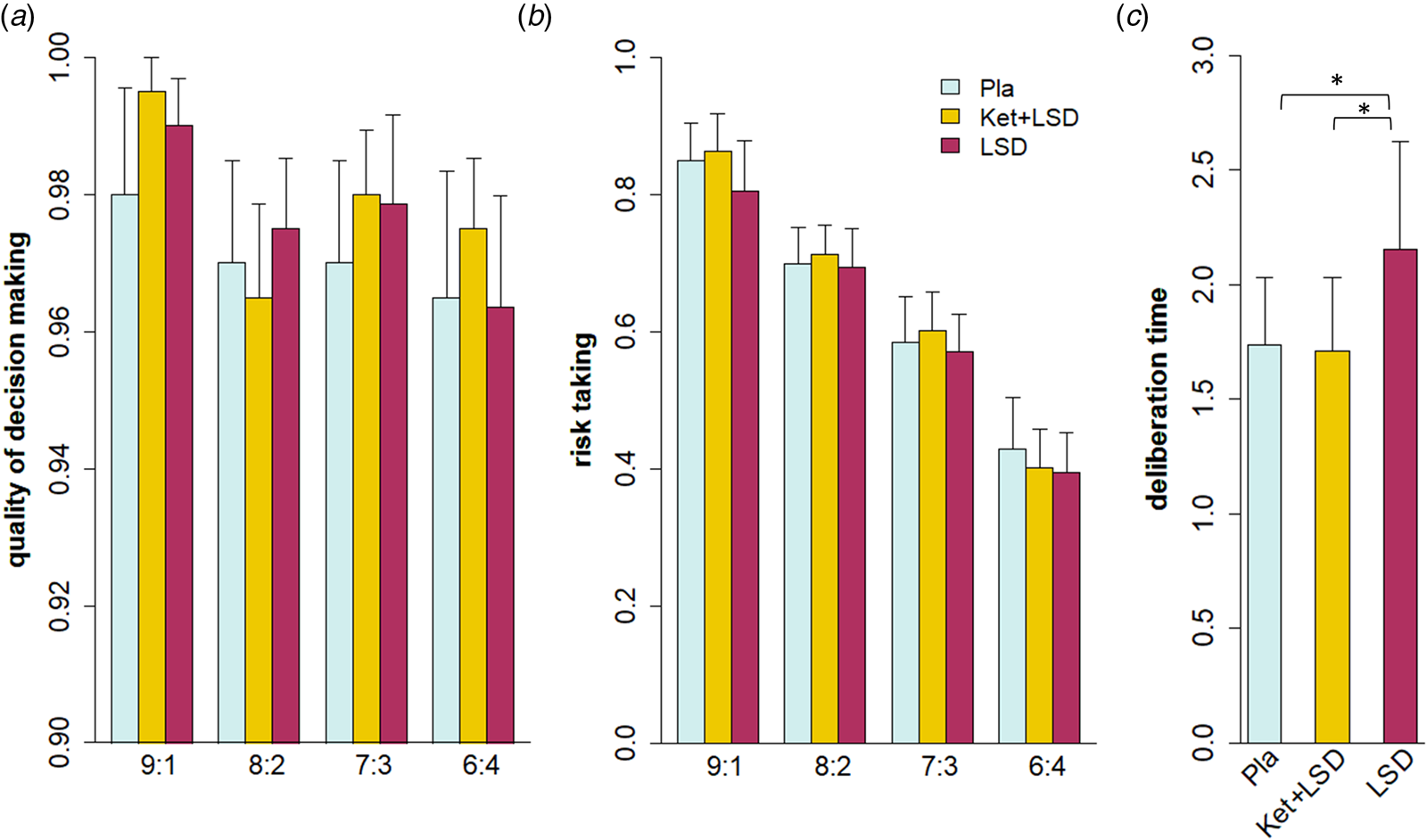
For quality of decision-making, there was no significant drug × risk ratio [F (6,144) = 0.38, p > 0.8], interaction (Fig. 4A), and no main effects of drug [F (2,48) = 0.50, p > 0.6] or risk ratio [F (3,72) = 1.93, p > 0.1]. For risk taking (Fig. 4B), there was no significant drug × risk ratio [F (6,144) = 1.04, p > 0.4] interaction, and no significant main effect for drug [F (2,48) = 1.05, p > 0.3]. However, there was a significant main effect of risk ratio [F (3,72) = 108.06, p < 0.000001] for risk taking, indicating that participants made higher bets when the risk ratio was lower. For deliberation time, there was no significant drug × risk ratio [F (6,144) = 1.31, p > 0.2] interaction, but a significant main effect for drug [F (2,48) = 6.97, p < 0.01] (Fig. 4C), and a significant main effect for risk ratio [F (3,72) = 4.96, p < 0.01). Tukey post-hoc tests revealed that LSD significantly increased deliberation time [mean (SD) = 2.15 (1.19), 95% CI 1.66–2.64] compared to Pla [mean (SD) = 1.74 (0.74), 95% CI 1.43–2.04] and Ket + LSD [mean (SD) = 1.71 (0.81), 95% CI 1.39–2.04] (both p < 0.01) but there was no significant difference between Pla and Ket + LSD (p > 0.9). Further, participants needed significantly more time for making their choice when the ratio was 8:2 or 6:4 (both p < 0.05) compared to the ratio 9:1. No other significant differences between risk ratios were found (all p > 0.8).
Cambridge Gambling Task. No significant effects of the drug were found for (A) quality of decision-making or (B) risk taking but for (C) deliberation time in seconds. LSD increased deliberation time compared to Pla and Ket + LSD (both p < 0.01, corrected). Data are expressed as mean + SEM. *p < 0.01, corrected.

Multiple regression analysis for 5D-ASC scales, and verbal IQ predicting LSD-induced changes in CANTAB outcome variables
5D-ASC scales and verbal IQ were entered as predictors of significant LSD-induced changes in CANTAB outcome variables (IED: EDS errors, Latency EDS stage; SWM: Between errors 6 boxes, Between errors 8 boxes, Strategy 8 boxes; CGT: Deliberation time) in separate multiple regression models. None of the models was significant. There was a trend in the regression equitation for Latency EDS stage [F (12,12) = 2.648, p < 0.06], with an R 2 = 0.726. However, none of the individual predictors reached significance (all p > 0.05). Detailed results of the multiple linear regression analyses are presented in the online Supplementary material Tables S1–S3.
Discussion
Trans-diagnostic deficits in cognitive abilities are highly prevalent in psychiatric and neurological disorders, but are insufficiently improved by current treatment approaches (Millan et al., Reference Millan, Agid, Brune, Bullmore, Carter, Clayton, Connor, Davis, Deakin, DeRubeis, Dubois, Geyer, Goodwin, Gorwood, Jay, Joels, Mansuy, Meyer-Lindenberg, Murphy, Rolls, Saletu, Spedding, Sweeney, Whittington and Young2012). The current study closes major knowledge gaps in the field via the administration of LSD together with a 5-HT2A receptor antagonist and the application of standardized and computerized cognitive tasks that capture the most relevant cognitive domains impaired in psychiatric disorders (Jessen et al., Reference Jessen, Mandl, Fagerlund, Bojesen, Raghava, Obaid, Jensen, Johansen, Nielsen, Pantelis, Rostrup, Glenthøj and Ebdrup2019). We show that (I) acutely administered LSD significantly impaired executive functions and working memory compared to placebo, (II) risk-based decision-making was unaffected by LSD, and (III) LSD-induced cognitive deficits and subjective symptoms were dependent on 5-HT2A receptor stimulation.
LSD impairs cognitive flexibility and executive functions on the Intra/Extra-Dimensional shift task
LSD led to a significant increase in error rates and increased latency in the EDS stage of the IED task compared to placebo. These impairments were normalized in the Ket + LSD condition. Impairments in the EDS stage are interpreted as signs of preservation of a previously established attentional set (Elliott et al., Reference Elliott, McKenna, Robbins and Sahakian1995). Extradimensional shifting requires being able to inhibit the previously established attentional set and shift attention between stimulus dimensions. Therefore, impairments in EDS are interpreted as reduced cognitive flexibility (Chamberlain et al., Reference Chamberlain, Fineberg, Menzies, Blackwell, Bullmore, Robbins and Sahakian2007). Processes that may underlie this LSD-induced decrease in cognitive flexibility are deficits in executive functions, in particular increased susceptibility to distraction from task-irrelevant stimuli (Jazbec et al., Reference Jazbec, Pantelis, Robbins, Weickert, Weinberger and Goldberg2007). This interpretation is supported by previous studies in healthy humans which have shown that psilocybin, a structurally related serotonergic hallucinogen and 5-HT2A receptor agonist, led to a significant decline of correct detection and an increase of false alarm in the AX continuous performance test (Umbricht et al., Reference Umbricht, Vollenweider, Schmid, Grubel, Skrabo, Huber and Koller2003) and to a significant reduction in attentional tracking ability on a multiple-object tracking task, an effect attenuated by ketanserin (Carter et al., Reference Carter, Hasler, Pettigrew, Wallis, Liu and Vollenweider2007). The authors of the later study suggest that the impaired attentional performance under psilocybin may reflect a reduced ability to suppress or ignore distracting stimuli rather than reduced attentional capacity per se. This interpretation may also explain seemingly contradictory findings reporting increases in psychological flexibility under the influence of other psychedelic substances (Kuypers et al., Reference Kuypers, Riba, de La Fuente Revenga, Barker, Theunissen and Ramaekers2016). Here, participants were instructed to provide alternative interpretations of the presented stimulus material. However, the applied tasks did not require the suppression of distracting elements which may explain the differing results. In contrast to our current finding, an early study with LSD found no significant change in performance on the Wisconsin Card Sorting Test (Primac et al., Reference Primac, Mirsky and Rosvold1957), of which the IED is the computerized analog. It seems likely that this previous study was not able to detect LSD-induced effects due to the small sample size (n = 10). Importantly, LSD-induced impairments in cognitive flexibility and executive functions were normalized by ketanserin, therefore pinpointing the crucial role of the 5-HT2A receptor in these cognitive functions. While speculative, a reduced ability to ignore stimuli under the influence of psychedelics may be important for psychedelic-assisted therapeutic approaches. It is possible that being unable to ignore otherwise suppressed thoughts may promote a confrontation with and deeper understanding of problems that patients face and therefore contribute to the potential clinical efficacy of psychedelic substances.
LSD impairs executive functions and working memory on the Spatial Working Memory task
LSD compared to placebo led to a significant increase of between errors and decreased use of strategy in the SWM. An increase in between errors represents a deficit in working memory, since participants revisited boxes even though a token had already been found within the box. Deficits in strategy represent impairments in executive functions. Importantly, these effects were only present when the cognitive load was high. These results are in line with previous studies investigating the effects of other psychedelic 5-HT2A agonists on spatial working memory. Psilocybin has been shown to dose-dependently impair performance on a different SWM (Wittmann et al., Reference Wittmann, Carter, Hasler, Cahn, Grimberg, Spring, Hell, Flohr and Vollenweider2007). Furthermore, ayahuasca acutely impaired working memory (Bouso et al., Reference Bouso, Fabregas, Antonijoan, Rodriguez-Fornells and Riba2013). Similarly to results obtained on the IED, pre-treatment with ketanserin normalized LSD-induced working memory and executive function deficits on the SWM in the current study. No treatment effect was found for within-errors. Although the within-error rate increased when more boxes were presented, the error rate was generally very low regardless of the treatment condition. Therefore, potential treatment effects may only become apparent if cognitive load were even further increased.
The role of the 5-HT2A receptor in LSD-induced cognitive impairments
On both, the IED and the SWM task, blocking the 5-HT2A receptor with ketanserin prevented LSD-induced cognitive deficits, therefore pointing to the importance of this receptor system in working memory and executive functions. This result is in line with a recent computational study indicating that 5-HT2A receptors contribute to SWM (Cano-Colino et al., Reference Cano-Colino, Almeida, Gomez-Cabrero, Artigas and Compte2014). The hippocampus is particularly involved in spatial memory and has moderate to high levels of 5-HT2A receptors (Dwivedi and Pandey, Reference Dwivedi and Pandey1998; Naghdi and Harooni, Reference Naghdi and Harooni2005). Furthermore, the prefrontal cortex (PFC) is implicated in higher-order executive tasks such as working memory, attention, and executive function (Millan et al., Reference Millan, Agid, Brune, Bullmore, Carter, Clayton, Connor, Davis, Deakin, DeRubeis, Dubois, Geyer, Goodwin, Gorwood, Jay, Joels, Mansuy, Meyer-Lindenberg, Murphy, Rolls, Saletu, Spedding, Sweeney, Whittington and Young2012). This is corroborated by studies showing spatial working memory impairments and poor use of strategy in patients with lesions of the frontal lobe on the SWM (Owen et al., Reference Owen, Downes, Sahakian, Polkey and Robbins1990, Reference Owen, Sahakian, Semple, Polkey and Robbins1995, Reference Owen, Morris, Sahakian, Polkey and Robbins1996). Further, switching attention between stimulus dimensions such as in the EDS stage of the IED involves the ventrolateral PFC (Dias et al., Reference Dias, Robbins and Roberts1996; Hampshire and Owen, Reference Hampshire and Owen2006; Morris et al., Reference Morris, Kundu, Dowell, Mechelmans, Favre, Irvine, Robbins, Daw, Bullmore, Harrison and Voon2016; Vaghi et al., Reference Vaghi, Vértes, Kitzbichler, Apergis-Schoute, van der Flier, Fineberg, Sule, Zaman, Voon, Kundu, Bullmore and Robbins2017). The PFC is linked to the parietal cortex, which exerts a modulatory influence on attention and working memory (Millan et al., Reference Millan, Agid, Brune, Bullmore, Carter, Clayton, Connor, Davis, Deakin, DeRubeis, Dubois, Geyer, Goodwin, Gorwood, Jay, Joels, Mansuy, Meyer-Lindenberg, Murphy, Rolls, Saletu, Spedding, Sweeney, Whittington and Young2012). Involvement of these structures in deficits in working memory and executive function in the current study is conceivable given that participants under LSD showed a disintegration of functional connectivity in these brain networks (Preller et al., Reference Preller, Burt, Ji, Schleifer, Adkinson, Stämpfli, Seifritz, Repovs, Krystal, Murray, Vollenweider and Anticevic2018a). Both structures have a particular high density of 5-HT2A receptors, and they exert top-down modulatory influence on subcortical regions including the hippocampus (Pompeiano et al., Reference Pompeiano, Palacios and Mengod1994). Clinical evidence corroborates the current results pinpointing the importance of the 5-HT2A receptor in cognitive abilities: Atypical antipsychotics, which have 5-HT2A receptor antagonistic properties, have been shown to be advantageous for treating cognitive impairments in schizophrenia compared to classic antipsychotics (Meltzer et al., Reference Meltzer, Massey and Horiguchi2012). There are qualitative similarities between hallucinogen-induced alterations in information processing and the symptoms of an early phase of schizophrenic psychoses (Geyer and Vollenweider, Reference Geyer and Vollenweider2008). Specifically, sensorimotor gating as indexed by prepulse inhibition (PPI) is impaired in patients with schizophrenia and related to cognitive deficits (Braff et al., Reference Braff, Geyer and Swerdlow2001). LSD and psilocybin disrupt PPI in healthy subjects, an effect that was also correlated with impairments of sustained attention in healthy humans (Gouzoulis-Mayfrank et al., Reference Gouzoulis-Mayfrank, Heekeren, Thelen, Lindenblatt, Kovar, Sass and Geyer1998; Quednow et al., Reference Quednow, Kometer, Geyer and Vollenweider2012; Schmid et al., Reference Schmid, Enzler, Gasser, Grouzmann, Preller, Vollenweider, Brenneisen, Muller, Borgwardt and Liechti2015; Vollenweider et al., Reference Vollenweider, Csomor, Knappe, Geyer and Quednow2007). Importantly, it has been shown that the disruptions of PPI induced by psilocybin in humans and LSD in rats are reversed by 5-HT2A receptor antagonists (Halberstadt and Geyer, Reference Halberstadt and Geyer2010; Ouagazzal et al., Reference Ouagazzal, Grottick, Moreau and Higgins2001; Quednow et al., Reference Quednow, Kometer, Geyer and Vollenweider2012).
Together these results suggest that the 5-HT2A receptor system may be a promising target in the treatment of trans-diagnostic impairments in working memory and executive functions. This is also corroborated by data from animal and human studies suggesting that selective 5-HT2A receptor modulators targeting distinct signaling pathways could be possible therapeutic approaches to improve cognitive impairments (Zhang and Stackman, Reference Zhang and Stackman2015; Švob Štrac et al., Reference Švob Štrac, Pivac and Mück-Šeler2016). For example, intrahippocampal injections of the 5HT2A antagonist ritanserin increased spatial learning and memory in rats (Naghdi and Harooni, Reference Naghdi and Harooni2005) and treatment with 5-HT2A antagonist EMD 281014 improved working memory in non-human primates (Terry et al., Reference Terry, Buccafusco and Bartoszyk2005). Although 5-HT2A antagonism was reported to improve cognition in schizophrenia (Roth et al., Reference Roth, Hanizavareh and Blum2004), it has also been reported that atypical antipsychotics with lower 5-HT2A antagonistic affinity have higher efficacy in improving cognitive performance than drugs with higher affinity (Tyson et al., Reference Tyson, Laws, Flowers, Tyson and Mortimer2006). Therefore, further studies with 5-HT2A agonists and antagonists are needed to elucidate the involvement of this receptor subtype in different cognitive functions in patient populations.
LSD does not affect risk-based decision-making on the Cambridge Gambling Task
Interestingly, in the CGT, LSD did not influence the quality of decision-making and risk taking. Even though previous evidence indicates that the 5-HT system may be involved in the quality of decision-making (Rogers et al., Reference Rogers, Everitt, Baldacchino, Blackshaw, Swainson, Wynne, Baker, Hunter, Carthy, Booker, London, Deakin, Sahakian and Robbins1999), our current results indicate that these cognitive domains may not be modulated by 5-HT2A receptor signaling. This is in line with a recent study that showed that psilocybin had no effect on moral decision-making (Pokorny et al., Reference Pokorny, Preller, Kometer, Dziobek and Vollenweider2017). Furthermore, this result supports previous reports that associate risk-based decision-making behavior with dopaminergic signaling, whereas the serotonin system has been suggested to play a role in the regulation of cognitive biases, and therefore the appraisal of reinforcers when selecting between actions, in particular in a learning context (Rogers, Reference Rogers2011). The CGT, however, is not relying on learning, and risk-based decision-making on the CGT may therefore not be sensitive to alterations in 5-HT2A receptor signaling. Yet, LSD also has affinity for dopamine receptors and animal studies have reported a first 5-HT2A receptor mediated and a second D2 receptor mediated phase of action (Marona-Lewicka and Nichols, Reference Marona-Lewicka and Nichols2007; Marona-Lewicka et al., Reference Marona-Lewicka, Thisted and Nichols2005). However, the involvement of the dopaminergic system in this study is unlikely as pretreatment with ketanserin normalized the LSD-induced effects not only in the CANTAB tasks 220 min after drug intake but also the retrospective rated psychological effects measured with the 5D-ASC. Therefore, the present results indicate that the effects of LSD in humans are primarily mediated via 5-HT2A receptor activation. This is in line with recent reports, that LSD in humans increased the levels of prolactin and cortisol, which are markers for serotonergic drug activity (Schmid et al., Reference Schmid, Enzler, Gasser, Grouzmann, Preller, Vollenweider, Brenneisen, Muller, Borgwardt and Liechti2015; Seifritz et al., Reference Seifritz, Baumann, Muller, Annen, Amey, Hemmeter, Hatzinger, Chardon and Holsboer-Trachsler1996; Sommers et al., Reference Sommers, van Wyk and Snyman1994). However, it is possible that higher doses of LSD are needed to modulate dopaminergic activity and potentially induce alterations in risk-based decision-making.
LSD-induced cognitive impairments are not predicted by subjective effects or verbal IQ
Regression analyses to predict LSD-induced cognitive impairments testing the impact of subjective effects and IQ were not significant. Importantly, this suggests that cognitive processes under LSD are not confounded by psychedelic effects, in particular visual inaccuracies or disturbances. Furthermore, LSD-induced impairments were not related to individuals' IQ, suggesting that 5-HT2A receptor stimulation by LSD impaired working memory and executive functions independently of general intelligence.
Limitations
Previous studies have shown that the selective 5-HT2A receptor antagonist ketanserin is suitable for studying the role of 5-HT2A receptors in human performance and to investigate the specific contribution of the 5-HT2A receptor to effects of psychedelic drugs (Carter et al., Reference Carter, Hasler, Pettigrew, Wallis, Liu and Vollenweider2007; Kometer et al., Reference Kometer, Schmidt, Bachmann, Studerus, Seifritz and Vollenweider2012; Liechti et al., Reference Liechti, Saur, Gamma, Hell and Vollenweider2000; Quednow et al., Reference Quednow, Kometer, Geyer and Vollenweider2012; Vollenweider et al., Reference Vollenweider, Vollenweider-Scherpenhuyzen, Babler, Vogel and Hell1998; Preller et al., Reference Preller, Herdener, Pokorny, Planzer, Kraehenmann, Stämpfli, Liechti, Seifritz and Vollenweider2017). A limitation of the present study is the lack of a fourth drug condition investigating the effect of ketanserin alone. However, previous studies have shown that ketanserin administered in the same dose (40 mg) as used in this study and even at a higher dose (50 mg) neither led to any significant differences in subjective drug effects assessed with the 5D-ASC (Carter et al., Reference Carter, Hasler, Pettigrew, Wallis, Liu and Vollenweider2007; Kometer et al., Reference Kometer, Schmidt, Bachmann, Studerus, Seifritz and Vollenweider2012, both 50 mg ketanserin), nor to performance changes in cognitive tasks such as a different SWM (Carter et al., Reference Carter, Burr, Pettigrew, Wallis, Hasler and Vollenweider2005, 50 mg ketanserin), or the Stroop task (Quednow et al., Reference Quednow, Kometer, Geyer and Vollenweider2012, 40 mg ketanserin) in healthy volunteers. Furthermore, to be able to comprehensively investigate the role of the 5-HT2A receptor in human cognition, future research will additionally need to focus on effects of other 5-HT2A agonists, such as the non-hallucinogenic drug lisuride, on cognitive processes.
Conclusion
In conclusion, the present study pinpoints the role of the 5-HT2A receptor in cognitive processes, in particular executive functions, cognitive flexibility, and spatial working memory. However, risk-based decision-making outside a learning context was unaffected by LSD and is therefore potentially not mediated by the 5-HT2A receptor. Blocking the 5-HT2A receptor by ketanserin normalized both LSD-induced cognitive impairments and subjective drug effects. As altered 5-HT2A receptor density and cognitive dysfunctions are found in several psychiatric disorders such as in schizophrenia, autism, and obsessive–compulsive disorder (Millan et al., Reference Millan, Agid, Brune, Bullmore, Carter, Clayton, Connor, Davis, Deakin, DeRubeis, Dubois, Geyer, Goodwin, Gorwood, Jay, Joels, Mansuy, Meyer-Lindenberg, Murphy, Rolls, Saletu, Spedding, Sweeney, Whittington and Young2012), this receptor subtype represents a promising target to help understand the neuropharmacological basis of cognitive processes and to improve treatment in affected patients.
Supplementary material
The supplementary material for this article can be found at https://doi.org/10.1017/S0033291719002393
Acknowledgements
We thank Amanda Planzer, Jan Flemming, and Rainer Krähenmann for their assistance in data collection.
Financial support
Funding for this study was provided by Swiss Neuromatrix Foundation (FX.V., grant number 2015–2056) and Heffter Research Institute (FX.V., grant number 1-190413); both foundations had no further role in study design; in the collection, analysis and interpretation of data; in the writing of the report; and in the decision to submit the paper for publication.
Conflict of interest
None.
Ethical standards
The authors assert that all procedures contributing to this work comply with the ethical standards of the relevant national and institutional committees on human experimentation and with the Helsinki Declaration of 1975, as revised in 2008.