Social unrest, mass protest, and sporadic violence rocked East Asia throughout the late 1960s, as was true in many parts of the world during the closing years of that turbulent decade. The Great Proletariat Cultural Revolution unleashed by Mao Zedong in 1966 might be the first example of this popular turmoil that springs to mind for many, as associated images of rampaging Red Guards swiftly storm across one's historical imagination. Japanese society, however, also experienced the sometimes violent convulsions of a radical student movement, as well as numerous other expressions of political dissent and social frustration during those same years. While what it went through was certainly nothing on par with the terror and loss experienced in China during that tumultuous era, Japanese society was hardly immune to the energy and impact of popular activism that sought a future vastly different from the present (Avenell Reference Avenell2010; George Reference George2002; Havens Reference Havens1987; Marotti Reference Marotti2009; Sasaki-Uemura Reference Sasaki-Uemura2001).
For those students, writers, intellectuals, and citizen activists who stood up to resist Japan's conservative postwar political regime and its values during that volatile time, the urban middle-class “salaryman” would seem to have embodied perfectly all that they sought to upend—docile submission to the state's policies of national economic growth buttressed by the individual sacrifice of citizens dreaming only of their own personal financial prosperity. Indeed, one would be hard-pressed to imagine a more effective and reliable representative than the salaryman of the mundane capitalist “everyday” that avant-garde artists, for example, targeted for destruction in their sculpture and performance during the 1960s (Marotti Reference Marotti2013). Working nearly seven days a week, trudging to and from their corporate offices like thousands upon thousands of obedient drones, they were the so-called “corporate warriors” (kigyō senshi 企業戦士), widely imagined by society's most rebellious elements as supremely loyal servants of the Japanese state's latest ideology of diligence, thrift, and self-sacrifice for the sake of the national greatness (Ueno Reference Ueno, Teruko, Chizuko and Yumiko1995).
That social critics of the postwar Japanese state and economy during the late 1960s would target the salaryman as an audience for any sort of revolutionary message then seems deeply counterintuitive. Moreover, that the Chinese Cultural Revolution might prove useful to them as a rhetorical vehicle through which to deliver that critique to such apparently apolitical readers is even more surprising. This article takes as its main source base several lowbrow comic magazines, widely read by male members of the urban, middle-class demographic group from which the corporate salaryman most often came, that did precisely this. During the fall of 1966 in particular, as the Red Guard movement reached its initial apogee, and thus garnered wide coverage in the mainstream media, Japanese cartoonists employed complex references to the rhetoric and action of Red Guards in ways designed to resonate deeply with their target audience of male white-collar workers. These comic artists crafted humorous (but heroic) stories of Red Guard–like activism in the corporate workplace that offered the Japanese salaryman a fantasy of revolutionary resistance to the forces of inequality, corruption, and exploitation that existed in his world. By portraying him as locked in rebellious combat against the managerial supervisors and corporate CEOs that lived the high life on the fruits of his white-collar labor, cartoonists aimed to provide the salaryman both temporary (and imaginary) release from his daily frustrations and a good laugh in commiseration with the millions of other low-level company men who shared his fate. In doing so, the artists also landed more than a few of their own personal jabs of criticism concerning the blatant inequities produced by postwar Japanese society's vigorous and relentless pursuit of rapid growth.
While it is methodologically difficult, if not impossible, to know precisely how the average white-collar male reader responded to these comic stories, their content can nonetheless cast valuable light on his frame of mind. Scholars have long used examples from everyday mass culture in Japan to identify and analyze the ideological contours of various social identities, with Ron Toby's (Reference Toby1986) work on popular perceptions of Korea as reflected in Tokugawa-era woodblock prints, votive shrine tablets, and urban festivals being one especially insightful example. William Steele (Reference Steele1989) has also persuasively argued that the popular sentiment of late Tokugawa-era commoners concerning the arrival of the Perry Mission in 1853–54 can be garnered from the broadsheet newspapers of the day, as has Gregory Smits (Reference Smits2006) more recently contended in his examination of catfish prints (namazu-e) in late 1850s Edo. The white-collar, male corporate worker of the 1960s, too, might not have left detailed memoirs of his life for historians to analyze directly, but by reading what he read we can garner at least some insight concerning what he might have believed. While he was seemingly the beneficiary of Japan's postwar-era “economic miracle” and a potent symbol of all that Japanese society had achieved in the twenty years since the end of the war, these comic tales suggest that the salaryman could nonetheless be as dissatisfied with the social order of his day as the radical student, progressive intellectual, or avant-garde artist. The magazine's editors surely would not have published these stories otherwise. Comic magazines are certainly not the only place where one could find critiques expressing the dissatisfaction and emptiness of salaryman life, as many postwar authors of fiction developed similar themes in their novels and short stories (Tillack Reference Tillack2011). The cartoon features from a weekly lowbrow magazine, however, expressed these concepts with a colloquial humor that provides deeper insight concerning the views of their everyday male audience.
Beyond their illumination of salarymen's social frustration, these sources also indicate that there is still much to learn concerning how other societies around the world understood and internalized the Chinese Cultural Revolution. The influence of Maoism on revolutionary subcultures in Europe, as well as on numerous developing countries' political conflicts during the high tide of postwar anti-colonial struggle around the globe has been explored to some degree (Cook Reference Cook and Cheek2010; Dirlik, Healy, and Knight Reference Dirlik, Healy and Knight1997; Ross Reference Ross2002; Slobodian Reference Slobodian2012, 170–99), as has most recently the truly global impact of Mao's “little red book” (Cook Reference Cook2014). Concerning Japan specifically, scholars have also done much to illuminate the function of Maoism and the Chinese revolution in the postwar thought of influential thinkers such as Takeuchi Yoshimi (Gayle Reference Gayle2009; Koschmann Reference Koschmann, Dirlik, Healy and Knight1997). Examining the place of the Red Guard movement in lowbrow Japanese print culture during the late 1960s, however, goes beyond extant secondary scholarship by decoding popular imaginings of the Chinese revolution that were embedded with meanings often quite different from those elucidated by political agitators, intellectual writers, and academic philosophers. Just as Barbara Mittler (Reference Mittler2012) has contended that Cultural Revolution culture in Chinese society can be understood more comprehensively by exploring it as the lived experience of everyday people, not the mere political propaganda of ruling elites, the impact of the Red Guard movement beyond China can also be usefully interrogated not only through the prism of intellectual theory and political activism, but also within the realm of popular culture.
Finally, the appearance of Red Guard rhetoric and imagery in Japanese comic culture during the late 1960s reminds us of the myriad ways in which China continued to loom large in popular Japanese life throughout the postwar era. While the significant work of scholars such as Joshua Fogel (Reference Fogel1996, Reference Fogel2014) has made clear the rich complexity of China-Japan relations within a cultural framework from the late nineteenth century through the Second World War, the history of postwar China-Japan relations has been explored to date primarily by political scientists and historians of Cold War politics and diplomacy; cultural interactions and mutual representations remain largely unstudied. Among the exceptions are Baba Kimihiko's (Reference Kimihiko2010, Reference Kimihiko2015) comprehensive overviews of popular Japanese perceptions of China during the postwar era and Yoshimi Yoshiaki's (Reference Yoshiaki and Michihiko2009) more sharply focused examination of China in Japanese public opinion during the U.S. Occupation period. Following their lead can open up new opportunities for interpreting the course of China-Japan relations across the chronological divide posed by the wartime era.
For many centuries, people in Japan have (to varying degrees, of course) derived meaning from their own social experience through reference to events and ideas in Chinese society, and that pattern did not abruptly cease with Japan's cataclysmic defeat in 1945. Indeed, one of the most striking aspects of the cartoons explored here is the degree to which the humor employed in them relied upon relatively detailed knowledge of events in contemporary Chinese society among their intended audience. Beyond mere familiarity with current events on the mainland, however, the influence of deeply embedded and highly ambivalent popular Japanese perceptions of Chinese society, as something alternatively both admired and ridiculed, is also unmistakably evident in these comics, thus connecting them to dimensions of the modern China-Japan relationship with much deeper roots. While nuanced and multidimensional representations of postwar China-Japan relations are a tough sell in the hyper-nationalist climate of East Asian society today, many progressive Chinese and Japanese scholars are endeavoring admirably nonetheless to excavate and depoliticize their deeply interconnected recent past (Liu and Kawashima Reference Jie and Shin2009, Reference Jie and Shin2013). This journey through the unexpected intersection of Red Guards and salarymen in popular Japanese print culture of the 1960s thus aims also to make a modest contribution toward that valuable goal.
The Chinese Cultural Revolution in Japanese Editorial Cartoons
Before examining the patterns and themes of Red Guard representations in the lowbrow comic magazines enjoyed primarily by white-collar salarymen, placing those images first within the larger context of other humorous depictions of the Cultural Revolution found in a variety of popular Japanese newspapers and journals provides the necessary context for appreciating their interpretive significance. Such imagery was easy to find between the fall of 1966 and the summer of 1968, and even a small sample of those visual texts can cast light on the most characteristic elements in popular Japanese attitudes concerning Chinese society at that time—a blend of dismissive criticism and thoughtful self-reflection, both informed by a wealth of knowledge concerning current affairs related to the Cultural Revolution.
Not surprisingly, since much of the world outside China found the awesome personal power of Mao rather disconcerting, some Japanese cartoonists took a bluntly critical tone in evaluating Red Guard fanaticism. In the pages of Seikai ōrai (Political world review), a monthly political affairs magazine, Morikuma Takeshi 森熊猛 (Reference Takeshi1966b), for example, blasted young Chinese students for their blind loyalty with a cartoon of a Red Guard performing a “kowtow” before a portrait of Chairman Mao and a caption that read “the all-knowing god” (zenchi zennō no kamisama 全知全能の神様). Morikuma (Reference Takeshi1966a) followed that image the next month with another comic showing a female Red Guard wielding an enormous spiked club, but rigged with ropes to a giant marionette cross clutched by Mao, all positioned next to a caption reading “dolls on strings” (ayatsuri ningyō あやつり人形). Echoing Morikuma's blanket condemnation of the seemingly mindless devotion of so many young Chinese to the Great Helmsman, Yokoyama Taizō 横山泰三 (Reference Taizō1966f), in a single-frame comic from Manga dokuhon (Manga reader), depicted a Chinese and a Westerner as the only two men left on a deserted island—the Westerner reading the Bible, the Chinese reading Mao's little red book.
Yokoyama Taizō, in fact, was a prolific cartoonist who quite often engaged in a bit of outright Red Guard ridicule. In a second example from Manga dokuhon, Yokoyama (Reference Taizō1966e) portrayed a nude female Red Guard literally tearing off her right breast and tossing it aside while shouting, “These things are bourgeois!” Targeting the spectacle of mass rallies in the Chinese capital in the Shūkan Asahi (Weekly Asahi), Yokoyama (Reference Taizō1966a) also sketched an anthropomorphized Temple of Heaven in Beijing looking down over an enormous noodle bowl surrounded by an innumerable throng of Red Guards as the perturbed monument bellows, “There's no way we can feed a million of you. Red Guards go home!” Later in that same issue, Yokoyama (Reference Taizō1966b) went on to launch a condemnation of the Red Guards as little more than foolish children while simultaneously lampooning the inability of China's leaders to control their own citizens. In that single-frame comic, a young Red Guard gripping a comically long lance rides confidently atop a smoke-belching dragon while a Sancho Panza–like CCP official follows close behind on a smaller saurian steed of his own. “Mr. Don Quixote, where are you headed?” he asks. “Just shut up and follow me,” the Quixotic young rebel replies.
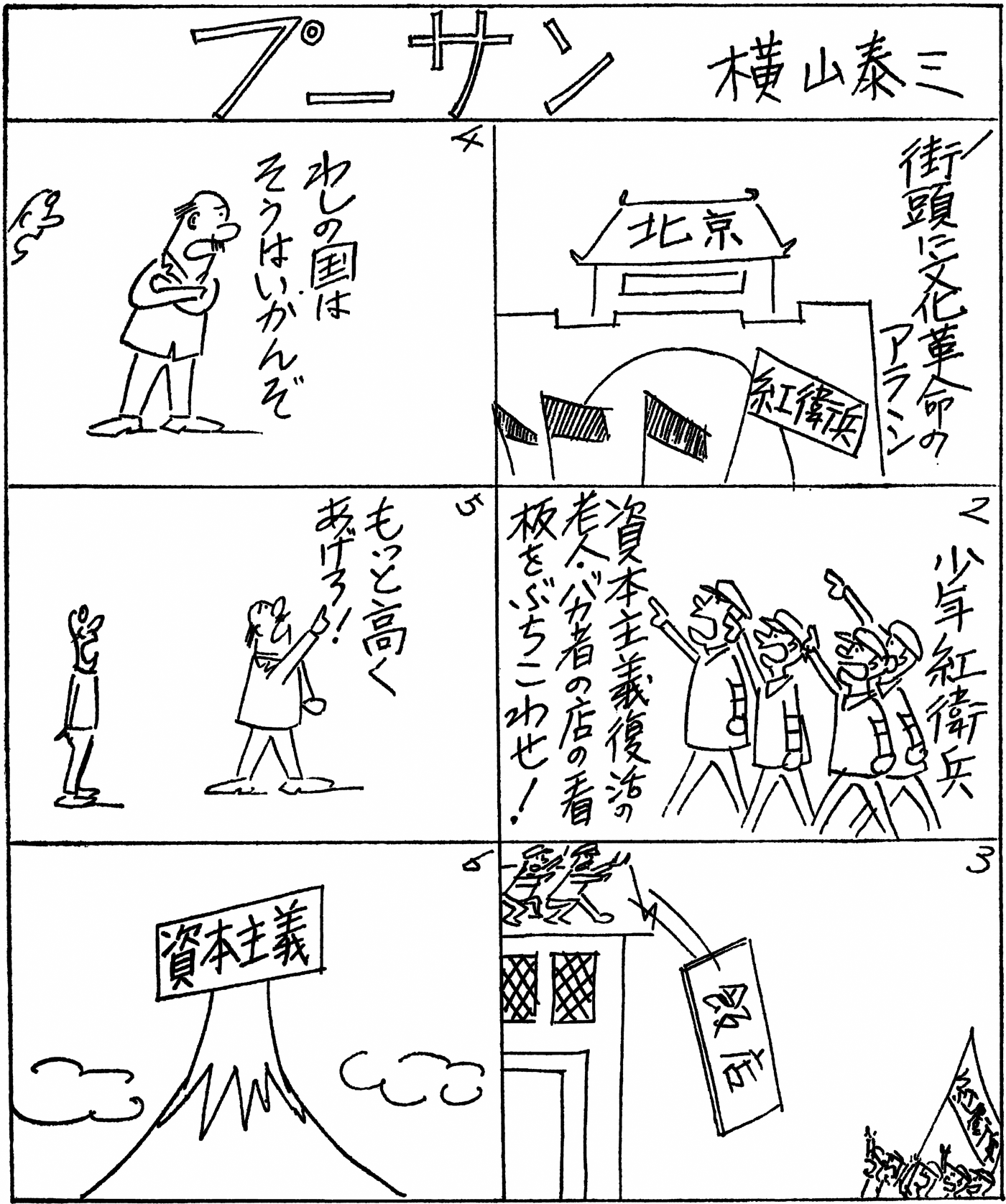
Yokoyama, however, could also be more subtle with his comic references to the Cultural Revolution; in fact, he just as often used Red Guard imagery to reflect critically upon his own society. One of his six-panel strips in Shūkan Shinchō (Weekly Shinchō) begins with a crowd of Red Guards rampaging through Beijing and then demanding that the shop sign of an “old capitalist-roader fool” (shihonshugi fukkatsu no rōjin bakamono 資本主義復活の老人バカ者) be destroyed (Yokoyama Reference Taizō1966d; see figure 1). A Japanese observer from across the sea then defiantly claims, “That sort of thing would never happen in our country.” He then turns and shouts, “Raise it up higher!” and the viewer sees in the final frame an enormous banner of “capitalism” resting upon the peak of Mt. Fuji, making for a rather wicked bit of sarcastic criticism of Japan's own fanatical devotion to the ideology of free commerce.
Yokoyama Taizō comic in Shūkan Shinchō, September 3, 1966. Courtesy of Shinchōsha.

In another similarly critical example from Yokoyama (Reference Taizō1966c) in the Shūkan Asahi, a young Red Guard tears down a street sign for Beijing's famous Wangfujing district (王府井大街) and replaces it with the name “Revolutionary Road” (kakumei ōji 革命大路). His Japanese student counterpart on the other side of the panel (identified by the visual cue of Mt. Fuji in the distance behind him) also angrily tears down an old street sign in his neighborhood, but he replaces it with one that reads “Thoughtless Thoroughfare” (hoi hoi ōji ほいほい大路). Moreover, the only result of his bold revolutionary act is a furious postal worker who throttles him in the final frame. While again drawing attention to Red Guard fanaticism, this time Yokoyama's purpose is to criticize what he perceives as the comparative political complacency of so many Japanese youth.
Yokoyama was not alone in crafting such socially provocative comic references to the Cultural Revolution. In a single-frame piece in Heibon panchi (Heibon punch), Yanagihara Ryōhei 柳原良平 (Reference Ryōhei1966) drew a pair of Red Guards parading with a portrait of Mao while a Japanese man in suit and tie looks disapprovingly upon them. The image of wartime Prime Minister Tōjō Hideki appears in a thought bubble above his head as he warns the naïve Chinese youngsters, “That whole ‘extravagance is the enemy’ idea, yeah, we had that in Japan, too, a while back.” While on one level, the cartoon clearly embodies a brand of cultural superiority in its depiction of a mature “adult” Japan chastising a childlike China for its rash and thoughtless behavior, on another it is a notably humble equation of Japan's own ideological fanaticism of the 1940s with the revolutionary fervor of Chinese society in the 1960s. In other words, Yanagihara was suggesting that Japanese society had been just as irrational and misguided during the war as Chinese society seemed to be then.
Editorial cartoons could also be surprisingly specific in their referential symbols, as illustrated by a sophisticated commentary from Nasu Ryōsuke 那須良輔 in the Mainichi shinbun (Mainichi newspaper) on the persecution of the Chinese writer Guo Moruo 郭沫若 during the early summer of 1966. In the single-frame image, Nasu (Reference Ryōsuke1966) depicts Guo standing in front of a pile of his burning books as a mushroom cloud–shaped plume of smoke containing the words “literary rectification” (bungei seifū 文芸整風) ascends before him. The caption reads, “dai san-ji kaku jikken” (第三次郭実験), a subtle reference to the PRC's recent third test of a thermonuclear weapon by replacing the kaku 核 of kaku jikken 核実験 (atomic weapon test) with the phonetically identical in Japanese kaku 郭 of Guo Moruo (Kaku Matsujaku in Japanese). Guo was a well-known figure in Japan, having spent many years living in Tokyo during the 1930s as well as more recently in the postwar era. Indeed, many of the Japanese writers and intellectuals who knew Guo best were deeply saddened by the news of his persecution in 1966 (Takeuchi Reference Minoru1966; Yamauchi Reference Yū1966).
Equally illustrative is an example from the widely known comic artist Kondō Hidezō 近藤日出造, who made Mao himself a target of his wit in the summer of 1968 with a full-page comic in the political satire magazine Manga: Miru jikyoku zasshi (Comics: A magazine for viewing current affairs). In it Mao parades triumphantly through Beijing, with the Gate of Heavenly Peace and the Temple of Heaven visible in the background, while riding atop a downtrodden and red-hooded pony, legs chained together and back bowed by the considerable heft of the portly Great Helmsman (Kondō Reference Hidezō1968). With that image and the caption “When managing the Cultural Revolution, rebellion is impossible” (Jpn. bunkaku shūshū zōhan muri 文革収拾造反無理), Kondō cleverly depicts the cruel irony of Mao marching proudly on the backs of suppressed Red Guards in the very location at Tiananmen Square where two years earlier one million Red Guards had gathered to offer praise for the man who was the shining red sun of their hearts. Kondō also assumes that his readers will catch his coy manipulation of the popular Red Guard phrase “It's right to rebel” (Chn. zoufan youli 造反有理) into “It's impossible to rebel” (Chn. zoufan wuli 造反無理 / Jpn. zōhan muri), a subtle turn of phrase detectable only because of the orthographic bond shared by Chinese and Japanese.
To be sure, however, there were still other cartoonists who simply hoped to derive generic humor from idiosyncratic Red Guard behavior. A playful piece entitled “Lovely girl, to a point” (soko made wa bijin そこまでは美人) by Okabe Fuyuhiko 岡部冬彦 (Reference Fuyuhiko1966), for example, begins with a rather fetching female Red Guard with raised fist proclaiming, “Aid Vietnam, Overthrow America” (Chn. yuanyue daomei 援越倒美). She then turns to another Red Guard, drawn with longer hair but slightly less attractive facial features, and says to her “that hairdo is unacceptable” before reproaching a second with the charge that her stylish shoes and cosmetics are also “counterrevolutionary.” After she admonishes yet a third young woman for wasting electricity by ironing her “Western-style” pleated trousers, all three of these sternly disciplined girls then applaud their senior comrade for helping them become very fine Red Guards by discouraging their vain attempts at beautification. The three then whisper to one another for a moment, however, realizing they have all been made far less lovely than they used to be, before the final frame shows an accusatory finger pointed at the more attractive leader by one of these now quite homely Red Guard girls as she says, “Hey, you are a real beauty . . . and that's unfair. It's anti-Communist!” (Chn. ru meiren ye ji bupingdeng er fangongchanzhuyi ye 汝美人也 即不平等 而 反共産主義也).
While the joke is derived from the simple comedic conflation of deeply serious charges of counter-revolutionary consciousness with petty jealousies between young women over their physical appearance, it is also striking that Okabe wrote all of the dialogue for this strip in Chinese. Perhaps he did so to emphasize the exotic “otherness” of the Red Guards and thereby lend authenticity to his depiction. It seems just as likely, however, that Okabe, like Kondō, was taking advantage of the deep linguistic ties between China and Japan to make use of clever orthographic puns. The term daomei 倒美, which means “down with America” in Chinese, could also be understood in Japanese as simply “down with the beautiful,” a double meaning that adds subtle ironic nuance to the image. At the very least, the choice reflects his (and the magazine editor's) confidence that the reader would be able to understand enough of the Chinese text to appreciate the cartoon's humor.
While the interpretive intent of each differed, what all of these editorial cartoons nonetheless indicate is a shared pool of knowledge among their audience made possible by the abundance of information about Chinese affairs available to the Japanese public during the late 1960s. Daily newspapers reported on specific events of the Cultural Revolution as Japanese journalists on the scene observed the action, and weekly magazines also delivered the latest news out of China in more lengthy and often sensationalistic feature stories. The Sandee Mainichi (Sunday Mainichi), for example, ran a feature entitled “100 days with the Red Guards” (Kōeiehi to no 100 nichi) by special Beijing correspondent Takata Fusao (Reference Fusao1967) that claimed to provide “a ringside seat (kaburitsuki) view of the Chinese Communists' great Cultural Revolution.” Professional journalists, however, were only one source for the latest information from the continent. Numerous Japanese intellectuals, writers, and artists also traveled in China during the opening months of the Cultural Revolution and published accounts of their wanderings in weekly periodicals. A lengthy tour of Japanese academics led by the China scholar Andō Hikotarō 安藤彦太郎, for example, was chronicled in the pages of Chūō kōron (Central review) in October (Andō Reference Hikotarō1966), and the subsequent issue also featured a roundtable discussion between Andō, Muramatsu Ei 村松暎, and Takeuchi Minoru 竹内実 on the theme of “The great Cultural Revolution—Destruction or creation?” (Bunka daikakumei—Hakai ka, kensetsu ka) (Andō, Muramatsu, and Takeuchi Reference Hikotarō, Ei and Minoru1966). One of the most substantial of these Japanese travelogues was that produced after the fall 1966 tour of China led by prominent social critic Ōya Sōichi 大宅壮一. The Ōya group's exposé on what it had seen of the Cultural Revolution firsthand on the mainland was widely published in numerous popular magazines, and Baba Kimihiko (Reference Kimihiko2010, 248–49) suggests that it was the most influential unofficial report to shape Japanese public opinion concerning China at that time.Footnote 1
That so many Japanese journalists, politicians, artists, and intellectuals traveled extensively throughout China during the Cultural Revolution years provided the reading public with an abundance of information in which to ground its imagination of contemporary conditions in Chinese society. Trusting then that their readers would grasp the subtle humor embedded within precise references to Chinese people and places, Japanese editorial cartoonists were free to craft surprisingly complex depictions of the Red Guard movement. One dimension of that complexity, the pendulum swing between ridicule of and respect for the revolutionary fanaticism of Chinese youth, can also be located in the Red Guard–inspired stories published in the specific genre of weekly comic magazines read primarily by male white-collar workers in the corporate jungles of urban Japan. These comic tales, however, offered even more multifaceted meaning. In those venues, Japanese cartoonists adapted the model of Red Guard zeal and violence both to humor and inspire their salarymen readers, as well as to critique the socioeconomic failures of Japan's so-called “economic miracle” and its architects.
Mao's Red Guards in Lowbrow Comic Magazines
Anyone familiar with the evening rush hour scene in Tokyo can easily imagine an exhausted company salesman trekking to the nearest subway station, after a twelve-hour day in the office and a few more hours drinking with his supervisor, and grabbing the latest issue of his favorite comic magazine at the newsstand before jumping onto the crowded car. During the latter half of 1966 in particular, it would not have been uncommon for him to find comic panels in that magazine that used the imagery and language of the Red Guard movement to lampoon elements of the daily corporate drudgery he knew all too well. Within the comedic contours of the satire crafted in the following examples is a fantasy vision of salaryman rebellion that stands in bold contrast to the “corporate warrior” image that is so often associated with the white-collar male office worker in postwar Japan. What follows is a basic plot summary of each story and then an elaboration upon the common interpretive themes that seem to bind them: deep resentment of both the perquisites enjoyed by corporate CEOs and the shameless corruption that dominated big business and politics; a largely comic conflation of revolution and sexual satisfaction; a sublimated desire to strike out violently against socioeconomic injustice; a poignant acceptance that rebellion against the corporate system was futile; and an ambivalent admiration, not for Mao and the CCP, but rather for the enthusiastic willingness of Chinese youth to take bold action in transforming their world.
The first example comes from a fall 1966 issue of Shūkan manga times (Weekly comic times), in which cartoonist Shōji Sadao 東海林さだお (Reference Sadao1966) offered an inspirational tale entitled “White-collar Red Guards” (Howaito karaa Kōeihei ホワイトカラー紅衛兵). It begins as a company president gazes around his workplace near month's end only to notice his employees slacking in various ways—chatting casually with the office secretaries, listening to music at their desks, one man even clipping his toenails. The boss sits down to read the newspaper, spots a headline about the Red Guards in China, and then wonders, “Why don't we do this, too?” After selecting a group of young male workers to be the office Red Guards, bestowing upon them total authority . . . and arm bands, he asks them what their first task will be. They respond by tearing down the sign outside his office door (shachōshitsu 社長室), renaming it the “recreation room” (gorakushitsu 娯楽室), and bringing in a ping-pong table, in turn forcing the president to remove his golf clubs and bonsai tree. Thus the boss's plan for reenergizing his workers immediately backfired, as his Red Guards used their power instead to attack his privilege.
Now brimming with confidence, the office Red Guards next target the typists' room, where they proclaim, “You old maids are a real eyesore for us young guys, so hit the road!” The typists respond with laughter, however, as one asks “Oh, is that right? Well, when will you repay that 10,000 yen I loaned you?” The Red Guard leader can only look sheepish as he caves in to her challenge and says, “Of course, you ladies can stay here as long as you like.” Unable to purge their workplace of these “old evils” (kyūaku 旧悪) as they call them (an obvious reference to the “four olds” targeted by radical Chinese students), the office Red Guards tell the typists, “Well, at least put on some make-up and perfume to make yourselves look a little better.”
After a rather sketchy scene in which the office Red Guards next use their authority to intimidate a young office lady out of her underpants, the leader of the group then notices someone taking a bribe from a client and he reports it right away to the company president. Agreeing that something must be done to end such shameless corruption, the president announces that all employees must immediately turn over everything they have received as a gift from either a client, company underling, or supervisor. The Red Guards designate an “unearned income disposal site” (furōshotoku bosshūsho 不労所得没収所), and a massive pile of goods quickly accumulates there—televisions, watches, champagne bottles, shoes, hats, briefcases, and even underpants. A pair of nearly nude employees (made so because they had to turn over almost everything they were wearing) then asks the Red Guard leader, “Hey, you are giving all of us so much trouble, don't you have anything to turn in?” “Oh yes! I do,” he replies, “I'll go home and get it.” The final panel then depicts the office Red Guard leader arriving back at the office to return the extravagant unofficial gift he had received from the company president. “It's your daughter, sir,” he gleefully explains as he nudges his wife toward her father (his boss).
That same week in Doyō manga (Saturday comics), Mori Testurō 森哲郎 (Reference Testurō1966) expressed similar themes in a comic entitled “The desperate Red Guard” (Yakekuso Kōeihei やけくそ紅衛兵). In this piece, the story begins as the salaryman hero is handed a pink slip by his unconvincingly apologetic boss. Angry over termination, he marches into a local pub and demands an array of sake, beer, and whiskey to drown his sorrows. Faced with a pricey bill, he demands a discount, storms out when it is denied, and then kicks over what he calls the bogus shop sign that reads something like “the bar where the customer comes first” (BAR saabisu BAR サービス). Entering next a bar called “Beautiful Girl Cabaret” (Bijin Kyabaree 美人キャバレー), he sits down with a hostess whose appearance is far less pleasing than what the sign had suggested patrons would find inside. Calling over the club manager, he then angrily demands that the sign outside be changed. The humor in both cases, of course, comes from the obvious reference to the Chinese Red Guard habit of tearing down storefront billboards and street signs and replacing them with more revolutionary terms. Here, too, our disgruntled worker destroys both signs in an act of rebellion, but in this case it is because they promoted what turned out to be false promises of generous discounts and lovely ladies.
In a third such encounter at the “First-Class Hotel” (Hoteru Ichiryū ホテル一流), where his room is in fact a pigsty, he berates another guest for staying there with a mistress when he has a wife and child at home, until finally the proprietress chases him off by tossing a bucket of water at him. He responds, however, by chastising her for wasting resources and demands that she pick up every last drop. After next mixing it up outside first with a cabbie who had needlessly honked at him and then a beat cop who was pestering him about where he was going, our hero arrives at a local sumo establishment humorously labeled the “Lost Match Stable” (Kuro Boshi Beya 黒星部屋). Inside he demands to see the yokozuna champion, whom he curtly chastises for sitting out so many tournaments, reminding him that he will never keep his fan base without training harder and winning more titles. Then, he finds his way to his boss's home. Noticing that the place is quite posh, the salaryman accuses his superior of being responsible for the company's failure (and in turn our hero's termination) due to his lavish personal spending.
Eventually finding himself in front of the prime minister's residence, he demands a meeting with Prime Minister Satō Eisaku, only to be taken to jail for disturbing the peace. Far from contrite, however, he demands a cigarette from the officer, claiming, “You're a public servant right? Give me a smoke!” Released from custody and now sleeping it off on a public park bench, he is next awoken by a young woman who tells him to move out of the way because she left her underpants near that bench the previous night. He berates her for being of such sordid character, after which she simply tells him to mind his own business and get to work. In the final frame, our hero then walks up to Mori's house and confronts the cartoonist himself, telling him to stop drawing such trivial and worthless comics.
In another example from Shūkan manga times, published just two weeks after Shōji's comic had appeared there, Yanagi Tsutomu 柳勉 took a different approach with his appropriation of the Red Guards by making young “office ladies” (OLs) the vanguard of revolutionary action in his comic tale. Entitled “The Red Girl Story—Red Guards” (The Red Girl Story 赤衛兵 Akaeihei), Yanagi's (Reference Tsutomu1966) cartoon satirizes the Japanese economy and the politicians who orchestrate it, rather than providing an imaginary vision of male rebellion against the system. Nonetheless, the humor employed in it clearly speaks to the same sensibilities of the white-collar corporate little man targeted by Shōji and Mori.
It begins with a closed-door meeting between the prime minister and his advisors in which they are all bemoaning the fact that Japan's trade surplus with so many countries is becoming a cause of friction and trouble. They decide that the Japanese people must be encouraged to abandon their frugal ways and spend more money on luxurious comforts, so they set loose a gang of miniskirt-wearing, armband-toting “office lady” Red Guards to carry out the prime minister's plan of action. They start by storming into a lowbrow noodle house where they berate a patron for eating a steaming bowl of ramen when he should be splurging on more high-class cuisine. Next, they stop in at an industrial factory and tell a machinist to stop working so hard and take a break to have some fun once in a while, before visiting a bank where they encourage a female senior citizen to withdraw her entire savings and spend it immediately.
When they next come across a young man lounging in a park all alone, they chastise him for not being with a young woman on whom he could spend some money. “I'm just no good with the ladies,” he explains, to which the Red Guard OL replies by radioing to her headquarters with an urgent request for a date to be sent over right away for this unlucky dud. The next stop for these Red Guard ladies is a family counseling center where they find a housewife weeping bitterly about her husband's infidelity. “Stop that whining!” the Red Guard shouts. “Spend up your secret stash of money on being even more unfaithful than your husband. . . . It's national policy!” she commands. After solving that marital spat, the Red Guard hero drops in at a high-class bar and finds a customer embroiled in a fierce argument with the proprietor. “You think I am going to pay a puny tab like this? Charge me more!” the customer demands. “But, if we earn too much profit, we'll have trouble,” the barkeep replies. “Hey, jackass! At least provide me with that much service here!” the customer retorts. “Relax,” the Red Guard intervenes, “you've both done a lot to achieve good results. We are all working together here on national policy.”
The action then turns back to the prime minister himself as the reader sees him taking a massive cash bribe from a proprietor of love hotels. He rejects the towering stack of yen notes, however, explaining as he points to a safe already bursting with cash that his party will be in trouble if it has too much money in its coffers. In the next frame, “NKH” television news (an obvious reference to the actual NHK news organization) reports that the prime minister has left on a fact-finding mission to the countryside to see if his “red line” (赤字 akaji) policy is working. To his great pleasure, he finds farming women in the fields wearing 500,000-yen “China dresses” and a tractor driver at the wheel of his rig donning a 1,000,000-yen formal tuxedo. So, satisfied with the results of the campaign, the prime minister holds a celebratory dinner for his Red Guard OLs where things get a little out of hand late into the evening. Several of the young ladies then wind up pregnant (presumably with the prime minister's illegitimate children), and when they rush to his residence to have him decide which of the babies would be designated as his first, they find that official policy has shifted against them. In the final frame, the prime minister berates his former revolutionary vanguard for humiliating him and pronounces the abolition of his “Red Guards” (Akaeihei 赤衛兵). The entire story, in fact, is filled with clever plays on the “red” of the Red Guards with phrases such as akaji 赤字 for budget surplus, akanbo 赤ん坊 for baby, and akahaji 赤恥 for embarrassment. The final plot twist was also quite prescient, as it seemingly predicts in 1966 that the Red Guards themselves would fall victim to Mao's revolutionary vision once their activism became a threat to the stability of his regime, as in fact happened by the summer of 1968.
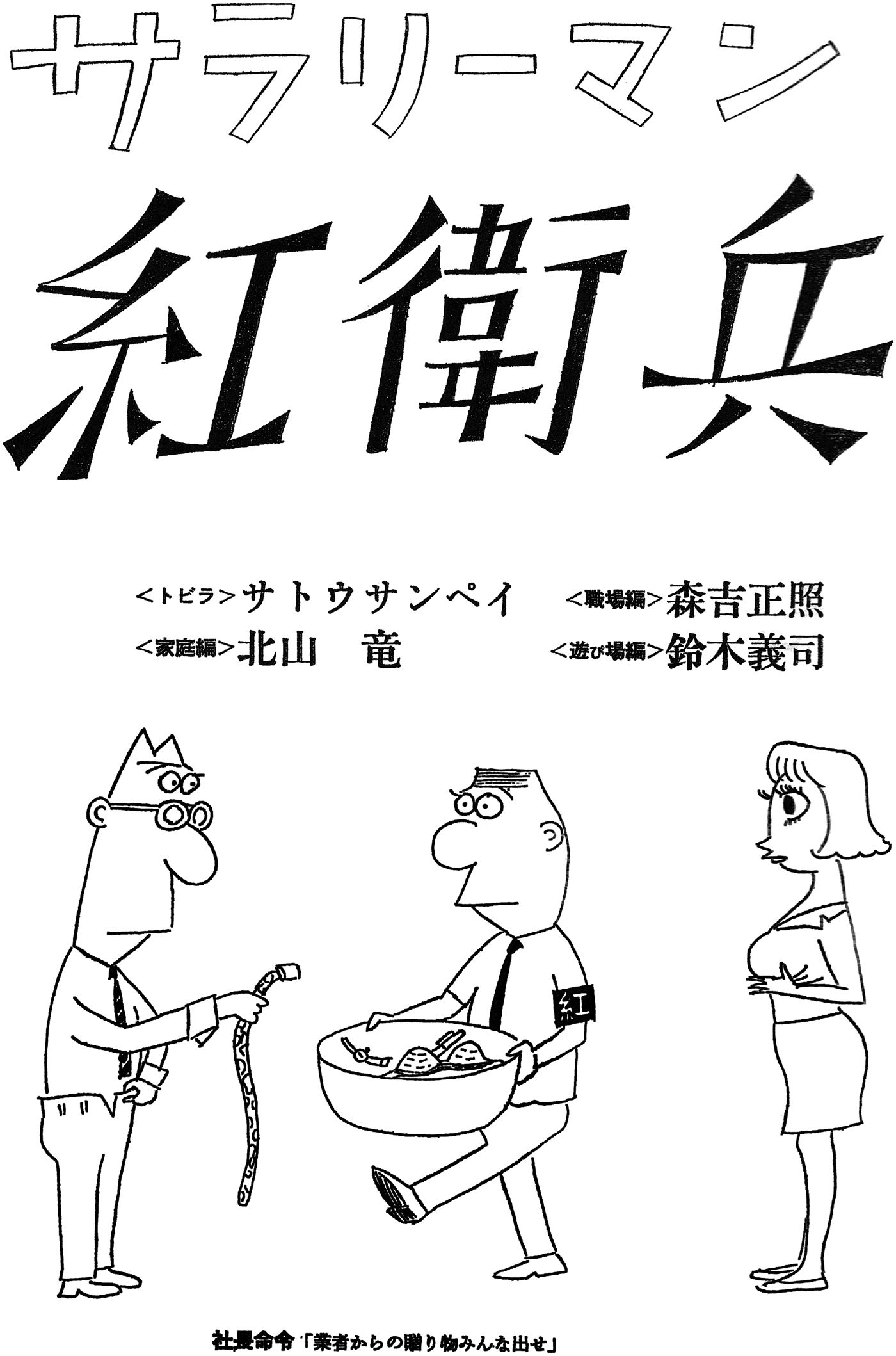
As interpretively rich as Shōji, Mori, and Yanagi's stories are, perhaps the most revealing examples can be found in a lengthy section of a late September 1966 issue of the widely circulated magazine Shūkan manga Sandee 週刊漫画サンデー called “Salaryman Red Guards” (Sarariiman Kōeihei サラリーマン紅衛兵) (Shūkan manga Sandee Reference Sandee1966; see figure 2). The segment featured three distinct stories, each by a different cartoonist, which addressed daily life at the three sites known best to the average corporate middling: his company office, his favorite late-night drinking spot, and his home.
Title page for the special feature in Shūkan manga Sandee, September 28, Reference Sandee1966. Courtesy of Jitsugyō no Nihonsha. The title page cartoon by Satō Sanpei shows an armband-toting office Red Guard confiscating gifts from business clients, including wristwatches, belts, and brassieres.
In the first example, a story entitled “The Quietly Absurd Revolution” (静かなるトンチン革命 shizukanaru tonchin kakumei), Moriyoshi Masateru 森吉正照 (Reference Masateru1966) describes an imaginary takeover of the workplace by pencil-pushing Red Guard office workers. It begins with several panels illustrating the lifestyle of a “one-man” company president and its many perks—numerous girlfriends, fancy automobiles, even a gold bust of himself at the office—contrasted with the flat salaries of his employees. Then, upon his return to the corporate headquarters after a pleasure trip abroad, the president discovers his office telephone missing. A stern-faced employee explains that because phone costs are too high, it has been replaced with a carrier pigeon. Likewise, his cushy desk chair and even the toilet paper in his bathroom, both deemed too extravagant and uneconomical, have been replaced with a pickle barrel and plant leaves. His Rolls-Royce and lovely young secretary, too, are replaced with bamboo stilts and a seventy-year-old hag for the same reasons. When he then checks his office safe and finds that all his stock and bond certificates are missing, his employee explains that it has all been distributed evenly among the company's workers. “We have all become Red Guards!” the elated worker exclaims.
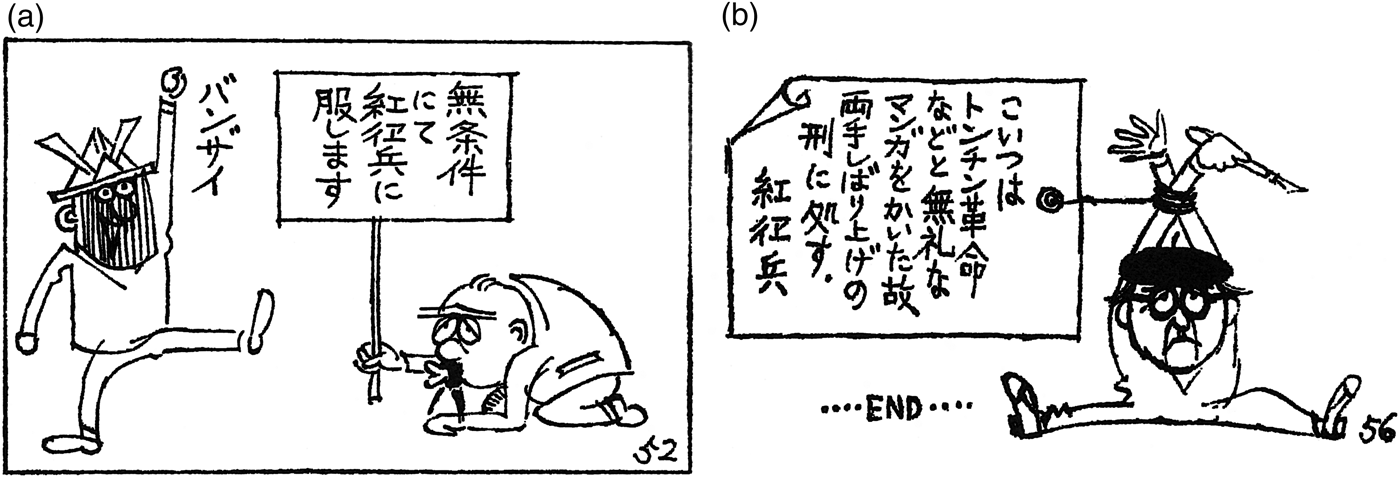
The revolution continues as the president has his wristwatch and lighter seized as “extravagant” (zeitaku), and when he dares to complain, his mustache is torn from his face as he is told “criticism is forbidden” (genron fūsa nari). In the final series of panels, the president cowers before the jubilant Red Guards, admitting his total submission to their authority (see figure 3a), and Moriyoshi concludes with a line that reads, “. . . and so the peaceful yet absurd revolution at the ‘one-man’ company came to an end.” A Red Guard, however, then grabs the hand of Moriyoshi himself and ties the cartoonist up with a sign elucidating his crimes: “Because this man has written insulting comics about the revolution, he is being punished” (see figure 3b), a deliberate and obvious reference to well-known scenes of Red Guards in China hanging signs on the targets of their wrath as the victims faced public persecution.
a (left) and b (right). From Moriyoshi Masateru's (Reference Masateru1966) contribution to the Sarariiman Kōeihei feature in Shūkan manga Sandee. Courtesy of Jitsugyō no Nihonsha.
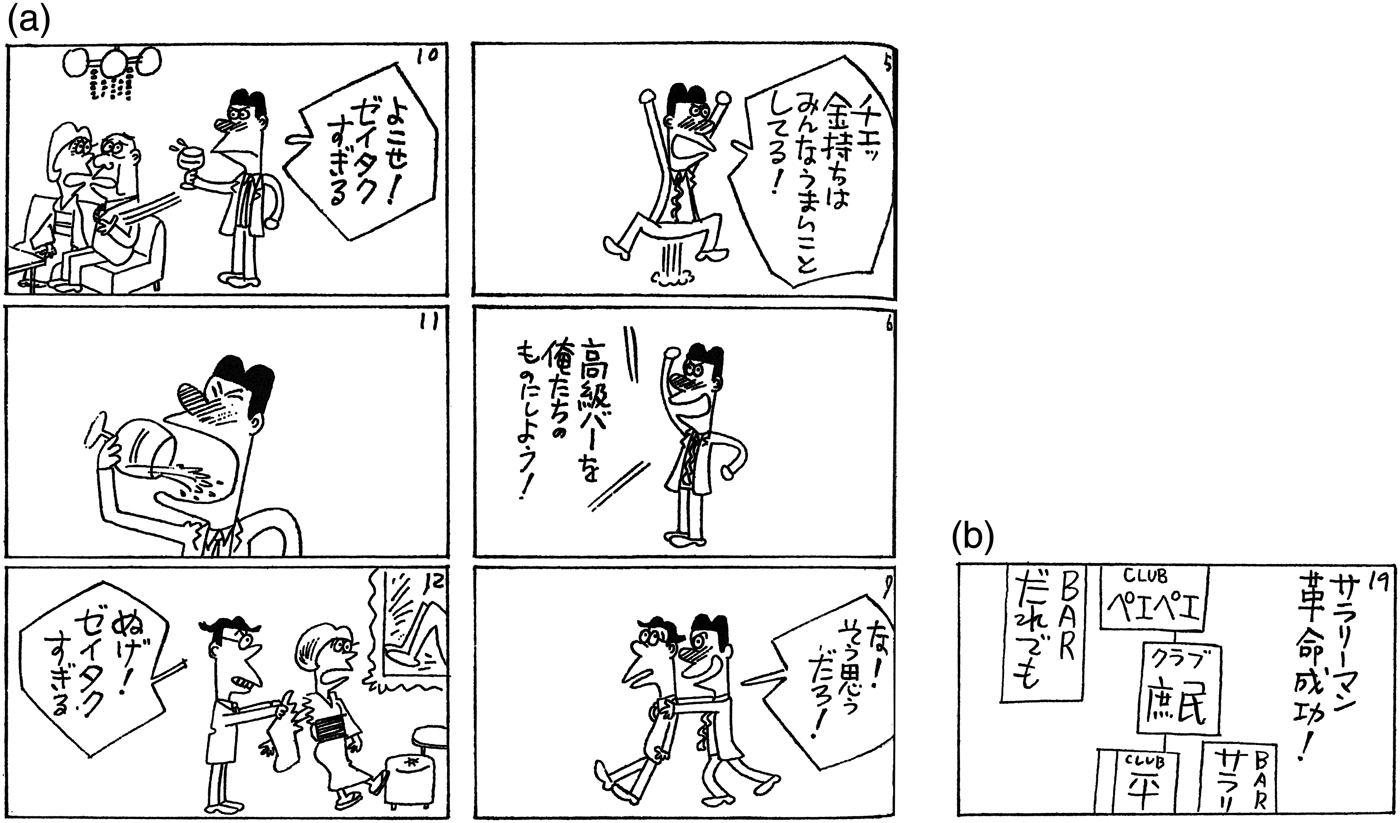
In the second story, Suzuki Yoshiji 鈴木義司 (Reference Yoshiji1966) took as his setting the smoky world of late-night pubs and bars frequented by rank-and-file office workers in a contribution entitled “Liberate the high-class bars! Beautiful ladies and good drink belong to us all!” (kōkyū sakaba kaihō banzai, bijo bishu mina waga shoyū 高級酒場開放万歳、美女美酒、皆我が所有). It begins with our white-collar hero walking away from a yakitori cart after eating his fill of the delectable skewers and feeling rather contented. Until, that is, he strolls in front of the “High-Class Bar” (BAR Kōkyū BAR 高級) and gets a glimpse of how the managerial class unwinds after work. “Damn, the rich have it good,” he shouts. “Let's make those high-class bars our own!” He cajoles a co-worker into joining him, and they rampage through a ritzy club seizing expensive drinks and tearing fancy kimono off the hostesses who pour them (see figure 4a). The success of their revolt is then depicted with a series of new signs such as “Bar Anyone” (Bar Daredemo BAR だれでも) and “Club Common Man” (Kurabu Shomin クラブ庶民) that have replaced the names of these previously out-of-reach watering holes (see figure 4b).
a (left) and b (right). From Suzuki Yoshiji's (Reference Yoshiji1966) contribution to the Sarariiman Kōeihei feature in Shūkan manga Sandee. Courtesy of Jitsugyō no Nihonsha.
Our heroes soon notice, however, that what they wanted most—lovely ladies serving them pricey drinks—are nowhere to be found in any of their revolutionized clubs. After they set out to find them, a secret underground elite bar is discovered and our rebels attempt to enter it without success. While in the sewers, however, they find inspiration in the city's vermin and hatch a plan to raise rats and set them loose on this clandestine high-class hideaway. “The time has come for men and rats to join hands in revolution,” the leader proclaims. A young OL overhearing his impassioned speech is impressed by his enthusiasm and agrees to help him carry out his plan, and the two then fall in love and marry. As revealed in the final frame, however, it was not the rat army of which he had dreamed, but rather only the “rug rats” (jari ジャリ) in his new family, that grew in number, leaving our hero no better off than when his revolt began.
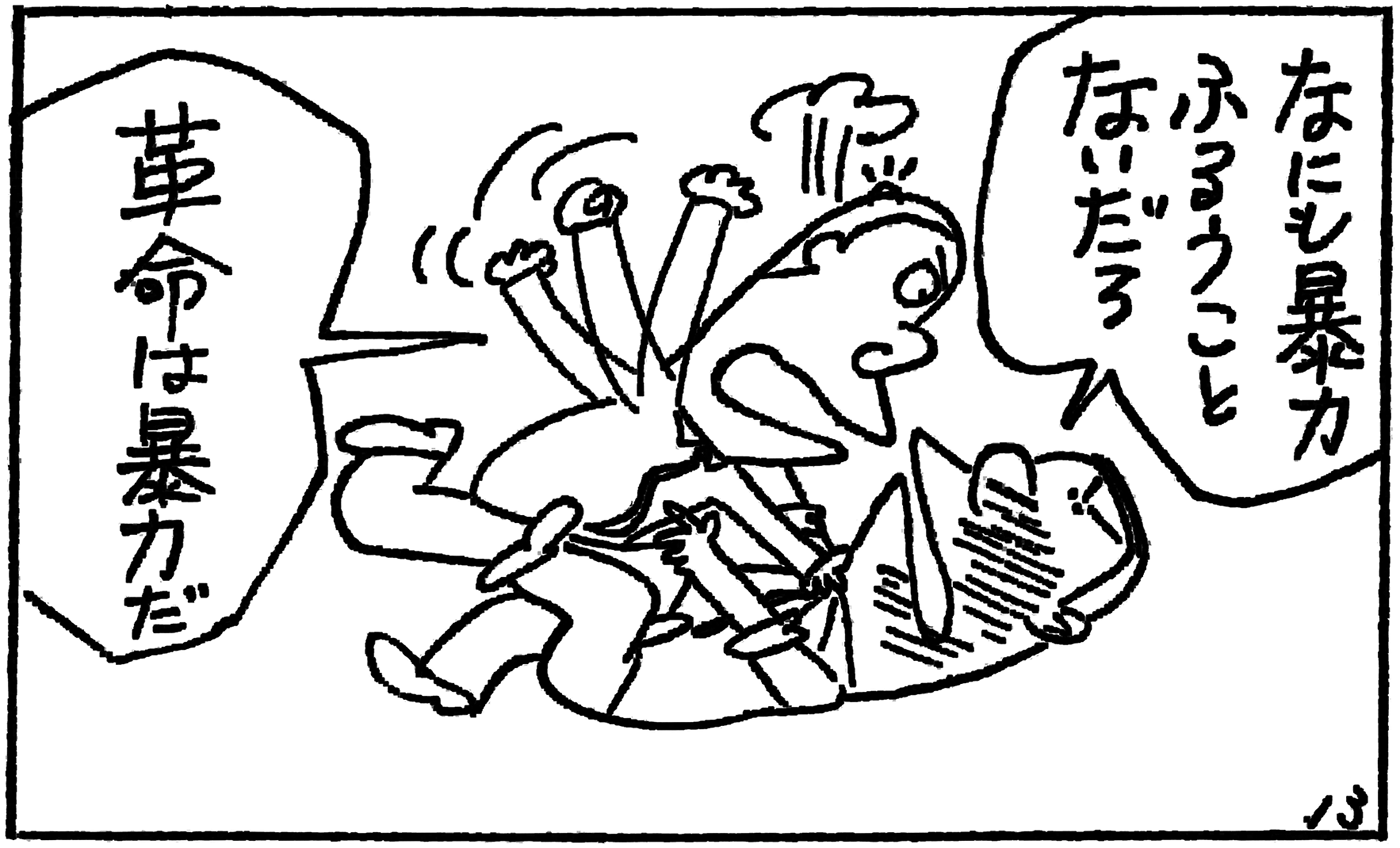
The application of Red Guard idealism in Japanese family life served as inspiration for the third story in the feature, a comic tale called “Red is the color of revolution” (aka wa kakumei no iro 赤は革命の色) by Kitayama Ryū 北山竜 (Reference Ryū1966). While crossing the street, our main character is struck by a car while reading the newspaper rather than noticing the red light. Escaping obvious injury, he ponders curiously, “Why does a red traffic signal mean stop? If it's red, that has to mean advance!” (kōtsū shingō no aka wa, naze stoppu na no ka, aka koso susume de aru beki da 交通信号の赤はなぜストップなのか 赤こそ進めであるべきだ). He then spots the red lantern outside a local pub and immediately “advances” inside for a drink. Once inside he takes a casual comment from another patron as an accusation of capitalist revisionism, and a fight breaks out between them. While being pummeled mercilessly, his opponent frantically asks why our hero is getting so worked up. In response the Red Guard shouts, “Revolution is violence!” (kakumei wa bōryoku da 革命は暴力だ), no doubt a direct reference to Mao's famous 1927 aphorism, “A revolution is not a dinner party. . . . It is an insurrection, an act of violence” (see figure 5).
From Kitayama Ryū's (Reference Ryū1966) contribution to the Sarariiman Kōeihei feature in Shūkan manga Sandee. Courtesy of Jitsugyō no Nihonsha.
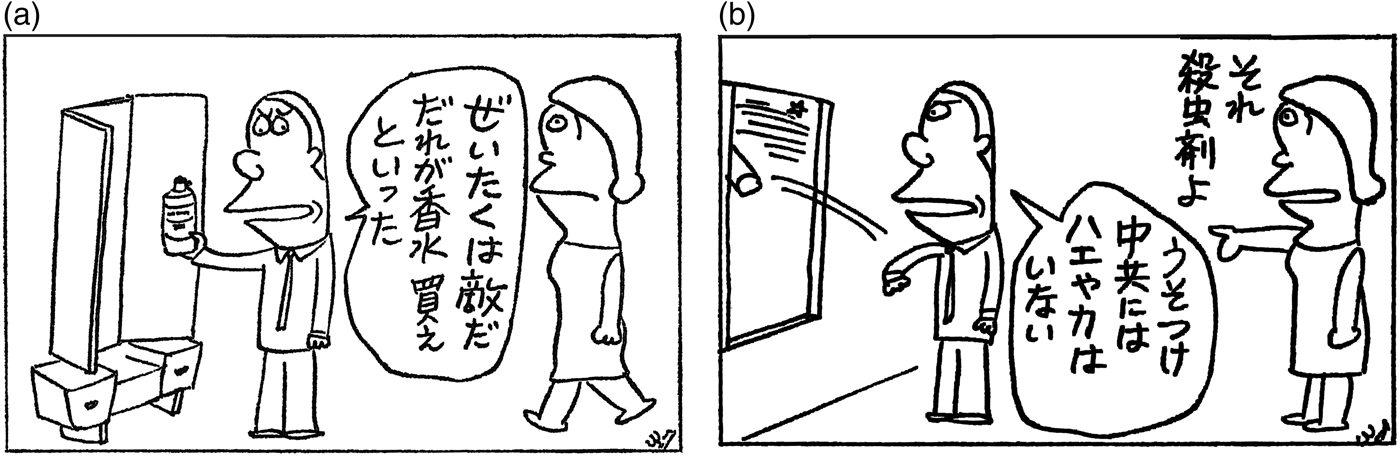
Our deluded hero's young son then finds his dad and tries to convince him to come home. “Mommy is waiting,” the poor lad says, to which his father replies, “Not mommy, call her comrade, OK, comrade.” Then, after attacking a young couple out for an evening stroll whose bourgeois fashion sense offends him, he is finally taken in and questioned by a police officer. “What's your address?” the officer inquires. “The East is Red City, Revolutionary Boulevard” (Tōhōkō shi kakumei ōji 東方紅市革命大路) he answers, to the officer's obvious chagrin. While being escorted home by the policeman, our hero spots his boss walking arm in arm with his wife, both dressed smartly for a night out on the town, and then attacks him as a rotten capitalist. When he finally arrives at his house, his wife asks him where he has been all night, to which he has no response but “Long Live Chairman Mao!” (Mō shuseki banzai 毛主席バンザイ). His odd behavior continues inside when he looks upon the dresser in their bedroom and says to his wife, “Extravagance is the enemy! (zeitaku wa teki da ぜいたくは敵だ!) Who told you to buy this perfume?” “That's bug spray,” she retorts. “Liar!” he shouts. “There are no flies or mosquitoes in Communist China!” (uso tsuke, Chūkyō ni wa hae ya ka wa inai うそつけ、中共にはハエやカはいない), a clear comic reference to the CCP's own campaigns during the 1950s to rid Chinese society of pests such as flying insects (see figure 6).
a (left) and b (right). From Kitayama Ryū's (Reference Ryū1966) contribution to the Sarariiman Kōeihei feature in Shūkan manga Sandee. Courtesy of Jitsugyō no Nihonsha.
After he exhorts his son to read more Mao and criticizes his wife's excessive weight as “too bourgeois,” his wife decides to have a doctor take a look at him. After a quick exam, the doctor assures her, “It's nothing bad, just something like amnesia. He was likely hit by a car while reading about the Red Guards. If you just shock him with something again, he'll go back to normal.” Their son brings out a mallet, and the doctor prepares to administer the curative blow, but the man's wife suddenly stops him. She then retrieves a notebook of some sort from their desk, shows it to her husband, and then turns back to the now puzzled physician, saying, “Doctor, he's all better now.” In the final frame, she then explains the nature of the notebook that had such a shocking impact on her husband: “It's our debt-ridden family budget record” (akaiji no kakeibō na no 赤字の家計簿なの). The startling realization of his miserable household finances had been more than enough to return him to the real world.
Decoding the Salaryman as Red Guard
Postwar publishers produced comic magazines such as those analyzed here for the purpose of entertainment and advertising, not as deliberate historical records of popular sentiment. It is just as true, however, that editors select cartoons for publication because their stories and themes will connect with readers; a comic tale that possessed little resonance in the lives of the magazine's target consumers would not stand a chance of getting printed in its pages. When themes evident across these examples are identified, then, several interpretively meaningful patterns emerge that allow us both to identify the targets of the cartoonists' satire and develop an appreciation of the salaryman frame of mind that was receptive to such social criticism.
First of all, evident throughout these humorous tales is the sublimated desire of the salaryman protagonist to attack the perquisites enjoyed by company bosses and high-level corporate managers as well as to rectify the shameless corruption endemic throughout the workplace. In Shōji Sadao's story, for example, the boss initially organized the office Red Guards in order to whip his office into shape, making all his workers more efficient and productive. The initial act of the Red Guards, however, was to appropriate the boss's private office and transform it into their own recreation room complete with ping-pong table. In Moriyoshi's story, too, the Red Guards, formed while their boss was away on a luxurious business trip, seize his high-end automobile and office furniture in his absence and then strip him of his fancy watch and cigarette lighter after he returns. In both Kitayama's and Mori's cartoons as well there are scenes in which the salaryman hero confronts his boss and berates him for lavish spending in his personal life. Likewise, gross corruption in corporate culture is targeted in Shōji's story when Red Guard office workers demand that everyone turn over any gifts received on the sly and it results in an absurd mountain of forfeited goods that includes everything from cars and computers to briefcases and underpants. In Yanagi's cartoon, too, the prime minister himself is depicted as awash in cash bribes from corporate bigwigs. This focus in the comics on the injustices of CEO perks and widespread corruption assumes a shared desire among the readers for the equal treatment of all company employees and the elimination of exploitative power structures in the workplace. The rhetoric of the real Red Guards in China then, insofar as it pertained to attacks on structural inequality and elite exploitation of the masses, proved useful to Japanese cartoonists in critiquing those same problems in their own society.
The lexicon of these attacks on lavish living by corporate elites, however, also had indigenous roots. The phrase “Extravagance is the enemy” (zeitaku wa teki da 贅沢は敵だ), as put to use by Kitayama when the amnesia-plagued dimwit dad in his tale barks those same words at his wife to chastise her for purchasing perfume, was a well-worn slogan of the wartime era (Garon Reference Garon2000). For the typical reader of Shūkan manga Sandee in 1966, an early forty-something male who had been a late teenager during the wartime years, that phrase certainly would have had a familiar ring. Moreover, the other cartoonists in the “Salaryman Red Guard” feature also made reference to the general notion of extravagance (zeitaku 贅沢) multiple times: Moriyoshi's office rebels seize from their boss his cigarette lighter, his wristwatch . . . and even his toilet paper, for being zeitaku, while Suzuki's bar-crawling misfits angrily dump the fancy drinks of their supervisors and tear the costly kimonos of hostesses on the grounds that it is all zeitaku sugiru (too extravagant). By reinscribing a familiar phrase from the past with new meanings relevant to the present, the word zeitaku seems to function in these comics as the sort of “language bridge” described by John Dower (Reference Dower1999, 168–80) in his analysis of Japanese society's psychological transition from war to peace during the Occupation era. The wartime Japanese state had relentlessly exhorted its subjects to reject “extravagance” and embrace frugality for the sake of national victory. Twenty years after surrender, the opposite seemed true; the government now staked its legitimacy on the promise of extravagant consumer comforts for all as the nation vigorously pursued economic superpower status. The cartoonists' sardonic conflation then of this Japanese wartime slogan with contemporary Red Guard attacks on bourgeois consumerism might also be seen as a critique of the entire twentieth-century Japanese conservative political-corporate order and its hypocrisy.
On a second and more purely comic level, these cartoonists also commonly crafted a vision of rebellion in which overthrowing the corporate regime would bring sexual satisfaction to salaryman life. Shōji's Red Guards use their authority to intimidate young office ladies out of their undergarments and get old, unattractive typists replaced by younger beauties. Suzuki's heroes lament that only the wealthy big shots in their company get to drink with the most attractive hostesses and thus they stage their revolution to “liberate the high-class bars” and secure beautiful women and top-shelf liquor for everyone. Mori's hero, too, feels like he has been duped unfairly when the hostess he finds at the bijin cabaret falls far short of being a true bijin in his eyes. The salaryman revolution, then, is humorously depicted as one that will bring not just socioeconomic justice but personal pleasure as well. Why did so many of the cartoonists add this element to their comic tales? While difficult to substantiate, a sociological interpretation might suggest that male readers would appreciate stories in which the comic protagonists reasserted male dominance in a postwar world where traditional gender roles had entered a state of flux. Alternatively, the pervasive sexist humor could indicate that the cartoonists (and readers) were well aware that the Red Guard movement, and the Chinese Revolution overall, often made gender norms of the capitalist bourgeoisie a target for destruction. The salaryman rebel in these stories, however, does not seek gender equality; rather, he simply resents that sexual gratification is more easily available to his section chief who sits higher on the corporate pay scale. By creating comic vignettes wherein the revolution does not elevate the status of women but instead merely removes the financial requirements for satisfying sex, the cartoonists are perhaps jabbing sarcastically at the dogged persistence of conservative Japanese gender ideals in postwar society. The most plausible explanation behind the sexist imagery and language, however, might relate simply to the nature of the periodicals in which the stories appeared. Weekly comic magazines of the 1960s routinely featured (as they still do) full-page nudes of young female models as well as a wide assortment of risqué innuendo in their cartoons and advertisements. The appearance of sexual humor in Red Guard–inspired cartoons there too should not be surprising.
The consistently violent outbursts of the protagonists in the pursuit of their revolutionary goals is a third quite striking element of these comic tales. Almost every story discussed here features scenes in which the main characters commit physical assault, destroy property, or otherwise employ brute force in attempting to bring their corporate rebellion to fruition. To a degree, such glib appropriation of Red Guard terror for humorous effect seems flippant and insensitive to say the least, since the suffering then faced by thousands across China from real Cultural Revolution violence was well known in Japan. The frequency with which Japanese cartoonists coopted the language and imagery of Red Guard violence, however, might also reflect their anticipation of pent-up rage and frustration in the salaryman reader. Indeed, while the media culture of Japanese society since the late 1990s, as Hiraku Shimoda (Reference Shimoda, Gerteis and George2013, 243) argues, has idealized rank-and-file white-collar workers of the “high-speed growth” era as men who stoically embodied the “ingenuity and hard work that bestowed redemption and prosperity upon a lost country,” these examples from the popular print culture of the late 1960s paint a vastly different picture. The salaryman heroes of these comics are such not because of their virtuous self-sacrifice for company and country; rather it is their violent resistance against the crushing weight of those duties that cartoonists expected the middle-class male reader of that day to find inspirational.
Fourthly, while these stories all feature dramatic acts of violent resistance, it is equally significant that the revolutionary escapades of the cartoon heroes consistently end in failure. Mori's hero vents his frustration in many ways after being laid off, but at the end of the story he is still jobless. Suzuki's office warriors plot to set loose an army of sewer rats on the high-class bar from which they have been excluded, but they end up drunk in a household of “rug rats” instead. Kitayama's memory-challenged dad, too, is cured of his aspirational Red Guard delusions when he gets a good look at the shocking reality of his household budget book. In short, while the salaryman reader is able to fantasize about his own resistance through these visual and textual narratives, his vicarious revolt is only a temporary release of anxiety and frustration. Why did the cartoonists so consistently remind him that rebellion would likely get him nowhere?
Some elements within postwar Japanese society, of course, had stayed true to a path of resistance during the Cultural Revolution years, evident in everything from the widespread public protests of the anti–Vietnam War coalition Beheiren ベ平連, to the raucous (and sometimes even deadly) campus takeovers by students at the University of Tokyo, to the violent terrorist extremism of the Japan Red Army (Nihon Sekigun 日本赤軍). For the most part, however, the transformative potential of postwar protest in Japan had reached its peak during the summer of 1960, when thousands had taken to the streets in Tokyo and beyond to oppose the renewal of the U.S.-Japan security agreement. Subsequent protest movements resonated with ever-dwindling social constituencies, and scholars often attribute this failure of the Japanese Left to energize society at large during the late 1960s to the state's increasingly successful delivery of material affluence as the decade wore on.
The humor in these cartoons suggests something else. These comic artists were keenly aware that the typical salaryman was hardly satisfied with his middle-class standard of living. But they also knew that he was the least likely person in postwar Japanese society to take to the barricades in violent rebellion. The humor they employed thus assumed not his capitalist consumer complacency, but rather his stoic acceptance of the reality that postwar Japan's peace and prosperity necessitated the perpetuation of at least some degree of socioeconomic injustice.
Viewed in that light, the utility of Red Guard rhetoric and imagery within these satirical visions, aimed as they were at such a decidedly non-revolutionary element of postwar Japanese society, can be better understood. The cartoonists behind these stories clearly believed that the Red Guard ideal of violently destroying a social order that benefited so few and hindered so many could strike a powerful chord for the typical male corporate cog in the machine of “Japan, Inc.” In other words, because so many dimensions of the “Japanese System,” to borrow Karel van Wolferen's (Reference Van Wolferen1989) classic and highly critical language, prevented him from leading a satisfying life, cartoonists knew that the fantasy of tearing down that system was deeply attractive to his white-collar readers. It was not the communist ideology of Mao and the CCP that a Japanese salaryman might have found so inspirational; rather, it was the bold and decisive action taken by Red Guards to change their world so dramatically and rapidly that the cartoonists trusted a Japanese corporate underling could admire.
While the shared themes are evident, the matter of intention and reception nonetheless requires critical attention. What did these Japanese cartoonists hope to achieve with the comic tales of Red Guard–inspired activism explored here? First of all, it is important to note that they cannot be painted with the same ideological brush. Mori Tetsurō, for example, was certainly left-leaning in his personal politics during the 1960s, and he also participated enthusiastically in numerous programs related to the promotion of China-Japan friendship through cultural exchange during the 1980s and 1990s. Shōji Sadao, on the other hand, was more of an apolitical specialist in salaryman humor, as evidenced by the wild popularity of his Sarariiman senka サラリーマン専科 comic serialized for many years in the weekly magazine Shūkan gendai 週刊現代 beginning in 1969, and ultimately transformed into a feature film of the same name in 1995. Compared then to the Chinese cartoonists recently examined by Louise Edwards (Reference Edwards2013), who pursued an explicitly stated goal of motivating popular wartime resistance through graphic depictions of violence against women by brutal Japanese invaders, the artists behind these salaryman stories, as well as the publication venues in which they appeared, had little unified political purpose. While the stories do ridicule to some degree the emptiness of Liberal Democratic Party promises of capitalist consumer comfort for all, as well as the willful ignorance of Japan's political leadership about the comparatively low standard of living enjoyed by much of the postwar middle class, they do not call seriously for open rebellion against the capitalist state and its corporate handmaidens. These cartoonists instead hoped simply to entertain (and titillate) their predominantly male middle-class readers by offering a comic fantasy of revolution through which they might experience a few moments of vicarious thrill at the notion of rising up against the mundane inequity of their everyday lives.
Did that message resonate with the salaryman readers at whom it was directed? While this is impossible to answer conclusively, the frequency of Red Guard–inspired stories and the consistency of the ideas expressed in them certainly suggest that magazine editors and comic artists were confident that it would. Moreover, the publication venues explored here were by no means fringe outlets. Shūkan manga Sandee, for example, established in 1959, garnered an impressive circulation figure of 400,000 copies per week by early 1960 and grew throughout the decade to become one of the most popular men's comic magazines of that time (Jitsugyō no Nihonsha Hyakunenshi Hensan Iinkai 1997, 201–2). At the very least then, while it might be a stretch to imagine a scenario in which a radical Japanese student of 1966 and her salaryman father might have sat down around their living room kotatsu to discuss the meaning of the Chinese revolution to their lives, these cartoons suggest that the two of them would have been able to employ a wide range of shared referential symbols related to the Red Guards had they wanted to have that chat. In fact, it is this degree to which precise knowledge of events in China related to the Red Guards and the Cultural Revolution, as well as the broader recent history of Mao and the CCP, was necessary to understand and appreciate these comic tales that stands out as another meaningful lesson offered through their analysis. Much of the humor found in these stories and images would be rendered ineffective in the absence of such familiarity. References to everything from the Red Guards' street sign alterations, to Mao's revolutionary aphorisms, to CCP policies like the Four-Pest campaign would fall completely flat before an audience that did not recognize subtle hints related to contemporary events on the mainland.
Embedded within that familiarity, however, was an unmistakable ambivalence in Japanese understandings of China during the Cultural Revolution era that also has deep roots. On one hand, there is a reaction to the enthusiasm and energy of the millions of Chinese youth swept up in the revolutionary tide of their day that borders on admiration. The Red Guards took bold action to transform their world in a dramatic way, and the comic depictions of Red Guard–like ideology and action explored here celebrate that level of supreme commitment and dedication, perhaps as a lamentation for the absence of such passion in Japanese society. On the other hand, the Red Guards and their behavior are just as often ridiculed in these cartoons for their irrational logic and short-sighted destructiveness, this in turn perhaps a reflection of Japanese confidence that their level of social sophistication far exceeded that of the citizens of the mainland. This two-layered popular understanding of Chinese society—as something both admired and derided—had been a part of Japanese views of its continental motherland since at least the 1860s. The images of China in postwar Japanese popular culture explored here thus remind us that such self-reflection through the lens of Chinese experience was still as much a part of Japanese life after 1945 as it had been for more than a century before.
Acknowledgments
My sincere thanks go to Aono Toshihiko for hosting me at Hitotsubashi University during the spring of 2012 when I first collected the materials examined in this article. I am also grateful to Max Ward for inviting me to speak on this topic at Middlebury College in 2013, as well as to everyone involved with the 2013 Visualizing Asia Conference at Yale University where I also presented some of these ideas and images. The journal's editor and three anonymous reviewers, as well as Laura Nenzi and Kyle Ikeda, kindly provided many valuable suggestions that made the final draft of this paper a far better piece of work.