


Introduction
Bulimia nervosa (BN) is characterized by recurrent episodes of binge eating accompanied by a marked sense of loss of control and compensatory behaviors such as self-induced vomiting, abuse of laxatives and diuretics and excessive exercise. A further criterion concerns self-evaluation, which is unduly influenced by body shape and weight. According to Diagnostic and Statistical Manual of Mental Disorders (DSM)-5 criteria [American Psychiatric Association (APA), 2013] individuals qualify for the diagnosis if binge eating episodes and compensatory behaviors occur at least once a week over a period of at least 3 months.
Lifetime prevalence rates for BN are around 2% for women and men combined (Hudson et al., Reference Hudson, Hiripi, Pope and Kessler2007) and are of comparable magnitude for adolescents (Swanson et al., Reference Swanson, Crow, Le Grange, Swendsen and Merikangas2011). In both adolescents and adults BN is associated with high levels of comorbid mental disorders, substantial medical, psychological and psychosocial sequelae (Hudson et al., Reference Hudson, Hiripi, Pope and Kessler2007; Preti et al., Reference Preti, de Girolamo, Vilagut, Alonso, de Graaf, Bruffaerts, Demyttenaere, Pinto-Meza, Haro, Morosini and Investigators2009; Swanson et al., Reference Swanson, Crow, Le Grange, Swendsen and Merikangas2011; Stice et al., Reference Stice, Marti and Rohde2013) reduced health-related quality of life (Baiano et al., Reference Baiano, Salvo, Righetti, Cereser, Baldissera, Camponogara and Balestrieri2014) and an increased mortality risk both as a consequence of medical complications and suicide (Crow et al., Reference Crow, Peterson, Swanson, Raymond, Specker, Eckert and Mitchell2009; Suokas et al., Reference Suokas, Suvisaari, Grainger, Raevuori, Gissler and Haukka2014).
Previous systematic reviews support the efficacy of psychological interventions, particularly cognitive behavioral therapy (CBT) developed for BN (CBT-BN) both clinician-led, guided and pure self-help (see Linardon et al., Reference Linardon, Wade, Garcia and Brennan2017c for a meta-analysis), and interpersonal psychotherapy (IPT) (Lundgren et al., Reference Lundgren, Danoff-Burg and Anderson2004; Hay et al., Reference Hay, Bacaltchuk, Stefano and Kashyap2009; Slade et al., Reference Slade, Keeney, Mavranezouli, Dias, Fou, Stockton, Saxon, Waller, Turner, Serpell, Fairburn and Kendall2018), as well as pharmacotherapy (Bacaltchuk and Hay, Reference Bacaltchuk and Hay2003; Shapiro et al., Reference Shapiro, Berkman, Brownley, Sedway, Lohr and Bulik2007; Arbaizar et al., Reference Arbaizar, Gomez-Acebo and Llorca2008) and their combination (Bacaltchuk et al., Reference Bacaltchuk, Trefiglio, Oliveira, Hay, Lima and Mari2000) for the treatment of BN. As such, CBT has been superior to waitlist (Freeman et al., Reference Freeman, Barry, Dunkeld-Turnbull and Henderson1988; Agras et al., Reference Agras, Schneider, Arnow, Raeburn and Telch1989), to other psychotherapeutic approaches such as supportive or nutritional therapy (Walsh et al., Reference Walsh, Wilson, Loeb, Devlin, Pike, Roose, Fleiss and Waternaux1997; Hsu et al., Reference Hsu, Rand, Sullivan, Liu, Mulliken, McDonagh and Kaye2001) and at posttreatment (but not at follow-up) to IPT (Agras et al., Reference Agras, Walsh, Fairburn, Wilson and Kraemer2000), possibly by its stronger impact on core BN aspects as dietary restraint and dysfunctional attitudes towards shape and weight as indicated by a recent meta-analysis (Reference Linardon2018a). Comparably, a number of studies on the efficacy of pharmacotherapy with antidepressants [mostly selective serotonin reuptake inhibitors (SSRIs), tricyclics (TCAs)] (Hughes et al., Reference Hughes, Wells, Cunningham and Ilstrup1986; Fluoxetine Bulimia Nervosa Collaborative Study Group, 1992) and topiramate (Nickel et al., Reference Nickel, Tritt, Muehlbacher, Pedrosa Gil, Mitterlehner, Kaplan, Lahmann, Leiberich, Krawczyk, Kettler, Rother, Loew and Nickel2005) yielded significant reductions of the core symptoms of binge eating and purging frequency and associated psychological features in the short term.
These effects notwithstanding, the overall quality of trials is very variable. Studies often lack a proper diagnostic assessment in terms of instruments used to establish the diagnosis of BN (i.e. use of standardized interviews or clinical judgment v. self-report). Moreover, types of binge eating episodes included often vary (e.g. patients with objective and/or subjective binge eating episodes) and relevant outcome variables are often reported for combined diagnostic groups only. Finally, previous systematic reviews and meta-analyses mostly considered original papers published before 2010. Consequently, new trials or follow-ups from published trials should be considered. In fact, a recent network meta-analysis of BN treatment (Slade et al., Reference Slade, Keeney, Mavranezouli, Dias, Fou, Stockton, Saxon, Waller, Turner, Serpell, Fairburn and Kendall2018) confirmed that CBT is particularly effective as an intervention. However, due to requirements of its elegant network design, only full remission rates at the end of treatment could be considered as a categorical outcome variable.
Against this backdrop, we conducted a meta-analysis of randomized-controlled trials (RCTs) using proper diagnostic assessment methods to assess the efficacy of psychotherapies and pharmacotherapies for a number of BN-specific outcomes and associated psychopathology, including full remission rates as well as reduced symptom severity. Additionally, outcome variables were analyzed at the end of treatment as well as at follow-up to investigate the sustainability of the intervention. Furthermore, this meta-analysis is thought to revise the German evidence-based S3 Guideline for the Diagnosis and Treatment of Eating Disorders [Association of the Scientific Medical Societies (Arbeitsgemeinschaft der Wissenschaftlichen Medizinischen Fachgesellschaften – AWMF), 2010], specifically for BN, with the aim to translate results from clinical research into practice.
Methods
Search strategy and selection criteria
We conducted a systematic review of interventions for BN according to Preferred Reporting Items for Systematic Reviews and Meta-Analyses (PRISMA) guidelines (Moher et al., Reference Moher, Liberati, Tetzlaff and Altman2009). The following bibliographic databases and study registries were searched from database inception to March 2017: PubMed, Cochrance Library, Web of Science Core Collection, Cinahl, PsychInfo, ClinicalTrial.gov, ICTRP (online Supplementary Table S1.0.). In addition, we also searched in reference lists of reviews and included studies.
After duplicate removal, all identified citations were screened by one author (JB) and checked independently by another author (CT). Of the remaining citations, all full-articles were retrieved and screened by two authors (JB and CT), who resolved disagreement in search results through consensus. Of the remaining potentially relevant citations, data extraction of study characteristics, outcome variables and risk of bias [Effective Practice and Organisation of Care (EPOC), 2015; Higgins and Green, Reference Higgins and Green2011] were coded by one author (JB or CT), whereby one third of these articles was coded independently by another author (JB or CT).
Inclusion criteria were randomized controlled trials (RCTs) on the treatment of adolescent and adult populations with a diagnosis of BN according to either the DSM or the International Classification of Diseases (ICD). Further requirements included the assessment of eating disorder pathology as an outcome measure over at least a period of 1 week and the presence of sufficient data to allow the calculation of effect sizes. Finally, studies examining multiple patient groups had to yield separate BN data reports. Unpublished studies, double publications of the same trial and RCTs with a sample size <10 were excluded.
Outcome measures
Primary outcome measures were the proportions of abstinence from binge eating episodes, abstinence from compensatory behaviors and the absence of a BN diagnosis post-intervention. Additionally, the reduction of binge eating episodes and of compensatory behaviors from pre to post-treatment was investigated. Secondary outcome criteria were a reduction in the severity of overall eating pathology and of depressive symptoms. Compensatory behaviors subsumed self-induced vomiting, misuse of laxatives, diuretics, or other medications, fasting, and excessive exercise. It has been emphasized that abstinence from binge eating and purging behavior is a relevant criterion for defining successful treatment, as symptom reduction alone could still imply significant function impairment. Consequently, abstinence rates have been argued to be of primary interest for intervention studies and meta-analyses (Linardon, Reference Linardon2018b), and we agree in this respect. But, we believe that a reduction in symptom severity still qualifies as a clinically important indicator of successful treatment, as it can substantially improve the condition of people affected by BN.
Standardized effect scores of all data were collapsed into one composite score, depending on availability in the study. Analogously, the eating pathology was a composite score of effect measures derived from the Eating Disorder Examination (Fairburn and Cooper, Reference Fairburn, Cooper, Fairburn and Wilson1993), the Eating Disorder Examination Questionnaire (Fairburn and Beglin, Reference Fairburn and Beglin1994), the Eating Disorder Inventory (Garner et al., Reference Garner, Olmstead and Polivy1983), and the Eating Attitude Test (Garner and Garfinkel, Reference Garner and Garfinkel1985), depending on availability in the studies. The Beck Depression Inventory (Beck et al., Reference Beck, Steer and Garbin1988) score was used to quantify depressive symptoms.
Meta-analysis
Three series of meta-analyses were computed: (1) between-group analyses at post-treatment were conducted for RCT studies with an inactive or placebo control group, (2) pre-to-post changes were analyzed within intervention groups, and (3) analogous studies were conducted for the within-group change from pre-treatment to follow-up. Meta-analyses were carried out for five major intervention categories, namely psychotherapy, self-help, other non-pharmacological interventions, pharmacotherapy, and combination therapies (online Supplementary S.9.0., Panel). Additionally, more homogenous subgroups were analyzed, resulting in a total of 19 groups for which meta-analyses were conducted.
Primary and secondary outcome variables were either proportions (e.g. the absence of a BN diagnosis) or continuous severity indexes (e.g. frequency ratings of the symptoms), and effect sizes were computed accordingly. For the RCT between-group comparisons, proportions at post-treatment were transformed into odds ratios (OR) that were entered into meta-analyses after log-transformation. Severity variables were analyzed following a pre-treatment to post-treatment control-group design, i.e. relative changes from pre-treatment to post-treatment were compared between groups (Morris, Reference Morris2008). To this end, Hedges’ g was computed which is conceptually similar to Cohen's d, but additionally has a correction term for small sample sizes.
For the within-group analyses, proportions of changes were double arcsine transformed (Freeman and Tukey (Reference Freeman and Tukey1950) for the meta-analyses, and results were back-transformed afterward to facilitate interpretation. Please note that absence rates of a BN diagnosis post-intervention reflect change since pre-treatment, as all participants initially met diagnostic criteria. For the continuous severity variables, standardized mean changes (Hedges’ g) were computed. If a study did not provide information concerning standard deviation, the sampling variance was computed following the suggestions of Becker (as mentioned in Koenig et al., Reference Koenig, Eagly, Mitchell and Ristikari2011). If pre-post correlations of repeated measures were not mentioned in the original paper and authors did not respond to queries, we entered typical values obtained in the literature for these variables. Additionally, we simulated effects for a range of plausible correlations to test the robustness of the effect size estimate.
Effect sizes were interpreted as small, moderate, large and very large when they correspond with a Hedges’ g of 0.2, 0.5, 0.8, and 1.2 (Sawilowsky, Reference Sawilowsky2009). For OR (log OR) values of 1.6 (0.47), 3.47 (1.24), and 6.71 (1.90) were interpreted as small, moderate and large effects (Chen et al., Reference Chen, Cohen and Chen2010).
General and generalized linear mixed models were computed for the meta-analyses. Random effects models were estimated for k ⩾ 3 studies. Cochran's Q statistic was computed to test how much individual studies deviate from the grand mean. Additionally, I 2 was calculated which denotes the percentage of variation across studies that is due to heterogeneity rather than chance (Higgins and Thompson, Reference Higgins and Thompson2002; Higgins et al., Reference Higgins, Thompson, Deeks and Altman2003). Thereby, 0–40% heterogeneity is not considered important, 30–60% represent moderate, 50–90% substantial and 75–100% considerable heterogeneity (Higgins and Green, Reference Higgins and Green2011). Further, the standard deviation of the random effects model τ and the prediction interval for random effects models was estimated. All analyses were computed with R version 3.3.3 (R Core Team, 2018) using the metafor package version 2.0-0 (Viechtbauer, Reference Viechtbauer2010). This study is registered with PROSPERO, number CRD42017067103.
Moderator analyses
A number of a-priori-defined variables were tested as moderators of the intervention effect, which could potentially contribute to the observed heterogeneity of effects across studies. The first group of moderator variables pertained to sample characteristics and comprised the mean age of participants, the onset and duration of their illness, and comorbidity of an affective disorder. Next, we investigated potential moderator variables related to the intervention. This comprised the setting of the intervention (e.g. outpatient, daycare, or inpatient), the treatment duration, the years of experience of the therapists, and the type of intervention (e.g. CBT). Finally, several moderator variables pertaining to study quality were tested (see next paragraph for the rationale). These comprised the blinding of personnel and participants, conducting intention-to-treat analyses, the reliability of the implementation of the intervention, a multi-dimensional operationalization of disorder-related treatment effects, and the type of diagnostic instrument used for assessment (e.g. structured interview, self-report). In addition, these quality criteria were aggregated into a summative quality index (with equal weights of the five criteria; range 0–5). Finally, the year of publication was investigated to test a general trend across time. In the case of categorical moderators, one of the values was used as a reference condition – usually the most frequent or supposedly least biased category. Dummy coding was used to specify contrasts with the other conditions. In case of a continuous moderator variable, the smallest value of the moderator was set at zero and the other values reflected the relative change.
Study quality and publication bias
All studies were classified according to an a-priori-defined list of quality criteria and possible biases broadly corresponding with the Cochrane Risk of Bias Tool (Higgins and Green, Reference Higgins and Green2011) and the EPOC criteria (2015). For the current analyses, we modified and extended these lists to accommodate the requirements of intervention studies with behavioral data in the mental health field (details are provided in online Supplementary Table S5). In line with Cochrane and EPOC suggestions, quality criteria comprised the randomized allocation of participants to conditions and blinding of participants and personnel. As allocation concealment and blinding can be generally difficult in therapy studies, we also checked if measures were taken against a Rosenthal effect (i.e. changes induced merely by expectations of the therapist). We considered it as important that measures were taken against drop-out and intention-to-treat analyses were conducted in order to avoid biased estimates of the intervention effect.
Additional variables were included that are relevant for therapy research: These included standardizing of the therapy setting, a reliable implementation of the therapy, avoiding treatment diffusion, avoiding competing treatment, and avoiding demoralization of controls. As selective reporting and incomplete outcome data can be sometimes difficult to judge (in particular for older studies that were not pre-registered), we included variables that capture the richness of reported data in the published work. This comprised multi-dimensional operationalization of disorder-related symptoms and their multi-dimensional assessment. Comprehensive summary graphs were plotted for each intervention category.
Additionally, we conducted sensitivity analyses to check for a possible publication bias. To this end, we inspected funnel plots displaying standard errors against effect sizes. Trim-and-fill analyses (Duval and Tweedie, Reference Duval and Tweedie2000a, Reference Duval and Tweedie2000b) were conducted to estimate a mean effect that would have resulted if the pattern of published effect sizes was more symmetrical. As these estimates are difficult to interpret for small numbers of published studies and with large heterogeneity between studies (Higgins and Green, Reference Higgins and Green2011), ‘bias corrected’ estimates were only added to the summary plots in case of k ⩾ 10 individual studies. A large difference between these trim-and-fill estimates and the means estimate of actually published studies could indicate a publication bias.
Role of funding source
This study was funded by the Christina Barz Foundation. The funder of the study had no role in study design, data analysis and interpretation, manuscript writing, and manuscript submission.
Results
Selection and inclusion of studies
In total 4515 records (see online Supplementary S1.0. for search strategy) were identified through database searching, 2148 duplicates removed and 2367 abstracts screened by one author (JB or CT). This procedure was then re-done by another author (JB or CT). Subsequently, 120 full-text articles were retrieved and screened by two authors (JB and CT), who resolved disagreement in search results through consensus. Of those, 28 trials had to be excluded due to not using clinical assessments for diagnosing patients and eight trials due to only analyzing BN subgroups. The remaining 84 trials all met our inclusion criteria. For the first 32 (38%) trials, data extraction was independently conducted by two authors (JB and CT) with good interrater reliabilities of κ = 0.773 and ICC = 0.997 for categorical and continuous variables, respectively. Therefore, 52 trials (62%) were coded by one author only (JB or CT). Of the 84 coded studies, 79 had enough data for calculating effect sizes. For the missing five trials, the authors were contacted, but they did not provide the requested data. Additionally, two studies only containing follow-up data were identified and included for follow-up analysis (Fairburn et al., Reference Fairburn, Jones, Peveler, Hope and O'connor1993; Griffiths et al., Reference Griffiths, Hadzi-Pavlovic and Channon-Little1996) (The PRISMA Flow in Fig. 1 depicts the selection and inclusion process).
PRISMA Flow Diagram. *n = 2 additional studies were included in the analysis, only containing follow-up results (Fairburn et al., Reference Fairburn, Jones, Peveler, Hope and O'connor1993; Griffiths et al., Reference Griffiths, Hadzi-Pavlovic and Channon-Little1996).

Characteristics of included studies
Details for the included studies are provided in online Supplementary Table S1.1 (a full reference list of all included studies is provided in the online Supplementary S8.0.), including sample sizes at pre and post-treatment, and dropout rates. Additionally, mean age, the proportion of female participants, the setting of the intervention, duration, and additional comments are provided to highlight specifics of the investigated studies. Characteristics of the samples included for the meta-analysis of the main intervention categories and their more specific sub-categories are summarized in online Supplementary Table S1.2.
For psychotherapy studies, there were k = 55 active study arms with a total of n = 1936 participants, n = 1756 in intervention groups and n = 180 in control groups. Their mean age was 25.3 (s.d. = 4.0), almost all participants were female (99.1%), their mean body mass index (BMI) was at 22.5 kg/m2 (s.d. = 2.3). The mean age at BN onset was 18.6 years (s.d. = 1.5) and the mean illness duration was about 7.7 years (s.d. = 3.2).
For self-help, k = 10 active study arms with a total of n = 562 participants, n = 451 in the intervention groups and n = 111 in the control groups, were analyzed. They were 24.8 years (s.d. = 4.6) old on average and were predominantly female (94.2%). Their mean BMI was 22.6 kg/m2 (s.d. = 1.8). The mean age at onset was 17.2 years (s.d. = 1.4), and their mean illness duration was 7.8 years (s.d. = 1.1).
For pharmacotherapy, k = 41 active study arms were included with a total sample size of n = 2143; n = 1198 were in the intervention groups and n = 945 in the control groups. Their mean age was 25.9 years (s.d. = 4.1) and they were mostly female (92.8%). Their mean BMI was 21.0 kg/m2 (s.d. = 4.6). Their mean age at BN onset was 17.0 years and the mean illness duration was 6.8 years (s.d. = 3.2).
For the category of combined therapies, there were 21 active study arms with a total of n = 781 participants, n = 731 in the intervention groups and n = 50 in the control groups. Their mean age was 27.2 years (s.d. = 2.4), and they were virtually all female (99%). Their mean BMI was 22.8 kg/m2 (s.d. = 1.0) on average. Mean age at onset was 18.4 years (s.d. = 1.5) and mean illness duration was 7.6 years (s.d. = 1.9).
Between-group effects at post-treatment per intervention category
The first series of meta-analyses comprised only RCT studies with a non-active or a placebo control group. All effects were group differences post-treatment (e.g. absence rates of a BN diagnosis) or group differences in pre-post changes (e.g. of reported symptom frequency or severity). Figure 2 summarizes meta-analytic findings for the most important primary and secondary variables. The number of independent studies (k) and the total sample size (n) is given for each intervention category and outcome. Point and whisker plots indicate the mean and its 95% confidence interval (CI) for the group. Additionally, bubble plots depict effect sizes and sample sizes of the individual studies (i.e. center and radius of the bubble, respectively). Effect sizes of individual studies are provided in form of forest plots in online Supplementary Fig. S3.1.
Between-group analyses at post-treatment per intervention category. Summary measures with 95% CI per group (black point with whisker). Gray bubble plots correspond with effect sizes of individual studies. Trim-and-fill estimates were added as gray diamonds for analyses with k ⩾ 10 studies. Combi = Combination.

Additional information for the between-group analyses at post-treatment is provided in online Supplementary Tables S2.1.1–2.1.7. This comprises the exact numbers of the estimated mean with its 95% CI in the metric of the meta-analysis and its corresponding Z and p values. For random-effects meta-analyses, the standard deviation (τ) of the heterogeneity is reported along with Cochrane's Q statistics of heterogeneity between studies, the I 2 statistic, and prediction intervals for the random effects analyses. Effect sizes and CIs for each of the included studies can be inferred from the forest plots in online Supplementary Fig. S3.
Abstinence from binge eating episodes
For psychotherapy, data were only available for CBT, indicating a moderate to large difference in binge eating abstinence rates relative to control participants (OR 5.25, CI 1.60–17.19). A similar effect was obtained for self-help (OR 5.60, CI 2.37–13.23). A small to moderate effect was observed for pharmacotherapy (OR 2.63, CI 1.27–5.46), but also a large heterogeneity between studies. In fact, small and non-significant effects were observed for SSRIs (OR 1.48, CI 0.88–2.50), whereas other medication yielded moderate to large effects [e.g. OR 13.87, CI 1.58–121.91 in one monoamine oxidase inhibitor (MAOI) study]. A particularly large effect was also observed in one study, in which different psychotherapies (i.e. an eclectic approach) were combined (OR 19.09, CI 2.16–169.09).
Abstinence from compensatory behaviors
Large effects were observed for CBT (OR 6.96, CI 2.50–19.35) and moderate effects for self-help (OR 4.23, CI 1.70–10.55). Pharmacotherapy yielded a small to moderate effect on average (OR 2.23, CI 1.13–4.40). Thereby, SSRIs yielded again a small effect whereas moderate to large effects occurred for other substance classes (see online Supplementary Table S2.1.2 for details). Based on one study, an eclectic approach combining elements of different psychotherapies again revealed a particularly large effect (OR 12.92, CI 1.45–115.57).
Absence of diagnosis
Only few RCT studies reported this variable. Based on two studies, psychotherapy appeared to yield a moderate effect (OR 4.15, CI 0.90–19.24), somewhat smaller for CBT and relatively large for dialectical behavioral therapy (see online Supplementary Table S2.1.3). Self-help appeared to have a moderate effect as well (OR 3.37, CI 1.36–8.38), whereas two studies investigating pharmacotherapy yielded small effects on average (OR 1.81, CI 0.66–4.95).
Reduction of binge eating episodes
More data were available for the severity variables. On average, psychotherapies revealed large effects (g = 0.98; CI 0.54–1.41), whereas effects were moderate to large for self-help (g = 0.66; CI 0.28–1.03) and pharmacotherapy (g = 0.61; CI 0.31–0.91), depending on sub-category: SSRIs (g = 0.10; CI −0.08 to 0.29) and MAOIs yielded a small improvement (g = 0.11; CI −0.65-0.87), whereas the category of other pharmacotherapies revealed large effects (g = 1.00; CI 0.43–1.58).
Reduction of compensatory behaviors
Most psychotherapy studies investigated CBT, and these revealed large effects (g = 0.82; CI 0.58–1.05). Moderate to large effects were observed for self-help (g = 0.71; CI 0.42–1.00) and pharmacotherapy (g = 0.69; CI 0.48–0.90). Very large effects were observed for combination therapies (g = 1.09; CI 0.24–1.94).
Reduction of overall eating pathology
Two studies indicated very large effects for psychotherapy (g = 1.37; CI 0.94–1.81) and one study for self-help (g = 1.76; CI 1.38–2.14) in this variable. Large effects were as well observed for pharmacotherapy (g = 1.01; CI 0.88–1.14) on the basis of nine studies. One study indicated a very large effect for an eclectic combination of psychotherapies (g = 2.12; CI 1.59–2.66).
Reduction of depressive symptoms
On average, psychotherapy yielded a large effect (g = 0.93; CI 0.50–1.35), very large for CBT (g = 1.20; CI 0.62–1.78), and moderate to large for dialectical behavioral therapy (g = 0.64; CI 0.14–1.13). Self-help only showed a small effect (g = 0.14; CI −0.43-0.71). Pharmacotherapy yielded a moderate effect on average (g = 0.51; CI 0.19–0.84). Based on one study each this was shown for SSRIs and MAOIs, whereas two studies indicated only small to moderate effects for TCAs (g = 0.61; CI 0.15–1.08) (see online Supplementary Table S2.1.7 for details).
Dropout
Odds ratios for drop-out were slightly <1 for psychotherapy (OR 0.92, CI 0.47–1.80), for self-help (OR 0.87, CI 0.44–1.73), for pharmacotherapy (OR 0.78, CI 0.50–1.20), and for combination therapies (OR 0.77, CI 0.26–2.26). This corresponds with the small negative values of log-transformed OR depicted in Fig. 1, and reflects that slightly less participants dropped out of the active intervention groups relative to controls (see next section for the actual proportions of dropout per intervention group).
Pre-treatment to post-treatment change per intervention category
In the second series of meta-analyses, effects within treatment groups were analyzed. This comprised post-treatment proportion of absence of a BN diagnosis, and pre-to-post changes in severity (see Fig. 3 for a graphical representation of effects and online Supplementary Tables S2.2 for additional information on heterogeneity). More studies were available for the within-treatment group analyses. Effect sizes of individual studies can be inferred from the forest plots depicted in online Supplementary Fig. S3.2.
Within-Group analyses of pre-to-post treatment change per intervention category. Summary measures with 95% CI per group (black point with whisker). Gray bubble plots correspond with effect sizes of individual studies. Trim-and-fill estimates were added as gray diamonds for analyses with k ⩾ 10 studies. Combi = Combination.

Abstinence from binge eating episodes
Most studies in psychotherapy were CBT studies, and these showed binge eating abstinence rates of 51% (CI 0.44–0.58), although effect sizes revealed considerable heterogeneity across studies. Somewhat lower binge eating abstinence rates were observed in self-help (43%; CI 34–52%) and other non-pharmacological studies (38%; CI 27–49%). Binge eating abstinence rates were only half that high in pharmacotherapy on average (19%; CI 13–27%). Combination therapies yielded absence rates as high as psychotherapy (48%; CI 31–65%).
Abstinence from compensatory behaviors
A similar picture arose for the abstinence from compensatory behaviors. High abstinence rates were observed for CBT (45%; CI 36–54%), lower for self-help (27%; CI 18–36%) and pharmacotherapy (23%; CI 15–32%), whereas again high for combination therapies (39%; CI 19–62%).
Absence of diagnosis
The absence of a BN diagnosis was shown in psychotherapy in 33% (CI 22–44%) and in 39% (CI 26–52%) in CBT. Somewhat lower absence rates were obtained for other psychotherapies (see online Supplementary Table S2.2.3). Absence rates of a BN diagnosis were somewhat lower for self-help (26%; CI 10–46%) and considerably lower for pharmacotherapy (15%; CI 09–21%). Particularly high absence rates of a BN diagnosis were again observed for combination therapies (46%; CI 23–69%).
Reduction of binge eating episodes
On average, psychotherapy yielded a large effect in the reduction of binge eating episodes (g = 0.84; CI 0.73–0.96), and this was also found for CBT as the largest sub-category (g = 0.89; CI 0.77–1.00). Self-help showed moderate effects (g = 0.51; CI 0.34–0.67). Pharmacotherapy revealed large effects (g = 0.83; CI 0.71–0.95), and this was also found for combination therapies (g = 0.95; CI 0.73–1.16).
Reduction of compensatory behaviors
Moderate to large effects were observed for psychotherapy (g = 0.67; CI 0.59–0.75) and for CBT (g = 0.69; CI 0.61–0.77). A small to moderate effect was obtained for self-help (g = 0.41; CI 0.27–0.54), and a moderate effect for pharmacotherapy (g = 0.47; CI 0.34–0.60). Large effects were obtained for the broader category of combination therapies (g = 0.96; CI 0.76–1.16) and very large effects for the sub-category of combined psychotherapy and pharmacotherapy (g = 1.15; CI 0.75–1.55).
Reduction of overall eating pathology
Very large effects were obtained for psychotherapy (g = 1.35; CI 1.18–1.53) and for CBT as the largest sub-category (g = 1.43; CI 1.24–1.63). A considerably smaller but still large effect was observed for self-help (g = 0.95; CI 0.52–1.38) and pharmacotherapy (g = 0.85; CI 0.48–1.23). Very large effects were also observed for combined therapies in general (g = 1.99; CI 0.78–3.20), and for combined psychotherapy and pharmacotherapy in particular (g = 2.49; CI 0.64–4.34).
Reduction of depressive symptoms
Again, effects were large for psychotherapy (g = 0.87; CI 0.72–1.02) and for its largest sub-category CBT (g = 0.90; CI 0.75–1.05). Moderate effects were observed for self-help (g = 0.45; CI 0.20–0.71), for pharmacotherapy (g = 0.48; CI 0.31–0.64), and also for the combination of psychotherapies (g = 0.53; CI 0.42–0.64).
Drop-out rates
In psychotherapies, an average of 16% (CI 0.13–0.19) did not complete treatment, and this was also found for the largest sub-category CBT (16%; CI 12–19%). In self-help, drop-out rates were twice as high (33%; CI 25–42%), also higher in pharmacotherapy (26%; CI 19–32%), and somewhat higher for combined therapies (20%; CI 14–26%).
Pre-treatment to follow-up change per intervention category
Few studies investigated the maintenance of treatment effects. In particular, data for the remission variables were sparse, but more data were available for the severity variables (see Fig. 4 for a graphical summary and online Supplementary Table S2.3 for detailed information including heterogeneity between studies). Effect sizes of individual studies can be inferred from the forests plots in online Supplementary Fig. S3.3.
Within-Group analyses of pre-to-follow-up treatment change per intervention category. Summary measures with 95% CI per group (black point with whisker). Gray bubble plots correspond with effect sizes of individual studies. Trim-and-fill estimates were added as gray diamonds for analyses with k ⩾ 10 studies. Combi = Combination.
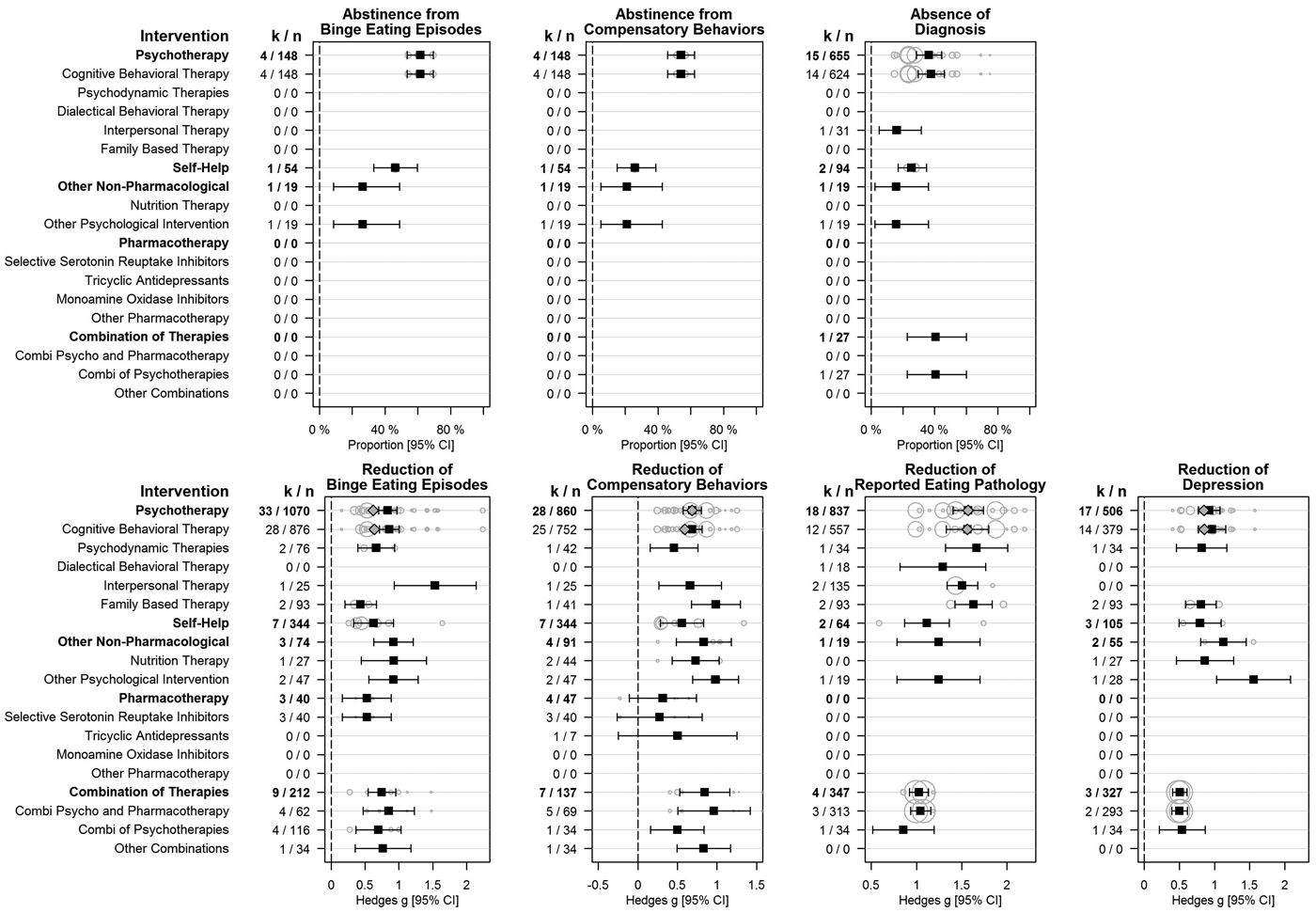
Abstinence from binge eating episodes
All of the four psychotherapy studies available for this analysis employed CBT, and these revealed 62% (CI 53–69%) abstinence rates at follow-up. One self-help study indicated a somewhat lower abstinence rate of 46% (CI 33–60%). No data were available for pharmacotherapy or for combination therapies.
Abstinence from compensatory behaviors
Abstinence rates of compensatory behaviors were observed in 54% (CI 46–62%) of the studies using CBT, and it was 26% (CI 15–39%) in one self-help study. Data for this variable were not available for pharmacotherapy or for combination therapies.
Absence of diagnosis
More data were available for the absence of a BN diagnosis at follow-up. Absence rates were 36% (CI 28–45%) for psychotherapy on average, and 38% (CI 30–46%) for CBT as its largest sub-category. Two studies suggest somewhat lower absence rates for self-help, 25% (CI 17–35%). No follow-up data were available for pharmacotherapy. Finally, one study indicated an absence rate of 41% (CI 23–60) for an eclectic combination of psychotherapies.
Reduction of binge eating episodes
Considerably more studies reported follow-up data for the continuous severity variables. Large effects were observed for psychotherapy in general (g = 0.83; CI 0.70–0.97) and for CBT (g = 0.86; CI 0.71–1.01) as the largest sub-category. Moderate to large effects were observed for self-help (g = 0.63; CI 0.33–0.92), moderate effects for pharmacotherapy (g = 0.53; CI 0.17–0.89), and finally large effects for combined therapies (g = 0.94; CI 0.61–1.26), with the combination of psycho- and pharmacotherapy revealing particularly large effects (g = 1.37; CI 0.68–2.06).
Reduction of compensatory behaviors
Moderate to large effects were also observed in this variable for psychotherapy in general (g = 0.69; CI 0.57–0.80) and for CBT in particular (g = 0.69; CI 0.56–0.81). Moderate effects were observed for self-help (g = 0.56; CI 0.29–0.83), whereas pharmacotherapy alone revealed a small to moderate effect (g = 0.32; CI −0.11-0.74). Large effects were observed again for combined therapies (g = 1.08; CI 0.69–1.46), in particular in the combination of psychotherapy and pharmacotherapy (g = 1.28; CI 0.82–1.74).
Reduction of overall eating pathology
Effects for this variable were generally large. Psychotherapy revealed a very large effect on average (g = 1.57; CI 1.40–1.74), and the same was found for CBT (g = 1.56; CI 1.33–1.80) as its largest sub-category. A smaller but still very large effect was observed for self-help (g = 1.11, CI 0.87–1.36). No data were available for pharmacotherapies, whereas for combined therapies effects were large again (g = 1.02; CI 0.91–1.13).
Reduction of depressive symptoms
Psychotherapies revealed a large to very large effect in general (g = 0.92; CI 0.77–1.08), and for CBT in particular (g = 0.96; CI 0.77–1.16). The effect was large also for self-help (g = 0.79; CI 0.49–1.09). No data were available for pharmacotherapy. Effects were only moderate for combination therapies (g = 0.51; CI 0.40–0.61).
Moderator analyses
Effects for the variables tested as potential moderators of the intervention effect will be summarized below. Details of the moderator analyses pertaining to sample characteristics, the intervention, and the study quality are provided in online Supplementary Table S4.1 for the RCT between-group analyses, in online Supplementary Table S4.2 for the pre-to-post changes, and in online Supplementary Table S4.3 for the follow-up analyses, respectively.
Sample characteristics
The mean age of participants was inconsistently related to intervention effects across outcome variables. However, significant moderation effects in about half of the outcome variables in the between-group analyses and at follow-up suggest that larger intervention effects were obtained in older patients. The onset of the illness was not consistently related to treatment effects in the between-group analyses or with respect to pre-to-post changes. Conversely, remission rates were consistently larger at follow-up for patients with a late onset of the illness. The duration of the illness was not consistently related with treatment effects neither in the between-group analyses nor in the pre-to-post-treatment changes. However, a longer duration of the illness was associated with lower remission rates, respectively higher relapse, at the follow-up assessment. A comorbidity of an affective disorder predicted a smaller intervention effect, consistently across all series of analyses. However, effects turned out to be statistically significant primarily in the pre-to-post changes in half of all outcome variables, arguably an effect of test power.
Intervention
The setting of the intervention (e.g. outpatient, day care, inpatient) was not significantly related to the size of the intervention effect. Some particularly large effects observed in a hospital context were driven by few data points and should be interpreted with caution. Neither the duration of the intervention nor years of experience of the therapist were related to the size of the intervention effect. The type of intervention did not significantly moderate the size of the intervention effect in the between-group analyses. Conversely, type of intervention turned out to moderate effects in five out of seven outcome variables in the pre-post-treatment analyses, and in one outcome variable in the follow-up analyses (cf. Figs 3 and 4). Again, these inconsistencies across series of analyses arguably reflect differences in test power as a function of the number of available studies.
Study quality
Blinding of personnel and participants was not significantly related to the size of the intervention effect. However, incomplete blinding tended to be associated with larger effects, but this moderation effect was significant only for self-reported eating pathology in the between-group analyses and abstinence from binge eating episodes in the pre-post-treatment analyses. Reporting intention-to-treat analyses (as contrasted with reporting completer analyses) was not significantly related to the size of the intervention in the between-group analyses as well as in the pre-post-treatment analyses. However, significant moderation effects were obtained for about half of the outcome variables in the follow-up analyses, showing larger effects in studies that report completer analyses. Reliability of the treatment implementation was not consistently related to the size of the treatment effect across the analyses. Further, there was no consistent effect of a multi-dimensional operationalization of disorder-related treatment effects, either. Conversely, the type of diagnostic instrument used (e.g. structured interview v. clinical judgment) revealed significant moderation effects in about half of all outcome variables in the between-group analyses. Studies using clinical judgment yielded smaller effects as compared with studies using a structured interview. The same pattern was observed in the pre-to-post-treatment analyses but turned out to be significant only for one variable, and the effect was descriptive only in the follow-up analyses. Most studies fulfilled 2, 3, or 4 of the five quality criteria that were aggregated for the study quality index. Studies with scores of 4 and 5 were rated as ‘good’, with 3 as ‘mediocre’, and with only 2 as ‘poor’ (frequencies are provided in online Supplementary Tables S4.1–4.3). These labels are more liberal than Cochrane and EPOC criteria. They vary across studies, which is a prerequisite for testing a moderation effect. However, the study quality index was not significantly related with the effect size in the outcome variables – not even its direction was consistent across the series of analyses.
Finally, the year of the publication was tested to inspect general trends across time. Moderation effects were far from significant in the between-group analyses. Conversely, in pre-to-post-treatment analyses, about half and in follow-up analyses, five out of seven variables were moderated by publication year. These effects consistently showed smaller effects of the intervention in more recently published studies.
Study quality and publication bias
Ratings of study quality and potential biases are provided in online Supplementary Table S5 for each study. Comprehensive plots for each of the intervention categories are displayed in online Supplementary Fig. S6. Obviously, only the randomized allocation of participants was met by all studies, as this was one of the inclusion criteria. All other quality criteria varied substantially across studies. As could be expected, blinding of participants was not given in all psychological and non-pharmacological studies. At the least, 66% of all psychological interventions took measures against a Rosenthal effect. In 70% of the studies, drop-out of participants was controlled for and in 63% intention-to-treat analyses were conducted. In 88% of all studies, means were taken to standardize therapy, and in 92% of all studies, symptoms were operationalized in a multidimensional way. As the predominant majority of psychotherapy studies used CBT, the numbers were about comparable for this subgroup. Only a few studies were available for the remaining psychotherapy categories (e.g. k = 2 for dialectical behavioral, k = 3 for interpersonal, or k = 2 for family-based therapy), but these were rated as qualitatively well conducted. In self-help, blinding of participants was not met for all included studies, but at least in 60% of the studies, means were taken against a Rosenthal effect. An average of 80% controlled for drop-out and 90% conducted intention-to-treat analyses. The therapy setting was standardized in 60%, and all (100%) operationalized the disorder in a multi-dimensional way.
In pharmacotherapy, participants were blinded in 83% of the studies, and means were taken against a Rosenthal effect in the same proportion of studies. In 37% of the studies, drop-out was controlled for, and intention-to-treat analyses were conducted in 42%. The intervention was standardized in 93% of the studies, and a multidimensional operationalization was given in 90% of the studies. In the heterogeneous category of combination therapies, blinding of participants was given in 33% of the studies, and a Rosenthal effect was avoided in 57%. An average of 52% controlled for drop-out and conducted intention-to-treat analyses. A standardized therapy setting was given in 71% of the studies, and all (100%) used a multidimensional operationalization of the diagnosis. Further details concerning additional quality criteria and other sub-categories of intervention can be inferred from online Supplementary Fig. S6.
For all series of analyses, sensitivity to outlier values was inspected with the funnel plots provided in online Supplementary Figs 7.1–7.3. The number of studies possibly not published due to publication bias can be inferred from the plots and the estimated numbers are provided in the legend. Some of the funnel plots and fill-and-trim analyses suggest that studies were missing occasionally. However, there did not appear to be a systematic bias across corresponding variables. Additionally, trim-and-fill estimates added into the summary plots displaying results for the outcome variables (Figs 2–4) were usually close to the empirically derived means or yielded only slightly smaller values which would not change the interpretation of effects.
Discussion
We conducted a meta-analysis of RCTs on the effectiveness of psychotherapies and pharmacotherapies for BN. This comprised a total of 79 independent trials with 143 active (experimental) treatment arms and 51 control arms (i.e. placebo, waitlist or active control group). Primary outcome variables were the abstinence from binge eating episodes and purging, the absence of a BN-diagnosis as well as the frequency of binge eating episodes and purging behaviors. Secondary outcomes included the severity of overall eating and depressive pathology. Thereby, this study aimed to update and extend previous systematic reviews and meta-analyses (Hughes et al., Reference Hughes, Wells, Cunningham and Ilstrup1986; Freeman et al., Reference Freeman, Barry, Dunkeld-Turnbull and Henderson1988; Agras et al., Reference Agras, Schneider, Arnow, Raeburn and Telch1989, Reference Agras, Walsh, Fairburn, Wilson and Kraemer2000; Fluoxetine Bulimia Nervosa Collaborative Study Group, 1992; Walsh et al., Reference Walsh, Wilson, Loeb, Devlin, Pike, Roose, Fleiss and Waternaux1997; Bacaltchuk et al., Reference Bacaltchuk, Trefiglio, Oliveira, Hay, Lima and Mari2000; Hsu et al., Reference Hsu, Rand, Sullivan, Liu, Mulliken, McDonagh and Kaye2001; Bacaltchuk and Hay, Reference Bacaltchuk and Hay2003; Lundgren et al., Reference Lundgren, Danoff-Burg and Anderson2004; Nickel et al., Reference Nickel, Tritt, Muehlbacher, Pedrosa Gil, Mitterlehner, Kaplan, Lahmann, Leiberich, Krawczyk, Kettler, Rother, Loew and Nickel2005; Shapiro et al., Reference Shapiro, Berkman, Brownley, Sedway, Lohr and Bulik2007; Arbaizar et al., Reference Arbaizar, Gomez-Acebo and Llorca2008; Hay et al., Reference Hay, Bacaltchuk, Stefano and Kashyap2009; Linardon et al., Reference Linardon, Fairburn, Fitzsimmons-Craft, Wilfley and Brennan2017a, Reference Linardon, Wade, Garcia and Brennan2017c, Linardon, Reference Linardon2018a; Slade et al., Reference Slade, Keeney, Mavranezouli, Dias, Fou, Stockton, Saxon, Waller, Turner, Serpell, Fairburn and Kendall2018).
Psychotherapies yielded moderate to large remissions from binge eating and compensatory behaviors and reductions in symptom severity in primary and secondary outcome variables when compared with control groups in RCT designs. These results were confirmed in the pre-to-post-treatment analyses within psychotherapy arms, showing remission rates of roughly 40% and moderate to a large reduction in symptom severity. In addition, psychotherapy revealed effects of comparable magnitude also at the follow-up measurement point. Notably, the predominant majority of psychotherapy studies were versions of CBT (individual or group CBT, exposure and response prevention, dialectic behavioral therapy, self-help, hypno-behavioral therapy, behavior-oriented therapy) and results of the psychotherapy category largely reflected the findings for this subgroup.
Few RCTs assessed the pre-to-post-treatment effectiveness of IPT (Fairburn et al., Reference Fairburn, Jones, Peveler, Carr, Solomon, O'Connor, Burton and Hope1991; Agras et al., Reference Agras, Walsh, Fairburn, Wilson and Kraemer2000; Mitchell et al., Reference Mitchell, Halmi, Wilson, Agras, Kraemer and Crow2002), and recently also psychodynamic therapies (Poulsen et al., Reference Poulsen, Lunn, Daniel, Folke, Mathiesen, Katznelson and Fairburn2014; Stefini et al., Reference Stefini, Salzer, Reich, Horn, Winkelmann, Bents, Rutz, Frost, von Boetticher, Ruhl, Specht and Kronmuller2017) and family-based therapy (Le Grange et al., Reference Le Grange, Crosby, Rathouz and Leventhal2007, Reference Le Grange, Lock, Agras, Bryson and Jo2015). Interpretation of pre-to-post-treatment results for the primary outcome variables for IPT is difficult, as two studies reported only small proportions (6% and 16%) of full symptom recovery (Agras et al., Reference Agras, Walsh, Fairburn, Wilson and Kraemer2000; Mitchell et al., Reference Mitchell, Halmi, Wilson, Agras, Kraemer and Crow2002), whereas one study (Fairburn et al., Reference Fairburn, Jones, Peveler, Carr, Solomon, O'Connor, Burton and Hope1991) reported a high binge eating abstinence rate of 62%. Meta-analytic evaluation of IPT was further possible only for the overall reduction of self-reported eating pathology, thereby yielding reductions of very large magnitudes.
Overall, pre-to-post-treatment effect sizes for psychodynamic therapies were lower in magnitude than for CBT or IPT for all outcome variables. Notably, both included psychodynamic studies (Poulsen et al., Reference Poulsen, Lunn, Daniel, Folke, Mathiesen, Katznelson and Fairburn2014; Stefini et al., Reference Stefini, Salzer, Reich, Horn, Winkelmann, Bents, Rutz, Frost, von Boetticher, Ruhl, Specht and Kronmuller2017) were RCT comparisons with CBT. However, while in the direct comparison psychoanalytic therapy (Poulsen et al., Reference Poulsen, Lunn, Daniel, Folke, Mathiesen, Katznelson and Fairburn2014) was inferior to CBT for binge eating and purging abstinence rates, psychodynamic therapy was comparable with CBT in the present meta-analyses. Hence, these results emphasize the need for more RCTs investigating the effects of psychodynamic therapies, but also demand a differentiated view on different treatment directions within psychodynamic therapies.
For self-help, only two RCTs, both based on a CBT-rationale (Treasure et al., Reference Treasure, Schmidt, Troop, Tiller, Todd, Keilen and Dodge1994; Banasiak et al., Reference Banasiak, Paxton and Hay2005), were available for pre-to-post-treatment between-group analyses, showing mostly moderate effects in the remission from diagnostic symptom variables, and moderate to large reductions in symptom frequency variables. Comparable effects were estimated also for pre-to-post-treatment changes within two to four self-help study arms (depending on outcome variable), revealing remission rates at post-treatment of about 30%, thereby slightly lower than for psychotherapies. Reduction of symptom frequency in the primary outcome variables was moderate for self-help. Comparable effects were also suggested for the follow-up session, though only by one available study (Banasiak et al., Reference Banasiak, Paxton and Hay2005). Notably, most of the study arms included in this category were based on a CBT rationale, and the majority was guided by an experienced therapist. Thus, not self-help per se, but a CBT-based guided self-help approach is a viable treatment alternative for adult patients with BN. However, the sustainability of its effects needs further investigation.
For other non-pharmacological interventions, no data were available from RCT studies for the primary outcome variables. Study arms included in this category comprised nutrition-based treatments (Laessle et al., Reference Laessle, Beumont, Butow, Lennerts, O'connor, Pirke, Touyz and Waadt1991; Hsu et al., Reference Hsu, Rand, Sullivan, Liu, Mulliken, McDonagh and Kaye2001; Sundgot-Borgen et al., Reference Sundgot-Borgen, Rosenvinge, Bahr and Schneider2002) and other psychological interventions that were either not BN-specific or were not attributable to broader therapeutic interventions such as pure psychoeducation (Davis and McVey, Reference Davis and McVey1999), stress-management (Laessle et al., Reference Laessle, Beumont, Butow, Lennerts, O'connor, Pirke, Touyz and Waadt1991), guided imagery designed to facilitate the internalization of soothing experiences (Esplen et al., Reference Esplen, Garfinkel, Olmsted, Gallop and Kennedy1998), self-psychological treatment and cognitive orientation therapy (Bachar et al., Reference Bachar, Latzer, Kreitler and Berry1999). In these study arms, absence rates of a BN diagnosis and binge eating and purging abstinence rates of approximately 30% were observed at post-treatment, whereas reductions in symptom severity for primary and secondary outcome variables were large. Only the study arm testing psychoeducation (Davis and McVey, Reference Davis and McVey1999) reported data for a follow-up point, suggesting rates of approximately 20% for the absence of a BN diagnosis and for the abstinence from binge eating and compensatory behavior, whereas a psycho-educational approach and stress-management revealed a large reduction in regard to binge eating episodes and compensatory behaviors at follow-up. Taken together, some evidence suggests positive effects of treatments focusing on a direct symptom reduction, such as nutrition management and other not BN-specific psychological interventions. However, moderate sample sizes in these studies call for caution, and maintenance of treatment effects needs further investigation.
Pharmacotherapy revealed small to moderate effects in RCT studies, albeit with large differences in effect sizes across types of pharmacotherapy. Treatment with SSRIs showed small and, in part, non-significant effects on abstinence rates of binge eating and purging behavior and reduction of binge eating episodes, as well as moderate to large effects for all other outcome variables. Large CIs for some of the central outcome variables indicate that more research is required to estimate the effects of SSRIs with higher precision. Similar conclusions can be drawn from the, in part, large CIs obtained for the effects of MAOs and TCAs. For the heterogeneous category of other pharmacotherapy observed effects ranged from small to large, depending on outcome measure. As there were not sufficient studies to form more homogeneous classes, the interpretation of meta-analytic effects obtained for this broad category can be a challenge. Therefore, the limited evidence available for specific classes should be considered with caution.
For the between-group analyses, both trazodone (Pope et al., Reference Pope, Keck, McElroy and Hudson1989), bupropion (Horne et al., Reference Horne, Ferguson, Pope, Hudson, Lineberry, Ascher and Cato1988), ondansetron (Faris et al., Reference Faris, Kim, Meller, Goodale, Oakman, Hofbauer, Marshall, Daughters, Banerjee-Stevens, Eckert and Hartman2000), naltrexone (Huseman et al., Reference Huseman, Pearson, Madison and Leuschen1990), topiramate (Hedges et al., Reference Hedges, Reimherr, Hoopes, Rosenthal, Kamin, Karim and Capece2003; Hoopes et al., Reference Hoopes, Reimherr, Hedges, Rosenthal, Kamin, Karim, Capece and Karvois2003; Nickel et al., Reference Nickel, Tritt, Muehlbacher, Pedrosa Gil, Mitterlehner, Kaplan, Lahmann, Leiberich, Krawczyk, Kettler, Rother, Loew and Nickel2005) and lithium (Hsu et al., Reference Hsu, Clement, Santhouse and Ju1991) yielded small to large effects depending on outcome measure, however, in part with large CIs. A similar picture arose for the pre-to-post-treatment changes within the pharmacotherapy arms. Remission rates at post-treatment were about 20%, and a reduction in symptom severity in the primary and secondary outcome variables was moderate to large. At follow up, no data were available for remission variables, whereas small to moderate reductions were observed across three and four studies (three testing SSRIs, one testing TCA), some of which were non-significant.
For combined therapies, there were only sparse RCT data available. This category included combinations of psychotherapy (mostly CBT) and pharmacotherapy (mostly SSRIs), combinations of psychotherapies, (i.e. eclectic approaches), as well as combinations of pharmacotherapy (mostly SSRIs) and treatment forms other than a BN-specific psychotherapeutic intervention (e.g. nutrition-based interventions, supportive therapy). One study applying hypno-behavioral therapy (Griffiths et al., Reference Griffiths, Hadz-Pavlovic and Channon-Little1994) with a moderate sample size suggests a large effect with regard to the absence of a BN diagnosis, and two studies, one applying hypno-behavioral therapy (Griffiths et al., Reference Griffiths, Hadz-Pavlovic and Channon-Little1994), the other applying self-help plus SSRI (Mitchell et al., Reference Mitchell, Fletcher, Hanson, Mussell, Seim, Crosby and Al-Banna2001) indicate moderate to large reductions in symptom severity in the primary outcome variables in the between-group analyses. In the within-group pre-to-post-treatment analyses, absence rates of a BN diagnosis of 40% and higher were observed, which was the highest of all major intervention groups. Similarly, large effects in the reduction of symptom severity were revealed for the primary and secondary outcome variables. No follow-up data were available for the remission variables. However, large effects were observed also for the reduction of primary and secondary outcome variables at follow up. In spite of these promising effects, the moderate sample sizes available for the combined therapies call for caution, and more research is required to confirm some of the observed large effects.
With regard to treatment moderating factors, some sample variables were shown to moderate the effect of the intervention, although inconsistently across outcome variables and types of analyses. For instance, comorbidity of an affective disorder predicted a lower intervention effect, while an early illness onset predicted higher relapse rates at follow-up. Both findings might indicate adverse effects of the severity of impairments in patients with a long illness history or with mental comorbidity. The moderating treatment effect of a comorbid affective disorder further suggests that change in depressive symptoms may be equally important as change in eating disorder symptoms in the treatment of BN and converges with a previous study showing that early changes in depression severity during treatment are significantly associated with remission of BN symptoms at the end of treatment (Thompson-Brenner et al., Reference Thompson-Brenner, Shingleton, Sauer-Zavala, Richards and Pratt2015).
As the setting (i.e. outpatient, day care, inpatient) of the intervention did not have clear effects on the intervention, it may be recommended that outpatient treatment shall be preferred as the reintegration of patients is easier in that case. It is of note that studies using clinical judgment revealed smaller effects than studies using structured interviews for diagnosing BN. Tentatively, this could indicate a higher sensitivity for partial symptom reduction in case a more complete structured interview is conducted. Finally, smaller intervention effects in more recently published studies might indicate more realistic estimates of effect sizes since quality criteria are more rigorously met in recent studies.
A number of limitations have to be discussed with respect to the current meta-analysis. For some of the intervention categories and their subgroups, there was only limited evidence available. Many RCTs compared two active intervention groups. In order to estimate the effects of the respective interventions, it would be desirable to have more controlled studies with comparison groups with non-effective or sham treatment to quantify specific treatment effects while avoiding nocebo effects in the control group (Furukawa et al., Reference Furukawa, Noma, Caldwell, Honyashiki, Shinohara, Imai, Chen, Hunot and Churchill2014). In addition, study quality was low in many of the analyzed studies. In part, this may reflect that the blinding of therapists is not possible for psychotherapy treatments. Similarly, blinding of patients is more difficult to obtain in psychotherapy, depending on the comparison arm (e.g. participant blinding is not possible in a comparison of CBT face to face v. internet based, but possible when comparing CBT v. IPT). Similarly, it is impossible to blind outcome assessment when core symptoms are inferred by means of self-report. Finally, a publication bias might exist in some of the analyzed variables. Against this latter point, trim-and-fill analyses suggest that the observed effects were quite robust.
Overall, the findings of the current meta-analysis suggest that psychotherapy, in particular, CBT, should be the treatment of choice for BN. This corroborates findings from previous meta-analytic studies on the effectiveness of CBT interventions for eating disorders (Linardon et al., Reference Linardon, Wade, Garcia and Brennan2017c; Linardon and Wade, Reference Linardon and Wade2018). In spite of first support for dialectic behavioral therapy in BN, independent replication is desirable, and follow-up data are required to determine its sustainability. Guided CBT-based self-help could be considered as an alternative if CBT cannot be realized, targeting the same mechanisms as clinician-led CBT, i.e. dietary restraint and shape- and weight concerns (Linardon, Reference Linardon2018a). Pharmacotherapy was shown to be moderately effective and may be suited for patients who prefer drug treatment. However, the heterogeneity observed in this broader category calls for more differentiation with respect to functional classes. Additionally, side-effects and contraindications need to be considered. As such, Bupropion is contraindicated for the treatment of BN because of the increased risk for seizures (Israel, 2002). Furthermore, also eclectic approaches and combinations of pharmacotherapy with BN-specific and non-specific interventions were shown to be highly efficient. However, for this heterogeneous category, more research is required to understand which of the intervention techniques drives the intervention effect. Given the large proportion of BN patients who fail to fully abstain from binge-purge behavior, the study of mediators and moderators of treatment success as well as risk factors of relapse should be considered a research priority in future research (Linardon et al., Reference Linardon, Brennan and Garcia2016, Reference Linardon, Garcia and Brennan2017b; Linardon and Wade, Reference Linardon and Wade2018).
Supplementary material
The supplementary material for this article can be found at https://doi.org/10.1017/S0033291718003525.
Author contributions
JS, BTC, FS studied the concept and designed the study. JS, FS, JB, CT, JvW, MdZ, TL, AH, BTC contributed to acquisition, analysis, and interpretation of data. JS, FS, JB drafted the manuscript. JvW, MdZ, TL, AH, BTC crticially revised the manuscript for important intellectual content. FS, JS, JB performed statistical analysis. The German Research Guideline BN Subgroup (JS, JvW, MdZ, TL, AH, BTC) obtained funding from the Christina Barz Foundation for this meta-analysis. JB provided administrative, technical and material support. JS, BTC supervised the study.
Acknowledgements
This systematic review and meta-analysis was funded by the Christina Barz Foundation (Project number T 155-27-464) and was part of the revision of the German Treatment Guidelines. The Christina Barz Foundation had no role with regard to design and conduct of the study, collection, management, analysis, and interpretation of the data, preparation, review, or approval of the manuscript, and decision to submit the manuscript.
Conflict of interest
JS gave lectures and workshops on the psychotherapy of eating disorders, received grants within the last 3 years from Novo Nordisk and Sanofi-Aventis and has authored books and articles on eating disorders published by Hogrefe, Otto Hoffmanns, Wiley & Sons and Urban und Vogel. FS, JB, CT, JvW do not have any conflicts of interest. MdZ reported serving on advisory boards, giving lectures and receiving travel grants within the last 3 years from Novo Nordisk and Danone and has authored books and articles on psychotherapy of eating disorders published by Thieme, Springer, Routledge, and Elsevier. TL gave lectures and workshops on the psychotherapy of eating disorders and has authored books and articles on (psychotherapy of) eating disorders published by Hogrefe, Springer, Wiley & Sons, SAGE and Elsevier. AH gave lectures and workshops on the psychotherapy of eating disorders and has authored book chapters and articles on eating disorders published by Springer, W. Kohlhammer, Elsevier, Multidisciplinary Digital Publishing Institute, and Wiley & Sons. BTC gave lectures and workshops on the psychotherapy of eating disorders and has authored books and articles on eating disorders published by Hogrefe, Otto Hoffmanns, Urban und Vogel and Wiley & Sons.



