Introduction
The sweet pepper, Capsicum annuum L. (Solanaceae), has been the focus of breeding programs for several decades in order to identify genotypes that meet the principles of productivity, quality, profitability and adaptability to the different crop systems (Machado et al., Reference Machado, Rodrigues, Weirich and Chagas2002). Hybrid genotypes, in particular, have several advantages such as raised yield potential (yield and quality), production of upper average weight fruit, multiple disease resistance and high vigor, productivity and uniformity (Nascimento et al., Reference Nascimento, Maluf, Valle, Faria, Gonçalves, Gomes, Licursi and Moretto2002).
Despite continuous efforts, C. annuum has a remarkable susceptibility to the attack of pest arthropods, which increase production costs due to intensive phytosanitary management and cause significant yield losses (Pereira et al., Reference Pereira, Bernardo, Nechet and Mourão Júnior2007). Among these, stands out the broad-mite, Polyphagotarsonemus latus (Banks) (Acari: Tarsonemidae), responsible for a very expensive control due to its small size, difficulty of detection and short development period (Venzon et al., Reference Venzon, Rosado, Molinarugama, Duarte, Dias and Pallini2008). It is a cosmopolitan and polyphagous species, which attacks over 60 plant families whose damage can adversely affect the morphology and/or physiology of attacked plants (Gerson, Reference Gerson1992; Grinberg et al., Reference Grinberg, Perl-Treves, Palevsky, Shomer and Soroker2005).
For a herbivorous arthropod as P. latus, of generalist feeding habit and limited mobility, the selection of the host plant is one of the crucial steps in their life cycle, not only being its food source, but also its habitat for several generations (Alagarmalai et al., Reference Alagarmalai, Grinberg, Perl-Treves and Soroker2009). Thus, variations in morphological features of different host genotypes can cause immediate effects on food preference, oviposition site choice and vulnerability to natural enemies (Panda & Khush, Reference Panda and Khush1995; Fordyce & Agrawal, Reference Fordyce and Agrawal2001; Mishalska, Reference Mishalska2003), and long-term effects on population dynamics, acting upon development, growth, fertility and survival (Skirvin & Williams, Reference Skirvin and Williams1999; Pessoa et al., Reference Pessoa, Souza, Silva and Carvalho2003).
Although phytophagous mites constitute a group of large economic importance, less is known about their host selection behavior, especially in relation to P. latus, for which most information is only inferred from injuries observations and not through its ability to choose (Alagarmalai et al., Reference Alagarmalai, Grinberg, Perl-Treves and Soroker2009). Considering the lack of information concerning the development of P. latus in different genotypes of C. annuum, as well as the factors that determine its abundance, the host preference, population growth and the injuries assessment in six genotypes (Atlantis, California Wonder, Impacto, Palloma, Rubia and Tendence) were studied.
Material and methods
The bioassays and P. latus rearing were carried out at temperature and relative humidity daily monitored by a thermohygrograph, and 12 h photoperiod.
P. latus rearing
Common bean plants (Phaseolus vulgaris L.) cv. Rajadinho were used for P. latus rearing to avoid preimaginal conditioning on sweet pepper genotypes. The plants were grown in 5 liters plastic pots, containing sandy soil and humus in the ratio of 2:1 as a method of organic fertilization, were kept at the greenhouse. Originally, after the opening of the first true leaves, the plants were infested with adult female mites, collected on the campus of UFRPE from apical leaves of cotton plants (Gossypium hirsutum L.). Weekly, during the whole period of the bioassays, new infestations were made through direct contact between plants infested with mites and uninfested plants.
Capsicum annuum Genotypes
The genotypes used and their characteristics are included in table 1.
Genotypes of Capsicum annuum used in the bioassays and their characteristics.

PepYMV, pepper yellow mosaic virus; PVY, potatovirus Y; TMV, tobaco mosaic vírus; Xcv, Xanthomonas campestris pv. Vesicatoria; TSWV, tomato spotted wild virus; PepMov, pepper motle virus.
Source: compiled with data collected from the websites www.sakata.com.br; www.horticeres.com.br; www.agristar.com.br; www.sementesakama.com.br; www.seminis.com.
Host preference of P. latus on C. annuum genotypes
Seeds of the genotypes Atlantis, California Wonder, Impacto, Paloma, Rubia and Tendence were cultivated at the greenhouse in a 68 cell trays containing Basa Plant® substrate until the opening of the first true leaves. Then, seedlings were transplanted to 5 liters pots containing a mixture of sandy soil and humus in the ratio of 2:1 until they reached 40 days old. After this period, new apical leaves were removed to be used in bioassays. Leaf discs of 3.5 cm diameter, one for each genotype, were paired interconnected by a coverslip of 18 × 18 mm2, with 15 adult females of P. latus, on filter paper and moistened sponge in Petri dishes arenas. Females were used at the experiment, as they are mainly responsible to start new colonies on new hosts. The bioassays consisted of 15-paired treatments, resulting from the combination of the different genotypes, with five replications each. After 24 and 48 h, the number of adult females on each disc was observed.
Statistical analysis
The results of the host preference bioassay were analyzed and compared by the nonparametric chi-square test (χ2) at 5% using SAS version 2.8 (SAS Institute, 2001).
Effects of C. annuum genotypes on P. latus population growth
Leaf discs of 3.5 cm diameter were used from the different genotypes. Each disc was fixed in a pin, glued with superglue to the base of a petri dish. The dishes were filled with water, allowing the discs to float. Each disc was infested with five adult female P. latus, and kept in a biological oxygen demand incubator regulated at 25 ± 1°C and RH 65 ± 10%. Genotypes individual biossays were carried out in a completely randomized design with ten replications. The evaluations were performed after 7 days, accessing the total number of females, males, pupae and eggs of P. latus presented in each disc. The genotypes effects on P. latus population growth were evaluated through the estimate of the instantaneous rate of growth (ri) according to the equation (Stark & Banks, Reference Stark and Banks2003).
 $${\rm ri} = {\rm ln}({\rm Nf}/{\rm No})/\Delta t,$$
where Nf is the number of mites (eggs, immatures and adults) present on each disc in the final evaluation; No is the initial number of mites transferred to each disc; and ∆t is the bioassay period. According to the equation, if ri = 0, there is a balance in the population growth; if ri > 0, population growth remain in an arising state; and if ri < 0, the population is suffering a decline, which could lead it to extinction when Nf = 0.
Statistical analysis
Data were analyzed by Analysis of Variance (ANOVA), data transformation was carried out by (x + 1)½, means were compared by Tukey test at 5% probability and the standard errors were generated through the PROC MEANS, using SAS version 8.2 (SAS Institute, 2001).
Injuries assessment and P. latus infestation on C. annuum genotypes
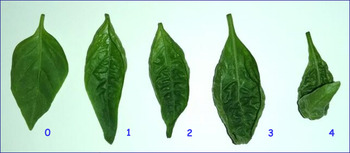
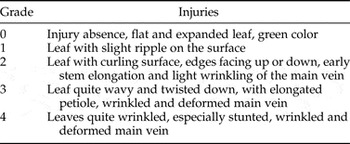
Seeds of the different C. annuum genotypes were grown in trays, containing BasaPlant® substrate, at the greenhouse until the opening of the first true leaves. Then, 16 seedlings of each material were transplanted into eight 5 liters pots (two seedlings per pot) containing a mixture of sandy soil and humus in the ratio of 2:1, and exposed to P. latus natural infestation at the greenhouse. The assessment of infestation was performed by observing the injuries and the number of mites per leaf. Observations were started on the 7th day after transplantation, with weekly frequency, using a scale for P. latus injuries in sweet-pepper adapted from Pereira et al. (Reference Pereira, Bernardo, Nechet and Mourão Júnior2007) and Lopes (Reference Lopes2009) (table 2) (fig. 1). For observations, for 5 weeks, eight apical leaves from plants of each genotype were collected weekly and placed into properly labeled paper bags. At laboratory, the leaves were measured in width X length and evaluated in the grade scale for injuries. For each leaf, the number of eggs, immature and adult of P. latus were counted in an optical stereoscopic. The experiment was conducted in a completely randomized design and subplots in time with six replications per genotype.
Visual grade scale for injuries (0–4) of Polyphagotarsonemus latus in Capsicum annuum genotypes. Adapted from Pereira et al. (Reference Pereira, Bernardo, Nechet and Mourão Júnior2007) and Lopes (Reference Lopes2009).

Grade scale for injuries of Polyphagotarsonemus latus in Capsicum annuum genotypes.

Adapted from Pereira et al. (Reference Pereira, Bernardo, Nechet and Mourão Júnior2007) and Lopes (Reference Lopes2009).
Statistical analysis
The results were submitted to ANOVA (Two-way ANOVA), considering the procedure of repeated measures (evaluation periods) and genotypes as treatments (SAS Institute, 2001). The means were compared by Tukey test at 5% probability. To study the correlation between the grades attributed to injuries and the mite infestation levels in different C. annuum genotypes, Pearson correlation coefficient was used.
Results
Host preference of P. latus on C. annuum genotypes
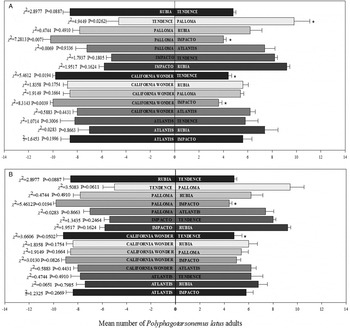
In free choice tests, assessing the host preference of P. latus in different C. annuum genotypes, there was statistical difference after 24 h for pairings between Tendence × Palloma; Palloma × Impacto; California Wonder × Tendence and California Wonder × Impacto (fig. 2). After 48 h, differences in the host preference of P. latus were significant only for the pairings Palloma × Impacto and California Wonder × Tendence. The results indicate the existence of host preference from P. latus by Palloma and California Wonder genotypes in relation to Impacto and Tendence, respectively. However, in none of the evaluated periods there was statistical difference between the pairings Rubia × Tendence; Palloma × Rubia; Palloma × Atlantis; Impacto × Tendence; Impacto × Rubia; California Wonder × Rubia; California Wonder × Palloma; California Wonder × Atlantis; Atlantis × Tendence; Atlantis × Rubia and Atlantis × Impacto.
Host preference of Polyphagotarsonemus latus adult females (n = 75) on Capsicum annuum genotypes (Atlantis, California Wonder, Impacto, Palloma, Rubia and Tendence) after 24 (A) and 48 (B) hours. Temperature: 25 ± 1°C, 70 ± 5% RH and 12 h photophase. Significance (P) by the χ2 test at 5% probability.

Effects of C. annuum genotypes on P. latus population growth
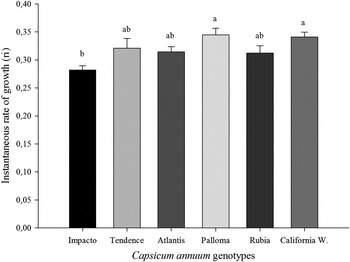
In no choice tests, the instantaneous rates of growth (ri) of P. latus were positive, after 7 days of bioassay, indicating a population growth in an arising state for all genotypes (fig. 3). Obtained values were 0.344; 0.340; 0.321; 0.314; 0.312; 0.281 for the genotypes Palloma, California Wonder, Tendence, Atlantis, Rubia and Impacto, respectively, with statistical differences only for Impacto when compared with Palloma and California Wonder (F = 3.47; P = 0.008; df = 5). The mean number of females, at the end of the bioassay, was statistically different between the genotypes Impacto and California Wonder (F = 2.37; P = 0.05; df = 5) (table 3), furthermore, Impacto mean number of males was significantly lower when compared with the other genotypes (F = 11.10, P < 0.0001; df = 5). Regarding the mean number of pupae, Impacto obtained smallest number when compared with California Wonder, Palloma and Rubia, as well as, the genotype Tendence when compared with Palloma (F = 6.95; P = 0.0005; df = 5). Impacto and Tendence also presented lower mean number of larvae when compared with Palloma (F = 2.66; P = 0.05; df = 5). The mean number of eggs did not differ between the genotypes (F = 0.93; P = 0.432; df = 5), and the mean of P. latus final population, after 7 days of bioassay, showed lower value for Impact when compared with Palloma and California Wonder (F = 2.48; P = 0.045; df = 5).
Instantaneous rate of growth (ri) of Polyphagotarsonemus latus on Capsicum annuum genotypes (Impacto, Tendence, Atlantis, Palloma, Rubia and California Wonder) after 7 days of bioassay. Temperature: 25 ± 1°C, RH 70 ± 5% and 12 h photophase.

Mean number ( ± SE) of females, males, pupae, larvae, eggs and final population (Nf) of Polyphagotarsonemus latus on Capsicum annuum genotypes after 7 days of bioassay. Temperature: 25 ± 1 °C, RH 70 ± 5% and 12 h photophase.

Means ± SE followed by the same letters in the column were not significantly different by the Tukey test at 5% of probability.
Injuries assessment and P. latus infestation on C. annuum genotypes
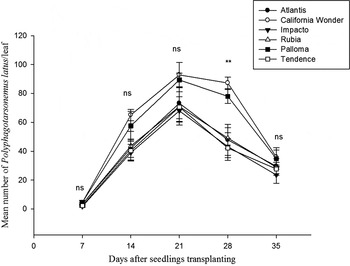
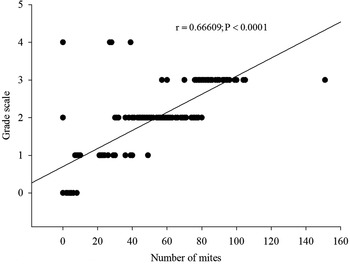
The number of mites on the leaves varied over the evaluation period, for all genotypes, individually, at 7, 14, 21, 28 and 35 days of evaluation, respectively (fig. 4). However, there was statistical difference between the genotypes, only after 28 days of bioassay, when California Wonder and Palloma presented a mean number of mites/leaf significantly higher compared with Impact and Tendence (F = 6.70; P = 0.0001, df = 20). In general, the total average of injuries grades at the end of the bioassay did not differ between genotypes, with values of 1.42; 1.65; 1.67; 1.7; 2.0 and 2.0 for Rubia, Impacto, Atlantis, Tendence, Palloma and California Wonder, respectively (F = 1.45; P = 0.206, df = 5). The grades from P. latus injuries among different C. annuum genotypes and the number of mite/leaf showed a positive correlation (r = 0.666; P < 0.0001) (fig. 5).
Mean number (±SE) of Polyphagotarsonemus latus collected per leaf on different Capsicum annuum genotypes (Atlantis, California Wonder, Impacto, Palloma, Rubia and Tendence) over 5 weeks after seedlings transplanting. ns, no significant difference; **, significant difference. Temperature: 29 ± 2°C, RH 73 ± 5% and 8 h photophase.

Correlation between the grade scale from injuries caused by Polyphagotarsonemus latus on Capsicum annuum and the number of mites collected in the evaluated leaves. Temperature: 29 ± 2°C, RH 73 ± 5% and 8 h photophase.

Discussion
The development of resistant genotypes as a management strategy for P. latus may represent an efficient and environmentally safe option, reducing the cost and risk of the need to use chemical control (Evaristo et al., Reference Evaristo, Venzon, Matos, Freitas, Kuki and Dias2013). The results of this study demonstrated that adult females of P. latus have active capacity of host choice, discriminating different C. annuum genotypes at the laboratory, being California Wonder and Palloma more preferred among the used genotypes, while Impact and Tendence were less preferred. Pereira et al. (Reference Pereira, Bernardo, Nechet and Mourão Júnior2007) evaluating the occurrence, damage and control of P. latus in greenhouse, also noted a preference to C. annuum genotypes. The hybrid Nathalie was the more resistant, with the lowest percentage of damaged plants throughout the experiment, while the hybrid Martha was the most preferred. Alagarmalai et al. (Reference Alagarmalai, Grinberg, Perl-Treves and Soroker2009) showed that adults and larvae of P. latus are capable of discriminating hosts in preference tests, and adult females stood out for higher choice behavior.
In accordance with the host preferences observed, P. latus demonstrated high rates of population growth in all C. annuum genotypes, however, showed greater population development on Palloma, followed by California Wonder and lower development on Impacto, with significant smallest numbers of males, larvae and pupae. The instantaneous rate of growth values (ri) found in this study ranged from 0.281 to 0.344 for Impacto to Palloma, corroborating with Silva et al. (Reference Silva, Oliveira, Gondim and Menezes1998) that evaluating P. latus biology in C. annuum, under laboratory conditions, found intrinsic rate of increase (rm) of 0.303. Miranda et al. (Reference Miranda, Montoya, Rodriguez, Depestre, Ramos and Rodriguez2009) estimated that the maximum capacity for increase of P. latus in C. annuum is up to 227.8 individuals per sample (leaf) with an intrinsic rate of 0.36. In our study, final populations of P. latus ranged from 86.3 to 167.5 for Impact to Palloma.
The differences observed in P. latus population development on different C. annuum genotypes, may result from the joint action of a number of factors, including, chemical and morphological mechanisms involved in the defense of these plants. However, there is a considerable difficulty in separating the effects of physical structures of those resulting from its chemical composition (Skirvin & Williams, Reference Skirvin and Williams1999). Knowledge regarding non-preference, biological parameters and the potential of P. latus growth allows the selection of desirable features for assessing suitable management strategies for this species (Evaristo et al., Reference Evaristo, Venzon, Matos, Freitas, Kuki and Dias2013).
Although there are methods widely used to control P. latus, infestations often begin soon after plants germination and are easily transported to uninfested seedlings by human action or phoresy by whiteflies and aphids (Palevsky et al., Reference Palevsky, Soroker, Weintraub, Mansour, Abu-Moach and Gerson2001). Thus, P. latus is featured as a major pest of the genus Capsicum, which has a particularly low tolerance to the attack of this mite (Coss-Romero & Peña, Reference Coss-Romero and Peña1998). According to the results, all C. annuum genotypes showed high susceptibility to P. latus, with rapid evolution of injuries, with no significant difference between them. However, the number of mites/leaf was significantly higher for California Wonder and Palloma and lower for Impact and Tendence at 28 days of evaluation period.
It was also verified a positive correlation between the injury scale grade and the number of mites/leaf, though, the most severe injuries have not met the greatest infestation. The number of mites/leaf was growing on the grade scale up to 3.0, but when the scale approached the grade 4.0, it was observed a decrease in the number of mites/leaf for all genotypes. Echer et al. (Reference Echer, Fernandes, Ribeiro and Peracchi2002), evaluating plant resistance to P. latus in 15 introductions of Capsicum spp., also found a reduction in the number of mites present in plants with high injury grades, and stated that this reduction was expected, since leafs with severe injuries become inadequate for the development of the mite, which tends to migrate to young leaves. According to Jeppson et al. (Reference Jeppson, Keifer and Baker1975), P. latus is very demanding for quality on colonized host, showing strong preference for young and tender plant tissues.
Jovicich et al. (Reference Jovicich, Cantliffe, Osborne and Stoffella2004) stated that at the time when the apical leaves have slight injuries, the population of P. latus is already high enough to cause real damage and high levels of effective control is difficult to achieve. Therefore, management strategies, where problems with this mite are frequent, should be whenever possible, based on preventing or controlling infestations right after plant germination. Cho et al. (Reference Cho, Jeon, La, Kim and Yiem1996) found that less than five mites in a seedling of Capsicum sp. might lead to severe injuries, resulting in lower production and fruit weight. Miranda et al. (Reference Miranda, Montoya, Rodriguez, Depestre, Ramos and Rodriguez2009) suggest applying a method of control when P. latus population reach more than 56 individuals per 100 sampled leaves. According to Gerson (Reference Gerson1992), the injuries caused by the mite may persist even after its control.
The development of C. annuum resistant genotypes to both pests and pathogens has been difficult to access, and research focusing on resistance to multiple species is scarce (Weintraub, Reference Weintraub2007). It is noteworthy that the results obtained to estimate the potential of P. latus, in each of the used genotypes, do not imply that the most favorable genotypes are attacked, in field situations, strictly in the same proportion as observed in laboratory and greenhouse. Since in the field, there are various biotic and abiotic factors acting on these organisms (Li & Li, Reference Li and Li1996; Croft, et al., Reference Croft, Pratt, Koskela and Kaufman1998).
This study ratifies the study of resistant genotypes as an important component of P. latus management, as they enable the producer to define and choose a C. annuum genotype more adapted and may reduce the use of phytosanitary management practices, thereby decreasing production costs and adverse environmental effects. In addition, it indicates the genotypes Impacto and Tendence as less preferred by P. latus.
Acknowledgements
To the Conselho Nacional de Desenvolvimento Científico e Tecnológico (CNPq), for granting the doctoral scholarship to the first author.