Debates about the role of religion in democratic citizenship have a long history and continue to elicit disagreement, but the link between religious involvement and democratic beliefs and behaviors appears fairly consistent: cross-nationally, individual religiosity is positively related to the strength of respondents’ democratic citizenship norms (Denters et al. Reference Denters, Gabriel, Torcal, Deth, Montero and Westholm2007; Bolzendahl and Coffé Reference Bolzendahl and Coffé2009; Dalton Reference Dalton2009), support for democracy (Ben-Nun Bloom and Arikan Reference Ben-Nun Bloom and Arikan2012; Vlas and Gherghina Reference Vlas and Gherghina2012; Smidt Reference Smidt2013), and political and civic engagement (Norris Reference Norris2002; Ruiter and De Graaf Reference Ruiter and De Graaf2006; Putnam and Campbell Reference Putnam and Campbell2010; Norris and Inglehart Reference Norris and Inglehart2011; McAndrew and Voas Reference McAndrew and Voas2013; Smidt Reference Smidt2013). Despite these consistent findings at the individual level, concerns about whether religion facilitates or undermines democratic citizenship linger.
First, taking religion seriously as a social construct means that we need to further investigate the relationship between aggregate societal religiosity and cross-national variation in citizenship norms and behavior. Specifically, aggregate religiosity may account, at least in part, for comparative variation in democratic citizenship values and participation. One possibility is that the positive relationship found at the individual level will be magnified in state-level variation, though recent research on volunteering and protest suggests this may not be the case (e.g., Lim and MacGregor Reference Lim and MacGregor2012; Arikan and Ben-Nun Bloom Reference Arikan and Ben-Nun Bloom2019). Second, individuals’ religious and political behaviors happen in a state religious context that varies dramatically from one country to another (Schnabel and Bock Reference Schnabel and Bock2017), and this context may alter the link between religiosity and democratic citizenship (Lim and MacGregor Reference Lim and MacGregor2012; Arikan and Ben-Nun Bloom Reference Arikan and Ben-Nun Bloom2019). In other words, national-level religiosity could moderate the impact of individual religiosity. Therefore, we ask: how is religious engagement related to democratic citizenship norms and political participation at the individual and national levels, and is there an interaction across the two levels?
The answers to these questions have important implications for larger debates about the fate of democracy in newly democratizing contexts where citizens are highly religious (Jamal and Tessler Reference Jamal and Tessler2008; Rowley and Smith Reference Rowley and Smith2009; Potrafke Reference Potrafke2012) as well as the democratic integration of more religious immigrants and refugees (Foner and Alba Reference Foner and Alba2008). Our approach highlights the importance of distinguishing between individual and state-level religion, and how individual-level religion may mean something different in more or less religious contexts. Building on an established literature about people's commitment to and participation in democratic citizenship (Marien et al. Reference Marien, Hooghe and Quintelier2010; Bolzendahl and Coffé Reference Bolzendahl and Coffé2013; Dalton and Welzel Reference Dalton and Welzel2014; Hooghe and Oser Reference Hooghe and Oser2015), we address our research questions with data from the 2014 International Social Survey Program (ISSP) module on Citizenship across 28 predominantly-Christian democracies. Using multi-level models, we examine how these outcomes vary by (1) individual-level religious attendance,Footnote 1 (2) state-level average national religious attendance, and (3) cross-level interactions between individual-level attendance and the state-level factor.
We find that (1) individual-level religious attendance is positively linked to strong citizenship norms and political participation, but is a stronger predictor of what people say (norms) than what they do (participation); (2) aggregate national levels of religious attendance are weakly positively linked to a country's average commitment to the norms of democratic citizenship but are negatively linked to levels of democratic participation; and (3) the relationship between individual-level attendance and citizenship varies by national religious context. Individual religious attendance is more strongly linked to political involvement where it is more distinctive (i.e., in more secular countries). We conclude with a discussion of the implications (and limitations) of these findings and questions for future research.
INDIVIDUAL RELIGIOSITY AND DEMOCRATIC CITIZENSHIP
Stable democracies rely on citizens sharing a set of broadly defined democratic norms and participatory commitments incorporating both rights and duties (Janoski Reference Janoski1998; Lister Reference Lister2003; Dalton Reference Dalton2009). The right and duty to participate in decision-making in social, economic, cultural, and political life are central components of democratic citizenship, grounded in a commitment to the ideals of citizens’ responsibilities to others in a democratic community (Marshall Reference Marshall1950; Meade Reference Meade1986; Lister Reference Lister2003; Conover et al. Reference Conover, Searing and Crewe2004; Bolzendahl and Coffé Reference Bolzendahl and Coffé2009). Citizenship norms reflecting these values are defined as a “…shared set of expectations about the citizen's role in politics” (Dalton Reference Dalton2008, 78). These norms encompass a broad set of commitments to citizenship basics such as being law-abiding, politically engaged, socially aware, and taxpaying voters, and beyond these basics to further aspects of citizenship such as politically-informed consumption, helping others, and participating in civic associations (Stolle et al. Reference Stolle, Hooghe and Micheletti2005; Denters et al. Reference Denters, Gabriel, Torcal, Deth, Montero and Westholm2007; Dalton Reference Dalton2009).
Democratic citizenship is also a function of what citizens actually do, including public participation in a variety of political venues (Verba et al. Reference Verba, Nie and Kim1978; Verba Reference Verba1996). When scholars talk about democratic participation they often focus on formal political outcomes such as voting or party membership, but a broad array of informal and non-electoral political and civic activities are key components of strong democratic citizenship (Almond and Verba Reference Almond and Verba1989; Inglehart Reference Inglehart1997; Stolle et al. Reference Stolle, Hooghe and Micheletti2005; Burns Reference Burns2007; Dalton Reference Dalton2008; Coffé and Bolzendahl Reference Coffé and Bolzendahl2010; Bolzendahl and Coffé Reference Bolzendahl and Coffé2013).
Individual religiosity has been positively linked to certain aspects of citizenship including democratic values (Denters et al. Reference Denters, Gabriel, Torcal, Deth, Montero and Westholm2007; Bolzendahl and Coffé Reference Bolzendahl and Coffé2009; Ben-Nun Bloom and Arikan Reference Ben-Nun Bloom and Arikan2012; Vlas and Gherghina Reference Vlas and Gherghina2012; Smidt Reference Smidt2013), civic involvement (Ruiter and De Graaf Reference Ruiter and De Graaf2006; Putnam and Campbell Reference Putnam and Campbell2010; McAndrew and Voas Reference McAndrew and Voas2013; Smidt Reference Smidt2013), and political participation including voting, party membership, and protest (Norris Reference Norris2002; Driskell et al. Reference Driskell, Embry and Lyon2008; Norris and Inglehart Reference Norris and Inglehart2011; Smidt Reference Smidt2013; Arikan and Ben-Nun Bloom Reference Arikan and Ben-Nun Bloom2019). The mechanisms explaining this connection are multiple and overlapping. First, religious involvement may promote civic and community interests (Putnam Reference Putnam2001; Borgonovi Reference Borgonovi2008; Putnam and Campbell Reference Putnam and Campbell2010) by instilling norms about belonging and community (Fox Reference Fox2001; Voicu Reference Voicu2012; Smidt Reference Smidt2013). Second, according to social network explanations, those attending religious services have more opportunities to interact with other citizens, discuss politics, and engage in community activities (Ben-Nun Bloom and Arikan Reference Ben-Nun Bloom and Arikan2012). Third, religious elites can encourage their engaged communities to become involved democratic citizens (Verba et al. Reference Verba, Schlozman and Brady1995; Jelen and Wilcox Reference Jelen and Wilcox2002). Finally, religion may equip individuals with the practical knowledge and skills (human capital) they need to become engaged citizens (Smith Reference Smith1996; Sherkat and Ellison Reference Sherkat and Ellison1999; Wald et al. Reference Wald, Silverman and Fridy2005; Smidt Reference Smidt2013), as well as organizational resources to engage in political action (Morris Reference Morris1984; Brady et al. Reference Brady, Verba and Schlozman1995; Putnam Reference Putnam2004; Burns and Kniss Reference Burns, Kniss, Snow, Della Porta, Klandermans and McAdam2013).
This established and fairly considerable literature leads us to the following hypothesis:
Hypothesis 1: Individual commitments to citizenship norms and involvement in political activities will be greater for those who attend religious services more frequently.
CROSS-NATIONAL DIFFERENCES IN RELIGIOSITY AND DEMOCRATIC CITIZENSHIP
The relationship between individual-level religiosity and democratic citizenship is well documented, but does not address comparative aggregate variation in democratic citizenship. Research has shown drastic cross-national differences in average religiosity (Fox Reference Fox2006; Fox and Flores Reference Fox and Flores2009; Arikan and Ben-Nun Bloom Reference Arikan and Ben-Nun Bloom2019), frequently measured as average frequency of attendance (Ruiter and van Tubergen Reference Ruiter and van Tubergen2009). We know contextual-level religion frequently operates over and above the individuals who contribute to it, having a “sui generis” influence on the social and sexual values and behavior of both religious and secular people (Kelly and DeGraaf Reference Kelly and DeGraaf1997; Adamczyk and Pitt Reference Adamczyk and Pitt2009; Lim and MacGregor Reference Lim and MacGregor2012). Yet, we know much less about how aggregate religiosity relates to average national differences in citizenship norms and behavior.
Theoretically, aggregate religious attendance is a contextual factor that could operate indirectly, through various network and exposure effects (Regnerus Reference Regnerus2003; Smith Reference Smith2003), as well as more formal legal or cultural institutions (Finke and Adamczyk Reference Finke and Adamczyk2008). The studies that could guide our expectations about the potential relationship between aggregate societal religiosity and political norms and behavior are limited and contradictory. When considering the impact of aggregate religious attendance and volunteering, for example, some work finds a positive relationship (Ruiter and De Graaf Reference Ruiter and De Graaf2006; Reference Ruiter and De Graaf2010) while other studies do not (Van der Meer et al. Reference Van der Meer, Te Grotenhuis and Pelzer2010; Arikan and Ben-Nun Bloom Reference Arikan and Ben-Nun Bloom2019).Footnote 2 Specifically, Lim and MacGregor (Reference Lim and MacGregor2012) find that religious localities in the United States have lower rates of volunteering.
Arguments for a positive relationship between societal religiosity and strong citizenship norms and behaviors are largely based on the concept of “moral communities” (Stark Reference Stark1996; Ruiter and De Graaf Reference Ruiter and De Graaf2006) in which higher average religious attendance indicates people's greater exposure to religious culture and the higher likelihood of having religious persons in one's social network (Kelly and DeGraaf Reference Kelly and DeGraaf1997; Ruiter and De Graaf Reference Ruiter and De Graaf2006). On the basis of this framework, a more religious context should, in theory, promote positive citizenship norms and civic participation. Lim and MacGregor (Reference Lim and MacGregor2012), however, argue that religiosity is too geographically or socially stratified and uneven to use aggregate religiosity as a proxy for religiosity in social networks, and their findings strongly challenge the moral communities’ framework. Lim and MacGregor provide several possible explanations for why contextual religiosity seems to have a negative impact on volunteering. For example, in more religious contexts there may be more free-riding, or that aggregate religiosity—if taken as a proxy for a national religious culture—could influence individual behaviors in ways that matter differently from, or regardless of, personal religiosity. Lacking a large literature with any consensus about how contextual religious culture impacts individual civic attitudes and behaviors, we draw on Lim and MacGregor (Reference Lim and MacGregor2012) to set forth the following hypothesis:
Hypothesis 2: National average commitments to citizenship norms and involvement in political activities will be weaker in nations with higher aggregate religious attendance.
RELIGIOUS CONTEXTS AND DEMOCRATIC CITIZENSHIP
Earlier, we offered arguments regarding the impact of religiosity among individuals as well as between states. Both approaches neglect the importance of potential contextual variation in individual differences. Does the relationship between individual religiosity and democratic citizenship norms and behavior vary based on national religious context? Research shows that religious individuals are more committed to citizenship norms and political activities, but this relationship may vary based on whether the individual lives in nations where their average fellow citizens are more or less actively involved in religion. In the United States, the individual propensity to volunteer is depressed in more highly religious contexts, though religious context does not affect frequent attendees’ level of volunteering (Lim and MacGregor Reference Lim and MacGregor2012). Across 53 countries, Ruiter and De Graaf (Reference Ruiter and De Graaf2006) found that individual attendance promotes volunteering more in the most secular countries.
Although the specific mechanisms underlying such potential cross-level interaction are difficult to untangle (and doing so is beyond the scope of this paper), we offer a few related possibilities that inform our expectations. One possibility is that in contexts where everyone is religious, there may be general saturation of religiosity and it may be a less distinctive factor in people's civic commitment and engagement. Specifically, if everyone is religious, the choice to be religious could be less meaningful, and the religious teachings and values of religious institutions potentially less counter-cultural. Widespread religiosity may also dissuade interest in political matters (Rink Reference Rink2018), marginalize those who are more weakly tied to the church (Lim and MacGregor Reference Lim and MacGregor2012), and/or place more sociopolitical issues under clerical control (Buckley Reference Buckley2016).Footnote 3 Conversely, being religious in a more secular society may be more distinctive, require more from adherents, and/or promote a sense of “embattlement” and perceived need for activism on behalf countercultural values. Therefore, we set forth the following hypothesis:
Hypothesis 3: The relationship between individual religiosity and citizenship norms and behaviors will be weaker in more religious contexts.
DATA
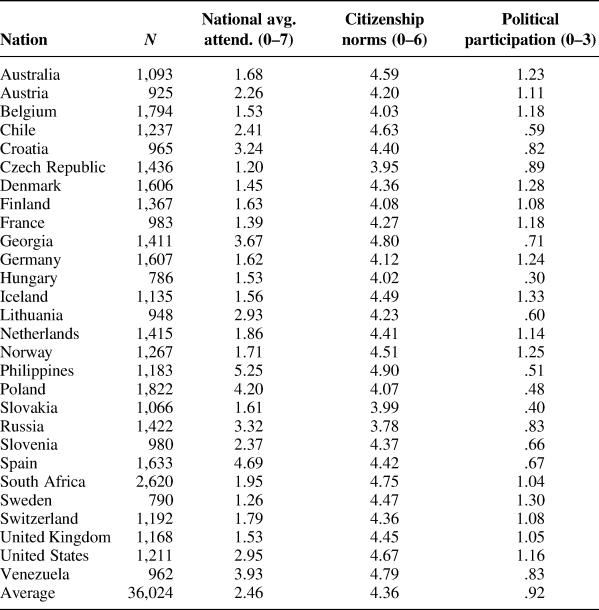
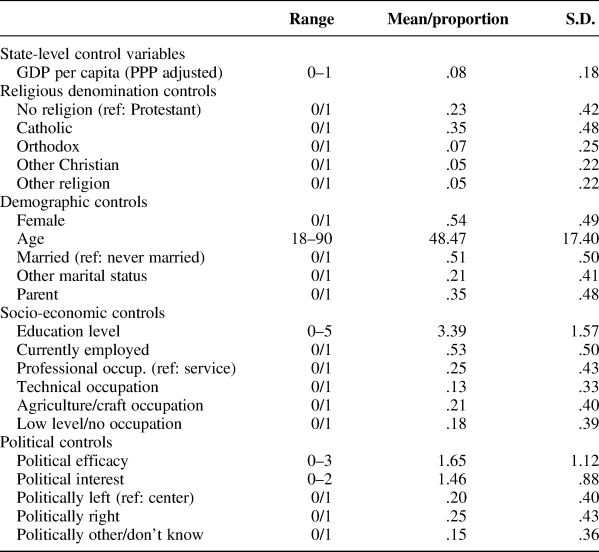
Our data come from the 2014 International Social Survey Program (ISSP) module on Citizenship (ISSP Research Group 2016; Joye and Sapin Reference Joye and Sapin2017). The ISSP coordinates survey research across a variety of different countries to provide social scientists with a reliable, cross-national dataset. For our analysis, we focus on 28 historically-Christian nations (see discussion of individual religious attendance below).Footnote 4 We focus on cases with complete data for a final sample size of 36,024 individuals. Nations, sample sizes, and means/proportions for key variables are listed in Table 2. Descriptive statistics for all individual-level variables are listed in the Appendix (Table A1).
MEASURES
Dependent Variables
Our measure of the norms of citizenship captures the normative expectations about the political, legal, and social responsibilities of democratic citizens (Denters et al. Reference Denters, Gabriel, Torcal, Deth, Montero and Westholm2007; Dalton Reference Dalton2008; Bolzendahl and Coffé Reference Bolzendahl and Coffé2009). Respondents were asked how important it is for citizens to do each of the following: always vote in elections; never evade taxes; always obey laws and regulations; keep watch on the actions of the government; be active in social or political associations; understand the reasoning of people with other opinions; to choose products for political, ethical or environmental reasons, even if they cost a bit more; to help people in their own country who are worse off than themselves; and to help people around the world who are worse off than themselves. Possible responses ranged from (1) not important to (7) very important. The nine items are summed into a scale (α = .78) with zero as the base value, and all respondents with at least one valid response are averaged into the scale. The scale is highly positively skewed such that most respondents viewed these responsibilities as quite important. Diagnostic tests indicate that squaring the values normalizes the distribution. Therefore, we use the squared values in the analyses presented in the paper. To aid in interpretability and comparability, we standardize this measure so that it has a mean of zero and a standard deviation of one.
Non-Electoral Political Participation
Active participation in various democratic arenas is central to well-functioning democracies as governments of and for the people (Verba et al. Reference Verba, Schlozman and Brady1995). Capturing a variety of modes of democratic participation, the ISSP asked respondents whether they had done the following activities: signed a petition; boycotted/bought products for political, ethical, or environmental reasons; took part in a demonstration; attended a political meeting or rally; contacted or attempted to contact a politician or civil servant to express views; donated or raised funds for a political or social activity; contacted or appeared in the media to express views; joined an internet political forum or discussion group. Respondents could state they have (0) never done it and are unwilling to; (1) never done it but are willing to; (2) done it in the distant past; (3) done it in the past year.Footnote 5 The eight items are summed into a scale (α = .84) capturing variation in the willingness to participate and recentness of participation. Respondents with valid responses on at least one item are retained. Tests for skew indicate the variable is not normally distributed. Although squaring the measure resolves the skew for the other outcome, it does not do the same for this measure. To ensure the robustness of our findings, the variable was analyzed with models based on a Poisson distribution and results were consistent. This variable is also standardized to have a mean of zero and a standard deviation of one.
Independent Variables: Individual Level
Individual Religiosity
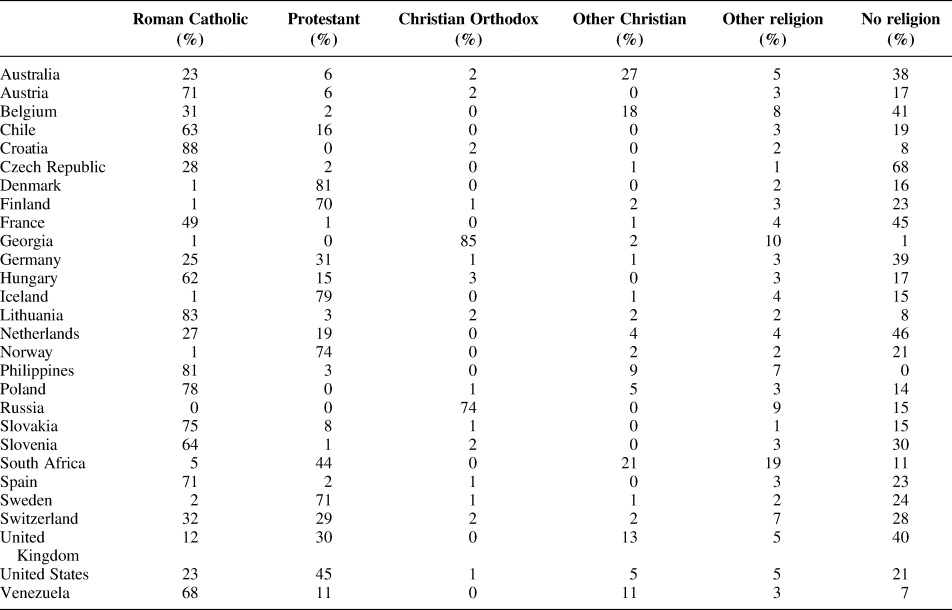
Our primary individual-level independent variable measures individual religiosity as religious service attendance. This measure represents the frequency of engagement in a formal religious community and proxies intensity of religiosity—specifically, how willing the respondent is to spend time and effort in being involved in organized religion. Respondents were given eight response options: several times a week, once a week, two or three times a month, once a month, several times a year, once a year, less frequently, or never. The variable is coded to range from (0) never to (7) several times a week. Attendance as a proxy for individual religiosity is not without limitations, including that it can mean different things in different contexts; specifically, attendance frequency is better at measuring religious participation in congregation-focused religious traditions such as Christianity. Not only is attendance biased toward congregation-focused religions, it means different things across traditions, such that the ISSP fielded the item differently in some non-Christian countries.Footnote 6 A more general measure of religious salience may be better for comparisons across religious traditions, but would not directly measure religious participation in the way attendance has in the existing literature (see e.g., Ruiter and De Graaf Reference Ruiter and De Graaf2006; Ruiter and van Tubergen Reference Ruiter and van Tubergen2009; Lim and MacGregor Reference Lim and MacGregor2012; Arikan and Ben-Nun Bloom Reference Arikan and Ben-Nun Bloom2019). Because attendance means something different across religious traditions, and all but six ISSP countries are predominantly-Christian, we limit the analysis to these contexts (see also Appendix, Table A2).
Individual-Level Controls
We control for a variety of socio-demographic characteristics and potentially confounding socio-political attitudes. These controls are standard in the literature on democratic norms and participation (Burns et al. Reference Burns, Schlozman and Verba2001; Dalton Reference Dalton2008; Bolzendahl and Coffé Reference Bolzendahl and Coffé2013), and in our case help ensure that the relationships we describe are net of confounding characteristics. At a basic level, we control for a number of key demographic characteristics. Models include age of respondent (in years), gender (woman = 1), marital status (categories: married/living as married/widowed; divorced/separated; and never married/single), and child in household (yes = 1). We also control for socio-economic status in three ways: (1) level of education, which ranges from (0) no formal qualifications to (5) university degree completedFootnote 7; (2) employment, measured with a dichotomous variable of whether the respondent is currently employed; and (3) occupation, measured with five categories (professional, technical, service, agricultural or craft work, and no or low skilled). Further tests with family income coded into relative values within each nation show no significant relationship to the dependent variables or mediating relationship with other controls. Given that income is measured inconsistently across the nations and has high proportions of missing values we chose to exclude family income as a control.
Three types of controls for political affinities are included. Two ordinal questions were combined to create a political efficacy scale (γ = .59; p < .005). Respondents could (0) strongly agree to (4) strongly disagree that they had no influence on what the government does and that the government did not care what s/he thought. Higher scores indicate greater feelings of efficacy. Respondents’ personal interest in politics is measured from (0) not at all interested to (3) very interested. Self-assessed political ideology is coded into four groups: left, right, center, and other/don't know. Finally, we control for potential religious denominational differences with a six-category (Catholic, Protestant, Orthodox, other Christian, other religion, and no affiliation) measure of religious affiliation.
Independent Variables: Country Level
We measure country-level religiosity with average national religious attendance, which we consider to proxy the cultural pervasiveness of religious involvement. This measure is aggregated from the individual measure of attendance provided through the ISSP and recoded to range from 0 continuously to 1. Table 1 presents the actual variation in the untransformed variable on average and for each nation.
Means for key state-level variables for all 28 nations

Notes: Raw data presented here, in models below these variables are recoded to range from 0 to 1 and/or are standardized.
Source: ISSP 2014.
All models control for 2014 Gross Domestic Product (GDP) per capita, adjusted for purchasing parity power (PPP), as publicly available from the World Bank (htttp:// www.worldbank.org). A variable controlling for level of democracy was too highly correlated with GDP to be included in the analysis. We also use categories from the Inglehart-Welzel Culture Map, one of the most powerful methods of identifying the cultural schisms among global society (Inglehart and Welzel 2015). This map identifies two major dimensions of cross-cultural variation: traditional values versus secular-rational values and survival values versus self-expression values. Given that attitudes are highly correlated with the philosophical, political, and religious ideas historically dominant in particular regions, Inglehart and Welzel have been able to identify substantively meaningful cultural clusters (Welzel Reference Welzel2013). We examined these clusters one-by-one and in combination with one another, and found the Catholic European cluster is notably different from the other clusters with regard to citizenship norms, and the Protestant European cluster is significantly different with regard to political participation. We include dichotomous variables for these clusters.
Table 1 presents average attendance, citizenship norms, and political participation for each of the 28 countries considered in this study.
ANALYTIC STRATEGY
Hierarchal linear regression models were run in Stata with the “xtmixed” command, and verified in HLM7. Data used in individual-level estimates are weighted using a factor provided by the ISSP. We examined the data visually through scatterplots and tested for the presence of influential cases with diagnostic tests (e.g., DFBETAs and values for Cook's D) (Van der Meer et al. Reference Van der Meer, Te Grotenhuis and Pelzer2010). We ran all models by dropping states individually and by dropping groups of states that were potential outliers. These approaches did reveal important inconsistencies in the results for democratic norms but not political participation. Differences are discussed in more detail in the results below.Footnote 8 We allow the slope for individual-level religious service attendance to vary randomly in all models.
CROSS-NATIONAL PATTERNS: RELIGION, NORMS, AND PARTICIPATION
As seen in Table 1, levels of religious attendance, political norms, and political participation vary widely across nations. We begin by considering scatterplots of the country-level relationships between these measures.
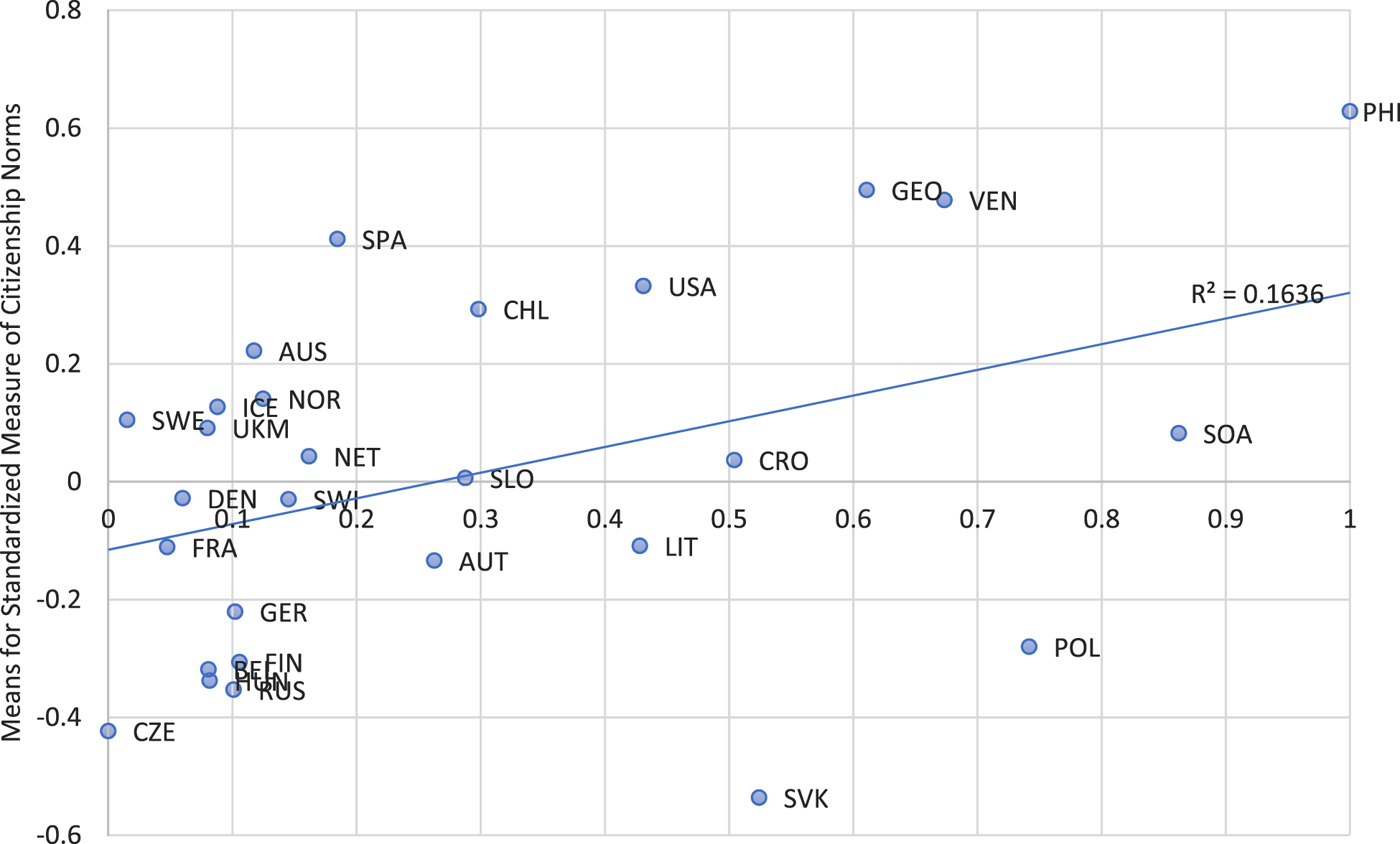
Figure 1 shows the relationship between the standardized measure of citizenship norms and average attendance (ranging from 0 to 1). These variables correlate at r = .40, which increases to .50 when one visual outlier, Slovakia, is dropped (or, alternatively, to .44 when Spain is dropped). The scatterplot indicates a positive relationship, though with substantial variation, between attendance and citizenship norms across the nations in this sample. We will present further information on outlier testing below.
Bivariate relationship between average religious service attendance (y-axis) and average citizenship norms.

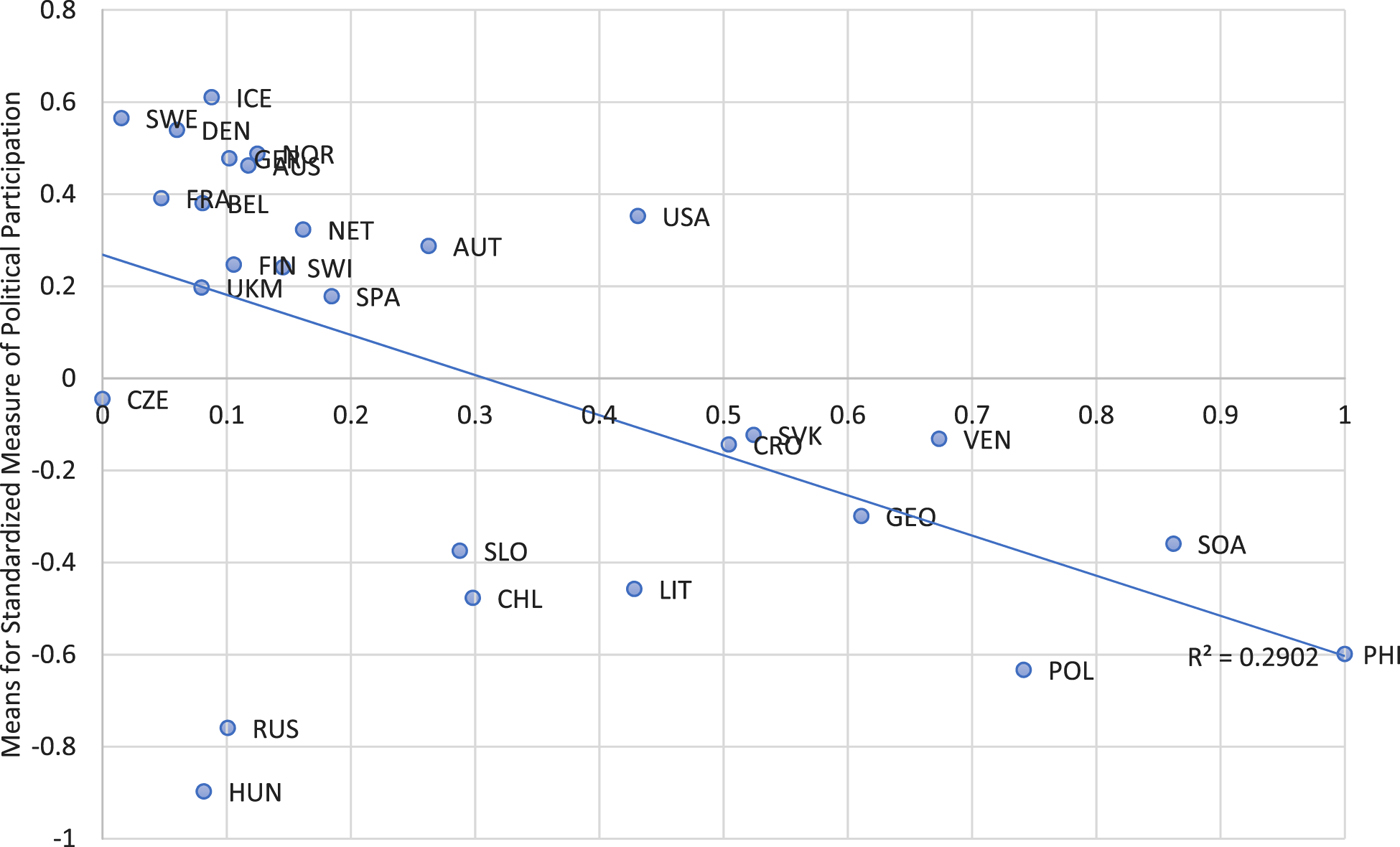
We found a strong positive correlation between attendance and citizenship norms, but when turning to citizenship behavior we see a strong negative relationship. The overall correlation is r = −.54, and this increases to −.78 when two visual outliers, Russia and Hungary, are not included in the calculations. Descriptively, then, we see some evidence that more religious cultures (as measured by average attendance) may bolster the expression of normative commitments, but undermine actual participation. However, we still need to consider multilevel and multivariate models to further explore these relationships. We next turn to models that allow us to test our hypotheses about the potential impact of country-level religion independent of, and in interaction with, individual-level religion.
MODELS OF RELIGION, NORMS, AND PARTICIPATION
Individual-Level Relationships
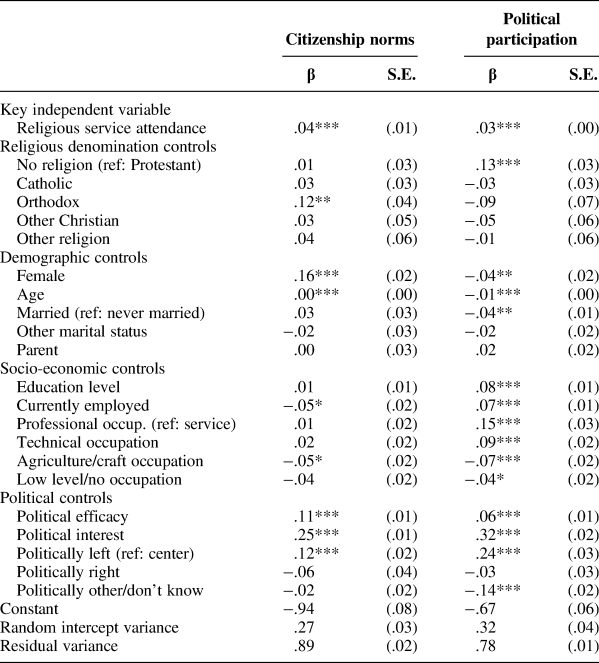
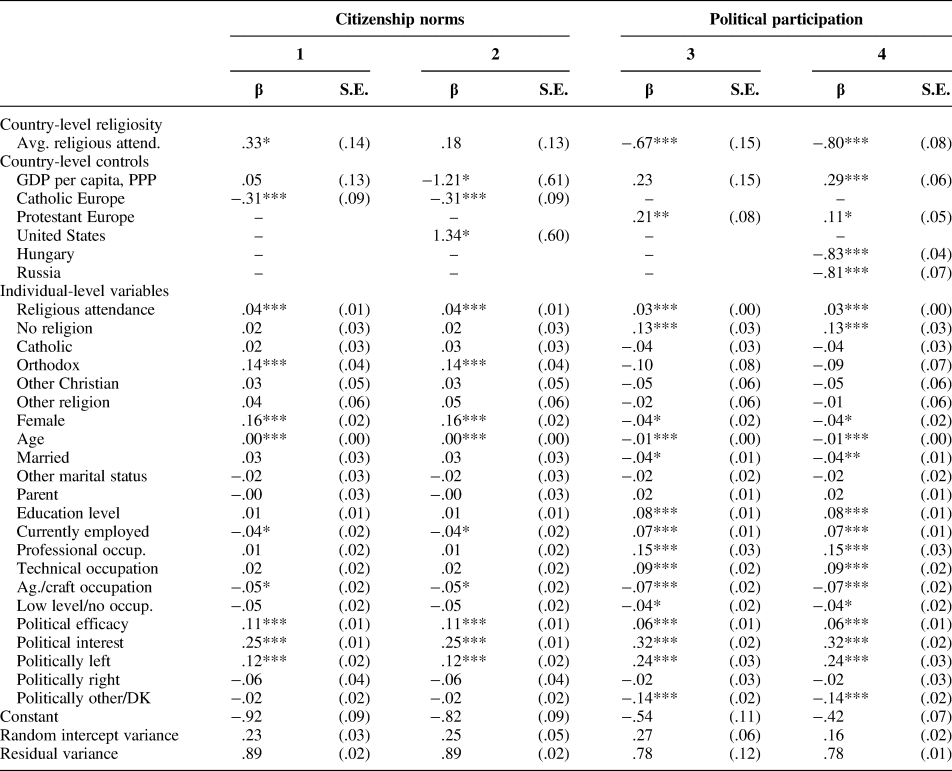
Table 2 shows the relationship between individual religious service attendance and both citizenship norms and political participation. Both coefficients are significant and positive, indicating (as expected) strong support for Hypothesis 1: individuals who attend religious services more frequently are more committed to citizenship norms and more involved in political activities. Findings for controls are similar to those in prior work studying norms and participation (Kam and Palmer Reference Kam and Palmer2008; Bolzendahl and Coffé Reference Bolzendahl and Coffé2009; Coffé and Bolzendahl Reference Coffé and Bolzendahl2010; Marien et al. Reference Marien, Hooghe and Quintelier2010). Specifically, women are more normatively committed to democratic citizenship than their lower participation would indicate. Those who are more politically interested and engaged hold stronger norms and participate more. Finally, participation is strongly cleaved by socio-economic divides such that those who have more resources in this area participate significantly more.Footnote 9
Results for individual-level hierarchal linear regression models of religious attendance on citizenship norms and political participation, N = 36,024

*p < .05, **p < .01, ***p < .001 (two-tailed tests).
Understanding Aggregate Norms and Participation Cross-Nationally
Figures 1 and 2 raise a number of questions about the appropriate sample to focus on in a second-level hierarchal analysis. A combination of visual assessments, dropping nations systematically, and examining clusters of influential cases are key for ensuring robust results (Ruiter and De Graaf Reference Ruiter and De Graaf2010; Van der Meer et al. Reference Van der Meer, Te Grotenhuis and Pelzer2010). Multilevel models for both norms and participation were checked across all these factors. Assessing and adjusting for outliers did not change the overall patterns for political participation, though dropping some nations strengthen the relationship described below. With regard to norms, the aggregate positive relationship is no longer significant when controlling for or excluding the United States. Dropping other visual outliers (e.g., Slovakia) does not change the results. We present results for final models in Table 3.
Bivariate relationship between average religious service attendance (y-axis) and average political participation.

Results from hierarchal linear regression models of average national religious attendance on citizenship norms and political participation, N = 36,024

*p < .05, **p < .01, ***p < .001 (two-tailed tests).
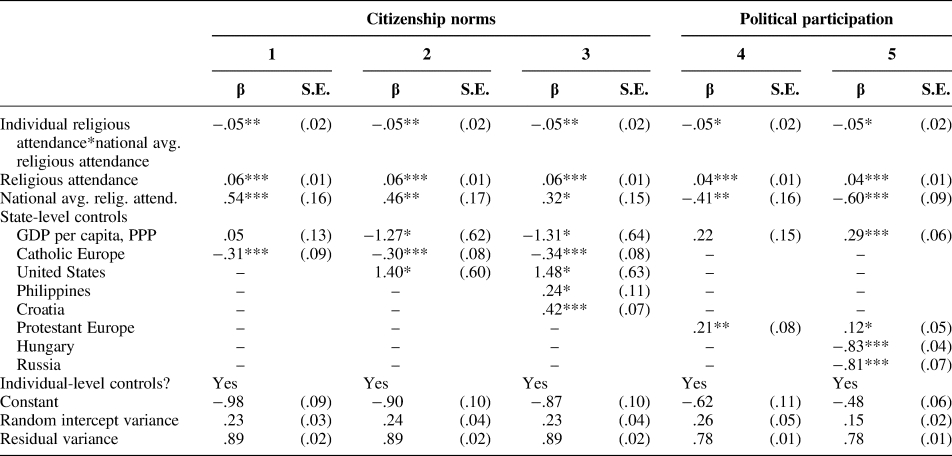
Although our descriptive plots suggested a strong positive relationship between aggregate attendance and citizenship norms, this relationship does not persist in models that control for key country-level differences. The negative residuals in Figure 1 belong to many historically-Catholic nations (e.g., Poland and Slovakia). Here we see that this group of 10 nations has significantly weaker citizenship norms. Yet, as we see in model 1 of Table 3, there is still a positive relationship with aggregate attendance. As further testing shows in model 2, however, the result was not stable and simply including a control for the United States—which seems to have an outsized impact on the pattern—makes the aggregate relationship between attendance and citizenship norms become insignificant.Footnote 10 In this case, we fail to reject the null in our second hypothesis and conclude there is no clear evidence that more religious nations have weaker commitments to citizenship norms.
In models 3 and 4, we examine political participation and find a negative relationship between average religious service attendance in a nation and that nation's political participation. Robustness checks did not indicate any important outliers and the main coefficient remained significant when dropping countries individually. Russia and Hungary were visual outliers (Figure 2), and when dropping them the relationship becomes even stronger. There is a positive relationship between Protestant European nations and participation, also reflecting patterns seen in Figure 2. These findings support Hypothesis 2, and suggest that more religious countries are more likely to eschew informal political participation. One clue for understanding this finding may be found in examining cross-level interactions, which we turn to next.
Cross-Level Interactions: Norms and Participation in Religious Context
The results presented in Table 4 consider whether the relationship between individual attendance and democratic norms and participation vary across religious contexts (in this case measured as the average level of religious service attendance in a country). Although a strong positive relationship was found (Table 2) between individual attendance frequency and citizenship norms, country-level tests (Table 3) suggested it could not be extended toward explaining variation across nations in the average importance assigned to these norms. The results in Table 4 indicate that the positive relationship between more frequent religious service attendance and norms is weaker in more religious contexts. Model 1 includes no country controls, model 2 controls for the United States, and model 3 controls for two additional outliers (Philippines and Croatia). All three nations have higher than average commitments to citizenship norms, thus controlling for all of them presents a conservative test of the cross-level interaction. The negative interaction remains significant.
Results from hierarchal linear regression models of the interaction between individual and national religious attendance on citizenship norms and political participation, N = 36,024

*p < .05, **p < .01, ***p < .001 (two-tailed tests).
In models 4 and 5, we examine the same relationship for political participation and also find that a more religious context (higher average levels of attendance) depresses the positive relationship between individual attendance and political participation. The negative main coefficient of country-level religiousness on political participation is strengthened slightly when controlling for Hungary and Russia, two nations with substantially lower than average levels of participation. Overall, we see strong support for Hypothesis 3: a more religious context appears to weaken the positive relationship between attendance and democratic values and behavior.
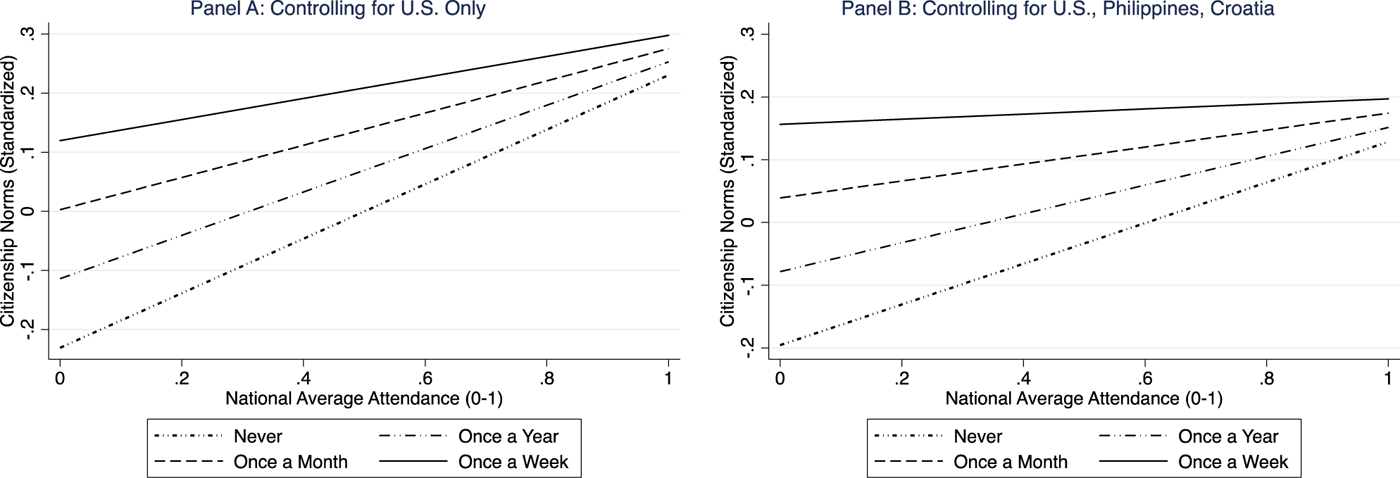
To more clearly illustrate these patterns, we modeled the marginal predicted values for citizenship norms and political participation at key levels of individual and national attendance in Figures 3 and 4. Figure 3 is comprised of panels A and B, which are based on models 2 and 3 in Table 4, respectively. Focusing on the most conservative model in panel B, we see that frequent attendees hold strong commitments to citizenship norms regardless of context, but as the context become more religious (higher average attendance) those who attend less frequently have much stronger normative values.
Predicted marginal values for citizenship norms across levels of individual and national average religious services attendance.

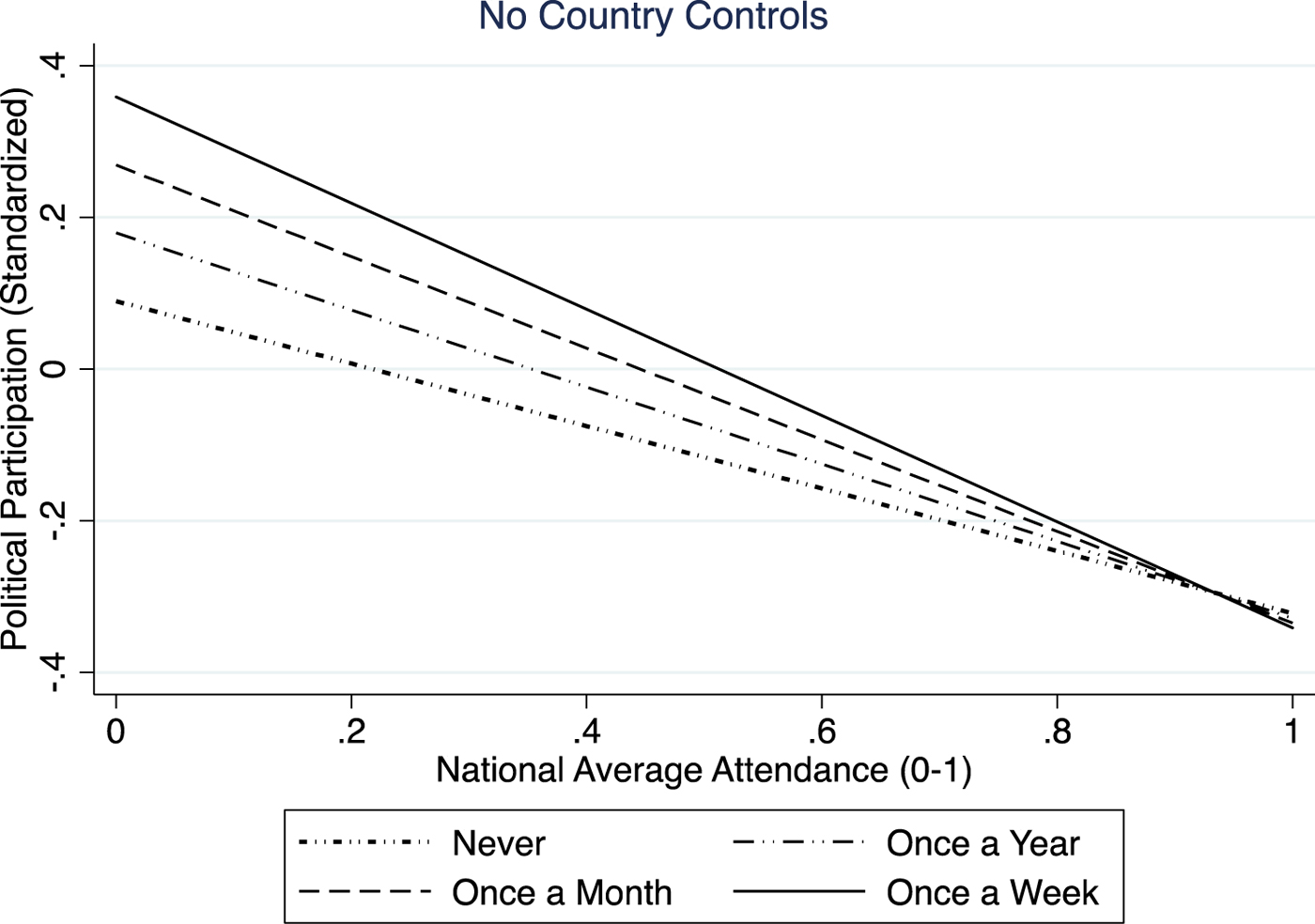
Predicted marginal values for political participation across levels of individual and national average religious services attendance.

In Figure 4, which illustrates model 4Footnote 11 in Table 4, the pattern for political participation is different because religious attendance operates differently at the individual and country levels. As Table 3 shows, religious individuals tend to participate more, and countries with higher levels of attendance tend to have less participation overall. The negative interaction thus indicates that, although frequent attendees participate more, this relationship becomes significantly weaker as the context become more religious. Those who never attend church participate less, but their participation is not shaped as strongly by religious context. Overall, then, we find that although there are large differences in citizenship norms and behaviors by attendance in more secular countries, the attendance gap shrinks with higher average attendance. In fact, the predicted probabilities in Figures 3 and 4 indicate that citizenship norms converge at similarly high, and citizenship behaviors at similarly low, levels in the most religious countries.
DISCUSSION
We examined whether and how religion at individual and national levels is related to democratic citizenship norms and political participation in a sample of predominantly-Christian democracies. Our results confirm, as expected, that individuals who attend religious services more frequently place much greater emphasis on citizenship duties and are somewhat more involved in political activities (see e.g., Denters et al. Reference Denters, Gabriel, Torcal, Deth, Montero and Westholm2007; Bolzendahl and Coffé Reference Bolzendahl and Coffé2009; Ben-Nun Bloom and Arikan Reference Ben-Nun Bloom and Arikan2012; Vlas and Gherghina Reference Vlas and Gherghina2012; Smidt Reference Smidt2013),
The country-level patterns were more complex. The relationship between aggregate attendance and average citizenship norms appeared positive but was driven by key outliers. The United States, in particular, had an outsized impact on the results for democratic norms and controlling for it diminished the positive main coefficient. In this case, our results do not support Hypothesis 2, and we conclude there is no evidence that average attendance accounts for cross-national differences in average country-level citizenship norms. In comparison, we found a strong negative country-level relationship between average attendance and political participation. These results support Hypothesis 2 and parallel other work in related areas (Lim and MacGregor Reference Lim and MacGregor2012; Arikan and Ben-Nun Bloom Reference Arikan and Ben-Nun Bloom2019). Although past studies focused on different indicators and samples than our own, we view our results as complementary. Given that aggregate religiosity is not related to norms but negatively related to participation, these results may also indicate the importance of distinguishing between religion's impact on political values versus political behaviors.
Our third hypothesis, that attendance would matter less in more religious nations, was supported for both citizenship norms and political participation, but in divergent ways. First, the strong positive relationship between the normative values of democratic citizenship and high church attendees holds regardless of religious context, but those who attend services less frequently, or not at all, have much stronger commitments to democratic norms in more religious contexts. By comparison, religious context matters less for regular attendees. Prior research has not tested this relationship, and we look forward to future studies on this topic. Second, with regard to participation, our patterns are similar to those of Ruiter and De Graaf (Reference Ruiter and De Graaf2006) in that we find individual attendance matters most in the most secular countries. The greater the average religiosity, the less all respondents—and especially regular attenders—participate politically.
CONCLUSION
We examined trends in religion and democratic citizenship in 28 nations and offer three broad conclusions that could theoretically generalize to historically-Christian democracies: first, people who attend religious services more frequently are much more likely to believe it is important to fulfill their democratic citizenship duties and more likely to actually engage in political activity. This finding is consistent with previous research, which has tended to focus primarily on the impact of individual-level religiosity on citizenship. Second, we found that country-level religion did little in our sample to explain cross-national variation in levels of citizenship norms, and is linked to lower average levels of political participation. Third, the relationship between individual-level religiousness and democratic citizenship is context dependent. Religious attendance is more strongly related to political involvement where it is less common, and thus more distinctive and countercultural. Therefore, religion's contribution to political involvement might be due less to a sense of community engagement and commitment, and more a sense of embattlement and subsequent activism on behalf of moral values perceived as unpopular. These findings highlight religion's complex relationship with democratic citizenship. We conclude that while individual-level religious participation is generally conducive to strong citizenship, country-level religion is not, and the impact of individual religiosity is context-dependent.
Limitations and Further Directions
Much less prior research has examined cross-national relationships between religiosity and political norms and participation in a multi-level framework. Future research should build upon the findings in this study, especially as further comparative data becomes available. Large scale international data are increasingly available and recent work has leveraged this greater availability to examine related political measures (Ben-Nun Bloom and Arikan Reference Ben-Nun Bloom and Arikan2012; Arikan and Ben-Nun Bloom Reference Arikan and Ben-Nun Bloom2019), but relationships between religion and democratic political involvement need further study. Global studies should carefully consider the varied meaning of political measures across different political (e.g., non-democratic) contexts. Our findings focused on a sample of mostly established democracies, and we might very well expect different patterns in a larger and more diverse sample of nations such as non-democracies or those with different religious cultures (e.g., predominantly-Muslim societies).
Our results suggest important differences in how religion operates at multiple levels and provide evidence for a more complex story than can be found by only examining individual-level patterns (Casanova Reference Casanova1994). Relationships between religion and politics should be tested with other and more comprehensive measures of religious culture. Country-level religion is a multi-dimensional concept, and our focus on attendance is limited as just one aspect of religion; other studies focused on other factors (e.g., religious salience, religious beliefs, or other religious practices) may yield different patterns.Footnote 12
Future research should also delve further into the mechanisms linking religiosity to citizenship norms. Longitudinal research, for example, could explore whether and how changing religious involvement affects democratic citizenship and political action, or alternatively whether more participation and normative commitment to being “good” in one sphere is correlated with similar participation and commitment in another due to exogenous factors (see e.g., Rink Reference Rink2018). Our measure of religiosity—religious service attendance—is frequently used in the literature, but is limited by potential selection and reporting biases (among more conscientious people, for example) and specificity to certain religious cultures (i.e., congregation-based religions). A more comprehensive examination of religiosity at the individual and national levels would no doubt shed further light on the role of religion in democratic citizenship. Despite important limitations and continued need for future research, we believe our multilevel and multi-measure approach contributes to what we hope will be an ongoing comparative discussion on religion and citizenship.
Appendix
Descriptive statistics for dependent and independent variables

Distribution of religious denominational membership across nations