INTRODUCTION
It is estimated that about 50% of persons with progressive illnesses would prefer to die at home (Higginson & Sen-Gupta, Reference Higginson and Sen-Gupta2000). As a result, the rate of actual deaths at home has been proposed as a quality indicator for palliative care (Earle et al., Reference Earle, Park and Lai2003). However, as Gomes and Higginson (Reference Gomes and Higginson2006) note, despite these preferences, only a minority of cancer deaths occur at home, and the rates of home deaths have been declining in multiple countries. Based on their systematic review of 58 studies of place of death for terminally ill cancer patients, there were six main factors with strong evidence for an effect on dying at home: functional status, personal preferences, access to and intensity of home care, living with relatives, and informal support.
In the general home care population, it is widely recognized that the majority of support received by clients comes from informal rather than formal sources (Aronson, Reference Aronson1990; Wiles, Reference Wiles2003; Spillman & Black, Reference Spillman and Black2005). Ramirez et al. (Reference Ramirez, Addington-Hall and Richards1998) note that the majority of terminally ill persons spend most of their final year of life at home and about 75% receive care from informal sources. Gomes and Higgins (Reference Gomes and Higginson2006) argue that the sustainability of keeping terminally ill persons at home is heavily dependent upon the availability of informal support. For that reason, factors related to caregiver distress should be of particular interest to palliative care professionals, if they have an adverse effect on the capacity of caregivers to persist in providing support to persons at the end of life.
Caregiver distress may be related to characteristics of the palliative care client, caregiver traits, and health service variables. Client characteristics reported to be associated with caregiver distress include: number, type and severity of symptoms (Emanuel et al., Reference Emanuel, Fairclough and Slutsman2000; Aranda & Hayman-White, Reference Aranda and Hayman-White2001; Given et al., Reference Given, Wyatt and Given2004; Wilkinson & Lynn, Reference Wilkinson and Lynn2005); activity restrictions and impaired mobility (Deeken et al., Reference Deeken, Taylor and Mangan2003; Dumont et al., Reference Dumont, Turgeon and Allard2006); and behavior problems (Pinquart et al., Reference Pinquart and Sorenson2003). In addition, Dumont et al. (Reference Dumont, Turgeon and Allard2006) note that depression in clients is also a predictor of depressive symptoms in caregivers.
With respect to caregiver characteristics, there is some evidence for an age effect, with a number of studies showing higher rates of distress among younger caregivers (Chappell & Reid, Reference Chappell and Reid2002; Tilden et al., Reference Tilden, Tolle and Drach2004; Gaugler et al., Reference Gaugler, Hanna and Linder2005; Goldstein et al., Reference Goldstein, Concato and Fried2004; Dumont et al., Reference Dumont, Turgeon and Allard2006). One argument is that younger caregivers may have competing demands on their time including childrearing and employment (Fredriksen & Scharlach, Reference Fredriksen and Scharlach1999). Other studies report higher rates of distress among spousal caregivers (Hwang et al., Reference Hwang, Chang and Alejandro2003; Ferrario et al., Reference Ferrario, Cardillo and Balzarini2004) as well as among caregivers in smaller families (Kristjanson & Aoun, Reference Kristjanson and Aoun2004). Given et al. (Reference Given, Wyatt and Given2004) reported higher rates of caregiver distress among female caregivers, which Gaugler et al. (Reference Gaugler, Hanna and Linder2005) attribute to the level of competing responsibilities they experience and their coping styles.
Most studies dealing with the impact of formal caregivers on caregiver distress focus on the need for effective communication of staff with the person and caregivers (see, for example, McWilliam & Sangster, Reference McWilliam and Sangster1994; Weaver, Reference Weaver, Perloff and Waters1998; Fried et al., Reference Fried, Bradley and O'Leary2005). However, relatively few studies have examined agency characteristics or the role of health service use on caregiver distress. If caregiver distress is an important factor in influencing the viability of home-based palliative care, it would be reasonable to consider rates of caregiver distress as a potential indicator for benchmarking quality in palliative care.
The present study used data from the pilot implementation of the interRAI Palliative Care (interRAI PC) assessment instrument in the palliative home care programs associated with three community care access centers (CCACs) in Ontario Canada. The study examines client characteristics, and caregiver and health service variables as predictors of caregiver distress among community-based palliative care clients.
METHOD
The study sample involved all community-based palliative care clients in Ontario who were assessed with the interRAI PC as part of normal clinical practice during pilot implementation of the instrument between 2007 and 2009. Assessments were performed by trained case managers with professional backgrounds in nursing or social work, and results were used as the basis for determining service needs to be addressed through services contracted by the case managers from provider agencies.
Sample Characteristics
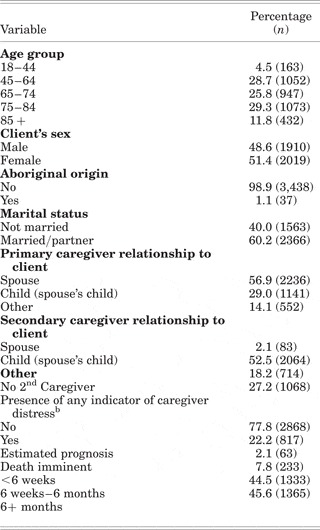
Table 1 summarizes the characteristics of 3,929 clients assessed with the interRAI PC. Although multiple longitudinal follow-up studies were available for a subset of clients, only cross-sectional data were used in the present analyses. Where longitudinal records were available, the first assessment was used. Clients who were reported to have no primary caregiver were excluded from these analyses.
Sample characteristics (N = 3,929a)

a In some cases, total available observations for a given variable are <3,929 because of missing values.
bIndicators of caregiver distress include: helper(s) unable to continue caring activities; primary informal helper expresses feelings of distress, anger, or depression; family or close friends report feeling overwhelmed by person's illness.
The sample was approximately evenly split between males and females, and the average age was 70.0 years of age (SD = 13.6). Approximately 50% of the sample was between 45 to 74 years of age. Approximately 50% of the sample had an expected prognosis of ≥6 months to live, and about 10% were expected to die within 6 weeks of the assessment. The majority of clients (60.2%) was married or had a common-law partner, and the spouse was typically identified as the primary caregiver. Children (or the spouse's children) were the second most common primary caregivers, and they were the most commonly identified secondary caregivers. Approximately 25% of the clients were reported to have no secondary caregiver.
The rate of caregiver distress was determined using the presence of any of the following: caregivers reported they were unable to continue caring activities (e.g., because of decline in their own health); caregivers expressed feelings of distress, anger, or depression; or family or close friends reported feeling overwhelmed by the person's illness. One or more of these indicators were present among the caregivers of 22.2% of the palliative care clients in the present study.
Data Collection
All data for the present analyses were obtained from secondary analyses of de-identified interRAI PC data available to the researchers using scannable forms with personal information removed. The assessments were completed by CCAC case managers using the instrument as part of normal clinical practice on a pilot basis. Assessors used all sources of information available to them including interviews with the client and caregivers, reviews of charts, consultations with other health professionals, and direct observation of the client. Assessors used their professional judgment based on the available evidence using standardized coding guidelines included with the assessment manual. All data were entered on paper forms, which were later scanned by research assistants in order to compile an electronic database. However, because data collection was not computer based, it was not possible to do automated checks for completeness. Therefore, missing values occurred for some of the variables of interest. Variables with excessive rates of missing data were excluded from the analyses. Pair wise deletion of items with missing values was used in bivariate analyses and list wise deletion was used in multivariate analyses.
The interRAI PC is part of a suite of comprehensive assessment instruments designed to serve as a basis for care planning, outcome measurement, quality monitoring, and resource allocation for services aimed at vulnerable populations with complex health needs (Steel et al., Reference Steel, Ljunggren and Topinkova2003; Gray et al., Reference Gray, Berg and Fries2009; Hirdes, Reference Hirdes2006; Hirdes et al., Reference Hirdes, Ljunggren and Morris2008). The interRAI PC has been shown to be have good psychometric properties in two large scale international studies (Steel et al., Reference Steel, Ljunggren and Topinkova2003; Hirdes et al., Reference Hirdes, Ljunggren and Morris2008) and it has been used to study do-not-resuscitate orders (Brink et al., Reference Brink, Smith and Kitson2008) and pressure ulcers (Brink et al., Reference Brink, Smith and Linkewich2006).
Similarly to other interRAI instruments, the interRAI PC includes a series of embedded scales including the Cognitive Performance Scale (CPS), which has been validated against the Mini-Mental Status Examination (Morris et al., Reference Morris, Fries and Mehr1994). The CPS ranges from 0 = cognitively intact to 6 = very severe impairment; multiple activities of daily living (ADL) scales that have been validated against scales such as the Barthel Index (Morris et al., Reference Morris, Fries and Morris1999). The Depression Rating Scale (DRS), which has been validated against the Hamilton and Cornell Scales (Burrows et al., Reference Burrows, Morris and Simon2000). The DRS has values that range from 0 (no depression) to a high score of 14. The Changes in Health, End Stage disease, Signs and Symptoms (CHESS) scale is a measure of medical instability with scores ranging from 0 = no instability to 5 = highly unstable, and it has been shown to be highly predictive of mortality (Hirdes et al., Reference Hirdes, Frijters and Teare2003). The interRAI Pain Scale, which has been validated against the Visual Analogue Scale (Fries et al., Reference Fries, Simon and Morris2001), has scores ranging from 0 = no pain to 3 = daily, horrible/excruciating pain.
Ethics clearance for secondary analyses of interRAI PC data was obtained through the University of Waterloo Office of Research.
Analyses
The data were analyzed using cross-tabulations and the χ2 test for significance at the bivariate level and logistic regression at the multivariate level. The dependent variable was a binary variable based on the presence of one or more indicators of caregiver distress. The independent variables were selected based on reviews of the literature and feedback from palliative care clinicians. Variables that were significant at the bivariate level were considered to be candidates for the multivariate model, and in some cases non-significant variables were also examined as possible predictors in the multivariate analyses if further consideration was warranted based on the available literature. The final model was reduced to include only terms significant at the 0.05 level. Stepwise elimination was not used, because of potential order of entry/deletion effects. Instead, all possible models were examined to deal with potential collinearity among some of the candidate independent variables. The C statistic was reported as an indicator of explanatory power for the final logistic regression model.
RESULTS
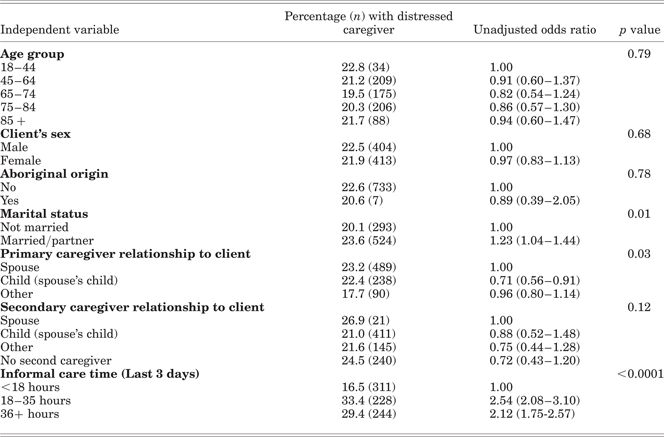
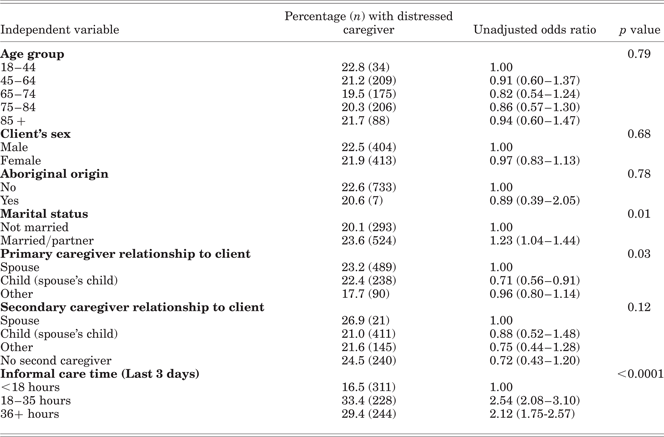
Tables 2–4 provide bivariate results for caregiver distress in relation to client demographic and clinical variables, caregiver variables, and health service use variables. With respect to demographic variables (see Table 2), neither the age nor sex of the client were significantly related to caregiver distress. However, consistent with the published literature, clients who were married had somewhat higher rates of caregiver distress. If the primary caregiver was a spouse or child (or spouse's child) the rates of caregiver distress were also higher than when the caregiver had another type of relationship to the client (e.g., other relative, friend, neighbor); however, the type of relationship with the secondary caregiver was not significantly related to caregiver distress. There was a strong relationship with hours of informal care over the preceding 3 days with higher rates of distress occurring when caregivers provided more hours of support. This was not a direct linear relationship, as the rates of distress were similar for the middle and highest groups.
Bivariate associations of client demographic and caregiver characteristics with rates of any indicator of caregiver distress, Ontario palliative home care clients (N=3,929)
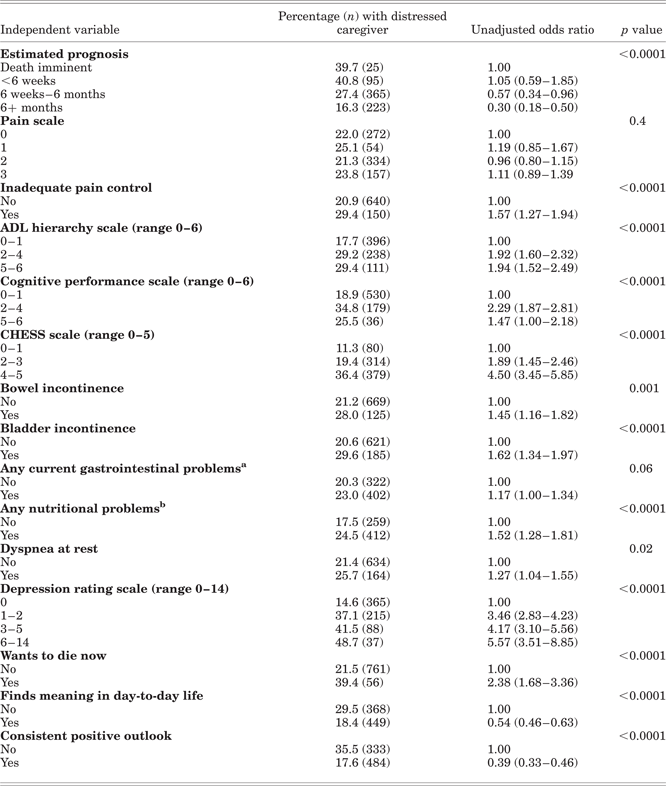
Bivariate associations of clinical indicators with rates of any indicator of caregiver distress, Ontario palliative home care clients (N=3,929)
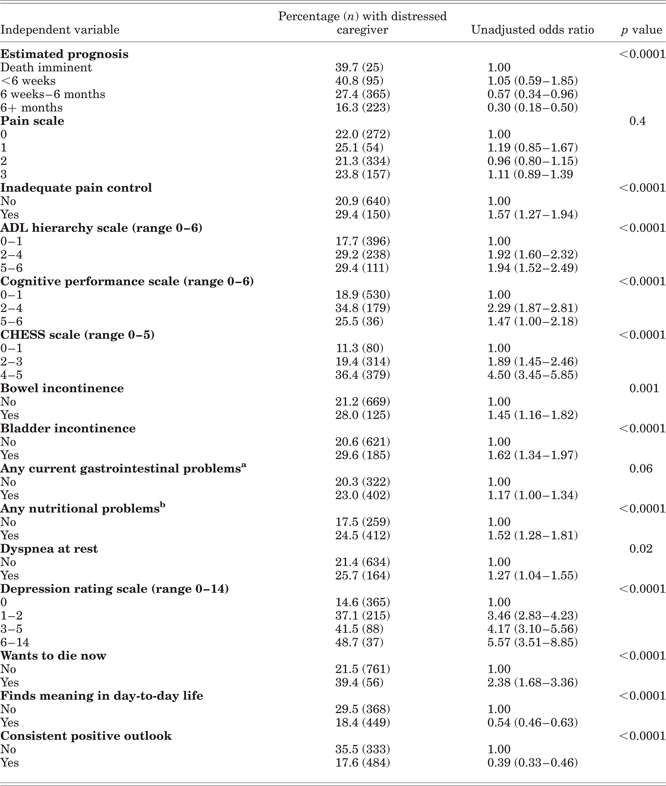
aGI problems considered include acid reflux, bloating, constipation, diarrhea, fecal impaction, nausea, and vomiting.
bNutritional problems considered include weight loss, number of meals eaten, cachexia/wasting, dehydration, fluid intake, and fluid output.
ADL; activities of daily living; CHESS, Changes in Health, End Stage Disease, Signs and Symptoms
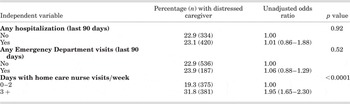
Bivariate associations of selected health service use indicators with rates of any indicator of caregiver distress, Ontario palliative home care clients (N=3,929)

There were very strong bivariate relationships for most of the client's clinical characteristics with caregiver distress (see Table 3). For example, there was a strong increase in rates of caregiver distress among clients with a shorter expected prognosis. Approximately 40% of those caring for clients expected to die within 6 weeks experienced caregiver distress compared with only about 16% of those caring for clients expected to live ≥6 months. Surprisingly, pain was not significantly related to distress among caregivers; however, clients with inadequate pain control had a notable increase in these rates. ADL impairment was clearly related to increased caregiver distress compared with caregivers of clients who were independent in ADLs, but there was no difference for those who had high versus moderate ADL impairment. Moderate cognitive impairment in the client was also associated with increased rates of caregiver distress, but the rates of distress tapered off for the highest levels of cognitive impairment. In contrast, there was a clear linear relationship between increased medical complexity as measured by the CHESS scale and caregiver distress with rates increasing from 11.3% among those with a CHESS score of 0,1 to more than triple the rate of distress (36.4%) among those with a CHESS score of ≥4 (conventionally used cut off point for high levels of medical instability).
Strong relationships with caregiver distress were also evident for bowel and bladder incontinence and the presence of nutritional problems in the client (including weight loss, number of meals eaten, cachexia/wasting, dehydration, fluid intake, and fluid output). More modest positive associations were evident for dyspnea at rest and for current gastrointestinal problems (including acid reflux, bloating, constipation, diarrhea, fecal impaction, nausea, and vomiting).
Table 3 also shows that the psychological well-being of the client is strongly related to rates of caregiver distress. For example, increases in the severity of scores on the DRS were consistently associated with increased rates of caregiver distress. Similarly, caregivers of clients who reported that they want to die now had double the rates of caregiver distress compared with those caring for clients who did not say that. Conversely, caregivers of clients who reported that they find meaning in day to day life and who were rated to have a consistent positive outlook had notably lower rates of caregiver distress.
Table 4 reports the relationship of three health service use variables with caregiver distress. There was not a significant bivariate association with either hospitalization in the last 90 days or emergency department visits. Contrary to what might be expected initially, caregivers of clients who received more home care nursing visits had higher rates of caregiver distress, potentially reflecting a more critical stage of illness.
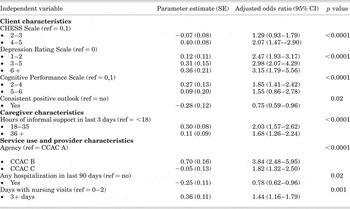
The final multiple logistic regression model for caregiver distress is reported in Table 5. In contrast to reports on caregiver demographics, the age and sex of the client were not significant in the multivariate model. In addition, prognosis, bowel and bladder incontinence, ADL impairment, gastrointestinal and nutritional issues, dyspnea, and inadequate pain control were all no longer significant in the multivariate model.
Final multiple logistic regression model predicting presence of any indicator of caregiver distress among community-based palliative care clients, Ontario

C statistic = 0.75.
CHESS, Changes in Health, End Stage Disease, Signs and Symptoms; CCAC, community care access center.
The three client characteristics with the strongest relationship with caregiver distress were medical complexity as measured by the CHESS scale, depressive symptoms based on the DRS, and impaired cognition based on the CPS. Unexpectedly, the relationship with cognition was somewhat curvilinear given that the adjusted odds ratio for caregiver distress was highest in the middle CPS groups.
There was some evidence of multicollinearity among the three indicators of psychological well-being (wants to die now, finds meaning in day to day life, consistent positive outlook); however, consistent positive outlook had the strongest adjusted odds ratio when retained in this model. As a measure of disposition, it showed that clients with a positive outlook had a significantly lower odds of having distressed caregivers (adjusted OR = 0.75).
The only caregiver characteristic to remain significant in the multivariate model was hours of informal support; higher odds ratios for caregiver distress were associated with higher amounts of informal care. Marital status was not significant in the multivariate model; however, it is strongly associated with hours of informal care and with having a primary caregiver who was a spouse.
Among the health service variables, any hospitalization in the last 90 days was significantly associated with lower odds of caregiver distress even though it was not significant at the bivariate level. Consistent with the bivariate results, receiving more days of nursing visits was associated with higher odds of caregiver distress. There were also some notable agency differences; compared with the arbitrarily chosen reference CCAC, both of the other CCACs had a greater odds of caregiver distress after controlling for the client and caregiver variables included in the multivariate model. For example, the adjusted odds ratio of CCAC B was 3.84, indicating an almost 4 times greater odds of distress than for the reference CCAC.
The value of C was 0.75, which indicates that the multivariate model was strongly predictive of caregiver distress.
DISCUSSION
Caregiver distress may be an important threat to the viability of continued support for palliative care clients receiving home-based care. Although it is probably unlikely that family members will simply abandon dying relatives because they are distressed, it is reasonable to assume that their informal care may become less effective, they may have reduced capacity to provide the volume of support needed by the client, they may become vulnerable to mental and physical health problems themselves, they may experience conflict or other relationship difficulties with the client, or they may feel disconnected from the outside world if they become overwhelmed. These negative feelings may persist well after the death of the client.
For these reasons, it is critical to identify caregiver distress when it occurs and to take preventive action to reduce its likelihood of occurring among palliative home care clients. The present study shows that client characteristics are the strongest predictors of distress among caregivers, but not all clinical variables hold equal importance. Medical instability and cognitive impairment persisted in the multivariate models, whereas ADL impairment and continence were no longer significant. This may mean that some, but not all, symptoms or impairments at the end of life may be difficult for caregivers to manage. In addition, given that these measures are readily available in the interRAI PC instrument, interventions aimed at preventing caregiver distress may be more effective when targeted at clients who exhibit these clinical characteristics.
The present study also highlights the inter-relationships of depression among clients with distress among caregivers. There is probably a bidirectional association in which the psychological well-being of one member of the dyad affects the well-being of the other. Therefore, interventions aimed at improving psychological well-being should consider both the client and the caregiver as a focus for intervention.
Consistent with the literature on caregiver burden (e.g., Hirst, Reference Hirst2005), those caregivers providing more informal support had higher odds of distress after adjusting for other variables in the multivariate model. Formal services should therefore be used to offset some of the burden of care for individuals providing substantial amounts of informal care each day.
With respect to agency characteristics, the findings for both hospitalization and nursing visits were somewhat unexpected and were potentially the result of the cross-sectional nature of the data. For example, nursing services are likely to be directed to those clients with higher levels of need and higher levels of caregiver distress. The problem of “confounding by indication” may explain this finding, which is probably better addressed with longitudinal data.
It is interesting to note there were clear agency differences after controlling for other client and caregiver risk factors. This raises the possibility that caregiver distress rates could be used, with risk adjustment, as a basis for benchmarking the quality of community-based palliative care services at the regional level.
There are some important limitations to the present study. First, the interRAI PC does not include some caregiver variables (e.g., sex and age of the caregiver) that have been shown to be important risk factors in the survey literature. . For example, it has been reported that older caregivers report lower perceived health, increased prescription drug use, and higher prevalence of emotional and mental issues, in comparison with their younger counterparts (Vitaliano et al., Reference Vitaliano, Zhang and Scanlan2003). However, although these variables may be of general interest to researchers, it is not clear that they are clinically necessary measures if one aims to appraise whether necessary support is available to the person. Second, the cross-sectional nature of the data limits the ability to make inferences about temporal order for some of the associations noted here. Hence, it is not possible to rule out reverse causality in the caregiver distress and home care nursing relationship.
Nonetheless, the present results suggest that the interRAI PC may be a useful clinical tool for identifying and responding to caregiver distress in palliative care. The instrument includes a series of embedded care planning protocols, called Clinical Assessment Protocols or CAPs (Fries et al., Reference Fries, Morris and Bernabei2007), which identify issues that require interventions to prevent decline or support improvement in the status of the assessed person. Among the CAPs in development for the interRAI PC are protocols related to depression, cognition, and, mainly, the health symptoms noted here. The present findings also point to the potential benefits of developing an interRAI PC CAP that specifically addresses the issue of caregiver distress.
ACKNOWLEDGMENTS
Financial support for this research was provided by the Change Foundation and by the Ontario Ministry of Health and Long Term Care. The authors are grateful for helpful comments by Justine Toscan and assistance from Krista Papkie.