Introduction
Dialectical behaviour therapy for adolescents (DBT-A) was initially developed for suicidal adolescents with chronic emotional dysregulation, self-harm and suicidal behaviours (Rathus & Miller, Reference Rathus and Miller2002; Miller et al. Reference Miller, Rathus and Linehan2007). DBT-A is an adaptation of DBT (Linehan Reference Linehan1993), which is efficacious in treating adults with severe emotion dysregulation, self-harm and suicidal behaviours (Linehan et al. Reference Linehan, Comtois, Murray, Brown, Gallop, Heard, Korslund, Tutek, Reynolds and Lindenboim2006; McMain et al. Reference McMain, Links, Gnam, Guimond, Cardish, Korman and Streiner2009). DBT-A has a growing evidence base with positive outcomes reported in controlled trials for emotionally dysregulated adolescents who self-harm and/or have suicidal ideation (Mehlum et al. Reference Mehlum, Tørmoen, Ramberg, Haga, Diep, Laberg, Larsson, Stanley, Miller, Sund and Grøholt2014; McCauley et al. Reference McCauley, Berk, Asarnow, Adrian, Cohen, Korslund, Avina, Hughes, Harned, Gallop and Linehan2018), and effectiveness studies in outpatient and community settings (Rathus & Miller, Reference Rathus and Miller2002; James et al. Reference James, Taylor, Winmill and Alfoadari2008; Woodberry & Popenoe, Reference Woodberry and Popenoe2008; Fleischhaker et al. Reference Fleischhaker, Bohme, Sixt, Bruck, Schneider and Schulz2011).
While positive outcomes have been reported for adolescents who participate in DBT-A, little research has been conducted on the potential benefits of the programme for parents who attend DBT-A with their child. Only one study has examined parental outcomes in DBT-A where the construct of depression was examined (Woodberry & Popenoe, Reference Woodberry and Popenoe2008). Although reductions in mean scores were reported at post-intervention, depression scores were not within the clinical range for the majority of participants at baseline. These findings suggest that depression may not be a relevant construct for exploration with this group.
Relevant constructs for examination in parents participating in DBT-A may be informed by research conducted on the impact of a young person’s self-harm on their parents. Although research in this area is somewhat limited, published studies report that self-harm by young people can be a distressing and traumatic experience for parents and can result in a ‘ripple effect’ on other family members (Raphael et al. Reference Raphael, Clarke and Kumar2006; Byrne et al. Reference Byrne, Morgan, Fitzpatrick, Boylan, Crowley, Gahan, Howley, Staunton and Guerin2008; Morgan et al. Reference Morgan, Rickard, Noone, Boylan, Carthy, Crowley, Butler, Guerin and Fitzpatrick2013). Parents of young people who self-harm face significant practical and emotional challenges where they report low levels of well-being, parenting satisfaction, social support and poor family communication (Morgan et al. Reference Morgan, Rickard, Noone, Boylan, Carthy, Crowley, Butler, Guerin and Fitzpatrick2013). Fear of repeated incidents and overall worry associated with caring for their loved one have been associated with high levels of burden, grief and psychological stress for parents (Raphael et al. Reference Raphael, Clarke and Kumar2006; McDonald et al. Reference McDonald, O’Brien and Jackson2007; Byrne et al. Reference Byrne, Morgan, Fitzpatrick, Boylan, Crowley, Gahan, Howley, Staunton and Guerin2008; Oldershaw et al. Reference Oldershaw, Richards, Simic and Schmidt2008; Ferrey et al. Reference Ferrey, Hughes, Simkin, Locock, Stewart, Kapur, Gunnell and Hawton2016). Similar findings have been reported for family members of suicidal individuals (McLaughlin et al. Reference McLaughlin, McGowan, O’Neill and Kernohan2014). These feelings can also result in significant difficulties in family communication and parent–child relationships (McDonald et al. Reference McDonald, O’Brien and Jackson2007; Byrne et al. Reference Byrne, Morgan, Fitzpatrick, Boylan, Crowley, Gahan, Howley, Staunton and Guerin2008; Oldershaw et al. Reference Oldershaw, Richards, Simic and Schmidt2008).
Studies of family members of adults with borderline personality disorder (BPD) highlight challenges that mirror these findings. Although not typically diagnosed in adolescents, hallmark features of BPD such as self-harm emerge and are evident in adolescence (Fonagy et al. Reference Fonagy, Speranza, Luyten, Kaess, Hessels and Bohus2015). Burden and grief have been reported to be significantly higher for carers of individuals with personality disorders than those with other serious mental illnesses (Bailey & Grenyer, Reference Bailey and Grenyer2014). Burden has also been found to have the largest impact on the emotional health of parents of females with BPD (Goodman et al. Reference Goodman, Patil, Triebwasser, Hoffman, Weinstein and New2011). DBT-informed programmes such as Family ConnectionsTM have been found to reduce burden and grief in family members of adults with BPD (Hoffman et al. Reference Hoffman, Fruzzetti, Buteau, Neiditch, Penney, Bruce, Hellman and Struening2005; Flynn et al. Reference Flynn, Kells, Joyce, Corcoran, Herley, Suarez, Cotter, Hurley, Weihrauch and Groeger2017). It is reasonable to suggest that the skills delivered in DBT-A may result in similar benefits for parents in terms of reduced burden, grief and stress.
In Ireland, the National DBT Project was established in 2013 to coordinate DBT training in the Irish public health service (Flynn et al. Reference Flynn, Kells, Joyce and Swales2018a). Two cohorts of eight teams in both adult and child/adolescent mental health services were trained in DBT over a 2-year period. The implementation and evaluation of DBT-A in child and adolescent mental health services (CAMHS) was examined as part of this project, and positive outcomes were reported for adolescent participants (Flynn et al. Reference Flynn, Kells, Joyce, Corcoran, Gillespie, Suarez, Swales and Arensman2019). As part of the multi-family group component of DBT-A, parent/guardians attend the weekly skills group with their adolescent child. The inclusion of parents in the skills group, in addition to the module that specifically addresses adolescent-family dilemmas, may help with some of the difficulties reported by parents of adolescents who self-harm. With this in mind, this study evaluates the skills group component of DBT-A for parent/guardians. It is hypothesised that participation in DBT-A will result in improved outcomes for parents in terms of reduced burden, grief and stress. The current study also aims to explore parents’ experiences of the programme by identifying helpful aspects of the programme and areas for improvement.
Methods
Study design and setting
This study applied a mixed methods approach where quantitative and qualitative data were collected from participants. The quantitative and qualitative components of the study were linked to a larger quasi-experimental study, the National Dialectical Behaviour Therapy Project Ireland (NDBTPI). Further information about the study design and main outcomes of the 16-week DBT-A programme have been reported elsewhere (Flynn et al. Reference Flynn, Kells, Joyce, Suarez and Gillespie2018b, Reference Flynn, Kells, Joyce, Corcoran, Gillespie, Suarez, Swales and Arensman2019). The setting for this study was community-based CAMHS in the national public health system in Ireland. A detailed overview of this health system structure can be found in Flynn et al. Reference Flynn, Kells, Joyce and Swales2018a.
Sample and recruitment
As part of the NDBTPI, seven teams in CAMHS across Ireland were trained in and implemented DBT-A in their respective services. Full details on the training and recruitment of therapists can be found elsewhere (Flynn et al. Reference Flynn, Kells, Joyce, Suarez and Gillespie2018b). Parent/guardians who attended the skills group component of the 16-week DBT-A programmes delivered by these seven teams during the period February 2014 to July 2015 were recruited for study participation. All teams who trained in DBT via the NDBTPI were requested to inform the researchers of the start date of their programme. A group data collection was scheduled to take place at each site during the first skills training session. DBT therapists were provided with participant information leaflets for distribution to potential participants in advance of the group data collection. When the researcher attended for data collection, participants also had an opportunity to ask questions about the research study prior to consenting to participate in the study.
Intervention
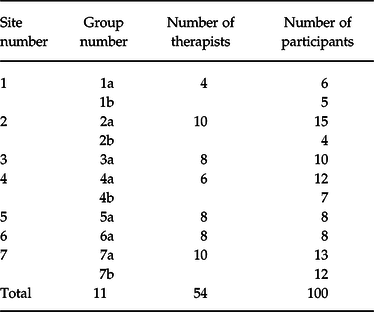
A total of 11 DBT-A programmes were delivered by the seven CAMHS DBT teams between February 2014 and July 2015. Table 1 provides an overview of the number of programmes, therapists and participants at each of the seven study sites. Teams delivered the 16-week DBT-A programme as outlined in Miller et al. (Reference Miller, Rathus and Linehan2007). Participants attended the weekly skills groups with their child. The skills groups were divided into four modules: (1) Distress Tolerance, (2) Emotion Regulation, (3) Walking the Middle Path, and (4) Interpersonal Effectiveness. While it is recommended that one parent attends skills group training for the duration of the programme (Miller et al. Reference Miller, Rathus and Linehan2007), some teams facilitated both parents attending the skills group with their child.
Overview of programmes, therapists and participants by site

Teams and therapists
Seven CAMHS teams consisting of 54 clinicians completed DBT training between December 2013 and May 2015 with a licensed training provider of Intensive TrainingTM (see Flynn et al. Reference Flynn, Kells, Joyce, Corcoran, Gillespie, Suarez, Swales and Arensman2019 for comprehensive details about team composition). All teams were allocated a total of 36 hours supervision each per year by internationally accredited model-adherent DBT therapists in Europe and the United States. While there were no formal ratings of adherence, all supervisors were qualified to make adherence ratings and were able to provide feedback to teams to shape increasing adherence to the treatment.
The data reported in this study are from the first (and where applicable, the second) delivery of the DBT-A programmes delivered by the seven teams following intensive training. Therefore, all therapists were novice.
Measures
Four outcome measures were included in the current study: the Burden Assessment Scale (BAS) (Reinhard et al. Reference Reinhard, Gubman, Horwitz and Minsky1994) assesses burden in family members of those with mental health difficulties. The BAS consists of 19 items which are rated on a scale of 1 (Not at all) to 4 (A lot), with higher scores indicating greater feelings of burden. The BAS can also be divided into two subscales measuring objective burden (10 items) and subjective burden (9 items). Objective burden refers to any potential observable behavioural effects of caregiving including financial problems, limitations on personal activity, household disruptions and social interactions. Subjective burden refers to the feelings, attitudes and emotions expressed by the participant in terms of the care-giving experience (Reinhard et al. Reference Reinhard, Gubman, Horwitz and Minsky1994). The BAS has demonstrated good psychometric properties (Reinhard et al. Reference Reinhard, Gubman, Horwitz and Minsky1994). In the current study, the internal reliability for the BAS was 0.92 at baseline.
The Grief Assessment Scale (GAS) (Struening et al. Reference Struening, Stueve, Vine, Kreisman, Link and Herman1995) is a 15-item assessment of current feelings of grief for caregivers of people with serious mental health illness. Items are rated on a scale of 1 (Always True) to 5 (Never True). All items are reverse scored with higher scores on the GAS indicate higher levels of grief. The internal reliability of the GAS in the current study was 0.93.
The Parental Stress Scale (PSS) (Berry & Jones, Reference Berry and Jones1995) is an 18-item assessment designed to measure levels of stress as a result of being a parent. Each item is based on the relationship between the parent and their child or children and examines feelings and perceptions about the experience of being a parent. Items are rated on a scale of 1 (Strongly disagree) to 5 (Strongly agree). Higher scores indicate greater levels of perceived parental stress. The internal reliability of the PSS in the current study was 0.89.
Finally, the Participant Satisfaction Questionnaire (PSQ) was developed by the National DBT Project research team in order to investigate the perceived benefits of the DBT-A programme for parent/guardians, with items rated on a scale of 1 (Poor/Not at all) to 4 (Excellent/Very Much). The PSQ also includes a section where participants can provide qualitative written feedback about the programme. The internal reliability for the PSQ was 0.90.
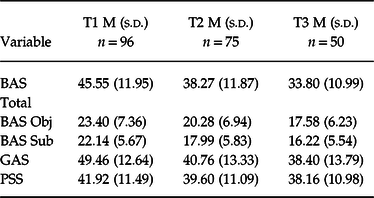
The means and standard deviation of each self-report outcome measure at each time-point are detailed in Table 2.
Outcome measure means (M) and standard deviations (s.d.) at each study time-point

Procedures
Data were collected from participants at 16-week time intervals: baseline (T1), post-intervention (T2) and 16-week follow-up (T3). Members of the National DBT Project research team visited each of the study sites at each time-point and administered the self-report measures to participants. A DBT therapist was present at each site during data collection should emotional distress occur as a result of completing the measures.
Data analysis
Quantitative self-report outcomes measuring burden, grief and parental stress were summarised by their mean and standard deviation. Multi-level linear mixed-effects regression models were used to estimate the mean at baseline (T1) and the mean change from baseline to each follow-up (T2 and T3) for each of these measures. Mixed-effects models use all available data at each time-point rather than the data from individuals assessed at all times. Therefore, in the case where there may be missing data for a participant at a given time-point, data collected from the participant at other time-points can still be included in the analyses. A random intercept was also used in the models for individual participants and for the participating sites. These intercepts adjust for random heterogeneity in each outcome measure between subjects and between study sites. As participant numbers at some study sites were small, the inclusion of this intercept adjusts for potential heterogeneity across sites at baseline.
Data from the quantitative section of the PSQ were analysed using descriptive statistics. Qualitative written feedback from the PSQ was analysed using a conventional approach to content analysis of which the aim is to describe a phenomenon (Hsieh & Shannon, Reference Hsieh and Shannon2005). The first step of the analysis process was to become fully immersed in the data through reading and re-reading. This was followed by the generation of codes using exact words from the data to capture key concepts. The next step involved the labelling of codes that were reflective of more than one key thought. Finally, codes were then sorted into categories based on how they were related. Content analysis was carried out independently by two of the authors (CG and MJ). Coding discrepancies were reconciled through discussion with a third author (DF). Data were analysed using Stata Statistical Software, Release 13; StataCorp LP, USA and IBM SPSS Statistics for Windows, Version 23.0; IBM Corp, USA.
Results
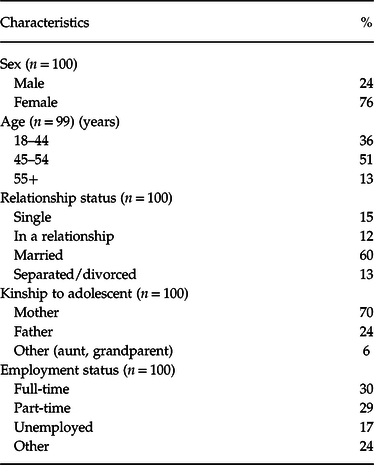
One hundred parent/guardians participated in this study. The 100 parent/guardians represented 84 adolescents who participated in 16-week DBT-A programmes across the seven study sites (see Flynn et al. Reference Flynn, Kells, Joyce, Corcoran, Gillespie, Suarez, Swales and Arensman2019 for corresponding adolescent outcomes). Fourteen adolescents had both parents attend the skills group and an additional two parents participated in the study although their child did not consent to their own research participation. The majority of participants were female (76%), mothers (70%), married (60%), in full-time employment (30%) and aged between 45 and 54 years (51%) (Table 3).
Socio-demographic characteristics of parents

Seventeen parent/guardians discontinued attendance at the skills group as a result of their child dropping out of the programme (4-miss rule or commitment difficulties). Of the 83 participants who completed the programme, complete data were available for 75 participants at the end of the intervention and for 50 participants at the 16-week follow-up. This resulted in a 9.6% and 39.8% attrition rate at post-intervention and follow-up, respectively.
Quantitative findings
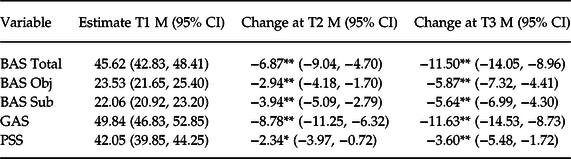
Based on the data presented in Table 2, there was evidence of decreases in total burden, objective burden, subjective burden, grief and stress from pre- to post-intervention and at follow-up. This was confirmed by the linear mixed-effects models as detailed in Table 4.
Outcome measure estimated baseline means (M) and changes at subsequent time-points

*p < 0.01, **p < 0.001.
Linear mixed-effects models indicated significant changes from T1 to T2 on all outcome measures. Significant reductions were reported for total burden, objective burden, subjective burden and grief (p < .001). A significant reduction in parental stress was also noted (p < 0.01).
When comparing T1 to T3, significant reductions were reported on all measures (p < 0.001). Further reductions in scores from T2 to T3 were statistically significant for total burden, objective burden and subjective burden only (p < 0.05).
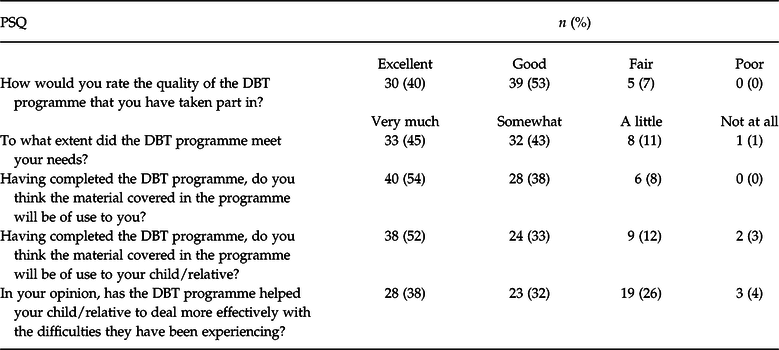
Participants completed the PSQ at the end of programme. The PSQ investigated the perceived benefits of different aspects of the programme for participants with items rated on a scale of 1 (Poor/Not at all) to 4 (Excellent/Very Much). Data were available for 75 of 83 participants who completed the programme. The number and percentage of responses to each of the five questions listed in the PSQ is presented in Table 5.
Participant responses (number and percentage) for PSQ items

The majority of participants (93%) rated the quality of the DBT-A programme as either ‘Excellent’ or ‘Good’. Just under half of participants (45%) reported that the programme was ‘very much’ effective in meeting their needs, while 43% reported that it was ‘somewhat’ effective. Over half of participants (54%) felt that the material covered in the programme would be very much useful for them, while 52% felt that it would be very useful for their child. The majority of participants (70%) felt the DBT programme ‘very much’ or ‘somewhat’ helped their child to deal more effectively with the difficulties they were experiencing.
Qualitative findings
Participants were also invited to provide qualitative feedback regarding helpful or unhelpful aspects of the programme and any other general comments they would like to provide about the programme. Firstly, content analysis identified three aspects of the programme that participants found most helpful: ‘Mindfulness’, ‘Meeting Others in Similar Situations’ and ‘Skill Development’. Mindfulness was the most commonly endorsed helpful element identified by parents (n = 29). Participants highlighted how mindfulness can be useful for dealing with stressful situations, while also giving themselves ‘permission to take time out for myself and stop focussing on problems’. Mindfulness was not only deemed useful ‘if things are not going well with my child but also if something was not going well at work’. Therefore, the skills were applied not only to stressful situations with their child, but also stressful life circumstances generally. One participant spoke of how mindfulness fostered feelings of empowerment:
[Mindfulness empowered me] as a parent to recognise the need to do this [mindfulness] myself and also when it is appropriate to guide/encourage my relative to do this [mindfulness] also
The second most endorsed facet of the programme was the acquisition of new skills (n = 27). Participants found that the skills they learned helpful in practical aspects of their lives, such as approaching situations differently and resolving conflict. One participant described the skills as a ‘tool box for parent and child’. Another participant felt ‘learning new skills on how to deal with certain issues has been a major plus in our family’, while also allowing for a ‘strengthening of my relationship with my daughter’ because of improvements in effective communication:
It gave an understanding of mental illness and how best to react (as a parent) to problems when they arise. Prior to DBT, I was always unsure what to say or do to help my daughter when she needs someone to turn to.
The third most frequently occurring theme regarding helpful aspects of the programme was being able to meet others in a similar situation (n = 22). Attending the skills groups with others who may have been suffering or experiencing similar feelings showed participants that they were not alone and they were able to support and learn from each other. As one participant noted:
The group sessions gave us time to hear other peoples’ experiences and opinions regarding the programme. It was important to me as a parent to know I wasn’t alone and neither was my child.
Another participant noted:
It was good to be part of a group. That for me was a sense of security. It is very easy to feel isolated and alone when you are dealing with an upset teenager
Participants also described the aspects of the programme that they did not find helpful. Twelve participants felt that there should have been separate groups for the adolescents and the parents. Some parents had envisaged that the adolescents would be separated at ‘certain times but this did not happen…which confused our [daughter and parent] perception of how the course would be delivered’. Some participants reported that separate sessions with just parents would have been useful, especially to ‘talk about real issues for me as a parent’ as ‘it felt like we were not getting to the core issues of behavioural difficulties’.
The second most common suggestion was in relation to the volume of material/length of the programme, and how the programme could be extended to facilitate full coverage of the material in more detail (n = 11). Some participants suggested that the programme could be extended or content shortened as there were many concepts/skills. Others felt that some sessions were not needed, while more time could be ‘put into other parts of the course’. Furthermore, some participants felt that the homework was not ‘explained properly’. Additionally, given that the course needed to be ‘taught mostly’ ‘because of the volume of information’, some participants felt this lack of interaction ‘occasionally boring’. One participant noted that:
Role playing, acting out situations in pairs was more effective than too much [time] listening to therapists talking. Some is necessary, but I prefer absolute minimum teacher talking time.
Discussion
The results of this study suggest that the skills group component of DBT-A may be beneficial for parent/guardians who are experiencing a child’s emotional and behavioural dysregulation. The skills group component of DBT-A was associated with a reduction in burden, grief and stress for participants who attended the programme with their child. These changes were observed from pre- to post-intervention and were maintained or further improved at the 16-week follow-up. These results mirror the positive gains reported for adolescents who participated in all modes of treatment across the seven study sites (Flynn et al. Reference Flynn, Kells, Joyce, Corcoran, Gillespie, Suarez, Swales and Arensman2019).
Previous research has highlighted the emotional challenges for parents whose adolescent child is engaging in self-harm, which may lead to increased levels of burden, grief and stress (Byrne et al. Reference Byrne, Morgan, Fitzpatrick, Boylan, Crowley, Gahan, Howley, Staunton and Guerin2008; Ferrey et al. Reference Ferrey, Hughes, Simkin, Locock, Stewart, Kapur, Gunnell and Hawton2016). It is therefore crucial to be cognisant of the potential adverse mental and physical health implications for parents experiencing a child’s self-harm (Byrne et al. Reference Byrne, Morgan, Fitzpatrick, Boylan, Crowley, Gahan, Howley, Staunton and Guerin2008; Arbuthnott & Lewis, Reference Arbuthnott and Lewis2015; Ferrey et al. Reference Ferrey, Hughes, Simkin, Locock, Stewart, Kapur, Gunnell and Hawton2016). Previous research has highlighted the benefits of such inputs in supporting family members of adults with emotion dysregulation. The reciprocal nature of family interactions results in positive gains for the relationship, where improvements on one member of the family can have a ripple effect on the wider system (Fruzzetti et al. Reference Fruzzetti, Shenk and Hoffman2005). This suggests that early intervention with families who experience emotional and behavioural dysregulation may lead to better long-term outcomes for both the young person and the family system. The PSQ provided participants with an opportunity to provide feedback on any aspect of their experience of the DBT-A skills group training. The results of the analyses highlighted that participants primarily had suggestions about how to enhance the utility of the DBT-A programme to better meet the needs of parent/guardians and adolescents. Firstly, although valuing the multi-family group skills, participants suggested the inclusion of an additional separate forum for parents where they can openly reflect on their experiences without concerns about the impact of their disclosures on their child. Such a forum could be similar to Family ConnectionsTM for families of adults with BPD. If a separate forum for parents were to be provided, the central focus of the intervention would then be on the parent and the development of skills use specifically for parents to help themselves. A separate forum would also provide a space for parental peer support. This would be a separate entity from participation in DBT-A which in the main, focuses on improved outcomes for the adolescent as the primary client. The development of new skills and meeting others were identified as two of the most helpful aspects of the programme by participants in the current study, both of which are key features of the Family ConnectionsTM programme. Future research could explore the added value of developing and offering additional group sessions specifically for parents.
The main limitation of this study was the lack of a control group which was not included due to a lack of resources. Future research would benefit from exploring the impact of this intervention in comparison to other evidence-based interventions, treatment-as-usual, or a wait list control for parents of adolescents with emotional and behavioural dysregulation. In addition, further research could be considered where parent outcomes from DBT-A are compared with outcomes for those who complete DBT-A with the addition of a separate forum focused on the parents’ development of coping skills and opportunities for peer support.
While the rate of attrition in this study was low from pre- to post-intervention (9.6%), attrition at follow-up was higher (39.8%). The reduction in participant numbers over the course of the study may result in difficulties interpreting the data. It is possible that participants with more positive experiences of the intervention are more likely to complete measures at follow-up. Analyses of data between participants who had completed datasets versus those who did not identified no differences in baseline scores on any of the measures, however. Future research might seek to obtain higher retention rates at follow-up to improve data reliability.
Another potential area for future research with parents who participate in DBT-A could be the exploration of skill acquisition. Research on DBT informed programmes such as Family ConnectionsTM has reported improvements in mastery in terms of skills acquisition for family members of emotionally dysregulated adults (Hoffman et al. Reference Hoffman, Fruzzetti, Buteau, Neiditch, Penney, Bruce, Hellman and Struening2005; Flynn et al. Reference Flynn, Kells, Joyce, Corcoran, Herley, Suarez, Cotter, Hurley, Weihrauch and Groeger2017). The development of new skills was identified by parents in this study as being one of the most helpful aspects of the programme. It is possible that skill acquisition during the intervention may also in part account for the continued reduction in scores on outcome measures at follow-up. Future research on parents participating in DBT-A could measure the change in skills used over time by including measures such as the DBT Ways of Coping Checklist (Neacsiu et al. Reference Neacsiu, Rizvi, Vitaliano, Lynch and Linehan2010) which has been specifically developed to measure DBT skill acquisition.
In conclusion, the current study highlights the potential benefits that DBT skills training may have for parent/guardians who participate in DBT-A with their child. Given the absence of a control group, however, the results must be interpreted with caution and further research is warranted in this area. Future studies will help determine how to best measure change for parents, what constructs warrant exploration, and how to optimise interventions for parents of young people with emotional and behavioural dysregulation.
Acknowledgements
We would like to thank the DBT therapists at each of the seven study sites for facilitating and contributing to this study. We also wish to thank the young people and parent/guardians who participated in the DBT-A programmes at the seven sites for contributing data to this study. We also acknowledge Dr Paul Corcoran for his expert guidance and direction regarding the statistical analysis conducted for this study.
Conflict of interest
Daniel Flynn has no conflicts of interest to disclose. Conall Gillespie has no conflicts of interest to disclose. Mary Joyce has no conflicts of interest to disclose. Ailbhe Spillane has no conflicts of interest to disclose.
Ethical standards
The authors assert that all procedures contributing to this work comply with the ethical standards of the relevant national and institutional committee on human experimentation with the Helsinki Declaration of 1975, as revised in 2008. The authors assert that ethical approval for carrying out this study has been provided by the local Ethics Committees of each participating site. Written informed consent was sought from the parent/guardians and adolescents who took part in this research.
Financial support
This work was supported by the National Office for Suicide Prevention in the Health Service Executive.